Tag: Gov Hochul

  • Governor Hochul Signs Legislation to Assess Asian American, Native Hawaiian, and Pacific Islander History Education and Establish Advisory Committee to Support AANHPI Content in Schools

    Governor Hochul Signs Legislation to Assess Asian American, Native Hawaiian, and Pacific Islander History Education and Establish Advisory Committee to Support AANHPI Content in Schools

    ALBANY, NY (TIP): Governor Kathy Hochul signed Legislation S7855E/A8463-E which assesses teaching on Asian American, Native Hawaiian, and Pacific Islander (AANHPI) history in social studies curricula in New York and establishes an advisory committee on the future of AANHPI content in schools. By signing this bill, the Governor demonstrates her commitment to ensuring all New York students receive a quality education, which includes the integration of historical content covering the AANHPI community.

    “AANHPI history is New York history, and our classrooms should reflect that fact,” Governor Hochul said. “I am proud to sign legislation affirming our commitment to AANHPI New Yorkers that their story is not just part of, but essential to New York students’ education. This law ensures that students across the state will have the tools to understand and appreciate the impact of these communities on our nation.”

    Today’s bill signing is part of Governor Hochul’s broader effort to strengthen inclusive history education – supporting African American, Indigenous, Holocaust, and AANHPI history so New York students receive a more complete and accurate understanding of the state and nation’s past.

    Research and advocacy efforts find that teaching comprehensive cultural history encourages empathy, reduces bias, and strengthens community belonging for all students and promotes cross-cultural understanding, helping students from diverse backgrounds appreciate the rich contributions of all ethnic groups to American history.

    Representative Grace Meng said, “I’m thrilled to see this crucial measure become law. Thank you to Governor Hochul for signing the bill and thank you to Senator Liu and Assemblymember Lee for introducing it. In Congress, I have pushed legislation to promote the teaching of AANHPI history in schools across the United States. For generations, AANHPI history has been poorly represented in our education system and social studies textbooks, and it is way past time for that to change. It is critical for our next generation to understand that AANHPI history IS American history. It IS New York history.”

    State Senator Shelley B. Mayer said, “I am grateful that Governor Kathy Hochul has signed legislation to direct a statewide survey on how Asian American, Native Hawaiian, and Pacific Islander history is taught in our schools and to establish a dedicated advisory committee to guide this important work. Education is one of our most powerful tools to fight ignorance, discrimination, and hate and this law is a meaningful step to building an education system that is inclusive and accurately reflects all communities. I want to thank my colleagues Senator John Liu and Assembly Member Grace Lee for their leadership in sponsoring this legislation, and Governor Hochul for signing it into law.”

    State Senator John Liu said, “In signing the AANHPI Education Equity Act into law, New York is now one step closer to a statewide AANHPI curriculum that would at long last truly validate the lived experiences of Asian Americans in New York. This survey bill is not the endgame, but an important step in that direction by measuring how AANHPI history is currently taught in classrooms, and how it is not. Gaining this understanding will help shape our curriculum in the future so we can make sure the education of all students throughout the state accurately reflects the diverse communities that have shaped it.”

    Assemblymember Grace Lee said, “The AANHPI Education Equity Act is about telling the complete American story. For generations, Asian Americans have helped build this country, yet our histories have too often been left out of our classrooms. This law affirms that our stories matter, that our children belong, and that an inclusive education strengthens our community. I’m grateful to the community advocates for their work on this effort, to Senator John Liu for his partnership and to Governor Hochul for championing an inclusive education that affirms belonging for all students.”

    New York City Council Member Linda Lee said, “More than 1.2 million New Yorkers of AANHPI descent call New York City home, and we have made, and will continue to make, vital contributions to the fabric of our city, state, and country. As one of the first Korean Americans to serve on the City Council, I am proud to see AANHPI studies included in the curriculum of our schools to foster a more inclusive and enriching educational environment. Thank you to Governor Hochul for signing this legislation for AANHPI New Yorkers.”

    New York City Council Member Sandra Ung said, “It is essential that New York classrooms reflect the full story of our communities and acknowledge the contributions of the AANHPI community. This legislation is an important step toward that goal by assessing how these histories are currently taught and establishing a committee to support their inclusion. I applaud Governor Hochul for signing this bill and thank Senator Liu and Assemblymember Lee for their leadership.”

  • Cell phone ban at NYC public schools goes into effect on September 4, the first day of classes

    Cell phone ban at NYC public schools goes into effect on September 4, the first day of classes

    NEW YORK (TIP): The first day of classes for 900,000 New York City students on Thursday, September 4,  meant a statewide ban on cell phones in schools is officially in effect. Gov. Hochul signed the law last spring prohibiting the devices from the morning until the final bell, with limited exceptions. The new policy is part of a larger effort to promote better attention in the classroom and more socializing in the cafeteria and hallways.

    “We’re doing this because we want to make sure that you can keep learning and in a distraction-free environment,” Hochul told students at Middle School 582, The Magnet School for Multimedia, Technology and Urban Planning, in East Williamsburg, Brooklyn. “We’re doing it all over the state, and you’re among the very first.”

    In New York City, about half of public schools banned phones this year, joining hundreds of schools that already had restrictions in place. While there are some guidelines that all city schools must follow, such as exemptions for students with disabilities or caregivers for younger siblings, it’s up to principals to come up with a plan to separate kids from their devices.

    Among the most popular methods: Give students pouches that snap shut at the start of the school day, then unlock with a magnet at dismissal. Or collect phones when teens get to the building or younger kids get to their first class, and give them back at the end of the school day.

    About 820 schools have purchased pouches, 600 are using drop-boxes or storage bins, and 550 are collecting phones in the classroom, according to the New York City Department of Education, which recently surveyed principals. The rules also apply to other electronic devices, such as smartwatches and AirPods.

    When it came time to put the phones away, the reception was mixed — with some parents and students finding creative ways to get around the ban.

    “I give her another phone to put in the pouch — arrest me,” said a mom of an eighth-grade student at MS 582, who was granted anonymity to speak freely. “I know her, she will not be on her phone. She’s actually a straight-A student, thank God. The governor can come and ask me, but I don’t care. Arrest me! She has a phone.”

    “I’m totally against it. Because, like, God forbid anything happens, especially with all the shootings going around, I feel like it’s just dangerous,” the mom continued.

    Unable to contact her daughter, Brooklyn Technical High School mom Rena Singh waited two hours to pick her up from school and show her the interborough route home to Queens. While a frustrating experience, Singh said she understood that the ban would help her child focus in the classroom and make friends at her new school.

    “I don’t know what’s gonna happen this year,” Singh said. “I think she will get used to it, and she’ll be able to focus more on her studies.”

    But unlike the magnetic pouches from the company Yondr at MS 582, Brooklyn Tech is using small bags with a velcro closure kept in backpacks that while a disincentive for students to grab their phones, does not guarantee their disuse.

    “The way we’re using these pouches, we can access them anyways,” said Rachel Zeng, a senior, calling that a “good thing” in case of an emergency. But with deans enforcing the policy and some students having their phones taken away, she noticed fewer of her classmates reaching for their devices during the school day.

    At a back-to-school press conference at HBCU Early College Prep in Jamaica, Queens, Mayor Adams said there are emergency procedures in place, locks on school front doors and student drills on what to do in a crisis.

    “We’re going to do our job to keep our children safe, but let’s not confuse this — Mommy did not text me during an emergency. She called the school,” Adams said. “And so, we will survive without cell phones in our schools. It is hurting our children.”

    Overall, the policy remains widely popular among adults — and, for some teens, at least not too much of a nuisance.

    “For me, if the phone ban wasn’t a thing, I would just keep it in my bag,” Taylin, a ninth-grader at HBCU Prep, said after the event. “Or if anyone needed to reach out to me, I would answer, put it back in my bag. … I wouldn’t just be on the phone the whole school day.”

    About 61% of New York voters support a cell phone ban in schools, according to an April poll from Siena College Research Institute. The restrictions were passed with bipartisan support in the state Legislature and the backing of both the state and city teachers unions.

    For the first day of the ban, Schools Chancellor Melissa Aviles-Ramos held an early afternoon meeting with principals citywide and deployed borough safety directors and local district staff to schools. She also planned to hold more meetings with administrators by grade level, as well as form a teacher advisory council and focus groups, including students. But the chancellor insisted schools were ready for the challenge.

    “It is a shift, but we will be OK,” Aviles-Ramos said at the press conference with the mayor. “This is not new to New York City. It is new to some schools.”

    New York is one of 17 states, plus the District of Columbia, that are implementing new phone restrictions this year, for a total of 35 states with such a law on the books. The education reform has seen a rapid uptake since Florida became the first state to do so in 2023.

    “I’m fortunate, when I went to school in this city, it was before the peak of social media,” mayoral Democratic nominee Zohran Mamdani said at press conference outside Intermediate School 5, The Walter Crowley Intermediate School, in Elmhurst, Queens, with the United Federation of Teachers. “Because to be young in this moment is to feel a relentless amount of pressure.”

    A state assemblyman, Mamdani is part of the New York Legislature that voted to implement the ban as part of its most recent state budget. IS 5 purchased Yondr pouches in spring 2024. Entering their second full school year with the policy in place, teachers say it’s been a boon for students and staffers alike.

    “We have a very successful cell phone ban in place,” said Nicole Keaster, an English teacher at IS 5, in Queens, which purchased Yondr pouches in spring 2024. “We’re really proud of it. There was a clear plan, there was follow-through.”

    “I know there might be some bumps, but if you stay the course, it really does work,” said Keaster, who’s also the UFT chapter leader at her school. “Everybody, just give it a little bit of time.”

    David Banks, the former city schools chancellor who pushed for a citywide school phone ban last year before Adams put the kibosh on his plans, took to social media to lament it did not happen sooner.

    “The mayor at the time wasn’t prepared to do it, but thank goodness that the governor has leaned in with a level of leadership to make this happen,” Banks said in a video posted on Instagram. “This is a huge deal.”

    (Source: New York Daily News)


  • New York Governor Hochul signs legislation to help with state nursing shortage

    New York Governor Hochul signs legislation to help with state nursing shortage

    New York is projected to face a shortage of almost 40,000 nurses by the year 2030

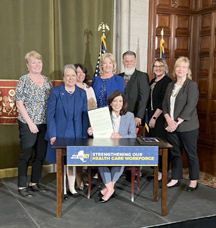
    ALBANY, NY (TIP): Gov. Kathy Hochul signed legislation on Monday, May 15 to strengthen New York’s health care workforce. The legislation will help address the state’s nursing shortage, and allow nursing programs to provide up to one third of a student’s clinical work in a high-tech simulation environment. This comes as the 2024 budget includes $967 million for the Wadsworth Laboratories in Albany. New York is projected to face a shortage of almost 40,000 nurses by the year 2030, Hochul said.