Tag: Gujarat

  • Beyond Gulbarg Massacre

    Beyond Gulbarg Massacre

    Lumpens’ patrons remain unrebuked

    Fourteen years after a Hindu mob felt emboldened enough to set afire an entire Muslim neighborhood, called Gulbarg Society, in Ahmedabad, some kind of justice has been promised by a court. Reports suggest that at least 24 persons stand convicted and will be punished. Among the victims of the mob’s murderous fury was Ehsan Jafri, a former member of Parliament. Against heavy odds and with remarkable fortitude and courage, his widow, Zakia Jafri, persisted all these years in seeking punishment for those who were responsible for the mayhem and murder. Her dogged fight tested the Indian judicial system and its commitment to ensure that the lawful order would not be allowed to be trifled with, whatever be the provocation and whosoever be the perpetrator. Her fight became a cause célèbre for every law-abiding citizen. The Thursday verdict would be a very small consolation to the victims but it could go some way towards restoring the primacy of the law.

    The court has rejected the argument that the massacre was the result of a conspiracy. For three days many areas in Ahmedabad and other parts of Gujarat were hosting their murderous dramas. Mob violence has its own laws of momentum. This is what had happened during the recent Jat agitation in Haryana.

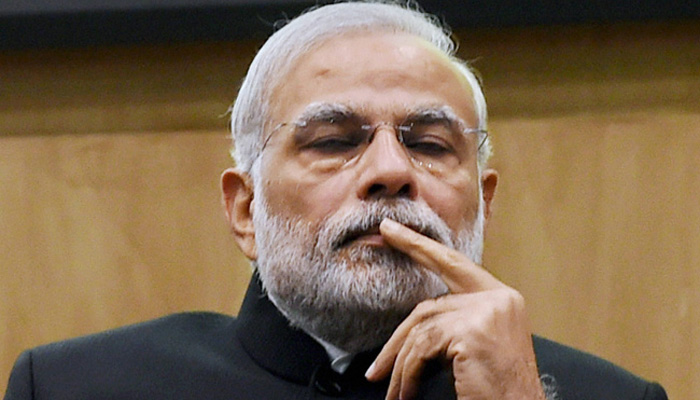
    If at all there was a conspiracy, it can only be located in the politically-driven decision to let the mobs rule the streets. And, the armed lumpens were indeed allowed to roam the streets of Ahmedabad, unchecked, unchallenged and unrestrained, as they zeroed in on the hapless minority community. The Gujarat government, then headed by @NarendraModi, simply failed to perform its rajdharma to provide safety and security of life to all citizens, irrespective of caste, creed or religion. The then Union Home Minister, L.K. Advani, a self-styled later day avatar of Sardar Patel, could never demand — leave alone, enforce — accountability from the state government in Gandhinagar for its failure to live up to its constitutional responsibilities. Neither Nitish Kumar nor Mamata Banerjee nor Omar Abdullah felt sufficiently agitated to walk out of the Vajpayee Cabinet. Even Atal Bihari Vajpayee allowed calculations of party interests to override his own conscience. The Gulbarg massacre and other horrible tales of horrible violence were used to create a new politics of intimidation and polarization.

  • Gujarat Sthapana Divas Celebrated at the Indian Consulate

    Gujarat Sthapana Divas Celebrated at the Indian Consulate

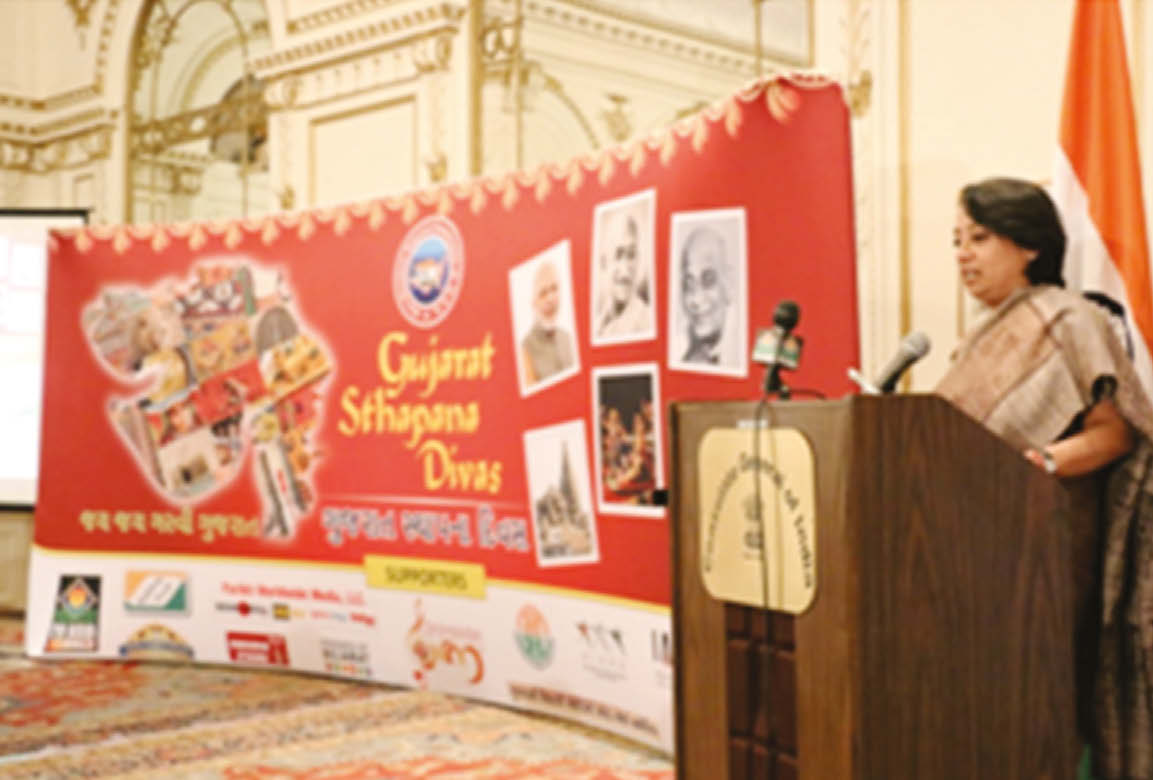
    Obviously delighted to see a packed room with Gujrati community members, Consul General of India in New York, Ambassador Riva Ganguly Das said, “You are the first State to celebrate Sthapana Divas at the Consulate” and added “Somebody suggested that India is a large country with so many States and each State should celebrate its day in the Consulate. I said the idea was good and readily agreed”. Incidentally, the suggestion was given by The Indian Panorama Chief Editor Prof. Indrajit S Saluja.

    Congratulating the gathered Gujrati community members the Ambassador highlighted rich heritage of Gujarat and listed the strengths of theState andthe Gujratis. She said Gujrat was full of places of tourist interest and she was looking forward to visiting some, some day.

    Some NYPD officers who had been helpful in organizing the Gujarat and Maharashtra Sthapana Divas a day earlier at the Times Square were honored on the occasion. The gathering was addressed by a few Gujrati community leaders which included TV Asia chairman H.R. Shah.

    NYPD officers honored at the event with the Consul General
    NYPD officers honored at the event with the Consul General
  • The New York Indian Film Festival announces full lineup for the 16th Annual Film Festival May 7 – May 14

    The New York Indian Film Festival announces full lineup for the 16th Annual Film Festival May 7 – May 14

    NEW YORK CITY, NY (TIP): The New York Indian Film Festival (NYIFF) announced the full lineup last night for their 16th year of celebrating independent, art house, alternate, and diaspora films from/about/connected to the Indian subcontinent (May 7 – May 14). Dedicated to bringing these films to a New York audience, the festival will feature 40 screenings (35 narrative, 5 documentary) -all seen for the first time in New York City. In addition, the festival will also feature five programs of short films.

    The festival highlights various cinemas of India’s different regions. All the films are subtitled in English and some of the languages this year include Hindi, Bengali, Marathi, Tamil, Kannada, Malayalam, Telegu, Assamese, Haryanavi and Urdu. This year’s festival will feature a couple of sidebars –NFDC restored first films of filmmakers and a three-generations sidebar, films of Bimal Roy, Basu Bhattacharya and Aditya Bhattacharya.

    The festival’s film lineup includes 2016 National Award winners A FAR AFTERNOON, BIRDS WITH LARGE WINGS and THE RIVER OF FABLES (KOTHANODI). THE RIVER OF FABLES is an Assamese language feature film written and directed by Bhaskar Hazarika and stars Seema Biswas and Adil Hussain. The story of the film is based on folktales from Assam, India.

    “We are thrilled to be able to share these films with the New York audience,” states Aseem Chhabra, NYIFF festival director. “Three of the feature films are National Award winners. And out of the nearly 40 shorts we are showing this year, there are two National Award winners: FAMOUS IN AHMEDABAD and DAARVATHA.”

    Straight from the Sundance Film Festival, BRAHMAN NAMAN is a true Indian teenage comedy. It is funny, touching and will be universal in its appeal. It is about the exhilaration and confusion of being 17 – the pleasure of being in a gang, breaking the rules, acting big, falling in love – coming of age.

    From the Tamil films, CRIME IN PUNISHMENT is the latest film from NYIFF alum and 2015 NYIFF award winner M. Manikandan. FOR THE LOVE OF A MAN is a documentary film that explores the popularity of the Tamil Superstar Rajinikanth.

    GOOD OL’ BOY is the feel-good, coming-of-age story of Smith, a 10-year-old boy from India growing up in Small Town, America in 1979. This Diaspora film features actors Samrat Chakrabarti (Midnight’s Children, The Waiting City) and Poorna Jagannathan (Delhi Belly, Nirbhaya).

    Bengali master, Soumitra Chatterjee starrer PEACE HAVEN is the story of three septuagenarian friends who embark on a journey to build their very own mortuary.

    Multiple award winner and fresh from the international film festival circuit PARCHED is a story about women set in the heart of parched rural landscape of Gujarat, India. It traces the bittersweet tale of four ordinary women Rani, Lajjo, Bijli and Janaki. We see them unapologetically talk about men, sex and life as they struggle with their individual boundaries to face their demons and stage their own personal wars.

    WORLD PREMIERE of KAGAZ KI KASHTI (PAPERBOAT)

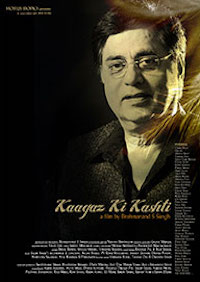
    In an era when Bollywood music ruled the Indian households and when Ghazal as a genre was limited to only the connoisseurs, Jagjit Singh made Ghazals a necessity of every music lover’s collection. KAAGAZ KI KASHTI traces the life journey of a down-to-earth, small-town boy, who made it big by breaking through the norms and the Ghazal scenario, by texturing traditional Ghazal singing with western instrumentation and making it simple and hummable, enticing new listeners into becoming Ghazal fans.

    “The 2016 festival features a wide array of films from all over the South Asian diaspora,” states IAAC founder Aroon Shivdasani. This year our films reflect the reality of India, dealing both with LGBT issues that have surfaced in the supreme court and on the streets, as well as strong feminist films dealing with female infanticide, child marriage, domestic abuse, trafficking and several other key issues that affect women in a world that still leans towards chauvinism.”

  • Mayor of Burr Ridge Mickey Straub to host Akshaya Patra Chicago Gala

    Mayor of Burr Ridge Mickey Straub to host Akshaya Patra Chicago Gala

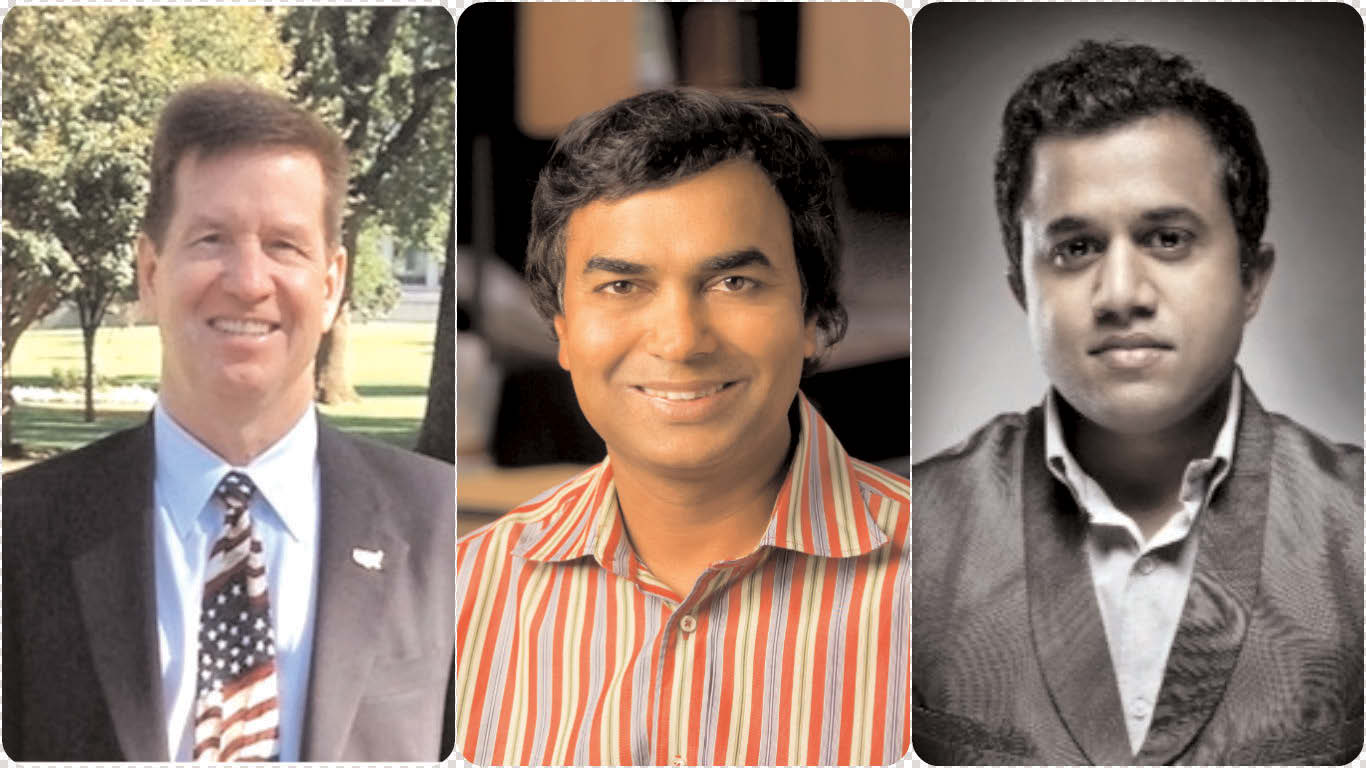
    CHICAGO, IL (TIP): The Akshaya Patra Foundation will be holding its 2016 Chicago Benefit Event on Saturday, May 7th. The Mayor of the Village of Burr Ridge, Mickey Straub, will be the honorary host of the event. The event’s Host Committee will also be led by Mafat Patel of Patel Brothers.

    Gopi Kallayil, Google’s Chief Evangelist for Brand Marketing will serve as the event’s keynote speaker. Comedian and actor Omi Vaidya will serve as the event’s Master of Ceremonies. The event will be held at the Meadows Club in Rolling Meadows, Illinois, and will begin with a welcome reception at 6:30 PM.

    Mickey Straub was elected Mayor of Burr Ridge, a suburb of Chicago, in 2013. Nicknamed “Mayor Mickey,” he is a husband, parent, speaker, and is active in his township and church. He is the author of a newly released BIG GOALS…Short Deadlines, an inspirational book with a patriotic and spiritual message. Mickey Straub is also the founder and president of Sales Activity Management, Inc., a faith-based company providing custom business management tools and services nationwide. In 2012, Mickey became the only person in history to take a patriotic pilgrimage in honor of Lincoln and our veterans to 50 capitols in 50 days.

    The event’s Host Committee is composed of prominent leaders of the Chicago community: Mayor Mickey Straub, Mafat Patel of Patel Brothers, Himanshu Patel, Ila Vyas, Saroj Patel, Sunil Kumar, Mohanbir Sawhney, Dipak Kapadia, Dr. Bharat Barai, Dr. Umang Patel, Harish Bhatt, Alok Gaur, Midwest Molding Inc., Cheena Chandra, Prashant Sheth, Vandana Walia, Dr. Romi Chopra, Ketki Parikh, Bhailal Patel, Ram Prashantha, Chhotalal Patel, Kanti S. Patel of the Gujarat Culture Samaj, Moti Agarwal of the Millennium Bank, Suketu Amin, Nilesh Naren Patel of MedStar, Kantilal Patel of New York Life, Kishan Patel of New York Life, Ram Barat, Babu Amin, Natubhai Bajee Patel, Madan Meadows Club, and Share with Love. Over 400 other business, non-profit, government, and philanthropic leaders from around the region are expected to attend and support the organization’s dual mission of addressing childhood hunger and malnutrition, and to promote education for underserved children in India.

    As Google’s Chief Evangelist for Brand Marketing, Gopi Kallayil connects corporate clients to their customer base using Google and Google social applications. In his time with Google, Mr. Kallayil has also been responsible for Google +, AdWords, and AdSense. Prior to joining Google, Gopi Kallayil was on the management team of two Silicon Valley venture startups. He also worked on information technology and business performance projects for global corporations in India, China, and the United States as a consultant with McKinsey & Co.

    Omi Vaidya is one of the few actors and filmmakers working in Hollywood and Bollywood. A graduate of NYU’s Film School, Omi started as a video editor on independent films and went on to direct short films that have won awards at film festivals worldwide. Omi’s work in front of the camera includes memorable characters on American TV shows like The Office, Arrested Development, Bones, Growing up Fischer, and The Comeback. In Bollywood, Omi made his major debut in Aamir Khan’s film, Three Idiots, which became the biggest Indian box office success of all time.

    Established in 2000, Akshaya Patra began by serving 1,500 in 5 schools in Bangalore. Today Akshaya Patra is the largest NGO-run school meal programs in the world and serves over 1.5 million children daily in over 11,501 schools through 24 kitchens in ten states in India. This March, Akshaya Patra will celebrate its 15th Anniversary and the serving of its 2 billionth meal to children in India.

    Akshaya Patra has received international recognition for its life-changing mission. In 2016, Akshaya Patra’s Founder Madhu Pandit Dasa received the Padma Shri Award, India’s fourth highest civilian award, for his work with Akshaya Patra. Shridhar Venkat, CEO of Akshaya Patra India, was recognized as being among the 50 Most Impactful Social Innovators in the world. Akshaya Patra was recently awarded the Nikkei Asia Prize, an award established to recognize an organization’s outstanding achievements that contribute to the region’s sustainable development.

    year’s Chicago Gala event will feature an evening of networking, entertainment, and dinner. Individuals interested in purchasing tickets and sponsoring the event, can contact Manisha C Gandhi, Director of Development, at 832-876-2142.

    To Register:
    www.foodforeducation.org/chicago

    For more Information: www.foodforeducation.org

    To register: Manisha C Gandhi,
    832-876-2142 | Piyali Dutta, 781-462-8454

    (Photographs and Press release courtesy Asian Media USA)

  • Gujarat Terror Alert: Hunt For 10 Suspected Terrorists Continues; NSG Commandos Rushed To State

    Gujarat Terror Alert: Hunt For 10 Suspected Terrorists Continues; NSG Commandos Rushed To State

    New Delhi: A security alert has been sounded in Gujarat and all metro cities by Central agencies following reports that 10 terrorists suspected to be from Pakistan have entered the western state to carry out attacks against high-value targets. Two NSG teams comprising nearly 200 personnel were rushed to Ahmedabad from Delhi.

    The national capital has also been put on high alert and security has been beefed up at vital installations, important buildings, malls, hospitals, schools and colleges and crowded places in Delhi.

    GujaratSources in the Delhi police said the input specifically mentions that 10 militants of Lashkar-e-Tayyaba (LeT) and Jaish-e-Mohammed (JeM) have entered India via Gujarat and that they could carry out a terror strike in Delhi.

    According to media reports, Pakistan’s NSA has informed that these are fidayeen from the Lashkar-e-Taiba and Jaish-e-Muhammed cadres, who are planning for major terror strikes across the state during the festival.

    Reports added that, following Doval’s communication to Gujarat, The state director general of police P C Thakur convened an emergency meeting on the issue and alerts were sounded off in all major cities and districts.

    Security has been stepped up at sensitive installations, places of worship and public places across the state.

    The DGP has also issued a notification cancelling leaves of all police officers and personnel till further directives.

    The Gir-Somnath district authorities in Gujarat have postponed Monday’s cultural event at Somnath Temple owing to the terror threat. “A massive security operation has been launched and raids are being conducted by a police team, led by the South Kutch superintendent of police in the coastal areas,” sources said.


  • PM HITS BACK AT RAHUL USING QUOTES BY NEHRU, INDIRA AND RAJIV

    PM HITS BACK AT RAHUL USING QUOTES BY NEHRU, INDIRA AND RAJIV

    NEW DELHI (TIP): Prime Minister Narendra Modi on March 4 reached out to the opposition, saying he needs their support for “improvement” in his government, even as he attacked the Congress over disruptions in Parliament while skipping the raging issues like JNU and Dalit student’s suicide. Speaking in the Lok Sabha, Modi used wit and barbs as he responded to the attack by Congress over various initiatives of his government, including ‘Make in India’ and MNREGA.

    Slamming the Congress for disrupting Parliament and stalling bills, he said the main opposition party was doing so because of “inferiority complex” of its top leaders. He also invoked the statements made by Jawaharlal Nehru, Indira Gandhi, Rajiv Gandhi and first President Rajendra Prasad by reading out their statements against stalling of legislative business.

    He deplored the ‘tu tu, mai mai’ (blame game) attitude by political parties for “scoring points”, saying the officialdom rejoices over this and nation suffers. “This government also needs improvement which cannot happen without your help. I am new, you are experienced. I need the benefit of your experience.

    Governments will come and go.

    Let us work shoulder to shoulder,” Modi said while replying to a debate on Motion of Thanks to the President’s address which was approved later.

    He said a democratic country like India cannot be left at the mercy of the bureaucracy as he sought to underline the importance of the legislature, saying even a single MP of any party should be treated like “Prime Minister”. In his 75-minute speech, Modi, however, did not respond to the specific issues raised by Rahul Gandhi and other opposition leaders, like his visit to Pakistan, blackmoney, JNU and Dalit student Rohith Vemula’s suicide.

    Without naming Rahul Gandhi, the Prime Minister appeared to be responding to his Wednesday’s remark that he should listen to others. “It is easy to preach others … There are some people to whom all kinds of questions are asked. But there are some others, to whom nobody dares to ask questions,” he said. “I have been questioned, I have faced criticism and accusations over last 14 years. I have learnt to live with it,” said Modi, apparently referring to the attacks on him in the aftermath of Gujarat riots of 2002. While hitting out at Rahul for criticising his government, he sarcastically recalled how the Congress vice-president had torn at a press conference an Ordinance approved by the Cabinet headed by Manmohan Singh and including veterans like AK Antony, Sharad Pawar and Farooq Abdullah.

    He also took on Rahul for mocking at the government’s ambitious ‘Make in India’ programme, questioning whether such a scheme should be made fun of. “You are mocking at ‘Make in India’? If it is not successful, you should suggest what should be done to make it successful,” he said.

    Referring to disruptions in Parliament due to which several bills, including the crucial GST legislation is stuck, Modi said “House is not allowed to function due to inferiority complex (of the opposition leadership).”

    While elaborating, he appeared to suggest that top Congress leadership was not allowing “young” and “bright” leaders to emerge fearing that they may overshadow Rahul.

    “In the opposition there are bright and talented youngsters who don’t get a chance to speak…They do a lot of study … The concern is that if they speak, they will be praised. Then what will happen to us,” Modi said. While talking of disruptions in Parliament, the Prime Minister again appeared to take a swipe at Congress, saying the opposition’s attitude was to “demonstrate its strength” even though its “strength may be less”.

    Congress has only 45 members in the 545-member Lok Sabha.

    Invoking Rajiv Gandhi over disruptions, Modi read out a statement made by the former Prime Minister in which he had expressed “pain” over stalling of Parliament and said that while it hurts the government, it equally hurts the members of the opposition who want to raise issues of their concern.

    He said because of the will of Speaker Sumitra Mahajan, some bills were passed in Lok Sabha but those could not move ahead, suggesting that they got stuck in Rajya Sabha. Identifying some of these legislations, he said the Whistleblowers Protection Amendment bill is meant for enlightening the citizens and “I see no reason why it is stopped.”

    Source: PTI

  • JNU Row: When dissent becomes sedition?

    JNU Row: When dissent becomes sedition?

    What is the issue at Jawaharlal Nehru University (JNU) in New Delhi? A radical left-wing student group as vocal and abusive as RSS/Parivar organized a function to discuss the ‘judicial murder of’ of Afzal Guru as they see it. The JNUSU President Kanhaiya Kumar was not at the function and had nothing to do with it.Yet he was arrested and charged with Sedition under the Indian Penal Code 124A. His speech to the students did not contain any anti-national sentiment, but rather only an affirmation of his faith in the constitution.

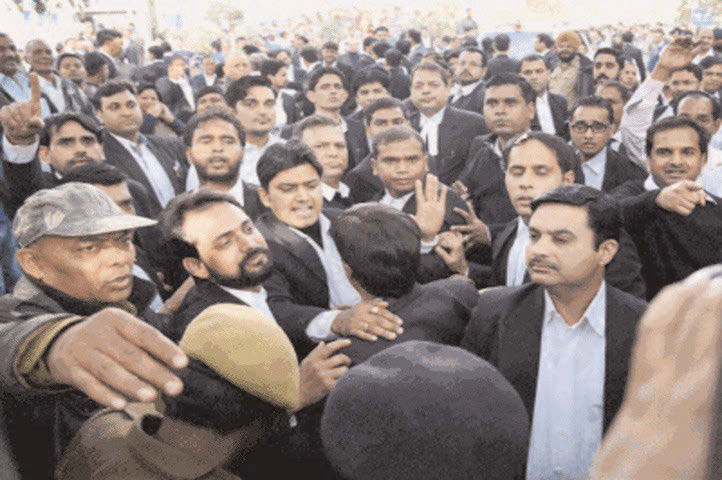
    A group of irate lawyers at Patiala House Court. Their violent conduct is a matter of investigation
    A group of irate lawyers at Patiala House Court. Their violent conduct is a matter of investigation

    This is the latest in a series of incidents where the Modi Government has determined to stifle dissent, shutting down debates, and muzzling the freedom of expression in the country, all in the name of nationalism. It is happening on the heels of the suicide death of RohithVemula, who was ostracized by right-wing elements for demanding his rights to be heard.

    ‘Sedition’ is a colonial era rule that was used to suppress the voice of the Indian people, who were demanding freedom and dignity from the British Empire. Today, the BJP government is using the same old arcane law – which should not have any place in a 21st-century democracy – to target individuals and institutions that are perceived to be non-conformist. Although the Indian law of sedition is different from the British law, law enforcement agencies have always used it against artists, public men and intellectuals for criticizing the Government.

    In the case of Kedarnath Singh vs State of Bihar (1962), a five-judge bench of the Supreme Court ruled that a charge of sedition would only apply if there were “an incitement to violence or public disorder”.There is no evidence to indicate that Kanhaiya Kumar raised slogans in favor of Pakistan, and against India.However, the heavy-handedness of the authorities on the campus and the speed in which the sedition charges were slapped on him clearly indicate that the government will not tolerate any dissent.

    JNU has long been a target of right-wing Hindu activists, who see the Institution as a laboratory of liberal and democratic thought process. It has been crucial in producing some of the finest minds in India who have become great proponents of freedom and liberty. It should be noted that while Prime Minister NarendraModiwas the Chief Minister of Gujarat, he branded JNU as a laboratory for secularists, which needed to be shut down.

    There is a certain pattern in how the HRD ministry, headed by Smithi Irani is dealing with institutions of higher learning. There was a growing acrimony with the students in FTII Pune, on the appointment of RSS ideologues to positions of power. Then, Ambedkar Periyar Study circle in IIT Madras was de-recognized. Then came the tragic suicide of Rohith Vemula, who was suspended after the complaints made by ABVP leaders to the HRD Ministry.

    Any independent observer can view a common pattern that is the ABVP, the student wing of BJP, has become a tool in the hands of the HRD ministry to advance the saffron agenda of the RSS across campuses, and around the country. Whenever they complain about political rivals, the ministry swoops in and takes actions on their behalf against the students who advocate academic freedom without any interference from the ruling class.

    University campuses ought to be a place where young minds can freely express their views, formulate their opinions, and create a forum where competing ideas and ideologies can germinate. A campus without vibrant intellectual discourse will fail in cultivating creative minds that are essential in coping with the challenges of globalizations and pressures of modernity.

    The effort to penalize parties who are critical of the Government or some of its regressive policies as ‘anti-national’ is an advancing of an agenda that mirrors fascism. The German historian Arthur Rosenberg, in his book, Fascism and Mass movement, refers to two conditions as prefiguring the rise of fascism: the rise of right-wing nationalism and an active connivance between the state and storm troopers. Let us hope that what we have witnessed in University of Hyderabad and JNU are not early indications of such an evolution.

    G. Sampath in a recent column described how according to the nationalist taxonomy of the SanghParivar, Adivasis in central India, Dalit students, Left Intellectuals, Human Rights activists, a certain Religious Minority, anti-nuclear activists, beef eaters, non-haters of Pakistan, inter-religious couples, homosexuals and labor activists are  all anti-nationals. He further stated that if what happened at the Patiala House in New Delhi is taken into account, journalists and anyone dressed like JNU students could also be lumped together in that category.

    What is more anti-national than justifying the murder of Mahatma Gandhi, the father of the nation or erecting a statue of NathuramGodse who had assassinated him? The Governmental hypocrisy was quite evident when Swami Omji from Hindu Mahasabha said the following “We killed Mahatma Gandhi. In the future, we will try to convince anti-nationals like Kejriwal. If he doesn’t listen, we will shoot him and kill him”. Doesn’t his statement constitute inciting violence or public disorder? Why then is the Government not responding to a charge of ‘sedition’ in these cases?

    Under Modi’s tenure in Gujarat, journalists were targeted for sedition charges as well as harassment and denial of entry into the State Assembly. In 2006, Modi’s administration brought sedition charges against the Gujarati-language daily editor, ManojShinde, for his criticism of Modi’s mishandling of a flood. Sedition and treason charges were also brought against Times of India editor, Bharat Desai and crime reporter PrashantDayal along with photographer Gautam Mehta at Gujarat Samachar due to an investigative series on crime questioning high-ranking police officers.

    If these developments continue unabated, it will constitute a growing threat to India’s democracy, a pluralistic framework which was preserved for the last six decades, under the successive Congress-led governments. According to PratapBanuMehta of Center for Policy research, ‘we are living under a government that is using nationalism to crush constitutional patriotism, legal tyranny to crush dissent, political power to settle petty scores and administrative power to destroy institutions”.

    Addressing the Editors Guild of India, the Nobel Laureate AmartyaSen recently said the following: “we should not tolerate the intolerance that undermines our democracy that impoverishes the lives of many Indians, and facilitates a culture of impunity of tormentors”. I hope the nation is listening!


    George Abraham
    George Abraham


    (The author is a former Chief Technology Officer of the United Nations. He can be reached at gta777@gmail.com)

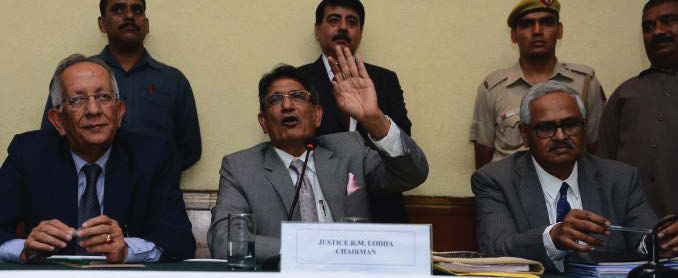
  • SUPREME COURT TO BCCI: CARRY OUT ALL LODHA COMMITTEE RECOMMENDATIONS

    SUPREME COURT TO BCCI: CARRY OUT ALL LODHA COMMITTEE RECOMMENDATIONS

    NEW DELHI (TIP): The Supreme Court of India on Feb. 4 suggested to the Board of Control for Cricket in India that it accept all the recommendations of the Justice Lodha Committee relating to structural reforms in the governing body, says an IANS report.

    The apex court bench of Justice T.S. Thakur and Justice Fakkir Mohamed Ibrahim Kalifulla told BCCI that the Justice Lodha Committee has given a “very viable rational solutions. You take a realistic view of the matter and act according to the recommendations.”

    Impressing upon senior counsel Shekhar Naphade, appearing for BCCI, the significance of the report, the court said: “The report deserves respect as it is given by the most competent and well-meaning members of the legal fraternity.”

    “It may affect some people who are holding positions but any transition has to have its problems,” the court said as Naphade sought to project the difficulties that the apex cricketing body was encountering with the recommendations of the Lodha Committee.

    “It involves sweeping changes. We are not taking an obstructionist view. There are technical and legal problems. The legal committee (of BCCI) will take a call on the recommendations, which in turn will be considered by the Board and take a final decision,” Naphade told the court pointing out that BCCI was registered as a society in Tamil Nadu and had to go by its by-laws.

    Not missing on apparent reservations on the part of BCCI in going along with the recommendations of the Lodha Committee, the court made it clear that it would not appreciate any suitable assessment of the same (recommendations) by the cricketing body.

    “We will say that we accept the recommendations and ask the Justice Lodha Committee to push forward its (recommendations) for its implementation… help and steer them (BCCI) in the implementation of the recommendations and also monitor it,” Chief Justice Thakur said.

    Thakur also made it clear that there could not be any “ifs and buts” in going along with the recommendations for structural reforms in BCCI.

    Senior counsel Indu Malhotra, appearing for Cricket Association of Bihar, read out the summary of the recommendations by the Justice Lodha Committee and told the court that some states including Bihar and six north-eastern states Manipur, Nagaland, Arunachal Pradesh, and Mizoram have no representation in the apex cricketing body.

    On the other hand, Maharashtra and Gujarat have multiple votes, Indu Malhotra told the court.

    Naphade cited historical reasons to justify multiple representation of Maharashtra and Gujarat in BCCI.

    The apex court appointed Justice R.M. Lodha Committee have made a host of far-reaching recommendations for improvement of cricket administration in the country including limiting the term for BCCI office bearers with a cooling off period and separate governing bodies for BCCI and the Indian Premier League.

    It had also recommended bringing BCCI under the Right to Information Act, legalization of betting, uniformity in structure of state associations, and a one-state-one-member (vote) pattern for BCCI’s governing body.

    The matter would come up for further hearing on March 3.

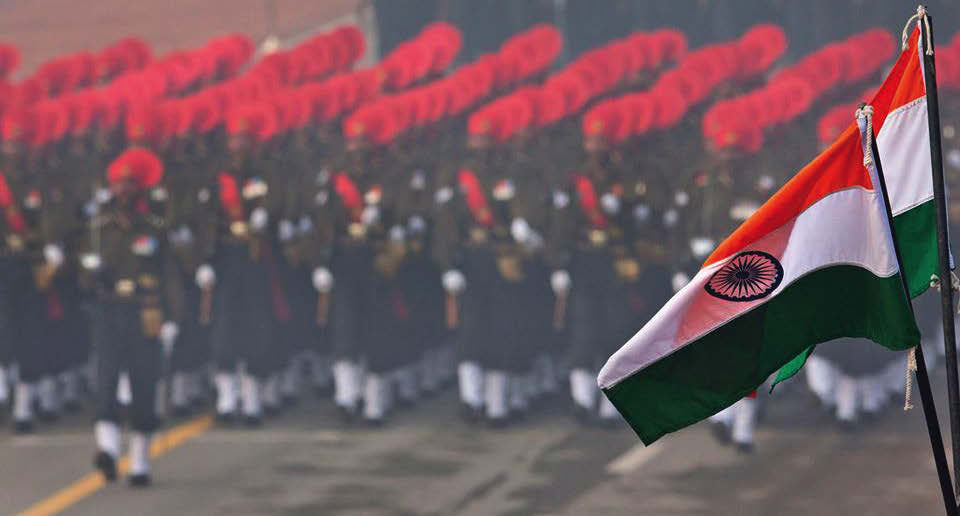
  • AMID TIGHT SECURITY, INDIAN STATES CELEBRATE REPUBLIC DAY

    AMID TIGHT SECURITY, INDIAN STATES CELEBRATE REPUBLIC DAY

    Vibrant parades and colorful programs highlighting the culture and achievements of states marked Republic Day celebrations across the country, which passed off peacefully amid tight security. The governors hoisted the Tricolour in the state capitals, and delivered speeches highlighting issues of immediate concern. An account of how various states marked the day:

    Jammu and KashmirRepublic Day celebrations, held amid massive security clampdown, were peaceful. For the second consecutive year, the Tricolor was unfurled by bureaucrats as the state is under Governor’s rule. The biggest function in the Valley was at Srinagar’s Bakshi Stadium.

    The Valley, though, observed a complete shutdown on a strike called by separatists. Shops and establishments were also shut.

    There were celebrations along the border, too. Indian and Pakistani troops along the LoC exchanged sweets at three places.

    Assam

    Hoisting the national flag in Guwahati, Chief Minister Tarun Gogoi asked fugitive ULFA leader Paresh Baruah to eschew violence and return to the mainstream. He hoped that with the repatriation of ULFA general secretary Anup Chetia, the ongoing peace talks with the Centre would be expedited. The CM said that while 13 extremist outfits had already laid down their arms, and discussion with these groups was progressing in a positive direction, Baruah should also follow suit.

    Arunachal Pradesh

    Governor J P Rajkhowa hoisted the flag at Indira Gandhi Park in Itanagar and called for a corruption-free administration. “Let us join hands to fight the menace of the hydra-headed monster called corruption, otherwise good governance will be a far cry,” he said. Rajkhowa laid emphasis on constitution of Lokayukta on priority basis.

    Gujarat

    Stunts on motorbikes and horseback, contingents of police and armed forces, cultural performances and a train of floats showcased the state during Republic Day celebrations near Somnath Temple in Gir Somnath district. Governor O P Kohli unfurled the flag in the presence of Chief Minister Anandiben Patel. The program was held outside Gandhinagar, a trend started by former CM Narendra Modi.

    Bihar

    Governor Ram Nath Kovind said that the rule of law and communal harmony prevailed in the state. “A check has been imposed on organised crime and this will continue in the future,” Kovind said in Patna’s Gandhi Maidan, adding the state has adopted a policy of zero tolerance on corruption.

    Punjab & Haryana

    In Chandigarh, Governor Kaptan Singh Solanki unfurled the national flag, while Punjab Deputy Chief Minister Sukhbir Singh Badal presided over the function at Bathinda as Chief Minister Parkash Singh Badal was indisposed.

    West Bengal

    In Kolkata, Governor K N Tripathi hoisted the Tricolor and took salute at the march past of armed forces and police forces at Red Road. A colourful parade and procession with decorated tableaus portraying the state’s culture and heritage were the highlights of the programme.

    Andhra Pradesh

    Governor E S L Narasimhan hoisted the national flag at Hyderabad and Vijaywada. Narasimhan outlined the state government’s vision to eliminate social and economic disparities.

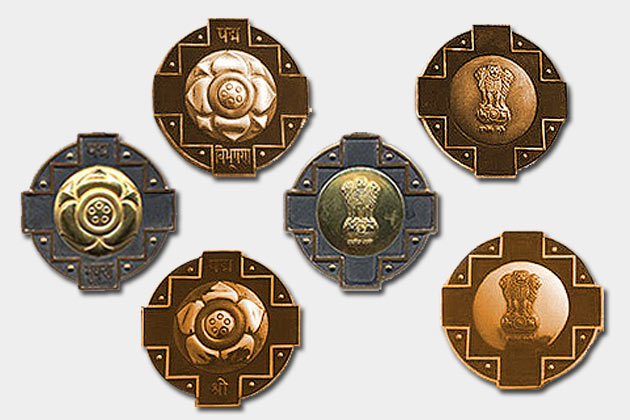
  • PADMA AWARDS 2016

    PADMA AWARDS 2016

    NEW DELHI (TIP): Former Comptroller and Auditor General of India Vinod Rai, actor Rajinikanth, spiritual guru Sri Sri Ravishankar and tennis player Sania Mirza are on the list of 112 Padma awardees whose names were announced on Monday by the government.

    The awards will be given across three categories: the Padma Vibhushan, Padma Bhushan and Padma Shri. These awards are given on Republic Day, for the over six decades now, to people who the government recognises have excelled in their fields.

    Padma Vibhushan

    1. Shri Rajinikanth    Art-Cinema    Tamil Nadu
    2. Ms. Yamini Krishnamurthi Art- Classical dance Delhi
    3. Smt. Girija Devi    Art-Classical Vocal    West Bengal
    4. Shri Ramoji Rao    Literature & Education-Journalism   Andhra Pradesh
    5. Dr. Viswanathan Shanta    Medicine- Oncology    Tamil Nadu
    6. Shri Shri Ravi Shankar    Others-Spiritualism    Karnataka
    7. Shri Jagmohan    Public Affairs    Delhi
    8. Dr.Vasudev Kalkunte Aatre    Science & Engineering    Karnataka
    9. Shri Avinash Dixit (Foreigner)    Literature & Education
    10. Late Shri Dhiru Bhai Ambani (Posthumous)    Trade & Industry    Maharashtra

    Padma Bhushan

    11. Shri Anupam Kher Art-Cinema Maharashtra
    12. Shri Udit Narayan Jha Art-Playback Singing Maharashtra
    13. Shri Ram V. Sutar Art-Sculpture Uttar Pradesh
    14. Shri Heisnam Kanhailal Art-Theatre Manipur
    15. Shri Vinod Rai Civil Service Kerala
    16. Dr. Yarlagadda Lakshmi Prasad Literature & Education Andhra Pradesh
    17. Prof. N. S. Ramanuja Tatacharya Literature & Education Maharashtra
    18. Dr. Barjinder Singh Hamdard Literature & Education – Journalism Punjab
    19. Prof. D. Nageshwar Reddy Medicine-Gastroenterology Telangana
    20. Swami Tejomayananda Other-Spiritualism Maharashtra
    21. Shri Hafeez Contractor Others-Architecture Maharashtra
    22. Shri Ravindra Chandra Bhargava Public Affairs Uttar Pradesh
    23. Dr.Venkata Rama Rao Alla Science & Engineering Andhra Pradesh
    24. Ms. Saina Nehwal Sports-Badminton Telangana
    25. Ms. Sania Mirza Sports-Tennis Telangana
    26. Ms. Indu Jain Trade & Industry Delhi
    27. Late Swami Dayanand Sarawasati (Posthumous) Others- Spiritualism Uttarakhand
    28. Shri Robert Blackwill (Foreigner) Public Affairs USA
    29. Shri Pallonji Shapoorji Mistry (NRI/PIO) Trade & Industry Ireland

    Padma Shri

    30. Smt. Prathibha Prahlad Art- Classical Dance Delhi
    31. Shri Bhikhudan Gadhvi Art- Folk Music Gujarat
    32. Shri Sribhas Chandra Supakar Art- Textile Designing Uttar Pradesh
    33. Shri Ajay Devgn Art-Cinema Maharashtra
    34. Ms. Priyanka Chopra Art-Cinema Maharashtra
    35. Pt. Tulsidas Borkar Art-Classical Music Goa
    36. Dr. Soma Ghosh Art-Classical Vocal Uttar Pradesh
    37. Shri Nila Madhab Panda Art-Film Direction and Production Delhi
    38. Shri S.S. Rajamouli Art-Film Direction and Production Karnataka
    39. Shri Madhur Bhandarkar Art-Film Direction and Production Maharashtra
    40. Prof. M. Venkatesh Kumar Art-Folk Artist Karnataka
    41. Ms. Gulabi Sapera Art-Folk Dance Rajasthan
    42. Smt. Mamta Chandrakar Art-Folk Music Chhattisgarh
    43. Ms. Malini Awasthi Art-Folk Music Uttar Pradesh
    44. Shri Jai Prakash Lekhiwal Art-Miniature Painting Delhi
    45. Shri K. Laxma Goud Art-Painting Telangana
    46. Shri Bhalchandra Dattatray Mondhe Art-Photography Madhya Pradesh
    47. Shri Naresh Chander Lal Art-Theatre & Cinema Andaman & Nicobar
    48. Shri Dhirendra Nath Bezbaruah Literature & Education Assam
    49. Shri Prahlad Chandra Tasa Literature & Education Assam
    50. Dr.Ravindra Nagar Literature & Education Delhi
    51. Shri Dahyabhai Shastri Literature & Education Gujarat
    52. Dr.Santeshivara Bhyrappa Literature & Education Karnataka
    53. Shri Haldar Nag Literature & Education Odisha
    54. Shri Kameshwaram Brahma Literature & Education – Journalism Assam
    55. Prof. Pushpesh Pant Literature & Education-Journalism Delhi
    56. Shri Jawaharlal Kaul Literature & Education-Journalism Jammu & Kashmir
    57. Shri Ashok Malik Literature &Education Delhi
    58. Dr.Mannam Gopi Chand Medicine-Cardio Thoracic Surgery Telangana
    59. Prof. Ravi Kant Medicine-Surgery Uttar Pradesh
    60. Prof. Ram Harsh Singh Medicine- Ayurveda Uttar Pradesh
    61. Prof. Shiv Narain Kureel Medicine- Paediatric Surgery Uttar Pradesh
    62. Dr.Sabya Sachi Sarkar Medicine -Radiology Uttar Pradesh
    63. Dr. Alla Gopala Krishna Gokhale Medicine-Cardiac Surgery Andhra Pradesh
    64. Prof. T.K. Lahiri Medicine-Cardio Thoracic Surgery Uttar Pradesh
    65. Dr. Praveen Chandra Medicine-Cardiology Delhi
    66. Prof. (Dr) Daljeet Singh Gambhir Medicine-Cardiology Uttar Pradesh
    67. Dr.Chandrasekar Shesadri Thoguluva Medicine- Gastroenterology Tamil Nadu
    68. Dr. (Mrs.) Anil Kumari Malhotra Medicine-Homeopathy Delhi
    69. Prof. M.V. Padma Srivastava Medicine-Neurology Delhi
    70. Dr. Sudhir V. Shah Medicine-Neurology Gujarat
    71. Dr. M. M. Joshi Medicine-Ophthalmology Karnataka
    72. Prof. (Dr) John Ebnezar Medicine-Orthopaedic Surgery Karnataka
    73. Dr. Nayudamma Yarlagadda Medicine-Paediatric Surgery Andhra Pradesh
    74. Shri Simon Oraon Other -Environment Conservation Jharkhand
    75. Shri Imitiaz Qureshi Other-Culinary Delhi
    76. Shri Piyush Pandey Others-Advertising & Communication Maharashtra
    77. Shri Subhash Palekar Others-Farming Maharashtra
    78. Shri Ravinder Kumar Sinha Others-Wildlife Conservation Bihar
    79. Dr. H.R. Nagendra Others-Yoga Karnataka
    80. Shri M. C. Mehta Public Affairs Delhi
    81. Shri M. N. Krishna Mani Public Affairs Delhi
    82. Shri Ujjwal Nikam Public Affairs Maharashtra
    83. Shri Tokheho Sema Public Affairs Nagaland
    84. Dr. Satish Kumar Science & Engineering Delhi
    85. Dr.Mylswamy Annadurai Science & Engineering Karnataka
    86. Prof. Dipankar Chatterji Science & Engineering Karnataka
    87. Prof.(Dr.) Ganapati Dadasaheb Yadav Science & Engineering Maharashtra
    88. Smt. (Prof.) Veena Tandon Science & Engineering Meghalaya
    89. Shri Onkar Nath Srivastava Science and Engineering Uttar Pradesh
    90. Ms. Sunita Krishnan Social Work Andhra Pradesh
    91. Shri Ajoy Kumar Dutta Social Work Assam
    92. Shri M. Pandit Dasa Social Work Karnataka
    93. Shri P. P. Gopinathan Nair Social Work Kerala
    94. Smt. Madeleine Herman de Blic Social Work Puducherry
    95. Shri Srinivasan Damal Kandalai Social work Tamil Nadu
    96. Shri Sudhakar Olwe Social Work Maharashtra
    97. Dr. T.V. Narayana Social Work Telangana
    98. Shri Arunachalam Murugantham Social Work Tamil Nadu
    99. Ms. Deepika Kumari Sports-Archery Jharkhand
    100. Shri Sushil Doshi Sports-commentary Madhya Pradesh
    101. Shri Mahesh Sharma Trade & Industry Delhi
    102. Shri Saurabh Srivastava Trade & Industry Delhi
    103. Sh Dilip Sanghvi Trade & Industry Maharashtra
    104. Dr. Keki Hormusji Gharda Trade & Industry Maharashtra
    105. Late Shri Prakash Chand Surana (Posthumous) Art – Classical Music Rajasthan
    106. Late Shri Saeed Jaffrey (NRI/PIO/Posthumous) Art- Cinema UK
    107. Shri Michael Postel (Foreigner) Art-Archaeology France
    108. Shri Salman Amin Sal Khan (NRI/PIO) Literature & Education USA
    109. Smt. Hui Lan Zhang (Foreigner) Others-Yoga China
    110. Shri Predrag K. Nikic (Foreigner) Others-Yoga Serbia
    111. Dr.Sundar Aditya Menon (NRI/PIO) Social Work UAE
    112. Shri Ajaypal Singh Banga (NRI/PIO) Trade & Industry USA

  • Meet India’s bravehearts

    Meet India’s bravehearts

    NEW DELHI (TIP): National Bravery Award-winning boys and girls drew applause from the audience at the Republic Day parade here for saving human lives in dangerous situations.

    As 23 out of the 25 award winners were driven in a jeep at the parade.

    From a 16-year-old who fought off a tiger to a 13-year-old who lost his life while trying to save his friend from drowning, three girls and 22 boys showed incredible bravery in the face of dangerous situations.

    Bharat Award, the highest of the National Bravery Awards, has been posthumously awarded to Gaurav Kawduji Sahastrabuddhe from Maharashtra who sacrificed his life during an attempt to save four of his friends.

    Shivansh Singh, who lost his life while undertaking a valiant effort to save his friend from drowning in Sarayu river was also awarded posthumously.

    The prestigious Geeta Chopra award has been given to eight-year-old Shivampet Ruchitha of Telangana who displayed exemplary valour in saving two lives when a train hit her school bus.

    Sixteen-year-old Arjun Singh was honoured with Sanjay Chopra Award for displaying outstanding bravery in fighting off a tiger to save his mother. Ramdinthara (15) of Mizoram, who saved two persons from electrocution, was awarded Bapu Gaidhani Award, along with Rakeshbhai Shanabhai Patel (13) of Gujarat and Aromal SM (12) from Kerala.

    While Rakeshbhai saved a boy who accidentally fell into a deep well, Aromal rescued two women from drowning.

    Other recipients of the bravery awards are Kashish Dhanani (Gujarat), Maurice Yengkhom and Chongtham Kuber Meitei from Manipur, Angelica Tynsong (Meghalaya), Sai Krishna Akhil Kilambi (Telangana), Joena Chakbraborty and Sarwanand Saha (Chhattisgarh) and Dishant Mehndiratta (Haryana). Beedhovan, Nithin Philip Mathew, Abhijit KV, Anandu Dillep, Muhammad Shamnad (all from Kerala), Mohit Mahdenrda Dalvi, Nilesh Revaram Bhil, Vaibhav Ramesh Ghangare (all from Maharashtra), Abinash Mishra (Odisha) and Bhimsen from Uttar Pradesh were also given the award.

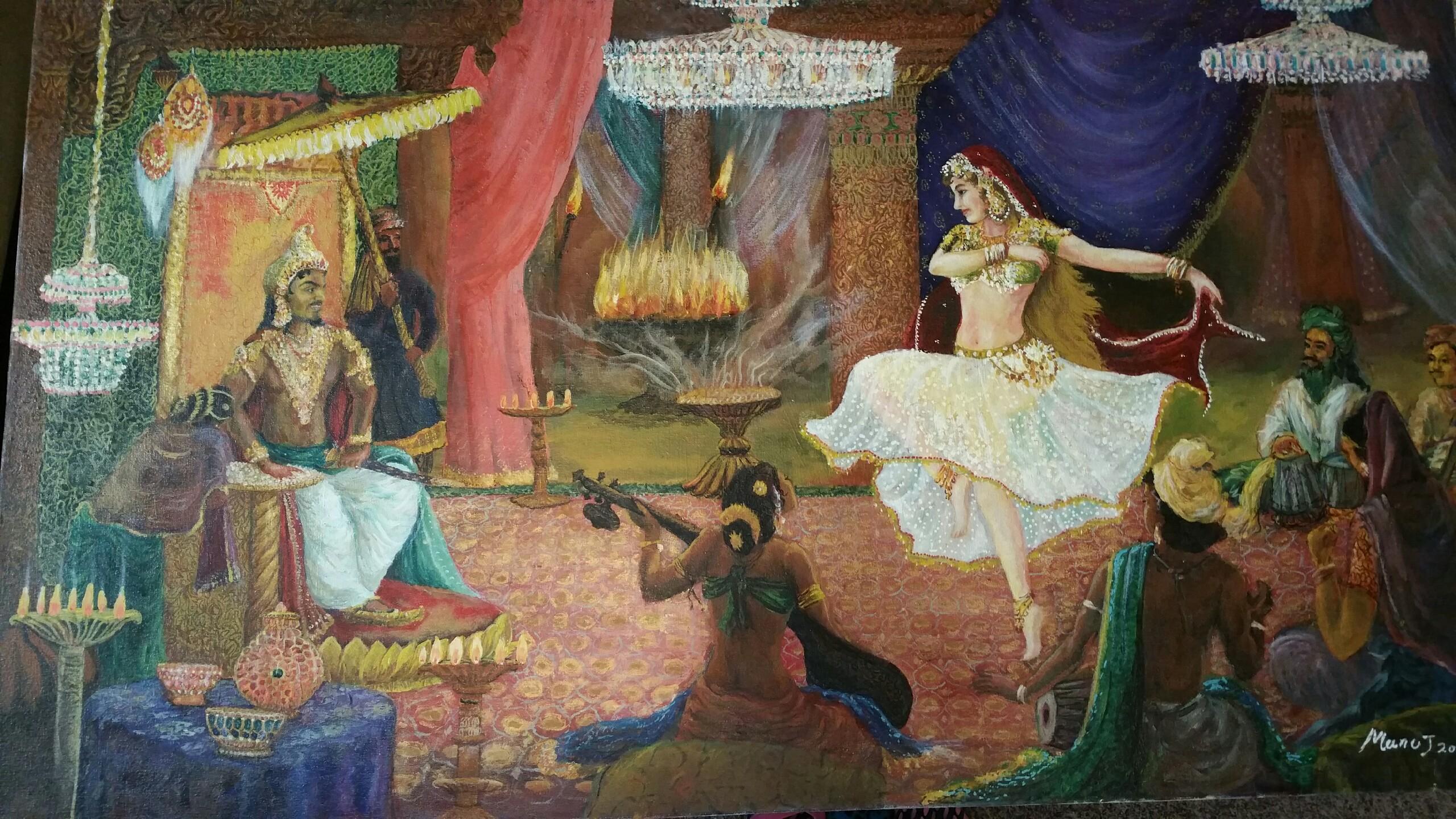
  • Bajirao Mastani of Manoj Vyas

    Bajirao Mastani of Manoj Vyas

    Born in India in 1956, Manoj Vyas began painting at the age of 8 when he
    amazed his father with his first mixed medium painting that he created out of
    whole rice. His father gave him paper and pencil encouraging him to draw on
    paper. But Manoj’s drawing found other mediums also. Many times he
    painted with coal and brick on the walls of the neighbors’ houses in his block
    and school rooms, and got scolded and spanked by them.

    He began participating in all drawing and painting competitions at his school
    and soon won a Drawing and Rangoli competition. He also sketched all his
    classmates’ portraits at school. His first recognition came when he won the
    Second Prize from Gujarat state in statewide competition. To continue his
    passion for painting, he joined the SSG School of Arts first, and then the
    famous Sir J.J. School of Arts in Bombay from where he got his Art degree.

    His first job was with Bombay’s prestigious daily newspaper Indian Express as
    a sketch and layout artist. His struggle continued even when he immigrated
    to the U.S. in 1985. But even here, his first job took him to the then
    prestigious and famous India Abroad newspapers where he worked 7 days a
    week. Unable to travel to participate in painting competitions and shows due
    to family obligations, he turned his profession into his hobby.

    Manoj has now started traveling to Europe in the last 5 years and has visited
    art galleries and museums at United Kingdom, Barcelona and other cities in
    Spain, and Rome and other areas in Italy. Painting still remains his passion
    and he now devotes more time to it, sometimes even waking up from sleep to
    quickly sketch ideas on canvas. He draws inspiration for painting from
    legends, folk tales and real life.

    The mediums for the little boy who used walls and coal have changed to
    canvas. Manoj has made a successful transition from his Indian background
    to his current American home. Today his canvas is large, covering real life
    portraits, religious paintings, and even Nudes as and when required by
    clients. And his mediums range from water colors and acrylics to oil and wax
    colors. His work depicts the conflicts between the spiritual and the material
    world, and conflicts between family obligations and the call of his heart, his
    art. Drawn from life, his work also represents his fears, hopes, pleasures and
    pains.

    About Bajiro Mastani:

    Manoj says about Bajirao Mastani: “I started this painting in the year of 1997 and it came to a completion in the year of 2005. After the painting was displayed, a lot of people asked me why did it take so long to finish this masterpiece.

    These were my descriptions for the painting:

    When I was in college, I had done many sketches on this subject but because of other obligations I could not start on the painting then. After that I researched a lot on the history of Bajirao Mastani, but due to the lack of information available at that time I was not successful at finding relevant information. My depiction of Mastani is clearly based on my imagination. Her beauty is so transparent that even in my painting you can visualize that when she devoured paan we can see the red juice going down her neck. Even the sketch of Bajirao was a struggle because once again I did not have any physical pictures. At my best knowledge I thought for having a male figure to draw, I would need a live person to visualize Bajiraos figure. I had a good friend who is an art lover, a south Indian movie actor and who has the understanding of the depth for art. He himself relates to Bajirao because he also married out of his caste because he was in love.

    “In the painting I have shown nine figures from which five of them are musicians, two of them are Bajiraos servants, and two are Bajirao and Mastani themselves. In the painting, I have shown that Mastani is dancing for the first time in front of Bajirao and this is when they both fall in love and he is ready to shower her with pearls which you can see in the beautiful painting. I even tried to reflect the historical interior that was used back in those days. The lavish, grand, and unique decor which also reflect the royal colors. The musicians that I have shown in the painting are described as wearing traditional Indian clothes, jewelry and are playing the traditional Indian instruments. They are sitting on majlis, which is a traditional sitting is surrounding Bajirao and Mastani. Out of the five musicians, four of them are Hindu and one male is a Muslim man that always went around with Mastani as her tabla player.

    “The painting has so much details that you cannot imagine by these few words written here. The words do not do justice to the original beauty that this painting showers.

    “I have purposely chosen not to spread the word about this painting in the past because ninety percent of the Indian people did not know about the historical part of the story. Now that movie has been released, I have decided to let this painting of mine go public.”
    Manoj is a versatile painter who paints in almost every medium- water color, acrylic, oil, pastel & stowing colors; on paper, wood, canvas & metal.
    He desires to make big paintings on mythological subjects like Ramayana and Baghvat Gita.

    Manoj’s paintings have been displayed at a number of art galleries in India, UK and USA. Recently, one of his paintings was on display at Ashok Jain Gallery in New York.
    For more information, please visit the website manojvyas.com

  • Expectations in 2016 | Wish for a peaceful and harmonious world

    Expectations in 2016 | Wish for a peaceful and harmonious world

    In 2016, I truly wish for a peaceful and harmonious world where our common humanity is  more celebrated rather than focusing on our differences. I  hope and pray that our community  could work together  in unity in the  political arena here and exercise our rights and privileges in a more assertive way than ever before. Both political parties, Democrats and Republicans, tend to treat the Asian Indian community like an ATM machine while displaying no loyalty or lasting commitment to  our needs or aspirations!They may have concluded that we are merely excited and privileged with the so-called photo sessions. A united south Asian Community with a thoughtful plan of action will go a long way in claiming a piece of the pie here in New York that is rightfully ours considering our presence and contributions. It is time that we balance the celebration of the cultural heritage with timely interventions and actions to help our younger generation to succeed in a more competitive environment here in USA.

    One last thing: Let us all remain true and consistent to the principles of life, liberty and pursuit of happiness for every human being on the planet. Let us raise our voices against injustices everywhere whether it is an assault on a visiting grand father from Gujarat by a policeman in Alabama or lynching a minority member in Dadri, U.P for his dietary habits or burning alive of Dalit Children in Faridabad, U.P or setting ablaze of Churches of a minority community in New Delhi. Martin Luther King once quoted as saying ‘if we remain silent in face of injustice, we are in complicity’!

    George AbrahamAuthor: George Abraham

    Chairman, INOC USA New York

    Email: gta777@gmail.com

  • BJP in Chaos after Congress’s comeback in Gujarat

    BJP in Chaos after Congress’s comeback in Gujarat

    After years of being in the political wilderness, Congress made a spectacular comeback in Gujarat, taking control of the rural local bodies in a stunning blow to the BJP in an election seen as a referendum on the ruling party’s state and central leadership.

    The Grand Old Party won an impressive 22 of 31 district panchayats, a huge jump from the single panchayat it had won in 2010. It also won more than 50 per cent of the state’s 231 talukas or block-level panchayats. The Congress has been buoyed by these results and its leaders say that the outcome will benefit the party in the Assembly elections in 2017. The Congress has been out of power in Gujarat since 1995 while the BJP has ruled since then, barring a two year period when Shankarsinh Vaghela was the chief minister.

    The setback to the BJP in Prime Minister Narendra Modi and party president Amit Shah’s home state comes barely weeks after the party suffered an embarrassing defeat in the assembly polls in Bihar.

    These are the first elections in Gujarat on this scale after Narendra Modi moved from the state to Delhi and the first real popularity test for chief minister Anandiben Patel after she took charge of Gujarat last year.

    Anandiben Patel has faced major political trouble in the shape of a widespread agitation by members of the Patel community who want either want reservations in jobs for themselves or the quotas to completely be eliminated.

    Anandiben Patel could feel somewhat relieved at the BJP’s performance in urban areas. Her party won all six municipal corporations including Ahmedabad and Surat, though it faced resistance from the Congress in Rajkot.

    The BJP also won more than 40 of the 56 municipalities where elections were held, including in Viramgam, where 22-year-old politician Hardik Patel, leader of the Patel agitation hails. A call by Hardik Patel to vote against the BJP seems to have not had much impact.

    In the urban areas, the BJP retained control over Ahmedabad, Vadodara, Surat, Rajkot, Bhavnagar and Jamnagar municipal corporations, though the Congress put up a tough fight at several places.

    The BJP attributed its loss in rural areas to the Patidar agitation.

    “The BJP has done work in rural areas. But with the kind of social engineering done by the Congress of late, the results for the BJP are below expectations,” said the party’s state vice-president IK Jadeja.
    “This is an overall mandate in favour of the Congress. Even in urban areas, with increased number of seats, we can say the Congress has been widely accepted,” said Gujarat Congress president Bharatsinh Solanki.

    In Delhi, senior leader Ahmed Patel, who is political secretary to Congress president Sonia Gandhi, said the BJP government was on its way out in Gujarat after the results.

  • Vishwa Gujarati Samaj, USA Celebrated 6th Annual Gala Banquet

    Vishwa Gujarati Samaj, USA Celebrated 6th Annual Gala Banquet

    CHICAGO, IL (TIP): Vishwa Gujarati Samaj (VGS), USA celebrated the 6th Annual Gala Banquet in the memory of late Narendrabhai Patel, Founder, Medstar Laboratories at Meadows Club, 2950 Golf Rd., Rolling Meadows, IL.

    The event was attended by a large number of eminent people, along with their families and friends, from different walks of life. The event was talk of the town and audience appreciated quality time spent with like-minded people and fun-filled musical melodies of famous Binaca Geetmala’s Blockbuster songs.

    Rich tributes were paid to Narendrabhai Patel for his professional achievements in different fields of work and to his philanthropic contributions to numerous organizations, irrespective of caste, creed, and religion.

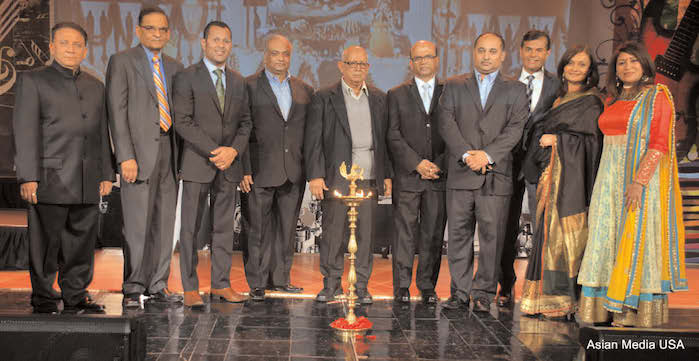
    The function commenced with the singing of the Indian and the US National Anthems and lighting of lamp by the Vishwa Gujarati Samaj USA Board of Directors; Mafat Patel, Neal Patel, Raj Patel, Treasurer Kishore Chugh, Secretary Jayal Amin, Piyush Patel, Subodh Gabhawala, Dr. Sonal Patel and President Beena Patel.

    Mrs. Sumitra Narendra Patel along with her two sons Neal and Raj and daughter-in-law Sonal and Nisha Patel were called on stage to present a Bouquet to honor Mrs. Patel for her husband’s contribution to the society.

    Beena Patel, President, VGSUSA in her welcome address, said that the cherished national goals can be achieved, in full measure, only when people come forward to take up community work and share their time and talent in helping each other. Beena gave a history of six years of VGS USA and said that we have provided top class programs to our members and we will continue to maintain the same standard. She said that our Organization’s goal is to engage and encourage younger generation to showcase and promote Gujarati Culture and Heritage. Half of the audience was in their 40’s and they all enjoyed networking with Gujarati Business Community and felt proud to be a Gujarati.

    Beena stated that community service does not mean merely organizing cultural events; it includes a wide spectrum of economic, education, health, social, and environmental issues concerning people. “A multifaceted community service will be greatly appreciated in making the lives of people worth-living”, she added.Beena thanked all the current office bearers of the VGS USA and said that Naren Patel, Mafat Patel, and Hiren Patel played a vital role in particular for their valuable contribution in making the Vishwa Gujarati Samaj USA stronger and famous for their beautiful exhibition of Gujarat Darshan and celebrating victory of Prime Minister Shri Narendra Modi. She also thanked community leaders, media, Harish Kolasani for the Gujarat Promo Video, Sunil Shah, Babubhai Patel, Harish Bhatt and many others for their support to the VGS in a variety of ways.

    Dr. Yash Amin, Member, Board of Directors said that VGSUSA has been committed to network with numerous Gujrati organizations and to ensure that all of them move in one direction and achieve the common goal of preserving the values and wisdom of Indian culture among the Indian Diaspora.

    “Narendrabhai Patel started his journey as a humble pharmacist and finally occupied the prestigious position of Chairman, Medstar Laboratories. His career, therefore, will continue as a source of inspiration for the young generation”, said Amin.

    “The rare blend of technical, conceptual, and human skills, and the high levels of emotional and spiritual quotients, enabled Narendrabhai Patel to touch the commanding heights of his professional success”, Amin added.

    Amin called upon the professionals belonging to new generation to enrich their people-related skills and adopt transformational leadership style, rather than merely focusing on their technical skills, in order to realize their full potential.

    “I know Naren Patel since 1969. “Behind every successful man there is a woman”. Sumitra Patel wife of Naren Patel was truly inspiration to him. Naren Patel two young entrepreneurs Neal and Raj Patel who are known for their sharp business acumen, a distant vision, sound capital and an ability to bounce back, now they are back bone of Vishwa Gujarati Samaj USA. Though born and grown up in United States, these young honchos are more Indian, who believe in upholding Indian culture and traditions” Said by Mafat Patel prominent community leader and well known Business man.

    The Live Music Concert, comprising eminent singers and fine musicians, was the highlight of the event. The melodious compositions of R D Burman, including “Chura liya hai tum ne jo dil ko”, “Bahon mein chale aao”, “Karvaten badalte rahe saari raat hum”, “Mehbooba mehbooba”, etc., uplifted the mood of the audience.

    Audio visual tributes were paid to R D Burman, the musical genius, by Asha Bhonsle, Gulzar, Javed Akhtar, Shankar Mahadevan, Shammi Kapoor, Rishi Kapoor, Vishal Bharadwaj, Shiv Kumar Sharma, Ameen Sayani and many more legends.

    The event concluded with an authentic Gujarati Family Style dinner.

    Dr. Subhash Patel conducted the proceedings of the event as the MC.

  • Indian-American offloaded from international flight in Islamabad over ‘bomb hoax’

    Indian-American offloaded from international flight in Islamabad over ‘bomb hoax’

    An Indian-American man on board the Qatar Airways flight to Washington via Doha was offloaded at the Benazir International Airport in Islamabad around 3 a.m. on Friday after he claimed that there was a bomb on the aircraft, which later turned out to be a hoax.

    Qatar Airways refused to board Ajit Vijay Joshi on its plane, claiming that he raised a bomb threat that turned out to be a hoax, the Express Tribune reports.

    Joshi was, however, detained by the airport security and was released only after the flight landed in Doha.

    The Anti-Narcotics Force (ANF) had last week held a passenger at the same airport for allegedly trying to smuggle heroin to Italy.

    An ANF release claimed that during routine patrolling, officials apprehended Khalid Mehmood, a resident of Gujarat, who purportedly confessed to having ingested heroin capsules.

    Meanwhile, security has been beefed up at various airports around the globe since a wave of coordinated attacks were carried out in Paris on November 13, claiming 129 lives, and downing of a Russian plane on October 31, killing all 224 on board.

    Two Air France flights from United States to Paris diverted over bomb threats

    On November 17, two Air France flights en route to Paris from the United States were diverted following anonymous bomb threats, and hundreds of passengers and crew were safely removed, the airline and the Federal Aviation Administration said.

    On November 22, a Turkish Airlines flight bound for Istanbul from New York was diverted to Halifax, Canada, after a bomb threat, Canadian police said.

    On the same day, a Singapore Airlines (SIA) flight from San Francisco via Hong Kong received a bomb threat but arrived without incident in Singapore, police said.

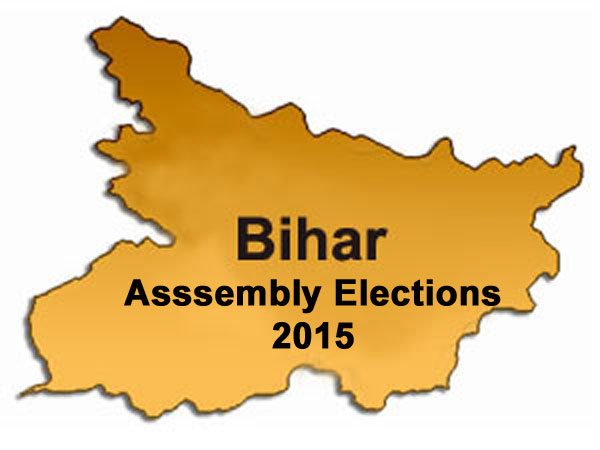
  • Quota remark, Dadri incident led to Bihar defeat, says Ram Vilas Paswan

    Quota remark, Dadri incident led to Bihar defeat, says Ram Vilas Paswan

    NEW DELHI (TIP): NDA partner and Union minister Ram Vilas Paswan on Thursday spoke out on the Bihar election defeat for the first time since the verdict, saying the rival grand alliance benefitted from successfully convincing people that reservation for backwards would be withdrawn and minorities won’t be safe if the NDA came to office.

    Even though Paswan refrained from directly blaming RSS chief Mohan Bhagwat, he agreed that the quota remark and the Dadri incident were the two major reasons for votes moving away from NDA parties.

    Besides the two controversial issues, the decision of Bihar chief minister Nitish Kumar to shift a number of castes from OBCs to EBCs and from EBCs to SCs/STs also led to consolidation of votes in favour of the grand alliance, the LJP chief said at a press conference.

    Replying to a question on Bhagwat’s remarks on quota review, Paswan said, “I do not think that this was the only issue. But this is true that the grand alliance leaders were to a large extent successful in misleading people with the help of that statement. That became a major issue. They were able to convince people that if NDA comes to power, reservation will be done away with.”

    He added, “We were not successful in convincing voters from SCs and OBCs that it is not so, though all of us including Prime Minister Narendra Modi and BJP chief Amit Shah clearly said that there was no plan to undo reservation system.”

    He hastened to add that he was not in a position to say in what context Bhagwat had made the remarks or whether he was saying this in response to Hardik Patel’s stir for reservation for Patels in Gujarat.

    Besides, he spoke about the discomfiture in NDA over the lynching in Dadri on the beef issue and subsequent row. “The incident of Dadri was a law and order problem and the blame for it should have gone to Samajwadi Party, which rules Uttar Pradesh. It should have been treated as an issue concerning Mulayam Singh Yadav. Latching on to this incident, the opposition was also successful in convincing minorities in Bihar that they will not be safe if NDA came to power,” Paswan said.

  • STOP MUSLIM POLYGAMY, SAYS GUJARAT HIGH COURT

    AHMEDABAD (TIP): The Gujarat high court on Nov 5 made a strong pitch for a uniform civil code and called for the abolition of polygamy in Muslim society in India as it’s a
    “heinously patriarchal” act.

    The court recommended an amendment of Muslim personal law saying that in this day and age, the practice of polygamy is often driven by selfish motives.

    “On the basis of modern progressive thinking, India must shun the practice (of polygamy) and establish a uniform civil code,” said Justice JB Pardiwala, while adjudicating on a petition by a Muslim man who faced bigamy charges after marrying for a second time without his first wife’s consent.

    The man was charged ?under section 494 of the IPC, for bigamy, but his second marriage is valid as per Muslim Personal Law, so he could not be prosecuted for bigamy.

    Justice Pardiwala had to quash the bigamy charges but while doing so, he said the practice of polygamy and unilateral talaq — without te wife’s consent — violates the provisions of the Constitution. He quoted Article 44 of Part IV of the Constitution, which mandates that the state must
    “endeavour to secure for the citizens a uniform civil code throughout the territory.”

    “If the state tolerates this law, it becomes an accomplice in the discrimination of the female, which is illegal under its own laws,” the judge said.

    The Quran forbids polygamy if the purpose to marry more than once is self-interest or sexual desire, Justice Pardiwala said. “… It’s for the maulvis and Muslim men to ensure that they do not abuse the Quran to justify the heinously patriarchal act of polygamy in self-interest,” the judge advised. Citing history, Justice Pardiwala said that when the Quran allowed polygamy, it was for a fair reason. “The Quran allowed conditional polygamy to protect orphans and their mothers from an exploitative society… When men use that provision today, they do it for a selfish reason.”

    The court said that abolition of polygamy in Hindu society was a progressive step and added that it could not be replicated for Muslims due to their “social backwardness then”. But now, in a much-changed changed socio-economic scenario, “polygamy is going into oblivion” and monogamy is becoming the reality, the court observed. Source: TOI

  • 41 WRITERS RETURN INDIAN AWARD IN PROTEST

    41 WRITERS RETURN INDIAN AWARD IN PROTEST

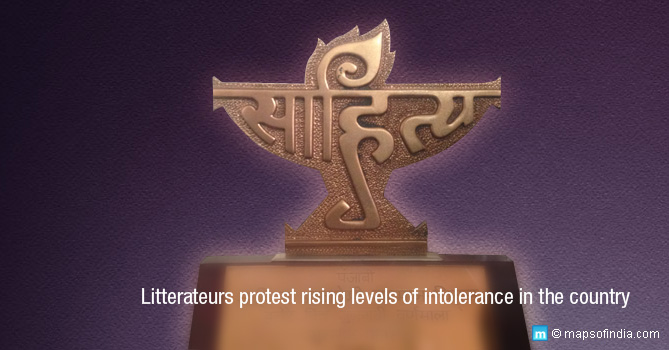
    NEW DELHI (TIP): Many in India’s literary community are disgusted. Dozens of writers say every day brings more evidence of intolerance and bigotry going mainstream — a man lynched allegedly for eating beef, an atheist critic of Hindu idol worship gunned down — all met by a deafening silence from the government.

    As of October 14, 41 novelists, essayists, playwrights and poets had returned the awards they received from India’s prestigious literary academy to protest what they call a growing climate of intolerance under Prime Minister Narendra Modi’s government.

    The writers are also angry that India’s Sahitya Akademi, or National Academy of Letters, has said little about the murder of the well-known rationalist Malleshappa Kalburgi, an award-winning Kannada-language writer, gunned down in August for his writings against superstition and false beliefs.

    The government has dismissed the writers’ protests, questioning their motives and accusing them of being politically motivated.

    “If they say they are unable to write, let them stop writing,” culture minister Mahesh Sharma told reporters.

    The writers say they cannot remain mute spectators to numerous incidents of communal violence, attacks on intellectuals and increasing curbs on free speech.

    “It’s become a question of an individual’s right to speak, to think, to write, to eat, to dress, to debate,” said Maya Krishna Rao, a playwright and theater actress, who returned her award to the academy this week.

    When Modi won a landslide victory in May 2014, many voiced fears of right-wing Hindu nationalism leading to communal violence and religious intolerance. Modi, who had spent years dodging allegations of failing to stop riots in Gujarat state in which around 1,000 Muslims died, assured the nation that he was prime minister for all and would work for everyone.

    But the last year has seen a rising crescendo of violence by Hindu fringe groups, trying to force a regressive Hindu nationalism on all, causing fear among India’s minority communities. State governments ruled by the BJP have cracked down on cow slaughter, and even buffalo meat, a key source of protein for poor Muslims and lower caste Hindus, has become scarce. The ban on cow slaughter has given rise to Hindu vigilante groups and mob violence has risen. Last month a Muslim man was lynched in northern India over false rumors that his family had eaten beef for dinner.

    On Wednesday, in response to persistent demands that the prime minister break his silence on the lynching, Modi said the mob killing was “sad and undesirable,” but added that his government could not be blamed as the local administration was responsible for the state.

    Last week, well-known writer Nayantara Sahgal returned her academy award, triggering the return of awards by other writers. Sahgal, a niece of India’s first prime minister, Jawaharlal Nehru, is known as a fiercely independent political writer who had crossed swords with her cousin and another former prime minister, Indira Gandhi, when she imposed a state of emergency in India in the mid-70s.

    Referring to recent violence by Hindu groups, Sahgal said in an interview to The Indian Express newspaper that there was “an attempt to blow up the idea of India and to put in its place a kind of travesty of Hinduism, a kind of monoculture, which has nothing to do with Hinduism.”

    Sahgal’s views are echoed across the literary spectrum.

    Ghulam Nabi Khayal, a Kashmiri language writer, said earlier governments would try to restore peace in situations of communal conflict.

    “But that’s no more the case with the rise of Hindu rightwing BJP,” Khayal said in Srinagar. “For the past one year, the Indian state has become suffocating and extremely intolerant.”

    The government was “now brazenly and institutionally backing this communal hatred,” he said, justifying his decision to return his award.

  • Learn ABC of the Grammar of Governance

    Learn ABC of the Grammar of Governance

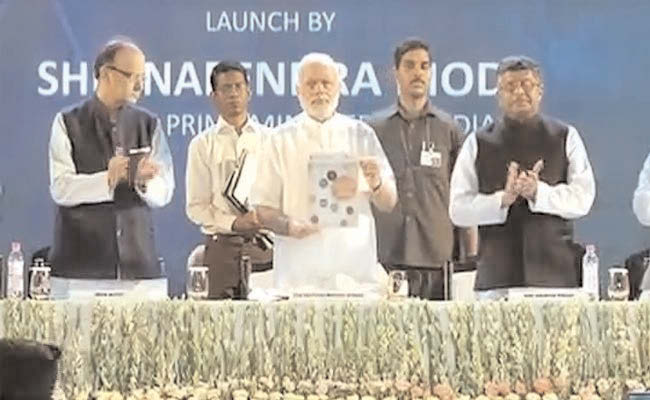
    During his US visit, Prime Minister Narendra Modi conveyed to his audience: “Reform in governance is my No 1 priority. We are for simplified procedures, speedy decision making, transparency and accountability.” As the Chief Minister of Gujarat, Modi was a
    “governance”addict. On his assuming Prime Ministership, “governance” became India’s flavor and the Center’s guiding mantra. The stated objective was to have a “governance architecture” that put people at the centre of the development process. The President’s address to Parliament in June last year also laid down the motto: “Minimum government, maximum governance”.

    However, even after 16 months there is no such governance architecture or blueprint. In the upper echelons of decision making, there is mixup of government and governance, as if both are the same. They are not. Governance is not just government; it is bureaucracy, laws, rules, policies, programs, processes and procedures. It is far more than that. In a democracy like India, governance should be “society-centered”. It should include the government, which is its dominant part, but transcend it by taking in the private (farming, business, industry) and voluntary sectors (civil society). All the three are critical for sustaining human, economic and social development.

    Governments create a conducive political, administrative, legal and living environment. The private sector promotes enterprise and generates jobs and wealth, while the voluntary sector educates and mobilizes citizens’ groups to participate in economic, social and political activities. Each has weaknesses and strengths, so governance is facilitated through a constructive interaction among all three. While government is a politico-bureaucratic entity, governance is a joint venture encompassing all. The difference is huge.

    Being a joint venture, governance should adhere to the basic functional norm of involving stakeholders in decision-making and implementation processes. The Modi government made a false start by putting out a “secret” Intelligence Bureau report condemning several civil society organizations and eminent opinion leaders who differed from government policies as “anti-national” and accusing them of thwarting India’s development! Since then, many NGOS are being harassed by abusing the Foreign Exchange Management Act and other laws. The voluntary sector, except the RSS as well as its affiliate “think-tanks” and individuals, are out of the reckoning as far as “governance” is concerned. As for farmers, they are treated more as mendicants than partners. The elitist vision of the BJP and its leader is replete with bullet trains, state-of-the-art highways, smart cities, insulated industrial corridors and “Digital-India.” These are far removed from the deprived lives of a majority of farmers. Agriculture, which accounts for 60 per cent of India’s population, and from where the poorest draw sustenance, is only an add-on in the scheme of things. In business and industry, it is “big-is-bountiful” and “small-is-not-beautiful”. This has been demonstrated during Modi’s high-profile foreign visits and the mad hunt for big-ticket FDIs. Last year, on the launch of the “Make-in-India” campaign at Delhi, about 10 big industrialists on the dais pledged to invest billions of Rupees. The same scenario was repeated while kick-starting the “Digital-India” initiative and billions were again promised. As if only big-ticket investors alone are “partners in development.” The grammar of good governance is about socio-economic harmony, arising out of the smooth interface between government, civil society, farming and business communities. Unless this is achieved across the board, no amount of reforms can bring about achche din. As to “minimum government, maximum governance,” David Thoreau wrote over a century ago: “That government is the best which governs the least.” Conversely, “that government is the worst which governs the most.” The latter seems to be true of India. The Union Territory of Chandigarh is also a case in point. From 1952 to 1966, Chandigarh was the capital of Punjab and its citizens were represented in the state’s Legislative Assembly. A Chief Commissioner headed the local administration. When the undivided Punjab was divided, both Punjab and Haryana claimed the new city for its capital. Pending the resolution of the issue, Chandigarh was made a Union Territory, with its administration functioning directly under the Centre. While the UT lost representation in the Assembly, it has a Member of Parliament. Till May 31, 1984 Chandigarh had an Administrator designated as the Chief Commissioner. On June 1, 1984, the Governor of Punjab took over as the Administrator and the Chief Commissioner was re-designated as the Adviser to the Administrator. This was a prelude to Operation Blue Star.

    The stated reason was to facilitate “co-ordination” between the districts of Punjab and the capital in Chandigarh. This ad hoc measure became permanent. The Governor of Punjab is the head of the UT Administration, though it is the Adviser who runs the show. The Municipal Corporation of Chandigarh (MCC) came into existence on May 24, 1994. Several functions were transferred from the Chandigarh Administration to it through notifications issued on September 28, 1995 and May 16, 1996. The elected body of the MCC came into being in December 1996. The first thing it did was to stall the decision to levy property tax on commercial and residential buildings in the city, thereby triggering a duel between the UT Administration’s bureaucratic and political wings that continues till date. The transfer of functions was a half-hearted affair. The bureaucratically run Chandigarh Administration  retains the bulk of the assets, including near-total control of funds and resources. Chandigarh has five governments/power centers: The Union Home Ministry, the Punjab Raj Bhavan, the UT Secretariat, the MP and the MCC. Things have been falling between several stools. In Chandigarh, Modi’s motto looks reversed to “Maximum government, minimum governance”!

    By M.G. Devasahayam (The author is a former IAS officer of Haryana Cadre, now settled in Tamilnadu)

  • CENTRE NOD TO GUJARAT TERROR BILL

    NEW DELHI (TIP): The NDA government has given its green signal for a controversial anti-terror law passed by Gujarat that was rejected thrice earlier, including once during A B Vajpayee regime, and forwarded it to President Pranab Mukherjee for his assent.The Gujarat Control of Terrorism and Organised CrimeBill has been hanging fire since it was first introduced in 2003 by Narendra Modi, when he was the chief minister of Gujarat. The bill was rejected twice during the UPA regime.

    “The bill has been sent to the President,” a Home Ministry official said.The controversial law was passed in April this year for the fourth time after making minor changes while retaining controversial provisions like allowing information collected through interception of mobile calls or through confessions made before an investigating officer as evidence.

  • HC pulls up Hardik Patel over writ petition

    HC pulls up Hardik Patel over writ petition

    AHMEDABAD (TIP): The Gujarat High Court (HC) on Thursday pulled up Patidar Anamat Andolan Samiti (PAAS) leader Hardik Patel and his lawyer B M Mangukia.

    It appeared that the petitioner had taken “for a ride” the court with regards to filing a habeas corpus writ past midnight of Tuesday. The petition had been filed by Mangukia on Tuesday past midnight, alleging that Hardik was picked up by police on Tuesday afternoon and that they feared for his  safety. The division bench of Justice M R Shah and Justice K J Thaker came down heavily on Hardik’s lawyer and sought an unconditional apology, saying that despite the urgency shown while filing the writ petition, none of them bothered to inform the court after Hardik was found on Wednesday morning. It asked the petitioners that when the petition was pending before the court why then they opted to go to media instead.

  • A Story of Courage and Determination | Arunima Sinha, the First Indian Amputee to Climb Mount Everest

    Ms Arunima Sinha of Lucknow (Uttar Pradesh) is the first Female Amputee of the world to climb Mount Everest. She is also the first Indian Amputee to climb Mount Everest. She reached the summit of Mount Everest on 21st May, 2013 at 10.55 hours after a hard toil of 17 hours, as a part of the Tata Group sponsored Eco Everest Expedition. She took 52 days to reach the summit.

    She was formerly a national level volleyball player. While traveling by train from Lucknow to New Delhi on 11th April, 2011, she was pushed out of the running train by the thieves wanting to snatch her bag and gold chain at about midnight. Her left leg below the knee was crushed. There were multiple injuries in her body. About 50 trains passed over her as she was lying between the two tracks in helpless condition. Next day morning she was rushed to Bareilley civil hospital with serious injuries. The doctors amputated her infected left leg below the knee to save her life. Then she was shifted to All India Institute of Medical Science, New Delhi. While she was undergoing treatment there for four months, she resolved to climb Mount Everest.

    When she was about one thousand feet away from the summit, her oxygen cylinder got almost empty. She was told to come back but she decided to take the risk of her life and marched forward and reached the summit. She placed the Indian flag on the top of the summit along with the flag of Tata Steel (sponsoring agency). Then she worshiped the photograph of Holy Trio (Swami Vivekananda, Bhagwan Shri Ramakrishna and the Holy Mother Sri Sarada Devi) and left it there for good. After the worship, she unexpectedly found an oxygen cylinder left by an Englishman, who had dropped one of the two cylinders as it was too heavy. This is how she survived and came back. She feels that she survived because of the grace of Holy Trio, therefore she has resolved to place the photos of Holy Trio on remaining six summits of the world, she has already placed the photographs on Mount Killmanaro of Africa (11 May, 2014 And Mt. Elbrus of Russia (24th July, 2014).

    She was felicitated by Dr. APJ Abdul Kalam, former President of India at Vadodra on August 10, 2013 during the international youth conference organized by Ramakrishna Mission, Vadodra. She was felicitated by Shri Narendra Modi, the then Chief Minister of Gujarat on January 11, 2014 at Mahatma Mandir, Gandhinagar in the presence of a large number of youths of India and abroad and a large number of dignitaries. She has received many prestigious awards from many reputed organizations — Salam India Award by India TV, Bharatiya Nari Shakti Award by India Today etc. The Vice-President of India Shri M. Hamid Ansari presented an ‘Amazing India Award’ instituted by Times Now channel on 6 Feb. 2014. The Governor of Rajasthan Mrs. Margret Alva presented International Vaish Federation Award .

    She has now dedicated herself to the social cause. She actively participated in Uttarakhand Relief Work. She is planning to start a Sports Academy for poor and differently abled people and is motivating thousands of youths throughout the country with her inspiring life story and the message of Swami Vivekananda. She has delivered many Motivational talks in educational institutions like IIM, Kolkata, IIM Ahmedabad, IIT, Kanpur and in international, national and regional level youth conventions organized by Ramakrishna Mission in various parts of India, and in many reputed companies. Both print media and electronic media have covered her life story in various ways and on various occasions which has inspired thousands of people throughout the country. A book on her life will be soon published by Penguin.

    She is now preparing herself for participating in Para Olympics, 2016 as a Blade Runner.

    Because of her extraordinary courage and self-confidence and inspiring speeches, she is now becoming a role model for modern youth. She is a living example of women Empowerment & Development. Her life story is at once thrilling and inspiring and practical demonstration of the power of faith.

  • ERODING CIVIL RIGHTS!  Is India’s Democracy in Danger?

    ERODING CIVIL RIGHTS! Is India’s Democracy in Danger?

    Our country is facing the destruction of the very idea of India as a great, multi-religious, multi-cultural civilization. We are facing the gravest danger we have faced since independence. Our freedom is not merely under threat, it is being ‘openly attacked’, says Nayantara Sahgal, niece of India’s first Prime Minister Jawaharlal Nehru, whose latest work, “Nehru’s India: Essays on the Maker of a Nation”, has just been released.

    What is happening to the body politic of India in the short time since Shri Narendra Modi assumed power?  Are the institutions of democratic strength and stability for six decades, which were built under the stewardship of eminent statesmen like Jawaharlal Nehru and B.R. Ambedkar proving to be weak and vulnerable?

    If we listen to various pundits, there is a serious cause for concern to India’s vast democracy. Although the BJP government has come to power with only 31 per cent of the vote share, the Sangh Parivar with its misguided agenda and regressive policies has determined to transform India into its own liking. With civil society under threats and intimidation, the media’s eagerness to establish approval, and the survival mode of the opposition parties, the saffron brigade is not wasting any time.

    On the eve of Shri Modi’s second visit to the United States, there is certainly a shift in the mood within the Diaspora as regards the intent and purposes of the BJP government. A letter signed by 124 members of faculty  from leading Universities in USA questions the Prime Minister on well-publicized episodes of censorship and harassment in his critical policies; bans and restrictions on NGOs; ongoing violations of religious freedom; and a steady impingement on the independence of the judiciary.

    The letter also talked about foreign scholars who have been denied entry in to India to attend International conferences, and the ongoing interference with the governance of top Indian Universities and academic institutions. It mentioned under-qualified or incompetent key appointments made to Indian Council of Historical research, the Film and Television Institute of India and the National Book Trust. In conclusion, the statement expressed serious concern for the political future of the country if these trends are allowed to continue.

    In an interview with Times of India, Nobel Laureate  Amartya Sen said, ” Government must understand that winning a Lok Sabha election does not give you permission to undermine the autonomy of academic institutions, or for that matter, the courts or the upper house of Parliament. Academic freedom is based on the government understanding the limits of its formal power as opposed to its actual power and what they are expected to do: they are expected to listen to the voice of the professoriate and the voice of the people in the University”.

    Whether it is banning the documentary ‘India’s Daughter”; offloading Ms. Priya Pillai, a Green Peace activist from her flight to London, while she was on her way to address British Parliamentarians; banning the processing, selling or eating of the red meat in Maharashtra and in 4 other BJP-ruled states; the Rashtriya Swayamsevak Sangh (RSS) is stamping history with their regressive policies and divisive agenda.

    The BJP Government so far has banned 69 Non-Governmental Organizations from receiving foreign funding, branding them as anti-national and accusing them of working at the behest of foreign governments. It includes organizations like Ford Foundation and Caritas International that provided much-needed help to communities in rural India in an effort to end poverty promote justice and restore dignity to a neglected segment of the population.

    Ms. Teesta Setavald, a long-time critic of Mr. Modi on his handling of the 2002 Gujarat riots that killed more than 1000 people in Gujarat is currently being investigated by CBI. According to a New York Times report, the prosecutor branded her ‘a threat to India’s national security, so dangerous that she should be locked up while Modi’s Government investigates whether it was legal for her to accept funding from Ford Foundation’.

    For the first time since it took charge, the NDA government has issued show-cause notices to ABP news, NDTV and Aaj Talk alleging that these three private channels showed disrespect to the judiciary in their coverage of the hanging of Mumbai blast convict Yakub Memon, asking them to explain within 15 days why action should not be taken against them for broadcasting such content.

    These should not be regarded as isolated incidents but rather as a  part of a grand strategy to intimidate civil society, and silence the media in order to advance the saffron agenda. All these incidents point to a growing intolerance to dissent, and the very concept of freedom that may ultimately prove fatal to the democratic and pluralistic framework that was created out of the visionary leadership of the founding fathers of modern India.

    Asked to explain what prompted him to be a signatory on the faculty statement against Narendra Modi’s “Digital India Campaign”, Richard A. Falk, Professor Emeritus of Law at Princeton University said the following: “I and others on the list have questions about Narendra Modi’s record on religious tolerance, freedom of religion, and freedom of expression. Some of those who signed the letter have also been subject to a campaign of harassment from Hindu nationalist followers, which raises particular worries about academic freedom. “Digital India” as an initiative has enormous potential to affect positive social change, but it simultaneously poses dangers for abuse under the Modi administration that can make use of digitization to target members of minority communities or those who are critical of its policies. It is my impression that the Modi government has been particularly sensitive to criticism and unfriendly to critics, making our concern more credible”.

    Mr. Falk’s statement sounds prophetic, as at the time of writing this article Mr. John Dayal, a member of the National Integration Council and Secretary General of All India Catholic Union and a foremost Human Rights defender was being hounded with abusive and threatening tweets along with his personal details. The abuses are also directed at the Catholic-Christian minority and are aimed at disturbing communal harmony. The country has just witnessed the murders of three well-known rationalists -Narendra Dabholkar, Govind Pansare and M.M. Kalburgi allegedly by religious extremists. These elements appear to be serious in their nefarious undertaking.

    As the Indian entrepreneurs in the Silicon Valley are gearing up to give a grand reception to the Prime Minister, I hope they would also be cognizant of the fact that the freedom they enjoy here in the United States should empower them to enhance freedom elsewhere. As Mahatma Gandhi once said “Commerce (Business) without morality (ethics) and science without humanity could prove to be detrimental to everyone’s long term interests!”

    (The author is a former Chief Technology Officer of the United Nations)

  • LENOVO EYES POLE POSITION IN INDIAN PC MARKET

    LENOVO EYES POLE POSITION IN INDIAN PC MARKET

    KOLKATA (TIP): Lenovo India Pvt. is eyeing the top position in the Indian PC market by March, its Marketing Director – India & South Asia, Bhaskar Choudhuri said.

    The company also aims to grab the number three spot in the smartphone segment, he said.

    The Chinese computer maker is currently ranked third in the Indian PC market with a share of about 18 per cent, which it wants to increase to 20 per cent. It is fifth-largest in smartphones with a share of about 7 per cent.

    “Lot of work needs to be done to get there…it is a stiff target,” he told The Hindu during an interaction. The company “needs to fundamentally rethink the categories and take bold steps to reach there.”

    Lenovo entered the Indian smartphone market a little over two years ago. “We plan to build a portfolio in 4G- enabled phones,” he said, declining to reveal more details of his strategies.

    Mr. Choudhuri said that Lenovo has already started initiatives to boost computer penetration in India, which at 10 per cent, is lowest among developing countries. The programme aims at educating the youth on PC use while providing financial support through Bajaj Fin Serv. This initiative is now being launched in West Bengal after successful pilots in Andhra Pradesh, Telangana, Gujarat, Punjab and Maharashtra. The computer sales market is flat and Lenovo is targeting the tier two markets, he said.

    “In terms of growth, India is among the most important markets for Lenovo. It is among the top-10 countries by turnover,” he said, adding that India could also become Lenovo’s export-hub. “However some clarity is needed on taxes and duties.” The company has two production facilities in India – at Puducherry (for PCs) and the other near Chennai (for smartphones).