Tag: Guru Arjan

  • Guru Arjan: The embodiment of godly devotion, selfless service

    Guru Arjan: The embodiment of godly devotion, selfless service

    Guru Arjan Dev Ji is the fifth Master of the Sikhs. He stood against the Moghul rulers of the time for the human rights of the people of India. His birth anniversary in 2023 falls on April 12.

    Guru Arjan is the fifth Sikh Guru. He was the youngest son of Guru Ram Das. He was born in Goindwal, India. He breathed his last in Lahore, Pakistan where the Gurdwara of Dehra Sahib was established. His mother was Mata Bhani Ji. His wife was Mata Ganga Ji, They had only one son, Hargobind, who became Guru Hargobind Sahib.

    Guru Arjan completed the work of his father by finishing the construction of the Harimandir Sahib.

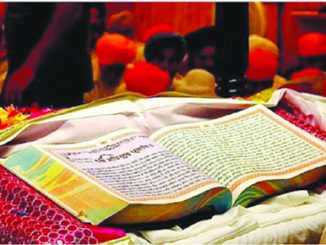
    Guru Arjan also undertook the tremendous task of creating the Adi Granth, which became the predecessor to the Siri Guru Granth Sahib. Recognizing that the Shabad Guru was the base of the Sikh practice, Guru Arjan created a compilation of sacred songs that included the songs of the previous Sikh Gurus, songs from Hindu and Sufi mystics, and his own sacred writings. As a master, Guru Arjan could hear whether a song was in the sound current of the Shabad – and those songs that clearly came from the Universal Teachings were incorporated into the work. Guru Arjan viewed the Adi Granth as holding the eternal, universal wisdom of the Shabad Guru. While working on the Adi Granth, he would keep the Adi Granth on his bed and himself sleep next to it on the floor – like a servant. The Adi Granth exemplified the Sikh Gurus’ teachings that the Word, itself, is the Teacher – not a human person.

    During this period of time, the community that surrounded Guru Arjan thrived and became very prosperous. Through a series of political intrigues, the sovereignty of Guru Arjan and his people were challenged by the Mughal Emperor Jahangir. To protect the independence of the community, Guru Arjan allowed himself to be tortured for five days and five nights. He was chained to a hot metal plate while his captors poured burning sand on his body. Guru Arjan smiled the entire time, for he saw the hand of the Divine behind it all. He saw the One Creator playing every part in the torture and recognized his Union with the Creator. After five days and nights, Guru Arjan was permitted to bathe in a nearby river. Guru Arjan dove into the water and dissolved into Light. His physical body was never seen again.

    Early life

    Guru Ram Das had envisioned heavenly qualities in his youngest son Arjan. From his earliest childhood the Guru had found him to be imbued with the Name, and immersed in tranquillity. Almost since his birth it seemed that the Guruship was destined to be bestowed upon Arjan. One day baby Arjan had crawled up onto the Divine throne of his grandfather, Guru Amar Das the third Guru, and sat there comfortably.

    Seeing this the Guru smiled and prophesied, “My maternal Grandson will ship the Name across.” But growing up Arjan was always well aware that despite his Grandfather’s prediction, it was the service to the Sangat, not their lineage that had bestowed Guruship on the previous preceptors, Guru Angad and Guru Amar Das. With this in mind, he indulged in Seva (service) most ardently.

    But his emotive intentions were always quite perceptible to his father, Guru Ram Das Ji and, all to apparent to his eldest brother, Prithi Chand, who suspecting the consequence of their Grandfather’s prophecy, indulged in numerous means to disrupt the life of Guru Arjan, that ended in bringing about what he had feared.

    Sent to Lahore to attend a wedding on behalf of his father, Arjan was kept there for a long time, by the cunning manipulations of his elder brother Prithi Chand, who had long worked to inherit the Guru Gaddi (Throne) himself. But by his interception and concealment of a series of letters that Arjan had sent to his father; (Majh M.5 G.G.S. Page 96) his duplicity, when it was discovered, ended with Arjan being installed as the fifth Guru.

    Despite his brother’s actions he showed no resentment to his elder brother and inundated him with reverence and honour. Guru Arjan Dev Ji was a born an apostle of peace. Although he ascended the throne of Guru Nanak at the age of 18, he was far more advanced in wisdom than normal for his years not to ention his angelic qualities. The letters he wrote to his father from Lahore, not then even a teen-aged boy, stand testimony to that fact.

    Completion of the Harmandar Sahib

    The Basics of the new religion had been defined by Baba Nanak, and the groundwork was carried out by three of his successors. Guru Arjan Dev Ji set upon a mission of putting it on a solid footing. As ordained by his predecessors, Guru Nanak through Guru Ram Das Ji, he took the task of the completion of the place where his father had constructed a clay tank of Nectar. In the true spirit of “I am neither Hindu, nor Muslim…” Guru Arjan Dev Ji invited Mian Mir, a Muslim Saint from Lahore to lay the cornerstone of the foundation of the Harmandar, the present Golden Temple. The doors on all four sides of the building signified its acceptance of all the four castes and every Religion. Contrary to the requests of the congregation, the floor of the Harmandar Saheb was kept lower than the surrounding area; as the water flows downward so would the seekers of God’s blessings. Along with God’s House came the existence of the City of Amritsar with all its reverence, amenities, and gaiety.

    The completion of the Adi Granth

    The preparation of the Holy Book is the most valuable achievement of Guru Arjan Dev Ji. With three things in his mind he initiated the compilation of the Holy Book, the present Guru Granth Sahib. Unfortunately the Hymns and teachings of the first four Gurus were being added to and even distorted by impostors. Seeing such things going on Guru Arjan wanted to preserve these original treasures. Not only fixing the path of the efforts of his predecessors, but also bestowing, on the Panth, an ever-lasting guiding light that was to serve as both a physical and spiritual phenomenon.

    And most of all he wanted to establish the credibility of the Sikh Religion as a casteless and secular society. Laced among the Hymns of the earlier Nanaks he added his own compositions as well as, the celestial utterances of Sheikh Farid and Bhagat Kabir, Bhagat Ravi Das, Dhanna Namdev, Ramannand, Jai Dev, Trilochan, Beni, Pipa and Surdas. All of whom belong to different times, beliefs, sects, and Castes from high and low.

    The poetic revelations of Guru Arjan are of the greatest aesthetic calibre. More than half of the Guru Granth Sahib is constituted of his own holy renderings. The Granth Sahib is not only a collection of the revelations but also it throws considerable light on the contemporary political and social life; the physical being and spiritual awareness are fused into one. Among his other equally important accomplishments are the creation of new cities at Kartarpur, Tarn Taran with its magnanimous Tank of Salvation and the construction of the Baoli at Lahore.

    Martyrdom of Guru Arjan

    On 16 June 1606, the Mughal Emperor Jahangir ordered that Guru Arjan Dev Ji, the fifth Sikh Guru be tortured and sentenced to death after the Guru had refused to stop preaching his message of God as started by Guru Nanak Dev Ji. The Guru was made to sit on a burning hot sheet while boiling hot sand was poured over his body. After enduring five days of unrelenting torture, Guru Arjan Dev Ji was taken for a bath in the river. As thousands watched he entered the river, never to be seen again.

    Accordingly, on the 16 of June of every year since 1606, the Sikhs commemorate the martyrdom of Guru Arjan Dev Ji, the fifth Guru and the first Sikh Martyr. Before the arrest, torture, and martyrdom of Guru Arjan Dev, the Sikhs had nothing to do with weapons or violence, as all the Sikh Gurus had taught the message of compassion, love, dedication, hard work, worship of one God, and the commitment to peace and harmony for all the people of the world.

  • Installation of Shri Guru Granth Sahib

    Installation of Shri Guru Granth Sahib

    The compilation of the Sikh scripture Shri Guru Granth Sahib  was completed on 29 August, 1604, and was first  installed inside the Golden Temple in Amritsar on 1 September, 1604

    One of the classic simplifications of Sikh history pertains to the preparation of the sacred scripture, the Guru Granth Sahib. The event is generally described in the briefest terms.

    The Holy Volume was compiled by Guru Arjan (A.D. 1563-1606) and the first copy was calligraphed by Bhai Gurdas at his dictation-this is all we learn from most of the sources.

    What amount of planning, minute attention to detail and labour went into this work is slurred over. An old text which gives some detailed information is the Gurbilas Chhevin Patshahi. Written in AD. 1718, this, in fact, is the oldest source. Although it does not go into the technical and literary minutiae, it narrates the entire process from the beginning of the transcription of the Holy Volume to its installation in the newly built Harmandir Sahib (Golden Temple) at Amritsar.

    Why Guru Arjan undertook the task is variously explained. One commonly accepted assumption is that the codification of the Gurus’ compositions into an authorized volume was begun by him with a view to preserving them from garbling by schismatic groups and others. According to the Mahima Prakash (AD. 1776), he set to work with the announcement : As the Panth (Community) has been revealed unto the world, so there must be the Granth (Book), too. The bani, Gurus’ inspifed utterance, had always been the object of highest reverence for the Sikhs as well as for the Gurus themselves. It was equated with the Guru himself. The bani is the Guru and the Guru bani, sang Guru Ram Das in measure Nat Narain. By accumulating the canon, Guru Arjun wished to affix the seal on the sacred word. It was also to be the perennial fountain of inspiration and the means of self-perpetuation for the community.

    Guru Arjan called Bhai Gurdas to his presence and expressed to him the wish that the compositions of the Gurus as well as those of some of the saints and sufis be collected. Massages were sent to the disciples to gather and transmit to him the hymns of his predecessors.

    Baba Mohan, son of Guru Amar Das, Nanak III, had two manuscript collections of the Gurus’ hymns inherited from his father. Bhai Gurdas travelled to Goindwal to bring these pothis, but the owner refused to see him. Bhai Buddha, one of the oldest Sikhs from Guru Nanak’s days, was similarly turned away from his door. Then Guru Arjun went himself. He sat in the street below Mohan’s attic serenading him on his tambura. Mohan was disarmed to hear the hymh. He came downstairs with the pothis and presented these to the Guru. As says the Gurbilas, the pothis were placed on a palanquin bedecked with precious stones. The Sikhs carried it on their shoulders and Guru Arjun walked behind barefoot. He refused to ride his horse, saying that the pot his were the very spirit of the four Gurus-his predecessors.

    The cavalcade brokejourney at Khadur Sahib to make obeisance at shrines sacred to Guru Angad. Two kos from Amritsar, it was received by Hargobind, Guru Arjan’s young son, accompanied by a large number of Sikhs. He bowed at his father’s feet and showered petals in front of the pot his. Guru Arjan, Hargobind, Bhai Gurdas and Bhai Buddha now bore the palanquin on their shoulders and marched towards Amritsar, led by musicians, with flutes and drums. In Amritsar, Guru Arjun first went to the Harimandir to offer karah prasad in gratefulness.

    The making of the Granth was no easy task. It involved sustained labour and a rigorous intellectual discipline. Selections had to be made from a vast amount of material. Besides the compositions of the four preceding Gurus and the Guru Arjan who him self was a poet with a rare spiritual insight, there were songs and hymns by saints, both Hindu and Muslim. What was genuine had to be sifted from what was counterfeit. Then the selected material had to be assigned to appropriate musical measures and transcribed in a minutely laid out order.

    Guru Arjan carried out the work with extraordinary exactness. He arranged the hymns in thirty different ragas, or musical patterns. A precise method was followed in setting down the compositions. First came sabdas by the Gurus in the order of their succession. Then came chhands, vars, and other poetic forms in a set order. The compositions of the Gurus in each raga were followed by those of the Bhaktas in the same format. Gurmukhi was the script used for the transcription.

    A genius, unique in spiritual insight and not unconcerned with methodological design, had created a scripture with an exalted mystical tone and a high degree of organization. It was large in size-nearly 7,000 hymns, comprising compositions of the first five Sikhs Gurus and fifteen Bhaktas and sufis from different parts of India, including Shaikh Farid, Kabir and Ravidas. The Sacred Volume consisted of 974 leaves, or 1948 pages, 12×8, with several blank ones at the end of a raga when there were not sabdas enough to fill the section assigned to it. The site of these marvellous labours is now marked by a shrine called Ramsar.

    The completion of the Granth Sahib was celebrated with much jubilation. In thanksgiving, karah prasad was prepared in huge quantities. Sikhs came in large numbers to see the Holy Book. They rejoiced in their hearts by a sight of it and bowed before it in veneration. Among the visitors was Bhai Banno, who had led a group of Sikhs from Mangat, in western Punjab. Guru Arjan, who knew him as a devoted Sikh, instructed him to go to Lahore and have the Book bound. Banno sought the Guru’s permission to be allowed to take the Granth Sahib first to Mangat for the Sikhs there to see it. The Guru allowed this, but enjoined him not to tarry at Mangat, or at any other place, more than a night.

    As Banno left Amritsar with his sacred charge, it occurred to him o have a second copy transcribed. The first copy, he argued, would remain with the Guru. There must be an additional one for the sangat. The Guru’s direction was that he should not stay longer than one night at a place, but he had said nothing about the time to be spent on the journey. So he proceeded with his plans and sent a Sikh to purchase paper. He proposed to his companions that they should travel by easy marches of five miles a day. The time thus saved was utilized in transcribing the holy text. Sikhs wrote with love and devotion and nobody shirked his duty whether it was day or night. By the time they reached Lahore, the second copy was ready. But Banno had added to it some apocryphal texts. He had both volumes bound and returned to Amritsar as fast as he could.

    At Amritsar, he was received with due ceremony, though Guru Arjun was not a little surprised to see two volumes instead of one. Bhai Banno spoke truthfully: Lord, there is nothing that is hidden from you. This second copy I have had made for the sake of the sangat. But the Guru put his seal only on the volume written by Bhai Gurdas’s hand. He enjoined the Sikhs to own the Granth equal with the Guru and make no distinction between the two. He who would wish to see the Guru, let him see the Granth. He who would seek the Guru’s word, let him read the Granth with love and attention.

    Guru Arjan asked his Sikhs where the Granth Sahib be installed. Bhai Buddha said, You are omniscient, Master! But there is no place more suitable than the Harimandir. The Guru was happy to hear these words like one who has sighted the new moon. He then recited the praise of the Harimandir: There is nothing like it in all the three worlds. Harimandir is like the ship-the means for the people to cross over the worldly ocean triumphantly. A new joy pervades here every day. A sight of it annuls all sins.,’

    It was decided to spend the night at Ramsar and return to Amritsar the next morning. The Granth Sahib rested on a seat under the canopy, whereas the Guru and the Sikhs slept on the ground.

    A disciple had to be chosen to take charge of the Granth Sahib. As says the Gurbilas, Guru Arjan lay awake through the night reflecting on the question. His choice finally fell on Bhai Buddha whose devotion was universally applauded. As they awoke, the Guru and his Sikhs made ablutions in Ramsar. The former thereupon practised his wonted meditation. At dawn, the entire sangat marched towards Harmandir Sahib. Bhai Buddha carried the Holy Book on his head and Guru Arjun walked behind swinging the whisk over it. Musicians sang sabdas. Thus they reached the Harimandir. The Granth Sahib was ceremonially installed in the centre of the inner sanctuary on Bhadon Sudi 1, 1661 BK/August 16, 1604. Bhai Buddha opened it with reverence to obtain from it the divine command, as Guru Arjan stood in attendance behind.