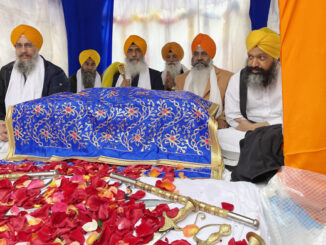
RICHMOND HILL, NY (TIP): An impressive Parade (Nagar Kirtan) was taken out by the Sikh community of the Tri-State area of New York, New Jersey and Connecticut on November 9, 2024 in celebration of the 555th Birth anniversary of Shri Guru Nanak Dev Ji, the First Master of the Sikhs.
Priests in attendance of Shri Guru Granth Sahib
Thousands of devotees followed the Guru Granth Sahib, the Holy Book revered as the Living Master atop a motorized vehicle, with the priests attending and singing hymns (shabad kirtan). Ahead of the float carrying Shri Guru Granth Sahib were the Panj Piaras (the Five Beloveds- the first five disciples of the Tenth Master, Guru Gobind Singh, when he created Khalsa in 1699).
All along the 3-mile route of the parade, a number of organizations and individuals served food and beverages, called langar (free food) to each and everyone. Langar (free food) is a unique feature of Sikhism.
Community leaders walk beside the float carrying Guru Granth Sahib, with milling crowds all around.
Sikhism is the youngest and the fifth most followed religion of the world. The Sikhs, known for their enterprise, are present in every part of the world, and contribute richly to their nations of adoption. The U.S. Canada, UK, account for a larger percentage of the Sikh population. The annual Guru Nanak parade is organized by Gurdwara Baba Makhan Shah Lobana Sikh Center in Richmond Hill in cooperation with the Sikh Gurdwaras and the Sikh organizations in the Tri-State area. The 2024 parade was in its 24th year.
Young boys performed Gatka, a Sikh martial art. A former President of Gurdwara Baba Makhan Shah Lobana, Sardar Daler Singh is the trainer of the Gatka players.
Guru Gobind Singh succeeded his father Guru Teg Bahadur at the age of 9. His teachings were different from his predecessors’ – he believed that no power could exploit the Sikhs.
He spent his childhood years studying Persian and Sanskrit, and was skilled in the art of war. His mission was to uphold right in every place and destroy sin and evil. In 1699 he chose the festival day of Vaisakhi as the occasion to transform the Sikhs into the Khalsa, a family of soldier saints. Guru Gobind Singh introduced many of the customs that Sikhs practise today.
Sikhs who have been through the Amrit ceremony of initiation become Amritdhari, initiated Sikhs. They take new names and wear the 5 Ks – five physical symbols that Sikhs must wear.
He declared the the Sikh holy book as his successor instead of a human being. The Guru Granth Sahib would thus be the Sikhs’ guide forever. Sikhs give it the same status and respect as a human Guru.
In 1699 the tenth guru, Guru Gobind Singh, chose Vaisakhi as the occasion to transform the Sikhs into a family of soldier saints, known as the Khalsa Panth.
Guru Gobind Singh founded the Khalsa in front of thousands at Anandpur Sahib.
During the Vaisakhi festival Guru Gobind Singh came out of a tent carrying a sword. He challenged any Sikh who was prepared to give his life to come into the tent. The Guru returned alone with his sword covered in blood. He then requested another volunteer and repeated the same action four times until five men disappeared into the tent. The crowd was very concerned until they saw five men return wearing turbans with the Guru.
These five men became known as the Panj Piare, or ‘Beloved Five’.
The men were then baptised into the Khalsa by the Guru. He sprinkled them with Amrit (‘immortalising nectar’: the Sikh term for holy water) and said prayers. This is the basis of the Sikh baptism ceremony.
Vaisakhi is celebrated in much the same way as Gurpurbs. Gudwaras are decorated and visited. Parades, dancing and singing happen throughout the day. Many Sikhs choose to be baptised into the Khalsa brotherhood on this day.
The festival is marked with nagar kirtan processions: processions through the streets (nagar means “town”) which form an important part of Sikh culture and religious celebrations.
Kirtan is a term meaning the singing of hymns from the Guru Grath Sahib, the Sikh holy book. Celebrations always include music, singing and chanting scriptures and hymns.
The processions are led by traditionally dressed Panj Piaras.
The Guru Granth Sahib will be carried in the procession in a place of honour.
Amrit Ceremony
Sikhs who have been through the Amrit Ceremony of initiation, or Amrit Sanskar, become baptised Sikhs, take new names, and wear the 5 Ks.
The Amrit Ceremony is the initiation rite introduced by Guru Gobind Singh when he founded the Khalsa in 1699. A Sikh can go through this initiation as soon as they are old enough to understand the full committment that they are making.
The ceremony takes place in a Gurdwara, before the Guru Granth Sahib, and in the presence of 5 initiated Sikhs (who represent the Panj Piyaras, the first 5 Sikhs to be initiated). During the ceremony, hymns are recited from the Sikh scripture, prayers are said, and the principles of Sikhism are affirmed. Then amrit is prepared. Amrit is a mixture of sugar and water that has been stirred with a double-edged sword. The candidates for initiation drink some of the amrit from the same bowl, and have it sprinkled on their eyes and hair.
Each then recites the Mool Mantra (the fundamentals of Sikhism). There are readings from the Guru Granth Sahib and an explanation of rules of Sikhism.
The ceremony ends with the eating of the ceremonial karah parshad. Parshad is a sweet tasting food which has been blessed. It is made from semolina, sugar and ghee.
Khalsa initiation
The 5 Ks date from the creation of the Khalsa Panth by Guru Gobind Singh in 1699.
The Guru introduced them for several reasons:
– Adopting these common symbols would identify members of the Khalsa
– Because all members of the Khalsa wear the 5 Ks the members of the community are more strongly bound together
– Each K has a particular significance. The meaning of the 5 Ks
The 5 Ks taken together symbolise that the Sikh who wears them has dedicated themselves to a life of devotion and submission to the Guru. The 5 Ks are 5 physical symbols worn by Sikhs who have been initiated into the Khalsa.
The five Ks are:
– Kesh (uncut hair)
– Kara (a steel bracelet)
– Kanga (a wooden comb)
– Kaccha – also spelt, Kachh, Kachera (cotton underwear)
– Kirpan (steel sword)
Various reasons and symbolisms have been put forward for the Sikh practice of keeping hair uncut.
– Throughout history hair (kesh) has been regarded as a symbol both of holiness and strength.
– One’s hair is part of God’s creation. Keeping hair uncut indicates that one is willing to accept God’s gift as God intended it.
– Uncut hair symbolizes adoption of a simple life, and denial of pride in one’s appearance.
– Not cutting one’s hair is a symbol of one’s wish to move beyond concerns of the body and attain spiritual maturity.
– A Sikh should only bow his head to the Guru, and not to a barber.
– It is a highly visible symbol of membership of the group.
– It follows the appearance of Guru Gobind Singh, founder of the Khalsa.
– Sikh women are just as forbidden to cut any body hair or even trim their eyebrows, as Sikh men are forbidden to trim their beards.
Kara – a steel bracelet
– A symbol of restraint and gentility.
– A symbol that a Sikh is linked to the Guru.
– It acts as a reminder that a Sikh should not do anything of which the Guru would not approve.
– A symbol of God having no beginning or end.
– A symbol of permanent bonding to the community-being a link in the chain of Khalsa Sikhs (the word for link is ‘kari’).
– The Kara is made of steel, rather than gold or silver, because it is not an ornament.
Kanga – a wooden comb
– This symbolises a clean mind and body; since it keeps the uncut hair neat and tidy.
– It symbolises the importance of looking after the body which God has created. This does not conflict with the Sikh’s aim to move beyond bodily concerns; since the body is one’s vehicle for enlightenment one should care for it appropriately.
Kachha – special underwear
– This is a pair of breeches that must not come below the knee. It was a particularly useful garment for Sikh warriors of the 18th and 19th centuries, being very suitable for warfare when riding a horse.
– It’s a symbol of chastity.
Kirpan – a ceremonial sword
There is no fixed style of Kirpan and it can be anything from a few inches to three feet long. It is kept in a sheath and can be worn over or under clothing.
The Kirpan can symbolise:
– Spirituality
– The soldier part of the Soldier-Saints
– Defence of good
– Defence of the weak
– The struggle against injustice
– A metaphor for God
For a Sikh the fact that the Guru has instructed the Sikhs to wear the 5 Ks is an entirely sufficient reason, and no more need be said. The symbols have become greatly more powerful with each passing year of Sikh history. Every Sikh remembers that every Sikh warrior, saint, or martyr since 1699, and every living member of the Khalsa, is united with them in having adopted the same 5 Ks.
New York City Mayor Eric Adams joined the parade as the Guest of Honor. Deputy Commissioner of International Affairs Dilip Chauhan is seen on the extreme left.
I.S. Saluja
NEW YORK (TIP): Despite rain, Sikh men, women and children in thousands thronged New York City to participate in the annual Sikh Day Parade, April 29. It is a day of the birth of Khalsa, the pure Sikhs. It was on the day of Vaisakhi in 1699 that the Tenth Master of the Sikhs, Shri Guru Gobind Singh Ji created Khalsa, the pure among the Sikhs. The Master (Guru) enjoined upon his Sikhs to fight for basic human rights and against all kinds of injustice, oppression and tyranny. Which made them a martial community. During the British rule of India, the Sikh soldiers were recognized for their valor and the most Victoria Crosses, the highest gallantry award were won by them. In independent India, Sikhs have proved time and again they are the sword arm of the country.
The Sikhs number more than 30 million and are present in every part of the world. Their adventurous spirit has taken them far and wide in search of greener pastures. They created a great impression of themselves as honest and hardworking people. Many Sikhs have won laurels in various fields in countries across the world. The Sikh religion-Sikhism is one of the five major religions of the world. Sikhs believe in unity of mankind and seek good of all. On or around the day of Vaisakhi, which usually falls in the middle of April, Sikhs organize parades and prayers to celebrate their birth. In New York, as elsewhere, every year, thousands of Sikhs gather to celebrate the day. Unconfirmed estimates suggested presence of over 5000 Sikh men, women and children in the parade this year. Over the years, the size of parade has grown, with non-Sikhs also joining in the parade.
The Sikh Day Parade is more a religious affair than a mere social gathering. That is why, the parade is led by the Living Guru of the Sikhs- The Holy Guru Granth Sahib in whose presence a perfect decorum and an atmosphere of spirituality is maintained. On display at the parade were Sikh history, culture and traditions, as also the Sikhs’ holy places. Various forms of Sikh martial art were displayed by the young and not so young.
Many bands, including the NYPD band participated. NYPD Desi officers also were part of a contingent.
A conference was a part of the celebrations where community leaders spoke about their religion and the community. A few politicians and officials also attended the parade and the conference.
A community kitchen (Langar) proved to be a great attraction, with people enjoying many delectable dishes absolutely free. Sikhs are the only community in the world who have the unique tradition of langar. In every Sikh temple, food is provided free to everyone without any discrimination on any basis. The park at 23rd Street was a great place for people to sit in and enjoy the food which was served free to all.
A contingent of NYPD police officers in the parade.The huge crowds, following their Guru, at the Parade in Manhattan on April 29.
Signup to our Newsletter!
Don’t miss out on all the happenings around the world