

Guru Nanak taught us to share. Thanksgiving reminds us to be grateful. Together, they teach us that the finest expression of gratitude is sharing our blessings.
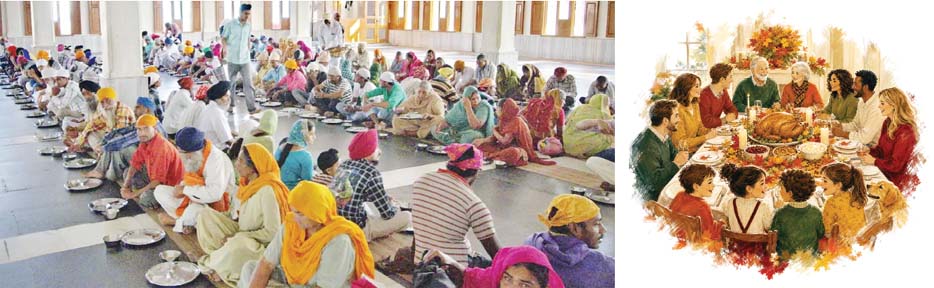
On November 24, Sikhs will commemorate the birth of Guru Nanak, the founder of their faith. Two days later, Americans will gather for Thanksgiving. These are different occasions, rooted in different histories, yet together they offer a message our divided world urgently needs: be grateful for what you receive, and share what you have.
The message is simple enough for a child to understand. Its practice could transform the world.
Born in 1469 in Talwandi, now Nankana Sahib in Pakistan, Guru Nanak challenged the prejudices of his time. He rejected the notion that caste, wealth, or religious identity made one person inherently superior to another. He proclaimed the oneness of God and the dignity of every human being. The Divine, he taught, is not confined to a particular place or the possession of a particular community.
His vision was spiritual, but never detached from daily life. Remember the Divine. Earn an honest living. Share with others. These principles, often expressed as Naam Japna, Kirat Karni, and Vand Chhakna, join faith to responsibility. Worship without compassion, and piety without integrity, fall short of their purpose.
Guru Nanak’s words remain a searching test of our conduct: “Truth is high, but higher still is truthful living.” His teaching asks not merely what we believe, but how we treat people whose needs, convictions, and circumstances differ from our own.
That is why the Sikh tradition of langar speaks so powerfully across boundaries. People sit together and receive a meal without distinction of status, caste, or faith. No one must establish importance before being fed. The shared meal declares what speeches about equality sometimes fail to achieve: each person deserves dignity.
Thanksgiving, too, is centered on a shared meal. Families and friends gather to acknowledge the blessings of the year and the people who have sustained them. For many Indian Americans, the occasion carries particular warmth. It is an opportunity to give thanks for the welcome and opportunities found in an adopted homeland, while remembering parents, teachers, neighbors, colleagues, and countless others whose sacrifices helped make a new life possible.
Yet gratitude should not become self-congratulation. No achievement is entirely our own. Behind every success stand people whose names may never appear in a newspaper: workers who keep our communities functioning, caregivers who sacrifice sleep, and strangers whose timely kindness changes another person’s course.
Nor should Thanksgiving require us to overlook history. Its familiar narratives coexist with the painful history of Indigenous dispossession. A generous understanding of the holiday makes room for remembrance, honesty, and respect. Gratitude and truth need not compete.
The question is what we do after giving thanks. Do we remember the neighbor who eats alone? The family choosing between groceries and rent? The newcomer struggling to find work? The child who needs encouragement more than another gift?
A Thanksgiving table becomes more meaningful when its circle of concern extends beyond those seated around it.
And here is an image from Diwali that captures the possibility before us. A match lights one small lamp. That lamp lights another, and another. Soon a room, a courtyard, or an entire street glows with countless flames.
The first lamp loses none of its light by lighting another.
Is that not the very nature of compassion?
A person who has received kindness may extend it to someone else. One generous act may inspire another. Someone who was helped through hardship may recognize that same hardship in a stranger and respond. The light travels farther than the hands that first kindled it.
We cannot all relieve the suffering of the world at once. But each of us can brighten one person’s world. And that person can brighten another’s.
Let us be lamps that light other lamps.
The analogy should not conceal a difficult truth. Compassion does not spread automatically. It requires decisions, sometimes inconvenient ones: to give time when we are busy, to listen when we disagree, to help when there is no reward, and to defend another person’s dignity when doing so demands courage.
It also requires us to see beyond the boundaries we inherit. Guru Nanak’s message of one Creator challenges the arrogance of claiming that human worth depends on birth or belief. Thanksgiving, at its best, asks Americans of many origins to recognize their dependence on one another.
Neither occasion erases differences. We need not share the same religion, history, or political views to share responsibility for the vulnerable. In fact, our willingness to care across differences may be the clearest measure of our humanity.
In a world marked by war, displacement, suspicion, and loneliness, this responsibility cannot be dismissed as sentimental. A hungry person needs food. A frightened family needs safety. A society divided by hostility needs people willing to speak with respect and act with fairness. Institutions have indispensable duties, but individual conscience matters too.
Compassion must also extend beyond immediate charity. It should inspire us to question the circumstances that leave people hungry, homeless, excluded, or afraid. Feeding a hungry person is an act of kindness; working toward a society in which fewer people go hungry is an expression of the same compassion.
As America observes Thanksgiving in its 250th year of independence, gratitude should also prompt a question about the nation’s promise. Have we made liberty and opportunity more accessible? Have we honored those whose work sustains our prosperity? Have we treated newcomers and long-established neighbors alike as human beings deserving respect?
The same questions can be asked of every community. Celebrating Guru Nanak is not merely remembering a great teacher. It is testing whether his teachings live in our actions.
This November, let us carry something from the gurdwara to the Thanksgiving table, and from the table into the days that follow: the conviction that blessings are not diminished when shared.
Let us thank those who have helped us, feed someone who is hungry, visit someone who is lonely, and offer a hand without first asking whether the person belongs to our community.
The world will not be transformed by a single feast, a single sermon, or a single act of charity. But neither is compassion powerless because it begins small.
One lamp lights another. One heart touches another. And the circle of light grows.
Two traditions. One message. Humanity above all.
HAPPY GURU NANAK BIRTH ANNIVERSARY & HAPPY THANKSGIVING

Be the first to comment