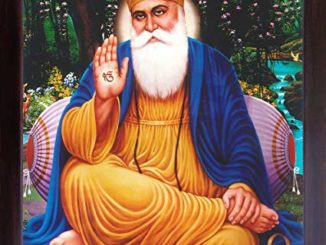
Tag: Guru Nanak Dev Ji

  • Celebrating the 554th birth anniversary of Shri Guru Nanak Dev Ji

    Celebrating the 554th birth anniversary of Shri Guru Nanak Dev Ji

    The nearly 30 million Sikhs across the world are in jubilation to celebrate the 554th birth anniversary of their First Master Shri Guru Nanak Dev Ji on November 27. 

    https://youtu.be/lO0Y-FBMt3A?si=svh9-ZdL98rdn4wf

    Guru Nanak, the founder of Sikhism and the first of the ten Sikh Gurus, was not merely a religious figure but a beacon of humanity, compassion, and social justice. His teachings reverberate through the corridors of time, transcending centuries to inspire and guide humanity towards a path of righteousness, equality, and enlightenment. Guru Nanak’s philosophy encompasses a profound humanism that remains remarkably pertinent in today’s world.

    At the heart of Guru Nanak’s teachings lies a resolute emphasis on the oneness of humanity. He propagated the concept of Ik Onkar, the belief in the unity of God, emphasizing that all human beings are equal regardless of their caste, creed, religion, or social status. In an era marred by deep-seated societal divisions and discriminatory practices, Guru Nanak’s message of equality and unity was revolutionary. He challenged the prevailing societal norms that fostered discrimination, and propagated the dignity of every individual.

    His teachings against blind faith and ritualism challenged the dogmas prevalent during his time. Guru Nanak emphasized the importance of spirituality over mere religious practices. He advocated for a direct connection with the divine through meditation, honest living, and serving humanity. His rejection of empty rituals and emphasis on genuine, heartfelt devotion resonates with the modern quest for spiritual authenticity.

    Guru Nanak was a vehement critic of social exploitation and oppression in all its forms. He spoke out against the oppressive caste system, societal hierarchies, and economic injustices prevalent in society. His teachings denounced the exploitation of the poor and marginalized, advocating for compassion, empathy, and sharing with those in need. He established the concept of langar, a community kitchen where people from all walks of life could sit together and share a meal, breaking down barriers of caste and class.

    The Guru’s humanitarian efforts extended beyond religious boundaries. He traveled extensively, engaging in dialogues with people from different faiths and backgrounds, promoting mutual respect and understanding among diverse communities. His messages of peace, love, and harmony resonate with the principles of tolerance and coexistence that are vital in today’s multicultural world.

    Guru Nanak’s teachings on women’s rights were revolutionary for his time. He advocated for gender equality, condemning the subjugation and mistreatment of women. He believed in the inherent dignity and equality of women, empowering them with equal rights and respect in society. His teachings emphasized the importance of education for both men and women, recognizing the crucial role of women in shaping a progressive society.

    The Guru’s legacy as a humanitarian and social reformer remains incredibly relevant in addressing contemporary global challenges. In an era marked by religious extremism, intolerance, and social inequality, Guru Nanak’s teachings offer a beacon of hope and guidance. His emphasis on compassion, selflessness, and service to humanity serves as a guiding principle for fostering a more inclusive and compassionate society.

    Furthermore, Guru Nanak’s teachings resonate strongly with the ideals of modern humanism. His emphasis on the inherent worth and dignity of every individual, irrespective of their background or beliefs, aligns with the core values of humanism. He encouraged critical thinking, rationality, and a quest for truth, challenging individuals to seek enlightenment through knowledge and introspection.

    Guru Nanak’s profound teachings as a great humanitarian, advocate against blind belief, and proponent of social justice transcend time and continue to hold immense relevance in the modern world. His legacy serves as a guiding light, inspiring individuals to strive for a more equitable, compassionate, and harmonious society. As we navigate the complexities of the contemporary world, the universal message of Guru Nanak stands as a testament to the enduring power of humanism, social justice, and the pursuit of a more enlightened humanity.

    Happy Guru Nanak Prakash Divas (birth anniversary) !


  • All about Sikhs and Sikhism

    All about Sikhs and Sikhism

    The word Sikh (pronounced “sickh”) means ‘disciple’ or ‘learner.’ The Sikh religion was founded in Northern India in the fifteenth century by Guru Nanak Dev Ji and is distinct from Islam and Hinduism. Sikhism is monotheistic and stresses the equality of all men and women. Sikhs believe in three basic principles; meditating on the name of God (praying), earning a living by honest means as well as sharing the fruits of one’s labor with others. Sikhism rejects caste and class systems and emphasizes service to humanity.
    Turbans are worn to cover our long hair and with respect to God. Learn to recognize a Sikh turban. Sikhs have unshorn hair, beards and moustaches. The Sikh faith teaches us the humanitarian principles of freedom, equality, and justice – the same principles this great democracy is founded on. There are about 25 million Sikhs in the world. Sikhs have been in the United States for over 100 years. Sikhism recognizes the universal truths that underlie all human endeavors, religions and belief systems. The universal nature of the Sikh way of life reaches out to people of all faiths and cultural backgrounds, encouraging us to see beyond our differences and to work together for world peace and harmony.
    History and Beliefs
    The almost 25 million Sikhs worldwide constitute the fifth largest religion in the world. Despite almost a million Sikhs living in North America (USA and Canada), Sikhs are often confused as Arabs or Muslims. Sikhs arrived in North America in 1897 and played a pivotal role in the opening of the West and construction of the Panama Canal in 1904. In 1906, Sikhs established their first gurdwara, or place of worship, in the United States. 700,000 Americans and Canadians are Sikh and nearly every major city has a Sikh place of worship and community center.
    The Sikh faith is five hundred years old. Guru Nanak, the founder of Sikhism, taught a message of love. He spoke of a universal God, common to all mankind, not limited to any religion, nation, race, creed, color, or gender. The Sikh religion is strictly monotheistic, believing in one supreme Creator, free of gender, absolute, all-pervading, and eternal. Sikhism views lfe not as a fall from grace, but a unique opportunity to discover and develop the divinity in each of us. Human rights and justice form a cornerstone of Sikh belief, and Sikh history features countless examples of Sikh Gurus and their followers making tremendous sacrifices for the cause of religious freedom and justice. More recently, Sikhs have been some of the most highly decorated soldiers of the British armed services during both World Wars. They played a significant role in the memorable battles of El Alamein in the Burma-China front and also in the allied assault in Italy. In India’s struggle for independence from the British, over two-thirds of all the Indians who were sentenced to life imprisonment or death were Sikh. This is in spite of the fact that Sikhs form less than two percent of India’s population
    The Sikh Identity
    In 1699, the tenth and last living Sikh Guru, Guru Gobind Singh, summoned his followers to the town of Anandpur in Punjab; over 80,000 came. According to history, Guru Gobind Singh appeared before his people, flashed a naked sword, and demanded a head. He repeated his call until five Sikhs volunteered. These five individuals came from different parts of India and from different castes. To these five, and subsequently to many others on that historic day, Guru Gobind Singh bestowed a new discipline, a creed to his Sikhs. The Guru initiated these five in the new order of the Khalsa and then, in a dramatic and historic gesture, they in turn initiated him. On that day, he gave the Sikhs a unique identity which includes five articles of faith:
    – Unshorn hair as a gift of God and Guru and a mark of Sikh identity
    – A small comb for the hair
    – A steel bracelet which signifies a reality with no beginning and no end, and is also symbolic of a Sikh’s commitment to the ideals of his faith, much as wedding ring might indicate fealty and identity
    – A sword indicative of resolve and commitment to justice, and
    – Knee-length breeches in keeping with the disciplined life-style of a Sikh
    For the past 300 years, male Sikhs have been easily recognized by their long unshorn hair covered with a turban. Notably, in traditional Indian society only males of high caste or the elite, ruling class wore turbans. In requiring all Sikhs to don turbans, Guru Gobind Singh envisioned all individuals as noble. Sikh women adhere to the same life style, symbols, rules and conduct, but relatively few choose to wear turbans. Young Sikh boys, instead of wearing a turban, often cover their uncut hair, which is tied in a top-knot, with a simple piece of fabric.
    Along with the aforementioned physical identifiers, Guru Gobind Singh went further in distinguishing Sikhs. In Indian society, an individual’s name reveals one’s caste and social status. Guru Gobind Singh freed Sikhs from the rigid caste system by ordering all Sikh males adopt the surname “Singh,” meaning a lion, and women use the surname “Kaur” meaning princess, thus shedding their caste identity. Each year, Sikhs worldwide commemorate and celebrate the historic events of Vaisakhi 1699 as a milestone in Sikh history when Guru Gobind Singh decreed the formation of the Khalsa and fashioned the nation of Sikhs.
    The Sikh Scripture
    Guru Gobind Singh also decreed an end to the line of Gurus in human form. The writings of the earlier Gurus were collated along with those of Hindu and Muslim spiritual figures whose teachings strongly resonated with Sikh beliefs. This collection of writings is known as Guru Granth Sahib, a uniquely ecumenical and eclectic collection of spiritual writings. For Sikhs, Guru Granth Sahib is the repository of all spiritual knowledge and authority. In temporal matters all authority rests with the Sikh community worldwide acting democratically and in mindful prayer with an awareness of the spiritual heritage which is embodied in the Guru Granth. Sikhs revere the ten Gurus, Guru Nanak to Guru Gobind Singh, because they delivered the divine word of the one, timeless God. The word “Guru” acquires, therefore, a very special meaning for Sikhs. It is reserved only for the ten Gurus who gave us the divine message and to this message contained in the Guru Granth Sahib.
    The Gurdwara
    The Sikh place of worship, or Gurdwara, is more than a place of worship. It has historically served as a refuge for the homeless and the destitute. Gurdwaras usually display the Nishan Sahib, a saffron-colored triangular flag bearing the khanda, the symbol of the Sikh faith. Visitors, irrespective of their religion, are offered shelter, comfort, and food. The prerequisites for entering a Gurdwara are removing shoes and covering one’s head with a handkerchief, scarf, or other cloth.
    In a Gurdwara, no special place or seat may be reserved or set aside for any dignitary, as all are considered equals. The service consists of singing of the liturgy, as well as the exposition of Sikh history, tradition, and theology. Non-Sikhs are always welcome. Sikh gurdwaras all over the world usually run free community kitchens, which provide meals to all. These kitchens are run and funded by volunteers. In traditional Indian society, people of high and low caste were rigidly segregated. To combat this social problem, the Sikh community kitchen, or langar, requires everyone to sit side by side and eat together, thereby teaching the concept of equality by shattering all barriers of caste and class. Every major city in the United States and Canada has Sikh gurdwaras and they are open to all.
    The Sikh Way of Life
    Sikhism is a practical religion and Sikhs are a pragmatic people. The emphasis is on a leading a worldly, successful life as a householder and a contributing member of society, but with the mind attuned to an awareness of God. Sikhism rejects all distinctions based on caste, creed, gender, color, race, or national origin. For Sikhs, God is not found in isolation or by renouncing the world, but is attained as an active family member and member of one’s community. The word “Sikh” means student. Therefore, a Sikh is and remains a student of the meaning of life. The core values of Sikhism are derived from three equally important tenets: an honest living and an honest day’s work, sharing with others what God and life have given, and living life fully with an awareness of the divine within each of us. Sikhism enunciates a philosophical concept termed Miri-Piri, which means living a life with an active, strong sense of commitment to the world and humanity, governed and directed by a strong foundation and underpinning of spirituality. Thus, the Sikh ideal is to strike a perfect balance and integration of these two states of existence.
    In matters that affect the Sikh community, Sikhs have throughout history followed a simple but effective mechanism whereby individual voices are heard and decisions reflect the current state of knowledge, information and technology. In all such matters, and in honor of the first five Sikhs who heeded the call of Guru Gobind Singh in 1699, the voice of the community is channeled through five initiated Sikhs selected and authorized to resolve issues and speak as the voice of the community. Sikhs believe that God and Guru pervade the congregation when five Sikhs act in mindful prayer. Decision making, thus, becomes a collective process. Sikhs do not have a priestly hierarchy with its associated ecclesiastical authority.
    Source: Sikhnet

  • Government of India Announce Ambitious Plans to Celebrate Guru Nanak Dev Ji’s 550th Birth Anniversary

    Government of India Announce Ambitious Plans to Celebrate Guru Nanak Dev Ji’s 550th Birth Anniversary

    NEW YORK(TIP): The Consulate General of India at New York in a press note enumerated the recent  steps taken by Govt. of India with respect to Sikh community and celebration of   550th Birth Anniversary of Shri Guru Nanak Dev Ji.

    • On November 22, 2018, the Indian Union Cabinet passed a resolution to celebrate 550thbirth anniversary of Shri Guru Nanak Dev ji within India and across the world.
    • The historic town of Sultanpur Lodhi is being developed as a heritage town. The upgradation of the Railway Station and the Museum will be completed by mid-October 2019.
    • The foundation stone-laying ceremony for the heritage complex “Pind Babe Nanak Da” will be held in October 2019.
    • Commemorative coins and postage stamps will be released in November 2019. Indian Railways will run special trains to connect places associated with Shri Guru Nanak Dev ji.
    • Taking the 550thbirth anniversary as an opportunity, a more proactive focus is being given to popularizing the teachings and philosophy of Sikhism, as India’s unique contribution to world peace and harmony.
    • The 550thbirth anniversary of Shri Guru Nanak Dev ji is being celebrated in all Missions and Posts abroad. LED projection on iconic buildings in 10 identified countries around the world on the will be undertaken.
    • A Centre for Inter-faith Studies is being set up in Guru Nanak Dev University, Amritsar. Besides, Chairs on Guru Nanak Dev ji are proposed to be set up in foreign universities including in Concordia University, Canada and Birmingham University, UK. It is proposed to have UNESCO publish the writings of Guru Nanak Dev ji into different languages of the world.
    • Indian Council for Cultural Relations (ICCR) is sending Gurbani troupes and speakers/ experts on Sikhism to participate in seminars in several countries abroad.
    • The Consulate has also organized several events along with local partners to commemorate this special occasion throughout the year.

     Development of the Kartarpur Sahib Corridor (KSC)

    • The Government has started the development of the Kartarpur Sahib Corridor (KSC) from Dera Baba Nanak (DBN) in Gurdaspur district up to the international boundary. Work on border infrastructure is in full swing. The passenger terminal building at Dera Baba Nanak will be completed by October 31, 2019 and a National Highway connecting the zero point to the passenger terminal building and National Highway 354 will be completed by mid-October 2019. Government has also been successful in persuading Pakistan to agree to:

    (a)     visa-free arrangement and a substantial increase in the daily pilgrims’ number, and

    (b)     Permit OCI card holders to also make use of the Kartarpur Sahib Corridor.

    Steps being taken for giving Passports & Consular Services to people who have not obtained foreign citizenship.

    • Grievances of the Sikh community abroad regarding denial of consular services have been systematically addressed in the past months. The redressal includes a comprehensive review and revision of travel restrictions for foreigners, as a result of which restrictions on 312 Sikh foreign citizens have been removed. Now passports and consular services will be provided to political asylees of Sikh origin as well as their family members. In cases where they have obtained foreign passports they can easily obtain necessary visa and OCI services.

    Release of Sikh prisoners and action being taken on punishing those involved in 1984 anti-Sikh riots.

    • There have been long standing requests of the Sikh community and representative bodies to release various prisoners linked with erstwhile militancy currently in jails in India. There requests are under active consideration of the Government and several have been released and are being released.
    • A Special Investigation Team (SIT) has been constituted to re-investigate 186 cases filed in the anti-Sikh riots of 1984, to ensure justice for the victims. The investigations have been expedited leading to charge sheets being filed in some cases, and the convictions in others. Government has also announced additional compensation of Rs.5 lakh each to the 3325 victims of the 1984 riots throughout India.
    • Government has also released an amount of Rs.2.16 crores to Government of Punjab for disbursement to the 40 ‘Jodhpur detainees’.