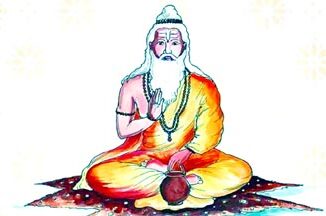
Guru Purnima, also known as Vyasa Purnima, is observed and celebrated every year throughout India. This year, Guru Purnima will be observed on July 3. There is a law of worship of Guru on this day. The religious gurus of Hinduism are worshiped by their followers. Guru Purnima comes at the beginning of the rainy season. On this day all saints take bath in the Ganges river together.
It is celebrated by Hindus, Jains and Buddhists as a festival in India, Nepal, and Bhutan. This festival is traditionally celebrated by Hindus, Buddhists and Jains to honor and express their gratitude to their chosen spiritual teachers Dharma Guru.
This day is also the birthday of Krishna Dwaipayan Vyas, the author of Mahabharata. He was a Sanskrit scholar and also composed the four Vedas. For this reason, he is also named Ved Vyas. He is called Adiguru and Guru Purnima is also known as Vyasa Purnima in his honor. It is the day when Ved Vyas was born in the Mahabharata period by Sage Parashar, the daughter of a fisherman, Satyavati. Bhaktikal’s saint Gheesadas was also born on this day, he was a disciple of Kabirdas. The Sanskrit word Guru has been derived from two different words Gu and Ru. Gu means ignorance or darkness and Ru means elimination or removal. Thus, the term Guru means someone who removes all the darkness by enlightening and providing knowledge to the students. Read on to know more about Guru Purnima 2021 which is dedicated to our beloved and respected gurus or teachers.
Observances
The celebration is marked by ritualistic respect to the guru, Guru Puja. The Guru Principle is said to be a thousand times more active on the day of Gurupurnima than on any other day. The word guru is derived from two words, gu and ru. The Sanskrit root gu means darkness or ignorance, and ru denotes the remover of that darkness. Therefore, a guru is one who removes the darkness of our ignorance. Gurus are believed by many to be the most necessary part of life. On this day, disciples offer puja (worship) or pay respect to their guru (spiritual guide). In addition to having religious importance, this festival has great importance for Indian academics and scholars. Indian academics celebrate this day by thanking their teachers as well as remembering past teachers and scholars.
Traditionally the festival is celebrated by Buddhists in honor of the lord Buddha who gave His first sermon on this day at Sarnath, Uttar Pradesh, India. In the yogic tradition, the day is celebrated as the occasion when Shiva became the first guru, as he began the transmission of yoga to the Saptarishis. Many Hindus celebrate the day in honor of the great sage Vyasa, who is seen as one of the greatest gurus in ancient Hindu traditions and a symbol of the Guru-shishya tradition. Vyasa was not only believed to have been born on this day, but also to have started writing the Brahma Sutras on ashadha sudha padyami, which ends on this day. Their recitations are a dedication to him, and are organised on this day, which is also known as Vyasa Purnima. The festival is common to all spiritual traditions in Hinduism, where it is an expression of gratitude toward the teacher by his/her disciple. Hindu ascetics and wandering monks (sanyasis), observe this day by offering puja to their guru, during the Chaturmas, a four-month period during the rainy season, when they choose seclusion and stay at one chosen place; some also give discourses to the local public. Students of Indian classical music, which also follows the Guru shishya parampara, celebrate this holy festival around the world.
Hindu legend
This was the day, when Krishna-Dwaipayana Vyasa – author of the Mahabharata – was born to sage Parashara and a fisherman’s daughter Satyavati, thus this day is also celebrated as Vyasa Purnima.Veda Vyasa, did yeoman service to the cause of Vedic studies by gathering all the Vedic hymns extant during his times, dividing them into four parts based on their use in the sacrificial rites, and teaching them to his four chief disciples – Paila, Vaisampayana, Jaimini and Sumantu. It was this dividing and editing that earned him the honorific “Vyasa”.
“He divided the Veda into four, namely Rig, Yajur, Sama and Atharva. The histories and the Puranas are said to be the fifth Veda.”
Yogic lore
In yogic lore, it is said that Guru Purnima was the day that saw the birth of the Adi Guru, or the first Guru. The story goes that over 15,000 years ago, a yogi[9] appeared in the upper regions of the Himalayas. Nobody knew what his origins were. But his presence was extraordinary, and people gathered. However, he exhibited no signs of life, but for the occasional tears of ecstasy that rolled down his face. People began to drift away, but seven men stayed on. When he opened his eyes, they pleaded with him, wanting to experience whatever was happening to him. He dismissed them, but they persevered. Finally, he gave them a simple preparatory step and closed his eyes again. The seven men began to prepare. Days rolled into weeks, weeks into months, months into years, but the yogi’s attention did not fall upon them again.After 84 years of sadhana, on the summer solstice that marks the advent of Dakshinayana, the earth’s southern run, the yogi looked at them again. They had become shining receptacles, wonderfully receptive. He could not ignore them anymore. On the very next full moon day, the yogi turned south and sat as a guru to these seven men. The Adiyogi (the first yogi) thus became the Adi Guru. Adiyogi expounded these mechanics of life for many years. The seven disciples became celebrated as the Saptarishis and took this knowledge across the world.Guru Purnima is held sacred in the yogic tradition because the Adiyogi opened up the possibility for a human being to evolve consciously. The seven different aspects of yoga that were put in these seven individuals became the foundation for the seven basic forms of yoga, something that has still endured.
Observances by Buddhists and Hindus Buddhists observe on this day uposatha i.e. to observe eight precepts. Vipassana meditators practice meditation on this day under the guidance of their teachers. Rainy season i.e. varsha vassa also starts with this day. During the rainy season lasting for three lunar months from July to October. During this time Buddhist monks remain in a single place, generally in their temples. In some monasteries, monks dedicate the Vassa to intensive meditation. During Vassa, many Buddhist lay people reinvigorate their spiritual training and adopt more ascetic practices, such as giving up meat, alcohol, or smoking.
The Hindu spiritual Gurus are revered on this day by a remembering their life and teachings. Vyasa Puja is held at various temples, where floral offerings and symbolic gifts are given away in his honour and that of the cosmic satguru. The festivities are usually followed by feast for the disciples, shishya, where the prasad and charnamrita literally nectar of the feet, the symbolic wash of Guru’s feet, which represents his grace, kripa is distributed.
Tag: Guru Purnima
-

Guru Purnima
-

Guru Purnima
Guru Purnima is a special day for Hindus. A full moon day occurs when the moon is fully visible at night. This day also known as Vyas Purnima, is the birthday of Ved Vyas. There is a law of worship of Guru on this day. The religious gurus of Hinduism are worshiped by their followers. Guru Purnima comes at the beginning of the rainy season. On this day all saints take bath in the Ganges river together. It is celebrated by Hindus, Jains and Buddhists as a festival in India, Nepal, and Bhutan. This festival is traditionally celebrated by Hindus, Buddhists and Jains to honor and express their gratitude to their chosen spiritual teachers Dharma Guru. This day is also the birthday of Krishna Dwaipayan Vyas, the author of Mahabharata. He was a Sanskrit scholar and also composed the four Vedas. For this reason, he is also named Ved Vyas. He is called Adiguru and Guru Purnima is also known as Vyasa Purnima in his honor. It is the day when Ved Vyas was born in the Mahabharata period by Sage Parashar, the daughter of a fisherman, Satyavati. Bhaktikal’s saint Gheesadas was also born on this day, he was a disciple of Kabirdas.
What is the Guru? It is told by a verse. Which is as follows: –
Agyan timiraandhashch gyananjan shalakya, chakshunmeetim tasmai shri guroo nam:
In a verse for equality between the Guru and the deity, it has been said that the need of devotion is for the deity as it is for the guru as well. Rather it is possible to interview God with the grace of Sadhguru. Nothing is possible in the absence of the Guru’s grace.
Guru Brahma, Guru Vishnu, Guru Devo Maheshwara |
Guru Sakshat Param Brahma, Tasmai Shri Gurave Namah Guru is Brahma ||
Guru is Vishnu, Guru is Lord Maheshwara. Guru is verily the supreme reality. Sublime prostrations to Him.
Significance of Guru Purnima
Guru Purnima, otherwise called Vyasa Purnima, is celebrating the birth anniversary of Veda Vyasa, the legendary author of Mahabharata. Full moon day in the month of June-July is the witness of celebrating Guru Purnima. Hindus, Buddhists and Jains are celebrating this day in various forms. As part of our culture, Hindus are honouring Veda Vyasa on that day. Disciples are expressing their love, gratitude and devotion to their teachers. Among Buddhists, disciples are worshipping and honouring Lord Buddha during Guru Purnima day. As per the part of Jain religious custom, people are celebrating Guru Purnima as Treenok Guha Purnima in the name of Ganadhara becoming Treenok Guha. As in the terms of the basics of oldest Hindu mythology, Lord Shiva is denoted as first Guru and he had two disciples Shani and Parashurama. He introduced civilization and religion on earth. That is the story behind the name of Adidev and Adiguru to Lord Shiva. He provided seven people with Shani and Parasurama and after that, they began to be known as Saptarishis and they distributed knowledge of Shiva to the whole world. Purnima ritual is started by waking up in the early morning and taking a bath. Wearing white or yellow clothes is necessary. After that, praying to Lord Vishnu, Lord Shiva, Guru Brihaspati, Saint Ved Vyas along with our own Guru. On that occasion, students are worshipping the picture of these Gods by setting on a white cloth. Yet, people are using flowers, lamps, naivedya, sandalwood etc to honour Guru. Washing the feet of Guru by chanting the mantra and offering flowers to show their respect. Guru Purnima is considered as auspicious for the person who wants to become saints and give their life to Guru can join Ashram.
The traditional perspective of Guru Purnima is entirely different from the modern view. As per the traditional Hindu mythology, disciples are worshipping their Guru based on rituals and customs. But today, all the academic institutions’ students are celebrating Guru Purnima as Teachers day by thanking their teachers. Devotees are remembering saint Vyasa through some facts. First of all, Vyasa is known as the author of Mahabharata and Bhagavad Gita. He was the legend who wrote eighteen Puranas. Vyasa is represented as the guru of Dattatreya. Yet, he was known as the guru of all gurus.
History of Guru Purnima
Legends say that Ved Vyas structured the four Vedas, composed the epic of the Mahabharata, created the foundation for the many Puranas and the day of Guru Purnima is to honor him.
Some also say that Guru Purnima represents the date on which Lord Shiva as the Adi Guru taught the seven rishis who were the seers of the Vedas.
In some parts, Buddhists celebrate this day as Buddha Purnima too as it is believed that Lord Buddha was said to have delivered his first sermon on this day at Sarnath, reflecting the power of this sacred time.
How to celebrate Guru Purnima
– On this day people worship the gods who are our ultimate teachers in life.
– It has also been seen that people associate importance of Vishnu pooja with Guru Purnima.
– The thousand names of Lord Vishnu also known as Vishnu Sahatranam should be recited on this day.
– The day is celebrated with full vigor and auspiciousness of thanking the lords and the Gurus.
Fasting and food traditions on Guru Purnima
– Many people fast on this occasion. They refrain from eating salt, rice, heavy foods such as non-vegetarian dishes and other meals made of cereals.
– They only eat yogurt and fruit mostly.
– People break their fast after performing puja and other rituals in the evening.
– In most houses a feast of delicious Indian delicacies like poori, choley, halwa and other exuberant sweets are prepared and enjoyed.