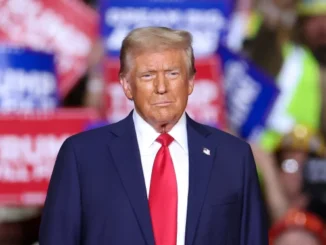
WASHINGTON, D.C. (TIP): US President Donald Trump appears to have softened his stance on his administration’s aggressive push on H-1B visa reforms, acknowledging the need for specialized foreign talent to fill critical roles in the American workforce.
During a TV interview on Tuesday, November 11, Trump defended the value of skilled immigrant workers, arguing that the US could not simply repurpose long-term unemployed Americans for complex roles in manufacturing and defense without extensive training.
When the interviewer said the US had “plenty of talented people,” Trump countered, “No, you don’t. There are certain skills you don’t have, and people have to learn them. You can’t take people off the unemployment line and say, ‘I’m going to put you into a factory where we’re going to make missiles.’”
Trump cited an example from the state of Georgia, where, according to him, the removal of skilled foreign workers created difficulties in manufacturing complex products. His remarks mark a notable shift from his earlier stance on foreign worker visas, particularly the H-1B programme, which has been a central topic in US debates over immigration and employment.
WASHINGTON, D.C. (TIP): The US Chamber of Commerce has filed a lawsuit against the Donald Trump administration’s decision to impose a USD 100,000 fee on all new H-1B visa petitions, describing it as “misguided policy and plainly unlawful” action that could cripple American innovation and competitiveness.
The lawsuit, filed Thursday, October 16, in a district court in Columbia, challenges the administration’s September 19 proclamation, ‘Restriction on entry of certain nonimmigrant workers’, arguing that it violates the Immigration and Nationality Act by overriding Congress’ authority to regulate the H-1B visa programme.
The departments of Homeland Security and State, along with their secretaries, Kristi L Noem and Marco Rubio, respectively, have been named as defendants.
The exorbitant fee, up from the current level of around USD 3,600, would make it “cost-prohibitive for US employers, especially start-ups and small and midsize businesses to utilize the H-1B programme, which was created by Congress expressly to ensure that American businesses of all sizes can access the global talent they need to grow their operations here”, said Neil Bradley, Executive Vice President and Chief Policy Officer at the US Chamber.
In its complaint, the business body said the proclamation is “not only misguided policy; it is plainly unlawful”.
The president, it said, has significant authority over the entry of noncitizens into the US, but that authority is bounded by statute and cannot directly contradict laws passed by Congress.
“The proclamation does precisely that: It blatantly contravenes the fees Congress has set for the H-1B programme and countermands Congress’s judgment that the programme should provide a pathway for up to 85,000 people annually to contribute their talents to the United States for the betterment of American society,” it stated.
The proclamation exceeds the president’s lawful authority, the complaint underlined.
Bradley said the Chamber has actively backed Trump’s proposals to attract more investment in America, but to support this growth, the US economy will “require more workers, not fewer”.
Tens of thousands of highly skilled people in specialized fields boost the American economy each year after obtaining H-1B status. These workers allow businesses of all sizes, in industries across the economy, to innovate and grow. The resulting innovations lead to more American jobs, higher wages, and new products and services that improve the quality of life for all Americans.
The Chamber’s complaint contends that the new proclamation “upends” a carefully balanced statutory framework.
“If implemented, that fee would inflict significant harm on American businesses, which would be forced to either dramatically increase their labor costs or hire fewer highly skilled employees for whom domestic replacements are not readily available,” it said.
According to the Chamber, such restrictions would also hand an economic advantage to America’s rivals, “who will surely welcome the talent no longer able to accept work in the United States. That is a competitive edge that foreign employers might never cede back”.
In September, President Donald Trump signed the proclamation, raising the fee for H1-B visas to a staggering USD 100,000 (approx INR 88 lakhs) annually, in a move that could adversely impact Indian professionals on visas in the US.
Indians make up an estimated 71 per cent of all approved H-1B applications in recent years, according to the US Citizenship and Immigration Services (USCIS). Companies pay to sponsor H-1B applicants.
While the US tightens its visa regime, China has recently announced a new work permit called the K-Visa under which qualified professionals from across the world can come to the country and explore work opportunities. The K-Visa is aimed at attracting young science and technology talent and does not require a domestic employer or entity to issue an invitation.
The K-Visa category is in addition to its existing 12 ordinary visa types, available to eligible science and technology professionals. Compared to the existing visa types, K visas will offer more convenience to holders in terms of the number of permitted entries, validity period, and duration of stay.
(Source: PTI)
Medical Care, Education, and Economy Face Harm as New H-1B Proclamation Blocks Essential Talent
NEW YORK / SAN FRANCISCO (TIP): A coalition of labor unions, health care providers, schools, and religious organizations filed suit today to stop President Trump’s latest anti-immigration power grab: a sweeping executive action that slaps an unlawful new $100,000 price tag on every new H-1B application. The proclamation – issued on September 19, 2025, and made effective just 36 hours later – has already thrown employers, workers, and federal agencies into chaos. Plaintiffs are represented by Democracy Forward, Justice Action Center, South Asian American Justice Collaborative (SAAJCO), Kuck Baxter LLC, Joseph & Hall, P.C., and IMMpact Litigation.
The H-1B visa program was created by Congress to provide a critical path for the United States to attract highly skilled professionals from around the world to fill urgent needs in the economy and public services to strengthen American innovation. Under the program, U.S. employers can hire qualified foreign talent — such as doctors, nurses, engineers, teachers, and researchers — after a rigorous review process.
The lawsuit, filed in the U.S. District Court for the Northern District of California, challenges the order as unconstitutional and unlawful under the Administrative Procedure Act. Plaintiffs include Global Nurse Force; Global Village Academy Collaborative; Society of the Divine Word; the Fathers of St. Charles; Church on the Hill; International Union; United Automobile, Aerospace and Agricultural Implement Workers of America (UAW International); UAW Local 4811; American Association of University Professors (AAUP); Committee of Interns and Residents, SEIU (CIR), a citizen of the United Kingdom residing in the Appalachia region, and a citizen of India residing in the Northern District of California.
These plaintiffs represent medical residents, fellows, interns, and nurses serving rural and medically underserved communities, a school that relies on H-1B workers to serve their students, religious organizations that depend on the H-1B program to hire pastors and religious professionals that minister to underserved communities, major labor unions representing faculty and academic professionals and higher education members, and individual highly skilled workers whose careers and lives were upended overnight. Plaintiff and co-counsel’s quotes can be found here.
When the government makes it prohibitively expensive or impossible for these professionals to come to America, or for current H-1B workers to transition to a more permanent status, entire communities lose — patients wait longer for care, students have fewer teachers, and local economies miss out on the innovation and jobs these experts create.
The complaint details how the sudden $100,000 demand:
Defies Congress: The H-1B program has a carefully crafted fee and oversight system set by law. The President cannot rewrite it overnight or levy new taxes by proclamation.
Invites chaos and favoritism: The order offers a vague “national interest” loophole with no clear standards for fee exemptions, opening the door to arbitrary, pay-to-play decisions.
Hurts communities nationwide: Rural hospitals warn they will be unable to keep needed doctors and nurses; schools say the unlawful fee is more than many teacher salaries; and nonprofit organizations and research institutions can’t absorb the significant expense. All will lose if they cannot utilize H-1B workers.
Undermines the economy: Economists agree that H-1B workers create U.S. jobs and drive new industries. Forcing talent away means companies move operations—and good jobs—overseas.
Without relief, hospitals will lose medical staff, churches will lose pastors, classrooms will lose teachers, and industries across the country risk losing key innovators. The suit asks the court to immediately block the order and restore predictability for employers and workers.
What can a H-1B holder do if they lose their job and are ordered to appear in Immigration court?
Laid-off H-1B workers in the U.S. are usually granted a 60-day grace period to find a new employer or change their visa status. However, since mid-2025, there has been a surge in reports of Notices to Appear (NTAs) being issued well before the grace period has expired.
This has caused significant stress and uncertainty for many H-1B visa holders and their families in the U.S.
According to PEW, 400,000 H-1B visas were approved in 2024. 73% of those visas went to workers from India. A vast majority of the H-1B visas each year are renewals.
What options are available to H-1B visa holders in such situations?
To better understand the legal landscape and possible courses of action, Anjana Nagarajan-Butaney spoke with Sameer Khedekar, Founder and Managing Attorney at Vanguard Visa Law in California.
This interview has been lightly edited for clarity.
Anjana Nagarajan-Butaney
Anjana: To give us a little bit of context on why we’re even having this conversation at this point in time, can you outline the changes that have occurred in the H-1B visa process in the last few months?
Sameer: I would say it’s apparent that the changes appear to be broader than just the H-1B community. It’s the entire kind of legal visa holder community of which H-1B’s are like the highest percentage (for Indian Americans). So it kind of makes sense that we focus on them because they have the most people here.
Let me back up a little bit — In February of this year, USCIS issued a memo policy update saying that they will issue notices to appear (NTA) in immigration court to anybody who is not of lawful status in the US.
So we thought it makes sense, right? I mean if you are not in lawful status, you might end up in immigration court. That made sense to us, and we didn’t really think too much about it. They provided a bunch of examples that had nothing to do with the H-1B community.
Then in early July, we started hearing of people who had been working in H-1B jobs who were laid off or left a company for whatever reason. Whenever you leave an H-1B job, whether it’s through a layoff or even voluntarily, the company is required to notify USCIS, and the reason they’re required to notify USCIS is, if they don’t, the employee can come back and claim back wages for the period of time, even after they left. So the company kind of has to do this.
And the question is, when do they have to do it? The regulations say immediately, but immediately, like instantaneously, or most companies do it anywhere from a few days to a few months after the employment ends.
So now the other part to remember is that when an H-1B holder or any visa holder leaves their company, they get a 60-day grace period, which in the regulations is discretionary. But never since 2016 or 2017 when the grace period was implemented, has the government chosen to exercise their discretion not to give it to people.
So it’s been pretty much uniformly awarded to anybody who’s left their company. And people have used that time, the 60 days, to either find new employment and get a new H-1B transfer or change their status to H-4 or B-1/B-2 while they wait for a job and then go back to H-1B.
The B-1/B-2 to H-1B was a strategy actually almost encouraged by the Biden administration. Post covid, there were a lot of layoffs when companies started realizing they had over hired. In 2023/2024, you remember all the layoffs that happened, and many of these were H-1B holders.
So what the Biden administration said is, if you’re laid off, you have options. If you have an H-1B you have a 60-day grace period. You can also apply to change to a B-1/B-2 change in the US. And then if you find a job and you get sponsored for an H-1B, we may just kind of put you back in H-1B if you have a pending B-1/B-2. So basically, there’s a pending application that’s keeping you in a period of authorized stay. And they even had a website that kind of explained it.
So, remember I told you about the February memo by USCIS. Then in March/April, the Trump administration archived that web page. We’re like — what do they mean by that?
In June, they started issuing the NTAs to people. So you can kind of see the timeline, right? They are going after people who are laid off and trying to get them kicked out of the country, Number one. And they’re trying to do so in a way where they’re not even recognizing the grace period.
Anjana: Can you walk us through the process that happens?
Sameer: So what’s happening is somebody leaves their employer — the company withdraws H-1B. That withdrawal has USCIS almost autotrigger a notice to appear in immigration court regardless of what that person has done in the interim to maintain their status — apply for a B-1/B-2, apply for an H-4 or all the things I told you. They’re not even really looking. They’re saying — you are not in status and you have to go to immigration court.
So it turns out, they are in status — like some have applied for an H-1B transfer in that interim, some have applied for an H-4, some have applied for B-1/B-2, but the NTAs don’t reflect that at all. So we’re taking people to immigration court, and we’re getting those cases dismissed, because for those that have actually changed their status, changed their employer or applied for B-1/B-2, the courts say they’re not deportable. The courts are starting to dismiss them one by one.
Now, every judge is different, every court is different, and the result is not guaranteed. So multiply this by all the layoffs we had in May and in June — Microsoft, Intel, lots of different firms and multiply this by how many people this is happening to and you can kind of see the chaos that it’s creating.
If you’re going to leave your job or if you’re going to be laid off, you might end up in immigration court. You might get deported. For people who have been here and who is this affecting the most — it’s the people that can’t get green cards because they’re stuck in the longest backlogs. Who are they? Indian nationals. You have to connect a lot of dots to see who this is really affecting. 99% of our clients right now are Indians.
Anjana: This 60-day grace period — is it a law, or is it an executive action?
Sameer: It’s a regulation. However, the regulation does say it’s discretionary,
Usually, unless there’s some compelling reason that it shouldn’t give it to them. That’s kind of what we had all thought discretionary meant. But it seems like, in this case, the government saying discretionary is we just are deciding not to for no reason whatsoever.
What’s problematic is that the judges so far that we’ve seen are not necessarily disagreeing with USCIS. They’re not saying — this person applied for a change of employer in the grace period. Therefore, they maintain their status.
What they’re saying is they applied for the change of employer before the NTA was issued, So, this whole thing is eroding the grace period in many ways.
Anjana: What steps should a person on an H-1B visa take after being laid off or changing their job to maintain their status?
Sameer: Number one, they should be very clear as to when their employer is going to withdraw their H-1B, because that has so far been the trigger. If they were to leave their company, and they know this is happening, and they have enough time — talk to their employer about not withdrawing the H-1B until at least the grace period is done. The employer may not choose to. They are going to do what they’re going to do, but you could at least have that conversation.
Previously, people have been pretty passive about this topic because it’s kind of an awkward thing to talk about. But now I feel like there’s enough understanding and people know this is happening, so I think it’s definitely something an employee should ask. When are you going to withdraw the H-1B? Can you wait until the end of my grace period because, as you know, when you withdraw an H-1B, it’s triggering NTAs. So many companies are actually waiting for the end of the grace period to withdraw H-1Bs but it depends on the company.
Anjana: So, there is no difference from a legal point of view on whether you got laid off or you’re choosing to change jobs for a better one?
Sameer: Yeah because I had a client who is 37 ½ weeks pregnant with her second child, and she’s like —I’m going to change to H-4 because I want to stop working so I can get ready for my delivery. And so she left her job and she changed to H-4 but the H-4 process takes 6 to 8 months. So she’s in a pending H-4 application, and the company had to withdraw the H-1B and she got an NTA.
Anjana: That was my next question. How are a non-working spouse and children affected if the H-1B holder changes jobs, loses their job, or is issued an NTA?
Sameer: That’s what’s scary. How many calls have I had where the family’s been living here for 10 or 12 or 15 years; the child is a nine-year-old standing next to the mom during the zoom, watching his mom panic while I’m talking them through what is happening. The specter of families being separated because of this.
Now, what I’m finding is that everybody has done what they’ve had to do to maintain their status in some way — whether it’s changing to H-4 or having a green card pending or having an EAD. There’s something and they’ve tried to follow the law, and what I’m finding is that we generally can get their cases dismissed because of that so far.
It’s early, this has only been happening a few weeks but it seems like we’re able to get the cases dismissed. So we’re hoping that this is just going to be a huge annoyance for them, but for the most part, we can convince the courts not to deport anybody and to dismiss the case because the person has already taken steps to preserve their status or stay in the US.
The problem is there are second-order implications. Even if you get a case dismissed, you still have to go for visa stamping. You have to answer a question at the consulate — have you ever been in a removal proceeding? You have to say Yes. And what is that going to cost? Is that going to cause 221(g) delays? Is it going to cause stamping denials because the consulates are kind of their own entity —they’re not really answerable to anybody.
What about when you return to the US? Is this going to be on their record, the CBP record at the airport? Are they going to be questioned about this? Indians are in this process forever, so are they gonna have to be doing this for the rest of their lives?
Anjana: What options are available if a visa holder is unable to secure employment within the 60-day grace period?
Sameer: This is an evolving kind of area. The safest thing to do would be to leave the country because if you leave before the NTA is issued, then you can absolutely get the case dismissed. There’s nothing you can do to prevent an NTA. You can’t call somebody and say Hey, I’ve left, don’t issue the NTA. The government’s going to do what they’re going to do.
What a person has to do is to put themselves in a position where they can easily get the case dismissed if they get an NTA. So, leaving the US before the NTA is issued is the best course.
Now, people don’t receive NTAs for a few weeks after they’re issued. Follow the court. So you need to track as soon as it’s issued, not when you get it. There are notice laws that protect you to help you throw a case out if you didn’t get it on time. There’s a website where people can look up their file number to see if an NTA has been issued.
Anjana: What if you get an NTA and you don’t have a job yet?
Sameer: Your question is what should you do in the grace period? So one option is to leave, but that’s not feasible if you have kids, and so we’re starting to find that if you take some sort of action, like file to change your status to H-4. Let’s say your spouse is on an H-1B, you file to change to an H-4 online right as soon as you leave. That seems to be enough.
We’ve got some cases dismissed where somebody had applied for an H-4, or certainly if you find another job in the 60-day grace period and a company transfers to H-1B, and even if it’s pending, that seems to be enough that you have an H-1B pending. You’re in status. You’re working for that company. That seems to be enough to get a case dismissed.
I heard of one case where somebody actually filed for B-1/B-2 in the grace period, and it was pending, and they got their case dismissed. That’s the riskiest because B-1/B-2 only gives you a few months, and so how compelling is that going to be to a judge?
In some cases, it seems like the judges are just annoyed by this, and for any reason they might have to dismiss a case, they will, because they’re like — What are these cases that are coming in? We’re dealing with people who are applying for asylum, who have no status. What are these new NTAs that are coming in for people who actually have cases on file with the government and are not out of status?
It’s risky, but it seems like so far a pending B-1/B-2 may be enough to allow you to help get your case dismissed.
Anjana: And this is also true if your spouse is not working, therefore, you cannot switch to an H-4 right?
Sameer: You can’t switch an H-4 under those circumstances, and maybe B-1/B-2 is your only option then, and trying to get back in H-1B. But the problem is that they may not approve the B-1/B-2 to H-1B like they used to. In fact, we have an indication, and we have a case right now, where it seems like they don’t want to do that.
So then that would require the person to travel, and if they don’t have a visa, to re-enter, to activate the H-1B, and if they have to go get a visa stamp – that’s a delay. They have to say they were in court proceedings. So it’s going to cause a lot of confusion and chaos.
Anjana: An additional consideration is the status of an H-1B holder who is partway through the green card process. How does this affect their legal ability to remain in the U.S. or transition to a different employer at this point?
Sameer: This is what we’re really concerned about. Some people have had pending green cards for a long time now — AOS pending, working on EADs. And we’ve always kind of been like — try to maintain your H-1B if you can also. We never know what will happen, but you don’t have to, because you have the EAD.
Now, we hope everyone’s maintaining their underlying H-1B because the pending green card is not by itself a status. It’s like a period of authorized day, and it’s not guaranteed a judge will say that’s enough to stay in the US anymore. So I have a client like that. She just came to us. We’re gonna file for her dismissal in about a week or two, and we’ll see what the court says there.
Anjana: This is a point of confusion for a lot of people, the fact that once you’ve been selected for the H-1B lottery and it’s been approved, if you change your job again, you don’t have to go through the lottery again. Even though an H-1B is tied to your job, winning the lottery means that it’s kind of tied to you in a way too, right? Can you explain this?
Sameer: For the most part, that’s true. Once you’ve been picked at the lottery, and you’ve activated that H-1B, had the H-1B approved, and you’ve started an H-1B status, then you don’t have to go through the lottery again. Unless you’ve exhausted your six years of H-1B time and have been out of the US for more than a year. But for the most part, 99% of people don’t have to go through the lottery again once they’ve been selected and they’ve activated their H-1B.
Anjana: As you can imagine, many H-1B professionals right now are incredibly anxious — they have well-established families here and given the current instability in the Tech market and the political environment, what steps can they take proactively in case they are laid off or thinking about switching jobs? What can they start thinking about and preparing for in advance?
Sameer: (First) find out when the company’s going to withdraw the H-1B because that is a necessary trigger. Next, constantly check on the link to see if an NTA has been issued. Everyone has a different situation. Talk to an attorney and get advice what you could do.
Anjana: To clarify, your own personal immigration attorney, not your company’s attorney, right?
Sameer: Your company attorney is generally not going to help because their obligations are with the company. They also don’t have the bandwidth. Let’s say the company lays off 1000 H-1B holders. A company can’t talk to each person. They don’t have the time.
NTA is an immigration court procedure, and so it’s this weird kind of area that most H-1B lawyers don’t understand – most Immigration Court lawyers don’t understand H-1Bs. But you have to understand immigration court procedure if you’re a lawyer, and then you have to understand H-1B law to get a case dismissed. That’s what I would recommend.
Anjana: Are you seeing a decline in the number of people choosing to stay in the US? Is there a noticeable decrease in visa applications or approvals for H1, O1, L1 kind of visas?
Sameer: What we’ve noticed, and I think the stats kind of back this up, is that the number of student visa holders or student visa applications has decreased considerably. That’s the usual way Indian nationals make their entry into the US. That’s a pipeline. And then once they’re here, they stay. So the ones that are here, I haven’t seen them personally go back yet, but I’ve certainly felt their stress. I could feel the confusion it’s causing in their life. But I haven’t seen them go back yet.
Anjana: Can you also talk about non H-1B NTAs that you are seeing?
Sameer: So it’s not just H-1Bs that are getting NTAs now. There’s a company that had an employee on an L-1 visa. They had layoffs, and they laid off the L-1s except that you don’t have to notify USCIS about L-1s. That L1 notification triggered NTAs.
I actually talked to that company. They’re not my clients, but I know the person who runs immigration there. I told them, please stop doing that, because any notification that USCIS gets that a visa ends, they are turning that into an NTA whether or not the person has changed status or not.
Anjana: Are you seeing any immigration changes affecting families visiting on a B-1/B-2 visa?
Sameer: If you’re a U.S. citizen or green card holder and your mother or father comes to visit on B-1/B-2, and let’s say they stay for six months; they need to be here for two more months because they’re helping with the grandchild. You apply for an extension, and they’re issuing an NTA if you are still here after the B-1/B-2 period has elapsed, even if you applied for an extension and that extension hasn’t been approved.
Anjana: This could affect their ability to obtain a B-1/B-2 visa or be allowed entry into the U.S. in the future, right?
Sameer: Here’s what’s happening. Let’s say in this case, the person applied for a three-month extension. By the time the NTA arrived, it was right on schedule for the three months. And I sent my mom home because she was going to overstay the three months that I requested. But he sent her home after the NCA was issued, which is a no-no. And he’s like — you wanted me to have her stay past the three months? I’m like, this is like the rock and the hard place people are finding themselves in.
It’s worse to actually leave after an NTA is issued, because then a judge can say, we are barring you from entry for five years because you left after you’ve been called to immigration court. Even if the court hearing is way far out, which is also what’s happening because the government is firing judges, and cases are backlogged for years. So some hearings are not until 2027 or 2028.
The system is not set up to handle this kind of permutation. So what I would do in that case, depending on timing, is — if you’re in court, you can request voluntary departure, which is basically like, let me self-deport, let me leave right with your permission. And then if you do that, you don’t accrue any period of time unlawfully present. So that would be the solution. But still, you have to disclose that in the future, like you said.
I don’t know how much worse this is going to be. Is this like a blip? Is this going to continue? It’s hard to say right now.
Anjana Nagarajan-Butaney
(Anjana is a 2021 and 2022 Fellow of USC Annenberg’s Center for Health Journalism, reporting on domestic violence in the South Asian community. She also won a grant from Altavoz Labs to report on aging in 2022 and the 2024 Journalists in Aging Fellowship from the Gerontological Society of America (GSA) and the Journalists Network on Generations to report on menopause.
She has received Journalistic Excellence awards from the San Francisco Press Club and from California News Publishers Association for In-Depth Reporting. Her stories have appeared on India Currents, Palabra, San Diego Herald-Tribune, Indiaspora and American Kahani.)
NEW DELHI / NEW YORK (TIP): The U.S. Embassy in India has warned Indian nationals of “severe consequences” if they overstay their visas while visiting the United States. In an Aug. 4 statement on social media, the U.S. Embassy stated that people visiting the country should “respect the terms” of their U.S. visas and their “authorized period of stay in the United States.”
Staying past the visa’s expiration date “can lead to severe consequences such as visa revocation, possible deportation, and ineligibility for future visas,” according to the embassy.
“Overstaying may permanently affect your ability to travel, study, or work in the United States,” the statement reads.
At least one Republican lawmaker said the Trump administration should also move to terminate H-1B foreign worker visas from India that allow some U.S. companies to hire foreign workers in specialty positions.
“End Indian H1-B visas replacing American jobs instead and stop funding and sending weapons [to Ukraine],” Rep. Marjorie Taylor Greene (R-Ga.) wrote in a social media post on Aug. 4.
Earlier this week, the U.S. State Department updated guidance to require nationals from Zambia and Malawi to post a bond of up to $15,000 if they are seeking a business or tourism visa in the United States. It is not clear whether the policy will be applied to other countries.
“A bond does not guarantee visa issuance, and if any individual pays fees without being directed to do so by a consular officer, that money will not be returned,” the State Department said.
WASHINGTON, D.C. (TIP): The initial registration period for the H-1B visas, the most sought-after by Indian IT professionals, for fiscal 2026 will commence on March 7 and close on March 24, a federal agency has said. The H-1B visa is a non-immigrant visa that allows US companies to employ foreign workers in specialty occupations that require theoretical or technical expertise. Technology companies depend on it to hire tens of thousands of employees each year from countries like India and China.
The initial registration period for the most sought-after H-1B visas for foreign guest workers for fiscal 2026 will open at noon Eastern Time (10.30 pm IST) on March 7 and run through noon Eastern Time (10.30 pm IST) on March 24, US Citizenship and Immigration Services (USCIS) said on Wednesday, February 5. During this period, prospective petitioners and representatives must use a USCIS online account to register each beneficiary electronically for the selection process and pay the associated registration fee for each beneficiary, it said.
(Source: PTI)
WASHINGTON, D.C. (TIP): President-elect Donald Trump has declared that he is a “believer in H-1B” visas, quashing the opposition to the programme for qualified professionals to work in the US that pitted the right-wing fringe against his advisers Elon Musk and Vivek Ramaswamy. “It’s a great program,” he told the New York Post in a phone interview on Saturday, December 28.
He said, “I’ve always liked the visas, I have always been in favor of the visas. That’s why we have them.”
“I have many H-1B visas on my properties. I’ve been a believer in H-1B. I have used it many times,” he told the newspaper that is a part of the Rupert Murdoch-controlled News Corp.
Trump has supported reforming the immigration system to make it merit-based, adopting a points system like Canada’s or Australia’s that gives weight to academic and employable qualifications.
He has said that he wanted foreign students graduating from US universities to get green cards with their diplomas.
He reiterated it during his campaign this year: “What I want to do, and what I will do, is — you graduate from a college, I think you should get automatically, as part of your diploma, a green card to be able to stay in this country.”
The differences over H1-B visas and the immigration of highly qualified persons boiled over among Trump’s loyalists after he appointed Sriram Krishnan, an Indian immigrant, as his artificial intelligence adviser.
One of the first salvos was fired by Laura Loomer, a far-right Trump supporter in the base of his loyalists known as the MAGA, an acronym for Trump’s rallying cry of “Make America Great Again”.
She posted on Musk’s X, “Deeply disturbing to see the appointment of Sriram Krishnan” and accused him of wanting to remove all restrictions on the number of green cards, which give permanent resident immigration status.
To begin with, 20,000 H-1B specialty occupation workers will be able to renew their visas in the US beginning from January next year
NEW YORK (TIP): In a move likely to benefit Indian professionals, a pilot program allowing H-1B holders to renew visas without leaving the US, has cleared a review by the White House Office of Information and Regulatory Affairs.
To begin with, 20,000 H-1B specialty occupation workers will be able to renew their visas in the US beginning from January next year.
The Department of State is launching a pilot program for domestic renewal of H-1B visas, offering a significant development for qualified applicants. The program, active from January 29 to April 1, 2024, allows eligible H-1B visa holders to renew their visas within the United States, a departure from the standard process requiring renewal from outside the country.
Eligibility and Application Details:
Scope: Limited to H-1B visa renewals.
Requirements: Applicants must meet specific criteria, including prior visa issuance by Mission Canada (from January 1, 2020, to April 1, 2023) or Mission India (from February 1, 2021, to September 30, 2021), among others.
Application Process: Applicants can apply online at travel.state.gov.
Aim of the Pilot: The pilot aims to test the feasibility of resuming domestic visa renewals and to assess its effectiveness in reducing global visa wait times. This move is aligned with the Administration’s commitment to improving federal service delivery and supporting U.S. industry partners.
Application Procedure:
Period: Online applications accepted from January 29, 2024.
Limits: Weekly limits on applications based on the region of prior visa issuance.
Processing Time: Expected to be 6-8 weeks from the receipt of required documents.
Fees: Non-refundable and non-transferrable $205 MRV fee.
Requirements for Participation:
Includes criteria such as in-person interview waiver eligibility and maintaining H-1B status.
Documentation Needed:
A completed DS-160 form, a recent photograph, passport, Form I-797, and I-94.
Important Notes:
Visa issuance through this program is not guaranteed.
Ineligible or incomplete applications will face refusal under INA section 221(g).
This pilot is a temporary arrangement, and participation is voluntary.
The pilot program cleared the Office of Information and Regulatory Affairs review on December 15, the final regulatory hurdle before publication. The development comes months after the White House announced a pilot program for domestic renewal of certain categories of H-1B visas during the state visit of Prime Minister Narendra Modi in June this year.
It would allow H-1B holders to renew their visas by mailing them to the State Department rather than travel outside the US and face uncertain wait times to secure an appointment at an American consular office before returning.
In countries like India, the largest source of H-1B workers, high visa wait times have added uncertainty to travel plans for those workers and their employers.
An estimated 75 per cent of the H-1B visas granted in a year are known to go to workers from India, hired by some of the largest US tech giant such as Amazon, Microsoft, Google and Facebook.
Due to heavy visa backlogs, some H-1B workers have pursued work-arounds such as travelling to nearby countries with fewer backlogs to secure appointments. The average wait time to secure a visa appointment for travel to the US fell to 130 days last year, a drop of 70 days from fiscal year 2022. The State Department considers acceptable wait times to be closer to 90 days.
(Source: IANS)
WASHINGTON, D.C. (TIP): The US has received a sufficient number of petitions needed to reach a cap for the much-sought-after H-1B foreign work visas for the fiscal year 2024, a federal agency has announced.
The H-1B visa is a non-immigrant visa that allows US companies to employ foreign workers in speciality occupations that require theoretical or technical expertise. Technology companies depend on it to hire tens of thousands of employees each year from countries like India and China.
US Citizenship and Immigration Services (USCIS) in a statement on Thursday, December 14, said it has received a sufficient number of petitions needed to reach the congressionally mandated 65,000 H-1B visa regular cap and the 20,000 H-1B visa US advanced degree exemption, known as the master’s cap, for fiscal year 2024.
The US federal government’s fiscal year runs from October 1 to September 30. “We will send non-selection notices to registrants through their online accounts over the next few days,” USCIS said.
USCIS said it will continue to accept and process petitions that are otherwise exempt from the cap.
Petitions filed for current H-1B workers who have been counted previously against the cap and who still retain their cap number are exempt from the FY 2024 H-1B cap. The federal agency will continue to accept and process petitions filed to extend the amount of time a current H-1B worker may remain in the United States; change the terms of employment for current H-1B workers; allow current H-1B workers to change employers; and allow current H-1B workers to work concurrently in additional H-1B positions.
WASHINGTON, D.C. (TIP): Canada is increasingly becoming a sought-after destination for H-1B visa holders affected by layoffs in the US tech sector. The Canadian government launched a three-year open work permit scheme on July 16th, providing a path to employment for up to 10,000 US-based H-1B visa holders. Over 6,000 have already taken advantage of this opportunity, prompting the closure of the application process. The H-1B visa, highly sought by international students for post-education work in the US, suffered setbacks due to tech layoffs. Major companies like Amazon, Microsoft, and Google announced significant staff reductions, giving H-1B holders a 60-day ultimatum to leave, transfer visas, or find new sponsors. In response, Canada’s three-year work permit scheme, launched in July, provided with a timely alternative, offering them the opportunity to move to Canada for employment. As of October, more than 6,000 laid-off H-1B visa holders have been granted permits, contributing to Canada’s flourishing tech industry, which has outpaced the US in talent growth by over 11% between 2020 and 2022. Meanwhile, the US Department of Homeland Security is considering changes to the H-1B visa scheme.
WASHINGTON, D.C. (TIP): An association of more than 2,100 small and mid-size IT companies in the US mostly owned and operated by Indian-Americans has urged lawmakers to double the H-1B quota from the current 65,000 to address the massive shortage of highly skilled workforce in the country.
The H-1B visa is a non-immigrant visa that allows US companies to employ foreign workers in specialty occupations that require theoretical or technical expertise. Technology companies depend on it to hire tens of thousands of employees each year from countries like India and China.
More than 240 members of the association named ITServe converged in the US capitol on Tuesday for the first-ever in-person Congressional advocacy day during which they plan to reach out to Congressmen and Senators to brief them about the massive shortage of highly skilled workforce in the US.
They said the shortage of highly skilled workforce is impacting their businesses and the American advantage in general. In addition to increasing the number of H-1B visas from 65,000 currently to 130,000 per annum, ITServe is also urging lawmakers to increase the investment in STEM (Science, technology, engineering, and mathematics) education in the US to develop the required high-skilled force within the country.
Coinciding with the Congressional advocacy of ITServe, Indian-American Congressman Raja Krishnamoorthi on Tuesday introduced the High-Skilled Immigration Reform for Employment (HIRE) Act.
The act would strengthen US competitiveness by helping to close the skills gap – the space between the skills required for jobs that employers need to fill, and the skills possessed by current prospective employees.
It would help to close the skills gap by providing additional funding to strengthen US elementary and secondary school science, technology, engineering, and math (STEM) education programs while also doubling the number of H-1B visas available annually from 65,000 to 130,000 to allow American employers, including in critical technology sectors, to draw the best talent from around the world.
“Creating jobs and building the economy of the future requires us to lead the way in technology by developing our domestic workforce while drawing the best talent from around the world,” Krishnamoorthi said.
“The US needs to maintain its leadership in technology and innovation,” Vinay Mahajan, ITServe Alliance president, said.
(Source: PTI)
WASHINGTON, D.C. (TIP): An eminent Indian-American community leader from Silicon Valley has urged US lawmakers to remove the prevailing seven per cent cap on green cards, observing that the country-specific limit on the most sought-after residency document has created extensive backlogs.
A Green Card is a document issued to immigrants to the US as evidence that the bearer has been granted the privilege of residing in the country permanently. Speaking at the US-India summit held at the US Capitol on Wednesday, April 26, Ajay Jain Bhutoria, an entrepreneur and community leader, asked why there was a cap on the Green Card if not on an H-1 visa.
“When we do not have a country’s limit on giving an H-1 visa to support our companies, businesses and economy. Why should we have a country cap limit on green card issuance,” Bhutoria said at the summit organised by Indian-American Congressman Ro Khanna in his capacity as Co-chair of the Congressional India Caucus.
The per-country caps are numerical limits on the issuance of green cards to individuals from certain countries.
Immigration law provides for approximately 140,000 employment-based green cards to be issued each year.
However, only seven per cent of those green cards can go to individuals from a single country annually.
If the number of individuals being sponsored from a single country is greater than seven per cent of the annual available total, a backlog forms and the excess approved petitions are not considered until a visa becomes available and their petition falls within the initial seven per cent per-country cap.
“These country-specific caps have created extensive backlogs, forcing individuals from certain countries—primarily India and China in the employment-based categories— to wait much longer than average to receive their green cards, simply because of their country of origin,” he said. “We estimate that more than 880,000 people, including dependent spouses and children, are waiting in the US in employment-based green card backlogs.
“In some categories, applicants who began the process in 2012 are just now able to file formally, meaning they may have waited more than a decade to join their families, even though they were already qualified to do so. These wait times are projected to extend up to 50 years if the law is not changed,” Bhutoria said.
Making a detailed presentation, Bhutoria said that the number of students coming to the US from India on average is around 180-190 thousand per year. There are 85,000 H-1B work visas issued every year and out of which nearly 60 per cent of H-1B visas are issued via a fair lottery system to tech workers from India, so around 51,000-60,000 H-1B visas. The number of employment-based green cards issued to people from India is roughly around 7,000-8,000 per year due to the seven per cent country cap limit.This 7,000-8,000 includes dependents of primary applicants, so roughly 2,000 Individual H-1B applicants get green cards every year for people of India.
Bhutoria said 180-190 thousand students from India come here to study, 50,000-60,000 get H-1B and only roughly 2,000 get green cards every year due to the country’s seven per cent cap limit, the rest applicants continue to live an uncertain life. “So the request is to remove the seven per cent country limit,” Bhutoria said.
(Source: PTI)
WASHINGTON, D.C. (TIP): A judge has ruled that spouses of H-1B visa holders, a significantly large number of whom are Indians, can work in the country, in a big relief to foreign workers in the American tech sector who have been struggling to make ends meet.
The H-1B visa is a non-immigrant visa that allows US companies to employ foreign workers in specialty occupations that require theoretical or technical expertise. Technology companies depend on it to hire tens of thousands of employees each year from countries like India and China.
US District Judge Tanya Chutkan dismissed a lawsuit filed by Save Jobs USA which had approached the court to dismiss the Obama-era regulation that gave employment authorization cards to spouses of certain categories of H-1B visa holders. Save Jobs USA is an organization comprising IT workers who claim they lost their jobs to H-1B workers. Tech companies such as Amazon, Apple, Google and Microsoft had opposed the lawsuit. The US has so far issued nearly 1,00,000 work authorizations to spouses of H-1B workers.
In her order, Judge Chutkan said the primary contention of Save Jobs USA is that Congress has never granted the Department of Homeland Security authority to allow foreign nationals, like H-4 visa-holders, to work during their stay in the United States. But that contention runs headlong into the text of the Immigration and Nationality Act, decades of executive-branch practice and both explicit and implicit congressional ratification of that practice, she wrote. The judge wrote that Congress has expressly and knowingly empowered the US government to authorize employment as a permissible condition of an H-4 spouse’s stay in the United States.
The fact that the federal government has had longstanding and open responsibility for authorizing employment for similar visa classes further manifests Congress’ approval of it exercising that authority, she said.
The Department of Homeland Security and its predecessors have authorized employment not just for students, but also for their spouses and dependents, Judge Chutkan wrote in the ruling.
Also, the Department of Homeland Security has long extended work authorization to spouses of foreign government officials and spouses of employees or officers of international organizations, the judge wrote as she dismissed the lawsuit filed by Save Jobs USA.
(Source: PTI)
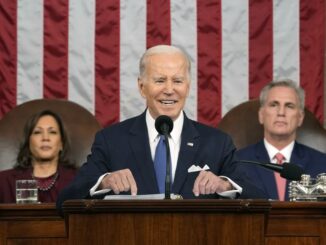
WASHINGTON, D.C. (TIP): President Joe Biden has urged the US Congress to pass a comprehensive immigration reform, a move which would provide a path to citizenship to not only illegal immigrants but also those who entered the country legally, like those on H-1B visas. In the 118th Congress, where the Opposition Republicans enjoy a majority in the House of Representatives, such an ask might not be an easy one.
Biden acknowledged it indirectly though. “If you won’t pass my comprehensive immigration reform, at least pass my plan to provide the equipment and officers to secure the border,” Biden said in his second State of the Union Address before a Joint Session of the US Congress.
“And a pathway to citizenship for Dreamers, those on temporary status, farm workers, and essential workers. Here in the people’s House, it’s our duty to protect all the people’s rights and freedoms,” said the president amidst applause from the Democratic lawmakers of the Congress.
Dreamers are undocumented immigrants who enter the US as children with parents.
Millions of illegal immigrants are looking for a pathway to citizenship, and so do a large number of those who entered the country legally with visas like H-1B and are having years waiting for a Green Card.
The H1B visa is a non-immigrant visa that allows US companies to employ foreign workers in specialty occupations that require theoretical or technical expertise. Technology companies depend on it to hire tens of thousands of employees each year from countries like India and China.
A Green Card, known officially as a Permanent Resident Card, is a document issued to immigrants to the US as evidence that the bearer has been granted the privilege of residing permanently.
In his address that lasted for more than 75 minutes, Biden urged Congress to come together on immigration and make immigration a bipartisan issue like it was before.
“We now have a record number of personnel working to secure the border, arresting 8,000 human smugglers and seizing over 23,000 pounds of fentanyl in just the last several months,” he said. “Since we launched our new border plan last month, unlawful migration from Cuba, Haiti, Nicaragua, and Venezuela has come down 97 per cent. But America’s border problems won’t be fixed until Congress acts,” Biden said.
WASHINGTON, D.C. (TIP): Amidst massive layoffs in the American tech sector that have resulted in a large number of Indian professionals being jobless, two Indian-American organizations have launched an online petition urging President Joe Biden to extend the grace period of H-1B visas holders from two months to a year.
This means that once fired from a job, a foreign tech worker on H-1B visas would have one year to find a new job instead of the existing duration of 60 days, after which they have to leave the country.
The H-1B visa is a non-immigrant visa that allows US companies to employ foreign workers in specialty occupations that require theoretical or technical expertise. Technology companies depend on it to hire tens of thousands of employees each year from countries like India and China.
“On behalf of immigrants (from the world, mainly from India and China) as well as naturalized citizens like Indian-Americans, Foundation for India and Indian Diaspora Studies and Global Technology Professionals Association (GITPRO) has submitted an appeal to the President of the United States, the Secretary of DHS (Department of Homeland Security) and the director of USCIS (US Citizenship and Immigration Services) to extend the current grace period from 60 days to 1 year (minimum 6 months),” the online petition said.
“We join the appeal and request to sympathetically consider the impact of the families on humanitarian grounds. We believe that this extension will pause this brain drain and ensure that the US will continue to be a world leader in technology and innovation. We also request elected officials to support this extension and if needed introduce a bill in the House of Representatives,” said the online petition that has been signed by more than 2,200 people so far. According to LayoffTracker.com, 91,000 were laid off just in January 2023 and this number may grow in the coming months. This has a huge impact on them, and their families, especially on the H-1B holders who would need to leave the US immediately within 10 days beyond the H-1B grace period, the petition said.
In addition to the impact on them and their families, this is also a long-term impact on the talent that the US has. For example, 70 per cent of startup founders are immigrants. About 50+ CEOs of public companies are of Indian origin. Hence, the exodus of this talent from the US is harmful for the long-term interests of the US, especially in the modern age of Artificial Intelligence competition, it said.
“The laid-off H-1B holders currently have about 60 days to find another employer to file for the H-1B transfer or leave the country. During the current economic situation, it would be impossible for these hardworking, tax-paying and talented people to get hired till the economy recovers,” said the petition.
Meanwhile, a Facebook group of overseas Indians has launched a petition urging the Indian government to hire the laid-off Indian tech workers in the US. “Considering the ongoing layoff situation, we are requesting you to consider hiring the recently laid-off and returning Indian IT workers as consultants as part of the digitization initiatives undertaken by your ministries,” said the letter addressed to Ashwini Vaishnav, the Minister of Electronics and Information Technology.
WASHINGTON, D.C. (TIP): Rohit Kumar, 30, hailing from West Bengal, is charged with six counts of submitting false and fraudulent immigration documents and six counts of committing aggravated identity theft, United States Attorney Philip Sellinger announced on Thursday, June 2.
Each count of immigration documents fraud is punishable by a sentence of up to 10 years in prison, as well as a maximum fine of USD 250,000. Each count of aggravated identity theft is punishable by a sentence of two years in prison, which must be served consecutively to any other term imposed, as well as a maximum fine of USD 250,000. According to documents filed in this case and statements made in court, Kumar worked for several years in India for one of the largest information technology companies in the world. This IT company contracted with an electric utility company that was based in New Jersey and owned and operated nuclear power facilities at multiple locations, including in southern New Jersey. Under the contract, the IT company supplied services to the New Jersey company, including through the use of foreign national workers from India who worked in specialized occupations, the documents stated. Kumar helped to arrange for Indian national workers to enter the United States under the H-1B visa program and then work at the New Jersey company. Some of these Indian national workers were stationed at a nuclear power plant in southern New Jersey, while other foreign workers were stationed at the company’s other locations in and around New Jersey, it added.
On several occasions in 2017 and 2018, Kumar created and presented false and fraudulent documents to the United States Citizenship and Immigration Service in support of the H-1B visa applications of the Indian national workers. The documents purported to contain the authorized signature of a contracting manager at the New Jersey electric utility company, but the contracting manager never signed or authorized a signature on these documents, the attorney said.
WASHINGTON, D.C. (TIP): Seeking to comprehensively overhaul the H-1B and L-1 visa programs, a bipartisan group of influential senators have introduced a legislation in the US Senate, which they argued will protect American workers and crack down on foreign outsourcing companies that exploit these popular visa programs to deprive qualified Americans of high-skilled jobs.
The H-1B visa is a non-immigrant visa that allows US companies to employ foreign workers in specialty occupations that require theoretical or technical expertise. Technology companies depend on it to hire tens of thousands of employees each year from countries like India and China. The H-1B visa programme is the most sought-after work visa among foreign professionals, including Indians. The L-1 visa is a non-immigrant visa for the purpose of work in L-1 status. It is valid for a relatively short amount of time.
The H-1B and L-1 Visa Reform Act will reduce fraud and abuse, provide protections for American workers and visa holders, and require more transparency in the recruitment of foreign workers, the senators said.
Introduced by Senate Majority Whip Dick Durbin, Chair of the Senate Judiciary Committee, and Senator Chuck Grassley, Ranking Member of the Senate Judiciary Committee, the legislation is co-sponsored by Senators Richard Blumenthal, Tommy Tuberville, Sherrod Brown, Bill Hagerty, and Bernie Sanders.
The H-1B and L-1 Visa Reform Act will require US Citizenship and Immigration Services to prioritize for the first time the annual allocation of H-1B visas. The new system would ensure that the best and brightest STEM advanced degree students educated in the United States receive preference for an H-1B visa, and also prioritize other US advanced degree holders, those being paid a high wage, and those with valuable skills. STEM stands for Science, Technology, Engineering, and Mathematics.
The legislation explicitly prohibits the replacement of American workers by H-1B or L-1 visa holders and clarifies that the working conditions of similarly employed American workers may not be adversely affected by the hiring of an H-1B worker, including H-1B workers who have been placed by another employer at the American worker’s worksite, a media release said.
“Reforming the H-1B and L-1 visa programs is a critical component to fixing America’s broken immigration system,” Durbin said. “For years, outsourcing companies have used legal loopholes to displace qualified American workers, exploit foreign workers, and facilitate the outsourcing of American jobs. Our legislation would fix these broken programs, protect workers, and put an end to these abuses,” he said. “Congress created the H-1B and L-1 visa programs to complement America’s high-skilled workforce, not replace it. Unfortunately, some companies are trying to exploit the programs by cutting American workers for cheaper labor. We need programs dedicated to putting American workers first,” Grassley said.
“When skilled foreign workers are needed to meet the demands of our labor market, we must also ensure that visa applicants who honed their skills at American colleges and universities are a priority over the importation of more foreign workers. Our bill takes steps to ensure that the programs work for Americans and skilled foreign workers alike,” he added.
According to the senators, the legislation will target outsourcing companies that import large numbers of H-1B and L-1 workers for temporary training purposes only to send the workers back to their home countries to do the same job.
Specifically, the bill would prohibit companies with more than 50 employees, of which at least half are H-1B or L-1 holders, from hiring additional H-1B employees. The bill gives the US Department of Labor enhanced authority to review, investigate, and audit employer compliance with programme requirements, as well as to penalize fraudulent or abusive conduct.
It requires the production of extensive statistical data about the H-1B and L-1 programs, including wage data, worker education levels, place of employment, and gender.
In addition, the H-1B and L-1 Visa Reform Act includes several reforms of the L-1 visa programme, including the establishment of a wage floor for L-1 workers; authority for the US Department of Homeland Security to investigate, audit, and enforce compliance with the L-1 programme requirements; assurance that intra-company transfers occur between legitimate branches of a company and do not involve “shell” facilities; and a change to the definition of “specialized knowledge” to ensure that L-1 visas are reserved only for truly key personnel, the media release said.
“This legislation will crackdown on the manipulation of existing vulnerabilities to ensure employers prioritize the American worker before considering any high-skilled foreign applicants. If we are going to get our economy back up and running, we need to do it correctly and that begins with utilizing the talent we have here at home first and foremost,” said Senator Tuberville.
US Citizenship and Immigration Services (USCIS) on Monday , February 28, announced that it has received a sufficient number of petitions needed to reach the congressionally mandated 65,000 H-1B visa regular cap and the 20,000 H-1B visa US advanced degree exemption, known as the master’s cap, for fiscal year (FY) 2022.
WASHINGTON D.C. (TIP): In a major victory for H-1B employers, a federal court has approved a settlement under which the US Citizenship and Immigration Services has agreed to qualify market research analyst as a specialty occupation for the purposes of determining H-1B visa application of a foreign professional.
Based on its prior interpretation of the Occupational Outlook Handbook — a Department of Labor’s Bureau of Labor Statistics publication profiling hundreds of occupations in the US job market — the USCIS was determining that market research analysts did not qualify as a “specialty occupation”. The settlement approved by the federal district court in the Northern District of California would now let companies request that the USCIS reopen and re-adjudicate their denied H-1B petitions. “This settlement is an important victory that will benefit hundreds of American businesses and the market research analysts they sought to employ,” said Leslie K Dellon, senior attorney (business immigration) at the American Immigration Council. “The settlement gives US businesses another chance to have their H-1B market research analyst petitions approved — this time under new guidance worked out by the parties to the lawsuit. Each H-1B petition reopened and approved will represent another opportunity for US employers and the workers they sponsored to advance their business objectives,” she said.
The class action lawsuit in this regard was filed by the American Immigration Council, American Immigration Lawyers Association, and the law firms Van Der Hout LLP, Berry Appleman & Leiden LLP (formerly Joseph & Hall P.C.), and Kuck Baxter Immigration LLC. Jeff Joseph, partner at Berry Appleman & Leiden LLP, said this settlement finally resolves an issue on which immigration lawyers have been battling the government for years.
“This settlement strikes the right balance between what the regulations actually say and how employers evaluate a candidate’s professional qualifications in the real world. It is our sincere hope that USCIS will now interpret other specialty occupations from a perspective that is in line with what actually happens in the free market,” he said.
WASHINGTON (TIP): Some foreign guest workers in the U.S. will be able to re-submit their applications for the H1-B visa, the most sought-after non-immigrant visa among Indian IT professionals, if their petition was solely rejected because it was based on the initial registration period, according to a federal agency.
According to the U.S. Citizenship and Immigration Services (USCIS), such re-submission of applications is for those whose applications have been rejected or administratively closed solely because the requested start date was after October 1, 2020.
The H-1B visa allows the U.S. companies to employ foreign workers in specialty occupations that require theoretical or technical expertise. Technology companies depend on it to hire tens of thousands of employees each year from countries such as India and China.
“If your FY 2021 petition was rejected or administratively closed solely because your petition was based on a registration submitted during the initial registration period, but you requested a start date after October 1, 2020, you may re-submit that previously filed petition, with all applicable fees,” USCIS said on Wednesday.
“Such petitions must be re-submitted before October 1, 2021. If properly resubmitted, we will consider the petition to have been filed on the original receipt date,” the USCIS said.
In 2020, USCIS implemented an electronic registration process for the H-1B cap.
Prospective petitioners seeking to file H-1B cap-subject petitions, including for beneficiaries eligible for the advanced degree exemption, must first electronically register and pay the USD 10 H-1B registration fee for each beneficiary.
“The electronic registration process has streamlined processing by reducing paperwork and data exchange and provided overall cost savings to employers seeking to file H-1B cap-subject petitions,” it said.
According to USCIS, for fiscal 2021, the number of petitions filed during the initial filing period was below the number projected as needed to reach the numerical allocations.
This discrepancy was likely related to multiple factors, including the economic, political and public health uncertainty created by the COVID-19 pandemic, as well as the fact that FY-2021 was the first year that we implemented the electronic registration process.
“Therefore, in August 2020, we selected additional registrations that were held in reserve. The filing period for registrations selected in August ended on November 16, 2020,” it said.
“Some petitioners indicated a start date after October 1, 2020. We rejected or administratively closed those petitions because they were based on registrations submitted during the initial registration period but indicated a start date after October 1, 2020. Upon reconsideration, we no longer believe that the regulations required us to reject or administratively close those petitions,” the USCIS said.
The move comes days after the powerful the U.S. Chambers of Commerce launched a massive campaign to address the acute shortage of skilled and professional workforce in America.
The demand to increase the H-1B quota, which currently is at 65,000 and another 20,000 for those who have higher studies from the U.S., is part of the America Works campaign launched by the U.S. Chambers of Commerce early this month.
The entry restrictions do not apply to lawful permanent residents
WASHINGTON (TIP): Due to the very high numbers of COVID-19 cases and multiple strains of the virus in India, the United States will restrict travel of non-citizens from the country, starting Tuesday, May 4 Eastern U.S. time.
U.S. President Joe Biden issued a proclamation on Friday, April 30, afternoon prohibiting the entry of non-citizens (the administration has done away with the term ‘alien’) who have been physically present in India for 14 days prior to their entry or attempted entry into the U.S.
There is a long list of exemptions to the entry restrictions and the order will be reviewed every thirty days. H-1B, L and J visa holders and their dependents are not exempt from the restrictions. The entry restrictions do not apply to lawful permanent residents’ (LPRs or green card holders); non-citizens married to Americans or green card holders; non-citizen parents or legal guardians of minors (under 21) who are U.S. citizens or green card holders; siblings of unmarried citizens or LPRs, provided they are both under 21 and unmarried and other categories of travelers. The exemption list is longer than similar lists under the Trump administration’s pandemic-related restrictions.
Other exemptions include foreigners traveling at the invitation of the administration for the purposes of containment of the virus, those whose entry into the U.S. is in its national interest, diplomats of various categories, crew members, and other categories. Significantly, the order also states that the rights of individuals to claim asylum shall not be diminished by the order. “After reviewing the public health situation within the Republic of India, CDC has concluded that proactive measures are required to protect the Nation’s public health from travelers entering the United States from that jurisdiction,” Mr. Biden said. News of the order came earlier on Friday with White House Press Secretary Jen Psaki releasing a statement announcing it. “It is the policy of my Administration to implement science-based public health measures, across all areas of the Federal Government, to act swiftly and aggressively to prevent further spread of the disease,” Mr. Biden said in the order.
The order says India accounts for over a third of the new cases of the virus, and that they are increasing at a ‘rapid rate’. The order says that India has seen circulating a variant called B.1.617, among others, such as the U.K. variant (B.1.1.7) and South African variant (B.1.351). These variants may be less susceptible to vaccines and more easily transmitted as per the CDC.
Mr. Biden’s order invokes section 212(f) of the U.S.’s Immigration and Nationality Act, which was among the laws invoked on January this year by U.S. President Biden to extend a Trump-era restriction on travel from the UK, Ireland, EU, Brazil and South Africa due to COVID-19 concerns.
Airlines have been informed of the administration’s decision, as per a CNN report.
WASHINGTON (TIP): US President Joe Biden on Thursday, April 1, let the ban on foreign workers visa, H-1B, lapse as the notification issued by his predecessor Donald Trump expired, a move which is likely to benefit thousands of Indian IT professionals. Amidst a national lockdown and the COVID-19 crisis, Trump in June last year issued a proclamation that suspended entry to the US of applicants for several temporary or “non-immigrant” visa categories, including H-1B, arguing that these visas presented a risk to the US labor market during the economic recovery. On December 31, Trump extended the order to March 31, 2021, noting that an extension was warranted as the pandemic continued to disrupt American lives, and high levels of unemployment and job loss were still presenting serious economic challenges to workers across the US.
Biden did not issue a fresh proclamation for the ban on H-1B visas to continue after March 31.
He had promised to lift the suspension on H-1B visas, saying Trump’s immigration policies were cruel.
The H-1B visa is a non-immigrant visa that allows US companies to employ foreign workers in specialty occupations that require theoretical or technical expertise. Technology companies depend on it to hire tens of thousands of employees each year from countries like India and China.
The expiry of the Trump’s proclamation would now result in the issuing of H-1B visas by American diplomatic missions overseas that would result in US companies bringing in talented technology professionals inside the country.
No new proclamation was issued by Biden till Wednesday midnight, resulting in the automatic end to the ban on issuing of fresh H-1B visas.
The Wall Street Journal reported that the White House would not renew a ban on H-1B, and other work-based visas imposed last year in response to the COVID-19 pandemic that is set to expire on Wednesday.
Meanwhile, a Republican Senator from Missouri on Wednesday urged Biden to issue a fresh proclamation to continue with the H-1B visa ban.
“I write today to urge you to extend the freeze on temporary foreign worker entries into the United States that, without intervention, will expire today,” Senator Josh Hawley wrote in a letter to Biden.
“The presidential proclamation suspending entry of certain temporary workers into the US has protected Americans suffering from the pandemic-induced economic crisis. With millions of struggling Americans out of work – and millions more desperate to make ends meet – now is not the time to open the floodgates to thousands of foreign workers competing with American workers for scarce jobs and resources,” he wrote.
Bicameral immigration Bill, if signed into law by President Biden, would also benefit hundreds and thousands of Indian IT professionals and their families
WASHINGTON (TIP): President Joe Biden is keen that the US Congress should quickly fix America’s “broken” immigration system, for which he has already sent in a legislation, the White House has said. In February, the Biden administration introduced an ambitious immigration bill in Congress which among other things proposes to eliminate the per-country cap for employment-based green cards. The US Citizenship Act of 2021 proposes a pathway to citizenship to 11 million undocumented workers, elimination of per country quota for employment-based green cards and work authorization for dependents of H-1B foreign workers. “The president…believes that there should be faster processing, that our immigration system is broken at many levels and of the system and that he is eager for Congress to move forward with action there,” White House Press Secretary Jen Psaki told reporters on Wednesday at her daily news conference. She was responding to a question on the recent protest by Indian-American doctors who are seeking the elimination of the existing per country quota for Green Card, as a result of which the backlog for Indians now runs into several decades. A Green Card, known officially as a Permanent Resident Card, is a document issued to immigrants to the US as evidence that the bearer has been granted the privilege of residing permanently. The bicameral immigration bill, if passed by both the chambers of the Congress House of Representatives and the Senate and signed into law by President Joe Biden, would bring citizenship to millions of foreign nationals, including undocumented workers and those who came to the country legally. The legislation would also benefit hundreds and thousands of Indian IT professionals and their families.
Responding to another question on the inordinate delay in the issuance of employment authorization card to H4 and L2 visa holders, a significant number of whom are Indian women, Psaki said that part of the reason the administration went to push for action on immigration on the Hill is to move forward with expediting the processing and doing that on several levels, including a number of the visas.
“So, that’s part of the reason why we think that’s such an important piece to move forward,” Psaki said.
An H-4 visa is issued by the US Citizenship and Immigration Services (USCIS) to immediate family members (spouse and children under 21 years of age) of the H-1B visa holders, most of whom are Indian IT professionals.
The Biden administration has taken several steps to address the problems related to legal immigrants.
The citizenship bill sent by the White House to Congress includes providing new funding to the state and local governments, private organizations, educational institutions, community-based organizations, and not-for-profit organizations to expand programs to promote integration and inclusion, increase English-language instruction, and provide assistance to individuals seeking to become citizens. This bill clears employment-based visa backlogs, recaptures unused visas, reduces lengthy wait times, and eliminates per-country visa caps. The bill makes it easier for graduates of US universities with advanced STEM degrees to stay in the US; improves access to green cards for workers in lower-wage sectors; and eliminates other unnecessary hurdles for employment-based green cards. The bill provides dependents of H-1B visa holders work authorization, and children are prevented from “aging out” of the system. The bill sent by the White House also creates a pilot programme to stimulate regional economic development, gives the Department of Homeland Security (DHS) the authority to adjust green cards based on macroeconomic conditions, and incentivizes higher wages for non-immigrant, high-skilled visas to prevent unfair competition with American workers. It also requires that the DHS and the Department of Labor establish a commission involving labor, employer, and civil rights organizations to make recommendations for improving the employment verification process. Workers who suffer serious labor violations and cooperate with worker protection agencies will be granted greater access to U visa relief. The bill protects workers who are victims of workplace retaliation from deportation in order to allow labor agencies to interview these workers. It also protects migrant and seasonal workers and increases penalties for employers who violate labor laws.
WASHINGTON (TIP): A group of Indian-American frontline healthcare workers languishing in the Green Card backlog held a demonstration in front of the US Capitol urging lawmakers and the Biden administration to end the per capita country-specific quota. A Green Card, known officially as a Permanent Resident Card, is a document issued to immigrants to the US as evidence that the bearer has been granted the privilege of residing permanently in the country. Indian IT professionals, most of whom are highly skilled and come to the US mainly on the H-1B work visas, are the worst sufferers of the current immigration system which imposes a seven per cent per country quota on allotment of the coveted Green Card or permanent legal residency.
We are frontline COVID warriors, and we are here to tell how we have been shortchanged into a life of perpetual indentured servitude. Each of us has a story. We are here from all over the country asking for justice. Justice that has precluded us for decades now, Dr Raj Karnatak, an infectious disease and critical care physician and Dr Pranav Singh, a pulmonary and critical care physician, said.
Most of us are from India. We trained in the US and took oath as physicians to serve the sick and needy. Most of us are serving the rural and underserved areas. We are in a Green Card backlog due to archaic country caps that allow no country to get more than seven percent of employment-based green cards, said the two Indian American doctors’ organizers of the peaceful protest said in a joint statement.
According to them, due to decades of backlog, many high-skilled immigrants are not able to change jobs due to fear of losing the spot in the Green Card line and are indentured to one employer.
Can only work in the specialty occupation the visa is allotted for decades. Many healthcare workers could not serve in COVID-19 hot spots as the visas are tied to the job and employer, they said.
The small group of protestors said that President Joe Biden can direct United States Citizenship and Immigration Services (USCIS) to end the Green Card backlog for the frontline healthcare workers by utilizing the unused green cards in the past years.
There was an HR 1044 fairness bill that was passed in the House of Representatives by 365 votes in 2019 and its senate equivalent S386 passed the Senate in 2020.
Now it is back to House as a modified version. Representative Zoe Lofgren, initial co-sponsor of the bill HR 1044 has not shown any interest in bringing the bill to vote as a bipartisan solution to end the suffering of skilled professionals including frontline healthcare workers, they alleged.
Dr Karnatak and Dr Singh said that India is a land of more than a billion people, but the number of green cards India gets is the same as a country as small as Iceland.
Indian high-skilled workers are brought into the US on an H-1B visa. There is no country cap on the H-1B visa and due to its sheer population; Indians make 50 per cent of the H-1B workforce.
The H-1B visa, the most sought after among Indian IT professionals, is a non-immigrant visa that allows US companies to employ foreign workers in specialty occupations that require theoretical or technical expertise. The technology companies depend on it to hire tens of thousands of employees each year from countries like India and China. The discrepancy in the number of H-1B hired from India and a small number of green cards allotted to India creates an inhumane Green Card backlog. Green Card backlog is adversely affecting the professional and personal lives of high-skilled immigrants from India including the frontline healthcare workers, they said.
Frontline healthcare workers need immediate relief, they are suffering for a very long time. As frontline healthcare workers who are risking their lives in this pandemic, the least we deserve is a certainty. A certainty that if we die or get disabled, our children and spouses won’t be kicked out of the country, said the joint statement on behalf of the protestors. Last month, President Biden revoked a policy issued by his predecessor during the pandemic that blocked many Green Card applicants from entering the US.
Reopening the country to people seeking green cards, or legal permanent residence, Biden in his proclamation said that the policy of former president Donald Trump does not advance the interests of the country.
To the contrary, it harms the United States, including by preventing certain family members of United States citizens and lawful permanent residents from joining their families here, he said.
The US is currently facing a backlog of nearly 473,000 qualified family-based Green Card requests.
As a result of Trump’s ban on issuing green cards, as many as 120,000 family-based preference visas were lost. But this came as a big boon for issuing employment-based green cards, mainly those on H-1B visas.
Move expected to benefit tens of thousands of Indian professionals
WASHINGTON (TIP): US President-elect Joe Biden plans to increase the number of high-skilled visas, including the H-1B, and eliminate the limit on employment-based visas by country, both of which are expected to benefit tens of thousands of Indian professionals impacted by some immigration policies of the outgoing Trump administration. With Kamala Harris as his deputy, Biden is expected to reverse the move of the outgoing Trump administration to revoke work permits to the spouses of H-1B visas, which had adversely impacted a large number of Indian families in the US. All these are part of a comprehensive immigration reform that the Biden administration plans to work on, either in one go or in separate pieces. “High-skilled temporary visas should not be used to disincentivize recruiting workers already in the US for in-demand occupations. An immigration system that crowds out high-skilled workers in favor of only entry level wages and skills threatens American innovation and competitiveness,” according to a policy document issued by the Biden campaign.
“Biden will work with Congress to first reform temporary visas to establish a wage-based allocation process and establish enforcement mechanisms to ensure they are aligned with the labor market and not used to undermine wages. Then, Biden will support expanding the number of high-skilled visas and eliminating the limits on employment-based visas by country, which create unacceptably long backlogs,” it said.
H-1B visas, which expand the available pool of high skilled workers in the US, is a non-immigrant visa that allows American companies to employ foreign workers in specialty occupations that require theoretical or technical expertise. The technology companies depend on it to hire tens of thousands of employees each year from countries like India and China.Employment-based visas, also known as green cards, allow migrants to gain lawful permanent residence in the US in order to engage in skilled work. Noting that currently, the number of employment-based visas is capped at 140,000 each year, without the ability to be responsive to the state of the labor market or demands from domestic employers, the policy document said that as president, Biden will work with Congress to increase the number of visas awarded for permanent, employment-based immigration — and promote mechanisms to temporarily reduce the number of visas during times of high US unemployment.
In June, Trump had suspended the H-1B visas along with other types of foreign work visas until the end of 2020 to protect American workers. In October, the Trump administration had announced new restrictions on the H-1B non-immigrant visa programme, which it said is aimed at protecting American workers, restoring integrity and to better guarantee that H-1B petitions are approved only for qualified beneficiaries and petitioners.
According to the policy document, Biden will also exempt from any cap recent graduates of PhD programs in STEM (science, technology, engineering and math) fields in the US who are poised to make some of the most important contributions to the world economy.
“Biden believes that foreign graduates of a US doctoral programme should be given a green card with their degree and that losing these highly trained workers to foreign economies is a disservice to our own economic competitiveness,” it said.
The Biden administration plans to create a new visa category to allow cities and counties to petition for higher levels of immigrants to support their growth.
“The disparity in economic growth between US cities, and between rural communities and urban areas, is one of the great imbalances of today’s economy. Some cities and many rural communities struggle with shrinking populations, an erosion of economic opportunity, and local businesses that face unique challenges.
“Others simply struggle to attract a productive workforce and innovative entrepreneurs. As president, Biden will support a programme to allow any county or municipal executive of a large or midsize county or city to petition for additional immigrant visas to support the region’s economic development strategy, provided employers in those regions certify there are available jobs, and that there are no workers to fill them,” the policy document said. The holders of these visas would be required to work and reside in the city or county that petitioned for them, and would be subject to the same certification protections as other employment-based immigrants, it argued.
According to the policy document, Biden believes that keeping families together and allowing eligible immigrants to join their American relatives on US soil is critically important, but the current system is poorly designed with per-country caps that prevent applications from being approved in a timely fashion.
That means approved applicants may wait decades to be reunited with their families, it said. “As president, Biden will support family-based immigration by preserving family unification as a foundation of our immigration system; by allowing any approved applicant to receive a temporary non-immigrant visa until the permanent visa is processed; and by supporting legislation that treats the spouse and children of green card holders as the immediate relatives they are, exempting them from caps, and allowing parents to bring their minor children with them at the time they immigrate,” the policy paper said. PTI
WASHINGTON (TIP): A lawsuit has been filed by a group of 174 Indians, including seven minors, against the recent presidential proclamation on H-1B that would prevent them from entering the US due to the suspension of issuing of foreign work visas for the rest of the year.
In his presidential proclamation on June 22, President Donald Trump temporarily suspended issuing of H-1B work visas till the end of the year.
The H-1B visa is a non-immigrant visa that allows US companies to employ foreign workers in specialty occupations that require theoretical or technical expertise. The technology companies depend on it to hire tens of thousands of employees each year from countries namely India and China.
The lawsuit was filed by the Indians in the US District Court in the District of Columbia on Tuesday, July 14.
Judge Ketanji Brown Jackson at the US District Court for the District of Columbia issued summonses on Wednesday to Secretary of State Mike Pompeo and acting Secretary of Homeland Security Chad F Wolf, along with Labor Secretary Eugene Scalia.
“The proclamation 10052’s H-1B/H-4 visa ban hurts the United States’ economy, separates families and defies the Congress. While the two former points render it unseemly, the latter point renders it unlawful,” said the lawsuit filed by lawyer Wasden Banias on behalf of the 174 Indian nationals.
The lawsuit seeks an order declaring the presidential proclamation restriction on issuing new H-1B or H-4 visas or admitting new H-1B or H-4 visa holders as unlawful.
An H-4 visa is a visa issued by the US Citizenship and Immigration Services (USCIS) to immediate family members of the H-1B visa holders.
The lawsuit also urges the court to compel the Department of State to issue decisions on pending requests for H-1B and H-4 visas.
“In the administration of our nation’s immigration system, we must remain mindful of the impact of foreign workers on the United States labor market, particularly in the current extraordinary environment of high domestic unemployment and depressed demand for labor,” said the proclamation issued by Trump.
Trump said the overall unemployment rate in the US nearly quadrupled between February and May of 2020, producing some of the most extreme unemployment ever recorded by the Bureau of Labor Statistics.
While the May rate of 13.3 per cent reflects a marked decline from April, millions of Americans remain out of work.
The proclamation also extends till year-end his previous executive order that had banned issuance of new green cards of lawful permanent residency.
Green Card holders, once admitted pursuant to immigrant visas, are granted “open-market” employment authorization documents, allowing them immediate eligibility to compete for almost any job in any sector of the economy, Trump said.
Forbes, which first reported the lawsuit filed by the Indian nationals, said the complaint points out that the Congress specified the rules under which H-1B visa holders could work in the US and balanced the interests of US workers and employers.
“The complaint seeks to protect H-1B professionals, including those who have passed the labor certification process and possess approved immigrant petitions. Such individuals are waiting for their priority date to obtain permanent residence, a wait that can take many years for Indian nationals,” Forbes reported.
Meanwhile, several lawmakers urged Scalia on Tuesday to reverse the work visa ban.
“Throughout this administration, the president has continued to lament the alleged abuses of the immigration system while failing to address the systemic problems that have persisted and allowed businesses and employers to exploit and underpay immigrant workers, guest workers and American workers,” the lawmakers wrote.
“This misguided attempt by the president to scapegoat immigrants for policy failures during the pandemic not only serves to hurt immigrants but dismisses the true problem of a broken work visa programme that is in desperate need of reform,” said the letter.
The letter among others was signed by congressmen Joaquin Castro, Chair of the Congressional Hispanic Caucus; Bobby Scott, Chair of the Education and Labor Committee; Karen Bass, Chair of the Congressional Black Caucus; Judy Chu, Raul Grijalva, Vicente Gonzalez, Yvette Clarke and Linda Sánchez.
(Source: PTI)
Signup to our Newsletter!
Don’t miss out on all the happenings around the world