Tag: H1-B Visa

  • Biden admin makes it easier for US companies to hire foreign workers with H-1B visas

    Biden admin makes it easier for US companies to hire foreign workers with H-1B visas

    WASHINGTON, D.C. (TIP): A month ahead of transferring power, the outgoing Biden administration announced a new set of rules on Tuesday, December 17 for H-1B visas that makes it easier for American companies to hire foreign workers with special skill sets and facilitate a smoother transition from F-1 student visas to H-1B visas.

    The rule, announced by the Department of Homeland Security (DHS), aims to provide greater flexibility to employers and workers by modernizing the definition and criteria for special positions and nonprofit and governmental research organizations that are exempt from the annual statutory limit on H-1B visas. The changes will help U.S. employers hire as per their business needs and remain competitive in the global marketplace, an official release said.

    Donald Trump will be the next president of the US after a swearing-in ceremony on January 20.

    According to the DHS, the rule also extends certain flexibilities for students on an F-1 visa seeking to change their status to H-1B to avoid disruptions in lawful status and employment authorization for students holding F-1 visas.

    It also will allow US Citizenship and Immigration Services (USCIS) to process applications more quickly for most individuals who had previously been approved for an H1-B visa. It will also allow H1-B visa holders with a controlling interest in the petitioning organization to be eligible for H-1B status subject to reasonable conditions. The latest move by the outgoing Biden administration builds on its previous efforts to ensure that the labor needs of American businesses are met to reduce undue burden on employers while adhering to all U.S. worker protections under the law.

    “American businesses rely on the H-1B visa programme for the recruitment of highly-skilled talent, benefiting communities across the country,” said Secretary of Homeland Security Alejandro N. Mayorkas. “These improvements to the programme provide employers with greater flexibility to hire global talent, boost our economic competitiveness, and allow highly skilled workers to continue to advance American innovation,” he said.

    “The H-1B programme was created by Congress in 1990, and there’s no question it needed to be modernized to support our nation’s growing economy,” said USCIS Director Ur M. Jaddou.

    The changes made in the final rule will ensure that U.S. employers can hire highly skilled workers they need to grow and innovate while enhancing the integrity of the programme, he said.

    The DHS said the rule also strengthens the program’s integrity by codifying USCIS’ authority to conduct inspections and impose penalties for failure to comply; requiring that the employer must establish that it has a bona fide position in a specialty occupation available for the worker as of the requested start date.

    It clarifies that the Labor Condition Application must support and properly correspond with the H-1B petition; and requires that the petitioner have a legal presence and be subject to legal processes in the courts of the United States.

    In order to implement the rule, a new edition of Form I-129, Petition for a Nonimmigrant Worker, will be required for all petitions beginning January 17, 2025, which is the rule’s effective date.
    (Source: PTI)

  • India flags concern over H1B visa issue

    India flags concern over H1B visa issue

    NEW DELHI(TIP): During the inaugural 2+2 dialogue on Thursday, India flagged its concerns about pending changes in the US Congress to H1B visas and H4 visas for spouses that could severely impact Indians working in America.

    Sources said External Affairs Minister Sushma Swaraj raised the issue ‘forcefully’. India made a case of the track record and contribution of its diaspora to American society, asking the Donald Trump administration to take a favorable view on the matter.

    “Specifically, I conveyed our expectation for a non-discriminatory and predictable approach to the H1B visa regime,” said Swaraj in her press statement.

    Officials privy to the discussion mentioned that the American delegation led by Secretary of State Pompeo and Defense Secretary James Mattis, acknowledged the positive role of the diaspora.

    “I have mentioned this to Secretary Pompeo that on the basis of the friendship which exists between President Trump and Prime Minister Narendra Modi, Indians believe that America will not work against their interest,” Swaraj said.

    “The US leaders assured it is review of the entire US immigration system and not specifically targeted at one country… there have been no significant reductions in the number of H1B visas so far,” said a highly placed source.

  • INFOSYS TO RECRUIT 10,000 AMERICANS

    INFOSYS TO RECRUIT 10,000 AMERICANS

    NEW STRATEGY
    • ? Infosys is the largest employer of workers under the US H1-B visa programme for skilled workers .
    • ? H1-B visa programme has been under fire as the Trump Administration moves to tighten a range of immigration laws .
    • ? The company has leased 35,000 sq ft of office space in Indianapolis

    SAN FRANCISCO (TIP): Infosys on May 24 (Wednesday) touted its new strategy to hire and train 10,000 American workers over the next two years at the company’s annual leadership meeting in San Francisco.

    Infosys is the largest employer of workers under the US H1-B visa programme for skilled workers, which has been under fire as the Trump Administration moves to tighten a range of immigration laws. Infosys announced three weeks ago that it would hire 10,000 Americans, and said on Monday it had leased 35,000 sq ft of office space in downtown Indianapolis.

    Indiana Gov. Eric Holcomb, who succeeded Vice President Mike Pence in the state’s top office, and Indiana University President Michael McRobbie appeared at the San Francisco event to voice their support.

    Ravi Kumar, Infosys’s deputy chief operating officer, said the company will be looking to hire both experienced professionals and recent college graduates at a range of skill levels.

    Each month, Kumar said, the company plans to put large batches of prospective employees through training courses of eight to 10 weeks that will prepare them for positions in fields like data analytics, enterprise cloud applications and cybersecurity.

    Source: Reuters

  • Another big jolt to Indian H-1B visa holders in Cognizant seeking a green card

    Another big jolt to Indian H-1B visa holders in Cognizant seeking a green card

    WASHINGTON (TIP): IT major Cognizant Technology Solutions (CTS) is going to stop applying green cards for its employees under EB2 and EB3 routes. In a major decision, giving up the employees hopes of getting permanent residence in the US, the Cognizant decides to halt the fresh filing of applications for green cards under EB2 and EB3 routes until further notice.

    This move to halt the processing of EB2 and EB3 applications could dash the hopes of many H-1B visa holders Any H1-B visa holder who is going for permanent residency need to go through the process of green card filed by the company. A company provides its H1- B employees with Employment Based (EB) permanent residency through EB1, EB2 and EB3 routes. It will affect thousands of Indian employees in Cognizant working with H-1B visa seeking a green card.

    In an email sent to some of its employees Cognizant said, “As part of our strategic business goals, we continue to assess the benefits and efficiency of our internal programs which are evolving to align with our long-term objectives. As part of this, we will no longer be filing green card PERM (EB2 and EB3 applications) until further notice.”

    Cognizant already hired 4,000 US citizens and residents for its US delivery centers, a similar move also by its counterparts like Infosys.The company’s decision follows a policy by the Trump administration to encourage hiring of more American workers.

  • Hire the best: IT companies must seize the moment

    Hire the best: IT companies must seize the moment

    Indian IT companies have built their fortunes on outsourcing, but now their business model is under pressure because of a rising tide of nationalistic politics in several countries, particularly the US. The issue has escalated ever since President Donald Trump took over. He hit out at outsourcing during electioneering, and recently, norms regarding the grant of H-1B visas were tightened, making it more difficult for Indian IT workers to work in the US.

    Infosys CEO Vishal Sikka’s statement that the company will hire 10,000 American workers is a peace offering to the US political establishment. Alibaba founder Jack Ma, who pledged to create one million jobs in the US, took the lead and others followed suit. Out of two lakh or so workers that Infosys employs worldwide, only 25,000 work in the US on H-1B visas. Indian IT companies, including Infosys, typically focus on the lowest end of the food chain, and are thus squeezed tighter than others. Indian workers on H-1B visas may often have been paid less than their counterparts in the industry, but the work that they perform for their foreign clients is essential, while not particularly remunerative.

    There is no doubt that such workers will be needed, and may well be the mainstay of the outsourcing efforts of Indian IT companies. However, what Sikka and other IT CEOs need to focus on is raising the bar by hiring the best talent they can, and using it to improve their work profile. The base is strong, what is needed is a recalibration of effort and a focus on the aspects that deliver the most -social media, mobile, analytics and cloud. Major IT companies are putting in their best talent in these fields, and now that Indian IT companies are aggressively hiring Americans, they should try to get the top talent and build high-end products. The challenges posed by the new visa regime can be turned into opportunities, given the right leadership and long-term perspective on the part of the investors.

  • STEM Update – 24-month OPT extension lawsuit dismissed

    STEM Update – 24-month OPT extension lawsuit dismissed

    WASHINGTON (TIP): Encouraging foreign students who graduate with specialized degrees in the United States, the US administration had allowed them, especially STEM F-1 visa students to avail of the extended 24-month Optional Practical Training (OPT) period, apart from the regulation 12 months of the work-training they receive through the program: a lawsuit to revoke the extension has been dismissed in federal court.

    OPT is a period during which undergraduate and graduate students with F-1 visa status, who have completed or have been pursuing their degrees for more than 9 months, are permitted by the United States Citizenship and Immigration Services (USCIS) to work for one year on a student visa towards getting practical training to complement their education.

    Anti-immigration advocates have been targeting the OPT for several years, terming it as a job killer for American workers, a chance for American employers to avail of cheap labor and exploit foreign students.

    Back in August 2015, a D.C. federal judge said the 2008 Department of Homeland Security rule that allows STEM graduates in F-1 status to obtain an additional 17 months of OPT time in the U.S. was deficient. The decision in Washington Alliance of Technology Workers v. U.S.

    Department of Homeland Security was based on the fact that DHS did not go through the usual notice and comment period required for new regulations. The judge vacated the 2008 rule allowing the 17-month extension, however, a stay was put in place until a new regulation could be put in place. That new regulation took effect on May 10, 2016 and allows a new STEM OPT extension of 24-months. The same group of tech workers that challenged the old STEM OPT rule filed a new lawsuit in June 2016 in federal court again challenging DHS policy allowing student visa holders to work after completion of their studies. The new lawsuit brought by the Washington Alliance of Technology Workers argued that the Optional Practical Training (OPT) program denies labor protections to US tech workers, allows increased competition, allows unfair competition, provides foreign students the benefit of mentoring programs (i.e. the I-983 training plan) without requiring schools to give the same benefit to US workers, and violates procedural rights of US workers by failing to include the question of whether OPT should be expanded in the first place in the regulatory process. Washtech asked the court to issue a declaratory judgement (find in their favor without going through an entire trial) that DHS exceeded its authority by allowing F-1 students the ability to work, vacate the new regulations, and award attorney’s fees to Washtech.

    The DHS argued in favor of retention of the extended 24-month OPT, and asked the court to dismiss the lawsuit. Last month, a federal court in its ruling, granted only part of DHS’ motion to dismiss, but also denied part of the motion to dismiss. Now, in its final ruling on the case, the federal court has dismissed the lawsuit brought by the WATW, in favor of DHS. The decision means F-1 visa students in STEM-related studies will continue to get a total of three years of OPT during and after the program they are enrolled in. It also improves the chances of F-1 visa students to gain a good foothold in a job they take up in the US, and to be sponsored by the employer for an H-1B visa. Annually, 20,000 H-1B visas are reserved for F-1 visa higher degree graduates of US educational institutions. If there are more than 20,000 applications, they are pooled to compete for the general quota of 65,000 H-1B visas which are for all foreign workers.


  • IT firms may face layoffs due to US visa curbs: Report

    IT firms may face layoffs due to US visa curbs: Report

    NEW DELHI (TIP): With the US tightening the norms for H-1B visas under the President Donald Trump’s ‘Buy American, Hire American’ campaign, the Indian IT companies are bound to face disruptions by way of higher costs and even some laying off work force back home, and the rising rupee is aggravating the situation further for the technology export firms, an Assocham paper said.

    Nearly 86% of the H-1B visas issued for workers in the computer space go to Indians and this figure is now sure to be scaled down to about 60% or even less, it said.

    Remittances from the US would decline, hurting the balance of payment. World Bank data showed the US was the second largest source of remittance for India in 2015, behind Saudi Arabia, and about $10.96 billion, nearly 16% of the total inflows, were sent to India.

    As the cost pressure would increase, aggravated by rising rupee leading to lower realisations, the Indian IT firms may be forced to displace work force. “In that case, the chances of layoffs are real,” said Assocham secretary general DS Rawat.

    He said the IT industry apex organisations and the government need to work out a joint strategy to deal with the unfolding situation.

    Source: IANS

  • Wipro sacks at least 600 employees after performance appraisal

    Wipro sacks at least 600 employees after performance appraisal

    NEW DELHI (TIP): The country’s third largest software services firm Wipro is learnt to have fired hundreds of employees as part of its annual “performance appraisal”.

    According to sources, Wipro has shown the door to about 600 employees, while speculation was rife that the number could go as high as 2,000.

    At the end of December 2016, the Bengaluru-based company had over 1.79 lakh employees.

    When contacted, Wipro said it undertakes a “rigorous performance appraisal process” on a regular basis to align its workforce with business objectives, strategic priorities of the company, and client requirements.

    “The performance appraisal may also lead to the separation of some employees from the company and these numbers vary from year to year,” it added.

    The company, however, did not comment on the number of employees that have been asked to leave.

    Wipro said its comprehensive performance evaluation process includes mentoring, re-training and upskilling of employees. The company is scheduled to report its fourth quarter and full-year numbers on April 25.

    The development comes at a time when Indian IT companies are facing an uncertain environment given the curbs being proposed on worker visa norms by various countries like the US, Singapore, Australia and New Zealand.

    These companies use temporary work visas to send employees to work on client sites.

    With visa programmes in these countries becoming more rigorous, Indian IT companies are likely to face challenges in movement of labour as well as a spike in operational costs.

    Indian IT companies get over 60% of their revenues from the North American market, about 20 per cent from Europe and the remaining from other economies.

    Source: PTI

  • American industry leaders hammer Trump’s H-1B order

    American industry leaders hammer Trump’s H-1B order

    WASHINGTON (TIP): US President Donald Trump is getting hammered by critics for what they say is his dubious commitment to the “Buy American, Hire American” policy that he is promoting on faulty premise, even as his hardline nationalist supporters are in raptures that he is putting “America First.”

    From pointing out that the product line from his own companies are made abroad (including Made in India sports coats) to taunting that his properties, estates, and businesses employ a large number of immigrants, detractors eviscerated the US President for double standards after he went on a blue-collar road show on Tuesday to expound American First vision.

    He promoted it with an executive diktat aimed, among other things, at reforming the H1B visa program that has helped grow the Indian IT industry. (PTI)

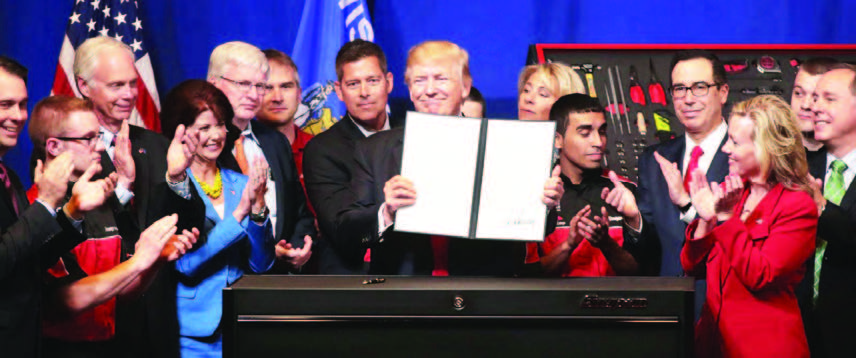
  • Trump signs executive order on H1B visa review

    Trump signs executive order on H1B visa review

    WASHINGTON (TIP): US President Donald Trump on Tuesday, April 18, ordered federal agencies to look at tightening the H1B visa program used to bring high-skilled foreign workers to the US, as he tries to carry out his campaign pledges to put “America First“.

    The EO also establishes certain Hire American standards, which are not necessarily limited to federal procurement or federally-funded projects. This primarily includes an overhaul of the “H1B” visa program to replace the lottery features of the program and to impose restrictions designed to preclude the H1B program from being a conduit for lower-cost labor at the expense of American workers.

    The latest action is part of Trump’s administration relentless series of tightening measures and is a major deterrent to Indian IT companies which send hundreds of software engineers to the US on H1B visas.

    The executive order doesn’t actually make any change in the policy as it stands today.

    This year there were 199,000 applications for the H1B visas even after the USCIS guidelines released April 3 clarifying that computer programmers will not be eligible for H1B visas by default.

    The Trump administration appears to be keen to scrap the lottery system, which is why it is insisting on a higher wage floor as a first eligibility criterion to apply for the visa. It may also set a minimum education criterion, skewering the hopes of many Indians who hope to gain entry into the US.

    H1B visas are intended for foreign nationals in occupations that generally require higher education, including science, engineering or computer programming. The government uses a lottery to award 65,000 visas every year and randomly distributes another 20,000 to graduate student workers.

    Critics say the lottery benefits outsourcing firms that flood the system with mass applications for visas for lower-paid information technology workers.

    “Right now, H1B visas are awarded in a totally random lottery and that’s wrong. Instead, they should be given to the most skilled and highest paid applicants and they should never, ever be used to replace Americans,” Trump said.

    At present, about 70 per cent of the 85,000 H1B visas issued annually go to Indians, with more than half of that to software professionals. The infotech industry adds around 10 per cent to India’s GDP.

    Senior officials gave few details on implementation of the order but Trump aides have expressed concern that most H1B visas are awarded for lower-paid jobs at outsourcing firms, many based in India, which they say takes work away from Americans.

    They seek a more merit-based way to give the visas to highly skilled workers.

    “Right now, widespread abuse in our immigration system is allowing American workers of all backgrounds to be replaced by workers brought in from other countries,” Trump said.

    Read the full EO at  https://www.whitehouse.gov/the-press-office/2017/04/18/presidential-executive-order-buy-american-and-hire-american? utm_source= email&utm_medium= email&utm_content=20170419_ADM_1600-Daily

  • Computer Programmer not a specialty occupation? – USCIS will Investigate, Call for RFE’s

    Computer Programmer not a specialty occupation? – USCIS will Investigate, Call for RFE’s

    USCIS released a policy memorandum on March 31, 2017, Recession of the December 22, 2000 “Guidance Memo on H-1B computer related positions” to clarify its approach on computer programmer position and whether it qualifies as a specialty occupation, with an immediate effect.

    The memo brings the position of computer programmers on the spot and cruises on the eligibility criteria. It specifies that a person may be employed as a computer programmer and may use information technology skills and knowledge to help an enterprise achieve its goal in the course of his/her job but it is not sufficient to establish the position as a specialty occupation. Hence, the petitioner now has an additional burden to establish that a particular position is one of the specialty occupation as defined by 8 CFR 214.2(h)(4)(ii).

    Entry or senior level position: The 2000-01 edition described all programmers as sharing a fundamental job duty, i.e. writing and testing computer code and any individual with only an associate degree may enter these occupations. But the Memo now settles that it is improper to conclude on the above information that an individual will qualify for a specialty occupation.

    Hence the memo concludes that a person may be employed as a computer programmer and may use information technology skills and knowledge to help an enterprise achieve its goals in the course of his/her job, but an additional evidence is required to establish the position of computer programmer is a specialty occupation.

    Impact of the memo: The memo came out with an immediate effect and hence will have a substantial impact on petitioners filing as computer programmer for the H-1B CAP FY2018. There will be more scrutiny and request for evidence for this category.

    U.S. Citizenship and Immigration Services (USCIS) also announced multiple measures to further deter and detect H-1B visa fraud and abuse on April 03, 2017.

    Beginning April 3rd, USCIS will take a more targeted approach when making site visits across the country to H-1B petitioners and the worksites of H-1B employees. USCIS will focus on:

    · Cases where USCIS cannot validate the employer’s basic business information through commercially available data;

    · H-1B-dependent employers (those who have a high ratio of H-1B workers as compared to U.S. workers, as defined by statute); and

    · Employers petitioning for H-1B workers who work off-site at another company or organization’s location.

    Targeted site visits will allow USCIS to focus resources where fraud and abuse of the H-1B program may be more likely to occur, and determine whether H-1B dependent employers are evading their obligation to make a good faith effort to recruit U.S. workers.

    USCIS will continue random and unannounced visits nationwide. These site visits are not meant to target nonimmigrant employees for any kind of criminal or administrative action but rather to identify employers who are abusing the system.

    Employers who abuse the H-1B visa program negatively affect U.S. workers, decreasing wages and job opportunities as they import more foreign workers. To further deter and detect abuse, USCIS has established an email address which will allow individuals (including both American workers and H-1B workers who suspect they or others may be the victim of H-1B fraud or abuse) to submit tips, alleged violations and other relevant information about potential H-1B fraud or abuse. Information submitted to the email address will be used for investigations and referrals to law enforcement agencies for potential prosecution.


  • Foreign Tech Workers On Edge As Donald Trump Cracks Down On H-1B Visa Program That Feeds Silicon Valley

    Foreign Tech Workers On Edge As Donald Trump Cracks Down On H-1B Visa Program That Feeds Silicon Valley

    The U.S. administration began to deliver on President Donald Trump’s campaign promise to crack down on a work visa program that channels thousands of skilled overseas workers to companies across the technology industry.

    Fed up with a program it says favors foreign workers at the expense of Americans, the Trump administration rolled out a trio of policy shifts. The U.S. Citizenship and Immigration Services agency on Friday made it harder for companies to bring overseas tech workers to the U.S. using the H-1B work visa.

    Lottery Opens For High Skilled H-1B Visas

    On Monday, April 3, as the H1-B lottery program for “high-skilled” worker visas opened with the 85,000 slots, the USCIS agency issued a memo laying out new measures to combat what it called “fraud and abuse” in the Program. The Justice Department further warned employers applying for the visas not to discriminate against U.S. workers.

    Nearly three-quarters of the visas are expected to go to Indian workers, as they have in recent years.

    “The Justice Department will not tolerate employers misusing the H-1B visa process to discriminate against U.S. workers,” said Acting Assistant Attorney General Tom Wheeler in a prepared statement. “U.S. workers should not be placed in a disfavored status, and the department is wholeheartedly committed to investigating and vigorously prosecuting these claims.”

    The department’s U.S. Citizenship and Immigration Services will make unannounced site visits to companies that have a high ratio of workers on H-1B visas, and those whose foreign workers are outsourced to another company.

    Seventy one percent of H-1B visa recipients came from India in 2015, according to a 2016 report by the U.S. Department of Homeland Security. China comes in second, accounting for nearly 10 percent of H-1B visa recipients.

    India’s dominance of the H-1B visa system is cemented by the country’s giant outsourcing firms that submit tens of thousands of applications, increasing their chances of winning the coveted temporary work visas.

    Among the top H-1B visa sponsors are Infosys, Tata Consultancy Services, Wipro, and Tech Mahindra Americas — Indian multinational corporations providing information technology and outsourcing services, according to Myvisajobs.com.

    The outsourcing firms are controversial because they are exempt from the federal requirement that they not displace American workers if they pay H-1B visa holders at least $60,000 a year. That threshold still falls below the market rate for American tech workers.

    American tech companies who use workers hired by these firms benefit from the cheaper labor, as well as the automatic loyalty engendered among workers who would otherwise lose their legal status.

    The H-1B visas last for three years, and can be renewed once. But workers applying for green cards can renew their visas indefinitely. There is currently a decade-long backlog of Indian green card applicants. Given the tremendous delay, companies have an incentive to hire workers from India, who critics say end up in a system of de facto “indentured servitude.”

  • US lawmakers reintroduce Bipartisan Bill to Stop Outsourcing of American Jobs

    US lawmakers reintroduce Bipartisan Bill to Stop Outsourcing of American Jobs

    WASHINGTON (TIP): On March 23, Representatives Derek Kilmer (D-WA) and Doug Collins (R-GA) reintroduced a bill to prevent employers from sending jobs overseas by abusing a temporary visa program. The legislation would stop employers that are awarded temporary visas through the H-1B program from using them to train workers in the United States then move those jobs to another country.

    H-1B visas allow American businesses to hire foreign professionals if skilled American workers are unavailable to fill job openings. The employees must have expertise in fields like science and technology and generally have college degrees. This month, 60 Minutes reported that unscrupulous employers have utilized the program to bring foreign workers in and displace American jobs. This follows reports last year that American workers were forced to train H1B visa holders to do their job so that the jobs could be permanently outsourced to foreign workers.

    “Our policies should promote jobs in America,”said Kilmer. “They shouldn’t be about sending jobs done by hard working Americans overseas. That’s why I’m continuing my push with Representative Collins to keep H-1B visas from ever being used to send any job to another country.”

    “Protecting American jobs is crucial in order for our economy to continue to gain strength and momentum,” said Collins. “Companies have the opportunity to bring workers from overseas on an H-1B visa in the event that qualified Americans aren’t available, but we can’t allow the law to be exploited to displace American workers and send their jobs abroad. The Keeping American Jobs Act protects American workers by preventing bad actors from abusing the system in order to offshore jobs.”

  • Indian American tech executive indicted for H-1B visa fraud

    Indian American tech executive indicted for H-1B visa fraud

    FREMONT, CA (TIP): Two Bay Area tech executives, Including an Indian American CEO of an employment firm based in Fremont with an office in India, are accused of filing false visa documents through a staffing agency in a scheme to illegally bring a pool of foreign tech workers into the United States.

    An indictment from a federal grand jury unsealed on Friday, March 24 accuses Indian American Jayavel Murugan, Dynasoft Synergy’s chief executive officer, and a 40-year-old Santa Clara man, Syed Nawaz, of fraudulently submitting H-1B applications to illegally obtain visas, according to Brian Stretch, U.S. attorney for the Northern District of California.

    The men are charged with 26 counts of visa fraud, conspiracy to commit visa fraud, use of false documents, mail fraud and aggravated identity theft, according to prosecutors. Each charge can carry penalties of between two and 20 years in prison.

  • Indian Firms Gaming H-1B Visa System: Congressman Darrell Issa

    Indian Firms Gaming H-1B Visa System: Congressman Darrell Issa

    Washington:  Indian firms, which account for the bulk of H-1B visas, have “gamed” the system, an influential American lawmaker today alleged and insisted his legislation introduced in the Congress will help fix the existing flaws.

    Congressman Darrell Issa, who recently introduced the legislation which calls for an increase in the salary of H-1B workers, insisted that his move would bring the best talents to the US and help fix the flaws in the existing H-1B system.

    “The president supports (the bill). I think we will have strong support in the Senate,” he told a Washington audience at an event hosted by Atlantic Council at the Capitol Visitor Center.

    He alleged that Indian companies have “gamed the system” and made the “best use of this flawed immigration system”.

    “You can’t have 75 per cent of a programme going to an Indian-owner, Indian operated, Indian employee visas and not say that this is distortion,” Mr Issa said, adding it’s common sense to hire the best and not the other way around.

    “It would be interesting that India would be concerned that a relatively simple change (in H-1B visas) that does not target India, somehow happens to be accommodation for India,” he said.

    “Today 75 per cent of all H-1Bs are coming in about $60-65,000, which is pretty absurd considering these are high-skilled visas… If they were told to write $ 1,00,000 and you will get your H-1B, they will write that check,” he said.

    The lawmaker from California called for fixing the system and removing the country-based caps. He also said increasing the salary would raise the quality of people coming to the US.

    “An auction system is not a bad way to go,” he said. “A graduate with a STEM degree from a US university is not going to take a job with $ 60,000 salary. And that’s the reality,” said the Congressman.

    The H-1B visa is a non-immigrant visa that allows American firms to employ foreign workers in occupations that require theoretical or technical expertise. The technology companies depend on it to hire tens of thousands of employees each year.

  • USCIS suspends Premium Processing for All H-1B Petitions

    USCIS suspends Premium Processing for All H-1B Petitions

    Starting April 3, 2017, U.S. Citizenship and Immigration Services will temporarily suspend premium processing for all H-1B petitions, a statement issued by the USCIS stated. This suspension may last up to 6 months. While H-1B premium processing is suspended, petitioners will not be able to file Form I-907, Request for Premium Processing Service for a Form I-129, Petition for a Non-immigrant Worker which requests the H-1B nonimmigrant classification. We will notify the public before resuming premium processing for H-1B petitions.

    The premium processing service allows an applicant or his potential employer to pay $1,225 to receive a response to his petition within 15 days. If USCIS has not responded within 15 days, the fee is refunded, though the application still receives expedited processing, according to a bulletin issued by the agency March 3. H-1B visas are used by U.S. employers to temporarily employ foreign workers, most often from India, in specialty occupations.

    “This temporary suspension will help us to reduce overall H-1B processing times. By temporarily suspending premium processing, we will be able to process long-pending petitions, which we have currently been unable to process due to the high volume of incoming petitions and the significant surge in premium processing requests over the past few years; and prioritize adjudication of H-1B extension of status cases that are nearing the 240 day mark,” said the agency in a bulletin.

    USCIS has said the temporary suspension of premium processing could last as long as six months. The agency has said it will reject any form I-907 – request for premium processing – filed with an H-1B petition. If a check is issued to cover both applications, USCIS noted it will have to reject the H-1B application as well.

    “Since FY18 cap-subject H-1B petitions cannot be filed before April 3, this suspension will apply to all petitions filed for the FY18 H-1B regular cap and master’s advanced degree cap exemption (the ‘master’s cap’),” noted USCIS, adding that the suspension also applies to petitions that may be cap-exempt.

    H-1B petitioners can still expedite their applications if they meet one of the following criteria: a severe financial loss to company or  person;   an emergency situation; humanitarian reasons; a non-profit organization whose work benefits the cultural and social interests of the U.S., certain Defense Department situations; or USCIS errors. Such requests will be reviewed on a case-by-case basis. The temporary suspension does not apply to other non-immigrant classifications. The United States Citizenship and Immigration Services has ruled that Green Card holders and visa holders, like those on H-1B, L-1, J or F-1, H4 visa, and even those having an Employment Authorization Card (EAD) must carry legal documents papers when traveling in and out of the country and at all times within the United States, or face the risk of being fined or imprisoned, or even both.

    With a large-scale immigration crack-down on undocumented foreigners imminent after President Donald Trump’s new executive orders, it’s important for all documented residents in the US to keep proof of their legal status in the country.

    And for those in the pipeline for a Green Card, a misdemeanor charge could have terrible repercussions when it comes to being adjudicated for legal permanent resident status. The same applies for Green Card holders who wish to become US citizen.

    The United States Citizenship and Immigration Services rule states: ‘Every alien, eighteen years of age and over, shall at all times carry with him and have in his personal possession any certificate of alien registration or alien registration receipt card issued to him pursuant to subsection (d). Any alien who fails to comply with the provisions of this subsection shall be guilty of a misdemeanor and shall upon conviction for each offense be fined not to exceed $100 or be imprisoned not more than thirty days, or both.’

    Another sub-section of the rule says: ‘Notwithstanding any other provision of law, the Attorney General is authorized to require any alien to provide the alien’s social security account number for purposes of inclusion in any record of the alien maintained by the Attorney General or the Service.’

  • Trump’s Immigration Plans Could Impact 3 Lakh Indian-Americans

    Trump’s Immigration Plans Could Impact 3 Lakh Indian-Americans

    Washington:  Nearly 300,000 Indian-Americans are likely to be impacted by the Trump administration’s sweeping plans that put the nation’s 11 million undocumented immigrants at risk of deportation.

    The Trump administration is releasing more on its plans to crack down on illegal immigration, enforcing the executive orders President Trump issued in late January. Those orders called for increased border security and stricter enforcement of immigration laws.

    “Those people who are in this country and pose a threat to our public safety, or have committed a crime, will be the first to go,” White House spokesman Sean Spicer told reporters. “And we will be aggressively making sure that occurs. That is what the priority is.”

    “The Department no longer will exempt classes or categories of removable aliens from potential enforcement,” the Department of Homeland Security (DHS) said in an enforcement memo.

    “Department personnel have full authority to arrest or apprehend an alien whom an immigration officer has probable cause to believe is in violation of the immigration laws,” it said.

    The Department of Homeland Security has issued two enforcement memos, which among other things, tightens deportation of illegal immigrants.

    The emphasis is on criminal aliens, though, but opens up the door for others too.

    Indian-Americans as per unofficial figures account for nearly 300,000 illegal aliens.

    Homeland Security Outlines New Rules on Immigration

    According to the memo, the DHS Secretary has the authority to apply expedited removal provisions to aliens who have not been admitted or paroled into the US, who are inadmissible, and who have not been continuously physically present in the US for the two-year period immediately prior to the determination of their inadmissibility, so that such aliens are immediately removed unless the alien is an unaccompanied minor, intends to apply for asylum or has a fear of persecution or torture in their home country, or claims to have lawful immigration status.

    Immigrant rights advocates say the rules are written so broadly that they make anyone in the country illegally a target for deportation — potentially, as many as eight to 11 million people.

    The White House and DHS deny that the rules amount to a blueprint for mass deportation.

    While the new policies call for a “surge” in the deployment of immigration judges and other personnel, DHS officials said the agency is not planning mass deportations and that many of the new policies would take time to implement.

    “We don’t need a sense of panic necessarily in these communities,” one DHS official said in a conference call with reporters.

    Homeland Security officials said the policies would not affect Deferred Action for Childhood Arrivals #DACA, the Obama administration program that offered protection from deportation for so-called Dreamers who were brought to the U.S. illegally as children.

    The DHS wants to expand the use of so-called expedited removal, in which migrants do not appear before an immigration judge before being deported. Under the Obama administration, those expedited deportations had been limited to those in the country for two weeks or less, and within 100 miles of the border.

    DHS officials say they could seek to expand the use of expedited removal all over the country, for immigrants who have been in the U.S. for up to two years. Those rules have not yet been finalized.

    In addition, the policies call for an expansion of a federal program that enlists state and local police to enforce immigration laws.

    That partnership has come under fire from critics who allege that it has led to racial profiling. The federal government terminated one such agreement with Arizona’s Maricopa County Sheriff Joe Arpaio in 2011 after the Justice Department found that county officers unlawfully stopped and detained Latinos.

    On Tuesday, Feb 21, DHS called the program “a highly successful force multiplier.” Officials said local officers go through extensive training and that racial profiling would not be tolerated.

  • ‘Indian economy is resilient to global headwinds’: Dr. Raghavan Seetharaman

    ‘Indian economy is resilient to global headwinds’: Dr. Raghavan Seetharaman

    CHENNAI (TIP); The US ruling on cancellation of H-1B visa rules poses risk towards IT companies immigrants and offshore projects, expectation is that costs may escalate for these companies operating in US. Global growth is challenging, however Indian economy is resilient to global headwinds on account of the strong domestic fundamentals, said Dr Raghavan Seetharaman, CEO of Doha Bank in Qatar.

    The recent budget had given thrust on infrastructure, agriculture and aims to revive the growth of Indian economy. India exported $6 billion worth of drugs to the US in 2015 and restrictions on pharmaceutical imports and manufacturing abroad could impact the industry in India, he said.

    The Indian government has encouraged global investors to participate through FDI. The recent budget has stated that foreign investment promotion board will be abolished, which will improve ease of doing business.

    IMF has pegged India growth at 7.2 percent in 2017.India’s Current Account Deficit decreased from about 1 percent of GDP last year to 0.3 percent of GDP in first half of 2016-17. India has pegged fiscal deficit for 2017-18 at 3.2 percent and its Forex Reserves at $361 billion offer a comfortable cover for 12 months of imports thanks to better financial management by Narendra Modi government, he said.

    Contentious issues are coming between developed and developing world on global trade and investment. The lack of convergence between politics and economics could impact global growth. We’re entering a new stage of international global relations where national policies could shape how globalization eventually develops, he said.

    Dr. R. Seetharaman highlighted the opportunities for India arising from global developments. “After Brexit better trading opportunities with India than is possible as part of a 28-member EU. India has had a trade surplus with UK in the recent years. It is thus crucial for India to have a first mover advantage by executing a bilateral trade agreement with UK encompassing goods, services and technology.

    For UK, India is an attractive trade partner, given its high proportion of skilled working-age population and high growth rate. This strengthens the possibility of an FTA between UK and India and presents a significant opportunity for India’s financial and small and medium-sized enterprises (SME) sectors. European Union (EU) hopes to soon re-engage with India on negotiations regarding the proposed Free Trade Agreement (FTA), he said.

    Dr. R. Seetharaman said” India should also continue to strengthen bilateral relationships with GCC in trade and in other segments. GCC – India Bilateral trade is close to $100bn in 2015-16. In Feb 2016 India and the United Arab Emirates (UAE) signed a wide-ranging set of seven agreements, including on cyber security, infrastructure investment and insurance.

    GCC Sovereign Wealth funds can look forward to participate in India’s infrastructure development. UAE and India have agreed to collaborate closely to identify bottlenecks to trade and new areas of trade with the aim of increasing two way trade by 60 per cent in five years while significantly boosting investment. The new goal set by both sides is to boost trade by 60 per cent by 2020.Qatar and India can look beyond the buyer-seller relationship to include joint ventures, joint research and development and joint exploration. Indian can invest in the port sector of Qatar. Indian companies can participate in Qatar’s infrastructure development pertaining to FIF World Cup 2022.Qatar and India will enhance bilateral cooperation in the field of cyber security, including prevention of the use of cyberspace in support of terrorism and extremism.”

    The Institute of Directors hosted a Felicitation Function of Doha Bank CEO, Dr. R. Seetharaman on being recognized by the Government of India with the Pravasi Bharatiya Samman Award, the Highest Honor Conferred on Overseas Indians. The felicitation was held on Feb 10 at Hotel The Residency Tower Town Hall, Chennai, India.

    Justice Dr AR Lakshmanan, former Judge of Indian Supreme Court and former Chairman of Law Commission of India released a book on Dr Seetharaman titled “In search of truth” a biography on him in Tamil and first copies were received by Poet Laureate Vairamuthu, Judge of Madras High Court Justice PN Prakash and Lt.Gen JS Ahluwalia, President of Institute of Directors. The authors of the book- Prof Aranga Nedumaran and NC Mohandas of Kuwait -were also honored.

  • H 1B visas help American firms remain competitive, says Indian envoy Navtej Sarna

    H 1B visas help American firms remain competitive, says Indian envoy Navtej Sarna

    H1-B visas, sought-after by Indian IT professionals, help make US firms competitive globally and contribute to generating jobs locally, India’s envoy has said amid reports the Trump administration plans to cut down the scheme.

    “The H1B scheme has been crucial in making US companies competitive globally in increasing their client base, in increasing their innovation. And it is the Indian tech industry, which has actually been creating jobs here (in the US),” Ambassador to the US Navtej Sarna told a news channel.

    “There are reports and analysis by very respected houses, which say that over 400,000 jobs have been directly and indirectly supported in the US,” he said, adding that Indian tech companies had invested USD 2 billion in four years and paid USD 20 billion in taxes.

    H1-B visa is a non-immigrant visa that allows American firms to employ foreign workers in speciality occupations that require theoretical or technical expertise. The tech companies depend on it to hire thousands of employees each year.

    “Out of every 100, H-1B visas have resulted in support to 183 jobs in the US. This is very important because nine out of the 15 top tech companies in India are American companies,” Sarna said.

    “This is a relationship which is symbiotic and which has a potential of becoming even stronger for both the countries,” he added.

    India is one of the top sources for international workers in the American tech industry, accounting for a major chunk of all H1-B visas. And any move by Trump, who has vowed to put an “America First” policy, will have an adverse impact in India.

    However, those demanding a revision of the policy say the program hurt American interests.

    In an op-ed piece in ‘Fortune’ magazine Senator Chuck Grassley, argued that the flaws in H1B program hurt American workers, American innovation, and even H1B workers, who are in many cases “benched” without work or pay for long periods.

    Grassley is Chairman of the Senate Judiciary Committee and co-author of H1-B and L1 Visa Reform Act of 2017.

    Earlier this year, he introduced the bipartisan legislation with Senator Dick Durbin to tackle these problems and return the program to its original intent: filling gaps in America’s skilled labor market.

    Schumer said his bill explicitly prohibits companies from replacing qualified American workers with H1-B workers. It also requires companies to post job openings and make good faith efforts to hire qualified American workers before seeking H1-B visas.

    “Companies would also be prohibited from laying off American workers 180 days prior to and following the hiring of an H1-B worker. These provisions ensure that qualified American workers are considered for jobs first,” he said.

    “To ensure that limited number of annual H1-B visas go to the best and brightest workers, our bill prioritizes petitions, starting with foreign nationals who received advance science and engineering degrees right here in the US,” he said.

  • Indian American convicted for H-1B visa fraud

    Indian American convicted for H-1B visa fraud

    NEWARK, NJ (TIP): The 34-year-old Patel pleaded guilty before US District Judge Kevin McNulty in Newark federal court. Patel worked to fraudulently obtain visas for foreign workers visas. She recruited workers through two Information Technology (IT) firms in New Jersey. However, these workers were not employed full time or paid according to federal rules, PTI reported.

    Patel, who is from Jersey City, was the human resource manager of the IT companies SCM Data Inc and MMC Systems Inc. The companies offered consultants to clients in need of IT support, and recruited foreign nationals, often student visa holders or fresh graduates.

    She admitted her involvement in preparing false leave slips for the foreign workers on behalf of the companies in February and March 2015. Patel’s conspirators represented that the foreign workers they recruited had full-time positions and were paid an annual salary. They showed compliance with the visa requirements as laid by the US Department of Homeland Security, US Citizenship and Immigration Services (USCIS), the news agency reported.

    In reality, however, the conspirators violated the H-1B program rules and paid the foreign workers only when they were place at a third-party client who entered into a contract with SCM Data and MMC Systems.

    They also asked foreign workers, who were not currently working, to come up with what their gross wage would be in cash and give it to companies in order to maintain their H-1B visa status. They also made the workers submit bogus payroll checks to USCIS as proof that they were working as full-time employees. The fraud was discovered by the US Department of Labor in an audit at SCM data and MMC Systems.

    The conspiracy to commit visa fraud charge carries a maximum penalty of five years in prison and a $250,000 fine. Patel faces sentence in June, 2017.

  • Trump’s H-1B Visa Bill spooks India’s IT companies

    Trump’s H-1B Visa Bill spooks India’s IT companies

    It may not be a good time to be a non-American in Trump’s America.

    India, the largest exporter of IT workforce to the US, could be jolted if the H-1B Visa Bill, which was tabled in the House of Representatives, becomes a law.

    The country’s biggest IT companies, TCS, Infosys, Wipro and others, that enjoy significant cost advantages by sending Indian engineers to the US, are likely to be hit if the minimum salary cap for H-1B visas is raised to $130,000 from its current $60,000.

    In anticipation of the eventuality, India’s top four IT company stocks plunged on the Bombay Stock Exchange today. Mashable India reached out to these companies but they declined comment.

    Meanwhile, NASSCOM, the industry body for software and services companies, was not pleased with the development. “The bill does not treat all IT service companies with H-1B visa holders equally, and the provisions are biased against H-1B dependent companies,” it said in a statement.

    “The bill does nothing to address the underlying shortage of STEM-skilled workers, which has led all companies to have a calibrated strategy of hiring locally and bridging the skills gap by bringing skilled workers on non-immigrant visas including H-1Bs,” it added.

    The US issued more than a million visas to Indians in 2016, which accounted for 70% of all H1B visas issued worldwide.

    India happens to be the largest receiver of H-1B visas in the world. The US issued more than a million visas to Indians in 2016, which accounted for 70% of all H1B visas issued worldwide, according to news reports.

    IT analysts reckon that the new law, if and when it passes, will have far-reaching implications not only on Indian companies but on the US economy as well since most US-based Fortune 500 organizations are “deeply invested and dependent” on Indian IT services providers.

    “Skilled foreign workers who come to work in the US by the route of H1-B visas don’t just directly supplement the US IT industry with specialized skillsets, they also contribute indirectly to other industries in the US. Often H1-B workers bring their families along and thereby bring additional business for other industries like real estate, banking, hospitality to name a few. The effects of this announcement will impact the GDP and the overall business economy and growth of US,” says Sanchit Vir Gogia, chief analyst at Greyhound Research

    While the final outcome of the Bill is yet to be known, NASSCOM said it will continue to engage with the US administration and legislators both directly and through the Government of India. The focus would be on highlighting the value contribution of India’s IT sector as a “net creator” of jobs in the US.

    FUN FACT: The CEOs of both Microsoft and Google are of Indian origin.

  • IMMIGRATION UNDER TRUMP ADMINISTRATION: EXECUTIVE ORDERS UNDER REVIEW

    IMMIGRATION UNDER TRUMP ADMINISTRATION: EXECUTIVE ORDERS UNDER REVIEW

    In less than a month in the Oval Office, President Trump has issued few Executive Orders (EO), each of which has potential to stir extreme vetting, racial profiling and deportations. We briefly discuss some of the EO below and their immediate impact.

    Protecting the Nation from Foreign Terrorist Entry Into The United States: This EO placed a 90-day ban on the issuance of US visas and to entry into the United States of any one who is a national of one of the seven “designated” countries – Iran, Iraq, Libya, Somalia, Sudan, Syria and Yemen, suspended the US Refugee Admission Program for 120 days (for Syrian refugees, the ban was indefinite), suspended visa interview waiver program and extensive review by Department of Homeland Security of any individual, from their country to determine their visa, admission or other immigration benefit and that they are not threat to security or public safety.

    Current Impact: The impact of this EO is currently neutered. The US District Judge James Robart granted Temporary Restraining Order on a “nationwide basis” and the Ninth Circuit unanimously refused to reinstate EO. If Supreme Court takes up the case, it will be a split decision and Ninth Circuit’s decision would stand. But is believed the Trump administration may reintroduce this EO with some changes in it. Nevertheless, this EO created climate of chaos and confusion and clearly showcased discrimination based on religion. We hope this stays on hold permanently.

    Enhancing Public Safety in the Interior of the United States: This EO directs the Executive departments and its agencies to employ all lawful means, to enforce the immigration laws of the United States. It sets aliens on priority who have criminal backgrounds, committed crimes, abused public taxpayer benefits or are a national security concern. Federal grants will not be given to sanctuary cities. The Department of Homeland Security will deputize state and local law enforcement officers to perform functions of federal immigration agents.

    Current Impact: This EO may cause greatest danger to the unauthorized immigrants. The local police will transform in to Immigration and Custom Enforcement (ICE) officers. The “enforcement priority” will effectively include all the unauthorized immigrants in the United States, irrespective of their criminal record. An instance of this was witnessed on February 14, 2017, when ICE agents near Seattle, WA, detained and threatened to deport a 23 years old immigrant who is currently under the DACA program with no criminal background. This arrest appears to be arbitrary and denial of administrative and constitutional rights. The past week also observed raids by ICE agents throughout the country and detaining people with criminal background.

    We are hopeful checks and balances are placed on the President’s power and the Government policies adhere to the American values!

  • Trump’s Next Executive Order on Immigration may cause H-4 Visa holders to lose work permit

    Trump’s Next Executive Order on Immigration may cause H-4 Visa holders to lose work permit

    Indian Americans overwhelmingly use H1-B or the work visa. Most recently, under Obama administration their spouses, who are on H-4 visa were allowed to work. However, things are changing with the new Trump administration at the healm and Republicans and some Democratic lawmakers consider that high-tech Indian workers are stealing away American jobs.

    The Trump administration, media reports suggest, has launched a sweeping overhaul of the nation’s immigration policies, especially on the H-4 visa holders — spouses of H-1B visa-holders.

    President Donald Trump said to be considering an executive order that would rescind employment authorization for H-4 visa holders, leaving 180,000 women, mostly from India, frantic about their ability to continue to work in the U.S.

    H-4 visas are given to the spouses of H-1B visa holders, highly-skilled foreign workers, the majority of whom are from India. Until 2015, H-4 visa holders – who often had skill levels comparable to their spouses – were not allowed to work. In 2015, U.S. Citizenship and Immigration Services announced that some H-4 visa holders, whose spouses were on track for permanent residency in the U.S., would be able to work.

    “Allowing the spouses of these visa holders to legally work in the United States makes perfect sense,” USCIS Director León Rodríguez said in February 2015. “It helps U.S. businesses keep their highly skilled workers by increasing the chances these workers will choose to stay in this country during the transition from temporary workers to permanent residents. It also provides more economic stability and better quality of life for the affected families.”

    At a press briefing on February 8th organized by New America Media, Sally Kinoshita, deputy director of the Immigrant Legal Resource Center, told reporters that a leaked memo from the Trump administration proposes to end work authorization for H-4 visa holders. “H-4s are vulnerable because the Department of Homeland Security extended work permits to them under the regulations in 2015 and this draft memo seeks to rescind those regulations,” she said.

    A leaked draft of an executive order titled “Protecting American jobs and workers by strengthening the integrity of foreign worker visa programs” appeared on the New York Times Web site Jan. 27. In the draft, Trump proposes sweeping changes to several highly-skilled foreign worker visa programs, including H-1B workers.

  • USCIS to increase scrutiny of Indian IT firms, L-1 visa holders will be under the scanner

    USCIS to increase scrutiny of Indian IT firms, L-1 visa holders will be under the scanner

    WASHINGTON, DC (TIP) – US is getting ready to crack down on the number of foreign workers brought into the country with L-1 visas over the course of this year, meaning that Indian IT companies with branches in the US will see a significant uptick in federal government scrutiny.

    Indian companies already lead firms of any other nationality in the number of L-1A and L-1B petitions they filed in the US. Over the course of fiscal years 2002-2011, seven of the top 10 L-1 visa employers were either founded, headed, or based in India or by Indians – in fact, it wasn’t just any seven, it was the top seven. IBM India, Wipro, Infosys, Satyam, and HCL all combined for a staggering 66,119 L-1 visa petitions over that 10 year period.

    As a whole, the top 10 petitioned for 70,227 L-1 visas. This means that companies with ties to India ended up accounting for a whopping 94% of total L-1 visa petitions during that time frame. TCS alone accounted for 25,908 petitions, or just under 37%. Cognizant, which is based in the US, founded by Kumar Mahadeva, and has its headquarters in Chennai, tallied 19,719 petitions, equaling about 28%.

    India is also one of the largest beneficiaries of the H-1B short-term work visa program, which will open its 2017 application window on April 1. Industry insiders expect the already sizeable cap of 65,000 visas to be reached in a matter of just days. Over the past few months, the US Citizenship and Immigration Services (USCIS) has said that it will now investigate L-1 petitions and holders as much as it does for H-1Bs.

    Speaking to the Economic Times, Murthy Law Firm founder Sheela Murthy said that the USCIS scrutiny will affect all companies and that the crackdown will severely curtail the number of Indian employees that corporations are able to send between the two nations. Couple this with the proposed fees of as much as $10,000 for each worker visa petition in the immigration reform bill, and the US is clearly trying to keep IT job hiring as domestic as possible.

    IT companies hiring Indians and other foreign workers have already felt the effects of Uncle Sam breathing down their necks. Infosys paid $34 million in an out-of-court settlement with the Department of Justice over alleged abuse of the visa system in bringing workers into the country, while Oracle has also come under fire in recent weeks for allegedly paying foreign workers as much as $50,000-$60,000 less than American ones.

    In total, the outsourcing industry is said to be worth as much as $108 billion per year, according to some estimates.

    The immigration reform bill could significantly impact how visas to highly skilled workers are given out. The legislation has gotten new wind under its wings now that 2017 is underway, and President Barack Obama’s State of the Union address Tuesday night may touch on the Commander-in-Chief’s resurgent desire to get the legislation passed this year.

  • H1B visa curbs: Sleepless nights for Indian techies

    H1B visa curbs: Sleepless nights for Indian techies

    US President Donald Trump is yet to unroll the “America First” doctrine. But worryingly for India, Democrats are competing with him in imposing restrictions on low-cost foreign IT workers.

    The US House of Representatives has taken up a Bill for reforming H1B visas.

    Indians account for one lakh such visas every year, besides another 1.25 lakh that are renewed. The sponsor of the Bill is a veteran Democrat representing the Silicon Valley, indicating that the notion of Indian “cyber-coolies” is widespread.

    Officially, the Indian Government has withheld comment because similar Bills in the past have sunk into oblivion. But deep inside there must be considerable concern. The failure to create jobs inside India is being compounded by the inability to defend jobs for Indians abroad.

    The Trump administration has no plans to come out with an executive order on H-1B visas, Shalabh Kumar "Shally", a prominent Indian-American donor and supporter of the US President claimed.
    The Trump administration has no plans to come out with an executive order on H-1B visas, Shalabh Kumar “Shally”, a prominent Indian-American donor and supporter of the US President claimed.

    Currently, the US President is beyond the call of reason. In due course, he will appreciate that trade in services with India is not a one-way street. If India raked in $19 billion from the US last year, the corresponding figure was $12 billion. This is set to increase because of $28 billion US investment in this sector. Trump will also not be unaware that India’s $25 billion annual trade surplus in goods with the US may shrink. His predecessor has set the stage for increased US involvement in India’s infrastructure sector and energy supplies, both fossil and solar based.

    If those are not enough reasons to go slow on clamping down on H1B visas, three of Trump’s Cabinet picks were CEOs of Fortune 500 companies, the very section that has benefited the most from low-cost IT labor from India. Would they not be counselling their President against such a move? On the world stage, the US needs India because of its tensions with Pakistan and China and close ties with Japan, Singapore, Vietnam, Indonesia and Australia. The Obama days will not return anytime soon when India’s trade surplus and work visas had doubled. While fighting to retain the quota of H1B visas, India will also have to take a call on how long its corporates will make money on the back of modestly paid techies?

    (Tribune, India)