Tag: H1-B Visa

  • PREDICTED UPCOMING H-1B CHANGES (NOT LAW YET)

    PREDICTED UPCOMING H-1B CHANGES (NOT LAW YET)

    UNCONFIRMED AND UNSIGNED LEAKED PROPOSED EXECUTIVE ORDER ON H1B VISA & IMMIGRATION.

    President Trump has already signed several immigration-related executive orders. One unconfirmed and unsigned leaked proposed order, entitled “Executive Order on Protecting American Jobs and Workers by Strengthening the Integrity of Foreign Worker Visa Programs” includes a number of provisions related to the employment-based immigration system.

    None of these provisions is in effect. It is possible that this order will never be signed, or that it will be substantially modified prior to being signed. The order proposes the following:

    • “in consultation with the Secretaries of State and Labor … restore the integrity of employment-based nonimmigrant worker programs and better protect U.S. and foreign workers affected by those programs”
    • “consider ways to make the process for allocating H1B visas more efficient and ensure that beneficiaries of the program are the best and the brightest”
    • “… provide recommendations for making U.S. immigration policy better serve the national interest; and to recommend changes to the immigrations laws to move towards a merit-based system”

    • Secretary of Labor to issue a report on “… the actual or potential injury to U.S. workers caused … by work performed by nonimmigrant workers in the H1B, L-1, and B-1 visa categories.”

    • DHS to draft a regulation that would clarify the types of activities that are or are not permissible for B-1/B-2 visitors. More specifically, the order seeks to eliminate situations in which a B-1/B-2 is permitted to work while in the United States.

    • DHS to “review all regulations that allow foreign nationals to work in the United States, determine which of those regulations violate immigration laws or are otherwise not in the national interest and should be rescinded, and propose … a rule … to rescind or modify such regulations.” This may affect H-4 EAD program.

    • DHS to start work on a regulation that would “… reform practical training programs for foreign students to prevent the disadvantaging of U.S. students in the workforce, better protect U.S. and foreign workers affected by such programs, … and improve monitoring of foreign students.” This may affect OPT and CPT.

    • Department of State (DOS) and the DHS to “conform to Congressional intent … [in] determin[ing] when an immigrant visa is ‘immediately available.’” This may affect dual-chart visa bulletin system implement in October 2015, which, at times, allows for the filing of an adjustment of status application (form I-485) based on a ‘dates for filing’ chart.

    • DHS to propose regulatory reforms to the E-2 visa category. Details about the form and intent of any such reforms, however, remain unclear.

    • Immediate termination of parole programs that do not comply with the principles laid out in the memo, or that otherwise do not comport with immigration law.

    LEGISLATION PROPOSED BY U.S. REP. DARRELL ISSA (R-CALIFORNIA)

    On January 4, 2017, Congressman Darrell Issa (R-Calif.) today re-introduced the “Protect and Grow American Jobs Act,” in an effort to help stop the outsourcing of American jobs and to reform the nation’s high-skilled immigration program. The bill proposes to:

    • Raise salary requirement for H-1B visa positions to $100,000/year (up from $60,000/year currently); and
    • Require successful candidates to have a master’s degree from accredited institutions as determined by the Department of Homeland Security.

    The rules, if enacted, would apply only to US-based companies which have more than 50 employees and with more than 15% of that workforce comprising of H-1B visa workers.

    LEGISLATION PROPOSED BY U.S. REP. ZOE LOFGREN (D-CALIFORNIA)

    On January 4, 2017, U.S. Rep. Zoe Lofgren (D-Calif.) introduced “The High-Skilled Integrity and Fairness Act of 2017” to curtail abuse of the H-1B program.

    Among other reforms, the High-Skilled Integrity and Fairness Act of 2017 proposes:

    • Increases prevailing wage requirements to protect U.S. workers by replacing the current 4-level wage calculation with a new, more balanced, geographically based 3-level formula which eliminates the lowest wage level and puts upward pressure on the wages in the remaining levels.

    o Level 1 = mean of bottom 2/3 of wages surveyed
    o Level 2 = mean of all wages surveyed
    o Level 3 = mean of top 2/3 of wages surveyed

    • Prioritizes market-based allocation of H-1B visas as follows:
    1) Employers paying 200% of level 3 prevailing wage, then 150% of level 3
    2) Employers paying 200% of level 2 prevailing wage, then 150% of level 2
    3) Employers paying 200% of level 1 prevailing wage, them 150% of level 1

    • Removes the ‘per country’ cap for employment based immigrant visas so that all workers are treated more fairly and to move to a system where employers hire the most skilled workers without regard to national origin.

    • Raises the salary level at which H-1B dependent employer are exempt from attestation requirements to a new required wage level of 35 percentile points above the median national annual wage for Computer and Mathematical Occupations published by the Department of Labor Occupational Employment Statistics (roughly $132,000), which would be adjusted in the future without the need for new legislation, and eliminates the Master’s Degree exemption for dependent employers.

    • Sets aside 20% of the annually allocated H-1B visas for small and start-up employers (50 or fewer employers) to ensure small businesses have an opportunity to compete for high-skilled workers, while still protecting against outsourcing.

    • Removes visa hurdles for students and other temporary visa holders by building a bridge from F-1 student status to Lawful Permanent Residence.

    • Removes paperwork burdens by streamlining H-1B filing requirements and reducing administrative costs.

    • The legislation tightens employee protection by stipulating that employers may not reduce beneficiary wages, regardless of whether the deduction is in accordance with a voluntary authorization by the employee.

    • It makes exceptions for taxes, garnishments, and deductions that are reasonable and customary in the occupation.

    LEGISLATION PROPOSED BY SENATORS CHUCK GRASSLEY (R-IOWA) AND DICK DURBIN (D-ILLINOIS)

    On January 19, 2017, Senators Chuck Grassley and Dick Durbin, announced that they would reintroduce their bill for revamping the H-1B and L-1 visa programs. The bill was first introduced in 2007.

    • The bill will require U.S. Citizenship and Immigration Services to prioritize for the first time the annual allocation of H-1B visas. The new system would ensure that the best and brightest students being educated in the United States receive preference for an H-1B visa. The preference system also gives a leg up to advanced degree holders, those being paid a high wage, and those with valuable skills.

    • The bill would crack down on outsourcing companies that import large numbers of H-1B and L-1 workers. Specifically, the bill would prohibit companies with more than 50 employees, of which at least half are H-1B or L-1 holders, from hiring additional H-1B employees.

    • The bill also gives the Department of Labor enhanced authority to review, investigate, and audit employer compliance with program requirements, as well as to penalize fraudulent or abusive conduct. It requires the production of extensive statistical data about the H-1B and L-1 programs, including wage data, worker education levels, place of employment and gender.

    • The bill clarifies that working conditions of similarly employed American workers may not be adversely affected by the hiring of the H-1B worker, including H-1B workers who have been placed by another employer at the American worker’s worksite. In addition, it explicitly prohibits the replacement of American workers by H-1B or L-1 visa holders.

    • In addition, the bill includes several reforms of the L-1 visa program. These include establishment of a wage floor for L-1 workers; authority for the Department of Homeland Security to investigate, audit and enforce compliance with L-1 program requirements; assurance that intra-company transfers occur between legitimate branches of a company and don’t involve “shell” facilities; and a change to the definition of “specialized knowledge” to ensure that L-1 visas are reserved only for truly key personnel.

    LEGISLATION PROPOSED BY SENATOR SHERROD BROWN (D-OHIO)

    Senator Sherrod Brown also announced he would introduce an H-1B and L-1 Visa Reform Act in the Senate which would close loopholes in the H-1B and L-1 visa programs and provide increased protections for both American workers and visa holders. The bill would:

    • Require that employers first offer a vacant position to an equally or better qualified American worker before seeking an H-1B or L-1 visa holder.

    • Establish wage requirements for L-1 workers and improve H-1B wage requirements to encourage companies to hire qualified American workers and prevent them from using foreign workers as a source of cheap labour.

    • Under the H-1B and L-1 Visa Reform, the Department of Labor (DOL) and the Department of Homeland Security (DHS) would have additional oversight authority to investigate fraud and abuse as well as to increase penalties for companies that violate the bill’s requirements.

    • The bill also requires DOL and DHS to share information so that visa petitions are effectively scrutinized.

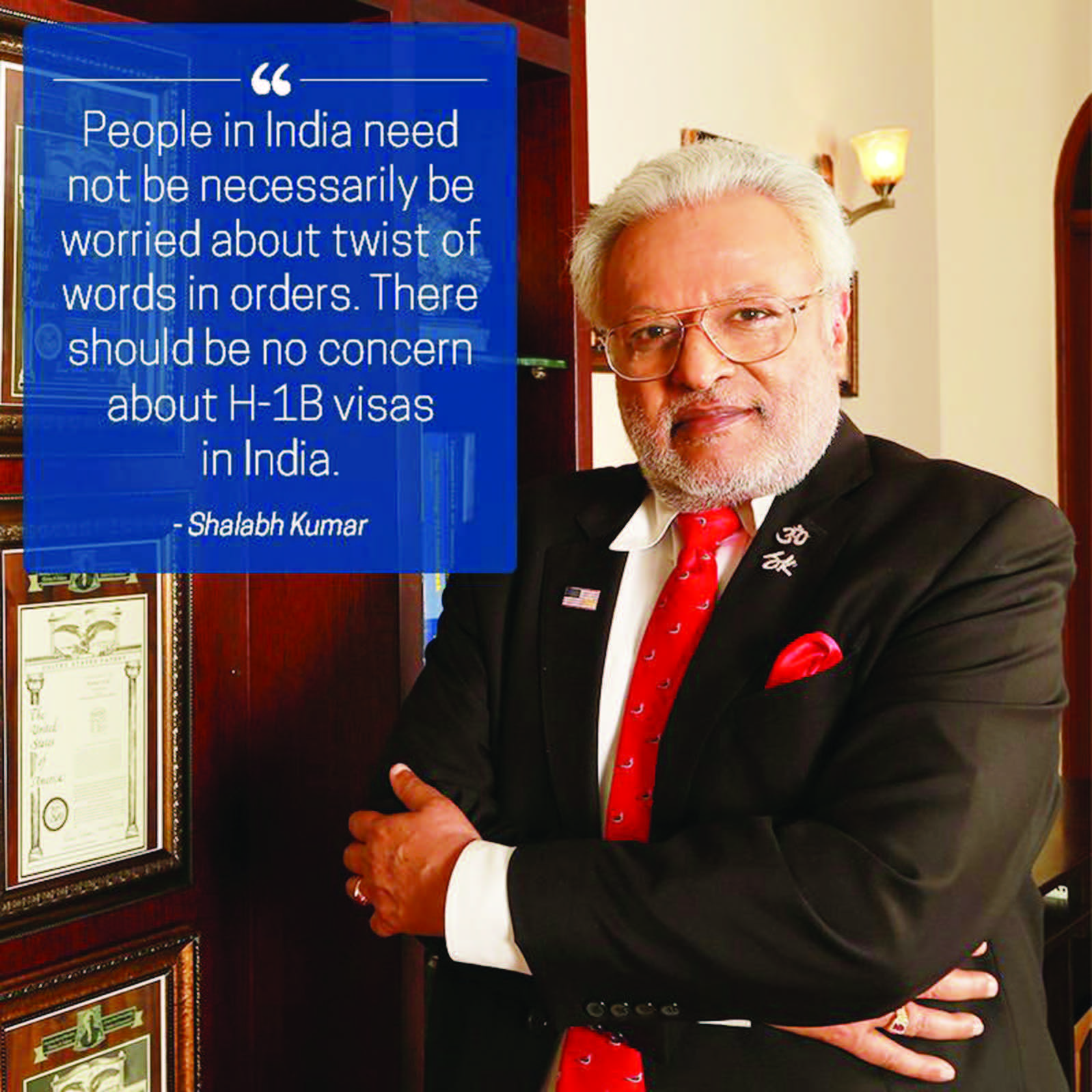
  • Trump not planning any executive order on H-1B visas: Shalabh ‘Shalli’ Kumar

    Trump not planning any executive order on H-1B visas: Shalabh ‘Shalli’ Kumar

    The Trump administration has no plans to come out with an executive order on H-1B visas, a prominent Indian-American donor and supporter of the US President claimed today, contradicting media reports that have generated anxiety in India. “There will be a need of more H-1B visas. The number of people on H-1B from India is certainly going to increase,” Chicago-based Shalabh ‘Shalli’, Kumar and head of the Republican Hindu Coalition, told reporters at a news conference.

    Responding to a volley of questions, Kumar claimed that contrary to the reports in the media, there is no executive order being worked upon by the White House on H-1B visa. For the American economy to grow, IT would have to play an important role.

    “As such I visualize need of more IT workers in the US,” he said, adding that the US has huge shortage of IT workers which can be filled up only by Indian IT professionals. Of the view that the Trump Administration would be working to ensure that there is no fraud and abuse of H-1B visas, Kumar said he believes that the White House would work to eliminate country-quota towards allocation of green cards for legal permanent residents.

    “This would be of great help Indian IT professionals,” he said, adding that the current wait time for Indians to get a green card could be as many as 35 years.

    According to reports, President Donald Trump may soon crack down on US temporary work visas including the H-1B and L-1 visas that are used widely by Indian tech companies.

    The H1B visa is a non-immigrant visa that allows US firms to employ foreign workers in specialty occupations that require theoretical or technical expertise in specialized fields. The technology companies depend on it to hire tens of thousands of employees each year.

    During his campaign, Trump had promised to increase oversight of our H-1B and L-1 visa programs.

    Supporting the executive orders of Trump on immigration and visa ban, Kumar said he would prefer this to be expanded to other countries like Pakistan. Kumar said the US Government is currently reviewing the list of countries, and if Pakistan does not start co-operating with the US, there is very high probability of it being included in the list of visa ban countries. Pakistan needs to act against terrorism.

    “There cannot be any difference between what it says and what it does. Trump would not tolerate that,” he said. In response to a question, he did not altogether rule out the possibility of him becoming the next US Ambassador to India.

  • H-1B Cap Reached: Majority of Applications by Indian Companies: 250k Applications in 5 Days

    H-1B Cap Reached: Majority of Applications by Indian Companies: 250k Applications in 5 Days

    WASHINGTON (TIP): The US government is believed to have received about 250,000 petitions for H-1B visas – the most sought after American work visas — with a majority of them being from either Indian companies or having huge footprint in India.

    In 2015, about 2,30,000 petitions for H1-B visa were received. This year, the US believes it may have received about 2,50,000 petitions for the most sought-after work visa.

    The US Citizenship and Immigration Services yesterday, April 6 said it has reached the Congressional mandated cap for H-1B visas in the general category and also the 20,000 for those who completed higher education from inside the US in STEM (science, technology, engineering and mathematics) subjects.

    USCIS did not give the number of H-1B petitions it received since April 1, when it started accepting applications for this most coveted visa for the fiscal year 2017 beginning October 1, this year. But, it says the successful petitions would be determined by a computerized draw of lots.

    As of now, below are the H1B cap number for fiscal year 2017. The below numbers are confirmed in press release by USCIS on Mar 16, 2016.

    • Regular H1B Quota: 65,000
    • H1B Master’s Degree Quota (only US Master Degrees): 20,000
    • Out of the above, a total of 6,800 is usually set aside for Singapore and Chile citizens as part of the free trade agreement between them.

    Summary of H1B 2017 Cap Reached News from USCIS

    • Congressionally mandated H1B visa cap for FY 2017 reached as USCIS received enough number of petitions for this fiscal year 2017.
    • USCIS has also received more than 20,000 petitions for the master’s cap.

    H1B 2017 Lottery Details:

    • As there were more petitions received by USCIS than required for the H1B cap, USCIS will conduct a random selection process, aka popularly called as H1B lottery, to pick the necessary cap count of 65,000 petitions for regular quota and 20,000 for master’s quota to fulfill the FY 2017 cap.
    • Lottery will be conducted for US Master’s students quota first and then the unselected petitions will be part of the general group to conduct lottery for the selecting the remaining 65,000 petitions.
    • All the unselected petitions, which are not duplicate will be rejected and return along with the filing fees
    • USCIS will consider all the H1B petitions received during the 5-day filing window from April 1st through April 7th for conducting this lottery.
    • H1B Lottery Date: As there were lot of H1B petitions filed, USCIS at the moment cannot really announce the date of H1B Lottery, as they need to do the initial paperwork for all the petitions so that the lottery can be conducted for the petitions received properly.

    H1B Cap Exempt Petitions:

    • USCIS will NOT include the cap-exempt petitions, aka who already have filed earlier and counted towards H1B cap, in the lottery selection process.
    • USCIS will continue to accept all the cap-exempt petitions that are filed with USCIS that fall under the below categories
    • H1B transfers, H1B extensions
    • H1B petitions for changes in employment terms
    • Second H1B petition to work concurrently for those who have been part of cap.
  • Silicon Valley Wants ‘Dramatic Expansion’ Of H1-B Visa: Top American CEO

    Silicon Valley Wants ‘Dramatic Expansion’ Of H1-B Visa: Top American CEO

    WASHINGTON:  With IT firms struggling to find quality and right number of professionals, a top American CEO has called for a “dramatic expansion” of the H-1B visa scheme popular among Indian tech firms to meet the growing demand.

    “The entire Silicon Valley believes that the H-1B visa policy needs to be dramatically expanded,” Bill Coleman CEO of Veritas told news agency PTI in an interview.

    “We can’t hire enough good people. They are just not available here. The salaries here are going through the roof, because everybody is competing to hire from everybody else,” he said.

    Mr Coleman, a former chairman of Silicon Valley Leadership Group, is involved with the Silicon Valley for about 40 years.

    Early this month, he became the CEO of Veritas, which has re-emerged as a newly-independent company after its purchase by The Carlyle Group for USD 7.4 billion on January 29.

    Soon headed to India, where Veritas has about 1,700 people working for it with Pune being a major centre, Mr Coleman said he plans to migrate some of his facilities to India from Florida.

    “That is a priority,” he said. The H1B visa is designed to allow US employers to recruit and employ foreign professionals in speciality occupations within the US. But in a blow to Indian IT firms, the US has imposed an additional fee of up to USD 4,500 for certain categories of H-1B visa.

    Amidst revival of the US economy wherein the unemployment rate has hit below 5 per cent, Mr Coleman referred to the huge shortage of quality IT professionals the Silicon Valley faces.

    “In Silicon Valley you go to Apple, Facebook or Google, open their websites, you will find thousands of open jobs. One of the biggest problem here is that everybody is trying to hire from everybody else. As they can’t find enough good candidates what they are doing is pushing the salaries through the moon,” he said.

    Referring to a conversation he recently had with Alphabet chairman Eric Schmidt, Mr Coleman described a “crazy” incident when the hiring-salary of a data scientist skyrocketed.

    “I know this is a very very extreme example. I was talking to Eric Smith a while ago. He was telling me that they had a really really top machine learning data scientist who they were trying to recruit. They ended up getting him, but with a USD 10 million sign on bonus. That’s crazy,” he said.

    Mr Coleman said the number of H-1B visas should be based on market demand and the programme’s expansion is one of the top priorities for the Silicon Valley.

  • Former-Disney Workers Replaced by H1-B Visa Holders File Complaint

    Former-Disney Workers Replaced by H1-B Visa Holders File Complaint

    WASHINGTON:  Replaced by H-1B visa workers, at least 23 former Disney IT workers have filed a complaint alleging discrimination.

    In a complaint filed before the federal Equal Employment Opportunity Commission, the fired Disney employees alleged that they are victims of national origin discrimination, Computer World reported.

    The report is the first step towards filing a discrimination against the major US Company.

    “These employees are making discrimination claims with the EEO under Title VII of the Civil Rights Act of 1964, citing in part ‘hostile treatment in forcing the Americans to train their replacements’. The claims include discrimination based on national origin and age,” the report said.

    However, Disney spokeswoman Jacquee Wahler asserted that the company complies with all applicable employment laws.

    “We comply with all applicable employment laws. We are expanding our IT department and adding more jobs for US IT workers,” she was quoted as saying.

    “I’m hoping that it signifies that American workers are being brave and standing up and doing something about it,” said Sara Blackwell, the attorney representing these workers.

    In June, Disney had laid off about 250 employees and replaced them with Indians holding H1-B visas.

  • Work Permits For Spouses of H1-B Visa Holders Will Help Families, Economy

    Work Permits For Spouses of H1-B Visa Holders Will Help Families, Economy

    NEW YORK (TIP): The news that the United States has finally decided to amend its regulations to allow the dependent spouses of the specialized H-1B visa holders to work was hailed with jubilation by Indian Americans.

    Effective immediately, US Citizenship and Immigration Services will begin accepting applications for employment (see details at www.uscis.gov).

    Technology companies have lobbied hard for this change, which they say will retain and attract more foreign talent and their educated spouses. This will apparently affect 97,000 people in the first year, and 30,000 per year after that.

    It’s one of a few small changes in immigration policy that the White House can make while comprehensive reform languishes in Congress.

    Rashi Bhatnagar, a former journalist from New Delhi who is currently unemployed, is ecstatic. The 31-year-old Milwaukee resident took a stand seven years ago. She started a Facebook blog H4 Visa, A Curse. It has attracted about 13,000 “likes” and many people routinely log on to commiserate. “We had no financial independence, no identity in this country. I was a voiceless, faceless human being,” she said. She came here to be with her husband Kapil, who works for Cognizant.

    Pallavi Banerjee, a post-doctoral fellow at Vanderbilt University, agrees. She has studied the effects of the visa policy on the domestic affairs of high-skilled immigrants from India, and found that they often regressed to the traditional model of dominant husbands and subservient wives. This led to depression, anxiety, domestic violence and financial difficulties.” As a sociologist, I wanted to discover the stories of people who need their voices heard and who are made invisible. There was no activism or even public discussion,” says Banerjee, who started the project seven years ago. “It affected me as a feminist academic and as an immigrant woman. I was appalled at the US Laws.”

    Ravi Batra, a famous Manhattan attorney also applauds the new development. “A family that is fully and gainfully employed is not only good for that individual unit but good for the entire nation as each working member in our nation is contributing to the country’s economy,” he says.

    By Sonia Chopra
    Journalist – http://www.huffingtonpost.in/sonia-chopra/

    The Indian Panorama News cited: DHS Starts Accepting Work Permit Applications For H4 Visa Holders

  • F1 visa Students maybe able to work in USA for upto 6 years under OPT

    F1 visa Students maybe able to work in USA for upto 6 years under OPT

    Update : F1 Visa | OPT STEM |Court Says USCIS Rule Allowing 17-Month STEM Extension Is Revoked — Read more – Stay has been put in place until February 12, 2016


    Earlier Update:

    [vc_row full_width=”” parallax=”” parallax_image=””][vc_column width=”1/1″][td_block_trending_now style=”style2″ tag_slug=”immigration” sort=”popular” limit=”5″][/vc_column][/vc_row]

    Department of Homeland Security (DHS) is considering revising regulations that would allow Foreign Students on F1 visas to work in the United States for upto SIX YEARS Jobs/Employment under the Optimal Practical Training Program.

    In the United States, the F visas are a type of non-immigrant student visa that allows foreigners to pursue education (academic studies and/or language training programs) in the United States. F-1 students must maintain a full course of study.

    Optional Practical Training and Curricular Practical Training are two employment options available to students on an F1 student visa.

    OPT is a 12-month period after graduation in which students may work in a field related to their study,and find an H-1B sponsor. Science, technology, engineering and mathematics students are eligible for an additional 17-month extension.

    CPT allows students to work up to 20 hours a week in a field related to their studies while still attending school.

    Currently, the Optional Practical Training (OPT) program allows Foreign Students to work in the U.S. in their field of study for 12 months after graduation.

    Foreign Graduates from Science, Technology, Engineering and Math (STEM) programs can request an additional work authorization for between 17 and 29 months.

    ICE officials briefed Senate Judiciary Committee staff in late May about proposed regulation affecting foreign students.

    The regulation would:

    • Allow foreign students with degrees in STEM fields to receive up to two 24-month extensions beyond the original 12-month period provided under OPT regulations; and
    • Authorize foreign graduates of non-STEM U.S. degree programs to receive the 24-month extension of the OPT period, even if the STEM degree upon which the extension is based is an earlier degree and not for the program from which the student is currently.

    DHS proposes to give same level benefit to F1 visa students that are given to H1-B visa holders.

    [crp]

  • Indians to benefit most from sop for ‘H1-B spouses’

    Indians to benefit most from sop for ‘H1-B spouses’

    WASHINGTON (TIP): Kusuma’s long hard winters of discontent in America, six of them in fact, are drawing to a close. Spouse of an Indian H1-B visa professional who came with her husband to the United States in 2009, the Bangalore University graduate had to become an involuntary homemaker, despite her degree in accounting, because her H-4 dependent visa tied to her husband’s guest worker visa barred her from seeking employment in the US.

    The Obama administration on Tuesday announced it was extending work authorization to certain categories of H-4 visa holders effective May 26, 2015, sending a wave a joy and relief through Kusuma and thousands of so called “H1-B spouses” across America, a majority of them from India. According to the United States Citizenship and Immigration Services (USCIS), which initiated the move as part of President Obama immigration reform, an estimated 179,600 H-4 dependent spouses will be eligible to apply for employment authorization in the first year of implementation alone, and an estimated 55,000 H-4 spouses will be eligible to apply in subsequent years.

    ”Allowing the spouses of these visa holders to legally work in the US makes perfect sense,” USCIS Direction Leon Rodriguez said while announcing the changes and presenting it as a win-win to both potential immigrants and the United States. ”It helps U.S. businesses keep their highly skilled workers by increasing the chances these workers will choose to stay in this country during the transition from temporary workers to permanent residents. It also provides more economic stability and better quality of life for the affected families.”

    Not all H-4 visa holders will be qualify for work authorization, USCIS has clarified. The immediate beneficiaries will be spouses of those H1-B visa holders who have applied for green cards through their employer and have received an approved Form I-140 (called Immigration of Petition for Alien Worker), and spouses of those have extended H1B status beyond six years based. Kusuma, whose name has been changed at her request, makes the cut on the first count.

    ”The important thing is I can express myself and feel my academic degree is not useless,” says Kusuma, who worked in an accounting firm in Bangalore before she came to the U.S after her marriage to a software professional.

  • 5 FACTS ABOUT INDIAN AMERICANS

    5 FACTS ABOUT INDIAN AMERICANS

    Indian Prime Minister Narendra Modi received a rapturous reception in New York City on Sunday, speaking to more than 19,000 people – largely Indian Americans, according to The New York Times – at Madison Square Garden. During his packed five-day visit, Modi also addressed the UN General Assembly and met with a bevy of U.S. business leaders Monday morning before heading to an “intimate dinner” with President Obama.

    This is the first official trip to the U.S. for Modi, who was elected in May. His visit not only marks an effort to repair strained U.S.-India relations, but also spotlights the growing presence of Indians and Indian Americans in American life. Two sitting governors (Louisiana’s Bobby Jindal and South Carolina’s Nikki Haley, both Republicans) are of Indian ancestry; so are Preet Bharara, U.S. attorney for the Southern District of New York, and Neel Kashkari, former Treasury Department official and current GOP candidate for California governor.

    In 2012, the Pew Research Center released a pair of reports on Asian Americans – one focused on demographics and attitudes, the other on religion. The reports, which drew from 2010 census data and 2012 survey results, included much information about the country’s nearly 3.2 million Indian Americans; we’ve selected a sampling of facts from both reports:

    1 Many Indian Americans are recent arrivals.
    87.2% of Indian-American adults in 2010 were foreign-born, the highest percentage among the six largest Asian-American groups; 37.6% of those had been in the U.S. 10 years or less. One consequence of so many Indian Americans having arrived so recently: Only 56.2% of adults were U.S. citizens, the lowest share among the six subgroups studied in detail.

    5 FACTS ABOUT INDIAN AMERICANS1

    2 Indian Americans are among the most highly educated racial or ethnic groups in the U.S.

    70% of Indian Americans aged 25 and older had college degrees in 2010, by far the highest rate among the six Asian-American groups studied and 2.5 times the rate among the overall U.S. population. More recent (2013) data from the American Community Survey provides more detail: 40.6% of Indian Americans 25 and older have graduate or professional degrees, and 32.3% have bachelor’s degrees; an additional 10.4% have some college education. One likely factor: the large segment of Indian Americans who entered the country under the H1-B visa program, which allow highly skilled foreign workers in designated “specialty occupations” to work in the U.S. In 2011, for example, 72,438 Indians received H1-B visas, 56% of all such visas granted that year.

    5 FACTS ABOUT INDIAN AMERICANS2

    3 Not all Indian Americans are Hindu.

    Only about half (51%) of Indian Americans are Hindu, though nearly all Asian-American Hindus (93%) trace their heritage to India, according to our 2012 survey. 18% of Indian Americans identified themselves as Christians (as both Haley and Jindal do); 10% said they were Muslim. The religious shares of Indian Americans are markedly different from those of India itself (where an estimated 79.5% of the population is Hindu and only 2.5% is Christian, according to Pew Research’s 2012 Global Religious Landscape report), reflecting differential migration patterns.
    5 FACTS ABOUT INDIAN AMERICANS3

    4 Indian Americans generally are well-off.
    Median annual household income for Indian Americans in 2010 was $88,000, much higher than for all Asian Americans ($66,000) and all U.S. households ($49,800) – perhaps not surprising, given their high education levels. Only 9% of adult Indian Americans live in poverty, compared with 12%of Asian Americans overall and 13% of the U.S. population. In 2010, by our analysis, 28% of Indian American worked in science and engineering fields; according to the 2013 American Community Survey, more than two-thirds (69.3%) of Indian Americans 16 and older were in management, business, science and arts occupations.

    5 FACTS ABOUT INDIAN AMERICANS4

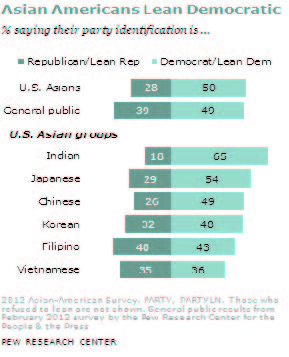
    5 Indian Americans lean left.
    65% of Indian Americans were Democrats or leaned toward the Democrats, making them the Asian-American subgroup most likely to identify with the Democratic Party. An identical share of Indian Americans approved of Obama’s job performance in 2012

    5 FACTS ABOUT INDIAN AMERICANS5

  • SUMMITRY OVER SUBSTANCE?

    SUMMITRY OVER SUBSTANCE?

    “Expectations of Prime Minister Narendra Modi’s visit to the United States later this month need to be modulated with stiff doses of reality. Structural weakness in the United States means that it cannot offer much; and what can be offered is further limited by India’s inability to leverage it to advantage”, says the author.


    36


    In contrast to the last few years, there is a perceptible shift in the dynamics of the relationship between the two counties. Although President Barack Obama had developed a warm and personal relationship with former Prime Minister Manmohan Singh, the latter’s manifest political weakness meant that this personal chemistry yielded few tangible results.

    Now, when Mr. Modi heads to the United States, the shoe is on the other foot. While the jury is still out on his domestic policies and programs, there is little doubt that he has shown purpose and dexterity on the foreign policy front – both wooing and lining up suitors – while the United States has by and large remained a bystander. A confident Indian prime minister faces a beleaguered and distracted United States president.

    On the domestic front, President Obama’s dreadful relationship with the Republicancontrolled Congress has stymied him at every step. And on the international front, he is distracted by crises – from Ukraine to the West Asia to the South China Sea – where the limits to American power are palpable and its mystique is eroding. The emerging structural weakness of American power means that a key lubricant of power in the modern age – money to underwrite programmatic initiatives – is simply not there. Both Japan and China are willing to commit – at least in principle – to considerable amounts of money to build India’s infrastructure. Of course, there is self-interest involved on the part of both governments.

    Sadly in the United States’ case, not only are American firms more expensive but government financial support ranges from minimal to non-existent. Even the modest tools that the United States has such as the Exim Bank face the threat of being shut down by a Congress unwilling to renew its charter. To take another example, the United States and India may differ on the specifics of controlling carbon emissions, but both have a common interest in undertaking serious research on mitigation and adaptation.

    Not only is there little money to develop new initiatives, instead, economic fears are keeping the pot bubbling on major irritants in the relationship – such as the United States Trade Representative (USTR)’s crusade on pharmaceutical intellectual property rights, or the unwillingness to sign a tantalization agreement, or periodically vilifying the H1-B visa program. Money is not the answer – but it is helpful in finding answers. The structural weaknesses of the United States are compounded by a perceptible lacuna in American bureaucratic resources – both number and competence – devoted to India.

    From the White House to the State Department to the Treasury, the leadership and personnel resources related to India are extremely limited. The trend toward centralizing foreign policymaking in the White House has not been matched by a strong advocate of India within the White House of sufficient stature. In the same vein, the absence of a United States ambassador to India (indeed no one has even been nominated as yet), even after a less than stellar stint for the previous ambassador, speaks volumes of United States’ priorities.

    Indeed if bureaucratic resources devoted to a country are any measure of “revealed preference” on how important the country is on the United States government radar screens, then in this administration the paucity of resources is pretty damning. And where resources are committed, as in USTR, India is seen as enemy number one. One could argue that India is itself to blame, having shot itself in the foot with illadvised policies over the last few years, and America’s tepid interest is its logical outcome.

    But to the extent this is true, great powers do not stay great for long if they are primarily reactive. Compounding these shortcomings is a state department that still devotes considerable resources on well-publicized annual reports on “worthy” issues ranging from religious freedom to human trafficking to human rights, whose hectoring report-card tone might please domestic constituencies but almost certainly raises hackles with emerging powers like India.

    Prison populations or gun-related deaths are also worthy causes – but if emerging powers write annual reports on these issues, it would hardly be helpful in strengthening their relations with the United States. Unfortunately, where America has strengths, India has weaknesses. There are a range of issues where India has a lot to gain by partnering with American institutions. Take higher education or building “smart cities”.

    But who would want to partner in higher education when the Indian regulatory institutions are All India Council for Technical Education and University Grants Commission? And with the 74th amendment effectively gutted, cities in the United States do not have effective counterparts, since power continues to be concentrated at the state level. This is not to say that there are areas where India cannot seek help from American public institutions.

    The Centers for Disease Control and the National Oceanic and Atmospheric Administration are two excellent institutions that can help India build capabilities in important areas (epidemiology and weather modeling). The heavy lifting in deepening the relationship will have to come from the two singular strengths of the American system: defense production and private-sector investment. In both cases, India needs help – but can only leverage American strengths if it moves rapidly to remove the multiple bottlenecks that have limited the potential gains.

    India’s stance on defense production has been that we would rather have our armed forces poorly equipped, and if not, give you money – lots of it, often in dubious ways – rather than have firms set up production facilities in India. There are few policies in India that have been as incredibly selfdefeating as defense procurement. Given the fiscal pressures facing western defense contractors, India is in a much better bargaining position to invite them to set up shop within the country. And the United States has to consider whether it would rather keep the multiple controls on technology transfer – especially on nonstrategic weaponry – or allow a core strength to be drained away to competitors.

    But the bedrock of the relationship will have to be the private sector. That will require regulatory certainty, an improved macroeconomic environment and swifter policy implementation on the Indian side. Both sides have certain weaknesses that could limit the private-sector partnership. In the United States’ case, some business sectors are too close to certain agencies of the United States government (the pharmaceutical sector being a prime example), leading the government to mistake the sectoral trees for the forest of the overall relationship.

    In the Indian case, the selfconfidence of the CIIs and FCCIS notwithstanding, the private sector simply lacks any strategic vision. Whether that can (or will) change remains to be seen. For these reasons expect a lot of pomp and professed bonhomie from this trip. But as regards substance, lower your expectations.

  • Us Entices Future Techies  With H-1b Visas, Green Cards

    Us Entices Future Techies With H-1b Visas, Green Cards

    WASHINGTON (TIP): The United States is poised to turn the so-called outsourcing visa into a skill importing programme. American lawmakers are on the verge of overhauling immigration laws, including the infamous H-1B visa, which critics say has been widely misused by bodyshoppers and outsourcing giants to bring in underspaid foreign (mainly Indian) technology workers to displace Americans from the workforce.

    Under new proposals being considered by a senate panel, the number of H-1B visas will actually be doubled from the current 65,000 to 130,000 to address the continued shortage of specific skilled workers in the US. But the primary beneficiaries will not be outsourcing firms who rotate workers between the US and home countries, but foreign students who come to study in America, who will be enticed to stay back, work here, and contribute to the US economy. Industrious foreign students who pay top dollar to graduate from US universities in science, technology, engineering and math ( STEM) subjects will literally have H-1B visas – eventually leading to Green Cards – stapled to their degrees, if the proposals go through. Over 100,000 Indians students are enrolled in US universities at any given time, with thousands coming in each year. The student inflow is already said to contribute more than $3 billion annually to the US economy. In the process, family members of US citizens waiting to immigrate to America may get shafted.

    Among the proposals under consideration is one which will reduce the number of green cards to siblings, parents and grown children of immigrants who have become US citizens. The restriction will not apply to spouses and underage children. In effect, Washington is gradually shifting its immigration policy from being “family unification” centered to economic and skill-based immigration. In other words, prospective immigrants will have a better chance of moving to America if they have a required skill set rather than just having a relative in the US.

    Tough negotiations are going on in the Congress on all aspects of the visa makeover. Powerful technology giants such as Microsoft, IBM, and Google want foreign workers because they say there is a genuine skills’ shortage in the US and they have benefited from infusion of foreign talent. In a letter to President Obama and lawmakers last week, a number of high-profile CEOs, including Facebook’s Mark Zuckerberg and Yahoo’s Marissa Mayer, said that being able to hire more high-skilled workers and retain foreign students enrolled in US schools is key to keeping American companies globally competitive.

    Tech companies fear that American schools are failing to produce enough graduates with advanced science and engineering degrees. But lawmakers are also buffeted by a vicious anti-immigrant sentiment on the ground, including some directed against the H1-B visa program and Indian workers. Not that pro-H1B groups are keeping quiet. A Washington Post story on the subject elicited hundreds of comments, many of them xenophobic and borderline racist.