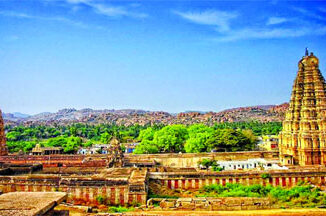
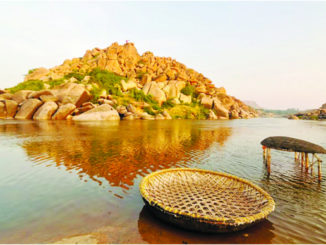
There are places you visit-and then there is Hampi, a landscape you enter, as though crossing the threshold of time itself. Scattered across the sun-washed plains of Karnataka, Hampi is a spectacular tapestry of colossal ruins, carved temples, ancient bazaars, mythological echoes, and surreal geography formed by boulders stacked like forgotten sculptures by nature. Once the capital of the mighty Vijayanagara Empire, one of the richest kingdoms of medieval India, Hampi today is a UNESCO World Heritage Site that continues to inspire wonder, awe, and quiet reflection. Hampi is located in the central part of Karnataka in the southern part of India. It is 353 km from Bangalore, and 13 km from Hospet. It is located on top of the rugged terrain and is 467 m above sea level. Tungabhadra River flows through Hampi. It has a tropical climate with hot summers (April-June), and cool winters (October-February). It experiences the southwestern monsoon rains from June to August.
Virupaksha Temple
The temple is so constructed that its main entrance faces east and homes to two courtyards. No sooner you enter the temple, there is a statue of Nandi with three heads. There is a pillared hall in the center which is reckoned as the Ranga Mandapa. In case you are an international traveler, you have to register yourself at a police outpost with all your essential details. Mostly, this temple remains crowded in December; whereas it celebrates its annual festival in February and it is one of the best places to visit in Hampi.
Vijaya Vittala Temple
Vijaya Vittala Temple or Vijaya temple of Hampi amongst the ancient Places to Visit In Hampi worthy of visiting. There are fantastic stone structures all around, and the pillars here appear as if they are playing music. This is true architectural excellence of Hampi as it exemplifies remarkable creativity and the beauty of architecture’s imagination. The architecture of this temple dates back to the Dravidian era and reflects South Indian traits. Three towering gateways are encircling the temple along with high compound walls. Maha Mantapa, Stone chariot, musical pillars are amongst the tourist attractions of this Vijaya Vittala Temple.
Lotus Mahal
Lotus Mahal or Kamal Mahal exhibits an explicit architectural design amongst all the other Hampi tourist places. It is so called as it more or less resembles the shape of a lotus flower.
Central dome of this Mahala resembles the bud of lotus and the balcony and passages as petals. The roof illustrates a multi-layered design reflecting and Indo architectural style. There are around 24 pillars to provide excellent support to the arched windows of this palace.
Yantrodharaka Hanuman Temple
Yantrodharaka Hanuman Temple is present at a distance of around 2km from the famous Virupaksha temple. This temple is a part of a cave standing at the peak of a hill and is dedicated to the Hindu deity Lord Hanuman.
Also, the Tungabhadra river flows through the steps of this hill. Here, you can find Lord Hanuman indulged in a state of deep meditation. Within a distance of five minutes from here, you can find another temple dedicated to Lord Srinivasa. In case you feel hungry, you can approach small stalls nearby selling either mangoes, biscuits or cucumbers.
Hippie Island
Another area which is amongst the most visited Places to Visit In Hampi is Hippie Island, named after its vibrant culture. Virapapur Gadde is a small island located across the Tungabhadra River. Known to be a backpacker’s delight, this island is stunning and is popular amongst the locals as well as tourists for its laid back ambience and cosy lodges.
Tourists can spend their time relaxing at one of the many cafes and shacks, like Green Garden Restaurant, Laughing Buddha Café, etc. while gorging on great food, and soaking in the view of beautiful rice paddies. This location is also known to be a centre for people to conduct sunset jam sessions with musical instruments for a fun party-like atmosphere.
Queen’s Bath
Reckoned as a large bath of Hampi, Queen’s Bath exemplifies the Vijayanagara’s architectural excellence. It lies close to one of the most awful places to visit in Hampi- the Royal Enclosure. Although built around 500 years ago, this magnificent structure still remains intact in its construction. It’s simplest exterior perfectly blends with an ornate interior to embrace its overall appearance. It a rectangular building admeasuring around 30 square meters and has a large sunken bath at its center. It may interest you to find arched corridors all around this Royal bath.
Matanga Hill
Out of all the places to visit in Hampi, Matanga Hill is the one which is most talked about. It represents the highest point of Hampi, and it’s a picturesque destination for the travel photographers to capture some aerial vies of Hampi.
North portion of this hill terminates into Tungabhadra river where you have another religious place to visit-Kodanda Rama temple. Towards the south of this hill, you have a twisting valley with a zigzag Turthu canal. Low-lying Northern section exhibits a trekking trail that connects straightaway to Hampi bazaar.
Tag: Hampi
-

Hampi: Walking through the lost empire of stone and story
-

Hampi: The abode of bygone ruins
Hampi, the city of ruins, is a UNESCO World Heritage Site. Situated in the shadowed depth of hills and valleys in the state of Karnataka, this place is a historical delight for travellers. Surrounded by 500 ancient monuments, beautiful temples, bustling street markets, bastions, treasury building and captivating remains of Vijayanagar Empire, Hampi is a backpacker’s delight. Hampi is an open museum with 100+ locations to explore and a favourite way to see the city from the perspective of its history.
Hampi was the capital of the Vijayanagar empire around 1500 AD, and by some accounts, the second largest city in the world at that time. Over the next centuries it fell out of importance, and now you can explore the ruins of a lot of temples and other structures spread out over a vast area. The terrain around Hampi is as mysterious as the ruins itself – the city is surrounded by boulders of different sizes, and you can climb to the top of them with a little effort to get a stunning view of the entire city and the geography. It is located on the banks of the Tungabhadra River. Famous for its massive, beautifully carved temples, especially the Virupaksha Temple, dedicated to the patron deity of the empire. You can also find remains of the old aqueducts, canals and military barracks and stables here. Hampi was declared a UNESCO World Heritage site in 1986 and many efforts have been taken to restore the lost glory of the place – very limited (if any) modern establishments are allowed in the main area, which gives an authentic feel to the ruins.
Virupaksha Temple, Hampi
The Virupaksha temple (or Prasanna Virupaksha temple) is located on the banks of the Tungabhadra river at Hampi. Built during the 7th century, the beautiful architecture and history of the temple have made it a UNESCO World Heritage site. The temple is abode to one of the forms of Lord Shiva called Lord Virupaksha. While it is located at present-day Hampi, it was once a smaller shrine in the middle of the ancient and majestic Vijayanagara empire. You will find beautiful stone inscriptions dating back to the 7th century on the walls of the temple as proof of its rich heritage. Architecture-lovers and history-buffs, do visit the temple when you are in Hampi!
The temple has tall towers or gopurams acting as gateways to the inner sanctums, as is usually seen in temples of south Indian style architecture. The gopurams lead to many inner corridors and halls, all decorated with ornate stone-work. The sculptures depict mythological stories of numerous Gods and Goddesses. The main deity of the temple is Lord Virupaksha, but it is also abode to few other Hindu deities too. While many devotees visit the temple during festival seasons like the Car Festival, it is otherwise less crowded.
Vithala Temple
The most impressive structure in Hampi, the Vithala Temple dates back to the 16th century and is a truly splendid example of rich architecture. The famous stone chariot, which has become an iconic symbol of the architecture of Hampi, is located inside the premises of this temple.
The temple complex is spread over a huge area. The main gate has an impressive arch with carvings, and opens in a large courtyard which has the famous stone chariot in the center. The main temple is located just behind the chariot and has beautiful carvings. There are also several other smaller temples inside the courtyard, all of which are definitely worth a visit. The carvings on the walls/pillars of these structures depict various gods in different forms.
Lotus Palace
The Lotus Palace in Hampi is one of the most iconic landmarks in the town. Named so for the way the structure looks like a lotus in bloom, this palace was the designated area for the royal women of the Vijayanagara Empire and is found within the Zenana Enclosure. Known widely as one of the few edifices in Hampi that was not lost either to the Mughal raids of the town or to the ravages of time, the Lotus Mahal stands tall in its courtyard.
Yantrodharaka Hanuman Temple
On top of the Anjaneya Hill, at a distance of 2 kilometres from the Virupaksha Temple, the beautiful Yantradharaka Hanuman Temple also known as the Monkey Temple is present inside a cave. The temple being 500 years old is dedicated to Lord Hanuman. Sri Vyasaraja, who was the Rajaguru of the Vijayanagara Kingdom and a Dwaita philosopher, was the one to install the idol of Lord Hanuman in the temple. Being one of the most famous attractions of the Anjeyanadri Hill, the Monkey Temple is considered as a sacred spot for Hindus.
Hampi Bazaar
Also known as the Virupaksha Bazaar, the Hampi Bazaar is the place to go to pick up knick-knacks, souvenirs, cheap clothes and trinkets to remember your trip to Hampi by. Situated right in front of Virupaksha temple, hence its alternate name, this bazaar which stretches for over a kilometre long is one of the main landmarks of Hampi. From embroidered shawls, fibre handicrafts, to stone carvings, this is the place to pick up anything Hampi-related. The Hampi Utsav which happens every November is also a big tourist draw and should be noted.
Hippie Island
While most tourists stay to the south of Tungabhadra where most of the ruins are located, some prefer the north banks which have a vibrant hippie culture. Virapapur Gadde or Hippie Island is a small island situated across the Tungabhadra river. It takes 5 minutes to travel to the island via coracle or boat. The last boat for the island leaves at 5.30 pm. The backpacker’s delight, Hippie Island (Virupapur Gadde) is an epitome of scenic beauty and is known for laidback ambient and lodges. Source: Holidify.com -

Hampi: The abode of bygone ruins and fascinating landscape
Hampi, the city of ruins, is a UNESCO World Heritage Site. Situated in the shadowed depth of hills and valleys in the state of Karnataka, this place is a historical delight for travellers. Surrounded by 500 ancient monuments, beautiful temples, bustling street markets, bastions, treasury building and captivating remains of Vijayanagar Empire, Hampi is a backpacker’s delight. Hampi is an open museum with 100+ locations to explore and a favourite way to see the city from the perspective of its history.
Hampi was the capital of the Vijayanagar empire around 1500 AD, and by some accounts, the second largest city in the world at that time. Over the next centuries it fell out of importance, and now you can explore the ruins of a lot of temples and other structures spread out over a vast area. The terrain around Hampi is as mysterious as the ruins itself – the city is surrounded by boulders of different sizes, and you can climb to the top of them with a little effort to get a stunning view of the entire city and the geography. It is located on the banks of the Tungabhadra River. Famous for its massive, beautifully carved temples, especially the Virupaksha Temple, dedicated to the patron deity of the empire. You can also find remains of the old aqueducts, canals and military barracks and stables here. Hampi was declared a UNESCO World Heritage site in 1986 and many efforts have been taken to restore the lost glory of the place – very limited (if any) modern establishments are allowed in the main area, which gives an authentic feel to the ruins.
Virupaksha Temple
The Virupaksha temple (or Prasanna Virupaksha temple) is located on the banks of the Tungabhadra river at Hampi. Built during the 7th century, the beautiful architecture and history of the temple have made it a UNESCO World Heritage site. The temple is abode to one of the forms of Lord Shiva called Lord Virupaksha. While it is located at present-day Hampi, it was once a smaller shrine in the middle of the ancient and majestic Vijayanagara empire. You will find beautiful stone inscriptions dating back to the 7th century on the walls of the temple as proof of its rich heritage. Architecture-lovers and history-buffs, do visit the temple when you are in Hampi!
The temple has tall towers or gopurams acting as gateways to the inner sanctums, as is usually seen in temples of south Indian style architecture. The gopurams lead to many inner corridors and halls, all decorated with ornate stone-work. The sculptures depict mythological stories of numerous Gods and Goddesses. The main deity of the temple is Lord Virupaksha, but it is also abode to few other Hindu deities too. While many devotees visit the temple during festival seasons like the Car Festival, it is otherwise less crowded.
Vithala Temple
The most impressive structure in Hampi, the Vithala Temple dates back to the 16th century and is a truly splendid example of rich architecture. The famous stone chariot, which has become an iconic symbol of the architecture of Hampi, is located inside the premises of this temple.
The temple complex is spread over a huge area. The main gate has an impressive arch with carvings, and opens in a large courtyard which has the famous stone chariot in the center. The main temple is located just behind the chariot and has beautiful carvings. There are also several other smaller temples inside the courtyard, all of which are definitely worth a visit. The carvings on the walls/pillars of these structures depict various gods in different forms.
Lotus Palace
The Lotus Palace in Hampi is one of the most iconic landmarks in the town. Named so for the way the structure looks like a lotus in bloom, this palace was the designated area for the royal women of the Vijayanagara Empire and is found within the Zenana Enclosure. Known widely as one of the few edifices in Hampi that was not lost either to the Mughal raids of the town or to the ravages of time, the Lotus Mahal stands tall in its courtyard.
Yantrodharaka Hanuman Temple
On top of the Anjaneya Hill, at a distance of 2 kilometres from the Virupaksha Temple, the beautiful Yantradharaka Hanuman Temple also known as the Monkey Temple is present inside a cave. The temple being 500 years old is dedicated to Lord Hanuman. Sri Vyasaraja, who was the Rajaguru of the Vijayanagara Kingdom and a Dwaita philosopher, was the one to install the idol of Lord Hanuman in the temple. Being one of the most famous attractions of the Anjeyanadri Hill, the Monkey Temple is considered as a sacred spot for Hindus.
One has to climb 570 steps to reach the temple since it is located on top of the hill. Though the climb is steep, the beautiful views and the pleasant air make up for the climbing. One is also likely to come across aged people climbing up with energy and devotion. There is a small temple just 5 minutes away from the Yantrodharaka Temple which is dedicated to an incarnation of Lord Vishnu, i.e. Lord Srinivasa. His idol has been carved out by Sri Vyasaraja. Below a fig tree in front of the Hanuman Temple lie some snakestones, and they are worshipped as well. It is one of the must-visit spots for all the nature as well as religious lovers.
Hampi Bazaar
Also known as the Virupaksha Bazaar, the Hampi Bazaar is the place to go to pick up knick-knacks, souvenirs, cheap clothes and trinkets to remember your trip to Hampi by. Situated right in front of Virupaksha temple, hence its alternate name, this bazaar which stretches for over a kilometre long is one of the main landmarks of Hampi. From embroidered shawls, fibre handicrafts, to stone carvings, this is the place to pick up anything Hampi-related. The Hampi Utsav which happens every November is also a big tourist draw and should be noted.
Hippie Island
While most tourists stay to the south of Tungabhadra where most of the ruins are located, some prefer the north banks which have a vibrant hippie culture. Virapapur Gadde or Hippie Island is a small island situated across the Tungabhadra river. It takes 5 minutes to travel to the island via coracle or boat. The last boat for the island leaves at 5.30 pm. The backpacker’s delight, Hippie Island (Virupapur Gadde) is an epitome of scenic beauty and is known for laidback ambient and lodges.
It has shacks and cafes which operate from October end to mid-March. They serve awesome food along with chilled beer, and most of these have a great view of either the river or the beautiful rice fields. A lot of these cafes also serve as guest houses and you can get simple rooms here at cheap rates. Away from the luxurious life, living in small huts, savouring the taste both Indian and Western cuisine and lying on the banks of the river you will definitely develop affection for the place. The shacks and cafes are a joint venture by Indians and Foreigners. Virupapur Gadde is full of backpackers who are on their way of exploring the remains of ancient times in the modern age. Therefore, you would find many for your company.
During the peak, season backpackers storm this area. It has small tourist huts which are offered at quite reasonable prices. The island has small cafes which are a joint venture of Indians and foreigners who stayed back to the place after it mesmerized them. A coracle ferry is needed to reach this side of the river. During the monsoon season, it is advisable to take a taxi to another end which is 40 km away.
Source: Holidify
-

Hampi: World Heritage site
Hampi is famous for its ruins belonging to the erstwhile medieval Hindu kingdom of Vijaynagar and it is declared a World Heritage site. The temples of Hampi, its monolithic sculptures and monuments, attract the traveler because of their excellent workmanship. The Hindu style of architecture found at Hampi reflects the splendor of the Vijaynagar Empire. The rugged landscape adds to the historic ambiance of this site.
Hampi is located in the central part of Karnataka in the southern part of India. It is 353 km from Bangalore, and 13 km from Hospet. It is located on top of the rugged terrain and is 467 m above sea level. Tungabhadra River flows through Hampi. It has a tropical climate with hot summers (April-June), and cool winters (October-February). It experiences the southwestern monsoon rains from June to August.
Places to visit in Hampi
Virupaksha Temple
The temple is so constructed that its main entrance faces east and homes to two courtyards. No sooner you enter the temple, there is a statue of Nandi with three heads. There is a pillared hall in the center which is reckoned as the Ranga Mandapa.
In case you are an international traveler, you have to register yourself at a police outpost with all your essential details. Mostly, this temple remains crowded in December; whereas it celebrates its annual festival in February and it is one of the best places to visit in Hampi.
Vijaya Vittala Temple
Vijaya Vittala Temple or Vijaya temple of Hampi amongst the ancient Places to Visit In Hampi worthy of visiting. There are fantastic stone structures all around, and the pillars here appear as if they are playing music.
This is true architectural excellence of Hampi as it exemplifies remarkable creativity and the beauty of architecture’s imagination. The architecture of this temple dates back to the Dravidian era and reflects South Indian traits.
Three towering gateways are encircling the temple along with high compound walls. Maha Mantapa, Stone chariot, musical pillars are amongst the tourist attractions of this Vijaya Vittala Temple.
Lotus Mahal
Lotus Mahal or Kamal Mahal exhibits an explicit architectural design amongst all the other Hampi tourist places. It is so called as it more or less resembles the shape of a lotus flower.
Central dome of this Mahala resembles the bud of lotus and the balcony and passages as petals. The roof illustrates a multi-layered design reflecting and Indo architectural style. There are around 24 pillars to provide excellent support to the arched windows of this palace.
Yantrodharaka Hanuman Temple
Yantrodharaka Hanuman Temple is present at a distance of around 2km from the famous Virupaksha temple. This temple is a part of a cave standing at the peak of a hill and is dedicated to the Hindu deity Lord Hanuman.
Also, the Tungabhadra river flows through the steps of this hill. Here, you can find Lord Hanuman indulged in a state of deep meditation. Within a distance of five minutes from here, you can find another temple dedicated to Lord Srinivasa. In case you feel hungry, you can approach small stalls nearby selling either mangoes, biscuits or cucumbers.
Hippie Island
Another area which is amongst the most visited Places to Visit In Hampi is Hippie Island, named after its vibrant culture. Virapapur Gadde is a small island located across the Tungabhadra River. Known to be a backpacker’s delight, this island is stunning and is popular amongst the locals as well as tourists for its laid back ambience and cosy lodges.
Tourists can spend their time relaxing at one of the many cafes and shacks, like Green Garden Restaurant, Laughing Buddha Café, etc. while gorging on great food, and soaking in the view of beautiful rice paddies. This location is also known to be a centre for people to conduct sunset jam sessions with musical instruments for a fun party-like atmosphere.
Queen’s Bath
Reckoned as a large bath of Hampi, Queen’s Bath exemplifies the Vijayanagara’s architectural excellence. It lies close to one of the most awful places to visit in Hampi- the Royal Enclosure.
Although built around 500 years ago, this magnificent structure still remains intact in its construction. It’s simplest exterior perfectly blends with an ornate interior to embrace its overall appearance.
It a rectangular building admeasuring around 30 square meters and has a large sunken bath at its center. It may interest you to find arched corridors all around this Royal bath.
Matanga Hill
Out of all the places to visit in Hampi, Matanga Hill is the one which is most talked about. It represents the highest point of Hampi, and it’s a picturesque destination for the travel photographers to capture some aerial vies of Hampi.
North portion of this hill terminates into Tungabhadra river where you have another religious place to visit-Kodanda Rama temple. Towards the south of this hill, you have a twisting valley with a zigzag Turthu canal. Low-lying Northern section exhibits a trekking trail that connects straightaway to Hampi bazaar.
Elephant Stables
Elephant Stables is amongst the significant tourist places to visit in Hampi to witness a little to absolutely no destruction. It is a long building homing to a series of dome-shaped chambers which once were used for the parking of royal elephants.
These chambers are around 11 in their total count; some of which are interconnected. The whole building gives a symmetrical appearance, and the central hall tower reflects the shape of most of the temples here. This central hall has five domes on either side of it which reflects an Islamic style of architecture.
Monolithic Bull
Situated at the east end of the Hampi Bazaar, the Monolith Bull or Nandi is a grand piece of ancient architecture that is housed in a two-story pavilion. This huge structure, which mythologically is the vehicle of Lord Shiva, is placed just opposite to the famous Virupaksha Temple. This Monolithic Bull, although partially mutilated, exhibits a coarse style of carving. The statue is so beautiful that it attracts a large number of visitors every day. It is also one of the frequently visited historical Tourist Places in Hampi. It is also surrounded by huge boulders and rock pillars.