Tag: Harsh Shringla

  • G20 outcome under India’s Presidency will be unprecedented: Harsh Shringla

    G20 outcome under India’s Presidency will be unprecedented: Harsh Shringla

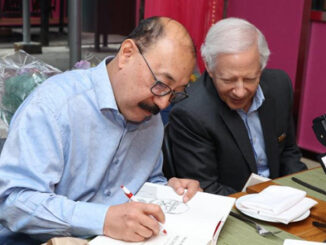
    The book launch: guests display the book. Seen from L to R : Prem Bhandari, Rajiv Bhambri, Ravi Batra, Consul General Randhir Kumar Jaiswal, Harsh Vardhan Shringla, Kenneth Juster, and other guests.

    NEW YORK (TIP): The G20 outcome under India’s Presidency will be unprecedented, veteran diplomat Harsh Vardhan Shringla has said as he underlined that the international community sees India as one country that is up to the challenge of providing solutions to current global problems. The G20 is the “most significant” international event India has hosted since its independence, Shringla, the Chief Coordinator of India’s G20 Presidency and former Foreign Secretary, said here. He addressed prominent members of the Indian-American and diaspora community on Tuesday, April 25, at the launch event of his biography ‘Not An Accidental Rise’.

    Former US ambassador to India Kenneth Juster and Consul General of India in New York Randhir Jaiswal were among the special guests at the event hosted by Jaipur Foot USA, a subsidiary of Bhagwan Mahaveer Viklang Sahayata Samiti (BMVSS). India assumed the year-long presidency of the G20 on December 1 last year and is hosting over 200 meetings and related events in cities across the country that will culminate in a global Leaders’ Summit in New Delhi in September. The summit will be attended by over 40 Heads of State, Heads of Government and international organizations.

    A G20 Leaders’ Declaration will be adopted at the conclusion of the New Delhi Summit, stating “Leaders’ commitment towards the priorities discussed and agreed upon during the respective ministerial and working group meetings.” “I have no doubt that the Summit that India will host and the outcome that we will deliver at the time of the G20 will be unprecedented,” Shringla said. He said the world is currently facing difficult times where the only certainty is uncertainty. “Many of our partners in the international community feel that if there is one country that is up to the challenge of providing solutions to global situations that have emerged today, it is India,” he said.

    India will deliver in entirety to the international community’s expectations, in particular the Global South, of which “we are a part and have been a voice of,” he said. Shringla also highlighted that about 100 G20 meetings have already been hosted across India with each meeting witnessing rejuvenation of that particular city and region, urban transformation and beautification. It witnessed involvement at the public and grassroots level of people who have never known what G20 is but known this is something big for India and are happy to be a part of the effort, he said. “Bringing G20 to the grassroots level through ‘Jan Bhagidari’ has been a major objective and one that has been achieved quite well,” he said. Earlier this month, the book ‘Not An Accidental Rise’, written by Assistant Professor, Department of International Relations, Sikkim University, Gangtok Dr Dipmala Roka was launched in Darjeeling.

    Shringla noted that the book is a “well researched” and “candid” account “not just of my career, but my entire life, so far.” Shringla, who was India’s ambassador to the US and later the Foreign Secretary when Juster was Washington’s envoy in New Delhi from 2017–2021, recalled working very closely with his American counterpart on a host of issues, including some challenging situations. “It was a difficult time. There was shock upon shock. We not only had the Covid-19 crisis, we also had multiple transgressions on our western border from our neighbor China. “We had a shock on our western borders that is Afghanistan and “another shock on the eastern border with the situation in Myanmar as well as the Ukraine conflict,” he said.

    Juster recalled working closely with Shringla on a range of issues, with the ‘Howdy Modi’ event in 2019 being among the “most notable” when Prime Minister Narendra Modi and then US President Donald Trump addressed over 50,000 people from the diaspora community in a stadium in Houston.

    Juster added that he and Shringla also cooperated and worked together during the Covid-19 crisis, as well as during the Chinese standoff. “It has always been a tremendous privilege to work with someone who has represented his own country extremely well and with someone you can discuss issues candidly and you can work together to solve problems in the best interest of both of our countries,” Juster said. Jaipur Foot USA Chairman Prem Bhandari described Shringla as the “People’s Ambassador” and the “People’s Foreign Secretary”.

    Bhandari expressed gratitude for the consistent support Shringla provided to the millions of people of Indian origin in America as well as around the world, particularly during crises such as the Covid pandemic, on issues related to OCI cards and evacuation of Indians from Ukraine in the aftermath of the conflict.

    “He is the darling of 40 million NRIs throughout the world,” Bhandari said.

    Shringla noted that the book also deals with the aspect of people-to-people ties between India and the US.

    “The community has been our mainstay and main support. Much of what we have achieved, from the nuclear deal to what we have achieved in the recent past, can be attributed to the wholehearted support from the Indian-American community,” Shringla said. Shringla also lauded Bhandari’s efforts to help the community, saying he has been a “pillar of support” during difficult times, particularly during the devastating years of the Covid-19 pandemic when Bhandari helped send much-needed ventilators and concentrators to India.
    (Source: PTI)

    Guests line up for Shringla to autograph the book “Not An Accidental Rise”
  • Boris,beware the Ides of March!

    Boris,beware the Ides of March!

    • India’s External Affairs Ministers S Jaishankar made a strong statement in the Parliament that set the tone for the ensuing period of Indo-UK relations
    • Jaishankar’s statement came after a question about racism in the UK by an MP Ashwini Vaishnaw
    • Vaishnaw alleged that an Indian student and former president-elect of the Oxford University Student Union was “cyberbullied”
    By Prabhu Dayal

    It is indeed a cause of some concern that some mischievous, anti-India elements in the UK have an unambiguous agenda of pushing their country’s relationship with India on a downward spiral. These include Khalistan supporters and Kashmiri activists who have the backing of Pakistan’s ISI.  A series of unfortunate developments engineered by such elements have been threatening to derail the bilateral relationship.

    On the Ides of March (15th March), India’s External Affairs Minister S Jaishankar made a strong statement in the Indian Parliament which set the tone for the ensuing period of Indo-UK relations. Jaishankar’s statement came after a question about racism in the UK by an MP Ashwini Vaishnaw who alleged that Rashmi Samant, a student from Karnataka and the former president-elect of the Oxford University Student Union, was “cyberbullied to the point that she had to resign (from the post).” Jaishankar said in his reply: “As the land of Mahatma Gandhi, we can never ever turn our eyes away from racism wherever it is. Particularly so when it is in a country where we have such a large diaspora.”

    Through this statement, the Indian government sent out a message that if the British parliament can debate India’s internal affairs, so can the Indian parliament debate the internal affairs of Britain. Thus, the clear message sent by New Delhi to London is that the trend being witnessed in Britain to interfere in India’s internal affairs must be brought to an end or else it will adversely affect the growth of bilateral ties.

    It is indeed a cause of some concern that some mischievous, anti-India elements in the UK have an unambiguous agenda of pushing their country’s relationship with India on a downward spiral. These include Khalistan supporters and Kashmiri activists who have the backing of Pakistan’s ISI.  A series of unfortunate developments engineered by such elements have been threatening to derail the bilateral relationship.

    A quick review of recent events is needed to put matters in the correct perspective. Tension has slowly built up between some British political groups and the Indian Government in regard to the farmers protests in India. When British PM Boris Johnson was slated to come to India in January this year as the Chief Guest for the Republic Day celebrations, more than a hundred members of the British Parliament had signed a letter asking him to raise the concerns of India’s protesting farmers in his discussions with Prime Minister Narendra Modi, as also the “brute force” employed against them. However, Johnson had to cancel his visit due to the surge in the Coronavirus cases in the UK.  Later, as a follow up of a petition which was started by a UK Sikh activist Gurch Singh and signed by more than 1 lakh persons, the House of Commons had assigned 90 minutes for a debate on March 8, 2021 on matters relating to the farmers’ protests in India.  During this debate, several MPs from the Liberal Democrats, Labour Party and the Scottish National Party expressed concern about the safety of the farmers protesting against the agricultural laws on Delhi’s borders and the targeting of journalists covering the agitation. They made adverse comments against India over press freedom, freedom of speech and domestic values.

    The Indian High Commission in London issued a strong statement against these British Parliamentarians over their comments. The High Commission said that it would “normally refrain from commenting on an internal discussion involving a small group of Parliamentarians in a limited quorum. However, when aspersions are cast against India by anyone, there’s a need to set the record straight.”

    To further underline India’s displeasure, Foreign Secretary Harsh Shringla summoned the British High Commissioner and conveyed strong opposition to the unwarranted and tendentious discussion on India’s agricultural reforms in the British Parliament. The Foreign Secretary made it clear that this represented a gross interference in the politics of another democratic country. He advised that the British MPs should refrain from practicing vote bank politics by misrepresenting events, especially in relation to another fellow democracy.

    Thus Jaishankar’s ‘Ides of March’ statement in Parliament was a firm signal that the demarche made recently by the Foreign Secretary with the UK high commissioner last week was more than just a passing phenomenon. However, Jaishankar went on to say during the very same statement that “as a friend of the UK, we also have concerns about its reputational impact,” adding “What I do want to say is that we have strong ties with the UK (and) we will take up such matters with great candor when required.” The use of the expressions ‘a friend of the UK’ and ‘strong ties with the UK’ indicates that having made known his displeasure, he perhaps signaled the Indian Government’s willingness to put the relationship back on track.

     Notably, within a few hours of making his statement in Parliament yesterday, Minister Jaishankar and Foreign Secretary Harsh Shringla held talks covering bilateral ties and global cooperation with Lord Tariq Ahmad, the visiting UK Minister of State for South Asia. The talks assume a great deal of significance in view of the fact that British Prime Minister Boris Johnson will visit India at the end of next month in what will be his first major international trip after Britain’s exit from the European Union and will be part of his efforts to boost the UK’s opportunities in the Indo-Pacific region.

    It is a truism that in diplomacy, overcoming the main threats to national interests must always override other concerns. India’s national interests are threatened by serious challenges such as the ongoing stand-off with China, the unending tension with Pakistan and the Covid-19 pandemic with its resultant slowing-down of the economy. No doubt, at this critical juncture, India can ill-afford a deterioration in its relationship with the UK, but the latter must also realize that the reverse is equally true. Hopefully, the combination of tough posturing and deft diplomacy by India will perhaps be able to put things back on track.

    (The author is a retired Indian diplomat)

    (Courtesy OPOYI)