Tag: Harsh Vardhan Shringla

  • G20 outcome under India’s Presidency will be unprecedented: Harsh Shringla

    G20 outcome under India’s Presidency will be unprecedented: Harsh Shringla

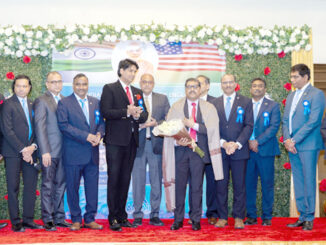
    The book launch: guests display the book. Seen from L to R : Prem Bhandari, Rajiv Bhambri, Ravi Batra, Consul General Randhir Kumar Jaiswal, Harsh Vardhan Shringla, Kenneth Juster, and other guests.

    NEW YORK (TIP): The G20 outcome under India’s Presidency will be unprecedented, veteran diplomat Harsh Vardhan Shringla has said as he underlined that the international community sees India as one country that is up to the challenge of providing solutions to current global problems. The G20 is the “most significant” international event India has hosted since its independence, Shringla, the Chief Coordinator of India’s G20 Presidency and former Foreign Secretary, said here. He addressed prominent members of the Indian-American and diaspora community on Tuesday, April 25, at the launch event of his biography ‘Not An Accidental Rise’.

    Former US ambassador to India Kenneth Juster and Consul General of India in New York Randhir Jaiswal were among the special guests at the event hosted by Jaipur Foot USA, a subsidiary of Bhagwan Mahaveer Viklang Sahayata Samiti (BMVSS). India assumed the year-long presidency of the G20 on December 1 last year and is hosting over 200 meetings and related events in cities across the country that will culminate in a global Leaders’ Summit in New Delhi in September. The summit will be attended by over 40 Heads of State, Heads of Government and international organizations.

    A G20 Leaders’ Declaration will be adopted at the conclusion of the New Delhi Summit, stating “Leaders’ commitment towards the priorities discussed and agreed upon during the respective ministerial and working group meetings.” “I have no doubt that the Summit that India will host and the outcome that we will deliver at the time of the G20 will be unprecedented,” Shringla said. He said the world is currently facing difficult times where the only certainty is uncertainty. “Many of our partners in the international community feel that if there is one country that is up to the challenge of providing solutions to global situations that have emerged today, it is India,” he said.

    India will deliver in entirety to the international community’s expectations, in particular the Global South, of which “we are a part and have been a voice of,” he said. Shringla also highlighted that about 100 G20 meetings have already been hosted across India with each meeting witnessing rejuvenation of that particular city and region, urban transformation and beautification. It witnessed involvement at the public and grassroots level of people who have never known what G20 is but known this is something big for India and are happy to be a part of the effort, he said. “Bringing G20 to the grassroots level through ‘Jan Bhagidari’ has been a major objective and one that has been achieved quite well,” he said. Earlier this month, the book ‘Not An Accidental Rise’, written by Assistant Professor, Department of International Relations, Sikkim University, Gangtok Dr Dipmala Roka was launched in Darjeeling.

    Shringla noted that the book is a “well researched” and “candid” account “not just of my career, but my entire life, so far.” Shringla, who was India’s ambassador to the US and later the Foreign Secretary when Juster was Washington’s envoy in New Delhi from 2017–2021, recalled working very closely with his American counterpart on a host of issues, including some challenging situations. “It was a difficult time. There was shock upon shock. We not only had the Covid-19 crisis, we also had multiple transgressions on our western border from our neighbor China. “We had a shock on our western borders that is Afghanistan and “another shock on the eastern border with the situation in Myanmar as well as the Ukraine conflict,” he said.

    Juster recalled working closely with Shringla on a range of issues, with the ‘Howdy Modi’ event in 2019 being among the “most notable” when Prime Minister Narendra Modi and then US President Donald Trump addressed over 50,000 people from the diaspora community in a stadium in Houston.

    Juster added that he and Shringla also cooperated and worked together during the Covid-19 crisis, as well as during the Chinese standoff. “It has always been a tremendous privilege to work with someone who has represented his own country extremely well and with someone you can discuss issues candidly and you can work together to solve problems in the best interest of both of our countries,” Juster said. Jaipur Foot USA Chairman Prem Bhandari described Shringla as the “People’s Ambassador” and the “People’s Foreign Secretary”.

    Bhandari expressed gratitude for the consistent support Shringla provided to the millions of people of Indian origin in America as well as around the world, particularly during crises such as the Covid pandemic, on issues related to OCI cards and evacuation of Indians from Ukraine in the aftermath of the conflict.

    “He is the darling of 40 million NRIs throughout the world,” Bhandari said.

    Shringla noted that the book also deals with the aspect of people-to-people ties between India and the US.

    “The community has been our mainstay and main support. Much of what we have achieved, from the nuclear deal to what we have achieved in the recent past, can be attributed to the wholehearted support from the Indian-American community,” Shringla said. Shringla also lauded Bhandari’s efforts to help the community, saying he has been a “pillar of support” during difficult times, particularly during the devastating years of the Covid-19 pandemic when Bhandari helped send much-needed ventilators and concentrators to India.
    (Source: PTI)

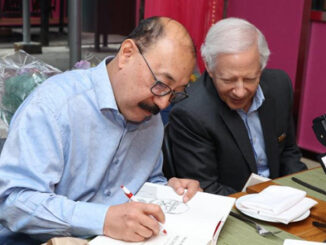
    Guests line up for Shringla to autograph the book “Not An Accidental Rise”
  • We will take all possible steps to bring back Indians from Ukraine, says  Foreign Secretary Shringla

    We will take all possible steps to bring back Indians from Ukraine, says  Foreign Secretary Shringla

    NEW DELHI (TIP): India on Thursday, February 24,  assured its citizens stranded in Ukraine that it will take all possible steps to bring them back safe and sound. Foreign Secretary Harsh Vardhan Shringla said at a media briefing that the Indian embassy in Ukraine is extending all possible assistance to the Indians notwithstanding the complicated situation.

    He said a meeting of the Cabinet Committee on Security (CCS), chaired by PM Narendra Modi, was underway on the Ukraine crisis.

    Shringla said Modi conveyed at the CCS meeting that the topmost priority of the government is the safety and security of Indians and their evacuation from Ukraine.

    The foreign secretary said around 4,000 Indian nationals out of 20,000 have already left Ukraine in the past few days.

    “The situation on the ground is difficult and rapidly evolving,” he said. “I want to assure all Indian citizens including students in Ukraine that we will take all possible steps to bring you back safe and sound,” he said. Shringla said External Affairs Minister S Jaishankar will speak to foreign ministers of Romania, Slovakia, Poland and Hungary on the Ukraine crisis.

    (Source: PTI)

  • PM Modi discusses bilateral, regional, global issues with Australia’s Morrison

    PM Modi discusses bilateral, regional, global issues with Australia’s Morrison

    WASHINGTON, DC (TIP): Prime Minister Narendra Modi has met his Australian counterpart Scott Morrison here ahead of the first in-person Quad meeting to be hosted by US President Joe Biden and discussed a broad range of issues of bilateral, regional and global importance, including the Indo-Pacific. The meeting between Modi and Morrison on Friday, September 24, came a week after they spoke over phone and reviewed the rapid progress in the India-Australia Comprehensive Strategic Partnership, including through the recent ‘two-plus-two’ dialogue, and exchanged views on regional developments and the forthcoming Quad meeting. This was the first in-person meeting between the two leaders in the post-pandemic period. “They reviewed progress since the last leader’s summit that was held virtually in June 2020, and they resolved to continue their close partnership and cooperation for the mutual wellbeing of both sides,” Foreign Secretary Harsh Vardhan Shringla told reporters while details of the meeting. The last bilateral meeting was the Leaders’ Virtual Summit held on June 4 last year when the Strategic Partnership between India and Australia was elevated to a Comprehensive Strategic Partnership, the Ministry of External Affairs (MEA) said in a statement.

    During the meeting here, Modi and Morrison discussed a broad range of issues of bilateral, regional and global importance, it said.

    The Prime Ministers “resolved to continue close cooperation for mutual well-being and towards advancing their shared objective of an open, free, prosperous and rules-based Indo-Pacific region,” the MEA said.

    India, the US and several other world powers have been talking about the need to ensure a free, open and thriving Indo-Pacific in the backdrop of China’s rising military maneuvering in the region.

    China claims nearly all of the disputed South China Sea, though Taiwan, the Philippines, Brunei, Malaysia and Vietnam all claim parts of it. Beijing has built artificial islands and military installations in the South China Sea.

    “Great to meet with my good friend and a great friend of Australia, Indian PM Narendra Modi during my visit to the US,” Morrison tweeted.

    “A wide-ranging and productive discussion ahead of the first in-person Quad meeting as we look to further deepen the partnership between our two countries,” Morrison said.

    Prime Minister Modi in a tweet said, ”It is always wonderful to interact with my good friend, PM @ScottMorrisonMP. We had wide-ranging deliberations on strengthening cooperation in the fields of commerce, trade, energy and more.” According to the MEA statement, in their meeting, Modi and Morrison reviewed the ongoing negotiations on a bilateral Comprehensive Economic Cooperation Agreement (CECA) and welcomed the visit to India by former Australian prime minister Tony Abbott as Morrison’s Special Trade Envoy for India and noted the commitment of both sides to achieve an early harvest announcement on an interim agreement by December 2021. They underlined the need for the international community to address the issue of climate change on an urgent basis as Prime Minister Modi highlighted the need for a broader dialogue on environment protection, it said, adding that both the leaders also discussed possibilities of providing clean technologies.

    Modi and Morrison agreed that “as two vibrant democracies in the region, the two countries needed to work closer together to overcome the challenges in the post-pandemic world, inter alia to enhance supply chain resilience,” the MEA said.

    “Both leaders lauded the immense contribution of the Indian diaspora to Australia’s economy and society, and discussed ways to enhance people to people ties,” the statement added.

    Prime Minister Modi also invited Morrison to visit India.

    “The Prime Minister mentioned that the Indian community was very well looked after during the COVID crisis in Australia. He especially mentioned that to the Prime Minister and there was an appreciation of the contribution of the Indian diaspora in Australia,” Shringla said.

    Earlier, Office of Prime Minister Modi said on Twitter: “Advancing friendship with Australia. PM @ScottMorrisonMP held talks with PM @narendramodi. They discussed a wide range of subjects aimed at deepening economic and people-to-people linkages between India and Australia.

    Ministry of External Affairs spokesperson Arindam Bagchi termed the meeting as “another chapter in our Comprehensive Strategic Partnership with Australia”.

    “Another chapter in our Comprehensive Strategic Partnership with Australia! PM @narendramodi and @ScottMorrisonMP met today. Discussed regional & global developments as well as ongoing bilateral cooperation in areas related to Covid-19, trade, defense, clean energy & more,” Bagchi said on Twitter.

    The meeting assumes significance as External Affairs Minister S Jaishankar and Defense Minister Rajnath Singh on September 11 held the ‘two-plus-two’ talks in New Delhi with their Australian counterparts Marise Payne and Peter Dutton.

    It was the first meeting between the prime ministers of India and Australia since the AUKUS (Australia, the UK and the US) security partnership was unveiled last week by US President Biden, British Prime Minister Boris Johnson and Morrison.

    In response to a question, Shringla said that Prime Minister Morrison did briefly mention rationale from the Australian side in seeking to initiate the AUKUS Alliance.

    “He felt that the technology that they received was appropriate and there was a brief discussion in that regard,” he said.

    In a tweet, the prime minister’s office described it as advancing friendship with Australia. “They discussed a wide range of subjects aimed at deepening economic and people-to-people linkages between India and Australia,” the PMO tweeted. The AUKUS partnership, seen as an effort to counter China in the Indo-Pacific, will allow the US and the UK to provide Australia with the technology to develop nuclear-powered submarines for the first time.

    Australia said its decision to join a security alliance with the US and the UK is aimed at developing capabilities that can contribute along with India and other countries in deterring behavior that threatens the peace and security in the Indo-Pacific.

    In the first reaction from India on the contentious alliance, Shringla on Tuesday said that the new security agreement among the US, the UK and Australia is neither relevant to the Quad nor will have any impact on its functioning, and they are not groupings of a similar nature.

    Shringla said while the AUKUS is a security alliance among the three countries, the Quad is a plurilateral grouping with a vision for a free, open, transparent and inclusive Indo-Pacific.

    The Quad comprises India, the US, Japan and Australia.

    Visit www.theindianpanorama.news for more stories on PM Modi’s US visit.

  • Indian diplomacy adjusting to an ‘uncertain’ world order: Shringla

    Indian diplomacy adjusting to an ‘uncertain’ world order: Shringla

    NEW DELHI (TIP): India has created capacities to take on future waves of the COVID-19 pandemic, Foreign Secretary Harsh Vardhan Shringla said on Friday. June 18.

    Delivering a lecture at the Public Affairs Forum of India on “India’s Foreign Policy in the post-COVID World: New Vulnerabilities, New Opportunities,” he said Indian diplomacy was adjusting to the “uncertain” world order.

    “We have created capacities in terms of hospitals and equipment so that we are better prepared for future waves that may come. We have provided essential support in this national effort through our diplomatic efforts,” said Mr. Shringla. He revisited the overall effort to deal with the second wave of COVID-19 that intensified in India beginning with March and drew a multi-agency response from the Government of India that included ramping up medicines and oxygen capacities.

    Mr. Shringla pointed at the role played by Indian embassies in Washington DC and Moscow which “facilitated discussion” on India’s vaccine diplomacy with leading vaccine manufacturers in the United States and Russia. The Foreign Secretary said the current phase had also brought new opportunities in the digital world.

    “Opportunity has been created by transition to knowledge economy. Transition to a virtual world points towards transformation, but rapid one. India is well placed to take the advantage of this transition,” said Mr. Shringla.

    He also pointed at the changing nature of diplomacy in the world and said the world is “complex” and can no longer be defined in “binaries”. “Indian diplomacy is adjusting to this complex and uncertain environment. The challenge before us is to create capacities in the face of unexpected and catastrophic events of the kind that we are currently faced with. We have to be able to repurpose organizations at very short notice to deal with unexpected challenges. Existing hierarchies and structures are often unable to cope with such challenges and may require re-engineering,” said Mr. Shringla.

    He pointed out that diplomacy earlier was conducted along principles of “balance of power”but the rules of diplomacy have changed after the arrival of COVID-19 and added, “Today’s environment is multilayered, multi-dimensional. Binaries and simple equations have been replaced by complicated algorithms.”

    “We must engage simultaneously with multiple centers of gravity and capacities in an extremely complex and fast-moving global scenario,” said Mr. Shringla, summing up the post-COVID diplomatic challenges emerging before India.

    (Source: PTI)

  • UK PM Boris to visit India in April-end

    UK PM Boris to visit India in April-end

    Will shift focus to Indo-Pacific in post-Brexit review

    NEW DELHI (TIP): UK Prime Minister Boris Johnson will visit India at the end of April, his first major international tour after London’s exit from the EU. The announcement from London came after the minister for South Asia Tariq Ahmad wrapped up his visits where which included interactions with External Affairs Minister S Jaishankar and Foreign Secretary Harsh Vardhan Shringla. During his meeting with Minister of State for Home Affairs G Kishan Reddy, Ahmad is learnt to have raised the detention of Christian Michel, the alleged middleman in the AgustaWestland VVIP helicopter deal, whose prolonged incarceration has been flagged by the UN Working Group on Aribtrary Detentions. The visit is understood to have cleared the decks for an Enhanced Trade Partnership (ETP) to be inked during Johnson’s visit. The ETP could serve as a precursor to a free trade agreement (FTA). The PM was to be the chief guest at this year’s Republic Day parade but had to put off his visit due to Covid surge in the UK. Since then London has wrapped up the integrated review of defense, security, development and foreign policy. A key takeaway is the accent on the Indo-Pacific region, which includes theUK applying for partner status of the ASEAN economic union.

    (Source: TNS)

  • India is a constructive, dependable actor globally

    India is a constructive, dependable actor globally

    Through the pandemic, it has not only met its domestic requirements but taken a range of steps for global good

    By Harsh Vardhan Shringla
    We reaffirmed our position as first responder to humanitarian crises in the region by deploying medical teams to help Maldives, Mauritius, Comoros and Kuwait deal with the pandemic. India also dispatched naval assets to Maldives, Mauritius, Madagascar, Comoros and Seychelles to deliver assistance. This demonstrated our strong commitment to the PM’s vision of Security and Growth for All in the Region (SAGAR).

    At the virtual Global Vaccine Summit, the PM highlighted how India’s contribution to the global response in terms of sharing medicines was guided by our philosophy of Vasudhaiva Kutumbkum.

    Covid-19 continues to exact a heavy toll worldwide. In India too, positive cases are rising. However, India’s effective response has led to a significant improvement in its recovery rate, which is now 68.78%. The case fatality rate at 2.01% remains one of the lowest in the world.

    High recovery and low-fatality outcomes can be attributed to proactive measures taken to deal with the outbreak from its early stages. In comparative terms, India started screening Covid-19 cases a full 13 days before the first case was detected in the country.  India implemented full lockdown on the 55th day of the outbreak when it had only around 600 cases. Its public health response has been appreciated by the World Health Organization (WHO). The government took rapid steps to augment health infrastructure. As Prime Minister Narendra Modi noted, “India now has over 11,000 Covid-19 facilities and 1.1 million isolation beds. We have ramped up testing to over half-a-million tests a day, to be scaled up to a million”.

    India’s response has not been confined to meeting its domestic requirements. India has been significantly engaged with the international community in providing the leadership that the global situation demanded. As a responsible stakeholder in global health supply chains, India ensured  timely access to essential drugs and medical items for over 150 countries while meeting our own domestic requirements.

    We reaffirmed our position as first responder to humanitarian crises in the region by deploying medical teams to help Maldives, Mauritius, Comoros and Kuwait deal with the pandemic. India also dispatched naval assets to Maldives, Mauritius, Madagascar, Comoros and Seychelles to deliver assistance. This demonstrated our strong commitment to the PM’s vision of Security and Growth for All in the Region (SAGAR).

    From being a net importer of Covid-19-related medical items, India has emerged as a net exporter. Today, India manufactures over 500,000 personal protective equipment (PPE) kits and over 300,000 N-95 masks every day. Our system has shown the necessary adaptability and agility to significantly ramp up production to go beyond our domestic requirements.

    The repatriation of Indian nationals stranded abroad and the evacuation of foreigners from India to their home countries have been among the most successful aspects of our response. In the initial days, the ministry of external affairs had promptly set up a Covid cell and a 24×7 control room to assist Indian citizens abroad. The PM had also personally directed our heads of missions to extend all possible assistance to our nationals stranded abroad. Subsequently, the Vande Bharat mission, launched to repatriate our nationals stranded overseas, has been the largest exercise of its kind ever undertaken by the government and has demonstrated our capacity to effectively carry out complex humanitarian missions. Over a million Indians have returned under the ‘Vande Bharat’ mission so far through flights, across land borders and on naval ships.

    We have not only been able to bring home Indian nationals from distant locations but also facilitated the return of Bhutanese, Nepalese and other nationals stranded in third countries to their homes on these repatriation flights. In recognition of the immense contribution played by the Indian American community in building bridges between India and USA, India has allowed all holders of Overseas Citizenship of India cards to travel freely between the two countries. The institution of ‘travel bubbles’ between India and USA and a few other countries has further facilitated such travel.

    Rigorous screening of returnees by our diplomatic missions has ensured that the proportion of positive cases remains extremely small (less than 0.2%). Testing on arrival by the health ministry and state governments has helped detect these cases. The mission just doesn’t end with the return  of Indian nationals. Recognizing that a lot of expatriate Indians would have lost their jobs particularly in the Gulf area, the Govt is mapping the skills of Indians on arrival to reskill and  link them with companies for job opportunities.

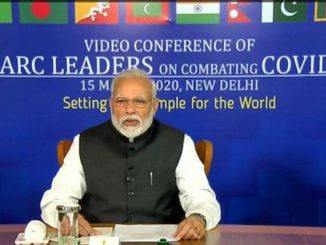
    There has also been no let-up in India’s diplomatic outreach during the pandemic. We have initiated and been part of several important conversations globally. Our ‘Neighborhood First’ policy was on full display when the PM hosted a video conference of the South Asian Association for Regional Cooperation (Saarc) leaders early in the crisis — our first such engagement on Covid-19. He announced a series of measures to deal with the pandemic, including the creation of a Covid-19 emergency fund with a commitment of $10 million from India.

    We have also called for a better multilateral response to global crises in the future. The PM has, on several occasions, including in the G-20 and Non-aligned Movement virtual summits, proposed the reform of multilateral cooperation by bringing people to the center of our efforts. Our own initiatives such as the International Solar Alliance and the Coalition for Disaster Resilient Infrastructure are prime examples of this approach. The decision of the G-20 on debt service suspension for developing countries, which India fully supported, reflects this people-centric approach.

    At the virtual Global Vaccine Summit, the PM highlighted how India’s contribution to the global response in terms of sharing medicines was guided by our philosophy of Vasudhaiva Kutumbkum.

    The PM also hosted the first virtual bilateral summit with Australia, which was followed by the India-European Union summit. In addition, the PM has spoken to his counterparts from 61 countries during this period. The external affairs minister has spoken to foreign ministers from 77 countries. I have been part of several dialogues with several of our partners countries, notably the Indo Pacific Group that convenes every other week to coordinate health, travel, immigration and related issues during COVID times,  We have kept open channels of virtual communication to strengthen partnerships and deal with situations that require diplomatic engagement.

    We have been constantly adjusting, adapting and innovating to deal with the changed reality, particularly in our engagement with the world. And in the process, we have been successful in elevating India’s profile as a constructive and dependable actor on the global stage.

    (The author  is foreign secretary, Government of India. The views expressed are personal)