Tag: Haryana

  • CBI to probe three cases of Jat quota violence in Haryana

    CBI to probe three cases of Jat quota violence in Haryana

    NEW DELHI (TIP): The CBI registered three cases on Thursday to probe incidents of violence and arson during the Jat quota agitation in Rohtak in February.

    This is the first instance of the agency formally taking over the probe in a case related to the quota violence.

    Two of the three cases pertain to violence and arson at the residence of Haryana’s finance minister Captain Abhimanyu in Rohtak that was the hotbed of the agitation.

    “The third case relates to allegations of looting of weapons by thousands of armed rioters from a company of BSF and Haryana police and attempting to murder them while they were on law and order duty at the Delhi bypass in Rohtak,” said the Central Bureau of Investigation (CBI)’s spokesperson Devpreet Singh.

    The FIRs have been filed at the agency’s Chandigarh branch.

    Only one of the three FIRs, pertaining to arson at Captain Abhimanyu’s residence, has around 40 persons named as accused.

    The remaining are against unknown persons.

    The spokesperson said the CBI took over the investigation on the request of the Ha ryana government and further orders from the department of personnel and training.

    A total of 2,104 FIRs, including one for alleged gang rapes in Murthal, were registered in connection with the Jat quota violence and 701 people were arrested.

    “A large number of persons were allegedly injured and some of them grievously in these violent attacks. It was further alleged that property worth crores of rupees was burnt and weapons of police guards were looted by the agitators,” said the spokesperson.

    During a hearing on a petition with regard to violence during the agitation, the Punjab and Haryana high court had hinted last month that it may hand over all cases registered by the state police to the CBI.

  • SC DROPS SEHAJDHARI CASE AS NEW LAW DENIES VOTING RIGHT

    SC DROPS SEHAJDHARI CASE AS NEW LAW DENIES VOTING RIGHT

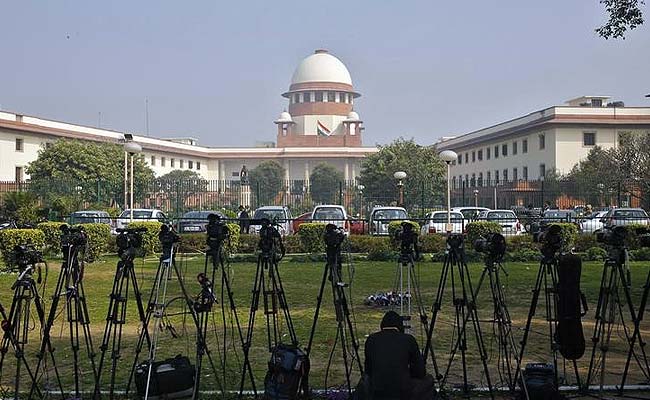
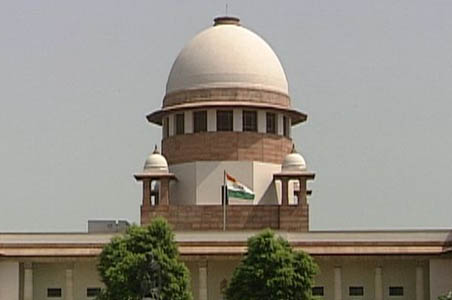
    NEW DELHI (TIP): The Supreme Court on September 15 disposed of a petition by Shiromani Gurdwara Parbandhak Committee (SGPC) over Sehajdhari Sikhs’ right to vote in SGPC elections as the case had become irrelevant following a new central law taking away their right.

    A Bench comprising Chief Justice TS Thakur and Justice AM Khanwilkar said there was no point in hearing the case just for the sake of “academic interest.” The SGPC had come to the SC challenging the December 20, 2011, judgment of the Punjab and Haryana Court restoring Sehajdharis’ right to vote.

    The HC had ensured this by quashing the Centre’s October 8, 2003, notification disenfranchising the Sehajdharis. The HC had explained that the Centre could not take away the right, given under the Gurdwara Act 1925, through an official notification.

    In the light of the HC judgment, the Centre got the 1925 Act amended in Parliament and notified the new law on May 5, 2016, denying Sehajdharis the right to vote. Subsequently, the SGPC moved an application in the apex court, pleading for allowing its appeal against the HC verdict on the basis of the new law.

    Arguing for the SGPC, senior counsel AK Ganguly and Satinder Gulati pleaded with the Bench to reinstate the committee elected in the September 18, 2011, SGPC elections. But the court did not pass any order.

    On March 30, 2013, the SC had asked the November 2010 executive committee headed by Avtar Singh Makkar to manage the gurdwaras and other SGPC institutions as the Sehajdharis had not been allowed to participate in the 2011 election of the new Board. The SGPC elections are held once every five years.

    Appearing for Sehajdhari Sikhs Federation (SSF), senior counsel Sushil Jain sought liberty to challenge the validity of the amendment to the Gurdwara Act. The Bench said the SSF was free to do so without the court’s nod.

    In view of the HC verdict and the SC’s September 2011 order, the Centre was reluctant to convene the first meeting of the 170-member SGPC Board and came to the SC seeking its clarification despite notifying the new Board on December 17, 2011.

    The SGPC also approached the apex court, seeking a direction to the Centre to convene the first meeting of the new Board and thereby facilitate election of its office-bearers —president, senior vice-president, junior vice-president, general secretary and 11 executive committee members.

  • BJP, Dalits, and the ‘Cow politics.’

    BJP, Dalits, and the ‘Cow politics.’

    In these four years, I also saw with, some disquiet, forces of divisiveness and intolerance trying to raise their ugly head. Attacks on weaker sections that militate against our national ethos are aberrations that need to be dealt with firmly. The collective wisdom of our society and our polity gives me confidence that such forces will remain marginalized, and India’s remarkable growth story will continue uninterrupted,”so said honorable Pranab Mukherjee, President of India, addressing the nation on the eve of the 70th yearof Independencefrom British colonialism.

    It is indeed quite an emphatic and forceful statement coming from the bully pulpit of the highest office in the land. It also puts to shame those who refuse to acknowledge the growing intolerance and prejudice that is sweeping across India by the rightwing zealots who are emboldened by the election of Narendra Modi to power. The question to ponder is whether this is only an aberration or a growing trend that may have disastrous consequences to the way of life as we experience it today!

    Just as India was celebrating its Independence Day, word has come out from Bengaluru that SEDITION charges are being filed against Amnesty International of India, an organization that promotes human rights and creates awareness when it is violated in any part of the world. Once again, it appears that the law enforcement agencies are madepawns by ultra-nationalists bent upon imposing their version of cultural hegemony on the diverse people of India.

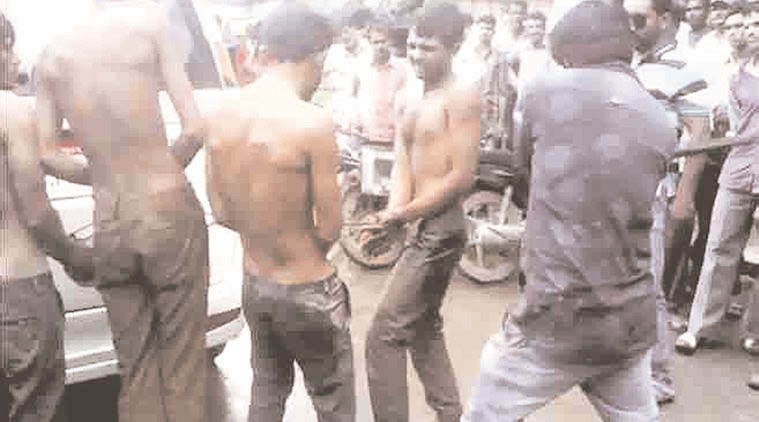
    Millions of Indians everywhere must be feeling the shame of India as the President has spoken out on the continuing assaults on Dalits. In a recent incident in Una, Gujarat, four Dalit youths were severely beaten up and dragged on the road for nearly a kilometer for allegedly possessing beef. It is widely known that the so-called upper castes will not touch the carcass and the Dalits are forced to clear or handle it and when they do, they are mercilessly beaten up in the name of self-appointed ‘Gau Rakshak Samiti.’

    Dalits who constitute one-sixth of India’s population, some 170 million people, live in precarious existence, shunned by much of Indian society because of their rank as “untouchables” or Dalits – meaning broken people – at the bottom of India’s caste system. Dalits are discriminated against, denied access to land and basic resources, forced to work in degrading conditions, and routinely abused at the hands of police and dominant caste groups that enjoy state’s protection.

    It appears that the Prime Minister had finally broken his silence when he made a statement in a town hall meeting saying that “I feel really angry that some people have opened shops in the name of cow protection. I have seen that some people commit anti-social activities through the night, but act as cow protectors by the day”. It is noteworthy that Modi did not call for the prosecution and punishment of these cow vigilantes but asked the authorities to prepare ‘dossiers’ on them and keep them under control!

    Almost a year ago, a mob lynched Mohammed Akhlaq in Dadri U.P. on suspicion of possessing beef in his home refrigerator. Subsequently, the meat was sent for forensic examination. In June, Baliyan, who is a member of Modi’s Council of Ministers, BJP MP Yogi Adityanath and BJP MLA Sangeet Som defended the killers and demanded action against the dead man’s family for the ‘crime of eating beef.’

    If there is growing intolerance on the dietary habits of Indians and rising violence by the emboldened vigilante groups who have taken up law unto their hands, many in the current leadership are in complicity, lending credence to their nefarious activities with their overt or covert support to this highly charged environment.

    Amit Shah, the President of BJP, boasted once that wherever there is a BJP government, there is a ban on beef. Raja Singh, a member of Parliament, went even further stating that he extends his full support to all those who take it upon themselves to teach those Dalits a valuable lesson!Mohinder Lal Khattar, the current Chief Minister of Haryana, is on the record saying that Muslims can live in the country only if they give up eating beef. Panchajanyam, an RSS newspaper has quoted Vedic scriptures that ordered the killing of sinners who slaughtered cows and the Union Minister of Agriculture Radhamohan Singh termed cow slaughter a ‘mortal sin.’

    There is no doubt that these vitriolic statements from higher ups have given fodder and cover to these cow vigilantes who roam the streets and become the judge, jury, and the executioners. Since BJP came to power, states like Maharashtra, Haryana and Jharkhand have tightened laws against cow slaughter, but those in the leadership used the beef issue as an emotive political tool without any repercussions from the Prime Minister. In Maharashtra state, one may get five years incarceration for possession of beef as opposed to two years for sexual harassment of a woman!

    Prime Minister himself effectively conjured up the specter of a ‘pink revolution’ – cow killing on a mass scale – in the event of a BJP’s defeat in the 2014 election as part of a   strategy to motivate people and to vote for his party. Both in Western Uttar Pradesh and again in Bihar Modi spoke at length about the dangers of ‘pink revolution.’ “The agenda of the Congress is the pink revolution,” he said. “we have heard of the green revolution and white revolution but never pink, and this means the slaughter of animals (pashu). You see, the color of mutton is pink, and they are committing the sin of exporting it and bringing revolution…Because of this, our animal wealth is being slaughtered, our cows are being slaughtered, or sent abroad to be slaughtered….And now the Congress is saying, ‘if you vote for us, we will give you permission to kill cows’”

    It is quite apparent that if Modi has to call the heinous and brutal beating of the Dalit boys in Gujarat as criminal wrongdoing and ask that the perpetrators to be punished, he would have to cross that ideological line he and his party have helped to formulate in attaining the power. However, what he has done with his recent statement to the nation is an attempt to soothe the bruised feelings of Dalits who are critical to the BJP’s prospects in the upcoming elections in U.P. and Punjab. What else could explain his silence in all these months when Muslim youths were lynched or beaten up by cow vigilantes?

    The very idea of a consolidated vote bank based on the ideology of ‘Hindutva’ to include the Dalits and other backward castes may be fast unraveling as the video footage of the beating has gone viral and stoked Dalit anger. The nation also witnessed the de-recognition of the Ambedkar Students Association in Chennai, mistreatment and subsequent suicide of the Dalit scholar Rohit Vemula in Hyderabad, torching of a Dalit home in Haryana and killing of two children. All these incidents may only reinforce the age-old Dalit thinking that BJP is essentially a party dominated by an upper caste ideology, and there may be very little room left in it for anyone else!

    (The author is a former Chief
    Technology Officer of the United
    Nations and Chairman of the Indian
    National Overseas Congress, USA)

  • Indian Defense Minister Compares Pakistan to Hell

    Indian Defense Minister Compares Pakistan to Hell

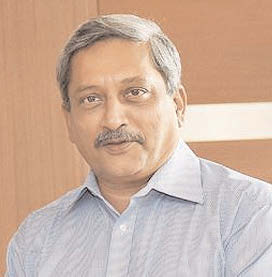
    Amid escalating tension between New Delhi and Islamabad over the ongoing violence in the Kashmir Valley, Defence Minister Manohar Parrikar said Aug. 16 here that going to Pakistan was the same as going to hell.

    Talking about the killing of five terrorists during a foiled infiltration bid from Pakistan’s side into Jammu and Kashmir, Parrikar said, “Yesterday our jawans sent back five infiltrators. Going to Pakistan and going to hell is the same.”

    “Pakistan has promoted terrorism. Sometimes they themselves have become the victims of terrorism,” he added.

    Five militants were killed as the Army on Monday foiled an infiltration bid along the Line of Control in the Uri sector of Kashmir.

    Parrikar also assured the gathering that he will look into the demand to set up a regional recruitment center of the army in Rewari, which is also known as the “Ahirwal” region of Haryana.

    He said the recruitment center will be set up in Rewari if there was no legal hindrance and after considering all related issues.

    He said the “Ahirwal” (the Yadav-dominated belt of south Haryana) was known for its soldiers and martyrs and he was honoured to visit the land.

    Parrikar was visiting Rewari, around 90 kilometres from Delhi, to participate in the “70 years of Independence — Recall the Sacrifices” program.

    He, along with Union Minister of State Rao Inderjit Singh, paid rich tributes to Rao Tula Ram, a key leader of the Indian War of Independence of 1857, at his birthplace here.

    Singh kicked off the Tiranga Yatra from Rao Tula Ram Chowk (also called Naiwali Chowk) and concluded at the Rezang La War Memorial after passing through various parts of the city.

    After the event, Parrikar told reporters that commanding officers in the army have been given more powers to take decisions at their own level in the interest of their regiments.

    He said officers at the commander level were allowed to spent Rs.50 crore to meet the needs and requirements of soldiers they were leading.

  • Beyond Gulbarg Massacre

    Beyond Gulbarg Massacre

    Lumpens’ patrons remain unrebuked

    Fourteen years after a Hindu mob felt emboldened enough to set afire an entire Muslim neighborhood, called Gulbarg Society, in Ahmedabad, some kind of justice has been promised by a court. Reports suggest that at least 24 persons stand convicted and will be punished. Among the victims of the mob’s murderous fury was Ehsan Jafri, a former member of Parliament. Against heavy odds and with remarkable fortitude and courage, his widow, Zakia Jafri, persisted all these years in seeking punishment for those who were responsible for the mayhem and murder. Her dogged fight tested the Indian judicial system and its commitment to ensure that the lawful order would not be allowed to be trifled with, whatever be the provocation and whosoever be the perpetrator. Her fight became a cause célèbre for every law-abiding citizen. The Thursday verdict would be a very small consolation to the victims but it could go some way towards restoring the primacy of the law.

    The court has rejected the argument that the massacre was the result of a conspiracy. For three days many areas in Ahmedabad and other parts of Gujarat were hosting their murderous dramas. Mob violence has its own laws of momentum. This is what had happened during the recent Jat agitation in Haryana.

    If at all there was a conspiracy, it can only be located in the politically-driven decision to let the mobs rule the streets. And, the armed lumpens were indeed allowed to roam the streets of Ahmedabad, unchecked, unchallenged and unrestrained, as they zeroed in on the hapless minority community. The Gujarat government, then headed by @NarendraModi, simply failed to perform its rajdharma to provide safety and security of life to all citizens, irrespective of caste, creed or religion. The then Union Home Minister, L.K. Advani, a self-styled later day avatar of Sardar Patel, could never demand — leave alone, enforce — accountability from the state government in Gandhinagar for its failure to live up to its constitutional responsibilities. Neither Nitish Kumar nor Mamata Banerjee nor Omar Abdullah felt sufficiently agitated to walk out of the Vajpayee Cabinet. Even Atal Bihari Vajpayee allowed calculations of party interests to override his own conscience. The Gulbarg massacre and other horrible tales of horrible violence were used to create a new politics of intimidation and polarization.

  • Sonia Lather storms into final of World Boxing Championship

    Sonia Lather storms into final of World Boxing Championship

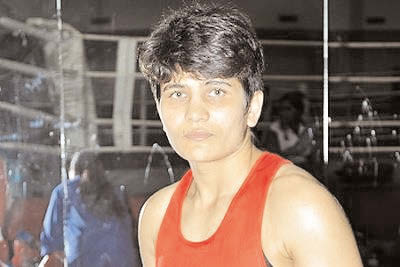
    ASTANA: Sonia Lather (57kg) stood just one win away from ending India’s six-year-old gold medal drought at the AIBA Women’s World Boxing Championship as she advanced to final after outpunching Kazakhstan’s Aizhan Khojabekova in the last-four stage on Thursday.

    The 24-year-old Sonia, who is a 2012 Asian Championships silver-medallist, defeated Khojabekova 3-0 to set up a clash with Italian Alessia Mesiano, who got the better of Bulgaria’s Denitsa Eliseeva by a similar margin.

    The lone Indian left in the fray, Sonia was quick off the blocks against her rather sloppy rival. Combining right hooks with power-packed jabs, Sonia threw Khojabekova off balance on more than one occasion.

    Khojabekova was mostly clueless when it came to defending herself and her feeble attempts at attack were blocked or evaded effortlessly by the quick-thinking Haryana girl.

    In the end, it was hardly a surprise that judges ruled unanimously in Sonia’s favour.

    Sonia’s performance is the lone bright spot in an otherwise disappointing show by the Indians in the event, where none from the country, including the celebrated M C Mary Kom, could qualify for Rio Games in the three Olympic categories of 51kg, 60kg and 75 kg.

    India have not won a gold at this event since 2010 when Mary Kom had finished on top in the 48kg category to clinch her fifth world title.

    This year’s performance continues India’s falling stock in the prestigious event. Mary Kom (51kg), who was christened ‘The Magnificent Mary’ by the world body for her feats at the tournament, could only go till as far as the second round this time.

  • HC stays reservation for Jats

    HC stays reservation for Jats

    CHANDIGARH (TIP): In what is seen as a setback for the Khattar government in Haryana, the Punjab and Haryana High Court here on Thursday stayed the reservation granted by the state government to Jats and five other communities.

    Reservation was granted to these communities under a new category of Backward Class (C). Under this, six communities — Jats, Jat Sikhs, Muslim Jats, Bishnois, Rors and Tyagis — are entitled to 10% quota in government jobs and admission to educational institutions.

    The government had passed a bill on providing quota in jobs and educational institutions to these categories in the state Assembly on March 29. The government succumbed to fierce agitation launched by members of the community, who paralysed rail and road network for nearly nine days over the reservation issue, leaving 31 people dead and 320 injured.

    On Thursday, the court issued a notice to the government on a petition filed by one M L Gupta of Bhiwani, who challenged the constitutionality of the newly enacted bill – The Haryana Backward Classes (reservation in services and admission in educational institutions) Act, 2016. The petitioner said that reservation for these communities was provided under the new act on the basis of the Justice K C Gupta commission report, which has already been quashed by the Supreme Court.

    The petitioner said providing reservation on the basis of the Gupta commission will amount to the revision of a judicial order, which the legislature cannot undertake. Also, only the judiciary can review the findings on an issue already decided in a judicial order. The petition also states that in 2014, the state government under Bhupinder Singh Hooda had introduced a bill to include Jats in the list of Other Backward Classes for reservation in jobs and educational institutes. But the apex court had held that Jats are not socially, educationally and politically backward, and had quashed the decision to grant reservation.

  • Jat stir: Haryana govt ‘ignored’ alerts on possible violence

    Jat stir: Haryana govt ‘ignored’ alerts on possible violence

    NEW DELHI (TIP): More than 100 intelligence alerts were allegedly ignored by the Haryana government since June last year, leading to large-scale violence in February during a fortnight-long agitation by Jats seeking reservation in government jobs, multiple sources said.

    The fresh revelations come before a one-member commission of former IPS officer Prakash Singh submits its report — likely by April-end — on alleged lapses by police and civil officials during the Jat stir. Singh had said this week that police inaction during the initial days of the agitation was “deliberate”.

    The violent quota agitation by the community that constitutes 26% of the state’s 2.64-crore population left at least 30 people dead and more than 320 injured. Besides, property worth crores of rupees was damaged in arson during the agitation that left the state paralysed for nearly two weeks.

    The state government last month approved a bill for providing reservation to Jats by including them under a newly-created backward class category.

    The government on Tuesday shunted out director general of police (DGP) Yashpal Singal for alleged failure to anticipate the violence despite intelligence inputs. Additional DGP of CID Shatrujeet Singh Kapur was transferred to crime branch. By the end of February, IGP (Rohtak range) Shrikant Jadhav, along with two DSPs posted in Rohtak, were suspended for alleged lapses.

  • CONSPIRACY THEORIES FLOAT  AFTER NAMDHARI MATRIARCH’S MURDER

    CONSPIRACY THEORIES FLOAT AFTER NAMDHARI MATRIARCH’S MURDER

    LUDHIANA (TIP): After Namdhari sect matriarch and the widow of former sect head Satguru Jagjit Singh was gunned down, many followers on blamed a “third party”, which purportedly wants the family running the sect to stay divided, for the murder.

    Chand Kaur, 88, was shot by two unidentified assailants on a motorcycle outside Bhaini Sahib, the headquarters of Namdhari sect near Ludhiana, on Monday morning.

    On April 5, there was a sea of supporters, clad in traditional white Namdhari attire, at Bhaini Sahib for Chand Kaur’s cremation, attended, among others, by Punjab Chief Minister Parkash Singh Badal and Ludhiana MP Ravneet Singh Bittu.

    Kaur’s grandson Jai Singh (son of the matriarch’s daughter, Sahib Kaur) and Uttam Singh, son of present sect chief Thakur Uday Singh, lit the pyre.

    Following Kaur’s death, a section of supporters of Uday Singh had alleged that his brother Dalip Singh could be behind the conspiracy — the brothers are Kaur’s nephews— and a group of protesters demanded his arrest. A bitter succession war had begun in the sect after Jagjit Singh’s death in 2012.

    Chand Kaur backed Uday Singh to take over the reins from her late husband, while Dalip Singh wanted Kaur to be the satguru. Dalip Singh, who leads the sect’s dera in Jagjivan Nagar, in Sirsa district of Haryana, stands barred from entering the Namdharis’ Bhaini Sahib headquarters. Several cases have been filed by followers of the brothers against the

    other group over the years. While a bhog ceremony for Chand Kaur, held as part of the funeral ceremony, will be organised at Bhaini Sahib on Sunday, Dalip Singh’s dera in Haryana will have a separate bhog a day before— on Saturday. On Tuesday, many followers at Bhaini Sahib called Chand Kaur’s murder a “third-party conspiracy” to polarise the sect and an attempt to widen the rift between Dalip Singh and Uday Singh. Several supporters claimed that more than a succession war, this has now become a “war among their people do want the family to unite”. Besides the succession issue, there is a huge financial empire at stake as well. The sect owns acres of land, schools, hospitals and other businesses across the country — all run in the name of Satguru Partap Singh, father of Jagjit Singh. Many Namdhari followers believe this, too, could be a possible reason for the murder. Dalip Singh said: “My mother had no enemies — she was the peacemaker in this family. I wanted her to be on gaddi (be the sect chief) because if I had accepted it, the family would have been divided…for me, she will always be our satguru. How can I even think of getting our satguru murdered?” About organising a separate bhog ceremony, Dalip Singh said, “I knew I will not be allowed to attend the last rites, or bhog (at Bhaini Sahib), and I do not want to enter forcibly and create a scene. So we will hold bhog on April 9 (Saturday).”

  • HARYANA ASSEMBLY PASSES JAT QUOTA BILL

    HARYANA ASSEMBLY PASSES JAT QUOTA BILL

    CHANDIGARH (TIP): The Haryana Assembly  passed the Haryana Backward Classes (Reservation in Services and Admission in Educational Institutions) Bill, 2016 to provide reservation for Jats and four other communities in government jobs and education.

    Haryana Chief Minister Manohar Lal Khattar moved the Bill in the House to give statutory status to Backward classes Block ‘A’, Backward classes Block ‘B’ and Backward classes Block ‘C’ — by enacting the Haryana Backward Classes (Reservation in Services and Admission in Educational Institutions) Act, 2016 and requested the Central government to include this Act in 9th Schedule read with Article 31B of the Constitution of India.

    It may be recalled that the Chief Minister had promised reservation for the Jat community and others that included Jat Sikhs, Rors, Bishnois and Tyagis, by bringing a Bill during the ongoing Budget Assembly session, following a violent Jat agitation that had left the State paralysed for over ten days in February 2016.

    The press communication issued by the government said the Bill provides for increase in percentage of reservation in Schedule I, II and III for Class I and II posts for BC ‘A’, BC ‘B’ and BC ‘C’ from 10 per cent, five per cent and five per cent to 11 per cent, six per cent and six per cent respectively.

    It was also ecided to increase the existing reservation of five per cent for Economically Backward Persons in General Caste Category in Class I and II posts from five per cent to seven per cent.

    The Bill states that notwithstanding anything contained in this Act, the state government may provide horizontal reservation for such category or categories of persons within Backward Classes, as it may deem necessary from time to time.

    After analysing the Justice (Retd.) K.C. Gupta Commission report (the Commission that was set-up to entertain, examine and recommend upon requests for inclusion and exclusion of castes in the list of backward classes), the state government is satisfied that the report of the Commission is based on quantifiable data and strong evidences, which indicates that not only the five
    castes/classes — Jat, Jat Sikh, Ror, Bishnoi and Tyagi are backward classes socially and educationally, but they also comply with all legal norms suggested in Indra Sawhney’s (CWP 930 of 1990) case, which has made it imperative for the state to provide these castes/classes ten percent reservation in relaxation of general rule of 50 percent in terms of paragraph 810 of the Indra Sawhney’s case.

    Notably, reservation in Haryana has already touched the 50 per cent threshold as prescribed by the Supreme Court of India, however the case law established by Indra Sawhney’s case does not limit the powers for providing reservation to classes by the executive or legislative Branches.

    As per the judgement, reservation should not “exceed 50 per cent of the appointments in a grade, cadre or service in any particular year. It is only for extraordinary reasons that this percentage may be exceeded.” However, every excess over 50 per cent will have to be justified on valid grounds which will have to be specifically made out, said the government statement.

  • Jat quota agitation: Ex-Haryana CM Hooda’s aide arrested

    Jat quota agitation: Ex-Haryana CM Hooda’s aide arrested

    ROHTAK (TIP): Former Haryana chief minister Bhupinder Singh Hooda’s close assistant Virender Singh, who was booked for sedition and criminal conspiracy on charges of inciting violence during the Jat agitation, was arrested on March 17, police said.

    “We have arrested Virender Singh. He will be produced before court and we will be seeking his custodial interrogation,” Rohtak superintendent of police Shashank Anand said.

    Singh was political adviser to Hooda during his 10-year tenure as chief minister. He, however, claimed before reporters that he had voluntarily surrendered at the SP’s office.

    “I am a law abiding citizen. I have not done anything wrong and the truth will come out,” he said.

    The arrest came after the Rohtak district court on Tuesday denied him anticipatory bail.

    Singh along with others was booked last month under various sections of the IPC, including sedition, after an audio clip surfaced in which he was purportedly heard talking to a khap leader in order to allegedly incite violence during the Jat community’s reservation stir.

  • Jat quota stir: Tense calm as Haryana limps back to normal

    Jat quota stir: Tense calm as Haryana limps back to normal

    ROHTAK (TIP): Haryana saw a tense calm as Jats seeking job quotas withdrew from the streets or were chased away on February 24. Highway and rail traffic was restored even as security forces were on alert to foil clashes between Jats and non-Jats.

    More on “JAT QUOTA PROTESTS HARYANA – INDIA”

    Jat quota stir- Tense calmIn a sign of people’s anger over the mindless violence that rocked the state, Haryana Chief Minister Manohar Lal Khattar faced angry traders and residents in Rohtak town and was forced to retreat and leave for Delhi.

    [td_block_trending_now style=”style2″ tag_slug=”JAT QUOTA PROTESTS HARYANA – INDIA”]

    Khattar, who reached Rohtak for the first time after widespread violence during the Jat agitation devastated many parts of the town, vowed not to spare those guilty of rioting and arson that crippled Haryana.

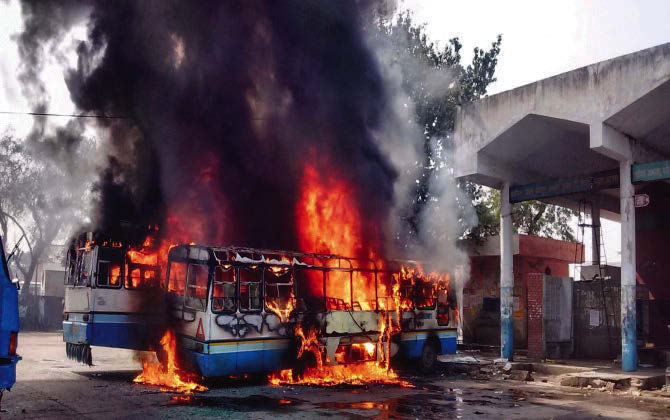
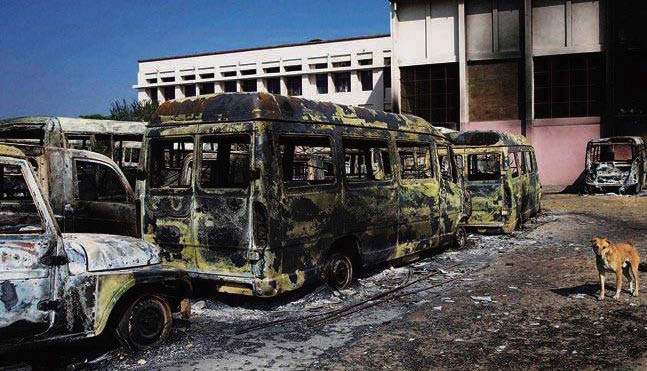
    Charred vehicles pile up in Rohtak.
    Charred vehicles pile up in Rohtak.

    “A high-level probe will be conducted into the (violence) and strict action taken against officers and employees of police and administration involved in this,” Khattar told the media in Rohtak.

    In a fine balancing act, he said the Jat community will get job quotas under a special provision and the OBC quota of 27 percent won’t be disturbed. The OBC communities don’t want Jats to be included in the OBC bracket.

    “The government will make a separate provision for (Jats) reservation,” said a stern-looking Khattar, whose government has drawn widespread flak for failing to contain the frenzy on the streets.

    In New Delhi, Khattar attended a meeting with union Parliamentary Affairs Minister M. Venkiaih Naidu and other ministers who are part of a high-powered panel studying the issue of reservation for Jats in other states.

    Nineteen people were killed and nearly 200 injured in the nine days when Jats held Haryana to ransom, and in the process disrupted life in large parts of northern India.

    As Monday was a holiday on account of Sant Ravidas Jayanti, Tuesday was the first working day after the Jat agitation. Most schools were, however, shut.

    Traffic was restored on the busy Delhi-Ambala national highway (NH-1) after three days. Three people were killed when Jat protesters blocked the highway on Monday, forcing security forces to open fire.

    Traffic was also restored on the Delhi-Hisar NH-10, especially near Sampla town, police said.

    Curfew was relaxed in Rohtak town and some other places. Some villages and towns were tense as some members of Jat and non-Jat communities headed for a clash on Monday.

    The worst affected districts in the Jat agitation were Rohtak, Bhiwani, Hisar, Sonipat, Jhajjar, Jind, Panipat and Kaithal.

    The government has an ex-gratia of Rs.10 lakh to the next of kin of the innocents killed in the agitation and employment to a member of the family of the deceased. The PHD Chamber of Commerce and Industry has pegged the loss to Haryana and other states due to the violence at Rs.34,000 crore.

    More on “JAT QUOTA PROTESTS HARYANA – INDIA”

    The India-Pakistan train and bus services, which pass through Haryana, are expected to resume operations on Thursday. Referring to an audio clip in which a close aide of a Congress leader is heard inciting people to indulge in violence, Khattar said those who damaged property would be identified and strict action taken against them.

    The government has promised to compensate those who lost property in the agitation.

    The chief minister said ‘dharnas’ across the state had been lifted and blockades on all roads cleared.

    [td_block_trending_now style=”style2″ tag_slug=”JAT QUOTA PROTESTS HARYANA – INDIA”]

    Earlier, Khattar was shown black flags by a section of traders and residents who raised slogans against him and questioned his government’s failure to deal with the Jat agitation.

    The Punjab and Haryana High Court on Tuesday directed the Haryana government to submit a status report on the Jat agitation by next Monday.

    The Jat community wants reservation under the OBC category in government jobs and educational institutions.

    Source: IANS

  • Haryana Suspends Inspector General , Two Other Police Officers

    Haryana Suspends Inspector General , Two Other Police Officers

    CHANDIGARH (TIP): Initiating action against police officers following the recent violent Jat agitation, the Haryana government on February 25 ordered the suspenion an inspector general of police (IGP) and two deputy superintendents of police (DSPs).

    Those suspended include IGP Shrikant Jadhav, who was the Rohtak range IG till last week when the agitation took a violent turn.

    Jadhav was, on Sunday, shunted out at Rohtak Range IG and posted as IG, State Crime Record Bureau, Madhuban, an inconsequential posting.

    The two DSPs suspended are Amit Dahiya and Amit Bhatia, both posted in Rohtak town.

    The Haryana Police is being accused of not reacting to the situation and ensuring safety of people and property as the violent protestors had a field day in arson and looting.

    Rohtak, Sonipat, Panipat and Jhajjar, the districts worst-hit by violence in the ongoing Jat agitation, fall under the Rohtak range.

  • HC seeks report on alleged Murthal rapes during Jat stir

    HC seeks report on alleged Murthal rapes during Jat stir

    CHANDIGARH (TIP): Days after allegations of women being molested during the Jat agitation, the Punjab and Haryana High Court has asked Haryana DGP and Chief Secretary to file a report in the matter. The High Court took suo motto cognizance of the issue. Reports had emerged that women passengers were raped near Murthal in Sonipat during the Jat agitation.

  • RAIL-ROAD TRAFFIC HIT AS JAT QUOTA STIR CONTINUES IN HARYANA

    RAIL-ROAD TRAFFIC HIT AS JAT QUOTA STIR CONTINUES IN HARYANA

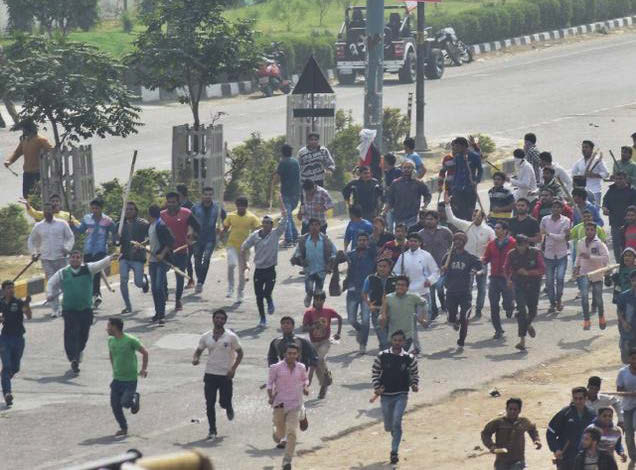
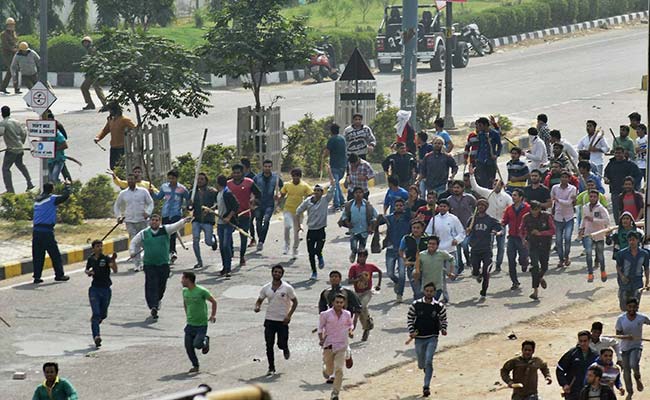
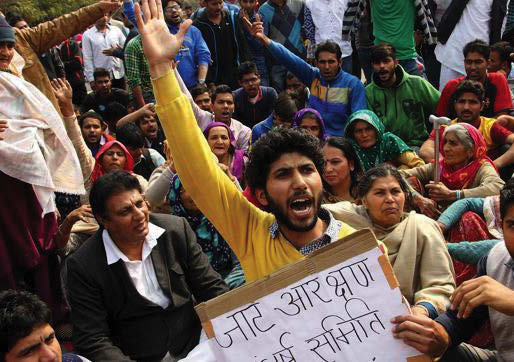
    ROHTAK (TIP):Jat protests have disrupted road and rail traffic with the worst hit being the Rohtak-Jhajjar, the epicentre of the protests, besides Bhiwani, Sonipat and Hisar.

    Trucks have been stranded near Rohtak bypass as the agitation continues.

    Earlier, authorities blocked mobile internet services in two Haryana districts as a Jat quota agitation turned violent overnight and crippled normal life across large parts of the state which struggled to maintain supply of essential commodities for the past five days.

    Chief minister Manohar Lal Khattar called an all-party meeting on Friday to discuss the issue after Jat leaders vowed to continue the agitation till the government provided them reservation under the other backward classes (OBC) category. Khattar also convened an emergency cabinet meeting on Thursday night to review the situation in the wake of the agitation by the community which constitutes nearly 30% of the state’s population.

    INTERNET SERVICES BLOCKED IN JHAJJAR, ROHTAK

    Officials said mobile internet services have been blocked in Jhajjar and Rohtak in the Jat heartland which saw violence on Thursday when protesters clashed and pelted stones on police trying to evict them after imposition of prohibitory orders in four districts.

    They said the move was aimed at preventing spread of rumours which could add fuel to the already tense situation. The agitation also spread to northern Haryana districts of Kurukshetra and Yamunanagar.

    Two lawyers were injured and two motorcycles were set afire in a clash between members of the Punjabi community and lawyers supporting Jat protesters outside the Rohtak district court. The district administration has declared holiday in all educational institutions of Rohtak till February 21.

    The agitation by Jats has crippled life despite the state government assuring them to include them in quota for economically backward persons (EBP) of general castes and also increasing the EBP quota from 10% to 20%.Agriculture minister Om Prakash Dhankar said after the Cabinet meeting that supply of essential commodities such as cooking gas and petrol has been affected.

    “Our fuel trucks have not reached us for the past four days and soon we will be out of stock. It will add to the woes of the people,” said an employee of a fuel pump on Delhi road in Rohtak.

    90 FUEL DEPOTS DECLARED DRIED

    The All Haryana Petroleum Dealers’ Association vice-president Bhushan Goel said out of 102 fuel depots in Rohtak more than 90 have already been declared dried and remaining may go out of stock if the agitation lasts for one more day. The agitation has also affected crushing operations of the co-operative sugar mills in Jat-dominated areas of Rohtak, Meham, Gohana and Sonepat. While all state and national highways had been blocked in Rohtak, Sonepat and Jhajjar districts for the past four days, Jat protesters blocked the Bahadurgarh-Delhi road at Bahadurgarh and Najafgarh of Jhajjar district, affecting traffic movement to Delhi from Haryana on Thursday. Bus services continued to be suspended in Jind, Rohtak, Narwana, Hisar, Jhajjar, Sonepat districts.


  • QUOTA CAULDRON: ANGER IN JATLAND

    QUOTA CAULDRON: ANGER IN JATLAND

    Why Jats are protesting now?

    It’s a double whammy for them. The Punjab and Haryana high court on July 27 last year stayed the decision of the state government to grant 10 % quota to Jats and four other castes — Jat-Sikh, Bishnoi, Ror and Tyagi — under the special backward class (SBC) category. Earlier, the apex court on March 17, 2015, had quashed the decision of the Congress-led UPA government at the Centre to provide reservation to Jats under other backward classes (OBC) of the central government.

    How Jats were included in Centre’s OBC list in 2014?

    While the National Commission for Backward Classes (NCBC) had rejected the demand to include the Jats in the OBC central list, the UPA cabinet overruled its recommendation to include Jats of Haryana, Himachal Pradesh, NCT of Delhi, Uttar Pradesh, Uttarakhand Bihar, Gujarat, Madhya Pradesh and Bharatpur and Dholpur districts of Rajasthan in the OBC list.

    How Jats, 4 other castes were granted quota by Haryana?

    The previous Congress regime re-constituted the Haryana Backward Classes Commission (HBCC) to look into the quota demands of Jats, Jat Sikhs, Rors, Tyagis and Bishnois. The HBCC recommended 10% quota for five castes under the SBC category, which was implemented by the Congress regime. This took the reservation to 57% in the state.

    Whether any other castes were also given quota in 2013?

    Soon after granting SBC quota to Jats and four other castes, the previous regime also gave 10% reservation to economically backward persons (EBP) of general castes such as Brahmins, Rajput, Punjabi, Aggarwals etc. The total annual income to qualify for the EBP quota was fixed at ` 2.5 lakh. With this, the reservation reached 67% in Haryana.

    Was 10% quota under SBC and EPB categories legally tenable?

    No. The Supreme Court in its 1992 judgment in the Indra Sawhney case has held that reservation contemplated in clause 4 of Article 16 of Constitution should not exceed 50 %. Article 16 provides for equality of opportunity in matters of public employment.

    What does inclusion of Jats and 4 other castes in EBP quota entail?

    While under 10% SBC quota five castes-Jats, Jat Sikhs, Rors, Bishnois and Tyagis — competed with each other for jobs and admissions in educational institutions, the inclusion in 20% economically backward persons quota for general castes will mean more competition with other castes thus reducing their chances considerably

    What was SC/BC quota in jobs, education institutes before 2013?

    It was 47%. For SCs, the quota was 20% and for BCs it was 27%.

    Was there a bifurcation in percentage of quota for BCs?

    The reservation for BCs was bifurcated into two blocks- A & B. For block A —having 71 castes — the reservation was 16%. For block B — having five castes, Ahir, Gujjar, Lodh/Lodha, Saini and Meos — the quota was 11%.

  • QUOTA CAULDRON: INTERNET SERVICES BLOCKED IN JHAJJAR, ROHTAK

    Officials said mobile internet services have been blocked in Jhajjar and Rohtak in the Jat heartland which saw violence on Thursday when protesters clashed and pelted stones on police trying to evict them after imposition of prohibitory orders in four districts.

    They said the move was aimed at preventing spread of rumours which could add fuel to the already tense situation. The agitation also spread to northern Haryana districts of Kurukshetra and Yamunanagar.

    Two lawyers were injured and two motorcycles were set afire in a clash between members of the Punjabi community and lawyers supporting Jat protesters outside the Rohtak district court. The district administration has declared holiday in all educational institutions of Rohtak till February 21.

    The agitation by Jats has crippled life despite the state government assuring them to include them in quota for economically backward persons (EBP) of general castes and also increasing the EBP quota from 10% to 20%.Agriculture minister Om Prakash Dhankar said after the Cabinet meeting that supply of essential commodities such as cooking gas and petrol has been affected.

    “Our fuel trucks have not reached us for the past four days and soon we will be out of stock. It will add to the woes of the people,” said an employee of a fuel pump on Delhi road in Rohtak.

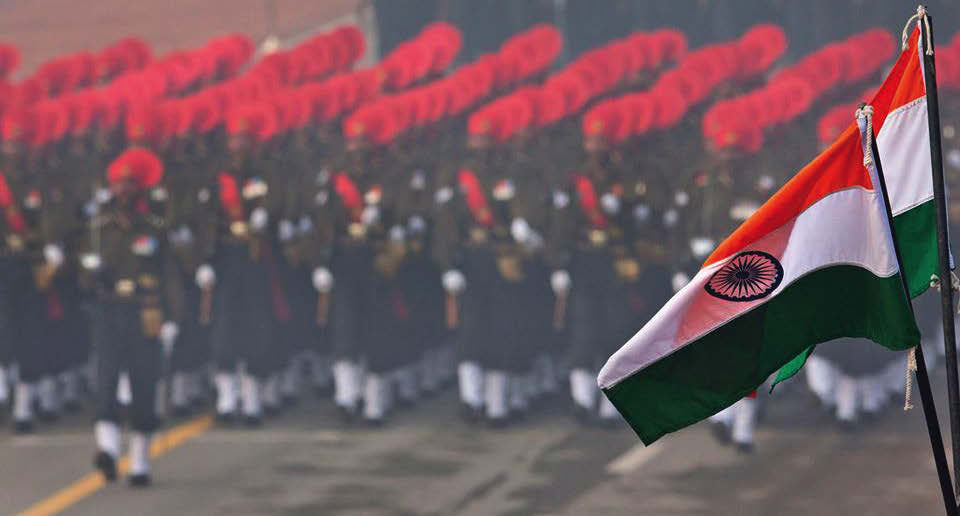
  • AMID TIGHT SECURITY, INDIAN STATES CELEBRATE REPUBLIC DAY

    AMID TIGHT SECURITY, INDIAN STATES CELEBRATE REPUBLIC DAY

    Vibrant parades and colorful programs highlighting the culture and achievements of states marked Republic Day celebrations across the country, which passed off peacefully amid tight security. The governors hoisted the Tricolour in the state capitals, and delivered speeches highlighting issues of immediate concern. An account of how various states marked the day:

    Jammu and KashmirRepublic Day celebrations, held amid massive security clampdown, were peaceful. For the second consecutive year, the Tricolor was unfurled by bureaucrats as the state is under Governor’s rule. The biggest function in the Valley was at Srinagar’s Bakshi Stadium.

    The Valley, though, observed a complete shutdown on a strike called by separatists. Shops and establishments were also shut.

    There were celebrations along the border, too. Indian and Pakistani troops along the LoC exchanged sweets at three places.

    Assam

    Hoisting the national flag in Guwahati, Chief Minister Tarun Gogoi asked fugitive ULFA leader Paresh Baruah to eschew violence and return to the mainstream. He hoped that with the repatriation of ULFA general secretary Anup Chetia, the ongoing peace talks with the Centre would be expedited. The CM said that while 13 extremist outfits had already laid down their arms, and discussion with these groups was progressing in a positive direction, Baruah should also follow suit.

    Arunachal Pradesh

    Governor J P Rajkhowa hoisted the flag at Indira Gandhi Park in Itanagar and called for a corruption-free administration. “Let us join hands to fight the menace of the hydra-headed monster called corruption, otherwise good governance will be a far cry,” he said. Rajkhowa laid emphasis on constitution of Lokayukta on priority basis.

    Gujarat

    Stunts on motorbikes and horseback, contingents of police and armed forces, cultural performances and a train of floats showcased the state during Republic Day celebrations near Somnath Temple in Gir Somnath district. Governor O P Kohli unfurled the flag in the presence of Chief Minister Anandiben Patel. The program was held outside Gandhinagar, a trend started by former CM Narendra Modi.

    Bihar

    Governor Ram Nath Kovind said that the rule of law and communal harmony prevailed in the state. “A check has been imposed on organised crime and this will continue in the future,” Kovind said in Patna’s Gandhi Maidan, adding the state has adopted a policy of zero tolerance on corruption.

    Punjab & Haryana

    In Chandigarh, Governor Kaptan Singh Solanki unfurled the national flag, while Punjab Deputy Chief Minister Sukhbir Singh Badal presided over the function at Bathinda as Chief Minister Parkash Singh Badal was indisposed.

    West Bengal

    In Kolkata, Governor K N Tripathi hoisted the Tricolor and took salute at the march past of armed forces and police forces at Red Road. A colourful parade and procession with decorated tableaus portraying the state’s culture and heritage were the highlights of the programme.

    Andhra Pradesh

    Governor E S L Narasimhan hoisted the national flag at Hyderabad and Vijaywada. Narasimhan outlined the state government’s vision to eliminate social and economic disparities.

  • Meet India’s bravehearts

    Meet India’s bravehearts

    NEW DELHI (TIP): National Bravery Award-winning boys and girls drew applause from the audience at the Republic Day parade here for saving human lives in dangerous situations.

    As 23 out of the 25 award winners were driven in a jeep at the parade.

    From a 16-year-old who fought off a tiger to a 13-year-old who lost his life while trying to save his friend from drowning, three girls and 22 boys showed incredible bravery in the face of dangerous situations.

    Bharat Award, the highest of the National Bravery Awards, has been posthumously awarded to Gaurav Kawduji Sahastrabuddhe from Maharashtra who sacrificed his life during an attempt to save four of his friends.

    Shivansh Singh, who lost his life while undertaking a valiant effort to save his friend from drowning in Sarayu river was also awarded posthumously.

    The prestigious Geeta Chopra award has been given to eight-year-old Shivampet Ruchitha of Telangana who displayed exemplary valour in saving two lives when a train hit her school bus.

    Sixteen-year-old Arjun Singh was honoured with Sanjay Chopra Award for displaying outstanding bravery in fighting off a tiger to save his mother. Ramdinthara (15) of Mizoram, who saved two persons from electrocution, was awarded Bapu Gaidhani Award, along with Rakeshbhai Shanabhai Patel (13) of Gujarat and Aromal SM (12) from Kerala.

    While Rakeshbhai saved a boy who accidentally fell into a deep well, Aromal rescued two women from drowning.

    Other recipients of the bravery awards are Kashish Dhanani (Gujarat), Maurice Yengkhom and Chongtham Kuber Meitei from Manipur, Angelica Tynsong (Meghalaya), Sai Krishna Akhil Kilambi (Telangana), Joena Chakbraborty and Sarwanand Saha (Chhattisgarh) and Dishant Mehndiratta (Haryana). Beedhovan, Nithin Philip Mathew, Abhijit KV, Anandu Dillep, Muhammad Shamnad (all from Kerala), Mohit Mahdenrda Dalvi, Nilesh Revaram Bhil, Vaibhav Ramesh Ghangare (all from Maharashtra), Abinash Mishra (Odisha) and Bhimsen from Uttar Pradesh were also given the award.

  • I don’t need extra rounds to finish off Hyuseinov: VIJENDER SINGH

    I don’t need extra rounds to finish off Hyuseinov: VIJENDER SINGH

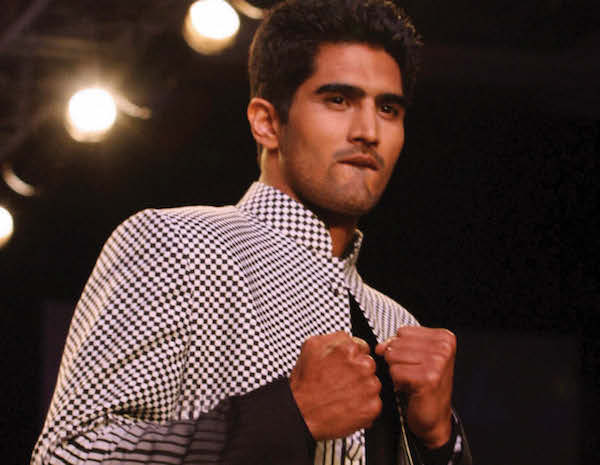
    MANCHESTER (TIP): Indian boxing star Vijender Singh, who competes in his first six rounds contest this Saturday night at the Manchester Arena, says he won’t need the extra rounds to finish off experienced Hungarian Samet Hyuseinov in his third professional bout.

    The fast rising middleweight star from Bhiwani, in Haryana, has steamed through his first two professional opponents since turning pro after a highly decorated amateur career culminating in bronze at the 2008 Olympics Games.

    Dusting off Sonny Whiting in three rounds in October and then Dean Gillen inside one in November and with a reluctance of domestic fighters wanting to face Singh, an international opposition has been selected for Vijender’s last fight of the year with Bulgaria’s Hyuseinov taking up the challenge.

    Vijender doesn’t see it going beyond three rounds against Hyuseinov.

    “I feel in tremendous shape and ready to punch holes in Hyuseinov on Saturday night,” said Vijender.

    “It’s another progression in my boxing career to move up to six rounds, but I really don’t feel I’ll need them against Hyuseinov.

    “While it’s good to get rounds and experience under my belt I want excitement and knockouts, the rounds will come as we move up into title fights, right now I want to take opponents out as quickly as I can, three rounds, maybe, against Hyuseinov.

    “He won’t be in for the distance against me that’s for sure, once I start lining him up with the jabs and get my distance and then start dropping big hard rights in, he won’t be lasting too long.”

    However Hyuseinov says he’ll teach Vijender a painful lesson for dismissing him as an easy job and disrespecting him.

    “For all his insults I will make him pay,” said Hyuseinov.

    “He is just a two-fight kid, two fights and he’s talking like he’s a world champion. This man has been disrespectful to me and questioned my fighting ability by saying that he will knockout me out before six rounds, what a joke, for that I will make sure that I hurt him.

    “Nobody will talk to me as if I am a journeyman and I will not let a raw novice boxer, who in my eyes is just a play actor boxer and should stick to acting in films, say he will knock me out.

    “Watch on Saturday, he says he doesn’t need six rounds to knock me out, but I will hit him for six.”

    (PTI).

  • Affordable Housing – Win-Win for all

    Affordable Housing – Win-Win for all

    The Govt. of India, Ministry of Housing and Poverty alleviation with the aim to create affordable housing stock encouraged private players to enter this segment as PPP Model (Public Private Partnership) recognizing that mere efforts of government will not be sufficient to address the housing shortage aspect of rapid growing cities

    The AHP (Affordable Housing Project) is driven by any of the following modes:-

    • Projects on Govt. land(State/UT’s/Central Govt.) executed by Govt. itself
    • Projects on land provided by Govt. but executed by Private players by providing suitable facilities/incentives to use its financial and technical resources
    • Projects on land of Private developers executed solely by them where Govt. to offer Incentives/facilities like FAR/FSI Use and other concessions to make the product available to masses classified as “Affordable”

    To make the project commercially viable for Pvt. Player’s mix of EWS/LIG/MIG/HIG & Commercial spaces are allowed with cross subsidy on premium earned for MIG/HIG/Commercial units

    With these mechanisms in place the Govt. has ensured to use low cost construction technologies, clearances for the project within 60 days to avoid any delays, nominal stamp duty for EWS/LIG Units

    This project once awarded will be subjected to Supervision for Quality by 3rd party agency appointed by State/UT and becomes the basis of release of Incentives

    The booking is subjected to Allotment on a draw based system only. Successful participant to complete the payments in 3 years in equal tranches and post-handover can move in to stay or may create a rental Inventory

    This initiative is purely aimed to provide Housing for all by 2022 and aims to build a stock for end users or migrants looking to rent out and is a complete win-win for all end users as well as Developer.

    So far in NCR region, Haryana has taken lead and more than 5 affordable projects already launched and sold; Uttar Pradesh is also following the trend starting with Lucknow, Meerut and Ghaziabad

    Right time to make the best of this Initiative by Central Govt. and Safety Invest to build your nest

    (With Inputs from Affordable Housing in Partnership, Sept 13-Guidelines from Ministry of Housing and Poverty Alleviation

  • Justice Thakur assumes charge as CJI

    Justice Thakur assumes charge as CJI

    NEW DELHI (TIP): A soft-spoken but tough judge, Justice Tirath Singh Thakur on December 3 assumed office as Chief Justice of India after being sworn in by President Pranab Mukherjee.

    Justice Thakur’s term as 43 rd CJI would last for 13 months and he would retire on January 4, 2017. Well-versed in Urdu poetry, Justice Thakur, who passed several signficant orders in IPL spot fixing scandal, Subrata Roy Sahara case, NRHM and Saradha and other chit fund scams, never misses an opportunity to recide couplets to mollify the frayed tempers in the court.

    Son of former Judge of Jammu and Kashmir HC and Assam Governor Devi Das Thakur, Justice Thakur started his practice as pleader in 1972.

    Justice Thakur became the additional judge of the Jammu and Kashmir High Court on February 16, 1994. He was transferred to the Karnataka High Court in March 1994. He became the permanent judge in September 1995. He was transferred to the Delhi High Court in July 2004.

    Justice Thakur became the acting chief justice of the Delhi High Court on April 9, 2008 and the chief justice of Punjab and Haryana High Court on August 11, 2008 and continued to serve in that capacity till he was elevated as the judge of the apex court.

    The brief oath-taking ceremony in the Durbar Hall of Rashtrapati Bhavan was attended by Vice President Hamid Ansari, Prime Minister Narendra Modi, his cabinet colleagues and former chief justices, among others. His mother Saraswati Thakur and other family members were present at the function.

  • BSP, Congress go after VK Singh over dog remark

    BSP, Congress go after VK Singh over dog remark

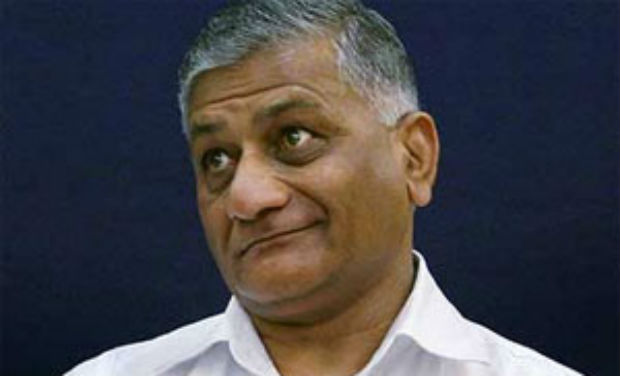
    NEW DELHI (TIP): Demanding an apology from Minister of State for External Affairs VK Singh for his controversial “dog” analogy after killing of two Dalit children in Haryana recently, BSP members today forced two adjournments in the Rajya Sabha.

    The minister’s troubles are likely to continue in the Lok Sabha as well with the Congress today mulling his boycott during Question Hour.

    In Rajya Sabha, BSP leaders disrupted the House twice late afternoon by storming the well and seeking Singh’s apology for “insulting the Constitution that guarantees protection to Dalits”.

    The pandemonium began during a discussion on amendments to the Prevention of Corruption Act, 1988.

    Demanding Singh’s exit from the House, BSP MPs trooped into the well and caused two adjournments. BSP leader Satish Chandra Mishra said: “He (Singh) has no right to be in the House. He has still not apologised.”

    The ruckus led to Deputy Chairman PJ Kurien citing the Constitutional provisions to protect the minister. “Constitutional provision is very clear. It allows the minister to be in the House,” Kurien said, referring to Article 88 of the Constitution.

    The government, too, defended Singh with Parliamentary Affairs Minister M Venkaiah Naidu saying: “As per Article 88, all ministers have a right to participate in proceedings of both Houses.”

    Largely isolated on the issue, the BSP found some support from few Congress MPs who also entered the well as the BSP demanded that Singh be asked to leave.

    BSP MPs finally relented and allowed Home Minister Rajnath Singh to reply to a discussion on the Tamil Nadu flood situation.

    Sing, however, may face a similar boycott during Question Hour with sources in the Congress today saying the party was mulling to go out of Lok Sabha as a sign of protest against Singh when he replies to questions on his scheduled day. Discussions on this matter were held today at the meeting of Lok Sabha MPs, which Congress vice-president Rahul Gandhi chaired.

    In October, after two Dalit children were burnt alive at Sunped village of Haryana’s Faridabad district, Singh had said: “If someone throws stones at a dog, the government is not responsible. It was a feud between two families, the matter in under inquiry.”

  • GET OUT, HARYANA MINISTER ANIL VIJ TELLS WOMAN COP AFTER SPAT

    GET OUT, HARYANA MINISTER ANIL VIJ TELLS WOMAN COP AFTER SPAT

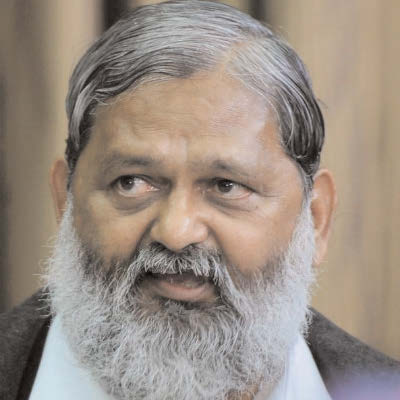
    CHANDIGARH (TIP): Haryana minister Anil Vij on Nov 27 asked superintendent of police (SP) Sangeeta Kalia to “get out” of a meeting in Fatehabad.

    But the IPS officer refused to leave, forcing a fuming Vij to walk out of the meeting in a huff.

    The ugly spat between the two took place in presence of several others at the meeting at Fatehabad district panchayat office.

    A video grab shows the minister getting agitated while asking Kalia about a complaint pertaining to unauthorized sale of liquor.

    On being asked about the steps being taken to check the illegal liquor sale, Kalia claimed around 2,500 cases were registered under the Excise Act in the past 10 months, which was a “record”.

    Vij was apparently not satisfied with the reply and as the two continued to argue before he asked her to “get out”.

    BJP workers and others at the meeting too left with Vij, who said he will take up the matter with the cabinet.

    Fatehabad deputy commissioner N K Solanki, who was at the meeting, tried to pacify Vij, but the minister refused to listen to him.

    Vij had taken up the liquor smuggling issue at the meeting after an NGO complained to him about it.

    “I will not attend the meeting till this SP is there in the district. She has behaved like this even in the past,” he said.

    “We had complaints from local residents and the NGO that they were not getting any help from police in curtailing liquor smuggling from the border villages of Punjab.”

    Kalia refused to comment while Congress’s state chief Ashok Tanwar said the BJP government has lost control over bureaucrats and official machinery within a year.

    “…even its ministers are yet to learn how to deal with officers and the system.”

  • This Rs 7 crore buffalo earns Rs 50 lakh per year

    This Rs 7 crore buffalo earns Rs 50 lakh per year

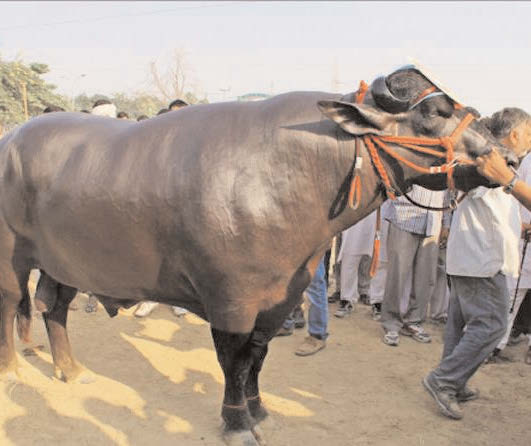
    NEW DELHI (TIP): With cow and cow protection hog the headlines these days it’s the buffalo which faces discrimination. In the Annual Buffalo Carnival in Hyderabad there’s a Murrah buffalo ‘Yuvraj’ which needs a special mention.

    This Murrah buffalo worth whopping 7 crore. Which means you can get two Audi R8 LMX  for the price of this buffalo and can still save money.

    Yuvraj is a handsome animal with oiled backward-curving horns, a smooth grey-black coat and a slim, bushy tail. It weighs 450kg, is 10ft long and 5ft 8in tall.

    Kurukshetra-based Karamvir Singh’s Murrah buffalo ‘Yuvraj’, has proven to be a cash cow for him as the bull’s semen is in great demand across north India.

    Yuvraj’s semen is now possibly the most expensive in India, sold at Rs.350 per dose. The earnings from the sale of this buffalo’s semem corss Rs. 50 lakh per year.

    This Murrah buffalo is the star attraction at the Sardar Utsav Mela in Hyderabad. It was brought from Haryana to participate in a buffalo carnival known as Dunnapothula panduga celebrated on the second day after Diwali.

    Sardar Utsav Mela the buffaloes are decorated with garlands of flowers, painted horns, and paraded among public.