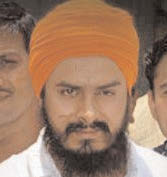
CHANDIGARH: It is not for the first time that a convicted killer has been ‘appointed’ as jathedar of the highest temporal body of Sikhs — the Akal Takht. Ironically, it was the Shiromani Gurdwara Parbandhak Committee (SGPC), which is now facing a similar situation, that had set the dangerous precedent in 1990.
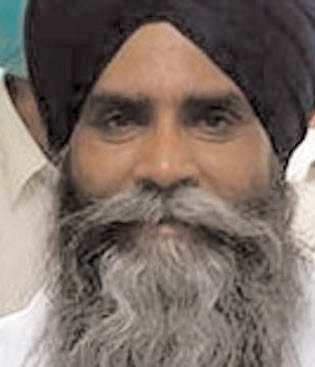
Serving life sentence for the murder of Nirankari sect leader Gurbachan Singh in 1980, Ranjit Singh was appointed as the Akal Takht jathedar in 1990 by the Shiromani Akali Dal-backed SGPC, then led by Gurcharan Singh Tohra. Though Parkash Singh Badal and Tohra were then on the same side, it was Tohra who had masterminded the move to get Akalis to group around him by proving his Jagtar Singh Hawara far-right credentials. In a curious replay of the earlier situation, former Punjab chief minister Beant Singh’s assassin Jagtar Singh Hawara has been declared as the Akal Takht “jathedar” by the radicals during their recent Sarbat Khalsa. Hawara, like Ranjit Singh then, is lodged in Delhi’s Tihar Jail and is serving a life sentence after his death penalty was commuted to life sentence by the Punjab and Haryana high court in October 2010. After appointing him as jathedar, Tohra, backed by the SAD and BJP, had lobbied hard for the release of Ranjit Singh and a petition seeking remission of his sentence was sent to then President KR Narayanan, who later signed the order commuting the remainder of Ranjit Singh’s sentence in November 1997 during the IK Gujral government at the Centre.
Now, it’s the release of “jathedar Hawara” that is being sought by over 20,000 people through an online petition on the White House website seeking help of US President Barack Obama. The petition has been launched by US-based separatist group, Sikhs For Justice. However, unlike the 1990 precedent, now it is the SGPC which is at the receiving end of radicals’ religio-political move.
Ranjit Singh was released after serving 13 years for murdering the Nirankari sect leader over a violent clash on Baisakhi day in 1978, when individuals at a Nirankari gathering in Amritsar had opened fire on protesters belonging to the fundamentalist Damdami Taksal led by Jarnail Singh Bhindranwale and the Akhand Kirtani Jatha led by Fauja Singh.
The Shiromani Gurdwara Parbandhak Committee (SGPC) is contemplating to pick eminent Sikh kathavachak (preacher) Giani Pinderpal Singh (49) as the Akal Takht jathedar to replace the beleaguered Giani Gurbachan Singh.
The development comes in the backdrop of the controversial decision taken at the radicals’ Sarbat Khalsa to ‘appoint’ former Punjab chief minister Beant Singh’s assassin Jagtar Singh Hawara as the Akal Takht jathedar.
As per reports, speculation is rife in Sikh circles that a person like Pinderpal would be acceptable to Sikhs in India as well as abroad, be it moderate or hardliners, to head the highest temporal seat of the community.
“A person like him (Pinderpal) can certainly help bring the Sikh community out of the current crisis, but it remains to be seen whether he would accept the post of the Akal Takht head or not,” said SGPC president Avtar Singh Makkar, adding that it was premature to reach any conclusion.
Pinderpal, who hails from Tharwa Majra village in Karnal (Haryana), lives in Ludhiana. Sources say he is being persuaded by the SGPC and other Sikh bodies to head the Akal Takht.
In August 2008, he was approached by the SGPC to take over as the Akal Takht jathedar after the ouster of then jathedar Giani Joginder Singh Vedanti, but he refused the offer.
Talking to HT on the phone, Pinderpal said, “In the current situation, there is an acute deficit of trust and faith among the Sikhs. No Sikh believes in the other. Moreover, when there are two jathedars (one appointed by the SGPC, the other by the ‘Sarbat Khalsa’), it is very difficult for both to prove who is the real one.”
Evading queries on being approached to head the Akal Takht, he said a priest could not be a leader.
Pinderpal, a product of Gurmat Missionary College, Rupnagar, is known to focus on Gurbani rather than criticising the political set-up in Sikh institutions. Considered to be in the league of preacher Sant Singh Maskeen, he has a popular slot on a Punjabi TV channel for performing ‘katha’ daily at 9am.
He got upset with the SGPC when he was told late last month to wind up his scheduled 10-day ‘katha’ on the fourth day because of his comments on the Panthic crisis, made at Manji Sahib on the premises of the Golden Temple.
BALLABHGARH (TIP): As scores of Dalits gathered in Sunpedh on Wednesday, a day after two Dalit children in the village were burnt alive in an attack by Rajputs on their family, the Haryana government said it would recommend a CBI probe into the incident.
Villagers blocked the Delhi-Agra highway for most of the day in grief and anger, with the bodies of two infants who died on Tuesday placed on blocks of ice. They allowed the children to be buried only after meeting with the district administration.
On Wednesday morning, the bodies of three-year-old Vaibhav and nine-month-old Divya, wrapped in white sheets, were brought to the village from AIIMS. A crowd first gathered in support of their father Jitender, and soon swelled after Dalits from other villages arrived and demanded stringent action against the guilty.
After protesting at the bypass for a few hours, the demonstrators began to march from Jaat Chowk in Sunpedh till the Faridabad highway. The highway was blocked for over two hours before the Faridabad administration spoke to the family and asked them to form a committee of six people to put forth the demands.
The crowd, however, had to be pushed away with force while at least 300 policemen from Faridabad and Gurgaon were deployed to maintain security. An additional five battalions of reserve forces were also called in.
Around 6 pm, the family finally started the last rites of the two children who were buried in an empty plot near the village. Jitendra’s wife Rekha
(23) is still battling for life in Delhi’s Safdarjung Hospital. Police on Tuesday arrested four named by Jitendra in the FIR.
Also on Wednesday, politicians from across party lines made a beeline for the village, including Congress vice president Rahul Gandhi, Union Minister of State and Faridabad MP Krishan Pal Gujjar, CPI(M) leader Brinda Karat and AAP leader Ashutosh.
Gandhi arrived with Haryana Congress chief Ashok Tanwar and Congress leader Shakeel Ahmed. Speaking to the family, Rahul said: “If you are weak you can be crushed. This is the attitude shared by the Prime Minister, Haryana Chief Minister, BJP and the RSS. They have been killed for no fault of theirs except that they were poor.”
Gandhi also objected to a reporter’s query on allegations that his visit was a mere ‘photo opportunity’. “This is insulting when someone says it when someone comes here. It is not insulting to me. It is insulting to these people. What is a photo op. What you mean? People are dying. I will keep coming to such places,” Gandhi said. Source: The Indian Express
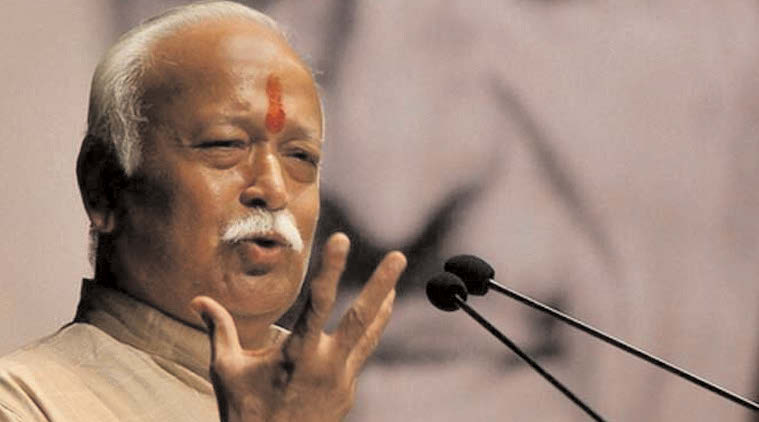
Since Prime Minister Modi and his ministerial colleagues have chosen to report to the RSS and invite its inputs on policy issues, it is important to take note of RSS chief Mohan Bhagwat’s annual Vijayadashmi address, delivered at Nagpur on Thursday and telecast live by Doordarshan despite Opposition protests last year. While his emphasis on “unity in diversity” is welcome, Mohan Bhagwat has, without naming any of the recent incidents – killings of writers and rationalists, beef and ink attacks and the Dadri lynching – said that “small incidents” were being “blown up”.
He chose to give an indirect message to hardliners in the Sangh Parivar and other outfits by saying that his organization believed in “cooperation and coordination” and “such small incidents do not affect Indian and Hindu culture.” While Mohan Bhagwat talks of inclusivity being “the core of our culture”, the Union Culture Minister is known to violate the basic values of Indian culture very time he opens his mouth. Prime Minister Modi, BJP chief Amit Shah and Finance Minister Jaitley too have reacted to these incidents but none has given the recalcitrant ministers, MPs and MLAs a message strong enough to silence them and others. The latest to display characteristic insensitivity is Union minister VK Singh, who, reacting to the burning to death of two Dalit children in Haryana, said: “If someone throws stones at a dog, the government is not responsible”. For the benefit of the BJP in Bihar, Bhagwat did not say anything damaging. He did not touch on the reservation issue. But there seems no one to control the likes of Gen VK Singh and Kiren Rijiju, who too has been encouraged to make irresponsible comments about north Indians.
If so many loose cannons have sprung up creating social tension, it is because there is no fear of the law or disciplinary action. If Bhagwat considers the recent incidents, which have forced writers to return their awards, as “small”, then he is not expected to contain the elements threatening India’s culture of tolerance and liberalism. His silence on the Shiv Sena, which has launched a hate campaign against anything and anyone Pakistani, is understandable, but not desirable.
NEW YORK (TIP): A cadre of Indian American youth was among the winners announced by Action For Nature’s International Young Eco-Hero Awards, with three individuals earning honorable mentions while one youngster of Indian-origin took home a second place prize.
According to its website, Action For Nature’s award honors the work of young people between the ages of 8 and 16 who have executed creative environmental projects.
The judges are experts in environmental science, biology, and environmental health, and the winners receive a cash prize and a special certificate.
Aarushee Nair was the sole prize winner, slotting in at runner-up in the competition’s 13 to 16 age group.
Nair, of Haryana, India, earned the award for her design of the Blu Pak, a biodegradable container that can hold 350 milliliters of clean drinking water and has a packet of oral rehydration salts pasted on the side. It also has a small beak-shaped outlet so that fluids can be easily administered to infants. She designed the Blu Pak after learning that thousands of Indian children under the age of 5 were dying due to a lack of clean drinking water.
Sai Sameer Pusapaty, 16, of Texas, received an honorable mention in the 13-16 age group for his efforts in promoting the importance of recycling, according to Action for Nature. After realizing many people don’t understand what can be recycled and how, he developed tools for his community to make recycling easier and more efficient.
He even developed a mobile app that he calls Recycle Buddy. It can scan a UPC or QR code and display the recycling information for any given product. It can also perform generic lookups for disposal information based on the material and the item type.
Anuj Sisodiya, 16, of Connecticut also earned an honorable mention for embarking on a project to mitigate the energy waste caused by holiday lighting that is left on during the day.
He created a project that encouraged the use of an electrical light timer to prevent lights and lighting displays from being left on for extended hours.
Using social media such as Facebook and Twitter, his Web site, public canvassing, and booths at grocery stores, he distributed free electrical light timers to help save energy across town.
Furthermore, he formed a team of school volunteers who devoted approximately 500 volunteer hours, and he worked with town leaders, energy company program managers, and vendors to effectively execute his project.
By creating a sample study of his local community he learned that this campaign had the potential to save about 1 million-kilowatt hours of power in the town of Trumbull, Conn. preventing up to 1.3 million pounds of carbon dioxide being released into the environment.
Anirudh Suri notched a third honorable mention for Indian Americans after he masterminded a successful recycling program in his local community to cut down on battery waste.
With the help of his school principal, Anirudh developed the One Cell program. He purchased envelopes for collecting batteries, customized them, and sent them home with students to return with all the used batteries inside their homes.
Anirudh began the program when he was 9 years old and 5 years later the program is still growing. His goal for One Cell is to expand the program to more schools so that he can collect more batteries.
In the past three years, he has collected more than 1100 pounds of batteries. This year his goal is to collect over 700 pounds.
During his US visit, Prime Minister Narendra Modi conveyed to his audience: “Reform in governance is my No 1 priority. We are for simplified procedures, speedy decision making, transparency and accountability.” As the Chief Minister of Gujarat, Modi was a
“governance”addict. On his assuming Prime Ministership, “governance” became India’s flavor and the Center’s guiding mantra. The stated objective was to have a “governance architecture” that put people at the centre of the development process. The President’s address to Parliament in June last year also laid down the motto: “Minimum government, maximum governance”.
However, even after 16 months there is no such governance architecture or blueprint. In the upper echelons of decision making, there is mixup of government and governance, as if both are the same. They are not. Governance is not just government; it is bureaucracy, laws, rules, policies, programs, processes and procedures. It is far more than that. In a democracy like India, governance should be “society-centered”. It should include the government, which is its dominant part, but transcend it by taking in the private (farming, business, industry) and voluntary sectors (civil society). All the three are critical for sustaining human, economic and social development.
Governments create a conducive political, administrative, legal and living environment. The private sector promotes enterprise and generates jobs and wealth, while the voluntary sector educates and mobilizes citizens’ groups to participate in economic, social and political activities. Each has weaknesses and strengths, so governance is facilitated through a constructive interaction among all three. While government is a politico-bureaucratic entity, governance is a joint venture encompassing all. The difference is huge.
Being a joint venture, governance should adhere to the basic functional norm of involving stakeholders in decision-making and implementation processes. The Modi government made a false start by putting out a “secret” Intelligence Bureau report condemning several civil society organizations and eminent opinion leaders who differed from government policies as “anti-national” and accusing them of thwarting India’s development! Since then, many NGOS are being harassed by abusing the Foreign Exchange Management Act and other laws. The voluntary sector, except the RSS as well as its affiliate “think-tanks” and individuals, are out of the reckoning as far as “governance” is concerned. As for farmers, they are treated more as mendicants than partners. The elitist vision of the BJP and its leader is replete with bullet trains, state-of-the-art highways, smart cities, insulated industrial corridors and “Digital-India.” These are far removed from the deprived lives of a majority of farmers. Agriculture, which accounts for 60 per cent of India’s population, and from where the poorest draw sustenance, is only an add-on in the scheme of things. In business and industry, it is “big-is-bountiful” and “small-is-not-beautiful”. This has been demonstrated during Modi’s high-profile foreign visits and the mad hunt for big-ticket FDIs. Last year, on the launch of the “Make-in-India” campaign at Delhi, about 10 big industrialists on the dais pledged to invest billions of Rupees. The same scenario was repeated while kick-starting the “Digital-India” initiative and billions were again promised. As if only big-ticket investors alone are “partners in development.” The grammar of good governance is about socio-economic harmony, arising out of the smooth interface between government, civil society, farming and business communities. Unless this is achieved across the board, no amount of reforms can bring about achche din. As to “minimum government, maximum governance,” David Thoreau wrote over a century ago: “That government is the best which governs the least.” Conversely, “that government is the worst which governs the most.” The latter seems to be true of India. The Union Territory of Chandigarh is also a case in point. From 1952 to 1966, Chandigarh was the capital of Punjab and its citizens were represented in the state’s Legislative Assembly. A Chief Commissioner headed the local administration. When the undivided Punjab was divided, both Punjab and Haryana claimed the new city for its capital. Pending the resolution of the issue, Chandigarh was made a Union Territory, with its administration functioning directly under the Centre. While the UT lost representation in the Assembly, it has a Member of Parliament. Till May 31, 1984 Chandigarh had an Administrator designated as the Chief Commissioner. On June 1, 1984, the Governor of Punjab took over as the Administrator and the Chief Commissioner was re-designated as the Adviser to the Administrator. This was a prelude to Operation Blue Star.
The stated reason was to facilitate “co-ordination” between the districts of Punjab and the capital in Chandigarh. This ad hoc measure became permanent. The Governor of Punjab is the head of the UT Administration, though it is the Adviser who runs the show. The Municipal Corporation of Chandigarh (MCC) came into existence on May 24, 1994. Several functions were transferred from the Chandigarh Administration to it through notifications issued on September 28, 1995 and May 16, 1996. The elected body of the MCC came into being in December 1996. The first thing it did was to stall the decision to levy property tax on commercial and residential buildings in the city, thereby triggering a duel between the UT Administration’s bureaucratic and political wings that continues till date. The transfer of functions was a half-hearted affair. The bureaucratically run Chandigarh Administration retains the bulk of the assets, including near-total control of funds and resources. Chandigarh has five governments/power centers: The Union Home Ministry, the Punjab Raj Bhavan, the UT Secretariat, the MP and the MCC. Things have been falling between several stools. In Chandigarh, Modi’s motto looks reversed to “Maximum government, minimum governance”!
By M.G. Devasahayam (The author is a former IAS officer of Haryana Cadre, now settled in Tamilnadu)
The demand for OBC status by the Patels of Gujrat has set stage for a review of the reservation policy as such. The RSS chief Mohan Bhagwat has already called for such a review. The passage of bills by the Rajasthan government to accommodate the demands of the Gujjar community, thus taking reservation to beyond 50 per cent, indicates that the issue is not going to blow away soon. Debate around reservation has been highly polarized. On the one side are those who on principle abhor the very idea of reservation and there are those who defend this, also on principle. There has not been much work that defends the principle of reservation but also critically looks at its implementation.
By and large, the demand for reservation by Patels (and Jats etc.) has found no support amongst the intelligentsia and rightly so. But Patels (and others) have a very persuasive case — other similarly placed castes have got the benefit of reservation. Yadavs (Ahirs) of Haryana are just about similarly placed as Jats. There is a region in Haryana that is known as Ahirwal, where Yadavs are the dominant caste, owning land and calling the shots in politics in that region as Jats do in their area of dominance. If the Yadavs can get reservation then why not the Jats? If the Jats of Delhi can get it, why not the Jats of neighboring Haryana? The Gujjars of Rajasthan justify their demand by comparison with the Meenas of Rajasthan.
Reservation has been defended on two different grounds — discrimination and backwardness. Deprivation can be on account of discrimination but it need not be so. There could be whole regions that are backward; then there is the difference between the rural and urban areas within regions, between small towns and metros, and so on. Shall we have a quota for all these categories, along with caste and gender quotas? Of course, not. But what if a community faces widespread and deep-rooted discrimination and prejudice? In that case, that community certainly needs reservation. Without the benefit of reservation, this community — it could be caste or gender or race based — forget about getting a level playing field, would not get equal treatment even after having overcome the handicap of an uneven playing field. Only in such cases of widespread and deep-rooted prejudice and discrimination, reservation can be justified. It cannot be the remedy for all kinds of backwardness or inequity or feelings of discrimination. Even amongst the so-called “forward” castes, there is caste segregation, with each caste or sub-caste harboring notions of its own superiority vis-à-vis other “upper” castes (as well as being the discriminated one). Reservation has to be an exception to be used to tackle pervasive discrimination and not a common tool to be used to tackle backwardness of various kinds. Reservation is not meant to perpetually segregate various communities and give proportionate representation to various groups. It is meant to overcome caste divisions.
It is interesting to note that agitations have only been for inclusion in the OBC or the ST category and not amongst the Scheduled Castes. This clearly indicates that the Scheduled Castes really have a very low social status and no community would like to be clubbed with them. However, there is no such stigma attached to being from an OBC or even ST community (who were not treated as untouchables). Different legal treatment of SC/ST reservation and OBC reservation itself is indicative of something being seriously amiss. There is subdivision of the OBC quota but subdivision of the SC/ST quota has been struck down. There is the notion of creamy layer in the OBC reservation but there is no similar concept for the SC/ST reservation. While this differential treatment of the SC/ST and the OBC reservation may have some legal basis, yet other than legal technicalities, does it have any justification? While it is true that financial or professional success does not by itself end discrimination and even IAS officers from the Scheduled Castes may continue to be socially discriminated, yet continuing extending the benefit of reservation is not going to solve this problem. That has to be fought at another level. Deprivation can have multiple causes and even children from the so-called “forward” castes, studying in rural areas, may be educationally deprived as compared to their urban counterparts. Deprivation can be compensated through some type of weightage mechanism similar to one in force for cultural and sports achievements. Even such compensation should not be all-pervasive and should be based on an objective criterion that is not easy to fudge. Educationally backward communities can be motivated through various incentives like the ones in place for “de-notified tribes”. The problem of identifying poor is in addition to this. When even counting the number of poor in the country is bogged down in controversy all the while, when BPL lists are not finalized for years, when under-reporting of income and tax evasion is so common, when those living on the streets cannot even get a ration card, how do you ensure it is only the really poor that benefit from reservation meant for the poor?
Lastly, ignoring legal niceties, commonsense and logic demand that reservation should be in the nature of ensuring a minimum (and not proportionate) representation to communities and it should not be over and above their representation in the General category. Say, if we have fixed minimum representation of the SC at 15 per cent and 5 per cent seats have been filled by candidates from the SC without the benefit of reservation, then only 10 per cent more SC candidates should be taken through reservation. This will ensure that as communities provided with the protective cover of reservation come up and start competing well with other communities, reservation will die a natural death, without abolition. The ever-burgeoning reservation category, with the clamor of more and more communities seeking inclusion, is indicative of the fact that perhaps we have overdone it. It is time reservation is reduced to an exceptional measure for exceptional situations, rather than a regular feature. A reasonable and limited domain for reservation would significantly tone down vehement opposition and have more widespread acceptance.
(The author is a former Professor of Economics, MDU, Rohtak)
NEW DELHI (TIP): In a setback for the Manohar Lal Khattar government in Haryana, the Supreme Court on Thursday stayed the state law providing that a candidate aspiring to contest the panchayat elections should have cleared the class 10 examination.
A bench hof Justice J. Chelameswar stayed the operation of the Haryana Panchayati Raj (Amendment) Act, 2015, passed by the state assembly on September 7, after the petition challenging the amended law was mentioned before the court.
While staying operation of the amended provision providing for educational qualifications for contesting local body’s elections, the court also issued notice to Haryana government and the Election Commission.
Under the amended law, a person from the general category should have passed the class 10 examinations and a Dalit should have passed class 8 to be eligible to contest local body’s elections.
The court was moved by the Communist Party of India-Marxist”s woman wing, the All India Democratic Women Association, Rajbala and others.
The court order came after senior counsel Sanjay Parikh and Kirti Singh appearing for the petition mentioned the matter before the court.
15 years ago, this month, a prime minister of India had traveled to the United States for the annual United Nations General Assembly mela. During that visit, he found time to attend a Vishwa Hindu Parishad event in Staten Island where he declared himself a swayamsevak – yes, as in the Rashtriya Swayamsevak Sangh. This was music to the ears of the Nagpur Gharana. A prime minister who all along was pretending to have little to do with this Hindu outfit suddenly got into a confessional mood.
Back in New Delhi, Atal Behari Vajpayee’s exuberance did not last long. The conflict between the demands the RSS would make on a prime minister and his constitutional oath was too palpable to permit any kind of meaningful jugalbandi. Though Vajpayee continued to mark his token attendance at the annual guru dakshina rites, he was not afraid to antagonize the Nagpur crowd. After the 2002 anti-Muslim riots in Gujarat, it was simply not possible for Vajpayee to maintain any civilized conversation with these comrades among the swayamsevaks. The gurus never forgave Vajpayee for wanting to draw outside the lines.
And, again, 10 years ago, July 2005 to be precise, three designated gurus of the Nagpur Gharana traveled to Delhi to tell the then BJP president, LK Advani, to put in his papers. Advani had committed the solecism of saying something vaguely in praise of Muhammad Ali Jinnah. All the top leaders of the BJP held their collective peace as the “unknown, unelected, unaccountable” Nagpur-empowered busybodies roughed up Advani as if he was just a taluka-level politician. Advani was rendered hors de combat. By the end of the year, he was gone as the party president. The Nagpur bosses wanted to reaffirm the first principle: No BJP leader would be allowed any deviation. They had had enough of Vajpayee and his liberal tantrums.
And, last week, it was this very first principle that was re-asserted when the Sarsanghchalak summoned Prime Minister Modi and his ministers. Well, if you are a swayamsevak, you do respond to summons from the superior in the hierarchy. Period. That is the code of the saffron brotherhood. Admitted, Sushma Swaraj is not an RSS bhakt. Nor is Arun Jaitley. Unless, he has managed to keep this fact away from his “moderate and decent” friends in Delhi. But neither of them had any choice.
Why are the liberal souls losing their shirt just because the Prime Minister and his ministerial colleagues had all chosen to put in an appearance before the RSS chief and his advisers? After all, the Modi-RSS connection is not new.
It was no secret that it was the RSS’s unequivocal endorsement of Modi that proved decisive in the BJP making him its prime ministerial mascot. Nor was the RSS’s involvement on behalf of Narendra Modi in the 2014 electoral process a secret affair. It was open and fairly well documented.
From his Gujarat days, Modi has written the blue book on how to look after the RSS and its functionaries. Modi is smarter – which is not the same thing as being wiser – than Vajpayee. He has shrewdly sized up the small men and their small needs.
To be fair, Modi never kept anyone in the dark about his RSS links. Yet, if the best and the brightest among the New Delhi-based intellectuals and others ‘thought leaders’ chose to be taken in by the ‘vikas’ mantra, it is their problem – not Modi’s.
Instead of having the buyer’s regret, every moderate voice should welcome this national-level seduction of the RSS. There is no dark side to it.
Look at what has already happened: The RSS, which has arrogated to itself the role of the sole arbiter of moral values, is now wasting its breath on explaining the excesses and aberrations of the BJP chief ministers – Shivraj Singh Chouhan in Madhya Pradesh and Vasundhara Raje in Rajasthan. It would be instructive to find out how that fly-by-night entrepreneur, Lalit Modi, is described in the morning shakha meetings in Jaipur. Just as it would be revealing to know what explanation the swayamsevaks in Bhopal offered regarding the horror of a scandal called Vyapam.
Indeed, none seems to have noticed that the RSS has reduced itself to being a BJP spokesperson.
Its two other chief ministers – in Haryana and Maharashtra – both proud products of the Sangh brain-washing factory system – have turned out to be such poor advertisements for good governance or for the RSS brand. Apart from exhibiting a new willingness to provoke -Manohar Lal Khattar’s absurd infatuation with Baba Ramdev and Devendra Fadnavis’ with petty preoccupations with bans – these two have hardly enhanced the reputation of the RSS.
More interestingly, the BJP apologists have cockily explained Modi and his ministers’ attendance at the Sangh Shivir as not very dissimilar to some Congress ministers and Prime Minister Manmohan Singh’s response to the Sonia Gandhi-led National Advisory Council.
Never mind that the NAC was a government-constituted, gazetted body; it has now been easily done away with. Never mind that Sonia Gandhi is the head of a legally recognized political party, which enters the electoral fray with its own symbol. Yet any suggestion of a moral equivalence between Sonia Gandhi and Mohan Bhagwat should not be resented.
Perhaps, it should even be a matter of some satisfaction that the RSS has come out of its bogus pretence of being just a cultural organization. The democratic forces should welcome it and demand that it should be brought within the ambit of the Right-to-Information regime.
Nonetheless, a matter of grave concern is the new attempt aimed at an intellectual hegemony. For instance, the culture minister in the Modi government.
Mahesh Sharma, a black-belt saffronite, has argued that by voting for Modi and the BJP, the voters have given a mandate for “saffronisation” of education, culture and other institutions. With just 31 per cent of the votes, the Modi sarkaar would like to believe that it has been given a license to operationalize the RSS agenda?
This is an anti-democratic argument and is laced with morally unpleasant smells. Whatever obedience the Prime Minister and his ministers may choose to render to the Sarsanghchalak, they need to be reminded that they are still governed and bound by something called the Constitution of India. India is still a constitutional democracy and its rulers, irrespective of the number of seats in the Lok Sabha, are still answerable to a robust Parliament and an independent judiciary.
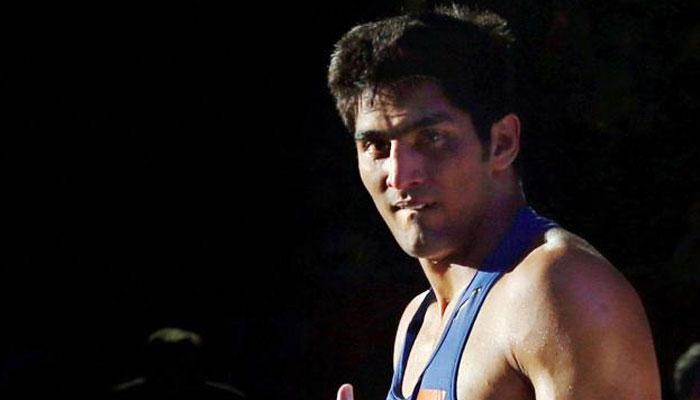
Fighters never fear,” said Vijender Singh as he geared up for yet another marathon six-hour training session in Manchester, England, to prepare for next month’s bout. The bout, to be held on October 10, is special for the boxer – it will be the first of his professional boxing career. The outcome could have a bearing on his future in the circuit.
The boxer from Bhiwani, who will turn 30 next year, is eager to get things off the ground. “To be honest, I am quite excited about the debut. No nervousness. You can’t afford to be nervous in boxing, be it amateur or professional. Though at this point I don’t know who I will fight, I am eagerly waiting for it to happen. I am hopeful of getting my professional career off to a good start,” he told media.
Vijender’s maiden bout will be over four rounds. In future, he expects to fight bouts with more rounds. “Pro boxing is different from amateur boxing and I am getting used to it. I am preparing for larger bouts. But even for the four-round bout, I am working intensely on fitness, endurance and technique. It’s not an easy task. But you have to put in these hard hours in professional boxing. The focus to get going is helping me.”
Eyebrows were raised when Vijender turned professional, and though he may not say so in as many words, there is lingering bitterness following all the criticism. “Some people understood and supported my decision, but some didn’t. I have played three Olympics for India and have won a medal. When Amir Khan (British professional boxer) won a silver and turned pro, there was no hue and cry. People accepted his decision. And now he is doing well as a professional boxer.
“This is just the start of the professional life for me. I have a long way to go.There are not many Indians in professional boxing. I hope to inspire them. If I achieve success, everybody will appreciate me. If I don’t, I don’t mind, since I know at least I tried my best. I will keep doing the hard work. For me it has been quite a journey (from Bhiwani in Haryana to the top boxing club in Britain).”
Vijender thanked the Haryana government for allowing him to turn professional and added that Indian boxing would do well to set its house in order. “Things must improve in India. There’s no federation and no authority running the show. Two-three persons are managing things. That’s not good for the sport.”
Vijender, who started aspiring for a career in professional boxing way back in 2008, just before the Beijing Olympics, said his eventual goal was to win a world title. “I will keep working hard. I will never sit back and live on my past achievements. My ultimate goal is to win a world title. I will give my best for that.”
NEW YORK (TIP): The Haryana Chief Minister, Manohar Lal, has appealed to the non-resident Indians (NRIs) in New York to come forward and help in the development of their paternal villages and support the efforts being made by the state government. The NRIs could do so by participating in the Adarsh Gram Yojana, a Government of India scheme which has been adopted by the Haryana Government, he said.
Addressing the NRIs at a program held in New York, August 17, the Chief Minister said that the 15 MPs and 90 MLAs of Haryana were engaged in ensuring development of villages under the Adarsh Gram Yojana but the number of villages in Haryana exceeds 6,500. The NRIs of Haryana origin could adopt the remaining villages and help in their development.
Those present on the occasion assured the Chief Minister of all possible support.
Speaking at another event organized by Non Resident Indians to honor him in New York the Chief Minister said that in its 10-month tenure, the Haryana Government had formulated a new industrial policy. While people from India and the rest of the world connected to Haryana would invest under the policy, those from across the globe also consider Haryana an ideal state, whether they want to invest in a welfare project or achieve their targets by investing in an earning project, he said.
The Chief Minister said that Haryana has witnessed a remarkable growth in terms of infrastructure. While the State had only four National Highways till now, nine National Highways are being built to connect the districts. The State has an abundance of raw material for industries, which could be transported easily as a result of these new road projects.
The Chief Minister said that Haryana being an agrarian state, the setting up and promotion of agro-based industries, food processing, pharma, information technology, auto, defense production, aerospace and aircraft industries would remain a priority for the Haryana Government. “Agro-industries are being set up in Haryana. Besides, Haryana will work further with major companies like IBM, Harley Davidson and Hollister, which have more than 1,000 projects, so that our industries can advance in an appropriate manner,” he added.
Welcoming those investing in Haryana, the Chief Minister invited others to take advantage of facilities offered by the State and invest in Haryana.
Later, the Chief Minister , addressed investors at a meeting of the US India Business Council in Washington on August 19.
Emphasizing investment opportunities in Haryana, Chief Minister Manohar Lal said, “We strive to attract both international and domestic business in to the state of Haryana. To achieve this end, I am proud of the reform efforts that have gone in to making public services more efficient- land registration is now enabled through information technology (IT), long-pending land acquisition cases have been resolved and infrastructure construction is faster as evidenced by the completion of the Delhi-Faridabad Metro project and restarting of work on Kundli-Manesar-Palwal Expressway. We are pushing for policy reforms in a manner that will place Haryana as a business-friendly state and create jobs. I welcome American enterprise to be a part of our state’s growth.”
Lauding the vision of Chief Minister Manohar Lal, Mukesh Aghi, President of USIBC, said, “Since 2000, the state of Haryana has emerged as a major investment hub in Northern India. The city of Gurgaon is a key center for the information technology and automotive industries. The state’s Enterprise Promotion Policy 2015 aims at enhancing ease of doing business, promotes micro, small-scale and medium enterprises and encourages long-term investment in the state to flourish. All these measures are critical for not just enhancing the perception of doing business in India, but also indicate the reality of ease of doing business.”
Sonny Khurana, President and CEO of iTECH, a leading distribution company in the telecom sector, said, “Haryana, with its diversified economy and vibrant cities is well positioned to leverage initiatives such as Make in India and Smart Cities. Emerging markets are important for iTECH’s business model. A pro-growth government, under the visionary leadership of Mr. Manohar Lal, places Haryana as a strong hub for future investment opportunities.”
The round table discussion focused on key areas for investment promotion in the state that include energy related initiatives, aerospace, food processing, auto/auto components and mass rapid transport.
The event was attended by companies and senior leaders from every major sector of business-Blumberg Grain, IREO, Coca Cola, Wipro, Capital Novus, Cargill, Medtronic, Uber and Boston Scientific.
Rajiv Khanna, President of India-America Chamber of Commerce was optimistic about Haryana Chief Minister’s visit
Commenting on the visit of Haryana Chief Minister, Rajiv Khanna, President of India-America Chamber of Commerce, a binational chamber of commerce which is the focal point of cross border investments between the U.S. and India, said: ” We continue to be optimistic that states like Haryana would lead the country towards growth, prosperity and a greater economic co-operation with the United States. This does not mean that we under estimate the challenge in achieving these goals, particularly those posed by the failure of the Indian Parliament to pass the much needed legislations during the recent monsoon session that would have expedited the realization of these goals. It only means that we expect the state chief minister and his team to rise to the challenge and make it happen even with this setback, because failure is not an option for India.”
On arrival in New York on August 16, Manohar Lal first went to the Memorial Tower in Downtown Manhattan and paid his homage to the victims of 9/11.
Manohar Lal pays homage at the 9/11 Memorial , August 16
The Chief Minister was in time for the India Day Parade, believed to be the largest India Day Parade, outside India. He stayed for a while watching the floats pass by, greeting waving hand to the milling crowds and making a brief speech.
Chief Minister Manohar Lal at the India Day Parade in New York, August 16. Seen in the picture: Consul General Dnyaneshwar M Mulay (second left), Bollywood actor Parineeti Chopra, Manohar Lal
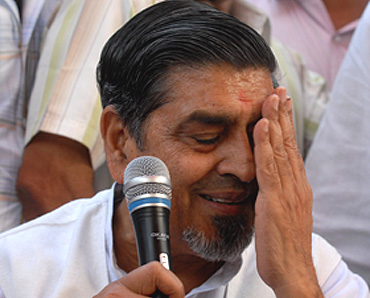
NEW DELHI (TIP): A Delhi court on July 30 fixed August 14 for hearing a case in which the Central Bureau of Investigation (CBI) has filed a closure report giving a clean chit to Congress leader Jagdish Tytler for his alleged role in a 1984 anti-Sikh riots case.
Additional chief metropolitan magistrate SPS Laler put the matter for next month as the lawyers in all six district courts are on an indefinite strike to protest delay in the passage of a bill in Parliament aimed at enhancing pecuniary jurisdiction of trial courts.
The court had earlier fixed Thursday’s hearing for filing of a protest petition by the victims against the CBI’s third closure report giving clean chit to Tytler in the case.
Senior advocate HS Phoolka, representing the victims, had earlier sought four weeks time to file the protest petition.
The CBI had earlier told the court that no fresh first information report (FIR) had been lodged against Tytler on allegations of influencing witness and money laundering.
The CBI’s reply had come while responding to the court’s query whether the agency had registered any case against Tytler under Sections 193 (punishment for false evidence), 195-A (threatening a person to give false evidence) of the Indian Penal Code (IPC) and the Prevention of Money Laundering Act (PMLA).
The court had earlier asked the CBI to respond to the allegations that Tytler had allegedly tried to influence a witness by giving him money and sending his son abroad and also alleged “hawala” transaction.
Allegations of influencing witness and “hawala” transaction had surfaced from the statement of arms dealer and navy war room leak case accused Abhishek Verma, which was recorded by the CBI earlier.
Verma, who is at present lodged in a jail and whose statement was recorded by the CBI on August 5, 2013, had said the conversation between him and Tytler took place after his release from the jail in the leak case when they were going to a farmhouse of Gopal Kanda, the then Congress MLA of Haryana, in August-September 2008.
The case pertains to riots at Gurdwara Pulbangash in North Delhi where three people were killed on November 1, 1984, after the assassination of then prime minister Indira Gandhi.
The CBI had claimed Tytler was not present at the gurdwara during the riots and was at Teen Murti House.
Tytler’s alleged role in the case relating to the killing of three persons — Badal Singh, Thakur Singh and Gurcharan Singh — near Gurdwara Pulbangash was re-investigated by the CBI after a court had in December 2007 refused to accept its closure report.
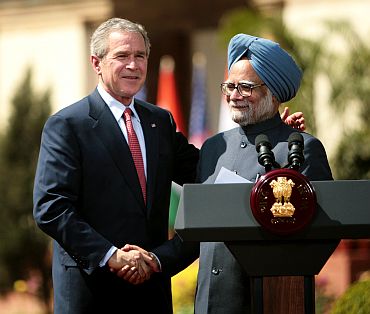
Ten years ago a historic, though unexpected, announcement was made in Washington after a meeting between the then US President George Bush and the then Indian Prime Minister Dr Manmohan Singh. It said that the US would “work with friends and allies to adjust international regimes to enable full civil energy cooperation and trade with India”. The deal, which had significant international ramifications, lifted the 30 year American-led moratorium on nuclear trade with India and paved way for transforming relations between the two largest democracies of the world.
While a conference was organized in Washington on the 10th anniversary of the deal, where some of the top leaders who were associated with the process participated in discussions, the anniversary went off largely unnoticed in India. The current dispensation in the Congress perhaps did not wish to credit Dr Singh with the achievement, perhaps his crowning glory as PM, the BJP too did not wish to credit the Congress for the deal in this season of acrimony between the two parties. However, both the BJP and the Congress governments in the past deserved to be patted for the deal. As Dr Sanjay Baru, former media advisor to Dr Singh noted in his book, The Accidental Prime Minister, Dr Singh met Vajpayee on his return from the US and told him that he had only culminated the process which Vajpayee had started as the PM.
One reason for the rather lukewarm response to the 10th anniversary of the deal is the fact that there has not been any significant gain at the ground level as far as setting up of civil nuclear reactors are concerned. In fact the first civil nuclear plant after the deal slated to come up in Haryana is still not even on a take off stage. Land for the plant has been acquired after dealing with opposition from the residents of the area but even the civil engineering work has not started as yet. However, the availability of fuel for the existing nuclear plants has made a major difference. At the time of the deal, India’s nuclear reactors were running out of fuel due to international sanctions. As per official figures, 11 of the country’s 17 nuclear power reactors were operating below capacity and the overall capacity utilization for the country’s nuclear power plants was just about 50 per cent which has now shot up to over 80 per cent after receiving fuel supplies from abroad. The lifting of sanctions has rescued the country’s nuclear program from a serious crisis.
Still, it is the other benefits of the deal that have opened up many vistas not only with the US but with other countries as well who had placed a moratorium on trade with India at the instance of the US after the 1998 tests.
The deal had marked a recognition by the US of the growing role of India in the international stage and its ability to act as a responsible regional and emerging global power. For India it was an end to its mistrust that the US had been “biased” and for the recognition that it was being considered a responsible partner in the process of development across the world.
Experts say that two developments came in the way of the full realization of the deal. One was the failure of the UPA 2 in getting Parliamentary approval for the original civil nuclear liability bill that was drafted in 2010. The opposition demanded redrafting the bill which was subsequently done but with several amendments. The other was the Fukushima disaster in Japan that increased the cost of building nuclear power plants and revived the global anti-nuclear campaign, including in India.
Yet the deal had laid the foundation to build a substantially broader partnership. It is mainly as a fallout of the deal that the US is now India’s largest trade partner in goods and services. It has also emerged as one of the major supplier of defense equipment to India. The majority of US advanced technology exports to India now do not require a license. On the other hand the US imports of high technology from India has more than doubled and exports to India have almost tripled since the deal was signed.
The Obama Administration in its first term, as well as Manmohan Singh government in his second term, did not make much progress and did not seize the opportunity to take it forward. However, there has been some course correction in the last one year and the fillip in the strategic partnership between the two governments led by Obama and Narendra Modi has moved towards a closure on the civil nuclear deal.
NEW DELHI (TIP): Effectively moving against Robert Vadra, son-in-law of Congress president Sonia Gandhi, the Haryana government notified a commission of inquiry on May 14 to probe alleged irregularities in land deals in Sector 83, Gurgaon where his firm was one of several dealing in real estate.
Late in the night, Chief Minister Manohar Lal Khattar also tweeted this. The Justice S N Dhingra commission has been asked to look into land deals in Sector 83, Gurgaon, during Congress rule in the state. At least 16 licences issued by the Town and Country Planning Department in Sector 83 will be under scrutiny. It is alleged that beneficiaries of the Sector 83 licences and land deals include Vadra’s M/s Skylight Hospitality. Justice Dhingra, who retired as judge of the Delhi High Court, handled several high profile cases and, as trial court judge, delivered the verdict in the Parliament attack case.
NEW DELHI (TIP): Rajya Sabha plunged into chaos during Zero Hour on April 30 over an Ayurvedic medicine, manufactured by Baba Ramdev’s Divya Pharmacy and purportedly promising birth of male child, with the opposition seeking a ban on the drug and stringent action against its manufacturers.
The entire opposition joined K C Tyagi (JD-U) when he raised the issue showing a packet of the medicine called ‘putrajeevak beej’, calling it ‘illegal’ and ‘unconstitutional’.
Health minister JP Nadda said the issue relates to the department of Ayush, but assured the government would look into it. “It is a serious matter. Government is serious about gender ratio. All departments are working towards it. PM is himself monitoring ‘Beti Bachao, Beti Padhao’ programme. I will come back to the House,” he said. “The Government will look into it and proper action will be taken.”
Displaying the packet of the medicine to the members, Tyagi said despite the Constiutional guarantee of no discrimination on the basis of caste and gender, the medicine will only perpetuate the gender divide. He said he bought the medicine himself. Without taking Ramdev’s name, Tyagi said, “The man has been made brand ambassador of Haryana. It is violation of PM’s ‘Beti Bachao, Beti Padhao. How can a state appoint him as brand ambassador?”
At this point Sitaram Yechury (CPM) walked up to Tyagi and looked at the medicine. Jaya Bachchan (SP) ook the medicine to Nadda.
Deputy chairperson PJ Kurien also joined the discussion and said, “If there is an attempt for selection or option of sex, it is against the spirit of the Constitution.” Minister of state for parliamentary affairs Mukhtar Abbas Naqvi said, “The issue should not become a topic of discussion. There are many drug-related laws in the country. We will find out if it violates any law.”
Jaya Bachchan demanded that the licence of the company be cancelled and the product removed from market. Yechury said the medicine also spreads obscurantism and is against the spirit of scientific temper. Leader of Opposition Ghulam Nabi Azad feared the medicine could be spurious and demanded strict punishment.
In a statement, Patanjali Yogpeeth (Trust) and Divya Yog Mandir (Trust) said the medicine had nothing to do with sex determination. “Some people, due to their ignorance and selfish reasons, are trying to give a bad name to us and to Ayurveda as part of a well-planned campaign. The truth is that ‘putrajeevak aushadhi’ has been used to treat infertility for thousands of years,” it said.
“Its Hindi name is ‘putrajeevak’ and its botanical name is ‘putranjiva roxburghii’. From Chjarak to Sushruta, all experts of Ayurveda have mentioned in the Ayurveda texts that this medicine treats infertility and has no role in sex determination … The ancient texts use the word ‘putrajeevak’ for child,” it said.
Patanjali’s medicine is only for treating infertility and not for sex determination, the statement said.
The AAP rebel camp today claimed that rights activist Aruna Roy, a former comrade of Arvind Kejriwal from his RTI campaign days, would be attending a meeting called by them next week along with over 100 Lok Sabha poll nominees who had fought on the party’s ticket.
A twitter account created by the rebel camp also claimed that veteran journalist Kuldip Nayar would be among those attending the meet.
The group has claimed that it has received responses from around 3,591 people for the April 14 meet.
It also said that social activist Medha Patkar, who had resigned from AAP as it was rocked by internal differences, is going to attend the meet.
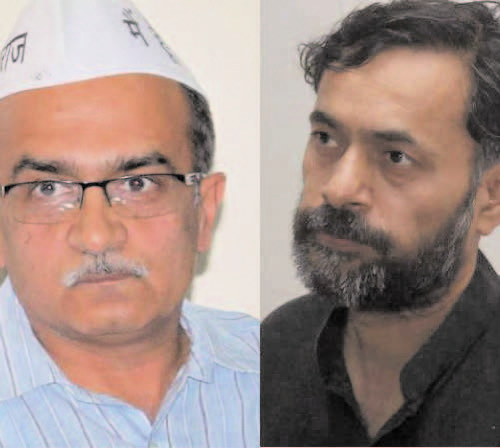
Yogendra Yadav and Prashant Bhushan have also released a pre-invite for the event that is to be held at IFFCO Chowk at Gurgaon from 10 A.M. To 5 P.M., saying it involves “restarting” the journey of alternative politics so as to remain true to the “original spirit” of the ‘andolan’ (movement).
The rebel camp claims to have garnered the support of 968 volunteers in Delhi, 661 from Uttar Pradesh, 329 from Bihar, 301 from Haryana and 200 from Maharashtra.
The build-up to the April 14 meet has witnessed a series of allegations and counter-allegations with the dissident camp accusing Arvind Kejriwal loyalists of trying to scuttle the event while the party has issued a veiled warning to those intending to participate in the ‘Swaraj Samwad’.
Bhushan and Yadav were ousted from the party’s top panels last month.
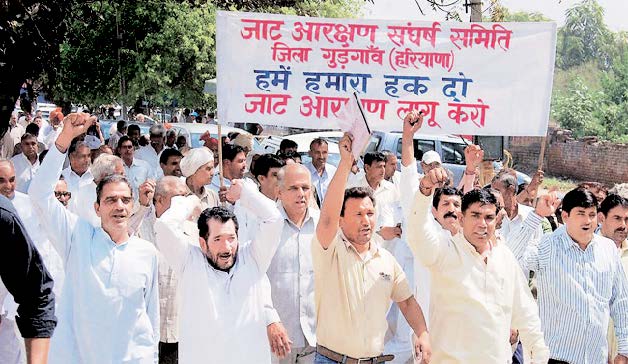
NEW DELHI: (TIP): Compelled by electoral politics, the BJP-led NDA government has filed a review petition in the Supreme Court pleading for its nod to extend reservation to Jats in education and jobs under the Other Backward Classes (OBCs) category which enjoyed a 27% quota.
The review petition comes in the wake of a Jat delegation’s meeting with PM Narendra Modi following the SC ruling The government’s move has come within a fortnight of the SC verdict on March 17 striking down the Centre’s March 2014 notification that had put Jats on the OBC list meant for 9 states —Haryana, HP, Uttarakhand, UP, Delhi, Bihar, Gujarat, MP and Rajasthan (Bharatpur and Dholpur districts).
Only two days ago, the SC had reiterated its ruling by refusing to entertain a petition filed by Jat doctors pleading for exempting the admissions for the 2015-16 academic session from the purview of the judgment. The doctors, who had applied for post graduation medical courses under the OBC quota, had argued that since the admission process had begun much before the SC verdict, the quota for Jats should be retained at least for one more year. In the review petition, the government said the decision to include Jats in the OBC list was in consonance with the SC verdict in the OBC quota issue in the backdrop of the Mandal Commission report.
All nine states had already included Jats in their OBC lists and had pleaded with the Centre to put them on the Central list as well.
While the UPA government had extended the OBC quota to Jats on the eve of the 2014 LS elections, the Modi government supported this decision in the SC ahead of the Haryana Assembly polls last year.
NEW DELHI (TIP): The Centre is mulling filling vacancies of Governors in nine states — five of them ruled by the Congress— soon as one Governor is holding the charge of four states while five others are in charge of at least two states each.
“Since some Governors are holding additional charge of 2-3 states, new appointments are expected in the coming weeks,” official sources said.
There are vacancies in Raj Bhavans in Assam, Himachal Pradesh, Meghalaya, Mizoram and Manipur, all ruled by the Congress. Opposition parties like JD-U, Left and TRS are in power in Bihar, Tripura and Telangana respectively.
There is also vacancy in Punjab, ruled by the Akali Dal-BJP combine. The post of Lieutenant Governor in Puducherry is also lying vacant.
West Bengal Governor Keshari Nath Tripathi is holding the additional charge of Bihar, Meghalaya and Mizoram while Nagaland Governor Padmanabha Acharya is in charge of the Raj Bhavans in Assam and Tripura.
Haryana Governor Kaptan Singh Solanki has been given the additional charge of Punjab Governor and administrator of Chandigarh; Rajasthan Governor Kalyan Singh is holding the additional charge of Himachal Pradesh. Uttarakhand Governor KK Paul is in charge of the Raj Bhavan of Manipur too.
ESL Narasimhan, who was the Governor of undivided Andhra Pradesh, continues to be the Governor of both Telangana and residuary Andhra Pradesh after the bifurcation while Lieutenant Governor of Andaman and Nicobar Islands Lt General Ajay Kumar Singh (retd) is holding the additional charge of the LG of Puducherry.
Mr. Julio Ribeiro, Retired IPS officer, former DGP of Mumbai and Gujarat recently said: ‘As a Christian, suddenly, I am a stranger in my own country’. He was merely reflecting on the recent dilemma of the Christian community in India since the ascendance of Mr. Narendra Modi as Prime Minister of India. It is indeed the anguish of a distinguished public servant who has served the country with great zeal and dedication to protect and preserve its territorial integrity.
Today, scores of Indian Christians who have contributed in so many ways towards the development of India especially in the social and educational sectors are pained to feel the same way as Mr. Ribeiro does!As a Christian and a member of the Diaspora, I truly share the sentiment of Mr. Ribeiro and salute him for his forthrightness in speaking out.
What exactly has happened to bring about such anxiety and insecurity to such a small community that poses no harm to its fellow citizens? The latest reports from India point to two more attacks targeting the Christian religious places of worship, one at St. George Church in Navi, Maharashtra and the other at St.Peter and Paul Church at Jabalpur, Madhya Pradesh, along with two schools that are managed by the churches. Incidentally, both Maharashtra and Madhya Pradesh states are governed by Prime Minister Modi’s party-BJP.
These may have happened at the heel of another incident in Nadia district in West Bengal where a 72 year old Nun was gang raped by six individuals at the Jesus and Mary convent school. Reacting to the gang rape of the Nun, Surendra Jain, Joint Secretary of the Vishwa Hindu Parishad (VHP) blamed the ‘Christian Culture’ for the incident. He also justified the vandalizing of a Church in Haryana and stated that these attacks would continue if conversions do not stop.
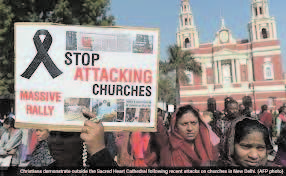
Several Churches in Delhi were vandalized and desecrated by religious extremists in the past months including St. Sebastian Church in Dilshad Garden which was reduced to ashes with its altar charred and Bibles strewn all over the ground. Archbishop Anil Couto said that the arson in St. Sebastian Church was condemnable not just because it was act of sacrilege and hate against the community and its faith, but because it could happen in the national capital which is recovering from a series of communal incidents. Also distressing to him is the sense of police impunity that long hours were lost, and possible evidence destroyed, before police finally came. Most of the culprits still remain at large and the law enforcement officials seem to show very little urgency in bringing them to justice.
These incidents are not just limited to certain parts of India but happening across the country. The recent incident in a village in Chattisgarh reveals the fear and insecurity of those who have embraced Christianity as their faith. Sukhram Kashyap, a Christian from Chattisgarh, has not only seen his church vandalized but was denied food rations from the Hindu dominated village council and several of his friends were beaten up when they protested. Some of his fellow worshippers were reconverted in an aggressive campaign called ‘Ghar Wapasi’ by Hindu fundamentalists who have also banned any Christian clergy from entering the village.
Breaking a long silence on this continuing onslaught by the Hindutva brigade on Christians and their Institutions around the country Prime Minister Modi said the following; ‘the tradition of welcoming, respecting and honoring all faiths is as old as India itself’. One wonders whether his ardent followers in BJP and RSS are listening!
The President of Catholic Bishops Conference of India Cardinal Baselios Cleemis said that the recent attacks on churches and Christians in India have made many ‘feel that their Christian identity is being questioned and it gives a sense of sadness. It showed that not everybody had taken seriously the Prime Minister Narendra Modi’s assurance to minorities’. ‘Irrespective of their faiths, anybody being attacked was an Indian citizen and it was the government’s duty to protect them’ Cardinal added.
In an interview to Karan Thapar on Headlines Today, Cardianal Cleemis also described as “very painful and sad” the comments of RSS head Mohan Bhagwat that Mother Teresa’s humanitarian works were driven by her motive to convert those she served. “It was very painful and very sad to hear about Mother Teresa whom the nation honored with Bharat Ratna,” he said.
There is no doubt that that Cardinal Cleemis spoke on behalf of all Christians in India that may very well include many of the faithful in the Diaspora. Although he did not single out any organization over many of these incidents but went on to criticize the Modi government for observing Christmas as Good Governance Day, saying good governance should be done everyday and the Christian festival should be respected.
One of the most astounding observations that can be made about these attacks on minorities in India is that there is a deafening silence on the part of the Diaspora in the US. Hindu American Foundation, Vishwa Hindu Parishad of America, and GOPIO along with many other organizations have decided to look the other way. Though relatively new as immigrants to this great country, Indians continue to demand our rightful place, justifiably so, at the table in sharing the riches and defending our values and traditions while not tolerating any injustice that offends our sensibilities. A huge segment of the community has indeed made tremendous strides in this short period realizing the American dream and integrating itself into the mainstream.
However, Christians in India who have lived there for almost two Millennia are made to feel as if they are strangers in their own land. How a personal choice of faith that is guaranteed under the article 25 and 26 of the Constitution of India could make or break the ‘Indian ness’ of its citizenry is beyond the comprehension of any rational mind!
Undoubtedly, the forces of polarization and divisions have come out of the woodwork and kept themselves busy transforming India at the expense of the values and principles of inclusiveness and tolerance that brought the nation together. The current Government’s dual-track policy of providing good optics for the consumption of the global community while unleashing the extremist forces to undo the social progress of the last 65 years, mostly under the Congress rule, is troublesome and disheartening to most of its citizens!
President Obama in his Siri Fort speech prodded the new Government ‘India will succeed so long as it is not splintered along the lines of religious faith, as long as it is not splintered along any lines and it is unified as a nation’. It sounds prophetic and to plainly put it, unless the Prime Minister reins in these extremist elements that run amok now, his dream of ‘modern India’ could be in increasing peril!
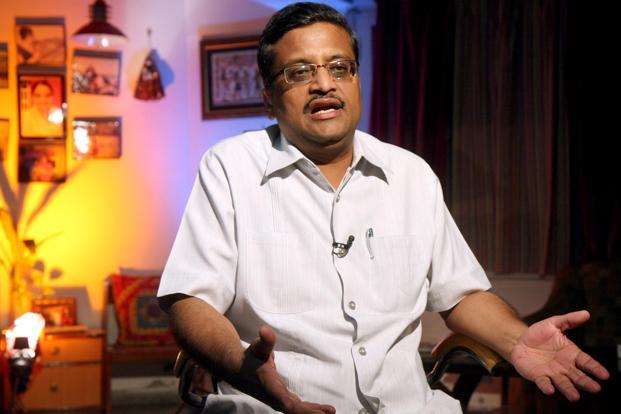
CHANDIGARH (TIP): Differences surfaced in Haryana BJP over the transfer of whistleblower IAS officer Ashok Khemka, with cabinet minister Anil Vij saying he stands by Khemka and chief minister Manohar Lal Khattar calling the transfer “routine”.
Health minister Anil Vij said, “I am totally with Khemka. I am with him since he fought the battle against corruption. I will stand by him… comment about this after talking to the CM.”
Khattar, who was in Hisar on April 2, “Jo sarkar ko jahan aavashyakta hoti hai, wahin harek adhikari ko bulaya jata hai. Hamari aavashyakta us hisab se jaisi hai, waisa hamney lagaya hai (government appoints any officer as per its requirements. We have posted him as per our requirements).” He said Khemka was a good and honest officer.
A 1991 batch IAS officer, Khemka has faced 46 transfers during 22 years of service. He reacted to his transfer on Thursday with a tweet, “Tried hard to address corruption and bring reforms in transport despite severe limitations and entrenched interests. Moment is truly painful.”
The government has not given any reason for his transfer, but sources said that the influential transporters’ lobby was unhappy with the officers’ order for stringent checking of trucks plying the inter—state route, especially those moving between Haryana and Rajasthan.
Brushing aside suggestion of any role in Khemka’s transfer, transport minister Ram Bilas Sharma said, “It’s a routine matter. I have still kept him in my department. The archaeology (department) is under me.”
Agriculture minister Om Prakash Dhankar saw no controversy in Khemka’s transfer either, unlike the previous Congress regime when he was allegedly shunted out over the Vadra land deal.
“If he (Khemka) sees any issue, then he should talk to us or the CM,” said Dhankar, urging officers to not go to the media. “He (Khemka) is among the officers who goes to the media the most,” he added.
The government had on April 1 transferred Khemka, 49, to a “low profile” assignment of secretary and director general of state archaeology and museums department, just four months after he was made transport commissioner.
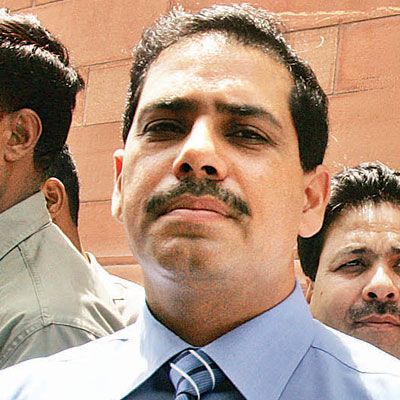
NEW DELHI (TIP): Taking to task the previous Congress government of Bhupinder Singh Hooda in Haryana, a report by the Comptroller and Auditor General (CAG) has alleged that land rules were relaxed, ignored on more than one occasion, to favour M/s Sky Light Hospitality Pvt Ltd, a firm owned by Robert Vadra, son-in-law of Congress president Sonia Gandhi.
The CAG report, tabled in the Haryana assembly Wednesday, the last day of the budget session, alleges that because of Vadra, rules were also relaxed for other developers and builders, including real estate major DLF Universal Ltd.
Underlining that “the possibility of extending undue benefit to particular applicants cannot be ruled out”, the report mentions how a commercial licence was granted to Sky Light Hospitality merely after reading Vadra’s name in the director’s column.
The CAG said it examined cases of nine firms which applied for 14 commercial licences in Sector 83, Gurgaon and found that Vadra’s firm, one of the nine companies, had not submitted documents on financial adequacy. “The applicant has not submitted any document in respect of financial capacity… name of the director alone was mentioned.”
It was the job of the Town and Country Planning Department (TCPD) to assess the financial capacity of applicants. Stating that were glaring discrepancies in the cases the auditors examined, the report notes that “no uniform criteria/ benchmarks were applied for assessment of financial adequacy with the result that appraisal was ad hoc and varied from case to case”.
Asked about the comments in the CAG report, P Raghvendra Rao, Additional Chief Secretary, Town and Country Planning Department, said: “We have prepared our reply to all such observations recorded by the CAG in its report. The reply, which runs into 30 pages, has been submitted to the state government for approval. Once the government approves the reply, we shall be able to respond to each and every observation made in the CAG report.”
Detailing the alleged relaxations made for Vadra’s company, this is what the CAG recorded:
The minimum area norm for a commercial colony in a Hyper Potential Zone like Gurgaon was two acres. “… projects were sanctioned in Sector 83, Gurgaon for area measuring less than two acres on the rationale that if applied land was contiguous with the already licensed area, then area of both contiguous plots was to be taken into account.”
“While appraising the licence of M/s Sky Light Hospitality Pvt Ltd, it was observed that out of 3.531 acres applied area, 0.83 acre fell in residential zone and 1.35 acres fell in the 24-metre internal circulation plan road. After excluding these areas, net area for commercial licence remained 1.351acres. However, the coloniser was assessed to have fulfilled the minimum area requirement of two acres.”
NEW DELHI (TIP): BJP-ruled Goa would not ban beef as it is an essential part of the cuisine of minority communities in the state, chief minister Laxmikant Parsekar told ET, adding that it had taken several years for his party to earn the trust of the state’s Christians and Muslims.
“Regardless of what the Centre does -in Goa minorities are 3940% -if it is part of their food habits, why and how can we ban it? For people -especially minorities -eating beef is part of their food,” said Parsekar. The Goan CM’s comments assume significance as it comes days after Maharashtra and Haryana imposed blanket bans on beef. The move had also triggered speculation that the BJP-led Central government could be considering a nation-wide plan to ban beef distribution and consumption.
Parsekar, a former state-level functionary of RSS, said that he is also conscious about the sentiments of a section of Hindus concerning slaughter of cows.
“Sentiments are hurt with regards to killing cows, not in the case of oxen or bulls. We don’t permit killing of cows, and even oxen are not killed there (in Goa) now. It (beef) is brought from Karnataka and sold here, which we allow since it is a part of cuisine of Catholics and Muslims, and I feel it should not be banned,” he said.
The Goa CM also felt that there was a concerted effort from some quarters, including media, to paint BJP as antiminority by blaming the recent attacks on churches on the party. Such incidents are happening even in states where BJP is not in power, but the party is being blamed, he said.
Parsekar said the BJP managed to grow “gradually” and achieve a full majority government for the first time in the state because of it having “build confidence” among the minority community.
“In fact, we favour the minorities,” he said, adding, “In Goa, we are always one step ahead (in reassuring the minority community). We favour the minorities -whether it is for (setting up their) institutions or any other help. For your information, exposition of the holy relics of Saint Xavier’s was organised this year. We spent a lot of money for raising infrastructure for that event. It went on for 45 days and 46 lakh people arrived from the world over. We had put up a secretariat comprising top officers for monitoring the event and spent more than Rs 50 crore at the campus.”
HISAR (TIP): An under-construction church in Kaimri village near here was vandalised by a group and the cross replaced with an idol of Hanuman, triggering tension in the area in Haryana.
Father Subhash Chand of Williwarsh church lodged a complaint against 14 people, following which a case was registered by police under sections 147 (Punishment for rioting), 153A (promoting enmity between groups), 295 (destroying, damaging a place of worship with intent to insult the religion of any class of persons), 380 (theft in a building), 506 (criminal intimidation) of IPC.
The complainant stated that the accused fragmented the cross and installed the statue of Hanuman and a flag depicting Lord Ram and threatened to kill him.
He alleged that they stole a cooler and some items from the worship place that was under construction.
Hisar range Deputy Inspector General (DIG) Saurabh Singh said that the situation was under control.
Meanwhile, Christian Front Haryana has condemned the incident and has demanded immediate arrest of the accused, all residents of Kaimri.
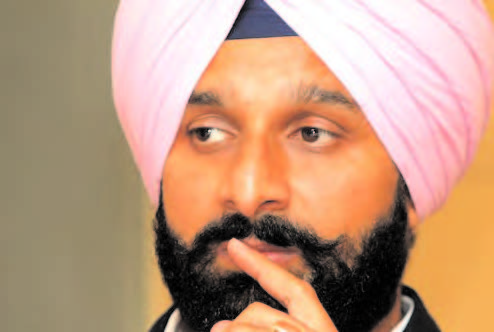
CHANDIGARH (TIP): Punjab revenue minister Bikram Singh Majithia received about Rs 35 lakh as “election fund” from Jagjit Singh Chahal, the arrested pharma company owner and the kingpin of the synthetic drugs racket, according to the Enforcement Directorate (ED) chargesheet filed in the Patiala court on March 2.
“Between 2007 and 2012, I gave Rs 35 lakh in cash to Majithia in seven or eight instalments. I used to hand over the money to Majithia in the drawing room of his 43, Green Avenue, residence in Amritsar,” Chahal said in signed statements in Punjabi made before Niranjan Singh, the Jalandhar-posted assistant director of the ED, on February 9 this year.
The statements, made under Section 50 of the Prevention of Money Laundering Act and permissible in the court as evidence, are part of the ED’s voluminous chargesheet.
However, it’s noteworthy that the ED chargesheet does not directly name Majithia in this case of money-laundering. Nor has the ED produced any corroborating evidence yet to establish the veracity of Chahal’s allegations.
Significantly, Majithia had appeared before the ED on December 26 last year in connection with the drug racket. Strangely, it is after summoning Majithia that the ED again recorded Chahal’s statement on February 9, 2015, in which the latter has alleged that he gave the money to the minister. It is, however, not clear whether Chahal had made the same allegation against Majithia in his earlier confessional statements before the ED.
Majithia was questioned by assistant director Niranjan Singh, who was later transferred to Kolkata. In an interim order, the Punjab and Haryana high court has stayed Singh’s transfer.
According to the ED documents, Chahal told ED, “Eh sariyan rakman main Majithia saab di kothi ch ja ke usde drawing room which dittiyan. Jaan ton pehlan, main usde PA Kartar Singh, jo ki usda sarkari PA hai, de naal telephone the gal kar ke Majithia saab de naal meeting da sama le lenda si (Before going to meet Majithia, I used to take appointment from his PA Kartar Singh).”
One of the primary accusations against Chahal who owned pharma companies was that he was allegedly manufacturing banned precursor chemicals — ephedrine and pseudoephedrine — which were being diverted illegally for the production of synthetic drug ICE.
The ED chargesheet says another accused and Amritsar businessman Maninder Singh alias Bittu Aulakh, stated before the central agency that Majithia was “involved” in sand mining business.
In response to the ED’s question about the “business of Majithia and his business associates”, Aulakh on January 13 this year had told ED, “He (Majithia) runs a distillery in Uttar Pradesh. His trusted man for sand mining is Kanwarjit Singh alias Rosy Barkandi of Muktsar.”
On the other hand, Chahal said, “Bittu Aulakh, Majithia and Bonny Amarpal Ajnala, SAD MLA, together deal in the business of sand mining.”
NEW DELHI (TIP): Investment proposals by corporates are generally associated with improving business sentiment and often linked with the possibility of job creation. The comparison of proposed investment with actual implementation and job creation in the past 23 years, however, shows that the actual delivery has fallen well short of the promise.
Data from the department of industrial policy and promotion shows that between August 1991 and March 2014, the government received about 94,000 investment proposals. These proposals include Industrial Investment Intentions through Entrepreneurs Memorandum — IEMs (delicensed sector) and Direct Industrial Licences (licensable sector).
Put together, these proposed the investment of more than Rs 102 lakh crore and were supposed to create 2.3 crore jobs. The data on actual implementation of these proposals shows that only Rs 5.1 lakh crore was actually invested and just 20.1 lakh jobs created. That’s less than 5% of the proposed investments and 8.9% of the promised jobs.
A state-wise analysis of proposals shows that between August 1991 and March 2014 corporates proposed to invest Rs 15.4 lakh crore in Orissa —the highest in the country. It was followed by Gujarat and Chhattisgarh receiving over Rs 10 lakh crore of proposed investments and Maharashtra just a tad below that mark. Overall, there were 15 states, which were each supposed to get over Rs 1 lakh crore of investments in these 23 years.
When one analyses actual investments, Haryana has been the most successful among these 15 states in converting proposals to reality as 18.9% of the proposed money actually reached the state. It is followed by Gujarat (12.6%) and Uttar Pradesh (11.4%). The states that fared the worst in this conversion are Bihar, Jharkhand, Chhattisgarh and Orissa, where less than 1% of the proposed money actually arrived.
So, what is the investment to job creation ratio? Overall, the Rs 5 lakh crore actually invested created a little over 20 lakh jobs, which amounts to four jobs per crore of investment. There were 25 states which witnessed the actual investment of more Rs 1,000 crore. Among these states, Jammu and Kashmir witnessed the most labour intensive investments, while Gujarat had the most capital intensive ones. Every crore of rupee invested in Jammu and Kashmir created about 12 jobs, while in Gujarat a crore of investment yielded only two jobs.
In the investment to job creation ratio, Jammu and Kashmir is followed by Goa, Uttarakhand, Kerala and Punjab, where ten or more jobs were created per crore of investment. The worst state/UTs in this list are Madhya Pradesh, Jharkhand, Daman & Diu, Uttar Pradesh and Gujarat.
Signup to our Newsletter!
Don’t miss out on all the happenings around the world