Tag: Haryana

  • Delhi HC upholds 10-yr jail for Chautala, son

    Delhi HC upholds 10-yr jail for Chautala, son

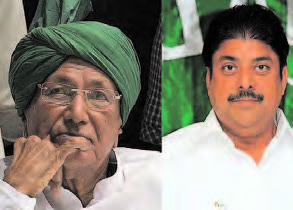
    NEW DELHI (TIP): The Delhi high court on Feb 5 upheld the conviction and 10-year jail term of former Haryana chief minister O P Chautala, 80, observing that he cheated the youth of his state in the JBT teachers’ recruitment scam.

    Justice Siddharth Mridul also upheld the prison terms of Chautala’s son Ajay, two IAS officers Sanjiv Kumar and Vidya Dhar along with the former CM’s political adviser Sher Singh Baddhami — all of whom had got 10 years —pointing out that a teaching cadre “inducted through patronage, nepotism and corruption cannot, morally, be higher than the methods that produced it and be free from the sins of its own origin”.

    “So this is the end of the road, appeals have been dismissed,” the judge remarked before pronouncing the verdict. He, however, took a lenient view of the remaining 50 convicts, recognizing that they were pressured to be part of the scam and reduced their jail term to two years. They had been awarded 4-10-year terms.

    A CBI court had on January 22, 2013, found the Chautalas and others guilty of illegally recruiting 3,206 junior basic trained teachers in 2000.


    The court observed that Chautala, as the then chief minister of Haryana, could have been a figure of hope and inspiration to the youth of the state. “Cheating them of their future deserves punishment of the highest kind,” it said, refusing to show any leniency to the politician on grounds of his advanced age and the fact that he is “towards the tail end of his political career”.

    While IAS officer Sanjiv Kumar, the then director of primary education, had claimed to be a whistleblower on the scam, the court found evidence establishing his complicity. The other officer, Vidya Dhar, was the then officer on special duty (OSD) to the chief minister.

    Justice Mridul, in his 400-page verdict found “overwhelming evidence” of the manner in which the scam was given effect to, adding it showed the “shocking and spine-chilling state of affairs in the country”. It directed Ajay Chautala, out on medical bail, to surrender immediately to serve the remaining sentence.

    Referring to the role played by the politicians and the senior bureaucrats in the scam, HC noted that “an ingenious employment scam spanning across 18 districts of state of Haryana was given effect to by persons at the helm of power and the entire bureaucratic machinery fell prey to its satanic influence”. It said the common thread between Chautalas, the two IAS officers and Sher Singh Badshami was the “flagrant disregard towards the system” that led to shaking of public confidence.

    “Each one of them played a role in disrupting the established process to achieve their object. Not only did they offend every duty they had to the office they were holding, but in the process, also challenged the ethical standard of every other public servant and compelled them to abandon their otherwise perfect career records,” HC observed.

    It added that “such scams not only result in dissemination of poor quality education to millions of children who are bound to suffer, but also unfairly deprive the competent participants in such selection processes an opportunity to gain public employment and meaningfully serve the country.” 

  • Deloitte names India American Punit Renjen to be Global CEO

    Deloitte names India American Punit Renjen to be Global CEO

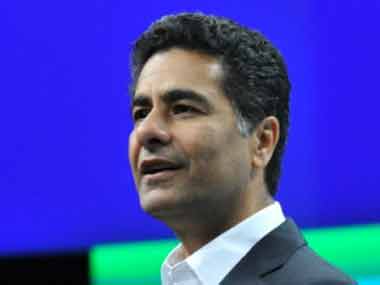
    Punit Renjen has been appointed as the new chief executive officer of Deloitte Global (Deloitte Touche Tohmatsu), the first India-born senior executive to head one of the Big Four consultancies.  

    Renjen is the latest to join a long list of persons of Indian origin to become global CEOs. Others inlcude Indira Nooyi, Satya Nadela and Anshu Jain, who have made to the top posts at PepsiCo, Microsoft and Deutsche Bank, respectively.

    Renjen in an e-mail to all global directors and partners wrote “Thank you for the trust you have placed in me and you have my commitment to serve the global network. I will do my best to serve the global network…..” 

    Renjen’s History – Renjen’s father was a prominent businessman in Lahore before the partition. The Renjen family moved to Rohtak in Haryana where his father started an electrical switchgear manufacturing unit. Renjen completed his schooling from Lawrence School in Himachal Pradesh and worked in Usha International in New Delhi after his graduation. 

    Renjen was on of The Top 25 Consultants ranked by Consulting Magazine in 2007. Others on the list that year included Paul Laudicina of A.T. Kearney, Alan Herrick of Sapient, Kris Pederson of IBM, Tata Consultancy Services, and Romil Bahl of Infosys Consulting.
     
    Renjen is considered a leader in M&As, according to this profile on Bloomberg Business. He has facilitated many major M&As in the last 10 years, “helping clients expand into new markets, create new profit streams, and generate cost reductions and savings synergies”, the profile said.
     
     
  • The AAP’s Second Coming

    The AAP’s Second Coming

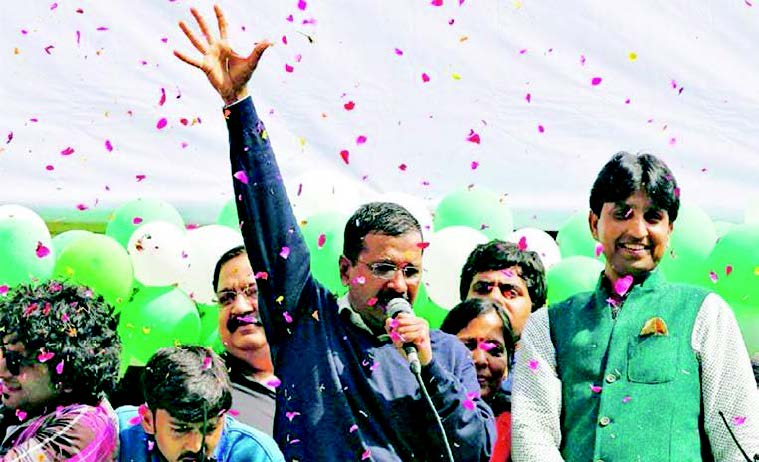
    In the winter of 2013, at a dinner party hosted by a prominent Janata Dal (United) leader in the national capital, shortly after the Delhi Assembly elections, I was witness to an extraordinary conversation. Seated at a table on the lawns of a Lutyens’ bungalow, senior leaders from the Congress, the Nationalist Congress Party (NCP), the Bharatiya Janata Party, the Communist Party of India (Marxist), the JD (U) and the Samajwadi Party discussed the dramatic electoral debut of Arvind Kejriwal’s Aam Aadmi Party (AAP) that stood a close second to the BJP in the State polls. The surprise?Despite their differing world views, they unanimously described Mr. Kejriwal’s politics as the most serious threat to the future of their own parties.

    But 13 months later – a period that saw Mr. Kejriwal become Chief Minister, then quit and fade away, and Narendra Modi’s BJP achieve spectacular success in the general election – many of those opposition parties including the JD (U), the Trinamool Congress and those from the Left declared solidarity with the AAP ahead of this year’s Delhi Assembly polls. When the results arrived, the significance of the barely two-year-old party’s victory sank in, and congratulations started pouring in from opposition parties including the Shiv Sena and the People’s Democratic Party, BJP allies, old and new. The message?Thank you for stopping the BJP.

    So what does the AAP’s second coming in Delhi – a microcosm of India, with its privileged, powerful urban centre widening out into a hinterland of migrants – mean for the traditional opposition parties? Is it an opportunity or a challenge, as they read it in 2013? 


    Ending era of ‘anti-Congressism’

    Last year, the BJP became the first party other than the Congress to win a majority at the Centre, ending the era of “anti-Congressism.” If the BJP was to be defeated, the message of the electorate was that as many non-BJP parties as could unite would have to come onto one platform, flipping the concept of “anti-Congressism” formulated by the socialist leader Ram Manohar Lohia over half a century ago.

    It is, therefore, not surprising that those at the forefront of the emerging “anti-BJPism” in the country are Lohia’s disciples: Janata Parivar members who have, on several occasions, since the 1960s, worked closely with the BJP or the Jan Sangh against the Congress.

    Today, the Janata Parivar’s constituents are struggling to merge their identities to form one party to protect their turf in Bihar, Uttar Pradesh, Karnataka and Haryana against the imminent BJP onslaught, their efforts slowed down by the crisis within the JD (U) in Bihar where they will face their first challenge in State elections later this year.


    Challenging BJP in Parliament

    Simultaneously, the Janata Parivar has also been playing a key role in challenging the BJP on the streets and in Parliament. The Janata Parivar-sponsored agitations questioning the government’s failure to act on the BJP’s electoral promises of bringing back black money, enhancing prices of farm produce, etc. may have gone largely unnoticed. But in Parliament, along with other opposition parties, they have caused serious discomfort to the ruling dispensation.

    In the winter session, the opposition deployed its superior numbers to block the Modi government’s reforms agenda. Divided on economic issues, the opposition joined hands to demand a clarification on religious conversions and communal statements made by BJP MPs, before cooperating on legislative business. The government walked into the opposition trap, failing to clear the Insurance Bill and the Coal Mines Bill. Eventually, it issued a slew of ordinances, providing fresh fodder for the opposition, which accused the BJP government of bypassing Parliament.

    This show of opposition solidarity (that saw nine parties including the Dravida Munnetra Kazhagam, the Bahujan Samaj Party and the NCP working jointly) will be repeated in this month’s budget session of Parliament, with the AAP’s clean sweep in the capital only strengthening that unity. Indeed, the government will find it hard now to push the land acquisition ordinance, for it was on this issue that the AAP campaigned in Outer Delhi where it had failed to get even a single seat in 2013, thanks largely to its inability to crack the caste factor among the migrant population. In 2015, the AAP won 12 of the 14 seats here.

    But replicating opposition unity outside Parliament will be far more difficult. The compulsions of State politics will ensure that regional parties such as West Bengal’s Trinamool and Odisha’s Biju Janata Dal will continue to work alone in their States, especially when it comes to electoral politics. The All India Anna Dravida Munnetra Kazhagam and the DMK will remain the dominant parties in Tamil Nadu, joining hands with parties with smaller presence at election time. Of course, any of these parties might at some stage join a broader national opposition front, provided potential partners don’t encroach upon their own areas of influence.

    For the steadily declining Left parties, which are in power in Tripura and have a notable presence in West Bengal and in Kerala, forging issue-based unity with other parties in Parliament is even less likely to translate into electoral solidarity. At best, it will participate in street agitations and its trade unions may make common cause with similar organisations on specific issues. The Left parties – the CPI(M), the CPI, the Forward Bloc and the Revolutionary Socialist Party – are currently engaged in trying “to broaden the Left” by including the Communist Party of India (Marxist-Leninist) and the Socialist Unity Centre of India. But with its focus still on creating an alternative policy framework, one that still remains at odds with most other political parties, it is unlikely that it would have any meaningful electoral alliances.

    That leaves us with the country’s largest opposition party, the Congress. If party president Sonia Gandhi had forged electoral alliances ahead of the 2004 general election to lead the United Progressive Alliance to victory, one that sustained for a decade, her successor is not cut from the same cloth. Rahul Gandhi, poised to become party president, has not yet demonstrated the leadership qualities necessary to revive the Congress that touched a historic electoral low last year. Worse, say despairing members of the Congress Working Committee, he is unwilling to work towards building electoral alliances to regain political ground.

    Most opposition parties were looking to the Congress for revival of the opposition. But now with the party scoring a duck in a State that it had earlier ruled for 15 uninterrupted years, that hope will diminish further.

    Where does the AAP now fit into the opposition? A quick check with some opposition leaders suggests that while they would like Mr. Kejriwal to endorse their dying brands, they are wary of entering into an alliance with him. They know that his David-like slaying of the Modi Goliath means he could only join such a platform in one capacity – as the leader.

    The AAP’s historic win may have shattered the air of invincibility that Mr. Modi had acquired, but for traditional opposition parties to get another life outside Parliament, they must build a younger leadership, re-invent themselves or simply perish. The Delhi election reflected a change in the national mood and if they don’t adjust to it, their irrelevance will further grow. Arithmetic can only help up to a point.

    The AAP, on its part, is in no hurry. It first wishes to make Delhi a model State, then build its unit in Punjab where it has four MPs, and then gradually grow in the rest of the country. Any success – or failure – in Delhi, the AAP knows, will get it nationwide attention. For the traditional parties, the threat they spotted in 2013 still looms large.


  • Delhi to go to polls on February 7, counting on 10th

    Delhi to go to polls on February 7, counting on 10th

    NEW DELHI (TIP): The national capital will go to the polls on February 7 with the Aam Aadmi Party (AAP) hoping to beat its stunning debut performance a year ago, while the Bharatiya Janata Party (BJP) faces another big test of its popularity after back-to-back election wins at the Centre and in state assemblies.

    Results will be announced on February 10. Delhi has been under President’s Rule for almost a year since the Arvind Kejriwal-led AAP quit after just 49 days in office, most of them dominated by public sit-ins, conflicts with electricity, water and law enforcement agencies as well as a power struggle with the Centre.

    Most analysts see the election as a two-way contest between the BJP and AAP with price rise and women’s safety emerging as key electoral issues, though the Congress is also looking to revive its fortunes in the 70-member assembly following a string of defeats last year.

    BJP: Eyeing absolute majority

    Unable to get the magic number in 2013 assembly elections despite a strong anti-incumbency wave against the ruling Congress, the BJP was forced to sit in the opposition as AAP formed the government with outside support from the Congress.

    But with consecutive wins in the Lok Sabha polls and then assembly elections in Haryana, Maharashtra, Jharkhand and a good showing in J-K, the BJP has the momentum going. Also, the party won all seven parliamentary seats in Delhi. However, like the last time, the party is finding it difficult to project a

    chief ministerial candidate. With too many in the race for the top post, the party has decided to bank entirely on brand Modi to keep infighting at bay.

    The party’s campaign has been designed solely around Modi and the Prime Minister will address a rally each in all parliamentary constituencies. Unlike AAP and Congress, the BJP is yet to announce its candidates.

    With successive electoral reverses leaving the Congress weak, the party is in a direct contest with AAP. The Arvind Kejriwal party has taken the lead by announcing names for all 70 seats and going door-to-door seeking votes. Though pre-poll surveys are giving a clear majority to the BJP, it remains to be seen whether it lives up to the hype.

    AAP: Looking to better 2013 tally

    When the AAP came second in 2013 on its electoral debut, winning 28 seats in the 70-member Delhi assembly, volunteers looked ecstatic. Even many of their leaders shared, in private, that the result caught them by surprise as the party went on to rule Delhi for a brief period.

    But the decision to quit is something that has never stopped hurting AAP. It still enjoys support among the lower-middle class and the poor of Delhi. But many of those more affluent did not—and continue not to—approve leaving Delhi for national footprint.

    The party is projecting its “governance potentials” to demonstrate that it is prepared to stay the course. Through policy blueprints, it is fighting its image of a one-issue (corruption) party driven only by agitation.

    The party also has built an organisational structure and is trying to build a perception about the “good works” it did ‘with Congress’ in those 49 days. But this time around nothing short of a clear majority will do.

    The question is: will the party get there, as Delhi BJP hides behind party strongman and PM Narendra Modi? “I will not claim that we’re sure to win. It’s tough for us, but it’s no less tough for the BJP,” senior party leader Yogendra Yadav said in a recent address to AAP volunteers.

    Congress: Fighting survival battle
    Unlike the BJP and the Aam Aadmi Party, which are aiming to form a government with a clear majority, something that the either party failed to achieve in the 2013 polls, the fight for the Congress is that of survival.

    Despite ruling the Capital for three consecutive terms — between 1998 and 2013 — and a long list of infrastructure projects it completed during its 15-year rule that changed the face of Delhi on its election agenda, the party could not withstand the anti-Congress wave that swept across the city. Its seat tally came down from 43 in 2008 to just eight in 2013. The party’s poor run continued in the 2014 Lok Sabha elections when all seven sitting members of Parliament lost by huge margins, four of them forfeiting their security deposit.

    Not much seems to have changed for the Congress in the past few months. The poor, Dalits and the minorities, which were ardent followers of the Congress and had been voting for the party for the past several years, started gravitating towards the Aam Aadmi Party, which was fighting its debut election, in 2013. The trend continued in 2014 Lok Sabha elections too. The party faces an uphill task of bringing these voters back to its fold.

  • PBD 2015 ROUND-UP

    PBD 2015 ROUND-UP

    Chief Ministers beckon overseas Indians to cash in on Investment opportunities in States

    GANDHINAGAR (GUJARAT) (TIP), January 9, 2015. Chief Ministers of as many as 9 States made a strong pitch for investments by overseas Indians as they laid bare the opportunities and facilities for investors here today at the CMs session on the concluding day of the three-day Pravasi Bharatiya Divas. Presiding over the session, Mr. Rajnath Singh, Union Home Minister, said that the real Bharat was the villages of India and therefore it was important to develop villages to ensure a balanced and an inclusive growth.

    He added that every state in India has a success story to tell and have been able to make a mark in one sector or the other. The Central government, he said, believed in promoting cooperative federalism and therefore the States and the Centre have to work in tandem to make India an economic super power. NRIs, he said, will have to play an important role in fulfilling the Centre’s

    ‘Make in India’ vision.

    GUJARAT: ‘Smart State’ is the mantra of the State Government for which a five-point agenda has been adopted. These are smart schemes for welfare, smart economy, smart governance, smart energy and smart human resources. These schemes are expected to help the Indian diaspora to channelize the flow of investments into the State, set up industrial units and contribute to the social sector schemes to light up the lives of the common man. Kerala: Some of the path-breaking projects being undertaken by the State Government are: e Kochi Metro Rail project, Smart City Project, Vizhinjam port development, Light Metro Rail, Kannur Airport Project, Surface Transport Development, National Waterway and a Student Entrepreneurship Programme. These projects demonstrate that this is the right time to invest in the State and be part of the overall growth of the State. The State Government will offer full support to all who extend their help in further developing the State. Kerala has seen a rapid increase in its growth performance. The state has the highest literacy rate, best human development indicators and has many structural advantages such as a vast coastal line and high productivity due to historical reasons.

    PUNJAB: The immediate investment opportunities in the State are in the fields of IT, bio-sciences and healthcare and futuristic development of 147 cities and towns. The focus areas of the government are agro and food processing, education & skills, electronics manufacturing, textiles & garments and infrastructure development. The top five reasons for investing in Punjab are: easiest place to do business, robust infrastructure, abundant skills and enterprise,responsive, accountable & transparent governance and fiscal incentives. A lot of facilities have been initiated for the NRIs in the State of Punjab. A special court has been set for NRIs in the State to expedite the process of litigation, special police thanas have been put in place and a special commission has been set up to address property related issues of the NRIs.Jharkhand: The State Government offers ample opportunities to investors to partner in sectors such as industry and industrial infrastructure, electronics & IT/ITeS, road & road transport infrastructure, skill development, knowledge & education, healthcare, power generation & distribution, tourism, hospitality, leisure & entertainment and urban infrastructure. The key enablers for attracting investments are nearness to natural resources, skilled manpower due to existing industrial base, investor friendly policies and land bank. To leverage these enablers through a comprehensive and partnering module, the Government of Jharkhand has focused on industrial and economic development of the state through implementation of various infrastructure projects on PPP format.

    MADHYA PRADESH: The State has come a long way from being counted amongst the BIMARU states. It has state-of-the-art infrastructure including roads, power, railways etc. The state has been witnessing double digit growth and has the most investment friendly environment. The industrial policy of the state is investor friendly, the state is very peaceful and there are no man day losses and has single window clearances. The State houses India’s best national parks and world heritage sites.

    ANDHRA PRADESH: The state of Andhra Pradesh has a long coast line and is the gateway to India and south east Asia, has 30 urban centres, extensive road and rail network, natural gas and 24X7 power, young and skilled population and deposits. The state is looking at building five grids- water, gas, power, road and fibre. It has a very strong agriculture and marine and diary sector besides having a niche in high technology sectors like information technology. The state has formulated specific policies to give customised impetus for thrust sectors like industry, port, electronics, textile and agro processing. Also, a land bank has been created with 400 thousandhectares of land. The state is ideally poised for river linking and has the potential to become a drought proof state in the next 5 years.

    MAHARASHTRA: The state of Maharashtra is a land of investment opportunities. The State Government has started fast tracking approvals, simplifying processes and initiated the process of reducing timelines to facilitate investors, inflow of FDIs and make the state conducive for ease of doing business. The state has commenced work in full earnest to take ahead Prime Minister Narendra Modi’s call for ‘Make in India’. The State offers immense opportunities for infrastructure development as the government is planning to create a new urban city which would be bigger than the city of Mumbai. Also, the Government looks forward to providing affordable housing to middle and lower strata of society, and hence the State invited the Pravasis to take advantage of these investment opportunities.

    GOA: The State possesses talented human resource, natural reserves, captivating beauty which makes a great tourism destination. The Goa Government has now identified thrust areas such as creation of knowledge hub, focus on R&D, pharmaceuticals, biotechnology, aviation, aerospace, defence, IT, agro-based & food processing industries, to synergize its efforts with the ‘Make in India’ campaign of the Prime Minister. The aim is that the fruits of development percolate to the underprivileged of the society.

    HARYANA: The state of Haryana witnessed rapid growth in various sectors and is also an integral part of Delhi’s National Capital Region. Earlier, known as an agricultural state, Haryana has come a long way and now witnesses the presence of some of the well-known multinational companies. Haryana is focusing on skill development for both its urban and rural population toprovide them with employment opportunities, particularly, in MSMEs. Known for achieving milestones in sports, the Government desires to establish Haryana as a ‘Sports Hub’.

  • Cabinet clears Rs 5 lakh compensation to 1984 anti-Sikh riot victims

    Cabinet clears Rs 5 lakh compensation to 1984 anti-Sikh riot victims

    NEW DELHI (TIP): A proposal to give Rs 5 lakh each to the kin of victims of the 1984 anti-Sikh riots, triggered after assassination of the then Prime Minister Indira Gandhi, has been approved by the government on December 10 night. The decision has been taken by the Union Cabinet at a meeting presided over by Prime Minister Narendra Modi. The compensation to the families of the riot victims will be given in addition to what they have so far received from the government and other agencies, official sources said. Of the 3,325 victims, 2,733 were killed in Delhi alone while rest of the victims were from Uttar Pradesh, Haryana, Madhya Pradesh, Maharashtra and other states.

    The Narendra Modi government had received several petitions from various Sikh organisations in the last three months. The fresh compensation, which will cost the exchequer Rs 166 crore, sources said. The anti-Sikhs riots were triggered following the assassination of the then Prime Minister Indira Gandhi by her Sikh bodyguards on October 31, 1984. In 2006, the UPA government led by Prime Minister Manmohan Singh had announced a package of Rs 717 crore which included monetary compensation of Rs 3.5 lakh to the kin of each killed in the riots besides financial assistance to the injured and those who had lost their property.

    Out of this only, Rs 517 crore had been spent and the remaining Rs 200 crore could not be distributed because of dispute over claimants. The most affected regions were the Sikh neighbourhoods in Delhi. Some of the anti-Sikh riot cases are still continuing in courts and many Sikh organisations have alleged that the key conspirators of the violence were at large and victims have not yet got justice. In 2005, then Prime Minister Manmohan Singh had apologised for the 1984 anti-Sikh violence saying Gandhi’s assassination was a “great national tragedy” and what happened subsequently was “equally shameful”. “I have no hesitation in apologising to the Sikh community. I apologise not only to the Sikh community, but to the whole Indian nation because what took place in 1984 is the negation of the concept of nationhood enshrined in our Constitution,” he had said.

  • 22 STATES, UTS SUPPORT BILL TO PREVENT ‘HONOUR KILLINGS’

    22 STATES, UTS SUPPORT BILL TO PREVENT ‘HONOUR KILLINGS’

    NEW DELHI (TIP): The government has initiated the process of drafting a law against honour killings by treating crimes in the name of honour as a separate category of offences. The moves comes after 22 states, including Punjab, Haryana, Himachal Pradesh and Chandigarh (UT), supported the recommendations of the Law Commission of India to treat honour crimes as a standalone offence. Law Minister Sadananda Gowda said in Parliament today that the government would, after considering the comments from states, hold consultations on the enactment of the legislation against honour crimes. “After considering the responses of all states and UTs and consultations with stakeholders, the policy decision to enact the legislation on the subject will be taken. It would be difficult to fix a timeline but the department has initiated the process of implementation of the report of the Law Commission in this respect,” Gowda said.

    The Law Commission had in its 242nd Report on “Prevention of Interference with the Freedom of Matrimonial Alliances in the Name of Honour and Tradition” recommended a strict law against honour crimes being perpetuated by community panchayats working by different names in different parts of the country. The proposal to bring the law was first initiated during Congress-led UPA-II which had formed a Group of Ministers to make recommendations. The GOM never presented its report and was disbanded once its chairman – Pranab Mukherjee – proceeded to become President. At that time, Haryana had opposed the move. The BJP government, after coming to power, circulated the proposal again and 22 states, including Haryana (which now has a BJP government), have supported the recommendations of the Law Commission.

    Apart from Punjab, Haryana, Himachal and Chandigarh, the states that have backed the law are: Andhra, Assam, Chhattisgarh, Goa, Jharkhand, Karnataka, Kerala, Meghalaya, Mizoram, Nagaland, Odisha, Uttar Pradesh, West Bengal and the UTs of Dadra and Nagar Haveli; Daman and Diu, Lakshadweep and Puducherry. The responses of the remaining states are awaited. Consensus of states on the law to curb honour crimes is critical because the subject falls in List III (Concurrent List) of the Seventh Schedule of the Constitution and the Centre alone cannot legislate on it.

  • Woman’s death: Rampal sent to judicial custody

    Woman’s death: Rampal sent to judicial custody

    HISAR (TIP): A local court on December 11 sent the selfstyled godman Rampal to judicial custody in connection with the death of a woman follower in his ashram during the recent standoff between his disciples and police. Rampal was produced before the court of judicial magistrate (Hisar) Prateek Jain on Thursday after the completion of his three-day police remand relating to a murder case registered against him on November 19 in Barwala police station. Police sought 5-day police remand in connection with the death of a woman who along with four other women and an infant were killed during the over 10 day standoff in Satlok Ashram last month. The court had sent Rampal in 3-day police remand in this case on December 8. The case was registered against Rampal and some of his followers under Section 302 of the IPC (murder). The 63-year-old controversial godman was arrested from his ashram at Barwala in Hisar on November 19. He was produced before the Punjab and Haryana high court a day after his arrest in connection with a contempt case and was sent to police custody for five days by a court.

  • Haryana puts bravery award for Rohtak sisters on hold

    Haryana puts bravery award for Rohtak sisters on hold

    CHANDIGARH (TIP): Amid new disclosures in the alleged molestation of two sisters in a moving bus near Rohtak on November 28, the Haryana government, on December 4, put its decision of honouring both the girls on Republic Day on hold till the final outcome of a probe. The government made the announcement of honouring the girls on the basis of media reports. But the decision is being held back in the wake of new inputs, including the surfacing of three videos related to the controversy.

    Many co-passengers, including a few women, told the police there was no molestation in the bus and the girls thrashed the boys in the course of a dispute over a seat. However, the two sisters have been terming passengers’ statements as stories concocted to pressurize them. “Whether or not to award the girls will be ascertained only after investigating the matter,” said chief minister Manohar Lal Khattar while speaking to journalists in Rohtak. The CM also assured an impartial probe into the matter when family members of the accused and other villagers met him.

    The three youths, Mohit, Kuldeep and Deepak, from Asan village of Sonipat, were arrested and later released on bail. On December 1, the Khattar government had announced that both sisters would be honoured. At the time, Khattar said both girls showed indomitable courage and bravery by opposing the misdemeanour of three youths who tried to molest them. “Initially, we received a message from the media and other sources of the government that the two girls had to struggle after they were teased in a bus. Being a sensitive government, we took the first step (of honouring the girls) in public interest,” said Jawahar Yadav, adviser to Haryana CM, on December 4 . “Till now, three videos have surfaced and according to the opinion of the government, there should be no injustice with anybody, girls, boys or any other associated party like the driver and conductor of the bus,” he said.

    In the latest video, family members of the accused are seen thrashing them and asking them to seek an apology from the girls at the police station. “Kuldeep’s father Balbir Singh, a retired soldier, was very upset. Despite the accused insisting they were innocent, he asked them to seek an apology from the girls because he was apprehensive about their career in case an FIR was registered against them,” said Sandeep Rathi, advocate of the accused, who claimed that the video was prepared by the girls’ family in the police station. In another video, the girls were seen thrashing a youth at a park in Rohtak. Residents of the native village of the accused have been opposing any award for the girls. “The government should set up a special investigation team to probe the matter,” said Raj Singh, sarpanch of Asan village.

  • Rampal sent to jail, faces murder charges after 6 deaths in Satlok Ashram

    Rampal sent to jail, faces murder charges after 6 deaths in Satlok Ashram

    CHANDIGARH, HISAR (TIP): Controversial godman Rampal and his close aides have been booked for murder on November 20. They have been blamed for the six deaths at Rampal’s Satlok Ashram near Barwala during the clashes with security forces. Haryana’s Director General of Police S.N. Vashisht told the media: “The murder cases relate to the six deaths at the ashram.” Vashisht said Rampal had been sent to Hisar for investigation of the fresh cases against him which include sedition, rioting, illegal detention and violation of Arms Act.

    Earlier, he was sent to judicial custody till November 28 by the Punjab and Haryana High Court after days of stubborn resistance by his followers, which turned Barwala town in Haryana’s Hisar district into a virtual warzone. There was loud hooting as the godman emerged from the court after the hearing. Dressed in a shirt and track pant and wearing slippers, the godman sat through the hourlong hearings, which started earlier than scheduled.

    The court ordered that Rampal be immediately sent to jai as the Division Bench cancelled his bail in the 2006 murder case. Rampal was put behind bars in Panchkula this morning after the high court cancelled the bail granted to him in April 2008 in a 2006 murder case. He was taken from a government hospital in Panchkula, where he was admitted early in the day, to the Sector 5 police station adjoining Chandigarh. Disappointment writ large on his face, Rampal stood in the lock up holding the iron bars, occasionally looking down. Before being taken to the police station, Rampal claimed that he was an innocent man.

    “I am innocent. All the charges against me are baseless,” he told journalists. When asked if he sorry for the death of six people at his ashram during the Satlok Ashram standoff, he said, “I did not ask them to be there.” The 63-year-old godman was arrested on November 19 night, more than 24 hours after over 5,000 security personnel stormed his fortified ashram compound using water cannon, tear gas and batons. More than 500 devotees of Rampal, including nearly 250 members of his private army, called Baba’s Commandoes, were also arrested.

  • RAMPAL SENT TO JAIL, FACES MURDER CHARGES AFTER 6 DEATHS IN SATLOK ASHRAM

    RAMPAL SENT TO JAIL, FACES MURDER CHARGES AFTER 6 DEATHS IN SATLOK ASHRAM

    CHANDIGARH, HISAR (TIP): Controversial godman Rampal and his close aides have been booked for murder on November 20. They have been blamed for the six deaths at Rampal’s Satlok Ashram near Barwala during the clashes with security forces. Haryana’s Director General of Police S.N. Vashisht told the media: “The murder cases relate to the six deaths at the ashram.” Vashisht said Rampal had been sent to Hisar for investigation of the fresh cases against him which include sedition, rioting, illegal detention and violation of Arms Act.


    38


    Earlier, he was sent to judicial custody till November 28 by the Punjab and Haryana High Court after days of stubborn resistance by his followers, which turned Barwala town in Haryana’s Hisar district into a virtual warzone. There was loud hooting as the godman emerged from the court after the hearing. Dressed in a shirt and track pant and wearing slippers, the godman sat through the hour-long hearings, which started earlier than scheduled. The court ordered that Rampal be immediately sent to jai as the Division Bench cancelled his bail in the 2006 murder case.


    39


    Rampal was put behind bars in Panchkula this morning after the high court cancelled the bail granted to him in April 2008 in a 2006 murder case. He was taken from a government hospital in Panchkula, where he was admitted early in the day, to the Sector 5 police station adjoining Chandigarh. Disappointment writ large on his face, Rampal stood in the lock up holding the iron bars, occasionally looking down. Before being taken to the police station, Rampal claimed that he was an innocent man. “I am innocent. All the charges against me are baseless,” he told journalists.

    When asked if he sorry for the death of six people at his ashram during the Satlok Ashram standoff, he said, “I did not ask them to be there.” The 63-year-old godman was arrested on November 19 night, more than 24 hours after over 5,000 security personnel stormed his fortified ashram compound using water cannon, tear gas and batons. More than 500 devotees of Rampal, including nearly 250 members of his private army, called Baba’s Commandoes, were also arrested.

    Rampal’s army

    Controversial preacher Rampal’s private army was armed to the teeth with firearms and was capable of sparking a small war if it wanted to. When senior police officials finally entered Satlok Ashram in Barwala on Wednesday, they found at least a couple of almirahs stacked with revolvers, guns and ammunition. The cops came across a number of locked almirahs as well in which more firearms are believed to have been kept. From the two almirahs they opened cops found .32 bore revolvers, .315 bore rifles and 12 bore guns. The officials also found some ammunition, including several rounds for 7.62mm rifle used in self-loading rifles (SLR) and 303 rifles. The army, paramilitary forces and police used these previously but they have since migrated to 5.56mm INSAS rifles. The 7.62mm is prohibited bore for private individuals who are not allowed to own such firearms even if they have a licence.

    Inside the ashram

    Satlok Ashram of controversial sect leader Rampal Dass is built like a fortress, surrounded by high walls with watchtowers. “The ashram is built like a fort meant to ward off an invasion. It reminded me of the Agra fort,” said a senior police officer who was part of the Operation Samvedi (sensitive) conducted over three days to nab the “mouse”— codename for the 63-year-old engineerturned- preacher. The “fortress” saw bloody clashes Tuesday as the police tried to storm the ashram to arrest Rampal for contempt of court after he repeatedly failed to appear in the HC in a 2006 murder case.

    The hall that can seat 50,000 has a special enclosure from where Rampal, who claims to be a devotee of mystic poet Kabir, delivered sermons from a hydraulic chair as his private militia stood guard. Dozens of air-conditioners and hundreds of fans can be seen. A local police officer gave the break-up: 10,000 ceiling and 1,000 exhaust fans under one roof. On the extreme left corner of the complex is a four-storey mansion Rampal lived in. A private swimming pool, state-of-the art elevators, 24 AC rooms with attached bathrooms fitted with top-of-the line fixtures, Rampal, whose followers largely come from lowincome strata, lived big.

    One of the rooms had a massage bed, another treadmills as Rampal stared down from huge wall posters. Satlok Ashram’s kitchen had all the modern equipment to cater to a lakh of devotees. Huge quantities of rice, pulses, vegetables, paneer and other items are stocked up in the kitchen. A DSP-rank officer said the stock could have fed a lakh people for a month. According to the officer, during the Satsangs, Rampal’s aides used to collect food material to feed the devotees. Several Barwala residents said that vendors used to queue up in front of the ashram’s gate with huge quantities of vegetables and other food items.

  • Escalating tension is not good for either country

    Escalating tension is not good for either country

    While there will be no open war between India and Pakistan in the normally understood sense, this does not prevent Pakistan from activating its tools of terror

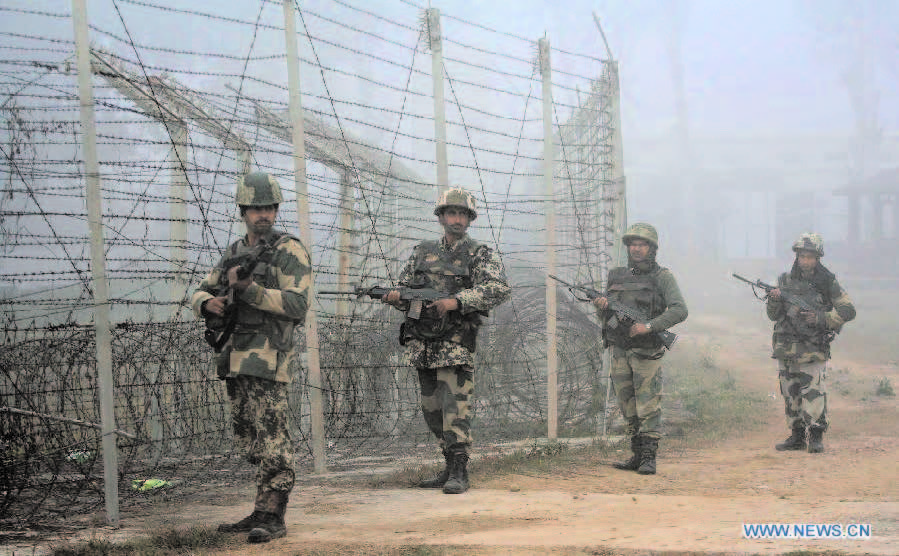
    There has been an escalation of tension between India and Pakistan in the recent few days. The Line of Control (LoC) has witnessed serious exchange of fire at the border for nearly a fortnight. Prime Minister Narendra Modi referred to the border firing in one of his election rallies in Maharashtra. Modi said that Pakistan was getting the befitting lesson and it would not dare to open fire on the border.

    It may be recalled that the cease-fire agreement between India and Pakistan came into effect in November 2003. Thereafter there had been periodic fire from Pakistan side, which had to be routinely returned by the Indian forces posted at the LoC. Union Home Minister, Rajnath Singh made a statement that Pakistan should understand that times have changed in India, an obvious reference to Bharatiya Janata Party under Narendra Modi coming to power at the centre with majority of its own.

    Reverting to the situation on the LoC, the Border Security Force (BSF) was handling the situation on the international border and it was BSF which was doing the firing across the LoC in Poonch, R.S. Pura and Arnia sectors. Reports say that instructions to Director General BSF, D.K. Pathak went out from the National Security Adviser Ajit Doval, who was in direct touch with DG, BSF over the period of 5 days in the first half of October 2014. The BSF reportedly fired more than 10,000 mortar shells, not to speak of countless ammunition, leading to an unprecedented situation in the border.

    Pakistan reported that 2 civilians were killed and about 100 injured on their side and also that scores of villages witnessed vacating of houses by the civilians moving away from the border. The former Chief of BSF E.N. Rammohan commented that earlier the exchange of fire was confined to LMGs and MMGs and now, mortars are being used which spelt danger to civilian lives who lived within 5000 meters range. He went on to comment, “civilians dying like this is absolutely absurd”.

    An analyst had written that the flare up on the border came at the height of campaigning for Assembly elections in Maharashtra and Haryana when Modi referred to Pakistan being taught lesson at a public rally in Maharashtra on October 9. A BSF Commandant said, “I am very proud, nobody, not even Indian Army has fired as much as we have into Pakistan since 1971 war. There were no restrictions this time and we kept on firing. Even the Army cannot boast of so much. At least no Army infantry battalion had fired mortars.”

    In Pakistan, Prime Minister, Nawaz Sharif was a worried man and he summoned all the senior army officers for taking stock of the situation. Nawaz Sharif also dispatched his trusted adviser Shahryar Khan to Delhi for back channel work and to bring out normalcy on the border. Khan is the President of the Pakistan Cricket Control Board and his visit to India was ostensibly to discuss cricket fixtures with India, did not go much beyond that level, since no senior Indian back channel representative met him during his stay in Delhi.

    Prime Minister Narendra Modi, meanwhile held a meeting attended by all senior Army commanders. Prime Minister Modi said that India had to be prepared for a changing world which demanded new thinking on economic, diplomatic and security policies. He asked them to be fully prepared for any eventuality. He also said that security challenges would be more unpredictable and invisible. On the Pakistan side, the Army Chief Gen. Raheel Sharif said at the Military Academy on October 18, that Pakistani forces are fully capable of meeting any external threat and that any aggression against Pakistan would get a befitting response.

    The Pakistani Army chief also digressed to the subject of Kashmir and said that the people of Kashmir should be allowed to decide their fate in the light of UN Resolutions. The growing tension between India and Pakistan had not escaped the attention of foreign observers. The Australian scholar Christopher Snedden, who has specialized on the subject of Kashmir and teaches at the Asia Pacific Centre for Security Studies, Honolulu, has commented that India’s new belligerence towards Pakistan is unhelpful and cited the cancellation of talks by the Indian Foreign Secretary with her counterpart in Pakistan over the Pakistan Ambassador’s meeting with Kashmiri separatists. Snedden went on to say that such meetings had routinely taken place in the past.

    Pakistan Prime Minister, Nawaz Sharif had attended Modi’s oath taking ceremony as the Prime Minister of India in New Delhi, on May 16, 2014, which he did ignoring the advice of the armed forces and hardliners, who were against his visiting India for the occasion. The border tensions and the disproportionate level of Indian reaction would lead to Pakistan analyzing and reviewing various options to retaliate against India. While there would not be any serious flare up between Indian and Pakistani forces in any sector. Pakistan Army Chief and the ISI Chief of Pakistan would be seriously exploring multiple ways of hurting India.

    At the diplomatic level, Pakistan had activated its diplomatic representative to brief UN members on the unfulfilled UN resolution for holding plebiscite in Kashmir for ascertaining views of the Kashmiri people regarding their options between India and Pakistan.

    While there will be no open war between India and Pakistan in the normally understood sense, that does not prevent Pakistan from activating its tools of terror like Lashkar-e-Toiba and Jaish-e-Mohammed in carrying out serious attacks within India. The National Security Guard (NSG) Chief J.N. Choudhury had warned on October 16 that the Al Qaeda and the ISIS may join hands with terror groups like Indian Mujahideen and carry out multicity multiple attacks in the country at the time of their choosing. Terror organizations like Lashkar-e- Toiba and Jaish-e- Muhammed will also be carried along in their dastardly scheme.

    The tensions between the two countries have to be seriously examined and ways and means to bring back normalcy should be worked out and implemented. India stands to lose much more if terrorist organizations are deployed in various cities in the country at a time of Pakistan’s choice. As this possibility is strong, this needs to be given serious consideration. Now that Prime Minister Narendra Modi has demonstrated his strength once again by decisively winning the elections in Maharashtra and Haryana, it is time for him to turn to the important issue of easing tensions between India and Pakistan.

    There was no meeting between Prime Ministers of India and Pakistan during the UN session in October as Modi was not interested in meeting with his Pakistani counterpart. The next opportunity comes up in November during the SAARC meeting in Nepal. It is hoped that the two Prime Ministers will have one to one meeting, with or without officials and work out a road map for future course of action.

  • Haryana Cabinet announced, CM keeps Home and Power

    Haryana Cabinet announced, CM keeps Home and Power

    CHANDIGARH (TIP): Two days after being sworn in, Haryana Chief Minister Manohar Lal Khattar on October 28 allocated departments to his nine Cabinet colleagues, while retaining key departments, including Home, Power and Town and Country Planning, for himself. Khattar returned from Delhi this afternoon with the “final approval” of the BJP high command over work distribution. Third in the chain of command, Captain Abhimanyu, a firsttimer, has emerged as a “big gainer” with the Finance, Revenue and Excise and Taxation departments among others.

    Placed ahead of Abhimanyu in the Khattar Cabinet, Ram Bilas Sharma, an Education Minister in the Bansi Lal government in 1996, has been allocated the same portfolio yet again in addition to the Transport, Tourism and Food and Supplies. Despite being a chief ministerial aspirant and the state unit chief of the party, Sharma, eyeing Town and Country Planning, is likely to be disappointed with his “share of work” especially since Abhimanyu has clearly scored over him despite being a “junior minister”.

    Rao Narbir, another minister of the Bansi Lal Cabinet, has been pleased with the PW (B and R) and Public Health Departments he will head, while farmer leader Om Prakash Dhankar will be the state’s new Agriculture and Irrigation Minister while also getting Development and Panchayat. This allocation is on expected lines. The BJP’s face in the Haryana Vidhan Sabha till the recent elections, Anil Vij has got the “ailing” Health Department and the Sports portfolio.

    Having “waged war” against the Congress government in the House, Vij “deserved a better deal” since he is the only other five-time MLA after Sharma. Also, he seems twice unlucky since he has been placed fourth, after Abhimanyu and Dhankar, both first-timers. The only woman in the Khattar Cabinet, Kavita Jain, has been given Social Justice and Empowerment besides Women and Child Development Department.

    Minister of State (independent charge) Vikram Singh Thekedar has been allocated Cooperation (Independent charge) and Development and Panchayats, for which he will be attached with the minister. MoS Krishan Kumar has been allocated Social Justice and Empowerment, Women and Child Development for which he will be attached to Kavita Jain, while Karan Dev Kamboj got Food and Supplies. They are all first-timers.

    WHO’S GOT WHAT

    Manohar Lal Khattar

    Home, Power, Town & Country Planning and Urban Estates, Mines & Geology, General Administration, Science & Technology, Urban Local Bodies, Administration of Justice, Archives, Architecture, Electronics & Information Technology, Housing, Jails, Information, Public Relations & Cultural Affairs, Personnel & Training, Raj Bhawan Affairs, Renewable Energy & any department not specifically allotted to any minister

    CABINET MINISTERS

    Ram Bilas Sharma

    Education & Languages, Transport, Technical Education, Food & Supplies, Tourism, Civil Aviation, Parliamentary Affairs, Archaeology & Museums, Hospitality

    Capt Abhimanyu

    Finance, Revenue & Disaster Management, Excise & Taxation, Planning, Forests, Environment, Industries & Commerce, Labour & Employment, Law & Legislative, Institutional Finance & Credit Control, Consolidation, Rehabilitation, Industrial Training

    OP Dhankar

    Agriculture, Development & Panchayats, Irrigation, Animal Husbandry & Dairying, Fisheries

    Anil Vij

    Health & Medical Education, AYUSH, ESI, Election, Sports & Youth Affairs

    Rao Narbir

    Public Works (B&R), Public Health Engineering

    Kavita Jain

    Social Justice & Empowerment, Women & Child Development, Welfare of Scheduled Castes & Backward Classes

    MoS

    Vikram Singh Thekedar Cooperation (Independent Charge), Printing & Stationery (Independent Charge), Development & Panchayats

    Krishan Kumar

    Social Justice & Empowerment, Women & Child Development, Welfare of Scheduled Castes & Backward Classes

    Karan Dev Kamboj

    Food & Supplies, Transport, Tourism, Hospitality

  • RSS man Manohar Lal Khattar is Haryana’s new chief minister

    RSS man Manohar Lal Khattar is Haryana’s new chief minister

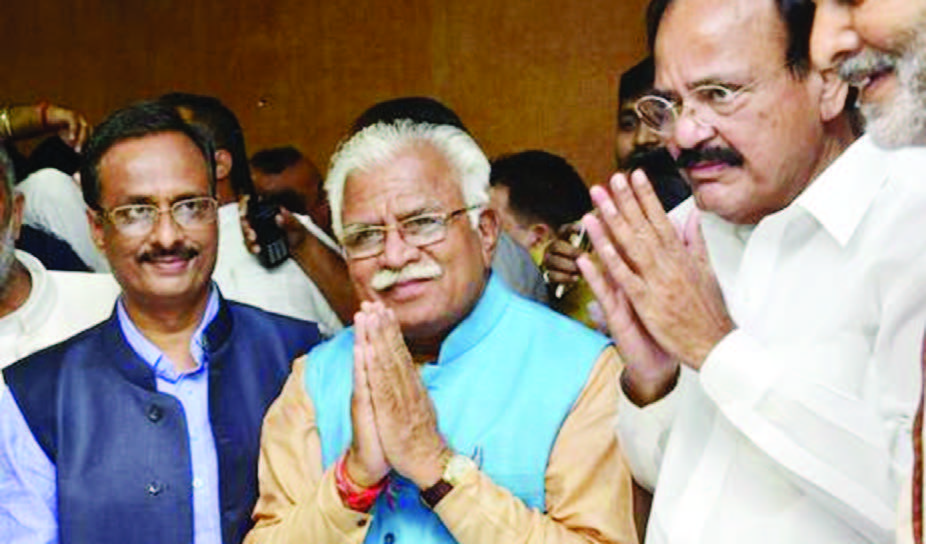
    CHANDIGARH (TIP): The Bharatiya Janata Party (BJP) has named Manohar Lal Khattar as chief minister of Haryana after it secured a majority in the Assembly elections for the first time in the state. Khattar, a Punjabi, had worked as a Rashtriya Swayamsevak Sangh (RSS) pracharak (a full-time RSS worker) for 40 years.

    The decision was taken in a meeting of elected MLAs, attended by Parliamentary Affairs Minister M Venkaiah Naidu and BJP vice president Dinesh Sharma, who were appointed as observers by the BJP’s Parliamentary Board to decide on who would become Haryana’s new chief minister. Born in Rohtak district, Khattar had contested the Assembly elections from Karnal. He won the Karnal seat with a margin of 63,736 votes. He is stated to be close to the Prime MinisterNarendra Modi and BJP chief Amit Shah Manohar Lal Khattar said, “MLAs have elected me as the leader of BJP Legislature Party.

    It was a unanimous decision. We are going to the Governor and will put forth our claim to form the Government. “The BJP has got a clear majority in the 90- member Assembly for the first time,” Khattar said as he entered the guest house with his supporters who shouted slogans in his favour. Prem Lata, first-time MLA from Uchana Kalan and wife of Birendra Singh, who joined the BJP recently, told reporters that her husband was the most experienced politician to run the state. The saffron party won 47 seats while the Indian National Lok Dal (INLD) won 19, the Congress 15, HJC-BL two, BSP and SAD bagged one seat each while Independents got five.

  • BJP front runner in Haryana, Maharashtra: Exit polls

    BJP front runner in Haryana, Maharashtra: Exit polls

    NEW DELHI/MUMBAI (TIP): At least three exit polls put the Bharatiya Janata Party (BJP) ahead but short of a clear majority in Maharashtra and Haryana on Wednesday, a ringing endorsement of the so-called ‘Modi magic’ that may have helped the party come into its own in the two politically crucial states. A fourth survey by Today’s Chanakya, which correctly predicted the results of the Lok Sabha polls this year, gave the party a clear majority in both states.

    The projections, if true, could touch off a round of intense haggling between the party and its estranged allies – the Shiv Sena in Maharashtra and Haryana Janhit Congress (HJC) – for control of the two states that the Congress has led for more than a decade, either on its own or with its partners. A BJP victory will reaffirm Modi’s appeal among voters and silence detractors of his new party leadership, which was blamed for a string of defeats in recent by-elections that tempered the euphoria of his Lok Sabha triumph. Modi campaigned extensively for the state elections, addressing 27 rallies in Maharashtra and 11 in Haryana in a bid to prop up the BJP’s fortunes after the by-election losses.

    A Times Now-C Voter poll predicted the BJP would bag 129 of 288 seats in the politically crucial state of Maharashtra despite the falling apart of its 25-year-old association with the Shiv Sena, which was projected to win in 56 constituencies. Times Now-C Voter predicted 37 seats for the BJP in the 90-member Haryana assembly. An ABP-Nielsen poll predicted 144 seats for the BJP and 77 for the Sena, while an India Today-Cicero exit poll saw the BJP winning 124 seats in Maharashtra. The poll says the Shiv Sena will be the second largest gainer in Maharashtra with 71 seats.

    The polls did not bring any cheer to the Congress party, already relegated to the political sidelines since its bruising defeat in the Lok Sabha polls. The Times Now-C Voter poll said the Congress was likely to win 43 seats in Maharashtra while ABP-Nielsen said it will bag just 30 seats. In Haryana, Times Now-C Voter gave the Congress 15 seats and ABP-Nielsen poll predicted the country’s main opposition party will get 10 seats. Today’s Chanakya predicted a clear majority of 151 seats for the BJP in Maharashtra and 52 in Haryana. Today’s Chanakya was on the money when it predicted a 300-plus sweep for the National Democratic Alliance (NDA) in the Lok Sabha elections.

    For the Congress, a poor result will possibly stoke further murmurs against Rahul Gandhi’s leadership. If the outcome on October 19 judgement day matches the predictions, it would mean the Congress would have to carry forward with its restructuring process to script a turnaround in the face of a saffron surge. Haryana saw a high turnout of 75.9%, while Maharashtra registered a turnout of 63.4% in the elections seen as a test of Prime Minister Narendra Modi’s popularity since he stormed to power in May and the BJP’s strategy to abandon long-standing allies in the states.

    The elections were mainly peaceful except for minor clashes between workers of the Indian National Lok Dal (INLD), BJP and others in Haryana. Analysts said the BJP had benefited from anger towards the Congress party, which has held power in Maharashtra for 15 years and Haryana for a decade. Both chief ministers, Prithviraj Chavan in Maharashtra and Bhupinder Hooda in Haryana, battled strong anti-incumbency with corruption being a major poll issue.

    The BJP took a big gamble on its popularity and campaigned alone in both states. It was in contention for power for the first time in Haryana, where it was a junior partner in the Indian National Lok Dal (INLD) government in 2000. Similarly in Maharashtra, the BJP had so far played second fiddle to the Shiv Sena, which led the coalition government in the state from 1995 to 1999. The Congress-NCP alliance ruled the state for 15 years from 1999. In case of a hung verdict, the shaping up of new political alliances promises to be another interesting chapter following the high-stakes elections.

  • DLF FACES TOUGH CHOICES AFTER FUND-RAISING BAN

    DLF FACES TOUGH CHOICES AFTER FUND-RAISING BAN

    NEW DELHI/MUMBAI (TIP): DLF Ltd will be forced to sell assets, even unfinished projects, to meet debt obligations, say bankers, after India’s biggest property firm was banned from the capital markets for three years – the market regulator’s harshest penalty ever. The Securities and Exchange Board of India (SEBI) ruling on Monday will cut off DLF’s access to the Mumbai stock market, Asia’s best-performing bourse this year.

    The company, shouldering $3 billion of debt, will also be barred from the bond market just as its free cash flow sinks to multi-year lows. The ban follows what SEBI said was DLF’s failure to provide key information on subsidiaries and pending legal cases at the time of its record-breaking 2007 initial public offering. On October 14, DLF shares fell to a record low at the market close, wiping out $1.2 billion in market value. The SEBI ban comes as slowing home sales due to poor consumer sentiment, high inflation and interest rates hit developers in Asia’s thirdlargest economy.

    Bankers and analysts say the only option left for DLF, India’s most indebted property developer, is to divest assets, even half-complete projects, if the SEBI order is upheld. “That’s the only practical option because the banks are also very cautious in lending to the sectors like real estate. So refinancing would not be that easy,” a banker with a large U.S. bank that previously worked with DLF said, declining to be named as he was not allowed to speak to the media about client-specific issues.

    The ruling also adds to the regulatory pressure and political scrutiny on DLF. DLF is facing a probe from the antitrust watchdog and has been accused by the media and political opponents of entering into improper land deals with well-connected businessman Robert Vadra. DLF and Vadra, the son-in-law of opposition Congress party chief Sonia Gandhi, have denied the allegations. The SEBI ban also comes ahead of the state assembly elections in the northern state of Haryana on Wednesday.

    Any change in government could affect DLF’s future projects in the region, analysts say. An official at the Securities Appellate Tribunal said DLF could try and ask for a stay on the order until the appeal is heard. DLF declined to comment beyond the statement it issued late on Monday. The company said it would defend itself against the order passed by SEBI. SEBI is embarking on a plan to standardise corporate reporting in India, and chairman U.K. Sinha has warned that non-compliant companies will be punished.

    Insufficient funds

    DLF’s net debt stood at about 185 billion rupees ($3 billio Indian credit rating agency. “In the short term, this is a big issue for DLF clearly because there is a looming liquidity crisis in case the sales velocity does not pick up,” said V Krishnan, a sector analyst at Mumbaibased brokerage Ambit Capital. Ambit estimates that with about 57 million square feet of projects under development, DLF needs about 2 billion rupees a month towards construction costs, and its interest outflow to service debt is also about 2 billion rupees a monthly currently.

    The company’s operating cash flow of about 3 billion rupees will barely cover its construction costs and half its interest cost, given the slow pace of home sales in DLF’s primary market of Delhi and the surrounding region, Krishnan said. “DLF will either need to slow its pace of execution in underconstruction projects or monetise some of its assets at distressed valuations to contain or improve its operating cash inflows,” said Krishnan, adding that it could look for term loans from banks though that will not come cheap.

    DLF, which builds homes, offices and shopping centers and has about 26 million square feet of leased assets, will also be barred from listing a Real Estate Investment Trust (REIT) for three years, shutting yet another avenue for raising funds. Shares of DLF have slumped 37 percent this year, while the benchmark BSE index has risen about a quarter, making it the best performing index in Asia.

  • Strengthening the long arm of the law

    Strengthening the long arm of the law

    One reason for widespread political and bureaucratic corruption is that the punishment for such offences is light and, therefore, it does not serve as a deterrent. Punishment for corruption must include confiscation of all illicit wealth and assets, and also a life sentence for those convicted of serious graft. There should be no discretion in this matter”, says the author.

    By Joginder Singh

    Iused to be a movie buff and would be easily moved by emotive scenes, songs and dialogues. The 1957 classic, Do Aankhen Barah Haath, remains one of my favourite films; Aye malik tere bandey hum, one of the most powerful songs from the film, still has an impact on me. The song exhorts the common man to do good deeds for India. But a friend sent me different connotation: Through the song, the common man is asking God about the sins that he may have committed as a result of which his country is now being governed by corrupt and dishonest leaders. Then, the common man pleads with God to contain, if not eliminate, all such corrupt people. When it comes to matters of integrity and governance, Indians are at the bottom of the list. It takes decades for our court cases to be taken to their logical ends; conviction takes even longer, so much so that by the time the court hands down the sentence, either victim or the perpetrator is no more. Take the latest matter against J Jayalalithaa, who was recently stripped of her position as Chief Minister of Tamil Nadu, after being convicted in a disproportionate assets case. The case was registered in 1996, the chargesheet filed in 1997, but the judgement came only on September 27 of this year. The special court in Bangalore, which was hearing the Rs 66.65-crore disproportionate assets case against Jayalalithaa and her three associates, N Sasikalaa, J Elavarasi and VN Sudhakaran, found all four guilty. They were convicted under Section 120(B) of the IPC (criminal conspiracy), Section 13(1) of the Prevention of Corruption Act (criminal misconduct by public servants) and Section 109 (abetment). The former Chief Minister has been sentenced to four years in jail and slapped with Rs 100 crore fine. Jayalalithaa’s case had been transferred by the Supreme Court to the Bangalore special court in 2003 after a petition was filed by a DMK leader and then Janata Party chief Subramanian Swamy. They had expressed doubts over the conduct of a fair trial in Tamil Nadu. The September 27 judgement effectively bans Jayalalithaa from the electoral arena for the next 10 years. According to the Representation of the People Act, 1951, a convicted person cannot contest any election for six years, from the date of completion of sentence. However, it is up to the courts to stay the sentence and conviction, pending the consideration of appeal. Previously, the accused had challenged the case with three writ petitions. But on October 1, 1997, the Madras High Court dismissed those petitions, including one challenging the sanction granted to the prosecution by the then Governor of the Tamil Nadu. By 2000, all but 10 witnesses had been examined. Yet, it took another 14 years for the remaining witnesses to testify. This only shows how the judicial system is twisted in favour of the accused while the victims – in this case, the general public defrauded by Jayalalithaa – continue to suffer. Yet, Jayalalithaa is not the only Chief Minister to have been put behind bars. Former Chief Ministers of Haryana, Jammu & Kashmir, Bihar and Jharkhand have also shared a similar fate. Similarly, a whole bunch of former Union Ministers and even one former Prime Minister have been hauled by the judiciary on corruption charges. One reason for widespread political and bureaucratic corruption is that the punishment for such offences is light and, therefore, it does not serve as a deterrent. Punishment for corruption must include confiscation of all illicit wealth and assets, and also a life sentence for those convicted of serious graft. There should be no discretion in this matter. Moreover, our lawmakers must seriously consider changing the rules so that the onus is on the accused to prove his or her innocence. It is ridiculous to expect that a common man will run around the courts for years to testify against powerful politicians. As for the investigating agencies, they have no magic wand with which they can produce evidence against the accused. The following statement by a judicial officer, confirmed repeatedly by the Supreme Court, should serve as a wake-up call to the Government: “The biggest single hurdle which inhibits the citizen from coming forward to help the police is the deplorable conditions prevailing in the courts of law. The lot of witnesses, appearing on behalf of the state against a criminal, is certainly pitiable. More often than not, the case in which he is to appear is adjourned, on one pretext or the other. When ultimately the evidence is recorded, the witness is browbeaten by an over-zealous defence counsel or declared hostile or unreliable by the prosecution. It is a wonder of wonder, that despite these handicaps, we have bold citizens who are willing to depose, at the cost of their life and property.” If India is to end corruption, it should consider the death penalty and life imprisonment for those convicted of graft. The system of appeals must be streamlined. Also, financially-sound people should be made to pay for the duration of their stay in jail. There is no rationale for wasting taxpayers money on them. Why should the common man pay for the boarding and lodging of criminals? But first, the Government must build up investigation and judicial infrastructure, so that no case drags on for more than a year or two. This is vital as no innocent should be allowed to suffer, for any reason whatsoever. This might appear to be a tall order but it is worth trying

    (The author is a former Director of India’s premier investigating agency Central Bureau of Investigation {CBI})

  • BJP poised to create history in Haryana elections: Survey

    BJP poised to create history in Haryana elections: Survey

    NEW DELHI (TIP): A new poll shows that the Bharatiya Janata Party (BJP) is likely to score an outright win in the upcoming assembly election of Haryana on the back of a Modi wave. If it does win, it will be the first time for the BJP, which has had a poor record in assembly elections in the state (barring the period between 1977 and 1979 when it was a part of the Janata government in the state). The survey, conducted by Instavaani, a high-speed polling technology of the Bangalorebased Fourth Lion Technologies, reveals that prime minister Narendra Modi’s appeal to voters has carried over from the general election. To be sure, the poll was restricted to urban Haryana— the 2011 Census pegged the proportion of urban population in the state at 34.79%. Experts say that if the survey is any dipstick of BJP’s fortunes in state, it would be a unique win considering the party has no local face in the state, has been power at the centre for less than five months and has campaigned solely on the strength of the Modi brand. The BJP is facing off against the Indian National Lok Dal (INLD) and the Congress, the party that has ruled the state for 10 years and faces significant anti-incumbency, according to the experts. Instavaani polled 1,181 respondents in 20 urban constituencies of the state, and 46% of the respondents said they would vote for the BJP. While only 17% said they would vote for the incumbent Congress in the state, 10% claimed they would vote for Om Prakash Chautala-led INLD. Significantly, the survey was carried out on 8 October, a day after the prime minister completed all his election rallies in Haryana. According to the survey, corruption allegations against the Bhupinder Singh Hooda-led Haryana government and Modi’s election rallies (he has held over a dozen in the state) are the two main reasons for BJP’s “substantial margins” in the state. Experts concur. “The two factors— allegations of corruption against the Congress party and the effect of Modi’s rallies—fit very much into the narrative of the voter choices in the national elections. Even during national elections, our findings showed that people were not ready to trust the Congress,” said Manisha Priyam, a New Delhi-based political analyst. She is also the India coordinator of the London School of Economics’ EECURI (Explaining Electoral Change in Urban and Rural India) project. “In Haryana too, we are seeing something similar. The charges of corruption against the ruling state party are creating a mood for change and the BJP seems to be the only option which may benefit from it, given the INLD too is facing the same allegations as the Congress,” Priyam added. Chautala, a former chief minister, has been convicted and sentenced to a 10-year jail term in a corruption case involving the recruitment of teachers for government schools. He is campaigning while on bail for medical treatment. The survey also showed that voters in Haryana preferred the same party in the state and the centre. In the outgoing assembly, the Congress has 40 seats, INLD 31, the Haryana Janhit Congress (BL) six and the BJP only four. Haryana goes to polls on 15 October, with more than 16.31 million voters set to elect 90 legislators. The results will be announced on 19 October. Priyam added: “If the BJP wins these elections without a local leader in the state, that would be a tectonic shift in India. No political party, including the BJP, has ever won state elections without a local leader.”

  • No Poll Code Violation in Haryana Nod to Vadra-DLF Land Deal, says EC

    No Poll Code Violation in Haryana Nod to Vadra-DLF Land Deal, says EC

    NEW DELHI (TIP): A controversial land deal involving Robert Vadra, son-in-law of Cong chief Sonia Gandhi, which was sanctioned recently by the Haryana government does not violate election rules, the powerful Election Commission has decided.

    Haryana, ruled currently by Gandhi’s party, votes on October 15 for its next government.

    In a recent election rally in the state, Prime Minister Narendra Modi said the Election Commission should scrutinise the deal, which, he alleged, was pushed through in a hurry to benefit Vadra.

    “Despite the Model Code of Conduct, the son-in-law was given land. They know after the results he won’t be given anything,” the Prime Minister had said. “The Election Commission should take cognizance and appropriate action in this regard.” (In Haryana Campaign, PM Modi Brings Up Vadra Land Deal)

    The PM’s party, the BJP, had described the legitimization of the deal between Mr Vadra and real estate major DLF as “a parting gift” from the state’s Congress government to the party’s First Family.

    Haryana Chief Minister Bhupinder Singh Hooda said Mr Modi’s speech was “factually incorrect and far from the truth,” and the deal was cleared following proper procedure in July before model code of conduct kicked in.

    The deal had been described as illicit in 2012 by senior Haryana bureaucrat Ashok Khemka, who alleged that the rules were being bent for Mr Vadra on account of his hefty connections. Khemka cancelled the mutation of the 3.5 acres sold by Vadra in 2008 to DLF — the mutation means the land title is officially transferred in local records to register the new owner. He was transferred three days later. The Haryana government said an inquiry had found his allegations to be baseless. In July this year, the mutation was sanctioned by the state government.

    Congress seeks PM’s apology

    The Congress on October 9 stepped up attack on Prime Minister Narendra Modi demanding an “apology” from him as Election Commission ruled that there was no violation of model code of conduct by the Haryana Government in clearing the land deal involving Robert Vadra. Party spokesperson Anand Sharma alleged that Modi was “embarrassing” the position of the Prime Minister by repeatedly making “false allegations” and he should stop doing it. “BJP has egg on its face after the EC’s order. Narendra Modi, being the Prime Minister of the country, gave a very irresponsible statement and made allegations against Haryana Chief Minister Bhupinder Singh Hooda. Will the Prime Minister now seek apology from the Chief Minister and people of Haryana for making wrong statements,” Mr. Sharma told reporters here. Maintaining that it
    “belittles” the high post if somebody in the seat of Prime Minister keeps making false allegations, the Congress spokesperson said, “Modi should apologise to Haryana Chief Minister.” Election Commission had on Wednesday ruled that there appears to be no violation of the model code of conduct by Haryana government in clearing the land deal between Sonia Gandhi’s son-in law Robert Vadra and real estate major DLF.

  • BJP TO ROLL OUT BIG GUNS FOR ASSEMBLY POLLS

    BJP TO ROLL OUT BIG GUNS FOR ASSEMBLY POLLS

    NEW DELHI (TIP): With Dussehra over, BJP will get into campaign mode for the Haryana and Maharashtra assembly polls on a war footing.

    Prime Minister Narendra Modi and his senior ministers will have little time for anything else, criss-crossing the two states over the next two weeks, addressing rallies. BJP plans to hold at least four big rallies a day in each state till campaign ends for the October 15 polls.

    Modi will begin his charge on Saturday morning from Karnal in Haryana and move to Maharashtra to address three rallies in Beed, Aurangabad and Mahalakshmi (Mumbai). The PM will address 8-10 rallies in Haryana and around 22 in Maharashtra.

    Two senior ministers — home minister Rajnath Singh and external affairs minister Sushma Swaraj — will be all over Haryana on Saturday, holding four rallies each in the state. Singh will be at Radaur, Kalayat, Julana and Jakholi Rai while Swaraj will address rallies in Kalka, Thanachhapar, Shahbad and Gohana. Singh will address about 15 rallies in each state.

    The party has decided to have Swaraj, who belongs to Haryana, focus on the state where BJP is contesting on its own and is aiming to replace the Congress government. Similarly, road transport minister Nitin Gadkari has been asked to concentrate on Maharashtra, his home state, where BJP is contesting without its 25-year-old partner Shiv Sena this time.

    Swaraj is scheduled to address about 22 rallies in Haryana and will be in Maharashtra only for a day on October 6, attending three rallies. She will take a break from campaigning as she is travelling abroad between October 8 and 10. Gadkari is expected to address about 36 rallies in Maharashtra.

    Party veteran L K Advani will address six rallies in Maharashtra and two in Haryana, while Murli Manohar Joshi will address two rallies in Maharashtra and one in Haryana.

    Urban development minister M Venkaiah Naidu is slated to spend four days in Maharashtra and two in Haryana. Other ministers who will address a few rallies in both states are chemical and fertilizer minister Ananth Kumar, HRD minister Smriti Irani and social justice minister Thawar Chand Gehlot. Party chief Amit Shah will address about 15 rallies in each state.

    The party has roped in all its chief ministers to ensure its good governance campaign is showcased. Goa CM Manohar Parikkar will focus on Maharashtra while Madhya Pradesh CM Shivraj Singh Chouhan will spare three days for Maharashtra and one for Haryana. Rajasthan CM Vasundhara Raje has three days in Maharashtra and two days in Haryana, Chhattisgarh CM Raman Singh and Gujarat CM Anandiben Patel will each spend two days in Maharashtra. On an average, the chief ministers will address three rallies a day, party vice-president M A Naqvi said.

    Not to forget its star power, BJP has roped in actor-turned-MPs Hema Malini, Vinod Khanna and Shatrughan Sinha to campaign in both states.

  • Chautala meets supporters despite Delhi HC notice

    Chautala meets supporters despite Delhi HC notice

    JIND (TIP): Former Haryana chief minister Om Prakash Chautala, out on bail on health grounds, met his supporters, days after he and the CBI were put under notice by the Delhi high court on a plea seeking directions to the politician to surrender. Indian National Lok Dal (INLD) chief went to residences of his supporters in Jind besides visiting the party’s election office.

    INLD is fighting a battle for the October 15 assembly polls in alliance with Shiromani Akali Dal (SAD) after being out of helm of affairs for a decade. “Chautala arrived here last night. He met party workers and this morning left for Uchana to take a round of the village,” said a party spokesman.

    Chautala, however, maintained distance from the media. At the residence of an INLD supporter in the city he had breakfast. His supporters were seen touching his feet and offering him garlands. Chautala also visited the residence of a BJP leader on Gohana road where two saffron party politicians announced that they are joining the INLD.

    Ucahana in the Jat heartland from where his grandson and country’s youngest MP Dushyant is fighting his maiden assembly battle against Congress-turned -BJP leader Birender Singh’s wife Prem Lata.

    On October 1, the Delhi high court had issued notice to CBI and Chautala after senior advocate Vivek Tankha appearing for the petitioner lawyer contended that Chautala intends to
    “misuse the grace period of 17 days given to him to surrender” by planning to campaign during the period. While issuing notice to CBI and Chautala, the court had questioned, “Why has CBI not taken note of all this (election campaign)? CBI does not seem to be aggrieved by this.” The court also questioned the maintainability of the application. The petition had also contended that Chautala is “misusing the orders of the court and taking the court for a jolly ride, thereby abusing the process of law”.

    According to the petition, Chautala, who has been convicted and sentenced to 10 years jail term in a teachers’ recruitment scam case, was granted bail on medical grounds on May 21, 2013 and since then he has been out by extending it on the same ground.

  • By-poll results shock BJP

    By-poll results shock BJP

    New Delhi (TIP): The results of the Assembly byelections have come as a blow for the BJP in Uttar Pradesh, Rajasthan and Gujarat — the states it had swept in the Lok Sabha polls four months ago — losing 13 of the 24 seats held by it. Of the 32 Assembly seats across nine states for which counting of votes was held today, the BJP won 12, Congress seven and Samajwadi Party eight while TDP (Andhra), Trinamool Congress (West Bengal), AIUDF (Assam) and CPM bagged one each. One seat in Sikkim was won by an Independent.


    This is the third consecutive setback for the saffron party after its disappointing performance in Assembly byelections in Bihar, Uttarakhand, Karnataka and Madhya Pradesh in the past two months. All 11 seats in Uttar Pradesh, Gujarat (9) and Rajasthan (4) were held by the BJP and the bypolls were necessitated after the sitting MLAs were elected to the Lok Sabha. It was Uttar Pradesh — the party’s recently acquired stronghold where the BJP managed a near-total sweep in the LS elections — that delivered a humiliating blow to the saffron party as it lost seven of the 11 seats held by it, including the one held by its ally, the Apna Dal.


    The BSP’s absence in the byelections had made it a virtual straight fight between the SP and the BJP in the politically crucial state. BJP strongman Amit Shah was credited with crafting the spectacular win for his party in UP in the Lok Sabha polls. The party lost six out of 13 seats in Rajasthan and Gujarat, where it’s in power. Lost for words, BJP leaders could not even blame rival parties for playing foul in the elections. Senior BJP leader Rajiv Pratap Rudy said the results “deserve a small introspection”. “This is not a national mandate. It is a localised issue.


    Surely, it is a wake-up call for better planning in the upcoming Haryana and Maharashtra Assembly elections,” he said. Senior leader Uma Bharti dismissed questions about efficacy of the “Modi wave” saying “state leaders and workers need to introspect.” It was a significant comeback by the SP, which won eight out of 11 seats in Uttar Pradesh —and the Congress, which trounced BJP on three out of four seats in Rajasthan. “The people of the state have given a befitting reply to the communal forces and clearly expressed their desire for harmony and brotherhood,” said a beaming UP CM Akhilesh Yadav.


    Among BJP’s big losses is the Rohaniya seat, which falls within Modi’s parliamentary constituency Varanasi. The saffron party just about managed to hold to its own in Modi’s home state Gujarat, winning six out of nine seats. Rajasthan Chief Minister Vasundhara Raje was left re-faced as the Congress won three out of four seats. One of the seats — Surajgarh—was being contested by her close aide Digambar Singh who lost to Shravan Kumar of the Congress by 3270 votes.


    The BJP had swept the Lok Sabha and Assembly elections in the desert state earlier this year. High on the win, Rajasthan Congress chief Sachin Pilot advised the “BJP to take a lesson from these elections and introspect” The BJP retained Kota South, losing Surajgarh, Weir and Nasirabad to the Congress. The only silver lining for the BJP was the inroads into WB where it has won Basirhat Dakshin (South) seat.

  • BJP GETS THE JOLT IT DESERVED

    BJP GETS THE JOLT IT DESERVED

    The folly of polarization boomerangs

    Normally no great importance is attached to by-elections in this country which should explain why no Prime Minister has ever canvassed during them. Interestingly, Congress president Sonia Gandhi and her son and party vice-president Rahul Gandhi have stuck to this routine even after losing power. During the most recent by-elections to 33 assembly and three parliamentary seats, the Congress’ First Family chose to be abroad.


    38


    It must have regretted this because it lost the opportunity to celebrate the jolt the Bharatiya Janata Party has suffered exactly four months after its spectacular success in the parliamentary poll under Narendra Modi’s leadership. Particularly prominent is the saffron party’s overwhelming defeat in the politically key state of Uttar Pradesh where it had won 71 of the 80 Lok Sabha seats on May 16. This time around it has surrendered eight of 11 assembly seats to the Samajwadi Party that rules the state even though the latter’s own record is conspicuously poor.

    Even more hurtful to the BJP is that the Congress that was virtually wiped out in the Lok Sabha elections has wrested from it three assembly seats each in the BJP’s bastions, Rajasthan and Mr.Modi’s Gujarat. In UP, however, the Congress has drawn a complete blank. Having slid in nine of the 10 states where by-elections were held, the BJP has a cause for comfort only in West Bengal, where it has wrested a seat from Chief Minister Mamata Banerjee’s Trinamool Congress. From the day the Modi government came to power, there have been 50 by-elections across the country.


    39


    Of these the BJP and its allies have won only 18 and lost all others. The reason for this serious setback is crystal clear and it is writ large on the political landscape.Mr. Modi may have spoken about development and good governance in the past. Those in charge of the by-elections or chief campaigners in the by-elections never used these expressions. Arrogantly confident of coming to power in this most populous state in 1917, the BJP adopted the wrong, disruptive and dangerous strategy of polarization along religious lines. “Love jihad” was one of its favorite slogans.

    As time passed, the tone of the BJP’s UP leaders – such as the president of the party’s state unit, Lakshamikant Bajpai, and the saffron-clad Yogi Adityanath, a five-time MP and the principal campaigner in the state – became more provocative and indeed poisonous. It is noteworthy that neither Prime Minister Modi, nor party president Amit Shah, nor any other senior leader did anything to restrain the Hindutva hotheads. On the contrary, their silence greatly encouraged those spewing venom.

    The situation is not without irony. At a time when Bajpai and Yogi Adityanath were shouting hoarse about “love jihad”, an oxymoron that is supposed to mean that Muslims were busy luring Hindu women to marry them and then convert to Islam, the country’s Home Minister and a former president of the BJP, Rajnath Singh, told a press conference that he didn’t know what “love jihad” was. Exactly at that time, Sakshi Maharaj, another saffron-wearing BJP leader in UP, harangued his audience and the media not only about “love jihad” but also about “education in terrorism”.

    He thundered that madrasas were teaching “terrorism” to their pupils and “motivating” youth to lure women of other religions with “offers of cash awards – Rs 11 lakh for an affair with a Sikh girl, Rs 10 lakh with a Hindu girl and Rs 7 lakh for a Jain girl”. Not to be left behind, Usha Thakur, a BJP MLA in Madhya Pradesh who is also the vice-president of the party unit in the state, made another startling disclosure: At the prolonged Hindu festival of Garba, according to her, Muslims joined in large numbers. Consequently at the end of this festival every year, four and a half lakh Hindu women were converted to Islam.

    Yogi Adityanath reaffirmed that wherever in India the proportion of Muslims in the population was 35 per cent or more “non- Muslims could not be safe”. At this stage no less a person than Union Cabinet minister Maneka Gandhi intervened to declare that “profits made from the trade in slaughtered animals was financing terrorism” and to demand that the slaughter of all animals should be “banned completely”. If this strange and highly controversial statement went relatively unnoticed the reason is that by-election results had started coming and it was immediately obvious that the electorate in UP had rejected with contempt the BJP’s strategy to polarize and divide the country along religious lines.

    An accompanying development of significance is that the Election Commission took note of some of Yogi Adityanath’s “hate speeches” and “use of religion for electoral purposes”. He has been asked to explain why requisite action should not be taken against him. An earlier FIR against the BJP’s national president Amit Shah, issued by the UP police, was set aside by a district judge. The critically important need now is for the BJP to abandon its dangerously disastrous electoral strategy of polarization that has already boomeranged.

    So Mr. Modi must give priority to this for two reasons, and make up his mind on the subject because he alone can take crucial decisions. The first reason is that assembly elections are due in Maharashtra and Haryana very soon, and the saffron party would be courting huge trouble if it repeats in these two states what it did in UP. It should fully exploit the heavy anti-incumbency the Congress has piled up against itself in both these states. The second reason is that in view of the worsening of the overall situation, our duty is to promote communal harmony, not communal hatred.

    (The author is a senior journalist and editor.)

  • Top Indian challengers @ 2014 Asian Games

    Top Indian challengers @ 2014 Asian Games

    KILLER PUNCH: Mary Kom (boxing)


    12


    The Manipuri police officer is now a household name across the country. The five-time World Champion has got little left to prove, after punching her way to the bronze medal in London, but Mary Kom is still determined to add more medals to her collection. At a time when her biopic is raking in the moolah at the box office, Mary will be keen to recapture the golden moments in the ring at the Incheon Games. By topping the trials, after missing the selection for the CWG, the mother-of-three now guns for another triumph. In the 2010 edition, she won the bronze in flyweight.

    FEATHER TOUCH: PV Sindhu (badminton)


    15


    The teenager goes into the Asiad as a strong contender to end the Chinese dominance, along with her more illustrious teammate Saina Nehwal. PV Sindhu recently became the first Indian to win two medals in consecutive World Championships. Though her World Cup conqueror Carolina Marin won’t be there in Incheon, the Chinese, Chinese Taipei and Thailand shuttlers will be out in full strength to make her job tougher.

    SHARP SHOOTER: Jitu Rai (shooting)


    13


    The Nepal-born sharp shooter is literally on fire as he has shot down most of the medals that came his way this season. It began with a double at the World Cup in Maribor, Slovenia in June. The 26-year-old pistol shooter from the 11 Gorkha regiment created history when he won medals in both the 10m and 50m events. Then came the Commonwealth Games and Rai easily asserted his supremacy. The World Championships followed and the Indian was again bang on target settling for the silver and a quota place between a Korean and a Japanese who will again challenge him at the Asaid.

    BULL’S EYE: Deepika Kumari (archery)


    16


    The Tata Academy product is showing signs that she has finally got over the crushing defeat at Lord’s in the 2012 Olympics. Deepika Kumari went into the Games as one of the top medal contenders in recurve competition but went out in the preliminary round itself, crashing under the weight of expectations. The 20-year-old once again starts as a strong medal contender after showing great form in the recent World Cups. The three-time World Cup Finals silver medallist is peaking at the right time and will be keen to make amends after missing out on a bronze at Guangzhou.

    MR HERCULES: Vikas Gowda (athletics)


    17


    If there is one athlete who should get constant backing from the government then it’s this Mysore-born discus thrower, and that too just for his unwavering dedication. Vikas Gowda has trained his sights on the Rio Olympics and success at the Asian Games will only add to his confidence levels. The recent success at the Glasgow CWG shut out his critics and they are now backing him for the Asiad gold. At Incheon, Vikas, who is topping the Asian list with a throw of 65.62m, will face competition from two Iranians and one Chinese. However, exposure in the Diamond League circuit will surely help him produce the winning throw.

    MUSCLE MAN: Yogeshwar Dutt (wrestling)


    14


    In the absence of Sushil Kumar, London Olympics bronze medalist Yogeshwar Dutt will be India’s trump card in wrestling. The 31-year-old Haryana wrestler proved his form at the Glasgow CWG powering past his opponents, including in the final, with ease to bag the gold. It will be Yogeshwar’s second attempt at the Asiad after winning a bronze in the Doha Games in 2006. The Asian Championship winner in 2012 knows that Incheon will pose a much tougher competition with grapplers lining up from Iran, Japan and Korea. Yogeshwar has skipped the World Championships to focus on the Asiad gold.

  • SUZUKI TO MAKE INDIA A MANUFACTURING HUB FOR BIKES

    SUZUKI TO MAKE INDIA A MANUFACTURING HUB FOR BIKES

    NEW DELHI (TIP): Suzuki Motorcycles India is developing four new products, including a 100cc motorcycle, which would be rolled out over the next two years. The company plans to make India a manufacturing hub for motorcycles, which would be exported to countries in Latin America, Africa and the Middle East, apart from neighbouring countries, Atul Gupta, VP (sales and marketing) for Suzuki Motorcycles India, said as the company launched a new 155cc bike ‘Gixxer’ for Rs 72,199. “Suzuki wants to boost its share in the Indian two-wheeler market.

    Work is on at its headquarters at Hamamatsu in Japan for developing four new two-wheelers for India — two scooters and two motorcycles,” Gupta said. Suzuki has not been able to replicate the success of its car business (Maruti Suzuki) in the two-wheeler space and has decided to focus on introducing newer products. Sources said company chairman Osamu Suzuki recently visited the company’s two-wheeler factory in Haryana and took stock of the operations.

    Suzuki has a little over 2% share of the Indian twowheeler market and sold 3.6 lakh units last fiscal, a small share in total industry volumes of 1.48 crore units. The twowheeler market is dominated by Munjals-owned Hero MotoCorp and Honda’s fully-owned subsidiary, Honda Motorcycle and Scooter India (HMSI). Suzuki has been able to make some inroads into the scooter market where it has around 8% market share with models like the 125cc ‘Access’.

    However, it is very weak into the big-volume motorcycle segment, which commands as much as 70% of the two-wheeler sales. “We are hoping for a turnaround in our motorcycle sales with the Gixxer. The model will compete with the FZ from Yamaha, Apache from TVS and Pulsar from Bajaj Auto. The company, which signed up film actor Salman Khan as a brand ambassador, currently sells the 110cc Hayate. However, the model has not been able to deliver the desired volumes. Gupta also said that Suzuki will increase the number of dealerships that the company has in India.