Tag: Haryana

  • Woman gang-raped by husband, two others

    Woman gang-raped by husband, two others

    NEW DELHI (TIP): A 20-year-old woman was gang-raped in a moving car by her husband and his two relatives here, police said on April 11. All attackers have been arrested. The incident came to light late Wednesday evening when the woman was found in an unconscious condition in west Delhi’s Najafgarh area by a passerby, who informed police. The victim told police that she was gang-raped by her husband Inderjeet and his two relatives Nitin and Vijender — all in the age group of 21 and 25 — in a moving car.

    The woman told police that she was gang-raped after she consumed a cold drink offered by her husband and got unconscious. The woman, a resident of Haryana’s Jhajjar district, married Inderjeet at a temple in March without informing their parents, police said. ‘The victim’s medical examination was conducted at a hospital where doctors confirmed that she was gangraped,’ said a police officer

  • President Confers Padma Awards

    President Confers Padma Awards

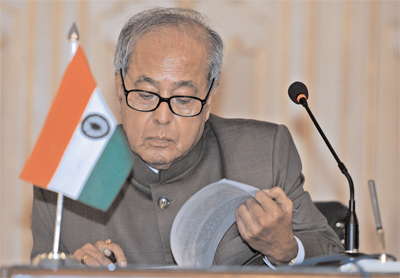
    NEW DELHI (TIP): President PranabMukherjee on April 5 conferred Padma Awards, the country’s highest civilian awards, to 108 personalities. The awards comprise 4 PadmaVibhushan, 24 PadmaBhushan and 80 PadmaShri Awards on Friday. 24 of the awardees are women and the list also includes 11 people in the category of foreigners, NRIs, PIOs and posthumous awardees. Noted physicist Yash Pal and space scientist Roddam Narasimha were chosen the second highest civilian honour Padma Vibhushan. Batting great Rahul Dravid and Olympic bronze medallist MC Mary Kom and late Bollywood actor Rajesh Khanna were named for the prestigious Padma Bhushan award, the third highest civilian award of the country. Renowned sculptor Raghunath Mohapatra and painter S Haider Raza were chosen for Padma Vibhushan.

    The list of 108 Padma awardees for this year also includes actress Sridevi, actors Nana Patekar and Malayalam star Madhu of Chemmeen fame and Olympians Yogeshwar Dutt and Vijay Kumar. Nobody was named for Bharat Ratna for this year too. The last awardee was late Bhimsen Joshi in 2008. Satirist Jaspal Bhatti, who died in a road accident last year, film maker D Rama Naidu, noted South Indian playback singer S Janaki, Bharatnatyam dancer Saroja Vaidyanathan, missile scientist Dr A Sivathanu Pillai of BrahMos programme, Industrialist Adi Godrej and R Tyagarajan, former bureaucrat M K Bhan were among the 24 Padma Bhushan awardees. In all four personalities were awarded Padma Vibhushan, 24 for Padma Bhushan and 80 Padma Shri. Of the awardees 24 are women, 11 belong to the category of foreigners, NRI, PIOs and posthumous.

    Padma Awards, the country’s highest civilian awards, are conferred in three categories, namely Padma Vibhushan, Padma Bhushan and Padma Shri.

    PADMA VIBHUSHAN
    Raghunath Mohapatra, Art, Orissa
    S Haider Raza, Art, Delhi
    Prof Yash Pal, Science and Engineering, Uttar Pradesh
    Prof Roddam Narasimha, Science and Engineering,Karnataka

    PADMA BHUSHAN
    Dr Ramanaidu Daggubati, Art, Andhra Pradesh
    Sreeramamurthy Janaki, Art, Tamil Nadu
    Dr (Smt) Kanak Rele, Art, Maharashtra
    Sharmila Tagore, Art, Delhi
    Dr (Smt) Saroja Vaidyanathan, Art, Delhi
    Abdul Rashid Khan, Art, West Bengal
    Late Rajesh Khanna, Art, Maharashtra
    Late Jaspal Singh Bhatti, Art, Punjab
    Shivajirao Girdhar Patil, Public Affairs, Maharashtra
    Dr Apathukatha Sivathanu Pillai, Science, Engineering,Delhi
    Dr Vijay Kumar Saraswat, Science and Engineering,Delhi
    Dr Ashoke Sen Science and Engineering,Uttar Pradesh
    B N Suresh, Science and Engineering, Karnataka
    Prof Satya N Atluri, Science and Engineering, USA
    Prof Jogesh Chandra Pati, Science and Engineering,USA
    Ramamurthy Thyagarajan, Trade and Industry,Tamil Nadu
    Adi Burjor Godrej, Trade and Industry, Maharashtra
    Dr Nandkishore Shamrao Laud, Medicine,Maharashtra
    Mangesh Padgaonkar, Literature and Education,Maharashtra
    Prof Gayatri Chakravorty Spivak, Literature & Education USA
    Hemendra Singh Panwar, Civil Service,Madhya Pradesh
    Maharaj Kishan Bhan, Civil Service, Delhi
    Rahul Dravid, Sports, Karnataka
    H Mangte Chungneijang Mary Kom, Sports, Manipur

    PADMA SHRI
    Gajam Anjaiah, Art, Andhra Pradesh
    Swami G C D Bharti alias Bharati Bandhu, Art,Chhattisgarh
    B Jayashree, Art, Karnataka
    Sridevi Kapoor, Art, Maharashtra
    Kailash Chandra Meher, Art, Orissa
    Brahmdeo Ram Pandit, Art, Maharashtra
    Vishwanath D Patekar alias Nana Patekar, Art,Maharashtra
    R Nageswara Rao alias Surabhi Babji, Art, Andhra Pradesh
    Lakshmi Narayana Sathiraju, Art, Tamil Nadu
    Jaymala Shiledar, Art, Maharashtra
    Suresh Dattatray Talwalkar, Art, Maharashtra
    P Madhavan Nair alias Madhu, Art, Kerala
    Apurba Kishore Bir, Art, Maharashtra
    Ghanakanta Bora Borbayan, Art, Assam
    Hilda Mit Lepcha, Art, Sikkim
    Sudha Malhotra, Art, Maharashtra
    Ghulam Mohammad Saznawaz, Art,Jammu and Kashmir
    Ramesh Gopaldas Sippy, Art, Maharashtra
    Mahrukh Tarapor, Art, Maharashtra
    Balwant Thakur, Art, Jammu and Kashmir
    Puran Das Baul, Art, West Bengal
    Rajendra Tikku, Art, Jammu and Kashmir
    Pablo Bartholomew, Art, Delhi
    Shri S Shakir Ali, Art, Rajasthan
    S K M Maeilanandhan, Social Work, Tamil Nadu
    Nileema Mishra, Social Work, Maharashtra
    Reema Nanavati, Social Work, Gujarat
    Jharna Dhara Chowdhury, Social Work, Bangladesh
    Late Dr Ram Krishan, Social Work, Uttar Pradesh
    Late Manju Bharat Ram, Social Work, Delhi
    Prof Mustansir Barma, Science and Engineering,Maharashtra
    Avinash Chander, Science and Engineering, Delhi
    Sanjay Govind Dhande, Science and Engineering,Uttar Pradesh
    Prof (Dr) Sankar Kumar Pal, Science, Engineering,West Bengal
    Deepak B Phatak, Science and Engineering,Maharashtra
    Dr Mudundi Ramakrishna Raju, Science and Engg,Andhra Pradesh
    Prof Ajay K Sood, Science and Engineering, Karnataka
    Prof Krishnaswamy Vijayraghavan, Science & Engg,Karnataka
    Dr Manindra Agrawal, Science and Engineering,Uttar Pradesh
    Dr Jayaraman Gowrishankar, Science & Engineering,Andhra Pradesh
    Prof Sharad Pandurang Kale, Science & Engineering,Maharashtra
    Vandana Luthra, Trade and Industry, Delhi
    Rajshree Pathy, Trade and Industry, Tamil Nadu
    Hemendra Prasad Barooah, Trade and Industry,Assam.
    Milind Kamble, Trade and Industry, Maharashtra
    Kalpana Saroj, Trade and Industry, Maharashtra
    Dr Sudarshan K Aggarwal, Medicine, Delhi
    Dr C Venkata S Ram alias Chitta, Venkata Sundara Ram, Medicine, Andhra Pradesh
    Dr Rajendra Achyut Badwe, Medicine, Maharashtra
    Dr Taraprasad Das, Medicine, Orissa
    Prof (Dr) T V Devarajan, Medicine, Tamil Nadu
    Prof (Dr) Saroj Chooramani Gopal, Medicine,Uttar Pradesh
    Dr Pramod Kumar Julka, Medicine, Delhi
    Dr Gulshan Rai Khatri, Medicine, Delhi
    Dr Ganesh Kumar Mani, Medicine, Delhi
    Dr Amit Prabhakar Maydeo, Medicine, Maharashtra
    Dr Sundaram Natarajan, Medicine, Maharashtra
    Prof Krishna Chandra Chunekar, Medicine,Uttar Pradesh
    Dr Vishwa Kumar Gupta, Medicine, Delhi
    Prof (Capt) Dr M Sharaf-eAlam, Literature & Education, Bihar
    Dr Radhika Herzberger, Literature & Education,Andhra Pradesh
    J Malsawma, Literature and Education, Mizoram
    Devendra Patel, Literature & Education, Gujarat
    Dr Rama Kant Shukla, Literature & Education, Delhi
    Prof Akhtarul Wasey, Literature & Education, Delhi
    Prof Anvita Abbi, Literature & Education, Delhi
    Nida Fazli, Literature & Education, Madhya Pradesh
    Surender Kumar Sharma, Literature & Education,Delhi
    Dr Jagdish Prasad Singh, Literature & Education,Bihar
    Late Shaukat Riaz Kapoor Alias Salik Lakhnawi,
    Literature & Education, West Bengal.
    Prof Noboru Karashima, Literature & Education, Japan
    Christopher Pinney, Literature & Education, UK
    Premlata Agrawal, Sports, Jharkhand
    Yogeshwar Dutt, Sports, Haryana
    Hosanagara Nagarajegowda Girisha, Sports,Karnataka
    Subedar Major Vijay Kumar, Sports, Himachal Pradesh
    Ngangom Dingko Singh, Sports, Maharashtra
    Naib Subedar Bajrang Lal Takhar, Sports, Rajasthan
    Ritu Kumar, Fashion Designing, Delhi
    Dr Ravindra Singh Bisht, Archaeology, Uttar Pradesh.

  • Haryana IAS officer Khemka transferred again

    Haryana IAS officer Khemka transferred again

    CHANDIGARH (TIP): Senior IAS officer Ashok Khemka, who had ordered a scrutiny of land deals of United Progressive Alliance chairperson Sonia Gandhi’s son-in-law Robert Vadra last year, was Thursday shunted by the Haryana government to an inconsequential post. Khemka, presently managing director of the Haryana Seeds Development Corporation (HSDC), will now be posted as the secretary of Haryana Archives, which is responsible for preserving public and private records in the state. The latest transfer came after Khemka highlighted irregularities in the HSDC, leaving the Bhupinder Singh Hooda government embarrassed. Khemka has been transferred almost 45 times in his two-decade-long career as an Indian Administrative Service (IAS) officer.

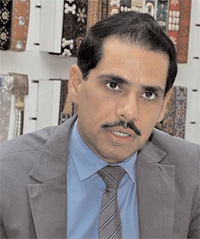
    He had hit national headlines October last year when he controversially cancelled a mutation of a multi-crorerupee land deal between Vadra’s company, Sky Light Hospitality, and realty giant DLF. The officer had even ordered a probe into all land deals done by Vadra and his companies in Haryana’s Gurgaon, Faridabad, Mewat and Palwal districts since 2005. After Khemka’s action Oct 8, the Hooda government went into overdrive to undo it. Within days, the district authorities of four districts in the national capital region (NCR) gave a ‘clean chit’ to the land deals done by Vadra and his companies.

    The Hooda government set up a committee of top bureaucrats to look into the action taken by Khemka. In its report, the committee held that Khemka’s actions as director-general of land consolidation were not in accordance with laid down procedures. Khemka, however, questioned the rationale of the committee in submitting its report without even seeking his views on the action taken in the land deals. An unfazed Khemka also claimed that action taken by him as director general of consolidation could only be reviewed by the high court and the state government did not have the jurisdiction to undo it.

    Khemka was removed from his post Oct 11 by the Hooda government which sought to project it as a routine transfer. Vadra and his companies had made land purchases of nearly 170 acres in Gurgaon, Palwal, Mewat and Faridabad districts since 2005.

  • NADA rubbishes boxer Vijender Singh’s claim

    NADA rubbishes boxer Vijender Singh’s claim

    Says boxer hasn’t given samples for test in the last 6 months
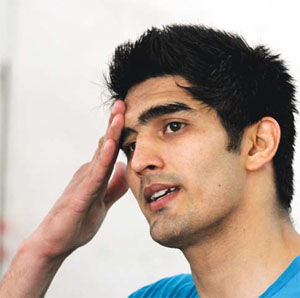
    CHANDIGARH (TIP): Troubles seem to be mounting for Olympic bronze medallist Vijender Singh , who has been accused by the Punjab Police of not cooperating in a heroin smuggling case . The National Anti-Doping Agency (NADA) on Wednesday rubbished the ace boxer’s claim that he had given samples to it for test in the last six months. In an interview to Headlines Today, NADA Director General Mukul Chatterjee said that Vijender had last given his sample in July 2012. He said heroin is a performance enhancing drug and if Punjab Police implicates the Olympian the agency would ban the boxer.

    “We last took his samples in July last year… Heroin not only relaxes you, but relieves your pain and enhances performance… Once Punjab Police implicates him, we can ban him,” Chatterjee said. “Vijender is reluctant because he knows that if he gives hair and blood samples to Punjab Police, he will be caught. He is denying them and playing the game. He knows hair sample can prove his innocence or otherwise,” the NADA chief said. Following a raid in Punjab’s Fatehgarh Sahib district, the police had found that the international boxer from Haryana was somehow linked to the drug peddling racket. Vijender’s friend and former sparring partner- national boxer Ram Singh, who was arrested by the police in the case after 26 kg heroin was recovered from an apartment recently- has admitted to consuming heroin with the Olympian.

  • Vadra land deals under scrutiny again-New investigation unearths ‘suspicious documents’

    Vadra land deals under scrutiny again-New investigation unearths ‘suspicious documents’

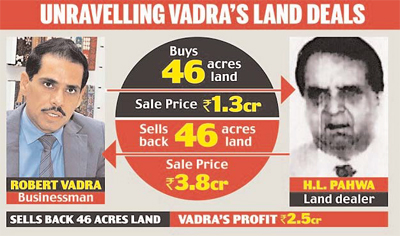
    NEW DELHI (TIP): Robert Vadra’s land deals in Haryana have turned murkier with new evidence suggesting hard cash transactions were made in the guise of a property purchase. A Headlines Today investigation has unearthed documents which raise suspicion over the authenticity of Vadra’s land deals and the validity of the clean chit given to him by a three-member probe panel appointed by the Haryana government in October last year. Between 2005 and 2006, Vadra struck four land deals with one agriculturist – Harbans Lal Pahwa – buying a total of 46 acres land in Amipur village in Faridabad district, only to sell it back to Pahwa at a premium five years later.

    Vadra signed the land deals overlooking the Haryana Ceiling on Land Holdings Act, 1972, which states that one person or family can buy a maximum of 26.9 acres of agricultural land in the state. On September 8, 2005, Vadra bought 12 acres of land in Amipur village from Pahwa for over Rs 32 lakh. On January 13, 2006,he bought 19 acres from Pahwa for Rs 54 lakh. On April 14, 2006, Vadra acquired 10 more acres of land from the same land dealer for Rs 30 lakh. On April 28, 2006, Vadra’s wife Priyanka Gandhi struck a deal with Pahwa for 5 acres in Amipur for Rs 15 lakh.

    Lawyer Anupam Gupta in Chandigarh said: “Ownership of the land beyond permissible limits vests in the hands of the state government. The surplus land has to be distributed among Dalits and poor.” So the extra 20 acres in Vadra’s possession belonged to the state government. Vadra did not continue with the disputed ownership of the land for long and sold it back to Pahwa for Rs 3.8 crore. Pahwa bought the land in three installments in 2010, bearing a loss of about Rs 2.5 crore. The transaction triggered suspicion about Pahwa’s connection with Vadra, and the relationship fell under scrutiny when Headlines Today dug up Vadra’s balance sheets. The investigation team came across a curious figure of Rs 1.55 crore against the name of Harbans Lal Pahwa. Documents in the possession of Headlines Today show Pahwa’s company, Carnival Intercontinental Estate Pvt Ltd, had given a loan of Rs 1. 55 crore to Vadra’s company, Skylight Hospitality. Pahwa also held a directorship in Vadra’s company, Real Earth, for over a year between February 2008 and March 2009. Former director of RBI, Vipin Malik, said there is more to the deals than meets the eye. “You are buying from agriculturist and making huge surpluses for self running into crores when you don’t have your money…the money is being lent by the same person who is buying it and who is selling it back to you… so this is a clear case of fictitious and fake transactions… this is cold cash cover up,” he said.

  • Unsafe North: 7 rape cases on eve of Women’s Day

    Unsafe North: 7 rape cases on eve of Women’s Day

    CHANDIGARH (TIP): For women in the region, Women’s Day could be just another day, with safety being their prime concern. Seven cases of rape and gang rape were reported from Punjab, Haryana and Delhi, including the National Capital Region, on March 7, besides incidents of violence against women. After a paramedical student died after she was gang- raped, beaten and thrown out of a moving bus along with a male friend in Delhi on December 16 last year, the government had promised to make the nation safer for women.

    In fact, a Rs 1,000 crore sum was set aside in the Union Budget to create a fund for women safety. But even as these decisions are yet to translate into action, a case of gang rape and rape were registered in the holy city of Amritsar. The incident took place months after an ASI was killed while protecting his daughter’s honour. In Haryana a minor girl went missing from Tarauri police station area in Karnal. When after a search the girl was found, she was sent for a medical examination that confirmed rape by her abductor. In Gurgaon a call centre employee alleged she was raped by her male colleagues, but later retracted her statement, saying that she did not want to pursue the matter.

    There is hardly a day in Haryana that passes by without an incident of rape. Sixtyone cases of rape have been reported in the state in the first two months of the year. In Lohari Ragho village of Hisar, a married Dalit woman was raped by two persons. Though the police claim to have arrested the accused, it has failed to check crime against women, putting the state among the most unsafe for women.

    In another incident, three youth gang raped a minor girl in Bani village of Sirsa. While the police claim to have nabbed the accused in a swift action, but in a majority of the cases the police only expresses helplessness. The minor’s medical examination confirmed sexual violence. In yet another incident three men abducted and attacked a 19-year-old woman who had got into an auto rickshaw near a popular shopping centre in Delhi’s satellite city of Ghaziabad.

    The woman was abducted in broad daylight, taken to a secluded place and subsequently raped. In Delhi a 25-year-old woman was given a drug-laced soft drink by a person in a park in east Delhi last night and was allegedly raped by some men in a car. She was found by the police in an unconscious state on March 7 morning

  • Bharat Bandh: Nation-Wide Two-Day Trade Union Strike Hits Banking, Transport Services

    Bharat Bandh: Nation-Wide Two-Day Trade Union Strike Hits Banking, Transport Services

    NEW DELHI (TIP): Bharat Bandh:Nation-wide strike hit banking andtransport sector day two of nationwidestrike. While banking services were onFebruary 21 paralysed with ATMs runningout of cash in metro cities and publictransport disrupted during the Centraltrade unions sponsored strike whichevoked a mixed response in most statesbarring Kerala where normal life was hit.Life remained normal in West Bengalthough banking services were crippled withnationalised and private banks closed andATMs remaining non-functional.Transport services were normal andshops, markets and businessestablishments opened in the state.

    In the national capital, commuters facedhardships for the second consecutive day asmajority of auto-rickshaws and taxis stayedoff the road in support of the strike.Various industrial units and banks eitherremained closed or witnessed thinattendance while markets and commercialareas were open.In Maharashtra, majority of ATMs driedup in the financial capital Mumbai.”A majority of ATMs have dried up while(bank) branches are shut. Additionally,there has not been any cheque clearing aspersonnel from RBI too joined the strike. Itwill take at least 2-3 working days to clearthe backlog for banks”, said All India BankEmployees Association Vice PresidentVishwas Utagi.Suburban railway, the city’s life line,functioned normally and road trafficremained unaffected.

    In Kerala, normal life was paralysed dueto the strike with workers from mostsectors ranging from transport to bankingkeeping away from work.Reports from across the state said busesand taxis were off the roads and marketsremained shut. Train and air services werenot affected.Attendance in government offices wasthin and educational institutions remainedclosed as pro-Left service and teachersunions joined the strike. Universities havecancelled examinations scheduled for thelast two days.

    The unions have put forward a charter of10 demands such as urgent steps to controlprice rise, strict enforcement of labourlaws in all places of work, social securitynet for workers in the unorganised sector,end to disinvestment in PSUs and raisingminimum wage to Rs 10,000 a month.However, the strike had no major impactin most parts of Karnataka.Though banking services were hit, manybuses, taxis and autos plied and shopsremained opened. However, schools andcolleges were closed.Employees of banks and public sectororganisations in Andhra Pradeshcontinued their protests on the second dayof the strike.In Tamil Nadu, banking and postalservices remained affected while shopsremained open and transport services pliednormally.Members of the protesting trade unionsstaged demonstrations in various parts ofChennai.

    Though there were reports that somelabour unions representing employees ofMaruti Udyog at its plants in Manesar andGurgaon had joined the strike along withUnions of HeroMotoCorp, workers of thecompany attended duty in the state.According to Union representatives ofHyundai Motor India Employees and FordMotor India, which has manufacturingfacilities at Sriperumbudur andMaraimalai Nagar, they have decided toconduct a mass rally today in view of thestrike.Transaction of cheques worth of Rs 3000crore in Chennai were affected while mostof the ATMs of several banks have driedout due to lack of cash.In the north, public transport andbanking services continued to be affectedin Punjab, Haryana and Chandigarh due tothe strike.

    Reports pouring in from various placessuggest that majority of state owned busesplying on inter-state routes and inter-cityroutes in Punjab, Haryana and Chandigarhdid not ply.With bank employees observing strike,banking transactions were hit, causinginconvenience to customers.Industrial production in Punjab andHaryana was unaffected.A report from Hisar has said activists ofdifferent trade unions staged dharnas infront of their respective offices.Normal life was partially affected inseveral parts of Odisha due to the strike.People faced difficulties in commuting asbuses, taxis auto-rickshaws remained offthe roads, leaving a large number ofpassengers stranded at different places.

    Bank services in Mumbai hit
    Mumbai: Majority of ATMs have driedup in the financial capital of Mumbai andbanking operations across the city were hiton the second day of the general strikecalled by central trade unions for variousdemands.”A majority of ATMs have dried up whilethe (bank) branches are shut. Additionally,there has not been any cheque clearing aspersonnel from RBI too joined the strike. Itwill take at least 2-3 working days to clearthe backlog for banks”, said All India BankEmployees Association Vice PresidentVishwas Utagi.The strike witnessed near cent per centparticipation by employees from bankingand insurance sector in the financial hub,leaving their operations completelyparalysed.our demands, including the one for notallowing private sector participants intothe fray for which we are holding thebandh”, Utagi said.Suburban railway, the city’s life line,functioned normally and road trafficremained unaffected, though there werefewer passengers using public transport.Flight operations at the Mumbai airportwere also normal despite a section ofairport unions declaring their support tothe strike, an airport spokesperson said.

    AP: Bank, govt employees hold protests
    Hyderabad: Employees of banks andpublic sector organisations in AndhraPradesh today continued their protestson the second day of the two-day strikecalled by Central trade unions in supportof their various demands.The personnel of variousorganisations, who stayed away fromwork yesterday, began their protests inHyderabad and other places in AndhraPradesh.The employees of various PSU banksand workers in the unorganised sectortook out protest rallies in Hyderabad andother parts of the state.Services in banking and other PSUorganisations were badly affected on thefirst day of the 48-hour general strikeyesterday.AITUC state unit president and MLC P JChandrasekhar Rao had claimed that thestrike was being held in an unprecedentedmanner with staff of the state-run minerSingareni Collieries, Andhra Pradesh StateRoad Transport Corporation (APSRTC)joining the stir.He claimed that 75 per cent of RTC buses,the principal mode of public transport inAP, remained off the roads yesterday.

    Life unaffected in KarnatakaBangalore:
    The two-day nationwidestrike called by 11 Central trade unionshadno major impact in most parts ofKarnataka today.Though banking services were hit, manybuses, taxis and autos plied and shops andhotels remained opened here.However, schools and colleges wereclosed.No violence was reported from any partof the state, police said.Services at many hospitals in the citywere not hit, as also in IT companies.Several PSUs including HAL, BHEL andBEL, besides a host of other industrialunits in Bangalore were functioningnormally.There was improvement in attendance ingovernment offices, police said.There has been no impact on normal lifedue to the strike in Belgaum district,sources said.Visvesvaraya Technological Universitypostponed Mtech, MCA and MBAexaminations scheduled for today.

    Partial impact in Odisha
    Normal life was partially affected inseveral parts of Odisha today on the lastday of the two-day nation-wide strike calledby central trade unions.People faced difficulties in commuting asbuses, taxis auto-rickshaws remained offthe roads, leaving a large number ofpassengers, including women and children,stranded at different places.In the state capital here, some threewheelerswere seen plying in many areassince this morning, giving respite to thecommuters who had a tough time travellingon February 21.Shops, markets, business establishmentsand petrol pumps remained closed, whileeating joints and kiosks were found opentoday. Small traders and retailers alsoresumed their business operations, officialsources said.Banks remained closed with employeespicketing and demonstrating at differentplaces, while most educational institutions,including schools, were open.

  • President Pranab Mukherjee May Turn Down 5 More Mercy Pleas

    President Pranab Mukherjee May Turn Down 5 More Mercy Pleas

    NEW DELHI (TIP): The Union homeministry is learnt to have recommendedrejection of mercy petitions in five morecases as it seeks to speedily dispose of allthe cases of death row convicts pendingwith it.Seeking to have a swift closure on thecases of those who have filed mercy pleasagainst capital punishment awarded tothem, the ministry has sent all the pendingfiles to President Pranab Mukherjee for afinal call.Sources said that seven cases involvingthe fate of nine people have been sent to thePresident, with the ministryrecommending rejection of the mercy pleasin five cases. It has and left the tworemaining ones open for commutation ofdeath sentence to life imprisonment withthe rider that the life term means jail forthe entire life of the convict and not just 20years or 14 years in prison.

    The President had sent the files to Unionhome minister Sushilkumar Shinde onOctober 30 for his review and opinion.Shinde sent the files back within 100 daysin a major shift from the pattern wheredecisions on mercy petitions wereindefinitely delayed with files shuttlingbetween the home ministry and theRashtrapati Bhavan.Though the case-wise recommendationsfor convicts were not known as both thehome ministry and Rashtrapati Bhavancontinue to remain tightlipped on mercypetition files, the seven cases relate tomultiple murders, including one in which arape convict out on bail killed five membersof the victim’s family.

    While two files were sent to RashtrapatiBhavan on February 9 (the day ParliamentHouse attack case convict Afzal Guru washanged), the remaining five files weredispatched last month.The mercy files, which have beenpending for years while moving to and frobetween Rashtrapati Bhavan and the homeministry, saw unprecedented movement oflate, resulting in two quick hangings(Ajmal Kasab and Afzal Guru) within lessthan three months. Mukherjee had rejectedthe mercy plea of Kasab on November 5,and Guru on February 3.The files, which are now with PresidentMukherjee, include the longest pendingcase of Gurmeet Singh of Uttar Pradesh,who was convicted for killing 13 membersof a family on August 17, 1986.

    The otherscases are of Suresh and Ramji, also fromUP, who were convicted for killing fivemembers of their brother’s family andDharampal from Haryana, who hadmurdered five members of the family of agirl he had raped in 1993. He had murderedthe family while on bail in the rape case.The other cases are of Sonia, daughter ofa former Haryana MLA, and her husbandSanjeev, who drugged and killed eight ofher family in Hisar in 2001, including herparents. Sunder Singh from Uttarakhand isconvicted for rape and murder on June 30,1989, Jafar Ali from Uttar Pradesh who wasconvicted for killing wife and five daughterin 2002 and Praveen Kumar of Karnataka,convicted for killing four members of afamily on February 23, 1994.

    Mukherjee has so far disposed of mercypetitions of eight death row convicts in fivecases.The President has also rejected themercy petitions of Saibanna NingappaNatikar (Karnataka: convicted for killingwife and daughter) and mercy petitions ofslain forest brigand Veerappan’s associatesGnanaprakash, Simon, ‘Meesai’ Madaianand Pilavendran, who were sentenced todeath for killing 22 police personnel in 1993.However, the mercy petition of Atbir(Delhi), who was convicted for murder ofhis step-mother, step-sister and step-brotherover property, was commuted to lifeimprisonment by the President.

    Strained mercy:
    1,455 persons awarded death penaltyin India from 2001 to 2011Sentences for 4,321 persons werecommuted from death penalty to lifeimprisonment during the same period.Highest number of death penalty wasimposed in Uttar Pradesh (370)followed by Bihar (132), Maharashtra(125), Karnataka and Tamil Nadu (95each), Madhya Pradesh (87),Jharkhand (81), West Bengal (79),Delhi (71), Gujarat (57), Rajasthan (38),Kerala (34), Odisha (33), Haryana (31),Assam (21), Jammu & Kashmir (20),Punjab (19), Chhattisgarh (18),Uttarakhand (16), Andhra Pradesh (8),Meghalaya (6), Chandigarh and Daman& Diu (4 each), Manipur and HimachalPradesh (3 each), Tripura andPondicherry (2 each) and Goa (1)No death penalty imposed inArunachal Pradesh, Mizoram,Nagaland and Sikkim and UnionTerritories of Andaman & NicobarIslands, Dadra & Nagar Haveli andLakshadweepSentences of 4,321 persons werecommuted from death penalty to lifeimprisonment in the country during2001-11.

  • India: The Growth Story-Agriculture

    India: The Growth Story-Agriculture

    Agriculture in India has a significant history. Today, India ranks second worldwide in farm output. Agriculture and allied sectors like forestry and fisheries accounted for 16.6% of the GDP in 2009, about 50% of the total workforce. The economic contribution of agriculture to India’s GDP is steadily declining with the country’s broad-based economic growth. Still, agriculture is demographically the broadest economic sector and plays a significant role in the overall socio-economic fabric of India.

    Overview
    Per 2010 FAO world agriculture statistics, India is the world’s largest producer of many fresh fruits and vegetables, milk, major spices, select fresh meats, select fibrous crops such as jute, several staples such as millets and castor oil seed. India is the second largest producer of wheat and rice, the world’s major food staples. India is also the world’s second or third largest producer of several dry fruits, agriculture-based textile raw materials, roots and tuber crops, pulses, farmed fish, eggs, coconut, sugarcane and numerous vegetables. India ranked within the world’s five largest producers of over 80% of agricultural produce items, including many cash crops such as coffee and cotton, in 2010. India is also one of the world’s five largest producers of livestock and poultry meat, with one of the fastest growth rates, as of 2011.

    Indian agriculture since 1947
    Over 50 years since its independence, India has made immense progress towards food security. Indian population has tripled, but food-grain production more than quadrupled: there has thus been substantial increase in available food-grain per capita. Prior to the mid-1960s India relied on imports and food aid to meet domestic requirements. However, two years of severe drought in 1965 and 1966 convinced India to reform its agricultural policy, and that India could not rely on foreign aid and foreign imports for food security. India adopted significant policy reforms focused on the goal of foodgrain self-sufficiency. This ushered in India’s Green Revolution.

    It began with the decision to adopt superior yielding, disease resistant wheat varieties in combination with better farming knowledge to improve productivity. The Indian state of Punjab led India’s green revolution and earned itself the distinction of being the country’s bread basket. With agricultural policy success in wheat, India’s Green Revolution technology spread to rice. However, since irrigation infrastructure was very poor, Indian farmer innovated with tube-wells, to harvest ground water.When gains from the new technology reached their limits in the states of initial adoption, the technology spread in the 1970s and 1980s to the states of eastern India – Bihar,[Orissa] and West Bengal.

    The lasting benefits of the improved seeds and new technology extended principally to the irrigated areas which account for about onethird of the harvested crop area. In the 1980s, Indian agriculture policy shifted to “evolution of a production pattern in line with the demand pattern” leading to a shift in emphasis to other agricultural commodities like oilseed, fruit and vegetables. Farmers began adopting improved methods and technologies in dairying, fisheries and livestock, and meeting the diversified food needs of India’s growing population.

    As with Rice, the lasting benefits of improved seeds and improved farming technologies now largely depends on whether India develops infrastructure such as irrigation network, flood control systems, reliable electricity production capacity, all season rural and urban highways, cold storage to prevent food spoilage, modern retail, and competitive buyers of produce from the Indian farmer. This is increasingly the focus of Indian agriculture policy. India’s agricultural economy is undergoing structural changes.

    Between 1970 and 2011, the GDP share of agriculture has fallen from 43 to 16 percent. This isn’t because of reduced importance of agriculture, or a consequence of agricultural policy.

    This is largely because of the rapid economic growth in services, industrial output, and non-agricultural sectors in India between 2000 to 2010. The initial increase in production was centered on the irrigated areas of the Indian states of Punjab, Haryana and western Uttar Pradesh.With both the farmers and the government officials focusing on farm productivity and knowledge transfer, India’s total foodgrain production soared.

    A hectare of Indian wheat farms that produced an average of 0.8 tons in 1948, produced 4.7 tons of wheat in 1975 from the same land. Such rapid growths in farm productivity enabled India to become self-sufficient by the 1970s. It also empowered the smallholder farmers to seek further means to increase food staples produced per hectare.

    By 2000, Indian farms were adopting wheat varieties capable of yielding 6 tons of wheat per hectare. Accomplishments As of 2011, India had a large and diverse agricultural sector, accounting, on average, for about 16 percent of GDP and 10 percent of export earnings. India’s arable land area of 159.7 million hectares (394.6 million acres) is the second largest in the world, after the United States. Its gross irrigated crop area of 82.6 million hectares (215.6 million acres) is the largest in the world. India has grown to become among the top three global producers of a broad range of crops, including wheat, rice, pulses, cotton, peanuts, fruits, and vegetables.Worldwide, as of 2011, India had the largest herds of buffalo and cattle, is the largest producer of milk, and has one of the largest and fastest growing poultry industries.

    The following table presents the twenty most important agricultural products in India, by economic value, in 2009. Included in the table is the average productivity of India’s farms for each produce. For context and comparison, included is the average of the most productive farms in the world and name of country where the most productive farms existed in 2010. The table suggests India has large potential for further accomplishments from productivity increases, in increased agricultural output and agricultural incomes. The Statistics Office of the Food and Agriculture Organization reported that, per final numbers for 2009, India had grown to become the world’s largest producer of the following agricultural produce.

    FRESH FRUIT
    Lemons and limes
    Buffalo milk, whole, fresh
    Castor oil seeds
    Sunflower seeds
    Sorghum
    Millet
    Spices
    Okra
    Jute
    Beeswax
    Bananas
    Mangoes, mangosteens, guavas

    PULSES
    Indigenous Buffalo Meat
    Fruit, tropical
    Ginger
    Chick peas
    Areca nuts
    Other Bastfibres
    Pigeon peas
    Papayas
    Chillies and peppers, dry
    Anise, badian, fennel, coriander
    Goat milk, whole, fresh
    Per final numbers for 2009, India is the
    world’s second largest producer of the
    following agricultural produce.
    Wheat
    Rice
    Vegetables, fresh
    Sugar cane
    Groundnuts, with shell
    Lentils
    Garlic
    Cauliflowers and broccoli
    Peas, green
    Sesame seed
    Cashew nuts, with shell
    Silk-worm cocoons, reelable
    Cow milk, whole, fresh
    Tea
    Potatoes
    Onions
    Cotton lint
    Cottonseed
    Eggplants (aubergines)
    Nutmeg, mace and cardamoms
    Indigenous Goat Meat
    Cabbages and other brassicas
    Pumpkins, squash and gourds

    In 2009, India was the world’s third largest producer of eggs, oranges, coconuts, tomatoes, peas and beans. In addition to growth in total output, agriculture in India has shown an increase in average agricultural output per hectare in last 60 years.

    The table below presents average farm productivity in India over three farming years for some crops. Improving road and power generation infrastructure, knowledge gains and reforms has allowed India to increase farm productivity between 40% to 500% over 40 years. India’s recent accomplishments in crop yields while being impressive, are still just 30% to 60% of the best crop yields achievable in the farms of developed as well as other developing countries. Additionally, despite these gains in farm productivity, losses after harvest due to poor infrastructure and unorganized retail cause India to experience some of the highest food losses in the world.

  • Murder accused Himachal MLA takes oath

    Murder accused Himachal MLA takes oath

    SHIMLA (TIP): Congress legislator Ram Kumar Chaudhary, who has been booked in the Jyoti murder case and lodged in the Ambala jail, took oath as an MLA here today. Speaker Brij Bihari Lal Butail administered oath to him in his chamber in the Vidhan Sabha complex. Ram Kumar was elected from the Doon constituency in Solan district recently. He had been trying to evade the police ever since he was charged with murder by the Haryana Police and could not take oath with other MLAs during the winter session held in Dharmasala early this month. He surrendered before the police on January 8 after the high court rejected his plea for anticipatory bail.

    The Haryana Police brought him to the Vidhan Sabha complex here from Ambala under heavy security cover. Ram Kumar claimed he was innocent and had never confessed to the crime. “I am innocent, it is conspiracy by my political opponents,” he said. He said he would continue to serve his constituency from the jail. He had already submitted his list of priorities to the Speaker, he said. He said he had faith in the judiciary and would come out clean.

  • Chautala, Son, 51 Others Convicted

    Chautala, Son, 51 Others Convicted

    NEW DELHI (TIP): Twelve years after the illegal recruitment of 3,200-odd junior teachers in Haryana, the law caught up with former CM Om Prakash Chautala, his son Ajay Chautala and 51 others on January 16 with a special Central Bureau of Investigation (CBI) court convicting them of acts of corruption and cheating. The high profile trial ended with Chautala behind bars as judge Vinod Kumar held the 78-year-old Indian National Lok Dal leader the “main conspirator” behind the scam that grabbed nation-wide notice for its scope and brazenness. Chautala and others, including two IAS officers, were sent to Delhi’s Tihar jail.

    The conviction has implications for Haryana politics as the ruling Congress government has been at the receiving end of corruption allegations over alleged illegal land allotments to influential persons. The conviction levels the playing field somewhat with a major opposition figure convicted of corrupt practices. Those sent to jail have been convicted of offences of cheating, forgery, using fake documents and conspiracy under the Indian Penal Code and abuse of their official position under the Prevention of Corruption Act. The court will announce the quantum of sentence on January 22.

    Commenting on the blatant manner in which the appointments were manipulated, the court noted that Chautala had called the then director of education Sanjiv Kumar to change the list of successful candidates as the government had gained a majority and did not need to accommodate the interests of MLAs from supporting parties any more. Interestingly, while Kumar was seen as a whistleblower in the scam, he was made a coaccused and has been convicted in the case. The former CM’s son, Ajay Chautala, is currently an MLA and is also facing trial in a case of disproportionate assets. In course of arguments, CBI claimed each teacher paid a bribe of Rs 3-4 lakh and that Chautala, who held the education portfolio at the time of the scam, gave written instructions to Kumar demanding the original list of candidates be replaced.

    The court held that in 2000, Chautala senior and his son conspired with others for illegally recruiting 3,206 junior basic trained (JBT) teachers in the state. Initially, 62 accused were named but six died during the trial while one was discharged. Ajay Chautala was then an MP, who was in regular touch with Kumar over the recruitment lists. Among the 55 convicted are Sanjiv Kumar, Chautala’s former officer on special duty Vidya Dhar, both IAS officers, political advisor to the then Haryana CM Sher Singh Badshami and 16 women officials. Stating that it was under Chautala’s tutelage that the state government officials “executed this scam”, the court said, “There is a complete chain of circumstances which pinned down accused Om Prakash Chautala as the main conspirator… it was O P Chautala on whose behalf these accused persons were executing this scam.”

    The circumstances and testimony of Sanjiv Kumar helped convince the court. As CM, Chautala directed Kumar to alter the award list, the court said as the judgment was pronounced in a jam-packed courtroom. The scam came to light after Kumar, a 1989 batch IAS officer, filed a writ petition in the Supreme Court alleging that the Chautala government had resorted to corrupt practices while recruiting the junior teachers in 2000. The apex court handed the case to CBI, which over the course of a four-year investigation, raided Chautala’s premises and grilled him, his legislator sons and the former officials.

    After the investigations, CBI also made Kumar an accused in the case. The prosecution alleged that the convicts had appointed 3,206 JBT teachers in the state during 1999-2000. In its chargesheet, the agency claimed that its probe established that a conspiracy on making a second list was hatched at Haryana Bhawan in the capital by calling the chairpersons and members of the district-level selection committees of 18 districts. They were also called to a guest house in Chandigarh, where the modalities were worked out, it had said. In its 308-page-order, the court relied on the testimony of Sanjiv Kumar and the CBI probe. Chautala’s INLD had got majority in Haryana in 2000 and the scam was committed the same year. Detailing the role of Chautala in the scam, the court said, “Profuse evidence is available on record to show that it was O P Chautala who was managing the whole affairs.” The court said that first IAS officer R P Chander, a CBI witness, who was the then director of primary education, had given a proposal for declaring the results of successful candidates in April 2000, but he was transferred the next day itself.

    Subsequently, IAS officer Rajni Shekri Sibal, also a CBI witness, was brought in at Chander’s place and she was asked by accused Badshami and Vidya Dhar to change the award lists in the presence of Ajay Chautala, it said. “When Rajni recommended compilation of results vide her note sheet of June 20, 2000, she was also transferred and Sanjiv Kumar was appointed in her place,” the court said, adding that Kumar’s testimony proves he was brought with a “specific mandate of changing the award lists”. The counsel appearing for Chautala alleged that Sibal was “playing in the hands” of Bhupinder Singh Hooda, the present Haryana CM and a political rival of Chautala’s, but the court dismissed the defence contention.

    “I am of the opinion that she is not only a truthful witness but I find that she was the only person who had enough courage to withstand the political pressures exerted upon them,” the court said. The defense counsel claimed Sibal was testifying falsely as she was a close relative of Union telecom minister Kapil Sibal and had links with Congress leaders. Dismissing the contention, the court said, “Had she (Sibal) been playing in the hands of Congress leaders, nothing stopped her from directly implicating the CM. She was an officer senior enough having an opportunity to meet the CM off and on…

    Therefore, the allegation against her that she is playing in the hands of Congress leaders namely Bhupinder Singh Hooda and Kapil Sibal does not hold.” It also rejected the defense’s attempt to scatter the blame by submitting that the council of ministers was responsible collectively for a cabinet decision. “Although the cabinet decision was taken by the council of ministers, but it must be remembered that it was done with the permission of O P Chautala who was the chief minister at that time despite the fact that the item was not in the agenda,” it said.

  • SC: All And Sundry Don’t Deserve Police Protection

    SC: All And Sundry Don’t Deserve Police Protection

    NEW DELHI (TIP): Questioning the need for providing police protection to all and sundry and allowing red beacon lights on their vehicles, the Supreme Court on January 17 directed all the states to furnish details about the total number of persons enjoying such facilities and the expenditure being incurred by the government for the purpose. A Bench comprising Justices GS Singhvi and HL Gokhale made it clear that only those holding important constitutional posts or were facing threat to their lives should be given such privileges. In Punjab, Haryana and Rajasthan, even sarpanches were getting security and had tinted glasses in their vehicles and the police could not dare to remove the black films, the Bench noted. In several states, even MPs, MLAs and municipal commissioners were being allowed to use beacon lights in their vehicles, while this facility should be restricted to ambulances and the vehicles of the police and some defence personnel.

  • Khap Leader On Save Girl Child Mission

    Khap Leader On Save Girl Child Mission

    CHANDIGARH (TIP): When khaps are being criticized for banning girls from wearing jeans and T-shirts, a woman khap leader of Haryana is busy collecting signatures to spread awareness against female foeticide. She has collected signatures of over 35,000 people, mainly youngsters, as part of her save the girl child campaign. An associate professor of Kurukshetra University, Santosh Dahiya, 45, wants to submit one lakh signatures to the President, demanding a curb on crime against women.

    She was nominated founder president of women wing of Haryana Sarv Jat Sarv Khap Mahapanchayat in a khap mahapanchayat held in Kurukshetra in 2009. According to Dahiya, the khap mahapanchayat is an umbrella body of 150 khaps of Haryana. Dahiya is also president of Haryana Women Boxing Association. As part of her save the girl child campaign, she approaches youngsters asking them to take an oath against female foeticide. Unfazed by the criticism of khaps by women organizations on the issue of honour killings, Dahiya said these bodies don’t order such crimes. “It is a conspiracy to defame khaps,” she insisted. “When I attended a khap mahapanchayat in 2009, I became convinced with the view point of khap leaders,” she said.

  • Muslim Panchayat Bans Use Of Cellphones By Girls

    Muslim Panchayat Bans Use Of Cellphones By Girls

    JAIPUR (TIP): After the khaps in Haryana and Uttar Pradesh, a Muslim community panchayat in Rajasthan on banned girls from using cellphones and also from dancing and singing at weddings, ostensibly in an effort to prevent incidents like Delhi gang rape. Boys and girls have also been prohibited from marrying someone against the wish of their family members or someone from a different community, panchayat members said on Thursday. The restrictions have been imposed on the Muslim community members at Salumbar town in Udaipur district, some 400 km from Jaipur, by the Anjuman Muslim Panchayat, a minority community council.

    “We have decided to ban the girls from carrying and using cellphones. The decision was taken with a view that cellphones are spoiling girls,” panchayat secretary Habibur Rahman told reporters. He said that a slew of measures has been taken to ensure safety of girls belonging to the community in the area. “The girls would not be allowed to dance and sing during wedding functions. A couple cannot get married against the wishes of their family members,” said the panchayat secretary. He added that punitive action will be taken against girls who are found ignoring the panchayat edicts. “If a couple runs away from house to get married, they will be ostracized and a cash fine of Rs 51,000 will be imposed on them. Fine of Rs 51,000 has also been decided for those who marry someone from a different community,” said the secretary. He added that panchayat decisions have been communicated to all members of the community in the town.

  • India’s Olympic Dreams Quashed

    India’s Olympic Dreams Quashed

    Indian sports received a huge setback and a major embarrassment when the International Olympic Association decided to suspend the Indian Olympic Association due to Government interference. This decision was on the cards after IOA decided to go ahead with the elections under the government`s Sports Code, defying the IOC`s order to hold the polls under the Olympic Charter. The suspension means that the IOA will not receive IOC funding and its officials will be banned from attending Olympic meetings and events. India`s athletes will also be barred from competing in Olympic events under their national flag, but they can participate under the IOC banner. Sports Minister Jitendra Singh said that The Indian Olympic Association is to blame for the current crisis as the ministry had told the IOA many times to amend its constitution and be compliant with the international rules.

    INDIA AT LONDON OLYMPICS:
    LOWS Despite the fact that India put up a much improved performance in the London Olympics there were also a few major disappointments.
    HOCKEY DEBACLE
    The biggest disappointment came in hockey, a sport that has brought glories to the country in the quadrennial extravaganza like no other event. Led by Bharat Chettri and under the guidance of coach Michael Nobbs, India succumbed to one defeat after another, losing all of their matches at the Olympics. They finished 12th – last among the participating teams, which also happened to be their worst ever performance at the event.

    ARCHERS MISS THE MARK
    On the hallowed turf of Lord’s, Indian archers were expected to script history. The presence of world No. 1 archer Deepika Kumari among the contingent was reason enough to harbour hopes of a rich medal haul. Despite the hype, in stark contrast, both the men and women’s team disappointed us. The story was repeated in the individual events too as they returned empty handed with the biggest casualty being 18-year-old Deepika. She was stunned by Amy Oliver 2-6 in the opening round. She was the last of the six archers to bow out, and with her ended India’s unsuccessful campaign in archery.

    BINDRA FAILS TO DEFEND HIS TITLE
    To say a medal was expected from Abhinav Bindra would be an understatement. In fact, he was the favourite to don the yellow metal again in the 10m Air Rifle event after his historic gold medal in Beijing. As luck would have it, Bindra failed to even qualify for the finals. His score of 594 out of 600 wasn’t enough to merit him a final SAINA NEHWAL Ace shuttler Saina Nehwal added another feather to her cap by winning a bronze medal in the women’s singles category to create history. Nehwal didn’t face any stiff competition on her way to the semi-final. It was there where she met the No. 1 seed Yihan Wang of China. She lost the match 13-21, 13-21. However, she still had a chance to fight for the bronze with Xin Wang of China. Luck was on her side as her opponent withdrew from the contest owing to a knee injury. Saina was trailing by a game and 0-1 in the contest but the injury meant that she would bring home the first medal for India in Olympic badminton.

    MARY KOM
    Women boxing made its debut in the 2012 London Olympics and Indian hopes were resting on MC Mary Kom to bring home a medal. The 23-year-old was a favourite to win gold on the back of her five world championship titles. The Manipuri began her quest in style defeating Karolina Michalczuk of Poland 14-19 and then outclassed Maroua Rahali of Tunisia 15-6 to seal a medal. She made it to the semifinal where she lost to the eventual gold medallist Nicola Adams. However, her semi-final appearance meant that she had already clinched a historic bronze medal. SUSHIL KUMAR AND YOGESHWAR DUTT Within 45 minutes, Yogeshwar Dutt fought three bouts that won him a bronze medal in the Men`s wrestling 60kg freestyle category. The 30-year-old wrestler from Haryana was making his third Olympic appearance and had lost his second round bout to Besik Kudukhov of Russia. He then defeated Franklin, Masoud and Jong Myong Ri to clinch the bronze. On the final day of the Games, Sushil Kumar created history by becoming the first ever Indian to win two individual Olympic medals. He had won a bronze medal in the 2008 Beijing Games and he bettered it by clinching a silver after losing the final to Tatsuhiro Yonemitsu of Japan. berth and he finished a dismal 16th out of the 47 competitors in the qualifying round.

    BOXERS KNOCKED OUT
    The Indian boxing team failed to win any medal save for Mary Kom who secured a historic bronze in the women’s category. Several decisions were marred by controversy with the highlight being Vikas Krishan’s bout. Krishan had won his match against Errol Spence of USA; the referee later overturned the decision to announce the latter as the winner. The poster boy of Indian boxing, Vijender Kumar’s run came to an end in the quarterfinal as he too returned home without a medal.

    INDIA AT OLYMPICS: HIGHS
    The Indian Olympic contingent returned home with its best ever performance at the quadrennial event with six medals. GAGAN NARANG Gagan Narang opened the medal account for India with a bronze medal in the 10m air rifle event on the second day. The ace marksman was one of the contenders for the medal and he did not disappoint his fans. He shot 103.1 in the final to take his tally to 701.1 ahead of Chinese rival Wang Tao finishing third.

    VIJAY KUMAR
    Army man Vijay Kumar made his country proud after clinching a silver medal in the 25m Rapid Fire Pistol event at the London Olympics. The unknown shooter from Himachal Pradesh shot 32/40 finishing ahead of Chinese rival Feng Ding while Leuris Pupo from Cuba took the gold with 34/40. His was the second medal for India at the event.

  • Jats to Review Delhi March Schedule

    Jats to Review Delhi March Schedule

    ROHTAK (TIP): In the wake of Haryana government’s favourable disposition towards the backward classes commission recommendations, that 10% reservation be provided for Jats and four other castes ( Bishnois, Jat Sikhs, Rors and Tyagis) in the state as well as Union government jobs by including them in the OBC list, the Jat groups are having second thoughts about their scheduled march to Delhi on December 16.

    The Jat organizations, including the Sarv Khap Jat Mahapanchayat, will hold a meeting in Danoda Kalan village of Jind district to take a decision in the wake of the recent development. The khap panchayats of Rohtak region would congregate in Rohtak. It is also learnt that the state government has invited khap representatives to hold talks with the chief minister sometime in the next few days. “Efforts are underway to soothe the agitated Jat groups which are gearing up to resume the stir from December 16. While a section of Jat leaders has accepted the state government’s move, another section is eager to go ahead with the stir,” said a Jat leader.

    Hawa Singh Sangwan, president of All India Jat Arakshan Sangharsh Samiti, who has been at the forefront of agitation, said, “Now, since the commission has recommended reservation for Jats, the decision on agitation should be reviewed.” The leaders of Hooda, Gathwala, Dahiya, Dhankar, Sangwan and Kadian khaps, which are based in old Rohtak region – the stronghold of Haryana chief minister Bhupinder Singh Hooda — too have softened their stand.

  • Former Prime Minister Inder Kumar Gujral Passes Away at 92

    Former Prime Minister Inder Kumar Gujral Passes Away at 92

    Govt declares 7-day national mourning | Prez, PM, top leaders express grief
    NEW DELHI (TIP): Former Prime Minister Inder Kumar Gujral, who headed a Congress-supported coalition government in 1997-98, died at a hospital in Gurgaon November 30 afternoon following a brief illness. He was 92. Gujral was hospitalized on November 19 after a lung infection. He had been put on ventilator as his condition had deteriorated. He had been on dialysis for a year. Gujral is survived by his sons, Naresh, an Akali Dal MP in Rajya Sabha, and Vishal, two grand-daughters and a grandson. His brother is noted artist Satish Gujral and he has three sisters. His wife Shiela had died last year. Gujral’s body was taken from hospital to his official residence, 5 Janpath, where it will be kept for the public to pay their respects till noon.

    The Government has declared a seven-day state mourning throughout India and cancelled all functions till December 6. Gujral was born to Avtar Narain and Pushpa Gujral at Jhelum in undivided Punjab on December 4, 1919. He belonged to a family of freedom fighters and participated in the freedom struggle. Educated at DAV College, Hailey College of Commerce and Forman Christian College, Lahore (Pakistan), Gujral was sworn in as the 12th Prime Minister of India on April 21, 1997. Known for his Left-leaning yet liberal ways, Gujral was very close to Indira Gandhi at one point of time. He became a member of the Rajya Sabha in April 1964 and was part of the “powerful coterie” around Indira that helped her become Prime Minister in 1966 following Lal Bahadur Shastri’s death.

    He became the Information and Broadcasting Minister in 1975 during the time of permit-quota raj when the I&B Minister could virtually control the supply of newsprint. Television, other than Doordarshan, was non-existent. Gujral was tasked to manage the much-criticized job of press censorship during Emergency. Before becoming PM, Gujral was External Affairs and Water Resources Minister. He also served as India’s Ambassador to the USSR. He was a Rajya Sabha member twice between 1964 and 1976 and a member of the Lok Sabha from 1989 to 1991. With Lalu Prasad’s help, he became a member of Rajya Sabha in 1992 after his election from Patna Lok Sabha constituency was countermanded. He was re-elected to the Lok Sabha in 1998 from Jalandhar as an Independent with Akali Dal’s help.

    The equation between the Gujral family and Akalis changed forever. PS Badal was so happy at the militancy-period loan waiver given by Gujral as PM that it blossomed into a personal friendship. During his tenure as PM, Gujral recommended President’s Rule in UP in 1997, which the then President KR Narayanan refused to sign. He propounded the “Gujral Doctrine” of five principles for maintaining good relations with the neighboring countries. That became the hallmark of his policy with countries in South Asia, especially Pakistan.

    Tributes
    I personally have lost a friend of long standing, whose wisdom, idealism and deep concern for social equity left a reat impression on me and whose counsel and opinion I often sought and valued greatly. – Manmohan Singh,Prime Minister

    Ability, sagacity and deep understanding of national and international affairs coupled with genuine warmth made him widely admired and respected. – Sonia Gandhi,Congress president

    Gujral was a versatile politician and a thinker who served the nation in various capacities with utmost dedication and sincerity. – Nitin Gadkari, BJP president

    Gujral was a good administrator who strove for the uplift of the poor. My heartfelt sympathies to his family members. – Shivraj V Patil, UT Administrator

    Gujral was a seasoned parliamentarian. My heartfelt sympathies to the members of the bereaved family. – Bhupinder Singh Hooda, Haryana CM

    Gujral’s demise is a great loss for the country. The void created by his death will be difficult to fill. – Vijay Bahuguna, Uttarakhand CM

    He was a nice human being, a gentleman to the core and a good friend. He was the PM when I was given peerage in 1996. He called me up to congratulate me and suggested that I be called ‘Lord Paul of Jalandhar’ as he knew I was born in
    Jalandhar. – Lord Swraj Paul

    Gujral was a real statesman who took active part in the Indian Freedom Struggle and was imprisoned for taking part in the Quit India Movement. His contribution as PM and External Affairs Minister will always be remembered. – PK Dhumal, Himachal Pradesh CM

    He was a veteran statesman who served the nation with distinction as Ambassador to the USSR, as a Union Minister and
    finally as the Prime Minister. – Pawan Kumar Bansal, Union Minister of Railways

    Gujral was an eminent statesman, a distinguished parliamentarian and above all, a great human being. – Farooq Abdullah, Union Minister for Renewable Energy

    Gujral was a true son of the soil as he was instrumental in waiving the longpending debt of Punjab during his stint as
    Prime Minister. He had deep regard and passion for Punjabi culture, language and literature. He was a true votary of Punjab, Punjabi and Punjabiat.

  • Former Prime Minister Inder Kumar  Gujral passes away at 92

    Former Prime Minister Inder Kumar Gujral passes away at 92

    Former Prime Minister Inder Kumar Gujral passes away at 92

    Govt declares 7-day national mourning Prez, PM, top leaders express grief


    NEW DELHI (TIP): Former Prime Minister Inder Kumar Gujral, who headed a Congress-supported coalition government in 1997-98, died at a hospital in Gurgaon November 30 afternoon following a brief illness. He was 92.

    Gujral was hospitalized on November 19 after a lung infection. He had been put on ventilator as his condition had deteriorated. He had been on dialysis for a year.

    Gujral is survived by his sons, Naresh, an Akali Dal MP in Rajya Sabha, and Vishal, two grand-daughters and a grandson. His brother is noted artist Satish Gujral and he has three sisters. His wife Shiela had died last year.
    Gujral’s body was taken from hospital to his official residence, 5 Janpath, where it will be kept for the public to pay their respects till noon. The Government has declared a seven-day state mourning throughout India and cancelled all functions till December 6.

    Gujral was born to Avtar Narain and Pushpa Gujral at Jhelum in undivided Punjab on December 4, 1919. He belonged to a family of freedom fighters and participated in the freedom struggle. Educated at DAV College, Hailey College of Commerce and Forman Christian College, Lahore (Pakistan), Gujral was sworn in as the 12th Prime Minister of India on April 21, 1997.

    Known for his Left-leaning yet liberal ways, Gujral was very close to Indira Gandhi at one point of time. He became a member of the Rajya Sabha in April 1964 and was part of the “powerful coterie” around Indira that helped her become Prime Minister in 1966 following Lal Bahadur Shastri’s death.

    He became the Information and Broadcasting Minister in 1975 during the time of permit-quota raj when the I&B Minister could virtually control the supply of newsprint. Television, other than Doordarshan, was non-existent. Gujral was tasked to manage the much-criticized job of press censorship during Emergency.

    Before becoming PM, Gujral was External Affairs and Water Resources Minister. He also served as India’s Ambassador to the USSR. He was a Rajya Sabha member twice between 1964 and 1976 and a member of the Lok Sabha from 1989 to 1991. With Lalu Prasad’s help, he became a member of Rajya Sabha in 1992 after his election from Patna Lok Sabha constituency was countermanded.

    He was re-elected to the Lok Sabha in 1998 from Jalandhar as an Independent with Akali Dal’s help. The equation between the Gujral family and Akalis changed forever. PS Badal was so happy at the militancy-period loan waiver given by Gujral as PM that it blossomed into a personal friendship.
    During his tenure as PM, Gujral recommended President’s Rule in UP in 1997, which the then President KR Narayanan refused to sign. He propounded the “Gujral Doctrine” of five principles for maintaining good relations with the neighboring countries. That became the hallmark of his policy with countries in South Asia, especially Pakistan.

    Tributes

    I personally have lost a friend of long standing, whose wisdom, idealism and deep concern for social equity left a great impression on me and whose counsel and opinion I often sought and valued greatly.
    — Manmohan Singh, Prime Minister

    Ability, sagacity and deep understanding of national and international affairs coupled with genuine warmth made him widely admired and respected.
    — Sonia Gandhi, Congress president

    Gujral was a versatile politician and a thinker who served the nation in various capacities with utmost dedication and sincerity.
    — Nitin Gadkari, BJP president

    Gujral was a good administrator who strove for the uplift of the poor. My heartfelt sympathies to his family members.
    — Shivraj V Patil, UT Administrator

    Gujral was a seasoned parliamentarian. My heartfelt sympathies to the members of the bereaved family.
    — Bhupinder Singh Hooda, Haryana CM

    Gujral was an eminent statesman, a distinguished parliamentarian and above all, a great human being.
    — Farooq Abdullah, Union Minister for Renewable Energy

    Gujral’s demise is a great loss for the country. The void created by his death will be difficult to fill.
    — Vijay Bahuguna, Uttarakhand CM

    He was a nice human being, a gentleman to the core and a good friend. He was the PM when I was given peerage in 1996.
    He called me up to congratulate me and suggested that I be called ‘Lord Paul of Jalandhar’ as he knew I was born in Jalandhar.
    — Lord Swraj Paul

    Gujral was a real statesman who took active part in the Indian Freedom Struggle and was imprisoned for taking part in the Quit India Movement. His contribution as PM and External Affairs Minister will always be remembered.
    — PK Dhumal, Himachal Pradesh CM

    He was a veteran statesman who served the nation with distinction as Ambassador to the USSR, as a Union Minister and finally as the Prime Minister.
    — Pawan Kumar Bansal, Union Minister of Railways

    Gujral was a true son of the soil as he was instrumental in waiving the long-pending debt of Punjab during his stint as Prime Minister. He had deep regard and passion for Punjabi culture, language and literature. He was a true votary of Punjab, Punjabi and Punjabiat.

  • Why Vadra affairs not being probed, asks BJP

    Why Vadra affairs not being probed, asks BJP

    NEW DELHI (TIP): The BJP on November 14 asked Prime Minister Manmohan Singh and the government to spell out why the alleged land scam involving Congress president Sonia Gandhi’s son-in-law Robert Vadra was not being probed. “Why is Robert Vadra not being probed? There is new evidence everyday of how land was given in Haryana, Rajasthan…the entire Congress party is silent. Why is the allotment to DLF not probed?” Bharatiya Janata Party (BJP) spokesperson Ravi Shankar Prasad asked during press conference here.

    The party also wanted to know from the prime minister why there was no probe on his role in the coal blocks allocation, said to have caused a presumptive loss of Rs 1.86 lakh crore ($38 billion) to the exchequer. ‘What was Dr Manmohan Singh’s role in coal block allocations? Why is he not being probed?’ Prasad wondered

    The party also questioned the prime minister on other reported scams and scandals that have come to the fore since 2009 such as those surrounding the 2G spectrum allocation and Commonwealth Games of 2010. ‘The country wants to know what is preventing the CBI and the Enforcement Directorate to carry out an impartial probe in the Aircel-Maxis deal. They have said so in Supreme Court.

    The government must explain,’ he said. ‘The Shunglu Committee has indicted the Sheila Dikshit government (in Delhi) in the Commonwealth Games scam. The prime minister had committed in parliament he will act on the report. We ask the prime minister: What action has been taken,’ he asked.

  • MOVE COURT IF VADRA-DLF ORDER INCORRECT, DARES KHEMKA

    MOVE COURT IF VADRA-DLF ORDER INCORRECT, DARES KHEMKA

    CHANDIGARH (TIP): The Robert Vadra- DLF land deal has stirred up a fresh controversy with the Town and Country Planning chief of Haryana, TC Gupta, claiming there were “factual inaccuracies” in the orders issued by Ashok Khemka who stood by his decision and said the aggrieved parties were free to move court. Khemka as Director General of Consolidation had cancelled the sale deed of 3.5 acre of land to realty major DLF following a deal with Vadra and had ordered probe into the entire episode.

    He said any party could approach the high court if they felt aggrieved with his recent order. The 1991 batch IAS officer met Haryana Chief Secretary PK Chaudhary here for about 50 minutes, his first meeting after the recent controversy arising out of his order and his subsequent transfer from the post of Director General of Consolidation. Earlier, Gupta had taken on Khemka, a 1991 batch IAS officer, saying his order cancelling the mutation of the land deal contained “factual inaccuracies” and had been passed in “total disregard of administrative propriety”.

    In a strongly worded letter to State Chief Secretary PK Chaudhary, Gupta, Director General of Haryana’s Town and Country Planning Department, referred to “orders of Director General, Consolidation of Land Holdings & Land Records-cum-Inspector General of Registration issued on October 15.” Khemka had observed that the Town and Country Planning department should not have renewed the LOI / licence granted to the vendor when a major portion of the consideration money had already been paid to it by the DLF. Gupta said the original copy of Khemka’s order has still not been received by his department, “even though the same has found its way to all newspapers / electronic media”. “In these orders, certain comments have unnecessarily been made against the working of this department which are not only unfounded but totally uncalled for,” he said. Talking to reporters after his meeting with the Chief Secretary, Khemka said, “The talk with the CS is privileged communication. It cannot be disclosed to the media.”

    “I have left the post of DG Consolidation. If any party or government has any grievance following my order, the remedy for them is to approach the (Punjab and Haryana) High Court,” he said. In his letter, Gupta said that concerned officer (Khemka) is clearly not aware of the difference between licence and LOI. Licence is issued only after requirements mentioned in LOI are fulfilled. He said “these observations show lack of knowledge on the part of the officer not only about Haryana Development & Regulation of Urban Areas Act, 1975 and Rules, 1976 framed thereunder which these licences are granted / renewed but also about the provisions of Transfer of Property Act, which the officer, in the capacity of Inspector General of Registration, was supposed to know.”

  • Kanda denied bail

    Kanda denied bail

    New Delhi (TIP): Former Haryana minister Gopal Kanda was on September 20 denied bail in the Geetika Sharma suicide case by a Delhi court which said further probe was needed in view of a police report that the victim was pregnant in March this year.

    The court said there was need to investigate whether there was any connection between the pregnancy and the alleged pressure by Kanda on Geetika to join his company.

    “In the police file, there is report of a private gynaecologist which shows applicant/accused and victim had visited the clinic on March 9, 2012 and the victim was pregnant. This may be one of the cause for her first suicide note dated May 4,” District and Additional Sessions Judge S.K. Sarvaria said.

    Taking note of the report of the gynaecologist, the court said, “it may be one of the causes for her to think about suicide and write a suicide note on May 4 but somehow she changed her mind. However, pressure tactics of accused allegedly continued and she was telephonically contacted to join duty,” the court noted.

    It also said, “The postmortem report collected during investigation by the IO shows one strange thing that the deceased/victim woman was habituated to sexual intercourse, therefore, the matter requires investigation whether the victim declined to join the services with the accused or was being pressurized to join it for the purpose of her sexual abuse or not.