Tag: Hate Politics

  • Supreme Court seeks response from Sajjan Kumar in 1984 anti-Sikh riots cases

    Supreme Court seeks response from Sajjan Kumar in 1984 anti-Sikh riots cases

    The Supreme Court on Thursday sought response from Congress leader Sajjan Kumar, accused in the 1984 anti-Sikh riots cases, on a plea filed by SIT challenging the anticipatory bail granted to him by Delhi HC. The apex court said it is high time that these cases are tried at the earliest

    NEW DELHI (TIP): The Supreme Court on July 5 sought response from Congress leader Sajjan Kumar, accused in the 1984 anti-Sikh riots cases, on a plea filed by the Special Investigation Team (SIT) challenging the anticipatory bail granted to him by Delhi high court.

    A bench of Justice AK Sikri and Ashok Bhushan said it is high time that these cases are tried at the earliest.

    The bench said it was an over 30- year-old case and it took around “200 pages” for the high court to grant anticipatory bail when it could have been done in just “40-50 pages”.

    Additional solicitor general Maninder Singh, appearing for the SIT, said the investigation started against Kumar only in 2016 and now he has come armed with a battery of lawyers and dictates his statement to the investigating officer of the case.

    The ASG said that while granting anticipatory bail to him, the high court had said that everything will be tested in trial of the case but at the end it granted him the relief saying there was no evidence.

    To this, the bench said whether all this was considered at the time of anticipatory bail. Singh said, “Yes. This is totally contrary to the established procedure of law.” The bench then issued notice.

    The Delhi HC had on February 22 upheld a trial court order granting anticipatory bail to Kumar in two anti- Sikh riots cases of 1984, saying that according to records, he was available throughout the investigation.

    The Congress leader was granted anticipatory bail by the trial court on December 21, 2016, in two cases of killing of three Sikhs during the riots which had occurred after the assassination of then prime minister Indira Gandhi.

    Kumar had submitted that his name was never taken earlier and it was a case of fresh allegations coming up after 32 years.

    Source: PTI

  • Sikh Cabbie assaulted by drunken passengers in New York

    Sikh Cabbie assaulted by drunken passengers in New York

    NYPD investigating if it was a hate crime

    Mayor de Blasio and Indian Consulate express concern

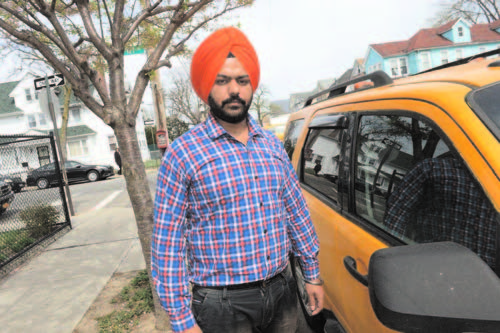
    NEW YORK (TIP): A drunken passenger roughed up a Sikh cabbie and snatched the turban off his head in an assault the NYPD is investigating as a possible hate crime.

    Harkirat Singh, 25, said the theft of his religious garb was the culmination of a scary encounter early Sunday with a belligerent boozehound and his three buddies that has made him too scared to drive another night shift.

    “I’m so afraid. I don’t want to work,” Singh told the Daily News at his home in Ozone Park, Queens. “It’s an insult on my religion, also,” he said. “An insult of my faith. It’s horrible.”

    Butcher leaves black deliveryman paranoid after handing him nooseThe immigrant from Punjab, India, said he picked up three men and a woman – all in their 20s – around 5 a.m. at the corner of Eighth Ave. and 30th St., a few blocks south of Madison Square Garden.

    The quartet said they wanted to go to E. 165th St. and Jerome Ave. in the Bronx. When the yellow taxi reached that intersection, the passengers complained that Singh took them to the wrong destination – but the drunks couldn’t give the cabbie a straight answer about where to go next, he said.

    Harkirat Singh, a Sikh taxi driver, was assaulted, called names and robbed of his religious turban in the Bronx while trying to collect a fare. (TODD MAISEL/NEW YORK DAILY NEWS)

    “The girl’s saying, ‘Take the right.’ The Spanish guy’s saying, ‘Take the left.’ So, at that time, I was confused,” Singh said. They began hurling slurs and banging on the plastic partition in his cab, Singh recalled. Gay couple rattled after brick-throwing teens spewed slurs in NYC

    “They’re using bad words, also. They said, ‘Ali Baba, f–k you,’” said Singh, who moved to the U.S. three years ago.

    He pulled over and told the group to pay $41.76 and to find another cab. The woman coughed up the cash after Singh called 911 – but then one of the men got back into the cab.

    Singh said the man who got back into the cab tried to smash the meter. Then he punched Singh

    in the arm, the cabbie said. “After that, he picked off my turban from my head,” he said. “He wanted to snatch my phone also…It was too horrible.”

    Police sources described the suspect as a clean-shaven white Hispanic man in his 20s, around 5-foot-9 and weighing 160 lbs. He was wearing red shoes and blue jeans. He had short hair.

    Terrified and crying, Singh says he pleaded with the man to calm down.

    “Why are you doing this, brother? We can sit. We can talk,” he recalled telling the unruly passenger.

    “At that time, I’m so afraid – they can do anything to me. They’re gonna kill me.” With cops en route, the group made a run for it – with Singh’s turban, which is a primary symbol of the faith.

    Singh said he’d been wearing a turban since he was 6. The theft occurred just hours after thousands of Sikhs flocked to Times Square for the annual celebration of Vaisakhi also dubbed Turban Day.

    Police say they’re only seeking one suspect, though they’d like to speak to the other three passengers. Singh did not require a medical attention but filed a report with police. He was able to snap a photo of two of the passengers.

    New York Mayor Bill de Blasio ? @NYCMayor tweeted: Harkirat Singh – You are welcome here. What happened to you was wrong. You did the right thing by calling the NYPD. https://twitter.com/ nydailynews/status/ 854105456104673281 …

    9:23 PM – 17 Apr 2017 – Harpreet Singh Toor, the chairman of public policy and external affairs at The Sikh Cultural Society, said the theft reflected prejudice against Sikhs, who often are the butt of anti-Muslim bias despite following a different faith. “I used to get mad – now I laugh at it, because if we are still ignorant about other faiths…who will make those people understand?” he asked.

    Consulate General of India in New York learnt about the incident and an official said it was a serious matter, if it were a case of hate crime. The Consulate is in touch with New York Police Department to get more information on the incident, the official said.

    Sikh community leaders HS Toor, Master Mohinder Singh and Himat Singh Sarpanch expressed concern at the incident and demanded immediate arrest of the culprits.

  • Turning India into a land only for Hindus goes against our nation – Perspective

    Turning India into a land only for Hindus goes against our nation – Perspective

    Nirupama Rao
    Nirupama Rao

    We are a blended nation. Our long traditions, our languages, our home states, these cultural geographies have blurred and indistinct boundaries, interrelated contexts of meaning. There are many echoes, spirits and voices that inhabit our gardens. Separation and distinctiveness are not their defining features. Human life is not about separation but about connection, says the author – Nirupama Rao.

    I am a Hindu by birth and by enduring faith. The house that I was born into that my grandfather built, had no special puja room — but the plaster of Paris statue of a flute playing Krishna, the Ravi Varma oleographs of a Lakshmi rising from a lotus with elephants trumpeting their joy at her presence, the veena-playing Saraswati, and our special deity Lord Guruvayurappan, with beautiful Kartikeya and his “vel”(spear) and his vehicle, the peacock made up the pantheon of our isthtadevatas.

    On my trips to my “native place” as we say in Indian English, I remember how every evening, the vilakku (bronze lamp) was lit with cotton wicks we lovingly made, dipped in gingelly oil, and brought out to the verandah of the tharawad (Hindu matrilineal family) house, with the heralding word: “Deepam” (lamp) repeated two or three times, quietly, with deep reverence. We would greet the sight of this burnished lamp and its brave, bright flame in a prayerful namaskar with bowed heads in a moment of blessed quietude, as imaginary and heavenly angels murmured in the dusk of a tropical Kerala garden around us.

    Wherever we lived as children travelling the length and breadth of India with my army officer father, my homemaker mother would gather us three sisters together at dusk to say our prayers after she had lit the little vilakku that graced a small corner of the bedroom, auspiciously positioned.

    We sat down cross-legged on the bare floor, put our hands together in prayer, and recited our Om Namashivaya, and sang a few bhajans including Gandhiji’s favourite “Raghupati Raghava”. We must have sung with youthful fervour and reasonable harmony because in one of the towns we lived in, the neighbouring Malayalee Catholic family with whom we shared a wall, the Pereiras, would listen tell my mother how much they loved our “evensong”. Them being Christian, and our being Hindu did not matter in those simple days.

    I went to Catholic school till I finished high school and to a Catholic undergraduate college after that. I read Bible history as a young girl and was equally fascinated with the stories of Moses, N the Ark of Noah, and the life of Jesus as I was with the Ramayana and the Mahabharata. Growing up, we were taught to respect all faiths and to be tolerant of differences. We grew into self-confident Hindus, secure in our faith and respectful of our Christian and Muslim classmates and friends.

    In this recalling of memory, I am reminded of the saying that “the past is another country”. Where is that far-off land? What starship are we voyaging on today? Today we Hindus demand “empathy” from the minorities in our country. A Muslim dairy farmer transporting a cow, even with a permit, is not showing empathy for the majority religion, an NRI friend said recently. India is a Hindu nation he added and the minorities should respectfully acknowledge this and adjust to this basic reality.

    Ensconced in the United States, I do not believe he had any doubt in his mind that Hinduism should constitutionally be India’s national religion. Having lived in Sri Lanka, I was reminded of the manner in which that island country made Buddhism its state religion, with its Buddhist clergy being the most powerful source of authority in the land, and all the momentous repercussions of that approach for civil society and the Sri Lankan minorities.

    Is India a wounded civilization? If our religion as Hindus has survived intact despite the depredations of conquest and empire over the last millennium, then are we not prepared to face the next with the steadfastness of faith and the confidence that Hinduism with its capacity for tolerance and accommodation can create the India of our dreams? Are we instead, intent on molding our lives on the basis of religious militancy and a fundamentalist interpretation of belief? Are we intent on the subjugation of our religious minorities so that they conform to what our idea of their place in our society should be?

    Pepita Seth, the English woman who has become a Hindu, and made Kerala and particularly Guruvayur her home, has a passage in her book, Heaven on Earth: The Universe of Kerala’s Guruvayur Temple, that eloquently sums up how I define my being Hindu:

    “In northern Malabar there is a Theyyam deity, Kshetrapalan, the guardian of temples, who once demolished a semi-ruined shrine and built a mosque to give a growing community of Muslims a place of worship. This, in essence is a sharing of cultures and spaces, even as the other is respected. This fineness shows India’s profoundly pluralistic dimension. It is beyond me to suggest what can be done, political will being what it is. The great hope is that our children can, at an early age, be shown what is common to us all, that with opened minds they come to recognize that this will give them a share of the wider whole. As India is railed against for the dreadful things that now too often happen, it can help to recognize that the other side of the coin exists. And that I have been lucky to experience it.”

    India’s is a map of many migrations. She speaks to both East and West, those twins of history, when she demonstrates the fact that labels like Hindu, Muslim, Christian are no more than starting points. We are a blended nation. Our long traditions, our languages, our home states, these cultural geographies have blurred and indistinct boundaries, interrelated contexts of meaning. There are many echoes, spirits and voices that inhabit our gardens. Separation and distinctiveness are not their defining features. Human life is not about separation but about connection.

    Gandhiji drew inspiration from the devotional traditions of Hindu faith as expressed in the ideals of the religious poets and preachers of rural Gujarat, as also from Thoreau and Tolstoy, and even Christianity. He wove these influences into his life and made them work in a manner that was magnetic, riveting and resoundingly powerful. There is power in his example. The Indian answer to the question “who am I” which is “I am that” or Tat Tvam Asi, signifies a oneness with all creation. The Chinese saying: There is me in you, and you in me bridges divisions of race or creed. The Sanskrit word, Viswabodh or, awareness of the whole world, should apply in everything we do.

    It was Rabindranath Tagore who, when he spoke of the idea of India, which as he emphasised was not just a geographical expression, (“I love my India, but my India is an idea and not a geographical expression”), stressed the assimilative outlook, the irreducible diversity that characterised the civilization of India. In a similar way, life in my home state of Kerala has been largely marked by the tenor of coexistence between Hindus, Muslims and Christians. Each community left the other to come to terms with his God in his or her own fashion and in the words of the writer Krishna Chaitanya, realising that difference here in no way militated against close cooperation in activities that ensured the livelihood of all.

    The great twentieth century poet in Malayalam, Vallathol, a Hindu, wrote a narrative poem on Mary Magdalene which is treasured by the Christian community both for its spiritual high notes as well as its sheer beauty. The story of Genesis is seen integrated with the Hindu myth of origin of the churning of the primeval ocean by the gods and demons. This is the true symbiosis that India should seek to treasure and to preserve.

    Today, at evensong, even as I celebrate my being Hindu, I pray for India. I pray for peaceful coexistence, and for us to conduct our lives as citizens of a great and grown-up nation. Let us not leave our destinies to the vagaries of fate, or the tyranny of the closed and confined mind.

    (The author is a former Foreign Secretary of India) (Source: First Post) British English
  • The strange case of Kulbhushan Jadhav – As I See It

    The strange case of Kulbhushan Jadhav – As I See It

    Perhaps the backdrop explains the dynamics at play more than just details of his incarceration

    “The fact that despite specific provisions in the Vienna Convention on Consular Relations, India was denied access to Mr. Jadhav only confirms that Pakistan does not want the truth to be revealed about the place and manner of arrest. India also argues that spies and operatives are not sent carrying their own passports”, says the author – KC Singh.

    The military trial and summary sentencing to death of Kulbhushan Jadhav in Pakistan, with the Indian High Commission denied consular access to him, has plunged India-Pakistan relations into a crisis again. Mr. Jadhav is not the first Indian to be caught and sentenced as a spy by Pakistan, but the first retired middle-level naval officer. The context and background of this need examination.

    A diplomatic leap in the dark

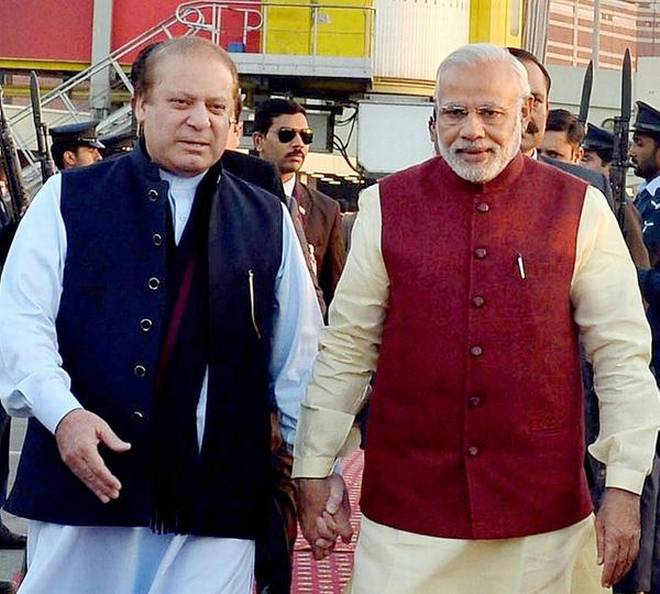
    The current cycle of bilateral engagement and acrimony runs from the dramatic visit by Prime Minister Narendra Modi to Lahore on Christmas in 2015. The occasion was Pakistan Prime Minister Nawaz Sharif’s granddaughter’s wedding, but really it was a diplomatic leap in the dark. As in the past, beginning with Prime Minister Atal Bihari Vajpayee’s Lahore bus journey, theatrical moves rattle anti-India forces in the Pakistani military and jihadi organisations, who then unleash retributive terrorist acts. Within a week of Mr. Modi and Mr. Sharif socialising, the Pathankot airbase was attacked. Tragically, within days of that, Mufti Mohammad Sayeed, the Chief Minister of Jammu and Kashmir, who headed the Peoples Democratic Party’s alliance with the Bharatiya Janata Party, died. The stage was set for instability in the Kashmir Valley.

    While Mufti sahib’s daughter Mehbooba Mufti dithered for nearly three months whether or not to succeed her father, the situation in Pakistan was drifting too. Prime Minister Sharif, marginalised by his namesake, the Pakistani Army chief, undermined by the Panama Papers revelations and suffering from heart trouble, left for the U.K. for medical treatment in April 2016. He returned to Pakistan in July. By then, Ms. Mufti had barely been in office when Burhan Wani, a self-styled commander of the Hizbul Mujahideen, was killed, inflaming an already restive Valley. From that point onwards, Indo-Pak relations slid downwards.

    Kulbhushan Jadhav alias Hussein Mubarak Patel was arrested by Pakistan in March 2016, allegedly in Balochistan, for espionage and abetting terror. This was a windfall for Pakistan as since the 2008 Mumbai attacks and the confessions of Pakistan-born American operative David Headley, it had been seeking moral equivalence by alleging complicity of India’s external intelligence agency, the Research and Analysis Wing (R&AW), in almost every major attack, particularly by the renegade Tehreek-e-Taliban Pakistan. In fact, the joint statement of Prime Ministers Manmohan Singh and Yousaf Raza Gilani at Sharm el-Sheikh in 2009 was widely condemned in India for unnecessarily allowing Pakistan to introduce Balochistan in the statement to discuss an alleged Indian hand in the Baloch uprising.

    Gaps in stories

    There is the usual Indo-Pak disagreement over facts. India claims Mr. Jadhav was conducting business out of Chabahar, Iran, for many years after retiring from the Navy, and that he has been abducted by Pakistani state or non-state actors from within Iran. The fact that despite specific provisions in the Vienna Convention on Consular Relations, India was denied access to Mr. Jadhav only confirms that Pakistan does not want the truth to be revealed about the place and manner of arrest. India also argues that spies and operatives are not sent carrying their own passports. On the other hand, it is unclear why Mr. Jadhav was operating under a Muslim name, and if he did convert, why the government keeps referring to him by his earlier name. India has not challenged the authenticity of his passport, implying that it was not obtained by fraud or faked by Pakistan. With the debate in India now enveloped in jingoism, such lacunae in stories paraded by both sides are beyond examination.

    The truth may never be known, but “Doval-isation” of India’s approach to Pakistan has been obvious for some time. Prime Minister Modi’s espousal of the cause of Balochis and the residents of Gilgit from the ramparts of the Red Fort on August 15, 2016 only confirmed Pakistani fears that India abets terror and secession in Pakistan. However, recent signals from Pakistan via Track II events were that the new Army chief, Gen. Qamar Javed Bajwa, wanted to reorient his Army’s approach towards India and would endorse the civilian government’s lead in crafting its India policy. He was apparently getting a pushback from entrenched interests raised on India baiting. There were unconfirmed reports that National Security Adviser Ajit Doval had spoken to his Pakistani counterpart to acknowledge the signal and create an environment for resuming political contact. Why then did Pakistan change tack and with sudden alacrity, devoid of transparency, sentence Mr. Jadhav?

    One trigger could have been the disappearance of an ex-ISI Pakistani military officer in Nepal. Another may be a desire to stoke further unrest in the Kashmir Valley. It could also be some re-balancing between the civilian and military authorities as Prime Minister Sharif awaits court judgement on the Panama Papers charges. At any rate, Pakistan has succeeded in capturing media space and the Indian government’s attention and thus mainstreaming its grouses even as a new U.S. president shapes his foreign policy.

    The Indian opposition has adopted a jingoistic pitch to entrap a government mixing politics, religion and nationalism. If assurances in Parliament are that the government will do “all” in its power to rescue Mr. Jadhav, either it is confident of a Cold War-style exchange of spies, provided they have managed to secure the asset that went missing from Nepal, or it is upping the ante hoping that Pakistan will not want to escalate tensions further.

    India’s perception of Pakistan

    India misperceives Pakistan, as the 19th century French statesman Talleyrand said the world did Russia, as it is neither as strong as it seems nor as weak as we think. For instance, it is not isolated, as policymakers in South Block assume. Pakistan would have seen rising Chinese rhetoric over the Dalai Lama’s visit to Tawang. It also would read U.S. President Donald Trump’s intervention in Syria and the dropping of the ‘mother of all bombs’ in Afghanistan as the U.S. returning to business as usual and restoring the primacy of its Sunni allies, i.e. Turkey, Saudi Arabia, plus the Gulf Cooperation Council, Pakistan, and Egypt. Pakistan is familiar with the generals now ruling the roost after White House chief strategist Stephen Bannon’s fall.

    A Sino-Pak alliance now fed by China’s open hostility and not countered by the U.S.’s words of restraint may entrap India into a regional morass. Many assumptions on which the Modi government has functioned in diplomacy are being rewritten. The challenge is to steer India through this maze with more than jingoism, theatre, and domestic electoral needs.

    (The author is a former Secretary, Ministry of External Affairs, Government of India) British English
  • Script to unlearn Kashmir begins with sad lessons

    Script to unlearn Kashmir begins with sad lessons

    In the absence of any initiative to begin a dialogue process, separatists hone their skills to influence people

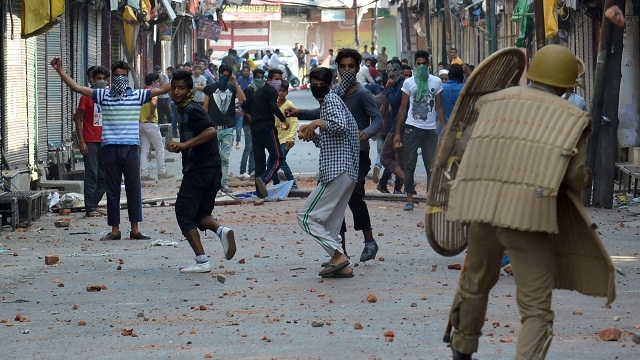
    There is a lot to unlearn from a recent video clip gone viral on social media. A CRPF man carrying EVMs keeps walking nonchalantly even as he is pushed, heckled and abused by a group of youths shouting anti-India slogans, — a predictive ranting tirade. The clip protagonists seemed to expect some elisions reflected in that part of Kashmir:

    a) security forces are used to such gimmickry of protestors; and
    b) most youths in the Valley are downright separatists whose writ runs so wantonly.

    For outsiders, a message went out: Kashmir is as bad as it has been in last three decades — a perception repeatedly reinforced by a series of violent events. The last year’s post – Burhan Wani’s killing and the death of over 80 people in its wake bear it out. It all climaxed in the lowest voter turnout on Thursday in Budgam, under Srinagar parliamentary constituency, where a re-poll was ordered after April 9’s poor voting figures amid large-scale violence leading to the death of eight people.

    “Maybe all sides — mainstream political parties, separatists and those sitting in Delhi and Islamabad — want to tire each other out before realizing the futility of it all,” says a youth in Srinagar, refusing to identify himself.

    “The frustration stems from people’s perception of betrayal and the anger is because no dialogue process is initiated — either with Pakistan or with the people’s representatives,” says Junaid Mattu, spokesperson for the National Conference.

    The separatists have their own take that essentially revolves around Pakistan. “It is not the fight for votes or power. This is the fight against the betrayal of Indian government for not fulfilling the promises made with the Kashmiri people. It is time to ease tension and ensure stability by settling all disputes,” says Abdul Gani Bhat, executive member in moderate faction of Hurriyat Conference.

    The separatists’ poll boycott call was reported from mosques’ loudspeakers, phone calls, WhatsApp and text messages. And despite several requests by the mainstream parties to postpone the polls, the Election Commission deemed it fit to hold elections. “In such an environment, genuine voters would obviously feel frightened,” said an NC activist.

    Development a ‘non-issue’

    During his recent visit to Udhampur, Prime Minister Narendra Modi asked the people, particularly Kashmiri youth, to choose “tourism over terrorism”. “Had the people of Kashmir devoted the past 40 years to development of tourism, the Valley would have been blessed with numerous benefits,” Modi said at a rally organized to mark South-East Asia’s biggest tunnel along the Jammu-Srinagar Highway.

    The separatists were quick to reject the assertion. “Construction of tunnels and roads is futile and won’t succeed to lure us,” said a joint Hurriyat Conference statement.

    The failure of the ‘development mantra’ was, in fact, clear from the election manifestoes of all parties during the assembly polls. Predominant issues were: a dialogue with Pakistan, opening new routes along the LoC, restoration of autonomy, demilitarization and revocation of the Armed Forces Special Powers Act. This explains why, after over a year of assembly polls, the separatist camp’s slogans of ‘azadi’ strongly influence the Kashmiri youth.

    Poor showing
    A senior government officer, who wished not to be named, throws light on areas of concern. “Our education is in a shambles. Out of the 96 degree colleges functioning in the state, at least 31 colleges —some of them sanctioned about nine years back – function from makeshift accommodations. We have poor health infrastructure. Hundreds of villages don’t have electricity and road connectivity. We have the highest number of unemployment in North India. But we have restricted our thought process to unnecessary issues,” he says.

    Nawang Rigzin Jora, Congress Legislature Party leader and MLA from Leh, rues that politics has taken over everything else. “There is no commonality among the people of three regions — Jammu, Kashmir and Ladakh. We have to have a binding force, which is not there.”

    Mahesh Koul, a research scholar, says by relegating areas of human development, “the government has handed a long leash to the subversives who want the state to waste time in conflict management.”

    The situation has come to such a pass, says Prof Hari Om, a Jammu-based historian, that leaders in Kashmir don’t want development. “The three regions — Jammu, Kashmir and Ladakh — are pulling in different directions. And the Indian state simply watches on.”

    (Source: Tribune, Chandigarh) – British English

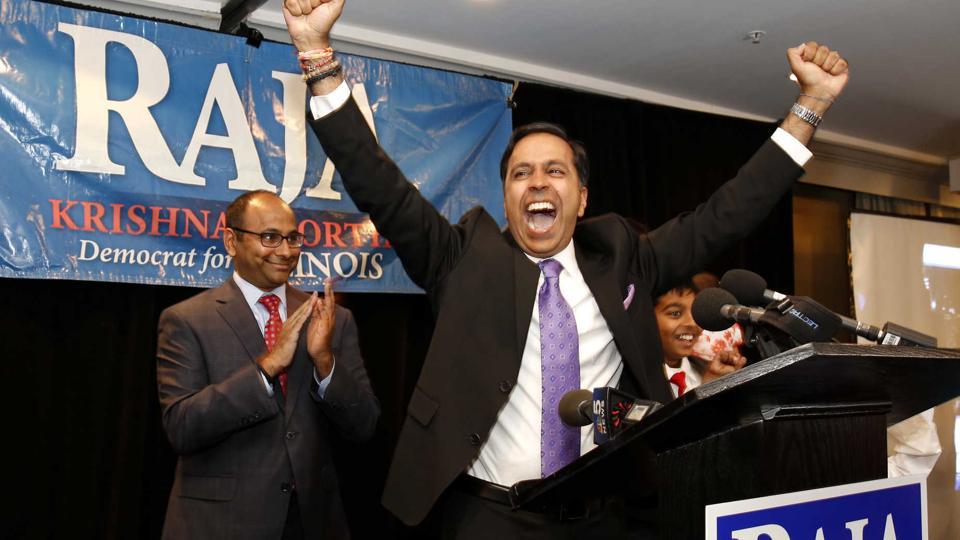
  • Raja Krishnamoorthi calls for decisive steps to end bigotry, hate crimes

    Raja Krishnamoorthi calls for decisive steps to end bigotry, hate crimes

    Indian-American Congressman Raja Krishnamoorthi has asked the US administration to take “decisive steps” to end bigotry and hate crimes towards Indian-Americans and other religious minorities in the country.

    “There are various reasons (for increase in hate crimes), but one is certainly there’s been a rise in divisive rhetoric starting with the top,” Krishnamoorthi, Congressman from Illinois, said.

    Krishnamoorthi, who has initiated steps to galvanise his Congressional colleagues on the issue, said there has been a number of issues taken on the immigration front, which really contributes to the divisive atmosphere in this country.

    “Starting with the immigration executive order dated January 27th, which targeted American legal permanent residents, also known as Green Card holders. But we’ve now seen a number of steps taken by the White House on a number of fronts, which have sown confusion, concern, and fear among Indian-Americans and others,” Krishnamoorthi told PTI.

    The first-time Congressman said he has not seen any measures being taken by President Donald Trump.

    “Not so far, but I’m heartened that at least Secretary (of Homeland Security John) Kelly was willing to meet with me and others to discuss this issue and to recognise that there has been an increase in hate crimes and that we need to do something about it,” he said.

    “But now is the time to act. We can’t just have a nice talk. It’s time for the authorities at the very top of our government to take decisive steps to end the state of bigotry and prejudice that’s being directed toward Indian-Americans, Jews, Latinos, Muslims, and others because at the end of the day, we have to come together as a country to confront the various challenges that we have on the landscape, primarily economic,” Krishnamoorthi said.

    One thing that the Trump Administration can do is that they can make sure that there continue to be the registry of where are the attacks happening and against who, and those responsible for it are prosecuted.

    “They’ve been dilly-dallying on this front in a number of cases,” he alleged.

    “It’s very clear that some of these attacks were motivated by hate, and they should be prosecuted as such. Then, we need leaders to come and meet with the community and to show solidarity with them,” he said.

    “We are all Americans, and regardless of what you think about his policies, George Bush, after the September 11th attacks, actually showed up in the different communities to allay concerns about different communities being singled out as targets of hatred. We need that same type of attention being given now,” he said.

    “Then, word needs to go out into law enforcement that they need to act with even more purpose, and they need to do everything they can to stop these attacks,” he added.

    Read more

    Krishnamoorthi last week met with Secretary of Homeland Security John Kelly.

    During the meeting, he brought up the concerns about the attacks on Indian-Americans, Hindus, Muslims, Jews, and others.

    “I basically got a commitment from him to work on this issue, and he also lamented the rise in White supremacist organisations,” he said.

    “I then followed up with a letter to him basically urging him to take action to follow up on his commitment. Then I’ve also asked him to come to Chicago and hold meetings with local concerned community leaders with regard to this issue. He said that he was interested, but we’re following up on that,” he added.

    “This follows a number of other actions taken by our office including calling for investigative hearings of my Oversight Committee, writing to Department of Justice (DOJ) including Attorney General Jeff Sessions asking them to investigate, and various other statements and letters that we’ve sent,” Krishnamoorthi said.

    “In addition, I’ve met with local leaders in the community with regard to this issue, and we are holding town halls and other meetings to basically bring attention to what’s happening. We’re doing everything we can to make sure that we address this rise in hate crimes and prejudice and bigotry in as diligent a manner as possible,” Krishnamoorthi said.

    Having received feedback from across the country, Krishnamoorthi said Indian-Americans are very concerned, which is bordering on fear.

    “I think that we have to do everything we can to allay their concerns, but more importantly, to take action, to make sure that we get to the bottom of what’s happening and prevent future attacks,” he said.

  • African-American attacks Nepali-Indian establishment pretending to be white supremacist

    African-American attacks Nepali-Indian establishment pretending to be white supremacist

    New York, April 11: A Bhutanese businessman is the victim of a false flag assault in Charlotte by an African-American man who made the attack on the man’s store appear to be the work of white supremacists.

    Hate Politics – A rash of racist attacks have broken out after Donald Trump’s victory

    North Carolina police arrested on Sunday the man allegedly seen on a surveillance video setting fire to the store on Thursday and leaving a note threatening to torture immigrants and refugees and signing it “White America”, The Charlotte Observer newspaper reported.

    The Central Market, described as Nepali-Indian establishment that sells South Asian food and gifts, is owned by Kamal Dhimel, a refugee from Bhutan.

    On Thursday night, the store’s front door was set on fire, a glass pane on the door was smashed with a stone and the note signed “White America” and warning that refugees and immigrant business owners would face torture “if they did not leave and go back to where they came from” was left there, according to police quoted by the newspaper.

    Investigators said a video surveillance of the incident showed a “black male suspect”, the Observer reported.

    African-American man Curtis Flournoy, 32, has been arrested and charged with ethnic intimidation, sending threatening letters, burning a business building and using incendiary material, according to the newspaper.

    Charlotte City Council member Dimple Ajmera told the Observer that she was frustrated to see the hate crime take place.

    “I’ll continue to work around the clock to make sure that all businesses and all the residences feel safe,” she added.

    Last month, Harnish Patel, an Indian-American businessman in Lancaster in neighbouring South Carolina state, was shot dead outside his home. There have been no arrests in the case.

    While attacks and threats against ethnic and religious minorities have always been a feature of America, activists and Democratic Party leaders have attributed recent incidents to President Donald Trump.


    RECENT RISE OF ATTCKS ON INDIAN AMERICANS

    In some places, including New York, false reports have been spread about raids on illegal immigrants to spook immigrant communities.

    In February, an Indian-American woman, Ekta Desai, was harassed on a New York-New Jersey metro train by an African-American man who threatened her using foul language and said she should “get out of here”.

    She uploaded the video of the harassment, but the Democratic New York city or state officials have not come forward to condemn it or take action against the man. US human rights organisations have not reacted to it either.

    In February, in a case directly attributed to white racism, Indian engineer Srinivas Kuchsbhotla was shot dead and Alok Madsani was injured in Kansas, after they were mistaken for Middle Easterners or Iranians.

    The alleged shooter, a white man, has been arrested and awaiting trial.

    Last month, a Sikh in Kent, Washington State, was shot and injured by a man who shouted at him, “Go back to your country”. Authorities are still looking for the shooter.

    In another case last month, an Indian woman Sasikala Narra, 38, and her six-year-old son, Anish, were stabbed to death in New Jersey.

  • There is no holy cow in the Vedas

    There is no holy cow in the Vedas

    Hinduism considers the Vedas as its Supreme Court, whose word is final, and if any of the later Sanskrit or non-Sanskrit writing goes against what the Vedas have said, a Hindu has to follow the words of the Vedas.

    The Vedas consider bovines important  for milk, beef, agriculture, transport, but not as divine or holy. The word ‘Aghnyaa’ applies only to a milch cow because it is not economical to kill it. A Vaisha cow is meant for beef, and especially reserved to an extent for Brahmins only. Atharva 12.4(13) tells us that in case a Brahmin begs for a cow from a non-Brahmin, “even if that person has a beef-dinner at his house, he has to select another cow to slaughter for his own dinner than the one that is asked for”.

    The word ‘Aghnyaa’ (not to be killed) coined by Rigveda for young milch cows was the main cause of the Hindu misunderstanding that cows or bovines are not to be slaughtered. The importance of the cow entered the Hindu religion with full force possibly later, when Krishna began to be worshipped as Vishnu’s incarnation. The Rig Veda, like our Constitution, only recommends that young milch cows should be considered ‘Aghnyaa’ or ‘not to be slaughtered’, for economic reasons, and specifically states that those animals which are of no use have to be killed -Rigveda[10.95(6)]. The cattle-protection laws in most of the Indian states also rule the same way.

    The Rigveda has never used the word ‘mother’ for a cow. As in our Constitution, so in the Rig Veda, cow protection is not mandatory but only a directive principle. There is no punishment recommended for a cow slaughterer even if he kills a young milch cow. Beef-eating is also not taboo. Beef parties are not only allowed but highly appreciated, and a person who cooks beef for his guests is praised by the term ‘Atithi-gva’ ‘one who offers beef to guests’.

    Ritual sacrifice of a bull is a must in worship to God Indra. Beef parties also seem a regular affair in weddings (RV 10.85). Cows are not sacred and beef is not forbidden to Hindus. Here is a line from a verse ascribed to god Savita, the presiding deity of the Gayatri Mantra, describing a dinner party he is hosting: “At night we are going to kill cows” (RV.10.85(19). RV 10.89 (14) mentions “cows for food, laying scattered on the grounds of a slaughter house”. Mark that the author does not use the word ‘animals’ but ‘cows’, showing that beef was the most popular item, and the cow the most slaughtered animal. RV 10.95(6) says that “old cows which do not give milk” are “only fit to be cooked”. It further states that “useless cows are taken to be cooked, but never milch cows”. It is clear that slaughter houses are not banned, beef is allowed and useless bovines are allowed to be slaughtered in Hinduism.

    The cattle-protection laws in most of the Indian states also rule the same way. The Central government, in a letter dated 20th December 1950, directed the state governments not to introduce total prohibition on cow slaughter, stating economic reasons[i](DAHD, 2002, para. 64). Again, in 1995, the government of India stated before the Supreme Court that the central government was encouraging development of livestock resources and their efficient utilization which included production of quality meat for export as well as for the domestic market (DAHD, 2002, para. 65). In recent decades, the government also started giving grants and loans for setting up modern slaughter houses (Ministry of Food Processing Industries, ND.).

    In several cases, the Supreme Court has held that “a total ban (on cattle slaughter) was not permissible if, under economic conditions, keeping useless bull or bullock be a burden on the society and therefore not in the public interest” (DAHD, 2002, para. 124). So much for the legal standing on cow slaughter in the Constitution of India.

    (Summarized by Dave Makkar from the article Bovines, India And Hinduism by Rajani K. Dixit, retired Lecturer in Sanskrit.

    We look forward to your comments – Editor

  • Cow is an excuse – Rajasthan murder more than a vigilante action

    Cow is an excuse – Rajasthan murder more than a vigilante action

    Another vigilante action, another Muslim dead. This time in Rajasthan. But the beating of five persons transporting milch cows, leading to the death of a 55-year-old man, Pehlu Khan, was not surprising even if it was shocking. Circumstances of the case make it obvious that it was not part of any attempt to prevent smuggling of cows. It was an assault on a particular religious identity. For one, anyone familiar with cattle – especially those who claim to be passionately devoted to it – should be able to tell condemned cattle from a milch cow, as was the case here. Then, the man who died had documents to show he purchased the cows for milk as he ran a dairy. The more pertinent bit, however, is that one Hindu driver was let off by the gang, even though he was as much a part of the crew transporting the cattle.

    The disturbing aspect is that this is not an action of “fringe elements”, if there is still any distinction to be made within the communal monolith called the “Sangh”. The police were as quick as the “gau rakshaks” to accuse the cattle buyers of being smuggles, and booked them too without even preliminary inquiries. The Rajasthan Home Minister defended the police action, and even the need for “gau rakshaks” to prevent cattle smuggling. Union Minister Mukhtar Abbas Naqvi said in the Rajya Sabha that the incident had been misreported. It is becoming increasingly difficult for the BJP to deny that it supports such vigilante action, given the systematic persecution of meat traders in certain states. UP has also seen “anti-Romeo squads” and instructions for teachers on how to dress “decently”.

    The fast evolving cultural tyranny needs to be recognised for what it is – a devious ploy at sustaining animosity on communal lines. The motives for this are as much political as a sincere faith in a medieval ideology, not very different from the extreme Islamic intrusion seen in all public institutions in Pakistan. Unless this is understood, and no less than the top leadership of the BJP moves to put a stop to the moral policing, the consequences also may be very similar to as in Pakistan.


  • AAPI condemns violence against physicians in India: Appeals to Govt. of India to put an end to violence against physicians

    AAPI condemns violence against physicians in India: Appeals to Govt. of India to put an end to violence against physicians

    NEW YORK (TIP): Physicians in India feel threatened and their lives are in danger. Some hospital administrators have begun to hire muscular looking bouncers, whose imposing presence deters patients’ relatives from aggressive behavior. The medical fraternity in several states is on strike, due to the recent incidents of violence against doctors. This is not good for the people we are committed to care and also is not benefiting the Doctors.

    In a letter sent to the Prime Minister of India and several high ranking officials at the Government of India, Dr. Ajay Lodha, President of AAPI, condemned the ongoing violence against physicians across several states in India.

    “We at AAPI, the largest ethnic medical organization in the nation, urge the government of India to make all the efforts possible and put an end to this ongoing violence against medical professionals and enable them to continue to serve the country with dignity, pride and security,” Dr. Lodha said in the letter sent to the Prime Minister, Home Minister, Health Minister, India’s ambassador to the US and the Ambassador of the US to India.

    Recalling that from ancient times, physicians across India and around the world have been revered for dedicating their lives for the noble mission of preventing people from getting and saving millions of lives of people from illnesses, Dr. Lodha told the Indian government that “we as a community of physicians and individual members of this fraternity have decided to go into the medical profession with the best of intentions. We as physicians want to help people, ease suffering and save lives. Physicians of Indian origin are well known around the world for their compassion, passion for patient care, medical skills, research, and leadership.”

    Expressing shock that despite these noble intentions, many doctors and nurses put their own lives on the line in the course of their jobs, facing attacks from the very people they are trying to help. “Violence against doctors has reached such an extreme in India that the medical staff is afraid to come to work and they need a police presence in the hospitals where they work,” Dr. Lodha said.

    For instance, 49 doctors have been attacked in the state of Maharashtra alone since 2015. “The violence against physicians in India, will put a dent in these area, where we have been growing rapidly as world leaders and will cause irrevocable damage to the health industry in India and our image will be tarnished forever, Dr. Lodha pointed out.

    Pointing to reports by the Indian Medical Association (IMA), he said, more than 75% of the population of doctors have had to deal with some degree of violence or aggression directed at them, according to. Shockingly, a large proportion of doctors don’t report such incidents, believing them to be a part of the job so the true figures are likely to be higher. Incidents vary from minor verbal abuse all the way through to the murder or attempted murder of staff, Dr. Lodha said.

    While security needs to be strengthened, enhancing the doctor-patient relationship is undoubtedly the most important factor in reducing violence. Improving the quality of medical facilities and reducing the financial burden on patient’s families is also important as large payments may be catastrophic for poorer people and if they then encounter poor facilities too, this may engender a feeling of corruption. There is even an online petition in change.org seeking safe work environment for doctors.

    According to Lodha, this recent rapid increase in violence has the potential to tarnish India’s image globally as a rising super power. One of the world’s fastest growing economics, India is a dynamic market with immense opportunities in healthcare. With pioneering Indian companies offering a global work culture, India is becoming a preferred career destination for professionals looking for exceptional individual learning and unique growth opportunities. And, in recent decades, India is turning medical tourism hub, attracting millions of people from abroad.

    The members of the American Association of Physicians of Indian Origin (AAPI), an umbrella organization which has nearly 90 local chapters, specialty societies and alumni organizations, with over 35 years of history of dedicated services to their motherland and the adopted land, are appalled at the growing violence against our fellow physicians in India, Dr. Lodha said. “We strongly condemn this ongoing violence. And we want immediate action against the culprits, who have been carrying on these criminal acts. We are shocked by the lack of coherent action against such violence and protect members of this noble fraternity.”

  • Rise of the anti-liberal order

    Rise of the anti-liberal order

    “The issue confronting India, as indeed the entire Western world, is the rise of populist leaders challenging liberal, pro-globalisation post World War II order, mixing xenophobia, religion and voodoo economics. Steve Bannon, President Trump’s closest adviser and former head of Breitbart News, apocalyptically senses the coming confrontation of the Christian world with ‘jihadist Islamic fascism’.

    KC Singh
    Author – KC Singh

    He spelt this out in a 2014 Rome interview. Capitalism’s crisis, he argued, is loss of its Judea-Christian roots as evidenced by ‘secularisation’ of the West. Yogi Adityanath and his sponsors would concur”, says the author – KC Singh.

    Two weeks after the counting of votes, with a controversial Yogi ensconced as UP Chief Minister, and the surprising lackluster performance of the AAP in Punjab, analysts and politicians continue to mull over the outcome.

    The AAP questioned the sanctity of EVMs, arguing that sworn affidavits by party loyalists exceed actual ballots in some booths. They may be underestimating the guile of ‘simple’ village folk, although Election Commission’s hesitation to double-check the paper trail in some constituencies raises questions. While the Supreme Court examines this aspect, trends from abroad may hold an explanation.

    Like the AAP, European Pirate parties rose from issue-based politics as an alternative to traditional parties in Sweden in 2006. They grew rapidly there and in Germany and Iceland, winning two seats even in the European parliament in 2009. The 2009 Upsala Declaration spelt out their platform encompassing greater government transparency, privacy and civil rights reform, open data access and direct democracy by co-opting citizenry in decision-making via the Internet. In Germany, additionally, the rights of the LGBT community and basic income guarantee were added.

    Their growth, however, has been disappointing except in Iceland. Germany saw the bickering which is a daily fare in New Delhi. In Iceland, the Panama Papers scandal, compelling the prime minister to resign, gave them an impetus. The real problem has been that public opinion has moved past their issues to existential dilemmas like terrorism, immigration, economic stagnation due to perceived impact of globalisation and the consequent ethno-religious resurgence. The AAP needs to recalibrate its message and broaden the leadership bench-strength to tap contemporary India’s aspirations that go beyond corruption. That issue too, usurped by Modi’s demonetisation juggernaut at present, needs to be redefined.

    In Punjab, the principal reason for the AAP’s fading at the finish line was lack of experienced and credible faces. The Hindu minority and Sikh elite thus gravitated towards the Congress as the only viable alternative to the detested Akali Dal. Punjab wanted change, but also feared chaos, as did people in Europe when assessing Pirate parties. As a result, Punjab may have missed its chance for radical governance reform. Though still early days but an education minister who knows no Punjabi, a culture minister fixated on television earnings and an industrialist as power minister are hardly symbols of accountability and governance change. The battle was for more than red beacons on cars.

    In Italy, new politics shaped differently, albeit with motives shared with Pirate Parties. Five Star Party (M5S) founded by popular comedian Beppo Grillo, a European Bhagwant Mann, and Gianoroberto Casaleggio, aimed to marginalise traditional parties seen as responsible for constant stagnation and impasse. They won mayors of Rome and Turin, like the AAP, but unlike it, are leading in the 2018 national election race. In his defence, while Arvind Kejriwal contends with an ascendant national leader, Narendra Modi, Grillo and associates step into a vacuum.

    #YogiAdityanath
    #YogiAdityanath

    The BJP sweeping UP and nominating Yogi Adiyanath as Chief Minister is replete with danger. For Gorakhnath math’s head to be so elevated raises questions about mixing religion and politics. The math, which allows non-Brahmin leadership, has a chequered past. Its head, Yogi Digvijay Nath joined the Congress in 1921. However, his suspected role in the Chauri Chaura incident involving police firing and in revenge burning alive of the entire police post personnel forced Gandhiji to withdraw the Non-Cooperation Movement. Yogi and the math thereafter parted ways with the Congress.

    Yogi Adityanath’s rise invited adverse editorial comment from the New York Times, which the Modi government has slammed. President Donald Trump, a fellow victim of the same paper, promptly telephoned to congratulate Modi on his electoral success. This would be a first for the US President as state elections are a domestic issue best left alone by foreign leaders.

    The separation of religion and state began the post-1648 Treaty of Westphalia, ending 30 years of religious wars in Europe. French Cardinal Richelieu’s concept of ‘raison d’etat’ or interests of state as the determinant of all actions, instead of religion or dynasty, brought secular thinking into inter-state affairs. Papal desire to control the Holy Roman Empire ended with its decline and ultimate demise by start of the 19th century.

    Arthur Koestler in Yogi and the Commissar argues there is little common ground between the two as one concerns man’s relations to the universe and the other to society. While Sikh Gurus did espouse the concept of ‘Miri-Piri’, implying the dual role as temporal and spiritual guides, in reality, the Badal trio – father, son and the bahu – were above the dictates of the Sikh clergy. The secularisation of the Akali Dal has been complete, but the BJP’s UP experiment defies history.

    In Shia Islam, the debate is still unsettled. Traditionally, the Shia clergy considered all governance as profane and thus beyond their pale. Ayatollah Khomeini of Iran, in exile in Iraq, developed the concept of Velayat-e-Faqih, or the rule of the most jurisprudent. He reasoned that till the return of the 12th Imam, who was in occultation, the wisest among the clergy must guide the ruler to stymie misrule. The revered living Iraqi cleric, Ayatollah Sistani, contests this thesis, subscribing instead to the quietist school requiring clerics to remain in the background.

    The issue confronting India, as indeed the entire Western world, is the rise of populist leaders challenging liberal, pro-globalisation post World War II order, mixing xenophobia, religion and voodoo economics. Steve Bannon, President Trump’s closest adviser and former head of Breitbart News, apocalyptically senses the coming confrontation of the Christian world with ‘jihadist Islamic fascism’. He spelt this out in a 2014 Rome interview. Capitalism’s crisis, he argued, is loss of its Judea-Christian roots as evidenced by ‘secularisation’ of the West. Yogi Adityanath and his sponsors would concur.

    How then can the demonised and beleaguered forces of liberalism respond? The recent defeat of Dutch nativist Geert Wilders provides a clue. D66, a collection of earnest pro-European liberals, improved seats by 50 per cent and Green Left tripled its strength by contesting and not dodging the narrative of Wilders with a counter-vision, as The Economist notes, centred on tolerance, openness and internationalism. The question is, who shall bell the Indian cat? Hopefully, Aristotle was right when he said ‘nature abhors a vacuum’.

    (The author is a former Secretary,

    Ministry of External Affairs, government of India)

  • BJP, Dalits, and the ‘Cow politics.’

    BJP, Dalits, and the ‘Cow politics.’

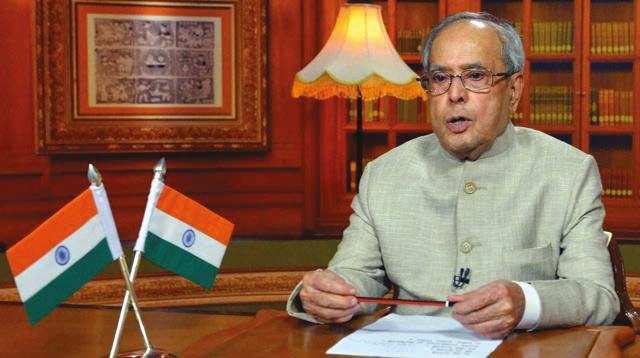
    In these four years, I also saw with, some disquiet, forces of divisiveness and intolerance trying to raise their ugly head. Attacks on weaker sections that militate against our national ethos are aberrations that need to be dealt with firmly. The collective wisdom of our society and our polity gives me confidence that such forces will remain marginalized, and India’s remarkable growth story will continue uninterrupted,”so said honorable Pranab Mukherjee, President of India, addressing the nation on the eve of the 70th yearof Independencefrom British colonialism.

    It is indeed quite an emphatic and forceful statement coming from the bully pulpit of the highest office in the land. It also puts to shame those who refuse to acknowledge the growing intolerance and prejudice that is sweeping across India by the rightwing zealots who are emboldened by the election of Narendra Modi to power. The question to ponder is whether this is only an aberration or a growing trend that may have disastrous consequences to the way of life as we experience it today!

    Just as India was celebrating its Independence Day, word has come out from Bengaluru that SEDITION charges are being filed against Amnesty International of India, an organization that promotes human rights and creates awareness when it is violated in any part of the world. Once again, it appears that the law enforcement agencies are madepawns by ultra-nationalists bent upon imposing their version of cultural hegemony on the diverse people of India.

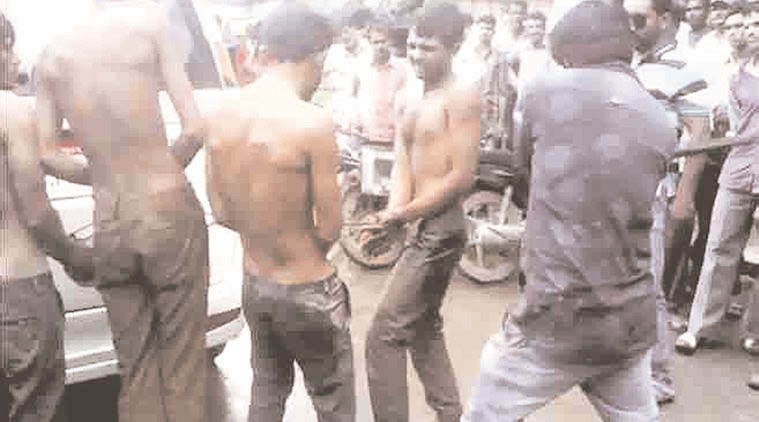
    Millions of Indians everywhere must be feeling the shame of India as the President has spoken out on the continuing assaults on Dalits. In a recent incident in Una, Gujarat, four Dalit youths were severely beaten up and dragged on the road for nearly a kilometer for allegedly possessing beef. It is widely known that the so-called upper castes will not touch the carcass and the Dalits are forced to clear or handle it and when they do, they are mercilessly beaten up in the name of self-appointed ‘Gau Rakshak Samiti.’

    Dalits who constitute one-sixth of India’s population, some 170 million people, live in precarious existence, shunned by much of Indian society because of their rank as “untouchables” or Dalits – meaning broken people – at the bottom of India’s caste system. Dalits are discriminated against, denied access to land and basic resources, forced to work in degrading conditions, and routinely abused at the hands of police and dominant caste groups that enjoy state’s protection.

    It appears that the Prime Minister had finally broken his silence when he made a statement in a town hall meeting saying that “I feel really angry that some people have opened shops in the name of cow protection. I have seen that some people commit anti-social activities through the night, but act as cow protectors by the day”. It is noteworthy that Modi did not call for the prosecution and punishment of these cow vigilantes but asked the authorities to prepare ‘dossiers’ on them and keep them under control!

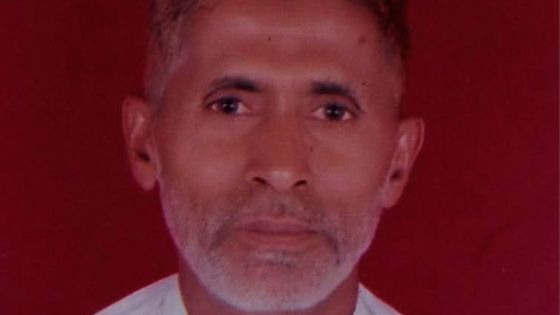
    Almost a year ago, a mob lynched Mohammed Akhlaq in Dadri U.P. on suspicion of possessing beef in his home refrigerator. Subsequently, the meat was sent for forensic examination. In June, Baliyan, who is a member of Modi’s Council of Ministers, BJP MP Yogi Adityanath and BJP MLA Sangeet Som defended the killers and demanded action against the dead man’s family for the ‘crime of eating beef.’

    If there is growing intolerance on the dietary habits of Indians and rising violence by the emboldened vigilante groups who have taken up law unto their hands, many in the current leadership are in complicity, lending credence to their nefarious activities with their overt or covert support to this highly charged environment.

    Amit Shah, the President of BJP, boasted once that wherever there is a BJP government, there is a ban on beef. Raja Singh, a member of Parliament, went even further stating that he extends his full support to all those who take it upon themselves to teach those Dalits a valuable lesson!Mohinder Lal Khattar, the current Chief Minister of Haryana, is on the record saying that Muslims can live in the country only if they give up eating beef. Panchajanyam, an RSS newspaper has quoted Vedic scriptures that ordered the killing of sinners who slaughtered cows and the Union Minister of Agriculture Radhamohan Singh termed cow slaughter a ‘mortal sin.’

    There is no doubt that these vitriolic statements from higher ups have given fodder and cover to these cow vigilantes who roam the streets and become the judge, jury, and the executioners. Since BJP came to power, states like Maharashtra, Haryana and Jharkhand have tightened laws against cow slaughter, but those in the leadership used the beef issue as an emotive political tool without any repercussions from the Prime Minister. In Maharashtra state, one may get five years incarceration for possession of beef as opposed to two years for sexual harassment of a woman!

    Prime Minister himself effectively conjured up the specter of a ‘pink revolution’ – cow killing on a mass scale – in the event of a BJP’s defeat in the 2014 election as part of a   strategy to motivate people and to vote for his party. Both in Western Uttar Pradesh and again in Bihar Modi spoke at length about the dangers of ‘pink revolution.’ “The agenda of the Congress is the pink revolution,” he said. “we have heard of the green revolution and white revolution but never pink, and this means the slaughter of animals (pashu). You see, the color of mutton is pink, and they are committing the sin of exporting it and bringing revolution…Because of this, our animal wealth is being slaughtered, our cows are being slaughtered, or sent abroad to be slaughtered….And now the Congress is saying, ‘if you vote for us, we will give you permission to kill cows’”

    It is quite apparent that if Modi has to call the heinous and brutal beating of the Dalit boys in Gujarat as criminal wrongdoing and ask that the perpetrators to be punished, he would have to cross that ideological line he and his party have helped to formulate in attaining the power. However, what he has done with his recent statement to the nation is an attempt to soothe the bruised feelings of Dalits who are critical to the BJP’s prospects in the upcoming elections in U.P. and Punjab. What else could explain his silence in all these months when Muslim youths were lynched or beaten up by cow vigilantes?

    The very idea of a consolidated vote bank based on the ideology of ‘Hindutva’ to include the Dalits and other backward castes may be fast unraveling as the video footage of the beating has gone viral and stoked Dalit anger. The nation also witnessed the de-recognition of the Ambedkar Students Association in Chennai, mistreatment and subsequent suicide of the Dalit scholar Rohit Vemula in Hyderabad, torching of a Dalit home in Haryana and killing of two children. All these incidents may only reinforce the age-old Dalit thinking that BJP is essentially a party dominated by an upper caste ideology, and there may be very little room left in it for anyone else!

    (The author is a former Chief
    Technology Officer of the United
    Nations and Chairman of the Indian
    National Overseas Congress, USA)

  • President Mukherjee warns against rise of divisive forces

    President Mukherjee warns against rise of divisive forces

    NEW DELHI (TIP): On the eve of India’s 70th Independence Day, President Pranab Mukherjee warned against the rise of divisive and intolerant forces, in what can be seen as a message for the parties in power.

    Mukherjee also asked for firm measures to deal with attacks on weaker sections amid allegations of increasing victimisation of Dalits and minorities, often by fringe elements of the ruling establishment.

    Reminding about the duties defined in the Constitution, President Mukherjee in his pre-Independence Day speech asked the stakeholders to uphold the “spirit of the Constitution” and maintain the “maryada (sanctity)” of authorities and institutions of state power.

    “In these four years, I saw with disgust forces of divisiveness and intolerance trying to raise their ugly head. Attacks on weaker sections that militate against our national ethos are aberrations that need to be dealt with firmly,” Mukherjee said in what may be his last speech as President on August 14.

    A spate of incidents, including attacks on churches, the beef controversy, a Muslim’s lynching on the suspicion that he was storing beef, the suicide of Dalit student Rohith Vemulla and the recent beating of Dalit youth in Gujarat, has raised a number of political storms for the ruling Bharatiya Janata Party, which has come under increased criticism from the opposition.

    “The Constitution has clearly defined the duties and responsibilities of every organ of the state. It has established the ancient Indian ethos of ‘maryada’ as far as authorities and institutions of state power are concerned,” Mukherjee said. “The spirit of the Constitution has to be upheld by adherence to this ‘maryada’ by the functionaries in the discharge of their duties.”

    The President hailed the passage of the 122nd Constitution Amendment Bill for the goods and services tax as
    “reason enough to celebrate India’s democratic maturity”. “The fact that despite two consecutive drought years, inflation has remained below 6% is a testimony to our nation’s resilience,” he said.

    But he also warned against
    “disruptions, obstructionism and unmindful pursuit of a divisive political agenda by groups and individuals” that might lead to “nothing but institutional travesty and Constitutional subversion”.

    “Polarising debates only deepen the fault lines in public discourse,” he said. “The collective wisdom of the society and India’s polity gives confidence that such forces will remain marginalised and India’s remarkable growth story will continue uninterrupted.”

  • COW IS YAHOO’S ‘Personality of The Year for India’

    COW IS YAHOO’S
    ‘Personality of The Year for India’

    Yahoo recently said that ‘cow’ pipped all other contenders in 2015 to emerge as the personality of the year in India.

    “In an unexpected twist, the humble ‘cow’ emerged as ‘Personality of the Year’, trumping other high-profile contenders for the top spot,” Yahoo said in a statement on its “Year in Review” for India which captures the year’s top trends, happenings and events.

    “It started with the Maharashtra government announcing a ban on sale of beef in the state — a move which led to massive debates online and offline, spiraling into the ‘beef controversy’,” it said.

    The Dadri mob lynching, award wapsi –eminent writers returning national awards –and numerous discussions centered on ‘intolerance’ further propelled the bovine to claim the overall top spot, the statement said.

    When the idea of crowning the cow as the ‘Personality of the Year’ was first proposed, it met with equal parts scorn and mockery, condescension and astonishment, excitement and amusement.

    After all, traditional wisdom mandates that lofty-sounding appellations be the exclusive preserve of humankind and not be conferred upon bovine stock.

    Yet, prudence demands that the title belong to the one ‘being’ that had the most significant impact on a variety of matters, dominated national debate, pervaded general consciousness, evoked passion, initiated protests, stalled work, and set the social media afire, among other things.

    The list of the prime contenders for the title had political bigwigs, matinee idols, sports icons…

    Some of the distinguished names that were considered included Prime Minister Narendra Modi, Delhi Chief Minister Arvind Kejriwal, Bihar Chief Minister Nitish Kumar, actors Deepika Padukone, Salman Khan, Aamir Khan and Shah Rukh Khan, cricketers M S Dhoni and Virat Kohli, social workers, human-, women- and child-rights activists, litterateurs….

    But, finally pragmatism beat custom and the docile cow pipped big guns to the post.

    Had the dove not been recognized as the universal symbol of peace, the cow would most certainly have donned that mantle. Yet, this gentlest of creatures was at the center of a violent, political, social and legal firestorm throughout 2015.

    The humble herbivore was wrenched away from its pastoral idyll and then savagely flung it into a bloody battlefield. This brought legislation to a standstill, impeded the growth of pace of a nation desperately in need of sustained and uninterrupted development, polarized the society and the social media into two distinctly combative factions, dominated television debates and newspaper columns, sparked off violent acts of crime across the country, united a disruptive opposition, exposed an unyielding government, and disturbed the nation’s peace as the minority community expressed fear and concern over what was termed as rising intolerance.

    It all started with a ban on beef. The anti-cow slaughter movement had begun to intensify and spiral out of control. While cow-slaughter is banned in most parts of India, some states insisted on strict implementation of the ban and also imposed 10-year jail for those who are found guilty of slaughtering a cow, a bull or an ox, or caught eating or carrying beef.

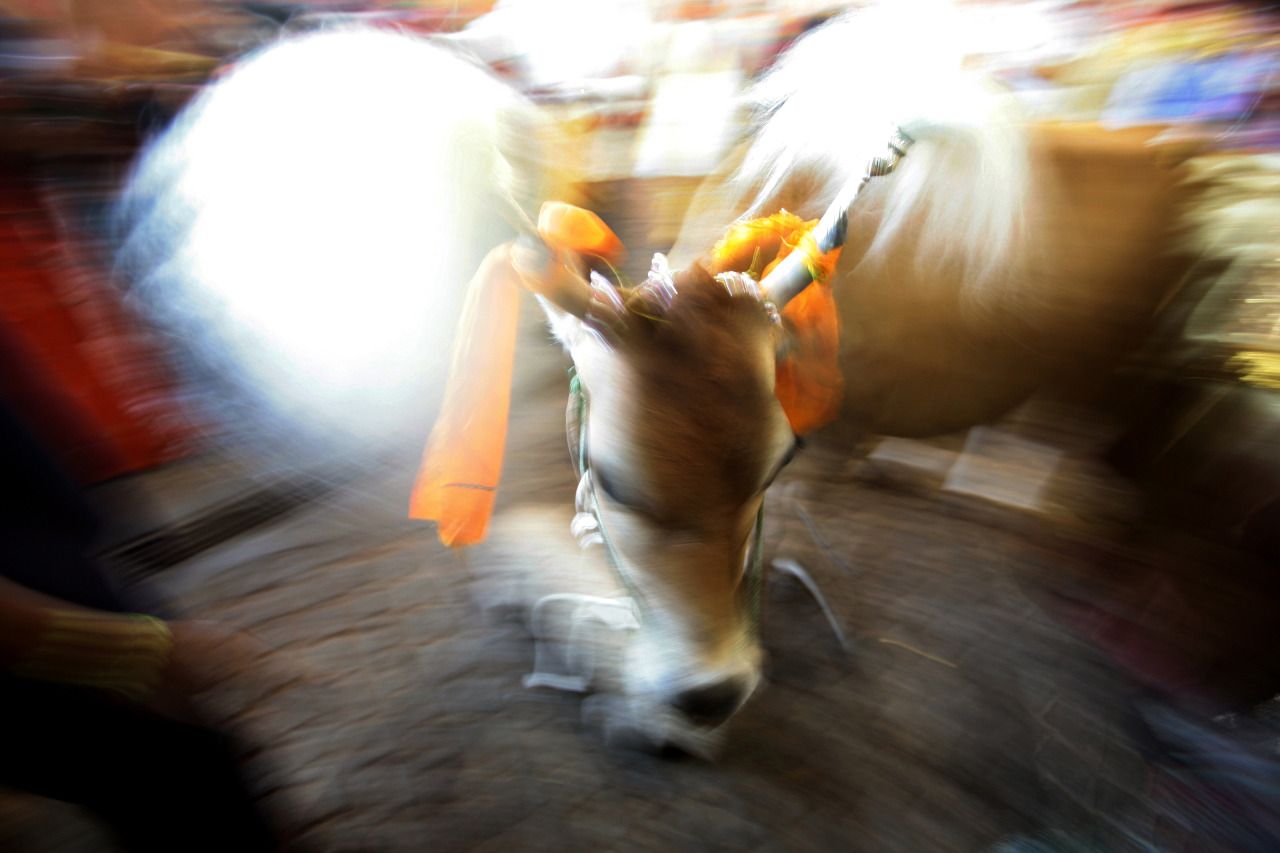
    Many Hindus have considered the humble cow a sacred animal. The cow enjoys an exalted status in society: it is worshipped, is seen as a mother who provides for the family it resides with, is thought to be divine. All this, ostensibly, for economic and social reasons. Its protection thus is a matter of ‘honor’ for many Hindus.

    Beef ban gave rise to vigilantism and pro-beef protests that began to spread across the nation. Soon cow protection groups sprang up – many of them allegedly spreading rumors against those who partake of beef -to save ‘mother cow’. This met with an equally potent and, at times, violent response.

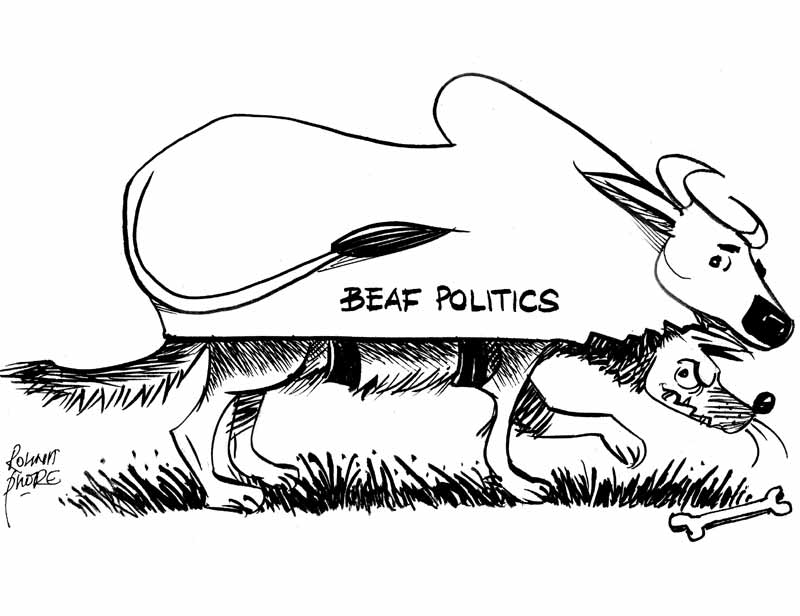
    There are doubts if the nation’s beef with beef is more an economic, cultural, legal and social argument or purely a religious dispute. Is it the way for the majority to assert itself over the beef-eating minorities? Or is it just a matter of respecting or insulting the sentiments of a large section of society?

    The cow can barely answer that. From a simple bovine it has been metamorphosed into a hardcore political symbol, a polarizing beast: a sort of a representation of the might of the majority leading to political slugfests, legal wrangles, social unrest, economic intimidation and ‘intolerance’ perceived by both sides of the divide.

    As was wont to happen, soon, in a horrific incident, a 50-year-old man in Dadri in Uttar Pradesh was lynched by a mob over rumors that he and his family were eating and storing beef at home. He was murdered and his son beaten to within an inch of his life over lies spread by goons.

    This sparked off national outrage, uniting the opposition parties against the ruling central government and igniting passionate debates, many of which were understandably political in nature.

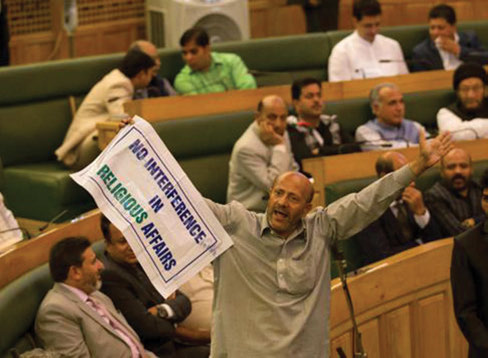
    Close on the heels of Dadri, right wing activists roughed up an independent legislator in Kashmir for hosting a beef party. In Delhi, a posse of cops raided Kerala House over the allegation that beef was being served there. It later transpired that the canteen there only offered buffalo meat and not beef. In India, the buffalo does not enjoy the illustrious standing that the cow revels in.

    In Himachal Pradesh, a young many was killed under the suspicion of smuggling cows for slaughter. Yet another man was butchered in Karnataka for opposing illegal abattoirs.

    With political opponents baying for his blood, the prime minister decided to take the bull by the horns and broke his silence over the issue. But that did not yield desired results.

    By this time, the problem had snowballed into an unmanageable controversy. Dozens of literary figures jumped in to the fray and began to return their prestigious awards, protesting against intolerance. Scientists and other intellectuals followed suit.

    Film personalities too joined the bandwagon, creating an unprecedented schism in Bollywood and adding to the shrillness of the arguments.

    While decibel levels of television debates acquired unbearable proportions and political name-calling became de rigueur, social media platforms exploded into an all-out war with pro- and anti-beef groups trading nauseating invectives and shocking threats.

    Opinion was sharply divided: those against the protests asserted that the demonstrations were all related to the then impending Bihar elections; those protesting feared that the secular fabric of India was being ripped apart.

    A defensive government had offered opposition parties an issue to disrupt parliamentary proceedings with incessantly bringing all legislation, reform and progress to a halt. Not a single day’s of business was allowed inside Parliament as lawmakers continued to pillory a beleaguered government.

    Meanwhile, all through the raging storm the ruminating cow continued to stand by with the stoicism that is a bovine hallmark.

    Whether it is the last we have heard on this is moot and can be debated till the cows come home, but that the quadruped had a huge, perhaps the biggest, impact on India in 2015 cannot be denied.


  • Intolerance in India Echoes Home and Abroad

    Intolerance in India Echoes Home and Abroad

    As a young boy I attended Rashtriya Swayamsevak Sangh (RSS) Shakhas. I loved to go there to play and wield lathi. It provided me an opportunity to prove my strength and superiority. As part of our training, we were told to be patriotic, have respect and love for Bharat Mata. At times, we were told about the superiority of Hindu religion. But I don’t think it ever occurred to me to develop a staunch Hindu view of everything.

    As I grew, I distanced myself from RSS shakhas because I did not any more find an opportunity for the kind of sport I looked for. The primitive kabaddi and wielding lathi did not attract me any more.

    A few years later in my life I found the ideology of RSS not in consonance with the liberal values that my education had imbibed me with. I was drawn more to left than to the right where I saw RSS and the political party Jan Sangh.

    The right will always remain opposed to the left. It is like the East is East and the West is West and the twain can never meet. So, I  maintained distance from the right wing  Jan Sangh and the RSS which I considered to be a  religion-based group. I could never digest the aversion of the RSS for minority religious groups, though it pleased me as a Sikh to find some of the pracharaks of the RSS eulogizing  Guru Gobind Singh for the great sacrifice he and his father made to protect Hindus from the tyranny of the Muslim rulers.

    India has always been a country which absorbed all  who arrived on its soil, much as USA has. But, of late it appears India is being sought to be taken in a different direction. And the direction is certainly  not a welcome one; certainly not the one which would  strengthen the unity of the nation. The government of the day seems to be  bent upon creating divisions  in the name of religion. Surely, we have not forgotten the number of painful  incidents of communal clashes which, besides claiming life and property, have left deep scars on the psyche of the suffering people.

    People of India and Indians abroad will have to  find ways to oppose the Hindutva agenda of the RSS and the present government. It is either the people of India and India succeed or they succeed.

    Luckily, India has a number of intelligent people who could see through the game plans of the present government. They saw danger in rationalists being killed. They saw danger in the utterances of some representatives of the party in power. They saw danger in the studied silence of the Prime Minister on the issue of growing intolerance in India. So, they protested. Writers, artists, film makers returned their awards to register their protest. Instead of trying to allay their fears and  remedy the situation, the Modi government let the party workers organize counter protests. What a government we have?

    Every time somebody spoke of intolerance, the party in power made sure to come up with a condemnation of the protest. It happened in the case of Shahrukh Khan. It happened recently in the case of Aamir Khan.

    However, the number of protesters is growing and the protests are getting louder. These have not remained confined to India; Indians abroad have also protested.

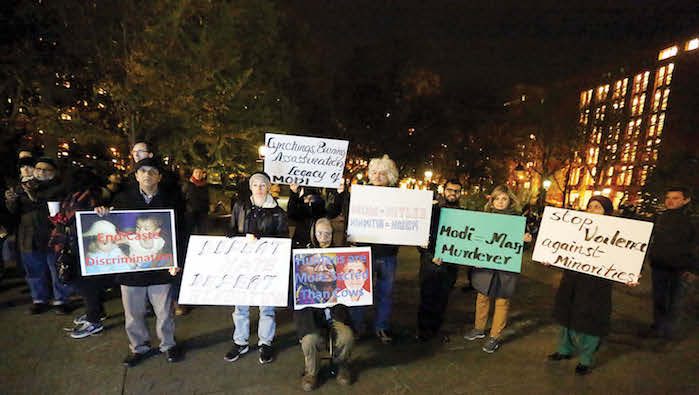
    The Alliance for Justice & Accountability held  a Public Demonstration & Candlelight Vigil on Saturday, November 14th from 3-5 pm in Washington Square Park, New York to stand in solidarity with India’s disenfranchised communities to raise their  voices to dissent the recent acceleration of killings of Muslims, Dalits, Adivasis, Christians and Sikhs.

    In USA, Indian Americans have raised their voice of protest.

    George Abraham, a former UN officer and Chairperson of Indian National Overseas Congress USA sent in his comment, which is being reproduced ad verbatim.

    “The very fact that Aamir Khan’s statement evoked so many vitriolic reactions from the Sanghis is another evidence of growing intolerance towards freedom of expression in Modi’s India. If anyone thinks that there is no anxiety among the minorities about the prevalent situation is fooling himself.

    People are getting lynched for their dietary habits, Dalit families are set on fire, NGOs like Greenpeace and Caritas International are being banned or FCNR denied, sedition charges are  being filed against human rights activists like Teesta Setalvad, eminent secular voices are silenced through murder in cases of Kalburgi and Pansare, respected writer such as Kulkarni being assaulted, cultural police raiding Bars and beating up women, 90 year old Dalit set on fire for entering the temple, another Dalit man’s hand chopped off because he was seen dining with an upper caste individual, MLAgetting beaten up in J&K Assembly building for expressing his freedom of thought on the issue of slaughter of cows and the list goes on and on.

    According to an NGO report, there were 800 incidents arising out of growing intolerance in last year alone. This is in addition to the ongoing purges in academic institutions of people with a pluralistic view, such as Amartya Sen in NalandaUniversity, who are being replaced by RSS ideologues across the board in institutions such as National Book Trust, National Film Institute, Historical Society and so forth to impose a kind of cultural hegemony based on Vedic history.

    The very fact that the current administration downplays the role Nehru has played in creating the very idea of India as we know it, is very troublesome as they are increasingly inclined to create divisions pitting one freedom fighter against the other for political ends. Yes, they have truly learned something ‘valuable’ for themselves from the British: ‘Divide and Rule’.!”

    Is the  Modi government not bothered about  the fall out of these protests on the image of India abroad? Is the Modi government not bothered about  feelings of the  minorities ? Is the Modi government not bothered  for the unity of the nation? Is the Modi government not bothered for the people of India? It would be very sad if the answer was a  “NO”.

  • Akhlaq’s son indirectly accuses BJP of Hate politics

    Akhlaq’s son indirectly accuses BJP of Hate politics

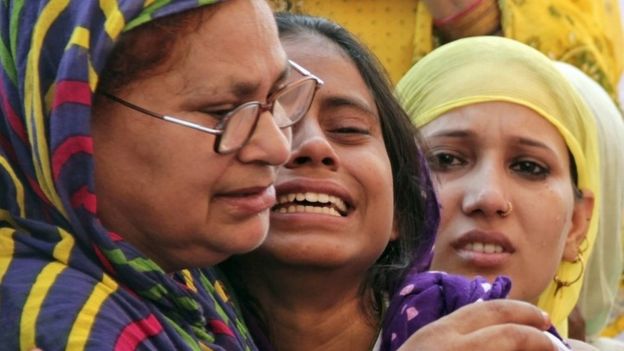
    As the Bihar poll results trickled icon Nov 08, residents of the Greater Noida village of Bisada, who had gathered around a TV set to follow the counting, spoke in one voice – that this was a verdict against the politics of hatred. Bisada is the village where Mohammad Akhlaq was lynched by a mob in September after a rumour that he had slaughtered a cow was circulated, has been living under a shadow since the attack.

    Sartaj, Akhlaq’s eldest son and a corporal in the IAF, said the Bihar verdict is a tribute to his father, that people had united against the gathering forces of communalism.

    “There’s no space for hate politics in our country. Today’s result is a tribute to my father, and against hate and communalism.

    People should realise there is no gain in fighting in the name of religion. I appeal to all politicians not to divide the country for the sake of power,” he said.

    There was a feeling of relief, as if BJP’s rout had exculpated the village of its collective guilt. Hate politics, several villagers said, had not worked in Bihar and wouldn’t in UP either.

    On normal days, Bisada gets power supply between 11 am and 3 pm and again between11 pm and 5 am. But with an unexpected power cut on Sunday, Nov 8 morning, most residents had crowded in houses of a few who have inverters or generators installed.

    An elated Bhoop Singh, 75, ex-pradhan of the village, said, “I was born, and I’ll breathe my last in this village. I’ve never experienced any communal tension in my village in all these years, as much as the recent tension after Akhlaq’s unfortunate death, which hurt me deeply.”

    He blamed politicians squarely for disturbing communal harmony. “If politicians had not visited our village, we were capable of dealing with the situation. But politicians need vote banks. The Bihar result is a slap on their faces.”

    Neighbour Om Mahesh nodded in agreement. “Killing Akhlaq was an unfortunate incident. There was no communal tension in the village even after Akhlaq’s death. But then, some politicians tried to disturb the harmony. We appeal all politicians to avoid visiting communally tense places,” he said.

    Another local Gulfaam said, “People of Bihar have given those who indulge in the politics of divide and rule a resounding defeat. Politicians are ready to put the country’s goodwill at stake for power. Such incidents dent the country’s image.”

    The obvious object of their scorn, BJP’s motormouth MLA from Sardhana, Sangeet Som, a key accused in the Muzaffarnagar riots who had visited Bisada in the aftermath of the lynching and issued several divisive statements, though, said BJP did not lose the Bihar polls due to his visit and controversial statements. “Bihar and UP differ in turfs and the people in temperament. I don’t believe my visit and statements in Bisada hampered BJP’s chances in Bihar,” he added.


  • Delhi Police raids Kerala government canteen over #BEEF causes outrage

    Delhi Police raids Kerala government canteen over #BEEF causes outrage

    New Delhi Oct 27: The canteen of ‘Kerala House’ which is run by Kerala Government in New Delhi was raided yesterday by police after a rightwing Hindu group called ‘Hindu Sena’ complained it had beef on its menu.

    Police said they only went to Kerala House as a “preventive measure”, not to investigate the complaint or take meat samples.

    Kerala is one of the few Indian states in which cow slaughter is legal. But most states, including Delhi, ban the slaughter of cows, considered sacred by India’s majority Hindu community.

    Kerala Chief Minister Oommen Chandy on Tuesday took strong exception to Delhi Police action at state-owned Kerala House in Delhi over beef served at its canteen. Chandy told the media in Kozhikode that the police should have shown restraint. “The state guest house is not a hotel. The police should have followed certain amount of guidelines while raiding a canteen at a government guest house. We would make our protest formal by writing to the Delhi government,” the Chief Minister said.

    “I would like to inform you that the Kerala House staff canteen serves authentic vegetarian and non-vegetarian Kerala cuisine and the items in the menu are entirely within law,” the letter is reported to have said.

    It is also reported that the kitchen will continue to serve the buffalo meat.

    Following Monday evening’s incident, the police picked up the caller from the Hindu Sena group for further questioning.

    “We dealt with the matter with necessary alertness and took our position. The objective was to ensure that law and order is not disrupted,” Jatin Narwal, a senior police officer, told the NDTV news site.

  • BJP MLAs IN J&K ASSEMBLY THRASH LEGISLATOR WHO HOSTED ‘BEEF PARTY’

    BJP MLAs IN J&K ASSEMBLY THRASH LEGISLATOR WHO HOSTED ‘BEEF PARTY’

    SRINAGAR (TIP): BJP legislators thrashed an independent MLA for hosting a beef party as the Jammu and Kashmir assembly grounded on October 8 opposition-backed bills aiming to overthrow a decades-old ban on cattle meat in the state.

    Lawmakers from the ruling party threw kicks and punches at Engineer Rashid a day after he reportedly served beef kebabs and patties on the lawns of the state legislators’ hostel in protest against the prohibition on cow slaughter that has triggered debates and communal concerns in parts of the country.

    Rashid said he didn’t wish to offend anyone and hadn’t broken any rules as the Supreme Court this week suspended the colonial-era beef ban under the state’s Ranbir Penal Code (RPC) for two months after separate wings of the J&K high court gave conflicting orders on the issue.

    “Nearly six to eight BJP members grabbed me and kicked and punched me,” the MLA told the media. “Is this democratic behaviour? And you expect separatists to join this assembly.”

    The Langate legislator has been in the news for leading protests against the ban and also courted controversy this month when he demanded that the remains of terrorist Afzal Guru, who was executed for his involvement in the 2001 Parliament attack, be returned to his family in the Valley.

    Amid the uproar, separate opposition bills seeking amendments to the RPC to decriminalise cattle slaughter were not taken up by the assembly on Thursday despite being listed for discussion, prompting criticism from the National Conference, Left and Congress leaders.

    Speaker Kavinder Gupta adjourned the House for the day at 1.30 pm, the schedule followed in the assembly during the current session, despite opposition leaders seeking more time to discuss the issue.

    “It seems that you have already decided to adjourn the house as the chief minister has left the House,” an angry Omar Abdullah, NC leader and former chief minister, told the Speaker. “This seems to be a way to save their chairs.

    This government is hiding behind you.”

    The beef ban controversy has emerged as a nettlesome test for the ideologically divergent PDP and BJP that tied up to form the J&K government this year after voters delivered a fractured mandate.

    “You cannot manhandle an MLA,” said chief minister Mufti Mohammad Sayeed of the PDP as he condemned the attack on Rashid.

    The incident comes against the backdrop of a raging debate across the country over cow slaughter with hardline Hindu organisations pushing for a nationwide ban and minority groups resisting the move. Last week, a mob dragged a Muslim man out of his home in an Uttar Pradesh village and bludgeoned him to death with sticks and stones over suspicions that he butchered a calf.

    The beef row snowballed in Jammu and Kashmir after a division bench of the high court instructed authorities to strictly implement the ban, an order that drew sharp reactions from separatists and several minority groups who called it “interference in religious affairs” and sought revocation of the law.

    The laws governing slaughter of cows, bullocks and buffaloes vary from state to state. Jammu and Kashmir has a 10-year jail term for flouting the ban, while many northeastern states are allowing slaughter of all three.

  • THE POLITICS OF BEEF

    THE POLITICS OF BEEF

    On Sept. 28, in a village less than 60 miles from New Delhi, a Hindu priest announced in a local temple (under threat by some hot heads, he claims) that a Muslim family was consuming beef.

    Shortly afterward, a frenzied (Hindu) mob, wielding sticks, swords and cheap pistols barged into the family’s house and pulled out Akhlaq & his 22-year-old son, Danish, accusing the family of having slaughtered a cow and consuming it. They beat the men with such rapturous fury that within minutes the father was dead and his son in a coma.

    Times cannot be treated as normal if the President of India feels the need to issue a public advisory. What can explain the inexplicable silence of the otherwise hyper-expressive Narendra Modi.

    While, leaders of the political parties have left no stone unturned in trivializing the issue. PM Modi did not issue a single tweet, nor posted a Facebook statement expressing regret or offering condolence for this dead citizen.

    The Prime Minister finds himself unable to condemn utterances of his own party leaders & ministers. Isn’t this what happened in Godhra, when Modi was the Chief Minister.

    PM Speaks – Only too little too late 

    Less than 24 hours after the President’s subtle reprimand, India’s Prime Minister did speak – Not against the murderers of Akhlaq. Not even on the provocative comments by his party men/women in Dadri. No, not even on the urgent need to put an end to beef politics. All this can wait. After all, elections in Bihar happen just once in five years.

    Its all Politics for Narendra Modi – Why else would he choose an election rally to indirectly mention the incident. What are the compulsions of Narendra Modi who has brought to his party 284 seats in the Lok Sabha?

    Why Laloo alone comes to his mind; and people like Mahesh Sharma, Sanjeev Balyan, Sakshi Maharaj, Yogi Adityanath, Sangeet Som, Azam Khan and AIMIM leader Assaduddin Owaisi are allowed to get away with their shameless statements?

    Akhlaq’s family members can wait. And the President of India should learn to wait. Prime Minister of India is busy consolidating his position. And for this he must win Bihar. India’s core civilizational values can wait too

    While only hinting on the raging row over the Dadri lynching incident, Prime Minister Narendra Modi said Hindus and Muslims should decide whether to fight each other or together overcome poverty while asking the people to ignore “irresponsible” statements of politicians.

    Its to be noted that the above statement comes at his 4th Bihar election rally this week and that too after blowing all the jibes on the beef row towards BJP opponents like Laloo.

    “The country has to stay united,” Modi asserted. “I have said it earlier also. We have to decide whether Hindus should fight Muslims or poverty. Muslims should decide whether to fight Hindus or poverty,” he added.

    The silence does not douse flames, it fans conspiracy theories

    Adding Fuel to the Fire – Our Politicians whom ‘WE’ elected

    Why are these shallow leaders not expelled? Every time a party has been questioned, their answer has been simple -point fingers at the other parties.

    Outrageous Things Leaders Have Said – For the record, BJP leads here. 

    Mahesh Sharma 

    Modi’s Culture Minister & BJP Leader Mahesh Sharma, a moral idiot recently opined that India’s late President Abdul Kalam was patriotic “despite being a Muslim,” and dubbed the vicious beating an “accident.” He consoled the family by noting that at least the 17-year-old daughter of the slain man was untouched!

    Azam Khan
    Uttar Pradesh minister Azam Khan took one step further and wrote to United Nations on the condition of Muslims in India.

    He goes on further to hint on a new partition of India, “There should be a round table conference on what will be the new map of India and how people will live in the country” and “Aaj poori duniya dekh rahi hai ki Babri se le ke Dadri tak ka mansooba kya tha”.

    He clubs the incident with the demolition of Babri Masjid to harness the power of hatred.

    Sangeet Som 

    BJP MLA Sangeet Som, infamous for making controversial speeches during the 2013 Muzaffarnagar riots & one of the accused, declared, “Agar nirdoshon ke khilaf karyawahi ki gayi, to munh-tod jawab hamne pehle bhi diya hai aur abh bhi dena jante hain (If action is taken against innocent, we have given a befitting reply earlier and can do so again). We can give a reply whenever we want.” He made this statement at a temple on the outskirts of Bisara, near where the incident occurred.

    Asaduddin Owaisi

    “This murder was premeditated. He has been killed in the name of religion. It is an attack on our community. It cannot be an accident. All of this is being propagated by the state and central governments,” Owaisi says. The Hyderabad MP also questioned Prime Minister Narendra Modi’s silence on the killing. “This mother has seen her son getting beaten to death in front of her. Where are his condolences?”

    Owaisi also slammed Union Minister Mahesh Sharma for describing the killing in the Dadri village as “an accident”. “He is the country’s Culture Minister. It is unfortunate that a minister who has taken an oath on the Constitution does not have the courage and intellectual honesty to condemn the incident unconditionally.”

    Tarun Vijay 

    BJP MP Tarun Vijay said, it wasn’t the Hindu community’s responsibility to maintain peace and the Muslim community should remain mute.

    “Why responsibility to keep peace and maintain calm is always put on the Hindus alone? Be a victim and maintain silence in face of assaults!!” tweeted the former editor the Rashtriya Swayamsevak Sangh (RSS) weekly in Hindi, Panchajanya.

    Muslims & Minorities in India – whatever the politicians may think – have a right to live with their heads held high as anyone else. They cannot & must not be ‘dumped’ or ‘subdued’.

    As Indians we need to fix our dysfunctional democracy. The idea of democracy cannot begin and end with elections alone. Until then we will continue to lose lives like Mohammad Akhlaq’s because of let’s call it “the politics of food “.

    Is anyone there listening???

  • Ban this, ban that – Intolerance growing in BJP-RSS regime

    Ban this, ban that – Intolerance growing in BJP-RSS regime

    Days after Prime Minister Modi warned the judiciary of dangers posed by five-star activists, the Union Home Ministry cut off foreign funding to Greenpeace for “campaigning against government policies” and “obstructing India’s energy plans”. Among the reasons cited for the ban is Greenpeace activists “holding talks” with the Aam Aadmi Party. Foreign money is welcome for pollution-causing industries but not for raising a voice to protect the forests, the environment or human rights. Swift green clearances for projects are seen as an achievement by the minister who is tasked with safeguarding the country’s environment and natural resources.

    Take Maharashtra. Union Minister of State for Agriculture Mohanbhai Kundaria told the Rajya Sabha recently that 135 farmers killed themselves in the first 58 days of this year in the state’s Aurangabad division.  That is not what worries the BJP government. It is devoting its time and resources to enforcing a ban on beef and promoting Marathi films. Most Indians do not approve of cow slaughter and will like the government to provide for adequate cow sheds. Cows become a financial liability once they stop yielding milk. What should farmers, barely making two ends meet, do? And those who survive on beef business? The state high court rightly asked the government how it could extend the ban to other states by stopping people from eating beef produced there. The Devendra Fadnavis government not only wants to decide what people should eat but also what films they should watch. Multiplexes have been forced to show Marathi films at prime time. When writer Shobhaa De protested against such “dadagiri”, cultural extremists ganged up to gag her.

    As if the censor board was not giving enough trouble to filmmakers, the SGPC has started demanding bans on films it disapproves of. Fanatics want to decide what people should wear, watch, read and even which religion they should follow, threatening in the process the very foundations of a secular, liberal India. Intolerance is growing in Modi raj and targets are clear. Anyone who opposes what the government is doing or the religious/cultural agenda it is patronising puts himself at risk.

  • BJP’s Goa CM opposes beef ban

    NEW DELHI (TIP): BJP-ruled Goa would not ban beef as it is an essential part of the cuisine of minority communities in the state, chief minister Laxmikant Parsekar told ET, adding that it had taken several years for his party to earn the trust of the state’s Christians and Muslims.

    “Regardless of what the Centre does -in Goa minorities are 3940% -if it is part of their food habits, why and how can we ban it? For people -especially minorities -eating beef is part of their food,” said Parsekar. The Goan CM’s comments assume significance as it comes days after Maharashtra and Haryana imposed blanket bans on beef. The move had also triggered speculation that the BJP-led Central government could be considering a nation-wide plan to ban beef distribution and consumption.

    Parsekar, a former state-level functionary of RSS, said that he is also conscious about the sentiments of a section of Hindus concerning slaughter of cows.

    “Sentiments are hurt with regards to killing cows, not in the case of oxen or bulls. We don’t permit killing of cows, and even oxen are not killed there (in Goa) now. It (beef) is brought from Karnataka and sold here, which we allow since it is a part of cuisine of Catholics and Muslims, and I feel it should not be banned,” he said.

    The Goa CM also felt that there was a concerted effort from some quarters, including media, to paint BJP as antiminority by blaming the recent attacks on churches on the party. Such incidents are happening even in states where BJP is not in power, but the party is being blamed, he said.

    Parsekar said the BJP managed to grow “gradually” and achieve a full majority government for the first time in the state because of it having “build confidence” among the minority community.

    “In fact, we favour the minorities,” he said, adding, “In Goa, we are always one step ahead (in reassuring the minority community). We favour the minorities -whether it is for (setting up their) institutions or any other help. For your information, exposition of the holy relics of Saint Xavier’s was organised this year. We spent a lot of money for raising infrastructure for that event. It went on for 45 days and 46 lakh people arrived from the world over. We had put up a secretariat comprising top officers for monitoring the event and spent more than Rs 50 crore at the campus.”