Tag: Hemant Gupta

  • Expression of view which is dissent from government not seditious: SC

    Expression of view which is dissent from government not seditious: SC

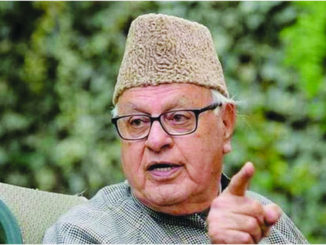
    New Delhi (TIP): Observing that expression of a view which is dissent from a decision taken by the Central Government itself cannot be said to be seditious, the Supreme Court on Wednesday dismissed a PIL seeking action against National Conference president Farooq Abdullah over his comments on abrogation of Article 370 of the Constitution. A bench of Justices Sanjay Kishan Kaul and Hemant Gupta rejected the plea and also imposed a fine of Rs 50,000 on the petitioners for making such claims and directed them to deposit the amount with the Supreme Court Advocates Welfare Fund within four weeks. “The expression of a view which is dissent from a decision taken by the Central Government itself cannot be said to be seditious. There is nothing in the statement which we find so offensive as to give a cause of action for a Court to initiate proceedings. “Not only that, the petitioners have nothing to do with the subject matter and this is clearly a case of publicity interest litigation for the petitioners only to get their names in press. We must discourage such endeavours,” the bench said.

    The top court was hearing a plea which referred to his statement on restoring Article 370, which gave special status to Jammu and Kashmir, and contended it clearly amounts to a seditious act and therefore he is liable to be punished under section 124-A of the IPC.

    The petition filed by Rajat Sharma and Dr Neh Srivastava, both belonging to an organisation Vishwa Guru India Vision of Sardar Patel, alleged that the former chief minister is trying to “hand over” Kashmir to China and thus, he should be prosecuted for Sedition.

    “Mr Farooq Abdullah has committed an offence punishable under section 124-A of Indian Penal Code. As he has made the live statement that for restoring Article 370 he would take help of China which clearly amount to seditious act and therefore he is liable to be punished under section 124-A of the IPC,” the plea said.

    The petitioners also referred to a statement made by BJP spokesperson Sambit Patra to claim that Abdullah is misleading the people of Jammu and Kashmir to join China for the restoration of Article 370 of the Constitution.

    Source: PTI

  • Dissent is not sedition

    Supreme Court lays down norm; time to erase colonial-era law

    The Supreme Court of India deserves unreserved praise for its decision to dismiss a sedition petition against former Jammu and Kashmir Chief Minister Farooq Abdullah with a fine of Rs 50,000. The Bench of Justices Sanjay Kishan Kaul and Hemant Gupta has laid down a much-needed norm when it ordered that dissent is not sedition. Unfortunately, the colonial-era law, which says that ‘whoever by words, either spoken or written, or by signs, or by visible representation or otherwise brings or attempts to bring into hatred or contempt, or excites or attempts to excite disaffection towards the government shall be punished with imprisonment for life’, still remains as Section 124 A of the Indian Penal Code. None of the founding fathers or the subsequent liberal governments found this vague and draconian provision distasteful enough to get it removed from the statute book. Hence, the constitutional court’s order assumes the status of a touchstone for the legality of the application of 124 A.

    The learned judges have made it clear that dissent or disagreement with the decisions of the Central government is not sedition. So, Disha Ravi and Farooq Abdullah cannot be prosecuted simply because they do not agree with the government on farm laws or the abrogation of Article 370. There is no democracy without dissent and debate. The court has correctly identified the petitioners’ attempt as ‘publicity interest litigation’, and by imposing the fine it has sent a cautionary message out to frivolous and politically motivated litigants. That the order came the very same day a Washington-based think tank, Freedom House, downgraded India’s status from ‘free’ to ‘partly free’ points to two conflicting facets of India’s present-day predicament. While our institutions try to remain free, there is an attempt by those like the petitioners in the Abdullah case to make the country ‘partly free’ by gagging dissent using those very institutions. The government should ensure that its image does not get sullied any further by its police or vigilante groups, and it is in its interest to showcase India’s free media and all other democratic institutions.

    (Tribune, India)
