New Delhi (TIP)-On a petition linked to the hijab row raging in Karnataka, the Supreme Court on February 11 rejected an urgent hearing and said, “We will interfere only at an appropriate time.”
A girl in Karnataka had approached the Supreme Court after the High Court yesterday advised students to avoid wearing “religious garments” until it decides on a case involving hijab restrictions in schools and colleges.
“Don’t spread these things to a national level. We will interfere only at an appropriate time,” Chief Justice NV Ramana said, declining an urgent hearing on the petition.
When a lawyer pressed the court to take it up, arguing that the case had “far-reaching implications” and that students had been wearing the hijab or head scarf for 10 years, the Supreme Court remained firm.
“Please do not spread it to larger levels. we know what is happening. Think over, is it proper to bring these things to Delhi? The national level? If there is anything wrong, we will protect…” Chief Justice Ramana said.
The girl’s petition had challenged the Karnataka High Court’s remarks that educational institutions in the state can open for now but with no religious clothing on campus, for the sake of peace.
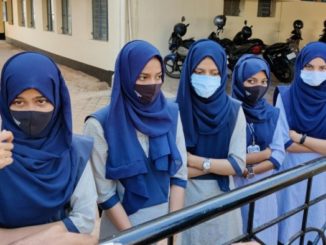
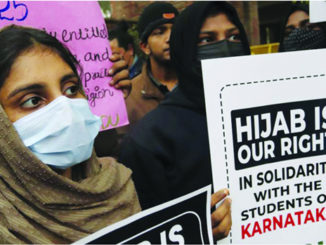
Schools and colleges were shut down earlier this week in an escalating row over hijab restrictions in class. The protests that began against a hijab ban in one government-run college in Udupi spread to many other institutions where girls wearing hijabs were not allowed entry. As saffron scarf-wearing students launched rival protests, violence at one college forced the police to fire teargas to control the flare-up.
The Karnataka High Court is hearing a petition challenging hijab restrictions in colleges. Yesterday, a three-member bench said it would resume the hearing on Monday.
The student who has challenged the High Court’s comments says in her appeal to the Supreme Court that practical exams begin on February 15 and “any interference on students’ access to educational institutions will impede their education”.
She argued that wearing the hijab is within the constitutional right of expression, right to privacy and “Freedom of Conscience”, so the High Court order violates the constitution.
“The government has issued an order thereby denying entry to the Muslim Women wearing Hijab in the educational institutions. The impugned order creates an unreasonable classification between the non-Muslim female students and the Muslim female students and thereby is in straight violation of the concept of secularism which forms the basic structure of the Indian Constitution. The impugned order is also in sheer violation of Articles 14, 15, 19, 21 and 25 of the Indian Constitution and also violates the core principles of the International Conventions that India is a signatory to,” her appeal to the Supreme Court said.
The Supreme Court had yesterday refused to take up another petition, filed by student Fathima Bushra, challenging the Karnataka government’s order last week banning clothes which it said “disturb equality, integrity and public order”.
“In the event of the administrative committee not selecting a uniform, clothes which disturb equality, integrity and public law and order should not be worn,” the Karnataka government’s order had said.
As Congress leader Kapil Sibal, a senior lawyer, urged the Supreme Court to take up Fathima Bushra’s petition, saying the issue is “spreading across the country”, Chief Justice Ramana had said: “We will see.” Source: NDTV
NEW DELHI (TIP): The Supreme Court on Friday, February 11, refused to intervene in the Karnataka hijab controversy, saying “We will take it up at an appropriate time.” “You should think if such issues should be brought at the national level,” a Bench led by CJI NV Ramana told senior advocate Devdatt Kamat.
Seeking to challenge the Karnataka High Court’s interim order restraining students from wearing religious dress till it decided the issues arising out of the hijab controversy, Kamat urged the top court to take up the matter on Monday.
But the CJI refused to oblige him. “We are also watching what’s happening in the state… Constitutional rights are for everybody, and this court will protect it. We will list at appropriate time,” the CJI said.
Solicitor General Tushar Mehta opposed Kamat’s submission, saying the issue shouldn’t be politicized. The high court order was not available, he pointed out.
One of the advocates pointed out that examinations were scheduled to commence from February 15 and the petitioners had to choose between the examinations and their faith. But the Bench wasn’t impressed.
This is the second time in as many days that the top court has refused to intervene.
On Thursday, February 10, senior advocate Kapil Sibal had urged CJI Ramana to take up a petition filed by Fatima Bushra – a student of Government PU College, Udupi – in view of its pan-India ramifications.
“The problem is that schools and colleges are closed…Girls are being stoned. It’s spreading across the country,” Sibal had said.
“Please wait…let the high court decide… They’re hearing it,” the CJI had told Sibal, refusing an urgent listing.
After hearing the matter on Thursday, a three-judge Bench led by Karnataka High Court Chief Justice Ritu Raj Awasthi had asked students not to go to educational institutes in religious dress.
“It’s a matter of a few days. Please cooperate, Chief Justice Awasthi had said, posting the matter for Monday. “We will restrain everyone from adopting religious practices while we are hearing…But till the matter is pending consideration…these students and all the stakeholders shall not insist on wearing religious garments, may be headdress or saffron shawl. We will restrain everyone. Because we want peace and tranquility in the state,” the high court had said.There are three petitions filed in the top court. The petitioners have contended that despite the freedom of conscience and the right to religion guaranteed by Article 25(1) of the Constitution, she and other girl students were not allowed to wear hijab.
They said there was a direct infringement of fundamental rights and also as events are happening in multiple states and likely to spread further, it would be better and proper that the apex court took cognizance of the issue.
They wanted the top court to decide the issue to avoid conflicting decisions by different high courts.
“The confrontations being organized, and divisions created among the youth at a time when lakhs of students have suffered a loss of education because of online learning which they could not access, is nothing short of criminal. What is being played out is the open and blatant promotion of the Hindutva agenda extended to educational institutions. The Corona pandemic is being replaced by the communal pandemic, a virus created in the laboratory of the Hindutva forces, leading to a lockdown of educational institutions, ruining the lives of young people.”
There is nothing controversial about Muslim girls wanting to wear a headscarf, referred to (incorrectly) as a “hijab”. But describing the happenings in BJP-ruled Karnataka as the ” hijab controversy” is misleading. It is nothing of the kind. It is an outright assault on the right to education of young Muslim women, guaranteed to them by the law and the Constitution of India. It is significant that even the National Human Rights Commission, thought to be pro-government under its new chief, issued notice to the district authorities in Udipi on January 27after it received a complaint stating ” Facts of the case are disturbing. The allegations made in the complaint are serious in nature involving ‘Right to Education’. The case therefore involves grave violation of human rights of the victim students.”
It is thus very disappointing that the single bench of the Karnataka High Court did not grant an interim stay against the Karnataka government’ s wholly unwarranted and misconceived order of February 5 which has jeopardized the future of hundreds of young Muslim women studying for their final Class 12 exams scheduled in just two months. The order wrongly invokes Section 133 (2) of the Karnataka Education Act, 1983, to state that students have to wear the dress chosen by the college Development Committee or the Appellate Committee of the Administrative Board of Pre-University Colleges, which come under the Pre-University Education Department. In the event of the Administrative Committee not selecting a uniform, “clothes which disturb equality, integrity and public law and order should not be worn. ” The use of this particular section 133(2) is itself questionable since it permits direct intervention by the state government in matters pertaining to ” development of education.” Uniforms surely do not fit into this category.
The intent of this dubious phrasing is clear enough. In Karnataka, College Development Committees are headed by the elected MLA of the area in which the college is located. The PU college in Udipi district, where the issue first started, is headed by the BJP MLA on whose watch the decision was taken to impose the ban on entering campuses for girls wearing headscarves, even though the college has no such rules against the wearing of a headscarf. The Bajrang Dal Udipi district secretary Surender Koteshwar warned that “If the college allows students to wear hijab on campus, they would make all Hindu students put on saffron shawls inside the campus.”
He put this plan into action with government patronage. First, the government, through its network of non-state actors like him and the Bajrang Dal mobilized aggressive young men wearing saffron scarves as a counter, then it allowed them to march to colleges where Muslim girls were being shut out at the gates, its police forces standing by as spectators as girls were heckled and harassed, and then, in the name of being “even-handed”, it issued an order which in effect held that the headscarf could cause a public law and order problem and was therefore prohibited, whether the college had such a rule or not. In fact, another college, the Bhandarkars Arts and Science Degree College, which is also in the Udipi district, had permitted girls to wear headscarves and specified that the coloring should be the same as the dupatta. But today, in spite of this rule, girls are being kept out of this college. Is this not blatantly unfair? This kind of targeting of Muslim girls leads to a counter-response among the community, and wearing a headscarf becomes a symbol of protest even for those who never wore one. This is also what we see developing in Karnataka. In such a situation, the grounds are laid for extremist Muslim organizations who are not in support of women’s freedom to promote their fundamentalist ideology.
It is being presented as if the very concept of a uniform in educational institutions is being opposed by the girls. The Karnataka Education Minister BC Nagesh stated, ” I have appealed to all these students to honor the uniform prescribed by the government. I am also making it clear that those who want to defy the government’s school uniform regulations cannot enter their schools and attend classes. ” Muslim girls are wearing the prescribed uniform. They are, in addition, covering their heads with a headscarf. They are not replacing their uniform with a burkha. They are not using a veil to cover their face. When boys of the Sikh religion wear turbans. are they defying the government’s orders on uniforms? Are there any rules anywhere in India which prevent a Sikh boy or girl from covering their head? Why should there be double standards? No one is against uniforms in educational institutions. There is no defiance of uniform regulations in the case of a Muslim girl wearing a headscarf.
The contention that this could be a law and order issue is absurd. All these years, it has never been a public law and order problem anywhere in Karnataka or indeed, India. In neighboring Kerala, Muslim students may if they choose, wear a headscarf. Many choose not to. There is no compulsion either way. There has been no law and order problem created by girls wearing headscarves in Kerala. It is a state which has the highest literacy rate among Muslim women and also the highest enrolment of Muslim girls in higher secondary schools. The reference to public order in the Karnataka government directive is deliberate. Article 25 of the Constitution states “(1) Subject to public order, morality and health and to the other provisions of this Part, all persons are equally entitled to freedom of conscience and the right freely to profess, practice and propagate religion.” By bringing in the issue of public order, the government is building a case that its stand is protected by the Constitution since in this case ” the right to profess, practice and propagate religion” is leading to a problem of public order.
There is a specific case dealt by the Kerala High Court (Amnah Bint Basheer vs CBSE 2016) which has held that wearing a headscarf and long sleeves for a Muslim woman is “an essential religious practice” which has the protection of Article 25. The case concerned a Muslim female candidate who was offended by the CBSE dress code stipulating short sleeves for women and no head covering on the grounds that it violated her fundamental rights under Section 25. The court upheld her objection since the CBSE directive was to prevent the smuggling in of materials to cheat and was not connected to public order or morality. However, the judgement also instructed the candidate to subject herself to physical inspection by CBSE-appointed authorities. Thus, the integrity of the examination process was protected, as also her fundamental right. Earlier as well in 2015 in another case (Nadia Raheem vs CBSE), the court had upheld the petition of two Muslim female candidates to wear a head scarf and long sleeves on grounds of religious belief. The court noted that in a country with many religions and diverse customs, it cannot be insisted that a particular dress code be followed failing which a student would be prohibited from sitting for the examinations. In this case too, the court directed the candidate to subject herself to physical inspection to address CBSE’s concerns. It is to circumvent the implications of these judgements that the Karnataka Government has deliberately created a public law and order problem as a fait accompli before the court hearings.
The focus should surely be on extending the right to education to more and more children. Girl students suffered disproportionately during these two years of online classes. According to the Right to Education Forum. ten million girls in India could drop out of secondary school due to the COVID-19 pandemic. A Karnataka survey, conducted by the Department of Rural Development and Panchayat Raj, whose findings were submitted to the state’s High Court in July 2021, found that 1.59 lakh children in rural Karnataka did not go to school. Yet this government is forcibly preventing girls from attending school, pushing a narrow agenda. It would seem that these Muslim girls are to be excluded as betis – daughters- in the” Beti Bachao, Beti Padao” slogan of the government.
It is a tragedy to see young people’s emotions being manipulated so cynically by these forces. The confrontations being organized, and divisions created among the youth at a time when lakhs of students have suffered a loss of education because of online learning which they could not access, is nothing short of criminal. What is being played out is the open and blatant promotion of the Hindutva agenda extended to educational institutions. The Corona pandemic is being replaced by the communal pandemic, a virus created in the laboratory of the Hindutva forces, leading to a lockdown of educational institutions, ruining the lives of young people.
(The author is an Indian politician)
(Source: Wire)
Signup to our Newsletter!
Don’t miss out on all the happenings around the world