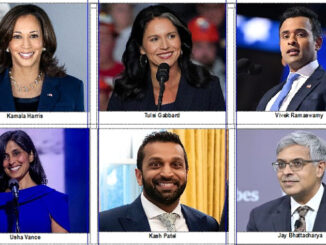
America went to polls this year, and chose its former president and Republican Donald Trump 47th President. The election was preceded by an entire year of campaigning, and a neck-and-neck competition between the Democrats and the Republicans. As Democrat nominee and US Vice-President Kamala Harris and Trump vied for the White House, India became the talk of the election.
With 2.6 million eligible Indian-American voters — according to data from the Carnegie Endowment for International Peace — the Indian diaspora’s growing political significance was felt in key US swing states. These states, which were won by Trump, accounted for a significant number of Indian-American votes.
Data suggested that there was a shift in the attitude of US voters of Indian origin this year. A large number of them shifted from Democratic Party to Republican Party in this election.
Indian-Americans didn’t just leave a mark by casting their votes though. They were also seen making headlines across both popular political parties in the US. From Presidential contenders of Indian origin to several top leaders with India connection, India came in the spotlight.
As this year comes to an end,we recap how politicians of Indian origin made waves in the US Presidential election.
Kamala Harris
She is no stranger to the world. Harris made global headlines in 2020 when she was chosen by Joe Biden as his running mate during his Presidential campaign. She became the first woman in America’s history to sit on the Vice President’s chair, and also the first person of Indian descent to occupy a top position in the US. Harris’s mother, Shyamala Gopalan, was a revered Indian-American scientist who had migrated to the US from India at the age of 19. Her Jamaican-origin father, Donald Jasper Harris, is an economist and professor at Stanford University. During her Presidential campaign, Harris prominently shared her memories of her mother. Harris conceded defeat on November 4, 2024, but her Presidential bid gave prominence to India in the US.
Tulsi Gabbard
Born in Hawaii, Tulsi Gabbard is not of Indian origin but has a connection with India due to her Hindu religion. It was her name and identity as a Hindu that confused people the world over about her origin. Gabbard has been a Congresswoman for decades, since she won her first election in 2002. It was earlier this year that she made headlines for quitting the Democratic party to back Trump. In November, Trump chose her as Director of National Intelligence. The rise of Tulsi in the American politics also brought to light her Hindu religion.
Vivek Ramaswamy
Biotech entrepreneur Vivek Ramaswamy came to prominence when he challenged Trump as a Republican contender for President earlier this year. A 39-year-old politician with roots in Kerala, Ramaswamy holds a degree in Biology from Harvard University and a law degree from Yale Law School. A staunch follower of Hinduism, he is set to co-lead a new initiative aimed at reducing government bureaucracy. Alongside tech mogul Elon Musk, Ramaswamy will head the Department of Government Efficiency (DOGE).
Usha Vance
Usha Chilukuri Vance is set to make history as the first Indian-origin Second Lady of the United States. The wife of Vice President-elect JD Vance, Usha came to the global spotlight when she introduced her husband at the Republican National Convention in July this year. Born to Indian immigrant parents in San Diego, Usha married Vance in 2014 in a Hindu ceremony. She had built a career as a litigator before leaving her job to support her husband as he transitioned to politics from the world of practising law. When Trump chose JD Vance as his running mate, Usha’s life, beliefs and Indian connection were widely covered in the media.
Kash Patel
Kashyap “Kash” Patel, a former federal prosecutor and a trusted ally of Trump, has been named Director of the Federal Bureau of Investigation (FBI). Patel, born in New York to Indian-origin immigrants from Uganda, rose to prominence for his work on intelligence reform and national security during Trump’s first term. Kash as the FBI head is a very polarising choice by Trump since Kash is seen as a bold man out to reform the FBI and purge it of deep state actors. His name drills fear amiong top Republican leaders and deep state actors just as he is hugely popular among Trump fanbase due to his vow to dismantle the deep state.
Jay Bhattacharya
Kolkata-born Jayanta “Jay” Bhattacharya, a renowned health policy expert and Stanford University professor, has been appointed Director of the National Institutes of Health (NIH), the US ‘s leading medical research agency. Bhattacharya, known for his controversial stance against covid restrictions, has advocated for policies focusing on individual liberty in public health. The eminent epidemiologist was censored by social media platforms, allegedly at the behest of the Biden adminsitration, for his contrarian stance on the pandemic restrictions. As the new NIH Director, Bhattacharya will oversee a budget of nearly $47.3 billion.
Harmeet Kaur Dhillon
Republican lawyer Harmeet Kaur Dhillon has been nominated by Trump as the Assistant Attorney General for Civil Rights. She became an influential figure in the Republican Party for filing lawsuits over election integrity issues and backing Trump’s legal efforts to overturn Presidential election results in 2020. She also filed lawsuits against covid restrictions. She was a legal adviser on the Trump 2020 campaign. Born in Chandigarh, Dhillon found her own law firm in San Francisco.
Odisha’s history, culture, tradition, and architecture are intertwined in a rich tapestry that reflects its ancient glory and resilience. From the grandeur of the Kalinga Empire to the magnificence of the Jagannath Temple and the artistic finesse of Odissi dance, the state stands as a testament to India’s diverse heritage. Odisha’s political history, marked by conquests, colonial rule, and modern progress, adds depth to its narrative. As a land of spirituality, art, and history, Odisha continues to inspire and captivate people from all over the world, earning its rightful place as the cultural soul of India.
Odisha, located on the eastern coast of India, is a land of timeless heritage, magnificent architecture, rich cultural traditions, and a fascinating political history. Known as the “soul of India,” Odisha has been a cradle of civilization, art, and spirituality. With its ancient temples, vibrant festivals, and storied past, the state beckons travelers, historians, and cultural enthusiasts alike. This article explores Odisha’s glorious history, cultural riches, architectural marvels, and political evolution over the centuries.
Ancient History of Odisha
Early Human Settlements
The history of Odisha dates back to prehistoric times, with evidence of human settlements as early as the Stone Age. Excavations at sites like Kuliana and Mayurbhanj indicate that the region was inhabited by early human societies practicing rudimentary agriculture and crafting tools.
Kalinga: The Ancient Name of Odisha
In ancient history, Odisha was known as Kalinga. It gained prominence as a powerful kingdom that played a significant role in Indian politics, trade, and culture.
The Kalinga region stretched across modern Odisha and parts of Andhra Pradesh. The first recorded mention of Kalinga appears in Mahabharata and Jain texts.
The Kalinga War (261 BCE)
One of the most defining moments in Odisha’s history was the Kalinga War fought between the Mauryan emperor Ashoka and the Kalinga kingdom in 261 BCE. The war was brutal, with massive casualties. However, its aftermath marked a turning point in Indian history. The devastation of the war led Ashoka to embrace Buddhism, promoting peace, compassion, and non-violence. The war’s significance is captured in Ashoka’s inscriptions at Dhauli and Jaugada.
Maritime Trade and Cultural Exchange
During ancient times, Odisha’s coastline facilitated extensive maritime trade with Southeast Asian countries like Java, Sumatra, Bali, and Sri Lanka. Traders and sailors from Kalinga established cultural and commercial ties, leading to the spread of Indian art, architecture, and religion, especially Buddhism and Hinduism.
Rich Cultural Heritage
Odisha’s culture is a harmonious blend of tradition, spirituality, art, and festivals, which have been preserved for thousands of years.
Performing Arts
Odissi Dance
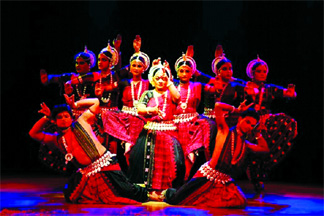
Odisha is the birthplace of Odissi, one of the eight classical dance forms of India. With its roots in ancient temple rituals, Odissi is characterized by graceful movements, expressive gestures, and intricate footwork. Dancers use mudras (hand gestures) to convey stories from Hindu mythology.
Folk Dances
Odisha boasts a variety of folk dances like Chhau, Sambalpuri, and Ghumura, each reflecting local traditions and cultural vibrancy. The Chhau dance, particularly from Mayurbhanj, combines martial arts and folk elements.
Music
Odisha has a rich musical tradition rooted in Odissi Sangeet, which is a form of classical music. The music, often accompanied by instruments like the veena, mardala, and bansuri, complements Odissi dance performances and devotional songs.
Festivals
Odisha’s festivals are colorful and deeply rooted in spirituality:
Rath Yatra
The annual chariot festival at the Jagannath Temple in Puri is one of the largest religious gatherings in the world.
Durga Puja
Celebrated with grandeur across the state, Durga Puja marks the victory of good over evil.
Bali Yatra
This festival commemorates Odisha’s ancient maritime connections and is celebrated on the banks of the Mahanadi River.
Makar Sankranti and Nuakhai
These harvest festivals celebrate agrarian traditions and community bonding.
Handicrafts and Textiles
Odisha’s artisans are renowned for their craftsmanship:
Pattachitra
Traditional scroll paintings depicting mythological themes and intricate designs.
Applique Work
Pipili appliqué craft, often seen during temple festivals, involves colorful fabric cutouts stitched onto cloth.
Ikat Weaving
Odisha’s handwoven Ikat sarees from Sambalpur and Sonepur are globally acclaimed.
Stone Carving
The art of stone carving, seen in Odisha’s temples, continues to thrive.
Architectural Marvels
Odisha is home to some of India’s most impressive architectural treasures. The state’s architecture reflects its religious and cultural history, particularly influenced by Hindu, Jain, and Buddhist traditions.
Temples of Odisha
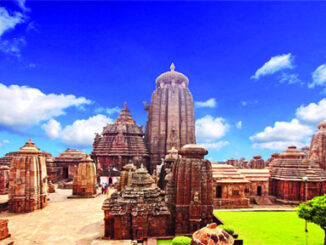
The temples of Odisha are a testament to the state’s rich architectural heritage. Built primarily during the Kalinga period, these temples follow the Kalinga style of architecture, characterized by curvilinear spires, intricate carvings, and spacious courtyards.
Lingaraj Temple (Bhubaneswar)
Built in the 11th century, this temple is dedicated to Lord Shiva and represents the zenith of Kalinga architecture. The sanctum, tower, and carvings display exceptional craftsmanship.
Jagannath Temple (Puri)
One of the Char Dhams of Hindu pilgrimage, the Jagannath Temple is dedicated to Lord Jagannath (a form of Vishnu). Its massive structure and annual Rath Yatra attract millions of devotees.
Konark Sun Temple
A UNESCO World Heritage Site, the Konark Sun Temple is shaped like a colossal chariot with intricately carved stone wheels, pillars, and sculptures. Built in the 13th century by King Narasimhadeva I, it remains a masterpiece of Kalinga architecture.
Mukteshwar Temple
Known as the “Gem of Odisha Architecture,” this 10th-century temple is renowned for its exquisite carvings and arched gateway.
Buddhist Monasteries and Stupas
Odisha has a rich Buddhist heritage reflected in its ancient stupas and monasteries:
Ratnagiri, Udayagiri, and Lalitgiri
Known as the Diamond Triangle of Odisha, these sites contain remains of stupas, monasteries, and sculptures from the Buddhist era (7th-12th centuries CE).
Dhauli
The site where Ashoka embraced Buddhism after the Kalinga War, Dhauli houses the Shanti Stupa (Peace Pagoda).
Forts and Palaces
Barabati Fort
Located in Cuttack, this 14th-century fort was a prominent military stronghold during the medieval period.
Chilika Lake and Kalijai Temple
Though not an architectural site, the Kalijai Temple on Chilika Lake is a significant cultural landmark.
Political History of Odisha
Odisha’s political history is marked by the rise and fall of powerful dynasties, colonial domination, and post-independence development.
Ancient Dynasties
Mauryas and Ashoka
The Mauryan conquest of Kalinga marked a significant chapter in Odisha’s history.
Mahameghavahana Dynasty
Under King Kharavela (1st century BCE), Odisha witnessed a resurgence of Jainism and territorial expansion. Kharavela’s Hathigumpha inscription at Udayagiri provides insights into his reign.
Medieval Period
Somavamshi Dynasty
Between the 9th and 12th centuries, the Somavamshis established their rule in Odisha, contributing to temple construction.
Ganga Dynasty
The Ganga rulers, particularly King Anantavarman Chodaganga Deva, ushered in a golden era of Odisha’s art and architecture. The Jagannath Temple was built during this period.
Eastern Ganga Dynasty
The Ganga rulers continued their legacy, with the construction of the Konark Sun Temple marking the pinnacle of their achievements.
Surya Vamsi Gajapati Dynasty
In the 15th century, the Gajapati kings ruled Odisha with great prowess, expanding their influence to neighboring regions.
Colonial Rule
In the 16th century, Odisha came under Mughal rule and later the Marathas in the 18th century. In 1803, the British East India Company annexed Odisha, marking the beginning of colonial exploitation. The region became part of the Bengal Presidency until it gained separate identity as Odisha Province in 1936.
Modern Odisha
Post-independence, Odisha became a state of the Indian Union on April 1, 1936, celebrated as Utkal Divas. Since then, Odisha has made significant strides in socio-economic development while preserving its cultural heritage.
BJP term in Odisha
The Bharatiya Janata Party (BJP) assumed power in Odisha on June 12, 2024, marking a significant shift after five consecutive terms under the Biju Janata Dal (BJD).
Since 1946, Odisha has had 14 chief ministers. Serving from 2000 till 2024, Naveen Patnaik of the Biju Janata Dal was the longest-serving chief minister in Odisha’s history. The current Chief Minister of Odisha since 12 June 2024 is Mohan Charan Majhi of the Bharatiya Janata Party.
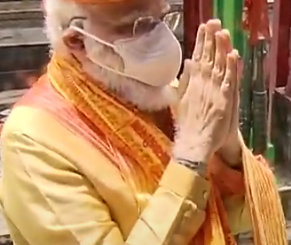
In collaboration with the state government, the 18th Pravasi Bharatiya Divas (PBD) Convention is scheduled to take place in Bhubaneswar from January 8 to 10, 2025. Prime Minister Narendra Modi is set to inaugurate the event, which will focus on the theme “Diaspora’s contribution to a Viksit Bharat.” The convention aims to engage the Indian diaspora in India’s development journey.
The BJP government in Odisha has been proactive in implementing policies to enhance the state’s growth trajectory. Prime Minister Modi has acknowledged these efforts, emphasizing the government’s commitment to development.
Additionally, the new administration has initiated investigations into alleged corruption during the previous BJD regime. Chief Minister Mohan Charan Majhi has pledged to probe all corruption cases from the BJD’s tenure, aiming to ensure transparency and accountability in governance.
The BJP’s rise to power in Odisha signifies a transformative period, with the government focusing on development, anti-corruption measures, and strengthening ties with the Indian diaspora through events like the upcoming PBD Convention.
Bhubaneswar, famously known as the Temple City of India, is a harmonious blend of ancient heritage and modern urbanization. Located in Odisha, Bhubaneswar’s unique identity stems from its status as a repository of Indian temple architecture, cultural traditions, and its rapid transformation into a smart city. As the chosen venue for the 18th Pravasi Bharatiya Divas (PBD) in January 2025, the city will once again be in the global spotlight, showcasing its historical, cultural, and economic vibrancy.This article explores Bhubaneswar’s rich legacy, its evolution into a modern city, and its significance as the host of the Pravasi Bharatiya Divas, a global event that celebrates the Indian diaspora’s contributions.
The Temple City’s Heritage
Bhubaneswar derives its name from “Tribhubaneswar,” meaning “Lord of the Three Worlds,” referring to Lord Shiva. The city is home to over 700 temples, many of which date back to the 7th and 13th centuries, exemplifying the Kalinga architectural style.Lingaraj Temple: A masterpiece of Kalinga architecture, the Lingaraj Temple is dedicated to Lord Shiva and is a prominent pilgrimage site.
The city’s temples are not just religious centers but also repositories of art, culture, and history. They attract historians, architects, and tourists from across the globe.
Cultural Significance
Bhubaneswar is more than just its temples. It is a cultural hub where traditional art forms like Odissi dance, Pattachitra painting, and stone carving thrive. The city also serves as a gateway to Odisha’s vibrant festivals such as Rath Yatra, Durga Puja, and Ekamra Utsav, which celebrate the region’s spiritual and artistic traditions.
Bhubaneswar: The Cultural and Architectural Marvel of India
Bhubaneswar, the capital city of Odisha, is a treasure trove of culture, architecture, and heritage. Known as the “City of Temples,” it boasts a history that spans over 3,000 years. From its ancient temples to modern urban planning, Bhubaneswar is a city that seamlessly blends its glorious past with a progressive present.
Historical Significance of Bhubaneswar
Bhubaneswar derives its name from the Sanskrit words “Bhubaneswar”, meaning “Lord of the Universe.” It is believed to have been the seat of the powerful Kalinga kingdom, which played a crucial role in shaping the history of ancient India.
The city’s historical roots can be traced to the 2nd century BCE, as evidenced by the archaeological remains at Sisupalgarh, one of the oldest known fortified urban centers in India.The turning point in Bhubaneswar’s history was the Kalinga War (261 BCE), fought near the city’s vicinity. This transformative event led to Emperor Ashoka’s conversion to Buddhism and the spread of Buddhist teachings across Asia.
Bhubaneswar’s historical narrative is deeply intertwined with Hinduism, Buddhism, and Jainism, making it a confluence of diverse religious traditions.
Cultural Vibrance
Bhubaneswar is not just a city but a living museum of Odisha’s vibrant culture. The city is renowned for its festivals, dance forms, music, and crafts, which reflect the ethos and spirit of Odisha.FestivalsThe festivals of Bhubaneswar are a testament to its cultural richness.
The city comes alive during Rath Yatra, a grand chariot festival dedicated to Lord Jagannath. Though the primary celebrations occur in Puri, Bhubaneswar’s temples also partake in the festivities. Durga Puja, Makar Sankranti, and Diwali are celebrated with great enthusiasm, showcasing the city’s communal harmony.The Ekamra Utsav, a cultural festival named after Bhubaneswar’s ancient name, Ekamra Kshetra, highlights the city’s artistic heritage. It features traditional music, dance performances, and exhibitions of local crafts, drawing visitors from across the globe.
Dance and Music
Odissi, one of India’s classical dance forms, originated in Odisha and finds its soul in Bhubaneswar. The city is home to iconic institutions like the Odissi Research Centre, where the dance form is preserved and propagated. The fluid movements, intricate gestures, and emotive expressions of Odissi are a visual delight, embodying the spiritual essence of the city.
Music in Bhubaneswar ranges from classical Odissi music to contemporary forms. The city’s musicians have preserved traditional instruments like the mardala and the gini, which add a unique rhythm to its musical heritage.
Handicrafts and Textiles
Bhubaneswar is a hub for Odisha’s famous handicrafts and textiles. The city markets, such as Ekamra Haat, showcase exquisite handwoven Sambalpuri sarees, Pipli appliqué work, and silver filigree jewelry. The intricate patterns and vibrant colors reflect the artisans’ skill and creativity, keeping traditional crafts alive in the modern era.
Architectural Marvels
Bhubaneswar is often referred to as a “living museum of architectural excellence.” The city’s temples, built over centuries, are exemplary of the Kalinga architectural style, characterized by ornate carvings, towering spires, and intricate sculptures.
The Temples of Bhubaneswar
Lingaraj Temple
The crown jewel of Bhubaneswar’s temple architecture, the Lingaraj Temple is dedicated to Lord Shiva. Built in the 11th century, it is a masterpiece of Kalinga architecture, with a towering 180-foot spire and exquisite carvings. The temple complex also houses smaller shrines, each narrating a story of devotion and craftsmanship.
Mukteshwar Temple
Known as the “Gem of Odisha,” the Mukteshwar Temple is a 10th-century marvel. Its intricately carved torana (arched gateway) and latticed windows are among the finest examples of temple art in India. The temple’s sculptures depict scenes from the Panchatantra, showcasing the interplay of religion and folklore.
Rajarani Temple
Unlike most temples in Bhubaneswar, the Rajarani Temple is not dedicated to any deity. Its name is derived from the red and yellow sandstone used in its construction. The temple is adorned with elaborate carvings of celestial nymphs, dancers, and musicians, reflecting the artistry of the bygone era.
Ananta Vasudeva Temple
Dedicated to Lord Krishna, this temple stands out for its Vaishnavite influence in a city predominantly associated with Shaivism. The temple’s sculptures and carvings depict scenes from the Mahabharata and the Bhagavata Purana.
Parasurameswara Temple
One of the oldest temples in Bhubaneswar, it dates back to the 7th century. The temple’s intricate carvings and compact structure mark the early stages of Kalinga architecture.
Jain and Buddhist Heritage
Bhubaneswar’s architectural heritage is not limited to Hindu temples. The city and its surroundings are home to significant Jain and Buddhist sites.
Khandagiri and Udayagiri Caves
These twin hills house ancient Jain rock-cut caves, dating back to the 2nd century BCE. The caves, such as the Hathigumpha and Rani Gumpha, are adorned with inscriptions and carvings that narrate tales of royal patronage and asceticism.
Dhauli Shanti Stupa
Located a short drive from Bhubaneswar, the Dhauli hill is believed to be the site of the Kalinga War. The Shanti Stupa (Peace Pagoda), built by the Japanese Buddhist community, stands as a symbol of peace and Ashoka’s conversion to Buddhism.
Ratnagiri, Lalitgiri, and Udayagiri
These Buddhist sites, collectively known as the Diamond Triangle, are located near Bhubaneswar. They feature ancient stupas, monasteries, and sculptures, offering a glimpse into Odisha’s Buddhist past.
Heritage Conservation
Efforts to preserve Bhubaneswar’s heritage have gained momentum in recent years. The Ekamra Kshetra Heritage Project aims to restore and rejuvenate the old city area, showcasing its historical and cultural landmarks. Initiatives like guided heritage walks and digital documentation of monuments are helping to connect the younger generation with the city’s legacy.
Modern Bhubaneswar A Smart City
While steeped in history, Bhubaneswar is also a city of the future. Recognized as one of India’s first Smart Cities, it has embraced technology and sustainable urban development. The city’s well-planned infrastructure, green spaces, and efficient public transport make it a model for urban living.The Info Valley IT Park and Start-Up Odisha Initiative have positioned Bhubaneswar as an emerging hub for technology and innovation. Its educational institutions, such as the Indian Institute of Technology (IIT) Bhubaneswar and KIIT University, attract students from across the country, fostering a dynamic academic environment.
Culinary Delights
No exploration of Bhubaneswar is complete without savoring its delectable cuisine. The city’s food culture is a reflection of its rich heritage and diversity.Pakhala Bhata: A staple dish of fermented rice served with fried fish, vegetables, and curd, pakhala is a must-try.
Chhena Poda
Known as Odisha’s cheesecake, this dessert made of caramelized cheese is a local favorite.Dalma: A wholesome dish made of lentils and vegetables, seasoned with aromatic spices.
Street Food
From dahi vada-aloo dum to ghugni chaat, the city’s street food scene is vibrant and flavorful.Bhubaneswar’s Role in TourismBhubaneswar serves as the gateway to Odisha’s rich cultural and natural attractions. The city’s proximity to Puri (home to the Jagannath Temple and beaches) and Konark (famous for the Sun Temple) makes it a crucial stop on the Golden Triangle of Odisha tourism. The Chilika Lake, Asia’s largest brackish water lagoon, and the Similipal National Park are other nearby attractions that draw nature enthusiasts.
Bhubaneswar is a city where the ancient and the modern coexist harmoniously. Its rich culture, stunning architecture, and historical significance make it a living testament to India’s diverse heritage. As it strides into the future as a Smart City, Bhubaneswar continues to honor its past, offering visitors an unforgettable journey through time. Whether you are a history buff, a culture enthusiast, or a seeker of spiritual solace, Bhubaneswar promises an experience like no other.
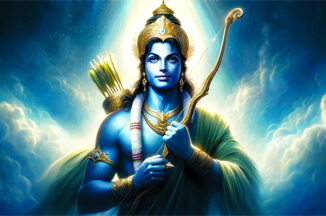
Ram Navami is a joyous occasion celebrated by millions of people around the world. It marks the birth anniversary of Lord Rama, the seventh avatar of the Hindu deity Vishnu. This auspicious festival falls on the ninth day of the Chaitra month in the Hindu calendar, typically during the months of March or April. In 2024, Ram Navami falls on Wednesday, April 17th, is a day to remember Rama’s birth and celebrate the ideals he represents, it brings communities together to honor the beloved hero, Lord Rama. Let’s delve into this vibrant festival’s rich history, significance, and traditions.
The Birth and Legacy of Lord Rama
To truly appreciate Shree Ram Navami, we must first understand the captivating tale of Lord Rama. According to Hindu mythology, Lord Rama was born to King Dasharatha and Queen Kausalya in the ancient city of Ayodhya. His birth is believed to have occurred thousands of years ago, during the Treta Yuga, a time of great virtue and righteousness.
The story of Lord Rama’s life is chronicled in the epic Ramayana, written by the sage Valmiki. It narrates the journey of Rama, his wife Sita, and his loyal companion Hanuman, as they face numerous trials and tribulations. From his exile to the forests to his epic battle against the demon king Ravana, Lord Rama exemplifies courage, compassion, and devotion to righteousness.
Ram Navami marks the auspicious day when Lord Rama incarnated on earth to rid the world of evil and establish dharma, or righteousness. His life serves as an inspiration to millions, embodying the values of honor, sacrifice, and love for all beings.
Ram Navami Importance
Ram Navami holds immense significance in Hindu culture and spirituality. It symbolizes the victory of good over evil and the triumph of righteousness over injustice. Devotees believe that by observing this festival with devotion and piety, they can seek the blessings of Lord Rama for peace, prosperity, and spiritual growth.
For many, Ram Navami is not just a religious observance but a time for introspection and renewal of one’s commitment to leading a virtuous life. It serves as a reminder of the enduring values embodied by Lord Rama and the importance of upholding them in our daily lives.
Celebrations and Traditions
Ram Navami is celebrated with great fervor and devotion by Hindus worldwide. The festivities typically begin with devotees taking a holy bath before sunrise, followed by prayers and rituals dedicated to Lord Rama. Temples are adorned with flowers and lights, and special ceremonies are conducted to honor the deity.
One of the highlights of Ram Navami is the recitation of the Ramayana, the epic saga of Lord Rama’s life. Devotees gather in temples or community halls to listen to the enchanting tales of Rama, Sita, Hanuman, and other characters from the epic. The recitation is often accompanied by devotional songs and hymns praising the virtues of Lord Rama.
Another integral part of Ram Navami celebrations is the procession or ‘Rathayatra’ of Lord Rama. Idols or images of Lord Rama, along with his consort Sita, his loyal brother Lakshmana, and devotee Hanuman, are placed on elaborately decorated chariots and paraded through the streets amidst chanting of hymns and mantras. Devotees throng the streets to catch a glimpse of the divine procession and seek blessings from Lord Rama.
Feasting is an essential aspect of Ram Navami celebrations, with devotees preparing and sharing delicious vegetarian dishes as offerings to the deity. Special sweets like ‘Panakam’ (a sweet drink made of jaggery and spices) and ‘Neer mor’ (buttermilk) are prepared to mark the occasion. Sharing food with family, friends, and neighbors is believed to be a way of spreading joy and goodwill during the festival.
Ram Navami Significance and Symbolism
Ram Navami holds profound symbolism and significance in Hinduism. The birth of Lord Rama symbolizes the victory of righteousness and dharma over adharma (evil). It serves as a reminder of the importance of upholding moral values, respecting one’s duties and responsibilities, and standing up against injustice and tyranny.
The festival also signifies the beginning of spring, a season of renewal, growth, and prosperity. Just as the earth blossoms with new life during spring, Ram Navami rejuvenates the spirit of devotees, filling their hearts with hope, joy, and devotion.
Ram Navami also promotes unity and harmony among people of different communities and backgrounds. Regardless of caste, creed, or nationality, devotees come together to celebrate the universal ideals of love, compassion, and righteousness embodied by Lord Rama.
Teaching Lessons from Ram Navami
Ram Navami offers valuable lessons that can be imparted to students, fostering moral and spiritual development. Here are some teaching points inspired by the festival:
The Importance of Virtue: Ram Navami teaches students the significance of leading a virtuous life guided by principles of truth, compassion, and integrity, as exemplified by Lord Rama.
Resilience and Perseverance: The story of Lord Rama’s exile and his subsequent triumph over adversity teaches students the importance of resilience, perseverance, and determination in overcoming challenges.
Respect for Diversity: Ram Navami promotes inclusivity and respect for diversity, encouraging students to embrace people from different backgrounds and cultures with understanding and compassion.
Service and Sacrifice: The devotion of Hanuman and other characters in the Ramayana highlights the virtues of selfless service and sacrifice, inspiring students to contribute positively to society.
Upholding Dharma: Ram Navami emphasizes the importance of upholding dharma (righteousness) and fulfilling one’s duties and responsibilities with sincerity and dedication.
Right now, India’s global reputation as a viable Democracy and a Secular nation is under scrutiny as it has descended into a major milestone of steep descent into darkness of bigotry and Islamophobia. Modi that is known to invoke values of pluralism abroad, has remained silent as Indian democracy is humiliated with international backlash. It looks like Modi has successfully externalized his domestic agenda of targeting minorities, especially the 205 million Muslims with impunity and hate speeches, and with official sanctions. Prime example is Anurag Thakur who was elevated from a Junior Minister to Independent Minister after he made a remark in Jan 2020 targeting Muslims for protesting against Citizenship (Amendment) Act, “Desh ke gaddaron ko, goli maaro saalon ko (Shoot the traitors of the country)”
By Dave Makkar
For the first time in the 75 years history of Independent India, the government headed by BJP’s Modi is on the biggest diplomatic firefighting mission of apology to 15 Majority-Muslim nations and 57-member Organization of Islamic Cooperation (OIC) and the Gulf Cooperation Council (GCC) over the derogatory remarks made on Prophet Mohammed by leaders of the ruling BJP. This time it was not just Indian Muslims speaking out and protesting on the streets all across India but on June 5, 2022 the governments of Qatar, Kuwait, Oman, Iran, Saudi Arabia, Jordan, Libya, Turkey, Maldives, Iraq, Indonesia, United Arab Emirates, Bahrain, Pakistan and Malaysia issued stinging statements condemning the comments. Some countries are demanding written apologies besides calling the Indian Ambassadors to register their protest. In some countries, there were massive street protests, and in Qatar, “Boycott India” campaign was also trending on social media.
Dinner to be hosted by Deputy Emir of Qatar for India’s VP Venkaiah Naidu was cancelled. VP Naidu was on a 3-day state visit to Qatar. Qatari Minister of State for Foreign Affairs Al Muraikhi warned in a statement that “insulting remarks would lead to incitement of religious hatred and offend more than 2 billion Muslims around the world.”
In response to this diplomatic row, the Indian embassy in Doha released a statement insisting that the comments were made by “fringe elements” and “do not, in any manner, reflect the views of the Government of India”.
The 57-member OIC . condemned the remarks and said it came in a “context of intensifying hatred and abuse toward Islam in India and systematic practices against Muslims.” OIC also urged the United Nations to take necessary measures to ensure that the rights of minorities are protected in India. The Spokesperson for UN Secretary-General Antonio Guterres has called for a halt to any sort of violence, especially the one based on perceived religious differences and hatred, amidst protests in India over the controversial remarks against the Prophet by two now-suspended BJP leaders.
This gigantic diplomatic backlash comes on the heels of US Secretary of State Antony Blinken naming India while releasing the State Department’s International Religious Freedom Report (USCIRF) on June 2, 2022. Blinken said: “in India, the world’s largest democracy and home to a great diversity of faiths, we have seen rising attacks on people and places of worship.” Rashad Hussain, the Ambassador-at-Large for IRF called out the Indian government officials, who he said are “ignoring or even supporting rising attacks on people and places of worship.” The report also mentioned several Hindu extremist leaders; like Yati Narasinghanand, Maa Annapurna Bharti, Swami Paramatmananda, and BJP’s UP CM Yogi Adityanath, a close ally of PM Modi.
USCIRF has recommended U.S. Government to designate India as a “country of particular concern,” or CPC, for engaging in and tolerating systematic, ongoing, and egregious religious freedom violations, as defined by the International Religious Freedom Act (IRFA); Impose targeted sanctions on individuals and entities responsible for severe violations of religious freedom by freezing those individuals’ or entities’ assets and/or barring their entry into the United States.
“Desh ke gaddaron ko, goli maaro saalon ko (Shoot the traitors of the country)”: Anurag Thakur, Sports Minister of India.
Right now, India’s global reputation as a viable Democracy and a Secular nation is under scrutiny as it has descended into a major milestone of steep descent into darkness of bigotry and Islamophobia. Modi that is known to invoke values of pluralism abroad, has remained silent as Indian democracy is humiliated with international backlash. It looks like Modi has successfully externalized his domestic agenda of targeting minorities, especially the 205 million Muslims with impunity and hate speeches, and with official sanctions. Prime example is Anurag Thakur who was elevated from a Junior Minister to Independent Minister after he made a remark in Jan 2020 targeting Muslims for protesting against Citizenship (Amendment) Act, “Desh ke gaddaron ko, goli maaro saalon ko (Shoot the traitors of the country)”
After assuming power in 2014, Modi has been allowing rather encouraging without punishment; Islamophobic remarks by members of his government, his Party BJP, state governments under BJP, Hindu organizations, Media & educational institutions. In all the BJP ruled states Muslims & Christians are openly being denied basic human rights, right to justice as well as right to worship. Muslims, especially male and female student leaders & activists are maliciously prosecuted under the directions from BJP ruled states or Modi’s central government. They are beaten & lynched in broad daylight. Muslim Houses are demolished in (Israeli style) Collective Punishment for valid protests termed as riots or turned into riots by BJP or RSS or other Hindu organizations or as unauthorized structures even if they are there for 30-40 years & some have government documents. Hindu owned houses with similar or worst status in the same vicinity are left untouched. On social media, female Muslim journalists, activist and social workers have been ferociously trolled and issued threats of the worst kind, including rape. Muslim women have been put up for sale in fake auctions. Islamophobic memes and hashtags, taunting and tainting Muslims in India has become the norm.
Also, since 2014, Islamic structures including Mosques are being targeted under the excuse that they were built 5-9 centuries ago after demolishing Hindu Temples. UNESCO World Heritage Sites like Taj Mahal, Jama Masjid, Qutub Minar etc. are being disputed as built on Hindu temples. BJP ruled Karnataka that is referred as “Silicon Valley of India” has gone one step further and started doing surveys of Christian Churches also to establish if they were built after demolishing Hindu temples. Whereas “The 1991 Act says that a mosque, temple, church or any place of public worship in existence on August 15, 1947, will retain the same religious character that it had on that day – irrespective of its history – and cannot be changed by the courts or the government”.
Fringe elements? Home Minister Amit Shah, Prime Minister Narendra Modi, Chief Minister of UP Yogi Adityanath.
Modi’s government has maintained a studied silence or at the most has always blamed “fringe elements” for such actions. They do not hesitate even to include their own National Spokesperson currently Chairman of Tourism Department, “Sambit Patra as Fringe Element”. All this appears to have emboldened ordinary Hindus to beat Muslims in public, go online and tarnish Muslims with impunity. They publicly cry about being the victim and think they are entitled to revenge for what happened from 7th to 17th century. This itself constitutes a grave danger to the protection of human rights and may lead to further prejudice and marginalization, which will create a cycle of violence and hate against Indian Muslims including public lynching.
Role of Indian Media in spreading Islamophobia in India:
The Godi Media of India
Prime Time debates in India since 2014 have become a platform to encourage Hindu hate mongers to speak ill about other religions. The anchors encourage hatemongering and allow BJP or RSS or other Hindu organizations spokesperson to speak rubbish that is corrupting the moral and social fiber of the society and can incite violence against believers of other religions.
These media houses are called as Modi’s Godi(lapdog), bikau (saleable), dalal(agent) and bharkau(inflammatory) Media This is how a major section of India’s mainstream media is labelled by most Indians, especially Muslims, Christians and low-caste Hindus, opposition parties, as well as ½ a dozen national media — all because of their brazen support for the ruling party BJP, its ideological parent RSS and the government.
Their journalists and anchors routinely engage in spreading hatred towards the country’s 205 million Muslim population and Islam, thus nourishing Islamophobia. They also demonstrate a clear bias against the country’s low-caste Hindus, the poor, and less privileged and weaker sections of society. They openly favor the rich and powerful that owns or finance their channels. Shamelessly they promote Hindutva & Hindu Rashtra– an ideology that seeks to establish the hegemony of Hindus and the Hindu way of life — spearheaded by Rashtriya Swayamsevak Sangh (RSS), its ruling political front Bharatiya Janata Party (BJP). Any criticism of the BJP is narrated as “anti-nationalist” and any individual challenging or demanding answers from the party is labelled “anti-Indian”.
Here is Media ranking in descending order in spreading Islamophobia in India:
Republic TV- co-founded and majority-owner Arnab Goswami is the channel’s editor and news anchor. Known for opinionated reporting in favor of BJP & RSS and their Hindutva-Hindu Rashtra agenda including uncritically reproducing government narratives, avoiding criticism of BJP/RSS figures, and presenting their political opponents in a negative light. He shamelessly shows his bias. He is the King; “No one can beat him in spreading hatred against Muslims and fake news”. On top of that no one can match him in shouting contest.
CNN News 18 owned by Poster Boy of Gangster Capitalism, billionaire Mukesh Ambani. A supporter & 2nd top financier of Modi, RSS, Hindu Rashtra; owns 65 channels: English, Hindi and 14 regional language news, business, entertainment, music, movies, youth, Kids, factual entertainment and shopping channels. Its star news anchor Amish Devgan is a Clone of Republic TV’s Arnab in shouting and arrogance, and routinely indulges in Muslim bashing and spreading fake news.
Aaj Tak – Owned by Arun Purie’s India Today Group, Aaj Tak has three of the worst Islamophobic anchors in the Indian media — Anjana Om Kashyap, Rohit Sardana and Sweta Singh. They are notorious for their vitriolic attacks against Muslims and spreading communal hatred. They routinely indulge in Muslim bashing, while show deferential surrender to anything the BJP does.
India Today (English) Also owned by Purie’s India Today Group with main anchors Rajdeep Sardesai and Rahul Kanwal. Rajdeep is mildly anti-BJP and a bit critical of Modi. Rahul Kanwal in 2020 became a full-time supporter of Modi, BJP & RSS and its ideology after a punishment for being openly critical of Modi.
Wion (World is One News) – operated by Essel Group, owns nearly two dozen Zee channels (some of them merged with Sony TV in Feb. 2022). Its chairman Subhash Chandra was a BJP supported Rajya Sabha MP till June 11, 2022. He has been promoting its Hindutva aka Hindu Rashtra agenda and anti-Muslim tirades. His star prime time news anchor Sudhir Chaudhary was jailed for demanding bribes for not publishing news; is also the editor-in-chief. He is the Hindi version of Republic TV’s Arnab as he openly supports the BJP, RSS and Modi.
Times Now- owned by Pro BJP/RSS Sahu Jain family of Times of India News paper’s Group. Rahul Shivshankar Editor in Chief, Navika Kumar Gp Editor; openly support BJP and RSS by promoting its Hindutva aka Hindu Rashtra and anti-Muslim agenda
India TV – Founder Rajat Sharma and his wife Ritu Dhawan. Rajat was a member of ABVP (Student Wing of RSS) & very close friend of late Arun Jaitley, the most corrupt Modi’s BJP Finance Minister in the history of India. He openly supports BJP and RSS by promoting its Hindutva aka Hindu Rashtra and anti-Muslim agenda.
ABP News – Owned Pro BJP Aveek Sarkar of Anandabazar Patrika Group. It used to be neutral, but it turned pro-BJP a couple of years ago. after the Modi government objected to criticism of the BJP and Baba Ramdev by its star journalists Punya Prasoon Vajpayee and Abhisar Sharma. Both were fired and Rubika Liyaquat joined to replace them to became the commander-in-chief of its news anchors. A Muslim, with angry rhetoric against Muslim leaders and do not allow any criticism of Modi or BJP or RSS or their policies.
Republic Bharat — This sister channel of Republic TV is funded by the BJP and RSS. Its anchor Sucherita Kukreti, a female version of Arnab Goswami in shouting and spitting the venom of hatred against Muslims.
Sudarshan News — Its chairman, Suresh Chavhanke, knowingly disseminates anti-Muslim content and manufactures fake news with communal overtones, which has earned him titles such as “bigot” and “dangerous”. He was a long-term RSS volunteer and associated with ABVP. And prefers that the news programs over his channel be viewed as opinionated campaigns.
News Nation – Deepak Chaurasia, the consulting editor of this channel, which is owned by News Nation Network, is known as a “puppet” of Modi. He always makes fun of all the political parties except the BJP and its allies. He is notorious for his over-the-top coverage of news issues and for being uncritical of the BJP government.
News24 (India) – Owner B.A.G. Films and Media, promoters are Anurradha Prasad, sister of BJP Union Minister R S Prasad, along with her husband, Pro BJP Congress politician Rajeev Shukla.
Ethnic Indian media in USA
Unfortunately, 97% of the Ethnic Indian media in USA are like their counterparts in India. Their anchors are no less than Arnab Goswami or Amish Devgan or Sudhir Chowdhary or Navika Kumar or Anjana Om Kashyap etc. when it comes to spreading Islamophobia and fake news while promoting BJP & RSS’s Hindutva & Hindu Rashtra agenda in USA.
A glance over the few important Islamophobic incidents in last 31/2 years that has led to the unprecedented international outcry against India for the Islamophobic comments made by ruling party BJP’s 2 senior leaders about Prophet Muhammad.
June 2018, Michelin-starred chef Atul Kochar was fired from JW Marriott Marquis, Dubai after he tweeted that followers of Islam had “terrorized” Hindus for 2,000 years.
Sep. 2018 in a public meeting, India’s Home (Interior) Minister Amit Shah compared the illegal Bangladeshi Muslims migrants with “Termites”.
April 2019 Home (Interior) Minister Amit Shah in an election rally again said, “Infiltrators are like termites in the soil of Bengal.” “A Bharatiya Janata Party (BJP) government will pick up infiltrators one by one and throw them into the Bay of Bengal,” referring to illegal Muslim immigrants from neighboring Bangladesh.
April 2019, BJP’s Communal & a Criminal Hindu Priest CM Adityanath Yogi of UP the most populous state of India, spoke about a “green virus” in an election speech in reference to Muslim voters who he said were being wooed by opposition parties. In another election speech he referred Muslims as the “Taliban”
April 2019, BJP MLA Mayankeshwar Singh from UP’s Siddharthnagar in an election speech threatened Muslims with bodily harm for effectively just existing. “If Hindus in Hindustan wake up the beard will be pulled and made into a choti (a tightened braid). If you have to live in Hindustan you have to say ‘Radhe’ (chant Hindu God’s name), else, like those who went to Pakistan during the partition, you can go too… you have no use here,”
Dec 2019, PM Modi made a Islamophobic remark targeting Muslims protesting over Citizenship (Amendment) Act (CAA); “those indulging in arson “can be identified by their clothes”.
Feb. 2020, Modi’s Junior Minister Anurag Thakur while leading a pro CAA and National Register of Citizens (NRC) rally called a slogan, “Desh ke gaddaron ko, goli maaro saalo ko (Shoot the traitors of the country)” targeting the ongoing Muslim women’s 24X7 sit in protest against CAA & NRC at Shaheen Bagh, Delhi. After Thakur’s rally, the city saw deadly communal riots which left 53 dead and 700 injured – majority of them Muslims. Shaheen Bagh protest (Dec 15, 2019 to March 24, 2020) was a peaceful sit-in protest in Delhi lead by women only. Anurag Thakur was rewarded and elevated to a Minister with independent charge in July 2021.
Nov. 9, 2019, Travesty of justice in Babri Masjid vs Ram Janma Bhumi; in a unanimous verdict the Supreme Court of India under CJ Ranjan Gogoi who was retiring on Nov. 17, 2019; awarded the land of disputed Babri Masjid to Hindus. However, the court added that the demolition of the Babri mosque was against the rule of law but do not propose any prosecution for those responsible for the demolition; basically acquitting all the 49 accused high ranking leaders of instigating the mob. Babri Masjid was built in 1528-29 and demolished by the Hindu mob under the top leadership of BJP, RSS, VHP & other militant Hindu organization in 1992. It led to riots in different parts of India that killed nearly 2,000 people. All the Hindu organizations led by BJP had started instigating the Hindus from 1989 to demolish the Mosque by making them believe that the land is the “Birthplace of Lord Ram”. On the other hand, Hindu scriptures say that “Kan Kan mei Vyape hein Ram” meaning “Lord Rama permeates every atom of this universe”. Ever since the Modi-led BJP came to power in 2014, India has seen deepening social and religious divisions. The demand for Ram Janam Bhumi became louder and clearer. Chief Justice Ranjan Gogoi was rewarded by Modi regime in March 2020 by making him Rajya Sabha (Upper House of Parliament) member after awarding a verdict in favor of Hindus in Dec 2019.
April 2020, BJP MP Tejasvi Surya landed in a row for a tweet he had posted in 2015 with an “objectionable and disrespectful” comment about Arab Women. “95 percent Arab women never had orgasms in last few hundred years: Tarek Fatah.” Prominent businesspeople, lawyers and commentators in Dubai and Kuwait condemned his remarks. He deleted the tweet.
April 2020, When Indians living in Dubai began posting anti-Tablighi Jamaat congregation in Delhi as a supper spreader of Covid, Princess Hend Al Qassimi warned that “anyone that is openly racist and discriminatory in the UAE will be fined and made to leave”. Under Modi’s Home Minister Amit Shah, attendees of Tablighi Jamaat congregation in Delhi were accused of spreading the Covid-19 virus. Criminal cases were registered against several attendees including foreign nationals in the courts across India. in August 2020, the Bombay HC quashed three FIRs against 35 petitioners – 29 of them foreign nationals. The court observed: “A political government tries to find the scapegoat when there is pandemic or calamity and the circumstances show that there is probability that these foreigners were chosen to make them scapegoats. Some of the charge sheeted Muslims neither attended the Delhi congregation nor were they inclined to the Tablighi ideology, as evidenced in the case of eight charge sheeted individuals, whose case was dismissed by the Delhi’s Saket district court on 25 August 2020. The SC CJ Sharad Bobde observed “evasiveness” in that the Government of India’s affidavit filed in response to petitions challenging the discriminatory and communal coverage of the Tablighi Jamaat incident by some sections of the media. He termed it as “unnecessary, nonsensical” averments. On 16 December 2020, Chief Metropolitan Magistrate of a Delhi Court, Arun Kumar Garg, acquitted the 36 foreign nationals from 14 countries of all the charges levelled against them.
August 2021, BJP leader and Supreme Court lawyer Ashwini Upadhyay made anti Muslim slogans including calling for Muslims to be murdered, in a rally in favor of the uniform civil code, at Jantar Mantar, Delhi.
Sep. 2021, BJP’s UP CM Adityanath Yogi in a public rally said that prior to his government’s formation in 2017, the ration (subsidized food grains) meant for the poor would get ‘digested’ by those who utter “Abba Jaan” as a communal reference to Muslims. In several parts of India, Muslims use the phrase “Abba Jaan” to refer to their fathers or as an endearment.
Oct. 2021, Uttarakhand BJP president Mandan Kaushik told the media, “Our party line is clear that no [religious] conversion [from Hinduism] will be tolerated.”
November 2021,BJP Leader Ashwini Upadhyay was featured on a panel on the imaginary bogey of ‘thook jihad (spit jihad).’ where he said, these thook (spitting) jihadis are either being taught all this by their parents or at their madrassas (schools).” He even suggested that Muslim men may be mixing other body fluids in the food they prepare for sale to Hindus.
December 2021, Upadhyay was a notable BJP presence at the now-notorious Dharma Sansad which took place at Haridwar. Known Islamophobic Militant Hindu Priest Yati Narsinghanand called Muslims “demons”, threatened to “eliminate” them and said he is striving to create an India “free of Islam”.
Swami Prabodhanand Giri said the country now belongs to Hindus. “This is why, like in Myanmar, the police here, the politicians here, the army and every Hindu must pick up weapons, and we will have to conduct this cleanliness drive,” he said while referring to Muslims. “There is no solution apart from this.”
Maa Annapurna Bharti, alias Pooja Shakun Pandey, “Nothing is possible without weapons. If you want to eliminate their population then kill them. Even if 100 of us are ready to kill 20 lakhs of them (Muslims), then we will be victorious, and go to jail.”
Suresh Chavhanke, owner of Militant Hindu channel “Sudarhan News”, administered an oath to turn India into a Hindu-first country. “We make a resolution until our last breath: We will make India a Hindu nation, and keep it a Hindu-only nation,” he said. “We will fight and die if required, we will kill as well.” He then tweeted a video of the oath to his half a million followers.
The event concluded with an oath-taking which called for the “protection” of the Hindu religion against all those who might pose a threat to it ‘by any means necessary.
Feb. 2022, BJP MLA from UP’s Dumariganj, in a video said, “Since I became an MLA, they (the Muslims) have stopped wearing skull caps. If you vote for me again, they will start wearing tilaks.” Again on February 15, 2022 panel on India TV, he interrupted a Muslim panelist to hurl religious slurs and abuses against him, threatening to feed pig’s milk (derogatory for Muslims) to the panelist, whom he described as a “b*****d dog and an illegitimate child of Hindus”. He was seen in another video threatening Muslims and accused all Hindus who did not vote for him of being Muslims. He said, “Any Hindu who doesn’t vote for me has Miyan (Muslim) blood in his veins. He’s a traitor. He is a b*****d son of Jaichand. He’s a sinner son of his father…I am warning you this time…traitors of Hindu religion will be destroyed.” Further he goes on to threaten Muslims by saying, “Listen Muslims, if any Hindu is insulted and if you look at any Hindu girl, then I’ll get you beaten so much and cut so much…that…”. The latter part of his warning drowns out amidst ‘Jai Shri Ram’ chants.
April 2022, Bihar BJP MLA Haribhushan Thakur Bachaul said that Muslims should be set ablaze just as Hindus burn Ravana effigies during the festival of Dussehra. Earlier in Feb 2022, he had also said that Muslims living in India should be stripped of “Voting Rights” and treated as second-class citizens.
May 2022, 3 BJP MLA’s K.G. Bopaiah, Appachuranjan and Suja Kushalappa from BJP ruled Karnataka state Assembly were present at the “Arms training camp’ organized by the anti-Islam militant Hindu “Bajrang Dal”. A viral video on social media showed youths, appearing to be minors, in possession of airguns, trishuls(Tridents) and other weapons.
May 2022 in BJP ruled MP, a 65-year-old Hindu with cognitive disabilities Bhawarlal Jain, was beaten to death by a BJP worker Dinesh Kushwaha suspecting him to be a Muslim.
NEW DELHI, INDIA – JANUARY 21: BJP candidate from New Delhi Constituency Nupur Sharma arrives at Jamnagar House to file her nominations for the upcoming Delhi Assembly Elections 2015 on January 21, 2015 in New Delhi, India. Polling in Delhi will be held on February 7 and the counting of votes will take place on February 10. (Photo by Saumya Khandelwal/Hindustan Times via Getty Images)
May 27, 2022, BJP National Spokesperson & SC Lawyer Nupur Sharma’s made derogatory and insulting comments against Prophet Mohammad during a debate on Times Now with Anchor Navika Kumar on the dispute over the Gyanvapi mosque. Pro BJP Navika Kumar allowed Sharma to make insulting remarks about the prophet and his marriage. The party’s Delhi media head, Naveen Kumar Jindal, subsequently tweeted another offensive comment about Prophet Muhammad, the most revered figure in Islam. This has incensed Indian Muslims and a week later outraged more than a dozen Islamic nations.
Hindus claim that the Gyanvapi Mosque in the Hindu holy city of Varanasi is built on the ruins of a grand 16th Century Hindu shrine – destroyed in 1669 by Mughal emperor Aurangzeb – and some are now seeking a court’s permission to pray within the mosque complex.
May 27, 2022, Former Karnataka Deputy CM and at present BJP MLA Eshwarappa issued a statement to media that 36,000 temples were destroyed to build mosques over them. He stated that all of them would be reclaimed by Hindus legally.
June 5, 2022, repeat offender for Islamophobic comments including calling for genocide & derogatory comments against the Father of the Nation, Mahatama Gandhi; Maa Annapurna Bharti alias Shakun Pandey inked a letter “with her blood” to India’s President Kovind, asking him to take action against Friday Muslim prayers, which she claims are an “anti-Hindu congregation”. She said, “Friday is not a day for prayers. Instead, it is a day for terrorism. The Friday congregations by Muslims are not for worship but for the genocide of non-Muslims, loot, arson and sexual harassment. Hence, the Akhil Bharat Hindu Mahasabha demands that on Fridays, the entry of Muslims in small mosques should be restricted only to 10 Muslims while 25 Muslims should be allowed in bigger ones.
If all the above Islamophobic actions were done by the “Fringe Elements” then who is promoting and supporting “Islamophobia” in India? The answer is not difficult to find. It is India’s internationally known Hinduwadi and domestically known as Hindu Heart Throb aka Hindu Hriday Samrat aka Hindu King aka Prime Minister Narendra Modi…!! Under parliamentary system fashioned after the Westminster system the prime minister is the presiding and actual head of the government and head/owner of all the departments and executive power. The head of the state, the president in India, holds a largely ceremonial position, although often with reserve powers. In case of current President Kovind, it is a well-known fact that he only speaks the language of PM Modi.
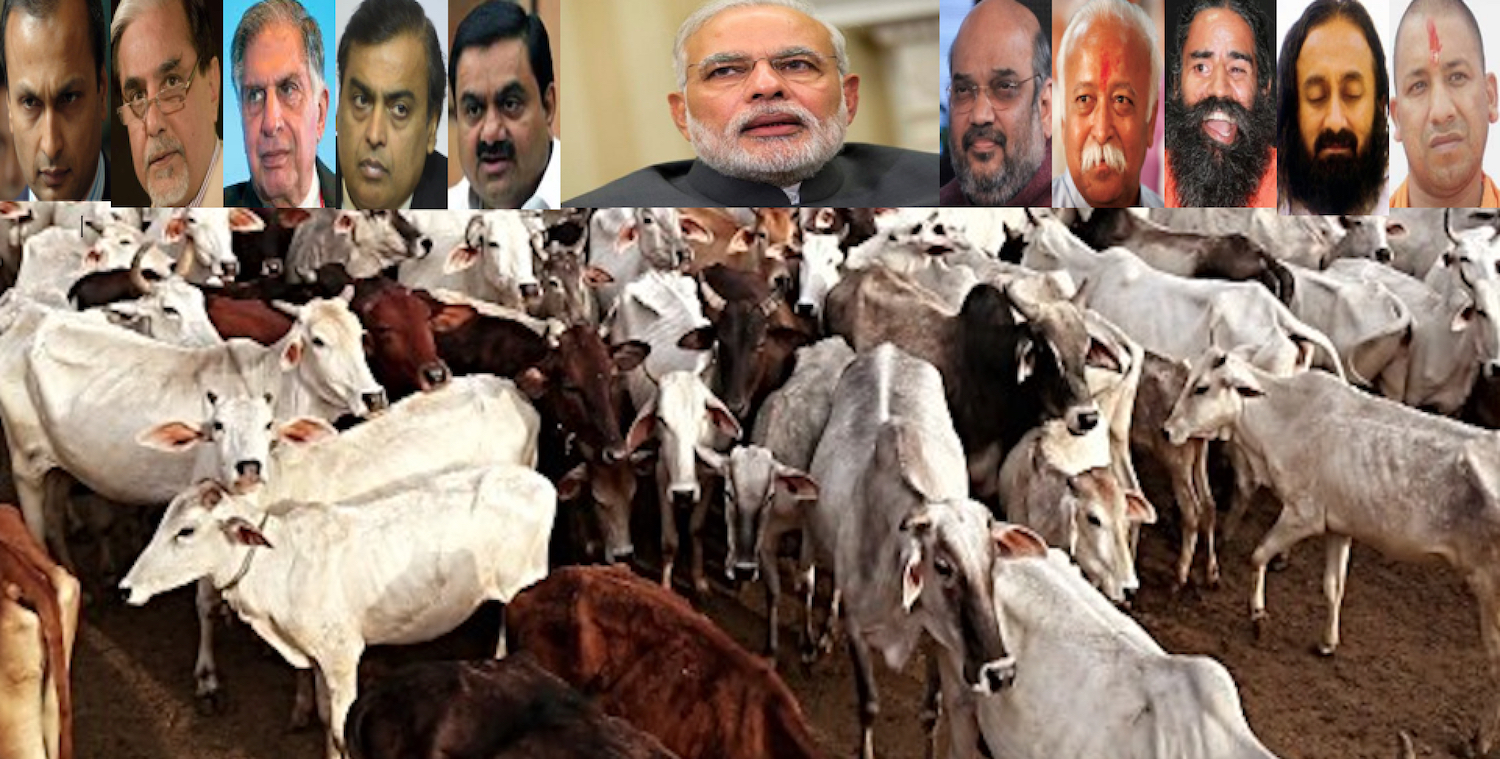
Poster Boys of Gangster Capitalism of India. L to R: Rattan Tata, Mukesh Ambani, and Gautam Adani
The next question is who is financing Islamophobia and Modi that is representing each and every Hindu organization that wants to make India a “Hindu Rashtra” ? The answer is the gangster capitalist of India that is supporting Modi. The current top 3 Poster Boys of Gangster Capitalism of India are Gautam Adani, Mukesh Ambani, and Rattan Tata. Their net worth under Modi’s 8 years rule has gone up by 175% to 350% and now they own all the major industries, including defense and service sector of India.
“Modi’s eminence is due to the surrounding flatness of India”.
Unfortunately, here the flatness means; illiterate, communal & criminal Modi’s high reputation is only because of the terribly low morals, ethics, honesty and talents left in India these days. Since 2014, India under Modi has become a sad story. Over 60% Indians are gladly willing to pay Islamophobic Tax, even if it begets them unemployment, poverty, hunger and even starvation! No one can save a nation in death wish mode.
(Compiled by Devendra Makkar from various internet sources & writings of prominent journalists)
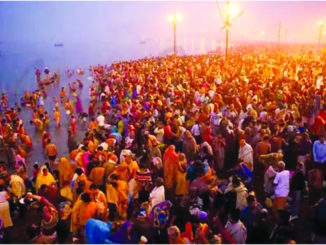
Mauni Amavasya, the word Mauni means silence, on this day any person remains silent all day and this is a kind of fast. Which is done on the day of Mauni Amavasya. Mauni Amavasya is considered the most important and auspicious day in the Hindu calendar. It is believed that on this day the water of the holy Ganges River turns into nectar and taking a bath in the Ganges on the day of Mauni Amavasya is considered holy. It is said that the creator of the universe, Manu, was also born on this new moon day. Amavasya is the most important festival of Magh month.
According to Hindu religion, Mauni Amavasya falls in the middle of the month of Magha and is also called Maghi Amavasya. In Hinduism, the month of Magha is considered auspicious because Dwapara Yuga started on this day. By the way, bathing the Ganges in the whole months of Magha is considered auspicious, but bathing on the day of Mauni Amavasya is considered special and holy.
Mauni Amavasya 2022
Tuesday, 1 February 2022
Amavasya Tithi Begins – 02:18 PM on Jan 31, 2022
Amavasya Tithi Ends – 11:15 AM on Feb 01, 2022
In the scriptures, the importance of doing charity on this day is said to be very fruitful. According to a belief, this day is also believed to be the birth of Manu Rishi, due to which this day is celebrated as Mauni Amavasya.
If the day of Mauni Amavasya falls during the biggest Kumbh Mela of Hinduism, then this day is called the most important bathing day, this day is also called the day of Amrit Yoga.
Mauni Amavasya Significance
The Mauni Amavasya is an auspicious day for Hindus all over the world. On this day, hundreds of devotees reside near the bank of the Triveni Sangam, where the holy rivers Ganga, Yamuna and Saraswati meet in Prayagraj. According to the Hindu Gurus, taking a bath in the Triveni Sangam on this day and truly worshipping Lord Vishnu wholeheartedly on this day shall lead to a prolonged, happy and healthy life. The Maha Kumbh Mela also welcomes lakhs of pilgrims on the day of the Mauni Amavasya or Maghi Amavasya.
Rituals
There are a few simple rituals one needs to follow in order to successfully complete the fast of the Mauni Amavasya. Let us know what these rituals are and how they should be performed:
– Wake up during the Brahma Muhurat i.e. between 3 am to 6 am.
– Take a bath in the River Ganga, and if you are not able to do that bathe in clean water or add some “Gangajal” in a bucket of water and then bathe with that water.
– Chant the mantra written below while bathing with the holy water.
– Gange cha yamune chaiva godavari saraswati. Narmade Sindhu Kaveri Jal sminsannidhi kuru.’After bathing, meditate in the name of Lord Vishnu and take an oath of silence or “Maun Vrat” for the day.
– Now circumambulate the Tulsi 108 times.
– Donate money, food and clothes to the poor after worshipping.
– Ensure that you remain silent right after taking the bath and chant the mantra mentioned above in your mind throughout the day.
The Story behind the Mauni Amavasya
The most popular story about Mauni Amavasya is the one with Brahmin Devaswami. Once lived a Brahmin named Devaswami, with his wife Dhanvati, his sons and a virtuous daughter in Kanchipuri. All his sons were married and he was left with an unmarried daughter eligible for marriage. He began to search for an eligible groom for his daughter and sent his eldest son with his daughter’s kundali to the city to search for a suitable groom. His son showed his sister’s horoscope to an expert astrologer who told him that the girl would become a widow after marriage.
When Devaswami heard about his daughter’s fate he got worried and asked the astrologer for a remedy. The astrologer suggested requesting a washerwoman Soma in Sinhaladweep to conduct a special “pooja” and that if the lady agreed to perform the “pooja” at his house, then his daughter’s horoscope dosha shall be removed. Devswami headed to Soma’s house but he had to cross the ocean to reach there. When he got tired, hungry and thirsty, he thought of having some rest under a banyan tree.
On the same tree lived a vulture’s family. The vulture asked Devaswami about his problem and he told them his whole story. Then the vulture assured him that he would help him reach Soma’s house and guided him throughout the journey. Devaswami brought Soma to his house and asked her to perform the pooja (worship) with all the rituals.
After the pooja, his daughter Gunvati got married to a suitable groom. Even after all this, her husband died. Then Soma, being a kind-hearted woman donated her good deeds to Gunavati. Her husband got his life back and Soma returned to Sinhaladweep. As she had donated all her virtuous deeds to Gunavati, her husband, her son and her son-in-law died. Soma went through a deeply saddened phase and began to worship Lord Vishnu sitting under a peepal tree at the bank of the river and circumambulated the Peepal tree 108 times. Pleased with her true worship, Lord Vishnu gave back life to her husband, her son and her son-in-law. And ever since the fast of Mauni Amavasya is practised.
Gayatri Jayanti is observed as the birth anniversary of Goddess Gayatri, the Goddess of Veda. Being the Goddess of all Veda, Goddess Gayatri is also known as Veda Mata.
This year, Gayatri Jayanti falls on August 22.
It is believed that Goddess Gayatri is manifestation of all phenomenal attributes of Brahman. She is also worshipped as the Goddess of Hindu Trimurti. She is considered as the mother of all Gods and embodiment of Goddess Saraswati, Goddess Parvati and Goddess Lakshmi.
Most people, especially in South India, observe Gayatri Jayanti during Shravana Purnima. According to Matantara i.e. due to the difference of opinions to observe Gayatri Jayanti, it is also observed on Shukla Paksha Ekadashi during Jyeshtha lunar month. Matantara Gayatri Jayanti is usually observed on the next day of Ganga Dussehra.
Devotees observe Gayatri Jayanti by making special prayers to Gayatri Mata and by repeatedly chanting Gayatri Mantra.
In modern India, Gayatri Jayanti day during Shravana Purnima is observed as Sanskrit Diwas, a day to mark the importance of Sanskrit language. Various activities, seminars and workshops are organized on the day of Sanskrit Diwas to promote the Vedic language. In current time, the usage of Sanskrit has been limited to only Puja-Patha and academic activities.
Significance Of Goddess Gayatri
& The Gayatri Mantra
Gayatri Mata or Goddess Gayatri is the representation of the divine essence of Mahalakshmi, Mahasaraswati and Mahakali. The word Gayatri is a combination of ‘Gaya’ which translates to mean the hymn of wisdom and ‘Tri’ represents the combined strength of the three Goddesses.
Goddess Gayatri is worshipped as the deity, which expresses the untiring pursuit of knowledge and wisdom. As per the Vedic literature, she is portrayed as the female form of the light of the sun. The light itself denotes the wisdom that enlightens the soul.
The Gayatri Mantra extols the form of Gayatri Mata. The Gayatri Mantra is the Mula mantra or the most basic mantra in Hinduism. It helps the devotee attain and follow the ‘Sanatana Dharma’, which is the ideal of perfection.
Mythology Of The Goddess Gayatri
According to mythology, Goddess Gayatri is considered as a form of Goddess Saraswati and is the spouse of Lord Brahma. As the story goes, Brahma was once conducting a ritual that required the presence of his wife Devi Saraswati.
Goddess Saraswati was delayed for some reason and couldn’t arrive on time. This made Brahma furious. He asked the priests to wed him to any woman available, so that she can sit through the ritual as his wife.
The priests searched for a woman who could take Saraswati Devi’s place and found a beautiful shepherdess Gayatri Devi. Brahma was married to her and the ritual was completed. It is believed that the shepherdess was an incarnate of Goddess Saraswati.
It is said that as Brahma’s wife, Gayatri Devi presented him with the four Vedas. This is why Gayatri Devi is known as the Veda Mata. She is also the patron Goddess of artisans, poets and musicians.
Depiction Of Goddess Gayatri
Goddess Gayatri is shown to have five heads. Each head represents a pancha vayu or pancha prana – Samana, Udana, Prana, Apana and Vyana. Alternatively, they are said to represent the pancha tatwas – Prithvi (earth), Vayu (air), Jala (water), Aakasha (sky/ether) and Teja (fire).
In her ten hands, she carries a shankha, chakra, varada, kamala, kasha, abhaya, ujjwala patra (utensil), ankusha and rudraksha mala.
The Gayatri Mantra
There is no other mantra in Hinduism that is more popular than Gayatri Mantra. It is one of the basic mantras that even the uninitiated devotee can chant. A person needs basic knowledge of the religious rituals before chanting the Gayatri Mantra. Caste and creed are no bars for chanting this mantra that absolves the worshiper of all sins and sufferings.
The Gayatri Mantra follows the Vedic meter and has 24 syllables. The Gayatri Mantra is as follows:
‘Om’ is the primeval sound that existed before the creation of the world.
‘Bhoor, Bhuvah and Svaha’ translate to the physical, mental and spiritual worlds respectively.
‘Tat’ denotes the Paramatma, ‘Savitur’ is the creator or the sun, ‘Varenyam’ means the highest and the word ‘Bargo’ means luster and tejas.
‘Devasya’ denotes the supreme God and ‘Dheemahi’ means to meditate upon. ‘Dheeyo’ is the understanding and intellect, ‘Yo’ refers to the word who and ‘Nah’ means our.
The last word ‘Prachodayat’ is the act of enlightenment. When put together, the Gayatri Mantra translates to: “We meditate and bow to thee, the most supreme creator who inspires and directs our intelligence and understanding.” There is a collection of Gayatri mantras for the various other deities in Hinduism, 24 to be specific. These are said to be very effective in invoking the blessings of the respective gods.
Worship Of Goddess Gayatri
Other than the Gayatri Mantra, there is also a simple method of worship or pooja dedicated to the Goddess Gayatri. You may perform the pooja by following the steps given below:
Things Needed: An image of Goddess Gayatri, Lamp Incense Camphor, Milk, Yoghurt, Panchagavya (concoction prepared by mixing cow dung, cow’s urine, milk, curd and ghee), Water, Fruit, Flowers.
Chant the following mantras as you offer each of the items to the Goddess.
– Light the lamp and offer the light Esha deepah om Gayatri devyai Namah ||
– Offer the incense Esha dhoopah om Gayatri devyai Namah ||
– Offer Camphor Om gam Gayatri devyai namah aratrikam samarpayami||
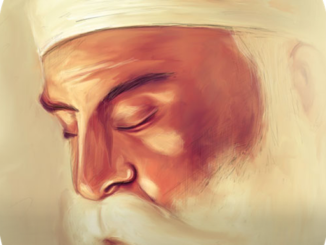
When Guru Nanak came to this world, paths to enlightenment were devoid of divinity; they were completely distorted towards unholy goals of the exploiters of people. The religious institutions had devised beauty shows with religious practices that were intended to attract innocent minds. For example, they invented deities with accompanying stories, idols with descriptions of their powers, recitations to invoke imaginary deities, and rituals that buttressed each other.
When Guru Nanak came into this world, humanity was in the midst of coming out of the realm of primitive homo sapiens, that was hitherto the animal world.
In their history, the people of that century were waking up from awful nightmares of animal life. As characteristic of human form, people were always engaged in fighting for food as the famines were the order of the day. People often lacked abilities to fight hunger and disease, and humanity was faced with those awful calamities on a regular basis. Their physical survival was challenged daily.
Basically, men were there to hunt for food and protect the family, while women were there only for bearing children.
It took thousands of years before those dreams of primitive times were coming to an end. Now, at the time of Guru Nanak, people were out of the dangers that the animal world faced, although their lives were still in the hands of homo-sapiens biology in their thinking. The people were only sluggishly advancing in their intellectual abilities along with taking care of their biological evolution.
With time, humanity was on its way to manage to rein on famine, plagues, or even heart diseases and some cancers. However, their minds would continue being overpowered by animal-like emotional tendencies. In the description of the human mind, Guru would still describe the condition of human beings as,
ਪਸੂ ਮਾਣਸ ਚੰਮਿ ਪਲੇਟੇ ਅੰਦਰਹੁ ਕਾਲਿਆ ॥ SGGS p. 1284
The human beings are nothing more than beasts, wrapped up in human skin; their minds were blackened within (with animal instincts).
Religions and Religiosities Before Guru Nanak
According to the Sikh theologian of the highest repute, Bhai Gurudas, as soon as human beings came out of the animal world, they began with formulating religions. Peoples invented religions that divided them, causing disputes and fights among and between the followers of both Judeo-Christian Religions of the West and Dharmic religions of Asia.
Thus, when Guru Nanak came to this world, paths to enlightenment were devoid of divinity; they were completely distorted towards unholy goals of the exploiters of people. The religious institutions had devised beauty shows with religious practices that were intended to attract innocent minds. For example, they invented deities with accompanying stories, idols with descriptions of their powers, recitations to invoke imaginary deities, and rituals that buttressed each other.
Clergies asked people to erect stunning buildings to house gods and promised accessibility to gods at precise times and places opened only through the expense of wealth, time, and inner energy. Altruism was perverted so that it only benefited clerics, their agents, and their business.
A class of religious leaders routinely concocted religious practices to thrust on people to serve many unholy interests. These interests were mutually supportive and were successful in designing a variety of concealed tricks to fool people who were seeking salvation.
Religious institutions were building cults of external marks and body wrappings to encourage murders and wars against those who did not toe the line, or who were members of competing enterprises.
Many other tricks were employed to speed a religion’s institutional agendas. For example, miracles were invented to convert people and influence human behaviors. The religious myths were invented to answer real questions and then safeguarded those miracles and myths by un-testable threats and promises.
People were asked to invest a massive amount of wealth, time, and mind in ritualistic illusions and also in corrupted beliefs such as, either converting others or serving clergy with wealth and flesh that would guarantee heavens no one had ever seen.
Above all, the self-appointed clerics used horrific fears to ensure compliance with all their tricks.
Guru Nanak Began His Ministry
Guru Nanak came out of his enlightening meditation at the Vein River with fervent zeal to spread what he said was inspiration from the ONE Creator. He then taught that human life was a result of the millions of years of history as well the experience from numerous life cycles of birth and death of their consciousness.
In the very first stanza of his very first composition JAP, Guru Nanak warned against religiosity consisting of practices promoted by the clergy class.
Liberation Not After-Life
Before Guru Nanak, and continued to date, we are told to look forward to achieving the goals of eternal peace and spiritual heights to be awarded in the next life, the life after the death of human existence. Both Judo- Christian religion of the west and Dharmic religions of the East promised the life of the fulfillment in the heavens reached only after death. Guru Nanak refused to accept that.
If You award me the salvation from all pains after I am dead, no one will know that I am liberated.
Throughout history, religions and ideologies did not sanctify life itself. They always sanctified something above or beyond earthly existence and were consequently quite tolerant of death. Indeed, some of them have been downright fond of the Grim Reaper. Because Christianity, Islam, and Hinduism insisted that the meaning of our existence depended on our fate in the afterlife, they viewed death as a vital and positive part of the life. Humans died because God decreed it, and their moment of death was a sacred metaphysical experience exploding with meaning to be realized after death.
When a human was about to breathe his last, this was the time to call Brahmans, priests, rabbis, Sikh granthis and shamans, to draw out the balance of life, and to embrace one’s true role in the universe. Just try to imagine Christianity, Islam, or Hinduism in a world without death – which is also a world without heaven, hell, or reincarnation. Modern science and modern culture have an entirely different take on life and death. They do not think of death as a metaphysical mystery, and they certainly do not view death as the source of life’s meaning. Rather, for modern people, death is a technical problem that the scientists of today are trying to solve, as people do not want to die to get rewards for their good deeds. Lengthening the human lifespan is a major thrust of scientific research today. We have already tripled human life span since the times of Guru Nanak.
In reality, however, humans do not die because the rewards and punishments for their deeds in this life are waiting to be fulfilled. Humans die because modern medicine could not save them from some biomedical glitch. The heart stops pumping blood. The main artery is clogged by fatty deposits. Cancerous cells spread in the liver. Germs multiply in the lungs and elsewhere. Nothing metaphysical about it. It is all currently insoluble technical problems. When some problems indeed are solved, humans begin to live longer. With the advances in technology, life expectancies are expanding from 20 yrs. at one time to now nearly a century in some societies. And life span of two century is within sight.
Sachiara As Human Life objective
In the JAP composition, Guru Nanak asks for becoming Sachiara meaning to be truthful as the objective of this human life. He used the Sachiara term right in the first stanza in the Guru Granth. Later, in the Guru’s hymns, other terms such as Mukta, Panch, Parvan, Pardhan, Gurmukh, are also used for achieving the same or a similar goal.
When asked as to how to achieve the human goal he prescribed, Guru Nanak answered the question by saying that one becomes Sachiara essentially when, under the guidance of the divine wisdom, one succeeds in suppressing and abandoning narcissism in favor of full commitment in Hukam, inculcation of the consciousness within that recognizes Divine blueprint for its creation.
How may one become Sachiara, the truthful? And how may the wall of falsehood (veil of illusion) be torn away? Says Nanak, walk on the path of Hukam, the laws of creation that are written in the systems of the creation, i.e., the Way of His Will.
Hukam may be simply defined as Creator’s blueprint for the creation as well as for its management. Hukam is a self-regulative teleological principle; the purpose of which is to serve rather than become the cause by which it may arise.
Sachiara begins to observe and appreciate Hukam in the working of the living environment as opposed to it being an illusion or imagination and achieved after death.
(The author is Professor and Chair Emeritus, University of North Texas Health Science Center. He can be reached at japji2050@gmail.com)
What the RSS needs is an exposure to Indian culture and a deeper understanding of Hinduism itself
“The RSS was among the few organizations in independent India that refused to honor some of the key symbols of the Indian republic: the national flag, the national anthem and, of course, the Constitution of India. It speaks volumes that the head of the RSS has to clarify, nearly seven decades after the promulgation of the Constitution, that his organization believes in it, something explicitly contradicted by his predecessor. Notwithstanding its recent claims to the contrary, the RSS does not quite subscribe to any of the key tenets of the Constitution: socialism, secularism, federalism and, indeed, democracy.”
The recent outreach by the Rashtriya Swayamsevak Sangh (RSS) at Vigyan Bhavan in Delhi seems to have succeeded in its principal objective: an image makeover for a niche audience. Thanks to an obsequious media and a commentariat ever willing to suspend disbelief, the event has yielded the soft, liberal gloss the RSS needed and desired. Sadly, the critics limited themselves to questions that the RSS anticipated, indeed wanted: Does the RSS exercise influence on this government? Is the RSS anti-Muslim?
It is time we asked a harder and deeper question: Is the RSS anti-national?
Theory and practice
On the face of it, this is an odd question. Nationalism, Indian-ness and Hindutva are very much the calling card of the RSS. This is not put on. I have known the RSS from inside and outside. Having met hundreds of swayamsevaks and many pracharaks, I know that an average RSS volunteer carries this nationalist self-image. I can also attest that just like the communists or old-time socialists, an average RSS worker tends to be more honest and idealist than a run-of-the-mill political leader. I am aware that on more than one occasion, the RSS has done exemplary rescue and relief work during national disasters. If anything, its critics accuse it of being ultra-nationalist. Thus, to question its nationalist credentials might appear outrageous.
Yet this question needs to be debated in all seriousness and all fairness. Given the salience of the RSS in our national public life today, this is a pressing question. We worry, rightly so, about the impact of Islamic fundamentalist groups and Maoist insurgents on our nation. We debate, as we should, the challenge posed by separatism in Kashmir and Nagaland to our nationhood. But we no longer debate with any seriousness the challenge posed by the RSS and its associates to the project of nation-building the Indian nation. The question is about the theory and practice of the RSS as an organization and its relation to the Indian nation, its past, present and future.
The nation and the past
Let’s begin with some indisputable facts about its past. Right from its inception in 1925, the RSS was not in any way active during the national movement. In fact, its associates such as the Hindu Mahasabha actively opposed the national movement. It is also a well-documented fact that V.D. Savarkar, whose ideology inspired the RSS’s founders and who remains its icon, was released from Cellular Jail in the Andaman and Nicobar Islands after he wrote four mercy petitions to the Viceroy pledging loyalty to the British empire. After his release, he lived off a stipend from the British government and obeyed faithfully the conditions it had imposed on him. Shyama Prasad Mookerjee, another Hindu Mahasabha leader, actively collaborated with the British during the Quit India movement while the RSS kept aloof from this biggest anti-colonial uprising. The two-nation theory was propagated by Hindu nationalists, much before the Muslim League. And it is no secret that Nathuram Godse was once an RSS member and was very much a part of its extended family when he murdered Mahatma Gandhi. Bluntly put, the RSS made zero, if not negative, contribution to the national struggle. But that is not sufficient to dub it anti-national today.
The role of the RSS after Independence is more relevant here. How did the RSS contribute to the project of nation-building? Sadly, the answer is again in the negative. The RSS was among the few organizations in independent India that refused to honor some of the key symbols of the Indian republic: the national flag, the national anthem and, of course, the Constitution of India. It speaks volumes that the head of the RSS has to clarify, nearly seven decades after the promulgation of the Constitution, that his organization believes in it, something explicitly contradicted by his predecessor. Notwithstanding its recent claims to the contrary, the RSS does not quite subscribe to any of the key tenets of the Constitution: socialism, secularism, federalism and, indeed, democracy.
“The secessionists challenge the territorial integrity of India. The left-wing extremists challenge the writ of the Indian state. The challenge posed by the RSS is much deeper: it challenges the very idea of India, the swadharma of the Republic of India. If this is not anti-national, what is anti-national?”
In practice, far from being a part of the solution, the RSS was always a part of the problem that India faced in its difficult journey of nation-building. The legacy of Partition and the challenge of bringing together immense diversities posed an unprecedented challenge to the nascent Indian nation. During this delicate phase, the RSS was at best an irresponsible denominational pressure group for the Hinduisation of the Indian state, opposing any and every concession to minorities and advocating a hawkish foreign policy. At worst the RSS became a fulcrum of organized subversion of the constitutional order, as in the demolition of the Babri Masjid in 1992. If constitutional patriotism is the heart of national political life, the RSS has repeatedly stood in opposition to the nation.
More than anything else, it is the theory and practice of its nationalism that shows the RSS to be a European import, out of sync with Indian nationalism. The RSS subscribes to the now outdated European model of nation-state which assumed that the cultural boundaries of a nation must match the political boundaries of a state. In Europe it meant a uniform race, religion, language and culture as the defining features of a nation. In India it meant Hindu-Hindi-Hindustan, the slogan coined by Savarkar. India’s home-grown nationalism challenged this European model and its futile and bloody quest for matching cultural and political boundaries. Instead, Indian nationalism was about creating political unity in conditions of deep diversity of culture, religion and language.
Paradox of its workings
Today, as a rapidly diversifying world seeks to learn from the Indian model, the RSS clings on to an alien, borrowed and fractious understanding of nationalism. Worse, its model of separatism of the majority is clearly the biggest obstacle for Indian nationalism. Isn’t it odd that an organization that claims to work for national integration has, or has had, little time and energy for an amicable resolution of some of the issues that challenge our national unity? These include intractable regional disputes (the Karnataka-Tamil Nadu and Punjab-Haryana water disputes), intra-regional tensions (demand for Telangana or Vidarbha), language issues (Punjabi-Hindi, Kannada-Marathi) or differences with racial and ethnic dimensions (violence against migrants from the Northeast in Bengaluru, Hindi speakers in Mumbai).
The RSS version of nationalism comes into play only when there is a religious angle to any issue. It is not that they care for Hinduism either. The RSS ideologues have little knowledge of or interest in Hindu traditions. In fact, the version of Hinduism that it seeks to impose is itself a parody of orthodox Islam and orthodox Christianity and against the basic spirit of Hinduism, let alone the spirit of humanism that informs all religions. Unfortunately, the principal focus of the RSS has been to foment Hindu-Muslim differences, division and hatred. Since Hindu-Muslim violence poses the biggest single threat to national unity today, those who work for the exacerbation of Hindu-Muslim tension must be seen as anti-national, and guilty of treason.
The secessionists challenge the territorial integrity of India. The left-wing extremists challenge the writ of the Indian state. The challenge posed by the RSS is much deeper: it challenges the very idea of India, the swadharma of the Republic of India. If this is not anti-national, what is anti-national?
I am not for a ban on the RSS. Its theory and practice represent a cultural-political malady that needs a deeper cure rather than a ban. It originates in an inferiority complex of a modern Hindu, made worse by a westernized, deracinated form of our secularism. This might sound odd, but what the RSS needs is exposure to Indian culture and its multiple traditions, greater appreciation of culturally more confident Indians such as Tagore and Gandhi and a deeper understanding of Hinduism itself. If it introspects rather than hold an outreach at Vigyan Bhavan, I am sure its Sarsanghchalak would recommend to the RSS what Gandhiji suggested to the Congress party: dissolve itself.
(The author is National President of Swaraj India and a psephologist/academic formerly with Lokniti, Centre for the Study of Developing Societies, New Delhi)
“These guys are frightening some of the innocent and ignorant Hindus to believe that “Hinduism is in danger” and posing themselves as the freaking saviors. Hinduism does not need these men to save it. It is a 5000-year-old robust religion and will always be there like all other religions.”
The World Hindu Congress held a conference in Chicago in the first week of September 2018, and it was attended by about 3000 Hindus from around the world. Unfortunately, many speakers fouled. Here is an accounting of the two who were divisive and sowed the seeds of ill-will between Indian communities.
Every faith group holds similar conferences. As Americans, we have an opportunity to guide these conferences towards the goal of civility and pluralistic societies, that is, “Respecting the otherness of others.” When we do that, conflicts fade, and solutions emerge.
Each one of us must work towards building cohesive societies where we can live without apprehensions and tensions. No matter what religion you belong to, you must put in that effort.
This conference listed over 100 speakers including the Rashtriya Swayam Sevak Sangh Chief Mohan Bhagwat and Vice President of India Venkaiah Naidu. Can we expect them to talk about the idea of living your life and letting others live theirs? I hope so, but their history points to the opposite. They want to ‘dictate’ what you eat, wear or believe.
Almost all speakers at the event were hell-bent on breaking India to pieces by placing wedges between fellow Indians, at this time, I am familiar with two of the most virulent speakers, and they are Rajiv Malhotra and Dilip Amin.
We unequivocally condemn their false preaching, but spare them, for they know not.
Malhotra panders to the base instincts of humans, some of whom have fallen for him. A few weeks ago, he sent a message urging Hindus to contribute to help Hindus only in the Kerala flood disaster and not Christians and Muslims. Instead of criticizing him for his egregious tweet, a small percent of Hindus has showered him with glory. I am not sure if these Indian Americans have imbibed the American values of caring for fellow humans – which is the value in all religions.
Malhotra is not only wrong but advocating evil acts in the Indian society, dividing it further, causing everyone to live in the hell of tensions.
These guys are frightening some of the innocent and ignorant Hindus to believe that “Hinduism is in danger” and posing themselves as the freaking saviors. Hinduism does not need these men to save it. It is a 5000-year-old robust religion and will always be there like all other religions.
The other guy speaking at the World Hindu Congress in Chicago is Dilip Amin, whose poster heads as “Interfaith Marriages – Silent Holocaust of Hindus.” On his website, he has placed a few good token messages of interfaith marriages, but his goal seems to frighten Hindus to prevent their daughters from marrying Muslims or Christians.
“Every faith group holds similar conferences. As Americans, we have an opportunity to guide these conferences towards the goal of civility and pluralistic societies, that is, “Respecting the otherness of others.” When we do that, conflicts fade, and solutions emerge.”
Amin rightfully claims that 38% of Hindus marry outside their faith and alludes that Hinduism is losing out to Muslims and Christians. Dumbly, he also quotes a similar figure of Muslims and Christians marrying outside their faiths as if they are not losing their flock.
On his website, he points out that these marriages ultimately will not pan out as one 18 years-married Hindu man says, we are divorcing, she calls me a Kafir. This is the dumbest idea he is selling in Chicago. When people go through a divorce, they resort to saying anything that pisses off the other. It has nothing to do with religion; it is all about personal conflicts. When a Hindu woman and man go through a divorce, they label some other reason for their divorce including an abusive, violent relationship, but when there is a religion, they make a scapegoat of religion. There is no need to blame the faith for the acts of individuals.
Over the last seven years, I have officiated nearly 75 interfaith weddings of all combinations. Hindu-Muslim, Muslim-Jain, Hindu-Atheist, Christian-Muslim, Jewish-Muslim and other combinations. The only divorce thus far has been between a Jewish-Christian couple – not because of their religion, but because of the differences in raising their combined children.
They come to me because I do not require conversions and deliver the sermon in both their religious traditions. Only two people have converted thus far out of their free will, which is a part of the pre-wedding counseling. More at Interfaith Marriages http://interfaithmarriages.org/
Those who convert, do feel comfortable sacrificing their belief for the love they have for the other, and to live with least conflicts and more harmony. Why should it matter to you or me? Do we own them and their souls?
“There are millions of Dalit Hindus who live in utter humility and are humiliated on a daily basis. Let these fake saviors of Hinduism give them dignity, treat them as equals, consider them as Brahmins. If not, let them find dignity in other faiths. To a majority of Hindus, Hinduism is an open universal tradition that has a large umbrella to give its beneficence to all faiths. Hinduism is not a dogmatic religion.”
Hindus, Muslims, Christians, Jews or others are individuals who have the freedom to fall in love with anyone and marry anyone for their good. Who are you to dictate who marries whom? American born kids will laugh at these ridiculous attempts to save Hinduism.
One of the members of RSS writes, “Take particular note of World Vision – the worst of the whole bunch bent on harvesting the Lost (Hindu) souls in India via any means – deception, disguise in helping victims. Majority of Christian NGOs are not much better. The Muslims Charities only help fellow Muslims.”
This man is very short-sighted and ill-informed. If everyone in the society starts caring for their own, we will have a disaster on hand. During the Gujarat Earthquake, Tsunami, Kerala Floods and other disasters, Indians have come together for each other. Americans have gone all over the world to serve fellow humans. That’s the right thing to do.
These men also need to know that Saint Mother Teresa saved so many souls and brought dignity to them; the Catholic Charities have helped so many Dalits that the upper Caste Hindus refuse to even go near. Islamic Relief has gone and helped people regardless of their religion in every corner of the world and the majority of Hindus have done the same and will continue to serve and care for fellow beings.
If American Christian Charities had taken the same stinky attitude and not sent shiploads of wheat and corn to non-Christians during the famine in the late sixties, India would have suffered a major crisis, that includes extremist Hindus like the men quoted above.
There are millions of Dalit Hindus who live in utter humility and are humiliated on a daily basis. Let these fake saviors of Hinduism give them dignity, treat them as equals, consider them as Brahmins. If not, let them find dignity in other faiths. To a majority of Hindus, Hinduism is an open universal tradition that has a large umbrella to give its beneficence to all faiths. Hinduism is not a dogmatic religion.
Didn’t some of these guys come to America for making money? So, what if Dalits convert to Christianity for money and uplifting their own lives.
Hinduism is not in danger, these guys are making it appear so, so that they can cash in on the fears of innocent and honest Hindus. I appeal to every Indian not to support divisive individuals or organizations.
We all have to work towards creating better societies.
(The author is the Executive Director of the Center for Pluralism in Washington, DC. He is committed to building cohesive societies and offers pluralistic solutions on issues of the day. More about him at https://www.linkedin.com/in/mikeghouse/)
NEW YORK (TIP): Hard Rock Hotel & Casino in Punta Cana (Dominican Republic) has a “Hindu” pizza on its menu containing “chicken tikka masala with yogurt, cilantro and mint”, which has upset the Hindus.
Hindu statesman Rajan Zed, in a statement to The Indian Panorama from Nevada termed it as a trivialization of the oldest and third largest religion of the world with about 1.1 billion adherents and a rich philosophical thought.
Zed, who is President of Universal Society of Hinduism, urged Orlando (Florida) headquartered Hard Rock International ((HRI), whose tagline is “Love All, Serve All”; to immediately rename the “Hindu” pizza, and its Chairman Jim Allen to offer a formal apology.
Rajan Zed pointed out that Hindus were mostly vegetarian and selling a meat topped pizza in their name was highly inappropriate. No faith, larger or smaller, should be taken frivolously and mishandled for mercantile greed, Zed added.
Zed suggested that HRI and other companies should send their senior executives for training in religious and cultural sensitivity so that they had an understanding of the feelings of customers and communities when introducing new products or launching advertising campaigns.
“Hindu” pizza was available at the Pizzeto restaurant (in HRI’s largest property located in Punta Cana) which opens daily from 12pm to next day 7am and has a “Dress Code”.
HRI, whose history goes back to 1971, owns-operates restaurants, hotels, live performance venues and casinos globally and sells collectible fashion and music-related merchandise. It claims: “no one does hospitality like us” and it recently launched “Rock Om”; “an in-room yoga experience, energizing the body and soul through the power of music.” It delivers “Rock Om yoga kit” to each hotel room free of charge. Select HRI hotels also reportedly offer live, on-site yoga classes.
MILFORD, CT (TIP): Planning and Zoning Board of the City of Milford in Connecticut has reportedly unanimously approved the proposal to establish a Hindu Temple and Cultural Center in Milford.
Besides worship services, it also plans to undertake various cultural activities and community events. The proposed Temple building sits on 1.77 acres, reports suggest.
Meanwhile, distinguished Hindu statesman Rajan Zed commended the efforts of temple leaders and area community towards realizing this temple complex.
Rajan Zed, who is President of Universal Society of Hinduism, further said that it was important to pass on Hindu spirituality, concepts and traditions to coming generations amidst so many distractions in the consumerist society and hoped that this temple would help in this direction. Zed stressed that instead of running after materialism; we should focus on inner search and realization of Self and work towards achieving moksh (liberation), which was the goal of Hinduism.
Milford, whose history goes back to 1639 and which calls itself “A Small City with a Big Heart!” and claims to be a meticulously maintained “town green”, is known for its annual Milford Oyster Festival. Benjamin G. Blake is the Mayor.
Hinduism, oldest and third largest religion of the world, has about 1.1 billion adherents. There are about three million Hindus in USA.
NEW YORK (TIP): Upset Hindus are urging Brooklyn (New York) headquartered e-commerce company Etsy, Inc. for immediate withdrawal of flip-flops carrying image of Hindu deity Lord Ganesh; calling it highly inappropriate.
In July last, Etsy withdrew toilet seat carrying image of Lord Ganesh from its website within less than two hours after a protest spearheaded by Hindu statesman Rajan Zed on this product, which Hindus thought was highly insensitive.
Zed, who is President of Universal Society of Hinduism said that Etsy should have been enlightened by now that Lord Ganesh was highly revered in Hinduism and was meant to be worshipped in temples or home shrines and not to adorn one’s feet. Hindus considered it a sacrilege to trample his image under one’s feet. Inappropriate usage of Hindu deities or concepts for commercial or other agenda was not okay as it hurt the devotees.
Rajan Zed also urged Etsy and its CEO Josh Silverman to offer a formal apology, besides withdrawing Ganesh Flip Flops.
Hinduism was the oldest and third largest religion of the world with about 1.1 billion adherents and a rich philosophical thought and it should not be taken frivolously. Symbols of any faith, larger or smaller, should not be mishandled, Zed noted.
Rajan Zed further said that such trivialization of Hindu deities was disturbing to the Hindus world over. Hindus were for free artistic expression and speech as much as anybody else if not more. But faith was something sacred and attempts at trivializing it hurt the followers, Zed added.
Is offering products like Ganesh Flip Flops really matches Etsy’s belief that “the power of business can create a better world”, its claim to “Keep Commerce Human” and its stated Mission “to reimagine commerce in ways that build a more fulfilling and lasting world”? Zed asks.
Rajan Zed suggested that Etsy and other companies should send their senior executives for training in religious and cultural sensitivity so that they had an understanding of the feelings of customers and communities when introducing new products or launching advertising campaigns.
Item description of Ganesh Flip Flops states: “Traditionally, Ganesh is thought to provide prosperity, fortune and success. He is the Lord of Beginnings and the Remover of Obstacles of both material & spiritual kinds… Stand out from the crowd in these cute flip flops!” It sells for $25.00.
Etsy, founded in 2005 in an apartment in Brooklyn and now headquartered in its Dumbo neighborhood with additional offices in France, Canada, Germany, United Kingdom, Ireland, San Francisco (California), Hudson (New York); describes itself as “a global creative commerce platform”. It claims to have had annual gross merchandise sales of $3.25B in 2017.
In Hinduism, Lord Ganesh is worshipped as god of wisdom and remover of obstacles and is invoked before the beginning of any major undertaking. There are about three million Hindus in USA.
ATLANTA (TIP): “Tell the Whole Story from Beginning to End:” The Ramayana in Indian Painting— exhibition has been launched at Michael C. Carlos Museum of Emory University (Carlos Museum), which will continue till May 20.
Claimed to be first-of-its kind art exhibit which was curated, organized and researched exclusively by Emory students; uniting artwork and classwork; in the class “The Art of an Hindu Epic”; which was taught by professors Ellen Gough and Marko Geslani from Emory’s Department of Religion.
The paintings in this exhibition are reportedly dated between the 17th and 19th centuries, including “The Coronation of Rama” (1840). Students included Darby Caso, Parth Goyal, Kristin Kimberlain, Saayli Kokitkar, Marshall Kupka-Moore, Elizabeth Muse, Thomas Shen, Tarun Swaminathan; most of whom had little background in art history; reports suggest.
Hindu statesman Rajan Zed commended Emory University for highlighting Hindu heritage through Ramayana exhibition.
Rajan Zed, who is President of Universal Society of Hinduism, urged major universities of the world; including Harvard, Oxford, Stanford, Cambridge, Princeton, UC Berkeley, Yale, Columbia, Toronto, Tokyo, Melbourne, etc.; to frequently offer Hinduism focused classes and exhibitions, thus sharing rich philosophy-concepts-symbols-traditions-art of this oldest religion with the rest of the world. If they needed any assistance, he or other Hindu scholars would gladly help, Zed added.
Carlos Museum, founded in 1919, “collects, preserves, exhibits, and interprets art and artifacts from antiquity to the present”. Its collections include some 17,000 artifacts. Bonnie Speed is the Director.
Internationally recognized Emory University in Atlanta (Georgia), one of the world’s leading research universities, was founded by Methodists (university maintains a formal affiliation with the United Methodist Church) in 1836. It serves about 15,252 students with about $5.4 billion annual operating budget and has been ranked among top in most beautiful campuses and happiest colleges. Dr. Claire E. Sterk is the President, while Robert C. Goddard III is its Trustees Chair.
Hinduism, third largest religion of the world, has about 1.1 billion adherents and moksh (liberation) is its ultimate goal. There are about three million Hindus in USA. Ramayana, a narrative poem of about 25,000 slokas beginning in BCE period is divided into seven kandas.
MELBOURNE (TIP): Upset Hindus are urging Gosford (New South Wales, Australia) based fightwear firm “Raven Fightwear” for immediate withdrawal of “Battle of the Gods – Hanoman v Ganesha” rashguards displaying images of Hindu deities Lord Ganesha and Lord Hanuman in a battle mode.
Hindu statesman Rajan Zed, in a statement in Nevada said that it was trivialization of Lord Ganesha and Lord Hanuman, who were highly revered in Hinduism, as there was no scriptural evidence that any Hanuman versus Ganesha battle took place. Inappropriate usage of Hindu deities or concepts for commercial or other agenda was not okay as it hurt the devotees.
Zed, who is President of Universal Society of Hinduism, also urged Raven Fightwear and its CEO to offer a formal apology, besides withdrawing “Battle of the Gods – Hanoman v Ganesha” rashguards from its website and stockists.
Zed further said that such trivialization of Hindu deities was disturbing to the Hindus world over. Hindus were for free artistic expression and speech as much as anybody else if not more. But faith was something sacred and attempts at trivializing it hurt the followers, Zed added.
“Battle of the Gods – Hanoman v Ganesha” men’s/women’s long sleeve rashguards were priced at $64.95 each on the website of Raven Fightwear, which specializes in Mixed Martial Arts apparel and claims to be “one of Australia’s fastest growing fight wear brands”. It has stockists in Australia, United Kingdom, USA, Canada, Czech Republic, Singapore, Russia; and its products include shorts, rashguards, gloves t-shirts, hoodies. “Our designs center around Norse mythology”, it states.
In Hinduism, Lord Ganesha is worshipped as god of wisdom and remover of obstacles and is invoked before the beginning of any major undertaking. Lord Hanuman is known for incredible strength and was a perfect grammarian.
NEVADA (TIP): Upset Hindus are seeking apology and urging online retailer Amazon.com for the immediate withdrawal of leggings carrying images of Hindu deity Lord Hanuman; calling it highly inappropriate.
“Hanuman the Great” Women’s Leggings are selling at Amazon.com for $48.00 – $58.00 and are described as: “ultimate fashion statement to express your style”.
Hindus have protested and contacted Amazon.com many times in the past over what they felt was trivialization of Hindu deities on various products sold on its website and had been mostly successful in persuading the company to remove those.
Hindu statesman Rajan Zed, in a statement in Nevada, said that Lord Hanuman was greatly revered in Hinduism and was meant to be worshipped in temples or home shrines and not to adorn one’s legs. Inappropriate usage of Hindu deities or concepts for commercial or other agenda was not okay as it hurt the faithful.
Zed, who is President of Universal Society of Hinduism, also urged Amazon.com President Jeffrey P. Bezos to offer a formal apology, besides withdrawing Lord Hanuman leggings, as this was not the first time for the company to offer such products which were deemed offensive by Hindu devotees.
Zed further said that such trivialization of Hindu deities was disturbing to the Hindus world over. Hindus were for free artistic expression and speech as much as anybody else if not more. But faith was something sacred and attempts at trivializing it hurt the devotees, Zed added.
Rajan Zed suggested that Amazon.com and other companies should send their senior executives for training in religious and cultural sensitivity so that they had an understanding of the feelings of customers and communities when introducing new products or launching advertising campaigns.
Cow is not sacred and beef is not forbidden to Hindus, according to Vedas
By Dave Makkar
The author finds no mention in Hindu scriptures about cow being referred to as “mother” or as “holy”. He finds no evidence that cow slaughter was ever prohibited, that beef eating was forbidden. He wonders why Hinduwadis are so obsessed with cow. The Indian Panorama, with this article, is initiating a debate on an issue which has fiercely divided the Indian nation. The views expressed here are the author’s own.
The current atmosphere in India on the issue of cow defies all sane logic, Hindu religious Texts, thousands of years old sacred history, historians and scholars. On one hand the current Modi government talks of making India the biggest economic power in the world surpassing America and China. On the other hand, his own party and his Hindu affiliate’s members talk of what people can eat or cannot eat, how many children the Hindu couples should produce, what the women should wear, adult girls cannot be seen in the company of opposite sex friends, Hindu girl cannot marry a non-Hindu and any criticism of government policies make you anti-national that includes refusing to say Bharat Mata ki Jai or Cow is our mother.
Modi himself and his team members are biggest hypocrites on the issue of cow or meat. As CM of Gujarat under Modi meat production 10,600 tons in 2001-2 went up to 35,286 tons in 2011-12. Still Modi accused UPA government for cow slaughter for their support to meat exporters “Pink Revolution” during the run up to the 2014 elections that brought him to power. Ironically under Modi’s watch bovine/cow meat export has gone up by 70% according to the Commerce Ministry website. Now India is number 1 exporter of bovine/cow meat in the world.
Modi’s confidante Amit Shah during the 2014 campaign made several speeches that cow slaughter will not be banned in north eastern states of India. As BJP’s party president on May 28, 2015 in Goa; Amit Shah ruled out a nation-wide beef-ban or cow slaughter. Union Government and Goa Government both under BJP are jointly running a slaughterhouse in Goa.
Sangeet Som, the Hindutva poster boy & one of the main accused in 2013 Muzzafarnagar communal riots, UP Assembly Member and now Minister in Adityanath Yogi’s government had been personally associated with two meat processing and export companies, Al-Dua and Al-Anam. Al-Dua is one of the India’s leading halal meat export companies which exports meat to Arab countries.
BJP candidate Sreeprakash on April 2, 2017 in the run up to the Mallapuram Lok Sabha by election in Kerala said, “I will ensure quality beef and standard abattoirs in my constituency.”
Modi’s Minister of State for Home Affairs Kiren Rijiju in Aizwal on May 27, 2017 said that, “I eat beef, I’m from Arunachal Pradesh and can anybody stop me? So let us not be touchy about somebody’s practices. This is a Democratic country. Sometime some statements are made which are not palatable.” Kiren Rijiju also described as “unpalatable” his colleague Mukhtar Abbas Naqvi’s remarks that those who eat beef should go to Pakistan, and questioned whether anyone could stop him from eating beef. The BJP leaders in Arunachal, Meghalaya, Sikkim, Mizoram, Nagaland have been making statements to their constituents, sale of beef at subsidized rates is their commitment to them. After the new Cattle Trade Rules announced by the Modi government they went to the extent of saying “No Beef No Support to BJP”
BJP’s Karnataka spokesperson Vaman Acharya on May 28, 2017 while participating in a panel discussion on Suvarna News opposed the beef ban. He said that people from all communities including the Brahmin community, consumed beef. Before India became an agrarian nation, beef had been a staple diet. Even today, several people, including indigenous tribes in the North Eastern States consumed beef as a staple. Acharya had also said that as chairman of the Karnataka Pollution Control Board, he gave permission for the setting up of 16 abattoirs in the State. Lastly, he had said that he didn’t subscribe to the religious sentimentality attached to the cattle. He retracted his statements on June 6, 2017 under party pressure.
Modi’s Home Minister Rajnath Singh in Aizwal on June 12, 2017, said that people are free to choose what they want to eat. When asked about protests against the government’s ban on sale of cattle for slaughter, Singh clarified that the Centre will not impose any restrictions on one’s choice of food. However, even as Singh spoke, scores of people in the Mizoram capital participated in a “beef ban bashing banquet” organized by a local organization. (PTI)
Kerala BJP and RSS have joined hands to start a co-operative society to sell meat which includes bovine meat as well as fish, a Malayalam daily Deshabhimani reported on July 5, 2017.
July 17, 2017 Goa’s BJP CM Manohar Parikar who also holds the animal husbandry portfolio in the assembly session replied to BJP assembly members concern over the poor quality of Beef imported from Congress ruled neighboring state Karnataka; “Approximately 2,000 kg beef is produced per day at the state abattoir of the Goa Meat Complex Limited, while rest of beef is brought in from Karnataka. Parrikar said he would issue directions to the department concerned to carry proper inspection of beef imported from Karnataka. Parrikar further added that “The Goa Meat Complex Ltd has no problem in slaughtering more animals if they are brought there by traders,”
Modi’s New Cattle Trade Rules that have been stayed by the SC on July 12, 2017 violates Right of a Person to Freedom of Choice regarding Food as enshrined in Indian Constitution and it is also violating the rights of the farmers to trade. Under this law farmers cannot sell the cattle in the market for slaughter but slaughter houses can come to the farmer and buy cattle for slaughter. Then majority of the farmers are not educated how they can comply with filling out numerous forms about the origin & ownership of the animal in question? First, the farmers/dairy operators will be exploited by the bureaucracy and then by Slaughterhouses that can make a cartel to give them less price for their cattle.
Modi aka BJP is paving the way for its handlers like Adani, Ambani, Tata and other foreign MNC’s to control the meat and animal hide trade that is worth Billions of Dollars. UP slaughterhouses alone employ 25 lac people with a turnover of Rs. 15,000.00 crore, the highest producer of meat in India. The meat industry is likely to grow at a compound growth rate of 8.4% over the next five years. The processed meat industry is growing even much faster, at about 20%. The meat export from India is about $4.5 billion and raw hide to leather goods is another $5.5 billion. About 22 million people are in the workforce and the meat export industry is expected to grow 50% in 5 years. Beside that 70% of Indians are non-vegetarians. Domestic per capita meat consumption in India is very low — around 5 kg as compared to the world average of 47 kg. With rising incomes between 2003 and 2012, their meat consumption rose by 6.3% a year. It is expected to rise by another 3.5% a year between 2013 and 2022.
Apart from 73.7 lakh tons of meat in 2016-17, India also produced 108 lakh tons of fisheries in 2015-16 ranking 2nd after China. India is the number One the and largest exporter of shrimp fish in the world. This industry is growing at a robust pace of 8% per annum. The business is valued at Rs. 1 Lakh Crore and employs about 150 lakh people. Andhra Pradesh occupies the first place, West Bengal 2nd and Modi’s Gujarat at 3rd place in fish production in India.
The demonetization was also done for these very influential people so that they can control food business worth billions that is traditionally run on cash basis by the informal sector. On top of that to pave the way for billions of dollars that can be made in transaction fees in the guise of digital money from the less fortunate and financially most vulnerable people of Indian society. Rich have credit cards; they don’t pay any fees to use it; rather they are rewarded with points and cash back for its use; it is the merchant that pays the fees for accepting it. The poor has to get a “Pre-Paid Debit Card” for a fee with a monthly maintenance fee and fee for loading money; one of the biggest Ponzi schemes ever invented by the American Financial Industry to loot the poor.
Coming to Team Modi & Hinduwadi’s understanding of Hinduism, its history, its writing on eating meat and views of various learned scholars, all of them are a very big disappointment. Team Modi should do some soul searching why Atal Behari Bajpai avoided the trap of cow laid by the bogus Hindutva supporters that has no love for their own 50 crore (500 million) extremely poor Hindus living a miserable life.
According to Sanskrit ScholarRajani K Dixit, “there is no such thing as Holy Cow in the Vedas”. The Vedas consider bovines important for milk, beef, agriculture and transport but not divine or holy. The word ‘Aghnyaa’ applies only to a milch cow because it is not economical to kill it. A Vaisha cow is meant for beef, and especially reserved to an extent for Brahmins only. Atharva 12.4(13) tells us that in case a Brahmin begs for a cow from a non-Brahmin, “even if that person has a beef-dinner at his house, he has to select another cow to slaughter for his own dinner, than the one that is asked for”. The word ‘Aghnyaa’ (not to be killed) coined by Rigveda for young milch cows was the main cause of the Hindu misunderstanding that cows or bovines are not to be slaughtered.
The Rigveda has never used the word ‘mother’ for a cow. There is no punishment recommended for a cow slaughterer even if someone kills a young milch cow. Beef-eating is also not taboo. Beef parties are not only allowed but highly appreciated, and a person who cooks beef for his guests is praised by the term ‘Atithi-gva’ ‘one who offers beef to guests’.
Ritual sacrifice of a bull is a must in worship to God Indra.Beef parties also seem a regular affair in weddings (RV 10.85). Cows are not sacred and beef is not forbidden to Hindus. Here is a line from a verse ascribed to god Savita, the presiding deity of the Gayatri Mantra, describing a dinner party he is hosting: “At night we are going to kill cows” (RV.10.85(19). RV 10.89 (14) mentions “cows for food, laying scattered on the grounds of a slaughter house”. Mark that the author does not use the word ‘animals’ but ‘cows’, showing that beef was the most popular item, and the cow the most slaughtered animal. RV 10.95(6) says that “old cows which do not give milk” are “only fit to be cooked”. It further states that “useless cows ….are taken to be cooked, but never milch cows”. It is clear that slaughter houses are not banned, beef is allowed and useless bovines are allowed to be slaughtered in Hinduism.
Aadi Shankaracharya born in 788 CEin Kerala: in his commentary on Brahadaranyako Upanishad 6/4/18 says: ’Odaan’ rice mixed with meat is called ‘maansodan’ on being asked whose meat it should be, he answers ‘Uksha’ is used for an ox, which is capable to produce semen. Currently 72 communities including some upper caste Hindus in Kerala prefer beef to the mutton and some prefer it because it is cheaper than mutton.
Hinduisms great propagator Swami Vivekaanand said: “You will be surprised to know that according to ancient Hindu rite and rituals, a man cannot be a good Hindu who does not eat beef “. (The complete works of Swami Vivekanand vol :3/5/36)
Vinayak Damodar Savarkar, the Hindutva Icon and Icon of Hindu religious & political parties including BJP, espoused his views in Vidnyan Nishta Nibandh, that the cow, like the peepal tree, should be cared for, as something useful to humans, which meant eating it as well if need be. He insisted that a superstitious mindset towards cows would ruin India’s intellect and that cows should be protected for their economic use to man, and not because of their ‘divinity’. Attributing religious qualities to it gives it a godly status. Such a superstitious mindset destroys the nation’s intellect. “When humanitarian interests are not served and in fact harmed by the cow and when humanism is shamed, self-defeating extreme cow protection should be rejected.”
Every now and then, an admirer of Savarkar raises the topic. “Can anyone imagine that the ‘Father of Hindutva’ advocated beef-eating (in special circumstances), rejected the divinity of the Vedas, denounced the sanctity of the caste system and launched a virulent attack on the hypocrisy of the priests?” wrote Ved Pratap Vaidik, a journalist close to several Hindutva figures. “Incidentally, Savarkar was a beef-eater,” wrote Varsha Bhonsle on Savarkar’s birth anniversary, February 26, in 1998. “For he was, above all else, a rationalist – a true Hindu – and eons ahead of contemporary Hindutvawadis.” (“Why is the Cow a Political Animal?” S. Joshi)
Mahatma Gandhi was approached for total ban on Cow Slaughter in India. His reply was, “I have been long pledged to serve the cow but how can my religion also be the religion of the rest of the Indians? It will mean coercion against those Indians who are not Hindus. The assumption of the Hindus that India now has become the land of the Hindus is erroneous. India belongs to all who live here. Earlier on 25th July 1947 he also said that “The Hindu religion prohibited cow slaughter for the Hindus, not for the world. The religious prohibition came from within. Any imposition from without meant compulsion. Such compulsion was repugnant to religion.”
A Brahmin’s Cow Tales by D. N. Jha, a high cast Brahmin himself. The cow as a sacred animal, Jha believes, did not really gain currency until Dayanand Saraswati’s cow protection movement in the 19th century”. The cow became a tool of mass political mobilization with the organized cow-protection movement,” the historian points out. “The killing of cows stopped gradually with the agrarian society and caste rigidity. The Brahmins found it convenient to say that those who ate beef were untouchable. But they themselves continued to consume it, recommending it for occasions such as shraadh. The beef-eating habits of Indians which existed in Rig Vedic times and continued till the 19th century and after, despite repeated Brahminical injunctions against cow-killing. That ancient Hindus, including Brahmins, were beef-eaters, willing to incur the minor penalty that an agrarian society began imposing on cow-killers, and that this fondness for cattle meat had nothing to do with Islam or Christianity.
For those who blame Muslims for the practice of Cow slaughter in India. Babar’s first act after conquering Delhi was to forbid the killing of cows. They must read Babar’s Directives (Wasiyyat namd-i-majchfi) a secret testament to his son Humayun and his future generations. For the stability of the Empire, O my son!, “The realm of Hindustan is full of diverse creeds. Praise be to God, the Righteous, the Glorious, the Highest, that He hath granted unto thee the Empire of it. It is but proper that thou, with heart cleansed of all religious bigotry, should dispense justice according to the tenets of each community.’ “And in particular refrain from the sacrifice of cow, for that way lies the conquest of the hearts of the people of Hindustan; and the subjects of the realm will, through royal favour, be devoted to thee. And the temples and abodes of worship of every community under Imperial sway, you should not damage. Dispense justice so that the sovereign may be happy with the subjects and likewise the subjects with their sovereign. The progress of Islam is better by the sword of kindness, not by the sword of oppression.” (Abstracted from the 1936 book The Mughal Empire From Babar To Aurangzeb, by SM Jaffar of Peshawar. It mentions that “the original document is in Persian and is treasured in the Hamida Library at Bhopal as one of its heirlooms.”)
The British Origin of Cow-Slaughter in India (published 2002) by Gandhian historian Dharampal. His book draws from official documents to show that the riots of 1880-1894 were not the obvious Hindu-Muslim conflagration they were made out to be. The book cites accounts of how “many prominent Muslims as well as the Parsis and Sikhs actively participated in the (cow protection) movement.” Dharampal wrote that large-scale cow slaughter was not the handiwork of Muslims who came to India from central and western Asia. “The question of the sacrifice of a cow did not arise as the land where Islam arose did not have many cows.”
Mughals were habituated to the meat of goats and mutton, sacrificing camels on the occasion of festivals like Eid or for large feasts, the book says. Dharampal rues the lack of research on cow killing between 1200 and 1700, when a series of Muslim kings ruled over a large part of India. But he goes on to show that systematic slaughter of cattle began in India with the East India Company establishing itself. The British, unlike the central and west Asians, were habituated to beef. The first slaughterhouse in India was built in Calcutta (now Kolkata) in 1760 by Robert Clive, then Governor of Bengal. It could kill 30,000 animals per day. Several more slaughterhouses were set up in various parts of the country by the Commissariat Wing of the three British armies of Bengal, Madras and Bombay Presidencies. A total of 350 slaughterhouses were constructed by 1910.
Nitya Sambamurti Ghotge, a veterinary surgeon who heads Anthra, a group in Pune that has worked with rural livestock rearers since 1992. Laws against cow slaughter and Trade Rules will only criminalize the livestock trade, not protect the animals, said Ghotge. Only the smugglers and the law enforcement officials will benefit from the ban on cow slaughter, not the poor farmers or the livestock. Like the agriculture scientist Ramanjaneyulu, Ghotge holds that the cow protection laws are unjust; it is about powerful urban people outsourcing the burden of cow protection on the rural poor, she said.
As for the BJP’s claim that “cow is the only divine animal that exhales oxygen”, no living being other than plants exhale oxygen is also a myth. Animals, however, exhale unused oxygen, as lungs cannot process all the oxygen that is inhaled. According to the 2006 FAO report, the livestock sector accounts for 9 per cent of carbon dioxide derived from human-related activities, but produces a much larger share of even more harmful greenhouse gases.
Team Modi is least concerned about the millions of Indians- Hindus as well as non-Hindus employed directly and indirectly in the cattle trade. The millions especially children and elderly that depend on bovine meat as the cheapest source of protein. In the name of misguided Hindutva they are imposing their personal believes on the cattle breeders, traders, farmers and bovine meat eaters without considering the economic realities. There was a time when the owner could get Rs 12,000.00 to Rs. 15,000.00 for the unproductive animal from a slaughterhouse, now that has been reduced to Zero by the Gau Rakshaks/cow vigilantes. Rs 2,500.00-3,000.0 per month is the cost just to keep the animal alive for 8-10 years after the end of its economic utility. If the 10 million or so cattle that possibly end up at the abattoir every year are not culled, farmers will simply stop caring for them and let them loose in towns and cities. It will cost upward of Rs 22,000 crore to take care of them. And since the 10 million-plus will keep adding each year, till they die in their natural course, these costs would only keep on mounting up every year. Just in the 4th year the cost could be more than Rs. 88,000.00 crore. In BJP ruled state Rajasthan the state government is providing Rs 70.00/day for cow and Rs 35/day for calf and at the same time it is providing Rs. 25.63/person on welfare schemes in the state. Under Modi, India has become an international joke where cow is more valuable than human beings.
(The author is a New Jersey based community activist and a regular commentator on burning issues. He can be reached at davemakkar@yahoo.com)
(The Indian Panorama invites comments on the article)
ATLANTA, GA (TIP): His Holiness Mahant Swami Maharaj, the current spiritual leader of the BAPS Swaminarayan Sanstha, joined devotees and well-wishers in celebrating the ten-year anniversary of the BAPS Shri Swaminarayan Mandir in Atlanta, GA on July 1, 2017. The Mandir was inaugurated by His Holiness Pramukh Swami Maharaj in 2007 and has helped enrich the local community through the development of family and youth programs, community outreach, and spiritual assemblies. A true labor of love, the Mandir offers weekly services and year-round programs organized by volunteers and Swamis within the BAPS community.
As a central place of Hindu worship, the BAPS Shri Swaminarayan Mandir opened to the community on August 26, 2007 and was made possible by the spiritual support, guidance, and inspiration of Pramukh Swami Maharaj, the fifth spiritual successor of Bhagwan Swaminarayan. Today, Mahant Swami Maharaj carries forward this work and legacy as the current spiritual successor of Bhagwan Swaminarayan. Through his leadership and guidance, Mahant Swami Maharaj invites people of all faiths and cultural backgrounds to visit and explore the mandir, its architecture, and its Hindu teachings.
Heer Patel from Memphis, Tennessee was relatively new to the BAPS community during the inaugural ceremonies in 2007 and recalled the event with great enthusiasm, “[Pramukh Swami] was truly someone special that was able to attract thousands of people from different backgrounds and bring them together for one purpose. I was not never really interested in spirituality, but after the memorable interactions with Pramukh Swami Maharaj when he inaugurated the temple in 2007, I became more and more connected with the temple.” Patel was a volunteer at the 10 year celebrations. “It has been such an amazing experience to have just as amazing interactions with Mahant Swami Maharaj as we celebrated the 10 year anniversary of the mandir”.
BAPS Atlanta 10th Anniversary: His Holiness Mahant Swami Maharaj, the current spiritual leader of the BAPS Swaminarayan Sanstha, joined devotees and well-wishers in celebrating the ten-year anniversary of the BAPS Shri Swaminarayan Mandir in Atlanta, GA on July 1, 2017.
Since Pramukh Swami Maharaj’s visit, participation within the local community and beyond has grown, and hundreds of individuals regularly attend celebrations of Hindu festivals throughout the year.
The BAPS Shri Swaminarayan Mandir in Atlanta is the first of its kind in the region, and community volunteers welcomed the ten-year anniversary celebrations in the presence of Mahant Swami Maharaj with the same zeal and excitement they experienced back in 2007.
The anniversary celebrations were primarily created and led by the youth of BAPS who have been preparing for the arrival of Mahant Swami Maharaj for several months. Yash Soni from Parkland, FL says, “By participating in various performances during the 10th anniversary celebration, I have felt a deep connection with my guru and developed a greater understanding of samp (unity) and teamwork. These are two values that he has stressed to youths of my age.”
Over the past ten years, the mandir has welcomed people from all walks of life, leaving a lasting impression in their lives. Community members join in weekly events to practice spirituality and personal development while fostering a sense of unity and teamwork. Music, language, and spiritual enrichment classes actively instill Hindu values and culture in future generations of young people who will grow to lead in their communities.
Regular programs and events at the mandir provide an opportunity for community members to explore and practice Hindu traditions and faith. The mandir is also the site of various charitable initiatives that include health fairs, blood drives, and community walkathons for people of all ages – merging the spirit of service with volunteerism.
The BAPS Mandir in Atlanta unites families in spirituality, setting the tone for the anniversary events. Highlights from the program included video footage of the inaugural ceremonies and colorful cultural dances. Guests relived the past ten years of the mandir’s history, the development of youth activities, and the installation of the sacred image of Nilkanth Varni. Devotees shared stories of reaching milestones in their spirituality, growing closer to one another, and practicing peaceful living – all inspired and guided by the role of mandir in their lives.
The event was attended by several community and government officials who recalled fond moments with Pramukh Swami Maharaj and shared heartfelt reflections on their first meeting with Mahant Swami Maharaj during his current travels. The mayor of Lilburn, Mayor Johnny Crist, presented Mahant Swami Maharaj with a key to the city while saying, “Most cities in the state of Georgia want to be a place where you live, work, and play. But may I offer another alternative, or add to it, and that is we need to be a city where that is a place to live, to work, to play, and to pray.” Mayor Crist also brought a proclamation designating July 1, 2017 as Mahant Swami Maharaj Day in the city of Lilburn. In addition to Lilburn there are a total of six cities recognizing July 1, 2017 as Mahant Swami Maharaj Day including Matthews, NC; Boynton Beach, FL; Montgomery, AL; Knox County, TN; and Anderson, SC.
Georgia’s Secretary of State, Mr. Brian Kemp, conferred an Honorary Citizenship of Georgia to His Holiness Mahant Swami Maharaj. The honorable Mr. Nagesh Singh, the Consul General of India, was also in attendance and conveyed a hearty welcome on behalf of the Government of India.
The celebrations concluded with blessings from Mahant Swami Maharaj who encouraged all to uphold unity, maintain faith, and further develop one’s spirituality in strengthening the mandir as a community place of worship.
Follow #BAPSATL10 and #MahantSwami on social media for more details regarding anniversary celebrations and His Holiness Mahant Swami Maharaj’s North America visit.
More details at http://www.baps.org/News/2017/BAPS-Atlanta-10th-anniversary-11686.aspx
NEVADA (TIP): Hindus are urging all state and independent/private schools in Wales (United Kingdom) to close on Diwali, most popular of their festival, which falls on October 19 this year.
Distinguished Hindu statesman Rajan Zed, in a statement in Nevada (USA) said that it would be a step in the positive direction, as it was important to meet the religious and spiritual needs of Hindu pupils.
Zed, who is President of Universal Society of Hinduism, indicated that Wales schools should make efforts to accommodate the religious requirements of Hindu students and show respect to their faith by not conducting regular business and scheduling classes on Diwali. We did not want our students to be put at an unnecessary disadvantage for missing tests/examinations/papers, assignments, class work, etc., by taking a day-off to observe Diwali.
If schools had declared other religious holidays, why not Diwali, Rajan Zed asked. Holidays of all major religions should be honored and no one should be penalized for practicing their religion, Zed added.
Zed suggested that all Wales schools, state as well as independent/private, to seriously look into declaring Diwali as an official holiday, thus recognizing the intersection of spirituality and education. Zed noted that awareness about other religions thus created by such holidays like Diwali would make Wales students well-nurtured, well-balanced, and enlightened citizens of tomorrow.
Rajan Zed urged Welsh First Minister Carwyn Jones and Cabinet Secretary for Education Kirsty Williams to work towards adding Diwali as an official holiday in all the state schools of Wales, and persuading the independent/private schools to follow.
Zed further says that Hinduism is rich in festivals and religious festivals are very dear and sacred to Hindus. Diwali, the festival of lights, aims at dispelling the darkness and lighting up the lives and symbolizes the victory of good over evil.
CARSON CITY, NEVADA (TIP): Nevada State Assembly in Carson City started its day with a set of Hindu mantras on May 24, containing verses from world’s oldest existing scripture.
Hindu statesman Rajan Zed delivered the invocation from ancient Sanskrit scriptures before the Assembly. After Sanskrit delivery, he then read the English translation of the prayer. Sanskrit is considered a sacred language in Hinduism and root language of Indo-European languages.
Zed, who is President of Universal Society of Hinduism, recited from Rig-Veda, the oldest scripture of the world still in common use, besides lines from Upanishads and Bhagavad-Gita (Song of the Lord), both ancient Hindu scriptures. He started and ended the prayer with “Om”, the mystical syllable containing the universe, which in
Hinduism is used to introduce and conclude religious work. Reciting from Brahadaranyakopanishad, Rajan Zed said, “Asato ma sad gamaya, Tamaso ma jyotir gamaya, Mrtyor mamrtam gamaya”; which he then interpreted as “Lead us from the unreal to the Real, Lead us from darkness to Light, and Lead us from death to immortality.” Reciting from Bhagavad-Gita, he urged assembly members to keep the welfare of others always in mind. Assembly members, employees, public and others present were seen standing in prayer mode with their heads bowed down during the invocation.Wearing saffron colored attire, a ruddraksh mala (rosary), and traditional sandalpaster tilak (religious mark) on the forehead, Zed sprinkled few drops of water from river Ganga of India, considered holy by Hindus, around the podium before the prayer.
Zed presented a copy of Bhagavad-Gita to Speaker Jason Frierson, who introduced Zed.
In the State of Nevada, besides Nevada Assembly and Nevada Senate, Rajan Zed has already delivered Hindu prayers at Cit Councils of Las Vegas, Henderson, Sparks and Boulder City; Clark County Board o Commissioners and Carson City Board of Supervisors. Besides Nevada, he has also read opening prayers in United States Senate and US House of Representatives in Washington DC, various State Senates and State Assemblies/Houses-of-Representatives, various County Commissions and City Councils all over USA.
Bestowed with World Interfaith Leader Award, Zed is a global Hindu and interfaith leader, who besides taking up the cause of religion worldwide, has also raised huge voice against the apartheid conditions faced by about 15-million Roma (Gypsies) in Europe. Many cities in USA have named October 25 as “Rajan Zed Day”.
Hinduism, oldest and third largest religion of the world, has about 1.1 billion adherents and moksh (liberation) is its ultimate goal. There are about three million Hindus in USA. Nevada Assembly has 42 members.
Nevada, largest gold producer and 7th largest state, was admitted to USA in 1864. Nevada, also called “Silver State”, is known for Las Vegas, Burning Man, Lake Tahoe, etc. Brian E. Sandoval is Governor.
“I remain hopeful that proper actions can be undertaken to help preserve a welcoming, ethical, tolerant, and legal religious environment in the USA. We are a religious nation, yet also a nation of laws. Religious freedom must not be used as an excuse or cover to inflict abuse and commit crimes. That is not what our laws provide for”, says the anonymous author.
BY AN ANONYMOUS AMERICAN HINDU
I was born a Hindu in India, in a traditional Hindu family. A temple offered me some of my earliest memories. I became a US Citizen many years ago along with my parents. My parents were first generation immigrants to America, who arrived in the 70’s after my father was accepted into a PHD program. I now reside in Houston, Texas along with my immediate and extended family.We have had a long journey and a good life overall. While we are all American through and through, we have remained very traditional in many respects.
My parents always stressed that we should all take the best from two cultures, two countries, while doing our best to keep out the bad. Therefore, I was very fortunate to have been raised in a traditional Hindu family as the son of Indian immigrants who stressed family, education, and traditional Hindu family/spiritual values.
I have watched how the Indian community in the US has grown and changed from the early 1970’s. Our faith is vital to our daily lives and we seek to engage in right action (karma) and to do our duty in life (dharma). Things have changed drastically over the years in the Indian American/Hindu community overall. Many traditional Hindus such as myself find have lived in America for many years. Meanwhile, a wave of “New Religious Movements” (NRM’s) has flooded America. Many of these groups are in fact “destructive cults”, operating fraudulent charities (501c’s) here in the US and globally. Is this Hinduism or any other religion per se? No. Many of them only use the “cloak of religion”. An extreme example is ISIS, which has very little to do with religion at all. ISIS is in fact a destructive cult, with brainwashing as a key ingredient in its power to mold impressionable minds.
Allowing this plethora of destructive “guru” cults has very damaging economic, social, and religious impacts for America and all Americans. They have the potential to lead to a national if not global crisis. These are not just questions of faith. This also has national security implications, especially since criminality is involved. Many of these groups work with criminal elements within the US. Meanwhile, Americans and primarily Indian Americans continue to be harmed and divided. Our society must not allow for such negative influences here in the United States of America. Tremendous negative consequences will ensue if we do nothing and allow this to persist. Even American companies and prestigious academic institutions are being severely influenced by the propaganda and money that is used to fund these operations. Some even have “MOUs” with these destructive organizations or cults. So, there are such business alliances involved. It is a very sophisticated web that has been woven, especially since the late 1980’s. Yet, the roots go back much further back into at least the late 1800’s. There are billions of dollars and deep seated corruption linked to many of these NRM’s/cults. They are receiving assistance from many special interests and political allies.
Meanwhile, social media and even IT hackers play key roles in “recruitment”, as well as systematic harassment of those that oppose their efforts. Those that are critical or acting to stop their criminal enterprises are often targeted by illegal means, so law enforcement must by brought in to mount the effort to combat them. Many people in authority, in government and otherwise, have seemingly been swayed or lured into providing begrudging support. Other are simply looking the other way, in purposeful ignorance. Some in our community are going along with all this simply for political or monetary reasons. This is away to grab power as well. Many first-generation immigrants from India and South Asia have always known full well what has been occurring. Now, their children are also getting wrapped up in this nexus.
These groups with connections to India have formed a strategic alliance with New Religious Movements (NRMs). These cults often have Indian “gurus” (teachers) as leaders/figureheads of the destructive cults. In this way, the Indian community here in the US is being split badly and harmed. There is much corruption, fraud, and in fact criminal activity connected with many of these 501(c) organizations. They are typically for profit businesses hiding behind charity/non-profit status. Often the 501(c) have devotees run businesses as registered agents, and then the money simply gets funneled back to the 501(c). The businesses run by such fraudulent 501(c)’s are utilized for recruitment as well financial and tax fraud. There is also immigration fraud, tax fraud, slave labor and much criminal activity linked to many of these destructive cults. In this way, they do significant personal damage to their followers or devotees. They also thereby harm extended families and friends of devotees, who are slowly transformed into slaves of the organization. Even God and family slowly comes second to the destructive cult.
These problematic organizations take in huge cash donations and they do not have independently audited financial statements. They also take in donations such as gold and ask for property to be willed to these so-called charities. Just how much “charity” is actually being done? Are the donations being audited and traced from source to destination? No, they are not. If there is a way to make money off their devotees and their lives, these groups will do it. Then, where is that money going? What are the money flows globally? A complete list of these destructive groups would be very long. There are many splinter groups or small groups that copy the formulas of the largest most lucrative destructive cults. Many of these groups in fact disparage “traditional” or “Vedic” Hinduism, or simply copy the principle and text from ancient texts in the public domain. They then monetize it all. There are groups in the USA now attempting to recast Hinduism in a new problematic way here in the USA, in India, and worldwide. This is part of a larger effort to make spirituality more lucrative for a select few, at the expense of the general Hindu population. The future of the Hindu religion is at stake in the US. Many honest and devout Hindus simply want to practice our ancient faith, which has been passed down from thousands of years ago by our ancestors. Such Hindus are traditional in their practice of the faith, in that they do not attempt to convert others into their faith and they cannot be converted to some other faith. Traditionally, Hinduism is simply not a missionary religion. That is one of its strengths and key features. In this manner, it has influenced all the other major religions of the world, through sheer strength of the ideas contained in the world’s most ancient religion.
Sanskrit, the language of the Hindu texts, is the world’s oldest surviving language.Will we allow Hinduism to be taken over by powerful, money interests and fake gurus while it heads towards a future of continued corruption and serious crimes? The damage would certainly not be easily contained to our Indian American community, since active Americans in these cults are very often Americans born in the USA. These cults impact and influence the communities around them in a myriad of ways, fostering criminal activity, significant social costs, and the weakening of the fabric of our society. What are we leaving behind for our children that are growing up in the USA? What will be left for them to aspire to? How will they practice Hinduism if we are not good stewards of our faith? This entire nexus that I speak of uses “religion” or “spirituality” to cloak very bad motives and efforts. Yet, this will not be allowed to continue if enough Americans stand up and say no, not in the U.S.A., not in our country. The US Constitution allows for religious freedom, yet not when such organizations engage in criminal behavior and actively harm devotees, by utilizing brainwashing, fraud and various concerted, systematic efforts. There are many devotees today that are secretly being abused and they have no voice. No one is helping these folks. I also suspect that many minors are being harmed, especially the ones who have parents that live at the sites of these organizations. Many children end up with no protection at all and are abused unfortunately, by gurus and others. Unless corrective actions are taken to change these dynamics and shut down such organizations, we will pay huge societal costs as a nation. Meanwhile, some reap rewards while many do absolutely nothing. There are those too afraid to even speak out, for fear of retribution, especially since they may have friends and family involved with such groups. These cults are also very vindictive by their very nature, casting those that are critics as being biased, dishonest, or intolerant of other “faiths”. Yet, freedom of religion does not offer protection for criminal and civil wrongs in America. The American public and the citizens that are served by our Government has a right to know these things and to be fully informed of what exactly is at play. For far too long, there has not been a proper airing of these issues. They should be exposed to the light of day, especially since many end up unwittingly giving their money and lives to these groups. Our community and society at large has a fundamental, legal right to be protected from these groups. This issue cuts across all religions and countries. It impacts Hindus, Jews, Christians, Buddhists, and Muslims alike.
This problem has only continued for decades now, especially since the 50’s and 60’s when there was a large uptick in destructive cult activity. The USA has more cults per capita than any other country in the world. Please reference the exhaustive work done by Drs. Lifton and Singer. Dr. Robert Lifton is an American psychiatrist and noted author. His studies of destructive cults, the psychological causes and effects of war and political violence, as well as his theory of thought reform are very pertinent to the study of these organizations. Dr. Lifton is also an expert on psychohistory. Meanwhile, Dr. Margaret Singer was a clinical psychologist and researcher. She was a very prominent figure in the study of undue influence in social and religious contexts. Dr. Singer interviewed over 3,000 cult followers, family members of cult followers, and friends of cult followers while contributing so much to our understanding of how destructive cults operate. Dr. Singer’s primary areas of research included coercive persuasion, schizophrenia, family therapy, and brainwashing. Also, see the legal work done by famous Attorney Paul Morantz as background research. He has prosecuted numerous cults over the last several decades. Also see the information outlined by the “Cult Education Institute” run by Dr. Rick Ross, and the international group, ICSA. The Rick Ross website has the largest archive of information on cults available online. Both Rick Ross and Paul Morantz are certified experts in this field. Both are FBI consultants as well.
Relying on academia, such as religious scholars and “spiritual leaders” is not sufficient, since these issues involve other disciplines such as the legal field, psychiatry, psychology, and sociology as well. Furthermore, many religious scholars are muted in their criticism of such groups, since academia in the USA has been infiltrated by them, through moneyed interests. Furthermore, “spiritual leaders” are often protective of NRM’s that use the very same destructive cult formulas they employ. Commonly these destructive cults put their devotees through four stages: love bombing, then confessional, followed by indoctrination/brainwashing, and finally significant “exit costs”. Once immersed in such groups, followers find it very difficult to return to their “old lives”, especially since their old self has been obliterated and cognitive dissonance has set in. Information that is contrary to their new belief system is often simply disregarded by cult followers. Followers of destructive cults must be treated with sympathy as they are victims of these organizations, yet it is critical to understand how these groups and their followers operate.
The brainwashing of many people by such cults or “spiritual organizations” continues, and there are Westerners, Indians, and people from all backgrounds being harmed spiritually, financially, physically and emotionally. This nexus that operates and in effect harms and subverts Hinduism and the Indian community in America is now being exposed through books, articles, and social media. Yet, awareness is not enough. More must be done, through corrective action as well. Many victims are simply silenced and too afraid to even report the crimes involved. These are uncomfortable truths. There are so many silent victims, searching and eager for a way out. Meanwhile, many are striving to install as many cult leaders as possible and to grow their “followings” through internet recruitment and direct personal contact, often in social settings or even at temples and community events. Much of this is driven by the billions of dollars being generated and the significant corruption that is intertwined with it all. I remain hopeful that proper actions can be undertaken to help preserve a welcoming, ethical, tolerant, and legal religious environment in the USA. We are a religious nation, yet also a nation of laws. Religious freedom must not be used as an excuse or cover to inflict abuse and commit crimes. That is not what our laws provide for. Thank you for taking the time to hear me out and read this article. May God bless us all, no matter the religion, and may God bless the United States of America!
SALT LAKE CITY (TIP): Hindus have commended Salt Lake City School District (SLCSD) in Utah for offering yoga in its various schools, calling it a step in the positive direction.
Course Catalog (2017-2018) of its East High School (EHS) offers Yoga I (9-12), whose description includes: “In this course students will unite the mind and body with the spirit, creating a more whole person” and it includes “meditation”. Its list of yoga benefits includes “self-realization” and “inner peace”. It also offers Yoga II (10-12), whose description includes enhancing “mind/body connection”.
Yoga was also offered in EHS, West High School and Highland High School of SLCSD as a course in 2016-2017. Yoga was reportedly one of the electives in Nibley Park School (K-8) and in 2015 – 2016, several teachers used “Yoga Me Do” in Newman Elementary School. Third graders at Lincoln Elementary School have been practicing yoga, and according to a write-up on SLCSD website: “At the end of each session, when the entire room shares a long “Om,” it is amazing to feel the unity, calm, and peace pervade the space.” Grades 11-12 Course Catalog (2017-2018) of neighboring Park City High School includes Yoga, whose description includes “mind-body connectivity” and meditation exercises.
Hindu statesman Rajan Zed, in a statement from Nevada applauded SLCSD for coming forward and providing an opportunity to students to avail the multiple benefits yoga offered.
Zed, who is President of Universal Society of Hinduism, exhorted all public, private, charter and independent schools of Utah to adopt yoga as part of their curriculum so that students did not miss a learning opportunity in this competitive world.
Rajan Zed also urged Utah Governor Gary R. Herbert, Utah State Board of Education Chair Mark Huntsman and Utah Superintendent of Public Instruction Dr. Sydnee Dickson; to work towards formally introducing yoga as a part of curriculum in all the public schools of the state, thus incorporating highly beneficial yoga in the lives of Utah’s students.
Yoga, referred as “a living fossil”, was a mental and physical discipline, for everybody to share and benefit from, whose traces went back to around 2,000 BCE to Indus Valley civilization, Ze pointed out.
Rajan Zed further said that yoga, although introduced and nourished by Hinduism, was a world heritage and liberation powerhouse to be utilized by all. According to Patanjali who codified it in Yoga Sutra, yoga was a methodical effort to attain perfection, through the control of the different elements of human nature, physical and psychical.
According to US National Institutes of Health, yoga may help one to feel more relaxed, be more flexible, improve posture, breathe deeply, and get rid of stress. According to a “2016 Yoga in America Study”, about 37 million Americans (which included many celebrities) now practice yoga; and yoga is strongly correlated with having a positive self-image. Yoga was the repository of something basic in the human soul and psyche, Zed added. Tagline of SLCSD, said to be the oldest public school district in Utah with one of its high school founded in 1890, is “Your Best Choice”. Heather Bennett and Dr. Lexi Cunningham are its Board President and Superintendent respectively.
According to Hindu sacred scripture, Agni Purana, “Astrology is not a belief but a well defined science”, and using it one have deep knowledge about any individual’s character traits.
Hinduism
Hinduism is a dominant religion of the Indian subcontinent, and has three major traditions, Shaivism (Shiva), Vaishnavism (Vishnu) and Shaktism (Shakti).
With references to Hindu scriptures, it is believed that there are 33 Crore or 330 million Indian gods and goddesses.
Universal truth
All these gods and goddesses are the avatars of Shiva, Vishnu and Shakti, in which each one of us finds solace; we worship the ones we feel connected to.
Significance
Have you ever wondered, as to why you felt that intangible pull for a specific Indian god or goddess?
Agni Purana
According to Agni Purana, one should worship god and goddess as per their sun sign, which further boosts their cosmic energy and impresses them to calm planetary motions.
Scriptures
It says, “Those who know their janma raashi may offer their prayers to their ruling planet and the ruling God of their raashi.”
The Agni Purana further says, “…and if you know your date of birth and your janma raashi thoroughly well, then you can quickly achieve what you rightfully deserve in life by offering your prayers to that particular form of God who is assigned by His supreme commander to take care of all your needs in life.”
Aries, Scorpio, Capricorn and Aquarius
If you have been born under the above mentioned zodiac, then your ruling planets are Mars (for Aries and Scorpio) and Saturn (for Capricorn and Aquarius); the ruling God for all four of you is Lord Shiva.
You must worship and offer your first prayers to this deity. And, what better way to impress Lord Shiva, the mighty of all, but his favorite mantra.
For calming the effects of Saturn “Om Shanno devirabhistdaapo bhavantupitaye Aparadhasahastrani kriyanteharnisam maya Dasoyamiti maa matva kshamasva paramesvara. Gatam papam gatam du Kham gatam daridraya m e v a ch…Agatah Sukhasampatti punyoham tava darsanat”
Taurus and Libra
If according to your birth star, you are born in Taurus and Libra zodiacs, then your ruling planet is Venus and the ruling Goddess is Sri Mahalakshmi.
Offering prayers to Goddess Lakshmi, will shower upon you good fortune and prosperity. Chanting this mantra would pull much positive energy towards you.
Mantra
“Om Sarvabaadhaa Vinirmukto, Dhan Dhaanyah Sutaanvitah… Manushyo Matprasaaden Bhavishyati Na Sanshayah…Om Om Shree Mahalakshmyai Cha Vidraahe Vishnu Patrayai Cha Dheemahi Tanno Lakshmi Prachodayat Om”
If your birth star is Leo, then your ruling planet Lord Sun and your ruling God is Lord Siva.
Lord Shiva is a dear god, who needs no tough worshiping rituals. All one has to do is chant this sacred mantra 21 times a day. It means all those born under this Raashi should offer their prayers to Lord Siva.. Here’s Lord Siva’s most favorite sloka or the sloka that pleases him the most.
Mantra
“Nagendraharaya trilacanaya bhasmanga ragaya mahesvaraya nityaya suddhaya digambaraya tasme na karaya nama: shivaya… Mandakini salila candana carcitaya nandisvara pramathanatha mahesvaraya mandarapuspa bahupuspa supujitaya tasme ma karaya namah shivaya” To calm the effects of Sun God “Aum namah suryay shantaya sarva rog vinashane Ayuh arogyam aishwarya dehi deva jagatpate… japa kusum sankash kashyapeyam mahadhytim dhvantari sarva paapdhanam pranatotsim divakaram”
Sagittarius and Pisces
Those born under zodiacs, Sagittarius and Pisces, have Jupiter as their ruling planet, and their ruling lord is Sri Dakshina Murthy. Sri Dakshina Murthy is an avatar of Lord Shiva, known to be the teacher of knowledge and wisdom, and offering prayers to him would yield powerful results. This powerful shloka is believed to please him the most.
EDISON, NJ (TIP): A grand Hindu temple, Sri MahaPeriyava ManiMandapam, is reportedly being planned in Flemington area of Raritan Township in New Jersey.
Raritan Township Planning Board is holding a public hearing on April 12 on “Application for Preliminary and Final Site Plan Proposed Use” of non-profit Sanatana Dharma Foundation Inc. (SDFI) of Skillman on this reportedly 10,482-square-foot house of worship.
A 10-acres plot has been purchased for this proposed temple, which will become a weekly “devotion place with family”, a place of satsang, a place for conducting all Vedic and religious events, and a place to strengthen bhakti, reports suggest.
Distinguished Hindu statesman Rajan Zed has commended efforts of temple leaders and area community towards realizing this Hindu temple, saying it was important to pass on Hindu spirituality, concepts and traditions to coming generations amidst so many distractions in the consumerist society and hoped that this temple would help in this direction. Zed stressed that instead of running after materialism; we should focus on inner search and realization of Self and work towards achieving moksh (liberation), which was the goal of Hinduism.
Trustees of SDFI, which ultimately wants to have such a temple in all major cities, include: Mahesh Krishnamoorthy, Narayanan Krishnaswamy, Shivagiri Nallicheri, Srinivasan Natarajan, Shivakumar Nathan, Suriyanarayanan Subramanian and Aarthi Suriyanarayanan. Funds are being raised.
As mentioned in Linga Puran, once Lord Brahma asked Lord Shiva as to why he never reincarnated in a human form that involved him living among human relations, like Lord Vishnu? Lord Shiva in all his calmness replied, “Not once, but many a time I have taken the required avatar for the advantage of humankind.”
Even though, there’s no significant evidence to prove these claims, but it is believed that Lord Shiva did appear not once but under 28 dwapars. Following are the excerpts from Linga Purana, where Lord Shiva explains all his avatars.
“I shall incarnate as Shwet-Mahamuni during first Dwapar Yuga of Vaivaswat manvantar. My abode shell is at Chhogal peak of Himalaya mountain. I shall have four disciples who will be proficient in the Vedas.”
“I will incarnate as Sutar during second dwapar. At that time, Saddyojat Prajapati will be holding he post of Vyasa.I will have four sons- Dundubhi, Shataroopa, Richika and Keluma.”
“During third dwapar and at the time when Sage Bhargav will be acting as a Vyasa, I will take incarnation as Daman. I will have four sons- Vikrosh, Vikesh, Vipash and Papnashak.”
“During fourth dwapar and at the time when Sage Angira will be acting as a Vyasa, I will take incarnation as Suhotra. I will have four sons- Sumukh, Durmukh, Durdhar and Duratikram.”
“I will take incarnation as Kank during fifth dwapar and at the time when Sage Savita will be fulfilling the obligations of Vyasa; I will have four sons- Sanak, Sanandan, Sanatan and Sanatkumar.”
“During Sixth dwapar, I will take incarnation as Laugakshi. At that time Sage Mrityu will be holding the post of Vyasa. My sons will be Sudhama, Viraja, Shankh and Padraj.”
“Sage Shataritu will act as Vyasa during Seventh dwapar. I will have four sons- Saraswat, Megh, Meghvah and Suvahan.”
“Sage Vashishtha will be the Vyasa during eighth dwapar. I will take incarnation as Dadhivahan. My sons will be- Kapila, Asuri, Panch, Shikhomuni and Vashkal.”
“Sage Saraswat will act as Vyasa during nineth dwapar. I will take incarnation as Rishabh. I will have four sons-Parashar, Garg, Bhargav and Angiras.”
“The 10th dwapar will see Tripad fulfilling the duties of Vyasa. I will incarnate as Bhavita Muni. I will have four sons-Bala, Bandhu, Niramitra and Ketu.”
“Sage Trivat will be the Vyasa during 11th dwapar. I will take incarnation as Ugra. My sons will be- Lambodar, Lambaksha and Lambakesh.”
“Sage Shatateja will perform the duties of Vyasa during 12th dwapar. I will have four sons- Sarvagya, Sambuddhi, Sadhya and Sarva.”
“Dharma will be the Vyasa during 13th dwapar. I will take incarnation as Bali and live at the hermitage of the Balkhilya. I will have four sons- Sudhama, Kashyapa, Vashishtha and Viraja.”
“In the 14th dwapar, I will be born as sage Gautama and the responsibilities of Vyasa would be fulfilled by Sage Tarakashu. In this avatar I will have four sons- Atri, Devarudra, Shravana & Srivishthak.”
“Sage Traiyyaruni will obligate the duties of Vyasa and I will re-incarnate as Vedshira in the 15th dwapar. My sons would be named- Kuni, Kunibahu, Kusharir & Kunetrak.”
“Sage Deva will perform the duties of Vyasa during 16th dwapar. And, I will be Gokarn and would have four sons-Kashyao, Shukracharya, Chyavn & Brihaspati.”
“The 17th dwapar will see Kritanjay fulfilling the duties of Vyasa. I will incarnate as Guhavasi. I will have four sons-Utathya, Vamadev, Mahayoga & Mahabal.”
“During 18th dwapar and at the time when Sage Ritanjay will be acting as a Vyasa, I will take incarnation as Shikhani. I will have four sons- Vachashrava, Richik, Shyavasva & Yatishwar.”
“I will take incarnation as Jatamali during 19h dwapar and at the time when Sage Bhardwaj will be fulfilling the obligations of Vyasa; I will have four sons- Hiranyabh, Kaushal, Laungaksi & Kuthumi.”
“Sage Gautam will perform the duties of Vyasa during 20th dwapar, and I will re-incarnate as Attahas. I will have four sons- Sumantu, Varvari, Kavand & Kushi Kandar.”
“During the 21st dwapar, where I will incarnate as Daruko, sage Vachashrava will disembark on the journey of fulfilling the duties of Vyasa. My four sons would be- Ramapksoda, Bhayani, Ketuman & Gautam.”
“During 22nd dwapar and at the time when Sage Shushmayan will be acting as a Vyasa, I will take incarnation as Langli Bheem. I will have four sons- Dharmik, Mahayotri, Bhallavi, Madhupinga,Shwetu, Ketu & Kush.”
“Trinabindu will be the Vyasa during 23rd dwapar. I will take incarnation as Kalanjar. I will have four sons- Ushik, Vrihadashva, Deval & Kavirevach.”
“When 24th dwapar would begin, I will re-incarnate as Shooli, while Vyasa’s duties would be fulfilled by Riksha. I will have four sons- Salihotra, Agnivesh, Unasva & Sharadvasu.”
“I will incarnate as Dandi-Mundishvar during the 25th dwapar. At that time, Shakti will be holding he post of Vyasa. I will have four sons- Chhagal, Kundak, Kumbhand & Prawahaj.”
Signup to our Newsletter!
Don’t miss out on all the happenings around the world