Tag: Hinduism

  • US university launches yearlong celebration of India

    US university launches yearlong celebration of India

    WASHINGTON (TIP): The University of South Carolina launched year-long, a year-long celebration of India, as it unveiled the international edition of the Encyclopaedia of Hinduism at a conference on one of the world’s oldest major religions. Hundreds of Hindu families travelled to Columbia in South Carolina, to watch Indian social activist Anna Hazare, Hindu spiritual leader Swami Chidanand Saraswati and university President Harris Pastides unveil the 11-volume encyclopaedia Monday. Culmination of a 25-year academic effort, the definitive guide is conceived, compiled and produced by the India Heritage Research Foundation and published by Mandala Publishing, according to the university.”This is a remarkable work of scholarship and research. I hope that many in academia and in everyday life will turn to it as a resource to better understand the characters, the tenets and the impact that Hinduism has had, and is having in the world,” said Pastides.Hal French, professor emeritus of religious studies, who served as associate editor of the encyclopaedia since its inception in 1987, called the 25-year quest to document Hinduism a privilege.

    The conference also marked the beginning of CarolIndia, a yearlong celebration of India as part of the university’ expanding internationalization programme that would focus on a single country every year. Robert Cox, director of the university’s Walker Institute for International and Area Studies, said the university chose India for its first year because of the university’s and state’s increasing ties with the country and for its importance as the world’s largest democracy and rising economic power. Cox said his greatest hope is that university students come to think of India as familiar place, not an exotic one. CarolIndia will feature film festival, lectures, concerts and exhibits. Among the many visitors to campus will be filmmaker Mira Nair. Students also will have the opportunity to engage with faculty with Indian research and teaching interests.More than 1,000 scholars have contributed to the seminal work documenting one of the world’s oldest living traditions. Encompassing more than 7,000 articles with over 1,000 colour illustrations and photographs, the encyclopaedia also covers Indian history, civilisation, language and philosophy; architecture, art, music and dance; medicine, sciences and social institutions; and religion, spirituality and the role of Hindu women.

  • SYDNEY TO HOST REGIONAL PRAVASI BHARATIYA DIVAS

    SYDNEY TO HOST REGIONAL PRAVASI BHARATIYA DIVAS

    NEW DELHI/MELBOURNE (TIP): The seventh regional Pravasi Bhartiya Divas will be held in Sydney from November 10 to 12 with an aim to woo overseas investors and deepen two-way engagement with the Indians living there. A simultaneous announcement in this regard was made by Minister of Overseas Indian Affairs Vayalar Ravi here and Barry O’Farrel, Premier of New South Wales through video conferencing from Australia.

    “We organise regional PBDs in different parts of the world, especially where Indians are living. Australia and Pacific region is one such area where large Indian contingent reside,” said Ravi. Speaking from Australia, O’Farrel thanked the Indian government for choosing Sydney for the event.

    “I am delighted to be jointly announcing with minister Ravi that the strong bond between NSW, India and overseas Indians will be further strengthened during the 2013 Regional Pravasi Bharatiya Divas in Sydney…I am confident that the event will be a major success,” O’Farrell said. “The aim of the Regional Pravasi Bharatiya Divas – or Overseas Indian Conference – is to connect India with its vast Indian diaspora and bringing their knowledge, expertise and skills together. NSW is honoured to be a part of this fantastic event,” he added.

    He also hailed Sydney as the perfect location for the conference, adding that the event will generate an estimated USD 2.8 million of economic activity for NSW. Officials in Ministry of Overseas Indian Affairs said the main aim of the event is to showcase India as an attractive investment destination and to deepen the engagement with the Indian community living in Australia. Australian High Commissioner Patrick Suckling, who was present during the announcement, highlighted the growing relationship between the two countries.

    “We have a very strong economic relationship with India. We have a nice, balanced and strategic relationship. We have 4,50,000 Indian citizen living in Australia and Indian people are the fastest growing migrant group in Australia. “Currently Punjabi is the fastest growing language in Australia, Hinduism is the fastest growing religion in Australia and the Prime Minister is determined that India becomes one of our top five partners,” he said. The 2013 Regional Pravasi Bharatiya Divas, the seventh such conference to be held outside India, is expected to attract about 1,000 delegates from the Asia-Pacific.

  • A Good Samaritan Of Queens

    A Good Samaritan Of Queens

    Swami Durga Das lives for fellow human beings
    It was late in the morning last month when I walked in to Swami Durga Das’s modest office-cum-ashram, The River Fund, at Richmond Hill for an interview with him for The Indian Panorama. The River Fund is an exceptional nonprofit organization established in three locations in New York to help people by providing them food supplies and other assistance. His office was bustling with daily activities and dozens of people waiting for their cards to be prepared. Swamiji greeted them all with a warm smile and as I much expected, he waded through all my questions with a positively inspiring smile.

    Swami Durga Das is unlike any Swamis you have met. Born Michael Portillo into an Italian family, Swami Durga Das was always in search of finding the true meaning of self. He spent his teenage years traveling and seeking more meaning to his life. “I was a Hippie traveling around,” he admits. But he did find the answers he was looking for in India. “I was traveling aimlessly in the 60s when one day someone told me that I should visit India. At that point it sounded all so wonderfully foreign and exciting that I decided to make the trip. Once I set foot in India, I knelt down and kissed the Earth. It was an instantaneous connection that I felt.

    There was something profound about India,” he adds. The changes he was adopting weren’t well received by his family in the beginning. He says, “I grew up in Queens. My mother was not a big fan of me changing my name. Eventually she saw how good this was doing me. Initially when she used to hear me talk about Ma, she used to say ‘I am your only mother’. But she warmed up from the natural Italian jealousy.” India, he says, is the place that changed everything for him. During his visit he met Ma Jaya Sati Bhagawati. Ma was born in Brooklyn and also rendered to a lifetime of proving services to the ones in need. She was the inspiration behind Swami Durga Das’s renunciation of the material world. “As a youth, I was trying to find out who I was. I met Ma and there was an instant connection through her teachings and lessons. I realized that it really is a life of service.

    She taught me that ego is what needs to be destroyed; she called it death of the ‘I’. In 42 years of being with her I learned that it is not about me, it is about the journey. So I vowed to serve lifelong,” he says. He reveres the name he was given by Ma. He tells us, “Ma gave me the name of Acharya Swami Durga Kali Saraswati Das. Although I follow Hinduism I do not care if people say I am not a Hindu. It doesn’t matter. With Ma, I learnt that acceptance is the key to serving lifelong. You cannot do your duties if you discriminate. I am a gay man. I am now celibate. But even then, Ma accepted me for what I am.” Unfortunately Ma Jaya Sati Bhagawati passed away two years ago. Yet Swami Durga Das leads his life with all the ideals she taught him. He explains, “Her principal was basic, be the best of who u are inside. As human beings or any living specie, we all have many breaths inside us.

    With all the breath you have, what use are you making of these breaths. By Fighting? Or crying? Or hating? She taught me to make use of breaths wisely. By destroying the elements of negativity and using it with wisdom for more positive acts. Of course, there are many other ways to accepting faiths. Ma used to say that if you sit with someone and they say that their way is the only way, you go the other way”.

    Swami Durga Das or Swamiji as he is commonly known to everyone is the Executive Director of The River Fund at New York. Although The River Fund has several other establishments throughout the country, the one at Queens was established 21 years ago. Swamiji has been providing exceptional services to people all these years and he wants to continue to do so for as long as he can. “I always tell myself that no one should go hungry. Hunger is a situation that I believe we can eradicate if we put our minds to it. I do my best here at New York by providing food supplies to over 700 families every week.”

    The River Fund, founded through Ma, is known for the free quality food services it provides for the less-fortunate who live in or near the vicinity of New York. Every Saturday, Swamiji and his team open the ashram door to hundreds of people who have been lining up for hours. “River Fund operates a client choice pantry on every Saturday. It starts at 7.30. We serve about 500 to 700 families every week. People start lining up at 3 AM. You don’t need any kind of criteria. We don’t turn away anyone, there is no discrimination.

    We have a card system. But that is only for us to understand what kind of food requirements the family has, if they are diabetic, or they need formula, etc.” However, it has come to our attention that there are many people who are well-off enough who come every Saturday to get supplies from Swamiji’s ashram. When enquired about this, Swamiji smiles and says, “Every type of human nature comes on our lines. I have seen many different kinds of people who come here and stand for hours. Of course there are people who do that, I’ll be honest. But I am not someone who will go look into that. There are a people who steal millions and compared to that a person who can afford the bill and still comes to us for a grocery bag worth $40 is immaterial. I look at it this way. If this person is willing to stand in the line for about three to four hours, there is a need. And need is what we work with. It is a struggle to survive these days.” The River Fund has other centers in the US. Swamiji elaborates, “We have a center in LA for the HIV affected and senior citizens. In LA they have a brilliant program called ‘Under the bridges’ which literally mean helping people who live under the bridges by providing them with food and shelter. In Uganda and India they have many centers that facilitate providing food for the needy.” The garage is stocked with food supplies for the next Saturday. There were three giant refrigerators to chill frozen products. There is always need for strong financing.

    Swamiji explains, “We always have to raise money through grants and donation. We do need continual financial support and we try to get it from different places. As far as supplies are concerned, Food Bank is a partner, City Harvest, Robin Hood foundation, Trader Joes, Broadway Cares, United Way, Hilton Foundation, Costco, private donors and many other organizations are partners with us or they aid us in other ways.” In his long years of service, Swamiji has had his own share of ups and downs. His high point was when he arrived in India for the first time and when he met Ma there. He calls them his two most pivotal moments of his life. Although he faced many lows, he like everyone learned profound lessons from these moments. “Losing my partner to AIDS was the weakest moment for me. It’s not that I am not familiar with death. I embrace death but losing him in that manner and in 9 months was very difficult for me. And losing my Guru was also another weak moment. There were many other lows, like death of the ego, it’s very painful.

    But today I am here only because slowly I understood that I have to go on doing what I came here to do irrespective of any highs or lows. And that was it.” When Swamiji decided to renunciate his life to take up Sanyasan, he found the reasons to do so very easily. “Years later I wanted to be a renunciate. I wanted to take up the life of a Sanyasan. Being a renunciate does not mean that I want to stop caring about the world. It means to live in this world by helping the ones in need and not have expectations or demands from the world at all.” Swamiji stresses on spirituality more than religion and he explains why, “Hinduism is our base, but we believe in faith or spirituality. We believe more in Spirituality than religion. According to me, religion is a set of rules and guidelines that help us live a good life. And spirituality is the actual practice of it. This is the reason why I prefer spirituality. All religions preach kindness, compassion, caring, loving and helping others. But spirituality is the aspect that gets us to do all that.” The biggest difference between Swami Durga Das and other Swamis we meet is that he is not a preacher. He lives on ideals he found are apt for him. He is willing to help people when they are wrong but he does not prefer to sermonize. “I am not here to preach. I am not here to say that Lord Hanuman or Lord Ganesha is the way to go. Or to tell people that Jesus Christ or Mary Mother are the right religious leaders to follow.”

    Such a thought process could help us in the times we live in. Where fighting in the name of land or religion or other arbitrary factors are highly prevalent. “We live in the most chaotic times. It’s human nature to wage wars, start killing innocents or destroy the environment. Anger is a human nature. But the other side of this nature is kindness. I remember during 9/11 how despite the religious tensions, people across the country came together and helped each other despite the atrocities that were committed. But the question is how long can we be like that. As months went by, everybody went back to their lives and it all changed.” Swamiji explains that while anger and hate are one side to the human nature, the other side is kindness and compassion. What we must understand is what side we want to remain at and master ways to remain on the good side for long. He attributes most of his learning such as this from many Hindu religious texts that he has read.

    But it is not certain whether he can return to India permanently to learn more. “I want to go back to India. But I work seven days here. The needs are ever growing here. So it may be a bit difficult.” With that I take my leave and wish Swami Durga Das, his team and The River Fund establishment a very bright success on behalf of the readers of The Indian Panorama.

  • Diplomats celebrate the festival of Spring, Holi

    Diplomats celebrate the festival of Spring, Holi

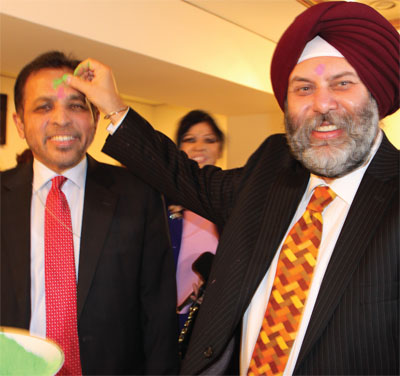
    NEW YORK (TIP): The Permanent Mission of India to the United Nations celebrated Holi at the permanent mission here on Wednesday, March 27, in style and with great enthusiasm. Colors and flower petals expressed the feeling of joy and delight that pervaded the atmosphere.

    Holi is one of the most popular festive occasions in India. The holiday celebrated mainly by the Hindus in India and Nepal marks the beginning of spring and the triumph of good over evil. Bonfires are set on the eve of Holi, and the next day the Hindus throw colored dry powder and water in celebration. It is also observed by the minority Hindus in Bangladesh and Pakistan as well in countries with large Indian Diaspora populations following Hinduism, such as Suriname, Malaysia, Guyana, South Africa, Trinidad and Tobago, the United Kingdom, the United States, Mauritius, and Fiji. Holi is of particular significance in the Braj region of North India, which includes locations traditionally connected to the Lord Krishna: Mathura, Vrindavan, Nandagaon, and Barsana, which become tourist destinations during the season of Holi. There is a legend associated with celebration of Holi. The word Holi originated from “Holika”, sister of Hiranyakashipu.

    The festival of Holi is celebrated because of a story in the old Hindu religion. In Vaishnavism, Hiranyakashipu is the great king of demons, and he had been granted a boon by Brahma, which made it almost impossible for him to be killed. The boon was due to his long penance, after which he had demanded that he not be killed “during day or night; inside the home or outside, not on earth or in the sky; neither by a man nor an animal; neither by astra nor by shastra”. Consequently, he grew arrogant and attacked the Heavens and the Earth. He demanded that people stop worshipping gods and start praising respectfully to him.

    According to this belief, Hiranyakashipu’s own son, Prahlada, was a devotee of Vishnu. In spite of several threats from Hiranyakashipu, Prahlada continued offering prayers to Vishnu. He was poisoned by Hiranyakashipu, but the poison turned to nectar in his mouth. He was ordered to be trampled by elephants yet remained unharmed. He was put in a room with hungry, poisonous snakes and survived. All of Hiranyakashipu’s attempts to kill his son failed. Finally, he ordered young Prahlada to sit on a pyre in the lap of Holika, Hiranyakashipu’s demoness sister, who also could not die because she had a boon preventing her from being burned by fire. Prahlada readily accepted his father’s orders, and prayed to Lord Vishnu to keep him safe. When the fire started, everyone watched in amazement as Holika burnt to death, while Prahlada survived unharmed.

    The salvation of Prahlada and burning of Holika is celebrated as Holi. In Mathura, where Krishna grew up, the festival is celebrated for 16 days (until Rangpanchmi) in commemoration of the divine love of Radha for Krishna. The festivities officially usher in spring, the celebrated season of love. The party at the Permanent Mission of India was hosted by Acting Permanent Representative Ambassador Manjeev S. Puri and his staff, who were in the best of spirits of Holi throughout the evening. Mrs. Puri who was dressed in a beautiful multicolored Saree for the multicolored occasion was enthusiastically going round, supervising arrangements and taking care of guests.

    The event was attended by Permanent Representative of Sri Lanka, Ambassador Palitha Kohona, and Permanent Representative of Republic of Singapore, Ambassador Albert Chua besides diplomats from many countries, and officials at the UN. Ambassador Puri was seen applying colors on his guests and welcoming them to the heavily attended celebratory party. He joyously threw flower petals and colors at the guests, as is the custom during Holi. The authentic Indian menu included Thandai, a special drink made during Holi and much other Holi specialty food that included chats and sweets, among many other delicacies.

  • As I See It : Hindu Terrorism

    As I See It : Hindu Terrorism

    Is there such a thing as ‘Hinduterrorism’, as Home MinisterShinde is heavily hinting at?Well, I am one of that rare breed offoreign correspondents – a lover ofHindus! A born Frenchman, Catholiceducatedand non-Hindu, I do hope I’llbe given some credit for my opinions,which are not the product of myparents’ ideas, my education or myatavism, but garnered from 25 years ofreporting in South Asia (for LeJournal de Geneve and Le Figaro).

    In the early 1980s, when I startedfreelancing in south India, doing photofeatures on Kalaripayattu, theAyyappa festival, or the Ayyanars, Islowly realized that the genius of thiscountry lies in its Hindu ethos, in thetrue spirituality behind Hinduism.The average Hindu you meet in amillion villages possesses this simple,innate spirituality and accepts yourdiversity, whether you are Christian orMuslim, Jain or Arab, French orChinese.

    It is this Hinduness thatmakes the Indian Christian differentfrom, say, a French Christian, or theIndian Muslim unlike a Saudi Muslim.I also learnt that Hindus not onlybelieved that the divine could manifestitself at different times, underdifferent names, using differentscriptures (not to mention thewonderful avatar concept, the perfectanswer to 21st century religious strife)but that they had also given refuge topersecuted minorities from across theworld-Syrian Christians, Parsis, Jews,Armenians, and today, Tibetans.

    In 3,500 years of existence, Hindushave never militarily invaded anothercountry, never tried to impose theirreligion on others by force or inducedconversions. You cannot find anybodyless fundamentalist than a Hindu inthe world and it saddens me when I seethe Indian and western press equatingterrorist groups like SIMI, which blowup innocent civilians, with ordinary,angry Hindus who burn churcheswithout killing anybody. We know alsothat most of these communalincidents often involve persons fromthe same groups-often Dalits andtribals-some of who have converted toChristianity and others not.

    However reprehensible thedestruction of Babri Masjid, noMuslim was killed in the process;compare this to the ‘vengeance’bombings of 1993 in Bombay, whichwiped out hundreds of innocents,mostly Hindus. Yet the Babri Masjiddestruction is often described byjournalists as the more horrible act ofthe two.We also remember how SharadPawar, when he was chief minister ofMaharashtra in 1993, lied about abomb that was supposed to have goneoff in a Muslim locality of Bombay.

    I have never been politicallycorrect, but have always written whatI have discovered while reporting. Letme then be straightforward about thisso-called Hindu terror. Hindus, sincethe first Arab invasions, have been atthe receiving end of terrorism,whether it was by Timur, who killed1,00,000 Hindus in a single day in 1399,or by the Portuguese Inquisitionwhich crucified Brahmins in Goa.Today, Hindus are still being targeted:there were one million Hindus in theKashmir valley in 1900; only a fewhundred remain, the rest having fledin terror.

    Blasts after blasts havekilled hundreds of innocent Hindusall over India in the last four years.Hindus, the overwhelming majoritycommunity of this country, are beingmade fun of, are despised, aredeprived of the most basic facilitiesfor one of their most sacredpilgrimages in Amarnath while theirgovernment heavily sponsors the Haj..They see their brothers and sistersconverted to Christianity throughinducements and financial traps, see aharmless 84-year-old swami and asadhvi brutally murdered. Their godsare blasphemed. So sometimes,enough is enough.At some point, after years or evencenturies of submitting like sheep toslaughter, Hindus-whom the Mahatmaonce gently called cowards-erupt inuncontrolled fury.

    And it hurts badly.It happened in Gujarat. It happened inJammu, then in Kandhamal,Mangalore, Malegaon, or Ajmer.It may happen again elsewhere.What should be understood is that thisis a spontaneous revolution on theground, by ordinary Hindus, withoutany planning from the politicalleadership. Therefore, the BJP, insteadof fighting over each other as to whomshould be the next party president, orwho will be their PM candidate for the2014 elections, should do well to put itshouse together.

    For, it’s evident that the Congresshas decided on this absurd strategy ofthe absurd, the untrue, the unjust, thetreacherous, only to target Mr.Narendra Modi, their enemy numberOne.It should also fight the Untrue withTruth: there are about a billionHindus, one in every six persons onthis planet. They form one of the mostsuccessful, law-abiding and integratedcommunities in the world today. Canyou call them terrorists? Let the BJPcompile a statistics of how manyHindus were killed by Muslims since1947 and how many Muslims byHindus. These statistics will speak bythemselves.

    (The author can be reached atfgautier26@gmail.com)

  • A Unique Saint Soldier  Guru Gobind Singh

    A Unique Saint Soldier Guru Gobind Singh

    Nature has its own ways to establish equilibrium in the universe. Otherwise, the powerful will always prevail and vanquish the weak. At about the time Guru Gobind Singh was born in the winter of 1666 A.D., India was passing through a period of extreme religious bigotry.

    A home grown centuries old religion- Hinduism- was the faith of the majority of Indians. They were subjugated and ruthlessly ruled by a far fewer number of Sunni Muslim conquerors hailing from Afghanistan. The Sunni Muslim Afghan conquerors wanted to propagate and spread only their form of religion in India.

    Guru Gobind Singh was vehemently opposed to such dictats. The founder of Sikhism Guru Nanak was the first high profile social reformer in India, who was a witness to the cruelty and tyranny of the first Mughal Emperor Zahir-Ud-Din Babar. Guru Nanak was briefly imprisoned by Babar, but soon Babar realized his folly, apologized to Guru Nanak and released him from the prison. Babar’s grandson Jalal-Ud-Din Akbar was more tolerant and just to the people of all faiths and he befriended the successors of Guru Nanak.

    By far the most intolerant Mughal Emperor was Aurangzeb Alamgir. He was determined to convert every well-meaning Indian to his Sunni Muslim faith. He picked up the affluent and fair colored and blue eyed Brahmins living in the Northern most hilly areas of Kashmir for forcible conversion into Sunni Islam. Guru Gobind Singh’s father, Guru Tegh Bahadur the ninth “Jyot” of Guru Nanak was on a gospel tour of North Eastern India, when Guru Gobind Singh was born in an ancient city of Patna on “Poh Sudi Satween” (according to the Christian Calendar in 1966). Guru Gobind Singh’s early childhood was spent in the North Eastern areas of India consisting of the present states of Bihar, Jharkhand, West Bengal, Assam and Bangladesh.

    As a child, he developed a strong inclination to play with bows and arrows. At his early age before ten, the family moved to a small hamlet in the lower Shivalik Himalayas in Punjab. This place later on became famous as Anandpur Sahib in Ropar district of Punjab. One fine autumn morning in 1675 A.D., a group of Kashmiri Brahmins came to see Guru Gobind Singh’s father Guru Tegh Bahadur at Anandpur Sahib. From their grim faces it could be made out that they were quite a frightened lot. Soon they started narrating their tales of utter despair and miseries. According to their version, they were being coerced to convert to Islam.

    Guru Tegh Bahadur was not opposed to conversion by logic and persuasion, but he was fiercely opposed to all forms of forced conversion. On hearing their tales of horror, while Guru Tegh Bahadur was absorbed in thoughts, his nine year old son Gobind Rai came there. Seeing his father immersed in deep thoughts, he asked him about the reason for his being so immersed in thoughts. When Guru Tegh Bahadur told him the story of the Kashmiri Brahmins and asked for his son’s advice, the son surprised everyone when by advising his father to offer his own supreme sacrifice to awake the conscience of the nation.

    This is how Guru Tegh Bahadur made up his mind to offer himself to be beheaded in the national capital, Delhi. The place where Guru Tag Bahadur was beheaded is now a sacred Sikh temple. After Guru Tegh Bahadur’s merciless beheading, his son Gobind Rai made up his mind to fight the Sunni Islamic tyranny of Emperor Aurangzeb with an army of highly motivated saint soldiers. For years, young Gobind Rai struggled consistently against the far superior Mughal Armies. During the spring harvest season in 1699, Gobind Rai gave a call to his “Sikhs” to congregate at Anandpur Sahib in big numbers. In this very congregation he established the order of the “Khalsa” (the pure) and he changed his as well as his male followers’ last name to “Singh” and the last names of the females were changed to “Kaur”. Thus was created the bearded and turbaned “Khalsa”.

    From 1699 to 1907 A.D., Guru Gobind Singh fought a relentless series of battles against the imperial forces of Auranzeb Alamgir and scores of his subject Rajas of small hill area principalities. In the process of fighting the tyranny of Emperor Aurangzb Alamgir, Guru Gobind Singh lost all four of his sons and his mother. Thousands of his saint soldiers, including his five most favorite disciples and forty of his choicest soldiers died in the battlefields.

    Aurangzeb died in 1707. His son Bahadur Shah abandoned his father’s bigotry and coercive policies and befriended Guru Gobind Singh. A meeting marking a period of peace and harmony was arranged between Guru Gobind Singh and Emperor Bahadur Shah in 1707 A.D., after which Guru Gobind Singh moved to the Southern Peninsular India and started living at a place called Nanded (Sri Huzoor Sahib).

    Here he was assaulted with sharp edged weapons by two Muslim assassins. Guru Gobind Singh died at the age of forty two in 1708. Due to Guru Gobind Singh’s relentless military campaign against Mughal Emperor Aurangzeb, the Mughal Empire’s power base started eroding. After the death of Guru Gobind Singh, even the dreaded Mughal Empire saw its slow disintegration. Guru Gobind Singh was a great soldier, a great linguist and a brilliant scholar of theosophy.

    He composed volumes of spiritual verses. His poetry was composed in a number of Sanskrit, Persian and Arabic meters, unmatched by any other poet. The line by line weight in his poetry is so well balanced that it is a treat to sing his poetry in classical Raagas. He was so humble that he did not include his own poetry in the Sikh holy book “Sri Guru Granth Sahib”, although he did include some “Baani” of his illustrious father Guru Tegh Bahadur in the final version of “Sri Guru Granth Sahib”.

    Guru Gobind Singh very well knew that the time to end the practice of living Gurus has arrived. He had a group of fifty two celebrated poets in his court, who used to admire his poetry and likewise the Guru used to enjoy their poetry. Before his death, Guru Gobind Singh most respectfully placed the final version of holy “Sri Guru Granth Sahib” on a higher pedestal and then bowed his head before it.

    This gesture contained a message to his followers to take all spiritual and worldly guidance from the holy book and not to believe in any living Guru henceforth. He believed in a classless society and he created it amongst his followers. He always helped and never abandoned the poor and the downtrodden.

  • Hindus Laud US Congresswoman Tulsi Gabbard For Oath Of Office On Bhagavad-Gita

    Hindus Laud US Congresswoman Tulsi Gabbard For Oath Of Office On Bhagavad-Gita

    NEW YORK (TIP): Hindus have applauded Tulsi Gabbard, the first Hindu recently elected to 113th United States (US) Congress, for taking the Oath of Office on ancient Hindu scripture Bhagavad-Gita (Song of the Lord), who was sworn on January three as a member of the US House of Representatives in Washington DC. Zed, who is President of Universal Society of Hinduism, said that as Bhagavad-Gita talked about endeavoring constantly to serve the world’s welfare without any thought of personal gain, it should be the treatise for all the politicians and rulers of the world. Rajan Zed pointed out that Bhagavad-Gita also told us about selfless action and selfless service, always keeping focus on welfare of others and be guided by compassion in our work.

    Zed noted that this philosophical and intensely spiritual poem was often considered the epitome of Hinduism. Besides being the cornerstone of Hindu faith, Bhagavad-Gita was also one of the masterpieces of Sanskrit poetry and had been commented by hundreds of authors and translated into all major languages of the world. It was a dialogue between Lord Krishna and Arjuna, just before the beginning of the great Mahabharata war, in which Lord Krishna gave spiritual enlightenment to the warrior Arjuna, who realized that the true battle was for his own soul. Its 700 verses in 18 chapters considered the nature of action, the religious and social duty, the human relationship to God, the means of liberation, and the nature of sacrifice, etc., Rajan Zed added.

  • 8 yrs old Traumatized for drawing Hindu Swastik by a Teacher Aid in USA

    8 yrs old Traumatized for drawing Hindu Swastik by a Teacher Aid in USA

    Abizarre incident took place at an Elementary School in Middlesex County of New Jersey on Dec. 4, 2012. As part of 3RD Grade School work children were asked to draw a symbol of a holiday they celebrate. Innocently an 8 yrs old drew a Hindu Swastik along with a Christmas Tree.

    When the class teacher saw the drawing she knew it what significance it has for Hindus. But an ignorant Teacher Aid took strong offense to it. According to the people familiar with the incident; despite few other staff members telling the Teacher Aid that it is not Nazi Swastika she was not prepared to listen to any one. She kept on saying she has been offended and her religious feelings have been hurt.

    It is hate towards her and her community. The Teacher Aid insisted that the 8 yrs old must get counseling right away and she was backed by the Principle. Without the knowledge and permission of the parents the child was counseled by the Counselor under racial bias.

    The poor parent in the evening could not figure out why their 8 yrs old is so traumatized, scared and throwing up. In bits and pieces they were able to get some story from the child. Further, the child, in a traumatized voice asked them what the child had done wrong.

    The parents were also lost why their 8 yrs old has been traumatized and harassed physically, emotionally and mentally in the name of Counseling for no reason that too without their knowledge and permission? Next day the couple met the Principle who told them that their child was doing a school project where a “staff member” got very upset for what was drawn on paper. The child got upset and was counseled but it was not on the directive of that “staff member.” The child must understand that “when you are out with other people they may see things differently”. What the child has drawn “Every where else it is used as a hate symbol”.

    The parents tried to explain that it is a universal fact Swastik is just as sacred for Hindus as a cross for Christians or a Star of David for Jews. Then the Principle stated that if any child had drawn other religious symbols such as the Star of David or Cross of Jesus, then they would have been counseled the same way! Parent protested still they should have been asked for permission first.

    Principle said that they are fully entitled to counsel any student for any reason without the permission of their parent. The parent told the Principle that only person that needed counseling is the staff member who they know was upset for no apparent reason because of ignorance and not prepared to understand the importance of Swastik for Hindus. On Dec.

    9th parent filed a Complaint with the School Board and County School Superintendent against the Principle, Counselor and the Teacher Aid; demanding proper investigation into the conduct of all 3 and Teacher Aid must give written apology and must seek counseling from a Hindu Priest or a Scholar. In case she refuses to give written apology she must be dismissed.

    It is very strange how come the Educators catering to the multi-religious society; Principle, Counselor and Teacher Aid are so ignorant about Hindu symbols? It was their basic responsibility as teachers to know that the Swastik symbol 3RD Grader drew originated in 2000BC and is not the symbol Swastika the right-facing and rotated distortion of Hindu Swastik, the Nazis has used. The one used by Nazi’s is markedly different and the differences are clearly visible to human eyes.

    Hindu Swastik is always drawn with red vermillion and can be drawn on any surface including human body, on the head after complete head shave off of a child as per Hindu rituals. It is a symbol of faith and auspiciousness and used for all religious ceremonies including Hindu weddings. On the other hand Nazi Swastika is drawn with black in a white circle within a red square and it is a symbol of hate.

    These Educators have also ignored the United States Supreme Court Ruling that “children cannot be viewed simply as miniature adults” because a child’s age is more than a chronological fact.” Rather, it is a fact that “generates commonsense conclusions about behavior and perception.’ “Children generally are less mature and responsible than adults.” “They often lack the experience, perspective and judgment to recognize and avoid choices that could be detrimental to them.” These Educators before traumatizing the 8 yrs old should have spoken to a Hindu Priest or the parent of the child concerning the matter for which they themselves are completely ignorant. This is a wake up call for the Indian community especially Hindus.

    This is not the first incident where underage children of Hindu parents have been racially discriminated by the Educators. Black and Hispanic students go through racial discrimination by the Educators and now the Indian kids. Not just in Middlesex County but in other County Schools of New Jersey as well.

    There is no accountability prescribed for the Educators and Administrators and it is so subjective that they can say anything and get away with it. In my mind the Board of Education is a puppet strung by the Superintendent, and have no idea of how students are treated, how teachers are evaluated but know how well to say Yeh or Nay or just keep shut. Respecting the Laws of the land concerning a minor and the wishes of the parent their names have been with held.

    It is our sincere appeal to the community rather than wasting their energy and time to find out the parent; they should send their support for them via e-mail under the heading “Dec 4 Swastik Incident” to Middlesex County Executive School Superintendent Samuel Stewart’s Secretary Debra Hudson 732 249 2900 press 1 + Ext 3425 at (debbie.hudson@doe.state.nj.us).

    Since Middlesex County is home to a large Hindu population; community must demand that all Educators in Middlesex County Schools must be educated about Hindu Religious Symbols keeping in mind that Hinduism is practiced by almost 1 Billion people around the world.

  • An Indian grammar for International Studies

    An Indian grammar for International Studies

    A little over three years ago I wrote in The Hindu that at a time when interest in India and India’s interest in the world are arguably at their highest, Indian scholarship on global issues is showing few signs of responding to this challenge and that this could well stunt India’s ability to influence the international system.

    As we meet here now, at the first real convention of scholars (and practitioners) of International Studies from throughout India, we can take some comfort. A quick, albeit anecdotal, audit of the study of International Studies would suggest that the last three years have been unusually productive.

    So much so, that we are now, I believe, at a veritable “tipping point” in our emergence as an intellectual power in the discipline. Hoffman, Professor of International Relations (IR) at Harvard, once famously remarked that IR was an American social science.

    The blinding nexus between knowledge and power (particularly stark in the case of IR in the United States) perhaps made him forget that while the first modern IR departments were created in Aberystwyth and in Geneva, thinking on international relations went back, in the case of the Indian, Chinese and other great civilizations, to well before the West even began to think of the world outside their living space. Having absorbed the grammar of Western international relations, and transited to a phase of greater self-confidence, it is now opportune for us to also use the vocabulary of our past as a guide to the future.

    2011 survey
    Recovery of these Indian ideas should not be seen as part of a revivalist project or as an exercise that seeks to reify so-called Indian exceptionalism. Rather, interrogating our rich past with its deeply argumentative tradition is, as Amartya Sen put it, “partly a celebration, partly an invitation to criticality, partly a reason for further exploration, and partly also an incitement to get more people into the argument.”

    In the context of international relations it offers the intellectual promise of going beyond the Manichean opposition between power and principle; and between the world of ideas and norms on the one hand, and that of statecraft and even machtpolitik, on the other. In doing so we are not being particularly subversive.

    A 2011 survey of American IR scholars by Foreign Policy found that 22 per cent adopted a Constructivist approach (with its privileging of ideas and identity in shaping state preferences and international outcomes), 21 per cent adopted a Liberal approach, only 16 per cent a Realist approach, and a tiny two per cent a Marxist approach. When academics were asked to “list their peers who have had the greatest influence on them and the discipline,” the most influential was Alexander Wendt, the Constructivist, and neither the Liberal, Robert Koehane, nor the Realists, Kenneth Waltz or James Mearisheimer.

    Mohandas Gandhi once said that “if all the Upanishads and all the other scriptures happened all of a sudden to be reduced to ashes, and if only the first verse in the Ishopanishad were left in the memory of the Hindus, Hinduism would live forever.” Let me make what may seem like another astounding claim, and which I hope, in the best argumentative tradition, will be heavily contested.

    If all the books on war and peace were to suddenly disappear from the world, and only the Mahabharata remained, it would be good enough to capture almost all the possible debates on order, justice, force and the moral dilemmas associated with choices that are made on these issues within the realm of international politics.

    Uncertainty in the region

    Beyond theory, we are faced with a period of extraordinary uncertainty in the international system and in our region. Multilateralism is in serious crisis. While the U.N. Security Council remains deadlocked on key issues, there is little progress on most other issues of global concern, be it trade, sustainable development or climate change. As academics, we cannot remain unconcerned about these critical failures.

    Our continent is being defined and redefined over time. Regions are, after all, as much shaped by the powerful whose interests they seek to advance as by any objective reality. Whatever nomenclature we adopt, and whatever definition we accept, we are faced with, what Evan Feigenbaum and Robert Manning described as two Asias: the ‘Economic Asia’ whose $19 trillion regional economy drives global growth; the “Security Asia,” a “dysfunctional region of mistrustful powers, prone to nationalism and irredentism, escalating their territorial disputes over tiny rocks and shoals, and arming for conflict.” The Asian Development Bank says that by nearly doubling its share of global GDP to 52 per cent by 2050, Asia could regain the dominant economic position it held 300 years ago.

    Yet, as several academics have pointed out “it is beset by interstate rivalries that resemble 19th century Europe,” as well the new challenges of the 21st century: environmental catastrophes, natural disasters, climate change, terrorism, cyber security and maritime issues. An increasingly assertive China that has abandoned Deng Xiaoping’s 24-character strategy of hiding its light and keeping its head low, adds to the uncertainty of the prevailing strategic environment. India’s military and economic prowess are greater than ever before, yet its ability to influence South Asian countries is less than what it was, say, 30 years ago.

    An unstable Nepal with widespread anti-India sentiment, a triumphalist Sri Lanka where Sinhalese chauvinism shows no signs of accommodating legitimate Tamil aspirations, a chaotic Pakistan unwilling to even reassure New Delhi on future terrorist strikes, are symptomatic of a region being pulled in different directions. Can our thinking from the past help us navigate through this troubled present? Pankaj Mishra, in his brilliant book, From the Ruins of Empire: the Revolt Against the West and the Remaking of Asia, describes how three 19th century thinkers, the Persian Jamal-al Din al-Afghani, Liang Qichao from China and India’s Rabindranath Tagore, navigated through Eastern tradition and the Western onslaught to think of creative ways to strike a balance and find harmony.

    In many ways, these ideas remain relevant today as well. For if Asia merely mimics the West in its quest for economic growth and conspicuous consumption, and thAlittle over three years ago I wrote in The Hindu that at a time when interest in India and India’s interest in the world are arguably at their highest, Indian scholarship on global issues is showing few signs of responding to this challenge and that this could well stunt India’s ability to influence the international system. As we meet here now, at the first real convention of scholars (and practitioners) of International Studies from throughout India, we can take some comfort. A quick, albeit anecdotal, audit of the study of International Studies would suggest that the last three years have been unusually productive. So much so, that we are now, I believe, at a veritable “tipping point” in our emergence as an intellectual power in the discipline. Hoffman, Professor of International Relations (IR) at Harvard, once famously remarked that IR was an American social science. The blinding nexus between knowledge and power (particularly stark in the case of IR in the United States) perhaps made him forget that while the first modern IR departments were created in Aberystwyth and in Geneva, thinking on international relations went back, in the case of the Indian, Chinese and other great civilizations, to well before the West even began to think of the world outside their living space. Having absorbed the grammar of Western international relations, and transited to a phase of greater self-confidence, it is now opportune for us to also use the vocabulary of our past as a guide to the future. 2011 survey Recovery of these Indian ideas should not be seen as part of a revivalist project or as an exercise that seeks to reify so-called Indian exceptionalism.

    Rather, interrogating our rich past with its deeply argumentative tradition is, as Amartya Sen put it, “partly a celebration, partly an invitation to criticality, partly a reason for further exploration, and partly also an incitement to get more people into the argument.” In the context of international relations it offers the intellectual promise of going beyond the Manichean opposition between power and principle; and between the world of ideas and norms on the one hand, and that of statecraft and even machtpolitik, on the other. In doing so we are not being particularly subversive.

    A 2011 survey of American IR scholars by Foreign Policy found that 22 per cent adopted a Constructivist approach (with its privileging of ideas and identity in shaping state preferences and international outcomes), 21 per cent adopted a Liberal approach, only 16 per cent a Realist approach, and a tiny two per cent a Marxist approach. When academics were asked to “list their peers who have had the greatest influence on them and the discipline,” the most influential was Alexander Wendt, the Constructivist, and neither the Liberal, Robert Koehane, nor the Realists, Kenneth Waltz or James Mearisheimer.

    Mohandas Gandhi once said that “if all the Upanishads and all the other scriptures happened all of a sudden to be reduced to ashes, and if only the first verse in the Ishopanishad were left in the memory of the Hindus, Hinduism would live forever.” Let me make what may seem like another astounding claim, and which I hope, in the best argumentative tradition, will be heavily contested. If all the books on war and peace were to suddenly disappear from the world, and only the Mahabharata remained, it would be good enough to capture almost all the possible debates on order, justice, force and the moral dilemmas associated with choices that are made on these issues within the realm of international politics. Uncertainty in the region Beyond theory, we are faced with a period of extraordinary uncertainty in the international system and in our region. Multilateralism is in serious crisis. While the U.N. Security Council remains deadlocked on key issues, there is little progress on most other issues of global concern, be it trade, sustainable development or climate change. As academics, we cannot remain unconcerned about these critical failures. Our continent is being defined and redefined over time. Regions are, after all, as much shaped by the powerful whose interests they seek to advance as by any objective reality.

    Whatever nomenclature we adopt, and whatever definition we accept, we are faced with, what Evan Feigenbaum and Robert Manning described as two Asias: the ‘Economic Asia’ whose $19 trillion regional economy drives global growth; the “Security Asia,” a “dysfunctional region of mistrustful powers, prone to nationalism and irredentism, escalating their territorial disputes over tiny rocks and shoals, and arming for conflict.” The Asian Development Bank says that by nearly doubling its share of global GDP to 52 per cent by 2050, Asia could regain the dominant economic position it held 300 years ago.

    Yet, as several academics have pointed out “it is beset by interstate rivalries that resemble 19th century Europe,” as well the new challenges of the 21st century: environmental catastrophes, natural disasters, climate change, terrorism, cyber security and maritime issues. An increasingly assertive China that has abandoned Deng Xiaoping’s 24-character strategy of hiding its light and keeping its head low, adds to the uncertainty of the prevailing strategic environment.

    India’s military and economic prowess are greater than ever before, yet its ability to influence South Asian countries is less than what it was, say, 30 years ago. An unstable Nepal with widespread anti-India sentiment, a triumphalist Sri Lanka where Sinhalese chauvinism shows no signs of accommodating legitimate Tamil aspirations, a chaotic Pakistan unwilling to even reassure New Delhi on future terrorist strikes, are symptomatic of a region being pulled in different directions.

    Can our thinking from the past help us navigate through this troubled present? Pankaj Mishra, in his brilliant book, From the Ruins of Empire: the Revolt Against the West and the Remaking of Asia, describes how three 19th century thinkers, the Persian Jamal-al Din al-Afghani, Liang Qichao from China and India’s Rabindranath Tagore, navigated through Eastern tradition and the Western onslaught to think of creative ways to strike a balance and find harmony.

    In many ways, these ideas remain relevant today as well. For if Asia merely mimics the West in its quest for economic growth and conspicuous consumption, and the attendant conflict over economic resources and military prowess, the “revenge of the East” in the Asian century and “all its victories” will remain “truly Pyrrhic.”e attendant conflict over economic resources and military prowess, the “revenge of the East” in the Asian century and “all its victories” will remain “truly Pyrrhic.”

  • Marriage After Conversion Invalid: Kerala High Court

    Marriage After Conversion Invalid: Kerala High Court

    KOCHI (TIP): The Kerala high court on Tuesday ruled that marriage preceded by conversion – as a means to facilitate the marriage – will be deemed invalid before the law. It also controversially ordered the woman to stay with her parents until their marriage was solemnized in accordance with the Special Marriage Act, considering she is not a minor. The court gave the order after hearing the case of a Muslim man and a Hindu woman whose marriage was solemnized with the backing of Vishwa Hindu Parishad (VHP) after the man ‘converted’ to Hinduism.

    The man had produced a conversion certificate issued by the VHP and the marriage certificate was issued by a well-known temple in Kaloor. Refusing to recognize religious conversion as the basis for marriage, a division bench comprising justices Pius C Kuriakose and Babu Mathew P Joseph asked the couple to register their marriage according to the Special Marriage Act. This was after Shaiju M (24) of Vilakkupara, near Anchal in Kollam district, filed a petition alleging that his wife, Ashwathy Raveendran (22) of Vayala in Anchal, was being detained by her father and uncle. Following the court’s direction, Ashwathy was presented before the court by her parents.

    She told the court that her marriage with Shaiju took place on November 14 this year at Pavakkulam Sree Mahadeva Temple at Kaloor. Prior to this, Shaiju was converted to Hinduism by the VHP, she told the court. Ashwathy’s father K Raveendran objected to the groom’s overnight conversion from Islam to Hinduism. He also told the court that there was considerable social and financial disparity between the two families. “Having considered what we are told by the parties present before us, we feel that it is not safe to rely on the conversion of the petitioner from Islam to Hinduism stated to have been under the auspices (sic) of VHP,” the bench said. Shaiju said he will now pursue the course offered by the court, to marry under the Special Marriage Act, to restore his rights.

  • Readers Write : FIA Expose

    Readers Write : FIA Expose

    Ramesh Patel making FIA expose disrespect to Gujaratis

    It has come to my notice that Mr. Ramesh Patel is making the issue of exposure of FIA’s various violations as an issue of disrespect to entire Gujarati community. He is being supported by those who are defrauding charitable organizations FIA style. For me exposing FIA is about exposing individuals who are bringing bad name to their own community, doing corruption and misusing public funds. I am not against any community as my past speaks for itself I have raised issues against Hindu, Sikh, Muslim and Christian Leaders of Indian origin from different states as well as politicians of NJ and Washington.

    Although I respect all the states, union territories and every religion of India for India being the birth place of my religion Hinduism but two states have special place in my life. First is Punjab for being the birth place of my ancestors and second is Gujarat being the birth place of my idol Mahatma Gandhi. Then who will not admire Sardar Vallabhbhai Patel for integrating 565 princely estates in to one nation India? I had the good luck to briefly associate with the architect of modern India; Dhirubhai Ambani. Then I admire Gujaratis like Lord Bhikhu Parekh an eminent political theorist, Dr. Bhupi Patel in the field of medicines, a philanthropist and a great New Yorker, Kal Penn aka Kalpesh Modi a Great New Jerseyan, actor, producer and civil servant with the distinction of serving President Obama; for bringing glory to every Indian.

    I do not consider any one as my enemy even if I have differences with them on matters of principles and the system that is being advocated and recommended. I strongly believe multi racial, lingual and religious history of India is indeed very complex. It is culturally, socially and politically intertwined extending beyond thousands of years with a message that we are all brothers and sisters the children of one God.

    Dave Makkar

    Congratulations FIA for inducting first Pakistani Islamic member to your board

    I would like to take this opportunity in congratulating, through the columns of your esteemed weekly, the FIA on inducting Sam Khan, the first Pakistani Islamic member to their board. It is really heartening to see that an organization such as FIA has taken such a huge step keeping aside all racial indifferences. In today’s day with such religious turmoil brewing all over the world between USA and the Islamic community, they have not forgotten that the human bond comes first and I believe this step has been taken keeping only that in mind. I, as a fellow human being, salute the FIA and support them in this decision. We cannot judge others by their ethnicity but by their deeds.
    Thanks & Regards,

    Alisha Khan