Tag: Hosni Mubarak

  • Former Egyptian President Hosni Mubarak to be released

    Former Egyptian President Hosni Mubarak to be released

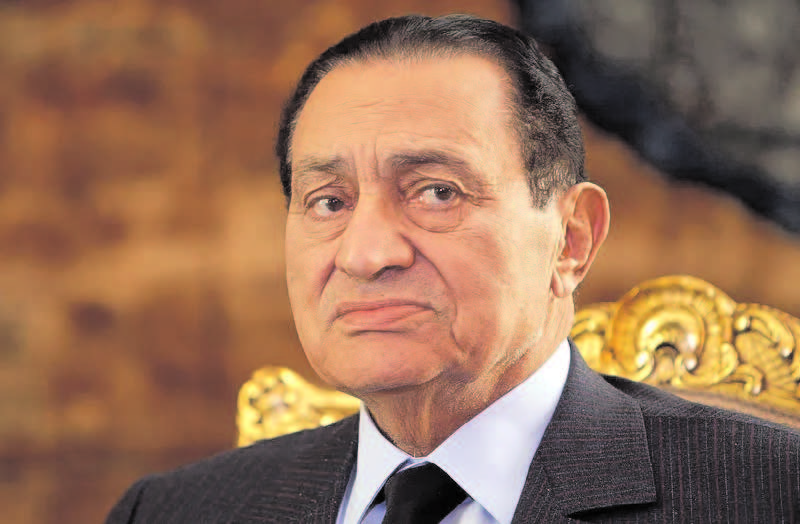
    CAIRO (TIP): Hosni Mubarak, who was overthrown as president of Egypt in an uprising in 2011, will be released from detention in a military hospital, the public prosecutor ruled on March 14, his lawyers and judicial sources said.

    “He will go to his home in Heliopolis,” Mubarak’s lawyer Farid El Deeb said, adding the ageing former president would likely be released Tuesday or soon after.

    Mubarak was cleared of murder charges this month in his final trial, having faced various charges ranging from corruption to ordering the killing of protesters who ended his 30-year-rule.

    He had one more jail sentence to serve but was cleared after serving time for the murder charges, judicial sources and the state news agency said.

    The prosecution subtracted the time served in the murder case from the time he was meant to serve for a separate case in which he was found guilty of appropriating funds reserved for maintaining presidential palaces.

    Mubarak was originally sentenced to life in prison in 2012 for conspiring to murder 239 demonstrators during the 18-day revolt – an uprising that sowed chaos and created a security vacuum but also inspired hope for democracy and social justice.

    An appeals court ordered a retrial that culminated in 2014 in the case against Mubarak and his senior officials being dropped. An appeal by the public prosecution led to a final retrial by the Court of Cassation, the highest in the country, which acquitted him on March 2. (Reuters)

  • Gunmen attack tourist bus of Arab-Israelis in Egypt’s Giza

    Gunmen attack tourist bus of Arab-Israelis in Egypt’s Giza

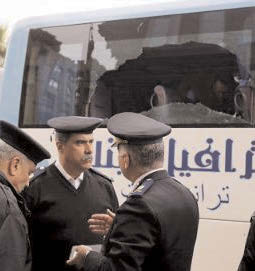
    CAIRO (TIP): Motorcycle-borne masked gunmen opened fire on a tourist bus of Arab-Israeli citizens and a hotel close to the Giza pyramids in Egypt during a rally of Muslim Brotherhood supporters today, but the tourists escaped unhurt.

    The attackers, apparantely part of a group of around 15 Brotherhood supporters, used birdshot and targeted the tourists while they entered the hotel on Al-Haram Street, the official said.

    No casualties have been reported, however. But the attack caused some damages to the bus and the hotel gate and facade.

    A suspect was arrested and police were searching for the rest of the group, the Interior Ministry said in a statement.

    The passengers on the bus were Arab-Israeli citizens, Al-ahram reported, citing a statement by Israeli government.

    The attack on the tourists came on a day when Egypt’s Coptic Orthodox Christians were celebrating Christmas in the predominantly Muslim country.

    Egypt’s security forces have been battling insurgency in North Sinai, which has witnessed many violent attacks by militants since the January 2011 revolution that toppled president Hosni Mubarak.

    The attacks targeting police and military increased after the ouster of Islamist president Mohamed Morsi in 2013 by military following massive protests against his rule. More than 600 security personnel have been reported killed since then.

    Some extremists in the restive Sinai peninsula have pledged allegiance to the Islamic State terrorist group. They have also claimed the downing of a Russian jet that killed 224 people there last year.

    Al-Haram Street in Giza, close to the Pyramids, regularly witnesses pro-Morsi rallies and protests.

  • Secret police detentions of activists on the rise in Egypt

    Secret police detentions of activists on the rise in Egypt

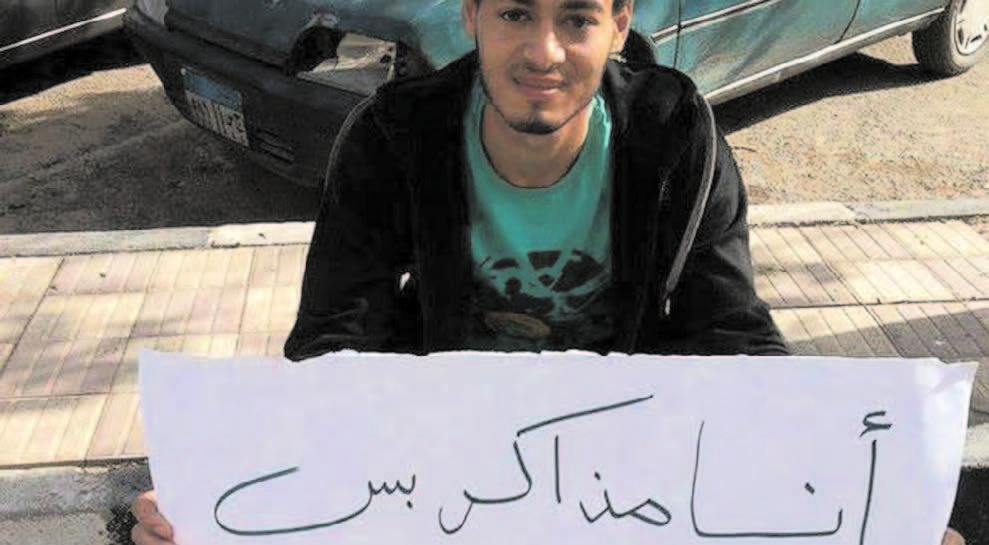
    CAIRO (TIP): The knock on the door came just before midnight, a group of plainclothes police demanding that 29-year-old Fatma el-Sayed, an activist with one of Egypt’s secular opposition groups, come with them. Her father pleaded to accompany her, but they took her away, alone.

    For the next four days, el-Sayed was kept in a cell in the security agency headquarters in her home town of Alexandria — off official records, essentially disappeared into Egypt’s labyrinth of detention facilities. She was interrogated without a lawyer and denied the injections she needed after recent surgery.

    “They tried to extract information from me,” she said — about fellow activists in the opposition group April 6, about the group’s call for a protest against the high cost of living, about any coordination with the Muslim Brotherhood.

    “I gave them nothing,” she said.

    Egyptian security agencies are increasingly detaining activists and students in secret, snatching them from homes or the street and holding them without official record of their arrest, as their families scramble to find them, activists and lawyers say.

    Activists have tracked more than 160 such suspected disappearances in police custody during the past two months — a sign of the renewed unchecked power of security agencies. It is a return to past practices under autocratic leader Hosni Mubarak, when detainees were held, sometimes for years, without trial under notorious emergency laws in effect for decades and lifted after his 2011 ouster.

    El-Sayed was lucky. After four days, police filed a record of her arrest and released her on bail. She has been charged with membership in April 6, a leading force in the anti-Mubarak uprising that is now banned. Other missing activists have reappeared days or even weeks later when police finally filed arrest reports.

    But the whereabouts of most remains unknown. Activists and lawyers fear they are abused during interrogation.

    At least one of the missing turned up dead. Islam Ateto was taken by security agents in May as he left a classroom at a Cairo university, according to student unions. Soon after, police announced that Ateto was killed in a gunbattle with security forces in the desert, alleging he was wanted for the assassination of a police officer.

    Government officials, including Prime Minister Ibrahim Mahlab, have repeatedly denied there are any extra-legal detainees in Egypt, saying those in custody are held either on a prosecutor’s order or were arrested during the act of a crime. With the recent spike in reports of missing detainees, government officials have largely ignored calls for an explanation. Repeated requests by The Associated Press to the spokesman for the Interior Ministry received no response. A senior security official dismissed allegations of disappearances and questioned how it could be proven that security agents took anyone away.

    However, another official said secret interrogations and detention were sometimes necessary when state security or intelligence agencies are pursuing terror cells that threaten national security. Both officials spoke on condition of anonymity because they were not permitted to speak to the media. The government has repeatedly touted its “war on terrorism” — a reference to its battle against Islamic militants carrying out stepped-up attacks and to a crackdown on Islamists following the military’s July 2013 ouster of Islamist President Mohammed Morsi. With the clampdown, many activists have gone into hiding, complicating efforts to determine who has been detained.

    When grilled by the father of a missing woman on a private television station last week, Interior Ministry spokesman Abu Bakr Abdel-Karim insisted that if she had been arrested, “legal procedures must have been followed.” The woman, Esraa el-Taweel, a 23-year old freelance photojournalist, was reported by her family to have been snatched on June 1 from a street in downtown Cairo, along with two male friends. Later, inmates got word to relatives that they had seen the two friends in a prison.

    El-Taweel finally surfaced Wednesday, when a visitor spotted her at a women’s prison near Cairo. On Thursday, she was brought for questioning before State Security prosecutors, who usually deal with terrorism cases, the first official acknowledgement of her detention.

    Lawyers say Islamists were frequently the targets of secret detentions over the past two years, and now the practice is increasingly being used against more secular activists.

    One activist group, Freedom for the Brave, has documented more than 160 cases since April. Of those, 66 have resurfaced.

    The Egyptian Coordination of Rights and Freedoms, a group of lawyers tracking missing suspected Brotherhood members, has recorded more than 210 cases as of May; one person has been missing since 2013.

    The London-based Human Rights Monitor recorded 31 cases of disappearance in May alone, in addition to 13 others from the two previous months. The group reported the cases to the U.N Working Group on Enforced Disappearance, which usually follows up on such reports.

    The National Human Rights Council, whose members are appointed by the state, has submitted 71 reported cases of missing people to the Interior Ministry and prosecutors’ office, said council member Nasser Amin. “In Egypt, there are plenty of cases of illegal detention,” a crime punishable by up to seven years in prison, he said. The council is working to determine if any missing cases reach the level of “enforced disappearance,” a crime against humanity under international law that involves a long period of disappearance, proof of an active government role and an exhaustive investigation to find the missing person. Amin said the United Nations has designated 13 cases of people missing since the turmoil in 2011 as likely enforced disappearances and has sought an explanation from the Egyptian government.

  • 27 killed in attacks in Egypt’s North Sinai, Suez

    27 killed in attacks in Egypt’s North Sinai, Suez

    CAIRO: Twenty-seven people were killed in four attacks in Egypt’s North Sinai and Suez, security and medical sources said, in some of the worst anti-state violence in months and after commemorations around the anniversary of the 2011 uprising turned deadly this week.


    Egypt’s government faces an Islamist insurgency based in Sinai and growing discontent with what critics perceive as heavy handed security tactics.


    Thursday’s first attack was a bombing of military buildings in the capital of North Sinai province, that killed 25 and wounded at least 58, including 9 civilians, security and medical sources said.


    The flagship government newspaper, al-Ahram, said its office in the town of Al-Arish, which is situated opposite a military hotel, headquarters and base that security sources said were the intended targets, had been “completely destroyed”.


    Later, suspected militants killed an army major and wounded six others at a checkpoint in Rafah, followed by a roadside bomb in Suez city that killed a police officer, and an assault on an army unit south of Al-Arish that wounded four soldiers, security sources said.


    Sinai-based militants have killed hundreds of security officers since president Mohamed Mursi of the Muslim Brotherhood was removed from power following mass protests against his rule.


    The military said in a statement on its Facebook page that the attacks were the result of a successful campaign to pressure the militants.


    Tensions have risen across Egypt this week with protests, some of them violent, marking four years since the uprising that ousted longtime autocrat Hosni Mubarak from power.


    Earlier on Thursday, a group of women protested in Cairo over the death of activist Shaimaa Sabbagh and around 25 others said to have been killed by security forces at rallies commemorating the 2011 uprising.


    Sabbagh, 32, died on Saturday as riot police were breaking up a small, peaceful demonstration. Friends said she had been shot, and images of her bleeding body rippled out across social media, sparking outrage and condemnation.


    “The Interior Ministry are thugs!” chanted around 100 women protesters at the site of Sabbagh’s death. Some held up signs with the word “Murderer” scrawled over the face of Interior Minister Mohamed Ibrahim.


    The protesters were defying a law that severely restricts protests. “People are here at incredible risk to themselves. But it’s a way of standing against the fear they have instilled,” said activist Yasmin el-Rifae.

  • Egypt sets parliamentary poll dates as Sisi cements grip

    Egypt sets parliamentary poll dates as Sisi cements grip

    CAIRO (TIP): Egypt said January Thursday it is to hold parliamentary elections from March 21 but analysts said the new legislature will offer no meaningful opposition to President Abdel Fattah al-Sisi’s iron-fisted rule.

    The elections, which will be held in phases culminating on May 7, will be the first since Sisi overthrew his Islamist predecessor Mohamed Morsi on July 3, 2013.

    But with Morsi’s Muslim Brotherhood crushed in a crackdown that has left hundreds dead and even secular opposition groups hit by jail terms, the elections are likely to be dominated by Sisi loyalists.

    “It is difficult to see there being much in the way of opposition on issues relating to governance and human rights from within any new parliament in this current environment,” said H. A. Hellyer of Centre for Middle East Policy at the Brookings Institution.

    The vote will be held under a complex electoral system that was originally designed to produce as representative a parliament as possible.

    Some of the 567 seats will be contested on nationwide party lists. Others will be fought on a first-past-the post basis in individual constituencies, where second-round runoffs will be held where necessary.

    But critics say the process has been emptied of meaning now that the main opposition groups have been outlawed. The top leaders of the once dominant Muslim Brotherhood are all on trial on charges that could carry the death penalty. Even verbal expressions of support have been punishable by heavy jail terms since the movement was declared a terrorist organisation in December 2013.

    Tough restrictions on the right to protest have also seen several secular leaders of the Arab Spring uprising that toppled veteran strongman Hosni Mubarak in 2011 sent to prison.

    “The president has crushed his political opposition with military force and not political. We are witnessing a political scene that cannot produce any opposition to the president,” said Ahmed Abdel Rabu, professor of political science at University of Cairo.

    Sisi remains popular among the many Egyptians who applaud his pledge to restore order after four years of political turmoil and economic chaos.

    The Arab world’s most populous nation has been hit by a mounting wave of violence by jihadist groups since Morsi’s ouster that the former army chief has vowed to crush with a rod of iron.

    It is a rhetoric that most candidates are likely to emulate as they seek to win election to parliament on Sisi’s coattails.

    “The parliamentary hopefuls are already using the language of his regime, such as regaining the state’s prestige and war on terrorism,” said Abdel Rabu.

    But the polls are important to Sisi as he seeks to cement a thaw in relations with Western governments that had condemned his overthrow of Egypt’s first freely elected president.

    The United States delivered 10 Apache helicopters last month after lifting part of a freeze on aid as mounting turmoil across the region underlined Egypt’s importance as an ally.

    The United States annually allocates some $1.5 billion in aid to Egypt, including $1.3 billion in military assistance.

    That was frozen in October 2013 pending the enactment of democratic reforms.

    After ousting Morsi, Sisi announced a political roadmap that envisaged adopting a new constitution, to be followed by presidential and parliamentary elections, and Western governments have called on him to see it through.

    The new constitution, which expanded the powers of the military, was adopted in a January 2014 referendum with a 98 percent yes vote.

    The presidential election, which Sisi won with 97 percent of the vote on a 47 percent turnout, was held in May.

  • Political shadow boxing, threat & reality

    Political shadow boxing, threat & reality

    “The American invasion of Iraq cost the lives of millions of children. Whatever the changing definitions of terror, it is children that are so often the forgotten victims of conflict – regardless of the perpetrator”, says the author.

    Well, heaven preserve us: the most useless “peacemaker” on earth has just used an Arabic acronym for the greatest threat to civilisation since the last greatest threat. Yup, ol’ John Kerry called it “Daesh”, which is what the Arabs call it. It stands for the “Islamic State in Iraq and the Levant”. We prefer Isis or Isil or the Islamic State or Islamic Caliphate. Most journos prefer Isis because – I suspect – it’s easier to remember. It’s the name of an Egyptian goddess, after all.

    It’s the name of a university city’s river. Many an American scribe has questioned why Kerry should be using this goddam Arabic lingo – although we use Fatah for the PLO. It, too, is an acronym which, translated, means “the Party for Palestinian Liberation”. And in 2011, we called Tahrir Square in Cairo “Tahrir”, only occasionally reminding readers and viewers that it, too, meant “liberation”. None explained why the place was important: because this was the square mile of Cairo in which was based the largest British barracks and into which the Brits – during their much-loved occupation of Egypt – refused to allow any Egyptian to walk without permission. That’s why it was called Tahrir – liberation – when the Brits left.

    That’s why Hosni Mubarak’s attempt to prevent the protesters entering the square in 2011 placed him firmly in the shadow of Egypt’s former colonial masters. But why do we care what the great leaders of the West (or the East for that matter) actually say, when we all know it’s the kind of material that comes out of the rear end of a bull? Let me give you an example from Canada. Two years ago, the country’s Foreign Affairs Minister, John Baird, closed Canada’s embassy in Tehran because he feared his diplomats might be harmed. “Canada views the government of Iran as the most significant threat to global peace and security in the world today,” he quoth then – although CBC broadcasters have dug up a Foreign Ministry report which reported the biggest threat to the Tehran embassy was an geophysical earthquake.

    Since then, as the Toronto Star’s pesky columnist Thomas Walkom has pointed out, the Canadian Prime Minister Stephen Harper – whose pro-Israeli policies might earn him a seat in the Israeli Knesset -has discovered more threats. Russia under Vladimir Putin, Harper says, “represents a significant threat to the peace and security of the world”. The aforesaid Baird, taking his cue, no doubt from our own beloved Prince Charles, compared Putin’s Russia to Hitler’s Third Reich. More recently, Canada’s defence minister, Rob Nicholson, described the men of Isis (or Isil, or the Islamic State, or the Islamic Caliphate, or Daesh) as “a real and growing threat to civilisation itself”.

    The war against Isis/ Isil/ IS/ IC/ Daesh, he informed the people of Abu Dhabi, was “the greatest struggle of our generation”. Well, blow me down.Wasn’t Iran the greatest threat, ever since 1979? Wasn’t Abu Nidal, the Palestinian gun-for-hire? Wasn’t that British prime minister chappie, with the habit of saying “absolutely” and “completely” over and over again, convinced that Saddam was the greatest threat to our civilisation or generation, what with all his WMDs and links to Al-Qaida and tubes from Niger, and so on? For that matter, wasn’t Osama bin Laden’s Al-Qaida – the very bunch which morphed into Isis/ Isil/ IS/ IC/ Daesh in Iraq – the greatest threat to our civilisation/generation? Yet now, when the Iranian air force has joined the battle against Isis/ Isil/ IS/ IC/ Daesh alongside the US, Britain, Canada, Australia, old Uncle Tom Cobley and all, Kerry, in “Daesh” mode, tells us that the Iranian military action in Iraq (in any other circumstances, a ruthless assault on Iraq’s sovereignty) is “positive”. And Kerry, remember, was the fellow who told us last year that America was going to attack the regime of Bashar al-Assad, the greatest enemy of Isis/ Isil/ IS/ IC /Daesh – whom Obama reprieved in favour of bashing Isis/ Isil/ IS/ IC/ Daesh itself – with its ally Iran described by Canada’s Baird only two years ago as “the most significant threat to global peace and security in the world”.

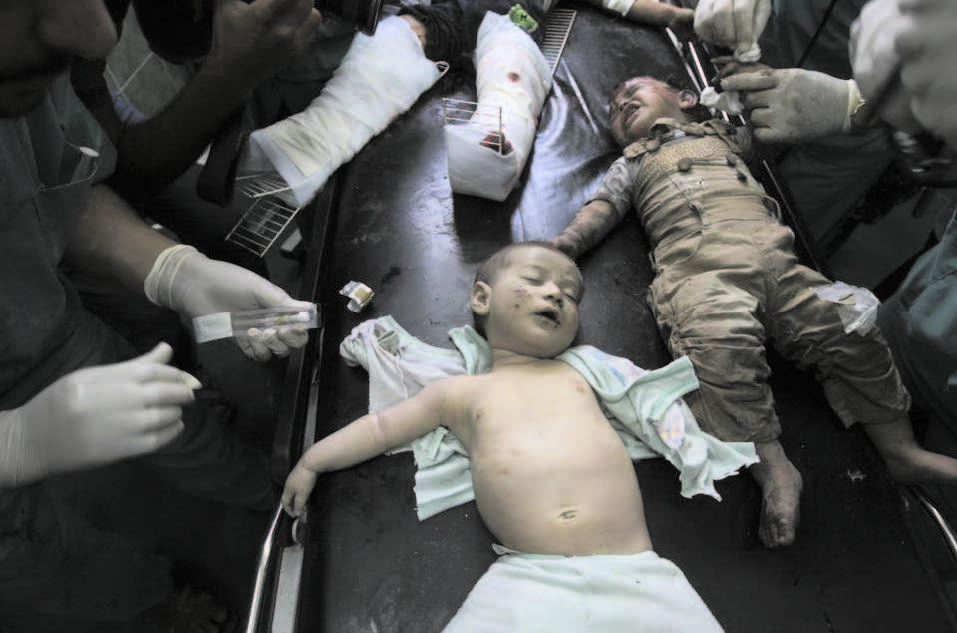
    But what the hell … Don’t we live in a world where Save the Children (American branch only, you understand) gave an award to the same former British prime minister quoted above? Having given a prize to the man who encouraged George W Bush to embark on an Iraqi invasion which cost the lives of tens of thousands of children, surely this fine charity (again, the American branch only) must reinvent and re-name itself “Abandon the Children”. And by the way, one of the ex-PM’s supporters blandly told Channel 4 not long ago that our British “peace envoy” had travelled to the Middle East more than 160 times.Which means, doesn’t it, that our Middle East envoy had left his station in the Middle East more than 160 times! But again, what is a child’s life worth? In 2002, a Israeli missile attack on a Gaza apartment block killed a Palestinian militants but also 14 civilians, including several children.

    The Bush administration, draw in your breath here, folks, and grit your teeth, said that this “heavy-handed action” did not “contribute to peace”. Wow, now that was telling them. Killing kids is a bit heavy-handed, isn’t it? And I can see what the Bush lads and lassies meant when they said that eviscerating, crushing and tearing to bits a bunch of children didn’t really, well, “contribute” towards peace. It’s important, you see, to realise who our enemies are. Muslims, Iranians, Iraqis, Syrians, Russians, you name it. Not Israel, of course. Nor Americans. Think generational. Think civilisation. Think the most significant threat to global peace. Daesh. Isn’t that the name?

    (The author is an English writer and journalist from Maidstone, Kent. He has been Middle East correspondent of The Independent for more than twenty years, primarily based in Beirut) British English. (Source: The Independent)

  • VERDICT DUE IN MURDER RETRIAL OF EGYPT’S HOSNI MUBARAK

    VERDICT DUE IN MURDER RETRIAL OF EGYPT’S HOSNI MUBARAK

    CAIRO (TIP): An Egyptian court is to deliver today its verdict in the murder retrial of former president Hosni Mubarak, almost four years after he was overthrown in a popular uprising. Mubarak, 86, is accused along with seven of his former police commanders of involvement in the killing of hundreds of demonstrators during the 2011 revolt that ended his three-decade rule.

    An appeals court overturned an initial life sentence for Mubarak in 2012 on a technicality. The new verdict was initially scheduled for September 27, but chief judge Mahmud Kamel al-Rashidi postponed it, saying he had not finished writing the reasoning after a retrial that saw thousands of case files presented. The court is also due to rule on corruption charges levelled against Mubarak and his sons Alaa and Gamal. If acquitted, he would not be released because he is serving a threeyear sentence in a separate corruption case, a judicial official said.

    Today’s verdict comes as the revolutionary fervour that unseated Mubarak has largely ebbed across the country. Mubarak’s Islamist successor Mohamed Morsi was himself removed last year by then-army chief Abdel Fattah al-Sisi, who is now president, and put on trial along with hundreds of other Islamists. Morsi and several top leaders of his Muslim Brotherhood movement are accused of committing acts of violence during the anti-Mubarak uprising as well as during huge anti-Morsi protests which prompted the army to remove him.

    Several top left-leaning youth activists who led the campaign against Mubarak have also been jailed by the authorities for staging unauthorised protests after the June 2013 overthrow of the divisive Morsi. Sisi, who won a presidential election in May after crushing his Islamist opponents, has made law and order and economic stability his top priorities rather than democratic freedoms – the key demand during the anti-Mubarak uprising. The police force, which Mubarak is accused of ordering to quell the 2011 uprising, is now feted in the largely pro-government media as it wages a deadly crackdown on pro-Morsi Islamist protesters and militants. At least 1,400 people have been killed in the crackdown, with scores of soldiers and policemen dying in militant attacks.

  • Two conscripts killed in an explosion in North Sinai

    Two conscripts killed in an explosion in North Sinai

    CAIRO (TIP): At least two policemen were killed and 8 others injured in an explosion in Egypt’s restive Sinai peninsula, official said October 17. The explosion occurred in west Al-Arish city in north Sinai October 16. A bomb planted by unidentified militants along the international road went off, killing two policemen, as a military tank was passing. 8 others were in a critical condition, a medical source said.

    North Sinai has witnessed many violent attacks by militants since the January 2011 revolution that toppled the ex-president Hosni Mubarak. The militant attacks targeting police and military increased after the ouster of Islamist ex-president Mohamed Morsi last year. Over 500 security personnel have been reported killed since then. In July, militants attacked a military checkpoint in Al-Wadi Al-Gedid governorate in southern Egypt, killing 21 Egyptian border guards and injured four others.

    The military has launched security campaigns in the area, arrested suspects and demolished houses that belong to terrorists, including those facilitating tunnels leading to the Gaza Strip. At the same time, two home-made bombs exploded yesterday near a famous mosque in Tanta city injuring at least 11 people.

  • Foreign funding and the Maharajas among NGOs

    Foreign funding and the Maharajas among NGOs

    “At the heart of the dilemmas presented by the evolving situation is the kind of Middle East major regional and world powers want to see. More importantly, where will the present series of conflicts take the region, with the escalating Shia-Sunni conflict and the dislocation of millions, either internally displaced or living as refugees in neighboring countries?” the author wonders

    Behind the frenzied diplomacy over the future of Iraq are new assumptions taking shape. First, is the division of the country among its Shia, Sunni and Kurdish areas a matter of time? Second, how far will the Islamic State of Iraq and Syria (and its variant the Levant), collectively known as the ISIS, spread from its present swathe in Syria and Iraq? What is being debated is the future shape of the Middle East some hundred years after the French-British division of the spoils of the disintegrating Ottoman Empire.

    There are no clear answers because of the variety of regional and world powers pursuing differing policies. Of the regional actors, the most important are Saudi Arabia, Iran and Turkey. Here is a conflict not only between Sunni and Shia countries but the very different inflections of the two Sunni powers and Shia Iran’s interest in seeking the destruction of the ISIS as it protects its influence in Iraq, now being governed by the majority Shias.

    The United States has an obvious interest in seeking to check the onslaught of the ISIS and to save a scrap of investment in all that it put into Iraq starting with its invasion in 2003.

    But the ISIS represents a danger also to its vital interest in Israel’s security, with the present ruling dispensation there bent on colonizing the land of Palestine in perpetuity.

    The dilemma for President Barack Obama is that having won his election and reelection on the strength of ending America’s wars in Iraq and Afghanistan, he has been forced to re-introduce American military power in the shape of 300 military advisers and the threat of air strikes. Washington cannot allow a terrorist outfit of the shape of the ISIS to hold sway over Iraq.

    Here Iranian and U.S. interests coincide, despite their backing of opposite sides in neighbouring Syria. At the heart of the dilemmas presented by the evolving situation is the kind of Middle East major regional and world powers want to see.

    More importantly, where will the present series of conflicts take the region, with the escalating Shia-Sunni conflict and the dislocation of millions, either internally displaced or living as refugees in neighbouring countries? A few pointers can be tabulated. If the present crisis in Iraq continues to take its toll, what is being described as the soft partition of its three main regions is inevitable.

    Second, the Gulf monarchies led by Saudi Arabia will draw closer even as they have been disheartened by the hesitation shown by President Obama over effectively dealing with the Syrian crisis. It remains to be seen whether the vast differences that separate Iran and the US over resolving the Iranian nuclear portfolio can be bridged in the near future.

    But Tehran has been signaling for some time under the Presidency of Mr. Hassan Rouhani that it wants to play a constructive role in the region and beyond it. Future steps taken by President Obama and Iran, among others, will decide the shape of the region. Egypt, the traditional regional heavyweight, is too involved in its domestic transition and economic woes to be of much assistance in the immediate crisis facing the region.

    Indeed, we are entering a new phase in the affairs of the region and the Arab world. The days of the Arab Spring are but a distinct memory although the hopes of a better world will not die down for ever.

    The problem for the liberals and secular reformers is that they are in a minority and religion-based politics and the destructive uses of religion in its distorted forms have taken their toll. Basically, the peoples of much of the region are conservative and God-fearing in their outlook even as the younger generation, vast sections of whom are unemployed, are looking for work and the goodies promised in a television – and internet-generated age.

    Besides, it would be imprudent to forget after the Arab romanticism introduced by Gamal Abdel Nasser in Egypt, the dream was snuffed out and disillusionment set in, accentuated by the Arabs’ humiliating defeat in the 1967 war with Israel.

    Even as the Palestinians are seeking to recover some of their land and dignity, Israel shows no sign of obliging, enjoying as it does uncritical American support, thanks to the powerful American Jewish lobby. For the most part, the Arab world has been ruled by absolute monarchies or, as in Egypt’s case, by armed forces officers donning the lounge suit, as in the case of three decades of Hosni Mubarak rule, until his overthrow.

    Tunisia, the originator of the Arab Spring, is the only country that is trying to make a success of the spirit of the original revolution. Indeed, the prospects for the Arab world look gloomy but, as the old adage has it, time does not wait for people and countries and the question before the world is where the currents of history are taking the region. In installing another armed forces man in the shape of ex-Field Marshal Abdel el-Sisi as the new President, Egypt offers no solution.

    Nor can President Bashar al-Assad of Syria fighting a vicious civil war to safeguard his office and the rule of his minority Alawite rule offer a solution. In Algeria, an incapacitated President Abdelaziz Bouteflika has won yet another show election. If the region’s leadership does not provide the answer, where will the peoples and the world look for answers?

    For one thing, the ISIS has helped concentrate minds because this is one thing neither the majority in the region nor outside powers want. The threeyear savagery of the Syrian civil war first gave rise to it even as President Assad interested outside powers to help the fight for, or against, him. In Iraq, the rapidity of the ISIS’s advance was determined in part by Prime Minister Nouri al-Maliki’s marginalization of Sunnis and the disaffection of Kurds. But the question remains: Where does the Middle East go from here? (Courtesy The Tribune)

  • Egypt police crush pro-Morsi protests on anniversary

    Egypt police crush pro-Morsi protests on anniversary

    AIRO (TIP): Egyptian police swiftly quashed Islamist protests marking the first anniversary of the military ouster of president Mohamed Morsi on July 3, firing tear gas and arresting dozens of demonstrators. The protests are seen as a test of the Islamists’ strength, with the Muslim Brotherhood-led Anti Coup Alliance having issued an aggressive rallying cry demanding a “day of anger” to mark Morsi’s overthrow. Police closed off several main squares in Cairo and scoured neighbourhoods to prevent protests. In Cairo’s Ain Shams district, black-clad riot policemen fired tear gas and shotguns to disperse a few dozen protesters who burned tyres on a road. Police also dispersed other protesters elsewhere in the capital, security officials said.

    Thirty-nine wanted activists were arrested ahead of Thursday’s protests, and 157 suspected demonstrators were detained during the day, the interior ministry said. Morsi’s Muslim Brotherhood movement was listed as a terrorist group after his overthrow last July 3 and many of its leaders, including Morsi himself, have been jailed. The ex-army chief who toppled him, Abdel Fattah al- Sisi, has since replaced him as president. Security forces were also on high alert for further bombings, days after two senior policemen were killed when devices they were defusing outside the presidential palace exploded. Since Morsi’s ouster after a turbulent year in power, at least 1,400 people have been killed in street clashes and more than 15,000 have been imprisoned.

    Despite the crackdown, the Islamists have insisted on continuing their protests in the hope, they say, of making the country ungovernable for Sisi. Militants have launched scores of attacks that killed several hundred policemen and soldiers, mostly in the restive Sinai Peninsula. Rights groups say the crackdown has been the bloodiest seen in Egypt in decades. Among the Brotherhood leaders arrested was its supreme guide Mohamed Badie, who was sentenced to death in a speedy mass trial.

    “A surge in arbitrary arrests, detentions and harrowing incidents of torture and deaths in police custody recorded by Amnesty International provide strong evidence of the sharp deterioration in human rights in Egypt in the year since President Mohamed Morsi was ousted,” the Londonbased rights group said in a statement. The repression has further divided Egypt, a regional powerhouse and the Arab world’s most populous country, with a fast-growing population of 86 million stretching its dilapidated infrastructure. The military removed Morsi after days of huge protests demanding the resignation of the polarising Islamist.

    Almost 23 million voters went on to endorse Sisi in a May presidential election against a weak leftist candidate who garnered only several hundred thousand votes. Sisi’s supporters view him as a strong leader who can restore stability in the often tumultuous country. Yet the Brotherhood, which had won every vote since an uprising toppled veteran strongman Hosni Mubarak in 2011, still commands a loyal following. “Let us turn our wealth of revolutionary defiance into an overwhelming power,” the Anti Coup Alliance said in its statement on Wednesday. In violence, one man was killed overnight while apparently preparing an explosive device in an apartment south of Cairo, security officials said.

    In the capital itself, a small bomb went off inside a car near a military installation late Wednesday. Police arrested a man who was in the car, but another escaped. The government says the Brotherhood has been behind militant attacks, a charge the Islamist group denies.

  • Sisi’s Challenge

    Sisi’s Challenge

    Egyptians seek better lives, more security

    Egypt’s new President is now firmly ensconced as the leader of the mostpopulated Arab nation in the world. He won the elections with a percentage of votes that would have been impressive, had it been supported by an equally imposing turnout. According to official figures, less than half of the voters turned up at polling stations. This has taken away some sheen from the victory of Abdel Fatah al-Sisi, the former Defence Minister who led the coup that ousted Muhammad Morsi, Egypt’s last elected President.

    The flux that followed the ouster of President Hosni Mubarak in February 2011, including the period during which Muslim Brotherhood’s Morsi was elected and later deposed as President, led to a worsening socio-economic situation in Egypt. The stability that the new regime promises may well have got it many votes. An unprecedented extending of the voting period by a day certainly helped, even as it chipped away at the credibility of the electoral processes in which the only opponent who stood against Sisi, the labor activist Hamdeen Sabahi, got barely 3.5 per cent of the votes.

    The military which he once headed is firmly behind him. However, Sisi now has to move on the economic front. Foreign direct investment has fallen. The number of tourists has plummeted, amidst security concerns, and foreign reserves have come down to their lowest level yet. Indeed, even staples like bread are in short supply. However, the support that Sisi enjoys from the establishment, especially the military, and his recent electoral success have attracted some institutions and nations that have shown an interest in investing in Egypt again.

    Sisi, like many others who assume the mantle of leadership in trying times, may well find that getting to be President was the easy part, the tough test is now to come. It remains to be seen if he can provide the stability that the country needs, and the security that Egyptians seek, even as he jumpstarts a stalled economy, and fulfils the aspirations of the millions who want better living standards.

  • Egyptian court orders retrial in soccer stadium disaster

    Egyptian court orders retrial in soccer stadium disaster

    CAIRO (TIP): An Egyptian court on February 6 ordered the retrial of 21 people sentenced to death in a politically charged case for involvement in deadly soccer stadium violence in 2012, judicial sources said.

    The Cassation Court accepted the appeal by the fans found guilty in January 2013 of taking part in the Port Said stadium disaster, in which 74 people died on Feb. 1 2012.

    Many of those killed were crushed when panicked fans tried to escape from the stadium after a post-match pitch invasion by supporters of the local side al-Masry. Others fell or were thrown from terraces, witnesses said. The death sentences were handed down during ousted President Mohamed Mursi’s year in office – but since then the political, and therefore judicial, landscape has reversed, with the case now being considered in a different light.

    Fans of the visiting team, Al Ahly, accused the Interior Ministry of deliberately causing the disaster in revenge for their role in toppling autocrat Hosni Mubarak in an uprising in 2011. At the time, the incident deepened frustration that a police force weakened by the revolt seemed unable to protect the population.

    But the Interior Ministry has made a comeback since the army toppled Mursi in July. Policemen and troops are lionised on state and private television channels. Security forces have cracked down hard on Mursi’s Muslim Brotherhood, killing about 1,000 and arresting the Islamist movement’s top leaders. (Reporting by Maggie Fick; Editing by Michael Georgy and Alison Williams)

  • So-Called Spring; Su-Shi Strife and The South-West Asia

    So-Called Spring; Su-Shi Strife and The South-West Asia

    “The author foresees tremendous tectonic changes in the wake of Arab Spring et al. He says, “There will be following major discernible evolutionary geo-political trends underlying the so-called Arab spring. The despotic regimes headed by dictators, monarchs, military strongmen, presidents-for-life and supreme leaders-for-life would eventually be overthrown by the popular revolt. The middle-east is surely due for a major cartographic make-over in the next few decades. The fault-lines would be sectarian, ethnic and linguistic. The glue of Political Islam supported by embedded Jihadi elements would be torn asunder while facing the sectarian, ethnic and linguistic divide.”

    Arab Spring, Arab Winter, Arab Summer, Arab Renaissance, Arab Awakening, Islamic Awakening and Islamic Rise are just few of the epithets used to describe the complex and multidimensional geopolitical changes in the middle-east region that comprises of West Asia and Northern Africa. Depending upon one’s perspective, each of these adjectives is inadequate to describe the complex geopolitical phenomena that have engulfed the region. It is important to recapitulate that barring three nations, viz. Iran, Turkey an Israel all other countries in this region are Arab. Despite Francis Fukuyama’s puerile musings about the “end of history”, we are now witnessing tectonic changes of historic proportions.

    However, it will be a very slow and bloody change that would be unstoppable despite numerous western interventions. The genie of historic change had been unleashed much earlier in 2003 when the Baathist regime was toppled in Iraq ostensibly to chase the now non-existent “weapons of mass destruction”. The ten year anniversary of the US invasion of Iraq and “the ensuing mother of all battles” does not witness peace and tranquility in that nation, divided de facto, on sectarian and ethnic fault-lines. The Iraqi Kurdistan, nominally under the central government of Iraq is on a rapid trajectory to peace, prosperity and development while Baghdad continues to witness sectarian violence and bomb attacks. The Prime Minister Nouri al- Maliki is grabbing executive powers and has inadvertently encouraged sectarian divide and Shia identity politics. Besides the Iraqi Kurds, the real beneficiary of the US invasion worth $ 870 billion has been the Islamic Republic of Iran.

    If one chooses to be historically correct, the Islamic revolution of 1979 in Iran is the real harbinger of the so-called Arab spring. A US supported dictator was overthrown by popular revolt in Iran. The popular revolution was usurped and captured by Islamist Ayatollah Khomeini leading to a lot of blood-shed and massacre of democratic and liberal sections of the Iranian society in a targeted manner. A mini-version of this so-called (“Persian”) spring was again manifest in Iran, a non-Arab Shia theocracy in 2009 under the name of “green revolution”. However, the US administration led by Barak Hussain Obama “rightly” failed to capitalize on the situation leading to brutal suppression of young Iranians by the theocratic regime and its revolutionary guards. For the first time the US and its cronies missed an opportunity for externally driven regime change in Iran. Starting with Tunisia, the Arab Spring phenomena later on engulfed Egypt and Yemen. In Yemen, an extended “managed” political change was indeed brought in grudgingly under the patronage of Western imperialistic powers. Both Tunisia and Egypt saw subsequent takeover by Islamists in democratic elections. After over-throwing of Ben-Ali, the fundamentalist An-Nahda Islamists were the victors of the Tunisian democratic elections in October 2011.

    The Jihadists and the Salafists are now working in tandem with the conservative An-Nahda Islamists to infiltrate the previously secular Tunisian state from within. The story in Egypt is not very much different where the popular revolution against Hosni Mubarak and the Armed Forces has already been annexed by the Muslim Brotherhood (MB) and Mohammad Morsey. The Egyptian judiciary, especially the Supreme Court has resisted the Muslim Brotherhood and its attempts to foist an Islamist constitution. Furthermore, the Egyptian Supreme court has postponed yet again the parliamentary elections denying the MB an opportunity to control the entire state. Parts of the civil police force have already stopped obeying orders of the Islamist government to fight against fellow citizens forcing the MB to spare its cadre for law enforcement duties. Using the fig-leaf of so-called Arab Spring, the opportunistic Western powers militarily intervened in Libya, another socialist Baathist party ruled Arab dictatorship and brought out a regime change they had craved for long.

    The subsequent Islamist take-over of Libya, the barbaric treatment (victor’s justice) given to the quixotic dictator Col Mommar Gadaffi and killings of the US ambassador and other personnel by Al Qaeda in Ben Ghazi is illustrative of the nature of the beast. Interestingly, the Shah of Iran, Saddam Hussain and Col Mommar Gadaffi, all three had indeed served with great distinction as the “useful idiots” of the Western imperialism. The ideological hollowness of the West and the cheer-leaders of the socalled Arab Spring was noted again in Bahrain where popular and public demands for political change were exterminated brutally by foreign military intervention undertaken by the Kingdom of Saudi Arabia (KSA) and Pakistan in order to prevent take-over of the Sunni ruled nation by a Shia majority population. Syrian example shows the true colors of the cheer-leaders of the so-called Arab spring.

    Another socialist and secular Arab country ruled by the Baath party is being systematically destabilized from outsideintervention for the last two years and sacrificed at the altar of Sunni-Salafi- Jihadi-Wahabi (SSJW) geopolitical interests. Foreign Sunni fighters are leading the war against the Assad regime, fully supported by the regional Sunni monarchies. What we see now is essentially a Sunni-Shia (SU-SHI) sectarian power struggle in the Islamic nations of the West Asian region with Western imperialistic intervention in a systematic manner to defeat the secular and socialist Baath party regimes and of course to safeguard the interests of the Sunni-Salafi-Jihadi-Wahabi (SSJW) alliance. This bloody sectarian conflict will not be resolved in next few months or years.

    As the geopolitical events unfold, we will witness a quasi-permanent fratricidal intra-Islamic sectarian war for decades in the west Asian region culminating in major cartographic changes. There will be multiple incarnations of Arab & Islamist “Tianamen Squares” during which the despotic rulers will brutally suppress the revolting citizens. The US strategic retreat from the middle- east and pivot to Asia will finally allow the history to emerge in the middle-east uncontaminated by the hegemonic order imposed by the US hyper-power. Right now all the Arab monarchies have tried to buy out the demands for freedom and socio-political change by bribing their respective populations with yet more goodies financed by petro-dollars. This monetary intervention would at best delay the clamor for freedom and political change only by a few years in the oil-rich nations. There will be Islamist take-over of one-kind or other in all these countries. But political Islam would not be able to provide stability and strategic security to these nations.

    Just like in the communist countries as they vied with one another for title of the adherents of the true nature of communism practiced in the former communist countries, one would witness competitive claims of “true or genuine Islamism” by various ruling dispensations in this region. Fundamentalist competitive “political Islam” in alliance with Jihadis would hijack liberal and democratic popular uprisings. Indeed, there will be immense loss of human life and Jihadi terrorism will rule the roost. Transfer of power and change of regimes will be an inherently bloody process. There will be serious human rights violations and genocide by all the sides in the name of “true Islam”. Western apologists and backers for these despotic countries under severe financial crunch would no longer be interested in maintaining the geo-political status quo ante. geopolitical tectonic changes are likely to result in emergence of new nation states. Syria might be balkanized into multiple small entities or state-lets analogous to the former Republic of Yugoslavia.

    One would not be surprised if an Independent Kurdistan finally emerges as the 4th non- Arab country in the middle-east. Iraq, Iran, Syria and Turkey may lose their respective Kurdish populations to a newly independent and democratic Kurdistan. Since the fall of the Ottoman empire, the Western imperialistic powers while arbitrarily carving out state-lets to safeguard their own economic and hydrocarbon interests, chose to sacrifice the Kurdish national interests and denied them right to a state. West Asia has app 35 million Kurdish (non-Arab) people with app half (18 million) in Turkey, 8 million in Iran, 7 million in Iraq and 2 million in Syria. Unraveling of Syria will serve as a catalyst for Turkish Kurds to revolt against the increasingly Islamist Sunni dispensation of Turkish Prime Minister Recep Tayyip Erdogan in Ankara that has systematically deviated from the secular ideology of Kemal Ata-Turk, the founding father of modern Turkey.

    Both the PKK (Kurdistan Workers Party) and its imprisoned leader Abdullah Ocalan have successfully orchestrated staggered, coordinated hunger strikes for more than two months by thousands of Kurdish prisoners in Turkish jails. Turkey is going through a schizophrenic struggle between its European aspirations and Islamic moorings. However, political Islam will not be able to hold the Turks and the Kurds together. With increasing Sunniazation of the Turkish polity, this large ethnic and linguistic Kurdish minority will eventually assert itself in this chaotic geopolitical transition. Islamic glue will not be able to hold together Turkish and Kurdish ethnic identities and a volcanic eruption of nationalist fervor will unravel Turkey as we know it. If Turkish and Syrian Kurds turn more nationalistic and declare an independent Kurdistan, Iraqi and Iranian Kurds will be forced to follow suit. As a result of this, a truncated Iraq would eventually come out as a Shia-Arab theocracy with a Sunni minority supported by the neighboring Shia-Persian theocracy, Iran. Iran would not be insulated from demands of political freedom and change if there is no external intervention.

    Young, educated and emancipated Iranians will eventually overthrow the conservative Ayatollah-cracy leading to a more democratic and liberal regime change. A non-theocratic and more democratic and liberal Iran will re-emerge as a major regional power with friendly Shia majority governments in Iraq, Azerbaijan, Bahrain and elsewhere including in Lebanon. Iran will be a longterm winner in the despite losing some territory to Kurdistan and Baluchistan. A loose federation of Shia states may become a power grouping in the region. In such a geopolitical scenario, the territorial integrity and sovereignty of the Kingdom of Saudi Arabia (KSA) would no longer be safeguarded by a strategically retreating USA. By 2017, the USA will surpass the Saudis as the largest petroleum producing nation that will become a net exporter of hydro-carbons in 2020. Future US administrations will be forced by domestic isolationists to give up the stability mantra leaving the middle-east region to its own devices.

    The ultrageriatric conservative clan of Saudi princelings with all their extremities in the grave will not be able to hold the country together especially in the face of increasingly restive and un-employed young men. Increasing modernization and “secularization” of this tribal society will be resisted violently by the ruling political establishment. There have already been small demonstrations by Sunni Muslims calling for the release of people held on security charges. Saudi women will demand equal rights and driving privileges. The Saudi women would like to emulate their more emancipated Iranian counter-parts in public discourse. If Al Qaeda or its various mutants take-over the Saudi Arabia, the House of Saud will be brutally slaughtered in the name of “liberating Islam”. The internal strife in Saudi Arabia will manifest openly in an explosive manner when the oilfields dry up in few decades. The only unrest to hit Saudi Arabia during the so-called Arab Spring wave of popular uprisings was among its Shi’ite Muslim minority. The Shia populations in the Eastern region of Saudi Arabia will eventually revolt against a Sunni-Salafi- Jihadi-Wahabi (SSJW) complex leading to emergence of another Shia state-let.

    Bahraini Shia population is likely to overthrow the ruling Sunni dynasty, leading to emergence of another Shia nation. A Palestinian state-let may eventually be established as a joint protectorate of Egypt and Jordan. Egypt and Turkey will have much diminished geo-political influence. Egypt will have to deal with the issue of human rights of an increasingly vocal Coptic Christian minority. Some countries might eventually disappear by 2030. The most putative candidates are Lebanon, Kuwait and the Palestine. The impact of these geo-political changes will without doubt creep eastwards towards the Af-Pak region of the South-Asia leading to cartographic changes in national boundaries. Pakistanoccupied Baluch principalities, exploited by the Punjabi-dominated Pakistani army will successfully revolt for an independent Baluchistan as the Chinese footprint increases in the Gwadar port. After taking over the Gwadar port, China will seriously attempt to exploit the mineral and hydrocarbon wealth of Pakistan-occupied Baluch areas, thereby, increasing the sense of alienation and marginalization amongst the Baluch tribes.

    The separatist Baluchistan Liberation Army will target Chinese companies and personnel in the ensuing war of independence. The Sistan- Baluchistan province of Iran will take its own time joining an Independent Baluchistan. The consequent undoing of the artificial geographic boundaries arbitrarily determined by the British colonialists will lead to emergence of newer states carved out of the Af-Pak region. Another fall-out of these changes would be emergence of an independent and greater Pakhtoonistan comprising of the Khyber-Pakhtoonwah province of Pakistan and the Pakhtoon areas of the Afghanistan across the now defunct Durand line. The result would a truncated but more stable Afghanistan controlled by the northern alliance comprising of the Tajeks, Hazaras and Uzbeks. A truncated Pakistan will continue to remain as a rent-seeking failed state. It may implode eventually, leading to its fragmentation followed by multi-lateral external intervention under supervision of the UN and the IAEA to secure the nuclear weapons and the fissile materials.

    Further to north-east, a restive Uighurs’ population will force the emergence of Eastern Turkistan while throwing away the 300 years’ old occupation by the Han Chinese and subsequent annexation by the Communist China led by Comrade Mao. Will this tectonic change engulf the central Asian states or the “stans” is not clear at this time as the geopolitical dynamics are entirely different in the Central Asia in comparison to the South and West Asia. There will be following major discernible evolutionary geo-political trends underlying the so-called Arab spring. The despotic regimes headed by dictators, monarchs, military strongmen, presidents-for-life and supreme leaders-for-life would eventually be overthrown by the popular revolt. The middle-east is surely due for a major cartographic make-over in the next few decades. The fault-lines would be sectarian, ethnic and linguistic. The glue of Political Islam supported by embedded Jihadi elements would be torn asunder while facing the sectarian, ethnic and linguistic divide.

    Whether some kind of democracy will eventually prevail in this region in near future is doubtful, at best. Political Islam with its Jihadi mutant will be on the ascendance temporarily as an essential bloody interim phase in the long-term development of liberal democracy in the West Asia, North Africa and Af-Pak regions of South Asia. Increasing modernization, secularization and intellectual emancipation of the common masses will eventually defeat the Islamist counterreaction in each of these countries. Iran which is way ahead in the trajectory of civilizational change and democratic evolution will emerge as the most influential regional player while Egypt, Turkey and the KSA will eclipse relatively.

  • Morsi Backers Plan Fresh Rallies, Defying Egypt’s Police

    Morsi Backers Plan Fresh Rallies, Defying Egypt’s Police

    CAIRO (TIP): Supporters of Egypt’s ousted president Mohamed Morsi urged fresh rallies on August 2, raising fears of renewed violence as police prepared to disperse them amid international appeals for restraint. The call came as US secretary of state John Kerry said the military’s removal in July of Morsi — Egypt’s first democratically elected president — had been requested by millions. In comments that will be seen in Egypt as supportive of the interim rulers, Kerry told Pakistan’s Geo television: “The military was asked to intervene by millions and millions of people, all of whom were afraid of a descendance into chaos, into violence.”

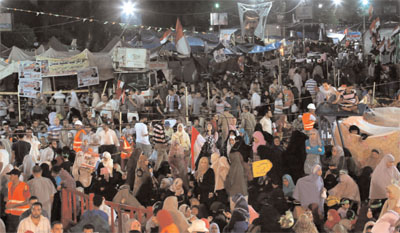
    “And the military did not take over, to the best of our judgement — so far. To run the country, there’s a civilian government. In effect, they were restoring democracy,” he added. Allaa Mostafa, a spokeswoman for the pro-Morsi Anti Coup Alliance, told AFP that demonstrators would “continue our sit-ins and our peaceful protests” against what she termed a “coup d’Etat”. Morsi backers rejected an earlier offer from Egypt’s interior ministry of a “safe exit” if they quickly left their Cairo protest camps, as police discussed how to carry out their orders from the military-installed interim government to end the protests.

    In a statement, the ministry called on those in Rabaa al-Adawiya and Nahda squares “to let reason and the national interest prevail, and to quickly leave”. The ministry pledged “a safe exit and full protection to whomever responds to this appeal”. Authorities had already warned that the demonstrations would be dispersed “soon”, but without saying when or how. The stand-off raised fears of new violence, less than a week after 82 people were killed in clashes at a pro- Morsi rally in Cairo.

    More than 250 people have been killed since the president’s ouster following nationwide protests against his single year in power. Meanwhile, diplomatic efforts to avoid further bloodshed gathered pace, with the European Union’s Middle East envoy Bernardino Leon and German foreign minister Guido Westerwelle both arriving in Cairo to urge the rival camps to find common ground. A senior member of the Freedom and Justice Party, the political arm of Morsi’s Muslim Brotherhood, said the European envoys asked them to end their sit-ins.

    “All the European delegates have the same message; they are pressuring the anti-coup protesters to disperse the sit-ins,” said the official. Following a meeting with Muslim Brotherhood representatives, Westerwelle warned that the situation was “very explosive”. “We have seriously and adamantly pressured for a peaceful solution. I hope that those concerned have gotten the message,” he said in a statement. “The international community has to keep up its diplomatic efforts, even though we don’t know today whether these will prove successful.”

    Kerry also warned against further violence, saying the US was “very, very concerned” about the killing of dozens of pro-Morsi protesters in clashes with security forces and warning such loss of life was “absolutely unacceptable”. British counterpart William Hague also called for “an urgent end to the current bloodshed” and Morsi’s release, in a phone call to interim vice-president Mohamed ElBaradei, the foreign office in London said.

    Amnesty International condemned the cabinet order as a “recipe for further bloodshed” but the mood was calm in Rabaa al-Adawiya square, where thousands of protesters have been camping out in a tent city, despite warnings from the authorities. Foreign trade minister Munir Fakhry Abdel Nur said Wednesday’s statement did not “give room for interpretation”. Accusing Morsi supporters of bearing arms, he told AFP, “It is clear the interior ministry has been given the green light to take the necessary measures within legal bounds.”

    Egypt’s interim government also faces an increase in militant attacks in the restive Sinai peninsula, where gunmen on Thursday shot dead a policeman in the northern town of El- Arish, security officials said. Much of the Egyptian media expressed support for the government’s decision, with some saying the interim administration had received “the people’s mandate” in demonstrations last Friday backing Morsi’s overthrow. Further raising tensions on Wednesday, judicial sources said three top Brotherhood leaders, including Supreme Guide Mohamed Badie, would be referred to trial for incitement to murder.

    Morsi himself has been formally remanded in custody on suspicion of offences when he broke out of prison during the 2011 revolt that toppled former president Hosni Mubarak. He was detained hours after the coup and is being held at an undisclosed location, where EU foreign policy chief Catherine Ashton met him on August 30, later telling reporters he was “well”.

  • Egypt: The True Revolution has begun

    Egypt: The True Revolution has begun

    The fast developing situation in Egypt and the rapid ouster of President Mohamed Morsi has puzzled many and belied the expectation of those who thought that the revolution started two and a half years ago with the ouster of Hosni Mubarak. June 30, 2013 will be remembered as the day the true revolution began. Never before in the history of Egypt have there been such mammoth protests all over the country, sending a clear message that the people have rejected the Monolithic Islamic Nation that the Muslim Brotherhood tried to impose upon them. The people have declared that there is no place for political Islam in the ancient nation. The message was well received by the army which acted responsibly and in accord with the pulse of the masses; there was no choice but to respond and dismiss the Morsi government.

    As a precautionary measure, tanks were deployed in vital areas to prevent clashes between pro- and anti- Morsi demonstrators; the leaders of the Muslim Brotherhood were barred from leaving the country, and will face trial for their misdeeds. The deposed President is currently confined in army custody and many been detained and taken to custody to face trial. The one harsh year Egypt lived under the Muslim Brotherhood has made the public reject the MB ideology and their attempts to force changes and Islamize the State and education. Army chief Abdul Fattah Alsissi, while reading out his statement after the peaceful coup, was surrounded by all secular leaders, Coptic and Al Azhar religious leaders, youth movement representatives, and many liberal leaders.

    All this shows that the pulse of the revolution demanded change and a better government, with representatives from all strata of society with its colors, ethnic and religious affiliations. In other words, a true Egypt of its native rich heritage and cultured people. The Muslim Brotherhood’s short term in power has exposed them and their agenda. Their indulgence in assassination and violence was well known even prior to the 1952 revolution of Nasser. The funding from Saudi Arabia and Qatar did not help in making the radicals more dominant, but the 365 days of Morsi misrule made the people of Egypt understand their true colors and hidden plans to destroy Egypt.

    Other external forces tried to deal with Egypt as a project to change regime and destroy the social fabric by indulging in sedition and encouraging extremism in the region. Washington and the West woke up late to the dangers of these forces at their own doorsteps, and many believe that this prompted the Americans and the Russians to reach to an agreement to end terrorism in the region before it is too late. This understanding may yet bring about an end to the bloodshed in Syria, or else more stable Egypt and Tunisia and Turkey are next in the line for instability. The future of Egypt will be decided only by its own people.

    Though the challenges are horrendous, as the economy is in a shambles and inflation is high, the priority is to set the house in order and bring in a government that can deal with these issues in a pragmatic and transparent manner. It is the beginning of a new chapter, and if the army is able to contain the Muslim Brotherhood and its affiliated groups who may take to arms to settle scores, Egypt will be on the road to democracy. More importantly, it will regain its prestigious Pan- Arab status which has been lost for so long. (The author is a senior Arab International correspondent)

  • Egypt’s Morsi, Lincoln and Janis Joplin

    Egypt’s Morsi, Lincoln and Janis Joplin

    Agender-insulted Tunisian lit himself up and ignited the Arab Spring. Social media (SM) gave it wings. Egypt’s Morsi and the Brotherhood came to power in Tahrir q e and caused the unhappy ending of our stable relationship with Hosni Mubarak. But, Morsi gave not a thought to Lincoln’s Gettysburg Address, wherein he created a citizen’s right: that only a “government of the people, by the people, for the people, shall not perish from the earth.” The awesome self-selection power of “community” in SM, makes it the ultimate uncontrollable “genie out of the bottle,” for it aggregates each like-minded fellow citizen of the world, on like topics, and produces a tsunami of topical discontent. To paraphrase Janis Joplin, “Freedom is just another word for nothing left to lose, Nothing, that all that [Morsi] left me…”. Methinks, Lincoln could not have imagined that what he was unleashing was more powerful than the Magna Carta, for he gave every citizen the right to hold its leaders accountable as honest fiduciaries and deliver the most “common good.” With digital connectivity, the dangerous Wikileaks and Snowdens of the world expose every government’s good secrets and hidden mistakes to the harsh sunlight of a public unaware of the art of statecraft. History instructs that Rome’s “Bread and Circus” and Robespierre’s “Reign of Terror” cabins evil at various points of the governmental spectrum. Ravi Batra, Chair Nat’/ Advisory Council on South Asian Affairs

  • MORSI OUSTED, under house arrest

    MORSI OUSTED, under house arrest

    CAIRO (TIP): Mohammed Morsi, in office only a year as the first democratically elected leader of Egypt, was rousted from power by the military July 3 as a euphoric crowd in Tahrir Square cheered his exit. The former leader was placed under house arrest at the Republican Guard Club, a senior adviser to the Freedom and Justice Party and spokesman for the Muslim Brotherhood said. Most members of the presidential team have also been placed under house arrest. Egyptian security forces also arrested the head of the Muslim Brotherhood’s Freedom and Justice Party and another of the movement’s top leaders.

    The commanding general of the armed forces, Gen. Abdel Fattah al-Sisi, said on Egyptian television that the military was suspending the constitution, which Morsi pushed through and which many Egyptians saw as slanted toward Islamists. “The armed forces couldn’t plug its ears or close its eyes as the movement and demands of the masses calling for them to play a national role, not a political role as the armed forces themselves will be the first to proclaim that they will stay away from politics,” al-Sisi said.

    He added that the head of the constitutional court, Adli Mansour, would be the acting president, with new elections to be held later. The general said that the military did not have designs on controlling the country’s politics but would “never turn a blind eye to the aspirations of the Egyptian people.” He spoke alongside a leading Sunni Muslim cleric and the head of Egypt’s Coptic Christians, as well as a prominent political opponent of Morsi — Mohamed ElBaradei, the former head of the U.N. nuclear weapons agency. Armored vehicles, tanks and troops deployed throughout the Egyptian capital, including near the presidential palace. The army seized the headquarters of the state television and the state-run newspaper, which reported that Morsi had been told he was no longer president.

    A statement on Morsi’s Facebook page described the army’s move as a “military coup.” Mansour will be sworn in as interim head of state on July 4. The United States will continue to monitor the “very fluid situation” in Egypt, President Barack Obama said in a statement Wednesday night. “We are deeply concerned by the decision of the Egyptian Armed Forces to remove President Morsy and suspend the Egyptian constitution,” the statement read. “I now call on the Egyptian military to move quickly and responsibly to return full authority back to a democratically elected civilian government as soon as possible through an inclusive and transparent process, and to avoid any arbitrary arrests of President Morsy and hisU.N. Secretary-General Ban Ki-moon called for calm and restraint, as well as the preservation of rights such as freedom of expression and assembly. “Many Egyptians in their protests have voiced deep frustrations and legitimate concerns,” he said in a statement that did not condemn the Egyptian armed forces’ ouster of Morsi.

    “At the same time, military interference in the affairs of any state is of concern,” he added. “Therefore, it will be crucial to quickly reinforce civilian rule in accordance with principles of democracy.” Security forces, meanwhile, raided the Cairo offices of Al Jazeera’s Egyptian television channel and detained at least five staff members. Four were later released, the channel said. Karim El-Assiuti, a journalist at the station, told Reuters his colleagues at the Al Jazeera Mubasher Misr channel were arrested while working in the studio. The station was prevented from broadcasting from a pro-Morsi rally and its crew there was also detained, he said. Authorities also shut down three Islamistrun TV stations, including one operated by the Muslim Brotherhood. The State Department warned U.S. citizens to defer travel to Egypt and told Americans already living in Egypt to depart “because of the continuing political and social unrest.” Morsi was elected a year ago after Egyptians ousted Hosni Mubarak, the autocrat who had ruled for almost three decades. Egyptians hoped he would build a more pluralistic and tolerant country.

    Instead, Egyptians have been frustrated by a struggling economy and poor services and infuriated by what they see as power grabs by Morsi — stifling the judiciary and forcing through a constitution that favored Islamists and ignored minorities. “Now we want a president who would really be the president of all Egyptians and will work for the country,” Said Shahin, a 19- year-old protester in Tahrir Square, told The Associated Press. The ouster will remake the politics of the Middle East at a volatile time. Egypt is the most populous country in the region, has a peace treaty with Israel and is a partner of the United States. On july 2, Morsi gave a loud, passionate, 45- minute speech to the country, blaming loyalists of Mubarak for fighting against democracy and refusing to step down.

    He vowed to die for his cause. “I am prepared to sacrifice my blood for the sake of the security and stability of this homeland,” he said. On July 3, as the military appeared to be taking control of parts of Cairo, advisers to Morsi said the generals were staging a coup and subverting the will of the people. In Tahrir Square, however, the military announcement hours later was greeted with jubilation reminiscent of the first days of the Arab Spring two years ago. Tens of thousands of people shot fireworks, sang, danced, chanted and waved Egyptian flags. Before they deposed Morsi, Egyptian military officials assured the U.S. that the military would not assume long-term control of the government, and ensured the safety of the U.S. Embassy, personnel and all Americans in Egypt, U.S. officials told NBC News.

  • Offices Of Egypt Islamist Party Torched

    Offices Of Egypt Islamist Party Torched

    CAIRO (TIP): Two offices of the Freedom and Justice Party, the political arm of President Mohamed Mursi’s Muslim Brotherhood, were torched today as rival rallies were held across Egypt. FJP offices were set alight in the Mediterranean city of Alexandria and in Aga in the Nile Delta province of Daqahliya, security officials said.

    Television footage showed plumes of smoke rising from the building in Alexandria as pro- and anti- Mursi protesters clashed. The offices in Aga were ransacked and then burned, the officials said. A Muslim Brotherhood spokesman, Gehad al- Haddad, in a Twitter message accused remnants of ousted president Hosni Mubarak’s National Democratic Party of attacking the offices.

    Tens of thousands of Islamist protesters gathered in Cairo’s Nasr City neighbourhood to defend Mursi’s legitimacy, while thousands of his opponents took to the streets in several parts of the country. The unrest comes ahead of mass protests planned against Mursi on Sunday’s first anniversary of his becoming president.

  • The ‘Epidemic’ of Sexual Harassmentand Rape-in Morsi’s Egypt

    The ‘Epidemic’ of Sexual Harassmentand Rape-in Morsi’s Egypt

    Since the “Arab Spring” came to Egypt and the Muslim Brotherhood assumed power, sexual harassment, abuse, and rape of women has skyrocketed. This graph, which shows an enormous jump in sexual harassment beginning around January 2011, when the Tahrir revolts began, certainly demonstrates as much. Its findings are supported by any number of reports appearing in both Arabic and Western media, and from both Egyptian and foreign women. Hundreds of Egyptian women recently took to the streets of Tahrir Square to protest the nonstop harassment they must endure whenever they emerge from their homes and onto the streets. They held slogans like “Silence is unacceptable, my anger will be heard,” and “A safe square for all; Down with sexual harassment.” “Marchers also shouted chants against President Mohamed Morsi and the Muslim Brotherhood group from which he hails,” wrote Al Ahram Online.

    The response? More sexual harassment and rapes.
    One woman recently appeared on Egyptian TV recounting her horrific experiences. On the program, she appeared shaded, to conceal her identity-less because she felt personal shame or guilt at what happened and more to protect her and her family from further abuses. She recounted how she saw a Facebook notice that Egyptian women were going to protest the unsafe conditions for women on the Egyptian street and decided to join them on their scheduled march in Tahrir Square on January 25, the anniversary of the revolution. “I did not realize I would become the victim,” she lamented. When it started to get dark, her group heard that “strange looking men” were appearing and that it was best to leave the area. During some chaos she was lost from her group. One man told her “this way,” pretending to help her to safety-“I was so naïve to believe him!”-only to lead her to a large group of men, she estimated around 50, who proceeded to encircle and rape her. “This was the first time someone touched me” quietly recounted the former virgin: “Each one of them attacked a part of my body.” Several pinned her down while others pulled off her pants and stripped her naked, gang-raping her for approximately 20 minutes.

    She explained how she truly thought she was going to die, and kept screaming “I’m dying!” In response, one of her rapists whispered in her ears: “Don’t worry. Take it,” even as the rest called her derogatory names she would not recite on the air. Considering that in late November last year, when many Egyptians were protesting President Morsi’s Shariaheavy constitution and the Muslim Brotherhood responded by paying gangs and thugs to rape protesting women in the streets, anecdotes like the above are becoming commonplace. Indeed, to appreciate the regularization of sexual harassment and rape in Egypt, consider the words of popular Salafi preacher Abu Islam, who openly, and very sarcastically, blamed the victims: “They tell you women are a red line.

    They tell you that naked woman-who are going to Tahrir Square because they want to be raped-are a red line! And they ask Mursi and the Brotherhood to leave power!” Abu Islam added that these women activists are going to Tahrir Square not to protest but to be sexually abused because they had wanted to be raped. “They have no shame, no fear and not even feminism. Practice your feminism, sheikha! It is a legitimate right for you to be a woman,” he said. “And by the way, 90 percent of them are crusaders [i.e. Christian Copts] and the remaining 10 percent are widows who have no one to control them. You see women talking like monsters,” he added. No doubt some will argue that Abu Islam is just a “radical” who speaks for himself. Yet many more formal bodies made similar observations, including the new Egyptian parliament’s Shura Council’s “human rights committee,” whose members said that women taking part in protests bear the responsibility of being sexually harassed, describing what happens in some demonstrators’ tents as “prostitution.” Major General Adel Afify, member of the committee representing the Salafi Asala Party, criticized female protesters, saying that they “know they are among thugs.

    They should protect themselves before requesting that the Interior Ministry does so. By getting herself involved in such circumstances, the woman has 100 percent responsibility.” These sentiments are widely shared in Egypt. A study by the Egyptian Center for Women’s Rights said that 98% of foreign female visitors and 83% of Egyptian women have experienced sexual harassment. Sixty-two percent of men admitted to harassing women, while 53% blame women for “bringing it on.” Even non-Egyptian women are becoming increasingly familiar with this phenomenon. After describing her own personal experiences with sexual harassment in Egypt, Sarah A. Topol asserts that “Sexual harassment – actually, let’s call it what it is: assault – in Egypt is not just common. It’s an epidemic. It inhabits every space in this society, from back alleys to the birthplace of the newest chapter of Egyptian history.… For the 18 days of protest last year, for me, Tahrir Square was a harassment-free zone. I noticed it, everyone did. But as soon as President Hosni Mubarak stepped down, the unity ended and the harassment returned.”

    Journalists Sophia Jones and Erin Banco also elaborated on the epidemic of sexual harassment in Egypt:
    It’s difficult to write about sexual harassment and assault in Egypt without sounding like Angry White Girls. But as journalists, it is not merely our job to report in such an environment, it is an everyday psychological and sometimes even physical battle.We open our closets in the morning and debate what to wear to lessen the harassment-as if this would help. Even fully veiled women are harassed on Cairo’s streets. As one young Cairo-based female reporter recently remarked, “it’s a f-ked-up reality that we will be touched.”…. Like hundreds of other countries around the world, sexual harassment and assault happens every day in Egypt. It happens to both Egyptian women, and to foreign women. It happens at all times of the day, despite what some may think, at the hands of men-young boys, grown men, police officers, military officers, and almost everyone in between.

    The journalists then offer an all too familiar story:
    Nor is this merely limited to sexual harassment, but it often, under the right circumstances-few witnesses, the availability of dark allies-culminates into full-blown gang rape. For example, Natasha Smith a young British journalist covering Tahrir Square, was dragged from her male companion into a frenzied mob in the hundreds. “Men began to rip off my clothes,” she wrote on her blog. They “pulled my limbs apart and threw me around. They were scratching and clenching my breasts and forcing their fingers inside me in every possible way … All I could see was leering faces, more and more faces sneering and jeering as I was tossed around like fresh meat among starving lions.” All this is yet one more example of the true nature of the Obamasupported “Arab Spring.”

  • Egypt Drops Treason Charges Against Opposition

    Egypt Drops Treason Charges Against Opposition

    CAIRO (TIP): Egypt on December 30 dropped treason charges against top opposition leaders including ex-IAEA chief Mohammed ElBaradei, extending an olive branch to the leaders who had accused President Mohamed Morsi of trying to muzzle dissent. The country’s top prosecutor had ordered an investigation into accusations against against the constitution party head ElBaradei, Nobel Prize laureate and former head of the Unbited Nations nuclear agency, along with Amr Moussa, former foreign minister and Hamdeen Sabahi, leader of the Dignity Party, of incitement to overthrow regime of President Morsi. Moussa and Sabahy both had challenged Morsi for the post of the president in a June poll this year, which followed the 2011 uprising against the long-time dictator Hosni Mubarak that led to him stepping down from his post.

    Asqalani, a member of the Freedoms Committee at the Lawyers Syndicate, said that he had filed the complaint at the time of the Ettehadeya presidential palace clashes that led to the deaths of several people. He also said it was a dark time when Egyptian blood was being shed, and suggested that “everything that has happened may be part of a conspiracy against the country”.

  • Spain Seizes 28 Million Euros in Hosni Mubarak-Linked Assets

    Spain Seizes 28 Million Euros in Hosni Mubarak-Linked Assets

    MADRID (TIP): Spain announced on Thursday it had seized 28 million euros ($37 million) in financial products, luxury cars and buildings linked to ousted Egyptian president Hosni Mubarak. Egypt requested Spain’s help under UN anti-corruption conventions to find and block assets owned by Mubarak, his family, top aides and their related companies, a national police statement said. Police blocked 18.4 million euros in financial products held in three Spanish banks; two buildings in Madrid’s wealthy Moraleja district worth a combined seven million euros; and seven properties in the holiday resort of Malaga worth more than three million euros.

    They also seized seven luxury cars. “The assets could be the proceeds of crimes such as the embezzlement of public funds, corruption, or the illegal enrichment committed during his mandate,” police said. The Egyptian request targeted some 130 people, they said. Mubarak was ousted on February 11 last year after nearly three weeks of mass protests that left 846 people dead and more than 6,000 injured. Both the interim military government that took over after his overthrow and the administration of elected Islamist President Mohamed Morsi have repeatedly promised to bring to justice all those responsible for the deaths. Mubarak and his interior minister Habib al-Adly were both jailed for life for their role in ordering the killings.

  • As I See It:Welcome Change

    As I See It:Welcome Change

    One must congratulate the Government of India for taking the bold step of joining the 138 nations voting ‘Yes’ for the resolution to upgrade Palestine to a non-member observer state in the United Nations.

    What is commendable is that despite India’s recent strategic overtures to the United States and its cooperation with Israel on defense matters, India demonstrated independence and courage in voting for the Palestinians. In the past, while India made some feeble noises in spurts regarding the Palestinians’ cause and about international morality, India’s policy had seen several flip-flops and had lacked boldness. It was the usual customary dubious statements after every incident involving or affecting the Palestinians; the nature and careful wording of the official statements after the fact reflected its spineless foreign policy.

    Gladly, this time it was different. Along with the newly found courage, one hopes that the policy is backed by a firm sense of purpose. This sense of purpose should be revealed in its reaction to America’s actions in Syria, another Arab country. Barack Obama, weighed down by the difficult task of showing results in the domestic economy and particularly in the unemployment rate during his second and last term of presidency, may take cover under results in his foreign policy.

    After his tacit approval of the happenings so far in Syria, he may now plan for a stronger action to dislodge President Bashar Assad. As it is, the effects of the uprising against Assad and the suppression of the unrest by the present Syrian government have been devastating for the people of that country. There is a humanitarian crisis, as US’s ally UK’s prime minister David Cameron has said recently.

    But, it is going to be complicated further by escalating the armed conflict in that country. The first step the US and its allies may take is to deploy surface to air missiles in Turkey, thus dragging the latter into almost a war. Will India show its true mettle by advising its new strategic partner – the US – against any misadventure in Syria? If India believes in the larger issue of peace and justice, it should put it in practice by being able to prevent escalation of the Syrian conflict to Turkey and then its further spread elsewhere. After the George W Bush era, the Americans have agreed, if not very vocally, that the ‘weapons of mass destruction’ theory was a lie. The threat of biological war by Iraq was also an unfounded fear.

    Indian foreign policy had been to keep its lips zipped through the entire episode. It was neither for the Arabs nor against them. Not a good policy for a country that depended so much on the Arab world by importing oil and exporting labor force in large numbers.

    No significant help
    What India got in return was some leniency in the international nuclear power production regime and nuclear reactors that the US and its European allies anyway wanted to sell us during their recessionary times. That a highly risk-prone nuclear power production would not help our energy crunch in any significant way is another matter. Since the fall of Saddam Hussein, the Arab world has seen increasing turmoil and the western world has become bolder in its initiatives in the Arab countries.

    There is a huge room for doubt regarding the genesis of the so-called ‘Arab Spring’. Hosni Mubarak of Egypt was toppled by what seemed like a popular uprising against his rule which lasted over three decades. His replacement, Mohamed Morsi who has enacted draconian laws giving him sweeping powers, does not appear to be any messenger of democracy for the people of that country.

    The effect for the Arab region and the countries nearby has been one of some degree of destabilization. Whatever may have been the demerits of the Hosni Mubarak government, it had an influence in holding the regional countries together. Egypt had a moderating influence in a region that was moving towards increasing fundamentalism. During the entire Tahrir Square movement, India remained a mute spectator, as though a strategy of non-commitment was a prudent policy. It remains unsure even now.

    The fall of and killing of Colonel Muammar Gaddafi of Libya was another sordid saga in which, again, India practiced silence. Gaddafi may have been a dictator, but the situation that has replaced his regime is no better; Libya has not gone any farther after Gaddafi; if any, it has sunk into endless internal squabbles. India did not take any active diplomatic interest to defuse the crisis and better the prospects of the country. Arabs and now Iran are at the receiving end from the western powers that obviously have an eye on the oil resources in this part of the world. Peace, stability and prosperity of that region are in the best interests of India.

    If India does not support their cause out of a sense of helplessness, then the same sense of vulnerability will manifest when it has to deal with the border problems with China and Pakistan and several other issues with Bangladesh, Myanmar, Sri Lanka and Maldives. If an era of toughness and principled stand has indeed commenced for India as indicated in the case of the recent UN vote on Palestine, it is a significant event. India needs to be firm and focused as regards its relations with the outside world. It needs to be candid with its strategic allies like the United States.

  • Egypt Mass Protests Challenge Islamist President Mohammed Morsi

    Egypt Mass Protests Challenge Islamist President Mohammed Morsi

    CAIRO (TIP): The same chants used against Hosni Mubarak were turned against his successor on Tuesday as more than 200,000 people packed Egypt’s Tahrir Square in the biggest challenge yet to Islamist President Mohammed Morsi. The massive, flag-waving throng protesting Morsi’s assertion of near-absolute powers rivaled some of the largest crowds that helped drive Mubarak from office last year.

    “The people want to bring down the regime!” and “erhal, erhal” — Arabic for “leave, leave” — rang out across the plaza, this time directed at Egypt’s first freely elected president. The protests were sparked by edicts Morsi issued last week that effectively neutralize the judiciary, the last branch of government he does not control. But they turned into a broader outpouring of anger against Morsi and his Muslim Brotherhood, which opponents say have used election victories to monopolize power, squeeze out rivals and dictate a new, Islamist constitution, while doing little to solve Egypt’s mounting economic and security woes.

    Clashes broke out in several cities, with Morsi’s opponents attacking Brotherhood offices, setting fire to at least one. Protesters and Brotherhood members pelted each other with stones and firebombs in the Nile Delta city of Mahalla el-Kobra, leaving at least 100 people injured. “Power has exposed the Brotherhood. We discovered their true face,” said Laila Salah, a housewife at the Tahrir protest who said she voted for Morsi in last summer’s presidential election. After Mubarak, she said, Egyptians would no longer accept being ruled by an autocrat. “It’s like a wife whose husband was beating her and then she divorces him and becomes free,” she said. “If she remarries she’ll never accept another day of abuse.”

    Gehad el-Haddad, a senior adviser to the Brotherhood and its political party, said Morsi would not back down on his edicts. “We are not rescinding the declaration,” he said.