Tag: Houston

  • Let us Know Texas – The State

    Let us Know Texas – The State

    Texas, the second most populous (after California) and the second -largest state (after Alaska) in the United States of America, has had a checkered history which all residents need to know. A state of immigrants, the state has made tremendous progress in the last few decades, and is growing. The Indian Panorama readers will get to know the state of Texas from a series of articles that will appear each week. – EDITOR

    Texas is the second most populous (after California) and the secondlargest of the 50 states (after Alaska) in the United States of America, and the largest state in the 48 contiguous United States. Geographically located in the South Central part of the country, Texas shares an international border with the Mexican states of Chihunahua, Coahuila, Nuevo León, and Tamaulipas to the south and borders the U.S. states of New Mexico to the west, Oklahoma to the north, Arkansas to the northeast, and Louisiana to the east. Texas has an area of 268,820 square miles (696,200 km2) and a growing population of 26.1 million residents. Houston is the largest city in Texas and the fourth-largest in the United States, while San Antonio is the second largest in the state and seventh largest in the United States. Dallas- Fort Worth and Greater Houston are the fourth and fifth largest United States metropolitan areas, respectively. Other major cities include El Paso and Austin-the state capital.

    Texas is nicknamed the Lone Star State to signify Texas as a former independent republic and as a reminder of the state’s struggle for independence from Mexico. The “Lone Star” can be found on the Texas state flag and on the Texas state seal today. The origin of the state name, Texas, is from the word, “Tejas”, which means ‘friends’ in the Caddo language. Due to its size and geologic features such as the Balcones Fault, Texas contains diverse landscapes that resemble both the American South and Southwest. Although Texas is popularly associated with the Southwestern deserts, less than 10 percent of the land area is desert. Most of the population centers are located in areas of former prairies, grasslands, forests, and the coastline. Traveling from east to west, one can observe terrain that ranges from coastal swamps and piney woods, to rolling plains and rugged hills, and finally the desert and mountains of the Big Bend. The term “six flags over Texas”, as can be seen in the Grand Prairie-based large national and international amusement park operator Six Flags, came from the several nations that had ruled over the territory. Spain was the first European country to claim the area of Texas. France held a shortlived colony in Texas.

    Mexico controlled the territory until 1836 when Texas won its independence, becoming an independent Republic. In 1845 it joined the United States as the 28th state. The state’s annexation set off a chain of events that caused the Mexican-American War in 1846. A slave state, Texas declared its secession from the United States in early 1861, joining the Confederate States of America during the American Civil War. After the war and its restoration to the Union, Texas entered a long period of economic stagnation. One Texas industry that thrived after the Civil War was cattle. Due to its long history as a center of the industry, Texas is associated with the image of the cowboy. The state’s economic fortunes changed in the early 20th century, when oil discoveries initiated an economic boom in the state. With strong investments in universities, Texas developed a diversified economy and high tech industry in the mid-20th century. As of 2010 it shares the top of the list of the most Fortune 500 companies with California at 57. With a growing base of industry, the state leads in many industries, including agriculture, petrochemicals, energy, computers and electronics, aerospace, and biomedical sciences. Texas has led the nation in export revenue since 2002 and has the second-highest gross state product.

    History
    Texas lies between two major cultural spheres of Pre-Columbian North America: the Southwestern and the Plains areas. Archaeologists have found that three major indigenous cultures lived in this territory, and reached their developmental peak before the first European contact. These were: ● the Pueblo from the upper Rio Grande region, centered west of Texas; ● the Mississippian culture, also known as Mound Builder, which extended along the Mississippi River Valley east of Texas; and ● the civilizations of Mesoamerica, centered south of Texas. Influence of Teotihuacan in northern Mexico peaked around AD 500 and declined over the 8th to 10th centuries. No culture was dominant in the presentday Texas region, and many peoples inhabited the area. Native American tribes that lived inside the boundaries of presentday Texas include the Alabama, Apache, Atakapan, Bidai, Caddo, Coahuiltecan, Comanche, Choctaw, Coushatta,Hasinai, Jumano, Karankawa, Kickapoo, Kiowa, Tonkawa, and Wichita.

    The name Texas derives from táysha?, a word in the Caddoan language of the Hasinai, which means “friends” or “allies”. Whether a Native American tribe was friendly or warlike was critical to the fates of European explorers and settlers in that land. Friendly tribes taught newcomers how to grow indigenous crops, prepare foods, and hunt wild game. Warlike tribes made life difficult and dangerous for Europeans through their attacks and resistance to the newcomers.[ The first historical document related to Texas was a map of the Gulf Coast, created in 1519 by Spanish explorer Alonso Álvarez de Pineda. Nine years later, shipwrecked Spanish explorer Álvar Núñez Cabeza de Vaca and his cohort became the first Europeans in what is now Texas. Cabeza de Vaca reported that in 1528, when the Spanish landed in the area, “half the natives died from a disease of the bowels and blamed us.” Francisco Vasquez de Coronado describes his 1541 encounter with “Two kinds of people travel around these plains with the cows; one is called Querechos and the others Teyas; they are very well built, and painted, and are enemies of each other. They have no other settlement or location than comes from traveling around with the cows.

    They kill all of these they wish, and tan the hides, with which they clothe themselves and make their tents, and they eat the flesh, sometimes even raw, and they also even drink the blood when thirsty. The tents they make are like field tents, and they set them up over some poles they have made for this purpose, which come together and are tied at the top, and when they go from one place to another they carry them on some dogs they have, of which they have many, and they load them with the tents and poles and other things, for the country is so level, as I said, that they can make use of these, because they carry the poles dragging along on the ground. The sun is what they worship most.” European powers ignored the area until accidentally settling there in 1685. Miscalculations by René Robert Cavelier de La Salle resulted in his establishing the colony of Fort Saint Louis at Matagorda Bay rather than along the Mississippi River. The colony lasted only four years before succumbing to harsh conditions and hostile natives. In 1690 Spanish authorities, concerned that France posed competitive threat, constructed several missions in East Texas. After Native American resistance, the Spanish missionaries returned to Mexico. When France began settling Louisiana, mostly in the southern part of the state, in 1716 Spanish authorities responded by founding a new series of missions in East Texas.

    Two years later, they created San Antonio as the first Spanish civilian settlement in the area. Hostile native tribes and distance from nearby Spanish colonies discouraged settlers from moving to the area. It was one of New Spain’s least populated provinces. In 1749, the Spanish peace treaty with the Lipan Apache angered many tribes, including the Comanche, Tonkawa, and Hasinai. The Comanche signed a treaty with Spain in 1785 and later helped to defeat the Lipan Apache and Karankawa tribes. With more numerous missions being established, priests led a peaceful conversion of most tribes. By the end of the 18th century only a few nomadic tribes had not converted to Christianity. When the United States purchased Louisiana from France in 1803, American authorities insisted that the agreement also included Texas. The boundary between New Spain and the United States was finally set at the Sabine River in 1819, at what is now the border between Texas and Louisiana. Eager for new land, many United States settlers refused to recognize the agreement. Several filibusters raised armies to invade the area west of the Sabine River.

    In 1821, the Mexican War of Independence included the Texas territory, which became part of Mexico. Due to its low population, Mexico made the area part of the state of Coahuila y Tejas. Hoping that more settlers would reduce the near-constant Comanche raids, Mexican Texas liberalized its immigration policies to permit immigrants from outside Mexico and Spain. Under the Mexican immigration system, large swathes of land were allotted to empresarios, who recruited settlers from the United States, Europe, and the Mexican interior. The first grant, to Moses Austin, was passed to his son Stephen F. Austin after his death. Austin’s settlers, the Old Three Hundred, made places along the Brazos River in 1822. Twenty-three other empresarios brought settlers to the state, the majority of whom were from the United States. The population of Texas grew rapidly. In 1825, Texas had a population of approximately 3,500, with most

  • Three killed, two injured in US apartment shooting

    Three killed, two injured in US apartment shooting

    WASHINGTON (TIP): Three people were fatally shot and two were injured at an apartment complex in the US city of Houston, a media report said. The shooting happened at around 5pm on November 19, Xinhua reported. According to the Harris County Sheriff’s Office, a man shot all the five victims in the head. Police have launched a manhunt to track down the gunman. The motive of the shooting is not yet known and the identities of the victims were not released.

  • Woman pleads guilty to killing mom, abducting baby

    Woman pleads guilty to killing mom, abducting baby

    CONROE, TX (TIP): A Houston woman accused of killing a mother and abducting her newborn son last year avoided a possible death sentence by pleading guilty Tuesday, November 19, and accepting a sentence of life without parole. Verna McClain, 32, was awaiting trial on a capital murder charge for fatally shooting the new mother outside a pediatric clinic in the Houston suburb of Spring and snatching her 3-day-old son. Montgomery County prosecutors had said they would seek the death penalty against McClain for the April 2012 slaying of 28-year-old Kala Golden- Schuchardt. The infant was found hours later safe with McClain’s sister, who told authorities McClain intended to adopt the child.

  • Fooled by forged files, jailers release 2 US killers

    Fooled by forged files, jailers release 2 US killers

    HOUSTON (TIP): Authorities in the US state of Florida have launched a massive manhunt for two murderers who were mistakenly released from prison after jailers were conned by forged court documents. Charles Walker and Joseph Jenkins, both 34, were released separately from the Franklin correctional institution in Carrabelle after officials received forged paperwork indicating their sentences had been reduced, The Orlando Sentinel reported. While Jenkins was serving a 50-year sentence for murder and armed robbery, Walker was serving 15 years for murder. The Florida department of law enforcement, which is investigating the case to determine how this happened, was not notified of the releases until Tuesday. Department of corrections spokeswoman Jessica Cary said state corrections officials acted on the court documents, not realizing they were falsified. Florida department of corrections secretary Michael Crews said that the agency is reviewing the releases to make sure that no other inmates have been released based on falsified documents. “The top priority of the department is the safety of Florida families and we’ll continue working with law enforcement to ensure these men are returned to custody,” Crews said.

  • Indian-American Couple Establishes Scholarship in Houston University

    Indian-American Couple Establishes Scholarship in Houston University

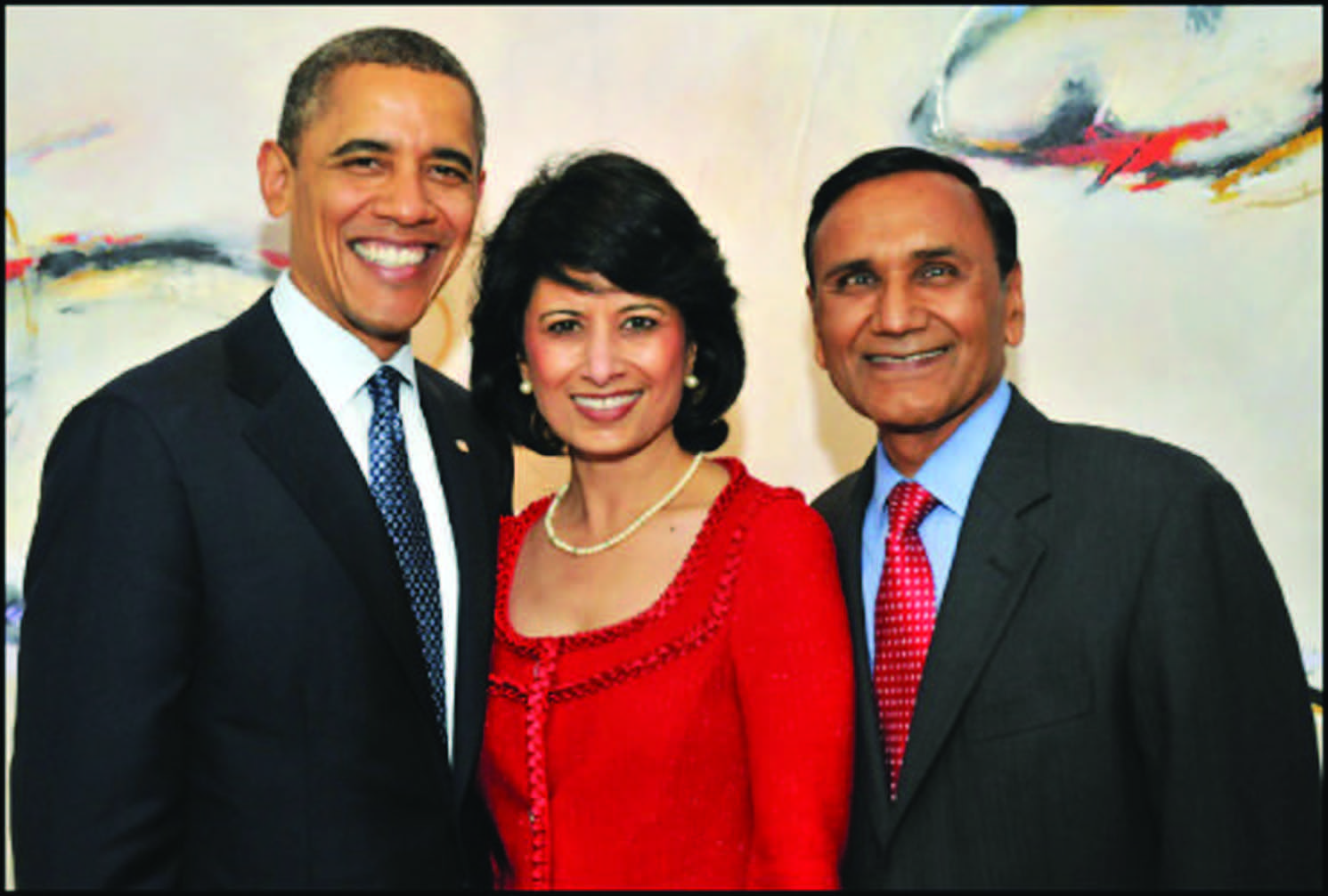
    HOUSTON (TIP): An Indian-American couple has established a tier one scholarship worth more than USD 100,000 in the prestigious University of Houston. Renu Khator, system chancellor and president of the University of Houston, and her husband Suresh, associate dean in the UH Cullen College of Engineering, have contributed more than USD 100,000 to establish the Renu and Suresh Khator UH tier one scholarship endowment. With matching funding, the endowment was augmented to USD 200,000, giving new energy to the University’s tier one scholarship program. “The University of Houston offers more than USD 150 million in aid and scholarship(s) each year to freshmen and transfer students. Most of it is needbased, but a few, including tier one scholarships, are based on merit,” Khator said. “Offering scholarships to freshmen, whether need-based or merit-based, encourages them to attend college, and more specifically, to choose UH,” Khator said. The tier one scholarship program admits students who have a combined math and critical reading SAT score of at least 1300, were ranked in the top 10 per cent of their class and were admitted to the University in the fall semester following their high school graduation, in accordance with the guidelines from the tier one website.

  • Sam Kannappan elected to NCEES

    Sam Kannappan elected to NCEES

    HOUSTON (TIP): The 92nd Annual Meeting of National Council of Examiners for Engineering and Surveying (NCEES) held in San Antonio, Texas recently has elected Sam Kannappan, a noted Indian-American community activist of Houston, Texas as its zonal Secretary/ treasurer, a press release said. Sockalingam Sam Kannappan, Chairman of Enforcement Committee, of Texas P.E. Board was elected Secretary and Treasurer of Southern Zone (SZ). South Zone has 18 boards under its control. NCEES is the American National Professional Engineers (PE) Board coordinating 50 national P.E. Boards, Puerto Rico and Virgin Islands. Engineering organizations from Canada, Mexico, Japan and other countries work with NCEES. Members of each state PE Board are appointed by their respective state governors. The requirements to receive a license to practice engineering such as education, examination and experience are decided by the Board.

    NCEES conducts examination for fundamental (FE) and Professional Examination (PE) through four zones. Kannapan was also recently made a board member of Texas Onsite Wastewater Treatment Research Council by Texas Governor Rick Perry. Kannappan is a registered Professional Engineer in Texas with 25 years of experience in design, analysis, and software development for the petrochemical, refinery, and pipeline industries. He graduated with Masters Degree in Mechanical Engineering from the University of Texas at Austin. He is a leading consultant in pipe design especially in designing piping under very high temperatures and pressures. He specializes in Finite Element Analysis and Fracture Mechanics methods to determine remaining life of a pressure component. He is author of text book “Introduction to Pipe Stress Analysis”. Kannappan, a native of Nattarasankottai in Sivaganga district of Tamil Nadu is the founder of Sri Meenakshi temple in Houston, Texas.

  • Halliburton Agrees To Plead Guilty In Spill, Said US

    Halliburton Agrees To Plead Guilty In Spill, Said US

    NEW ORLEANS: Halliburton Energy Services has agreed to plead guilty to destroying evidence in connection with the 2010 Gulf oil spill, the Department of Justice said on July 25. Federal officials said in a news release that a criminal information charging Halliburton with one count of destruction of evidence was filed in federal court in Louisiana.

    Halliburton has agreed to pay the maximum fine, be on probation for three years and continue to cooperate with the government’s criminal investigation, according to the news release, which did not list the amount of the fine. The Houston-based company has also made a $55 million voluntary contribution to the National Fish and Wildlife Foundation. It was not a condition of the court agreement, the news release says.

    The company said in a statement Thursday night that it had agreed to plead guilty “to one misdemeanor violation associated with the deletion of records created after the Macondo well incident, to pay the statutory maximum fine of $200,000 and to accept a term of three years probation.” The Justice Department has agreed it will not pursue further criminal prosecution of the company or its subsidiaries for any conduct arising from the 2010 spill, Halliburton’s statement said, adding that federal officials have also “acknowledged the company’s significant and valuable cooperation during the course of its investigation.”

    The plea agreement is subject to court approval, the company said. Halliburton was BP’s cement contractor on the drilling rig that exploded in the Gulf of Mexico in 2010. The blowout triggered an explosion that killed 11 workers and spilled millions of gallons of oil into the Gulf. According to the news release, Halliburton conducted its own review of the well’s design and construction after the blowout, and established a working group to review “whether the number of centralizers used on the final production casing could have contributed to the blowout.”

  • A Harassed Indian Student’s Tale of Woe

    A Harassed Indian Student’s Tale of Woe

    The Open Doors report, which is published annually by the Institute of International Education (IIE) with support from the U.S. Department of State’s Bureau of Educational and Cultural Affairs, says that the number of international students at colleges and universities in the United States increased to an all-time high of 6,71,616 in the 2008-09 academic year and has been steadily growing.

    The report says India that has been at the top in enrolment in 2008, is now the second leading place of origin of students after China that has gained only a marginal edge over India. The report is based on a comprehensive survey of approximately 3,000 accredited U.S higher education institutions of all types and sizes, regarding international students at all levels of study. On many occasions we have heard stories of sufferings and misery of Indian students in the U.S. Most relate to bias and discrimination.

    Many a time the embassy of India and the Indian consulates have been accused of complete indifference to the students’ plight. The present story of a young student at University of Texas, Brownsville is no different. Harassed by the university authorities the young man turned to the Consulate at Houston but failed to move the authorities there.

    I do not wish to pass any judgment on the Indian Consulate in Houston but our readers will agree that this unhelpful attitude of the Consulate authorities in protecting the interests of an Indian student is not compatible with their charter of duties. Please do not forget young Indians come to this country with big dreams, as many of us came with, and we need to help them realize their dreams, for themselves and for India.

    Indian students are the second highest foreign student contingent in USA. They come here to study, to make a career and to experience a different culture. They do not come here to get assaulted, hazed upon, or to have sexually profane acts get carried out in their house. Lastly they do not expect their college to take a biased decision against them. However such is exactly the list of inexperiences that an Indian student, who requests not to be identified, had to suffer at University of Texas, Brownsville between January and December 2011, as a graduate student.

    During his stay, he was hazed upon by a PhD student from Sri Lanka by the name of Shihan Weeratunga, who asked repeatedly for over 3 months to be included in a start-up already registered in the Indian student’s and his American business partner’s name. No one can ask to divulge company secrets (tantamount to asking one to commit a crime) or insist overtly to be included in a start-up at the expense of an existing co-founder. Mr.Weeratunga also behaved in many unacceptable ways in the Indian student’s house, including but not limited to groping of a common friend.

    There were also plenty of sexual allusions and at least one promiscuous act with a fellow student, in the Indian student’s house, after tactfully getting the latter inebriated, the details of which are not being divulged for now upon request. This reporter feels that this act alone is enough to get someone thrown out of a college and possibly incarcerated.

    Finally on the night of 25th August, Mr.Weeratunga cornered the Indian student on the staircase outside his house, and with much name calling, finger pointing and shouting, physically assaulted (coming chest to chest, shove/push, hit) him. The University’s code of conduct can be found here – http://www.utb.edu/ba/hoop/Polic y/6-4-1.pdf Mr.Weeratunga was clearly in violation of multiple items.

    The Indian student lodged a complaint to the college coordinator of judicial affairs, first submitting a brief report on the 19th September 2011 and then a full complaint on the 2nd October 2011. The adjudicator, upon receiving the first of the complaints, replied with the following, even though he had been asked to sit in judgment – “Because your allegation of harassment of you by Mr. Weeratunga is so serious, I am compelled to respond in some form.

    I need to do this because if your allegations are found to be true, then they represent a violation of our policy on harassment. The University is intolerant of behaviors that would be deemed as harassment and that create a hostile environment for any individual on our campus.” The official complaint was only against Mr.Weeratunga, and did not directly implicate anyone else.

    However the adjudicator then made a volte face and shut the case up in one day, conducting only a shoddy evaluation, once another Hispanic female student of the college (who carried out her share of distasteful acts in his house) came into the picture. The Indian student was denied a fair and full investigation, which is mandated by US law for all employees (student worker) of American institutions, and was instead threatened verbally with suspension and told by the adjudicator not to mention these incidents ever again.

    The about turn (and shoddiness and haste with which the investigation was carried out) made by a Hispanic adjudicator of a principally Hispanic institution after a Hispanic woman came into the picture, reeks of prejudice and borders on racial partiality to say the least.We suspect the adjudicator had already decided to exonerate Mr. Weeratunga and intimidate the Indian student to keep things secret even before receiving the full (2nd) report, for the sake of the female student.

    The Indian student had to lapse into medical trauma (noted by the college medical counselor Miss. Liebscher) since the day of the assault and more so since this misjudgment. U.T. Brownsville is part of the University of Texas system of colleges and cannot act in violation of their central set of rules.

    We demand that U.T. Brownsville please explain the anomaly, and explain why Mr.Weeratunga was allowed to get away with assault and many other violations of University policy and why another student was made to suffer in this way – is it for the reason we suspect – to protect the reputation of the woman? Mr.Weeratunga is part of the Physics PhD program of U.T. Brownsville, which is a degree conferred by the University of Texas, San Antonio – we believe that U.T.S.A. would also consider distancing themselves from him once the full extent of Mr. Weeratunga’s misdoings emerges.

    The Indian student after suffering this way, produced a dismal grade, and was ousted by U.T. Brownsville. He has since returned to another college in Texas and is doing many times better there. He went back to Brownsville this April and filed a case for assault against Mr. Weeratunga, and made the Indian Consulate in Houston aware of these developments (including supplying the police report). The Consulate promised to take up the matter with the college but has not done so as yet.

    He also contacted many Indian organizations and Indian media agencies (including NDTV) and the U.S.I.E.F. in India, but with little or very modest success. Indian Panorama is the first to feature this story. The student has recently made the U.T. Brownsville Physics department aware of the full extent of Mr. Weeratunga’s misdemeanors and now intends to sue the college for damages on grounds of partiality and deliberate negligence but does not have the resources to engage another law firm (he already engaged the law offices of Sherin Thawer, to file for an U visa), except on a percentage basis.

    He is now toying with the idea of writing a reveal-all book in future and contacting watch-dog bodies that monitor acts of hazing, violence, sexual misdemeanor and racial partiality in American Universities.

  • Embassy Of India In USA Appoints New Service Provider From July 1

    Embassy Of India In USA Appoints New Service Provider From July 1

    WASHINGTON (TIP): The Embassy of India in the USA has awarded the new contract to the BLS International Services Limited for providing Visa/OCI/PIO/Renunciation of Indian Citizenship Certificate application support services, to be operational from July 1, 2013. The current Service Provider, Travisa Outsourcing, will be closing its services on June 28 at all Embassy and Consulate locations. Applications in person will be accepted by Travisa Outsourcing only up to June 27.

    Only Emergency Visas will be entertained by Travisa Outsourcing on June 28. All applications sent through mail will be accepted by the Travisa Outsourcing up to June 21. Applicants, who propose to send their applications by mail thereafter, may send them, so as to reach offices of the BLS International Services Limited at jurisdictional locations on July 1 or thereafter. It may also be noted that Banker’s checks accompanying these applications are drawn in favor of the BLS International Services Limited. Applicants, who have already submitted their applications to Travisa, may check status of their applications from Travisa till June 28.

    Pending cases, thereafter, will be transferred to the BLS and can be tracked from their website for status and delivery.

    The Central Call Center details of the BLS International Services Limited are as follows:
    Toll Free Nos. Jurisdictional BLS Offices 8886837830 – BLS- Washington/ New York/ Atlanta 8886837831 – BLSChicago/ Houston 8886837832 – BLS- San Francisco The Website of BLS International Services Limited is: http://www.visa.blsindia-usa.com It will be operational on June 25.

    The addresses of the BLS offices at different locations are as follows:
    Washington, DC : 220 Eye Street NE, Washington, DC 20002 New York : 13 East, 37th Street, Between 5th and Madison, NY 10001 Chicago: 55 West, Van Buren, Chicago, IL 60607 Houston: Suite 515, Level 5, 1235, North Loop West, Houston, Texas 77060 San Francisco : 4239 Geary Street , SFO CA – 94118 Atlanta : 5775, Glenridge Drive, Building B, Suite 380, Atlanta, Ga 30328 Due to some technical reasons, Visa services at Atlanta Consulate jurisdiction would begin from July 18.

    Visa applicants from the states under the Atlanta jurisdiction may continue to submit applications as per the current Visa jurisdictions until July 17. However, OCI/PIO/Renunciation services would begin at Atlanta Consulate jurisdiction location from July 1.

  • HTC Honors Vijay Goradia for Entrepreneurship at Annual Gala

    HTC Honors Vijay Goradia for Entrepreneurship at Annual Gala

    Vijay Goradia of Houston was named by Houston Technology the Honoree of the Year for his entrepreneurial drive that has resulted in his company, Vinmar International Inc, a 34 year-old petrochemicals marketing group, to become one of the top growing firms in the metroplex.

    Nearly three years ago, Goradia pledged $1 million to fund an annual Innovation Prize during the next years at the HTC to help companies who got their start from university research. So far, several startups have shared $150,000 in annual prize money for the commercial application of their technology, the soundness of their business plan and the resulting potential for job growth within the region. The 2013 winners will be announced on October 9. Goradia also serves on the Board of Directors of the HTC.

  • New Passport Service Provider Appointed

    New Passport Service Provider Appointed

    NEW YORK (TIP): A press release issued by the Indian Embassy in Washington April 26 said that BLS International Services Ltd will be the new service provider for all Indian Passport Services in the USA with effect from May 07, 2013. The Services of the current service provider VFS Global Ltd., the release said will be terminated with effect from May 07, 2013 at all Embassy/Consulate locations in USA. VFS Global Ltd will continue to receive passport applications in person until May 6 and by mail until May 3, 2013. Those applying after those dates may submit their applications to new service provider.

    Their website and location details are given below: Website : http://www.blsindia-usa.com
    (1) Washington DC: 800 K Street NW Suite # MR-12 Washington DC 20001
    (2) New York: 28 West 30th Street Suite 202 New York NY 10001
    (3) Chicago : 29 East Madison Street Suite # 1203 Chicago IL 60602
    (4) San Francisco: 4837 Geary Blvd San Francisco CA 94118
    (5) Atlanta: 5775 Glenridge Drive Northeast Building B Suite # 390 Atlanta GA 30328
    (6) Houston: 9800 Northwest Fwy Suite 602 Houston TX 77092
    For Information related to passport services: info@blsindia-usa.com

  • Making Dollars & Sense

    Making Dollars & Sense

    South Asian Young Women Entrepreneurs Unveil Six-City Financial Education Tour
    NEW YORK (TIP): In celebration of National Women’s History Month in March, South Asian Young Women Entrepreneurs (SAY WE), a network of business-minded executives in the fields of technology, finance, entertainment and fashion, announced the launch of a six-city financial education tour, in association with the Consulate General of India (New York) and powered by Wells Fargo. “Making Dollars & Sense: Financial Education for South Asian Women Business Owners” will kick off in San Francisco on April 18.

    The panel of financial experts and successful South Asian women entrepreneurs will provide insights, tips and resources on topics such as building business credit, reinvesting in a business, protecting credit and maximizing relationships with business bankers. After the first event, the tour will stop in Los Angeles, Houston, Dallas, New Jersey, and culminate in New York City on May 30.

  • Building his dreams: Mihir Patel

    Building his dreams: Mihir Patel

    “Within our dreams and aspirations we find our opportunities”.
    Very few people truly love their jobs let it alone be a passion. But the just sworn in new President of the prestigious Society of Indo-American Engineers and Architects (SIAEA), Mihir Patel not only loves his job but works everyday with a burning passion. He is the President of Monpat Constructions Ltd., and a prominent member of the Indian American community. He spoke to The Indian Panorama correspondent Pooja Premchandran in an exclusive interview at his office in Flushing, New York. Mihir B. Patel is perhaps one of the wellestablished engineers in the Indian American community. A firm believer in the philosophy of ‘one life-live well’, Mihir Patel bats away the problems of his life and work. After a bit of struggling start, Patel has come a long way. “I am one of the founding members of Monpat Construction. The start to that hasn’t been easy but I sure am happy now. I came here and started working at a construction group. Currently we work on many New York City projects. Now I am the 15th President at SIAEA and that’s additional responsibility.


    img10

    But I am more than happy to take up this responsibility,” says a smiling Patel. Born in Mehsana, Gujarat, Mihir was always inclined towards doing Engineering. He set out to complete his Bachelors in Engineering from Birla Vishwakarma Mahvidyala in 1982. In 1986, he married Bhavana Patel and he now has a son, Priyank Patel, who is also an architect. Mohan Jetwani founded the Society of Indo-American Engineers and Architects or SIAEA in 1981. The Association immediately gained popularity among the Indian American engineers and architects who were continually looking for a larger umbrella to share their common goals. Patel is ready to further the valor of the organization. “They sowed the seed for this Association.

    Although it has blossomed already, my task is to make sure it remains that way. I need to carry its name and glory much further,” says Patel. Mihir also plans to get the Indian-American youth on board with SIAEA. He adds, “We plan to get many youngsters also inducted to our organization. We plan to provide them with scholarships to Engineering schools and once they graduate we will orient them to our organization.” Unlike many who see the seat of power as just another feather in their caps, Mihir resolves to change a few things within the SIAEA. He vows to accomplish a few of his own personal ambitions by using all the Presidential power that he is allotted to use. “My personal goal under this Presidency would be to open new chapters, facilitate grassroot level meetings, get more young engineers and architects involved. That would be priority. This was also the dream of Nayan Parikh, so now my task is to fulfill them,” Mihir stresses.

    In the midst of a housing crisis where the prices are sky-rocketing, Mihir has not lost all hope to provide housing for all. His personal ambition is to provide housing options to all sectors of the society. “My biggest ambition is to provide housing options for the society and not just specifically the Indian community. I think housing or shelter is a basic need for us all. I, along with the SIAEA have been trying to work on this need for the past six years. But we require continual monetary support for this. I am hoping that in these two years as the SIAEA President I will be able to bring us closer to fulfilling that dream,” says Mihir. He explains that he is relentlessly pursuing this aspiration and he hopes that it gets fulfilled. While most of us cannot handle just one job, Mihir eases through his role as President to two organizations. He attributes the successful organizing of his office and work projects to his brother. He explains, “Well my company is well organized and its very well established. I have my brother also helping me out and my staff does a wonderful job to settle things in a good way. So it gives me the motivation to come to a hassle free environment. As far as SIAEA is concerned, just being part of this group is an honor.

    I get all the respect and admiration I could ask for from SIAEA and in turn I strive to live up to the organizations dreams and valor.” Mihir also learnt long ago that all work and no play is not the way to go. He still remains a lively and active man despite the mounting economic crisis and additional work pressure. He explains that that he takes ‘the edge off’ by playing various sports. “I am most passionate about sports. I play cricket, tennis, golf and other active sports.

    I have made a small cricket pitch in my backyard. I had the fortune of having Mr. Kapil Dev come there and play once. It’s simple. With all the work you do, you need to find something that relaxes you. I need that relaxation after its 5 in the evening.” Mihir draws all his inspiration from his father. He recalls his father’s debacle when he was told that he couldn’t be an engineer. Since, then his father resolved to make Mihir an engineer.

    Mihir says, “My father easily is my mentor. When he was young, he aspired to be an engineer and run his own company in America. But sadly, my grandfather did not have the means to support him. So he always willed me to be an engineer and I did just that. Even today, I stress on the value of education. I always believe that education is the only way you can succeed in today’s world.” It usually takes a life changing experience for us to transform our manner of thinking and living.

    On being asked about Mihir’s life changing experience, he jokingly tells us, “I think ever since the 2009 recession I have been having life changing experiences. But seriously, initially we used to get regular work orders from agencies, but now we need to dig a little deeper to find work. Sadly though, the situation does not seem to be improving.” The 2009 recession has stunted many companies growth and many have given up. But Mihir Patel carries on due to his loving support from his family and friends. “See, problems will always come.

    It is never going to stop. I find that a good support from friends who are loyal and committed to you, it is easier to solve your problems,” he advises. In the last 20 years, Monpat Constructions have completed work worth $100 million. All his projects are close to his heart but two are very distinctive. “Currently, I am working on a project at the Otisville Correction facility. Although there are many other projects we are currently undertaking, the Otisville prison project or any other project that you do at the prison, deserves a special mention. Working at a prison is completely different.

    You get a bare minimum of 5 hours to work every day and you need to somehow complete your project by deadline. Also, there are strict rules on how many tools you can carry inside and how you can carry them. Even our Super’s presence and absence must be notified to authorities. So, construction around the prison is definitely a more challenging job for me,” Mihir adds.

    He also tell us about a second project called “Challenge America’ where the debris from the 9/11 tragedy was used to make the Houston park near FDR. Mihir explains, “This project was a joint effort of Erin Brokovich and Mayor Giuliani. We provided the roofing to this project. I decided to contribute to this project mainly because we all were overcome with the sense of needing to do something after the harsh 9/11 tragedy.” Like many other prominent members of our Indian American community, Mihir Patel also urges our community to grow stronger and stand united from within. “I find that the Gujarati community is very active and very well behaved. This is a group comprising of very well educated and very well established people. This is also true about the other Indian communities we have in the US. However, there is a problem with unity in our Indian society.

    Not only are we disunited but we also have the nature of being displeased when others succeed. I wish we could change that aspect.” But like any other Indian, family is the most important thing to him. “I only pray that in good or bad times, I have the support and presence of family and close friends. For me, family is of utmost importance. Everything else is secondary,” he concluded.

  • Indian Americans Show Their Class Ten Named Intel Science Contest Finalists

    Indian Americans Show Their Class Ten Named Intel Science Contest Finalists

    NEW YORK (TIP): Ten IndianAmerican high school students areamong the 40 finalists in the 2013Intel Science Talent Search.Students will compete March 7-13in Washington, D.C., for $630,000 inawards, with the top winnerreceiving $100,000 from the IntelFoundation.New York led all states with sevenIntel finalists this year, followed byCalifornia with six.Of the ten Indian Americanfinalists, three are from California:Paulomi Bhattacharya of Cupertino,a senior at The Harker School inSan Jose; Pavan Mehrotra, of SimiValley, who attends Sierra CanyonSchool in Chatsworth; and SahanaVasudevan of Palo Alto, a studentat the Gnyanam Academy. Two arefrom Portland, Ore: Naomi Shah ofSunset High School and RaghavTripathi of Westview High School.The other four finalists are fromGeorgia, Kentucky, Massachusettsand Tennessee.

    Mayuri’s project is titled”Computational Analysis of theDNA-Binding Mechanism of thep53 Tumor Suppressor and its Inactivationthrough the R249S Mutation”. MayuriSridhar, a 17-year-old senior at Kings ParkHigh School accepted to MassachusettsInstitute of Technology as an early actionapplicant, attended the Kings Park Board ofEducation meeting Tuesday night, shortlyafter receiving a phone call from Intel,alerting her to her finalist status.For her project, Sridhar studied thestructure of the p53 protein, a tumorsuppressor that helps prevent cancer.”Experimental research has shown that theloss of tumor suppressors, such as the p53protein, is highly correlated with thedevelopment of tumor cells,” Sridharexplained in a previous interview.

    “I wantedto create a better cancer diagnostictechnique.”Toward the end of her research, Sridharrealized she had possibly done that.”A week before submitting my entry, all myresults flipped around and I could not for thelife of me figure out why,” she said.”Eventually I realized my results wereproving the experiment wrong. I was reallyhappy because I was able to prove that I couldactually create better diagnostic techniquesthat hadn’t been done before. That was thebest moment.”At the Tuesday meeting, KPHS scienceresearch coordinator Mary Ellen Faycongratulated Sridhar.”This is the second time we are in thissituation, which is, I think, phenomenal,” shesaid. “Do you know the first time was hersister?”In 2008, Hamsa Sridhar became Kings ParkHigh School’s first student to be named anIntel finalist.”Genes, environment, whatever it is,they’re doing something really right in thathousehold,” Fay said.

    Paulomi Bhattacharya’s project is titled “A NovelAAA-ATPase p97/VCP Inhibitor Lead for MultipleMyeloma by Fragment-Based Drug Design: AComputational Binding Model and NMR/SPR-BasedValidation.”An 18-year-old senior at Harker, she has been doingscientific research in fields as diverse as bioengineeringand chemical engineering since the eighth grade, the SanJose Mercury News reported.”It’s unbelievable. It’s a dream come true,” she said. TheIndian American student did laboratory work to find adrug with the potential to shut off a protein responsible formultiple myeloma, a cancer that affects plasma cells.She identified and tested many drug candidates lastsummer before finding one that worked. “Research is somuch about failing over and over again, and finally whenyou succeed, it’s wonderful,” she told the Mercury News.

    Sahana Vasudevan made the finals with the project:”Minimizing the Number of Carries in the Set ofCoset Representatives of a Normal Subgroup.” Theresearch could improve the speed and efficiency ofcomputer algorithms.Pavan Mehrotra advanced with “Facile, Single StepConversion of Biomass to Electricity.”

    Two Indian American finalists are from Portland,Ore. Naomi Shah of Sunset High School advancedwith the project, “The Toxicological Effect ofAirborne Pollutants on Lung Health.”

    Raghav Tripathi of Westview High School inPortland submitted “Design and Synthesis of NovelFatty Acid Binding Protein Inhibitors for Analgesicand Anti-Inflammatory Effects through Increases inEndogenous Anandamide Concentrations.”Raghav Tripathi of Westview High School in Portlandsubmitted “Design and Synthesis of Novel Fatty Acid BindingProtein Inhibitors for Analgesic and Anti-InflammatoryEffects through Increases in Endogenous AnandamideConcentrations.”

    Raja Selvakumar, Milton High School, Alpharetta,Ga., “Gastro Microbial Fuel Cell: A NovelImplementation of a GMFC in CapsularNanorobotics”; Naethan Mundkur, duPont Manual HighSchool, Louisville, Kentucky, “Investigation into theThermal and Rheological Properties of CuO Nanofluids forHeat Transfer Applications”; Surya Bhupatiraju, LexingtonHigh School, Lexington, Mass., “On the Complexity of theMarginal Satisfiability Problem”, and AkshayPadmanabha, Houston High School, Collierville, Tenn.,”Predicting, Detecting, and Treating Seizures throughVagus Nerve Stimulation.”Finalists are rated on original scientific research,achievement, and leadership inside and outside theclassroom. Winners will be unveiled at an awardsceremony at the National Building Museum March 12.Society for Science and the Public, a nonprofit groupdedicated to public engagement in scientific research andeducation, has administered the competition since itsinception in 1942. The 40 finalists were narrowed downfrom 300 semifinalists and more than 1,700 entrants.

  • 55 % Indian-Americans Own House In US, Says Census Bureau Report

    55 % Indian-Americans Own House In US, Says Census Bureau Report

    WASHINGTON (TIP): Indian-Americansmay have the distinction of being thehighest-per capita income group amongethnic communities but they lag far behindtheir European counterparts when it comesto owning a house in the US.According to the ‘HomeownershipAmong the Foreign-Born Population: 2011’,released by the Census Bureau, 55 per centof the Indian-Americans own a house oftheir own while 45 live in rentedaccommodation.Foreign-born owned households with ahouseholder from Europe were the mostlikely to be owned free and clear (40 percent), while foreign-born owned householdswith a householder from Africa were theleast likely to be owned free and clear (14per cent), it said.

    Of the 20 country-of-birth groups withthe largest number of foreign-bornhouseholds in the US, several countriesfrom Europe along with Canada had thehighest homeownership rates.Over 70 per cent of foreign-bornhouseholds with a householder fromCanada (71 per cent), Germany (72 percent), Italy (79 per cent), and the UnitedKingdom (73 per cent) were owneroccupied.By comparison, less than one-third of theforeign-born households with ahouseholder born in the DominicanRepublic (25 per cent), Guatemala (30 percent), and Honduras (31 per cent), wereowner occupied. Italy and Germany werealso among the country-of-birth groupswith the highest percentage of ownedhomes that were owned free and clear.About half of foreign-born householdsthat were owned and had householdersfrom Italy and Germany owned their homesfree and clear (55 per cent and 51 per cent,respectively).

    “Homeownership is a goal shared bymany residents of the United States, bothnative- and foreign-born, citizen andnoncitizen,” said Elizabeth Grieco, chief ofthe Foreign-Born Population Branch at theCensus Bureau.”For immigrants in particular – whomaintain nearly one in seven households inthe US – making the transition from renterto homeowner represents a significantinvestment in the United States,” Griecosaid. This report found that foreign-bornnaturalized citizens were more likely to owntheir homes than foreign-born noncitizens.In naturalized citizen households, 66 percent were owner-occupied.

    That compareswith 34 per cent of noncitizen households.Rates of homeownership among foreignbornhouseholds also increased with timespent in the United States. Among foreignbornhouseholds with a householder whoentered the US before 1980, nearly threefourthswere owned rather than rented.Among households headed by someonewho entered the US since 2000, only onefourthwere owned.According to the brief, just 10metropolitan statistical areas accounted forabout half the nation’s foreign-bornhouseholds in 2011, led by New York andLos Angeles, each of which had more thanone million foreign-born households.Rounding out the top five were Miami,Chicago and Houston. Nearly half, or about45 per cent, of the metropolitan areas in theNortheast, particularly in New York andPennsylvania, exceeded the nationalhomeownership average for foreign-bornhouseholds of 52 per cent.

  • Indian-American Plans Run For Public Office In California

    Indian-American Plans Run For Public Office In California

    HOUSTON (TIP): An Indian American whoas a former US Treasury official oversawdepartment’s troubled Asset Relief Program atthe height of country’s financial crisis isconsidering a run for public office in Californiaas a Republican.Neel Kashkari, 39, announced that he isstepping down from his job as managementdirector for Pacific Investment Management Co(PIMCO), a Newport Beach investment firm.

    The former Goldman Sachs banker expressedan interest in entering public service in California in multiple interviews innewspapers and has launched a website toutinghis biography and leadership bona fides.Kashkari, whose parents Chaman and SheilaKashkari are Indian-Americans from Kashmir,said, “I’m not the typical California Republican.I’m the son of immigrants.

    “Kashkari told the Wall Street Journal. “Icome from modest upbringing. I have asuccessful track record. I’m an optimist. And Ithink something can be done if people worktogether.”Kashkari was a key figure in implementingthe USD 700 billion bank bailout effort, knownas the Troubled Asset Relief Program, duringPresident George W Bush’s second term.He stayed at the department for the start ofBarack Obama’s presidency before leaving tojoin PIMCO in 2009.

  • Indian American Honored With Mahatma Gandhi Pravasi Gold Medal

    Indian American Honored With Mahatma Gandhi Pravasi Gold Medal

    HOUSTON (TIP): Utpala Dubey, an Indian American engineer settled in Houston has been honored with the “Mahatma Gandhi Pravasi Samman 2012” medal by the government of India and the Non-Resident Indians (NRI) Welfare Society of India, reports Indo American News. Sandip Verma, Minister of Energy and Climate Change in the UK presented Dubey with the award at a function held at the House of Lords in London. Dubey dedicated the reward to her family and said, “I am extremely honored and humbled to receive such recognition.” She works as a Project Services Manager at BHP Billiton Petroleum. She was recognized for her excellent services, achievements and contributions in the field of project management. Dubey has more than 16 years of experience in Project Management and looks after large scale projects in the energy sector. She has been recognized with numerous awards earlier such as the Sword of Honor, Hind Rattan and Gurudev Rabindranath Tagore Samman.

  • Sunita Williams voted for US Prez polls by absentee

    Sunita Williams voted for US Prez polls by absentee

    NEW YORK (TIP): Indian-American astronaut Sunita Williams, currently in space and floating around in zero-gravity, voted for US Presidential polls by absentee ballot. Sunita, along with flight engineer Kevin Ford, exercised her franchise in July while stationed in Russia even before heading up to the station aboard Soyuz ships launched from the Baikonur cosmodrome.

    The other four members of the station’s current Expedition 33 crew are all non-Americans – three Russian cosmonauts and one Japanese space ace.

    For several years now, adventurers aboard the International Space Station (ISS) have been able to cast their votes via encrypted e-mail. Voting facility is available to those in the ISS with the help of to a digital ballot provided by Mission Control at NASA’s Johnson Space Center in Houston.

    The provision was envisaged by a 1997 Bill passed in the state of Texas, home to most of the NASA astronauts. The Bill allowed registered voters to digitally beam their ballots back down to Houston.

    After filling out the form, “they send it back to Mission Control,” says NASA spokesman Jay Bolden. “It’s a secure ballot that is then sent directly to the voting authorities,” says Bolden.

    Various US astronauts have cast their ballots from orbit in various past elections, and NASA has a procedure for such cases, brought in at the behest of Texan politicians keen to capitalize on publicity around space-going voters likely to be resident in the Houston area.

    When the bill was passed, David Wolf, then aboard Russia’s Mir space station became the first astronaut to file his vote from space via encrypted email. Wolf, however, was voting in a local election. In October 2004 that Leroy Chiao, then stuck aboard the ISS, became the first far-flung astronaut to vote for a President.

    Meanwhile, one former US astronaut will also be participating in the US elections. Former space shuttle mission specialist Jose Hernandez is hoping to be elected as a Democrat congressman for California’s 10th District.
    had made one spaceflight in 2009 aboard shuttle Discovery, a routine support mission to the ISS.

  • Reverse Outsourcing: Indian remedies to a fever-pitch outsourcing debate

    Reverse Outsourcing: Indian remedies to a fever-pitch outsourcing debate

    Presidential elections in the US follow a scripted narrative. As the candidates battle for the highest office, everything is fair game. In a weak economy, that means it is open season on that familiar bogey: outsourcing of jobs. US firms, driven less by altruism than by a desperation to cut costs, send jobs overseas: a well-known story. A deep recession that cost many Americans their jobs fuelled a backlash against outsourcing’s beneficiaries. And as the American economy has been making only a languid recovery, outsourcing has returned to being a political hot potato.
    In his speech accepting the Democratic Party’s presidential nomination, President Barack Obama threw in an allusion to outsourcing. His campaign has accused Republican rival Mitt Romney of investing in firms that moved jobs overseas when he was at the helm of private equity firm Bain Capital. Romney, whose campaign is run on the promise of creating American jobs, has distanced himself from that record and to show his critics where he stands on outsourcing, said earlier this year: “We will not let China continue to steal jobs from the United States of America.” India, of course, gets pride of place in that narrative.

    The truth is less simple. Actually, Indian-origin firms have over the years steadily established a foothold in the US, employing Americans, building the local economies and giving back to the communities in which they have put down roots. This trend is putting a dent in the tired argument that India, the most identifiable beneficiary of outsourcing, only “takes away” American jobs. While their US counterparts tend to be PR-savvy, the Indian companies have been reluctant to announce and promote their accomplishments. Largely due to a cultural difference, says Ameet Nivsarkar, vice-president of NASSCOM, the IT lobbying body

    A NASSCOM report in March found that Indian IT created over 2,80,000 jobs in the US in the past five years, of which about 2,18,000 are held by Americans or Green Card holders. “The US is the largest trading partner in the technology sector for the Indian industry and will continue to be so in the future. Over a period of time, more and more companies are getting closer to their customers. This kind of work can be outsourced, but it can’t be offshored,” says Nivsarkar.

    It isn’t just in the tech sector that desi firms have carved a niche for themselves. They are spread over a broad range of sectors, including education, energy, manufacturing, financial services, healthcare and hospitality. “Hundreds of Indian-origin companies currently operate in the US; these have put down roots, invested millions of dollars, and are today an integral part of the economic and social fabric,” reads a Confederation of Indian Industries report.

    “Rather than send American jobs to India, an Indian company is sending, safeguarding and even creating jobs overseas in the US.” Mani Iyer, President Mahindra US says.

    A list of firms that have established a presence in the US reads like a veritable who’s who of Indian industry. Mahindra USA was incorporated in 1994 in Houston, Texas. It has four assembly and distribution facilities: Houston; Red Bluff, California; Chattanooga, Tennessee; and Bloomsburg, Pennsylvania. Mani Iyer, Mahindra USA president, has a unique take on outsourcing: Mahindra & Mahindra Ltd outsources jobs to the US in the form of Mahindra USA and its partner-supplier relationships. “Rather than sending American jobs overseas to India, an Indian firm is sending, safeguarding and creating jobs overseas in the US,” he says.

    In 1999, Madhu Vuppuluri opened up shop for Essar in North America. Today, Essar Americas has close to 10,000 employees; 99 per cent are Americans. Essar Americas operates three main businesses in North America-iron ore in Minnesota, coal in West Virginia and Kentucky, and BPOs. It has acquired three call centers in the past decade, two of which are based in Texas and are run under the banner Aegis. Its employee base in this sector has grown from around 2,200 at the time of acquisition to 5,000 American employees and around 55,000 employees globally. “We have stabilized the operation, increased the employee base, increased the reach of this company and made it into a truly global BPO company, which has nearshore, onshore and offshore capabilities,” says Vuppuluri, who is president and CEO of Essar Americas.

    Some Indian-origin firms have actually gone out of their way to hire Americans. Akhil Jindal, head of finance and corporate strategy at Welspun, says the company, steel pipe and home textile producers in the US, resisted employing Indians at its facilities. “We actually brought 200 unskilled Americans who had no experience making a pipe to India for training,” says Jindal. “Indian companies probably have thought (in terms) of cost-saving, but at Welspun we have employed more than 600 people in Arkansas, one of the poorest states in America. When the US was going through a very difficult phase, we created more jobs and more opportunities, and that is also good for the company. It is not a social service,” he adds.

    And Welspun has also made greenfield investments, setting up operations from scratch. Similarly, Essar Americas is constructing a $1.7 billion iron ore palletizing project, one of the largest greenfield projects ever undertaken by an Indian corporation outside India, at the iron ore venture in northern Minnesota that it acquired in 2007. This undertaking is the first of its kind in the area in the past 35 years. “We are essentially engaged in manufacturing a revival, in some ways, in that part of the world,” says Vuppuluri.

    “We did not establish a call centre in India and move to the US. We acquired a US call centre and grew it. We were the first ones.” Madhu Vuppuluri, CEO Essar Americas

    Indian firms that have set up BPOs in the US may seem to go against the common wisdom that drives outsourcing. Essar followed a completely different model, Vuppuluri says. “We did not establish a call centre in India and move to the US. We acquired a call centre in the US, we grew that in the US and also grew outside the US. We were the first,” he says. “The driving factor is that instead of setting up shop in India and looking for customers here, we thought we would first try and understand the business as it is run within the US and then try and grow outside the US in a logical way in which to bring value to the customer. We proved we can manage operations onshore and still keep the competitiveness of the onshore operations intact, not by huge but by healthy margins,” Vuppuluri adds.

    The US is an obvious destination for Indian companies looking to grow a global presence. New Jersey-based Maneesh Agarwal, senior VP (finance) at Birlasoft, a global IT services provider, says the US is at an advantage since it has the “largest share of the biggest companies in the world and whatever global expansion they are doing, there are a lot of residual benefits that come to the US, as far as innovation and profits go”.

    Besides employing Americans, Indian-origin companies are making significant contributions to the wider communities in which they are based. In Nashwauk, Minnesota, Essar Americas (the biggest employer in north Minnesota) uses cutting-edge technology, reducing environmental emissions. And Mahindra USA has sponsored a scholarship program that recognizes and celebrates the important role women play in securing the future of the agricultural industry. This year, it has pledged to donate a portion of revenue from its tractor sales to Operation Finally Home, a non-profit body that provides custom-made, mortgage-free homes to wounded and disabled war veterans as also war widows. It has also contributed money and resources to disaster recovery programs, including after Hurricane Katrina. Welspun, meanwhile, has made healthcare for the needy its primary focus in Little Rock, Arkansas.

    For most India-based companies, their US experience has been rewarding, but not without challenges. “Doing business in America is not a bed of roses,” Vuppuluri points out. Yet, their Indian roots haven’t hindered, but appear rather to have helped, firms seeking innovative solutions to the constraints posed by a cautious, post-recession US banking system. “We got a financial tie-up of our entire financing before the crisis and suddenly realized that all the banks that had sanctioned us money for the project were not that forthcoming because of their own challenges,” Jindal says. His firm was forced to raise funds from the Indian banking sector. Essar Americas’s Minnesota iron ore project too is financed through a club of Indian banks.

    Yet such challenges have done little to deter their quests to grow their operations in the US. Jindal summed up the experience thus: “All in all, it’s been a good experience in a difficult time.” It’s an assessment many would agree with.