A low intake of officers during Covid pandemic has led to a shortage of 11,266 Majors and Captains and officers of the equivalent and other ranks in the Indian Air Force and Indian Navy.
The Army has a shortage of 2,094 Major-level officers and 4,734 at the Captain level. The IAF is short of 881 Squadron Leaders and 940 Flight Lieutenants, and the Navy 2,617 officers of the rank of Lt Commander and below. The Ministry of Defence in a written reply to the Lok Sabha today said the “low intake during Covid-19 pandemic” was the main reason for the shortage. Minister of State for Defence Ajay Bhatt in a reply to a question posed by three MPs — Manish Tewari, Prof Sougata Ray and Haji Fazlur Rehman – also attributed the shortage to a low induction in supporting cadres like the Short Service Commission (SSC).
The recruitment in the forces is done through several streams. One of them is through the SSC, where cadets pass out after 11 months of training and serve in the forces for a fixed tenure of 10 to 14 years.
Tag: IAF
-
Shortage of 11,266 Major, Captain-rank officers in IAF and Navy
-
Missile ‘misfire’: I4 IAF officials under lens
New Delhi (TIP)-The Court of Inquiry (CoI) probing the “accidental” firing of a BrahMos missile has examined the role of at least four Indian Air Force (IAF) officials — a Group Captain (Commanding Officer), his seniors and also his juniors. The initial probe has indicated a “human error”, and not a technical fault, led to the missile’s launch. Though alleged lapses in handling the missile are being probed, the CoI is looking at multiple angles.
A BrahMos missile was “accidentally” fired around 7 pm on March 9 from a base near Ambala and it landed some 124 km away at Mian Channu in Pakistan’s Punjab province.
All missile storage and inspecting protocols have been examined. IAF officials in the chain of command have been questioned to find out why and how the missile was fired. Each data, log and procedure followed by the officials on March 9 has been scrutinised by the CoI. The key question is how the launch codes were fed into the system that enabled the missile to fire. The protocol for firing and storage of BrahMos, a supersonic cruise missile, is such that a series of steps are needed to be completed before actual firing. The missile, which carried no warhead, travelled at Mach2 (some 3,200 km per hour) towards Pakistan. Source: TNS
-

IAF sacks staffer for refusing to get vaccinated against Covid
AAhmedabad (TIP): The Indian Air Force has sacked one of its personnel from service for refusing to get vaccinated against Covid-19, which has been made a service condition, the Central Government has told the Gujarat High Court.
Additional Solicitor General Devang Vyas, in his submission on Wednesday in the High Court on a plea moved by IAF corporal Yogendra Kumar at Jamnagar in Gujarat, told a Division Bench of Justices A J Desai and A P Thaker that across India, nine personnel had refused to get vaccinated and they were given show-cause notices.
One of them, who did not respond to the notice, was terminated from service, Vyas told the High Court.
He, however, did not give the name or any other details of the staffer against whom the action was taken.
“Across India, only nine personnel have refused to take the vaccine. All of them were given show cause notice…one did not respond, so in view of the lack of response, his service is already terminated,” Vyas told the court.
He said as far as the vaccine in general is concerned, it is optional, but so far as the Air Force is concerned, it is now made a service condition, which is in continuation of the oath taken at the time of enrollment in the service.
Also, it is imperative to see to it that the Force is not put in a vulnerable state, and it is required for personnel to mandatorily get vaccinated, he told the court.
Vyas also said since corporal Yogendra Kumar has responded to the show-cause notice, he can either appear before a proper authority or the Armed Forces Tribunal, under provisions of the Armed Forces Tribunal Act.
On the plea of Kumar, challenging the notice after his unwillingness to get vaccinated against Covid-19, the HC on Wednesday directed the IAF to consider his case afresh.
The court disposed of his plea after ordering that the interim relief granted to the petitioner unwilling to get vaccinated shall continue until his case is decided by the IAF, and the same shall not be implemented for a period of two weeks from the date of service of the order to the petitioner.
Kumar had approached the court, seeking quashing of the show-cause notice, dated May 10, 2021, issued to him by the IAF after he declined to get vaccinated against Covid-19.
The IAF had asked him to show cause why he should not be dismissed for not taking Covid-19 vaccine.
He had also sought the court’s direction to direct the IAF to not take coercive action against him in furtherance of the show cause notice.
Kumar also requested the court to direct the IAF to follow the Central Government’s order that the vaccine is purely voluntary and not mandatory.
-

India approves Tejas fighter jets deal worth Rs 48,000 crore
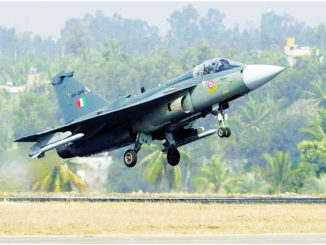
New Delhi (TIP): The PM Narendra Modi-led Cabinet Committee on Security (CCS) on Wednesday cleared indigenous defence deal worth Rs 48,000 crores to strengthen Indian Air Force’s fleet of LCA-Tejas fighter jets, Defence Minister Rajnath Singh said. This will be the biggest deal ever in the indigenous military aviation sector.
Defence Minister Rajnath Singh confirmed the development on Twitter, saying “the CCS chaired by the PM today approved the largest indigenous defence procurement deal worth about Rs 48,000 crore to strengthen IAF’s fleet of homegrown fighter jet ‘LCA-Tejas’. This deal will be a game-changer for self-reliance in Indian defence manufacturing.” The defence minister said Tejas is going to be the backbone of the fighter fleet of the Indian Air Force in years to come. Around three years back, the IAF had issued an initial tender for procurement of 83 Tejas aircraft, a four-and-half generation combat jet.
“LCA-Tejas incorporates a large number of new technologies many of which were never attempted in India. The indigenous content of LCA-Tejas is 50 percent in Mk1A variant which will be enhanced to 60 percent,’ Singh said.The defence minister said that aircraft maker Hindustan Aeronautics Ltd (HAL) has already set up second-line manufacturing facilities at its Nasik and Bengaluru divisions.
“Equipped with the augmented infrastructure the HAL will steer LCA-Mk1A production for timely deliveries to the IAF,” he said.
Singh said the Tejas programme would act as a catalyst for transforming the Indian aerospace manufacturing ecosystem into a vibrant, self-sustaining one. “I thank the Prime Minister Shri @narendramodi for this historic decision taken by the CCS today, ” the defence minister said.
Tejas More Advanced than China-Pakistan’s
JF-17 Fighter Jets, Better Equipped: IAF chief
Air Chief Marshal RKS Bhadauria on Thursday, Jan 14, said the indigenously-developed Light Combat Aircraft (LCA) Tejas is far better and more advanced than China’s JF-17 fighter aircraft manufactured by Pakistan’s aeronautical company, adding that the newly added jets will be equipped for Balakot-type airstrikes.
Welcoming the government’s approval to the Rs 48,000 crore deal to procure 83 LCAs from the Hindustan Aeronautics Limited (HAL), the Chief of Air Staff in an interview to ANI said, “Indian aircraft Tejas is far better and more advanced than the Chinese and Pakistan joint venture JF-17 fighter. It will have top of the line Beyond Visual Range (BVR) class of air-to-air missile Astra, and other sensors and weapons.”
On being asked on the aircraft’s capabilities in carrying out Balakot-type airstrikes, the Air Chief Marshal said, “In terms of strike capability, it will have the capability of a standoff weapon which will be even beyond the capability we used that time.”
The Tejas Mk-1A will be equipped with active electronically scanned array radar, beyond visual range missile, electronic warfare suite and air-to-air refuelling and would be a potent platform to meet the operational requirements of the IAF, according to official statements. The 83 aircraft will look after four squadrons, he said to question on the fighter aircraft’s deployment in the IAF. “The current strength of the two squadron plan of LCA will now increase to six. Essentially the deployment will be on the frontline,” he added.