Tag: ICC

  • Crimes against humanity and an obtuse Indian stance

    Crimes against humanity and an obtuse Indian stance

    India’s response to a ‘crimes against humanity’ treaty aligns with its aversion to the Rome Statute and the International Criminal Court

    “India advocates for the inclusion of ‘terrorism’ as an act amounting to CAH. India’s response to a CAH treaty aligns with its aversion to the Rome Statute and the ICC. For the last five years, since 2019, India has consistently argued for an ‘in-depth study’ and thorough discussion on the need for a dedicated treaty. India’s stance at the UNGA reflects its skepticism that a CAH treaty might duplicate the already existing regime under the Rome Statute. Further, India takes issue with the exclusion of ‘terror-related acts’ and the ‘use of nuclear weapons’ from the definition of CAH in the proposed treaty. Most importantly, reiterating that it is not a party to the Rome Statute, India has stressed at the UNGA that national legislations and the jurisdiction of national courts are more appropriate fora for dealing with CAH and other international crimes.”

    By Varsha Singh

    On December 4, 2024, the UN General Assembly (UNGA) adopted a resolution approving the text of a proposed treaty governing the prevention and punishment of crimes against humanity (CAH treaty). This marks the beginning of the negotiation process among states for the conclusion of a CAH treaty. This resolution comes five years after the International Law Commission submitted the draft text of the CAH treaty to the Sixth Committee — the primary forum for considering legal questions in the UNGA. This development is a landmark in the international community’s quest to combat impunity for CAH.

    There is a gap in accountability
    Alongside genocide and war crimes, CAH are among the grave international crimes which the International Criminal Court (ICC), established under the Rome Statute, seeks to punish. Importantly, genocide and war crimes are also governed by dedicated treaties, i.e., the Genocide Convention of 1948 and the Geneva Conventions of 1949, respectively. However, CAH are governed only under the Rome Statute, which includes specific criminal acts such as murder, extermination, enslavement, deportation, torture, imprisonment, and rape committed as part of a ‘widespread or systematic attack directed against any civilian population, with knowledge of the attack’. CAH were first codified in the 1945 London Charter establishing the Nuremberg Tribunal to investigate and prosecute the crimes committed in connection with the Second World War, and later in the statutes of the International Criminal Tribunal for Yugoslavia, and Rwanda. However, there is no dedicated treaty for CAH yet, creating a gap in terms of accountability in the legal architecture of international criminal justice. There are three reasons justifying the need for a CAH treaty.

    First, the jurisdiction of the ICC covers a limited number of states, making it challenging to punish perpetrators of CAH in non-member states. Second, the Rome Statute and the ICC only address individual criminal responsibility. A dedicated CAH treaty would allow for holding states accountable under international law for their failure to prevent the commission of CAH, as is the case with the Genocide Convention of 1948. For instance, in 2019, The Gambia filed a case before the International Court of Justice (ICJ) against Myanmar for alleged violations of the Genocide Convention against the ethnic Rohingya population. A dedicated CAH treaty would create an obligation for state parties to adopt administrative, legislative, or judicial measures to prevent the commission of CAH. Failure to meet this obligation could become the basis for the ICJ’s jurisdiction if the CAH treaty so provides. Third, a CAH treaty presents an opportunity to enlarge the scope of CAH to include, as suggested by various states in the Sixth Committee, starvation of civilian populations, gender apartheid, forced pregnancy, the use of nuclear weapons, terrorism, exploitation of natural resources, and crimes against indigenous populations.

    India’s stand
    India is not a party to the Rome Statute and has consistently objected to the ICC’s jurisdiction over issues such as the powers of the ICC prosecutor, the role of the UN Security Council under the Rome Statute, and the non-inclusion of ‘use of nuclear weapons and other weapons of mass destruction’ as a war crime. Further, India has argued that crimes committed only during armed conflicts — and not those committed during peacetime — should be considered CAH. Moreover, India does not favor the inclusion of ‘enforced disappearance’ as an act that can constitute CAH. Instead, India advocates for the inclusion of ‘terrorism’ as an act amounting to CAH. India’s response to a CAH treaty aligns with its aversion to the Rome Statute and the ICC. For the last five years, since 2019, India has consistently argued for an ‘in-depth study’ and thorough discussion on the need for a dedicated treaty. India’s stance at the UNGA reflects its skepticism that a CAH treaty might duplicate the already existing regime under the Rome Statute. Further, India takes issue with the exclusion of ‘terror-related acts’ and the ‘use of nuclear weapons’ from the definition of CAH in the proposed treaty. Most importantly, reiterating that it is not a party to the Rome Statute, India has stressed at the UNGA that national legislations and the jurisdiction of national courts are more appropriate fora for dealing with CAH and other international crimes.

    Lead the way
    Currently, India does not have domestic legislation prohibiting international crimes. In 2018, Justice S. Muralidhar of the Delhi High Court in State vs Sajjan Kumar observed that ‘neither crimes against humanity nor genocide have been made part of India’s criminal law, a lacuna that needs to be addressed urgently’. Nonetheless, there is little or no debate on the need for such laws in the domestic legal and policy spaces. The recent amendments to the criminal law were a missed opportunity to include these crimes in the penal law. This is inconsistent with India’s own insistence on the primacy of national and territorial jurisdiction for dealing with CAH. India should incorporate CAH and other international crimes into its domestic law, even if it is not a party to the Rome Statute, and lead the way in ending impunity for grave human rights violations — a role that befits a true Vishwaguru.

    (Varsha Singh is Assistant Professor at the National Law University, Jodhpur, Rajasthan)

  • ICC announces equal prize money for men and women at its global events

    The ICC on July 13 announced equal prize money for men’s and women’s teams at its global events in a bid to bring in pay parity, ushering in a new era in world cricket. In the last 50 over men’s World Cup, champions England got USD 4 million and runners-up New Zealand received USD 2 million.
    “The International Cricket Council (ICC) today announced equal prize money for men’s and women’s teams at ICC events. The decision was taken at the ICC Annual Conference in Durban, South Africa and ensures the ICC Board fulfilled its commitment to reaching prize money equity by 2030 well ahead of schedule,” the ICC said in a statement. “Teams will now receive equal prize money for the equivalent finishing position at comparable events as well as the same amount for winning a match at those events,” it further stated.
    ICC Chair Greg Barclay said: “This is a significant moment in the history of our sport, and I am delighted that men’s and women’s cricketers competing at ICC global events will now be rewarded equally.
    “Since 2017 we have increased prize money at women’s events every year with a clear focus on reaching equal prize money and from here on in, winning the ICC Women’s Cricket World Cup will carry the same prize money as winning the ICC Men’s Cricket World Cup and the same for T20 World Cups and U19s too.” Barclay added, “Cricket is genuinely a sport for all and this decision from the ICC Board reinforces that and enables us to celebrate and value every single player’s contribution to the game equally.” BCCI secretary Jay Shah played an active role as the head of Financial & Commercial Affairs Committee (F&CA) in formulating the policy having done the same in his own board last year.
    “I thank the fellow Board members for their support in helping achieve this important endeavour. Let’s work towards a future where cricket continues to thrive across the globe.”
    Source: PTI

  • Plan is to stage entire 2023 ODI World Cup in India: ICC source

    Plan is to stage entire 2023 ODI World Cup in India: ICC source

    Mumbai (TIP)- While the formal announcement of the dates and venues for this year’s ODI World Cup in India is awaited, the International Cricket Council (ICC) has denied media reports that Pakistan will play their matches at a neutral venue. “As far as we are concerned, everything is full speed for a full event in India later this year,” an ICC official said.
    A final word may yet be heard on the matter.
    BCCI has had talks with the Pakistan board (PCB) over adopting a “hybrid model” for the Asia Cup in September – staging the tournament in Pakistan but holding the India games in neutral venues. Reports in the Pakistan media say the same model will apply for the World Cup and Pakistan’s matches will be relocated to a neutral venue. Bangladesh is being spoken of as a possible host nation for these matches.
    Some media reports have even quoted Wasim Khan, ICC GM and ex-CEO of PCB, as saying that Pakistan’s World Cup matches will be played at a neutral venue. ICC has distanced itself from any such comments.
    While negotiations may be on for the Asia Cup to stay in Pakistan with only the India games and the final to be moved out, BCCI are unwilling to let PCB use it to bargain for moving World Cup matches out of India.
    The World Cup will be played in the same format as the last edition in England in 2019. All 10 teams played against the other once before the semi-finalists were decided. That would mean nine Pakistan matches are to be hosted in India.
    BCCI’s long-standing position has been that they won’t be able to play cricket in Pakistan without government permission. Pakistan is known to be putting forth the same argument at the ICC forum.
    Source: HT

  • Ashwin rises to 2nd spot in ICC Test bowlers’ rankings

    Ashwin rises to 2nd spot in ICC Test bowlers’ rankings

    Ashwin rises to 2nd spot in ICC Test bowlers’ rankings

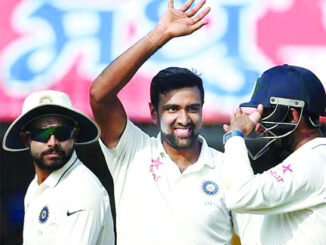
    Dubai (TIP)- India off-spinner Ravichandran Ashwin on Wednesday, February 15, jumped to the second spot in the ICC Men’s Test Bowlers Rankings following his eight-wicket show against Australia in the opening Test in Nagpur.
    Left-arm spinner Ravindra Jadeja, who made a successful comeback after almost five months due to a knee injury, has moved up to the 16th position, courtesy his player-of-the-match winning effort in the Border-Gavaskar Trophy series-opener.
    The spin duo haunted Australia in the first Test by sharing 15 wickets between them as India won by an innings and 132 runs inside three days. Ashwin ensured India wrapped up a stunning victory before tea on the third day, as the veteran off-spinner took 5/37 in the second innings to go with 3/42 earlier in the match. The 36-year-old is 21 rating points behind Australia captain Pat Cummins and is in contention to return to the No 1 ranking for the first time since 2017. While Ashwin stepped up in what turned out to be the last session of the Test, Jadeja did the damage on the first day with 5/47, including the prized wickets of Steve Smith and Marnus Labuschagne.
    Jadeja then took 2/34 in the second Australian innings. Australia were bowled out for just 91.
    Among other Indian bowlers, pacer Jasprit Bumrah, who too has been out of action since September last due to a lower back stress fracture, is placed fifth.
    In the Test batting chart, India captain Rohit Sharma has been rewarded for his match-defining ton in Nagpur. He gained two spots to be at number eight. Rohit came to the crease after Australia were all out for 177 in their first innings, then made the wicket look all-but tame with an assured 120 that set the tone for the rest of the match.
    Wicket-keeper Rishabh Pant, who will be out of action for an indefinite period following his horrific car accident, is the other Indian batter in top 10. He is placed seventh. In contrast, Australian openers David Warner and Usman Khawaja have paid the price for being dismissed cheaply twice.
    Warner has fallen six places to 20th after his scores of 1 and 10, while Khawaja has dropped two spots to 10th after making only 1 and 5 in the first Test.Australian duo of Marnus Labuschagne and Steve Smith occupy the top two positions with Pakistan captain Babar Azam in the third spot. India all-rounder Axar Patel has leaped six places to seventh in Test all-rounder rankings after coming to the crease at a tense 240 for 7. He hit a patient 84 for his highest score in the format.

  • ICC Women’s World Cup: Top-order woes again as India lose to England by 4 wickets

    ICC Women’s World Cup: Top-order woes again as India lose to England by 4 wickets

    Mount Maunganui (TIP)-An inconsistent India paid the price for shoddy batting as England infused a new life into their own title defence with a four-wicket win in a league stage game of the ICC Women’s World Cup here today. Inconsistency returned to haunt the Indian batters again as they were bundled out for a meagre 134 by England, who chased down the target in 31.2 overs to record their first win after a hat-trick of defeats. India could get some runs on the board thanks to the previous game’s centurion Smriti Mandhana, who top-scored for the side with a 35-run knock while wicketkeeper-batter Richa Ghosh made 33.

    With wickets falling every now and then, England bowled out India in 36.2 overs. Chasing the target, England made a stuttering start, losing both their openers — Danni Wyatt (1) and Tammy Beaumont (1) — cheaply with the scoreboard reading 4/2 in the third over. Wyatt was first to depart in the second over, courtesy a sensational diving catch by Sneh Rana off medium-pacer Meghna Singh (3/26).

    Veteran pace bowler Jhulan Goswami, the highest wicket-taker in the history of the tournament, then trapped Beaumont in the second over after India went for a review. It was Goswami’s 250th wicket in ODIs.

    Knight’s day

    England skipper Heather Knight (53 not out) and Nat Sciver (45 off 46) then steadied England’s innings, playing cautiously to reach 34/2 in 10 overs. While Knight anchored the chase, Sciver took the attack to the Indian bowlers, hitting as many as eight boundaries with some exquisite pull shots. With just 135 required for a win, what England needed was a decent partnership after the early blows, and Knight and Sciver provided that by sharing 65 runs for the third wicket.

    Sciver’s innings, however, was cut short by Pooja Vastrakar. It was a soft dismissal and against the run of play as Sciver spooned a length ball to Goswami while looking to go to the leg side.

    Amy Jones (10) then stitched a 33-run stand for the next wicket with Knight before the former fell to a stunning backward-running catch by India vice-captain Harmanpreet Kaur at mid-on off Rajeshwari Gayakwad’s bowling. By then it was all over for India as England needed just 32 runs more. The Indians picked up two more wickets in the 30th over before England completed the formality. Brief Scores: India: 134 all out in 36.2 overs (Mandhana 35; Dean 4/23); England: 136/6 in 31.2 overs (Knight*; Singh 3/26).

    Source: PTI

  • Ravindra Jadeja is No. 1 Test all-rounder in world

    Ravindra Jadeja is No. 1 Test all-rounder in world

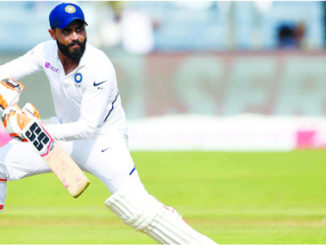
    Dubai (TIP)- India’s Ravindra Jadeja climbed to the top spot in the ICC Test rankings for all-rounders today after his match-winning performance against Sri Lanka in the opening Test in Mohali. “Ravindra Jadeja’s performance at India’s recent Test win against Sri Lanka in Mohali has catapulted him to the No. 1 position in the MRF Tyres ICC Men’s Test Player Rankings,” the ICC said in a statement. His unbeaten 175 lifted him up to 17 places from 54th to 37th with the bat and he added nine wickets to move up to 17th with the ball. His all-round contribution was enough for him to regain the top all-rounder spot from Jason Holder, who had held the position since February 2021. Jadeja’s only previous time on top was in August 2017, when he spent a week at No. 1. Jadeja was named the Player of the Match for his show against Sri Lanka in Mohali, where India triumphed under three days by an innings and 222 runs. In the same list, Ravichandran Ashwin dropped a rung to third while Axar Patel was the next best Indian at 14th, after going down two positions. Patel did not play the Mohali Test due to an injury. Among the batters, Virat Kohli rose two spots to be fifth, followed by skipper Rohit Sharma. Rishabh Pant, who impressed with an explosive 96-run knock, entered the top-10 at 10th after gaining one spot. Australian Marnus Labuschagne occupied the top spot.

  • ICC confirms new WTC points system: 12 for win, 4 for draw, 6 for tie

    The ICC on Wednesday, JUly 14,officially confirmed that teams will be awarded standardised 12 points for a win, four for a draw and six for a tie during the second World Test Championship cycle which kicks off with the five-match series between India and England in August.

    The ICC further said that percentage of points won will be used to determine standings in the 2021-23 cycle.

    Earlier, each Test series carried a value of 120 points which led to certain inequality in the table as a team winning a Test in a two-match series got 60 points compared to five-game series where a Test win is valued at 24 points.

    PTI had last month reported that ICC was set to introduce the new standardised points system for the second WTC cycle soon.

    ICC Acting Chief Executive Geoff Allardice said the changes were made to simplify the points system while taking learnings from the disruption last year.

    “We received feedback that the previous points system needed to be simplified. The Cricket Committee took this into consideration when proposing a new, standardized points system for each match. It maintained the principle of ensuring that all matches in a WTC series count towards a team’s standing, while accommodating series varying in length between two Tests and five Tests,” Allardice said in an ICC statement.