Tag: ICJ

  • ICJ opens hearings on Israeli military’s incursion into Rafah

    ICJ opens hearings on Israeli military’s incursion into Rafah

    It is the fourth time South Africa has asked the International Court of Justice for emergency measures alleging that Israel’s military action in its war with Hamas in Gaza amounts to genocide

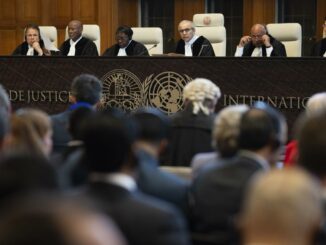
    THE HAGUE (TIP): The United Nations’ top court on May 16 opened two days of hearings into a request from South Africa to press Israel to halt its military operation in the southern Gaza city of Rafah, where more than half of Gaza’s population has sought shelter, says an AP report from The Hague.

    It is the fourth time South Africa has asked the International Court of Justice for emergency measures since the nation launched proceedings alleging that Israel’s military action in its war with Hamas in Gaza amounts to genocide. “The sitting is open,” said ICJ President Nawaf Salam.

    According to the latest request, the previous preliminary orders by The Hague-based court were not sufficient to address “a brutal military attack on the sole remaining refuge for the people of Gaza.”

    Israel has portrayed Rafah as the last stronghold of the militant group, brushing off warnings from the United States and other allies that any major operation there would be catastrophic for civilians.

    South Africa has asked the court to order Israel to withdraw from Rafah; to take measures to ensure unimpeded access for U.N. officials, humanitarian organizations and journalists to the Gaza Strip; and to report back within one week on how it is meeting these demands.

    During hearings earlier this year, Israel strongly denied committing genocide in Gaza and said it does all it can to spare civilians and is only targeting Hamas militants. It says Hamas’ tactic of embedding in civilian areas makes it difficult to avoid civilian casualties.

    In January, judges ordered Israel to do all it can to prevent death, destruction and any acts of genocide in Gaza, but the panel stopped short of ordering an end to the military offensive that has laid waste to the Palestinian enclave.

    In a second order in March, the court said Israel must take measures to improve the humanitarian situation in Gaza, including opening more land crossings to allow food, water, fuel and other supplies to enter.

    Most of Gaza’s population of 2.3 million people have been displaced since fighting began.

    The war began with a Hamas attack on southern Israel on Oct. 7 in which Palestinian militants killed around 1,200 people and took about 250 hostages. Gaza’s Health Ministry says over 35,000 Palestinians have been killed in the war, without distinguishing between civilians and combatants in its count.

    South Africa initiated proceedings in December 2023 and sees the legal campaign as rooted in issues central to its identity. Its governing party, the African National Congress, has long compared Israel’s policies in Gaza and the occupied West Bank to its own history under the apartheid regime of white minority rule, which restricted most Blacks to “homelands.” Apartheid ended in 1994.

    On Sunday, Egypt announced it plans to join the case. The Ministry of Foreign Affairs said Israeli military actions “constitute a flagrant violation of international law, humanitarian law, and the Fourth Geneva Convention of 1949 regarding the protection of civilians during wartime.” Several countries have also indicated they plan to intervene, but so far only Libya, Nicaragua and Colombia have filed formal requests to do so.
    (Source: AP)

  • Indian judge votes against Russia in world court for invading Ukraine

    Indian judge votes against Russia in world court for invading Ukraine

    WASHINGTON, D.C. (TIP): The United States on Wednesday, March 16,  welcomed an International Court of Justice order that asked Russia to immediately suspend its military operations in Ukraine. Describing it as a significant ruling, State Department Spokesperson Ned Price said that the ICJ “clearly and unequivocally” ordered Russia to immediately suspend its military operations. “The Russian Federation shall immediately suspend military operations that it commenced on 24 February on the territory of Ukraine,” presiding judge Joan Donoghue told the International Court of Justice, pending the final decision in the case.

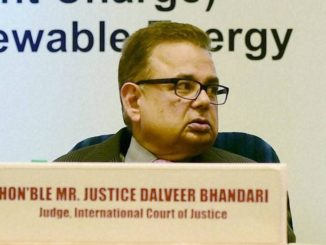
    India’s judge, Justice Dalveer Bhandari, voted against Russia. The court order was supported by 13 judges while two voted against it. This includes Vice-President Kirill Gevorgian from Russia and Judge Xue Hanqin from China.

    “We welcome the court order and call on the Russian Federation to comply with the order, immediately cease its military operations in Ukraine, and to establish unhindered humanitarian access in Ukraine,” Price said. In its ruling, the court – which plays a vital role in peaceful settlement of disputes under the UN Charter – stressed the need for States to act in conformity with their obligations under international law, including the laws of war, Price said. “And the Court expressed deep concern about the extreme vulnerability of the civilian population of Ukraine, the numerous civilian deaths and injuries that have resulted from the Kremlin’s actions, and the significant material damage, including the destruction of buildings and infrastructure,” he said.

    The Court further noted its profound concern with the Russian government’s use of force and emphasized the Court’s acute awareness of “the extent of the human tragedy that is taking place in Ukraine as well as the “continuing loss of life and human suffering”.

    The Court also observed that it did not possess any evidence substantiating Russia’s claims that genocide had been committed by Ukraine in the Donbas region, he said. Judge Xue Hanqin from China opposed the order.

    Ukraine’s contention that the Russian Federation’s allegation of genocide against Ukraine is just “an excuse for Russia’s unlawful aggression” raises doubt that this is a genuine case about genocide,” she wrote in her dissent note. “It appears that the acts complained of by Ukraine namely Russia’s recognition of the independence of the Luhansk and Donetsk regions of Ukraine and Russia’s military operations in Ukraine cannot be directly addressed by the interpretation and application of the provisions of the Genocide Convention, as the issues they have raised are concerned with the questions of recognition and use of force in international law,” she said. Meanwhile, India’s   Ministry of External Affairs on Thursday, March 17,  said judges at the International Court of Justice vote in their individual capacity, a day after Indian judge Dalveer Bhandari voted against Russia at the United Nations’ highest court.

    (With inputs from PTI)

  • The Kulbhushan Jadhav Case at the International Court of Justice

    The Kulbhushan Jadhav Case at the International Court of Justice

    By Ambassador Asoke Kumar Mukerji

    In March 2016, Kulbhushan Sudhir Jadhav, an Indian national, was detained by Pakistan, accused of performing acts of espionage and terrorism on behalf of India. In April 2017, he was sentenced to death by a military court in Pakistan. On 8 May 2017, India filed a case against Pakistan at the International Court of Justice or ICJ in The Hague, alleging violations by Pakistan of its obligations under the Vienna Convention on Consular Relations of 1963. Article 36 of the Convention specifically required Pakistan to inform India, “without delay”, of the detention of Kulbhushan Jadhav, inform Kulbhushan Jadhav of his rights, and allow Indian consular officials access to Kulbhushan Jadhav.

    Pakistan rejected India’s claims by using a variety of legal arguments during the hearing of the case at the ICJ. On 17 July 2019, the ICJ delivered its judgement, stating that the “Court finds that the Islamic Republic of Pakistan, in the matter of the detention and trial of an Indian national, Mr. Kulbhushan Sudhir Jadhav, has acted in breach of the obligations incumbent on it under Article 36 of the Vienna Convention on Consular Relations.”

    In the landmark judgement, the ICJ unanimously asserted that it had jurisdiction over the case, since both India and Pakistan were signatories of the Vienna Convention. The ICJ rejected Pakistan’s efforts to divert the case to either an arbitral tribunal or a conciliation commission, holding that India had the right to approach the ICJ directly in this matter. The ICJ rejected Pakistan’s argument that the Vienna Convention did not apply to cases of persons detained for alleged espionage. The Court found that Pakistan, by not informing India for three weeks of Kulbhushan Jadhav’s arrest, and not providing India consular access, had violated its obligations under the Vienna Convention which required it to do so “without delay”. The ICJ rejected Pakistan’s attempt to apply its obligations under Article 36 of the Vienna Convention in a conditional manner, dependent on India’s actions on other issues.

    The heart of the ICJ judgment is contained in Section 6, which recommends ways to remedy this violation of the Vienna Convention by Pakistan. Calling Pakistan’s denial of its obligations to uphold Kulbhushan Jadhav’s rights, including the right to consular access, “internationally wrongful acts of a continuing character”, the ICJ has asked Pakistan to comply with both obligations. It has opined that the “appropriate remedy in this case to be effective review and reconsideration of the conviction and sentence of Mr. Jadhav”, which “must be performed unconditionally” by Pakistan. This would include Pakistan “enacting appropriate legislation” if needed to ensure justice. Till then, the ICJ has ordered the “continued stay of execution” as an “indispensable condition for the effective review and reconsideration of the conviction and sentence of Mr. Jadhav.”

    As Prime Minister Narendra Modi said after the judgment, “Truth and justice have prevailed. Congratulations to the ICJ for a verdict based on extensive study of facts. I am sure Kulbhushan Jadhav will get justice. Our Government will always work for the safety and welfare of every Indian.”

    The ICJ judgement is significant for at least three reasons. First, the judgement is binding on “the parties and in respect of that particular case” according to Article 59 of the ICJ Statute. Second, the judgementvindicates India’s consistent belief and advocacy in using the rule of law to ensure justice for her citizens, and the peaceful settlement of disputes between states. Third, implementing the judgement will act as a litmus test for the principle of international cooperation, on which the current multilateral system, including the rule of law, is founded.

    In the wider framework, the ICJ judgment embellishes India’s track record since 1947 of giving substance to Article 13.1 of the UN Charter, which calls for “the progressive development of international law and its codification”. The provisions of the Vienna Convention on Consular Relationshave been significantly amplified by this case.

    (The Commentary was written for All India Radio)

    (The author is a former Permanent Representative of India to the United Nations, Distinguished Fellow, Vivekananda International Foundation, New Delhi)