Tag: India-China relationship

  • Rahul Gandhi speaks his mind on his visit to the US

    Rahul Gandhi in US

    Rahul Gandhi gets a warm reception on arrival at the San Francisco airport on May 30, 2023. Seen among others is IOC USA President Mohinder Gilzian in white turban (Photo / PTI

    I.S. Saluja

    NEW YORK (TIP): On his first visit abroad after being disqualified from the Lok Sabha, Rahul Gandhi spoke candidly on a number of national and international issues at a number of events which included a National Press Club appearance in Washington, D.C. , meetings with students at universities, and with the public in California and Washington D.C.
    On a six-day visit to the US, Rahul Gandhi was in California on May 30 and 31 on the first leg of his tour where he spoke at the ‘Mohabbat Ki Dukaan’ event organized by Indian Overseas Congress USA in Santa Clara on Tuesday, May 30.
    On May 31, he held interactions with Silicon Valley AI experts and startup entrepreneurs.
    Rahul Gandhi was in Washington, D.C. on June 1 and 2 where he appeared at a number of events including the National Press Club appearance , held meetings with students, business and trade representatives, the Indian Diaspora organizations and with US lawmakers.
    He would arrive in New York on June 3 on the last leg of his tour where the Indian Overseas Congress USA has planned a huge public meeting at the Javits Center in Manhattan on Sunday, June 4, and before that, on June 3, a dinner has been organized where Rahul Gandhi will meet people in an informal setting.
    During his stay in New York, he will be meeting with representatives of various organizations and have interactions with a number of delegations . He will also speak to students.

    Indian Overseas Congress chairperson Sam Pitroda said Gandhi’s visit is aimed at promoting shared values and a vision of “real democracy”.

    “The purpose of his (Gandhi’s) trip is to connect, interact and begin a new conversation with various individuals, institutions and media, including the Indian diaspora that is growing in numbers in the United States and abroad to promote the shared values and vision of the real democracy with a focus on freedom, inclusion, sustainability, justice, peace and opportunities world over,” Pitroda said in a statement on Sunday, May 28. The Indian Panorama brings you below the media coverage of Rahul Gandhi’s visit to the US from May 30 to June 2, 2023.

    BJP can be defeated if Opposition is ‘aligned properly’: Rahul Gandhi

    @RahulGandhi Interacts with activists, academics and civil society at University of California, Santa Cruz (Twitter photo)

    SANTA CLARA, CA (TIP): The ruling BJP can be defeated if the Opposition is “aligned properly” and the Congress party is working towards it and it is “coming along very nicely”, Rahul Gandhi has told Indian Americans here, citing his party’s emphatic victory in the recent assembly elections in Karnataka.

    Responding to questions from the moderator and the audiences at an event at the Silicon Valley Campus of the University of California in Santa Cruz on Tuesday, Gandhi said he can clearly see “vulnerabilities” in the BJP.

    “As a political entrepreneur, I can clearly see vulnerabilities in the BJP… The BJP can be defeated if the Opposition is aligned properly,” he said.

    “If you look at the Karnataka elections, the general sense is that the Congress Party fought the BJP and defeated the BJP. But what is not well understood is the mechanics that we used,” he said.

    The Congress party used a completely different approach to fighting an election and building a narrative, Gandhi said, adding that elements of what happened in Karnataka came out of the ‘Bharat Jodo Yatra’.

    In the May 10 elections to the 224-member Karnataka Assembly, the Congress won 135 seats, while incumbent BJP and the former prime minister H D Deve Gowda-led Janata Dal (Secular) got 66 and 19, respectively.

    Gandhi said in the Karnataka elections, the BJP spent 10 times more money than the Congress party.

    He said the country needed an alternative vision to defeat the ruling Bharatiya Janata Party (BJP), in addition to having a united Opposition in the 2024 general elections.

    “On the matter of opposition unity, we are working towards it and it is coming along very nicely. But I think in order to defeat the BJP, you need more than just opposition unity. Just opposition unity, in my opinion, is not going to be enough to do the job. I think you need an alternative vision to the BJP,” he said.

    “Part of Bharat Jodo Yatra was the first step in proposing such a vision. It’s the vision that all opposition parties are aligned with. No opposition party would disagree with the idea of the Bharat Jodo Yatra,” he said.

    Bharat Jodo Yatra (Unite India March) was a Gandhi-led mass movement aimed at uniting India. The yatra began on September 7 from Kanyakumari, passed through 12 states and culminated in Jammu and Kashmir on January 31. During the course of the yatra, Gandhi, 52, addressed 12 public meetings, over 100 corner meetings and 13 press conferences. He had over 275 planned walking interactions and more than 100 sitting interactions.

    “So, I think bringing the opposition together is important, but also aligning the opposition and making the people of India understand that there is not just a group of opposition parties that have combined but a proposed way forward for the country. And we’re working on those things,” Gandhi said.

    The ex-Wayanad MP said it is the president of the Congress party who will decide the prime ministerial candidate.

    “We believe that everybody in India, regardless of who they are, whichever part of the society they come from, they should have a voice that voice should be respected, to be listened to be appreciated. And I think that voice is an asset,” he said.

    In his address, Gandhi also took a dig at the ruling BJP government, saying it is “threatening” the people and “misusing” the country’s agencies.

    “The BJP is threatening people and misusing government agencies. The Bharat Jodo Yatra started because all the instruments that we needed to connect with the people were controlled by the BJP-RSS,” he said.

    “We were also finding that in some way, it had become quite difficult to act politically. And that’s why we decided to walk from the southernmost tip of India to Srinagar,” he said.

    Gandhi said the yatra carried the spirit of affection, respect and humility.

    “If one studies history, it can be seen that all spiritual leaders — including Guru Nanak Dev ji, Guru Basavanna ji, Narayana Guru ji — united the nation in a similar way,” he said.

    Gandhi said India is not what is being shown in the media which likes to promote a political narrative that is far from reality, asserting that there is a “huge distortion”.

    “It was very clear to me in the Yatra that it’s in the media’s interest to project these things, it helps the BJP. So, don’t think that everything you see in the media is the truth,” he said.

    “India is not what the media shows. The media likes to show a particular narrative. It likes to promote a political narrative that is actually not what is going on in India,” he said.

    The Congress leader arrived here on Tuesday, May 30 on a three-city US tour during which he will interact with the Indian diaspora and meet American lawmakers.

    He had a first-hand experience of the American immigration system as he had to wait for about two hours along with his other co-passengers on the Air India flight because of the common shortage of staff at the US airports.

    People were seen taking selfies with him and asking him questions. He was seen interacting and mingling with other traveler’s at the San Francisco airport.
    (Source: PTI)

    Rahul Gandhi says PM Modi thinks he knows more than God, calls him ‘specimen’

    SANTA CLARA, CA (TIP): There are people in India who think they know more than God and Prime Minister Narendra Modi is “one such specimen”, Congress leader Rahul Gandhi has said.

    Speaking at the ‘Mohabbat Ki Dukaan’ event organized by Indian Overseas Congress USA in Santa Clara in the US state of California on Tuesday, May 30, Gandhi said these people are “absolutely convinced” that they know everything and can explain history to historians, science to scientists and warfare to the army.

    “The world is too big and complicated for any person to know everything. That is the disease…There is a group of people in India who are absolutely convinced they know everything. They think they know even more than God.

    “They can sit with God and explain to him what’s going on. And of course, our prime minister is one such specimen. If you sat Modiji with God, he would explain to God how the universe works and God will get confused about what have I created,” he said, evoking peals of laughter from hundreds of his Indian American supporters.

    “They think they can explain history to historians, science to scientists and warfare to the army. But at the core of it is mediocrity. They’re not ready to listen!” he said.

    Gandhi’s event was attended by community members not only in Silicon Valley but also from Los Angeles and Canada. Gandhi told the Indian Americans that the idea of India was under attack and is being challenged.

    He applauded the Indian Americans for holding up the Indian flag in America, showing the American people what it means to be an Indian by respecting their culture and learning from them while also allowing the Americans to learn from them.

    “You make us all proud. When we think of our country, you are all our ambassadors. When America says Indian people are extremely intelligent. Indian people are masters of IT, Indian people are respectful. All these ideas that have come, they’ve come because of you and because of your actions and your behaviors,” he said.
    (Source: PTI)

    Rahul Gandhi says his disqualification from Lok Sabha has given him huge opportunity

    Congress @INCIndia
    Scenes from @RahulGandhi ji’s interaction with the Indian diaspora in San Francisco, California, in the United States.
    Twitter photo

    SAN FRANCISCO (TIP): Congress leader Rahul Gandhi has said that he did not imagine his disqualification from Lok Sabha was possible when he joined politics but asserted that it has given him a “huge opportunity” to serve the people.

    Gandhi, who is in the US for a three-city US tour, made the remarks on Wednesday, June 31 night in response to a series of questions from Indian students at the prestigious Stanford University Campus in California.

    The Wayanad (Kerala) Member of Parliament was disqualified from Lok Sabha earlier this year after he was convicted by a Surat court in a 2019 criminal defamation case over his “Modi surname” remark.

    In his remarks, Gandhi said that when he joined politics in 2000, he never imagined this is what he would go through. What he sees is going on now is way outside anything that he had thought when he joined politics.

    Referring to his disqualification from Lok Sabha as a Member of Parliament, Gandhi, 52, said he didn’t imagine that something like this was possible.

    “But then I think it’s actually given me a huge opportunity. Probably much bigger than the opportunity I would have. That’s just the way politics works,” he said.

    “I think the drama started really, about six months ago. We were struggling. The entire opposition is struggling in India. Huge financial dominance. Institutional capture. We’re struggling to fight the democratic fight in our country,” he said, adding that at this point in time, he decided to go for the ‘Bharat Jodo Yatra’.

    “I am very clear, our fight is ours fight,” he said. “But there is a group of young students from India here. I want to have a relationship with them and want to talk to them. It’s my right to do it,” he said during his interaction with Indian students and academicians of Indian origin at the University here.

    He also emphasized in his frequent foreign trips like this, he is not seeking support from anybody.

    “I don’t understand why the prime minister doesn’t come here and do it,” Gandhi asked amidst applause from the audience who had packed the entire auditorium at Stanford.

    The moderator said that the Prime Minister is welcome to come to Stanford anytime and interact with the students and academicians.

    Some of the students were denied entry as the auditorium was packed. Students started queuing up two hours before the event started. In the last one and a half years, several Indian ministers have interacted with Indian students.
    (Source: PTI)

    Rahul Gandhi holds interactions with Silicon Valley AI experts, startup entrepreneurs

    SUNNYWALE, CA (TIP): Congress leader Rahul Gandhi Wednesday, May 31 spent the first half of his day with Silicon Valley-based startup entrepreneurs, known for doing path-breaking work in the field of Artificial Intelligence and cutting-edge technologies.Sitting in the front row of the Plug and Play auditorium along with Indian Overseas Congress chairperson Sam Pitroda and some other key aides who have been travelling with him from India, Gandhi was seen engrossed in the panel discussion of experts on various aspects of artificial intelligence, big data, machine learning and their implications on mankind in general and on issues like governance, social welfare measures and also disinformation and misinformation.

    Based out of Sunnyvale in California, the Plug and Play Tech Centre is one of the largest incubators of startups. According to its CEO and Founder Saeed Amidi, more than 50 per cent of the startups founder at Plug and Play have been Indians or Indian Americans. Amidi told PTI after the event that Gandhi has shown a deep understanding of the IT sector and his knowledge of the latest and cutting edge technologies are quite impressive.

    Participating in a fireside chat with Amidi and Shaun Shankaran, founder of FixNix Startup, Gandhi tried to link all the technologies with the impact this would have on the common man in the remote villages of India.

    “If you want to spread any technology in India, you have to have a system where power is relatively decentralized,” he said in response to a question and then went on to share with the select group of invited entrepreneurs about his personal experience of drone technology and its regulation, which, according to him, “faced massive bureaucratic hurdles”.

    Data, Gandhi said, is the new gold and countries like India have realized the real potential of it. “There is need to have appropriate regulations on data safety and security”. However, on the issue of Pegasus spyware and similar technologies, Gandhi told the audience he is not worried about it. At one point of time he said he knows his phone is being tapped. And jokingly said, “Hello! Mr Modi” on his iPhone.

    “I presume my iPhone is being tapped. You need establish rules with regard to privacy of data information as a nation and also as an individual,” he said.

    “If a nation state decides that they want to tap your phone, no one can stop you. This is my sense,” he said. “If the nation is interested in tapping phone, then this is not a battle worth fighting. I think whatever I do and work, is available to the government,” he claimed.

    Shankaran, who hosted Gandhi for the AI event at Plug and Play, said he is very much impressed about the knowledge he has shown about the latest developments in technology.
    (Source: PTI)

    India, China relationship is going to be ‘tough’, says Rahul Gandhi

    Rahul Gandhi speaks at a gathering during his US visit (Photo / ANI)

    SAN FRANCISCO (TIP): Congress leader Rahul Gandhi has asserted that India cannot be pushed around by China as he underlined that the relationship between the two neighbors is going to be “tough” and not an easy one.

    Gandhi, who is in the US for a three-city US tour, made the remarks on Wednesday, May 31 night in response to a question from Indian students at the Stanford University Campus in California.

    “How do you see the India-China relationship evolving in the next 5-10 years?” he was asked.

    Gandhi replied, “It’s tough right now. I mean, they’ve occupied some of our territory. It’s rough. It’s not too easy (a relationship).” “India cannot be pushed around. That something is not going to happen,” Gandhi said.

    India and China are also locked in a lingering border standoff in eastern Ladakh for three years.

    The bilateral relationship came under severe strain following the deadly clash in Galwan Valley in eastern Ladakh in June 2020.

    India has maintained that the bilateral relationship cannot be normal unless there is peace in the border area.

    During his interaction at Stanford University, Gandhi supported New Delhi’s policy of having its relationship with Russia in the context of the Ukrainian war, despite the pressure it feels from the West.

    “We have a relationship with Russia, we have certain dependencies on Russia. So, I would have a similar stance as the Government of India,” Gandhi said in response to a question when asked does he supports India’s neutral stance on Russia. At the end of the day, India has to look for its own interest. India, he said, is a big enough country whereby it generally will have relationships with other countries.

    It’s not so small and dependent that it will have a relationship with one and nobody else, he added.

    “We will always have these types of relationships. We will have better relationships with some people, evolving relationships with other people. So that balance is there,” the former Congress president said.

    Supporting a strong relationship between India and the United States, Gandhi underscored the importance of manufacturing and both countries collaborating in emerging fields like data and artificial intelligence. Simply focusing on the security and defense aspect of this bilateral relationship is not enough he said.
    (Source: PTI)

    BJP will be ‘decimated’ in the next three-four assembly elections: Rahul Gandhi

    WASHINGTON, D.C. (TIP): Rahul Gandhi has said that the BJP will be “decimated” in the next three-four assembly elections by the Congress, emphasizing that they have the basic requirements that are needed to defeat the ruling party which do not have the support of the vast majority of the Indian population.

    These remarks were made by Gandhi, who is in the US for a three-city US tour, on Thursday, June 1, at a reception hosted for him by eminent Indian American Frank Islam.

    “There is a tendency of people to believe that this sort of juggernaut of the RSS and the BJP is unstoppable. This is not the case. I’ll make a little prediction here. You will see that the next three or four elections that we fight directly with the BJP will be decimated,” Gandhi said in response to a question at the reception.

    “I can give it to you right now, that they’re gonna have a really tough time in these assembly elections. We’ll do to them the very similar stuff that we’ve done in Karnataka. But if you ask the Indian media that’s not going to happen,” he said.

    The Congress secured a comfortable majority and ousted the BJP from power in Karnataka in the May 10 assembly elections. The visiting leader told the invited group of Indian Americans, members of the think-tank community and lawmakers that the Indian press is currently giving a highly favorable version of the BJP.

    “Please realize that 60 per cent of India does not vote for the BJP, does not vote for Narendra Modi. That’s something you have to remember. The BJP has the instruments of noise in their hand, so they can shout, they can scream, they can distort, they can yell, and they are much better at doing that. But they do not have the vast majority of the Indian population (supporting them),” he said.

    Responding to another question, Gandhi said that he is convinced that the Congress will be able to defeat the BJP.

    Assembly elections will be held in five states — Madhya Pradesh, Chhattisgarh, Rajasthan, Telangana and Mizoram — later this year, setting the stage for the crucial general elections in 2024.

    “Rebuilding the democratic architecture is not gonna be easy. It’s gonna be difficult. It’s gonna take time. But we are absolutely convinced that we have the basic requirements that are needed to defeat the BJP,” the 52-year-old former Congress party President said.

    “You will hear from the media that Modi is impossible to defeat. A lot of it is exaggerated. Modi is actually quite vulnerable. There’s huge unemployment in the country, a massive increase in prices in the country, and these things in India, pinch people, very, very quickly and very hard,” he said.

    “But it’s been a very interesting time for me to see how this process plays out. I would’ve never imagined that this is how democracy is attacked. This is the method of attacking a democracy. It has been very good for me,” he said responding to a question on his disqualification as an MP.

    The Wayanad (Kerala) Member of Parliament was disqualified from Lok Sabha earlier this year after he was convicted by a Surat court in a 2019 criminal defamation case over his “Modi surname” remark.

    “These are good things for me because they teach me and they crystallize exactly what I’m supposed to do and how I’m supposed to do it. I thank all of you for your support, your love and affection. It means a lot to me, especially coming to the United States and seeing that there are many, many people who are ready to fight for Indian democracy and protection,” he said.
    (Source: PTI )

    Indian democracy is a ‘global public good’; its ‘collapse’ will have an impact on world says Rahul Gandhi

    Rahul Gandhi at the National Press Club in Washington D.C. Photo / PTI

    WASHINGTON, D.C. (TIP): Asserting that Indian democracy is a “global public good”, Congress leader Rahul Gandhi has said that its “collapse” will have an impact on the world and is not in America’s national interest.

    At the same time, Gandhi, who is currently on a six-day tour of the United States, said in multiple settings that the issue of democracy is an internal matter of the country, and he is committed to fighting against it.

    “It’s our job, it’s our business, and it’s our work to fight the battle for democracy in India. “And it’s something that we understand, we accept, and we do,” he told reporters at a news conference here at the National Press Club on Thursday, June 1.

    “But the thing to remember is that Indian democracy is a global public good. Because India is large enough that a collapse in democracy in India will affect…will have an impact on the world. So that is for you to think about how much you have to value Indian democracy. But for us, it’s an internal matter, and it’s a fight that we are committed to, and we are going to, we are going to win,” Gandhi said. He gave a similar answer to questions on democracy at a reception hosted for him by eminent Indian American Frank Islam.

    Responding to a question, Gandhi said that there is a need to broaden the India-US relationship and it should not be restricted to just defense relationships alone. “India has to do what’s in its interest. And that’s what will guide us… So, I am not entirely convinced about the sort of autocratic vision that is being promoted. I think that it’s very important that democracy is protected on the planet. So, India has a role there. India, of course, has its view on things, and I think that that view should be put on the table, but I don’t think one should think about these things as the center of things. I think that’s, that would be arrogant,” he said.

    “We understand the strengths that we bring to the table: democratic values, data, these are some of the things that technology, a highly educated, technically educated population. These are our strengths. I think we have to chart our course based on these strengths,” he said in response to a question on the India-US relationship.

    During an interaction with the media at the National Press Club, Gandhi said that “the US and India have synergies, that if they come together can be very powerful. What we are facing is a particular vision of the world, the Chinese vision of the world that offers productivity, and prosperity, but under a non-Democratic field.”

    “That’s not acceptable to us, because we simply cannot thrive under non-democratic. So, we have to think about productive production and prosperity in a Democratic field. And I think that’s where the bridge between India and the United States can play a very important role for us and for you,” he said.

    Responding to a question on China, at a dinner reception, Gandhi said the Chinese system offers prosperity, but under a non-democratic system. “I feel that an alternative vision needs to be put on the table. I think that’s the real challenge facing the United States and India and other democracies. What exactly does a countervailing vision look like and what are the core elements of that vision?” he said.

    “I think we are in the midst of a number of transitions. We are in the midst of a transition in mobility, a transition in energy, a transition in communication. How do we, how do we think about those transitions? I think those are really the big questions. Of course, uh, with regards to the United States, we have cooperation on defense, and that’s very important, but I think it’s equally important to widen the relationship and make it broader so it’s more secure,” Gandhi said.
    China is occupying Indian territory, the former Congress party chief claimed.

    “It’s an accepted fact. I think 1,500 square kilometers of land the size of Delhi is occupied by them. It’s absolutely unacceptable. The Prime Minister seems to believe otherwise. Maybe he knows something that we don’t know,” he said at the National Press Club.
    (Source: PTI)

  • “Era of expansionism has ended; it is time for development”: Modi warns China

    “Era of expansionism has ended; it is time for development”: Modi warns China

    Prime Minister Narendra Modi on Friday, July 3  paid a surprise visit to Ladakh to assess the border situation.

    I.S.Saluja

    LEH / NEW YORK (TIP): :Modi, who reached Leh in the morning of July 3, had  a major strategic session with the army commanders, where the 14 Corps Commander gave a detailed view of the situation since May, how the standoff started and also how it looks like as of today in terms of the estimated strength of the soldiers and their machinery on both the sides.

    The PM was greeted with slogans of ‘Bharat Mata ki Jai’ and ‘Vande Mataram’ by the soldiers, who also raised their arms.

    Modi was also briefed about the evolving situation since May at Galwan Valley, Pangong Tso, Demchok and Hot Springs in the eastern Ladakh by Lt Gen Harinder Singh, who had led the Indian delegation in the three rounds of talks with his Chinese counterpart Major General Liu Lin.

    According to the latest situation, the soldiers on the two sides are to disengage as part of  de-escalation, that is, both sides have to scale down the aggressive posturing, though the standoff position would remain till the two sides sort out all the issues.

    The PM was accompanied by Chief of Defense Services Gen Bipin Rawat and Chief of Army Staff Gen MM Naravane.

    In an obvious warning to China, Modi said : “Era of expansionism has ended; it is time for development”.

     Here are some excerpts from Modi’s address to soldiers posted at India – China border.

    “I am again paying respect to brave soldiers who sacrificed their lives in Galwan Valley”.:

    “Bravery you have shown recently has sent a message to the whole world about India’s strength”.

    “Our resolve for ‘Atmanirbhar Bharat’ becomes stronger because of you and your strong resolve”.

    “Your willpower is as strong and firm as the Himalayas; the whole country is proud of you”..

    “Era of expansionism has ended; it is time for development”.

    “We are putting adequate focus on requirement of armed forces”.

    “Bravery is a prerequisite for peace”.

    “You have shown exemplary dedication in Galwan Valley; the country is proud of all of you”.

    Background to the conflicts:

    India and China, two nuclear-armed Asian neighbors, are in a tense diplomatic and military standoff following their first deadly border clash in more than 40 years.

    The June 15 incident in the disputed Galwan Valley, an arid Himalayan area along the Line of Actual Control (LAC), the de facto border between the two nations, left 20 Indian soldiers dead. China has yet to officially declare its casualties.

    Indian and Chinese troops have been engaged in the standoff since early May at several points along the 3,500km (2,200-mile) LAC, most of which remains undemarcated.

    The fighting on June 15 was triggered by a disagreement over two Chinese tents and observation towers that Indian officials said had been built on its side of the LAC.

    Chinese troops breached the Line to set up temporary “structures” in the Galwan Valley even after military officials had reached an agreement on June 6 to de-escalate, Indian Foreign Minister Subrahmanyam Jaishankar told China’s senior diplomat, Wang Yi, in a phone call.

    The problem arose when an Indian patrol visited the area near a ridge to verify a Chinese assertion that its troops had moved back from the LAC, two government sources told Reuters news agency.

    The Chinese troops had thinned out, leaving behind two tents and small observation posts, which the Indian party demolished, the sources said.

    A large group of Chinese soldiers arrived and confronted the Indian troops. It was not clear what happened next, but the two sides soon clashed, the Chinese soldiers reportedly using iron rods and batons with spikes, killing 20 Indian soldiers and wounding dozens of others.

    China has not said anything about any losses in the hand-to-hand combat.

    Experts mainly cite two reasons for the deadliest clash since 1975.

    A major reason, according to some experts, is linked to India’s unilateral move last year to repeal Article 370 of the Indian constitution, which had guaranteed a measure of autonomy to the former Jammu and Kashmir state, which also included the disputed areas in Ladakh region.

    China, which, like Pakistan, saw India’s move as unilaterally affecting its territory, strongly denounced the move at the UN Security Council last year.

    Analysts also believe the current standoff is also a result of China’s pushback against India’s recent construction of infrastructure in border areas.

    India inaugurated the 255km (158-mile) Darbuk-Shyok-Daulat Beg Oldie (DSDBO) road, built along the LAC, last year. China objected, seeing the move as a threat to its interests in the region.

    The heightened tensions between the world’s two most populous countries have drawn international concerns, with the United Nations urging both sides “to exercise maximum restraint”.

    China’s economic corridor to Pakistan and Central Asia passes through Karakoram, which is close to Galwan Valley, the site of the June 15 clash. Galwan Valley is close to Aksai Chin Plateau, which is under Chinese control but claimed by India.

    According to Happymon Jacob, professor of international relations at New Delhi-based Jawaharlal Nehru University, China considers the Ladakh region crucial for its “access to Central Asia and CPEC project with Pakistan in which they [China] have invested billions of dollars [about $60bn].”

    Chinese foreign ministry spokesman Zhao Lijian said he was unaware of the specifics but that the Indian army had crossed into Chinese territory in several places in recent days – violating the agreement reached on June 6 – and that they should withdraw.

    Calling it a “deliberate provocation” on New Delhi’s part, Zhao said: “The rights and wrongs… are very clear and the responsibility rests entirely with the Indian side.”

    In response, India’s foreign ministry spokesman Anurag Srivastava cautioned China against making “exaggerated and untenable claims” on the sovereignty of the Galwan Valley area.

    India says China occupies 38,000 sq. km (15,000 square miles) of its territory in the Aksai Chin Plateau in the Himalayas, with 12,000 Chinese soldiers reportedly pushing across the border.

    Modi’s denial of a Chinese incursion triggered a controversy, with opposition leaders accusing the government of intelligence failures and asking why the clash happened in the first place.

    Ashley Tellis, senior fellow at the Carnegie Endowment for International Peace, believes the latest Chinese advances in the Ladakh region leaves India with “painful” choices.

    “Beijing has moved into disputed territories that did not host a continual Chinese presence as recently as January 2020,” Tellis wrote on June 4, days before the brawl.

    Satellite pictures taken by Earth-imaging company, Planet Labs, in the days leading up to the clash, also suggest increased Chinese activity at the Galwan Valley.

    “Looking at it in Planet, it looks like China is constructing roads in the valley and possibly damming the river,” Jeffrey Lewis, director of the East Asia Nonproliferation Program at California’s Middlebury Institute of International Studies, told Reuters.

    “There are a ton of vehicles on both sides [of the LAC] – although there appear to be vastly more on the Chinese side. I count 30-40 Indian vehicles and well over 100 vehicles on the Chinese side.”

    In addition to its dispute with China, India has found itself at loggerheads with two other neighbors – long-standing rival Pakistan, and Nepal.

    Nepal and India have historically enjoyed good ties, but now find themselves engaged in what experts have called a cartographic war over border regions.

    Last week, Nepal’s Parliament approved a new map for the country, which includes land controlled by India.

    “On the one hand, the major power in the region, China, is against India and on the other hand, smaller neighbors, which have been traditionally very friendly to India, are also negatively disposed to India. I think that is a major policy failure,” Jacob told Al Jazeera.

    India-China Face off in Ladakh

    The Reaction in India

    The reaction in India to Chinese advances has been one of outrage, with citizens and trade associations calling for the Modi-led government to boycott Chinese goods.

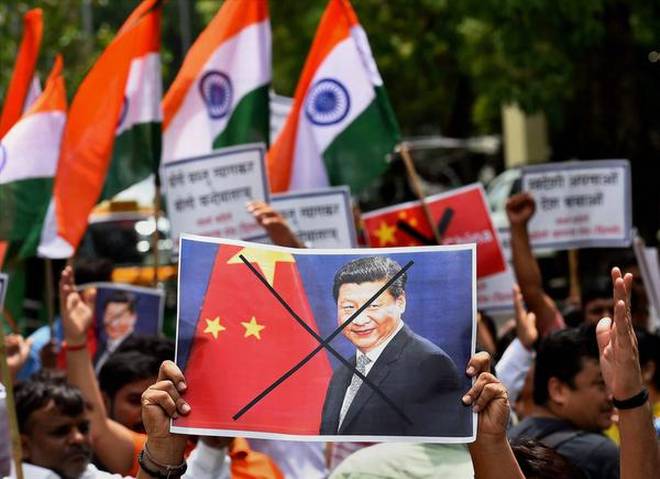
    Protesters across the country were seen burning Chinese flags and products, while videos on social media showed teenagers destroying their Chinese-made mobile phones.

    The Reaction abroad

    Some Indian American groups in  US, owing allegiance to the ruling BJP , have called for boycott of Chinese goods. These groups, at places , like New York, have called for protests against China.

    Beijing is India’s biggest trading partner, with annual bilateral trade worth $92bn. The trade imbalance between the two is significant and favors China heavily.

    In an interview to The Economic Times, Shyam Saran, former Indian foreign secretary, said India should avoid any “knee-jerk reactions” against China, claiming that it would be impossible for New Delhi to find alternative suppliers in the near future.

    Jacob believes India should reach out to Quadrilateral Security Dialogue, also known as Quad – an informal strategic forum that includes India, Japan, Australia and the United States – to take on China.

    “If the USA makes noises in favor of India and strengthens the Quad, it will send a message to China that we will take aggressive steps and will defend our interest,” he said.

    Meanwhile, India has bolstered  defense amid tensions along China border.

    India on Thursday, July 2,  approved the purchase of 33 Russian fighter jets and upgrades to 59 war planes at a cost of ₹18,148 crore amid rising tensions with China and about two weeks after the deadliest border clash in more than four decades between the two Asian nations.

    The order includes 21 MiG-29s that would be purchased directly from Russia and a dozen Sukhoi Su-30MKIs that would be produced under license by state-run Hindustan Aeronautics Ltd (HAL). In addition, 59 MiG-29 jets would be upgraded in Russia, the defense ministry said in a statement.

    The approval by the ministry’s defense acquisition council came on a day Prime Minister Narendra Modi spoke to Russian President Vladimir Putin. The Russian President reiterated his commitment to “further strengthen the special and privileged strategic partnership between the two countries in all spheres”, an Indian foreign ministry statement said. The statement did not say whether the two leaders discussed India’s border tensions with China .

    India’s foreign ministry spokesman Anurag Srivastava said on Thursday, July 2,  that New Delhi and Beijing will “continue their meetings both at the military and diplomatic levels… in the future to resolve the issue (current boundary tensions) to mutual satisfaction.”

    That Russia seemed to respond to India’s list for defense purchases at a time of tensions with China—seen a strong partner of Russia—together with support for New Delhi from countries like the US and France shows what “the global mood is like” on the issue of India-China tensions, said Harsh Pant, professor of international relations at London-based King’s College. “The support for India remains broad. It would be a smart strategy on the part of China to take this into account,” he said.

    The orders for the fighter jets as well as 248 indigenously developed beyond-visual-range ASTRA air-to-air missiles, with the capacity to engage and destroy highly maneuvering supersonic aircraft during night or day—besides long-range land attack missile systems having a firing range of 1,000km are expected to come as a shot in the arm for India’s military, especially the Indian Air Force whose squadron strength is now down to 30 from the sanctioned 42.

    An IAF helicopter flies in the sky, in Leh on Thursday, July 2.

    “While the MiG-29 procurement and upgradation from Russia is estimated to cost ₹7,418 crore, the Su-30 MKI will be procured from HAL at an estimated cost of ₹10,730 crore,” the statement said.

    In total, the defense acquisition council approved contracts worth ₹38,900 crore, of which ₹31,130 would be purchased locally including ammunition for Pinaka multiple rocket launcher, long-range land attack cruise missile and the Astra missiles for navy and air force.

    The tensions with China had prompted defense minister Rajnath Singh to visit Russia last month and meet senior members of government in Moscow to ensure supplies of spares and weapons systems. Despite India diversifying the sources from where it buys its military hardware in recent decades, an estimated 60% of its arsenal contains Russian origin systems making Delhi depend on Moscow for critical spares .

    India’s defense equipment purchases from Russia may irk US which has always expressed displeasure with India buying defense equipment from Russia.

    (With inputs from PTI, ALJAZEERA)

  • Prime Minister Narendra Modi’s visit to China should be seen in the context of the flux of global geopolitics

    Prime Minister Narendra Modi’s visit to China should be seen in the context of the flux of global geopolitics

    By P.S. Raghavan
    Prime Minister Narendra Modi goes to China on April 27, against the background of turbulence in global geopolitics and some domestic disquiet about “softening” of India’s China policy.

    The international backdrop is worrying in many respects. The face-off between the U.S. (and its allies) and Russia is arguably worse than during the Cold War. They confront each other, through proxy forces, in three active conflict zones — Ukraine, Syria and Afghanistan. The recent U.S.-French-British missile strikes in Syria were a stark reminder. It now emerges that prior communication to the Russians had ensured that equipment, personnel and civilians had been evacuated in advance. However, such deconfliction arrangements seem to be episodic, and there is a lurking danger that miscalculation or brinkmanship might spark off a direct conflict at a local level.

    Edgy confrontation

    Sanctions — particularly the new U.S. legislation, CAATSA (Countering America’s Adversaries Through Sanctions Act), under which it can impose sanctions on any company which engages with Russia in the defense or energy sector — impart a sharper edge to the confrontation. This weapon was not wielded in anything like this form in the Cold War; its impact could be far more devastating in today’s globalized world. Recent American sanctions on major Russian multinationals, whose stocks are internationally traded, widened the target beyond Russian oligarchs to a larger body of shareholders within and outside Russia.

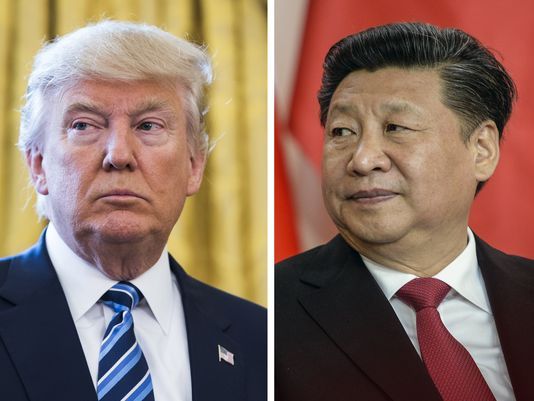
    As the U.S. ratchets up pressure on Russia, it has donned kid gloves in dealing with China, as indicated by U.S. President Donald Trump’s tweets. A recent tweet appreciates Chinese President Xi Jinping’s “kind words on tariffs and automobile barriers” and “his enlightenment on intellectual property and technology transfers”.

    Trade issues

    While India is being asked to address its trade surplus of about $25 billion with the U.S., Mr. Trump asked China (in a tweet last month) to reduce its massive trade surplus of about $375 billion with the U.S. by just $1 billion! He probably meant $100 billion, as has been suggested by his Administration, but it is worth noting that in 2017 alone, the U.S.’s trade imbalance rose by about $28 billion. America’s decision to withdraw from the Trans-Pacific Partnership (TPP), a free trade grouping excluding China, effectively benefited China.

    India itself, running a trade deficit of over $50 billion with China, is in difficult negotiations on the Regional Comprehensive Economic Partnership (RCEP), a free trade grouping that includes China, ASEAN (Association of Southeast Asian Nations), Japan, Korea, Australia and New Zealand.

    Unpredictable U.S.

    The unpredictability of U.S. foreign policy is driving even its closest allies to hedge their options. Japanese Prime Minister Shinzō Abe and Mr. Xi are to exchange visits in the near future — a significant breakthrough in relations between two strategic rivals, who were on the verge of a military confrontation about five years ago. Japan (like India) is concerned about China’s assertiveness in its neighborhood and the geopolitical implications of its Belt and Road Initiative (BRI).

    Yet, having failed to persuade Mr. Trump (with whom he claims excellent personal chemistry) to rethink U.S. withdrawal from the TPP and uncertain about the consistency of U.S. policy in the region, Mr. Abe sees benefit in sustaining a dialogue with China, whose positive response reflects its own desire to keep in touch with a U.S. ally, in the face of conflicting U.S. signals on trade and security policies.

    The sharpening of U.S.-Russia acrimony has complicated India’s relations with both countries. Besides pressure to address the India-U.S. trade imbalance, India has been warned that its defense and energy links with Russia could attract U.S. sanctions under CAATSA — a development which could have a major impact on our defense preparedness. Russia’s intensifying defense cooperation with China and its actions in Afghanistan and with Pakistan are areas on which serious and delicate high-level India-Russia dialogue is being pursued.

    Mutual interest in serenity

     This is the backdrop to the current “reset” in India-China relations. With a strengthening Russia-China axis and with the U.S. taking its eye off China to deal with Russia, it is prudent for India to maintain a harmonious dialogue with China, even as we deal with the wrinkles in our relations with the other two great powers. China’s motivation in extending the olive branch may be similar: to maintain serenity in relations while it deals with its other challenges.

    This is not to say that India should not stand firm on its core interests, political, economic or strategic. We cannot overlook Chinese designs in our neighborhood — from Doklam to the China-Pakistan Economic Corridor (CPEC), Nepal, Bangladesh, Sri Lanka and the Maldives — or ignore the larger geopolitical threat posed by the land and sea corridors of the BRI. It is just that circumstances may have opened up some space for furthering mutual interests, without compromising on our other interests.

    Countries do not publicly admit adverse asymmetries in relations, but their policymakers have to factor them into their policies and actions. Of course, even countries in adverse asymmetric relationships have levers which can and should be used to further their vital interests. In most cases, this is best done through quiet dialogue instead of public airing of differences, which hardens attitudes.

    Importance of messaging

    It is a valid point that the public messaging on this change in tone of the India-China relationship could have been better. The course of India-China relations in the past couple of years had created a public narrative of bilateral frictions over CPEC, Doklam, our Nuclear Suppliers Group membership and other issues, on which India had to take strong public positions. The transformation in the international environment, creating opportunities for non-confrontational dialogue, could perhaps have been better explained. Foreign policy can be pursued far more effectively when it is supported by public perceptions.

    The reality is that India has to maintain a pragmatic balance in its relations with the three major powers, remaining conscious of the fact that elements of these relations will be continuously impacted by the dynamic flux of today’s global geopolitics.

    The Prime Minister’s visit to China should be seen in this context.

    (The author, a former diplomat, is Convener of the National Security Advisory Board)

  • INDIA, CHINA HOLD SPECIAL REPRESENTATIVE-LEVEL TALKS ON BORDER ISSUES

    INDIA, CHINA HOLD SPECIAL REPRESENTATIVE-LEVEL TALKS ON BORDER ISSUES

    NEW DELHI (TIP): India and China on December 22 held special representative-level talks on key aspects related to border issues.

    National Security Adviser Ajit Doval and China’s State Councillor Yang Jiechi met along with senior officials for the 20th round of the India-China border talks.

    During the day-long talks the Doklam episode and other concerns pertaining to unresolved issues of boundary between India and China were discussed.

    The Doklam standoff began on June 16 over People’s Liberation Army’s plans to build a road in an area claimed by Bhutan after the Indian troops intervened to stop it as it posed a security risk to Chicken Neck, the narrow corridor connecting India with its North-eastern states.

    The standoff ended on August 28 following mutual agreement between India and China.

    Source: PTI

  • China on mind, India to host all ASEAN heads at R-Day parade

    China on mind, India to host all ASEAN heads at R-Day parade

    25 yrs of relationship

    ? India will host all heads of state of the 10-member Association of South East Asian Nations to mark 25 years of the relationship
    ? Commerce, Culture and Connectivity are the three ‘Cs’ of the India-ASEAN relationship
    ? The focus will be on maritime connectivity and strategic ties as India and companies held by private individuals are investing in various infrastructure projects
    NEW DELHI (TIP): Riding a mix of religion, commerce and a growing challenge of China, India will be hosting all heads of state of the 10-member Association of South East Asian Nations (ASEAN) for an India-ASEAN summit to mark 25 years of the relationship.

    All 10 leaders will be chief guests at the Republic Day parade down the Rajpath in New Delhi on January 26. Commerce, Culture and Connectivity are the three ‘Cs’ of the India-ASEAN relationship. Various people-to-people connects will be marked by the high profile India-ASEAN commemorative summit in New Delhi on January 25 and followed by the festive fanfare of the military-cultural parade the next day.

    This is the second time that an India- ASEAN summit is being held, the previous one being organised five years ago to mark 20 years of the relationship.

    ASEAN has conducted such summits with the US, Russia, China and Korea. The maritime connectivity will be an important route for our relationship, a source said. Another focus will be on strategic ties as India and companies held by private individuals are investing in various infrastructure projects.

    ASEAN — Thailand, Vietnam, Indonesia, Malaysia, Philippines, Singapore, Myanmar (Burma), Cambodia, Laos, Brunei — form fourth largest trading partner of India at $70 billion.

    India is also looking at providing the much needed stability in the South China Sea. Some of the ASEAN countries are locked in territorial dispute with China in the hydro-carbon rich sea. New Delhi has a stated goal that freedom of navigation and over flight over the South China Sea is crucial.

    China unilaterally claims large parts of the sea. “A peaceful, stable and free Asia is very important,” a source said. India will focus on the youth and host 500 children, exposing them to the Indian way of life. At the religious-cultural level, India has invited all 10 ASEAN countries to send in their ‘Ramayana’ troupes to perform in India. Variations of the Hindu epic are narrated in various forms in these countries. “Ramayana is an important link,” a source said.

    Source: The Tribune

  • Amid Sikkim standoff, Doval, Yang discuss major problems

    Amid Sikkim standoff, Doval, Yang discuss major problems

    Talks include bilateral relations, international and regional issues and multilateral affairs

    BEIJING/ NEW DELHI (TIP): National Security Adviser Ajit Doval and his Chinese counterpart Yang Jiechi discussed “major problems” in bilateral ties, the Foreign Ministry here said after the first high-level meeting between India and China since the military standoff erupted in the Sikkim sector on June 16.

    The Chinese foreign ministry, in a brief readout on Doval-Yang meeting, said Yang “elaborated China’s position on bilateral issues and major problems”, which is being seen as an apparent reference to the standoff in the Dokalam area.

    China’s state-run Xinhua news agency also reported that Yang met separately with Doval and his other counterparts from South Africa and Brazil. Though there were no direct reference to the Sikkim standoff in the Xinhua report, it said the talks between Doval and Yang included bilateral relations, international and regional issues and multilateral affairs. Though China had maintained that there won’t be a meaningful dialogue without the unconditional withdrawal of Indian troops, India has been maintaining that the unilateral action by China to build a road in the area was altering the status quo and had serious security implications for India.

    India has also been pitching for diplomatic solution to resolve the standoff but sought simultaneous withdrawal of troops of both the sides from the tri junction with Bhutan. However, the Chinese official media has been carrying a blistering campaign accusing India of trespassing into the Chinese territory.

    Doval arrived here yesterday to take part in the Brazil, Russia, India, China, South Africa (BRICS) NSAs meeting being hosted by Yang, who, like Doval, is the Special Representative for India-China boundary talks.

    His visit has raised expectations about the likelihood of India and China finding a way-out of the over the month-long standoff. While the media had no access to today’s meetings, it will be allowed to cover tomorrow’s joint meeting of the NSAs of the five-member bloc.

    Doval, along with other heads of the delegations, will also call on Chinese President Xi Jinping tomorrow evening. Source: PTI

  • China’s attempts to lobby against India suffer as US China talks hit hard rock

    China’s attempts to lobby against India suffer as US China talks hit hard rock

    BEIJING (TIP): China’s hopes of getting western support for its stance against India dimmed as Chinese negotiators suffer a serious setback during annual US-China Strategic Economic Dialogue in Washington on Wednesday. Negotiations between the two sides got into a deadlock as American negotiators demanded an end to Chinese dumping of steel and a reduction in the adverse trade deficit created by Chinese exporters.

    Chinese envoys are already facing an uphill task trying to convince western countries that the world’s biggest democracy was actually an aggressor on the border with the second biggest economy. It is much easy for China to persuade countries that depend on its largesse like Pakistan that it was a victim at the Doklam plateau where Indian troops have allegedly trespassed into Chinese territory.

    A joint press conference that was to be held by officials of the two countries was abruptly cancelled. “The press conference was canceled because there was nothing to say. Nothing has been achieved in specific terms,” Sourabh Gupta, a senior specialist at the Institute of China America Studies in Washington told TNN. “The US came down very hard on China and I think China balked,” he said.

    The economic dialogue has resulted in a setback in US-China relationship, which will make it more difficult for Chinese diplomats to get Washington to accept their point of view on the border standoff with India, sources said.

    The Trump administration has repeatedly said that Chinese dumping of steel and other goods has led to huge loss of American jobs. During the negotiations, US commerce secretary Wilbur Ross said that China’s $347 trade deficit with his country was not the result of natural market forces but the absence of “fair, equitable and reciprocal” relationship between the two countries.

    “We must create more balance in our trade by increasing exports of made-in- America goods to China,” Ross said adding, “There are significant opportunities to do this if we can work together to remove the significant barriers that continue to exist”.

    Chinese Vice-Premier Wang Yang, who participated in the talks, spoke about the importance of cooperation between the two countries in general terms but had nothing specific to report in terms of outcomes.

    “Good cooperation between China and the US, the world’s two largest economies, will not only benefit the businesses and people of the two countries, but the entire world,” China’s state media quoted him as saying. (PTI)

  • DOKLAM CRISIS INDIA PUSHES FOR DIALOGUE WITH CHINA

    DOKLAM CRISIS INDIA PUSHES FOR DIALOGUE WITH CHINA

    Beijing ‘threatens security’ at tri-junction

    • ? In the Rajya Sabha, External Affairs Minister Sushma Swaraj said China intends to unilaterally change the status of the trijunction with Bhutan, posing a challenge to India’s security
    • On the standoff at Doklam, she referred to the written agreement between India, China and Bhutan in 2012 that the three nations would together decide on the boundaries at the trijunction point
    • ? She said China had been constructing roads earlier too, but now they had brought in bulldozers and excavators. “We are saying that the matter can be resolved through talks, but both sides have to first take back their armies,” she said

    NEW DELHI (TIP): India on June 20 played cautious and maintained that talks were the way forward when it came to resolving the month-old Doklam standoff. China has maintained that Indian troops need to withdraw as a precondition for any ‘meaningful dialogue’ to begin.

    Gopal Baglay, official spokesperson for the Ministry of External Affairs, today chose not to directly answer questions on the Chinese precondition for talks but emphasised that ‘diplomatic channels’ had not been impeded. India’s response to the situation so far has been mellow, in contrast to the Chinese posturing which has been overly aggressive.

    The spokesperson said Bhutan wants China to go back to the status quo that existed on the ground before June 16 and in essence India also wants that status quo to be restored. Speculation has been rife that differences between India and Bhutan have arisen over the Doklam crisis.

    “Differences between India and China should never become a dispute…We’ve said diplomatic channels are available and have been available. To the best of my understanding they have never stopped,” said Baglay when asked whether India will approach any international bodies such as the UN to intervene in the dispute.

    Earlier in the day, External Affairs Minister Sushma Swaraj made a strong statement in the Rajya Sabha and demanded that China withdraw its troops for the talks to begin. “We are saying that if a dialogue is to be held, then both should withdraw (their troops),” she said. The Chinese action “is a challenge to our security”, Swaraj said, adding that India was not doing anything unreasonable.

    She added that foreign countries are with India. “They feel that China is being aggressive with a small country like Bhutan. Bhutan has protested, including in writing. All the countries feel India’s stand is right and the law is with us,” Swaraj added.

    Source: The Tribune

  • Bluster as foreign policy – Hostility has left neighbors unmoved

    Bluster as foreign policy – Hostility has left neighbors unmoved

    By Sandeep Dikshit

    Clearly, the comforting words of the American naval officer and the temporary presence of a number of warships in the Bay of Bengal can have no impact on the border standoff on the India-China-Bhutan tri-junction or dampen the Sino-Pakistani tango where Beijing has promised to do the heavy lifting for a massive infrastructure buildup that straddles Indian Kashmir, says the author.  

    An unnamed US navy top brass sought to enlighten us about the end game behind the recent week-long excitement in the waters of the Bay of Bengal involving navies of the US, India and Japan. “They [China] will know that we are standing together and that it is better to stand together,” he said at the end of the war-like maneuvers involving, as breathless defense correspondents put it, three aircraft carriers for the first time.

    Like all naval exercises this comes with a name, this one is called the Malabar. It began in 1992 as India began reaching out to the other side of the Cold War divide and has now assumed proportions that are the interest of every sea-faring nation in the world because it involves Japan, India and the US with a very interested onlooker in Australia, all of whom disagree with Beijing’s modus operandi of reworking the power equations in the region.

    Astute as they are, the Chinese would have noticed that the famed US aircraft carrier Nimitz came for the exercises with a leaner complement of accompanying warships. The Japanese contributed two warships. More than war-fighting machines, they remain symbols of Shinzo Abe’s overturning of Japan’s post World War law forbidding its participation in international conflicts. Australia, which was kept out of the Malabar exercises, is still reorienting its navy for a blue water role.

    Clearly, the comforting words of the American naval officer and the temporary presence of a number of warships in the Bay of Bengal can have no impact on the border standoff on the India-China-Bhutan tri-junction or dampen the Sino-Pakistani tango where Beijing has promised to do the heavy lifting for a massive infrastructure buildup that straddles Indian Kashmir.

    Prime Minister Narendra Modi has recently jet-setted to the US, Russia, Spain, France and Germany, all with a thriving military-industrial complex. Very few have responded to his call to manufacture military hardware on Indian soil, partly because most would not wish to rework their equations with China.

    The belligerent realists who have come to dominate the Indian foreign policy may draw comfort from the Donald Trump’s maiden defense budget that has a few lines about India. So far India has largely bought surveillance and detection equipment from the US while going slow on offensive platforms like fighters, tanks and submarines.

    Both sides have their reasons. The US had abruptly suspended the Malabar exercises after India conducted the nuclear tests in 1998. As part of US sanctions at that time, Pentagon even ordered the British to seize Indian Navy’s helicopters that had come for repairs because they had American parts. India’s strategic planner learnt their lessons. Just like they were left stranded after the US withdrew military assistance in 1965 (and unwittingly left a vacuum filled by the Soviet Union) after India had clashed with Pakistan, they realized military trade with the US can be halted anytime if it conflicts with American foreign objectives.

    The proximity brought about by the foreign policies of successive Indian administrations has caused those apprehensions to recede. There is even talk of the US transferring its F-16 manufacturing facility to India.  But the US will not easily offer any of the top-end offensive military platforms without a demonstrative expression of strategic closeness.

    This could be tactical such as positioning Indian armed forces in Afghanistan. But to get into the real meat of the US arms industry, this is inadequate. Even countries in a client-patronage relationship with the US like Pakistan have been let down on crucial occasions (Kargil War) or rewarded for their occasional usefulness with a few military toys that are grossly inadequate for a full-fledged war.

    The US would ideally like to sink a long strategic hook into India that makes the alliance irreversible. One element — signing of three military agreements — has been on the table since the Manmohan Singh-AK Antony era. The duo withstood immense American pressure to sign these agreements because that would have meant an irreversible entry into critical defense systems that countries with independent foreign policies try to prevent.

    The Modi government has succumbed to the easiest of the three military agreements. But even its complexities have meant that the two sides could not operationalize the pact for the Malabar exercises. The signing of the other two pacts will certainly cause the Russians to turn lukewarm in supplying top-end military hardware to India.

    With neither a credible sea denial strategy in hand or adequate military platforms to deter China, it was inevitable that the bluster in foreign policy would have a short shelf life. The Army Chief made a show of muscularity by dashing to Sikkim when the faceoff with the Chinese began. Three weeks later, he has reverted to expiating on Kashmir.

    This approach has brought negative returns with Pakistan as well. High on Chinese backing, utility for the Arabs and Russian mending of fences, Islamabad has little appetite for dialogue on New Delhi’s terms. The attempt to square Pakistan’s meddling in Kashmir with reciprocal interference in Balochistan has suffered a massive blowback with the arrest of the former Indian Naval officer. Nepal too is not looking too good and India has been left with too few diplomatic tools to turn the situation around. The antipathy with China could have been best avoided when Nepal was looking to balance India’s testiness with approaches to Beijing.

    This cul de sac may have persuaded Foreign Secretary S Jaishankar to complain that the Dokalam military standoff between India and China has blown out of proportion due to “supra-nationalism” — beyond the authority of one national government. Apart from the usual suspects and slogans — boycott of Chinese manufactured goods, annexure of Kailash Mansarovar — the Foreign Secretary may also be hinting at the wind being provided to the sails of hyper-nationalists by foreign strategic experts with the single point agenda of showing up China poorly.

    India has been hedging against Chinese dominance for nearly two decades. But its policy makers eschewed bluster towards China in favor of painstaking incremental diplomatic dexterity. The three years of belligerence may have turned the clock back.


  • INDIA TO PURSUE DIPLOMATIC CHANNELS WITH CHINA

    INDIA TO PURSUE DIPLOMATIC CHANNELS WITH CHINA

    NEW DELHI (TIP): India on Thursday said it would continue to use “diplomatic channels” with China to resolve the face-off between soldiers from the two nations in western Bhutan.

    As the face-off continued for the 26th day, Spokesperson of the Ministry of External Affairs (MEA) Gopal Baglay said,

    “We have diplomatic channels available and we will continue to use those channels.” Baglay noted that the MEA had issued a press release on June 30, articulating its views on the way to resolve the faceoff. New Delhi’s position has not changed, he said on Thursday, adding that Prime Minister Narendra Modi, too, had a conversation with Chinese President Xi Jinping during the G20 summit at Hamburg and they had covered “a range of issues”. “I can certainly say that the approach that we had underlined and put out at the end of the last month continues,” Baglay said.

    National Security Advisor Ajit Doval is likely to be in Beijing on July 27 and 28 to attend a meeting with his counterparts from other BRICS (Brazil, Russia, India, China and South Africa) nations.

  • Dilemma of a two front war

    Dilemma of a two front war

    By Maj Gen Ashok K Mehta (retd)

    Obsessed with Pakistan, India has grossly neglected the real adversary. In point-to-point skirmishes and standoffs, battle- hardened Indian soldiers will deter, if not defeat, the PLA. However, across a broad front spectrum in an unlikely all-out war, it is advantage China, Says the author.

    At a time when China is threatening to teach India another lesson and warning not to engage in a two-front conflict over the standoff in Doklam, our Service Chiefs, it seems, are not on the same page about fighting a two-front war especially as Beijing might try to emulate the New Delhi-Thimpu alliance in “disputed territory” with one with Islamabad in PoK. While General Bipin Rawat has more than once asserted the Army’s preparedness for a two-front war, Air Chief Marshal BS Dhanoa has highlighted the critical shortfall in the number of fighter squadrons — 32 against the required 42 squadrons — to dominate a two-front conflict, saying: “It is akin to a cricket team playing with seven players instead of 11”. The deficiency in air assets has existed for decades but this is the first time an Air Chief has related it to a two-front war.

    The Chief of Naval Staff, Sunil Lanba, when asked about the disparity in preparedness of the services, said: “The way national security is being handled is not commensurate with the security environment which is extremely serious at the moment”. Recently, Gen Rawat told a military audience that the military was not getting enough funds for modernization — repeated ad nauseum by every Chief — due to the perception that expenditure on defence is a burden on the economy. This set the cat among the pigeons as Finance Minister Arun Jaitley, a regular fill-in for Defence Minister, is believed to have told Gen Rawat: “Don’t worry about funds. When you run out, call me”. In the mid-1990s, when the Naval Shipyard order books had gone dry, CNS, admiral Vijay Shekhawat went public about the Navy’s operational deficiencies, prompting Defence Minister Mulayam Singh Yadav to invite him to discuss dwindling fleet numbers. Ad hocism has become the hallmark of modernization of the military.

    Power differential

    The Chinese are constantly reminding India about the power differential — military, economic and infrastructural — between them. Being obsessed with Pakistan, India has grossly neglected the real adversary. The reason for this is the institutionalized absence of strategic thinking and higher political direction of war and conflict in the face of growing threats and challenges to internal and external security. Prime Minister Modi’s boast about big defence reforms is hollow: had he been serious about defence, he would have named a full-time Defence Minister. The appointment of a Chief of Defence Staff has not overcome the hesitation of history — read bureaucracy. The country has never produced a “Defence White Paper” or done a “Strategic Defence and Security” review. Something called the “Raksha Mantri’s Directive” masquerades as higher political direction on deterrence and war. This bit of literature drafted by the military has its origin in 1983, with periodic face-lifts to make it contemporary.

    The Parrikar doctrine covering surgical strikes was included in the Joint Military Doctrine, scripted by the Integrated Defence Staff, which attracted extraordinary flak from the defence community for being substandard. In its present organization, each service essentially fights single-service combat. In the last border skirmish at Kargil, the Army’s operation was called Vijay while the IAF campaign in support was named Safed Saagar. So much for jointness.  So the Raksha Mantri’s Directive passes off as political guidance by the highest echelons of government. When I once asked a former Air Chief how he evolved his service’s span of responsibility, he replied: “Most of the time, from speeches made by the Prime Minister during the Combined Commanders’ Conferences.”

    Are we surprised that while President Xi Jinping who heads the Central Military Commission, has personally ordered and supervised the reorganization of the combat formations facing India, reducing them from three commands to one command — a single Western Theatre Command headed by the powerful Gen Xhao Zongqi — the China front in India is managed by four Army and three Air commands deployed at seven locations.

    Integrated command

    A forward-looking proposal made by a defence committee recommending three integrated operational commands — North, West and South instead of 17 single service commands — was shot out of hand by (no guesses) the Air Force. The CDS and accompanying Joint Staff ordered by the UK in 1984 was a fait accompli. It was introduced by a political class which understood defence and strategic security. In India, countless defence reforms are languishing for want of decision making.

    It is instructive to recall how the two-front strategy was formally enunciated in December 2009 by the Army Chief Gen Deepak Kapoor. It followed the 2008 Mumbai terrorist attack, after Prime Minister Manmohan Singh ordered the Service Chiefs to prepare for war. Defence Minister AK Antony then had “preparation for a two-front war” added in his Directive but did little to implement it. Both in 1965 and 1971 wars with Pakistan despite the collusive threat from China, there was no cross-border intervention by China though sizeable formations of the Eastern Command remained deployed against it and forces could not be switched to the west or east for fighting in East Pakistan in 1971. In a real two-front war, swing forces in east and west will not be able to reinforce either front and only dedicated formations will fight the war. Given the paucity in current force levels, inadequate sophistry of combat support and terrain and infrastructure handicaps, it will be an uphill task to match the PLA’s strength and versatility across a 3,488-km front of undefined borders.

     In point-to-point skirmishes and standoffs, battle-hardened Indian soldiers will deter if not defeat the PLA. Across a broad front spectrum in an unlikely all-out war, it is advantage China unless India is prepared to rethink its “no first use” nuclear doctrine. As an offset in the western front, Gen Rawat has suggested creating a two-front situation for Pakistan: either in Afghanistan or Iran. Doklam may go the 1986 Sumdorong Chu way; the 10-month-long standoff challenging the Chinese intrusion at Thandrong, west of Tawang over the interpretation of watershed, without a shot being fired. India need not invoke its doubtful capacity to fight a two-front war; instead, speedily augment its deterrence against China. This may not win votes for Modi but it will prevent Chinese pinpricks that he famously called “toothache”.

    (The author is a former Major General of the Indian Army, and a radio and television commentator, and a columnist on defence and security issues. He is founder-member of the Defence Planning Staff in the Ministry of Defence)         

  • In media blitz Beijing says Delhi’s stand is groundless

    In media blitz Beijing says Delhi’s stand is groundless

    NEW DELHI (TIP): As the Doklam standoff enters its fourth week, the Chinese embassy here has launched a media blitz to drive home its point that India’s position on the issue is “groundless”. After its late night statement on Mansarovar Yatra on July 6, the embassy came up with a video in which it sought to explain that it was India that was trying to change the status quo in the region as Doklam+ belonged to China.

    “As far as solution is concerned, the Indian troops must pull back to Indian side of the boundary unconditionally and immediately. This is the precondition for any meaningful dialogue between China and India+ ,” Li Ya, the political counsellor with the embassy, said in the video. “We have strong evidence to prove that Doklam belongs to China.

    Doklam has always been the traditional pasture for Chinese border inhabitants. Archives of Xi Zang Autonomous Region still retain some receipts of the grass tax paid by Bhutanese herdsmen. Today, the Chinese border troops still patrol there and the herdsmen graze their livestock there, and production and living facilities have been built there,” he said.

    Li accused India of crossing a delimited boundary and entering another country’s territory in the name of security concerns, adding that this won’t be acceptable to any sovereign state. Li, who claimed that he had first-hand knowledge of the area, said that based on his knowledge and work “for the past decade”, India’s “position is groundless”.

    (PTI)

  • CHINA REFERS TO 1962, ASKS INDIA TO LEARN LESSONS

    CHINA REFERS TO 1962, ASKS INDIA TO LEARN LESSONS

    NEW DELHI (TIP): Beijing on July 29 hardened its stance on the standoff with Indian troops, with the Chinese foreign ministry asking India to withdraw its troops from the Donglong area in Sikkim sector as a precondition for a “meaningful dialogue”.

    China went a step further and in a reference to the 1962 war said India should learn “historical lessons”. The Chinese defence ministry joined ranks with the foreign ministry and dismissed the protests by Bhutan that People’s Liberation Army soldiers violated its territory in Donglong, saying its troops operated on “Chinese territory” and also asked India to “correct” its “wrongdoing”.

    In effect, this also means that the pilgrimage to Kailash Mansarovar, which China has put off given the tensions, is unlikely to resume anytime soon. Chinese foreign ministry spokesman Lu Kang displayed a photograph of the Indian “incursion” into Donglong area.

    Later, the ministry uploaded two photographs on its website. “The diplomatic channel for communication remains unimpeded. We urged the Indian side to withdraw troops back to the Indian side of the boundary immediately. This is the precondition for the settlement of this incident and also the basis for any meaningful dialogue,” Lu said.

    In a parallel briefing, Chinese defence ministry spokesperson Col Wu Qian dismissed Bhutan’s protests and said, “I have to correct when you say Chinese personnel entered Bhutan’s territory. Chinese troops operated on Chinese territory.”

    Source: The Tribune

  • Indo-China border tension intensifies

    Indo-China border tension intensifies

    Both sides are not willing to budge from their positions. Flag meetings between the rival commanders have not worked. India has made it clear that it will not allow China to construct a motorable road till the tri-junction through the Bhutanese territory

    FACE-OFF

    • Two rival armies deployed around 3,000 troops each in a virtually eyeball-toeyeball confrontation
    • ? Bhutan, too, has issued a demarche to China over the construction of the road
    • ? Flag meetings and other talks between the rival commanders have not worked till now

    NEW DELHI (TIP): The ongoing troop face-off between India and China on the Sikkim-Bhutan-Tibet tri-junction has emerged as the biggest such confrontation in the region in decades, with both sides continuing to pump in reinforcements to the remote border region.

    Even as Army chief General Bipin Rawat reviewed the ground situation by visiting the headquarters of the 17 Mountain Division in Gangtok and 27 Mountain Division in Kalimpong on June 29 (Thursday), sources said the two rival armies had strengthened their positions at the tri-junction by deploying around 3,000 troops each in a virtually eyeballto- eyeball confrontation.

    The Indian Army, on its part, refused to say anything. But sources said though there had been other troop standoffs at the tri-junction over the years, the latest one at the Doka La general area was clearly the most serious.

    “Both sides are as yet not willing to budge from their positions. Flag meetings and other talks between the rival commanders have not worked till now,” a source said.

    During his visit, General Rawat especially concentrated on the deployments of the 17 Division, which is responsible for the defense of eastern Sikkim with four brigades (each with over 3,000 soldiers) under its command.

    “All top officers, including the 33 Corps and 17 Division commanders, were present during the extensive discussions. Undeterred by Beijing’s aggressive posturing, India has made it clear that it will not allow China to construct a motorable road till the tri-junction through the Bhutanese territory of Doklam plateau.

    Bhutan, too, has issued a demarche to China over the construction of the road towards its army camp at Zomplri in the Doklam plateau, asking Beijing to restore status quo by stopping work immediately.

    “China is trying to build a ‘Class-40 road’ in the Doklam plateau that can take the weight of military vehicles weighing up to 40 tones, which include light battle tanks, artillery guns and the like,” the source said.

    Interestingly, the People’s Liberation Army declared in Beijing on Thursday that it had conducted trials of a new 35-tonne tank in the plains of Tibet, though it added that “it was not targeted against any country”. The Indian defense establishment is concerned at the “creeping territorial aggression” by China, which aims to progressively swallow the 269 sq km Doklam plateau to add “strategic width” to its adjoining but narrow Chumbi Valley, which juts in between Sikkim and Bhutan.

    China has also been pushing Bhutan hard for the last two decades to go in for a “package deal”.

    Under it, Beijing wants Thimphu to cede control over Doklam plateau, while it surrenders claims to the 495 sq km of territory in Jakurlung and Pasamlung valleys in northern Bhutan.

    But India is militarily “very sensitive” about the Doklam plateau, especially the Zomplri Ridge area because it overlooks the strategically-vulnerable Siliguri corridor or the ‘Chicken’s Neck’ area.

    India has progressively strengthened its defenses in the Siliguri corridor, the narrow strip of land that connects the rest of India with its north-eastern states, to stem any Chinese ingress. “But it remains a geographical vulnerability. China has constructed several feeder roads from Tibet to the border with Bhutan, and is also trying to extend its railway line in the region,” the source said. Source: TOI

  • Sino-India border flap: Increasing risk of a spillover

    Sino-India border flap: Increasing risk of a spillover

    Scrimmages between the Indian and Chinese border troops on YouTube make for an amusing viewing. With rifles strapped securely on their backs, the soldiers carefully calibrate their firmness to ensure it does not deteriorate into aggression. It is this restraint, built up by patient diplomatic footwork over decades, that has led Prime Minister Narendra Modi to reiterate his predecessor’s observation of not a single shot having been fired on the Sino-Indian border in the last 40 years. Twice recently the Chinese troops have squatted for days on territory claimed by India. In both cases, India and China ensured the disagreement did not impact bilateral ties in other spheres. But it is for the first time that China has retaliated by closing one of the routes to the revered Mansarovar Lake that passes close to the ongoing site of confrontation.

    Over the past three years, Sino-Indian ties have developed new frictions. Chinese suspicions about India acting as the US’ cat’s paw have deepened. South Block in turn believes that the Chinese ‘String of Pearls’ strategy of encircling India, once dismissed as the work of a fevered intern, is becoming a reality. The fall in the frequency of high-level interactions suggests bilateral strategic disagreements are hardening. India feels the intensive Chinese dalliance with Pakistan has reached the point of no return. China sees a reverse String of Pearls of getting encircled from the emerging India-US-Japan partnership with Australia and South Korea as partly interested players.

    The easier task in foreign affairs is to manage relationships with countries at a distance. The challenge is to keep ties with neighbors on an even keel. The Modi government has tripped on that count. China and Pakistan are not the only irritants in the mix. Bangladesh has opted for Chinese weapons and Nepal wants to join the OBOR. Fresh from the US, the PM has his task cut out. The first priority is to ensure China’s block on Mansarovar Yatra should not deteriorate into a series of retaliatory actions. The second, and the longer haul, is to overhaul the current emphasis on militarism in current policy.


  • China renames towns in Arunachal Pradesh to support its claim

    China renames towns in Arunachal Pradesh to support its claim

    BEIJING (TIP): China has released “standardised” names of six towns of Arunachal Pradesh in Mandarin Chinese and Tibetan languages to buttress its claim over what it regards as “South Tibet”.

    The ministry tried to explain that it was a routine administrative work and part of an ongoing census on names of localities. But a Chinese expert, Xiong Kunxin, a professor of ethnic studies at the Minzu University of China in Beijing, contradicted the foreign ministry saying that the renaming exercise was aimed to “reaffirm Chinese sovereignty” over the area that belongs to India.

    The ministry of civil affairs in Beijing issued an order on April 14 saying that, “The official names of the six places using the Roman alphabet are Wo’gyainling, Mila Ri, Qoidengarbo Ri, Mainquka, Bumo La and Namkapub Ri”. It did not give the existing names of the six towns in Arunachal Pradesh.

    China had used a similar ploy naming islands in South China Sea or pulling out ancient records showing old Chinese names of islands to support its claims over the sea areas, and fight back similar claims from other countries including Vietnam, Indonesia and Philippines. China also began announcing weather forecasts of the disputed area to prove that they are part of Chinese territory.

    The new names will be shown in the international diplomatic arena as proof of China’s claims, informed sources said. China might even pull out old maps and records to show that these names existed for hundreds of years. At present, it has scant historical record to support its claims besides the fact that the 6th Dalai Lama was born in Tawang in Arunachal Pradesh, and the Tawang monastery was linked to monasteries in China in the past.

    “The standardization came amid China’s growing understanding and recognition of the geography in South Tibet. Naming the places is a step to reaffirm China’s territorial sovereignty to South Tibet,” the state backed Global Times quoted Xiong in an article on April 20, 2017.(PTI)

  • INDIA REFUSES CHINESE NAMES FOR ARUNACHAL SITES

    INDIA REFUSES CHINESE NAMES FOR ARUNACHAL SITES

    NEW DELHI (TIP): India on Thursday dismissed China’s recent move to rename six places in Arunachal Pradesh and thus, to tacitly assert its claim on the state.

    New Delhi reiterated that Arunachal Pradesh was an integral part of India and China’s move to rename some places in the state would not alter the facts on the ground.

    “Assigning invented names to the towns of your neighbour does not make illegal territorial claims legal. Arunachal Pradesh is and will always be an integral part of India,” official spokesperson of the Ministry of External Affairs Gopal Baglay told journalists in New Delhi.

    The Ministry of Civil Affairs of the Chinese Government had “standardised in Chinese characters, Tibetan and Roman alphabets, the names of six places in South Tibet, which India calls ‘Arunachal Pradesh’, in accordance with the regulations of the state council”, the Global Times, a state-run newspaper of the communist country, reported earlier this week.

    “The official names of the six places using the Roman alphabet are Wo’gyainling, Mila Ri, Qoidêngarbo Ri, Mainquka, Bümo La and Namkapub Ri,” the report stated.

    ‘Arunachal is integral part’

    Arunachal Pradesh is an integral part of India and China has no business on it, said Union Information and Broadcasting Minister M Venkaiah Naidu here on Thursday,

    “If you look at history, Arunachal Pradesh is with India. India is a sovereign country and there is an elected government in Arunachal Pradesh. There is no dispute in it,” Naidu said.


  • At the crossroads — US, China, Pakistan — India has its hands full

    At the crossroads — US, China, Pakistan — India has its hands full

    Jingoism may work for domestic electoral cycles, but can be dangerous internationally. Confronting the Sino-Pak combine, assuming Trump as a credible pro-India counterweight, is risky at best. Pliny the Elder’s advice to avoid ‘brutum fulmen’ or ‘senseless thunderbolt’ is perennially sound. PM Modi needs to send his ‘Rasgotra’ to Pakistan and avoid public fist-clenching, says the author – KC Singh.

    Harold Wilson’s quip that a week is a long time in politics comes to mind reviewing last fortnight’s developments. The US rained missiles on Syrian air base at Shayrat, near Qoms, in retaliation for the alleged Syrian use of sarin gas, notified as a chemical weapon, against civilians in Khan Sheikhoun. Pakistan upped the ante sentencing to death, for espionage and terrorism, Kulbhushan Jadhav, a former Indian Naval officer, allegedly apprehended in Balochistan. India ignored Chinese threats over the Dalai Lama visiting Tawang, which has the second holiest Buddhist monastery after Lhasa, and the birthplace of the sixth Dalai Lama.

    Taking them serially, Trump’s decision to punish Syria’s Assad regime surprised both his “Alt-right” allies, who felt betrayed by his neo-interventionism, as too his critics in own party and among Democrats, who were elated. Trump was recanting from his election rhetoric of distancing the US from geopolitical cesspools. He perhaps had multiple motives. He was able to jettison charges of cosiness, if not actual complicity, between the Russian government and his election campaign. It is speculated that the US gave Russians a heads-up to avoid direct conflict by ensuring no Russian lives were lost. Careful target selection by avoiding living quarters and attacking in the dead of night, when plane hangars were unmanned, also had the same objective.

    Chinese President Xi Jinping did not get the same courtesy as Trump, having ordered the Tomahawks fired, sat down for dinner with him at his Mar-a-Lago resort in Florida, informing him of the decision only post meal. Trump thus altered the dynamics between Xi and himself, demonstrating the resolve to defend the global order, which his withdrawal from the Trans-Pacific Partnership (TPP), flip-flop on ‘one-China’ policy and election rhetoric, urging isolationism, seemed to question. Xi swallowed the embarrassment but the Chinese media — after he left the US — lambasted the breach of Syrian sovereignty.

    Analysts are wondering if this was a mere knee-jerk reaction, or the first move towards replacing the Assad regime. If the latter is true, there is yet no evidence that Russia is ready to abandon the Iran-Assad-Hezbollah alliance sine qua non to re-balance the Shia alliance. In any case, to force a ceasefire and realign half-a-dozen Sunni groups which oppose the Assad regime and hold parts of Syrian territory, ranging from effective Kurds — whose success Turkey resists — to Al Qaida associates and the IS, would be impossible without an international force, ideally with the UN Security Council imprimatur and the US and NATO participation. But such a force would be an anathema to Russia and China. Clearly, the generals manning critical positions in the Trump administration are finally getting to influence policy choices.

    Prime Minister Nawaz Sharif Of Pakistan
    Prime Minister Nawaz Sharif Of Pakistan

    This may not augur well for India-Pakistan relations as Pakistan gets emboldened the minute it gets access to influential US presidential aides. Trump’s revision of the Obama doctrine to use the Shias, led by Iran, to counter the IS by attempting to separate Russia from the Shia alliance has resurrected the demoralized Sunni brigade, led by Saudi Arabia. Pakistan allowing its former army chief Gen Raheel Sharif to head the Sunni alliance forces conducting operations in Oman indicates re-convergence of Pakistani, GCC and US interests.

    That leads to the next issue of Pakistan suddenly pronouncing the death sentence on Kulbhushan Jadhav. The Indian public reaction and uproar in Parliament is perfect reading by Pakistan to get Indian attention. The exact motive is difficult to decipher at present, but may be multi-fold. It could have been triggered by a former Pakistan ISI officer going missing in Nepal, allegedly abducted by India. The desire to exploit the spring offensive by protesters in the Kashmir valley, whose protests have seen unprecedented success by forcing the negation of the electoral process, is a perennial factor. The Central government’s inability to understand this dynamic is inexplicable, particularly that the rise of Yogis as commissars will feed the paranoia of the Muslim majority in a sensitive state and that an alliance with the BJP has rendered the PDP politically irrelevant in the Valley. The Pakistan army may also have concluded that PM Nawaz Sharif is vulnerable to indictment in the Panama Papers case and political instability seems real. Finally, after the initial trepidation about how Trump led to the detention of Hafiz Saeed in a fit of delayed contrition, Pakistan now has a measure of Trump the interventionist, at whose court Pakistan will present itself as the nuclear weapon-wielding mercenary.

    Finally, the Indian decision to test China by a more forward policy is laudable, but the timing may be inappropriate if it is based on the assumption of continued US assessment that a stronger India was in US interests to balance a rising China. This has been the US assumption since after the initial brouhaha over Indian nuclear tests of 1998. Although the Trump-Xi summit in Florida was overshadowed by the Syrian imbroglio, the two leaders seem to have bought time to negotiate differences over imbalanced trade, North Korea and South China Sea, etc. The statement by US ambassador to UN Nikki Haley about US mediation in India-Pakistan dispute raises questions whether Pakistan is really as isolated as the BJP claims.

    Finally, the Indian reaction to the Kulbhushan episode, with External Affairs Minister Sushma Swaraj promising all in India’s power, is hyperbolic. Hostage takers are best dealt with by quiet threats, which should be credible, and carrots that are tangible. By minimizing Indo-Pak contact there are few carrots that India holds. The only credible threat, short of a war, can be that abducting each other’s citizens and conducting mock trials is letting security agencies override diplomacy. Former foreign secretary MK Rasgotra recalls calling on President Zia-ul-Haq to convey Indira Gandhi’s message that if Pakistan did not stop abetting the hijacking of planes — which was assuming epidemic proportions in the early 1980s — India would do likewise. The gambit worked as differential of power between the two states had not yet been levelled by Pakistan possessing nuclear weapons.

    Jingoism may work for domestic electoral cycles, but can be dangerous internationally. Confronting the Sino-Pak combine, assuming Trump as a credible pro-India counterweight, is risky at best. Pliny the Elder’s advice to avoid ‘brutum fulmen’ or ‘senseless thunderbolt’ is perennially sound. PM Modi needs to send his ‘Rasgotra’ to Pakistan and avoid public fist-clenching.

    (The author is a former Secretary, Ministry of External Affairs, Government of India)

  • China jittery as Dalai Lama’s visit challenges its diplomatic ‘symbol’

    China jittery as Dalai Lama’s visit challenges its diplomatic ‘symbol’

    BEIJING (TIP): Chinese foreign ministry said on Thursday that the Dalai Lama visit to Arunachal Pradesh has “fueled tensions” between China and India.

    “By inviting and approving the Dalai Lama to visit disputed areas between China and India, India has damaged our interests and the India-China relationship and it has fueled tensions,” ministry spokesperson, Hua Chunying, said. China was “opposed to attempts by the relevant country (referring to India) to arrange a platform for the Dalai Lama to conduct anti-China activities,” she said.

    There were also signs that a section of the Communist Party and the official media has stepped up pressure on the government to take action against India for allowing the Dalai Lama to visit Arunachal Pradesh.

    A senior Communist official, Zhu Weiqun, said that India is losing its dignity by encouraging the Tibetan leader, whom he accused of trying to split up China. “India is losing its dignity as a big power by playing around with such a figure,” Zhu, who heads the Ethnic and Religious Affairs Committee of the National Committee of the Chinese People’s Political Consultative Conference, said.

    It is rare for a sitting Communist official to comment on China’s relationship with other countries, which is an area left to the foreign ministry. Beijing based China Daily, which usually refrains from taking aggressive stance against India. (TOI)