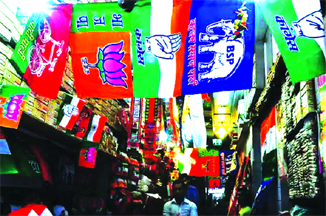
New Delhi (TIP)- Campaigning for the sixth phase of polling in 58 constituencies across eight states and union territories — Delhi, Haryana, West Bengal, Odisha, Uttar Pradesh, Bihar, Jharkhand and J&K — ended on Thursday, May 23, evening. The polling will be held on May 25.
Besides all seven seats in Delhi, polling will be held for 14 seats in Uttar Pradesh, all 10 seats of Haryana, eight seats each in Bihar and West Bengal, six seats in Odisha, four seats in Jharkhand and one seat in Jammu and Kashmir. In the previous elections, the NDA (BJP and its allies) had won 44 of these seats and the Congress none.
On the final day of campaigning, leaders of both BJP and the opposition-backed INDIA bloc spared no effort. Prime Minister Narendra Modi addressed a rally in Bhiwani, Haryana, while Defence Minister Rajnath Singh addressed a gathering in Dwarka, Delhi. Union Minister Piyush Goyal held a roadshow in Najafgarh. Congress leader Rahul Gandhi held a rally in support of party candidate from North East Delhi and later held a gathering in Mangolpuri. Priyanka Gandhi Vadra conducted a roadshow in Sirsa.
A total of 889 candidates are in the fray. Among the key contestants are former Union Minister and BJP leader Maneka Gandhi (Sultanpur, UP), former Haryana CM Manohar Lal Khattar (Karnal), Congress leader Deepender Hooda (Rohtak), former J&K CM Mehbooba Mufti (Anantnag), BJP leader Rao Inderjit Singh (Gurugram) and Congress’ Raj Babbar.
Delhi will see Congress leader and former president of JNU’s student union Kanhaiya Kumar locking horns with sitting BJP MP Manoj Tiwari in North East Delhi. Also, veteran Congress leader and former MP Jai Prakash Agrawal will be contesting against BJP’s Praveen Khandelwal from Chandni Chowk.
West Bengal’s eight seats will see some interesting battles. Tamluk will witness TMC’s Debangshu Bhattacharya (who had given the slogan “Khela Hobe”) contesting against BJP candidate and former Calcutta HC judge Abhijit Gangopadhyay, who was banned from campaigning for a day by the EC for allegedly making sexist comments against CM Mamata Banerjee.
Tag: India Elections 2024
-

India Elections 2024: Canvassing ends for 58 seats in 8 states
-

Elections 2024: Tight race in Thiruvananthapuram: Tharoor is expected to prevail
Keralites are a competent electorate who can distinguish the wolves in Sheep’s clothing. Ultimately, common sense will reign, and Tharoor is expected to prevail.

By George Abraham Following Tharoor behind his constituency ‘Paryadanam’ motorcade this time around evoked some earlier memories in me when he first ran for Parliament in 2009. At that point in time, there was novelty and simple curiosity about his candidature, always with a throng of people eagerly waiting to see him at every junction. Mothers with a child on their shoulders used to run up to the side of the road from their nearby houses to have a glimpse of him. Hence, times have changed, and Tharoor is now a familiar face and known quantity in the Thiruvananthapuram Lok Sabha constituency. Therefore, it has its pluses and minuses.
On the plus side, he can boast about his accomplishments on behalf of the constituents and his staunch defense of the Constitution and pluralistic principles; however, on the negative side, he is put on the radar for how his efforts have borne fruition for the people who have voted for him. That has always been a haunting dilemma for any incumbent. Tharoor has exemplified himself in Parliament and championed himself as a great critic of Modi’s policies and a powerful advocate for democracy and inclusiveness.
However, when I survey the ground realities at play, one thing becomes quite clear: the Kerala electorate is no longer satisfied with simple explanations from the politicians but rather ready to take on politicians on complex issues for honest answers. A good example is the Vizhinjam port development and related issues. When Tharoor campaigned for the first time, one of the popular demands from influential circles was to get involved and make that a reality. He has succeeded in just doing that. He also publicly stated that when there was no bidder for the port development, he appealed personally to Adani to submit his bid. However, what that development entailed, or its aftermath and consequences, still needed to be fully grasped. Today, the coastal community is up in arms not only on the coastal erosions due to the development but also on the failures to rehabilitate those who were displaced because of it. Therefore, Vizhinjam is a two-edged sword that could come back and haunt Tharoor as he seeks another mandate.
The ongoing war between Israelis and Palestinians evokes strong reactions from the Muslim community in Kerala. In Kerala’s political landscape today, the party in power and the Muslim community in particular are more vocal about what happened in Gaza, though justified, than what happened in Manipur, India. Many would dismiss Manipur as a fight between two tribes. Is it so? If that argument holds true, why, then, in a battle between Meiteis (mostly Hindus) and Kukis (mostly Christians), 249 Churches belonging to Meiteis Christians were destroyed in the first few days of fighting? In an era of sound bites, nobody seems to pay that much attention to those details!However, the world knows about Tharoor’s work with the Palestinians and where he stands firm behind the cause of a two-state solution. Yet, his statement critical of terrorist acts by Hamas that initiated the current fight is viewed unfavorably by a segment of the Muslim community. The CPM in Kerala, which is busy courting even the extreme elements to stay in power, suddenly found a weapon against Tharoor and that he is against the Palestinian cause. One has to wait and see whether that strategy will peel away some votes in that community. There is little doubt that a more significant vote share for CPI will only benefit the BJP candidate.

Author ( extreme left) with Shashi Tharoor and others on campaign trail The third most common complaint I have heard from the party workers is accessibility. Undoubtedly, his staff could have done a better job as Tharoor is one of the busiest souls in the country, and there is great demand for his appearances and speeches in addition to his practical work in Parliament. One of the coastal area’s social activists told me that Mr. Tharoor failed to talk about rehabilitating the displaced people from the Oki Disaster. Upon my query to verify the complaint, the Tharoor office has sent me several documents with his statements raising his concerns, especially in Parliament. The media did not properly carry his statements in Lok Sabha. His office should have correctly translated or propagated many of these exchanges in English.
However, more than anything else, the elephant in the room is the CPM and their role in this fight. To those astute observers of Kerala politics, the reason for BJP’s perennial failure to get a foothold in Kerala is apparent. In any election cycle, when a BJP candidate closes in on either UDF or LDF ones, many voters will switch their votes to deny the BJP the victory. The question is, will it happen this time around? Although UDF and LDF may want to state that the fight is between them, the reality in Thiruvananthapuram is quite different. Armed with tons of money, Rajiv Chandrasekhar, the BJP candidate, is said to be ready to buy anything and everything. There are even allegations that some of the resources might have been diverted to activists from various parties and even minority religious leaders. However, the real worry for the Tharoor campaign must be whether there is any behind-the-scenes understanding between BJP and CPM.
The world knows about all the allegations of corruption by Pinarayi Vijayan and his family members. While Modi’s ED is busy arresting and jailing opposition leaders and other opponents of the current regime across the country, how does the Chief Minister of Kerala go scot-free? Even the Delhi CM Kejriwal is in prison without any substantial evidence of wrongdoing, yet, there is hardly any investigation into the gold smuggling, Life mission, Cochin Minerals payments, and so forth by the famed Agencies, let alone the Lavalin case being postponed multiple times upon the request from the prosecution’s side. The BJP government keeps contending that specialized agencies are only doing their jobs. If so, how would they justify their inactions in this regard?
In the same way, Vigilance in the state is not doing any better either, having failed to find the source of the three crores of rupees of black money recovered during the last election cycle allegedly from people with links to the BJP. All of these spark suspicion that there is an underlying agreement between BJP and CPM. The question then is, what is the deal here? Is there a quid-pro-quo in the works for the CPM finally to enable the BJP to open an account for the Lok Sabha from Kerala? Only time will tell.
Despite all the advantages of money and power, Rajeev Chandrasekhar is proving himself a dud. He is unwilling to debate Tharoor, although he is touted here as yet another ‘global citizen’ with a great background. When a reporter asked Chandrasekhar what he has done for Karnataka as their Rajya Sabha MP, in addition to showing his ignorance of an ongoing project, he not only fumbled but dismissed it as an out-of-state question while repeatedly accusing Tharoor of not doing enough in TVM. Chandrashekar made his early riches primarily through his in-law’s company, BPL. A report available in the public domain states, “Before Chandrasekhar sold his BPL stake, his father-in-law took him to court for mismanagement of the company and discrepancies in the shareholding pattern in 2004 and filed petition to restrain Chandrasekhar from selling or transferring BPL Mobiles without his consent.”
Now, we know that on his nomination form, he listed his total assets as around 28 crore rupees and a taxable income of Rs. 680. Video circulating on social media details his holdings in various entities, including shell companies abroad. In those reports, it is estimated that he is said to be worth around 7500 Crores. He could legally justify it all through ‘smart’ accounting for tax purposes. However, the very fact the Modi administration, which once proclaimed to bring all black money back to India, has just crowned someone as a candidate who possesses excellent expertise as to how to hide his assets. They are some of the champions of nationalism who constantly lecture ordinary people like us about patriotism, duty, and honor to the country. If these allegations are proven correct, it is fraudulent misrepresentation while deceiving the voters in Thiruvananthapuram by not telling the truth. Moreover, It is indeed an integrity issue, and whether the voters want to be represented by such a character come April 26.
Another challenging issue for the Tharoor campaign is how to counter a BJP narrative that is undoubtedly taking a perch in the minds of this constituency’s elites and the upper middle class. According to several people I talked to, the conversation goes like this: ‘Modi is going to win anyway, Congress has no future, if Chandrasekhar wins, he might do something for Thiruvananthapuram’! There is very little doubt that people are being brainwashed about the inevitable victory of Modi through their effective propaganda network. The upper echelons of society all over India do not care, as they have no stakes in this election. Nevertheless, the Tharoor campaign needs to respond to this very quickly before it gains any more momentum.
Author joins in door-to-door campaigning There is little doubt that some disgruntled Congressmen and jealous leaders are in the Tharoor camp. To them, a Tharoor defeat or his banishment from the political arena is welcome, and many empires/endeavors have failed not due to external threats but because of the conflicts within. Those elements could come through the front door, and not only would they end up wreaking havoc, but they would also be capable of giving a devastating blow to the leadership. That may explain why a couple of Tharoor’s ‘Paryadanams’ were marred by some dissenting voices and shouting slogans in trying to create a stir. Many of them, like in the media, may allegedly be bought off and become tools in the hands of the BJP.
Despite all the hurdles, the people of Thiruvananthapuram will choose to preserve the Constitution and our way of life. Keralites are a competent electorate who can distinguish the wolves in Sheep’s clothing. Ultimately, common sense will reign, and Tharoor is expected to prevail. -

India Elections 2024: 19 April 2024 to 1 June 2024
Polling to be held in 7 phases, result on June 4
As India braces itself for what is anticipated to be the largest and longest general election in its history, the significance of the democratic process reverberates not only within the nation’s borders but resonates globally. With the Election Commission’s notification for the 18th Lok Sabha elections, slated to span from 19th April 2024 to 1st June 2024, India is poised to witness a monumental exercise in democratic participation. The sheer scale of these elections is unprecedented. Covering a vast electorate of approximately 960 million eligible voters out of a population of 1.4 billion, this election surpasses any previous in terms of sheer magnitude. Seven phases will unfold over 44 days, excluding the first general election in 1951-52, marking a testament to the democratic ethos entrenched within the Indian polity.The Indian Panorama will be covering the elaborate election exercise every week, starting from the April 5, 2024 edition.
Polling for 543 Lok Sabha constituencies will be conducted in seven phases, between April 19 and June 1, followed by counting of votes on June 4.
According to The Election Commission of India, Phase I will be held on April 19, Phase II on April 26, Phase III on May 7, Phase IV on May 13, Phase V on May 20, Phase VI on May 25, and Phase VII on June 1.
Here is a breakup of the phases
– Phase 1: Elections will be held on April 19 in 102 constituencies. This will be held in 21 States and Union Territories.
– Phase 2: Elections will be held on April 26 in 89 constituencies. Second phase will cover 12 States and Union Territories.
– Phase 3: Elections will be held on May 7 in 94 constituencies. The third phase will cover 12 States and Union Territories.
– Phase 4: Elections will be held on May 13 in 96 constituencies. Fourth phase will cover 10 States and Union Territories.
– Phase 5: Elections will be held on May 20 in 49 constituencies. The fifth phase will cover 8 States and Union Territories.
– Phase 6: Elections will be held on May 25 in 57 constituencies. The sixth phase will cover 7 States and Union territories.
– Phase 7: Elections will be held on June 1 in 57 constituencies. The seventh phase will cover 8 States and Union Territories.
The model code of conduct has come into force starting the evening of March 16 and will remain in force even after the polling on June 1 till the entire process of counting is completed on June 4.
Assembly elections in Andhra Pradesh, Sikkim, Arunachal Pradesh, and Odisha will also take place simultaneously, as will assembly bypolls for 26 vacant seats, ECI said.
“After assessment in all states, we are confident of ensuring memorable, independent and impartial polls,” chief election commissioner Rajiv Kumar said at a press briefing. He said the body was determined to tackle the use of muscle, money, misinformation and violations of the poll code. “From wherever we receive the information of violence, we will take action against them.”
The number of eligible voters stands at nearly 969 million, more than the population of the US, Russia and the European Union. The polls will take place in seven phases – on April 19, 26, May 7, 13, 20, 25 and June 1 – a testament to the daunting logistical and security challenges in overseeing an electorate stretching from the Himalayas in the north to deserts in the west, insurgent-infested tropical jungles in the centre and the coastal plains in the south.
Three of India’s biggest states, Uttar Pradesh, Bihar and West Bengal will see elections across all seven phases. Two states – Maharashtra and Jammu and Kashmir – will vote in five phases, three states in four phases, two states in three phases, four in two phases, and 22 in a single phase.
The first phase, on April 19, will be the biggest, across 102 seats and 21 states, and the fifth phase, across 49 seats and eight states on May 20, will be the smallest.
“I urge parties to refrain from personal attacks and foul language. No-go areas in speeches are defined to maintain civility. Let us not cross lines in our rivalry,” Kumar said.
The elections will see Prime Minister Narendra Modi seek a third consecutive term, which will make him only the second person in independent India after Jawaharlal Nehru to achieve the feat. He said the Bharatiya Janata Party (BJP) and the National Democratic Alliance (NDA) were fully prepared for elections.
“The last decade was about filling gaps created by those who ruled for seventy years. It was also about instilling a spirit of self-confidence that yes, India can become prosperous and self-reliant. We will build on this spirit,” he said on X.
The PM also took potshots at the Opposition, dubbing it “rudderless and issueless”.
“Ten years ago, before we assumed office, the people of India were feeling betrayed and disillusioned thanks to INDI Alliance’s pathetic governance. No sector was left untouched from scams and policy paralysis. The world had given up on India. From there, it’s been a glorious turnaround,” he said.
Opposition hits back
“2024 Lok Sabha elections will open the ‘Door of NYAY’ for India. This would be perhaps the last chance to save democracy and our Constitution from dictatorship. We the people of India will together fight against hatred, loot, unemployment, price rise and atrocities,” said Congress chief Mallikarjun Kharge.
Lok Sabha elections in India are a mind-boggling affair where leaders wrestle to weave narratives that bridge deep and complex divisions of caste, class, religion and region. In the last general elections in 2019, the BJP rode on a wave of Modi’s pan-Indian popularity and nationalistic fervour to a once-in-a-generation majority. The party won 303 seats, and along with its allies comprising the National Democratic Alliance (NDA) captured 336 seats in the 543-member Lower House. The Congress, saddled by the weight of past corruption and the lack of a charismatic leader, was reduced to 52 seats.
This time, the BJP has set a target of 370 seats and 400 for the NDA on the back of welfare politics, development, and the Hindutva plank. Former allies have returned to the NDA ahead of the polls, as the BJP looks to defend its fortress in northern India and make inroads in eastern and southern India.
The Opposition’s Indian National Democratic Inclusive Alliance (INDIA) hopes to cut into the BJP’s electoral track record and broad social coalition. But it is saddled with internal contradictions and still-deadlocked seat talks in key states.
In 2019, the general elections recorded a turnout of 67%, the highest since the first election in 1951-52. The first election process in independent India in 1951 was a months-long process that spilled over into 1952. The turnout was just 45% as the authorities struggled to reach remote areas in a country where the vast majority of the electorate was illiterate. Since then, ECI has instituted a number of innovations, becoming a model for major democracies and extending its expertise to help conduct polls in countries such as Cameroon, Afghanistan and the Philippines.
The women’s turnout in 2019 outstripped that of men – 67.18% to 67.01% – for the first time.
A total of 26.3 million new electors – nearly the population of Australia – were added ahead of the 2024 national polls. Around 14.1 million new women voters surpassed the newly enrolled male voters (12.2 million) by 15%.
“There are 12 such states where the gender ratio is over 1000 which means that number of women voters is more than males,” Kumar said.
The number of third-gender voters increased from 39,680 in 2014 to a little over 48,000. Over 20 million young electors in the 18-19 and 20-29 age groups were added to the electoral rolls. At least 18.5 million voters were above 80. The number of centenarians (those who are 100 and above) stood at 238,000. Uttar Pradesh had the maximum number of voters at 153 million as of February 8 and Lakshadweep had the lowest – 57,000.
Highlights of 7-phase voting 1.89 Cr first-time voters
About 96.8 crore voters, comprising 49.7 crore men and 47.1 crore women, are eligible to cast their franchise across 543 constituencies at over 10.5 lakh polling stations in the country to elect the 18th Lok Sabha. The voters include 1.89 crore first time voters, including 85 lakh women. The term of incumbent 17th Lok Sabha is ending on June 16.The Bharatiya Janata Party, led by PM Modi, is seeking a record third term in the upcoming elections. Only Jawaharlal Nehru, the first Prime Minister, has had three back-to-back terms in office in India’s independent history so far.
Target 370 for BJP, 400+ for NDA
The BJP, and PM Modi, has kept a target of 370 seats for the party and 400+ seats for the National Democratic Alliance (NDA) for the upcoming polls. The ruling alliance is up against the INDIA bloc, an amalgamation of several opposition parties including the Congress.
In 2019, the Lok Sabha poll dates were announced on March 10. The polling was held in seven phases from April 11 to May 19 to elect the members of the 17th Lok Sabha. Then the result, declared on May 23, 2019, saw a landslide victory for the Bharatiya Janata Party (BJP) under Prime Minister Narendra Modi, with 303 seats in the 543-member Lok Sabha.
Assembly Elections
The poll panel said that the elections to four state assemblies will also be held along the Lok Sabha elections. These include 175-member Andhra Pradesh assembly, 147-member Odisha assembly, 60-member Arunachal Pradesh assembly and 32-member Sikkim assembly. The term of these four assemblies also expires in June. The results of state assembly elections will also be declared on June 4. Jammu and Kashmir, which has been under President’s Rule since 2018, was not on the list of assembly elections, however.
The commission also announced the schedule of by-elections to the 26 assembly seats to be held along the general elections.
Vote-from home
Senior citizens aged 85 years and above and persons with disabilities can opt for postal ballots and cast their votes from homes, Chief Election Commissioner Rajiv Kumar said on Saturday while announcing the schedule for the polls beginning April 19. As on March 10, 2024, there are 81,87,999 senior citizen electors above 85 years and 2,18,442 electors above 100 years in the country.
Opinion poll predicts INDIA bloc’s debacle, Congress’ seats may fall even more
Opposition bloc INDIA including Congress may fail to dent Prime Minister Narendra Modi’s bid for a third term in the upcoming Lok Sabha elections that are scheduled in seven phases beginning on April 19. Recent opinion polls predicted that the INDI alliance is expected to end up with 94 seats, while the BJP-led NDA can win 399 constituencies.
According to India TV-CNX Opinion Poll, BJP is likely to secure 342 seats, Congress 38, Trinamool Congress 19 Lok Sabha seats, Dravida Munnetra Kazhagam (DMK) 18 constituencies, Janata Dal (United) 14, Aam Aadmi Party (AAP) 6, Samajwadi Party (SP) 3, Telugu Desam Party (TDP) 12, and others 91 seats. The Congress’ seat count can fall even more this time as the party has won 52 Lok Sabha seats in the 2019 general elections.
The pre-poll survey stated that Congress and Bahujan Samaj Party (BJP) may draw a blank in Uttar Pradesh, while the BJP can win 73 seats and its alliance partners RLD and Apna Dal (S) are expected to secure two seats each.
Congress can only win one seat in various states like Bihar, Chhattisgarh, Maharashtra, Manipur, Meghalaya, West Bengal, and Lakshadweep. The opinion poll predicted that the grand old party may also come empty-handed in Jammu and Kashmir, Uttar Pradesh, and Assam.
The regional parties including TMC, DMK, YSRCP, TDP, and BJD can win a significant number of seats in their respective states. TMC may win 19 seats in West Bengal, DMK 18 seats in Tamil Nadu, BJD 11 seats in Odisha, and YSRCP and TDP may win 10 and 12 seats respectively in Andhra Pradesh.
However, Sonia Gandhi-led Congress is expected to perform better in other states. It can win 7 seats in Kerala, 4 in Karnataka, 3 in Punjab, 8 in Tamil Nadu, and 9 in Telangana.
A political party or coalition needs to secure at least 272 seats s in the 543-member Lok Sabha elections. In the 2019 general elections, the Bharatiya Janata Pary won 290 seats, and the NDA’s total seat count stood at 346 constituencies.