Tag: India Prime Minister

  • India is a constructive, dependable actor globally

    India is a constructive, dependable actor globally

    Through the pandemic, it has not only met its domestic requirements but taken a range of steps for global good

    By Harsh Vardhan Shringla
    We reaffirmed our position as first responder to humanitarian crises in the region by deploying medical teams to help Maldives, Mauritius, Comoros and Kuwait deal with the pandemic. India also dispatched naval assets to Maldives, Mauritius, Madagascar, Comoros and Seychelles to deliver assistance. This demonstrated our strong commitment to the PM’s vision of Security and Growth for All in the Region (SAGAR).

    At the virtual Global Vaccine Summit, the PM highlighted how India’s contribution to the global response in terms of sharing medicines was guided by our philosophy of Vasudhaiva Kutumbkum.

    Covid-19 continues to exact a heavy toll worldwide. In India too, positive cases are rising. However, India’s effective response has led to a significant improvement in its recovery rate, which is now 68.78%. The case fatality rate at 2.01% remains one of the lowest in the world.

    High recovery and low-fatality outcomes can be attributed to proactive measures taken to deal with the outbreak from its early stages. In comparative terms, India started screening Covid-19 cases a full 13 days before the first case was detected in the country.  India implemented full lockdown on the 55th day of the outbreak when it had only around 600 cases. Its public health response has been appreciated by the World Health Organization (WHO). The government took rapid steps to augment health infrastructure. As Prime Minister Narendra Modi noted, “India now has over 11,000 Covid-19 facilities and 1.1 million isolation beds. We have ramped up testing to over half-a-million tests a day, to be scaled up to a million”.

    India’s response has not been confined to meeting its domestic requirements. India has been significantly engaged with the international community in providing the leadership that the global situation demanded. As a responsible stakeholder in global health supply chains, India ensured  timely access to essential drugs and medical items for over 150 countries while meeting our own domestic requirements.

    We reaffirmed our position as first responder to humanitarian crises in the region by deploying medical teams to help Maldives, Mauritius, Comoros and Kuwait deal with the pandemic. India also dispatched naval assets to Maldives, Mauritius, Madagascar, Comoros and Seychelles to deliver assistance. This demonstrated our strong commitment to the PM’s vision of Security and Growth for All in the Region (SAGAR).

    From being a net importer of Covid-19-related medical items, India has emerged as a net exporter. Today, India manufactures over 500,000 personal protective equipment (PPE) kits and over 300,000 N-95 masks every day. Our system has shown the necessary adaptability and agility to significantly ramp up production to go beyond our domestic requirements.

    The repatriation of Indian nationals stranded abroad and the evacuation of foreigners from India to their home countries have been among the most successful aspects of our response. In the initial days, the ministry of external affairs had promptly set up a Covid cell and a 24×7 control room to assist Indian citizens abroad. The PM had also personally directed our heads of missions to extend all possible assistance to our nationals stranded abroad. Subsequently, the Vande Bharat mission, launched to repatriate our nationals stranded overseas, has been the largest exercise of its kind ever undertaken by the government and has demonstrated our capacity to effectively carry out complex humanitarian missions. Over a million Indians have returned under the ‘Vande Bharat’ mission so far through flights, across land borders and on naval ships.

    We have not only been able to bring home Indian nationals from distant locations but also facilitated the return of Bhutanese, Nepalese and other nationals stranded in third countries to their homes on these repatriation flights. In recognition of the immense contribution played by the Indian American community in building bridges between India and USA, India has allowed all holders of Overseas Citizenship of India cards to travel freely between the two countries. The institution of ‘travel bubbles’ between India and USA and a few other countries has further facilitated such travel.

    Rigorous screening of returnees by our diplomatic missions has ensured that the proportion of positive cases remains extremely small (less than 0.2%). Testing on arrival by the health ministry and state governments has helped detect these cases. The mission just doesn’t end with the return  of Indian nationals. Recognizing that a lot of expatriate Indians would have lost their jobs particularly in the Gulf area, the Govt is mapping the skills of Indians on arrival to reskill and  link them with companies for job opportunities.

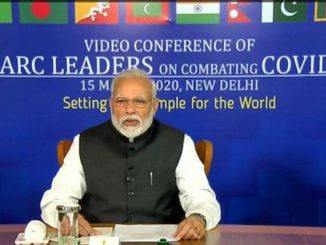
    There has also been no let-up in India’s diplomatic outreach during the pandemic. We have initiated and been part of several important conversations globally. Our ‘Neighborhood First’ policy was on full display when the PM hosted a video conference of the South Asian Association for Regional Cooperation (Saarc) leaders early in the crisis — our first such engagement on Covid-19. He announced a series of measures to deal with the pandemic, including the creation of a Covid-19 emergency fund with a commitment of $10 million from India.

    We have also called for a better multilateral response to global crises in the future. The PM has, on several occasions, including in the G-20 and Non-aligned Movement virtual summits, proposed the reform of multilateral cooperation by bringing people to the center of our efforts. Our own initiatives such as the International Solar Alliance and the Coalition for Disaster Resilient Infrastructure are prime examples of this approach. The decision of the G-20 on debt service suspension for developing countries, which India fully supported, reflects this people-centric approach.

    At the virtual Global Vaccine Summit, the PM highlighted how India’s contribution to the global response in terms of sharing medicines was guided by our philosophy of Vasudhaiva Kutumbkum.

    The PM also hosted the first virtual bilateral summit with Australia, which was followed by the India-European Union summit. In addition, the PM has spoken to his counterparts from 61 countries during this period. The external affairs minister has spoken to foreign ministers from 77 countries. I have been part of several dialogues with several of our partners countries, notably the Indo Pacific Group that convenes every other week to coordinate health, travel, immigration and related issues during COVID times,  We have kept open channels of virtual communication to strengthen partnerships and deal with situations that require diplomatic engagement.

    We have been constantly adjusting, adapting and innovating to deal with the changed reality, particularly in our engagement with the world. And in the process, we have been successful in elevating India’s profile as a constructive and dependable actor on the global stage.

    (The author  is foreign secretary, Government of India. The views expressed are personal)

  • Abki Baar Trump Sarkar” : Modi endorses Donald Trump for 2020 US Presidency

    Abki Baar Trump Sarkar” : Modi endorses Donald Trump for 2020 US Presidency

    “I present to you my family of 50,000”: Modi to Trump

    By I S Saluja

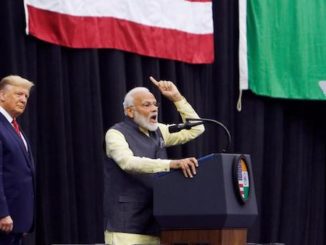
    HOUSTON(TIP): Prime Minister Narendra Modi’s  community reception in Houston on September 22 turned out to be an election rally for US President Donald Trump whom Modi described as “my friend” and “India’s friend”. Modi heaped praises on Trump for having strengthened American  economy and providing leadership to world. Trump reciprocated  with a list of achievements of Modi  a little later  before inviting Modi to speak. It was quid pro quo of the finest  order.

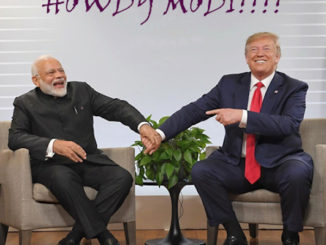
    Prime Minister Narendra Modi and US President Donald Trump, hands held, walk in the NRG Stadium, Houston, Sept 22

    Amid chants of “Modi, Modi”, Prime Minister endorsed Trump for 2020 US Presidency  when he said “Abki Baar Trump Sarkar”,  reminding the gathering of Indian Americans of the chant during recent general elections in India earlier this year where the chant was “Abki baar Modi Sarkar”. Modi a little later , inviting Trump to address the gathering said that Trump had introduced his family to him when he had visited the White House during his last visit to the US, and he was now presenting to him “my family of 50,000”, to the great delight of the man who loves crowds and applause.

    At hand were about 60 lawmakers  belonging to both the Republican and the Democratic Party.

    An estimated 50, 000  strong crowd went hysteric whenever Trump praised Modi or later, when  Modi spoke about India’s strength and resolve to deal with a hostile Pakistan.

    Defended his government’s actions in Kashmir and, in thinly veiled remarks, Modi accused Pakistan of harboring terrorists and promoting terrorism in the region.

    Trump sat in the front row as the Indian prime minister told cheering crowds his decision to remove all autonomy from Indian-administered Kashmir would bring progress and better rights for its people.

    India has faced international criticism over its actions in Kashmir. Thousands of people have reportedly been detained, and access to mobile or internet services has been severed for millions of people in a communications blackout, part of a security clampdown in the wake of Delhi’s decision.

    The rally, on Sunday, marked the first time Modi had discussed the decision to remove Kashmir’s special status on a world stage, and followed months of fierce rhetoric from Pakistan, which also claims the disputed region and has sought to raise the issue with the UN.

    Without directly naming Pakistan, Modi accused the country of “hatred towards India” and of supporting terrorism.

    “Whether it is the 9/11 attack in America or the 26/11 attack in Mumbai, where are its conspirators found?

    “The time has come for a decisive fight against terrorism and those who support terrorism,” he said. “I want to stress here that President Trump is standing firmly against this.”

    Trump, who was given a rapturous welcome at the event, said he was committed to protecting “innocent civilians from the threat of radical Islamic terrorism”.

    About 50,000 Indian Americans attended the “Howdy Modi!” rally, where crowds chanted “Modi! Modi! Modi!” as he took to the stage, following a 90-minute cultural program featuring 400 dancers.

    Trump, introduced by Modi as “my friend, a friend of India, a great American president”, was given a standing ovation at the event in Houston, a Democratic stronghold in Republican-dominated Texas. Houston is expected to be a critical battleground in Trump’s 2020 re-election bid.

    Modi, who was re-elected this year with a thumping majority, enjoys wide support among Indians both at home and abroad, especially among the middle classes, said Manoj Joshi, a fellow at the Observer Research Foundation, a New Delhi-based thinktank. “He is extremely popular, particularly when it comes to the Indian diaspora in the US where there is a lot of Gujarati diaspora, from his home state,” he said.

    The rally was held as Kashmir remains under a security crackdown, apparently to prevent unrest. Outside the stadium, protesters accused Modi’s government of human rights abuses against Kashmiris.

    Iltija Mufti, the daughter of the former Jammu and Kashmir chief minister Mehbooba Mufti, said on Twitter: “While people in Kashmir have been gagged, mass hysteria is orchestrated elsewhere to justify this decision.” Her mother was among thousands reportedly detained as part of a crackdown by security services.

    The jampacked NRG Stadium to welcome Prime Minister Modi

    Modi’s speech came just days before the UN general assembly’s meeting in New York, where the Pakistani prime minister, Imran Khan, is expected to accuse Modi of being complicit in torture and mass detention in Indian-administered Kashmir.

    Michael Kugelman, a south Asia expert at the Wilson Center, in Washington DC, said while Modi generally preferred to keep quiet about Kashmir with global audiences, it was unsurprising that he had raised the issue in Texas.

    “I think he wanted to try to blunt international criticism by demonstrating just how popular the move [to remove Kashmir’s special status] was among Indians — including Indian Americans in the US,” said Kugelman. “And indeed his comment got louder applause than just about anything he or Trump said during the whole event.”

    Though the scrapping of Kashmir’s special status faces major opposition within the region, it is widely supported elsewhere in India.

    A group of Sikhs with PM Modi. Seen, among others are J.S. Bakshi (second from left), H.P. Singh (third from left), Dr. Surinder Singh (fourth from left)

    It was unsurprising an Indian leader would criticize Pakistan in a political speech, said Kugelman, but he added: “It is significant that Modi did so with Trump seated right in front of him, and at a moment when the US-Pakistan relationship has enjoyed a renaissance thanks to Islamabad’s help with Taliban talks in Afghanistan.”

    (With inputs from Agencies)

  • Modi, Trump at Houston will be all about quid pro quo

    Modi, Trump at Houston will be all about quid pro quo

    By Robinder Nath Sachdev

    Why would Trump travel to Houston? Surely not to only attend the community event with Modi. It will have to be for something far more than this. Though by attending the event, Trump could well stand to gain political mileage with the Indian American community, or is Trump doing a favor by joining the event?

    When Modi roars “Howdy America”, it will be answered by a resounding “Howdy, Modi” by Trump. Quid pro Quo. Hello, Houston, we have a deal.

    The ducks seem to be lining up for President Donald Trump to join Prime Minister Narendra Modi at the Indian American community event slated to be held on September 22 at Houston.

    Modi will take the megaphone to address the Indian American community at the 50,000-capacity NRG Stadium, at an event titled as “Howdy America”. Now imagine that Trump is also at the event. Optopolitics of the rarest kind will emanate and follow from the combination.

    Will both leaders enter together, walk through the aisles, waving at the crowds, and reach the stage together? Will Modi start his address, and Trump sit and listen to the 40-60 minutes of Modi’s speech? And then, will Trump address the audience for 20-30 minutes? Chances are slim for this scenario to play out, for many reasons.

    Rather, some alternative version will be on display. One efficient option can be that Modi addresses the audience, and just as he is ending the address, Trump walks in, shouts out a “Howdy Modi!”, and joins and hugs Modi on stage, to rousing cheers. And then, Modi and Trump together, hand in hand, exit the reception, as the crowd keeps cheering to the roof. Trump comes to take his friend Modi, and they together go for a summit meeting.

    The optics and politics of Trump at the community event will be powerful. Why would Trump travel to Houston? Surely not to only attend the community event with Modi. It will have to be for something far more than this. Though by attending the event, Trump could well stand to gain political mileage with the Indian American community, or is Trump doing a favor by joining the event?

    Or, Trump could please the crowds by making a short announcement that he will soon be visiting India? A visit by Trump to India in next 3-4 months is of high importance, perhaps as chief guest to the pageantry of the Republic Day Parade at New Delhi on January 26, 2020.

    In any case, remember that there will also need to be some nimble political choreography on site at the community event to keep the messaging on track. After all, majority of the Indian American crowd is not very enthusiastic about Trump, and many of the US lawmakers who will be there to welcome Modi are no supporters of Trump.

    With the community event done, both leaders will move to hold the summit meeting. This is where the next quid pro quo will unfold. Will it be a mega oil and energy deal between the United States and India? Houston being the oil capital of the world, it will make sense as a venue to announce such a deal. If India does so, then what is the quid pro quo that the United States will offer to India?

    Or, will it also be about large-scale shifting of American companies to India from China, with some marquee announcements? What about a strong signal from America for an FTA (Free Trade Agreement) deal? India is worryingly short of what to do to tackle its current economic slowdown. A green flag on FTA will push US investments into India, away from China, and will therefore be a significant confidence building measure for the Indian market, and economy. If the US does this signaling, then what is the quid pro quo offered by India?

    In any case in matters of trade, there are several items outstanding – ranging from trade deficit, tariffs, market access, to intellectual property rights, and many more. Moving forward on these, in the spirit of quid pro quo and some exchange of favors, moving towards a roadmap for an FTA could, therefore, be a logical path and outcome of the summit.

    What else can be a bold, innovative exchange between the two leaders, at Houston? On defense? Though there can be some large deal on defense, there, however, cannot be a clean break by India in favor of the United States with the total exclusion of Russian supplies in future. The US seems to be realizing this, and India also seems to be doing some introspection in this matter.

    On Afghanistan? This is one area, where both leaders could do some major innovation. India could provide boots on the ground in Afghanistan – to ring fence and protect the US camps and troops remaining in Afghanistan after the drawdown ordered by Trump. If decided by India, this can be a quantum game changer.

    Right now, India may be at a stage where the geostrategic interests might weigh in favor of such a step by India. If India decides so, then the quid pro quo from the US must be something that India gets in exchange that is similarly ground-breaking, and with commensurate value for India. What can be this value that India might demand?

    Of course, there are a host of other topics too, equally important, that shall be discussed, like counter terrorism, Pakistan behavior in the Af-Pak, PoK, and Kashmir, and a range of other bilateral, regional, and global issues, including reform of world bodies, like the United Nations and WTO.

    Surprisingly, one big ticket area, which has seen silence so far is related to 5G and Huawei. After the Osaka G-20 summit, Ivanka Trump had made a short announcement about the topics discussed. In that announcement, she had said that the two countries have decided to work together in a big way to develop 5G technologies. This can be a game changer.

    If the two countries collaborate on 5G it will be a massive exercise in R&D, finance, talent, entrepreneurial and vendor eco-system, market adoption and success in the face of competition from Huawei and the Europeans. Will the US shepherd billions of dollars in the 5G sector to India, so that the latter stays away from Huawei, and the products developed via the US-India collaboration be used in the Indian, US, and other world markets, too?

    All the above can be discussed at New York, or in Washington DC, where again there is supposed to be a bilateral between Trump and Modi. What was the need for a separate, additional summit at Houston? Or, is it that the Houston rendezvous will piggy-back on the momentum of the community event, announce one mega-deal on oil, announce a state visit by Trump to India, and the rest will be taken up in New York or Washington?

    When Modi roars “Howdy America”, it will be answered by a resounding “Howdy, Modi” by Trump. Quid pro Quo. Hello, Houston, we have a deal.

    (Robinder Nath Sachdev is President of The Imagindia Institute. The views expressed here are personal)

  • India’s PM Modi Urges Canadian PM Trudeau to Curb Khalistanis

    India’s PM Modi Urges Canadian PM Trudeau to Curb Khalistanis

    DAVOS, SWITZERLAND (TIP): In his bilateral meeting with Canadian Prime Minister Justin Trudeau on the sidelines of the World Economic Forum meeting in Davos, Prime Minister of India Narendra Modi raised the issue of Khalistan and pro-Khalistani groups that are known to be active in Canada, a Hindi daily Navbharat Times has reported.

    Support for Khalistan has been on the rise with extremists organizing multiple events across Canada to rally support for the movement in the past few years. Numerous pro-Khalistan groups in Canada are planning to hold what they call the ‘Punjab Independence Referendum’ in the year 2020.

    In July 2016, India had raised the issue with Canada after Trudeau appeared in a Nagar Kirtan event in Toronto that featured Khalistani flags and posters of extremist leader Jarnail Singh Bhinderanwale.

    On 30 April, Trudeau had addressed a parade for ‘Khalsa Day’, which included events glorifying Sikh militant leaders. Trudeau’s Liberal party has a number of influential figures belonging to separatist Sikh organizations as elected leaders.

    Harinder Kaur Malhi, a legislator from Trudeau’s party, who had moved a resolution against India, to recognize the anti-Sikh riots of November 1984 as a genocide, was also felicitated during the parade. The resolution was passed by the Ontario Assembly on 6 April last year.

    India had condemned the move, calling it a “misguided motion based on a limited understanding of India, its constitution, society, ethos, rule of law and its judicial process”. The issue was also raised with Canada’s Defence Minister Harjit Sajjan during his visit to India the same month.

    The issue could be raised again during Trudeau’s visit to India next month.


  • PM Modi’s UAE, Palestine visit in February to focus on counterterrorism, cyber security

    PM Modi’s UAE, Palestine visit in February to focus on counterterrorism, cyber security

    NEW DELHI (TIP): More cooperation in cyber security and counterterrorism initiatives and facilitating more investment in India’s infrastructure sector will top Prime Minister Narendra Modi’s agenda when he visits the UAE next month, said an official familiar with the plans on condition of anonymity.

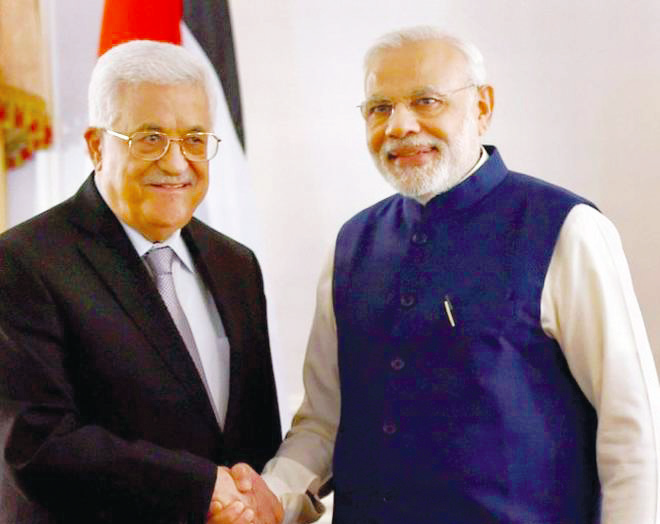
    Modi is likely to visit the Gulf nation on February 10 and 11. He will also visit Palestine en route to the UAE, home to 2.8 million Indian passport holders.

    Modi’s visit to Palestine will come shortly after the visit of Israeli Prime Minister Benjamin Netanyahu to India.

    Modi was the first Indian PM to visit Israel last year, de-hyphenating its relationship with the two countries.

    India and the UAE have put together an ambitious agenda to mark the second visit of Modi to the UAE, with which India has a comprehensive strategic partnership aimed at further strengthening their security and business ties.

    Cyber security is one area both countries have identified for stepping up cooperation, said the official. New Delhi would like to collaborate with the UAE in setting up a cyber security centre in India. The UAE has had a cyber security centre since 2014 that acts as a nodal agency for protecting data, telecom networks, and which works with similar bodies around the world, the official pointed out.

    “Cyber security has emerged as a key area of our bilateral cooperation with other countries. The UAE has some best practices and a centre in this field and the cooperation could be mutually beneficial,” said another official.

    The two sides are also looking at stepping up efforts to disrupt terrorist networks, their financing and movements. In this context, India would like the UAE to help track the properties of people in its wanted list. Facilitating more UAE investment to India remains another focus. The two countries plan to step up the proposed $ 75 billion target for UAE investments in India’s infrastructure development.

    Source: HT

  • INOC USA expresses serious concern over the growing mob violence and lawlessness in India

    INOC USA expresses serious concern over the growing mob violence and lawlessness in India

    NEW YORK (TIP): ‘The government of India appears to be failing big time from its constitutional and solemn duty of protecting the lives and property of its citizens.’ ‘The mob rule and vigilante justice currently taking over the country are posing a direct threat to its revered institutions and the rule of law’ said George Abraham, Chairman of the Indian National Overseas Congress, USA.

    We fully support Mrs. Sonia Gandhi’s observation that the culture of violence that is on the rise is being actively supported by those supposed to enforce the law. According to her, the country’s inclusive rule is under attack, and the domestic misrule is one of the big challenges facing the country.

    Mrs. Gandhi said,” The tried and tested the idea of India has been thrown fundamentally into question by rising intolerance, by malevolent forces that tell Indians what they cannot eat, who they cannot love, what they can say, indeed, what thoughts they cannot hold”.

    The Congress President urged people to speak against the wrongs committed, asserting that “if we do not raise our voices, if we do not speak up, our silence will be taken as consent”.

    She cautioned “let us not forget that though their language is modern, they seek to take India backward to further their narrow sectarian vision, their modern jargon conceals pre-modern beliefs.”

    In the latest incident, 16-year-old Junaid Khan was lynched to death in a train by cow vigilantes who accused him of killing cows and eating beef. In Jharkhand’s Dhanbad, Usman Ansari was thrashed by a mob, house set on fire over a dead cow.

    Prime Minister Narendra Modi, upon returning from U.S. made a statement that ‘killing in the name of cow is unacceptable.’ However, it is high time that his words are also matched with strong action from the central government.

    The Prime Minister may also share some responsibility in this regard as one of the major themes of the 2014 campaign was a supposed “pink revolution” that Congress was promoting, an insidious plan to slaughter more cows and make money of their meat. It seemed to have played well at that time with his constant charging the opposition of ‘minority appeasement.’

    INOC, USA urges NRIs worldwide to speak up urgently on the need to stop the politics of religious hatemongering and making India a subject of ridicule internationally.