Tag: India-U.S. 2+2 dialogue

  • Leveraging China vis-a-vis Uncle Sam

    Leveraging China vis-a-vis Uncle Sam

    By G Parthasarathy

    It would be naive to infer any change in China’s efforts to undermine India’s influence across its Indian Ocean neighborhood or moderate its support for Pakistan and terrorist groups like the Jaish-e-Mohammed. But it does indicate that China would not like Doklam-like tensions again. Also, it gives India more space to deal with Trump’s US., says the author.

    While public attention was focused on the highly publicized 2+2 Dialogue between the Foreign and Defense Ministers of India and the US, two interesting developments took place in India’s relations with China. The first was a remarkably warm meeting that Prime Minister Modi had with the visiting Chinese Defense Minister, General Wei Fenghe, on August 21. The Prime Minister appreciated that differences between the two countries were being handled with “sensitivity and maturity”, which was evident from the prevailing peace along the China-India borders. He also welcomed the growing cooperation between the two countries, including in areas of defense and military exchanges.

    Unlike its earlier behavior, which resulted in three million people being stranded and 130 killed in floods in Assam last year, China provided India information on the rising levels of the Brahmaputra, this year well in advance. This enabled India to deal with the flood situation effectively. It would, however, be naïve to infer that these developments signal any change in China’s efforts to undermine India’s influence across its Indian Ocean neighborhood, or moderate its economic, diplomatic and military support for Pakistan and terrorist groups like the Jaish-e-Mohammed. But it does indicate that after the Modi-Xi Jinping summit in Wuhan last year, China would not like tensions like those witnessed in Doklam last year, to arise again, in the near future.

    These developments give India more diplomatic space to deal with Trump’s US, which has offended friends and foes alike. The Trump Administration has unilaterally renounced many past American bilateral, regional and global commitments, with its “America First” policies. It is an Administration that has offended and dealt arbitrarily, even with long-term allies like Canada, Germany and Japan. India needs to be totally realistic in dealing with the Trump Administration. Even before commencing discussions with New Delhi, the Trump Administration filed a complaint against India in the World Trade Organization challenging our export programs. Ironically, this move came at a time, when the US had levied heavy duties on India’s exports of steel and aluminum.

    The Americans are indicating a desire for an early, face-saving exit, from Afghanistan. The Afghan armed Forces will, hopefully, continue to be armed, equipped and financed to meet challenges posed by the Pakistan-backed Taliban. A far more active engagement by India, with parties that respect the Constitution in Afghanistan, is imperative, so that the Afghans can ensure that Pakistan does not lead the Americans up the garden path, with a promise of good behavior, by the Taliban. Russia and China, for different reasons, now have a cozy relationship with the Taliban. They evidently hope that the Taliban will join them in taking on the Islamic state. Neither the Russians nor the Chinese, however, have a past record of understanding Afghanistan and its people objectively. China will also inevitably face the consequences of brutal suppression of its Muslim population in Xinjiang, bordering Afghanistan.

    Military cooperation between India and the US received a boost during the Pompeo-Mattis visit, with the establishment of formal links between India’s Western Naval Command and the American Fifth Fleet, based in Bahrain. Maritime cooperation with this Fleet would be very helpful, in events affecting the safety and security of over six million Indians, living in the Gulf region. Moreover, the Communications and Security Agreement signed during the recent talks would give India access to valuable intelligence information that Americans could provide. The US and India have shared concerns about growing Chinese assertiveness across the Western Pacific and Indian Oceans. These include Beijing seeking the establishment of a “string of pearls” across sea-lanes, from Kyaukpyu in Myanmar, to Djibouti. India, the US and Japan have been carrying out tripartite naval exercises. These exercises should now be extended across India’s west coast.

    Recent US legislation, popularly alluded to as CAATSA, enables it to impose sanctions on countries, which have “significant transactions” with Russian arms industries. These would adversely affect all banks having dollar transactions, which virtually all major Indian banks have. After strong lobbying by India, the Trump Administration got the legislation amended to enable it to exempt countries like India, Indonesia and Vietnam from its provisions. India has also been affected by recent sanctions imposed by the Trump Administration on oil purchases from Iran, a major supplier, after the Obama Administration revoked UN sanctions. With the reintroduction of sanctions on Iran by the Trump Administration, New Delhi would have to get a sanctions waiver from President Trump, for oil imports from Iran, after November.

    China escapes the effect of these sanctions, because it has a largely balanced trade with Iran and Russia and no dollar transfers are required. India has trade deficits and cannot arrange payments through bilateral settlement mechanisms, with either Russia or Iran. These are the two most crucial issues, affecting India-US relations presently. But what is interesting is that not a word was uttered officially about these crucial issues, by either side, after the recent 2+2 Dialogue. The American move, imposing sanctions on purchase of Russian arms, are obviously as motivated by a desire to promote its own arms sales, as by geopolitical considerations, to pressurize Russia. India will lose face internationally if it backs off from getting crucial S400 air defense missiles from Russia, for which negotiations have been completed.

    India could consider devising measures to modify its arms relationship with Russia, to one linked to its “Make in India” program. Payments will, of course, be made easier, if the Russians import more from India, by resorting to rupee trade, like the Soviet Union did. While US sanctions are not likely to be applied for India’s Chabahar port project in Iran, New Delhi will inevitably have to progressively reduce oil imports from Iran, after persuading the US not to oppose dollar payments, for a specified time, beyond November.

    In a long-term perspective, international cooperation has to be sought, if the US is to be prevented from acting in an arbitrary manner. Even its allies like Germany, which could face US sanctions for gas imports from Russia, may not be averse to considering such actions, to end the dominance of the US dollar, in international transactions.

    (The author is a former Indian diplomat.)

  • The bilateral limits of hype: on India-U.S. relations

    The bilateral limits of hype: on India-U.S. relations

    By Varghese K. George

    But India-U.S. relations will be better off without hype and grand theories, often encouraged by the government. Otherwise, every rescheduling of a meeting will be interpreted as the collapse of ties. Similarly, avoiding the hyperbole could help manage India’s troubles with Pakistan and China better. The U.S. has overlapping interests with China, and India has overlapping interests with both. The trouble with big-chest, small-heart hyper-nationalism in foreign policy is that it also causes short sightedness. The audacity of hype has its limits.”

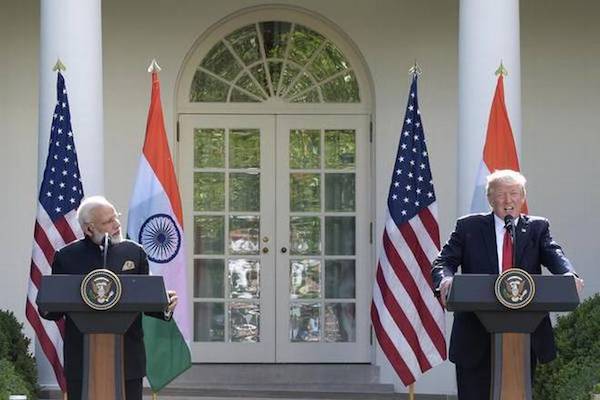
    Prime Minister Narendra Modi and U.S. President Donald Trump have both built their politics on the promise of making their countries great again. Placing India and the U.S., respectively, as leaders on the world stage is the stated objective of their foreign policy. The project of regaining national glory is based on another assumption that they inherited a mess from their respective predecessors. Yet another shared trait is their love for spectacle over meticulous, prolonged and often frustrating pursuit of strategic goals.

    Theatre as strategy

    The postponement of the India-U.S. 2+2 dialogue between the Foreign and Defense Ministers of both countries, that had been scheduled for this week, has to be understood in the context of the similar personality traits of Mr. Trump and Mr. Modi. Hugging Mr. Trump may be a good spectacle for Mr. Modi, but the same may not be true for the former. Mr. Trump has set his eyes on spectacles that suit him. Mr. Trump, still basking in the denuclearization deal that he’s said to have struck with North Korea’s Kim Jong-un, is now looking forward to the next big event: a summit meeting with Russian President Vladimir Putin. His every move on the global stage enrages his domestic political opponents and the professional strategic community alike and he is happy, as this keeps his political base constantly on the boil.

    North Korea, Syria, Afghanistan, trade deficit, and all global challenges before America are the faults of his predecessors, he repeatedly tells supporters. Most recently, at the G7 summit in Canada in June, he declared: “I blame our past leaders for allowing this to happen (trade deficits) …You can go back 50 years, frankly.” Such rhetoric may sound familiar to Indians. In Mr. Trump’s war on the legacy of all Presidents before him, India is on the wrong side. The remarkable growth in India-U.S. relations since the turn of the century had been nurtured by three U.S. Presidents, Bill Clinton, George W. Bush and Barack Obama, two Democrats and one Republican who have all been the target of Mr. Trump’s ire. India neither promises him the opportunity of a spectacle nor offers the grounds for destructing the legacy of a predecessor. So, he told Secretary of State Mike Pompeo to deal with North Korea and Russia, and 2+2 with India could wait. “Nobody wakes up in DC daily thinking of India,” says a former U.S. ambassador to India, pointing out that 16 months into the new administration, there is no Assistant Secretary of State for South and Central Asia in the State Department.

    Impact on ties

    To buttress one’s own claim to be a trailblazer by denying the achievements of predecessors may be good political tactics for these leaders but trying to wish away history itself is not a sustainable strategy. Against the backdrop of a programmatic negation of history in both countries, Mr. Trump’s bursts of unhinged rhetoric against China and Pakistan lend themselves to easy and convenient interpretations by supporters of improved U.S.-India ties as moments of enlightenment for the U.S., even as turning points.

    But Mr. Trump cannot undo all the legacy with a magic tweet. U.S. relations with Pakistan and China took shape during the Cold War. Pakistan might be the longest ally of the U.S. after the U.K., first in the fight against communism, and then in the fight against terror that was created in the first fight. China used the Cold War to its own advantage in its ties with the U.S.

    China today threatens the dominance of the U.S., but the America’s security establishment and political elite are obsessed with Russia. India gets caught in that internal American fight too, such as in the case of an American law that now requires the President to impose sanctions on any country that has significant security relations with Russia.

    Mr. Trump sees the challenges posed by China, but not in a manner helpful for India. For, India and China are in the same basket for Mr. Trump on many issues that agitate him. He has repeatedly mentioned India and China in the same breath as countries that duped his predecessors on climate and trade deals. His administration considers India and China as violators of intellectual property laws, as countries that put barriers to trade and subsidize exports and use state power to control markets. The nationalists in the Trump administration, including U.S. Trade Representative Robert Lighthizer, Commerce Secretary Wilbur Ross and White House National Trade Council Director Peter Navarro are all gunning for China, and India is in the same firing line. Many Americans who think that China took the U.S. for a ride — many Democrats among them — suspect that India is trying to do the same thing.

    But there are two constituencies in the U.S. that promote India against China: the Pentagon and the U.S. arms industry. This works to India’s favor. While the Obama administration could not overcome State Department objections to offer India even unarmed drones, the Trump administration has done so, offering armed drones. Here, Mr. Trump is not guided by any grand theories of ‘rule-based order’, etc. that professional strategists talk about, but by the opportunity to sell.

    Given Mr. Trump’s views on trade, American companies that used to argue China’s case are now guarded in their approach. Still, companies such as General Motors and Ford have come out against a trade war with China. This has implications for India too. American companies that eye the Indian market are allies in the pushback against Mr. Trump’s nationalist trade policies. Mr. Modi has realized this dynamic that puts India and China in the same corner in Mr. Trump’s perspective — and that significantly explains his Wuhan summit with Chinese President Xi Jinping, the third big leader who is gaming for the glory of his country.

    War against legacy

    The enlightenment that Mr. Trump purportedly brought on America’s Af-Pak policy also appears to have been short-lived. If one looks at the tough messages from Nikki Haley, U.S. Ambassador to the UN, in New Delhi recently on Pakistan and Iran, it is clear where the political priorities of the Trump administration lies. Here again, Mr. Trump is determined to gut his predecessor’s legacy, a key component of which was rapprochement with Iran. The war in Afghanistan is the worst optics for Mr. Trump’s showman politics, and his administration’s approach has been to sweep it under the carpet. The Pentagon has restricted release of data on the war, but a report last month paints a picture of a deteriorating situation. The U.S.’s ability to arm-twist Pakistan has been limited anyway, and Mr. Trump’s determination to turn the screws on Iran makes it tougher. National Security Adviser John Bolton, who had advocated bombing Iran, believes that a hardline policy against Pakistan is not desirable.

    All told, Mr. Trump might accept Mr. Modi’s invitation to be the chief guest at the 2019 Republic Day parade just ahead of the Lok Sabha campaign, triggering another round of commentary on their ‘body language’ and ‘chemistry’. A series of significant defense purchases and agreements could be concluded in coming months. But India-U.S. relations will be better off without hype and grand theories, often encouraged by the government. Otherwise, every rescheduling of a meeting will be interpreted as the collapse of ties. Similarly, avoiding the hyperbole could help manage India’s troubles with Pakistan and China better. The U.S. has overlapping interests with China, and India has overlapping interests with both. The trouble with big-chest, small-heart hyper-nationalism in foreign policy is that it also causes short sightedness. The audacity of hype has its limits.

    (The author is an assistant editor with The Hindu. He can be reached at varghese.g@thehindu.co.in)

    (Source: The Hindu)