Tag: India – UAE Relations

  • Accepting help: on UAE’s aid to Kerala

    Accepting help: on UAE’s aid to Kerala

    Junk the precedent; taking aid from countries for disaster relief is no sign of weakness

    The clearest indication so far that India would turn down offers of financial assistance from foreign governments for relief and rehabilitation work in Kerala came on Wednesday. And yet, it only added to the confusion. The Ministry of External Affairs spokesperson said that “in line with the existing policy”, the Central government would meet requirements in Kerala through “domestic efforts”. Various governments have made specific offers to Kerala, from about ₹700 crore from the UAE to about ₹35 lakh from the Maldives. The spokesperson added that only PIOs, NRIs or international foundations could send money from overseas to the Prime Minister’s or Chief Minister’s relief fund. But as Chief Minister Pinarayi Vijayan indicated, this clarity about existing policy is missing in the Central government’s National Disaster Management Plan. Put out in 2016, the Plan states that India will not appeal for foreign aid in the wake of a disaster. But it goes on to say: “… if the national government of another country voluntarily offers assistance as a goodwill gesture in solidarity with the disaster victims, the Central Government may accept the offer.” The condition applies that the Union Home Ministry would consult the MEA and assess the requirements “that the foreign teams can provide”. So, what exactly is government policy? Is it laid out in the NDMP document that has an opening message from Prime Minister Modi? Or is it based on the decision of the UPA government to refuse aid or assistance in the wake of the 2004 tsunami — a decision born out of a sense of false pride and a misplaced sense of shame — that became a sort of convention thereafter?

    It is not only this mismatch between convention and written document that has created space for the current controversy. Irrespective of what was agreed upon in the past, democracies should be supple enough to respond to emergencies in ways that benefit the greater common good. It serves well no citizen of India for the government to stand on mere precedent or pride to turn down genuine offers of help, in terms of funds or expert teams — or to even ask for help. Offers of aid from foreign governments must naturally be scrutinized to see if they compromise national security and other interests. But to stand on notions of self-reliance in a multilateral world, to spurn a helping hand, is to be beholden to a strange pride. There is no shame in taking help, just as there should be no hesitation in offering it. India has a longstanding tradition of rushing help elsewhere. Leaving Centre-State politics, if any, aside, the government should not just gracefully accept the assistance for Kerala, it should junk the 2004 precedent.

    (The Hindu)

  • Modi inaugurates model of first Hindu temple in Abu Dhabi

    Modi inaugurates model of first Hindu temple in Abu Dhabi

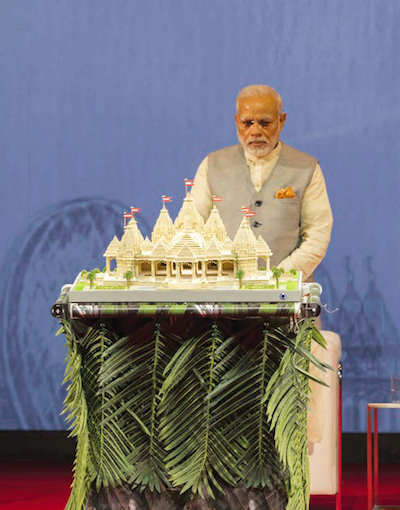
    ABU DHABI (TIP): Prime Minister of India Narendra Modi on Sunday, February 11, inaugurated the BAPS Hindu Mandir model, and thus officially launched the construction of the first BAPS Hindu Mandir in Abu Dhabi, UAE.

    Sadguru Pujya Ishwarcharandas Swami performed the foundation stone laying ceremony of the first Hindu temple in Abu Dhabi to be built on 55,000 square meters of land. The temple will be hand-carved by Indian temple artisans and assembled in the UAE. It is expected to be completed by 2020, and open to people of all religious backgrounds. The temple, inspired by His Holiness Pramukh Swami Maharaj and blessed by His Holiness Mahant Swami Maharaj, will be a significant symbol of global peace and harmony.

    The foundation stone-laying ceremony for the first Hindu temple in the capital of the UAE, home to over three million people of Indian origin was live-streamed to the Dubai Opera House where the PM was interacting with Indian and Emirati dignitaries from all walks of life.

    Speaking on the occasion, Modi thanked the Crown Prince of Abu Dhabi His Highness Sheikh Mohammed bin Zayed Al Nahyan for his generous gift. “I believe this temple will not be only unique in terms of architecture and splendor, but will also give a message of ‘VasudhaivaKutumbakam’ to people across the world,” he said.

    Several thousand devotees from all over the world, well wishers and guests participated in the ShilaPujan ceremony marking the first step in the construction of the traditional stone temple. Representatives of all Indian religious denominations and communities, as well as, representatives of the Jain, Sikh, Muslim, Christian and other faith communities also attended the auspicious ceremony. In particular, Pujya Shri Rakeshbhai, founder of the Shrimad Rajchandra Mission in Dharampur, India, participated in the Vedic rituals.

    Speaking on the occasion, Pujya Brahmaviharidas swami, the spokesperson of BAPS Swaminarayan Sanstha said, “The generous gift of land for a Hindu Temple by the Crown Prince of Abu Dhabi, His Highness Sheikh Mohammed bin Zayed Al Nahyan is a strong and sound message to the world that cultural and spiritual inclusiveness is the way forward for global harmony.”

    Commenting, the Consul General of India, Vipul, said, “This is a historic event, rightly called the millennial moment. The first traditional stone temple built by the BAPS Swaminarayan Sanstha shall serve the needs of the entire community. Closely working with their hundreds of volunteers and saints, I know the selfless spirit with which they dedicate themselves. The temple and its activities shall be path-breaking for promoting love, tolerance and harmony in the UAE and the neighboring regions.”

    Also, Dr BR Shetty, Founder & Chairman of NMC Healthcare and Chairman of UAE Exchange, and a leading member of the temple committee said, “I am speechless. The generosity of the rulers of the UAE, the clarity of India’s Prime Minister and the integrity and ability of the BAPS is incredible.We are soon going to have an iconic temple complex that will serve everyone for generations to come.”

    The temple will incorporate all aspects and features of a traditional Hindu temple as part of a fully functional, social, cultural and spiritual complex. The stones will be carved by temple artisans in India and assembled in the UAE. Expected to be completed by 2020, it shall also include a visitors’ center, prayer halls, exhibitions, learning areas, sports area for children and youths, thematic gardens, water features, a food court, books and gift shop and other facilities.

    Open to people of all beliefs and backgrounds, races and religions, this traditional temple will be a part of the UAE’s mission of happiness and harmony by helping to foster love, tolerance, understanding and peaceful coexistence. It will facilitate the traditional practice of the Hindu faith and serve the over 3.3 million Indians residing in and the millions of international tourists annually visiting the UAE through interfaith dialogue, pluralism and universal human values. It will also nurture the children of today and future generations towards a brighter future.

    Moreover, as a landmark addition to the UAE skyline, the temple will become a beacon of beauty, an oasis of peace, an ocean of spirituality and a home of harmony – a global symbol of faith and friendship.

  • BURJ KHALIFA LIGHTS UP WITH TRICOLOR

    BURJ KHALIFA LIGHTS UP WITH TRICOLOR

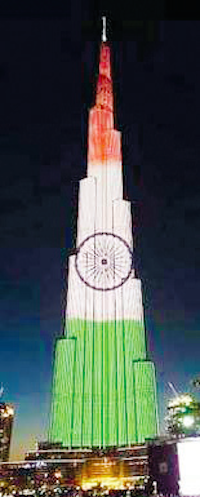
    DUBAI (TIP): Dubai’s iconic skyscraper Burj Khalifa was on Feb 10 lit up in the colours of the Indian flag to mark Prime Minister Narendra Modi’s second visit to the UAE.

    The Indian tricolour was displayed every hour for UAE residents to admire and enjoy, according to the Dubai-based real estate development company Emaar.

    “The Indian flag was showcased on Burj Khalifa on Feb 19 every hour from 7.15 pm to 11.15 pm,” an Emaar representative was quoted as saying by the Khaleej Times.

    The light show will coincide with Modi’s second state visit to the UAE.

    Modi last visited the country in August 2015. On Saturday evening, landmarks in Abu Dhabi and Dubai were also lit up to the colors of the Indian flag.

  • India, UAE sign five pacts as Modi meets crown prince of Abu Dhabi

    India, UAE sign five pacts as Modi meets crown prince of Abu Dhabi

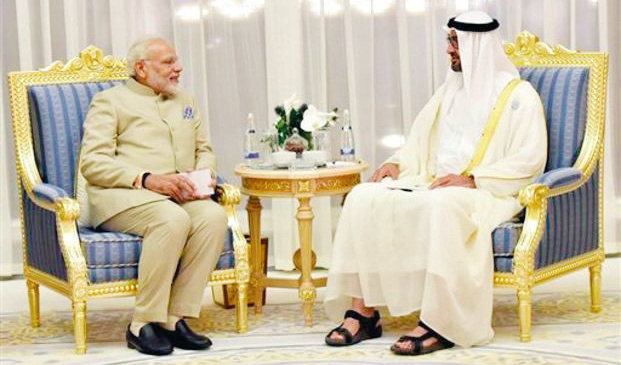
    ABU DHABI (TIP): Prime Minister Narendra Modi held wide-ranging talks with Crown Prince of Abu Dhabi Mohamed bin Zayed Al Nahyan on Saturday as the two sides signed five agreements including a historic pact awarding a consortium of Indian oil companies a 10% stake in offshore oil concession.

    Modi, who arrived in Abu Dhabi from Jordan on the second leg of his three nation tour, was received by Mohammed Bin Zayed and other members of the Royal family at the airport.

    The Prime Minister thanked the Crown Prince for the special gesture of receiving him at the airport and said his visit will have a positive impact on India-UAE ties.

    An MOU between Indian Consortium (OVL, BPRL & IOCL) and Abu Dhabi National Oil Company (ADNOC) was signed for the acquisition of a 10% participating interest in the Abu Dhabi’s offshore Lower Zakum Concession, a statement issued by the Indian embassy here said. The concession will be for 40 years from 2018 to 2057. 60% of the participating interest will be retained by ADNOC and remaining 30% will be awarded to other international oil companies, the statement said.

    “This is the first Indian Investment in upstream oil sector of UAE, transforming the traditional buyer seller relationship to a long-term investor relationship,” it added. To cooperate in the field of manpower, India and the UAE signed an MoU that aims to institutionalise the collaborative administration of contractual employment of Indian workers in the Gulf country.

    Under the MoU, both the sides will work to integrate their labour related eplatforms for ending the existing malpractices, combat trafficking and organise collaborative programs for education and awareness of contractual workers. An MoU for technical cooperation in railways was also signed between the two sides. The MoU aims at cooperation in infrastructure sector especially railways.

    “The MoU will facilitate development of joint projects, knowledge sharing, joint research and technology transfer.

    The MoU envisages formation of a Joint Working Group for institutionalising the cooperation mechanism,” the statement said.

    To deepen bilateral cooperation in the field of finance, an MoU between Bombay Stock Exchange and Abu Dhabi Securities Exchange was also signed. It aims at enhancing cooperation between both the countries in financial services industry. The MoU would facilitate investment in financial markets by investors from both the countries. An MoU between government of Jammu and Kashmir and DP World was also signed to establish multi-modal logistics park and hub in Jammu comprising warehouses and specialised storage solutions.

  • PM Modi’s UAE, Palestine visit in February to focus on counterterrorism, cyber security

    PM Modi’s UAE, Palestine visit in February to focus on counterterrorism, cyber security

    NEW DELHI (TIP): More cooperation in cyber security and counterterrorism initiatives and facilitating more investment in India’s infrastructure sector will top Prime Minister Narendra Modi’s agenda when he visits the UAE next month, said an official familiar with the plans on condition of anonymity.

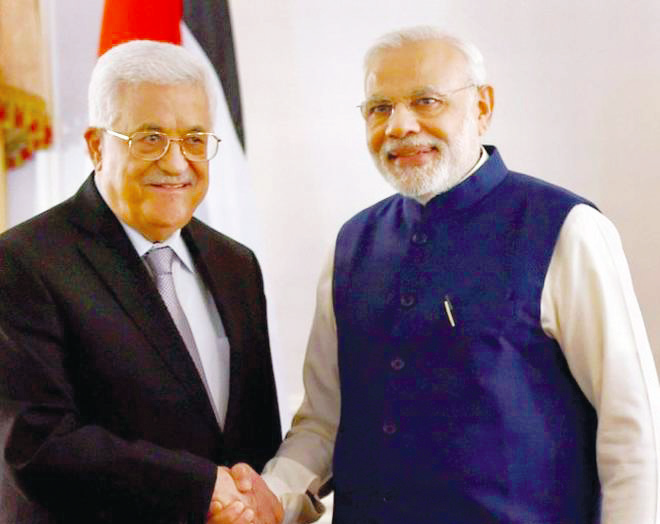
    Modi is likely to visit the Gulf nation on February 10 and 11. He will also visit Palestine en route to the UAE, home to 2.8 million Indian passport holders.

    Modi’s visit to Palestine will come shortly after the visit of Israeli Prime Minister Benjamin Netanyahu to India.

    Modi was the first Indian PM to visit Israel last year, de-hyphenating its relationship with the two countries.

    India and the UAE have put together an ambitious agenda to mark the second visit of Modi to the UAE, with which India has a comprehensive strategic partnership aimed at further strengthening their security and business ties.

    Cyber security is one area both countries have identified for stepping up cooperation, said the official. New Delhi would like to collaborate with the UAE in setting up a cyber security centre in India. The UAE has had a cyber security centre since 2014 that acts as a nodal agency for protecting data, telecom networks, and which works with similar bodies around the world, the official pointed out.

    “Cyber security has emerged as a key area of our bilateral cooperation with other countries. The UAE has some best practices and a centre in this field and the cooperation could be mutually beneficial,” said another official.

    The two sides are also looking at stepping up efforts to disrupt terrorist networks, their financing and movements. In this context, India would like the UAE to help track the properties of people in its wanted list. Facilitating more UAE investment to India remains another focus. The two countries plan to step up the proposed $ 75 billion target for UAE investments in India’s infrastructure development.

    Source: HT