
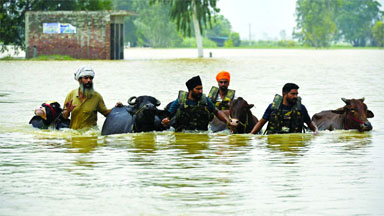

New Delhi (TIP)- Northern India is reeling under one of the worst monsoon seasons in decades, with devastating floods and landslides claiming over 500 lives across Punjab, Himachal Pradesh, Jammu & Kashmir, and Uttarakhand. Rescue teams, backed by the Army and NDRF, continue large-scale operations as rivers overflow, villages remain submerged, and key pilgrimage routes lie buried under debris.
Punjab: Worst Floods Since 1988
Punjab has recorded 43 deaths so far, with six new casualties reported on Thursday. According to state authorities, more than 1,902 villages in 23 districts are inundated, affecting over 438,000 acres of farmland. Gurdaspur remains the worst-hit district, where nearly 1 lakh acres are under water across 329 villages.
More than 3.8 lakh people have been displaced, with 197 relief camps housing evacuees. At least 20,972 residents have been rescued, while extensive damage to standing paddy and maize crops has raised concerns about food security in the agrarian state.
Himachal: Landslides and Torrential Rains
Himachal Pradesh continues to suffer repeated landslides and flash floods. Several incidents in the past week alone have claimed lives, pushing the state’s tally further upward as part of the region-wide toll. Roads, bridges, and hydropower projects have suffered massive destruction.
Meteorologists confirmed that North India is witnessing its second-wettest monsoon in 50 years, with Himachal reporting rainfall 37% above average, triggering slope failures and land erosion in fragile mountain zones.
J& K: Pilgrimage route tragedy and floods
J&K has reported over 130 deaths this season, with two major tragedies intensifying the crisis.
– Vaishno Devi Landslide: On August 26, a massive landslide struck the pilgrimage track near Ardhkuwari, killing 34 pilgrims. Victims hailed from Punjab, Uttar Pradesh, Delhi, Rajasthan, and Haryana. The Shri Mata Vaishno Devi Shrine Board suspended pilgrimages as debris clearance continues.
– Kishtwar Cloudburst: Earlier, on August 14, a cloudburst in Kishtwar district triggered a flash flood that killed at least 67 people, injured over 300, and left around 200 missing. Rescue efforts remain hampered by rugged terrain.
Authorities have announced compensation of Rs 9 lakh for the families of those killed, while a three-member committee has been set up to probe the Vaishno Devi landslide.
Uttarakhand: Flash Flood Wipes Out Village
In Uttarkashi district’s Dharali village, a sudden cloudburst triggered a destructive flash flood that left five dead and over 70 missing. Entire stretches of the village, including 50 hotels, 40 houses, an army camp, and a helipad, were swept away. Eleven soldiers are among those feared trapped.
The disaster has sparked concerns over unchecked construction in ecologically fragile zones.
Environmental alarm and SC warning
The Supreme Court has warned that illegal felling of trees and unplanned development have worsened the scale of devastation in Himachal, Punjab, and J&K. Experts have also linked the abnormal rainfall and recurring cloudbursts to the wider impact of climate change on the Himalayan ecosystem.
Humanitarian Crisis and Relief Efforts
Across the affected states, thousands remain stranded, relief camps are overcrowded, and key highways remain blocked. The Yamuna river in Delhi has also crossed the danger mark, leading to mass evacuations along low-lying banks.
Officials warn that the cumulative impact of the monsoon will continue to unfold in the coming weeks, with infrastructure damage, crop loss, and economic disruption likely to stretch into the long term.



Be the first to comment