
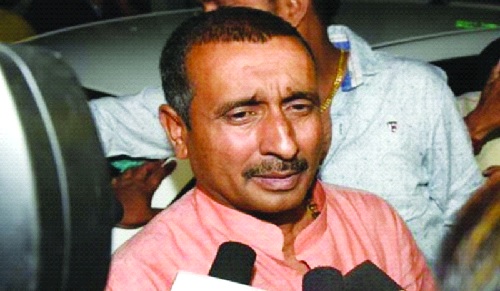

New Delhi/Muscat (TIP)- The Supreme Court on Monday stopped the release of former Bharatiya Janata Party (BJP) lawmaker Kuldeep Singh Sengar, staying a Delhi high court’s order last week that had opened the door for him to walk free and noting that the 2017 Unnao rape case convict was found guilty under both the Protection of Children from Sexual Offences Act (Pocso) and the Indian Penal Code.
A special vacation bench comprising Chief Justice of India (CJI) Surya Kant and justices J K Maheshwari and Augustine George Masih, which was hearing the Central Bureau of Investigation’s plea challenging the high court order, said that substantial questions of law had arisen in the matter that required consideration.
The apex court also issued notice to Sengar, seeking his response within four weeks on CBI’s plea. It noted that Sengar was also convicted and sentenced in a separate case and was still in custody in that matter.
“In the peculiar circumstances of the case, we stay the operation of the impugned order dated December 23, 2025, passed by the high court. Consequently, the respondent (Sengar) shall not be released from custody pursuant to the said order,” the bench said.
The order was hailed by the survivor, who attempted self-immolation outside the Uttar Pradesh chief minister’s residence in 2018 to bring attention to her case. “I have got justice from the Supreme Court. I will not rest until he is hanged. I will keep fighting,” she said.
Sengar’s family voiced discontent over the top court’s order. “We have been stripped of our dignity, our peace, and even our basic right to be heard. Still, I hope for justice,” his daughter, Aishwarya Sengar, said in a statement.
Sengar, a strongman politician from the Unnao region of central Uttar Pradesh, has won the assembly elections four times from three different parties, most recently from Bangarmau in 2017 on a BJP ticket.
In 2019, he was convicted under Indian Penal Code Section 376 (rape) and Section 5(c) of the Pocso Act. A year later, he was convicted under IPC Section 304 (culpable homicide not amounting to murder) over the death of the survivor’s father in custody.
On December 23, the Delhi high court said that Sengar was convicted under Section 5 (C) (aggravated penetrative sexual assault by a public servant) of the Pocso Act but an elected representative did not fit the definition of a “public servant” under Section 21 of IPC. But the top court differed.
“This definition of public servant (given by the HC) in the context of POCSO is a little bit disturbing. We are worried if a constable or patwari will be a public servant but an elected member of a legislative assembly or council who is accused of such an offence, by this definition, will be exempt,” said the bench. The order was passed on an appeal filed by CBI, led by solicitor general Tushar Mehta, who said, “We are answerable to the victim – a child who was 15 years and 10 months at the time of the incident in June 2017 when Sengar was a member of legislative assembly (MLA) in Uttar Pradesh.”
The court also noted the “peculiar” circumstance as Sengar was already in jail after being convicted in the conspiracy to murder the survivor’s father in police custody. Further, the top court observed that the high court may have glossed over the fact that Sengar stood convicted under section 376 (rape) of IPC.
“The high court was not conscious of section 376(2)(i) under which also he was convicted. The conviction is under two penal statutes – IPC and Pocso — but HC proceeds on the premise that conviction is only under one statute,” the bench remarked.
“These are some of the best judges we have…but at the same time, we all are prone to committing mistakes,” the bench added.

Be the first to comment