Tag: Indian-Americans

  • U.S. Reps. Maloney And Meng, Leaders Of South Asian Communities Rally Support

    U.S. Reps. Maloney And Meng, Leaders Of South Asian Communities Rally Support

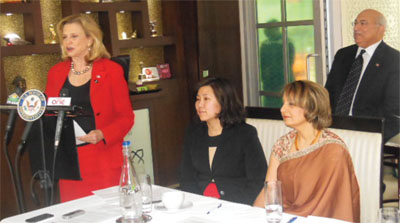
    NEW YORK, NY (TIP): CongresswomanCarolyn Maloney (D-Manhattan andQueens) joined Congresswoman GraceMeng (D-Queens) and South Asiancommunity leaders led by Ranju Batra,President of the Association of Indians in America-NY to rally grass-roots supportto press the Citizens Stamp AdvisoryCommission of the U.S. Postal Service toissue a postage stamp to honor Diwali, the”festival of lights” observed by Hindus,Sikhs, Christians, Jains, and Buddhists inIndia, the United States, and around theworld.

    “Diwali is an important spiritual andcultural festival along with other majorreligious holidays for which stamps areissued, such as Christmas, Kwanzaa,Hanukkah, and Eid, and it merits similarrecognition,” said CongresswomanMaloney.”Diwali – which literally translatedmeans ‘row of lights’ – is a festive andimportant Indian holiday that also signalsthe start of the Hindu New Year. As one ofthe world’s oldest religious holidays, itserves not only as a time for celebration,but also as an occasion for communitiesand families to convene in spiritual enlightenment.

    The practice of Diwali hassurvived political, economic and socialchanges throughout history, while alwayscarrying the universal symbolism of thevictory of light, goodness, knowledge andtruth.” Congresswoman Maloney said.Ranju Batra said “When I took over aspresident of AIA-NY, I set two goals: Tomake the 25th Silver Diwali celebrationshistory-making, and they were, and tolaser-focus on getting the Diwali Stampissued. I asked my dear friend Rep. CarolynMaloney to take the lead in Congress. I amso delighted to see Congresswoman GraceMeng here in person, and to have thesupport of Steve Israel, Ami Bera and Tulsi Gabbard.

    We need everyone who supportsreligious freedom and mutual respectamongst neighbors to sign on. We nowfinally have a strong core group to make ithappen.”Ravi Batra, attorney and chair ofNational Advisory Council on South AsianAffairs who emceed the meeting, added,”The target audience of the Diwali stampisn’t just 3 million Indian-Americans butover 1 billion in India alone. The sale of aDiwali Stamp would be a much-neededsource of revenue for the US Postal Servicein tough economic times. It may reduceUSPS’ need to raise first class rates for all.”

    “The Postal Service has issued stamps forseveral major religious holidays and nowit’s time for them to do the same forDiwali,” said U.S. Rep. Grace Meng. “Creating a Diwali stamp would be anoutstanding way to recognize and celebratethe vibrancy of the Hindu American andIndian American communities, and salutethe traditions and tremendouscontributions that they’ve made to ournation. Diwali deserves its own stamp, andI’m pleased to join my Congressionalcolleagues in urging the Postal Service tocreate one.”Congressman Steve Israel echoed thesentiments of his fellow New Yorkers,saying “I am proud to cosponsor thisresolution urging the Postal Service toissue a stamp that would recognize thefestival of Diwali, commonly known as the’festival of lights.’

    The holiday embodies theessential lessons of good triumphing overevil and embracing one’s inner light. Today,I join my colleagues to call on the Citizens’Stamp Advisory Committee to give Diwalithe recognition it deserves and issue acommemorative stamp.”India’s Permanent Representative to theUnited Nations, Ambassador HardeepSingh Puri and Ambassador LakshamiPuri, Deputy Secretary General, Women atthe United Nations also spoke.Others who addressed the gatheringincluded Mayor Ernie Davis, KamleshArya, a former President of AIA, NY andNew York City Council Member LetitiaJames.

    Indian-American Congressman AmiBera, in his statement, said “Diwali is oneof the world’s oldest religious holidays. Itcelebrates goodness and truth and isobserved by people from differentbackgrounds all across the United Statesand around the world. We should honor itsplace in our country’s tradition of religiousdiversity with a postage stamp, as we havedone for many other religious holidays. “Co-host of the lunch meeting SudhirVaishnav, President and CE of GlobosatEntertainment proposed a vote of thanks.

    Background:Diwali traditionally marks the lastharvest of the year before winter and overtime has come to also mark the first day of the new financial year in India. This”festival of lights” marks the triumph ofgood over evil, light above darkness, andinsight and knowledge over ignorance anddisregard. Diwali is celebrated byadherents of many faiths across the world.Congresswoman Carolyn Maloneyintroduced House Resolution 47 on January25th of this year to urge the Citizens’ StampAdvisory Committee, an entity of theUnited States Postal Service, to issue acommemorative stamp in honor of thefestival of Diwali.

    The bi-partisan and bicoastalresolution is co-sponsored byIndian-American Congressman Ami Bera(CA-07), Hindu-American Tulsi Gabbard,(HI-02), and by several members of the NewYork Congressional Delegation includingRep. Grace Meng (NY-06), Rep. Joe Crowley(NY-14), Rep. Steve Israel (NY-03) and Rep.Peter King (NY-02).Founded in 1967, the Association ofIndians in America is the oldestorganization of Indians in the country. TheNew York chapter is a microcosm of theextraordinary diversity of the Indiancommunity in the New York area, withmembers of all regions and religions ofIndia represented across the tri-stateregion.

    AIA prides itself on its tradition ofopenness and respect for persons of allreligious faiths, with members, as well as awide range of professions, backgroundsand occupations. AIA’s New York chapterperforms countless acts of public serviceand philanthropy, reflecting its motto,”Indian Heritage and Americancommitment.” Indeed, AIA-NY celebratedits history-making 25th Silver Diwali with adinner at the Pierre and the festival at theSouth Street Seaport, the largest suchcelebration in North America.

  • Indian-Americans’ Interest In Lobbying For Indo-Us Ties On The Wane

    Indian-Americans’ Interest In Lobbying For Indo-Us Ties On The Wane

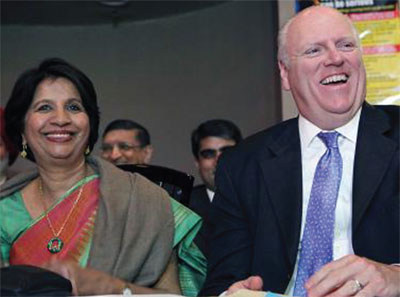
    NEW YORK (TIP): A sharp drop inmembership to the Congressional Caucuson India is sadly indicative of the waninginterest of the Indian-Americancommunity to lobby for closer bilateralties between India and the US.The Congressional Caucus on India andIndian-Americans, which was establishedin 1994 when the ties between the twocountries were still in a nascent phase,had grown to a record 186 members of theUS House of Representatives.For more than a decade theCongressional Caucus was considered tobe a driver of India-US bilateralrelationship, and played a key role in thepassage of the historic civilian nucleardeal.

    However, latest figures reveal thisnumber has dropped to about 110Congressmen, which is mainly becausethere has been no fresh drive from theIndian-American community asking theirrepresentatives to join the CongressionalCaucus on India and Indian-Americans.In the last 112th Congress there were 135members. The numbers have mainlydropped either of retirement or defeat ofprevious members.”It is not lack of interest on part oflawmakers. It is the lack of interest on thepart of the Indian-Americans.

    Lawmakersneed to be reminded. If asked most of thelawmakers are always willing to obligetheir active constituents,” Ashok Mago, aDallas-based prominent community leader,said.Sampat Shivangi, president of the bipartisanIndian- American Forum forPolitical Education (IAFPE) agreed withthe view as well.”India centric issue like civil US-Indianuclear treaty galvanized the Indian-American community, government ofIndia and Indian Embassy which shot upthe India Congressional Caucus numberaround 185 with united efforts of all thesegroups,” Shivangi said.

    “Now there is no burning issue and theenthusiasm has weaned in this process,”he said.In November IAFPE had held aCongressional reception at the Capitol Hillduring which at least three Congressmenannounced their decision to join thecaucus.But in the absence of follow-up fromlocal Indian- American leaders, they areyet to formally join the India Caucus.Shivangi said that there is a need to findother galvanizing issues so that Indian-Americans are motivated to work for thebilateral relationship.

    India’s permanent membership to theUN Security Council could be one, henoted.”This just cause if taken seriouslywould galvanize above said groups to uniteand move forward,” he said.The office of Congressman Joe Crowley,one of the founding members of thecaucus and its current co-chair from theDemocratic Party said that he wasworking on increasing the membership ofthe caucus.”There has been a lot of turnover in thepast few years in Congress (such asretirements), and since there are asignificant number of new members in the113th Congress, Congressman Crowleybelieves this is the perfect time to shareinformation about the caucus with hiscolleagues and encourage them to learnmore about the US-India relationship,”Courtney Gidner, Congressman Crowley’sspokesperson said.

    “He is definitely focused working atgetting a lot more members to join, and isexcited to make it happen,” Gidner said.In the new Congress, Dr Ami Bera, theonly Indian- American lawmaker in thecurrent Congress, and Tulsi Gabbard, theonly Hindu ever elected to the US Congresshave announced their decision to join theCongressional Caucus for India andIndian-Americans.A fresh drive for new membership isexpected to be launched in March, butMago argued it cannot be successful unlessIndian-Americans from across the nationcome out and support it and ask theirrepresentatives to join the caucus.

    Refraining from giving reasons for thissharp drop in the caucus membership,Indian Ambassador to the US NirupamaRao listed out the immense contributionthat India caucus has made instrengthening India US bilateralrelationship.”Over the years, the India Caucuses inboth Houses of Congress have beenincreasingly engaged in pushing forward asubstantive agenda of India-USpartnership, taking up specific issues ofcooperation and common interest fromtime to time, and providing strength andsubstance to the relationship between ourtwo countries,” Rao said.

  • Indian-American Receives Business Award

    Indian-American Receives Business Award

    DALLAS (TIP): AnIndian-Americanbusinessman, AshokMago, has been selectedfor a corporate awardgiven by a US journal.Based out of Dallasin Texas, Ashok Mago,the chairman ofUSINDIA Forum, wasfelicitated with the’Minority BusinessLeader Award’ by theDallas Business JournalFebruary 7 for hisaccomplishments in thefield of business.

    “I guess you canimagine that if I’ve beenliving here for more than38 years that I love this city,” Mago, a recipient of the2010 Pravasi Bharatiya Samman, said after receiving theaward at a function here.The other Indian-Americans who had been selectedfor the award earlier are Pete K Patel, Shaji K Daniel,Krishnakant Dave.The journal, in a statement, said this year’s recipientswere a mixture of corporate executives, businessowners and community leaders.

  • Skilled Immigrants Would Boost Up US Economy: Indian-Americans

    Skilled Immigrants Would Boost Up US Economy: Indian-Americans

    WASHINGTON (TIP):The US must find waysincluding granting moreH-1B visas to attractskilled immigrants toboost its ailing economy,top Indian-Americanexperts have toldlawmakers.

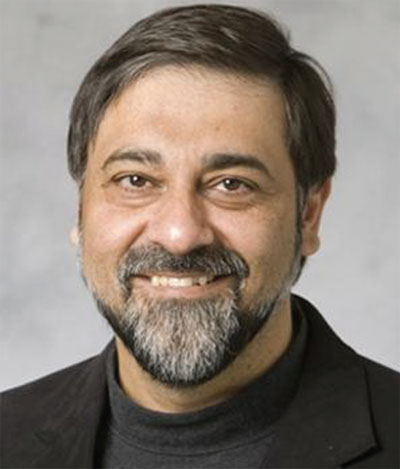
    “If you look at all thedata, every single studythat’s been done, it showsthat when you bringskilled immigrants in theycreate jobs. Right now,we’re in an innovationeconomy. Skilledimmigrants are moreimportant than ever, notonly to create jobs, but tomake us innovative and help us solve major problems,”said Vivek Wadhwa, Director of Research, Pratt School ofEngineering, Duke University.

    “So bring the right people in and you will make the piebigger for everyone, and we can bring in more unskilledas well because we will have a bigger economy. We needthem.

    “The population of America will decline unless we, youknow, keep immigration going, at least at the pace that itis,” Wadhwa told US lawmakers during a Congressionalhearing on immigration convened by the House JudiciaryCommittee.Puneet Arora, vice president, Immigration Voice, saidit’s important to protect American workers and at thesame time have a robust immigration system whereskilled immigrants can come in and fill real needs.”One of the problems that we have today is that we’verestricted the mobility of the skilled workers that comeinto the country.

    They are trapped in jobs for long periodswhere promotions can be denied, where they have no wayof going to another employer that’s willing to offer amarket wage or advancement based on the experiencethat they’ve gained over a period of time and towards theskills that are really required where the demand for jobsis,” Dr Arora said.Prominent among measures pushed by these Indian-American experts included substantial jump in H-1Bvisas, removing country specific caps for legal permanentresidency, automatic green card to those earning mastersand doctorate in science, technology, engineering andmathematics (STEM).

    Arora said the benefits of removing per-country limitswill accrue to only one nation in this world — the US.”Ultimately, we do not care how you fix the system. Wejust want it fixed. Not in five years, not in ten years. Now,this year,” he argued.”We’re extremely encouraged by the introduction of theImmigration Innovation Act of 2013 in the Senate and wereally hope that a similar bipartisan bill will beintroduced in the House. This innovation economy isglobal and the ripe export markets and the foreignprofessionals in America creating products for thesemarkets will not wait forever,” Arora said.

    Responding to a question, Wadhwa argued that the USwas not in a position to lose time on the skills because itseconomy is in a slump. “We’re in the middle of a majorreinvention. Our competitors are rising. Immigrants arefleeing. We have to fix the immediate problem of skilledimmigrants, the million skilled immigrants legally herewaiting for green cards. We don’t talk about them. Weneed to fix that ASAP, and we need to do the other thingsyou’re talking about, without doubt. But we can’t wait onthe million, because they’re leaving. And America isbleeding talent right now,” he said.

  • 55 % Indian-Americans Own House In US, Says Census Bureau Report

    55 % Indian-Americans Own House In US, Says Census Bureau Report

    WASHINGTON (TIP): Indian-Americansmay have the distinction of being thehighest-per capita income group amongethnic communities but they lag far behindtheir European counterparts when it comesto owning a house in the US.According to the ‘HomeownershipAmong the Foreign-Born Population: 2011’,released by the Census Bureau, 55 per centof the Indian-Americans own a house oftheir own while 45 live in rentedaccommodation.Foreign-born owned households with ahouseholder from Europe were the mostlikely to be owned free and clear (40 percent), while foreign-born owned householdswith a householder from Africa were theleast likely to be owned free and clear (14per cent), it said.

    Of the 20 country-of-birth groups withthe largest number of foreign-bornhouseholds in the US, several countriesfrom Europe along with Canada had thehighest homeownership rates.Over 70 per cent of foreign-bornhouseholds with a householder fromCanada (71 per cent), Germany (72 percent), Italy (79 per cent), and the UnitedKingdom (73 per cent) were owneroccupied.By comparison, less than one-third of theforeign-born households with ahouseholder born in the DominicanRepublic (25 per cent), Guatemala (30 percent), and Honduras (31 per cent), wereowner occupied. Italy and Germany werealso among the country-of-birth groupswith the highest percentage of ownedhomes that were owned free and clear.About half of foreign-born householdsthat were owned and had householdersfrom Italy and Germany owned their homesfree and clear (55 per cent and 51 per cent,respectively).

    “Homeownership is a goal shared bymany residents of the United States, bothnative- and foreign-born, citizen andnoncitizen,” said Elizabeth Grieco, chief ofthe Foreign-Born Population Branch at theCensus Bureau.”For immigrants in particular – whomaintain nearly one in seven households inthe US – making the transition from renterto homeowner represents a significantinvestment in the United States,” Griecosaid. This report found that foreign-bornnaturalized citizens were more likely to owntheir homes than foreign-born noncitizens.In naturalized citizen households, 66 percent were owner-occupied.

    That compareswith 34 per cent of noncitizen households.Rates of homeownership among foreignbornhouseholds also increased with timespent in the United States. Among foreignbornhouseholds with a householder whoentered the US before 1980, nearly threefourthswere owned rather than rented.Among households headed by someonewho entered the US since 2000, only onefourthwere owned.According to the brief, just 10metropolitan statistical areas accounted forabout half the nation’s foreign-bornhouseholds in 2011, led by New York andLos Angeles, each of which had more thanone million foreign-born households.Rounding out the top five were Miami,Chicago and Houston. Nearly half, or about45 per cent, of the metropolitan areas in theNortheast, particularly in New York andPennsylvania, exceeded the nationalhomeownership average for foreign-bornhouseholds of 52 per cent.

  • Indian-American Plans Run For Public Office In California

    Indian-American Plans Run For Public Office In California

    HOUSTON (TIP): An Indian American whoas a former US Treasury official oversawdepartment’s troubled Asset Relief Program atthe height of country’s financial crisis isconsidering a run for public office in Californiaas a Republican.Neel Kashkari, 39, announced that he isstepping down from his job as managementdirector for Pacific Investment Management Co(PIMCO), a Newport Beach investment firm.

    The former Goldman Sachs banker expressedan interest in entering public service in California in multiple interviews innewspapers and has launched a website toutinghis biography and leadership bona fides.Kashkari, whose parents Chaman and SheilaKashkari are Indian-Americans from Kashmir,said, “I’m not the typical California Republican.I’m the son of immigrants.

    “Kashkari told the Wall Street Journal. “Icome from modest upbringing. I have asuccessful track record. I’m an optimist. And Ithink something can be done if people worktogether.”Kashkari was a key figure in implementingthe USD 700 billion bank bailout effort, knownas the Troubled Asset Relief Program, duringPresident George W Bush’s second term.He stayed at the department for the start ofBarack Obama’s presidency before leaving tojoin PIMCO in 2009.

  • Indian-American Community Signals Its Coming Of Age

    Indian-American Community Signals Its Coming Of Age

    WASHINGTON (TIP): The ‘Indiaspora 2013 InauguralBall’ organized by the Indian-American community washeld on Saturday, January 19, to celebrate the Secondinauguration of President Barack Hussein Obama. Thiswas the first of its kind event organized and heralded thecoming of age for the community which is estimated tonumber over 3 million strong in the US.”Indian-Americans are tremendously important and wehope they would be increasingly visible not only in thegovernment, but also in all parts of American life,” saidMaya Kassandra Soetoro-Ng,maternal half-sister of Mr.Obama, adding that the President was very proud of thecommunity.

    “It is certainly a reflection of how importantIndia is and how important Indian-Americans are to thefabric of the nation. I would just like to celebrate all of thecontribution artistic, political and so much more of thecommunity,” said Ms.Maya at the first-ever Indian-American inaugural ball.The event was organized by Indiaspora – a recentlyformed organization which aims to be a catalyst totransform the success of Indian-Americans into meaningfulimpact in India and on the global stage.

    “It is time we come to recognize fully the contribution ofthe Indian-American community here,” said Ms.Maya,reflecting the views of Mr. Obama who has the distinctionof appointing the largest number of Indian-Americans inany presidential administration ever.”It is very exciting to serve in an Administration that hasso many great Indian-Americans serving,” said Raj Shah,Administrator of USIAD, the highest ranking Indian-American in the Obama Administration.

    A whopping 84 per cent Indian-Americans voted for Mr.Obama in November’s elections.”I think it is wonderful for the Indian-Americancommunity. It is coming of age, politically for them. This isnot just a ball. This is a massive gala,” said CongressmanJoe Crowley, Co-Chair of the Congressional India Caucus,referring to the hundreds of Indian-Americans who hadgathered at the inaugural ball of the community.

  • India Tourism Woos Indian Diaspora; Incentives And A Conducive Environment Vital To Attract Investments

    India Tourism Woos Indian Diaspora; Incentives And A Conducive Environment Vital To Attract Investments

    KOCHI (TIP): Incentive investors and give them a conducive environment and smoothen the approval processes and witness the surge of investment in the tourism sector, both from overseas and domestic investors. This was the message that tourism professionals conveyed to the Government at a pre-PBD Seminar on Tourism on the occasion of the 11th Pravasi Bharatiya Divas. Mr. A P Anilkumar, Minister of Tourism, Government of Kerala, said that there are immense investment opportunities in the tourism sector and the Indian Diaspora can venture into building of resorts and hotels, destination development, adventure activities, MICE facilities and human resource development. He mentioned that measures must be taken to strengthen the tourism sector in India and assured that he would play an instrumental role in developing the sector.

    Mr. Amitabh Kant, CEO and MD, Delhi Mumbai Industrial Corridor Development Corporation, and former Tourism Secretary, Government of Kerala, said building brand India and putting India on the world tourism map would require focused attention on what he described as the 6Cs – civil aviation development, civic governance, capacity building, constant communication strategy, convergence with other sectors and community participation. Mr. Kant said that India needed to replicate the success of Indian-Americans who have collectively put up 21,000 hotels across America. “The Patels need to set up hotels in this country just as they have done so successfully in their host countries.” The multiplier effect of such investment in hotels in terms of creating jobs and other tourism-related infrastructure would be huge, he pointed out.

    Mr. Alkesh Patel, President, Asian American Hotel Owners Association (AAHOA), USA, underlined the need to tap the expertise of the members of AAHOA in setting up franchisee hotels in India. While commending India’s overseas tourism campaigns, Mr. Patel pointed out that such campaigns are not backed up by commensurate infrastructure, and India is thus unable to provide an experience to tourists that could be converted into a return visit. Mr. K Sudhakaran, Member of Parliament, stated that India is becoming a preferred destination for healthcare tourism as it has top-notch medical facilities with only one-fifth cost compared to the West. But there are some challenges such as poor management, lack of sound marketing strategies, communication gap, bad roads, gap between availability of manpower and supply which are hindering the growth of medical tourism.

    Mr. E M Najeeb, President, Confederation of Tourism Industry, Kerala and CMD, ATE Group, said, “Tourism promotion should be focused on the 30 million strong Indian Diaspora. A mere 5% materialization would change the dimension of Indian tourism. They are high spenders and respect the culture and environment of our country. So they are quality tourists.” He added, “The national carrier Air India should change the policy to focus and take care of the Indian travelers. That would make to the airline profitable. Special packages and programs should be tailor-made for the Indians abroad, particularly the second and third generation PIOs.”

    Mr. Najeeb suggested that tourism promotional campaigns should be aimed at them and called for appointing Indians as tourism brand ambassadors of Indian Tourism. According to a theme paper brought out on the occasion, the emerging new dimensions of tourism include Golf Tourism, Education Tourism, Domestic Tourism, Luxury Trains,Wedding, Eco- Tourism and Tea Tourism. The average growth of global tourism industry is expected to be four per cent during the next 10 years, but the increase is not dispersed equally. Emerging markets, primarily India, contributes a lion’s share of the expansion with an increase of eight per cent. Smaller cities are expected to lead air-traffic growth in the country; the Government is planning to build nearly 200 low-cost airports in the next 20 years in Tier II and III cities.

    This additional aviation infrastructure is likely to be developed through public-private partnership (PPP) model, paving the way for new business opportunities for infrastructure developers. The first phase of growth in the aviation sector was led by low-cost airlines, and the next phase would be driven by lowcost airports. The market size of the Indian medical tourism sector is likely to be more than double and reach USD 2.4 billion by 2015 from USD 1 billion at present. The inflow of medical tourists in India is also expected to cross 32 lakh by 2015 from the current number of 8.5 lakh. Medical travel, health and wellness tourism in India are projected as some of the most important avenues to improve tourism economy.

    The healthtravel industry is increasingly grounded in tourism. Currently, Indian healthcare market is growing at a rate of more than 30 per cent every year. India’s share in the global medical tourism industry is expected to climb to around 2.4 per cent by the end of 2012. India’s competitive edge in Healthcare Tourism is globally recognized with only one-fifth cost as compared to the West, far less or no waiting lines, super specialty hospitals and renowned medical practitioners. The top-notch healthcare facilities like cardiology, joint replacement, orthopedic surgery, transplants and urology are some of the key factors which make India a preferred destination in terms of medical tourism. The states like Andhra Pradesh, Karnataka, Kerala, Tamil Nadu, Maharashtra and Delhi are fast emerging as India’s best medical centers with several hospitals and specialty clinics.

    India is also offering other medical services such as yoga, meditation and ayurveda, which are increasingly becoming popular as alternate, nonsurgical treatments for various ailments. Large numbers of medical tourists visit India from the Middle East, USA, and Europe and also from neighboring countries like Bangladesh, Pakistan and Afghanistan to avail high quality and low cost medical facilities. India’s topmost cities will see an addition of around 50,000 new rooms in the next 5-6 years.

    About 14,800 new hotel rooms are expected to add by the end of 2012, of which 2,000 rooms have already entered the market. The demand has been strong from both foreign as well as domestic tourists.With a total supply of 17,500 rooms in the next five years, the national capital region is expected to see the highest hotel room supply. Mumbai with 10,200 rooms and Bangalore with 9,400 rooms will significantly add to the existing inventory. The addition of new inventory will largely be in the potential growth areas around airports, commercial growth corridors, industrial corridors and special economic zones.

  • 2 Indian-Americans Sworn in as Members of US House of Representatives

    2 Indian-Americans Sworn in as Members of US House of Representatives

    WASHINGTON (TIP): Indian- Americans Ami Bera and Tulsi Gabbard were sworn in as members of the US House of Representatives January 4, much to the delight of the small but powerful community in the country.

    Born of immigrant parents from Punjab, California-based physician Bera is only the fourth Indian American to be a member of the US House of Representatives, while Iraq war veteran Tulsi Gabbard is the first Hindu ever to win Congressional election.

    The 113th Congress commenced on January 3, 2013 with the swearing-in ceremony for newly elected Members of Congress. The new Congress in session till January 3, 2015 has 43 African American members (all but one in the House of Representatives), a record high number of 100 female, seven LGBT members, and one member of the Kennedy family returning to elective federal office after a brief pause from public service from the family.

    Bera, 47, from seventh Congressional District from California and Gabbard, 31, from Hawaii’s second Congressional District, are reflective of the diversity of the new Congress. Both are from the Democratic Party of President Barack Obama. Hindus represent less than one per cent of the current US population.

  • Indian-Americans Meet Lawmakers at Annual Gala

    Indian-Americans Meet Lawmakers at Annual Gala

    WASHINGTON (TIP): Scores of lawmakers from the House and Senate attended a gala organized by an Indian American organization to celebrate the work of the Congressional Caucus for India and Indian Americans. The caucus is considered the largest on Capitol Hill getting bipartisan support from members who across the board consider India a close friend of Washington, and the Indian American community as a model for emulation.

    The gala was organized by the Indian American Forum for Political Education along with other community organizations and included the annual gala appreciation dinner on Nov. 28 as well as a luncheon discussion with Mississippi Republican Senator Roger Wicker, member of the U.S. Armed Services Committee, on Nov. 29, an event IAFPE coordinated with the U.S.-India Security Forum. The gala was held in the Kennedy Caucus Room in the Russell Senate Office Building adjacent to the Capitol building. More than 200 Indian- Americans from around the country listened to the 20-plus Democratic and Republican lawmakers who showed up to speak and pledge support for strengthening bilateral relations with India, Dr. Sampath Shivangi, president of IAFPE told News India Times.

    Shivangi gave the welcome address calling for expanded relations in agriculture, education, and other sectors between the two democracies, thanking those present for supporting the civil nuclear cooperation deal with India, and urging everyone to push for overcoming hurdles in the way of completing the deal. Numerous elected representatives addressed the gathering, among them Senators Ben Nelson, D-Neb.; Mark Warner, D-Va., Democratic co-chair of the Senate India Caucus; Reps. Joe Crowley, D-N.Y., Democratic co-chair of the House India Caucus; Ed Royce, RCalif., co-chair of the House India Caucus and now incoming chair of the House Foreign Relations Committee; Frank Pallone, D-N.J.; Dana Rohrabacher, R-Calif.; Doug Lamborn, R-Colo.; Congressmen Gregg Harper and Alan Nunnelee, both Republicans from Mississippi; and Gus Bilirakis, R-Fla., Royce noted how the India Caucus has become one of the powerful country caucuses on the Hill and its important role during the civil nuclear cooperation treaty.

    Crowley declared India would be Washington’s most important ally in the next decade.Warner praised the Indian American community and emphasized the enormous economic opportunities ahead of the two countries, especially in the energy sector. Nunnelee, a new caucus member said he will be visiting India in February and Bilirakis declared he is becoming a member of the India caucus.

    Other speakers included India’s Deputy Chief of Mission Arun Kumar. Shivangi told News India Times that among several people who helped with the gala reception were IAFPE committee members Satish Korpe and Dr. Ram Singh. At the Nov. 29 seminar entitled “The Indo Pacific Seas: Changes and Challenges for the Indian and US Navies in the 21st Century, held at the prestigious Cosmos Club in Washington, D.C., Sen. Roger Wicker, R-Miss., senior member of the Senate Armed Services Committee, noted the 10-year framework agreement signed between former President George W. Bush and India’s Prime Minister Manmohan Singh in 2005, calling it a solid road map for future collaboration. He also spoke of the rapidly expanding defense cooperation between the two democracies, Raj Kadian, chair of the US-India Security Forum moderated the discussion.

  • Us Senators Introduces Resolution Celebrating Diwali

    Us Senators Introduces Resolution Celebrating Diwali

    WASHINGTON (TIP): Two top American Senators have introduced a resolution in the US Senate recognizing the religious and historical significance of Diwali festival. Senators Mark Warner and John Cornyn, co-chairs of the US Senate’s bipartisan India Caucus, have introduced the resolution in observance of the festival of lights, expressing deepest respect for Indian Americans and South Asian Americans, as well as fellow countrymen and diaspora throughout the world on this significant occasion. “As co-chair of the Senate India Caucus, I am pleased to sponsor a resolution celebrating this important holiday for the Indian people and Indian-Americans,” Warner said. “India is the world’s largest democracy, which makes our countries and our people natural partners. It’s a relationship based on shared values, and its one I’d like to continue to grow,” he said. “Diwali’s message of tolerance, compassion, and the victory of good over evil resonates with the American spirit,” Cornyn said. “As Hindus, Sikhs, Jains, and others come together to celebrate this festival of lights, let us all be reminded, as Americans, of one of our most cherished freedoms: the freedom of religion,” he said in a statement. Diwali is a festival of lights that marks the beginning of the Hindu new year, during which celebrants light small oil lamps, place the lamps around the home, and pray for health, knowledge, peace, wealth and prosperity, the resolution notes. The lights symbolise the light of knowledge within the individual that overwhelms the darkness of ignorance, empowering each celebrant to do good deeds and show compassion to others, it said. Diwali falls on the last day of the last month in the lunar calendar and is celebrated as a day of thanksgiving for the homecoming of the Lord Rama and worship of Lord Ganesha, the remover of obstacles and bestower of blessings, at the beginning of the new year for many Hindus, it added.

  • Indian-Americans Elected To House Of Representatives

    Indian-Americans Elected To House Of Representatives

    WASHINGTON (TIP): Dr Ami Bera becomes the third Indian-American ever to be elected to the US House of Representatives, after Dalip Singh Saund, elected in 1950’s and Governor of Louisiana Bobby Jindal who was a House member from 2005 to 2008. Bera, 45, had a lead of just 184 votes against his Republican rival and incumbent Dan Lungren, when all the votes were counted for the Seventh Congressional District in California. But the Secretary of State, California put the results in the category of “Close Contest”, in which there is less than a two per cent difference between the first and second place for candidates or between yes and no votes for ballot measures.

    According to the Office of the Secretary of State, California, Bera had received 50.1 per cent of the total votes counted, while Lungren had received 49.9 per cent of the votes. Bera received 88,406 votes, while Lungren got 88,222 votes. Bera whose parents migrated to the US some 50 years ago was endorsed by charismatic Bill Clinton, the former US president, last month who campaigned for him. Bera had outraised his opponent in fund raising.

    Born and raised in Southern California, Dr. Bera served Sacramento County as Chief Medical Officer before becoming a Clinical Professor of Medicine and Associate Dean for Admissions and Outreach at UC Davis. Ami and his wife Janine live in Elk Grove with their daughter, Sydra. Tulsi Gabbard is the first Indian American woman and the first Hindu woman to win an election to House of Representatives. 31-year-old Gabbard defeated K. Crowley of the Republican Party with a handsome margin in Hawaii’s second Congressional district. Her victory has been cheered by the Hindu-American community across the country. The heavily Democratic district also elected one of two Buddhists to have ever served in the Congress, Mazie Hirono, who won her seat in 2006 but is now running for the US Senate.

    Born in American Samoa to a Catholic father and a Hindu mother, Gabbard moved to Hawaii when she was two

    In 2002, at age 21, she was elected to the Hawaii state legislature. The next year, she joined the Hawaii National Guard, and in 2004 was deployed to Baghdad as a medical operations specialist. After completing officers’ training, she was deployed to Kuwait in 2008 to train the country’s counterterrorism units. “Although there are not very many Hindus in Hawaii, I never felt discriminated against.

    I never really gave it a second thought growing up that any other reality existed, or that it was not the same everywhere,” Gabbard said in a statement soon after she took an unbeatable lead over her Republican challenger. “On my last trip to the mainland, I met a man who told me that his teenage daughter felt embarrassed about her faith, but after meeting me, she’s no longer feeling that way,” Gabbard said.

    “He was so happy that my being elected to Congress would give hope to hundreds and thousands of young Hindus in America, that they can be open about their faith, and even run for office, without fear of being discriminated against or attacked because of their religion,” Gabbard said. At 21, Gabbard became the youngest person elected to the Hawaii legislature.

    At 23, she was the state’s first elected official to voluntarily resign to go to war. At 28, she was the first woman to be presented with an award by the Kuwait Army National Guard. She is a deeply committed Vaishnava Hindu who is a strict vegetarian and is very knowledgeable about the Bhagavad Gita. She has also served with distinction as an officer of the US Army – twice, in Iraq and Kuwait.

  • The United States and India: A Vital Partnership in a Changing World

    The United States and India: A Vital Partnership in a Changing World

    The issue that I’ve been asked to address today — India’s rise and the promise of U.S.-Indian partnership — is one of those rarest of Washington species, especially ten days before a Presidential election, a genuinely bipartisan policy priority. I have been fortunate to play a small role in building our relationship with India over the past five years, spanning two U.S. Administrations, including the completion of the historic civil nuclear agreement by then-President Bush and Prime Minister Singh in 2008, and the landmark visits of Prime Minister Singh to the U.S. in 2009 and President Obama to India in 2010. I just returned from another visit to New Delhi, at the end of a fascinating trip across Asia, surely the most consequential region of the world in the new century unfolding before us.

    I remember well all the questions that spun around our relationship four years ago, as the Bush Administration gave way to the Obama Administration. Would we “re-hyphenate” relations with India, and see India mainly through the prism of preoccupations in Afghanistan and Pakistan? Would we be tempted by visions of a “G-2” world, subordinating relations with India to the significance of a rising China? Would India see as clearly as others how important its role in the world was becoming, and see beyond its G-77 past to its G-20 future? Would Indians embrace the rising responsibilities that come with rising influence?

    Debates were held. Papers were written. Hands were wrung. But together we’ve largely moved beyond those honest questions and concerns. Of course some suspicions linger, and some differences persist, which is only natural. Of course we have a great deal more work to do. But there is growing confidence in both our countries about what my longtime colleague and friend, India’s National Security Advisor Shivshankar Menon, has recently described as a steady convergence of interests and values. Indians and Americans, it seems to me, understand that the only “hyphen” we will pursue with respect to our relationship is the one that links the United States and India.

    The essence of the vital partnership that we’re building lies in a simple truth. For the first time, for both of us, our individual success at home and abroad depends significantly on our cooperation.

    Progress between us won’t always be measured in dramatic breakthroughs, like President Bush’s civil-nuclear initiative, or dramatic moments, like President Obama’s declaration of support for India’s permanent membership in a reformed UN Security Council. It won’t be measured in diplomatic honeymoons which never end. It won’t be measured in some special alchemy that magically transforms strategic convergence and powerful aspirations into meaningful cooperation.

    The real measure of progress in our increasingly vital partnership will instead be steady focus, persistence, hard work, systematic habits of collaboration, and methodically widening the arc of common interests and complementary actions. With that in mind, let me highlight quickly three important dimensions of the work — and the promise — that lies ahead of us: strengthening strategic cooperation; building shared prosperity; and deepening people to people ties.

    I. Strategic Cooperation

    First, as India’s recent economic rise has expanded its role and deepened its stake in shaping the international system, we are counting on India’s rise as a truly global power — one that looks east and west, a strategic partner for economic growth, security, and the provision of public goods.

    Last December in Pune, I spoke to Indian international affairs students. I told them that the U.S.-India relationship must be a cornerstone of the Asia-Pacific century ahead. And as the world’s economic and strategic center of gravity shifts east, the United States is not the only nation emphasizing its role as a resident diplomatic, economic and military power in the Asia-Pacific. India’s distinguished former Foreign Secretary, Shyam Saran, has also observed that India’s own engagement in East Asia reflects “the concept of the Asia-Pacific, which hitherto excluded India, expanding westwards to encompass the subcontinent as its integral part.”

    India and the United States have a powerful and shared interest in an Asia-Pacific where economic interdependence drives growth and shared prosperity … where disputes are resolved peacefully… where rules are respected and patterns of political and economic behavior favor openness. So we are working to define a shared agenda to help achieve and assure those goals.

    India has shown increasing signs that it intends to build on its longstanding “Look East” policy. I came away from my recent visits to India and Burma with renewed admiration for the East-West connectivity agenda India’s leadership is advancing across Southeast Asia. India is revitalizing centuries-old commercial ties with countries to its east and making headway on an Indo-Pacific corridor through Bangladesh and Burma that connects South and Southeast Asia.
    India just hosted the Mekong-Ganga ministerial meeting and held 2+2 consultations with Japan, and next week will host the U.S. and Japan for trilateral consultations. The ASEAN-India Summit will come to New Delhi this winter. Some may dismiss India’s efforts to become more embedded in the regional diplomatic architecture of the East Asia Summit, ASEAN Regional Forum and APEC as maybe good for India’s hotel industry, but really just so many talk shops. But consider this: last week, India’s External Affairs Minister was in Brunei celebrating $80 billion in India-ASEAN trade this year — up 37% in the last year alone. We should all find talk shops as profitable as these.

    We all obviously also have to keep a very careful eye on less promising trends across the region, and the revival of old animosities that can quickly undermine the promise of economic interdependence and easy assumptions about shared prosperity. Recent frictions in both the East China Sea and the South China Sea are a sobering reminder of how fast nationalism and maximalism can rear their heads. All that should simply reinforce the interest of the U.S. and India in encouraging dialogue and diplomacy, instead of intimidation and coercion.

    Looking westward, both the United States and India have a strong interest in a peaceful, stable future for Afghanistan. The same week the U.S. and Afghanistan signed the Strategic Partnership Agreement in May, New Delhi hosted the inaugural meeting of the India-Afghanistan Partnership Council and in a few weeks President Karzai will pay a return visit to Delhi. India and the U.S. share a long-term commitment to pursue sustainable economic growth, strong democratic institutions and an Afghan-led process of peace and reconciliation — commitments reflected in the first United States-India-Afghanistan trilateral dialogue in September.

    For our part, the United States will lead a security transition in — not a departure from — Afghanistan. As Secretary Clinton has made clear, none of us can afford to repeat the mistakes that followed the Soviet exit from Afghanistan. With coalition forces drawing down, Afghanistan will need massive private investment and far greater economic linkages to its neighbors.

    India has committed more than $2 billion in development assistance to Afghanistan since 2001, building on ties that go back to the early Indus Valley civilizations. Even without direct access to India’s growing markets, Afghanistan already sends one quarter of its exports to India. Extending trade and transit agreements outward to India and Central Asia will allow Afghan traders to return to the marketplaces of Amritsar and Delhi. In June, when India hosted its own investment conference with Afghanistan, attendance far outstripped expectations, reminding us how organic these connections are. There has also been good progress on the proposed Turkmenistan-Afghanistan-Pakistan-India (TAPI) pipeline, though a great deal of work still lies ahead. The vision of a “New Silk Road” is not a single path, it is a long-term vision of economic, transit, infrastructure and human links across Asia. And India is its natural engine.

    Deeper defense and security ties have become another leading indicator of a burgeoning strategic partnership. As India’s military influence grows, our hope is that our partnership can become one of our closest in the region. We are united by our experience of tragedy and terror, shared threats in Afghanistan and a shared vision for a peaceful and open Asia-Pacific. We are proud of our robust counterterrorism cooperation, which simply didn’t exist until a few years ago — and now extends to all levels of policy and law enforcement.

    Since 2008, India has bought over $8 billion in U.S. defense equipment, up from effectively zero less than a decade ago. When we complete delivery of India’s $4 billion in C-17 aircraft, our combined fleet will represent the largest air lift capability in the world. These are indispensable assets for global response to crisis and disaster; last year’s delivery of the C-130J Hercules came just in time for rescue operations after the Sikkim earthquake. Our military services conduct some of their largest joint exercises with India, including over fifty formal engagements in the past year. As our defense relationship evolves from “buyer-seller” to co-production and joint research, we will be ambitious, and we ask India to be equally ambitious in sharing this vision of a new security partnership with the United States.

    As our partnership matures, we will continue to seek India’s help in building what Secretary Clinton has called “a global architecture of cooperation.” While it is true that the international architecture has sometimes struggled to keep up with the emergence of a rising India, it is equally true that India has sometimes bristled at the burdens of global leadership. Both need to change, and both, I would argue, are changing. As President Obama said in his 2010 address to the Indian Parliament, the United States looks forward to “a reformed UN Security Council that includes India as a permanent member.”

    But India is not waiting for a permanent seat to begin exercising leadership. The list of India’s global contributions is long and growing: deep engagement in the Global Counterterrorism Forum … tough votes at the IAEA against Iran’s failure to meet its international obligations, and a lowering of dependence on Iranian crude … election support in Egypt … and peacekeepers around the globe. In the UN Human Rights Council, India made a powerful call for enhanced efforts to achieve reconciliation and accountability in troubled Sri Lanka. While we certainly don’t agree on everything, or see eye-to-eye on every issue, what matters is that India is continuing to use its resources and standing to help others enjoy the peace, prosperity and freedom its own people have worked so hard to achieve for themselves.

    II. Shared Prosperity

    The second critical area of cooperation is economic, consistent with Secretary Clinton’s greater emphasis on economic statecraft in America’s relationships around the world. But in this case, it is also a reflection of India’s vast potential and the realization that America’s and India’s long-term economic interests are essentially congruent and mutually reinforcing.

    Each of us is eager to put to rest questions about our economic staying power. In America, we obviously have to continue to put our own economic house in order. India has seen currency devaluation and high inflation, and its economic growth has slipped. We can and must help each other grow, and prove our doubters wrong.

    India’s modernization and the lifting of hundreds of millions of its own citizens out of poverty rightly remains the focus of the Indian government. In this endeavor, India has no more important partner than the United States. Our total direct investment in India in 2000 was $2.4 billion. By 2010, it was $27 billion. By the way, over roughly the same time period, the stock of Indian direct investment in America grew from a little over $200 million to nearly $5 billion – more than a twenty-fold increase. So we have literally never been so invested in each other’s success.
    Our economic relationship is very much a two-way street. Both of us are focused on attracting growth and investment to our shores. An Indian-owned Tata factory in Ohio puts thousands of Americans to work, part of the over 50,000 jobs Indian firms have created in the United States. And the opportunities for small, medium and large American businesses in India are staggering. While it’s well-known that India is projected to be the world’s third-largest economy by 2025, what is less well-known is that 90% of India is still without broadband; that 80% of the India of 2030 hasn’t yet been built, according to McKinsey; that India plans to invest one trillion dollars on infrastructure in the next five years alone. That is why Maryland Governor Martin O’Malley visited India, and came back with $60 million in two-way business. That is why Kentucky Governor Steve Beshear visited India three times and helped bring about a $7 billion private sector energy deal. That is why Norfolk has a sister-city alliance with Kochi in Kerala that has helped Virginia export nearly $300 million in goods to India each year.

    Of course, for our companies to provide the technology and expertise to help India prosper, India’s government must create an environment that encourages growth. That is why India’s recent easing of some restrictions on Foreign Direct Investment are so promising. Indian multi-brand retail, aviation, power grid and broadcasting companies and markets will be more open to investment, technologies, and best practices from all around the world. It will be easier to bring food to market. India’s Commerce Ministry estimates these changes will create 10 million jobs for its young and growing population. As encouraging as these changes are, we all know there is more to do to bring predictability to the Indian market — for India’s sake and for the sake of our economic relations.

    Greater economic openness is not a concession to the United States. It is one of the most powerful tools India has to maintain and expand its growth. In New Delhi last week, I urged my Indian counterparts to address non-tariff barriers, favoritism for local companies, restrictions on foreign investment and intellectual property protection — because progress and predictability will only shore up India’s economic foundations.

    So will a U.S.-India Bilateral Investment Treaty. We are aiming for a high-quality agreement that expands on recent reforms to provide still greater openness to investment; strong rules to protect investors and guarantee transparency; and effective means for resolving disputes should they arise.

    So will the Infrastructure Debt Fund, a consortium of Indian and American corporations and banks — created by the U.S.-India CEO Forum to finance India’s massive investment in roads, grids, seaports, airports and all the necessary building blocks of a modern economy.

    And so will a steady supply of energy. The Civil-Nuclear Initiative still holds remarkable promise for the people of India and the United States. Without diminishing the very real and often frustrating challenges we have faced, both our governments are now engaged in realizing the practical benefits of the civil-nuclear agreement, especially reliable electricity for India’s homes and businesses. Our companies are making good headway in negotiations with their Indian counterpart to complete pre-early works agreements by the end of this year. In June, Westinghouse and India’s Nuclear Power Corporation took important early steps that will lead to Westinghouse nuclear reactors in Gujarat. We hope General Electric can follow suit. The Indian government has clearly indicated that nuclear energy will remain an important part of India’s energy equation, and we are equally committed to expanding cooperation in other areas, from wind and solar energy to natural gas and biofuels.

    Of course, there is still more we can do. If we do not seize these economic opportunities, others will, and we will fall behind. Japan, Canada and the European Union are all moving to open up trade with India. Our goal should be to think ambitiously about the opportunities we can offer our businesses — including our small business and globalized entrepreneurs — through deepened economic engagement with India.

    III. People-to-People

    As important as economic resources and capital are, India has no greater resource and no richer source of capital than its own people. That brings me to my third area of cooperation: people-to-people ties. Some might think this “soft” or besides the point with hard security issues at stake. Diplomatic and economic dialogues are critical, but they are not enough for a twenty-first century friendship like ours. As Secretary Clinton has said, our greatest friendships have never been confined to the halls of power. They live also in the aspirations and interactions of our people. The phrase “people to people” actually covers tremendous ground in our relationship: science and technology, educational exchange, civil society engagement and innovation. The organic growth of people-to-people ties is what has set the pace in our relationship for many years, and our governments are only now catching up.

    The talents of the Indian diaspora are creating wealth from Calcutta to California. At a time when Indian immigrants comprised less than 1% of America’s population, they founded more than six percent of America’s startups, and over thirteen percent of the startups in Silicon Valley that powered our economy through the 1990s. We can all be proud of the successes of Indian-Americans in the U.S. and their contributions in boardrooms, classrooms, laboratories and now in the governor’s offices of South Carolina and Louisiana.

    We support student exchanges because we know from experience that today’s participants become tomorrow’s constituents for a strong U.S.-India relationship — from business leaders like Ratan Tata, educated at Harvard and Cornell; to statesmen like India’s External Affairs Minister, SM Krishna, a Fulbright Scholar who studied at Southern Methodist University in Dallas and George Washington University just up the street.

    In 2011, we held a U.S.-India Higher Education summit to usher in a new era of government support for people-to-people ties. 100,000 Indian students study in the U.S. every year, and we created a program called “Passport to India” to increase the numbers of young people heading in the other direction to learn and serve. A common determination to educate our children is one more tie that binds America and India together.

    And when tragedy strikes, as it did last August at a Sikh Temple in Oak Creek, Wisconsin, we come together to mourn and to heal. American police officers risked their lives to stop the gunman before he could do any more harm. The President personally reached out to India and to Indian-Americans, calling the Sikh community, “a part of our broader American family” and ordered flags to be flown at half-staff at every U.S. federal building in America and every U.S. mission around the world. The First Lady went to Wisconsin to show her support in person. The powerful response to this tragedy showed the very values of tolerance that the gunman sought to threaten. These, too, are values that Indians and Americans share.

    Conclusion

    While the potential of our bilateral relationship is limitless, I want to assure you that my remarks this morning are not.

    Much is possible as we deepen strategic cooperation and strengthen our economic and people-to-people ties. But we have to tend carefully to our partnership. Further progress is neither automatic nor pre-ordained. Keeping a partnership on track between two proud, noisy democracies takes vision and steady commitment. It’s a little like riding a bike; either you keep peddling ahead, or you tend to fall over.

    I remain an optimist about what’s possible for Indians and Americans. The truth is that there has never been a moment when India and America mattered more to one another. And there has never been a moment when partnership between us mattered more to the rest of the globe. As two of the world’s leading-democracies and most influential powers, we can help build a new international order — in which other democracies can flourish, human dignity is advanced, poverty is reduced, trade is expanded, our environment is preserved, violent extremism is marginalized, the spread of weapons of mass destruction is curbed, and new frontiers in science and technology are explored. That is the moment, and the promise, which lies before us.

    (Speech delivered by US Deputy Secretary of State William J. Burns at Center for American Progress, Washington DC October 26, 2012)

  • Flushing Saibaba temple  to hold Gita discoursea

    Flushing Saibaba temple to hold Gita discoursea

    NEW YORK (TIP): The Saibaba temple on Robinson Street in Flushing, Queens is organizing a program on the Bhagavad-Gita on September 22, according to information given out by the temple management.

    The discourse will be given by Swami Bodhananda Saraswati, the spiritual founder-director of the Sambodh Society, which is incorporated in the US.

    The swami is popular both in the US and India, and has written commentaries and delivered spiritual talks focusing on the Gita and other holy texts. He was born in Mattatur, Kerala, about 50 kilometers from Kalady village, the birthplace of Adi Sankaracharya-the great Indian philosopher of the Eighth Century and the best-known exponent of the Advaita philosophy. The swami has been spiritually inclined since his childhood and decided to lead a life of sanyasi in later years. He earned his bachelor’s degree in economics from Christ College, Irinjalkuda, Kerala. It was during the time when he was studying for his master’s that the swami decided to take the spiritual plunge.

    The swami began his spiritual journey to the US in 1997. New York was one of his first stops, along with Michigan, Illinois and California. After that visit the swami and his disciples incorporated The Sambodh Society, a non-profit and religious, charitable organization to teach meditation and vedanta to Indian-Americans and Americans at large.
    Since that first visit to the US, the swami has visited the country every year. Aside from his teachings to the public, the swami taught himself about the culture and traditions of different peoples of the New World through reading and observing.

    The year 2000 was a turning point when the swami made his most extensive tour of the US and Canada visiting devotees in more than 25 cities. In November a 32-acre parcel of land near Kalamazoo, Michigan, was bought on which the swami’s first center and headquarters in the US was set up.

    The swami gave discourses not only in Hindu temples, but also in Christian churches. Libraries, homes, workplaces and educational institutions have also played host to his spiritual talks, which generally focus on the Gita and the Upanishads.

    At the Saibaba temple in Flushing, the swami will speak on the Gita and answer queries of devotees with his engaging conversation laced with lively humor. He will also talk about applying the age-old tenets in the holy book to the modern-day context. The program is scheduled for Saturday, September 22 in the afternoon/evening.

    The two-session program begins at 4:30PM with a half-hour break at 6:30PM, according to the temple.

  • Indian-American Forum offersinternships in USCongress and WH

    Indian-American Forum offersinternships in USCongress and WH

    TAMPA, FL (TIP): An Indian-American forum has announced internship program for young members of the community in the US Congress and the White House with the aim of creating political awareness among them.

    Noting that while there are two Indian-American Governors – Nikki Haley and Bobby Jindal – there has not been much community representation in the Congress, the Indian-American Forum for Political Education (IAFPE) has said that it is time for more political awareness and participation among younger members of the community.

    “Internship program at the US Congress and the White House would help us achieve this goal,” IAFPE president Dr Sampat Shivangi said while announcing the internships. At its meeting in Tampa on September 8 to launch the Florida chapter of IAFPE, Dr Shivangi also announced programs to promote voter registration and encourage Indian- Americans to exercise their rights to vote and run for public offices. Inaugurated by the Deputy Indian Ambassador to the US, Arun Singh, IAFPE meeting also announced Student Ambassador Program for Indian-American students to visit India in association with Indian Embassy in US to maintain their Indian identity. Speaking on the occasion, Singh said that India-US relations have matured in last few years. The bi-lateral trade between to democracies has now touched USD 100 billion.

    India and US are natural allies as described US President Barack Obama and the Secretary of state Hillary Clinton, Singh said. Tulsi Gabbard, the Democratic Party Congressional candidate from Hawaii, was one of the guest speakers. Congressman Gus Bilirakis emphasized the contributions Indian-Americans have made in the US. The Congressman promised to join as a member of Indian Caucus in US Congress.

    Speaking on the occasion, the former Indian Ambassador at Large for Non-resident Indians, Bhishma Agnihotri, traced the history of Indian Immigrants and their contributions in the field of Medicine specifically by American Physicians of Indian Origin. (Agencies)