Tag: India’s Top Story This Week

  • India celebrates 68th Republic Day showcases military might, rich cultural diversity

    India celebrates 68th Republic Day showcases military might, rich cultural diversity

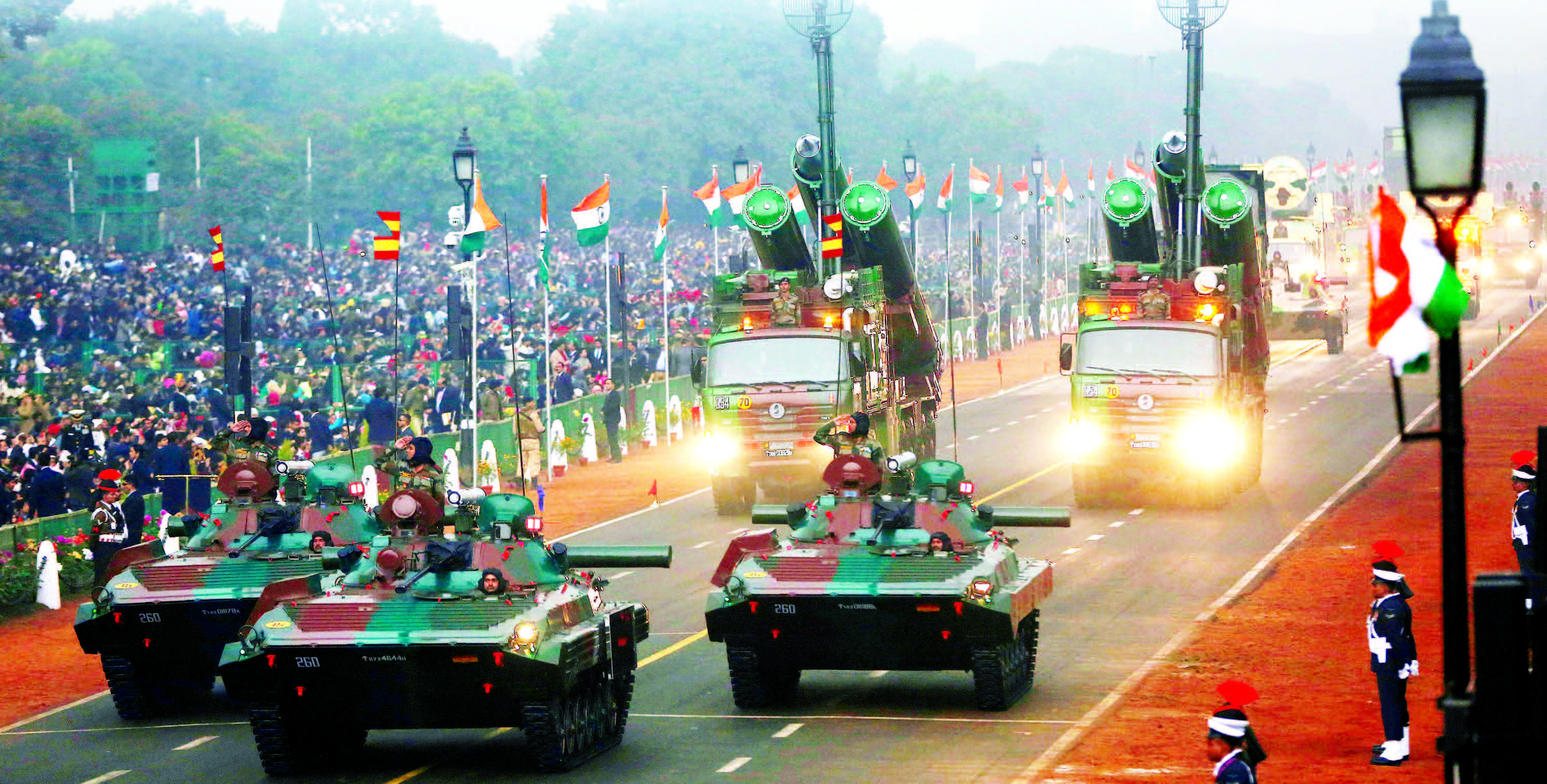
    he majestic Rajpath saw a scintillating display of India’s military might and resplendent cultural diversity as the country celebrated its 68th Republic Day January26, with the Crown Prince of Abu Dhabi Sheikh Mohamed bin Zayed Al Nahyan attending the event as guest of honor. Light rain and overcast skies failed to dampen the enthusiasm of thousands of spectators who watched the nearly an hour-and-half-long parade along the imposing

    Rajpath, India’s ceremonial boulevard. A major highlight of the parade was 149-member marching contingent from UAE comprising personnel from Presidential Guards, the Air Force, the Navy and Army, led by a band comprising 35 musicians from the Gulf country with which India’s defense and security ties are on an upswing.

    Al Nahyan, also Deputy Supreme Commander of the UAE armed forces, was seated next to Prime Minister Narendra Modi who wore a pink colored ‘safa’ (turban). The two leaders were seen sharing some light moments.

    Alongside the Crown Prince, the ceremonial parade was watched by Vice President Hamid Ansari, former Prime Minister Manmohan Singh, Congress chief Sonia Gandhi and the country’s top political and military brass, besides the diplomatic community.

    TEJAS, NSG MAKE DEBUT

    In a first, the ‘black cat’ commandos of the elite counter-terror force National Security Guard (NSG) participated in the parade which drew loud cheers from the spectators.

    A number of weapons systems and aircraft including the Tejas light combat jets and the Airborne Early Warning and Control System (AEW&C) developed by DRDO were on display, showcasing India’s military prowess.

    The Indian Army’s missile firing T-90 ‘Bhishma’ tank, Infantry Combat Vehicle BMP-2K, Mobile Autonomous Launcher of the BrahMos Missile System, Weapon Locating Radar ‘Swathi’ and Akash Weapons System, and Dhanush artillery guns were among the main draw in the mechanized columns. President Pranab Mukherjee took the salute of marching contingents.

    The splendid driving skills of ‘Dare Devils’–the MOTORCYCLE acrobatics team of Corps of Military Police was a major attraction of the parade. They performed breathtaking man oeuvres like Salute to President, Ladder, Double Bar, Lotus, Christmas Tree, Aircraft, Sudarshan Chakra, Flower Pot, Pyramid and Wheeling on moving motorcycles.

    SPECTACULAR SHOW BY AIR FORCE

    The ‘Netra’, an Airborne Early Warning and Control System aircraft also known as “Eye in the Sky” was one of the major attractions.

    It was followed by the ‘Globe Formation’ comprising one C-17 Globemaster flanked by two Su-30 MKIs. Next in line were the fighters, with five Jaguars fling in arrowhead formation, while five MiG-29 fighters darted through the sky in fulcrum style.

    It was followed by the breathtaking ‘Trishul’ formation comprising three Su-30 MKIs.

    The flypast concluded with another Su-30 MKI carrying out a ‘Vertical Charlie’ maneuver over the saluting dais. The ceremony concluded with the national anthem and release of colorful balloons.

    The theme of IAF tableau was “Air Dominance Through Network Centric Operations” and it displayed the scaled down models of Su-30 MKI, Mirage-2000, AWACS, UAV, Apache and Communication Satellite.

    The grand finale of the parade was a spectacular flypast by the Indian Air Force which displayed various formations like ‘Chakra’ and ‘Vic’ leaving spectators spell-bound. The ‘Hercules’ formation comprising three C-130J Super Hercules aircraft also drew loud cheers.

    CULTURAL HERITAGE ON FULL DISPLAY

    Tableaux from 17 states and Union Territories and six central ministries and departments showcased the varied historical, artistic and cultural heritage of the country. Interestingly, Goods and Services Tax (GST) was the theme of the tableau of Central Board of Excise and Customs.

    Tableaux from states, Union Territories and Union ministries presented the historical, artistic and cultural heritage of the country.

    Floats from Goa, Gujarat, Odisha, West Bengal, Assam and Jammu and Kashmir showcased the country’s progress in different fields.

    In the children’s pageant section, about 600 boys and girls drawn from three schools in Delhi and a group of school children from South Central Zone Cultural Centre, Nagpur, performed colorful dances on varied themes.

    The Indian Navy’s tableau showcased the lethal Marine Commandos proceeding for action, the indigenously built Kolkata Class Destroyer and the Kalvari Class next generation attack submarines. It also showcased a model of the P-8I Long Range Maritime Patrol Aircraft.

  • Welcome to Pravasi Bharatiya Divas 2017 at Bengaluru

    Welcome to Pravasi Bharatiya Divas 2017 at Bengaluru

    Pravasi Bharatiya Divas 2017 at BengaluruTHE CONVENTION WILL FOCUS ON DIASPORA ACHIEVEMENTS


    TIP Correspondent BENGALURU: The curtains are ready to be raised on the 14th edition of the Pravasi Bharatiya Divas being held at Bengaluru from January 7 to 9, 2017.

    President of India Pranab Mukherjee will present Pravasi Samman awards on January 9.
    Prime Minister Narendra Modi will inaugurate the PBD 2017 on January 8.
    Prime Minister Narendra Modi will inaugurate the PBD 2017 on January 8.

    The Mahakumbh of the NRIs, expected to be attended by over 3000 delegates from across the world, will be opened by Prime Minister Narendra Modi on January 8.

    President Pranab Mukherjee will present the awards on the last day, January 9, the day Mahatma Gandhi had returned from South Africa to India in 2015.

    Dr. António Costa, Prime Minister of the Republic of Portugal will be the Chief Guest
    Dr. António Costa, Prime Minister of the Republic of Portugal will be the Chief Guest

    Dr. António Costa, Prime Minister of the Republic of Portugal will be the Chief Guest at the 14th Pravasi Bharatiya Divas Convention. He will participate in the inaugural session of the PBD Convention on 8 January and address the delegates.

    Mr. Michael Ashwin Satyandre Adhin, Vice President of the Republic of Suriname will be the Special Guest at the Youth Pravasi Bharatiya Divas
    Mr. Michael Ashwin Satyandre Adhin, Vice President of the Republic of Suriname will be the Special Guest at the Youth Pravasi Bharatiya Divas

    Mr. Michael Ashwin Satyandre Adhin, Vice President of the Republic of Suriname will be the Special Guest at the Youth Pravasi Bharatiya Divas (PBD) to be held on 7 January. He will address the young overseas Indian delegates at the inaugural session of the Youth PBD, along with Minister of External Affairs Smt Sushma Swaraj and Minister of State for Youth Affairs and Sports Shri Vijay Goel.

    Youth Pravasi Bharatiya Divas is a platform to connect with the youth, the new generation of Pravasis growing up all over the world, confident, aspirational and transcending the old boundaries of caste and class. The government is keen to enable young Diaspora to know more about their roots and the place from where their fathers or forefathers originated. They can discover many features of India, its tradition, rich art and culture and many facets of contemporary India.

    The Government has put in place many schemes and programs to connect with the young Diaspora.

    The Bengaluru event will be the first full-fledged festival of diaspora Indians under a new format adopted by the government last year.The annual convention of Non Resident Indians will focus on what the Indian origin NRIs and PIOs achieved in the last few years, culminating with award of Pravasi Bharatiya Samman to distinguished NRI achievers.

    Dhyaneshwar Mulay, Secretary, Overseas Indian Affairs, said, “Highlight of the Pravasi Bharatiya Divas 2017 is social innovations by Indians, 20 social innovations will be highlighted and there will also be a contest of innovators and the winner will get an award of Rs.1 lakh.”

    Mr. Mulay said all sessions will be held in plenary format to allow more interaction with delegates from overseas to convey their suggestions to the government directly. “The sessions will focus on immigration and the role of diaspora organizations,” he said.

    The theme this year is ‘Redefining engagement with Indian diaspora’ and the event exhibition would showcase the achievements of the government in various sectors, and the delegates can also explore business opportunities in India and connect with government officials, business owners and entrepreneurs.

    The stated objectives of PBD 2017.

    • PBD 2017 will focus on the theme “Redefining the engagement with the Indian Diaspora”.
    • To strengthen Diaspora engagement and provide a platform for networking with the Diaspora.
    • To recognize the Diaspora’s contribution to India and know their expectations and concerns.
    • To deepen engagement with young Diasporas, to help them know more about their roots.


    For more information on PBD 2017, please visit www.pbdindia.gov.in

  • The implications of demonetization and Trump’s win will be far-reaching

    The implications of demonetization and Trump’s win will be far-reaching

    President-Elect Donald Trump met with the New York Times staff at the newspaper's office to make up with the premier newspaper of the US
    President-Elect Donald Trump met with the New York Times staff at the newspaper’s office to make up with the premier newspaper of the US

    Trump’s election as US President and demonetization in India arrived like conjoined twins on November 9. Joseph Schumpeter’s phrase “creative destruction”, used in 1942 to characterize industrial evolution, is the hopeful outcome. Experts are divided as neither falls into a neat historical precedent.

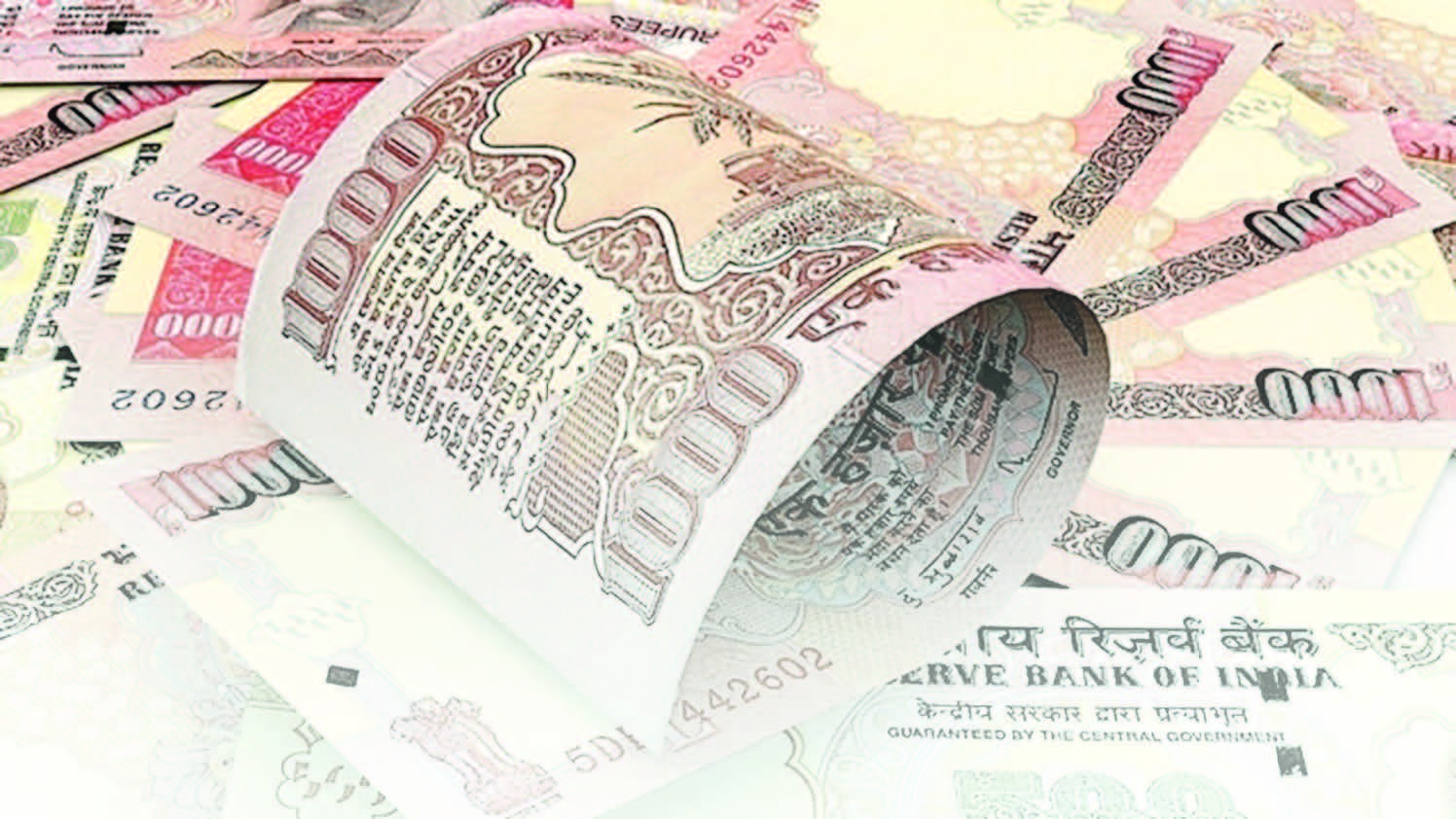
    Since PM Narendra Modi’s midnight announcement, queues of people wishing to withdraw money for weddings, agricultural inputs, studies, medical treatment or simply to meet daily expenditure continue to mull outside most banks. This has been particularly so in the Capital, where Parliament’s winter session gave the Opposition a ready stage for protests. The delivery of additional smaller and new higher denomination notes, printing of which lags demand, has been dismal in the hinterland. The crisis in rural areas has been compounded after cooperative banks were barred from the exercise, apparently due to their links to politicians in many states.

    Thus, while controlling black money has universal support, the poor implementation is souring public opinion. A number of conclusions can be reached. One, daily tweaking of levels, pretexts and manner of withdrawal confirms lack of planning. Two, making the Rs 2,000 note smaller and thus unusable in existing ATMs without recalibration defies common sense. The disruption of supply chains, private transportation and rural credit when the rabi season sowing was underway needs explaining. Finally, eliminating middle denomination notes – Rs 500 – made the Rs 2,000 note unusable as no one had change at retail level. The government should have had enough new notes when rendering 86 per cent of the currency invalid overnight.

    Experts on emerging markets are left incredulous. Ruchir Sharma of Morgan Stanley warned that populism “cannot paper over economic chaos”. India, he argues, is cash dependent, but its figure of 12 per cent of GDP compares with US’ 8 per cent and China’s 10 per cent. Tax collection is 16 per cent of GDP, “slightly higher than the norm for India’s peers”. Unlike India’s amnesty scheme that preceded demonetization, Indonesia’s keeping tax low at 4 per cent drew out $300 billion of hidden wealth. Sharma concludes that “revenge is not a development strategy”.

    Jean Druze likened the government’s move to shooting at the tires of a racing car. Respectable Larry H Summers expressed doubts about achieving stated objectives, pointing out the moral hazard of inconveniencing the majority honest people to bag a few crooks.

    After incremental bad news that cash shortage could only be ameliorated in some months, not weeks or even days as Modi hinted initially, the government resorted to jingoism. Indian people were participating in a public ritual or mahayagya of self-cleansing for larger national good and better future. Thus, its counter-terrorism role to choke funding by counterfeit currency was emphasized.

    India’s high risk and immediately disruptive policy has been unleashed when externally the world faces what The Economist calls “The New Nationalism”. Modi is in their “League of Nationalists” which includes China’s Xi Jinping; Turkey’s Recip Erdogan, Russia’s Vladimir Putin, and of course Donald Trump. Waiting in the wings are rising nationalists on the left and the right in Europe, particularly Marine Le Pen in France who if elected can spell the end of the EU. Thus, the timing for Indian financial experimentation is inappropriate as trade partnerships and alliances are tested globally.

    US leadership becomes critical at this juncture as since World War II it has underpinned the defense and propagation of a liberal and open international order, albeit for its own dominance. The economic power shift to Asia with the rise of China and now India and the concomitant de-industrialization in the US and economic distress in Europe, combined with the threat of Islamic terrorism, have created conditions for the rise of the new nationalism. The EU was an experiment in post-nationalism where nation states incrementally surrendered sovereignty to a supra-national entity. The process faces reversal.

    Trump is the wild card in this new game. In a New York Times interview on November 22, having kissed and made up, he moderated electoral rhetoric on some issues like prosecuting Hillary Clinton and climate change. But his core beliefs remain intact like lowering taxes, renewing US infrastructure or re-examining trade deals. He announced US withdrawal from a putative Trans-Pacific Partnership (TPP) that underpins US “pivot” to Asia and China containment strategy. Will China read it as US retreat or peace offering remains undetermined. The TPP, constituting two-fifth of the world’s economy, was to rewrite not just tariff and trade rules but harmonies standards on intellectual property, environment and labor rights. China will try filling the gap by either advancing a “Free Trade Area of the Asia-Pacific” tying 21 countries or pushing the Regional Comprehensive Economic Partnership (RCEP), which will, besides 10 ASEAN members, have India, Australia, New Zealand as well as China, ROK and Japan. This is the Chinese riposte to a US-centered intrusion into Asia. India needs to move cautiously as the cracks widen or heal.

    Meanwhile Pakistan, on the eve of army chief Gen Raheel Sharif’s retirement on November 29, has provoked India by repeat beheadings of Indian soldiers. India can either react clandestinely locally, which is unusable domestically by the BJP for jingoism or overtly, which should stall Gen Sharif’s retirement. Iran, too, is on tenterhooks with radical elements salivating at the nuclear deal falling through if Trump reimposes sanctions, which would be resisted by its European allies and Russia. On Syria, Trump, in the same interview, indicated urgency for a solution. Is he realizing that US retreat, as happened after World War I, would merely buy time till the US has to intervene under worse conditions?

    Opposition members in the Rajya Sabha demand that the Prime Minister make a statement on demonetization in the House, during the winter session of Parliament in New Delhi. Photo courtesy of PTI
    Opposition members in the Rajya Sabha demand that the Prime Minister make a statement on demonetization in the House, during the winter session of Parliament in New Delhi.
    Photo courtesy of PTI

    With the Opposition unity enhanced, Parliament stymied and the Modi government’s ability to restore currency-in-hand normalcy in question, will Modi – like Trump – tamper the government’s brash approach to tackling black money, terror funding and counterfeit currency? With free fire across the LoC, the deterrence value of “surgical strike I” is questionable. “Surgical strike II” on black money has disabled a growing economy and launched a Mao-like, hopefully not fatal, “great leap forward”. History teaches us that for civilizational behemoths like India and China, only little leaps work. For global hegemons like the US leap-backs are equally fatal.

    (The author is a former Secretary, Ministry of External Affairs, India)