Tag: Indian-Origin

  • Chicago celebrates Punjabi culture and heritagewith colorful treat, fun and frolic at Rangla Punjab

    Chicago celebrates Punjabi culture and heritagewith colorful treat, fun and frolic at Rangla Punjab

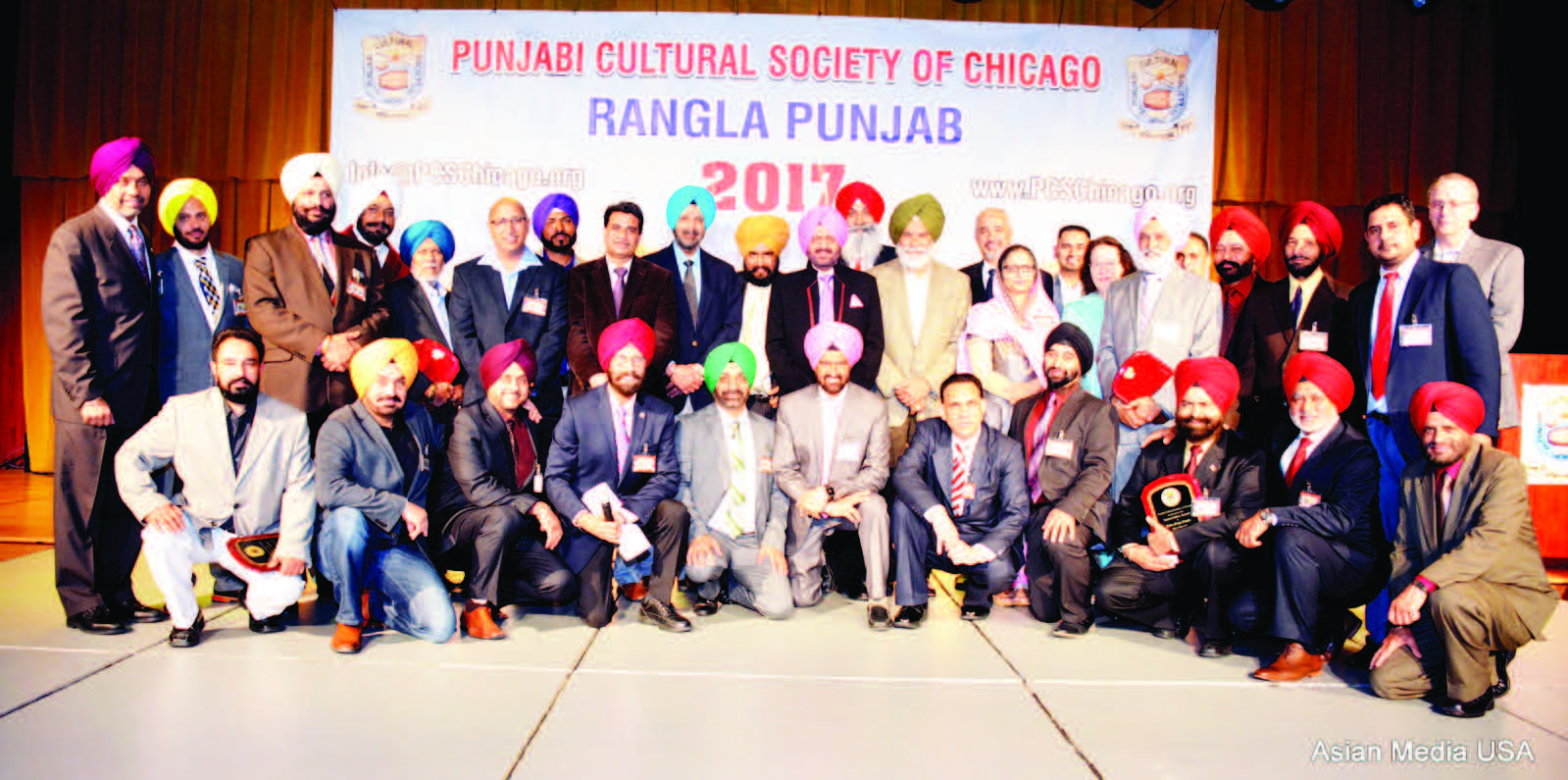
    CHICAGO, IL (TIP): The most awaited cultural program of the year, Rangla Punjab, 2017 organized by the Punjabi Cultural Society of Chicago was celebrated with a lot of zeal and fanfare by participants of all ages, with an electrified Chicago audience at Meadows Clubs, Rolling meadows, IL. The energy of the hall was palpable and the enthusiasm of the participants was contagious. Vaisakhi marks the foundation day of Khalsa panth or Sikh order by the tenth Sikh Guru, Sri Gobind Singh. In 1699 the tenth guru, Sri Guru Gobind Singh, chose Vaisakhi as the occasion to transform the Sikhs into a family of soldier saints, known as the Khalsa Panth.

    This memorable program encompassed a rare record-breaking number and variety of performances, with participants from Chicagoland as well as teams from neighboring states of Wisconsin and Indiana. The evening started with Shabad coordinated by Mr. Amardev Singh Bandesha followed by colorful dancing and singing performances that enthralled the crowd. The lineup of the cultural program performances was amazing and full of variety. The cultural program was very well anchored by four Emcees; Raskirath Singh, Parvinder Singh Nanua, Mona Bhalla and Paul Singh Lail. There were over thirty beautiful performances from all age groups.

    Chicago Giddha, popular folk dance of women in Punjab region of India
    Chicago Giddha, popular folk dance of women in Punjab region of India

    The cultural bonanza was celebrated by Chicago with unencumbered enthusiasm shown through the number of attendees and participants alike; children as young as 4-year-old, through teenagers and adults put on a memorable show. Bhangra and Giddah along with the signature drum beats and ‘boli’s’, electrified the audience and they participated by howling and clapping along the lively beats. The colorful atmosphere shone through the authentic outfits worn by the young and old alike – seemingly transported everyone to the meandering streets of Punjab. As an Emcee reminisced about growing up in Punjab, the atmosphere was brought alive by the participants and their grand attires with great attention to detail.

    Kaum Punzabi Bhangra Dance
    Kaum Punzabi Bhangra Dance

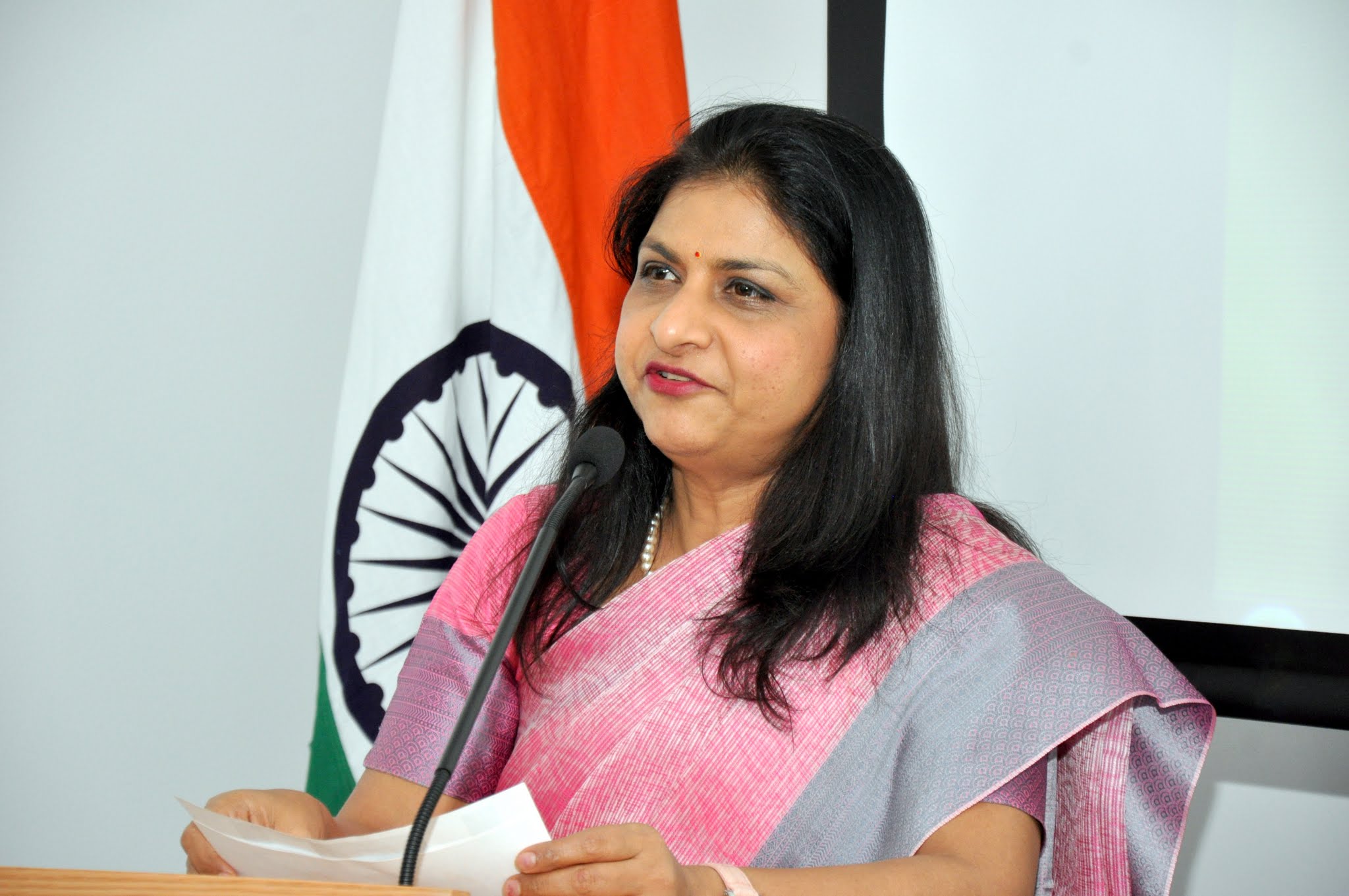
    Mr. Rajinder Singh Mago, one of the event organizers, introduced the dignitaries and distinguished guests to the audience. The chief guest Mr. Darshan Singh Dhaliwal of Dhaliwal Enterprises along with Mr. Sukhmel S. Atwal presented mementoes to the sponsors of the program Onkar Singh Sangha (Allstate Insurance), Dr. Bhupinder Singh Saini and Dr. Narinder S. Grewal. Grand sponsor Dr. Bhupinder Singh Saini congratulated everyone on the auspicious event of Vaisakhi. He credited PCS for keeping the Punjabi heritage alive through such celebrations far across the oceans that keep Punjabis connected with their culture. Dr. Saini, while making mention of the efforts and resources needed for such events said, “These things do not come cheap. I assure the organizers of my continuous support to this great cause.”  Dr. Saini got sentimental while expressing his love and gratitude for his father who was also present there. The guests of honor for the evening was the Consulate General of India Ms. Neeta Bhushan represented by Mr. D. B. Bhati (Consul). Mr. Bhati addressed the audience and congratulated PCS for the grand event. Consulate General of Pakistan Faisal Niaz Tirmizi also graced the evening.

    The Meadows Club hall became the microcosm of the Punjabi culture and entertainment; it felt as if we were sitting in Punjab amidst all the kaleidoscopic view of its heritage surrounding us. From the authentic props to the intricately designed bhangra and Gidah garbs, the event proved to be a hit once again. Parents’ eyes cherished the moments their children dressed in dance costumes performed on stage. Truly everyone was transported through time and space where one could smell the fragrance of corn and wheat being harvested from the villages of the mighty Punjab. The writer of this passages reminisced about her own childhood at this program; it was that powerful of an atmosphere. Gidah was performed by, to name a few, Bollywood Arts Academy, Shaukana Chicago Diyan, Milwaukee Gidah and Chicago Gidah Girls and so on. Bhangra teams included all age groups like Navi Paneeri, Punjabi Kaum, Warriors Bhangra and many more. Chicago’s renowned singers Mahijit Virdi, Mona Bhalla, Maddy Singh and Ashley Singh made everyone dance to their melodies.

    Punjabi music reverberated in the Meadows club hall as gaily-dressed men and women sang and danced to celebrate the festival. The essence of Punjab was reflected in the hall, with kudos to Punjabi Cultural Society of Chicago for putting up a grand show and bringing the community together for this memorable event. Truly, Chicagoland will be waiting with bated breath for the next Rangla Punjab from Punjabi Cultural Society of Chicago in 2018.

    (Photographs and Press release: Asian Media USA)

  • 85 South Asian films screened at the 17th NYIFF

    85 South Asian films screened at the 17th NYIFF

    NEW YORK (TIP): The 17th annual New York Indian Film Festival is a celebration of off-the-track movies produced in South Asia. Launched on April 30 with the screening of ‘Lipstick under my Burkha’, a story of struggle of women fighting for their freedom and aspirations, the festival was well appreciated by New Yorkers. Approximately 85 shorts, documentaries and feature films from South Asian countries (India, Pakistan, Sri Lanka & Bangladesh), made in Hindi, English and seven regional languages (Tamil, Malayalam, Kannada, Punjabi, Marathi, Gujarati and Bengali) were entered in the festival.

    ‘Gypsy’, is based on Mulay’s autobiographical work ‘Maati, Pankh and Akash’, a celebrated Marathi literary work, depicting the struggle of a boy born in a remote village in Maharashtra. It is the story of a poet who rose to the post of the Consul General of India in New York with sheer hard work and perseverance.

    Ambassador Dnyaneshwar Mulay is a true son of the soil. He calls his journey as that of a gypsy, who travelled to Tokyo, Syria and New York negotiating meanings out of political and diplomatic developments, engaging in as a competent diplomat with a poetic flavor, winning the hearts of Indian settlers as well as counterparts in the host countries. With his vision deeply rooted in the socio-cultural domain of India, Mulay, currently Secretary in-charge of Overseas Indian affairs in the Ministry of External Affairs, represents the aspirations of all Indians who belong to the impoverished strata of India, an India that lacks drinking water and nutritious food even after 75 years of India’s independence. Mulay’s success is an indicator that kids from the poorest economic levels can succeed and rise to the top.

    But does the movie, ‘Gypsy’, succeed in presenting the true colors of Mulay’s personality? Dhananjay, the young filmmaker from Maharashtra, captures a few touching moments of Mulay’s childhood life in Laat village of Kolhapur district, where he inherited traditional poverty and cultural richness, that was passed on to him from his teachers. He continued studying major literatures of the world during his teenage. The black and white visuals in the movie recreate social poverty and cultural richness of the village. We see Mulay walking around the streets of his native village where his school remains deprived of repair and his people continued living with traditions. We see ribbon cutting Mulay, and a number of his child hood friends and admirers including his mother, speaking highly about him as a young boy. The movie further depicts Mulay as an adult officer who pursued his dreams of joining the ranks of the bureaucrats of Delhi. He does well in UPSC interviews demonstrating his deep knowledge and understanding of Maharashtra’s socio-cultural traditions and relevance of Indian democracy. Finally, he joins the ranks of IFS officers rising to the position of an Ambassador.

    Other than breaking the traditions to joining the elite club of Indian bureaucracy, what are the major contributions of Mulay as a diplomat? What did he do to raise India’s prestige abroad? He handled difficult situations during the two-week-long refuge of President Mohamed Nasheed in the Indian High Commission in Male’. As Ravi Batra, a leading New York attorney, said after the screening of the movie, the high points in Mulay’s diplomatic career came in the second decade of 21st century, first at Male, and then in New York during his tenure as the Consul General, when the then Deputy Consul General of India in New York was arrested and strip searched. Mulay is credited with handling both situations aptly that helped raise the prestige of India. Mulay is too modest to talk about these incidents in the movie or in public. However, it shouldn’t have prevented the filmmaker of ‘Gypsy’ from projecting it in the movie, through the professional voice-over that Tom Alter provided so well.

    The movie also fails to underscore Mulay’s role in initiating the yearly organization of International Hindi Conferences in USA, now in its fifth year. It was an effort to reestablish the profile and importance of Hindi internationally that no other Consul General did in the past.

    The filmmaker of ‘Gypsy’, who seemed very conscious about Mulay’s roots in Maharashtra, fails to depict him as a national symbol of India’s aspirations, an India that lives in the villages. We are left to watch Mulay’s friends talking and not what Mulay thinks today about his people’s ongoing struggle, especially in Maharashtra and India, where farmers and students are unable to face their failures, only resorting to actions like suicides.

    NYIFF presented remarkable movies, such as, ‘A Death in the Gunj’, directed by Konkona Sen Sharma. The movie pays tribute to the late Om Puri, one of India’s most versatile character actors who starred in more than 147 films during his illustrious career and was awarded the Padma Shri in 1990.

    The closing movie, ‘You are my Sunday’, is a story of five young men in Mumbai who share same goal to play football (soccer) at Juhu Beach every Sunday. While each one has his reason to look forward to the Sunday morning, there’s no doubt it’s a high point of their week. One Sunday, as a result of the actions of a senile old stranger who joins their game, a ban is issued on playing games at Juhu Beach. The group now has to look for a new place to play in the crowded city of Mumbai. More than just football, the film is about each of their lives and how each one deals with their own physical and emotional space.

    NYIFF presented a rich fare for which Aroon Sivadasani and her colleagues on board of directors deserve all appreciation. Here is a list of NYIFF 2017 National Award Winners.

    • Best Films – “Kaasav (Turtle)”
    • Best Director – Rajesh Mapuskar -“Ventilator”
    • Best Editing – “Ventilator”
    • Best Recordist For Final Mixed Track – “Ventilator”
    • Best Gujarati Film – “Wrong Side Raju”
    • Best Short Film – “Aaba”
    • Best Child Actors – “Colours of Innocence”
    • Special Mention – Adil Hussain – “Mukti Bhawan (Hotel Salvation)”

    The 17th New York Film Festival in Pictures

    Aahana Kumra, lead actress of the Opening night film, "Lipstick under my BurkhaThe New York Indian Film Festival (NYIFF) is the oldest, most prestigious film festival screening premieres of feature, documentary and short films made from, of, and about the Indian subcontinent in the Independent, arthouse, alternate and diaspora genres. Seven days of screenings, post-screening discussions, industry panels, award ceremony, special events, nightly networking parties, red carpet galas, media attention and packed audiences build an awareness of Indian cinema, entertain & educate North Americans about the real India, and add to the amazing cultural diversity of New York City.

    The 17th IAFF was held from April 30 to May 7, 2017 in New York City. A total of 85 entries were received.

    Aroon Sivadasani, President and Executive Director heads a team of people deeply committed to promotion of cinema. Eminent persons from the world of arts and cinema which include Salman Rushdie, Shashi Throop, Mira Nair, Shabana Azmi, Deepa Mehta, Shyam Benegal, Mani Ratnam, Madhur Jaffrey, Sabrina Dhawan and Sakina Jaffrey are on the advisory board of the film festival.

    Aahana Kumra, lead actress of the Opening night film, "Lipstick under my BurkhaThe Indo-American Arts Council, the organization which organizes the film festival says its missionis to promote and build the awareness, creation, production, exhibition, publication and performance of Indian and cross-cultural art forms in North America.

    The Mission statement further says: “The IAAC supports all artistic disciplines in the classical, fusion, folk and innovative forms influenced by the arts of India. We work cooperatively with colleagues around the United States to broaden our collective audiences and to create a network for shared information, resources and funding.

    “Our focus is to work with artists and arts organizations in North America as well as to facilitate artists and arts organizations from India to exhibit, perform and produce their works here”.

    Well known photographer Jay Mandal who was on assignment with the IAFF 2017 has come up with some wonderful pictures of the event which we are happy to share with the readers of The Indian Panorama.


  • The 17th New York Film Festival in Pictures

    The 17th New York Film Festival in Pictures

    Aahana Kumra, lead actress of the Opening night film, "Lipstick under my BurkhaThe New York Indian Film Festival (NYIFF) is the oldest, most prestigious film festival screening premieres of feature, documentary and short films made from, of, and about the Indian subcontinent in the Independent, arthouse, alternate and diaspora genres. Seven days of screenings, post-screening discussions, industry panels, award ceremony, special events, nightly networking parties, red carpet galas, media attention and packed audiences build an awareness of Indian cinema, entertain & educate North Americans about the real India, and add to the amazing cultural diversity of New York City.

    The 17th IAFF was held from April 30 to May 7, 2017 in New York City. A total of 85 entries were received.

    Aroon Sivadasani, President and Executive Director heads a team of people deeply committed to promotion of cinema. Eminent persons from the world of arts and cinema which include Salman Rushdie, Shashi Throop, Mira Nair, Shabana Azmi, Deepa Mehta, Shyam Benegal, Mani Ratnam, Madhur Jaffrey, Sabrina Dhawan and Sakina Jaffrey are on the advisory board of the film festival.

    Aahana Kumra, lead actress of the Opening night film, "Lipstick under my BurkhaThe Indo-American Arts Council, the organization which organizes the film festival says its missionis to promote and build the awareness, creation, production, exhibition, publication and performance of Indian and cross-cultural art forms in North America.

    The Mission statement further says: “The IAAC supports all artistic disciplines in the classical, fusion, folk and innovative forms influenced by the arts of India. We work cooperatively with colleagues around the United States to broaden our collective audiences and to create a network for shared information, resources and funding.

    “Our focus is to work with artists and arts organizations in North America as well as to facilitate artists and arts organizations from India to exhibit, perform and produce their works here”.

    Well known photographer Jay Mandal who was on assignment with the IAFF 2017 has come up with some wonderful pictures of the event which we are happy to share with the readers of The Indian Panorama.


    "Gypsy", a documentary on the life of Ambassador Dnyaneshwar M Mulay, made by Dhananjay Bhawalekar and Sawani Arjun was selected for screening. The documentary received mixed reaction.
    “Gypsy”, a documentary on the life of Ambassador Dnyaneshwar M Mulay, made by Dhananjay Bhawalekar and Sawani Arjun was selected for screening. The documentary received mixed reaction.

    85 South Asian films screened at the 17thNYIFF

    ‘Gypsy’: Story of a village kid who rose to the top of Indian Bureaucracy received mixed reactions

    By Ashok Ojha NEW YORK (TIP): The 17th annual New York Indian Film Festival is a celebration of off-the-track movies produced in South Asia. Launched on April 30 with the screening of ‘Lipstick under my Burkha’, a story of struggle of women fighting for their freedom and aspirations, the festival was well appreciated by New Yorkers. Approximately 85 shorts, documentaries and feature films from South Asian countries (India, Pakistan, Sri Lanka & Bangladesh), made in Hindi, English and seven regional languages (Tamil, Malayalam, Kannada, Punjabi, Marathi, Gujarati and Bengali) were entered in the festival.

    ‘Gypsy’, is based on Mulay’s autobiographical work ‘Maati, Pankh and Akash’, a celebrated Marathi literary work, depicting the struggle of a boy born in a remote village in Maharashtra. It is the story of a poet who rose to the post of the Consul General of India in New York with sheer hard work and perseverance.

    Ambassador Dnyaneshwar Mulay is a true son of the soil. He calls his journey as that of a gypsy, who travelled to Tokyo, Syria and New York negotiating meanings out of political and diplomatic developments, engaging in as a competent diplomat with a poetic flavor, winning the hearts of Indian settlers as well as counterparts in the host countries. With his vision deeply rooted in the socio-cultural domain of India, Mulay, currently Secretary in-charge of Overseas Indian affairs in the Ministry of External Affairs, represents the aspirations of all Indians who belong to the impoverished strata of India, an India that lacks drinking water and nutritious food even after 75 years of India’s independence. Mulay’s success is an indicator that kids from the poorest economic levels can succeed and rise to the top.

    But does the movie, ‘Gypsy’, succeed in presenting the true colors of Mulay’s personality? Dhananjay, the young filmmaker from Maharashtra, captures a few touching moments of Mulay’s childhood life in Laat village of Kolhapur district, where he inherited traditional poverty and cultural richness, that was passed on to him from his teachers. He continued studying major literatures of the world during his teenage. The black and white visuals in the movie recreate social poverty and cultural richness of the village. We see Mulay walking around the streets of his native village where his school remains deprived of repair and his people continued living with traditions. We see ribbon cutting Mulay, and a number of his child hood friends and admirers including his mother, speaking highly about him as a young boy. The movie further depicts Mulay as an adult officer who pursued his dreams of joining the ranks of the bureaucrats of Delhi. He does well in UPSC interviews demonstrating his deep knowledge and understanding of Maharashtra’s socio-cultural traditions and relevance of Indian democracy. Finally, he joins the ranks of IFS officers rising to the position of an Ambassador.

    Other than breaking the traditions to joining the elite club of Indian bureaucracy, what are the major contributions of Mulay as a diplomat? What did he do to raise India’s prestige abroad? He handled difficult situations during the two-week-long refuge of President Mohamed Nasheed in the Indian High Commission in Male’. As Ravi Batra, a leading New York attorney, said after the screening of the movie, the high points in Mulay’s diplomatic career came in the second decade of 21st century, first at Male, and then in New York during his tenure as the Consul General, when the then Deputy Consul General of India in New York was arrested and strip searched. Mulay is credited with handling both situations aptly that helped raise the prestige of India. Mulay is too modest to talk about these incidents in the movie or in public. However, it shouldn’t have prevented the filmmaker of ‘Gypsy’ from projecting it in the movie, through the professional voice-over that Tom Alter provided so well.

    The movie also fails to underscore Mulay’s role in initiating the yearly organization of International Hindi Conferences in USA, now in its fifth year. It was an effort to reestablish the profile and importance of Hindi internationally that no other Consul General did in the past.

    The filmmaker of ‘Gypsy’, who seemed very conscious about Mulay’s roots in Maharashtra, fails to depict him as a national symbol of India’s aspirations, an India that lives in the villages. We are left to watch Mulay’s friends talking and not what Mulay thinks today about his people’s ongoing struggle, especially in Maharashtra and India, where farmers and students are unable to face their failures, only resorting to actions like suicides.

    NYIFF presented remarkable movies, such as, ‘A Death in the Gunj’, directed by Konkona Sen Sharma. The movie pays tribute to the late Om Puri, one of India’s most versatile character actors who starred in more than 147 films during his illustrious career and was awarded the Padma Shri in 1990.

    The closing movie, ‘You are my Sunday’, is a story of five young men in Mumbai who share same goal to play football (soccer) at Juhu Beach every Sunday. While each one has his reason to look forward to the Sunday morning, there’s no doubt it’s a high point of their week. One Sunday, as a result of the actions of a senile old stranger who joins their game, a ban is issued on playing games at Juhu Beach. The group now has to look for a new place to play in the crowded city of Mumbai. More than just football, the film is about each of their lives and how each one deals with their own physical and emotional space.

    NYIFF presented a rich fare for which Aroon Sivadasani and her colleagues on board of directors deserve all appreciation. Here is a list of NYIFF 2017 National Award Winners.

    • Best Films – “Kaasav (Turtle)”
    • Best Director – Rajesh Mapuskar -“Ventilator”
    • Best Editing – “Ventilator”
    • Best Recordist For Final Mixed Track – “Ventilator”
    • Best Gujarati Film – “Wrong Side Raju”
    • Best Short Film – “Aaba”
    • Best Child Actors – “Colours of Innocence”
    • Special Mention – Adil Hussain – “Mukti Bhawan (Hotel Salvation)”
  • Hundreds show their support for Virendra Sharma at his Election campaign launch

    Hundreds show their support for Virendra Sharma at his Election campaign launch

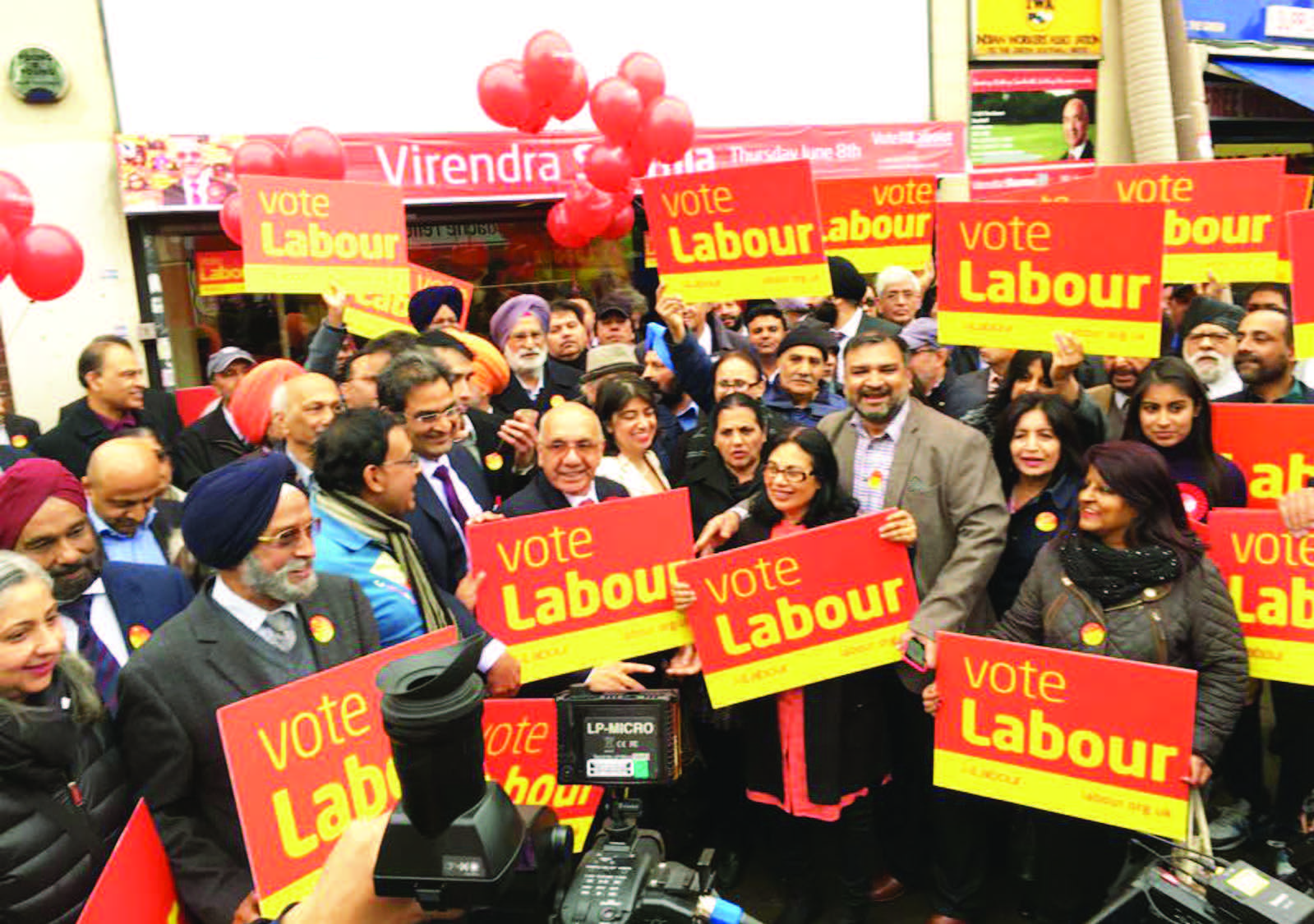
    LONDON (TIP): Hundreds showed up, May 3, in Ealing – Southall to show their support at Virendra Sharma’s election campaign launch. Following the shock announcement of a snap general election, today, on the day parliament dissolves, Virendra Sharma launched his campaign to continue as MP for Ealing -Southall, West London.

    The event was introduced by Dr Onkar Sahota, GLA member for Ealing and Hillingdon, other contributions were made by Steve Pound from Ealing North, Seema Malhota from Feltham and Heston, and Cllr Julian Bell Leader of Ealing Council, West London.

    Speaking at the launch Virendra Sharma said:”I am proud to represent the area I have lived in for the last 49 years and my campaign will focus on our community and how much we can achieve. This election must be about bringing people together, improving people’s lives and turning our backs on the politics of division.

    This is a British election, and we should be debating British values, not old community conflicts, ancient arguments and squabbles from half a world away and half a century ago. Ealing Southall should be a standard bearer for tolerance and integration. We achieve so much more when we cooperate, when we unite and when we come together. It harms our community when we see ourselves as different and live separate lives.

    I believe in the freedom of speech, I believe in debate and I believe in the ballot box. We only damage ourselves when we resort to scare tactics and when we try to silence dissenting opinion. I will represent all of Ealing Southall, I will represent every religion, every culture and those unsure of where they belong.”

    With dozens of community groups represented at the launch Virendra Sharma’s campaign is one of community unity and people coming together.

    Organizations represented at the launch included:Shri Guru Singh Sabha Southall; Sri Ram Mandir Temple; Miri Piri Gurudwara; Sri Guru Nanak Gurudwara; Abu Bakar Mosque; Sri Guru Ravidass Gurudwara; Vishwa Hindu Kendra; Sri Guru Amardas Gurudwara; Ramgarhia Sabha Southall; Sri Guru Nanak Darbar; Afghan Hindu Society; Rajpoot Society; Haryana Association; South Indian Associations; Rajasthan Society; Kashmiri Pandits; Councillors from Hounslow, Hillingdon, Brent, Harrow and of course Ealing, and many more prominent individuals from of all communities.

    Not even a shower of rain could dampen the excitement, and the groups came together with one voice in support of Virendra Sharma and his message of tolerance, democracy and secularism.

  • Indian-origin scientist helps develop robot drill for 50 times faster skull surgery

    Indian-origin scientist helps develop robot drill for 50 times faster skull surgery

    WASHINGTON (TIP): A new computer-driven robotic drill that can make a type of complex cranial surgery 50 times faster than standard procedures has been developed by scientists including one of Indian origin.

    The automated drill, similar to those used in machine auto parts, produces fast, clean and safe cuts, reducing the time the wound is open and the patient is anaesthetised.

    This can decrease the incidence of infection, human error, and surgical cost, according to the findings published in the journal Neurosurgical Focus.

    To perform complex surgeries, especially cranial surgeries, surgeons typically use hand drills to make intricate openings, adding hours to a procedure. The automated drill reduces the time for bone removal from two hours using a hand drill to 2.5 minutes. “It was like doing archaeology. We had to slowly take away the bone to avoid sensitive structures,” said William Couldwell, a neurosurgeon at University of Utah in the US.

    “I was interested in developing a low-cost drill that could do a lot of the grunt work to reduce surgeon fatigue,” said A K Balaji, associate professor at University of Utah.

    The patient is first is imaged using a CT scan to gather bone data and identify the exact location of sensitive structures, such as nerves and major veins and arteries that must be avoided.

    Surgeons use this information to programme the cutting path of the drill.

    “The software lets the surgeon choose the optimum path from point A to point B, like Google Maps,” said Balaji.

    In addition, the surgeon can programme safety barriers along the cutting path within one millimetre of sensitive structures.

    The drill does the heavy lifting by removing most of the bone, similar to a mill, accurately and rapidly.

    The translabyrinthine surgery is performed thousands of times a year to expose slow-growing, benign tumours that form around the auditory nerves, researchers said.

    This cut is not only difficult, the cutting path also must avoid several sensitive features, including facial nerves and the venous sinus, a large vein that drains blood from the brain. Risks of this surgery include loss of facial movement.

    The device also has an automatic emergency shut-off switch. During surgery, the facial nerve is monitored for any signs of irritation.

  • Missouri State University Announces $5,000 Scholarship for Indian Students

    Missouri State University Announces $5,000 Scholarship for Indian Students

    NEW DELHI (TIP): The Missouri State University (MSU) in the US announced $5,000 scholarship for Indian students. The university will grant the scholarship on the basis of GPA scores — the students’ cumulative scores in 10th, 11th and 12th class — and their SAT scores.

    “We have always welcomed Indian students and averaged a 120-130 of them till recently… Their current number is 55 and we would want this to grow, ” Stephen Robinette, Associate Vice President, International Program, MSU, told the media. There is no limitation on the number of scholarships and it can be extended to any number of students, he said.

    Another university official tried to allay the fears of deportation or denial of visa, which have increased now in the light of President Donald Trump’s ban on immigrants from six countries and strict curbs on the H-1B visa holders.

    “There has been no instance till date where applicants to MSU were denied visa… The Trump order is not on Indian students and the H-1B visa policy only applies to those who come to work here in professional capacity and not to those who study here and then continue to work,” Prateek Gujaral, Regional Head, South and Southeast Asia, MSU, said.

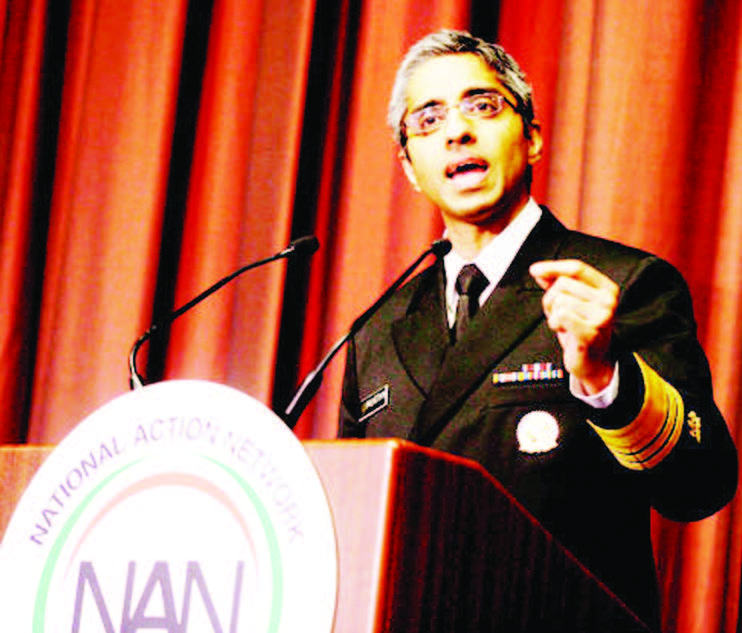
  • Indian American Medical fraternity praises contribution of its member, former US Surgeon General Dr. Vivek Murthy

    Indian American Medical fraternity praises contribution of its member, former US Surgeon General Dr. Vivek Murthy

    NEW YORK (TIP): “On behalf of the American Association of Physicians of Indian Origin (AAPI), I want to applaud the many contributions and initiatives of Dr. Vivek Murthy, our AAPI member, in the healthcare sector in very short span of about two years since he became US Surgeon General in 2014,” said Dr. Ajay Lodha, President of AAPI.

    Dr. Murthy has attended several AAPI meetings and has always acknowledged the contributions of AAPI and the Indian community in his statement which he quoted as, “I am proud of our community of Indian physicians for all the progress that we have made over the years, and I know that AAPI has been a critical force in making this process possible. The advice you shared and assistance you kindly offered were important pieces of this journey,”

    The growing influence of doctors of Indian heritage is evident, as increasingly physicians of Indian origin hold critical positions in the healthcare, academic, research and administrative positions across the nation. With their hard work, dedication, compassion, and skills, they have thus carved an enviable niche in the American medical community. AAPI’s role has come to be recognized as vital among members and among lawmakers.

    The surgeon general represents the Health and Human Services Secretary in addressing public health practice in the nation. Murthy, 39, was America’s youngest-ever top doctor, and is also the first surgeon general of Indian-American representing the next generation of Indian American physician. His ethics, quiet leadership style and impeccable credentials made him the smart choice for this position.

    Dr. Murthy, grandson of a farmer, second generation Indian American physician, said, he will always be grateful to “our country for welcoming my immigrant family nearly 40 years ago and giving me this opportunity to serve.

    Dr. Murthy played key role in bringing to the forefront many crucial health issues confronting the nation. In a landmark report on addiction released in November, said dependency on opioids and other substances must not be looked on as a “character flaw,” in the first publication from a surgeon general that has addressed drug and alcohol addiction.

    Murthy embarked on a three-month listening tour of the U.S. ahead of a ceremonial swearing in to listen to the people and professionals before taking on this important role.

    AAPI is shocked and saddened with his departure and wishes him well as he moves on to a new phase in life and is confident that his talents. skills, and experiences will be utilized effectively for the greater good of the nation.


  • Trump sends Indian-American Vishal J Amin’s name to Senate for ‘IP Czar’

    Trump sends Indian-American Vishal J Amin’s name to Senate for ‘IP Czar’

    WASHINGTON (TIP): Indian-American Vishal J Amin’s name has been sent by President Donald Trump to the Senate for confirmation as America’s new ‘IP czar’ to coordinate the country’s law-enforcement strategy around copyright, patents and trademarks.

    If confirmed by the Senate, Vishal, who is currently Senior Counsel on House Judiciary Committee, would succeed Daniel Marti in the White House.

    Earlier this month, Trump had tapped him as the US’ new Intellectual Property Enforcement Coordinator –dubbed as ‘IP czar’ — to coordinate US law-enforcement strategy around copyright, patents and trademarks.

    Amin has served in the administration of former president George W Bush at the White House as Associate Director for Domestic Policy and at the US Department of Commerce as Special Assistant and Associate Director for Policy in the Office of the Secretary, the White House said.

    Vishal received his bachelor’s degree in neuroscience from Johns Hopkins University and his law degree from Washington University in St Louis.

    The Recording Industry Association of America welcomed his nomination.

    “The prompt appointment and consideration of this position is critical, and we commend President Trump for his choice. Vishal Amin is a smart, thoughtful leader and we look forward to working with him,” said Cary Sherman, chairman and CEO of the Recording Industry Association of America.


  • Dr. Vivek Murthy fired as America’s Top Doctor by Trump

    Dr. Vivek Murthy fired as America’s Top Doctor by Trump

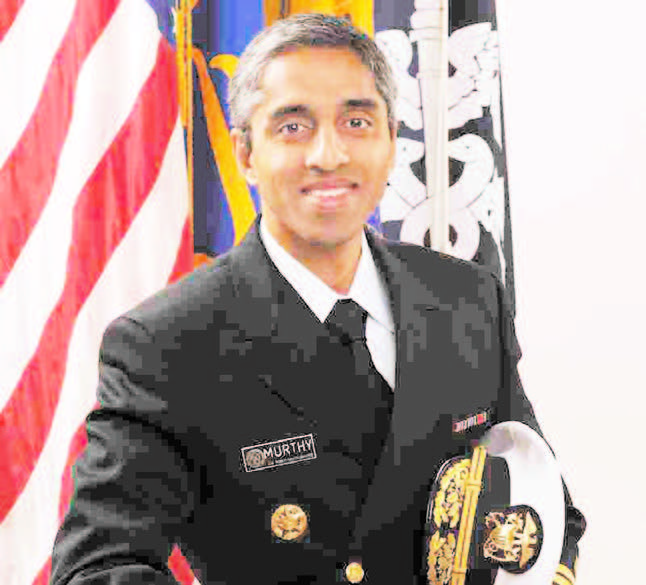
    WASHINGTON (TIP): The Indian American Hero Dr. Vivek Murthy, America’s top doctor, was dismissed by Donald Trump’s administration on Friday, April 21, 2017 as the US Surgeon General.

    Dr. Vivek Murthy taking charge as the US Surgeon General cemented the reputation physicians of Indian origin have across America. President Obama made the right choice in naming a highly-qualified physician to serve as America’s surgeon general.

    The surgeon general, known as “America’s doctor,” represents the Health and Human Services Secretary and Assistant Secretary in addressing public health practice in the nation. Murthy, 39, was America’s youngest-ever top doctor, and he is also the first surgeon general of Indian-American descent. Dr. Vivek Murthy represents the next generation of Indian American physician. His ethics, quiet leadership style and impeccable credentials made him the smart choice for this position.

    Murthy was named America’s top doctor by President Barack Obama in 2014, making him the first Indian American ever named to the post, one among many growing achievement of a tiny but economically powerful ethnic community. In a very short span of time, Dr. Murthy had played key role in bringing to the forefront many crucial health issues confronting the nation. Dr. Murthy said, being picked for the job was a “uniquely American story” for the “grandson of a poor farmer from India.”

    It was not immediately clear why Murthy was relieved from duty, the New York Times said while noting that employees at the Department of Health and Human Services privately expressed surprise at his sudden departure. Murthy, the 19th Surgeon General, and the first Indian American to hold this post said in a Facebook Post that it was an honor and privilege to work for this prestigious position.

    “For the grandson of a poor farmer from India to be asked by the President to look out for the health of an entire nation was a humbling and uniquely American story. I will always be grateful to our country for welcoming my immigrant family nearly 40 years ago and giving me this opportunity to serve,” he said.

    In a post on Facebook, Murthy said. “For the grandson of a poor farmer from India to be asked by the President to look out for the health of an entire nation was a humbling and uniquely American story. I will always be grateful to our country for welcoming my immigrant family nearly 40 years ago and giving me this opportunity to serve,” he added.

    Murthy went on to recount his goals and achievements as surgeon general and said he “had hoped to do more to help our nation tackle its biggest health challenges, (but) I will be forever grateful for the opportunity to have served”. He says he was the ‘grandson of a poor farmer from India’.

    The US health and human services said in a statement on Friday he had been asked “to resign from his duties as surgeon general after assisting in a smooth transition into the new Trump Administration … (and stood) relieved of his duties”.

    Rear Admiral Sylvia Trent-Adams, a nurse by training and currently deputy surgeon general, was named to serve as the acting surgeon general and assume leadership of the US public health service commissioned corps.


  • A Fund Raiser for Health and Education

    A Fund Raiser for Health and Education

    Gift of Life USA Involves Community in the gigantic task

    NEW YORK (TIP): Gift of Life USA Inc., a 501 (c) (3) Non-profit organization, for health and education was launched with a Grand Gala Dinner Night at Leonard’s Palazzo, on April 23, 2017. The organization aims at supporting the specially-abled, creating awareness – health and education and encouraging talent of the specially-abled followed by specially-abled services and much more in the long run.

    A kick start of the event, celebrating month of autism, included attendees, key supporters and leaders from the South Asian & American community. Hosted by Harshil Parekh, the event brought together the resources available and need under the same umbrella to raise the awareness of its vision, mission and goals.

    Founders, Paresh & Flora Parekh, presented a detailed overview of the inspiration, mission and vision of the organization.

    “At Gift of Life USA, we aim at working in support of the ones with special needs, creating awareness, encouraging talent of the specially-abled, providing and assisting with needed resources, to help them be better, socially acceptable, self-respectable, self-supporting individuals and generating services in the long term. This is just the beginning…” Say Founders Flora & Paresh Parekh.

    Our goal is to have a better, healthier and happier world for children and adults everywhere – especially for the specially-abled” – says Treasurer & Host Harshil Parekh.

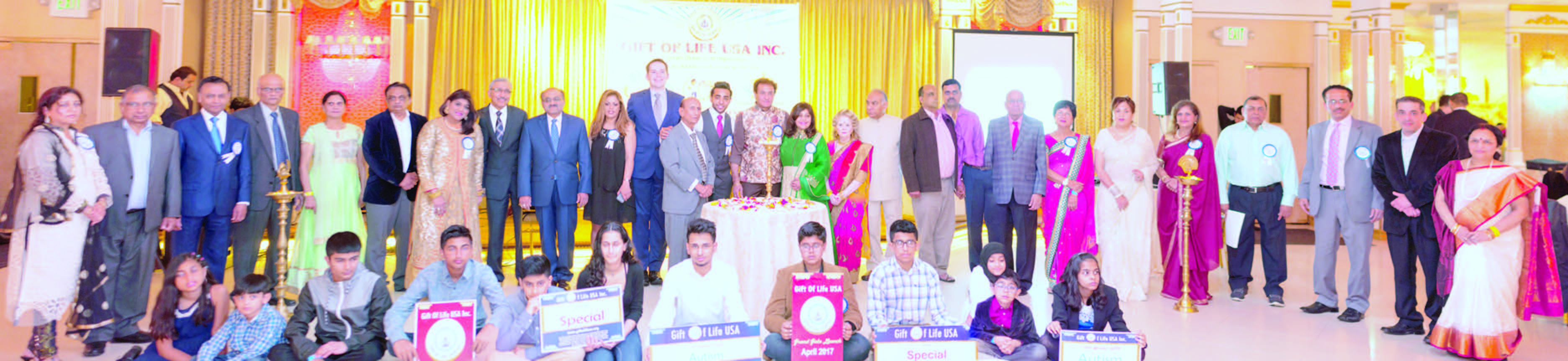
    Front row- L to R:Mr. Swaminathan, Pam Kwatra, Flora Parekh, Malti Shah, Manjari Bhatt, Dr. Hetal Gor, Madhu Parekh, Neela Pandya, Rupal Sehgal Second row- (L to R): Paresh Parekh, Eric Kumar, Lal Kwatra, H.K. Shah, Kamlesh Parekh, Dr. Harshad Bhatt, Bakul Matalia, Mom Speaker Kimberly Gilgeours, Harshil Parekh
    Front row- L to R:Mr. Swaminathan, Pam Kwatra, Flora Parekh, Malti Shah, Manjari Bhatt, Dr. Hetal Gor, Madhu Parekh, Neela Pandya, Rupal Sehgal Second row- (L to R): Paresh Parekh, Eric Kumar, Lal Kwatra, H.K. Shah, Kamlesh Parekh, Dr. Harshad Bhatt, Bakul Matalia, Mom Speaker Kimberly Gilgeours, Harshil Parekh

    The event was inaugurated with a special and traditional lamp lighting by key founders, committee, volunteers, supporters and community leaders. National Speaker Kerry Magro, (a young adult, diagnosed with a type of autism at the age of 4) who has talked at over 700 events an award-winning disability advocate, best-selling author of 3 books, movie consultant of 2 autism films, TV hosting his own local cable show) was the keynote speaker for the evening and shared his experiences. Mesmerizing performances by blind performers (singers, dancers, musicians), rocked the evening. The event also awarded children essay competition winners with cash prizes and Gift certificates. These kids participated in Essay Competition “I love someone with autism” in the beginning of the year and have been show casing their talent and support for the specially-abled at this very young tender age.

    Several distinguished individuals, dignitaries and community leaders joined hands to whole heartedly support this noble cause.

    Inspired by her mom, the event recognized the tireless efforts of 3 of the founders God mothers namely Manjari Bhatt, Malti Shah & Pam Kwatra; who have nourished several children with their dedicated love, care and support. Special experiences from Kimberly, mom of especially abed kid; spell bounded the audience. A special souvenir, portraying key business, facilitated by Eric Kumar, was launched at the event. Special raffles gave away exciting prizes like diamond ring by Paresh Parekh of Harshil Creations; a gold chain by East West Jewelers, Free Liposuction consulting and treatment by Dr. Hetal Gor, Gorgeous outfit by Wardrobe. The Gala Was the hard, tireless and dedicated work of several dedicated volunteers and committee members – Rupal Sehgal, Eric Kumar, Bakul Matalia, Kamlesh & Madhu Parekh, Kiran Mehta, Dr. Hetal Gor, Shashi Malik, Neela Pandya, Sanjay Sura, Aryan Sharma, Harshil Parekh, Dr. Sheetal Sheth, Aditi Patil and several others along with the support of donors, supporters and well wishers.

    Further information and donation opportunities visit website at www.giftoflifeus.org
    (Based on a press release by Neela Pandya)

  • Ananda Marg presents proposal for the Homeless to Mayor

    Ananda Marg presents proposal for the Homeless to Mayor

    BROOKLYN, NY (TIP): Ananda Marga is a socio-spiritual organization founded in India in 1955 by the philosopher and spiritual master Shrii Shrii Anandamurti.

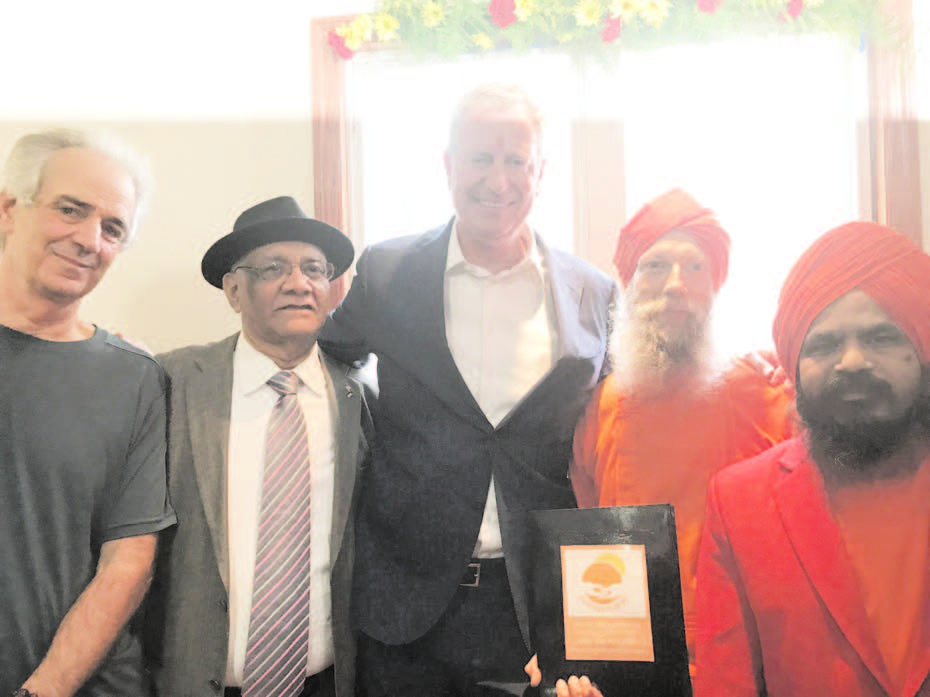
    On occasion of the meeting of Indian Business Leaders at the residence of Bipin Sangankar in Brooklyn on April 14th the Mayor of New York Bill De Blasio gave chance to Ananda Marga representatives for a very warm interaction during which a project for helping the Homeless population was presented to him.

    Arish Kumar Sahani as member of the Indian Community and promoter of the “Active and Productive Homeless” project was accompanied by Acarya Abhiramananda Avadhuta – President of Ananda Marga in USA and by Acarya Vimaleshananda Avadhuta -Public Relations Secretary for the non-profit organization.

    Helping the homeless population has been one of the hallmarks of the Mayor endeavor for bringing social equality in a city marked by a deep separation between rich and poor. Although under the pressure of the coming reelection we expect the Mayor to continue to the last his efforts so important for all the minorities and for the homeless particularly.

    The project proposal is centered on a 40 hours workshops divided in eight modules to be delivered in a few months period promising to change the attitude of the homeless people from passive receivers of help to active participants of the community.

    (Press Release)

  • Vancouver Vaisakhi parade brings together communities

    Vancouver Vaisakhi parade brings together communities

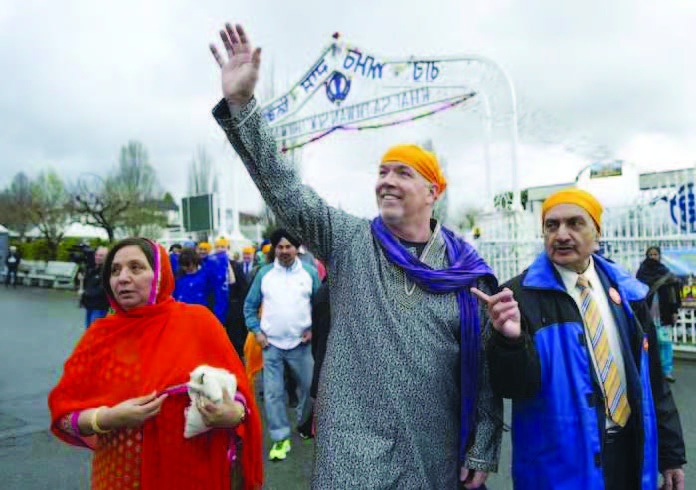
    The Vancouver Vaisakhi celebration brought tens of thousands of British Columbians to the same temple Saturday —including B.C.’s Liberal and NDP leaders, who first crossed paths after kicking off their campaigns earlier this week.

    B.C. Liberal Leader Christy Clark and B.C. NDP Leader John Horgan both attended the celebration and parade in South Vancouver, flanked by local candidates and supporters from the Sikh community.

    With their branded tour buses parked across the street, both leaders and staff kept their distance from each other, but supporters wearing Liberal or NDP buttons mingled at the event.

    Vaisakhi, which fell on Friday this year, marks the birth of the Khalsa – the Sikh brotherhood – and pays tribute to the start of the Punjabi harvest.

    Malkiat Dhami, president of the Khalsa Diwan Society, said the event has grown beyond a celebration for B.C.’s Indo-Canadian community and said organizers are noticing more non-Indo-Canadian people revelling in its festival atmosphere and tasty food.

    Christy Clark joins the tens of thousands of Vaisakhi revellers. Photo Courtesy:JASON PAYNE / PNG
    Christy Clark joins the tens of thousands of Vaisakhi revellers. Photo Courtesy:JASON PAYNE / PNG

    Dhami couldn’t confirm attendance by Saturday afternoon, but said it felt like the crowd was even bigger than the approximately 125,000-150,000 people who showed up last year. He praised the hard work of volunteers and organizers who helped the event thrive in its 39th year.

    Asked whether the presence of Clark and Horgan changed the nature of this year’s celebration, Dhami said politicians always like to come, no matter what party or level of government.“Sometimes people are mistaken— they say, ‘Maybe it’s an election year,’” Dhami said.“It gives them the platform to say whatever they want to say to the congregation. They’re seeking help from the people. It’s good for them, it’s good for us.”

  • VAISAKHI CELEBRATIONS AROUND THE WORLD

    VAISAKHI CELEBRATIONS AROUND THE WORLD

    Sadiq Khan Becomes First London Mayor to Celebrate #Vaisakhi

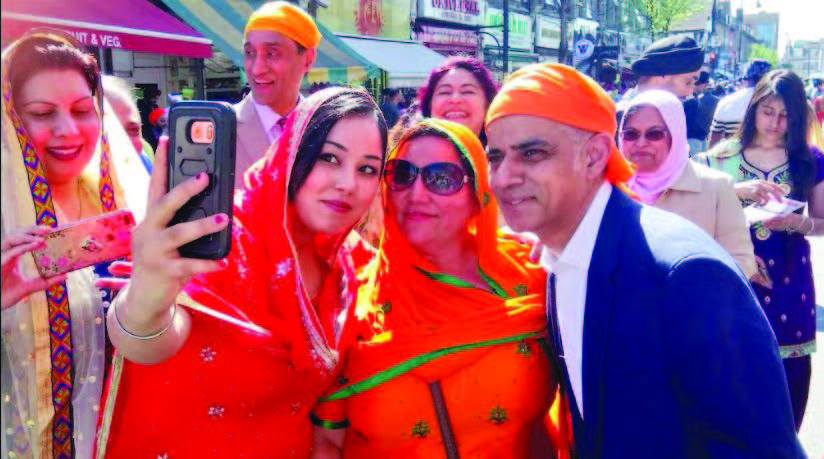
    Crowds gathered in Southall to watch the annual Vaisakhi parade, which started and ended at the Sri Guru Singh Sabha Southall Gurdwara on Havelock Road.

    Mayor of London Sadiq Khan was in attendance and tweeted: ‘Londoners don’t just tolerate our diversity, we celebrate it! Brilliant to be back in Southall alongside thousands at Vaisakhi celebrations.’

    It is thought to be the first time a London Mayor has ever visited the event, known as Nagar Kirtan, to mark Vaisakhi.

    With the sun beaming down, hundreds of people stopped by the many food stalls offering free drinks and Indian snacks (langar) while hyms were sung and various different dances took place.

    Other MPs including Southall MP Virendra Sharma and Feltham and Heston MP Seema Malhotra were in attendance.

    St John Ambulance and London Ambulance Service cycle responders were also present to keep everyone safe.

    The Sikh festival of Vaisakhi celebrates the birth of the Khalsa but is often mistaken for being a harvest festival or the Sikh New Year.

    In April 1699 the 10th Sikh Guru, Guru Gobind Singh Ji tested thousands of Sikhs and the first five to pass his test were initiated into a new order called the Khalsa.

    May says UK will need Sikh values of equality, respect

    UK Prime Minister Theresa May on April 13 said Britain needs Sikh values of equality and respect more than ever as the country forges a “new and ambitious role” in the world post Brexit.

    Greeting the Sikh community on the occasion of Baisakhi, May said Sikhs have set an example for all.

    “I send my best wishes to everyone in Britain and around the world celebrating Baisakhi -one of the most important dates in the Sikh calendar and a time when families and friends come together to commemorate the birth of the Khalsa,” she said in a video message released by Downing Street.

    She said Sikhs in the country consistently follow the pillars of their faith, which sets an example to all.

    Praising Sikh values of equality and respect, of fairness and helping those less fortunate, the British prime minister said these values Britain needs more than ever as it forges a “new, ambitious, role” in the world.

    “I am determined to build a country that works for everyone; a country where no matter who you are, you can achieve your goals – and the Sikh community is a vital part of that mission. So as the dancing and the festivals begin, at home and abroad, I would like to thank you for all that you do and to wish you a very happy,” she said.

    She noted: “As Sikhs across the globe take part in spectacular processions and neighbourhoods and gurdwaras burst forth with colour, I would like to take this opportunity to celebrate the immense contribution British Sikhs make to our country.

    “Whether it’s in the fields of business, the armed forces or the charitable sector, you consistently follow the pillars of your faith and in so doing set an example to us all,” she said.

    This year, the Indian High Commission in London has tied up with gurdwaras across London and other British Punjabi organisations to launch Baisakhi festivities on a grand scale.

    The event, to be held in north-west London on April 30, has been conceived as a grand mela complete with shabad kirtan and folk music to bring the Indian community together.

    “Come with your families and friends to celebrate, enjoy and be part of the best of Sikh culture,” according to a statement by the High Commission.

  • Dubai gurdwara creates world record with breakfast for people from 101 nations

    Dubai gurdwara creates world record with breakfast for people from 101 nations

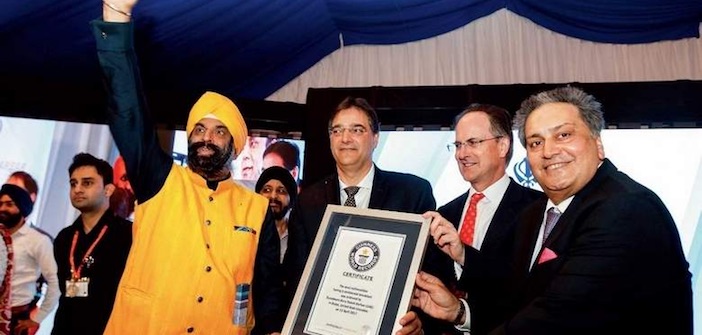
    A gurdwara in Dubai broke the world record for serving free breakfast to the maximum number of people from diverse nationalities.

    Gurdwara Guru Nanak Darbar entered the Guinness World Record on Thursday for serving continental breakfast titled ‘Breakfast for Diversity’ to 600 persons from 101 countries in an hour-long event in Jebel Ali.

    The Khaleej Times reported that schoolchildren, government officials and diplomats attended the event while Indian ambassador to the UAE Navdeep Singh Suri was the chief guest. People from different parts of the city flocked to the Jebel Ali Gardens and filled a temporary tent made for hosting the marathon breakfast event.

    The officials from the Guinness Book of World Records confirmed that the gurdwara broke the previous record of 55 nationalities having a continental breakfast, organised by Nutella at the Milan Expo in Italy in 2015.

    The gurdwara, which is known for serving free meals to all visitors through its community kitchen, caters to over 50,000 Sikh devotees in the United Arab Emirates.

    “Sikhism has always embraced diversity as it has been part of our faith and belief that we are all human beings to be treated with respect,” Surender Kandhari, chairman of the Gurdwara Guru Nanak Darbar, told the daily. “The gurdwara has been spearheading charity and volunteer work not only for the Indian community but for the entire UAE community as well. We feel blessed to give in any form, as this is our selfless service to the society,” he said.

  • Indian-American CEO to pay $135K to former domestic worker for Abuse

    Indian-American CEO to pay $135K to former domestic worker for Abuse

    SACRAMENTO (TIP): An Indian-American CEO has been ordered to pay USD 135,000 to her former domestic worker after a Labor Department investigation found she underpaid and mistreated her.

    Himanshu Bhatia, CEO of Rose International and IT Staffing, will have to pay her former live-in domestic service worker back wages and damages under the terms of a consent judgement entered into the US District Court for the Central District of California.

    The judgement, entered on April 11, resolves a complaint filed by the US Department of Labor in August last year. An investigation by the department’s Wage and Hour Division found that Bhatia willfully and repeatedly violated federal labor laws’ minimum wage and record keeping provisions from July 2012 to December 2014.

    The complaint alleged that Ms Bhatia paid her domestic service worker, who had been identified in an earlier complaint as Sheela Ningwal, a fixed monthly salary of USD 400 plus food and housing at Ms Bhatia’s home in San Juan Capistrano and other residences in Miami, Las Vegas and Long Beach.

    Investigators found that the employee suffered “callous abuse” and retaliation, including being forced to sleep on a piece of carpet in the garage when ill, while Ms Bhatia’s dogs slept on a mattress nearby. The complaint also alleged that Ms Bhatia confiscated Ms Ningwal’s passport.

    Ms Bhatia terminated the worker in December 2014 after she allegedly found her employee researching labor laws online, and after the worker refused to sign a document stating she was being paid an adequate salary and had no employment dispute with Ms Bhatia.

    “This consent judgement underlines the department’s commitment to protecting workers from exploitation,” said Janet Herold, solicitor for the Department of Labor’s Western Region.

    “The department will take strong and immediate action to ensure that workers are protected against retaliation.”

  • 126th Birth Anniversary of Dr. B.R. Ambedkar celebrated in Chicago

    126th Birth Anniversary of Dr. B.R. Ambedkar celebrated in Chicago

    CHICAGO, IL (TIP): The Consulate General of India in Chicago in collaboration with Ambedkar Association of North America [AANA] celebrated 126th Birth Anniversary of Dr. B.R. Ambedkar on 14th April, 2017.

    The opening remarks were delivered by Mrs. Neeta Bhushan, Consul General. Consul General addressed the gathering and recalled the mammoth work done by the Drafting Committee of the Constituent Assembly under the Chairmanship of Dr. B.R. Ambedkar in drafting the Constitution of India. She emphasized that the Constitution of India does not discriminate anyone on the basis of religion, creed, sex or any other ground. It is the duty of every citizen of India, therefore, to uphold the Constitution both in its letter and spirit.

    Speakers from Ambedkar Association of North America [AANA] spoke on role of Dr. Ambedkar in National Reconstruction, Ambedkar’s agriculture and economic policies and women empowerment. During cultural program, the children sang classical Raga & performed the classical dance “Bharat Natyam”. Mr. Mahesh Wasnik introduced the AANA & its activities.

    A Book and photo exhibition of photographs on the life and times of Dr. B.R. Ambedkar was also organized as part of the celebration.

    The celebration was attended by a cross-section of prominent Indian-Americans residing in Chicagoland. Mr OP Meena, Consul, proposed a vote of thanks.

    (Photograph and Press release by Asian Media USA)

  • India’s Abdulqadir Rashik Wins Top Prize at UN Challenge For Open Source Tool

    India’s Abdulqadir Rashik Wins Top Prize at UN Challenge For Open Source Tool

    United Nations: An Indian software engineer has won the top prize at a global challenge for an open-source tool that enables users to interactively view UN General Assembly resolutions and gain a deeper understanding of the voting patterns of member states.

    Abdulqadir Rashik, also an entrepreneur, won the ‘Unite Ideas #UNGAViz Textual Analysis and Visualisation Challenge’ for his ‘Global Policy’, an open-source tool that enables users to search and interactively view General Assembly resolutions to gain a deeper understanding of the voting patterns and decisions made by United Nations Member States.

    Mr Rashik’s prototype will be made public and shared with United Nations bodies and member states. He will also receive recognition from the Department of State and the Office of Information and Communications Technology.

    Mr Rashik is a frequent contributor to Unite Ideas challenges and he previously won the top prize in the #LinksSDGs challenge for his ‘Links to Sustainable Cities’, an interactive visualisation that identifies and maps the links between various Sustainable Development Goals.

    The world body said the project was the first collaboration between the UN Office of Information and Communications Technology (OICT) and the US Department of State.

    The UNGAViz challenged developers worldwide to create an open-source tool capable of providing greater visibility into Member State voting patterns, as well as greater public transparency about their voting choices.

    Solutions were judged not only on their technical merits, but also on their potential to support policymakers dealing with humanitarian challenges, peace and security issues, and other international matters, sometimes under extreme time pressure.

    A State Department official Andrew Hyde said the UN General Assembly has drafted and passed thousands of resolutions affecting people in every corner of the world since its establishment in 1946.

    “In support of transparency and accountability, we believe that everybody, from the general public to policymakers to diplomats, should have easy and timely access to this vast body of knowledge,” he said.

    The first runner-up position was awarded to Maximiliano Lopez, an information technology consultant from Argentina, and the second runner-up was Thomas Fournaise, an information technology manager from France.

    The Chief of the Global Services Division in the Office of Information and Communications Technology Salem Avan said the global network of talented open-source developers responded with insightful and practical solutions that can be easily implemented and made available to United Nations offices and Member States.

    UNGAViz is the sixth challenge issued by Unite Ideas, a big data crowd-sourcing platform developed by the Office of Information and Communications Technology to facilitate collaboration among academia, civil society and UN offices, and to mobilise data scientists and software developers around the world to help tackle the complex issues faced by the Organisation and its member states through the creation of open-source technology solutions.

    To date, academia, the general public and private companies have responded to the Unite Ideas challenges with more than 50 open-source solutions, many of which will be used by the United Nations or shared with member states.

  • 350th Birth Anniversary of Shri Guru Gobind Singh celebrated at the Indian Consulate

    350th Birth Anniversary of Shri Guru Gobind Singh celebrated at the Indian Consulate

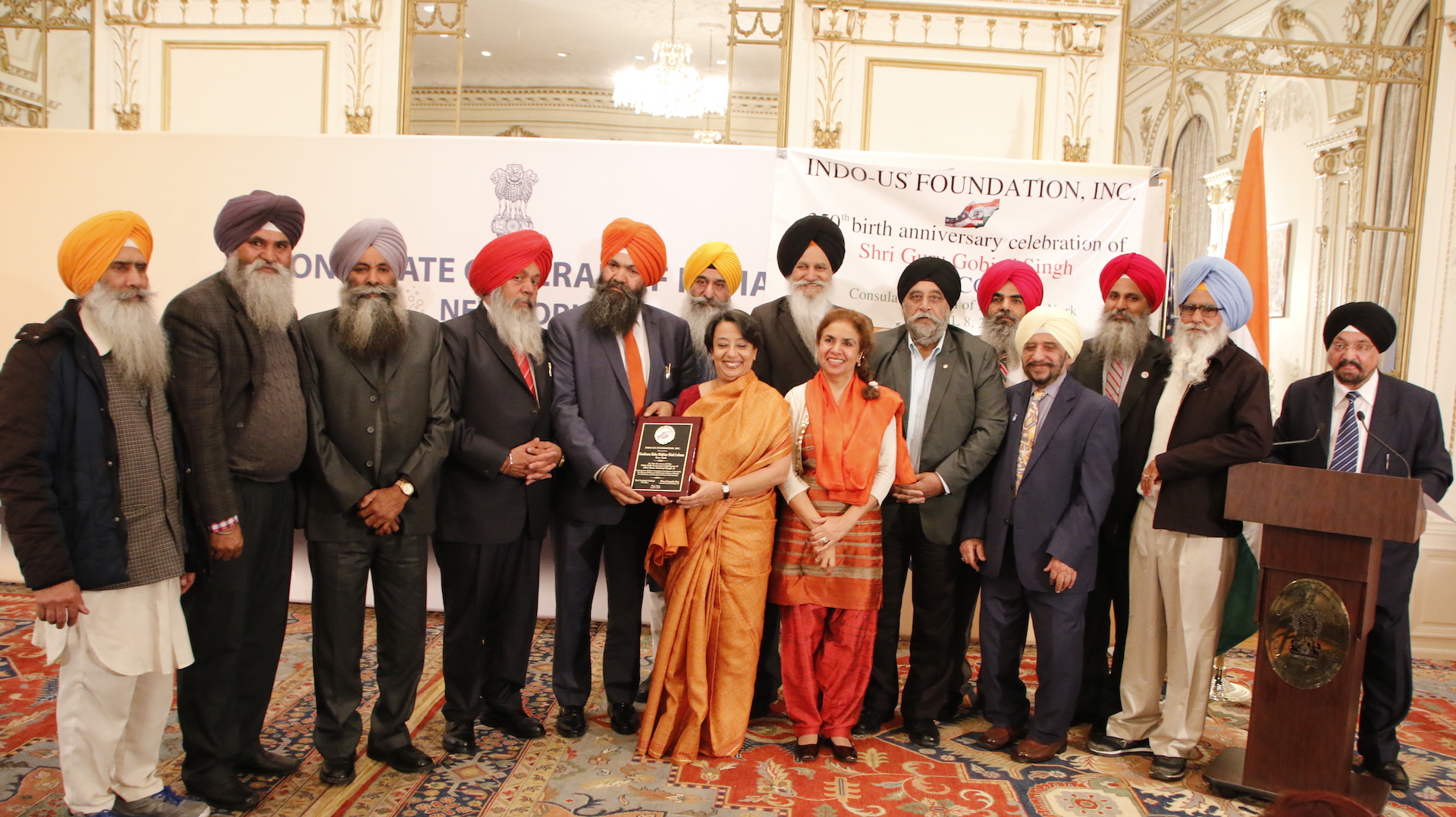
    NEW YORK (TIP): The Indian American community and their friends from the mainstream came together to celebrate the 350th birth anniversary of the Tenth Master of the Sikhs, Shri Guru Gobind Singh.

    It was for the first time that the birthday of a Sikh Master was celebrated at the Indian Consulate in New York.

    Welcoming the gathering, the Consul General Riva Ganguly Das characterized Guru Gobind Singh who created Khalsa as the savior of the people against the tyranny of the rulers of the time.  She recalled that as a young girl in Delhi she would often visit with her parents Gurdwara Bangla Sahib and Gurdwara Sisganj Sahib and listen to Gurbani which she found extremely soothing. She said she learnt about the wonderful traditions of the Sikhs from her visits to gurdwaras and from her readings on Sikhism.

    Consul General Das, who is a Bengali, said Guru Rabiindra Nath Tagore, one of the greatest writers who was the first Indian to be honored with a Nobel Prize, the greatest name among Bengali writers, and one of the greatest sons of India, was influenced by Guru Nanak and wrote a couple of poems dedicated to the First Sikh Guru.

    Consul General spoke appreciably of the great contribution of the Sikh community in India and abroad and said she was delighted to host the 350th birth anniversary celebration of Guru Gobind Singh at the Consulate. She added that she looked forward to many such events being organized to focus on Sikhs.

    Ambassador Das chose to heap her praise on Prof. Indrajit S Saluja, President of Indo-US Foundation for organizing the event.

    Welcoming the guest speaker, Dr. Nikky Guninder Kaur Singh, the endowed Crawford Professor of Religious Studies at Colby College, Waterville, Maine, the Consul General said Dr. Singh was a great scholar and an authority on religions and that it was a momentous occasion to have her at the Consulate to speak about the great Sikh Guru.

    Earlier, welcoming the Consul General Prof. Indrajit S Saluja said Ambassador Das, in just over a year, had taken significant steps to streamline working at the Consulate, with the result that the image of the Consulate was refurbished. The consular services improved. Prof. Saluja attributed the rising approval rating of the consular services to the efforts made by the Consul General who has been traveling extensively in all 10 States under her jurisdiction and reaching out to people, under the “Consulate at your doorstep” program. Another significant step she had taken was to reach out to administration and politicians which helped not only in strengthening of relations between the administration and the Indian Community but also in strengthening of relations between the US and India.

    Dr. Nikky Guninder Kaur Singh spoke at length about the personality and philosophy of Guru Gobind Singh and took questions.

    Dr. Singh enlightened the audience on four aspects of the great Guru.

    1. Universalism

    With the founder Guru Nanak as his matrix, Professor Nikky-Guninder underscored Guru Gobind Singh’s vison of the Divine One. She cited verses from the Jaap Sahib carrying forward the first Guru’s Japji in breathtaking speed. Countless ways are envisioned by Guru Gobind Singh only to underscore the absolute singularity of the Ultimate Reality: anek hain phir ek hain.

    1. Pluralism

    Dr. Nikky-Guninder reminded us that for Guru Gobind Singh pluralism went beyond mere diversity and tolerance. The Guru acknowledged diversity as a mere consequence of different regions and climates — niare desan ke bhes ko prabhao hai. But we humans are ultimately alike — ekai nain ekai kan ekai deh ekai ban (Akal Ustat: 86). The Guru powerfully makes the plea that humans recognize (pahicanbo) that they all belong to the same one caste. Birth and biology justify human equality. He does not want his people to be afraid of one another; he does not intend for people to merely tolerate one another with different colored eyes or complexions or accents or texture of hair. We can hear an urgency in Guru Gobind Singh’s tone as he voices the two imperatives “pahicanbo” (recognize) and “janbo” (know).

    manas ki jat sabai ekai pahicanbo….

    ek hi sarup sabai ekai jot janbo (Akal Ustat, 85)

    Recognize: humanity is the only caste….

    Know: we are all of the same body, the same light.

    Guru Gobind Singh imposed a moral obligation that people actively learn about others and recognize our fundamental humanity, which we desperately need to do in our dangerously divided and polarized world.

    1. Activism

    The visionary Guru was also an ardent activist. He was a phenomenal leader who fought battles against political and social oppression. But all his actions were inspired by the doctrine of the Divine One and his belief in the collective humanity.

    His momentous creation of the Khalsa in 1699 was to free his Sikhs from their stifling past and provide them with a liberating new present. The Five Beloved had come to Anandpur from different regions of India and they belonged to different social classes. But by sipping the amrit from the same bowl prepared by the Guru, they pledged their allegiance to fight against political oppression and social injustice for the sake of liberty and equality of humanity. In Sikh memory, the Guru also revoked the oppressive patriarchal lineage by giving the surname “Singh” (meaning “lion”) to the men, and “Kaur” (meaning princess) to the women. In the new family of the Khalsa everyone was to share the same name and worth. Their sense of identity was strengthened by the five external markers of their faith, the five k-s.

    His passing of Guruship to the sacred book is yet another unparalleled accomplishment. With his boundless humanity and divinity, the Guru made the historical and spiritual past perpetually present. The Guru Granth Sahib is the physical presence that bonds the Sikhs metaphysically with the Divine One, historically with their ten Gurus, and socially with their community. The spiritual and moral legacy of the glorious Guru resonates vibrantly in the everyday social, political, economic, and cultural life of the Sikhs.

    1. Poetic Genius

    Dr. Nikky-Guninder analyzed the poetic genius of the Tenth Guru. In the tradition of his spiritual predecessors, the Tenth Guru lyrically expressed the themes of love and equality, and a strictly ethical and moral code of conduct. Deprecating idolatry and superstitious beliefs and practices, he evoked the Singular Divine. Injustice was challenged through both word and deed. Poetry became the medium to impart a new orientation to his subjugated community. The fusion of the devotional and the martial was the most important feature of the philosophy of Guru Gobind Singh, and of his career as a spiritual leader and harbinger of a revolutionary impulse.

    What was kindled by the Tenth Sikh Guru some 350 years ago in India, must be kept alive in the new millennium and in the new world.

    Dr. Nikky-Guninder thanked the Consul General and her Sikh community for hosting the significant event in the Big Apple, and especially Dr. Indrajit Singh Saluja for his meticulous organization. Memories have a future. Our future is shaped by our past. By holding on to our rich past let us today enjoy the wonderful resources of our global society, let us together – Hindu, Muslim, Jew, and Christian, let us together —white, black, brown and yellow, let us together —men and women, old and young, let us together create a truly just and egalitarian future. Our fundamental principle should be love. In the experience of love, all the toxic stuff that clogs our arteries– hate, prejudice, stereotyping, hostility — dissolves. As the visionary Guru Gobind Singh says, jinni prem kio tinu hi prabh paiao – those who love, find the beloved.

    A major attraction was screening of two documentaries, one on the life of Guru Gobind Singh, and, another on Vaisakhi.  Both the documentaries were produced by Prof. Indrajit S Saluja. The audience was pleased and impressed with the documentaries.

    The Bhangra group “Soormay” gave a scintillating Bhangra performance. The young students from St. John’s University created a nostalgic vision of Punjab where Bhangra is a must at every happy occasion. The dance simply soars the spirit and fills even the dead with life.

    Those honored the occasion included Consul General Riva Ganguly Das, Dr. Nikky Guninder Kaur, Gurdwara Baba Makhan Shah Lobana, Bank of India, Air India, India Tourism, Singh & Singh Distribution and Balwant Hothi. Each was presented a plaque by Indo-US Foundation headed by Prof. Indrajit S Saluja.

    Harpreet Singh Toor who represented Assembly Member David Weprin presented citations from NY State Assembly to Consul General Das and Dr. Nikky Singh.

    Malini Shah who represented NY City Council Member Paul Vallone presented citations to the Consul General, Dr. Nikky Singh and Prof. Indrajit S Saluja

    The event was co-hosted by the Consulate General of India and Indo-US Foundation, with cooperation from Gurdwara Baba Makhan Shah Lobana, Bank of India, Singh & Singh Distribution, Air India and India Tourism.

    About Dr. Nikky – Guninder Kaur Singh

    Dr. Nikky-Guninder Kaur Singh is the endowed Crawford Professor of Religious Studies at Colby College. Her interests focus on Sikh scripture.  Dr. Nikky-Guninder has published several books and numerous articles. She is the author of the Birth of the Khalsa published by the State University of New York Press in 2005. She also authored Of Sacred and Secular Desire (2012), which is a translation of Punjabi poets — Sikh, Hindu, and Sufi. To name some of Dr. Singh’s other books: Sikhism (IB Tauris: 2011), Cosmic Symphony (2008), The Name of My Beloved (Penguin, 2001), The Feminine Principle in the Sikh Vision of the Transcendent (Cambridge University Press, 1993), Metaphysics and Physics of the Guru Granth Sahib (Sterling 1981).  Her views have also been aired on television and radio in America, Canada, England, Ireland, Australia, India, and Bangladesh. She serves as a trustee for the American Institute of Indian Studies, and is on the editorial board of several journals including the History of Religions, the Journal of the American Academy of Religion, and Sikh Formations. She came to America as a young teenager to attend a girls’ prep school in Virginia, got her BA from Wellesley College, her Masters from the University of Pennsylvania, and her PhD from Temple University. Professor Nikky-Guninder is currently working on translations from the Guru Granth Sahib for Harvard University Press.


  • Three Indian Americans among others awarded 2017 Guggenheim Fellowship

    Three Indian Americans among others awarded 2017 Guggenheim Fellowship

    The John Simon Guggenheim Memorial Foundation announced 173 fellowships on Friday, April 7, to artists, writers, scholars and scientists, including three Indian Americans – Sandeep Mukherjee, Pramila Vasudevan and Shalini Shankar.

    Appointed on the basis of prior achievement and exceptional promise, the successful candidates were chosen from a group of almost 3,000 applicants and represent 49 disciplines and artistic fields, 64 academic institutions and 27 states and the District of Columbia. The recipients range in age from 27 to 79. Sixty-eight Fellows have no academic affiliation or hold adjunct or part-time positions at universities. In addition, the Dorothy Tapper Goldman Foundation is once again underwriting the Fellowship in Constitutional Studies.

    Sandeep Mukherjee from Fine Arts Category ,Pramila Vasudevan in Choreography category, and Shalini Shankar in Anthropology and Cultural Studies. All winners get the same prize, around $50,000.

    “It’s exciting to name 173 new Guggenheim Fellows. These artists and writers, scholars and scientists, represent the best of the best. Each year since 1925, the Guggenheim Foundation has bet everything on the individual, and we’re thrilled to continue to do so with this wonderfully talented and diverse group. It’s an honor to be able to support these individuals to do the work they were meant to do, said Edward Hirsch, president of the Foundation.

    The size of grants vary and are given for six months to one year, depending on the scope of the project. The foundation was established in 1925 and has awarded more than $350 million in fellowships to more than 18,000 people who, according to the organization’s website, “have already demonstrated exceptional capacity for productive scholarship or exceptional creative ability in the arts.”

    Shalini Shankar
    Shalini Shankar

    SHALINI SHANKAR

    Field of Study: Anthropology and Cultural Studies

    Dr. Shalini Shankar is Professor of Anthropology and the Director of the Asian American Studies Program at Northwestern University. She is a sociocultural and linguistic anthropologist concerned with issues of race and ethnicity, youth and migration, language use, and media. She has conducted ethnographic research with South Asian American youth and communities in Silicon Valley, with advertising agencies in New York, San Francisco, and Los Angeles, and with spelling bee participants and producers in various US locations.

    During the Guggenheim Fellowship year, Shankar will be based in Brooklyn, NY. She will research Generation Z, exploring how this demographic category can be defined in ways that more centrally account for the contributions of immigrants and minorities.

    More Info – http://www.gf.org/fellows/all-fellows/shalini-shankar/

    PRAMILA VASUDEVAN

    Field of Study: Choreography

    Website: http://www.aniccha.org/

    Pramila Vasudevan is a choreographer and interdisciplinary artist based in Minneapolis. She has a combined 30+ years of experience in Bharatanatyam (classical Indian dance) and contemporary Indian dance, plus a B.F.A. in Interactive Media and a B.A. in Political Science, all which inform her interdisciplinary voice and socially conscious performance practice.

    Vasudevan is the founder and Artistic Director of Aniccha Arts (2004), an experimental arts group producing site-specific performances that examine agency, voice, and group dynamics within community histories, institutions, and systems. Aniccha Arts is best known for the all-night outdoor performance project ‘Census’ (2016) and ‘In Habit: Living Patterns’ (2012), both commissions of Northern Lights.mn that were experienced by thousands of audience members through the Northern Spark Festival; and ‘Every Other’ (2015), a site-specific installation performance at the Grain Belt Studios, which was nominated for an ‘Outstanding Performance’ Sage award. Aniccha Arts also has been commissioned by the Walker Art Center, to develop and present F6 as part of the Momentum: New Dance Works series (2013), and by the Weisman Art Museum, as part of the ‘Clouds: Temporarily Visible’ exhibit (2016).

    More Info – http://www.gf.org/fellows/all-fellows/pramila-vasudevan/ &/or  http://www.aniccha.org/

    For full list – visit – http://www.gf.org/fellows/current/

  • Troy University’s Indian American Professor Dr. Priya Menon receives Fulbright U.S. Scholar Award to study Emigration

    Troy University’s Indian American Professor Dr. Priya Menon receives Fulbright U.S. Scholar Award to study Emigration

    TROY – Dr. Priya Menon, associate professor of English at Troy University, has received a Fulbright U.S. Scholar Program grant to India from the U.S. Department of State and the J. William Fulbright Foreign Scholarship Board.

    In her research, Dr. Menon will study and document a counter-archive of the typical success stories of emigration to the Arabian Gulf States disseminated by mainstream media in India. In addition to her research, Dr. Menon will be offering a series of lectures and discussions on the topic and will help local faculty develop curricula, host seminars and engage in community services that will benefit expatriates who have returned to India from the Gulf States.

    Dr. Menon is one of more than 1,200 U.S. citizens who will teach, conduct research and provide expertise abroad for the 2016-2017 academic year through the Fulbright U.S. Scholar Program. Recipients of Fulbright awards are selected on the basis of academic and professional achievement, as well as record of service and demonstrated leadership in their respective fields.

    “This is an incredible honor, and I am very excited and humbled to be a part of the illustrious Fulbright alumni,” Dr. Menon said. “There is an exciting and growing body of literary texts, primarily conceived and circulated in southeast Asia, featuring these emigrant workers’ quotidian experiences which often involves exploitation grounded in a neo-colonial model of economic inequality and exclusion. It will be interesting to study whether literature can aid in bringing about social change apropos Arabian Gulf emigration.”

    Dr. Larry Blocher, dean of the College of Communication and Fine Arts, commended Dr. Menon for the award.

    “It is exciting to see Dr. Menon’s scholarship recognized at this level,” Dr. Blocher said. “She is a bright light among our Communication and Fine Arts faculty and all Troy University faculty. We certainly commend her for the dedication she has to teaching, her scholarly research and service to others.”

    A member of the TROY faculty full-time since 2007, Dr. Menon received the University’s Ingalls Award for Excellence in Classroom Teaching in 2009. She holds two bachelor’s degrees and a master’s degree from Calicut University in Kerala, India. She also earned a master’s degree in English education from TROY in 2005, and received her doctorate in literary studies from Georgia State University in 2011.

    The Fulbright Program is the flagship international educational exchange program sponsored by the U.S. government and is designed to build relations between the people of the United States and other countries that are needed to solve global challenges. The Fulbright Program is funded through an annual appropriation made by the U.S. Congress to the U.S. Department of State. The Fulbright U.S. Scholar Program is administered by the Council for International Exchange of Scholars.

  • 2 Rice students, including an Indian American, named Goldwater Scholars

    2 Rice students, including an Indian American, named Goldwater Scholars

    Two Rice University undergraduate students have been awarded Goldwater Scholarships for the 2017-2018 academic year.

    Rohan Palanki and Constantine Tzouanas were nominated by Rice and selected based on academic merit from a field of 1,286 natural sciences, mathematics and engineering students nationwide. The scholarships will cover the cost of tuition, fees, books and room and board up to a maximum of $7,500 per year.

    Rohan Palanki, a Rice sophomore from Mobile, Ala., is majoring in bioengineering and pursuing an M.D. from Baylor College of Medicine through the Rice/Baylor Medical Scholars Program. He intends to attain a Ph.D. in bioengineering and become a professor and researcher in academia.

    “I hope to lead a cutting-edge research group that utilizes translational bioengineering and synthetic biology methods to develop diagnostic point-of-care medical devices, while also carrying out clinical work at a hospital,” Palanki said.

    Palanki is currently studying the optimization of two-component bacterial systems for biosensor applications in the Tabor Lab at Rice.

    “By using mathematical modeling, bioinformatics and site-directed mutagenesis, I have engineered sensitivity-tuned, mutant bacteria,” Palanki said. “These bacteria can be incorporated into an oral diagnostic, such as yogurt, that can be ingested to detect intrinsic disease biomarkers for intestinal disease. The sensitivity-tuning method that has been developed can also be applied to create a wide range of biosensors for other medical, industrial and environmental applications.”

    Palanki holds a number of roles in Rice organizations, including campus chairperson of Rice University Global Brigades, president of Rice South Asian Society, Jones College senator for the Rice University Student Association, campus tour guide for the Rice Student Admissions Council and a member of two Indian dance teams: Rice Chowl Bhangra and Rice Riyaaz.

    – See more at: http://news.rice.edu/2017/04/10/2-rice-students-named-goldwater-scholars-2/#sthash.QzDYYEjO.dpuf

  • Indian-American Student at Rice University awarded Watson Fellowship

    Indian-American Student at Rice University awarded Watson Fellowship

    An Indian American student is among among the 40 students, chosen from 149 finalists nominated by private liberal arts colleges and universities across the United Sates, who were named a 2017 Thomas J. Watson Fellow and will each receive $30,000 for a year of international travel to study their field of choice.

    Madhuri Venkateswar, from San Antonio, is majoring in chemical engineering, minoring in poverty, justice and human capabilities and pursuing a certificate in civic leadership at Rice University. Another Rice University major Allison Yu has also been named a 2017 Thomas J. Watson Fellow.

    Madhuri plans to travel to Peru, Malawi, New Zealand, China and Germany, where she will study women’s choices and how they are constrained by unique social and political climates. From sexual violence to discrimination in higher education, she will learn how power structures engage and often oppress women in complex ways.

    This year’s class of Watson Fellows shows “the enormous depth, width and creativity of our next generation of leaders,” said Chris Kasabach, executive director of the Watson Foundation. He noted that the year of unparalleled international exploration funded by the foundation helps expand the vision and develop the potential of remarkable students.

    “My personal interactions with gender discrimination spurred me to learn more about it in college and quickly become passionate about doing my part to fight it,” Venkateswar said. “By leading a Women’s Empowerment Alternative Spring Break my sophomore year, I became aware of the breadth of issues that women face and want to further broaden my perspective by studying this abroad.”

    During her education at Rice, Venkateswar has served as president of her residential college and as president of Rice’s chapter of the Roosevelt Institute, which works to effectively engage students in Houston policy. She researched gender inequality in education through a Loewenstern Fellowship in India, where she helped a local nonprofit assess the impact of its mobile library program on women in the community.

    Upon completion of her Watson Fellowship, Venkateswar plans to move to Boston to work as a strategy and operations consultant for Deloitte.

    – See more at: http://news.rice.edu/2017/04/06/2-rice-university-students-awarded-watson-fellowships/#sthash.N2nEm0yV.dpuf


  • Raja Krishnamoorthi calls for decisive steps to end bigotry, hate crimes

    Raja Krishnamoorthi calls for decisive steps to end bigotry, hate crimes

    Indian-American Congressman Raja Krishnamoorthi has asked the US administration to take “decisive steps” to end bigotry and hate crimes towards Indian-Americans and other religious minorities in the country.

    “There are various reasons (for increase in hate crimes), but one is certainly there’s been a rise in divisive rhetoric starting with the top,” Krishnamoorthi, Congressman from Illinois, said.

    Krishnamoorthi, who has initiated steps to galvanise his Congressional colleagues on the issue, said there has been a number of issues taken on the immigration front, which really contributes to the divisive atmosphere in this country.

    “Starting with the immigration executive order dated January 27th, which targeted American legal permanent residents, also known as Green Card holders. But we’ve now seen a number of steps taken by the White House on a number of fronts, which have sown confusion, concern, and fear among Indian-Americans and others,” Krishnamoorthi told PTI.

    The first-time Congressman said he has not seen any measures being taken by President Donald Trump.

    “Not so far, but I’m heartened that at least Secretary (of Homeland Security John) Kelly was willing to meet with me and others to discuss this issue and to recognise that there has been an increase in hate crimes and that we need to do something about it,” he said.

    “But now is the time to act. We can’t just have a nice talk. It’s time for the authorities at the very top of our government to take decisive steps to end the state of bigotry and prejudice that’s being directed toward Indian-Americans, Jews, Latinos, Muslims, and others because at the end of the day, we have to come together as a country to confront the various challenges that we have on the landscape, primarily economic,” Krishnamoorthi said.

    One thing that the Trump Administration can do is that they can make sure that there continue to be the registry of where are the attacks happening and against who, and those responsible for it are prosecuted.

    “They’ve been dilly-dallying on this front in a number of cases,” he alleged.

    “It’s very clear that some of these attacks were motivated by hate, and they should be prosecuted as such. Then, we need leaders to come and meet with the community and to show solidarity with them,” he said.

    “We are all Americans, and regardless of what you think about his policies, George Bush, after the September 11th attacks, actually showed up in the different communities to allay concerns about different communities being singled out as targets of hatred. We need that same type of attention being given now,” he said.

    “Then, word needs to go out into law enforcement that they need to act with even more purpose, and they need to do everything they can to stop these attacks,” he added.

    Read more

    Krishnamoorthi last week met with Secretary of Homeland Security John Kelly.

    During the meeting, he brought up the concerns about the attacks on Indian-Americans, Hindus, Muslims, Jews, and others.

    “I basically got a commitment from him to work on this issue, and he also lamented the rise in White supremacist organisations,” he said.

    “I then followed up with a letter to him basically urging him to take action to follow up on his commitment. Then I’ve also asked him to come to Chicago and hold meetings with local concerned community leaders with regard to this issue. He said that he was interested, but we’re following up on that,” he added.

    “This follows a number of other actions taken by our office including calling for investigative hearings of my Oversight Committee, writing to Department of Justice (DOJ) including Attorney General Jeff Sessions asking them to investigate, and various other statements and letters that we’ve sent,” Krishnamoorthi said.

    “In addition, I’ve met with local leaders in the community with regard to this issue, and we are holding town halls and other meetings to basically bring attention to what’s happening. We’re doing everything we can to make sure that we address this rise in hate crimes and prejudice and bigotry in as diligent a manner as possible,” Krishnamoorthi said.

    Having received feedback from across the country, Krishnamoorthi said Indian-Americans are very concerned, which is bordering on fear.

    “I think that we have to do everything we can to allay their concerns, but more importantly, to take action, to make sure that we get to the bottom of what’s happening and prevent future attacks,” he said.

  • African-American attacks Nepali-Indian establishment pretending to be white supremacist

    African-American attacks Nepali-Indian establishment pretending to be white supremacist

    New York, April 11: A Bhutanese businessman is the victim of a false flag assault in Charlotte by an African-American man who made the attack on the man’s store appear to be the work of white supremacists.

    Hate Politics – A rash of racist attacks have broken out after Donald Trump’s victory

    North Carolina police arrested on Sunday the man allegedly seen on a surveillance video setting fire to the store on Thursday and leaving a note threatening to torture immigrants and refugees and signing it “White America”, The Charlotte Observer newspaper reported.

    The Central Market, described as Nepali-Indian establishment that sells South Asian food and gifts, is owned by Kamal Dhimel, a refugee from Bhutan.

    On Thursday night, the store’s front door was set on fire, a glass pane on the door was smashed with a stone and the note signed “White America” and warning that refugees and immigrant business owners would face torture “if they did not leave and go back to where they came from” was left there, according to police quoted by the newspaper.

    Investigators said a video surveillance of the incident showed a “black male suspect”, the Observer reported.

    African-American man Curtis Flournoy, 32, has been arrested and charged with ethnic intimidation, sending threatening letters, burning a business building and using incendiary material, according to the newspaper.

    Charlotte City Council member Dimple Ajmera told the Observer that she was frustrated to see the hate crime take place.

    “I’ll continue to work around the clock to make sure that all businesses and all the residences feel safe,” she added.

    Last month, Harnish Patel, an Indian-American businessman in Lancaster in neighbouring South Carolina state, was shot dead outside his home. There have been no arrests in the case.

    While attacks and threats against ethnic and religious minorities have always been a feature of America, activists and Democratic Party leaders have attributed recent incidents to President Donald Trump.


    RECENT RISE OF ATTCKS ON INDIAN AMERICANS

    In some places, including New York, false reports have been spread about raids on illegal immigrants to spook immigrant communities.

    In February, an Indian-American woman, Ekta Desai, was harassed on a New York-New Jersey metro train by an African-American man who threatened her using foul language and said she should “get out of here”.

    She uploaded the video of the harassment, but the Democratic New York city or state officials have not come forward to condemn it or take action against the man. US human rights organisations have not reacted to it either.

    In February, in a case directly attributed to white racism, Indian engineer Srinivas Kuchsbhotla was shot dead and Alok Madsani was injured in Kansas, after they were mistaken for Middle Easterners or Iranians.

    The alleged shooter, a white man, has been arrested and awaiting trial.

    Last month, a Sikh in Kent, Washington State, was shot and injured by a man who shouted at him, “Go back to your country”. Authorities are still looking for the shooter.

    In another case last month, an Indian woman Sasikala Narra, 38, and her six-year-old son, Anish, were stabbed to death in New Jersey.

  • Canadian Prime Minister Justin Trudeau To Visit India Soon

    Canadian Prime Minister Justin Trudeau To Visit India Soon

    New Delhi:  Canadian Prime Minister Justin Trudeau is expected to visit India either late this year or early next year, the country’s High Commissioner to India Nadir Patel said on Friday.

    “The India-Canada relationship is blooming and thriving,” Mr Patel said at a media interaction organised by the Indian Association of Foreign Affairs Correspondents (IAFAC) here.

    “We have already held four strategic dialogues,” he said.

    Stating that Prime Minister Narendra Modi and PM Trudeau have met both formally and informally, he said that “our leaders have developed a very strong relationship”.

    PM Modi had visited Canada in April 2015 when Stephen Harper was the Prime Minister. It was the first standalone prime ministerial visit from India to Canada in 42 years.

    According to Mr Patel, PM Trudeau is scheduled to visit India either “late this year or early next year” at the invitation of PM Modi.

    “We are yet to finalise the dates,” he said.

    Seven Canadian cabinet ministers have visited India in the last eight months.

    The High Commissioner said that both PM Trudeau and Canadian Foreign Minister Chrystia Freeland “have made it clear that India is top priority for Canada”.

    “Delhi is our largest diplomatic mission in the world,” he said.

    Stating that bilateral trade and investment was “largely balanced”, he said that there was “$14-15 billion of Canadian investment in India in the last two years”.

    “There are around 1,000 Canadian companies in India of which 400 are physically present,” Patel said.

    However, he lamented the fact that bilateral trade stood at only $8 billion given that “we do $2 billion of trade per day with the US”.

    “There is potential do a lot more,” he said.

    In terms of what Canada can offer to India, he cited food security, aviation, start-ups and clean energy among various sectors.

    He said that Canada was keen to have a Comprehensive Economic Partnership Agreement (CEPA) with India.

    “SMEs (small and medium enterprises) of both countries stand to gain the most,” the High Commissioner said.

    As for the civil nuclear agreement signed during PM Modi’s visit, he said that administrative guidelines have been concluded and “things are moving fast”.

    In this connection, he said a delegation of Canadian companies would be visiting India to discuss nuclear technology.

    “Large-scale uranium supply is already happening,” he stated.

    With around 1.2 million Indian-origin people in Canada, Mr Patel, who’s also an Indian-origin, said there are “very significant people-to-people links” with India.

    Of this number, 5,00,000 hail from Punjab and there are 19 Indian-origin lawmakers, of whom 4 are cabinet ministers.

    He also said that there has been a hike in the number of Indian student visas for Canada in the last four months. Asked if this was due to the policies of the Donald Trump administration in the US, he said that the surge started even before the US election and was “not attributable to the new US administration”.