Tag: Indian-Origin

  • Indian American  Vivek Murthy is confirmed as surgeon general

    Indian American Vivek Murthy is confirmed as surgeon general

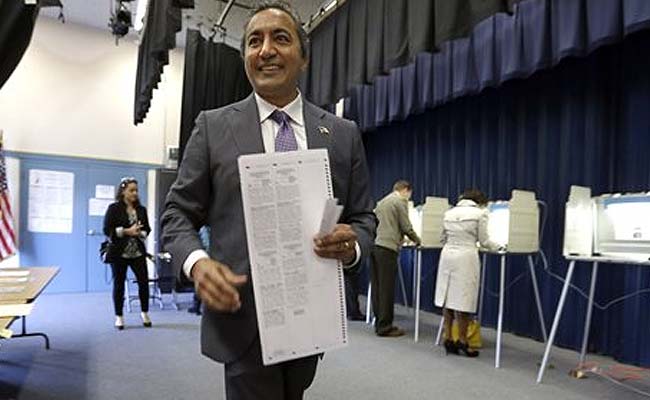
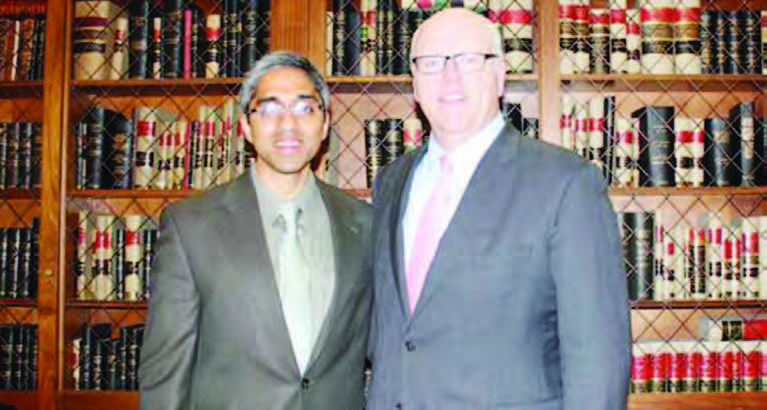
    WASHINGTON (TIP): The US Senate has at long last confirmed Vivek Murthy, M.D., M.B.A., to be the 19th surgeon general of the United States. An educator and practicing internal medicine physician, Murthy has been an outspoken champion on a number of public health issues of keen importance to family medicine.

    The 37-year-old Indian-American physician Vivek Hallegere Murthy is youngest person and first person of Indian-origin to hold the post.

    The upper house of US Congress confirmed Murthy’s nomination by 51 votes to 43 more than a year after President Barack Obama had nominated him to this top administration post on public health issues in November 2013 which saw a strong opposition from the powerful pro-gun lobby National Rifle Association (NRA).

    The final voting came yesterday soon after the Senate invoked cloture – a procedural hurdle – by same numbers (51 to 43 votes)

    href=”theindianpanorama.news/wp-content/uploads/2014/12/Vivek-Murthy2.jpg”>Vivek Murthy2

    Pitching strongly for Murthy’s confirmation, Senator Dick Durbin praised Murthy for his dedication to fighting obesity, tobacco related diseases and other chronic diseases that account for seven out of the top 10 causes for death in America and make up for 84 per cent of America’s health care costs.

    “I believe Dr Murthy understands the importance of the national crises before him, and feel confident that his experiences, his training, and his tenacity have provided him the qualifications he needs to tackle these issues, and the many more he’s sure to face, head-on,” Durbin said.

    “Not only is Dr Murthy an outstanding doctor and public health expert, but he also remains closely connected to his community and family,” he said.

    “There is no question about the qualification of Dr Murthy to do his job,” said another Senator Chris Murphy, adding that Murthy has a really impressive history of commitment to international public health, building two international organizations, one that empowers hundreds of youths in the US and India to educate over 45,000 students on HIV prevention.

    Senator Richard Blumenthal said Murthy has addressed some of the nation’s most pressing health problems over the times. “Dr Murthy’s credentials are without question. They are impeccable, unquestionable and indisputable”.

    Coming out in support of Murthy, senator Daniel Markey said he has developed a skill set which is much needed for the 21st century and in an era where disease cross international boundaries.

    “It is an opportunity to put a real leader in this position,” he said.

    Senator Mazie Hirono said Murthy would make an effective surgeon general.

    On the one hand, when several senators have lauded Murthy’s nomination there were others who continued to oppose his confirmation.

    “The American people deserve a surgeon general who has proven, throughout his or her career that their main focus is a commitment to patients, not a commitment to politics.

    Murthy’s confirmation has been widely applauded.

    Rep. Joe Crowley (D-Queens, the Bronx), Vice Chair of the Democratic Caucus and Co-Chair of the Congressional Caucus on India and Indian-Americans, released the statement below following the U.S. Senate’s confirmation of Vivek Hallegere Murthy as the next surgeon general

    “I congratulate Dr. Murthy on his confirmation as our nation’s next surgeon general. He is a dedicated fighter for public health and I know he will work tirelessly to improve the health of all Americans. I was proud to stand with him during his confirmation process, and I look forward to working with him in his new role.

    “I’m glad that this nomination didn’t fall victim to partisan bickering and pressure from special interests, but this is more than a political victory. The confirmation of the first surgeon general of Indian descent is a victory for the entire Indian-American community, whose young children will grow up knowing that anything is within their reach.

    “It’s a victory for our medical community, with a dynamic and skilled physician leading our public health policies as our nation’s top doctor.

    “And, this is a victory for the American people and ensuring better health for all.”

    Rep. Tulsi Gabbard in her Statement on Confirmation of Vivek Murthy as Surgeon General, said “I extend my sincere congratulations to our new Surgeon General, Dr. Vivek Murthy, who has demonstrated dedication to serving others. Dr. Murthy has shown his commitment and passion for improving healthcare, especially in the areas of mental health, obesity, chronic disease, and vaccinations. I look forward to working with him to serve the health and wellness needs of the American people.”

    Dr. Murthy’s parents are originally from Karnataka, India. He was born in Huddersfield, England and the family relocated to Miami, Florida when he was three years old. Dr. Murthy attended college at Harvard University, where he graduated magna cum laude in three years with a bachelor’s degree in Biochemical Sciences. He received an MD from the Yale School of Medicine and an MBA in Health Care Management from the Yale School of Management. He is currently a practicing physician at Brigham and Women’s Hospital in Boston, as well as the Hospitalist Attending Physician and Instructor in Medicine at Harvard Medical School.

  • Indian-origin man knifed in Britain succumbs to injuries

    Indian-origin man knifed in Britain succumbs to injuries

    LONDON (TIP): An Indian-origin man who was found stabbed at a house in Britain’s Manchester city earlier this week succumbed to his injuries on his 63rd birthday, a media report said on December 3. Ujjal Singh died after being attacked in the city’s Crumpsall area December 1. He was taken to Manchester Royal Infirmary after the attack but he died at the hospital, the Manchester Evening News reported. He is survived by his wife, four children, nine grandchildren and a great-grandson. “Ujjal Singh sadly passed away on December 1, the day of his 63rd Birthday,” Singh’s family said in a statement. Police were called late Sunday night after the attack. A 37-year-old man, arrested on suspicion of Singh’s murder, has been granted bail until February next year, pending further enquiries. Another man, 53, arrested on suspicion in the case, is presently in police custody. “The investigation will still continue until we fully understand exactly what happened,” reported BBC citing a police official.

  • 8-year-old Indian-origin CEO to address cyber security summit

    8-year-old Indian-origin CEO to address cyber security summit

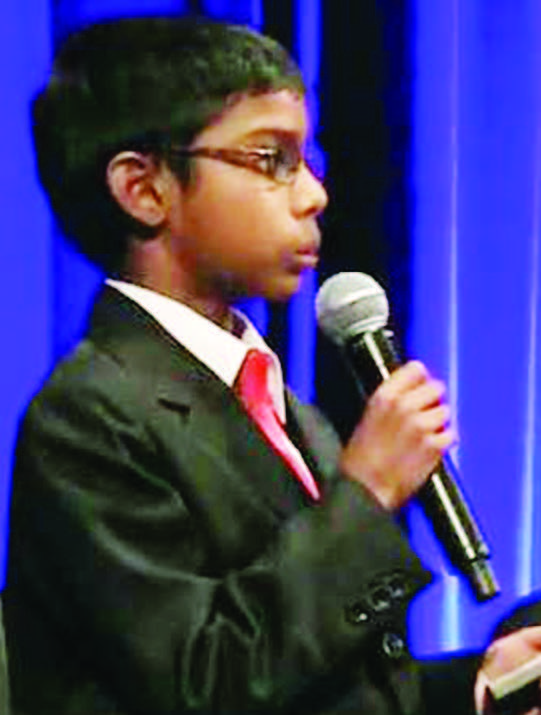
    HOUSTON (TIP): An eightyear old Indian-origin child prodigy, Reuben Paul, is among experts who will address a cyber security conference in New Delhi on November 14, national Children’s Day. The US-based whizkid Reuben Paul will speak about the need for developing cyber security skills in the current generation, according to the organizers of Ground Zero Summit.

    Minister of State for External Affairs, V K Singh, is also listed as a keynote speaker for the event. The organizers said, “8-year-old Reuben Paul gives keynote at Houston Security Conference.” Reuben has been trained in Object C programming language by his father, Mano Paul. The child prodigy is now learning Swift programming, for Apple’s iOS platform. He has his own gaming firm called Prudent Games, and is designated as CEO of the company. Mano Paul, his father is his partner in the company. “I started learning about computer languages around one-and-a-half years back.

    Now I design my own projects,” Reuben stated. “This will be Reuben’s fourth conference where he will be giving lecture on cyber security. He will talk about need to create awareness about cyber security among young kids as well as demo white page hacking,” Mano Paul said. Other keynote speakers listed for the event include Home Ministry Joint Secretary Nirmaljeet Singh Kalsi, National Technical Research Organization Director of Cyber Security Operations Alok Vijayant and Special Commissioner Police (Traffic) with Delhi Police Muktesh Chander. Recently an Indian-origin teenager Shubham Banerjee secured funding from Intel to manufacture a low-cost Braille printer.

    The middle-schooler is one of the world’s youngest venture capital-backed entrepreneurs. Banerjee plans to massproduce the printers and sell them for about $350.

  • INDIAN-ORIGIN TAXI DRIVER JAILED FOR SEX ATTACK IN UK

    INDIAN-ORIGIN TAXI DRIVER JAILED FOR SEX ATTACK IN UK

    LONDON (TIP): A 24-year-old Indian-origin taxi driver, who is also a bhangra singer, has been jailed for nine months for a sex attack on a passenger in the English town of Nottingham. Dhanraj Singh was taking a young woman home when he kissed and touched her. Singh was told he breached his passenger’s trust because she was in his care and had been drinking.

    Nottingham Crown Court heard that Singh was a bhangra singer and was due to fly to Mumbai to film a music video after topping the Asian music charts. But instead, the father-of-two was sent to prison for nine months on Tuesday after being found guilty earlier this month of sexual assault. “You are a talented, award-winning musician. You have put all of that in jeopardy. You were responsible for her safety and well-being. You took advantage of a lone female passenger who had been drinking,” Judge Gregory Dickinson said in his ruling. The judge said the effect on the victim had been “very serious” and the court was told that the woman had made a statement saying she was “still raw” and was having ongoing counselling.

    She had lost weight as a result of the attack on April 1, which had also affected her studies and left her feeling “vulnerable”, the local ‘Nottingham Post’ daily reported. Defence lawyer Mark Achurch told the court: “He is a family man with two children who had been working anti-social hours to support his family. “It was a short-lived incident. He lost his taxi driver’s licence immediately and has been out of work and on benefits since.” The case comes less than two weeks after another Nottingham taxi driver was jailed for sexually assaulting a 17- year-old girl in the back of his cab. Jamil Ahmed, chairman of Nottingham Licensed Taxi Owners’ and Drivers’ Association, said steps were being taken to keep passengers safe.

  • Rupal Shah-Palanki becomes the first Indian American judge to be confirmed in Connecticut

    Rupal Shah-Palanki becomes the first Indian American judge to be confirmed in Connecticut

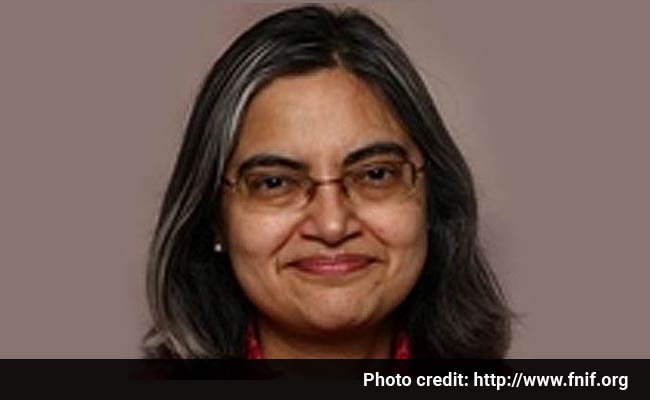
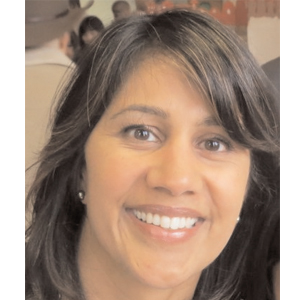
    NEW YORK: Connecticut Judge Rupal Shah-Palanki was confirmed to the Tolland District Superior Court recently, making her the first-ever Indian-origin Judge in the state of Connecticut to hold a Superior Court seat. Shah-Palanki was initially appointed by Governor Daniel Malloy on March 14, alongside 15 other Superior Court nominees, and her confirmation came just about a month and a half later.

    In a statement released at the time of her appointment, Shah-Palanki expressed her gratitude to Governor Malloy for selecting her for such a prestigious position. “I am deeply honored and humbled that Governor Malloy has nominated me to serve as a Superior Court Judge,” Shah-Palanki said. “I want to thank Governor Malloy for his belief in my abilities and character and his commitment to diversity in the judiciary.” “I also thank my family and friends for their constant support and the numerous mentors and colleagues I have been privileged to learn from and work with throughout my career.”

    she also said. “If I am confirmed, I promise to carry out this great responsibility with compassion, diligence, respect and fairness.” Shah-Palanki attended Massachusetts College of the Holy Cross for her undergraduate studies, graduating in 1995 with a B.A. in Political Science. She then attended the Georgetown University Law Center from 1996-1999 for her J.D., and was also involved with two prestigious organizations: the Policy International Law Society and the Georgetown Journal on Poverty Law.

    In taking up her new job, Shah-Palanki will be leaving her most recent position as an Assistant Attorney General with the Connecticut Attorney General’s Office, where she had been employed since 2003. Before that, she was an associate with two law firms: Bingham McCutcheon, located in Washington, DC; and Cohn, Birnbaum and Shea, in Hartford, Connecticut. Additionally, Shah-Palanki is an official with the Connecticut Asian Pacific American Affairs Commission.

  • Indian American Akhil Rekulapelli wins National Geographic Bee: Beats 11 yearold Ameya Mujumdar for the title

    Indian American Akhil Rekulapelli wins National Geographic Bee: Beats 11 yearold Ameya Mujumdar for the title

    WASHINGTON, DC (TIP): Akhil Rekulapelli, a 13 year-old eighth grader from northern Virginia’s Loudoun County, is the winner of the 2014 National Geographic Bee. Rekulapelli emerged as the victor of the Bee’s 26th annual iteration on Wednesday, May 21, beating out competitors from each state and territory in the US. His win as the national Geographic Bee champion continues a streak of Bee dominance displayed by Indian American students, who have also regularly topped the Scripps National Spelling Bee in recent years, too.

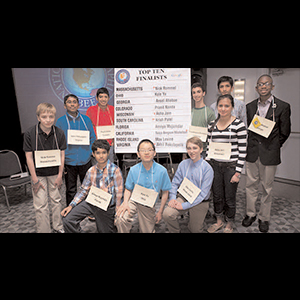
    Last year, Indian-origin 12 year-old Sathwik Karnik, of Massachusetts, won the National Geographic Bee. Of the top 10 competitors in this year’s Geographic Bee, exactly half were Indian, including Rekulapelli. The others were Coloradao’s Pranit Nanda, Florida’s Ameya Mujumdar, South Carolina’s Krish Patel, and Wisconsin’s Asha Jain. All, like Rekulapelli, are in eighth grade except for Mujumdar, who is in fifth grade.

    All are also 14 except Mujumdar, who is 11. Despite being the youngest, Mujumdar ended up placing second, losing to Rekulapelli at the very end. Rekulapelli stumped his competition by correctly answering a question about oil drilling in the Neuquén province of a major South American country (it’s Argentina, by the way). Now that he’s the US champion, Rekulapelli will represent the nation at the International Geographic Bee, which will take place in Monaco later this year.

    Geographic Bee host Soledad O’Brien, alongside National Geographic Society President and CEO Gary E. Knell, presented Rekulapelli with a check for $50,000 to be used towards a college scholarship. According to National Geographic, Rekulapelli is already looking to attend either Stanford, or his state’s University of Virginia.

    Additionally, Rekulapelli has won a trip to the Galapagos Islands, which he will take with National Geographic’s Lindblad Expeditions. Mujumdar walked away with $25,000 for his second-place performance. The third place winner, Tuvya Bergson- Michelson of California, received $10,000.

  • Indian-origin tech CEO ducks jail despite beating girlfriend 117 times

    Indian-origin tech CEO ducks jail despite beating girlfriend 117 times

    LOS ANGELES (TIP): Indian-origin internet advertising mogul Gurbaksh Chahal has escaped jail despite beating and kicking his girlfriend 117 times, according to a media report. Chahal, 31, pleaded misdemeanor, domestic violence and battery charges last week, dodging 45 felony counts for the videotaped 30-minute beating of his girlfriend, The Huffington Post reported. The CEO of RadiumOne – a Silicon Valley company that focusses on real-time advertising across web, mobile and Facebook – faces no jail time.

    Chahal was sentenced to three years’ probation, 52 weeks in a domestic violence training programme and 25 hours of community service. The Internet mogul was arrested in August last year after police responded to a 911 domestic violence call at his San Francisco penthouse apartment. His girlfriend told the officers that she was unable to breathe and that Chahal had told her four times, “I’m going to kill you,” a police officer said, adding: “She stated she was in fear for her life.” Home security footage reportedly showed Chahal beating and kicking his girlfriend 117 times during the 30-minute attack. Prosecutors said Chahal lashed out at his girlfriend after learning that she had cheated on him during a trip to Las Vegas, according to court documents.

    Soon after Chahal posted his USD 1 million bail and hired former federal prosecutor James Lassart as his attorney, his girlfriend stopped cooperating with the investigation and refused to testify against him. During a preliminary hearing, Lassart did not deny that Chahal repeatedly beat his girlfriend, but insisted the physical damage was overblown. In a crippling blow to the prosecution, San Francisco Superior Court Judge Brendan Conroy ruled the surveillance video could not be used as evidence because police seized it illegally from Chahal’s apartment. The prosecution argued it likely would have been erased if police had waited for a warrant.

    Alex Bastian, spokesman with the San Francisco District Attorney’s Office, issued a statement after the guilty plea yesterday, saying: “We disagree with the judge’s suppression of the video. The judge’s ruling substantially weakened the evidence we had for prosecution.” Chahal, once named one of America’s “most eligible bachelors” by ExtraTV, managed to advance his online- advertising network into its final stages for an initial public stock offering despite his arrest. He also secured a new partnership with publisher Conde Nast in April. Chahal sold his first online-ad network at the age of 16 for USD 20.5 million in stock. Seven years later, he sold another company he founded to Yahoo for USD 300 million. He authored a book about himself in 2009 titled ‘The Dream: How I Learned the Risks and Rewards of Entrepreneurship and Made Millions’.

  • Indian-origin doctor pleads guilty to taking bribes in US

    Indian-origin doctor pleads guilty to taking bribes in US

    NEW YORK (TIP): An Indian-origin pediatrician in the US has pleaded guilty to accepting bribes in exchange for test referrals as part of a long-running scheme operated by a diagnostic firm. Surender Gorukanti, 46, of Brooklyn, New York, admitted before US District Judge Stanley Chesler in Newark federal court to an information charging him with one count of accepting bribes, attorney Paul Fishman said.

    Besides Gorukanti, 24 people — including 14 physicians — have pleaded guilty in connection with the bribery scheme, which its organizers have admitted involved millions of dollars in bribes and resulted in more than $100 million in payments to the diagnostic firm from Medicare and various private insurance companies.

    Gorukanti admitted he accepted cheques of $1,000 per month as bribes from the firm in return for referring patient blood specimens to it. The bribery count to which Gorukanti pleaded guilty carries a maximum potential penalty of five years in prison and a $250,000 fine. Sentencing is scheduled for June 16.

  • INDIAN WOMAN IN US FOUND GUILTY OF SETTING HUSBAND AFIRE

    INDIAN WOMAN IN US FOUND GUILTY OF SETTING HUSBAND AFIRE

    HOUSTON: A 27-year-old Indian-origin woman in the US state of Texas has been found guilty of causing arson that killed her husband two years ago. Shriya Bimal Patel was convicted on Monday of dousing her husband Biman Patel in gasoline and setting him on fire in 2012.

    Bimal, 29, died at the burn centre of the San Antonio Military Medical Center, nearly five months after the April 17 incident. She faces five to 99 years in prison. In closing arguments on Monday, the state asked jurors to recommend a life sentence for Shriya, who witnesses have said intentionally ignited an explosion that killed Bimal. Defence lawyers, however, sought probation for her.

    They said Shriya would be deported to India should she receive community supervision. Testimonies ended on Friday when defence attorneys called their only witness, an associate professor of Indian culture from the University of Texas. Her lawyers have argued that her husband killed himself and forced her to help.

    Prosecutors said Shriya, who had studied in London and lived in Dubai was used to an upper-class lifestyle, was upset because Bimal did not lived up to her expectations. They said she was disappointed that Bimal had been laid off from a telemarketing job and was struggling to pay his rent.

  • Indian woman accused of killing husband in US faces life term

    Indian woman accused of killing husband in US faces life term

    DALLAS (TIP): US prosecutors have rested their case against a 27-yearold Indian-origin woman, who faces life sentence for allegedly killing her husband by setting him afire two years ago.

    Shriya Patel’s trial began on March 4 in Austin,Texas, with prosecutors accusing her of luring her husband into the bathtub for a massage, dousing him with gasoline and then setting him ablaze before shutting him in the bathroom. Bimal Patel, 29, died at the burn centre of the San Antonio Military Medical Center, nearly five months after the April 17, 2012, incident.

    Judge David Crain told jurors the defense will begin making its case today. In testimony yesterday, the state presented evidence from DNA experts who said Shriya Patel’s fingerprints were found on a 10-gallon white bucket that contained gasoline and plastic bags that witnesses have said were used to cover the sprinklers in the couple’s North Austin apartment. Testing results on prints found on a red gas can could not be matched to her, witnesses said.

    She faces a life sentence in prison without parole if convicted, the Austin American- Statesman reported. Under cross-examination, the crime scene specialists testified that they were not asked to test the materials in the apartment until last month, nearly two years after the incident. The defense received the DNA evidence on Monday, they said. The evidence came during a heated cross-examination of an arson investigator in the capital murder trial for Shriya Patel.

    Her lawyers are arguing that her husband killed himself and forced her to help. In opening statement, assistant district attorney Jim Young said Bimal Patel, who had been born in India, “grew up basically an American kid” in Amarillo. He went to Texas Tech and moved to Austin, where he became involved in business, but his father was a traditionalist and had pushed him to seek a partner through an arranged marriage service in India, the prosecutor said.

    Through this service, he submitted a resume and met Shriya Patel, Young said. The two married, but it took about a year for her to get her passport to come to the US, and she had only been in the country a week when she decided to kill her husband, the prosecutor said.

  • Indian-origin hedge fund manager seeks to overturn conviction

    Indian-origin hedge fund manager seeks to overturn conviction

    NEW YORK (TIP): Indian-origin hedge fund portfolio manager Mathew Martoma, convicted for his role in the most lucrative insider trading scheme in US history, has asked a court to overturn the verdict or give him a new trial as jury bias “tainted” the ruling.

    Martoma, 39, said his conviction should be thrown out because “unrelated” information about his dismissal from Harvard Law school biased the jury against him and the government failed to prove beyond reasonable doubt that he traded on material, non-public information. Alternatively, he said in a 45-page motion filed in a federal court here that he should face a new trial.

    The motion by the former portfolio manager of CR Intrinsic Investors, a division of SAC Capital, seeks “a judgement of acquittal on all counts”. Martoma, convicted on February 6, will be sentenced on June 10. He was found guilty by a federal jury for his role in the USD 275 million insider trading scheme after a monthlong trial on one count of conspiracy to commit securities fraud and two counts of securities fraud related to a clinical trial involving Elan Corp and Wyeth, now part of Pfizer Inc, for an experimental drug to treat Alzheimer’s.

    While the maximum prison sentence on all the three counts is 45 years, Martoma could face up to 15 to 20 years in prison based on federal sentencing guidelines, which will take into account the gains reaped by SAC from the trading. Martoma also faces a fine of over USD 5 million on the charges. In his motion, Martoma said the government failed to prove beyond reasonable doubt that he committed any of the crimes he was charged with and that he obtained non-public information from two doctors who knew about the clinical trial.

    The government also could not prove that the two doctors obtained a personal benefit from sharing confidential material with Martoma, the motion said. The prosecutors could not prove that Martoma agreed with the doctors who knew of the information about the clinical trial to commit insider trading or had the “requisite criminal intent to do so”, it said.

  • Two Indian-American students go missing

    Two Indian-American students go missing

    NEW YORK (TIP): Even as search continues for an Indian-American nursing student who went missing in New York 10 days ago another India native has mysteriously vanished on a spring break trip to Florida.

    Reny Jose, who arrived in Panama City Beach, Florida Saturday, March 1, disappeared Monday evening, the Houston Chronicle reported citing Florida’s Bay County Sheriff’s Office. A police spokesperson said Jose’s clothing were found in a garbage can behind the house.

    Rice University informed students of Jose’s disappearance Tuesday, said Rice spokesman B.J. Almond. Almond said the 21-year-old senior is a native of Latham, a suburb of Albany, New York. According to Jose’s Facebook page, he graduated from Latham’s Shaker High School before enrolling at Rice to study mechanical engineering.

    Jose’s sister, Reashma Jose, has created a Facebook page to help find her brother. Meanwhile, the Nassau county police department’s missing persons squad is seeking the public’s help in locating Jasmine V. Jospeh, a 22-year-old female college student from Syosset, according to Newsday.

    Her parents said Saturday that they had paid for their daughter to enrol at New York Institute of Technology for the fall 2013 semester. But university officials said Jasmine Joseph, who would have been a junior, hadn’t been a student at school in Old Westbury since last May. The parents don’t know for sure whether she had been attending class, and they haven’t seen any of her grades, Newsday said.

    They never, however, suspected anything suspicious about their daughter’s behavior. The family has set up a Facebook page and put up fliers in the neighborhood with the hopes of gaining any clues into their daughter’s disappearance. Last month, yet another Indian-origin student Pravin Varughese, who had gone missing in Illinois, was found dead in a wooded area in Carbondale. The Southern Illinois University student from Morton Grove had disappeared after getting into a dispute with an acquaintance who was giving him a ride.

  • Two Indian-origin men get prestigious award in US

    Two Indian-origin men get prestigious award in US

    NEW YORK (TIP): Two Indian-origin men are among this year’s prestigious Heinz Awards recipients in the US. Abraham Verghese, a professor at Stanford University Medical School, and Sanjeev Arora, a computer scientist, of Albuquerque in the US state of New Mexico will be honoured in Pittsburgh April 3, the foundation announced on its website on Tuesday.

    The five recipients will receive a cash award of $250,000 each as well as a medallion inscribed with an image of late US senator John Heinz. Abraham Verghese, who was born to parents from Kerala in Ethiopia, was given the award in recognition of his best-selling authorship. In his first book, ‘My Own Country’, he wrote extensively about AIDS in rural areas of Tennesse. Verghese did his MBBS degree from Madras University in 1979.

    Sanjeev Arora, born at Kota in Rajasthan and now a San Franciscobased entrepreneur, was recognized for revolutionizing community healthcare using video conferencing technology. The awards recognize outstanding individuals for their contributions in the fields of arts, humanities, environment, human Condition, public policy,technology, economy and employment. The awards are conferred annually by the Heinz Family Foundation and were instituted in 1993.

  • Indian-origin woman booked for killing son in Texas: Says she’s innocent

    Indian-origin woman booked for killing son in Texas: Says she’s innocent

    DALLAS (TIP): A Frisco woman, Pallavi Dhawan, charged with murder in the death of her 10-year-old son says she didn’t kill him. Arnav Dhawan was found dead in a bathtub Dec. 30 at his parents’ home.

    Pallavi’s attorney, David Finn, said Monday, February 10 that the toxicology reports on Arnav are back, but they are being reviewed by the medical examiner and likely will not be made public for about a week. Frisco Police said that Arnav’s mother, Pallavi Dhawan, confessed to killing her son — when asked by officers if she killed Arnav, they say she nodded her head, indicating yes.

    But Finn and Sumeet, Pallavi’s husband, say that never nodded her head. “I did nothing to cause his death,” Pallavi Dhawan said Monday in an exclusive interview with FOX 4. Pallavi says when she picked Arnav up from school the day before his death, she knew something was wrong. “He came, we went home, I offered him a snack,” said Pallavi. “He didn’t want to have a snack, which was a little bit unusual. So I offered him some grapes.

    He had a few bites of grapes and then he didn’t feel like eating. He said, ‘I don’t feel like eating. Can we go somewhere out?’” Pallavi says they went out to a movie, but Arnav said he was tired and wanted to go home, so she took him to Toys “R” Us and then their house. “I said, ‘Why don’t you just, you know, change and go to sleep?’” said Pallavi. “And he said, ‘You know, I don’t feel like changing.’ And he was still looking…he had to see if his Smurfs was recorded.

    That was important to him. So he checked if his Smurfs was recorded. He checked that, but then he was so tired, he didn’t feel like changing. And I could see that he was tired. He said, ‘I’m tired and I’m feeling little bit cold.’ So then I said, you know, ‘OK,’ and I touched him and he did seem a little bit cold, but there was no fever or anything.” Pallavi says she read Arnav a story and put him to bed, but he got up twice, complaining of being cold.

    “This time, I decided to stay with him, and I slept next to him,” she said. “…I woke up Saturday morning, I tried to wake him up, and he wouldn’t get up.” “And what did you think at first?” FOX 4’s Shaun Rabb asked. “At first I thought…he just didn’t want to wake up,” said Pallavi. “And then you realized that he was dead?” asked Rabb. “I think I knew, but I didn’t want to believe it,” said Pallavi.

    The mother says she picked up her son and realized he had relieved himself in his pants. “…I actually picked him up,” she said. “I picked him up, Shaun; I picked him up. I picked him up. I held on to him and I took him to the bathtub, because I didn’t want to believe he’s gone. I took him to the bathtub…’cause he was feeling a bit cold to me.”

    Pallavi says tried to save Arnav. “So I tried to push on his chest and just blow on his mouth, saying, ‘Get up!’” said Pallavi. “He wouldn’t open his eyes. He wouldn’t bend his arms. It took me a while to just tell myself, ‘He’s gone. He’s gone.’ And he was there, lying there, and I’m looking at him…he’s not there. What do I do next?’ Pallavi said she put shopping bags full of ice around Arnav to preserve his body for her husband, who was away on a business trip at the time.

  • Indian-origin scientist develops ‘brain’ for robots

    Indian-origin scientist develops ‘brain’ for robots

    WASHINGTON (TIP): Robot brain! An Indian-origin scientist in US has developed a new feedback system that allows robots to operate with minimal supervision and could eventually lead to autonomous machines. The system may lead to robots that think for themselves, learn, adapt and use active critique to work unsupervised. Developed by Dr Jagannathan Sarangapani, from Missouri University of Science and Technology, the system makes use of current formation moving robots and introduces a fault-tolerant control design to improve the probability of completing a set task. The new feedback system will allow a “follower” robot to take over as the “leader” robot if the original leader has a system or mechanical failure. In a leader/follower formation, the lead robot is controlled through a nonholonomic system, meaning that the trajectory is set in advance, and the followers are tracing the same pattern that the leader takes by using sonar. When a problem occurs and roles need to change to continue, the fault tolerant control system comes into use.

    It uses reinforcement learning and active critique, both inspired by behaviourist psychology to show how machines act in environments to maximise work rate, to help the new, unmanned robot to estimate its new course. Without this, the follower wouldn’t have a path to follow and the task would fail. “Imagine you have one operator in an office controlling 10 bulldozers remotely,” said Sarangapani, the William A Rutledge – Emerson Electric Company’s distinguished professor in Electrical Engineering at S&T. “In the event that the lead one suffers a mechanical problem, this hardware allows the work to continue,” said Sarangapani. The innovative research can be applied to robotic security surveillance, mining and even aerial manoeuvring. Sarangapani believes that the research is most important for aerial vehicles. When a helicopter is in flight, faults can now be detected and accommodated. This means that instead of a catastrophic failure resulting in a potentially fatal crash, the system can allow for a better chance for an emergency landing instead. The fault tolerance would notice a problem and essentially shut down that malfunctioning part while maintaining slight control of the overall vehicle. “The end goal is to push robotics to the next level,” said Sarangapani. “I want robots to think for themselves, to learn, adapt and use active critique to work unsupervised. A self-aware robot will eventually be here, it is just a matter of time, he said.

  • Indian-origin teacher in UK gives birth in classroom

    Indian-origin teacher in UK gives birth in classroom

    LONDON (TIP): An Indian-origin teacher in the UK has dramatically given birth to a baby boy in a classroom after she went into labour while in school. Diane Krish-Veeramany, 30, went into labour, a week before her due date, and three of her colleagues at Manford Primary School helped deliver the baby, called Jonah. Krish-Veeramany, who delivered the baby last Thursday said, “Everyone was so supportive and just acted on instinct.” “Luckily, my husband got to the school before I gave birth,” she said. “We now joke that he was late for his first day at school as he was born after the bell,” the primary school teacher was quoted as saying by BBC. Krish-Veeramany had gone to a morning meeting, but shortly afterwards she asked to go home after feeling ill. “I texted my husband to come and get me… but my colleagues asked if I wanted an ambulance. “I said ‘I’ll just go home’ – I just didn’t think it would be a contraction as it didn’t feel like one,” she said. Her husband Vijaye Veeramany was on his way to pick up his wife when he got a call telling him she was in labour. Teaching assistants Dita Gojnovci, Chris Sword and Sam Mustafa helped her give birth in a classroom. “One person was on the phone to my husband, one was on the phone to my hospital and the other to an ambulance,” said Krish-Veeramany. “It all just happened really quickly, within 20 minutes of these phone calls I’d had Jonah,” she added. Jonah is her second child, but this birth was very different from her previous delivery which was in a hospital.

  • Britain Appoints Indian-Origin Kumar Iyer As UKTI India Head

    Britain Appoints Indian-Origin Kumar Iyer As UKTI India Head

    NEW DELHI (TIP): The British government on August 1 appointed Kumar Iyer, an Indian-origin official, as director general for UK Trade and Investment (UKTI) in India. This is a new top level post and has been created to reflect the increasing importance of business ties between the two countries. As UKTI director general, India, Iyer will have overall responsibility for the bilateral commercial and trade relationship. Iyer will also be British deputy high commissioner for western India. He will take up both positions, based in Mumbai, Aug 5.

    “I am very excited at the prospect of living and working in India, it’s a country of boundless energy, talent and potential. Having lived and studied in India whilst growing up, I am equally keen to play my part in promoting the academic, cultural and social links between our two countries,” Iyer said, looking forward to his posting. Iyer has an MPhil in Economics from Cambridge University where he was a Bank of England scholar and an undergraduate tutor in Microeconomics. He was also a Kennedy Scholar and Teaching Fellow in International Capital Markets at Harvard University. Since 2008, Iyer has been a high-ranking official at the British Treasury and the Prime Minister’s Strategy Unit.

  • 15 Indian-American students qualify for Spelling Bee semis

    15 Indian-American students qualify for Spelling Bee semis

    WASHINGTON (TIP): 42 have made it to the national Spelling Bee semifinals. Of them 15 are Indian-American students. Six of them are girls. The Indian American students account for almost one-third of the total 42 candidates who have qualified. The girls who succeeded include Himanvi Kopuri from Colorado, Nikitha Chandran from Florida, Vanya Shivashankar from Kansas, Neha Seshadri from Michigan, Shobha Dasari from Texas and Vismaya Kharkar from Utah.

    Vanya is already making her third appearance in the Scripps National Spelling Bee. Her sister Kavya was a fourtime participant and the 2009 national champion. Vanya competed in the 2010 national finals, and tied for tenth place at last year’s Bee.

    The boys who made it to the semifinals after the day-long competitions are Pranav Shivakumar from Illinois, Kuvam Shahane from Michigan, Gokul Venkatachalam from Misouri, Ryan Devanandan, Sriram Hathwar and Arvind Mahankali from New York, Ashwin Veeramani from Ohio, Aditya Rao from New Jersey, and Chetan Reddy from Texas. However, Tara Singh, 8, the youngest in the competition, could not make it to the semi-finals.

    In all there were nearly 50 Indian Americans who came to Washington to take part in this prestigious national-level competition. Indian-origin people remain unchallenged in the Scripps National Spelling Bee since 2008, with Sameer Mishra winning it in 2008, Laodicean Kavya Shivashankar (2009), Anamika Veeramani (2010), Sukanya Roy (2011) and Snigdha Nandipati (2012).

    For the first time in the 86-year history of the National Spelling Bee, the evaluation of vocabulary knowledge will be formally incorporated as an element of the competition, the organizers said. “This is a significant change in the Scripps National Spelling Bee, but also a natural one,” said Paige Kimble, director of the Scripps National Spelling Bee. “It represents a deepening of the Bee’s commitment to its purpose: to help students improve their spelling, increase their vocabularies, learn concepts and develop correct English usage that will help them all their lives.”

    Earlier this month, 12-year-old Indian- American Sathwik Karnik won the National Geographic Bee contest in the US. In 2008, Akshay Rajagopal from the community won the geographic bee contest while the 2012 edition was won by Rahul Nagvekar

  • Obama terms Srikanth Srinivasan as a ‘Favorite’ person

    Obama terms Srikanth Srinivasan as a ‘Favorite’ person

    WASHINGTON (TIP): US President Barack Obama has described Indian-origin Srikanth Srinivasan, who created history by becoming a top federal judge, as one of his “favourite” persons. “One of my favourite people right now [is], Sri Srinivasan, who has just been confirmed,” Obama said at a White House reception held to celebrate the month of Asian American and Pacific Islanders (AAPI).

    “I was proud to nominate Sri, and he was just confirmed unanimously to become the first South Asian American federal appeals court judge,” Obama said addressing the gathering at the White House last evening. “I was telling his kids, who are here today, if he starts getting a big head, walking around the house with a robe asking them to call him ‘Your Honor’ then they should talk to me,” Obama said amidst laughter.

    Media reports suggest Obama might consider nominating Srinivasan, one of his favourite legal luminaries, for the Supreme Court judge in case of the next vacancy on the bench. Last week, Srinivasan was confirmed by the US Senate (97-0) votes as a judge on the DC circuit court of appeals, which is considered as the top court of the country after the Supreme Court. He is the first Indian-American to achieve the fete. Addressing the gathering, Obama fondly remembered delicacies like ‘keema’ and ‘daal’ cooked by his Indian and Pakistani classmates during college days.

  • PROMINENT LEGAL LUMINARIES OF INDIAN ORIGIN IN THE US

    PROMINENT LEGAL LUMINARIES OF INDIAN ORIGIN IN THE US

    WASHINGTON (TIP): Recently, Indian-American Srikanth Srinivasan scripted history after he was confirmed as the first South Asian judge to America’s second highest court. But Srinivasan is not the only famous person of Indian origin who has made it to the top ranks in US judicial system.
    Srikanth Srinivasan was appointed as a judge on the prestigious US Court of Appeals in Washington DC, the highest judicial appointment achieved by an Indian-American. Born in Chandigarh, Srinivasan spent nearly two decades as an extraordinary litigator before serving as Principal Deputy Solicitor General of the United States. Now he will serve with distinction on the federal bench. Srinivasan will be the first South Asian American to serve as a circuit court judge in US history.
    Preet Bharara, who was born in Punjab, is the US attorney for the Southern District of New York. In 2012, Bharara was named by Time magazine as one of ‘The 100 Most Influential People in the World’ and was also featured on a cover of Time Magazine. His office was responsible for the high-profile prosecutions of insider trading and other financial fraud on Wall Street including the investigation against the Galleon Group of Raj Rajaratnam and former McKinsey chief Rajat Gupta. Bharara graduated from Harvard College and Columbia Law School.

    Neal Katyal served as Acting Solicitor General of the United States from May 2010 until June 2011. A graduate of Dartmouth College and Yale Law School, Katyal currently runs the appellate practice at the law firm Hogan Lovells and teaches at the Georgetown University Law Center, where he was one of the youngest tenured professors in the university’s history. Katyal has served as counsel or co-counsel for numerous US Supreme Court cases.

    Amit Mehta, an Indian-origin lawyer, is a partner at Washington law firm Zuckerman Spaeder, and has been involved in many big cases, including helping former IMF president Dominique Strauss-Kahn successfully get criminal assault charges in New York state court dismissed. Mehta, 39, is also a board member of the Mid-Atlantic Innocence Project, which seeks to reverse and prevent wrongful convictions in DC, Maryland and Virginia.

    Preeta D. Bansal served as the General Counsel and Senior Policy Advisor to the US federal Office of Management and Budget from 2009 until 2011. Before her assignment in the Obama administration, she served as a law partner at Skadden, Arps, Slate, Meagher & Flom

    Amandeep Sidhu is a partner of law firm McDermott Will & Emery in Washington DC. He has built a reputation as a strong litigator with a solid commitment to pro bono cases. He is a founding member of The Sikh Coalition and has fought a pro bono battle on behalf of three Sikh men who wanted to serve in the US Army. He was able to successfully show that the men were able to meet uniform requirements by using Army-issued cloth for the turbans and that even with a beard, the men could not only use a gas mask effectively, but surpass their clean-shaven comrades in field tests. Eventually the men were allowed to join the service, but Sidhu said that he would settle for nothing less than a policy change.

    Kamala Devi Harris is the Attorney General of California following the 2010 California state elections. Earlier she had served as District Attorney of San Francisco from 2004 to 2011. Recently, US President Barack Obama apologized to Kamla Harris, for his comment in which he described the Indian-American as the best-looking attorney general of America – which many alleged was a sexist remark.

  • Two Indian-Origin Persons Jailed In Us

    Two Indian-Origin Persons Jailed In Us

    NEW YORK (TIP): Two Indian-origin persons have been sentenced to jail in the US for conspiring to commit wire fraud under which they used a call centre in India to defraud hundreds of individuals across America. California residents 47-year-old Baljit Singh and 36-yearold Sharanjit Kaur were sentenced by US District Judge Lawrence O’Neill for conspiring to commit mail and wire fraud.

    Singh was sentenced to four years while Kaur would spend over three years in jail. O’Neill also ordered the forfeiture of a property in New York owned by Kaur with more than USD 100,000 in equity and over USD 26,000 from two bank accounts held by the two.

    According to court documents, Kaur and Singh owned and operated several companies based in California for the sole purpose of defrauding at least 180 customers throughout the US. Kaur and Singh told consumers their companies provided debt consolidation services. The two falsely promised customers that they could obtain low-interest loans, assist in avoiding lawsuits, lower mortgage payments and correct errors in credit reports. The two utilised a call center in India from which individuals would call customers under fake identities.

    After luring customers into using these services, they and their agents instructed customers to send in monthly payments of over USD 500. In order to mislead customers, forged letters from creditors were sent indicating that loan modifications had been approved and when customers would contact the debt repair companies about late-payment or default notices they had received from their creditors, the defendants and their agents would hang up on customers. The funds received from customers were used for the defendants’ own benefit or wired to an individual located in Kolkata.

  • Indians account for 22% of Britain’s ultra-rich cluba

    Indians account for 22% of Britain’s ultra-rich cluba

    NEW YORK (TIP): Super-rich Indians account for more than 20% of the wealth of ultra-high net worth (UHNW) individuals in Britain, a new list showed on Tuesday, March 5. As a national group, they are second only to expat Russians. The list, published by the Singapore-based Wealth-X group, places steel magnate and ArcelorMittal chairman Lakshmi Mittal at second place with a fortune of $15.8 billion. Mittal was pushed to the second spot this year by Russian Alisher Burkhanovich Usmanov, who is part owner of the English football club Arsenal and is worth $16.4 billion. “Mittal has seen his net worth estimate decline along with the stock price of ArcelorMittal, losing at least $30 billion in recent years,” the report said. The two other Indians on the top 15 list are the Hinduja brothers – Srichand at number 9 with a net worth of $7.6 billion and Gopichand at 12th with $6 billion. Taken together, the wealth of the three Indian-origin industrialists makes up 22% of the top 15 total of $133.3 billion. Apart from Usmanov, the two other Russians in the list include Roman Abramovich (at number 3, $12.1 billion) and Leonard Blavatnik (Number 5, $9.5 billion).

    According to Wealth-X estimates, there are 10,760 individuals residents in Britain worth $30 million or more, with at least 310 new individuals joining the ranks of the ultra wealthy. On an average, Britain has added one UHNW individual every day since 2011. The combined wealth of the UHNW in Britain stands at an estimated $1.3 trillion. “The wealth composition of the United Kingdom, London in particular, is diverse,” said David Lincoln, Director of Research at Wealth-X. “This is reflected in our data showing that 31% of the UHNW population in the United Kingdom is considered non-domiciled, with non-resident Indians and West AsianUHNWIs making up a significant proportion of these.”

  • Indian-Origin Lottery Winner’s Body To Be Exhumed: US Court

    Indian-Origin Lottery Winner’s Body To Be Exhumed: US Court

    NEW YORK (TIP): A US court has given the go-ahead for exhumation of the body of an Indian-origin businessman in Chicago, who died of cyanide poisoning under mysterious circumstances days after he won a US dollar million lottery. Judge Susan Coleman of the Probate Division of the Cook County Circuit Court in Illinois approved the Cook County medical examiner’s request to exhume the body of Urooj Khan, 46, who died last July a day after he collected a cheque of $425,000 as his prize money. It was not immediately known how quickly the body would be exhumed, but Coleman’s order called for it “as soon as possible” since Khan’s body was not embalmed before burial. The process of exhumation and autopsy is expected to take place as soon as next week.

    Initially no foul play was suspected in Khan’s death and the medical examiner’s office had initially ruled that Khan had died of natural causes. However at the request of Khan’s relative, the cause of his death was re-examined and new screening results from fluid samples showed that a lethal amount of cyanide was present in Khan’s system. In allowing Khan’s body to be exhumed from a cemetery in Chicago, Coleman said there is “reasonable and sufficient” reason for the Cook County medical examiner to get more forensic samples from Khan’s body.

    The Chicago Tribune reported that no one had objected to exhuming Khan’s body. According to court papers, chief medical examiner Stephen Cina said it was important to exhume Khan’s body “as expeditiously as possible” since Khan’s body was not embalmed. The medical examiner’s office said in court papers it was necessary to do a full autopsy to “further confirm the results of the blood analysis as well as to rule out any other natural causes that might have contributed to or caused Khan’s death.”

  • Mom Kills Boy for Not Memorizing Quran

    Mom Kills Boy for Not Memorizing Quran

    LONDON (TIP): An Indian-origin mother who beat her son “like a dog” for not being able to memorize passages of the Quran, has been found guilty by a British court of murdering him and setting his body on fire to hide evidence. Sara Ege, 33, a mathematics graduate from India, was found guilty at Cardiff crown court on Wednesday of beating her son Yaseen Ege to death at their home in Pontcanna, Cardiff, in July 2010 and setting fire to his body. She was also found guilty of perverting the course of justice at the court. Sentence was adjourned, the BBC reported. Sara also claimed at one point she believed the stick she used on her son had an evil spirit in it.

    The boy’s father, Yousuf Ege, 38, was acquitted of causing Yaseen’s death by failing to protect him, the Daily Telegraph reported. It was initially thought Yaseen had died in the blaze at the family home but tests later revealed he had died hours earlier. Sara had pleaded not guilty to murder and claimed her husband was responsible for Yaseen’s death. Sara said she feared her husband would kill her and target her family unless she confessed to the murder. That confession, made to police days after the death of her son, was captured on video and played to the jury during the five-week trial. During the hour-long footage, university graduate Ege described how the young boy collapsed after she had beaten him while still murmuring extracts of the Quran.

    Sara said back then that she decided to burn his body and ran downstairs to get a lighter and a bottle of barbecue gel. In police interviews she also confessed to beating her son for no reason and that her anger often led to her being out of control.

  • Reverse Outsourcing: Indian remedies to a fever-pitch outsourcing debate

    Reverse Outsourcing: Indian remedies to a fever-pitch outsourcing debate

    Presidential elections in the US follow a scripted narrative. As the candidates battle for the highest office, everything is fair game. In a weak economy, that means it is open season on that familiar bogey: outsourcing of jobs. US firms, driven less by altruism than by a desperation to cut costs, send jobs overseas: a well-known story. A deep recession that cost many Americans their jobs fuelled a backlash against outsourcing’s beneficiaries. And as the American economy has been making only a languid recovery, outsourcing has returned to being a political hot potato.
    In his speech accepting the Democratic Party’s presidential nomination, President Barack Obama threw in an allusion to outsourcing. His campaign has accused Republican rival Mitt Romney of investing in firms that moved jobs overseas when he was at the helm of private equity firm Bain Capital. Romney, whose campaign is run on the promise of creating American jobs, has distanced himself from that record and to show his critics where he stands on outsourcing, said earlier this year: “We will not let China continue to steal jobs from the United States of America.” India, of course, gets pride of place in that narrative.

    The truth is less simple. Actually, Indian-origin firms have over the years steadily established a foothold in the US, employing Americans, building the local economies and giving back to the communities in which they have put down roots. This trend is putting a dent in the tired argument that India, the most identifiable beneficiary of outsourcing, only “takes away” American jobs. While their US counterparts tend to be PR-savvy, the Indian companies have been reluctant to announce and promote their accomplishments. Largely due to a cultural difference, says Ameet Nivsarkar, vice-president of NASSCOM, the IT lobbying body

    A NASSCOM report in March found that Indian IT created over 2,80,000 jobs in the US in the past five years, of which about 2,18,000 are held by Americans or Green Card holders. “The US is the largest trading partner in the technology sector for the Indian industry and will continue to be so in the future. Over a period of time, more and more companies are getting closer to their customers. This kind of work can be outsourced, but it can’t be offshored,” says Nivsarkar.

    It isn’t just in the tech sector that desi firms have carved a niche for themselves. They are spread over a broad range of sectors, including education, energy, manufacturing, financial services, healthcare and hospitality. “Hundreds of Indian-origin companies currently operate in the US; these have put down roots, invested millions of dollars, and are today an integral part of the economic and social fabric,” reads a Confederation of Indian Industries report.

    “Rather than send American jobs to India, an Indian company is sending, safeguarding and even creating jobs overseas in the US.” Mani Iyer, President Mahindra US says.

    A list of firms that have established a presence in the US reads like a veritable who’s who of Indian industry. Mahindra USA was incorporated in 1994 in Houston, Texas. It has four assembly and distribution facilities: Houston; Red Bluff, California; Chattanooga, Tennessee; and Bloomsburg, Pennsylvania. Mani Iyer, Mahindra USA president, has a unique take on outsourcing: Mahindra & Mahindra Ltd outsources jobs to the US in the form of Mahindra USA and its partner-supplier relationships. “Rather than sending American jobs overseas to India, an Indian firm is sending, safeguarding and creating jobs overseas in the US,” he says.

    In 1999, Madhu Vuppuluri opened up shop for Essar in North America. Today, Essar Americas has close to 10,000 employees; 99 per cent are Americans. Essar Americas operates three main businesses in North America-iron ore in Minnesota, coal in West Virginia and Kentucky, and BPOs. It has acquired three call centers in the past decade, two of which are based in Texas and are run under the banner Aegis. Its employee base in this sector has grown from around 2,200 at the time of acquisition to 5,000 American employees and around 55,000 employees globally. “We have stabilized the operation, increased the employee base, increased the reach of this company and made it into a truly global BPO company, which has nearshore, onshore and offshore capabilities,” says Vuppuluri, who is president and CEO of Essar Americas.

    Some Indian-origin firms have actually gone out of their way to hire Americans. Akhil Jindal, head of finance and corporate strategy at Welspun, says the company, steel pipe and home textile producers in the US, resisted employing Indians at its facilities. “We actually brought 200 unskilled Americans who had no experience making a pipe to India for training,” says Jindal. “Indian companies probably have thought (in terms) of cost-saving, but at Welspun we have employed more than 600 people in Arkansas, one of the poorest states in America. When the US was going through a very difficult phase, we created more jobs and more opportunities, and that is also good for the company. It is not a social service,” he adds.

    And Welspun has also made greenfield investments, setting up operations from scratch. Similarly, Essar Americas is constructing a $1.7 billion iron ore palletizing project, one of the largest greenfield projects ever undertaken by an Indian corporation outside India, at the iron ore venture in northern Minnesota that it acquired in 2007. This undertaking is the first of its kind in the area in the past 35 years. “We are essentially engaged in manufacturing a revival, in some ways, in that part of the world,” says Vuppuluri.

    “We did not establish a call centre in India and move to the US. We acquired a US call centre and grew it. We were the first ones.” Madhu Vuppuluri, CEO Essar Americas

    Indian firms that have set up BPOs in the US may seem to go against the common wisdom that drives outsourcing. Essar followed a completely different model, Vuppuluri says. “We did not establish a call centre in India and move to the US. We acquired a call centre in the US, we grew that in the US and also grew outside the US. We were the first,” he says. “The driving factor is that instead of setting up shop in India and looking for customers here, we thought we would first try and understand the business as it is run within the US and then try and grow outside the US in a logical way in which to bring value to the customer. We proved we can manage operations onshore and still keep the competitiveness of the onshore operations intact, not by huge but by healthy margins,” Vuppuluri adds.

    The US is an obvious destination for Indian companies looking to grow a global presence. New Jersey-based Maneesh Agarwal, senior VP (finance) at Birlasoft, a global IT services provider, says the US is at an advantage since it has the “largest share of the biggest companies in the world and whatever global expansion they are doing, there are a lot of residual benefits that come to the US, as far as innovation and profits go”.

    Besides employing Americans, Indian-origin companies are making significant contributions to the wider communities in which they are based. In Nashwauk, Minnesota, Essar Americas (the biggest employer in north Minnesota) uses cutting-edge technology, reducing environmental emissions. And Mahindra USA has sponsored a scholarship program that recognizes and celebrates the important role women play in securing the future of the agricultural industry. This year, it has pledged to donate a portion of revenue from its tractor sales to Operation Finally Home, a non-profit body that provides custom-made, mortgage-free homes to wounded and disabled war veterans as also war widows. It has also contributed money and resources to disaster recovery programs, including after Hurricane Katrina. Welspun, meanwhile, has made healthcare for the needy its primary focus in Little Rock, Arkansas.

    For most India-based companies, their US experience has been rewarding, but not without challenges. “Doing business in America is not a bed of roses,” Vuppuluri points out. Yet, their Indian roots haven’t hindered, but appear rather to have helped, firms seeking innovative solutions to the constraints posed by a cautious, post-recession US banking system. “We got a financial tie-up of our entire financing before the crisis and suddenly realized that all the banks that had sanctioned us money for the project were not that forthcoming because of their own challenges,” Jindal says. His firm was forced to raise funds from the Indian banking sector. Essar Americas’s Minnesota iron ore project too is financed through a club of Indian banks.

    Yet such challenges have done little to deter their quests to grow their operations in the US. Jindal summed up the experience thus: “All in all, it’s been a good experience in a difficult time.” It’s an assessment many would agree with.