Tag: Indian Panorama

  • The Indian Consulate is an extension of the government of India, and our job is to serve our people

    The Indian Consulate is an extension of the government of India, and our job is to serve our people

    Mr. Binaya Srikanta Pradhan took over as Consul General of India at New York on January 15, 2024. He  is a career diplomat of the 2002 batch of the Indian Foreign Service. He speaks English, Russian, Hindi, and Odiya languages. His diplomatic career includes senior roles in Indian Embassies in Moscow, Turkmenistan, and Pakistan from 2004 to 2012. During 2012-14, he managed India’s relations with Afghanistan and Iran at the Ministry of External Affairs, New Delhi.

    From 2014 to 2019, Mr. Pradhan served as the Chief of Staff to the Minister of Petroleum & Natural Gas, Government of India. His international engagements extended to being the Deputy Chief of Mission in the Embassy of India, Moscow, from June 2019 to July 2021.

    Prior to his current role as Consul General of India, New York, he held the position of High Commissioner of India to Tanzania and Permanent Representative to the East African Community (EAC) from August 2021 to January 2024. During this period India- Tanzania relationship was elevated to ‘Strategic Partnership’ and the first  overseas campus of the prestigious Indian Institute of Technology (IIT) Madras in Zanzibar, Tanzania was set up.

    Mr. Pradhan demonstrates a keen interest in economic and energy diplomacy. Beyond his diplomatic pursuits, he finds enjoyment in playing golf. Mr. Pradhan is married to Ms. Monalisa and they are proud parents of two daughters, Dibyanshi and Diya.

    Four days after joining the present position,  on the 19th January, 2024,  in an interview with the Editor of The Indian Panorama Prof. Indrajit S Saluja,  Consul General Pradhan spelt out  in brief  his  priorities which included nourishing and  strengthening the already strong bonds between India and the US, and exploring  new areas of cooperation and relationship in diverse fields of  economy, trade, technology, and   culture etc. Mr. Pradhan  added  that serving the Indian Diaspora remained the primary focused concern of  the Consulate. The strengthening of the multi-stake holders relationship will be another priority, he said.

    Here is the second part of the  long interview . The first one dealt  with Mr. Pradhan’s views on India’s foreign policy, situations in India’s  neighborhood,  and India’s relations with the neighboring countries.

    In the second part here , Mr. Pradhan speaks about the  contribution of  the Indian American Diaspora in strengthening India-US relations and in promoting business and cultural relations between the two countries, and about the consular services.

    Here are the excerpts.

    Mr. Binaya S Pradhan, Consul General of India at New York in conversation with Prof. Indrajit S Saluja, Editor of The Indian Panorama (Photo / Jay Mandal- on assignment)

    TIP:   What do you  feel about the consulate here?

    CG: I would say  I’m familiar with New York, I have come to this place, I guess, eight or nine times in past,  always as part of a government delegation, for three days four days. So, while the city is not new for me, working here, as a diplomat, is a new experience. I’m really happy that the team here  is quite strong. The team is quite experienced, and both ,  the Indian colleagues and the local colleagues form  a robust team. I’m really happy that  they’re all committed. I found that each one of them is committed. They have understood the larger objective that we are here to serve. We are here to further the agenda of the government, which is to bring friendship between the two people and the two countries. Good thing is that in this team, everybody has understood that well,

    I’m so happy to see that the number of complaints about our consular services has gone down drastically. I saw two people  giving very positive comments about consular services on social media.

    TIP : You  have a lot of experience about business development, trade and commerce. Because in Tanzania, as you just now said, that it is the Indians, particularly the Gujaratis, and they in fact control the economy of that country if I’m not mistaken. They play  a very important role. And it’s the same thing here. We have the Indian diaspora here, controlling levers of local economy in quite a few areas. And then there is a wider interest of promotion of trade and commerce between India and the US.  It has been happening here, and  it has accelerated over the years. And I’m sure you are the one who is going to probably look into how  to further accelerate it. Do you have any roadmap for that?

    CG: It  would be not correct for me to say that I have a roadmap at this stage. Like I said, you know, it’s very early, but I understand the task. If we have a target of $500 billion of trade between India and United States,  we need to do better. We need to bring the Indian business communities closer to the American business communities.  We  have to find the complementarities. We have to find the gaps where we can export more.  We have to find gaps where we can connect the American business with Indian business in a win win situation. We have to get the developments reviewed at very high level. But having said that, I think, in order  to make it a truly 21st century relationship we have to have stronger economic enhancement,  stronger technology engagement between India and the United States. I understand the 10 states that I deal with in this region, are very prominent players in this respect.  I look forward to working  with the business communities here very closely. I want to work with the Indian business communities very closely who are stakeholders here. As you know, we have prominent Indian companies more than 150 who are present here.  So, I want to  identify areas where our intervention is required which can actually lead to some kind of enhancement of trade and investment engagement. But it’s not one sided. When I talk about economic engagement I don’t mean to indicate about Americans investing in India or I don’t mean to Indians exporting to United States. I actually look for a Win -Win partnership, because if it is to sustain,  if it is to be a long-term sustainable process, it has to be both ways.

    TIP: Your “One District One Product” is also working very well.  I’m told that probably in the coming month or so, you’re going to focus on jute products from India.

    CG: Yes. When we bring a product, we have to sustain the focus on that. If we do it for a year and forget the next year it won’t work. So,  I feel that the focus that we put on coffee, we  will continue that this year as well. We found there is good demand for those products which are ODOP products and we plan to continue the focus for five six years on each product so that people develop familiarity,  and the market is created here. We will not be shifting every year or jumping from one to another. We will keep adding new products, though.

    TIP: Wonderful strategy! I don’t mean to tire you so much. But there are a couple of questions that I would be bothering you with. One is about our young people, particularly the students. Luckily, this jurisdiction of yours has  probably the best universities known in the US. And there is a diverse kind of education available here. Some specialize in technology, some specialize in medicine and some specialize in finance, some in law, and obviously, because of so many good universities here,  we have a number of students preferring to come to this area,  and we have a large population of Indian students here. Do you have any plans of providing them better facilities or  integrating them in such a way that they become a powerful instrument of change here, and if they go back to India, in India.

    CG: I’m happy that you asked me this question. In fact, today morning,  we were discussing this issue.  We were dealing with  two Indian students who passed away in Connecticut.  I was basically  part of the kind of process to send their  mortal remains  back to India. But that was a kind of occasion when we were discussing about the student community from India. As  you rightly said, we have  very well-known universities and the number of students in each of the 10 states would be quite high. It’s more than 100,000 students. And they remain  a very powerful constituency for us. I feel they have to be better connected with us. We have good association with different student bodies in different universities. But these days, thanks to social media, thanks to other innovative means, thanks to the possibility of using friendly associations to connect with them,  the scope of connecting with Indian students is much better. We plan to work on that, in order to support the newcomers, at least. When  somebody comes to United States, he’s coming to a different culture, he’s coming to a different place. After a year, he doesn’t require anybody’s support;  he will be able to navigate his way through. But I think in the initial months one requires a certain amount of handholding.  I was so happy to see that many students, former students, many young people, many associations are working in districts and many people are creating videos, which are very popular on  social media about how a newcomer should navigate his way through in a university campus or how you adjust  to the climate here,  how you adapt to the lifestyle here. But we also want to be part of this fraternity to work with Indian students. We  want to be connected with them , the student bodies. They come with a lot of new ideas. We want to  make them a part of the team  in a way that they feel a part of the team India here. In a sense, they also, at the  end of the day, knowingly, or  unknowingly, they are doing the same job that we are doing. If we are here with the larger objective of bringing the two countries together, deepening the relationship,  they are doing on the ground in a different way. They are connected to us in a more impactful manner. So,  I plan to visit different universities here. I plan to meet the student bodies. I have asked my team that we should be connected to them through social media, the student leaders, the student influencers,  people who are doing good work  in the youth space, we should be connected to them. I know that there are many Indian organizations who are working in that area. We will also try to take them along with us. This will remain a priority for me to remain connected to the youth,  with the youth,  the students.

    TIP: I think GOPIO  is one  such organization. They have always been facilitating a reception for newcomers among the students. I have a suggestion here which you could give a thought to. Like we have Pravasi Bhartiya Divas  in India, you  may think of a kind of Indian students youth festival or something like that, once a year or if you want to have it at  two or three different locations, then maybe you can increase the frequency. This is one way to integrate them as Indians. Number two, it will  promote Indian cultural values. And they can,  of course, be inviting  mainstream Americans that will provide  greater understanding among the American youth about Indian culture.

    CG: That’s a good suggestion. And when I said that, you just came to my mind. This could work. It’s a good idea. And when I say engagement with youth, I mean, engagement with youth, not only of Indian youth, but also you know, the American heroes. And what you said makes sense, you know At the  end of the day, if you are thinking of forging a partnership which would be a defining partnership  of  21st century, you cannot do that without the youth, absolutely. They’re an important part.

    TIP: I’m glad you understand that importance.  And coming to  our women here. They  have a lot many problems, like  domestic violence,  and there are women who are battered;  they are subjected to all kinds of blackmail, etc. And over the years, of course, consulate has done a lot to take care of them. But still a lot needs to be done. And maybe you could think of ways and means to further help them. Many do not know that Consulate  can help them. I don’t know how you would like to let everybody know that the  consulate is there to help them out. That is one area where probably much more needs to be done than has hitherto been done.

    CG: When it comes to consular  services, we are a service providing organization,  you know.  I would say that we also have gone through different processes. But  I would say the issue of Indian nationals having difficulties here, whether it is women or whether it is asylum seekers, whether it is any  kind of  person,  end of the day, we are here as an extension of government of India.  Our primary job is to serve our own people. That remains our priority. What I have understood from my colleagues is that we are now having  consular camps in different parts of the states. We are reaching out to different communities,  doing our consular camps in gurdwaras doing our consular camps in other places.  I think we can think of also reaching out to those places where we are yet to reach so that people don’t have to come to Manhattan.  Rather we go there , attend to them in their own places. If we still come across complaints, our objective would be to still work towards reaching that zero-complaint stage.

    TIP: What would you like to say to the readers of The Indian Panorama?

    The Indian Consulate in New York – India away from India; home away from home.

    CG: It is wonderful to be in New York.  I have come here with a lot of excitement, enthusiasm and a commitment that I’ll be part of the team, working with you very closely to bring our two countries together to bring the two people together, bringing the Indian consulate closer to the Indian community. Be always there with you and also working very closely with you.

    TIP: Thank you so much, sir, for having spoken with the Indian panorama. Thank you for your time.

    CG: Thank you for your time.

  • Prioritizing America: The Non-Desirability of American Intervention in Foreign Conflicts

    Prioritizing America: The Non-Desirability of American Intervention in Foreign Conflicts

    The non-desirability of American intervention in foreign conflicts must be viewed through the lens of prioritizing the American people and making the nation stronger. The costs of military interventions, both in terms of finances and human lives, are staggering. These resources could be better used to address pressing domestic needs and improve the well-being of American citizens.

    By Prof. Indrajit S. Saluja

    American foreign policy has long been a subject of debate, and one of the most contentious issues is the desirability of American intervention in conflicts abroad. While the United States has a history of involvement in international affairs, it is crucial to question whether such interventions are truly in the best interest of the American people and the nation as a whole.

    The Cost of Foreign Interventions

    One of the most significant arguments against American intervention in foreign conflicts is the tremendous financial burden it places on the nation. The cost of deploying troops, maintaining military bases, and funding foreign aid programs in conflict zones is exorbitant. These expenses divert resources from critical domestic needs, such as healthcare, education, infrastructure, and social welfare programs. The American people should rightfully question whether such financial resources could be better allocated to address pressing domestic issues.

    Furthermore, the human cost of intervention cannot be overlooked. American servicemen and women face physical and psychological trauma, and many make the ultimate sacrifice on foreign soil. The toll on military families and the broader community is immeasurable. Prioritizing the American people means considering the physical and emotional well-being of those who serve and their families.

    Undermining National Sovereignty

    Another critical issue is the potential erosion of national sovereignty that can occur through foreign interventions. When the United States intervenes in another country’s conflict, it often requires the establishment of military bases and the deployment of troops. This can lead to the perception that the U.S. is imposing its will on other nations, which can breed resentment and fuel anti-American sentiment.

    Furthermore, interventions can disrupt the political stability of other countries, sometimes leading to unintended consequences, such as power vacuums, civil unrest, and terrorism. This, in turn, can pose security threats to the United States and its allies. By refraining from unnecessary interventions, America can maintain a strong stance on respecting the sovereignty of other nations and avoid unintended consequences that could harm its own interests. 

    The Efficacy of Nation-Building

    One of the justifications for American intervention in foreign conflicts has been the notion of nation-building. The idea is that by intervening in a conflict-ridden country, the United States can help establish a stable government and a more peaceful society. However, history has shown that nation-building is a complex and often unsuccessful endeavor.

    The American people should be concerned about the effectiveness of such endeavors. From Afghanistan to Iraq, and other examples, the track record of nation-building is mixed at best. The enormous resources expended in these efforts often yield limited results, and long-term stability remains elusive. American intervention can inadvertently create more problems than it solves, potentially dragging the nation into protracted conflicts that sap resources and erode national prestige.

    Shifting Focus to Diplomacy

    Rather than relying on military intervention as a primary tool of foreign policy, the United States should place greater emphasis on diplomacy and international cooperation. Diplomatic efforts, such as negotiation, sanctions, and international alliances, can often achieve the same goals without the costly and destructive consequences of military intervention.

    Promoting diplomacy is not only more cost-effective but also better aligns with American values and ideals. It demonstrates a commitment to peaceful resolution of conflicts and a respect for international law. By prioritizing diplomacy, the United States can strengthen its diplomatic corps, enhance its soft power, and foster positive relationships with other nations. This approach not only serves the American people by reducing the human and financial costs of intervention but also enhances the nation’s global standing. 

    Blowback and Anti-American Sentiment

    American intervention in foreign conflicts often results in blowback, where unintended consequences have a negative impact on U.S. interests. For instance, the United States’ involvement in the Soviet-Afghan War in the 1980s led to the rise of extremist groups, including al-Qaeda. The consequences of such actions can reverberate for years, posing threats to national security.

    Furthermore, American intervention can breed anti-American sentiment in the countries where it occurs and around the world. This sentiment can fuel recruitment for extremist groups and make it more difficult for the United States to build positive relationships with foreign nations. Prioritizing the American people means considering the long-term consequences of intervention and minimizing the risks of blowback.

    Resource Reallocation and National Priorities

    The United States faces a multitude of domestic challenges that require significant attention and resources. These challenges include healthcare reform, infrastructure investment, environmental sustainability, education, and economic inequality. Focusing on these domestic priorities is essential for ensuring the well-being of the American people and the strength of the nation.

    By reducing foreign interventions, the government can reallocate resources to address these pressing issues. This not only improves the quality of life for American citizens but also bolsters the nation’s resilience and stability. A strong nation is one that can effectively address the needs of its citizens, and this can be achieved by shifting resources from foreign interventions to domestic priorities. 

    The Role of International Institutions

    Another approach to addressing global conflicts while avoiding direct American intervention is to strengthen international institutions and cooperation. The United Nations and other international organizations provide avenues for multilateral solutions to global problems. By investing in and reforming these institutions, the United States can play a leadership role in fostering peaceful and diplomatic resolutions to conflicts without resorting to unilateral military action.

    Strengthening international institutions also aligns with the principle of shared responsibility. It ensures that the burden of addressing global challenges is distributed among many nations rather than being shouldered solely by the United States. This approach is more cost-effective, reinforces America’s global leadership, and is consistent with prioritizing the American people and the nation’s interests.

    Lessons from History

    History provides valuable lessons on the non-desirability of American intervention in foreign conflicts. Examples such as the Vietnam War, where the U.S. became deeply entangled in a costly and protracted conflict with minimal gains, should serve as cautionary tales. It took decades for the United States to recover from the psychological, financial, and social scars of this conflict.

    Similarly, the Iraq War in the early 2000s had far-reaching consequences, including destabilizing the Middle East and straining international relations. It demonstrated the perils of acting on incomplete or inaccurate information and highlighted the need for a more prudent and deliberative foreign policy.

    The non-desirability of American intervention in foreign conflicts must be viewed through the lens of prioritizing the American people and making the nation stronger. The costs of military interventions, both in terms of finances and human lives, are staggering. These resources could be better used to address pressing domestic needs and improve the well-being of American citizens.

    (The author is chief editor of The Indian Panorama)


  • AIA Celebrates Diwali on a luxury boat

    AIA Celebrates Diwali on a luxury boat

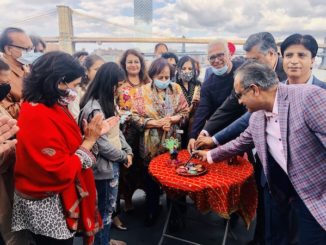
    NEW YORK CITY (TIP): Undaunted by the COVID-19, AIA NY celebrated on Sunday October 4th 2020, the 33rd Deepavli festival event at Hudson river in front of South Street Seaport, NYC on a luxury boat with AIA sponsors, media partners and AIA executive members.

    Due to Coronavirus (COVID 19) there were very limited number of invited guests for this event. For the last 32 years, Association of Indians in America (AIA), New York chapter has organized Deepavali festival with sparkling fireworks, classical fusion performances, fashion show, vegan expo, fun-filled children’s activities and booths with a variety of fine cuisine, handicrafts and gift items along with rich and varied works of contemporary Indian artists at South Street Seaport.

    According to Harish Thakkar, President of AIA- NY chapter, Deepavali festival is one of the landmark events of AIA-NY chapter, enjoyed by over 50,000 New Yorkers every year since 1987. Considered by far the largest attraction for Indian Americans from all over the tri-state, Deepavali festival celebrates the tradition of a faraway land in a new world. This celebration has itself become a tradition that unites New York in a world of myths and colors.

    AIA is a grass-roots national organization of Asian-immigrants in the U.S with chapters and membership spread across the nation. It was founded on August 20th, 1967. The New York Chapter was established in 1968 and is well known for its social, cultural and educational activities. AIA represents the hopes and aspirations of those immigrants who are united by their common Indian heritage and American commitment.

    AIA is thankful to its supporters like CheapOair and Qatar Airways, McDonald’s, New York Life, ICICI Bank, all media partners, Sony Entertainment, ITV Gold, TV Asia, Jus Punjabi, South Asian Times, Desi Talk, Indian Panorama, Indian Express and Hum Hindustani “We are grateful to all our sponsors who made this festival a big success for many years” AIA president Harish Thakkar said.