Tag: Indian Politics

  POLITICS & POLICY  

  • PM Modi Reviews Kashmir Situation, Appeals for Peace

    PM Modi Reviews Kashmir Situation, Appeals for Peace

    Prime Minister Narendra Modi, July 12, held a high-level meeting over the violence in Jammu and Kashmir, which has claimed 33 lives, and appealed for calm even as curfew continued for the fourth consecutive day in the Valley.

    Modi, who returned to the capital early in the morning after his four-nation tour of Africa, held the review meeting that was attended by Home Minister Rajnath Singh, External Affairs Minister Sushma Swaraj, Finance Minister Arun Jaitley, Defence Minister Manohar Parrikar, National Security Advisor Ajit Doval, and Foreign Secretary S. Jaishankar besides senior security officers.

    The meeting took stock of the situation in the Kashmir valley that has seen repeated clashes between thousands of protesters and security forces following the killing of Hizbul Mujahiddin commander Burhan Wani July 8.

    Besides 33 people killed in the violence so far, nearly 1,400 people have been wounded, many seriously.

    The Prime Minister also voiced concern over the violence in the Valley where curfew continued for the fourth consecutive day July 12.

    ” The Prime Minister has appealed to the people of Jammu and Kashmir to maintain calm and peace so that normalcy returns in the valley and no innocent lives are lost,” Minister of State in Prime Minister’s Office Jitendra Singh told reporters soon after the meeting concluded.

    Jitendra Singh also said that the Prime Minister offered every assistance to the state government and assured it of providing every help.

    He said the Prime Minister is keeping a close watch on the sequence of events in the valley.

    The Prime Minister also expressed hope that innocent people should not face inconvenience and expressed satisfaction over the ongoing Amarnath Yatra.

    In Kashmir, amid curfew in most parts of the valley, the authorities grappled to control continuing violence.

    Police said “strict curfew shall continue” almost all across the valley to prevent the spillover of street violence and counter-violence.

    Separatist groups have extended the ongoing protest shutdown in the valley until July 13.

    National Conference leader and former Chief Minister Omar Abdullah raised questions on Jammu and Kashmir being “unrepresented” at the high-level meeting.

    In a tweet, Abdullah said that Chief Minister Mehbooba Mufti’s presence at the meeting could have been ensured via video-conferencing.

    “I understand if Mehbooba Mufti didn’t leave the state to attend (the meeting) but why not by video conference? State unrepresented,” Abdullah tweeted.

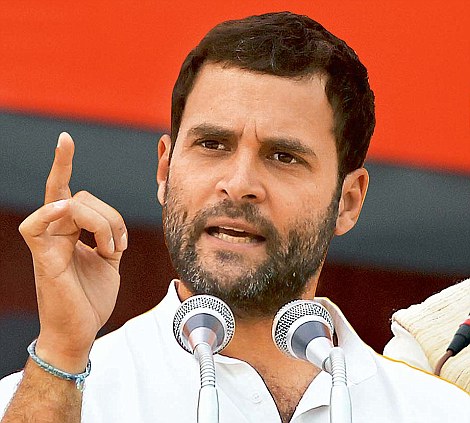
    Reacting to the prevailing situation in the valley, Congress Vice president Rahul Gandhi said that the gains made during the UPA regime in Jammu and Kashmir have been nullified by the “fatalistic policies” of the Modi government.

    Speaking at an Eid Milan reception hosted by Jamiat Ulema-e-Hind chief Maulana Asad Madni here on July 11 night, Gandhi said that mishandling the situation in the Kashmir Valley had led to political turmoil.

    MIM chief Asaduddin Owaisi urged the Centre to call an all-party meeting on the violence in the Kashmir Valley.

    The Hyderabad MP said the meeting should be called to discuss how to end the cycle of violence and to show empathy following street protests that have claimed 32 lives.

    A group of Muslim clerics met with Home Minister Rajnath Singh to discuss ways and means to restore normalcy in the Kashmir Valley.

    The clerics said the Minister assured them of all possible help in restoring peace in the disturbed valley.

    Umer Ahmed Ilyasi of All India Organization of Imams of Mosques told media later that they will visit Kashmir and urge people, especially religious leaders, there to help the valley to return to normalcy.

    Ilyasi said he along with other Muslim religious leaders will also meet Chief Minister Mehbooba Mufti.

    Meanwhile, the annual Amaranth Hindu pilgrimage resumed July 11, as 300 vehicles carrying pilgrims from different states of India entered the Kashmir Valley.

  • PORTFOLIOS OF MODI CABINET 2.0

    PORTFOLIOS OF MODI CABINET 2.0

    PRIME MINISTER NARENDRA MODI – Personnel, Public Grievances & Pensions, Department of Atomic Energy, Department of Space, All important policy issues, and All other portfolios not allocated to any Minister

    CABINET MINISTERS

    Rajnath Singh: Home Affairs

    Sushma Swaraj: External Affairs

    Arun Jaitley: Finance Corporate Affairs

    M. Venkaiah Naidu: Urban Development; Housing and Urban Poverty Alleviation; Information & Broadcasting

    Nitin Jairam Gadkari: Road Transport and Highways Shipping

    Manohar Parrikar: Defence

    Suresh Prabhu: Railways

    D.V. Sadananda Gowda: Statistics & Programme Implementation

    Uma Bharati: Water Resources, River Development and Ganga Rejuvenation

    Jual Oram: Tribal Affairs

    Dr Najma A Heptulla: Minority Affairs

    Ramvilas Paswan: Consumer Affairs, Food and Public Distribution

    Kalraj Mishra: Micro, Small and Medium  Enterprises

    Maneka Sanjay Gandhi: Women and Child Development

    Ananth Kumar: Chemicals and Fertilizers; Parliamentary Affairs

    Ravi Shankar Prasad: Law & Justice; Electronics & Information Technology

    Jagat Prakash Nadda: Health & Family Welfare

    Ashok Gajapathi Raju Pusapati: Civil Aviation

    Anant Geete: Heavy Industries and Public Enterprises

    Harsimrat Kaur Badal: Food Processing Industries

    Narendra Singh Tomar: Rural Development;

    Panchayati Raj; Drinking Water and Sanitation

    Chaudhary Birender Singh: Steel

    Radha Mohan Singh: Agriculture & Farmers Welfare

    Thaawar Chand Gehlot: Social Justice and Empowerment

    Smriti Zubin Irani: Textiles

    Dr. Harsh Vardhan: Science and Technology Earth Sciences

    Prakash Javadekar: Human Resource Development

  • PM Modi’s new cabinet has strong RSS imprint

    PM Modi’s new cabinet has strong RSS imprint

    The RSS’s imprint got deeper on the Narendra Modi government with as many as six parliamentarians with strong links to the BJP’s ideological mentor finding place in theexpanded union council of ministers .

    While veteran RSS pracharak Anil Madhav Dave got Independent charge of the environment ministry, five others out of the 19 new ministers have roots in the right-wing organisation.

    The RSS – which played a crucial role in the BJP’s victory in the 2014 Lok Sabha polls — was pleased with the choice of new ministers but maintained it was “the prerogative of the government.”

    “They have several compulsions, could be elections or other political decisions, which have to be borne in mind while accommodating people. It is not for us to comment. Yes, Dave was a pracharak. He has worked very closely with the Sangh,” a senior RSS functionary said.

    He, however, added that Dave has been a BJP member for a long time and a Rajya Sabha member as well. “It will not be right to call him a Sangh karyakarta anymore.”

    When the Modi government took oath in May 2014, the RSS influence was evident from the induction of at least nine Cabinet ministers and at least three ministers of state who were RSS pracharaks, those who are given the task of spreading the organisation’s ideology.

    There were at least a dozen others who were not full-time RSS pracharaks but were associated with the Sangh through its students’ wing, the ABVP.

    On the last count, more than third of the 66 members in the council of ministers –before the expansion — had an RSS background. The proportion continued in the latest expansion as well.

    With the Prime Minister himself being an RSS pracharak, his ministers have never shied away from projecting their association with the organisation.

    Among the newly inducted ministers with RSS background is Mahendra Nath Pandey, the new minister of state for human resource development who was an active participant in the movement for constructing a Ram temple in Ayodhya.

    Inducted as the new minister of state for textiles from Uttarakhand, Ajay Tamta, also has a RSS background and participated in the Ram Janmabhoomi temple agitation before plunging into electoral politics.

    Rajen Gohain, the new minister of state for railways, was one of the founders of the BJP in Assam.

    A die-hard Sangh activist, he was a known RSS face at the organisation’s training centre in Hojai of Nagaon district. At RSS rallies, he was regularly spotted in the outfit’s trademark khaki shorts.

    Faggan Singh Kulaste, another newly inducted junior minister from Madhya Pradesh, was also an RSS activist.

    BJP ally Shiv Sena, however, was critical of Modi’s choice.

    “In Nehru and Indira Gandhi’s cabinets, there used to be stellar ministers with people like Dr Babasaheb Ambedkar to Babu Jagjivan Ram and Yashwantrao Chavan. A portfolio like human resources development (HRD) gained prominence only because of PV Narasimha Rao; similarly, the world learnt of India’s finance ministry only after Manmohan Singh helmed it,” the Sena said in its mouthpiece Saamna on Wednesday.

    “But now, such leaders of such caliber are not to be found. Hence, Modi has to shoulder the burden of his responsibility all by himself.”

    There were signs of discontent within the BJP, too.

    “I do not know why I was dropped. I never had any issues or problem with Modi or party president Amit Shah,” Mansukhbhai Vasava, who was dropped as minister of state for tribal affairs, said.

  • Cabinet Reshuffle: Modi hits refresh button

    Cabinet Reshuffle: Modi hits refresh button

    NEW DELHI (TIP): Prime Minister Narendra Modi on July 5 went for a sea change in his team as he shuffled portfolios of many of his prominent ministers.

    The most unexpected was the shifting of Smriti Irani from human resource development (HRD) to the unglamorous textiles ministry. Prakash Javadekar whose elevation to the cabinet rank on Tuesday took many by surprise replaced Irani as the HRD minister.

    Newly appointed minister Anil Madhav Dave was appointed environment minister in place of Javadekar.

    Ravi Shankar Prasad is the new law minister, replacing DV Sadananda Gowda who was shifted to the statistics and programme implementation ministry. Minister of state for railways Manoj Sinha was promoted and given independent charge of communications, while Prasad retained the charge of electronics and information technology.

    Urban development minister M Venkaiah Naidu was divested of the parliamentary affairs portfolio and given charge of the information and broadcasting ministry, which was earlier with finance minister Arun Jaitley.

    Chemicals and fertilisers minister Ananth Kumar was another gainer as he got the additional charge of parliamentary affairs.

    The changes were announced hours after Modi expanded his council of ministers, inducting 19 new faces as junior ministers and dropping five.

    Shortly after the swearing-in at Rashtrapati Bhawan, Modi told his cabinet colleagues at a meeting that he had little time in hand and they should be prepared for “big changes” in their portfolios.

    Though there was no change in the top four portfolios — home, external affairs, finance and defence —the Prime Minister delivered a clear message through major changes in portfolios of prominent ministers: that they should stay clear of controversies.

    Irani had a controversy-riddled tenure that started with question marks about her academic credentials but soon turned into frequent face-offs with the academia.

    Gowda was unable to strike a positive chord with the judiciary, which has been upset with the government’s perceived attempt to interfere in judicial appointments. He courted controversy recently after he sought the law commission’s report on the implementation of the uniform civil code.

    Gowda has been shifted from law to the less important statistics and programme implementation. Junior foreign minister General VK Singh too was engulfed in controversies as his remarks drew frequent criticism of the government. The former army chief was stripped of independent charge in the statistics and implementation ministry. Portfolios of rural development minister Birender Singh and steel minister Narendra Singh Tomar were swapped.

    New junior minister Vijay Goyal will head the sports and youth affairs ministry, which has been vacant since Sarbanand Sonowal shifted from the Centre to become Assam chief minister.

    Minister of state in the finance ministry, Jayant Sinha, was shifted as junior minister in the civil aviation department. Santosh Gangwar and Arjun Ram Meghwal are new ministers of state in the finance department.

    Journalist-politician MJ Akbar was appointed junior minister in the external affair ministry. Five-term MP SS Ahluwalia was made minister of state for agriculture and parliamentary affairs.

    Among NDA allies, RPI’s Ramdas Athawale became junior minister in the social justice and empowerment ministry while Apna Dal’s Anupriya Patel got health and family welfare. The reshuffle was viewed as an exercise aimed both at pleasing voters in states headed for elections next year as well as speeding up efforts to boost economic growth.

    Among those dropped was Mansukh Bhai Vasava, a junior minister in the tribal affairs ministry that has in the past locked horns with Javadekar, mostly over tribal rights and diversion of forest land for industry. At least seven of the new ministers are from states going to elections next year and five from the Dalit community, part of the BJP’s plan to appeal to the scheduled castes in Uttar Pradesh and Uttarakhand. The states vote next year and have a substantial population of scheduled castes. With the expansion, the size of Modi’s cabinet has swelled to 78 — one of the biggest in years and a far cry from Modi’s 2014 election promise of “minimum government and maximum governance”.

  • Prime Minister Narendra Modi in South Africa

    Prime Minister Narendra Modi in South Africa

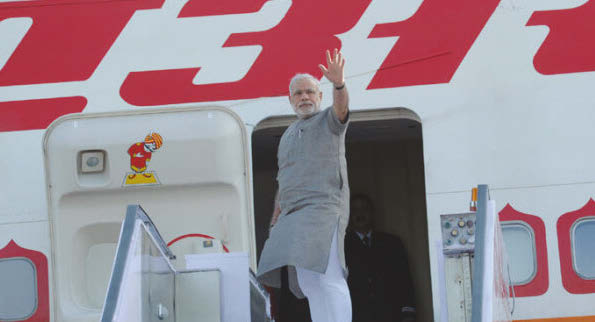
    JOHANNESBURG (TIP): India is working to achieve over 8 per cent growth in the coming years, Prime Minister Narendra Modi said in Johannesburg on July 8, while attributing the rise of the country to HOPE — Harmony, Optimism, Potential and Energy.

    He told the Indian diaspora that India is “one of the brightest spot in the global economy” and a “land of opportunities” for those who want to invest and have trade.

    Mr. Modi said his government is working in a campaign mode to create 500 million new jobs by 2022 besides transforming rural and urban areas of the country through infrastructure development.

    “While the world is marked by slowdown, India has registered a growth of 7.6 per cent this year and we are working to grow even at 8 per cent in the years ahead,” he said addressing an estimated gathering of 11,000 members of the Indian diaspora.

    Mr. Modi, wearing a ‘Madiba’ shirt identified with anti-apartheid icon Nelson Mandela, said India’s dynamism is not about mere words but it is driven by concrete action. “It (dynamism) is defined by our commitment to change the face of the Indian economy. Not just through sustained rapid economic growth but through multiple transformations that aim to uplift,” the Prime Minister said.

    “India’s rise can be defined as HOPE —Harmony, Optimism, Potential and Energy….India’s rise is a story of rare resilience, renewed resurgence, superb speed and spectacular scale,” he said in his 40-minute address.

    “India’s rise can be defined as HOPE —Harmony, Optimism, Potential and Energy….India’s rise is a story of rare resilience, renewed resurgence, superb speed and spectacular scale,” he said in his 40-minute address. He said his government wants enterprises to flourish, businesses to grow and the country to rise.

    (The Hindu)

  • Disqualify 24 Punjab MLAs for being parliamentary secretaries: AAP to EC

    Disqualify 24 Punjab MLAs for being parliamentary secretaries: AAP to EC

    New Delhi (TIP): With the sword of disqualification hanging over its 21 Delhi legislators over the issue of office of profit, the Aam Aadmi Party (AAP) has approached the Election Commission, seeking similar action against nearly 45 legislators of the BJP, Congress and Shiromani Akali Dal, holding similar posts in other states.

    In Punjab, the AAP has sought disqualification of 24 legislators for holding posts of parliamentary secretary (called ‘chief parliamentary secretary’ in the Punjab), of which five are of the BJP and the remaining 19 belong to the SAD. Its complaint said the total number of parliamentary secretaries in the state had gone up to 24 “in violation of Article 191 of the Constitution”.

  • Mehbooba pushes for India, Pakistan reconciliation

    Mehbooba pushes for India, Pakistan reconciliation

    CHAMLIYAL BORDER (TIP): Batting for revival of the India-Pakistan reconciliation process to bring about peace in Jammu & Kashmir, chief minister Mehbooba Mufti on June 23 said if hostilities between the two neighbours can become news, why cannot cultural bonhomie.

    “I wonder if hostilities can become news between the two neighbours, why can’t such cultural bonhomie,” she told reporters here.

    Mehbooba joined thousands of devotees from the two countries at the shrine of Baba Chamliyal near the international border (IB) in Ramgarh sector of Samba district on the occasion of the annual mela (fair) of the mystic saint.

    MP Jugal Kishore Sharma, state industries minister Chander Parkash Ganga and state tourism minister Priya Sethi accompanied the chief minister.

    Mehbooba said given its socio-religious significance, Chamliyal could become the hub of a new movement for reconciliation in the region.

    “I hope our good intentions are reciprocated by our neighbour,” she said, emphasizing on people-to-people contact between the two countries “to remove mistrust and create a congenial atmosphere for dialogue and reconciliation”. The PDP leader said like “siblings locked in an endless rivalry”, India and Pakistan have bickered for well over six decades.

  • INTERNATIONAL YOGA DAY | INDIA DOES ASANAS IN TANDEM WITH PM MODI

    INTERNATIONAL YOGA DAY | INDIA DOES ASANAS IN TANDEM WITH PM MODI

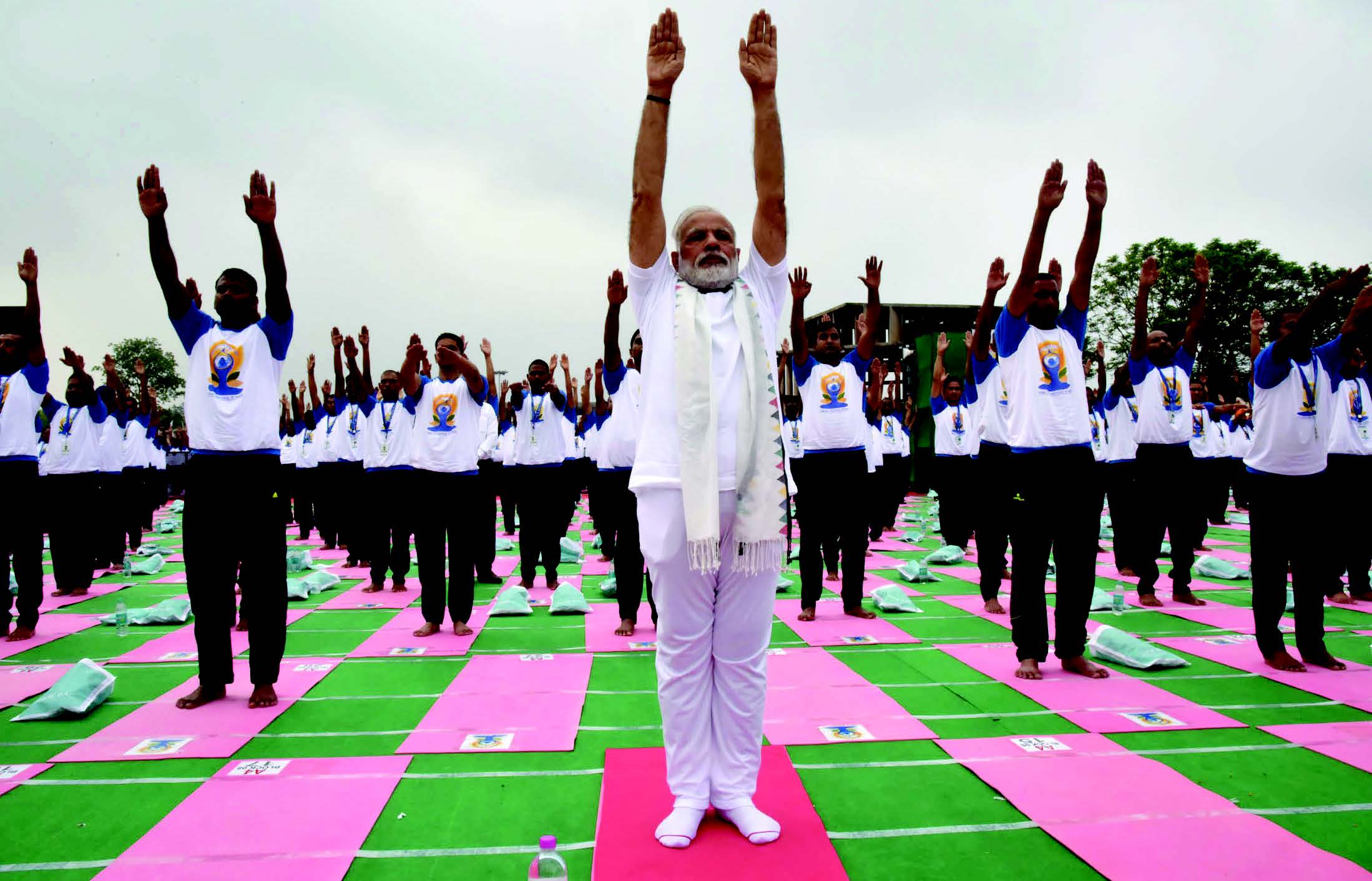
    CHANDIGARH (TIP): Millions of Indians on June 21 morning stretched and twisted their bodies and performed breathing exercises to celebrate the second International Yoga Day, with Prime Minister Narendra Modi in Chandigarh urging people to de-link the ancient Indian practice from their religious beliefs.

    MODI SHOWS THE WAY

    “Yoga is not a religious activity. Many people do not understand yoga completely. It is not what you will get from yoga, but what is important is what you will give to yoga and what all (ailments) will it rid you off,” he said early morning. Modi is a keen yoga enthusiast on whose proposal the UN marked June 21 to be celebrated as the International Yoga Day every year.

    Modi, in a white T-shirt and a payjama with a stole around his neck, led from the front in Chandigarh’s Capitol Complex. Stretching on a mat and staring at the overcast Chandigarh skies, he himself performed the asanas among the crowd of over 30,000 yoga enthusiasts.

    INDIA CELEBRATES WITH WORLD

    Mass yoga events were held in schools, public places, lawns of residential localities and office complexes across thousands of Indian villages, cities, and towns — from the deserts of Rajasthan to eastern planes and from the Himalayan heights to high seas — on naval warships — down south. The celebrations of the day and yoga performances even went high up in the sky at 35,000 feet above Earth on some morning flights. In the run-up to the celebrations, the government had created a huge hype to popularize the event, asking people to organise ceremonies for mass participations.

    CELEBRATIONS ACROSS INDIA

    In Delhi, as the morning sun broke through the overnight clouds, tens of thousands of its residents performed asanas. Over 10,000 people gathered at Central Park in the heart of Connaught Place and the circular road around it, making it one of the largest yoga events in the city.

    It rained heavily in Mumbai but that did not deter lakhs of school and college students and men and women of all ages from doing yoga exercises in many parts of the city and suburbs.

    The Indian Navy in Mumbai completed a three-week long capsule to train 25 personnel and popularise yoga among thousands of its sailors and civilians while over 2,000 took part in a yoga programme at Kohli Grounds.

    Tamil Nadu capital Chennai also saw thousands of people performing yoga. The navy marked the day with its officers and personnel performing yoga on INS Adyar.

    INDIA DOES ASANAS 2In Jammu and Kashmir, scores performed yoga exercises and the main function was held at the Maulana Azad Stadium in Jammu. Similar functions were held in Srinagar and Leh and Kargil towns of the Ladakh region.

    In Himachal Pradesh, the day was observed amid cloudy conditions and yet thousands did asanas in hundreds of camps across the state.

    In Left-ruled Kerala, the day sparked a controversy as Health Minister K.K. Shailaja was irked by Sanskrit kirtans rendered at an event. She pointed out that yoga doesn’t belong to any particular religion and is also practised by atheists.

    Celebrations were also held in Rajasthan, Madhya Pradesh, Odisha, Bihar and northeastern states.

    High up in the sky, budget airline SpiceJet conducted practice sessions on all its two-hour morning flights. It was a special 10-minute ‘Upa-Yoga’ onboard capsule for its passengers and crew. The participants performed while seated. The special asanas are believed to help activate joints, muscles and energy systems to overcome jetlag, fear of flying and breathing difficulties.

  • AAM AADMI PARTY SUSPENDS ALKA LAMBA AS PARTY SPOKESPERSON

    AAM AADMI PARTY SUSPENDS ALKA LAMBA AS PARTY SPOKESPERSON

    NEW DELHI: The Aam Aadmi Party on Thursday suspended MLA Alka Lamba @LambaAlka from the post of party spokesperson, for two months.

    Lamba was reportedly removed as AAP spokesperson over her statement that Gopal Rai was “relieved” of the transport portfolio on Tuesday because of the Anti-Corruption Branch (ACB)’s investigation into corruption charges related to favouring an app-based premium bus service.

    Reacting to her suspension, Lamba said that she is a disciplined worker and will abide by the party’s decision. “If I have made a mistake unknowingly, I am ready to repent,” Lamba tweeted on Thursday.

    On June 14, Gopal Rai had quit as transport minister citing his health, even as the opposition BJP and Congress termed it a fallout of the ACB’s investigation.

    Rai refuted the allegations levelled by the opposition parties saying that he quit solely on health grounds.

    “Some people are spreading rumour that I have resigned due to Premium Bus Scheme. There has been no corruption in this scheme and my resignation has no connection with it,” the former transport minister tweeted.

    The portfolio of the transport department has now been given to his cabinet colleague Satyendar Jain, who already holds key portfolios of PWD, health, power and home.

  • 2-Day BJP Conclave Concludes

    2-Day BJP Conclave Concludes

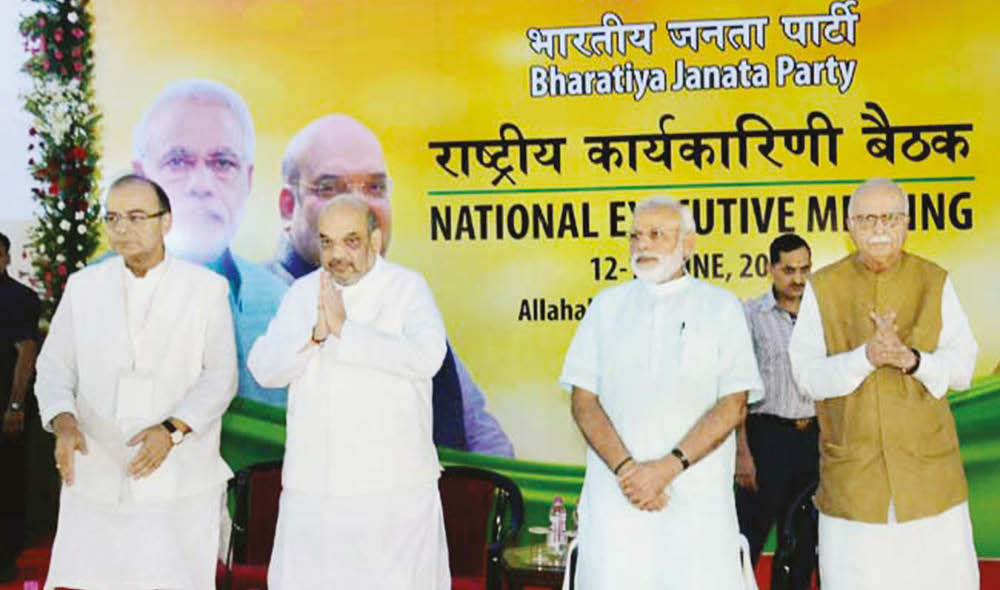
    ALLAHABAD (TIP): The Two-day conclave of Bharatiya Janata Party (BJP) concluded here Monday, June 13. High on the agenda was a strategy for the 2017 assembly elections in Uttar Pradesh, Punjab, Uttarakhand, Manipur and Goa. Of all the States going to polls in 2017, the State of Uttar Pradesh is of the greatest strategic importance for BJP. If the party is able to perform as it did in the Lok Sabha elections, it will contribute greatly to its strength in the Rajya Sabha where as of now the combined opposition is in a position to stall the BJP. Thus, the main thrust of the party leadership has been to strategize for a win in Uttar Pradesh.

    Senior Cabinet ministers, chief ministers of BJP-ruled states, party MPs and other senior leaders are participating in the conclave.

    Sources said PM Modi asked BJP office bearers to take forward what has been achieved. There is a need to constantly innovate in today’s politics. An organization and its working style should change with the political situation, he reportedly said.

    Briefing the media in the evening, senior BJP leader and Union Minister Ravi Shankar Prasad said the BJP “maintained balance between rural and urban development, reform and public welfare, connection between defense and foreign policy”.

    He quoted party chief Amit Shah as saying that the victory in Assam had opened the “gateway to the north east” for the party. Mr. Shah, he said, expressed confidence that the party will return to power in UP in 2017 and at the Centre in 2019 as well.

    The party discussed a strategy for Assembly elections in Uttar Pradesh and four other states – Punjab, Himachal Pradesh, Uttarakhand and Goa. Om Mathur, PM Modi’s key man in UP, said: “Many issues were discussed at the meet but the main focus was on UP polls due next year.”

    Sources in the BJP, however, say a decision on who will be the party’s chief ministerial candidate in the two key states will be taken in due course.

    The BJP has brought several new faces to its National Executive — including Himanta Biswa Sarma, who defected from Congress to BJP and played a key role in its big Assam win, and former Uttarakhand chief minister Vijay Bahuguna, a new entrant to the party.

  • Poll panel refuses to cancel Rajya Sabha polls in Karnataka

    Poll panel refuses to cancel Rajya Sabha polls in Karnataka

    NEW DELHI (TIP): The Election Commission of India on Thursday decided against countermanding Rajya Sabha polls in Karnataka on the ground that the sting videos did not present enough evidence to support the charges of bribery. Polls for the four seats will be held, as scheduled, on Saturday.

    The poll panel, however, ordered that the Returning Officer file an FIR against Independent MLA Mallikarjuna Khuba under the relevant provisions of the Prevention of Corruption Act, 1988, for openly demanding money for his vote. It will also write to the central government to initiate a CBI probe into the matter “so that all those who may be involved in such nefarious activities are exposed and duly punished under the law”.

    On Thursday evening, Chief Election Commissioner Nasim Zaidi and his colleague A K Joti met to review the factual report sent by the Karnataka Chief Electoral Officer on the sting videos that purportedly showed some MLAs of JD(S), Congress and a few Independent legislators, including Khuba, being offered bribes for their votes. The two top officers, however, were not convinced about revoking the elections in the state.

    Fresh Update | Rajya Sabha elections underway, all eyes on UP and Karnataka

    Voting for Rajya Sabha biennial began on Saturday, June 11, morning as 27 Upper House seats from seven states went to elections.

    Altogether, 58 RS seats fell vacant from 16 states over the past two months. Of these seats, 31 candidates have already won unopposed and their results will be formally announced, along with the 27 seats.

  • CBI questions Himachal  CM in assets case

    CBI questions Himachal CM in assets case

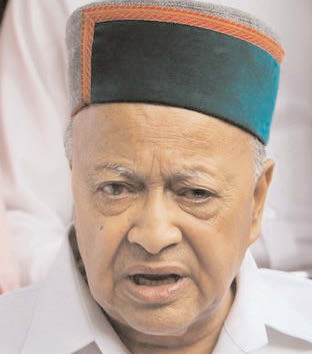
    NEW DELHI (TIP): Himachal Pradesh Chief Minister Virbhadra Singh was on June 9 questioned by the CBI in connection with allegations of acquiring wealth disproportionate to his known sources of income.

    Singh (81) appeared before the investigators in the morning, official sources said.

    The probe against the Himachal chief minister and his family was initiated following allegations against him during his tenure as the Union Steel Minister between 2009 and 2011.

    After Singh’s questioning, sources said the CBI has a fool-proof case against him and his associates on how they acquired assets in the name of wife and children of the chief minister.

    Sources said Singh denied any involvement and investigators are now planning to soon examine those named in the FIR.

    According to the FIR, Singh had accumulated assets worth Rs 6.03 crore in his name and in the name of his family members which were found to be disproportionate to his known sources of income.

    The FIR filed with a designated court in Delhi under the Prevention of Corruption Act named Singh, wife Pratibha, LIC agent Anand Chauhan and Chunni Lal Chauhan. CBI had claimed that Singh had invested his unaccounted income in LIC policies in his name and in the name of his wife and other family members through a private person by showing the same as agricultural income. “This was done by creation of a MoU purportedly dated June 15, 2008, for maintenance of an apple orchard, with the said private person (Chauhan) for a period of three years. The private person had allegedly deposited Rs five crore cash (approx) in his own bank account and debited the same through cheques for purchasing various LIC policies in their names,” the CBI had said. In March, the ED attached assets of Singh worth Rs 7.93 crore, including a flat in a posh locality here, in connection with a money laundering case. The ED had filed a money laundering case on the basis of a CBI FIR.

  • PM Modi in USA: Symphony, Inseparable Partnership

    PM Modi in USA: Symphony, Inseparable Partnership

    “India played a key role in 1773 Boston Tea Party and lost 5000 men, women and children to Lord Cornwallis upon his arrival in India after losing to George Washington. Today (June 7), destiny was bilaterally recognized: Indian PM Modi speaking of an Inseparable Partnership, and Ranker Eliot Engel, with Joe Crowley introducing The Special Global Partnership with India Act of 2016 (H.R.5387) – which would designate India as a Special Global Partner of the United States – to enhance global peace and security. A symphony orchestra capable to making global peace stick.

    As an American of proud Indian heritage, to see an Indian PM – be it Rajiv Gandhi in 1985 or Narendra Modi in 2016 – in the Congress is a joy only enhanced by the music to every ear: that United States and India are not only natural allies, but Inseparable Partners – the very definition of Destiny. Finally, all the constructive nudging for decades has paid off.

    Eliot Engel and Ed Royce are mature hands that embraced destiny by enhancing US-India ties to inseparability.

    Today, 1.25 billion Indians saluted the United States, and the American People, through their representatives, saluted them back. Destiny achieved is a thing of beauty that every heart and every nation can both enjoy and use to recalibrate.”

  • PM Modi delivers a well-rounded address to US Congress

    PM Modi delivers a well-rounded address to US Congress

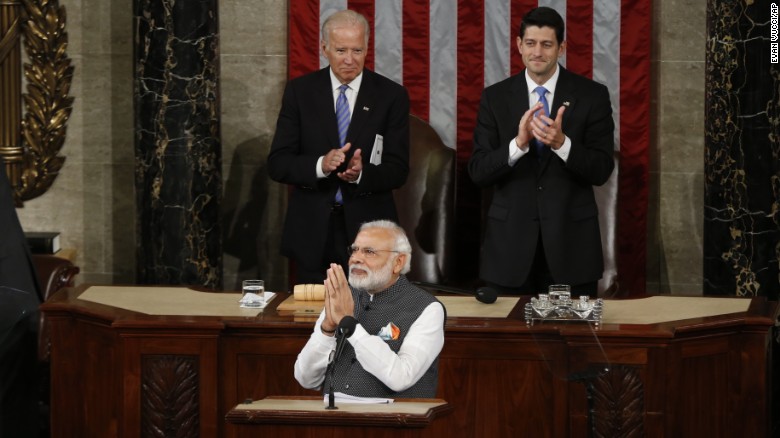
    WASHINGTON DC (TIP): When Prime Minister Narendra Modi addressed a joint sitting of US Congress on Wednesday, June 7, he became the sixth Indian PM to do so. Jawaharlal Nehru, Rajiv Gandhi, PV Narsimha Rao, Atal Behari Vajpayee and Dr. Manmohan Singh were the Prime Ministers of India who had addressed the US Congress.

    Speaks of shared history, aspirations, concerns and strengths

    In the course of his 45-minute speech, Modi covered all major aspects of the growing relationship between India and the US, particularly strategic ties and civil nuclear cooperation, and emphasized that the two countries should leave “constraints of the past” behind as the “foundations of the future are firmly in place”.

    PM Modi also talked about terrorism. He said there was no good terrorist or bad terrorist. A terrorist is a terrorist. In an apparent reference to Pakistan he called for isolation of those who harbor and support terrorists and said that terrorism had to be fought with “one voice” as he commended the American Congress t for sending out a clear message by refusing to “reward” those who preach and practice terrorism for political gains.

    Modi spoke candidly about the shared concerns and strengths of the two democracies. (Read the full text of Modi’s speech at www.theindianpanorama.news)

    Modi had the Congress in splits for a minute, when he spoke of the political values the world’s oldest democracy shares with its largest one.

    “I am told you are well-known for your bipartisanship,” he began, sending the US Congress members into peals of laughter and applause. “Well, you are not alone. Time and again, I have also witnessed a similar spirit in the Indian Parliament, especially our Upper House,” he added, referring to regularly stormy scenes in the US Senate, which presently has a Republican majority under a Democratic President.

    “So, as you can see, we have many shared practices,” he rounded off, referring to his own troubles in the Rajya Sabha, where his government is in a minority.

  • Modi’ in US: Standard templates unable to paint grand vision

    Modi’ in US: Standard templates unable to paint grand vision

    Prime Minister Narendra Modi had his biggest outing of the year in addressing the US Congress in Washington on Wednesday. Shorn of the atmospherics, Modi seems to have missed the moment to get counted as the world’s leading statesmen. True, there was a surfeit of platitudes and catchy phrases such as the Indo-US relationship having “overcome the hesitations of history”. Modi also provided a preview of how India sees today’s world — “(India is) already assuming her responsibilities in securing the Indian Ocean region” — and the problems — “absence of an agreed security architecture in Asia creates uncertainty”. The world by now is well acquainted with Brand Modi — words rolling out fluently, a commanding stage presence and an innovative twist at every show.

    But a Prime Minister on his fourth visit to the US should have been more forthcoming about his vision of India than could be gleaned from his party’s election manifestoes. Modi can hardly hope to excite American businessmen with an anodyne rendering of his government’s priorities or talking about the snakes in the terrorist pit next door which managers of American security and their accomplices had incubated. His take on social harmony — “all the 1.25 billion of our citizens have freedom from fear, a freedom they exercise every moment of their lives” — too sounded a shade hollow when juxtaposed against the under-reported Human Rights Commission hearing at which US Congressmen slammed his government for violence against minorities.

    However, after all the hits and misses are tallied, Modi accomplished his primary purpose of assuring the Americans that there is permanency in India’s affinity with the US in security, defense and climate change. He also managed to convey to the ordinary US politician, the country’s indispensability in the region — India was the first responder during natural calamities in Nepal, the Maldives and Sri Lanka — as well as its disagreement with the current global structures. Despite his dexterity as a communicator, Modi missed a trick or two in painting India as a country whose time has come.

  • Modi in US | Highlights from India-US joint statement after Modi-Obama meet

    Modi in US | Highlights from India-US joint statement after Modi-Obama meet

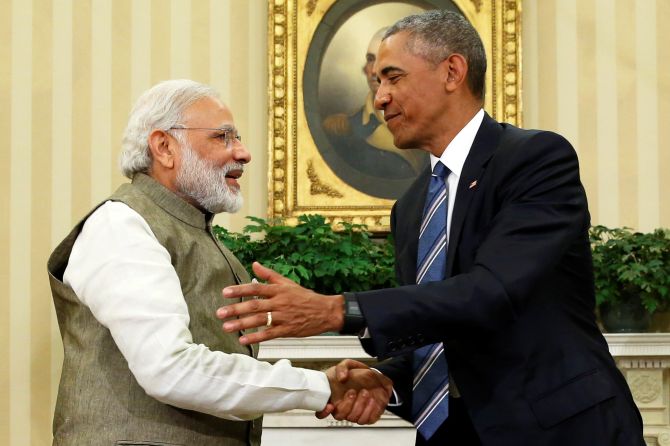
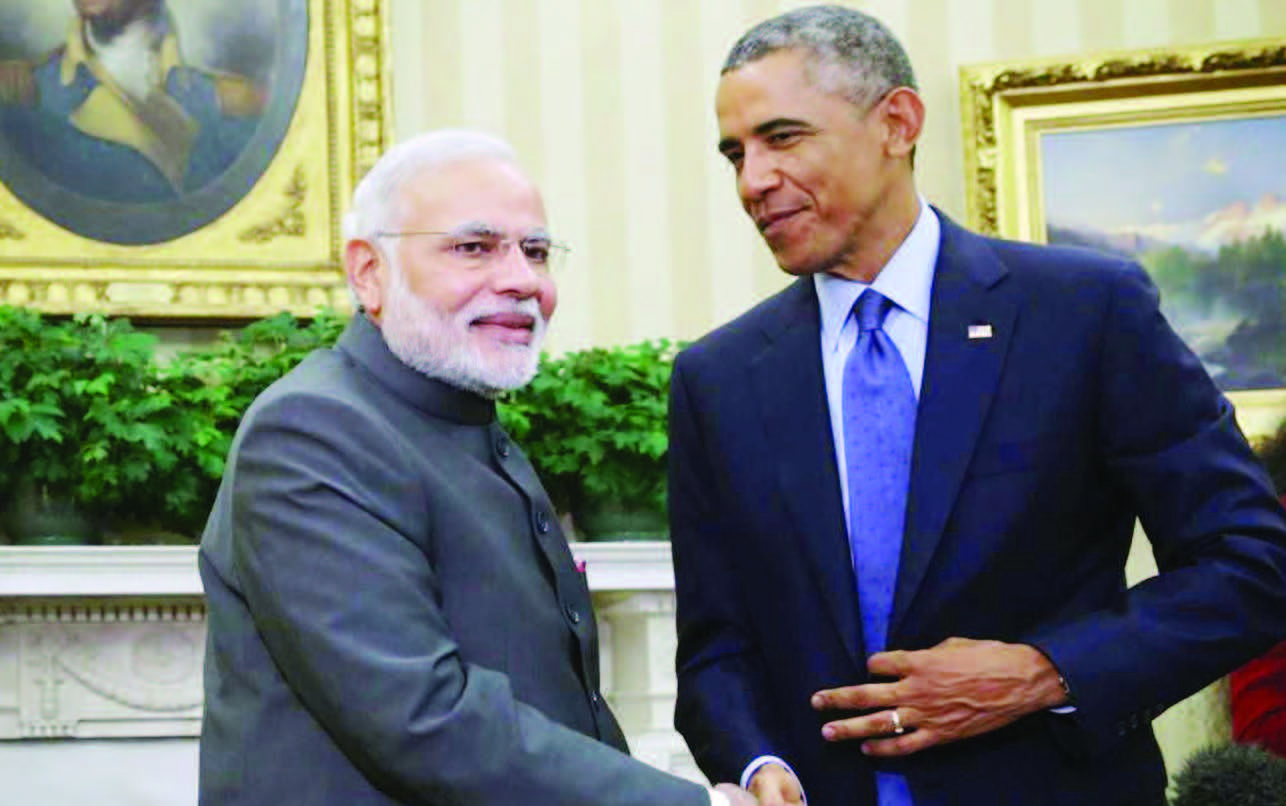
    New Delhi: Support for India becoming a member of the exclusive Nuclear Suppliers Group, agreement on building six nuclear power plants in Andhra Pradesh, backing for India’s stand on terrorism vis-a-vis Pakistan and financial assistance for India’s clean energy initiatives are some of the key takeaways in an exhaustive India-US joint statement released in Washington on Tuesday.

    The document, issued at the end of talks between US President Barack Obama and Prime Minister Narendra Modi, who is on his fourth visit to the US in less than two years, also lays out a road map for broad-ranging India-US collaboration in areas such as defence, trade and cyber security.

    According to the statement, India and the US “pledged to pursue new opportunities to bolster economic growth and sustainable development, promote peace and security at home and around the world, strengthen inclusive, democratic governance and respect for universal human rights, and provide global leadership on issues of shared interest”.

    Obama and Modi noted the “increasing convergence” in the strategic perspectives of India and the US and “emphasized the need to remain closely invested in each other’s security and prosperity”, the statement said.

    On India’s entry into exclusive non-proliferation groups and regimes, the statement said India and the US “looked forward” to India’s imminent admission into the Missile Technology Control Regime.

    “President Obama welcomed India’s application to join the Nuclear Suppliers Group (NSG)… The United States called on NSG participating governments to support India’s application when it comes up at the NSG plenary later this month,” it said.

    In the area of nuclear power production, Obama and Modi welcomed the start of preparatory work for six reactors to be built by Westinghouse Electric Co. in Andhra Pradesh. India and the US Export-Import Bank are to work together on a financing package for the project, the statement said.

    “Once completed, the project would be among the largest of its kind, fulfilling the promise of the US-India civil nuclear agreement and demonstrating a shared commitment to meet India’s growing energy needs while reducing reliance on fossil fuels… the two sides will work toward finalizing the contractual arrangements by June 2017,” the statement said.

    Acknowledging India’s role in the accord agreed to at the Paris climate change talks in November, it said the US was committed to supporting India’s renewable energy programme and was working to spur greater investment in the area. Together, the two countries announced the creation of a $20 million US-India Clean Energy Finance (USICEF) initiative, equally supported by the US and India, which is expected to mobilize up to $400 million to provide clean and renewable electricity to up to 1 million households by 2020.

    The statement also said that Modi and Obama “resolved that the United States and India should look to each other as priority partners in the Asia-Pacific and the Indian Ocean region”.

    In maritime security, India and the US called for ensuring the freedom of navigation and overflight and exploitation of resources as per international law, including the United Nations Convention on the Law of the Sea, and settlement of territorial disputes by peaceful means. This oblique reference is aimed at China which is locked in maritime disputes with its smaller South East Asian neighbours in the South China Sea. China claims the entire South China Sea as its exclusive domain and has imposed flight restrictions and embargoed maritime routes through the disputed area.

    In the area of defence cooperation, which “can be an anchor of stability”, the statement said the US “hereby recognizes India as a major defence partner”. The joint statement said India and the US would “explore agreements which would facilitate further expansion of bilateral defence cooperation in practical ways. In this regard, they welcomed the finalization of the text of the Logistics Exchange Memorandum of Agreement,” which would allow the two countries to provide logistics support, refuelling and berthing facilities for each other’s warships and aircraft.

    The US will “continue to work toward facilitating technology sharing with India to a level commensurate with that of its closest allies and partners. The leaders reached an understanding under which India would receive licence-free access to a wide range of dual-use technologies in conjunction with steps that India has committed to take to advance its export control objectives,” the statement said.

    In a boost for Modi’s Make in India programme, the US would support the Indian initiative to develop defence industries through the export of goods and technologies consistent with US law.

    In the area of cyber security, Obama and Modi said they would deepen cooperation and were committed to enhancing cyber collaboration on critical infrastructure, cyber crime, and malicious cyber activity by state and non-state actors.

    On terrorism, Obama and Modi condemned “the recent terrorist incidents from Paris to Pathankot, from Brussels to Kabul” and “resolved to redouble their efforts, bilaterally and with other like-minded countries, to bring to justice the perpetrators of terrorism anywhere in the world and the infrastructure that supports them”.

    The two countries pledged to work together to combat terrorist threats from extremist groups such as Al Qaida, Da’esh/ISIL (Islamic State), the Pakistan based Jaish-e Mohammad and Lashkar-e-Taiba, besides Indian gangster Dawood Ibrahim and his group and their affiliates “including through deepened collaboration on UN terrorist designations”.

    The two countries have finalised an arrangement to facilitate the sharing of terrorist-screening information and “called for Pakistan to bring the perpetrators of the 2008 Mumbai and 2016 Pathankot terrorist attacks to justice”, the statement said.

    To boost trade, India and the US resolved to “break down barriers to the movement of goods and services, and support deeper integration into global supply chains, thereby creating jobs and generating prosperity in both economies”, the statement said.

    The two leaders agreed to facilitate the freer movement of people of both countries. The US also welcomed India’s interest in joining the Asia Pacific Economic Cooperation forum.

  • Indian-Americans Keen About PM Modi’s Address To US Congress

    Indian-Americans Keen About PM Modi’s Address To US Congress

    Indian-Americans in the US are looking forward to listening to Prime Minister Narendra Modi’s address to a joint session of the US Congress with American lawmakers flooding with requests from the community members for tickets to the visitor’s gallery on June 8.

    A large number of Indian-Americans are disappointed by not being able to get tickets of the visitor’s gallery for the event.

    Indian-Americans from across the US are flying to Washington DC to listen PM Modi in person.

    “It’s a dream come true,” Chicago-based Bharat Barai said.

    “I am sure after listening to him, people of this country and Congressmen would realise the importance Modi attaches to the India-US relationship,” he said.

    “This is a speech, which I would like to watch in person. I do not want to miss it,” said MR Rangaswami, a Silicon Valley-based successful investor and entrepreneur, who is flying from California to attend Modi’s event at the Capitol Hill.

    Mr Rangaswami, the founder of Indiaspora, is among the lucky few who have managed to get a ticket to the visitors’ gallery of the House Chambers, which has limited number of seats.

    Congressional sources told Press Trust of India that lawmakers are having a tough time in declining requests for a ticket to the joint address by Modi.

    In fact, most of the Congressmen have been allocated one ticket each.

    Given the great demand for tickets, Congressional sources said at one point of time, there was consideration for erecting a huge tent for Indian-Americans to watch the speech live. But the idea was shelved because of Congress’ protocol.

    The speech would be telecast nationwide live on C-Span, a cable and satellite television network.

    “The invitation (to the Prime Minister) itself shows the status of the relationship and how far we have come,” Swadesh Chatterjee, an eminent Indian-American, said.

    Mr Chatterjee, who played a key role in reviving the India-US relationship after the Pokhran nuclear tests, vividly remembers how he and many other Indian-Americans had to lobby for months in the Congress to invite the then Prime Minister Atal Bihari Vajpayee to address a joint session of the Congress on September 14, 2000.

    “And this time, we had no role to play. Congressmen themselves wrote to the Speaker (of the House of Representatives) to invite Modi to address the joint session of the Congress. And it took no time for Speaker (Paul) Ryan to invite India’s Prime Minister,” said Mr Chatterjee.

  • PM Modi Pays Homage To Indian American Astronaut Kalpana Chawla, Meets Sunita Williams

    PM Modi Pays Homage To Indian American Astronaut Kalpana Chawla, Meets Sunita Williams

    WASHINGTON: Prime Minister Narendra Modi today laid a wreath at the Tomb of Unknown Soldiers and paid homage to Indian-American astronaut (late) Kalpana Chawla at the Arlington National Cemetery in Washington.

    “Honouring sacrifice, saluting valour. Formal engagements begin with a solemn ceremony,” External Affairs Ministry spokesperson Vikas Swarup tweeted.

    “In homage to heroism and indomitable courage,” Mr Swarup said in another tweet.

    He also had a brief interaction with Kalpana Chawla’s husband and family members, senior officials from NASA, Indian-American astronaut Sunita Williams and her father at Space Shuttle Columbia Memorial.

    US Defense Secretary Ashton Carter accompanied the Prime Minister. Indian Ambassador to the United States Arun K Singh, Foreign Secretary S Jaishankar, US Ambassador to India Richard Verma and Assistant Secretary of State for South and Central Asia Nisha Desai Biswal were also present on the occasion.

    “All of us are very honored that he took time to come and acknowledge the shuttle catastrophe and the deep cooperation that we have with India in space,” Ms Williams told news agency PTI after her brief interaction with Prime Minister Modi.

    “Personally it is commemorating my friend (Kalpana Chawala),” Ms Williams said.

    PM Modi spoke with Sunita’s father in Gujarati and invited them to visit India. “With health permitting, I definitely look forward to visiting India,” her father said.

    Kalpana Chawla’s husband Jean-Pierre Harrison presented a set of books on the late astronaut, including a biography written by him, to the Prime Minister.

    The Tomb of the Unknowns is a monument dedicated to American service members who have died without their remains being identified.

  • Modi raises abuse of migrant workers issue with Qatar

    Modi raises abuse of migrant workers issue with Qatar

    NEW DELHI: Qatar has reassured India that labour reforms will improve the conditions of more than half a million Indian migrants, after Prime Minister Narendra Modi raised concerns of abuses during a weekend visit to the Gulf state.

    Qatar vows to mitigate migrant workers’ woes

    Qatar is home to 630,000 Indian nationals, the single largest group of migrants in the country of 2 million. Many work in low paid construction jobs, building stadiums and other infrastructure for the 2022 World Cup. Rights groups accuse Qatar of abusive labour laws and forcing migrants to work under poor safety conditions. Unions and labour protests are banned, and authorities penalise dissent with jail or deportation.

    A joint government statement said PM Modi met with Qatar’s Emir Sheikh Tamim Bin Hamad Al-Thani on Sunday and discussed the plight of Indian migrants.

    “The Qatari side briefed the Indian side on the reform in labour laws which would protect the interest of skilled and unskilled labour in Qatar,” said the statement issued by the Prime Minister’s office.

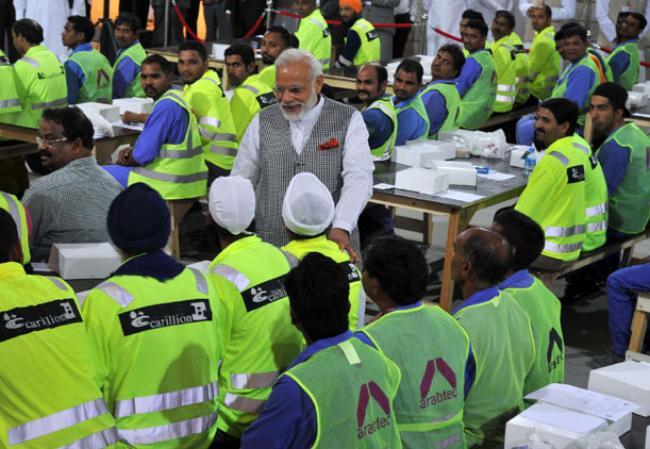
    During a two-day visit to the Gulf nation, PM Modi addressed a gathering of Indian labourers in Doha, assuring them he would present their concerns to Qatari authorities.

    “I am aware of the issues you are facing. I will talk about it when I meet the authorities,” Prime Minister Modi told them on Saturday. “If you have some issues on changing some laws and regulations, I can assure you that I will work with you all to bring about these changes.”

    PM Modi’s comments come amid growing scrutiny of Qatar over the plight of migrants from countries such as Nepal, India and Bangladesh employed to build infrastructure as Qatar gears up to host the world’s largest sporting event.

    Amnesty International in March said migrants faced abuses that in some cases amounted to forced labour. Workers reported squalid living conditions, having their salaries withheld for months and their passports confiscated by employers.

    Qatar’s kafala sponsorship system – under which migrant workers cannot change jobs or leave the country without their employer’s permission – is at the heart of threats to make people work, Amnesty said.

    The International Labour Organization said Qatar is making progress towards ending forced labour and improving migrant worker conditions, but added the real test will be whether it enforces new legislation from December.

    The new Qatari law abolishes the kafala sponsorship system and removes all curbs on worker movements. Migrants will no longer be forced to continue a job if there is abuse or exploitation, but domestic workers are excluded from this law.

    Qatar is an important partner for India, with bilateral trade in 2014/15 exceeding $15 billion, according to the Indian government. It is also one of India’s key sources of crude oil.

  • Why Modi is ‘Going to America – again: ‘Consolidation and Celebration’

    Why Modi is ‘Going to America – again: ‘Consolidation and Celebration’

    WASHINGTON (TIP): Why is Prime Minister Narendra Modi going to the United States again – for the fourth time in two years starting June 6 – that too at the last lap of the Obama Presidency and in the thick of the American presidential election, is a question that has swirled around political and diplomatic corridors for some weeks now. The answers, according to a range of sources, is as follows:

    It was President Obama who invited Modi to visit. The invitation was weighed carefully before accepting it with a view to strengthening the relationship, because it was felt that despite all the convergence in recent years, New Delhi and Washington ”still need to get into the habit of working together.”

    Besides, it was reasoned, if the Prime Minister did not take the opportunity to visit now, it could be another 18-24 months before such a visit could take place given that a new US President will be in place eight months from now, and it could be at least another year before she or he put together a team and settled in. Did it make sense to allow a long, fallow period of no high-level exchange at a time the ties had gathered so much momentum, was the question that the PMO chose to answer in the negative by accepting the invitation.

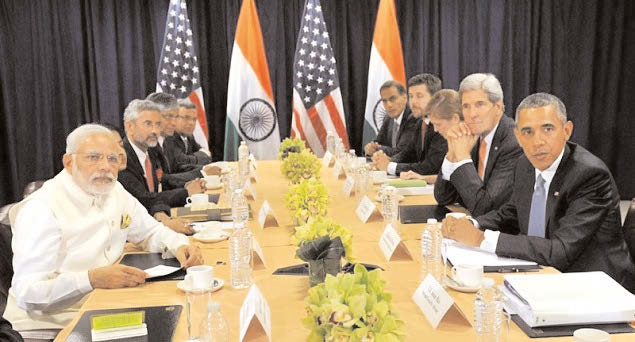
    “The invitation and the visit is part of consolidating and celebrating the relationship,” India’s ambassador to the US Arun Kumar Singh, told correspondents on Wednesday during a preview of the 50-hour visit, extending across three days in Washington DC, the centerpiece of which is a bilateral meeting with President Obama on June 7 morning, followed by a lunch.

    Although described an official working trip, the visit will have at least one characteristic of a ”State” visit, which was what was initially discussed before it was scaled down. Prime Minister Modi will stay at Blair House, across from the White House, which is usually where ”state” guests are hosted.

    The scuttlebutt surrounding the scuppering of the “state” visit: Save it for the next administration.

    Although officials dismiss talk of engaging with a “lame duck presidency,” maintaining that the US executive is fully empowered till the day the US President demits office on January 20, 2017, it is quite obvious from his schedule that the Prime Minister’s program involves heavy engagements with lawmakers. During a four-hour swirl of Capitol Hill on June 8, Modi will have four events on the Hill, including a joint address to Senators and Congressmen, and “unprecedented” luncheon hosted by the Speaker of the House.

    He will also attend a “rare” reception hosted in his honor by the Senate and House foreign relations committees and the India Caucuses in the House and the Senate, some of whose members have lit into New Delhi for various perceived infractions, from human rights and civil liberties violation to lack of transparency and clarity in trade issues.

    In fact, around the time Prime Minister Modi and President Obama finish their exchanges in the White House, the US Commission for Human Rights will begin its hearing on “Advancement of Human Rights in India.”

    The Indian side appears to have taken the criticism in its stride, preferring to see and present the larger picture of a healthy US-India relations up front than be distracted by what they it sees as agenda-driven needling.

    ”Of course we have problems in India. No society is perfect. We are always ready to discuss the issues,” one Indian official said pointedly, referring to recent spate of criticism from Ben Cardin, a Democratic Senator from Maryland, who some Indian activists see as the ”Dan Burton from the left.” But those exchanges have to be on the basis of equality and recognition of India’s democratic strengths that allows India’s own civil society to expose such inequalities and injustices, not preachy and judgmental pronouncement from Washington.

    Dan Burton was a US lawmaker from Indiana who routinely castigated India for years over human rights transgressions, mainly fueled by Khalistani and Kashmiri separatists.

    Ahead of the Prime Minister’s visit and surrounding it, the two sides will sign a raft of agreements, including on facilitating fast track visits through a global entry program, exchange of terrorist database information, and return of stolen antiques.

  • INDIA APPLIES FOR NSG MEMBERSHIP AHEAD OF PM NARENDRA MODI’S US VISIT

    INDIA APPLIES FOR NSG MEMBERSHIP AHEAD OF PM NARENDRA MODI’S US VISIT

    NEW DELHI (TIP): India’s biggest diplomatic battle since the nuclear deal has begun in earnest — New Delhi has quietly submitted its formal application for membership of the Nuclear Suppliers Group ( NSG ) ahead of PM Narendra Modi’s visit to the US starting June 4.

    India’s application will be assessed in the NSG Meeting which will take place in Vienna on 8-9 June. For India, membership in the NSG is important for two immediate reasons. India must be part of the group to meet its climate change agenda of targeting 40 percent non-fossil fuels in the country’s “energy mix”. Besides, India’s membership in the NSG will automatically mean that business opportunities for India will be more or less stable, regardless of change in governments, according to an Economic Times report.

    The application was pushed through on May 12, almost a week before Pakistan sent its case. And the first big test will be on June 9-10 at a closed-door NSG meet in Vienna.

    Senior diplomats, who didn’t want to be identified, told ET that the PM himself has been burning the telephone lines, reaching out to heads of government across the 48-member body to pitch for India’s case.

    The submission of the application, which comes after nearly seven years of talks with NSG and its various forums, has set Modi regime up for a big fight with China, an NSG member that is batting for Pakistan.

    The process began in last week of April when India transmitted what is called the ‘adherence to NSG’ document to International Atomic Energy Agency. This lists all the laws and rules that have been changed or inserted to streamline India’s regime in line with NSG guidelines. India submitted its application on May 12.

    As part of an overall strategy, President Pranab Mukherjee undertook a visit to China on May 24 to sound out Beijing. There was no clear response, but China agreed to get officials on both sides talking to each other. China was a hold-out even when NSG gave a one-time waiver to the Indo-US nuclear deal, but gave in after then US president George W Bush called up his then Chinese counterpart Hu Jintao to persuade Beijing.

    Now, big diplomatic push will come from the PM when he goes to the US on June 4. New Delhi is counting on Washington to send out a strong and clear message that will set the tone for the crucial NSG technical meet on June 9-10, where India’s application will be assessed. The action will then shift to the June 24 NSG plenary in Seoul, where the case is likely to be put up on the agenda.

    Hectic diplomatic activity has started. The message has been two-fold: First, if India needs to meet its climate change commitments of aiming for 40% non-fossil fuels in the country’s energy mix, it needs to be formally a part of the nuclear trading club. Second, India’s NSG membership will automatically ensure the business environment is kept more predictable and stable regardless of change in governments.

  • Investment, security to be focus of PM

    Investment, security to be focus of PM

    NEW DELHI (TIP): After a lull of several months, Prime Minister Narendra Modi will be off to another whirlwind diplomatic tour starting next week. His first stop will be Afghanistan on June 4 to inaugurate the Salma Dam which has been built with Indian assistance.

    By end of the day Modi will be in Doha to return a visit by the emir, Sheikh Tamim bin Hamad Al Thani, who visited India on March 2015. Qatar is India’s largest source for natural gas and Modi is keen to encourage more investments from there.

    PM Modi in his two years in office has already visited 29 nations. He now has the distinction among all Prime Ministers of India to have visited the highest number of nations in first two years in office

    India and Qatar are expected to hold some intensive discussions on the security situation too. The Afghan Taliban was allowed to open an office in Doha, which is something India has frowned upon in the past.

    Announcing the visit, MEA spokesperson Vikas Swarup said, “Qatar is an important trading partner for us in the Gulf region with bilateral trade in 2014-15 exceeding $15 billion. It is our largest supplier of LNG requirements, accounting for 65% of our total imports in 2015-16. It was also one of our key sources of crude oil. Over 6,30,000 Indian nationals form the largest expatriate community in Qatar.”

    Modi will then stopover in Switzerland on June 6 to hold talks with Swiss President Johann Schneider-Ammann on technology and investments. Interestingly, he will be visiting Switzerland days after the country inaugurates the world’s longest tunnel, an engineering feat of sorts.

    On June 7-8, Modi will be in US, his fourth visit to the country. “The main objective of the forthcoming visit would be to consolidate the progress made in diverse areas such as economy, energy, environment, defense and security, and to intensify cooperation for the future,” Swarup said.

    Modi will also address a joint session of the US Congress, a rare honor. “He will be the first foreign leader to be given this honor in 2016. The USCongress has been a source of strength for India-US strategic partnership and the India Congressional Caucus is the largest such group in the US Congress. During the visit, PM will interact with CEOs of major US companies.”

    Modi will then pay an important visit to Mexico, which has seen a big increase in economic ties with India. It’s not yet clear whether PM will stop over at any other country on way back. Generally, Air India One, the PM’s plane stops over in Germany for refueling, but Modi could utilize this stop for another short bilateral. Last year, PM stopped over in Ireland for such a visit.

  • Rahul as Cong chief? Challenges he will face in the HOT seat

    Rahul as Cong chief? Challenges he will face in the HOT seat

    NEW DELHI (TIP) : Congress circles are again abuzz with the possibility of Rahul Gandhi @OfficeOfRG taking over as the party president. If the change comes through in the coming days, as is being talked about but with little indication of the timings from the party, the 45-year-old will be elevated to the top rank at a challenging time.

    The Congress has suffered a series of poll setbacks that began with the 2014 Lok Sabha elections, which saw the party tally touch an all-time low of 44.

    Here are the five big challenges that await Gandhi in the hot seat.

    1. Back to winning ways: The Congress, which has ruled the Centre and also dominated the states for the larger part of its history, seems to be a declining force as the BJP expands its footprint. Though the party tasted success in Bihar as part of an alliance last year, its electoral base is fast depleting. If Gandhi takes charge in coming weeks, he will have limited time to prepare for the crucial assembly elections in Uttar Pradesh, Uttarakhand and Punjab due early next year.

    2. Party revamp: Arguably the biggest job — reshaping the party machinery to meet the aspirations of a young nation. He will have to tread carefully. His choices are limited and he will have to make the best use of them. A wholesale change or marginalisation of old guard may prove counter-productive.

    3. Rahul, the vote catcher: The Amethi MP was seen as the architect of the 2014 poll campaign, the outcome though was far from encouraging. But, it was Gandhi who in 2009 Lok Sabha elections won the party record number of seats in Uttar Pradesh, pushing the Congress tally to 206 seats that earned the UPA a second term.

    4. Strong state leaders: In party meetings, Gandhi often speaks about grooming strong leaders in states. He realises that without popular leaders like late YS Rajasekhara Reddy in Andhra Pradesh or Ibobi Singh in Manipur, the Congress has little chance of regaining lost ground. It is easier said than done. Historically, the party leadership has not encouraged strong leaders in states.

  • Tom Lantos commission to hold hearing on human rights violations in India during Modi trip

    Tom Lantos commission to hold hearing on human rights violations in India during Modi trip

    NEW YORK (TIP): Sant Gupta, an alum of IIT Delhi, based now in Virginia, and who has worked for the cause of #Hinduism and inter-faith dialogue for many years in the US, has lambasted a hearing organized by the Tom Lantos Human Rights Commission (TLHRC) that intends to examine the current state of human rights in India, challenges to fundamental freedoms, and opportunities for advancement, at Capitol Hill, on June 7th, to coincide with the visit of Indian Prime Minister Narendra Modi.

    Sant Gupta lambasts hearing on Capitol Hill, scheduled on June 7th.

    The hearing, organized by the Tom Lantos commission, named after the late congressman, is titled ‘Challenges & Opportunities: The Advancement of Human Rights in India’. The panel for the hearing has the following individuals listed: Jeff King, President, International Christian Concern; John Sifton, Asia Advocacy Director, Human Rights Watch; Musaddique Thange, Communications Director, Indian American Muslim Council; and T. Kumar, Asia Advocacy Director, Amnesty International.

    In an e-mail detailing the hearing, the commission wrote that “a wide variety of serious human rights concerns persist” in India.

    “Despite Constitutional provisions abolishing the legal existence of “untouchable” or Dalit castes and tribes, the caste system remains deeply ingrained within Indian society, leading to ongoing discrimination. Dalit communities, which make up a quarter of India’s population, are also disproportionately at risk of suffering from another major human rights concern in India, that of human trafficking. Tens of thousands of individuals, including children, are believed to be trafficking annually within India for the purposes of commercialized sexual exploitation or forced labor,” the e-mail said.

    It added: “Religious minorities also face growing challenges. According to the U.S. Commission on International Religious Freedom’s most recent report, “In 2015, religious tolerance deteriorated and religious freedom violations increased in India. Minority communities, especially Christians, Muslims, and Sikhs, experienced numerous incidents of intimidation, harassment, and violence, largely at the hands of Hindu nationalist groups.

    “Meanwhile, a large number of international non-governmental organizations supporting a range of causes, including human rights, have been added to government watch lists or had funding cut off by Indian officials. These actions, coupled with perceived crackdowns on groups or individuals critical of the Indian government, have many concerned that the rights to freedom of speech and freedom of association are being increasingly curtailed.”

    The hearing, the e-mail said, will “examine these and other issues, while seeking to provide concrete recommendations for how U.S. policy makers can most effectively encourage the protection of human rights given the strategic importance and continued growth of the U.S. – India bilateral relationship.”

    Gupta, who emigrated to the US over four decades ago, and works as a Business Development Executive for the federal government, has expressed his displeasure with the hearing. Gupta has over the years served on the executive Board of the World Hindu Council of America, and supports organizations like Life in Yoga Institute, Hindu American Foundation and Indian American Forum for Political Education.

    In an e-mail sent to the commission, in response to the hearing, a copy of which is with The American Bazaar, Gupta, said: “…TLHRC want to embarrass the PM Modi with this sham display of its biased, distorted and distasteful character. You quote USCIRF who in turn will quote you in their hearings and reports. This a classical circular argument to reinforce already established verdict. Neither of these entities have any interest to be fair, seek the truth or being helpful to those whom you pretend to assist.”

    Gupta came down hard upon not just the commission, but the entire Congress, too.

    “No wonder the US Congress has such a low approval rating among American public. Hope, you will stop wasting American tax $$ and do something good for the people here. Your actions amount to interfering in the internal affairs of other countries and jeopardizing good India-US relationship which will benefit both countries.”

    He also noted that “IAMC (Indian American Muslim Council) is a well-known Hindu and India hater. To give them stage is a poor reflection on TLHRC about their inability or lack of desire to hear multiple points of view to really convey the truth. And the Christian representative will probably cry about the untold (and in many cases unsubstantiated) atrocities committed by Hindus especially since Modi came to power. Somehow, there is little expectation of fairness from the representative of Amnesty International when it comes to conveying concerns of Hindus. So, the deck is stacked up against Modi, Hindus and India. And you expect no one to see through it!!”

    Gupta also wrote: “It appears that one of the primary goals of TLHRC is to build up atrocity literature against Hindus and India. Sooner it repurposes its mission better it would be for the genuine Human Rights.”

    He then asked some questions of the organizers: “Would you hold hearings on:

    “1. Deceptive and immoral practices by various Christian denominations in India for conversion. They pray on human vulnerability and take undue advantage of their plight while denigrating their way of life, religion and civilization. Any attempts to expose or stop such illegal practices is promptly labeled by USCIRF and your commission as Hindu Nationalists, Hindu Fundamentals and many other derogatory terms.

    “2. The hatred and disharmony spread by Muslims organizations, Madrassas or Mosques in India and elsewhere in the world. Please do not immediately label me as Islamophobic. Radical Islam is causing harm to the Western countries.”

    Gupta ended his e-mail with these strong words: “How can a body like TLHRC be so blatantly political and a constructive force for change? You have no business to be in such business.”

    Modi is scheduled to be in Washington, DC, on June 8-9, at the invitation of President Barack Obama.

  • US hopes to ink defence pact with India ahead of Modi visit

    US hopes to ink defence pact with India ahead of Modi visit

    WASHINGTON (TIP): The US is hopeful of concluding a key military logistics agreement with India and making progress on other foundational pacts in the defence sector ahead of Prime Minister Narendra Modi’s visit here next month, a top American official has said.

    “We are hopeful that progress would be made on some of the foundational agreements including the logistics agreement that might be concluded prior to the (US) visit (of Prime Minister) and we are looking to see if there are other things that we can take on board,” assistant secretary of state for south and central Asia Nisha Desai Biswal told members of the Senate Armed Services Committee during a Congressional hearing on India.

    Biswal made the remarks while responding to questions on possibility of signing any security agreements between India and the US during the Prime Minister’s visit.