Tag: Indian Politics

  POLITICS & POLICY  

  • TWO YEARS OF MODI GOVERNMENT

    TWO YEARS OF MODI GOVERNMENT

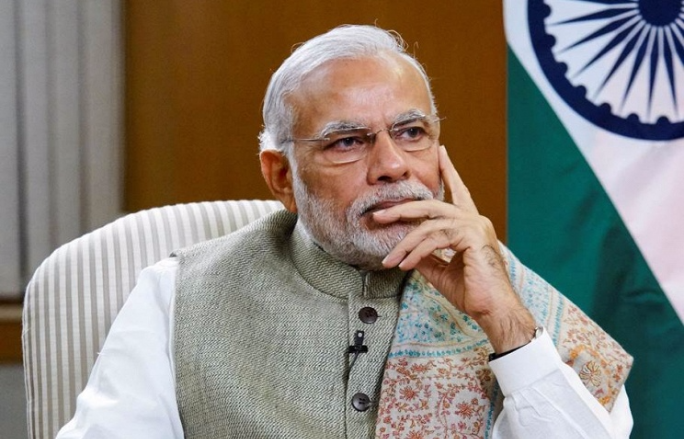
    On May 26, two years back, President Pranab Mukherjee administered the oath of office to Prime Minister Narendra Modi and his Cabinet. The lavish ceremony was attended by Premiers of SAARC nations, several Chief Ministers, Opposition leaders, besides a host of celebrities, corporate honchos and religious heads.

    For the first time in 30 years, the BJP came to power with an absolute majority and the swearing-in ceremony gave a hint that Team Modi was ready with a game-changing plan for the country. Two years into governance, we look back at the Centre’s performance.

    HITS

    Yemen evacuation

    This was one of the biggest evacuations during the times of war, since the Gulf War I. MoS Gen. (Retd) V.K. Singh personally oversaw the operation. The External Affairs Minister headed by Sushma Swaraj earned laurels for helping the Indians living abroad, be it for rescuing Kerala nurses from war-torn Libya or bringing back differently-abled Geeta from Pakistan.

    Jan Dhan Yojana

    Anyone can now open an account in a bank, thanks to this financial inclusion scheme. Barely a fortnight after the launch, the yojana entered the Guiness Book of World Records for the maximum number of accounts opened in a week. The scheme is a big boost in moving towards direct subsidy transfer.

    LPG subsidy reforms

    Initially started as a ‘Give It Up’ campaign, the Petroleum and Natural Gas Ministry headed by Dharmendra Pradhan barred LPG subsidy to customers who earn more than Rs. 10 lakh per annum. The amount saved was used to give over five lakh new LPG connections to those who still use firewoods or kerosene stoves for cooking.

    TWO YEARS OF MODI GOVERNMENT1Swachh Bharat Mission

    A pet project of Mr. Modi, sanitation ministry’s Swachh Bharat mission got wide public support, especially on social media after celebrities joined the Clean India challenge. Not just stopping with cleaning the locality, the government has taken initiatives such as building more toilets, waste management and waste segregation. Real success, will however happen, when manual scavenging is completely eradicated.

    India-Bangladesh land boundary pact

    When India is facing boundary disputes with every neighbour, this agreement gives optimism that issues can be amicably solved over diplomacy. The people living in the enclaves that were recently annexed to India even exercised their franchise in the recently concluded West Bengal Assembly elections.

    Bankruptcy code

    At a time when bankers were grappling with huge rise in non-performing assets and government eyeing to create more entrepreneurs, the amendment of existing bankruptcy laws was necessary. With the support from Congress, the law was passed in Rajya Sabha during the Budget Session where the ruling party was short of numbers.

    Real Estate regulation

    Apart from making the process transparent and keeping checks and balances in the form of a Real Estate Regulatory Authority, the law drafted by Housing Ministry headed by M. Venkaiah Naidu gave confidence to home-buyers. When housing sector contributes to nine per cent of GDP, this law, if effectively implemented by the States, is a game-changer in the housing sector.

    Yoga Day

    India’s lobbying got success when the United Nations declared June 21 as International Yoga Day. The mass yoga performance at Rajpath, which was led by Mr. Modi himself, set the record of most number of people participating in such an event.

    Mann Ki Baat

    A first such initiative in India where a top leader addresses millions, that too periodically. The programme even featured U.S. President Barack Obama during his visit to India.

    Digital India

    This flagship programme of Ravi Shankar Prasad’s Communications Ministry aiming to create a knowledge economy and good governance is travelling in the right path. Every minister and every ministry is now on Twitter. A slew of e-governance measures like digital locker and feedbacks through mygov.in are some notable initiatives.

    MISSES

    Pathankot attack

    The attack at IAF air base, just few hours from the National Capital, is the first of its kind after the 26/11 Mumbai attacks. There were differences of opinion over the way in which the encounter was handled, Home Minister Rajnath Singh was kept out of key meetings at the time of attacks and to make things worse, there was confusion over the number if terrorists sneaked in to carry out the attack. The attack raised questions on the security-level at India’s military bases.

    Masood Azhar

    India’s efforts to add the name of Masood Azhar, the chief of JeM, in the UN list of proscribed terrorists failed as China raised objections to it. This is a major setback to India as Azhar is believed to be behind the Pathankot attack.

    India-Pak relations

    Much to the hype of Pakistan Prime Minister Nawaz Sharif attending the swearing-in ceremony or the saree diplomacy, both governments couldn’t re-start the dialogue process nor has the firing across the Line of Control came down. Mr. Modi’s surprise stop-over at Lahore too failed to cut the ice.

    India-Nepal relations

    Anti-India protests flared up in Nepal after trade movements through the border were not allowed for many days. Nepal called it ‘India’s blockade’ as it followed protests by Madhesis. All of these happened within a year of the Himalayan quake, when Nepal thanked India’s help in rescue and rehabilitation. Also, India couldn’t keep away Nepal from moving closer to China.

    TWO YEARS OF MODI GOVERNMENT2Dissidence in Central Universities

    Smriti Irani and the Union Ministry of Human Resource and Development was in news for all wrong reasons. The suicide of a Dalit Research Scholar at Hyderabad Central University, sedition charges against students of Jawaharlal Nehru University, the FTII students’ strike, decision of not to support off-campus centres of Aligarh Muslim University, closing down Ambedkar-Periyar Study circle in IIT-Madras, the list goes on. And some avoidable controversies such as competition for schoolchildren on Christmas or scrapping German being taught at CBSE schools.

    Blackmoney

    Bringing back money stashed in off-shore accounts was one of BJP’s poll promises. The government gave a three-month window for compliance, but only 644 declarations were made. Finance Minister Arun Jaitley once said the bulk of blackmoney is within India, but little has been done to contain the feeders of parallel economy – higher education, real estate and mining.

    GST Bill/Land ordinance

    The government is unable to pass the GST Bill in Rajya Sabha for the past two years. Touted as the biggest tax reform in Independent India, the government is unable to bring consensus. Same is the fate of land bill. Though the Centre took the ordinance route to clear the bill, it was re-promulgated twice and lapsed on August 31, 2015.

    Uttarakhand fiasco

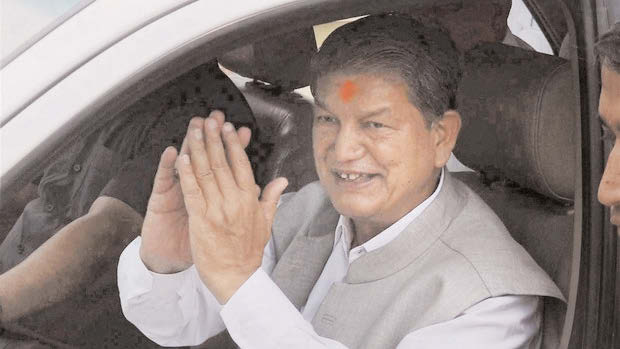
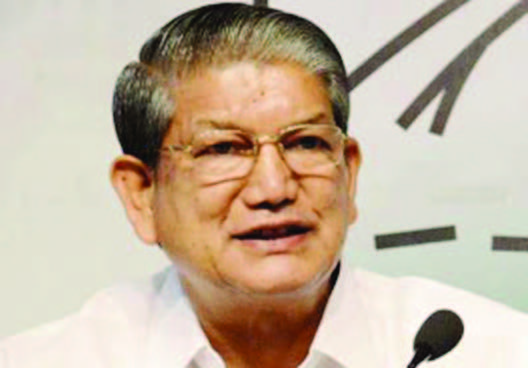
    The pre-mature imposition of President’s Rule in Uttarakhand, and victory of Harish Rawat in the Supreme Court-monitored floor test, is not only an embarrassment to the ruling government but also to the BJP, whose attempt to gain from dissidence in Uttarakhand Congress misfired.

    Silence on fringe right-wing groups

    Law and order could be a State subject. Murders of rationalists and attacks on minority community by fringe right-wing elements may not be limited to the BJP-ruled states. But the Centre as well as the Prime Minister’s refrains from condemning or making comments against such attacks didn’t go well with the public.

    Women’s Bill

    The bill seeking one-third representation for women in Parliament and State Assemblies is an almost-forgotten topic now. Cleared in Rajya Sabha in 2010, the Bill is pending in the lower House, in which the BJP front enjoys comfortable majority.

  • RAJNATH SINGH TO UP VOTERS: END BJP’S EXILE IN STATE

    RAJNATH SINGH TO UP VOTERS: END BJP’S EXILE IN STATE

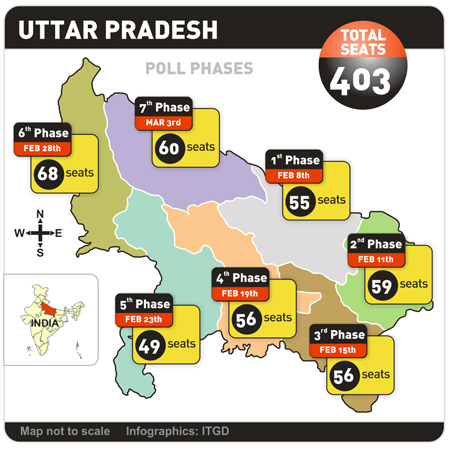
    SAHARANPUR (TIP): Virtually kickstarting BJP’s poll campaign in Uttar Pradesh on the occasion of the government’s second year of completion of power today, Home Minister Rajnath Singh made a fervent appeal to the people of the state to “end BJP’s exile”.

    Addressing a massive gathering of its supporters here this evening, Singh invoked the 14-year exile of Lord Rama to say to the people of Uttar Pradesh, “Fourteen years of our exile from UP are coming to an end. I appeal to the people of the state to end our exile and help us form our government. Even Lord Rama’s exile had ended after 14 years.” He made the “end-BJP-exile” point noting that the saffron party was voted out of power in Uttar Pradesh in 2002 after which BSP and Samajwadi Party ruled the state between them. Assembly polls are due in Uttar Pradesh next year. Singh, who represents the Lucknow segment in Lok Sabha, said the hallmark of BJP government at the Centre was delivery and honesty.

    “We have been successful in bringing about transparency in our government in these two years of rule at the Centre. India’s image across the world has been enhanced under the leadership of Prime Minister Narendra Modi. No one can level any allegation against our PM. Our government has remained free of corruption and blemishes,” he told a gathering in the politically crucial Western UP belt.

    About Congress, the fourth player in the state apart from BSP, SP and BJP, he said the party was consistently losing its appeal and shrinking electorally.

    “Congress is shrinking across the country. In the plains it had been wiped out and in hills it has shrunk. I am sure it will be wiped out from the hills as well in the next elections,” Singh said in reference to the two Congress led governments in Himachal Pradesh and Uttarakhand.

    The former BJP President also spoke for the sugarcane farmers who dominate the Western UP area and promised to give them their dues if voted to power.

  • Modi’s Kashmir score card: Do  walk the talk

    Modi’s Kashmir score card: Do walk the talk

    Kashmir is a difficult and challenging terrain for any Prime Minister of the country. It builds personalities who seize opportunities and introduce appealing concepts of their respective brand of politics in a bold fashion- as did former Prime Minister Atal Behari Vajpayee who used the soil of Kashmir to extend a hand of friendship to Pakistan. It also is a graveyard of many a reputation -Manmohan Singh who started his innings with a commitment to build a “naya” or New Kashmir but ended with no grand results to show at the end of his decade-long tenure as Prime Minister.

    Prime Minister Narendra Modi had more than one opportunity to transform the political, psychological and economic landscape of all the three regions of the state, particularly the Valley, in the past two years. His biggest strength is the massive electoral mandate and the personality cult. Despite a mood of trepidation in this only Muslim majority state of the country there was also a hope that hemight chart a new course to givea real-time meaning to the three mantras of his illustrious predecessor Vajpayee who had envisioned a solution through insaniyat (humanity), jambhooriyat (democracy) and Kashmiriyat (a concept denoting the Valley’s composite culture) way back in 2000.

    Modi reiterated his commitment to follow Vajpayee’s path in 2014, 2015 and 2016 to reach out to the people of Kashmir, but the Valleyis waiting for these pronouncements to be translated into action on the ground. The wait is getting longer as there are no visible steps being taken by New Delhi to know what is wrong and how it can be rectified.

    Manmohan Singh pragmatically acknowledged the “internal and external dimensions” of the issue. His attempt was reflected in the five working groups that he had constituted to determine the extent of the problem at various fronts and to find out ways and means to address those. Simultaneously, he had opened channels of communication with Pakistan. As summed up by former Chief Minister Omar Abdullah in 2006, “There was a golden opportunity to resolve the K issue…” The internal situation in Pakistan in 2007, following the dismissal of Chief Justice Iftikhar Choudhary followed by 26/11 halted the process.

    Prime Minister Modi’s opening was stunningly remarkable. The South-Asian neighborhood appeared on his foreign policy horizon. Pakistani Prime Minister Nawaz Sharif was among the leaders who attended Modi’s swearing-in ceremony. That was a grand gesture and there was a rethink in some quarters in Jammu and Kashmir about the image and attitude of Modi toward Pakistan and what all he wanted to achieve by this approach. A hope had sprung up for them.

    A conspicuous part of Nawaz Sharif’s visit to Delhi was that Hurriyat leaders from Kashmir were neither invited, nor did they insist on talks with the visiting Pakistan Prime Minister. Back home, Nawaz Sharif had to face a lot of flak for this miss. But some Hurriyat leaders sensed a chance of success of a process between two countries and were willing to wait for their turn to express their viewpoint. Mirwaiz Umar Farooq feltthat if the two countries could make progress on their own, the Kashmir issue could be resolved with the involvement of leaders of Kashmir at some stage. He has been consistent in his belief that the process would lead to results and expectation of instant results could damage the process. Kashmir is a decades-old issue and it cannot be resolved overnight.

    Notwithstanding the Prime Minister’s endorsement of the PDP-BJP government in the state, the PDP-BJP government is stuck in its own contradictions. Its attempts to regain lost paradise are hobbled by the situation, skepticism and lack of adequate support on the ground. The PDP is unsure which side to tilt and the state’s BJP leadership is clueless about Kashmir because they have never stepped out of their cocoons in Jammu. And, the result is that the common Kashmiri feels distanced and hemmed in by the one-sided narrative in which either the idea of composite culture or the idea of India is missing.

    When Modi took over, there existed a breathing space for the idea of India in the Valley and forces of peace were visible. Radicalism had started appearing on the scene, but there were strong voices upholding the traditional values of Kashmir. The way he started visiting Jammu and Kashmir and unfolded the economic initiatives in the Railways, power and connectivity sectors, generated the hope of progress on the political front as well.

    But doubts surfaced after the Foreign-Secretary level talk were called off, following a meeting of the Hurriyat leaders with Pakistan High Commissioner Abdul Basit in August, 2014. The fierce exchange of fire on borders, coupled with the rhetoric of the Assembly election campaign, despite the fact that there was no mention about the abrogation of Article 370 in the BJP’s vision document, suspicion gained ground. The moment the BJP as a political party embarked on 44-plus mission Kashmir, the Muslims felt as if a tempest was about to hit their boat of identity. The BJP was more keen on securing a political victory than showcasing itself as Vajpayee’s party, announcements to that effect notwithstanding.

    In between, the Prime Minister had sounded a right note during the September 2014 floods, whenhe declared that the treasury of the Centre was open to provide relief to the marooned people in Jammu and Kashmir. But when things started moving at a snail’s pace in response to the state government’s plea for early release of the sum of money for the relief and rehabilitation, all those who stoked doubts had a field day. The announcement of Rs 80,000 crore in November 2015 could not succeed in damage control.

    Today, thealienation in Kashmir is “more than 100 per cent,” quipped a young journalist in his twenties. This statement or perception is enough to disturb the sleep. Hordes of villagers throngingto disrupt the Army’s operations against militants and thousands attending the funeral of militants is a picture to which one cannot shut one’s eyes. Two years have not made a difference the way people of Jammu and Kashmir were expecting. May be something really good happens in the third year.

    Author can be reached at ajoshi57@gmail.com
  • 62% metropolitan Indians give Modi govt a thumbs up | TOI Survey

    62% metropolitan Indians give Modi govt a thumbs up | TOI Survey

    NEW DELHI: Two years into its term, the Narendra Modi government has been rated by 62 per cent of metropolitan Indians as having done a good or very good job in a survey done exclusively for TOI and reported by TOI.

    It is to be noted that people who said government has done a poor or very poor job has risen from 9 per cent in 2015 to 16 per cent this year.

    Modi himself was perceived by nearly half the respondents to the survey (47 per cent) as a strong leader with intent who was being handicapped in delivering on that intent by those around him, a perception that could explain the slightly lower ratings.

    This also fits in with the finding that just over half (51%) felt that the strength of Brand Modi had eroded since 2014, though about one in five felt it had actually become stronger.

    As was the case a year ago, the Swachh Bharat programme remains the most popular of the various initiatives launched by this gover nment, with 42 per cent picking it as the best. Make In India came in a distant second at 13 per cent.

    The failure to create enough jobs was seen as the government’s biggest failing

    with 43 per cent choosing this. Interestingly , the next biggest failing was seen as an overly confrontationist attitude towards the opposition.

    Responses to the government’s performance on two related areas – black money and corruption – were interestingly different. The government was perceived by just over a quarter of the respondents as having reduced corruption. About 40 per cent said it had made no difference and 23% felt corruption had in fact worsened. On black money, however, there is a less sceptical view that came across.

    While 40 per cent said the government had not kept its prom ise on black money, a little over a third felt a good beginning had been made and 15 per cent suggested that the promise had been fully kept.

    More than two-thirds of those polled approved of the government’s foreign policy initiatives and over three-fourths felt the Pakistan policy was either courageous or realistic. Barely one in five expressed the opinion that it was blinkered by ideology. The China policy had similar approval ratings.

    Less than half of the respondents were willing to give the government any or all of the credit for inflation coming down. About 24 per cent said government efforts had kept prices in check and another 22% said both international factors and government efforts had played a part. About 35 per cent said it was entirely due to international factors and one in five insisted that inflation hadn’t come down at all.

    The expectations from the government in its third year not surprisingly mirror these perceptions with job creation emerging as the top priority , followed by tackling farmers’ woes, curbing inflation and boosting the economy .

    The survey was conducted by IPSOS, a global market research company in India’s eight biggest cities – Delhi, Mumbai, Kolkata, Chennai, Bangalore, Hyderabad, Pune and Ahmedabad. The 1,348 people polled were aged 18 to 45 and from socio-economic categories (SEC) A and B.

  • 2 Years of Modi Government Show We Should Be Worried

    2 Years of Modi Government Show We Should Be Worried

    When a new government takes over, people have a lot of expectations. The government’s success is measured in terms of initiatives it has taken to permanently alter the fundamentals in social, political and intellectual domains.

    Seeds of such changes are mostly sown in the first year of the assumption of power. Narasimha Rao ushered in economic reform by de-licensing industries in his first budget presentation, the results of which were far-reaching. Rajiv Gandhi brought in Sam Pitroda and created C-Dot. The present telecom revolution owes a lot to that initiative of Rajiv Gandhi. Barack Obama reached out to Muslims by giving a speech at Al-Azhar University, clearly making a policy statement that the US was no longer interested in continuing Bush’s foreign policy while hinting at the withdrawal of US forces from Iraq and Afghanistan.

    Narendra Modi is completing two years in the government and without any exception, making efforts which have the potential to permanently change the fundamentals of the Indian system and its value structures.

    The social system’s liberal tradition has been confronted with the one-dimensional behavior pattern led by RSS’s ideological zealots. The killing of Akhlaq in Dadri by BJP leaders because of his alleged eating habits is symptomatic of that assertion. Beef has been banned in Maharashtra despite protests by minority communities. The Kerala House in Delhi, which has been serving beef for decades, was raided by the Delhi police. Haryana Chief Minister ML Khattar has advocated that girls should not wear jeans. “Love Jihad” and “Ghar Wapsi” are excuses to stop Hindus and Muslims from inter-mingling. Aamir Khan and Shah Rukh Khan have been hounded for statements on intolerance.

    Activists Kalburgi and Pansare were killed by people who could not tolerate them speaking their minds. The social atmosphere has been so vitiated that the President of India, Pranab Mukherjee has publicly prodded the government many times about its responsibilities, but without any substantive results.

    On the political front, the Modi government has been ruthlessly pursuing the agenda of making India “Congress mukt (free)”, or rather, devoid of any opposition whatsoever. Two Congress governments were toppled without any constitutional validity. The Supreme Court still has to decide about the Arunachal case, but its decision on Uttarakhand is a slap on the face of the Modi government and a warning for any future misdemeanors. But the simple fact that such attempts were made despite protests from all corners is proof that other opposition-led states will bear the wrath of the Modi government in days to come.

    The Modi government has been rigorous in its pursuit of denigrating Nehru, not just as an individual, but also in the context of his legacy. Modi knows that the Congress derives its ideological sustenance and legitimacy from Nehru and his liberal thoughts. To permanently discredit the Congress, Nehru’s legacy has to be discredited. The legends of Subhas Chandra Bose, Vallabhbhai Patel, Baba Saheb Ambedkar and Bhagat Singh are being resurrected in an attempt to diminish the historical contributions of Nehru and erase him from the collective consciousness. The Rajasthan government has tried to remove Nehru from its school curriculum. The chairman of the Nehru museum has been replaced by a Nehru baiter.

    Modi also knows that one liberal political discourse should not be replaced with another. So along with the Congress, other liberal political formations also have to suffer. Therefore, the Arvind Kejriwal government and its leaders are targeted by central agencies because the Aam Aadmi Party brand has the power to grow into a national alternative. A very powerful Chief Minister confided in me that the plan was that by 2019, many senior leaders of opposition parties would be in jail and there would be no opposition to Modi.

    The JNU episode is probably the most important indicator that the third sector I spoke of – the intellectual domain – has to make way for the militant right. Let’s not forget that Modi is not an ordinary politician. He represents the historical ideological ambition of the RSS which wants to create militant Hinduism, take revenge for the past and to establish the rule of the “pure” Hindu Race. The RSS was born in 1925 as a revolt to the Gandhian philosophy which it perceived as making Hindus weak, and the reason for civilizational dominance of other faiths over Hindus. But after independence, the Gandhian discourse was replaced by the Left ideology thanks to Nehru and that dominatedoverwhelmingly till India was opened to the world market in 1991.

    Such was the dominance of the Left in the academic and intellectual universe in India that the RSS was relegated to the margins. JNU or Jawaharlal Nehru University in Delhi was the epitome of the Left’s intellectual prevalence. To establish Hindutva ideology, that has to be discredited, broken and replaced. The RSS and the BJP did not mince words in calling Left intellectuals “anti-nationals”, accusing them of colluding with terrorists, and describing universities like JNU and Jadavpur inBengal as dens of terrorists. These varsities are the knowledge leaders of the country, and very highly rated globally. They have to be demolished in order to stitch a new intellectual paradigm. Kanhaiya got caught in that cross fire. He is an accident of history.

    Many argue that Modi has not fulfilled the promises he made during the 2014 elections. That kind of yardstick is applied to measure the success and failure of mere mortals. Modi is not one. He thinks he is a special child of history with a civilizational project. Those who thought that he would change the course of the economy are disappointed. Despite India being the fastest-growing economy, job growth is at its lowest in the last six years, eight core industries are shrinking, inflation is down but export figures are discouraging, the rupee is highly stressed, and social conflict is growing. The Jat and Patidar movements have been examples of civil unrest, but the Modi government is oblivious. Modi is busy laying the foundations of a new ideological edifice. In communist parlance, once the base is solidified, the super structure will take care of itself.

    Two years of Modi in government tell a singular story which looks strange and intimidating to many, but for his supporters and ideological friends he is doing a good job. Paul Eldridge, famous writer, said, “Man is ready to die for an idea, provided that idea is not quite clear.” There were many, other than his ideological friends, who were willing to die for Modi in 2014; for them he was a refreshing idea. For many of them, that idea is now losing its sheen. Or maybe the idea is getting clearer.

    (Ashutosh, a well-knownjournalist, joined the Aam Aadmi Party in January 2014.)

  • HARISH RAWAT BACK AS UTTARAKHAND CM

    HARISH RAWAT BACK AS UTTARAKHAND CM

    NEW DELHI (TIP): The Supreme Court on May 11 (Wednesday) put the Harish Rawat-led Congress government back in the saddle in Uttarakhand, allowing the central government to revoke President’s rule following Rawat’s victory in Tuesday’s floor test.

    A bench of Justice Dipak Misra and Justice Shiva Kirti Singh accepted Attorney General Mukul Rohatgi’s plea that the Centre wanted to withdraw the proclamation for President’s rule in the course of the day to enable Rawat to take charge as chief minister.

    As the AG submitted that Rawat had been successful in proving his majority on the floor of the House, the bench opened the results of the floor test, submitted by court-appointed observers, and declared that Rawat had secured 33 of the 61 votes.

    Late Wednesday night, a Home Ministry official confirmed that President’s rule had been lifted. “The President has signed the papers for lifting of President’s rule in Uttarakhand. The official notification is being issued,” the official said. While assembly polls in the state are scheduled for January-February next year, the Congress is learnt to be weighing the pros and cons of going for early elections to encash what it believes is a “sympathy wave” in favour of Rawat. There’s also nervousness about the state government counting on external support for its survival —it’s backed by the PDF of six MLAs.

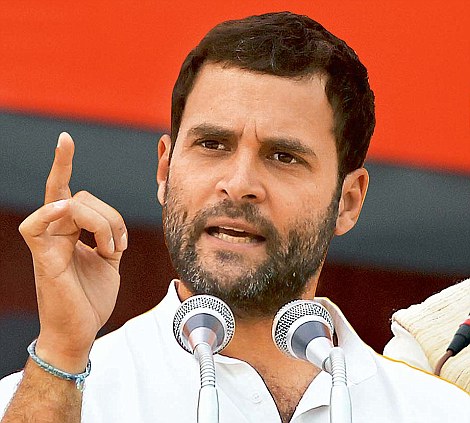
    After the court order, Congress vice-president Rahul Gandhi said, “Hope Modiji learns his lesson. People of of this country and the institutions built by our founding fathers will not tolerate the murder of democracy. They did their worst. We did our best. Democracy won in Uttarakhand.” But the BJP tried to put up a brave front, saying that the Congress’s victory had been “purchased”. “This is not a victory, it has been purchased. This was a fixed match… They are trying to run a government by dadagiri. This is a crisis of their own making,” BJP spokesman Shrikant Sharma said. In court, modifying its previous order whereby the Centre was restrained from revoking President’s rule in the state, the bench said, “Keeping in view the prayer made by the learned Attorney General, we vary the order by granting liberty to the Union of India to revoke the proclamation of President’s rule in the State of Uttarakhand in the course of the day. Needless to say, after the Presidential rule is revoked, the first respondent (Rawat) can assume the office of the Chief Minister of Uttarakhand.” Minutes after the bench gave its nod, the Union Cabinet met briefly at Parliament House at 12.45 pm and recommended the revocation of President’s rule in Uttarakhand. The order of revocation has to be placed before the apex court on Friday. Rawat’s counsel Abhishek Manu Singhvi and Kapil Sibal appreciated the Centre’s stand on revocation of the proclamation. “It is a very fair stand and we appreciate the learned AG for making a statement on revocation of President’s rule,” said the lawyers.

    Harish Rawat rules out snap polls

    Back to power in Uttarakhand, the Congress is in no hurry to call fresh Assembl y elections in the state. It will focus on development of the state, which stands derailed since the Centre imposed President’s rule on March 26.

    Chief Minister Harish Rawat today ruled out snap polls in the hill state after he met Congress president Sonia Gandhi at her residence here this evening. His Cabinet colleagues accompanied him. They are back to the Cabinet with the revocation of President’s rule in the state last midnight after Harish Rawat won the floor test. “Our sole priority right now is development of the state which has been derailed on account of the two-month gap during President’s rule. We have to put the state back on track,” said Rawat after being asked if he discussed snap polls and Uttarakhand cabinet rejig with Sonia Gandhi.

    Asked if he planned to meet Prime Minister Narendra Modi and Finance Minister Arun Jaitley, the Chief Minister said he would meet anyone he had to in the interest of the state. He said his win in the floor test was in fact a win of people of the state, adding that he would not practise a politics of confrontation with the Centre.

  • On Modi’s Watch, 20,000 Crores Vanished – The Big ‘Gas Scam’

    On Modi’s Watch, 20,000 Crores Vanished – The Big ‘Gas Scam’

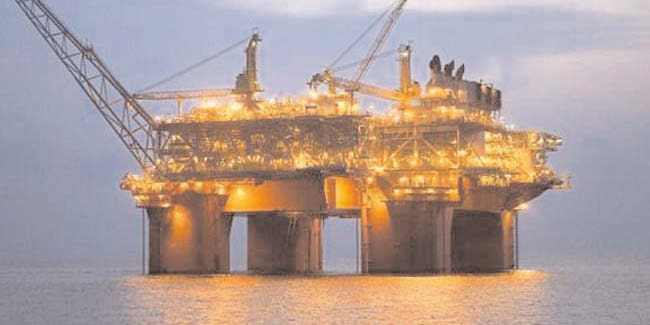
    Gujarat State Petroleum Corporation Ltd (GSPC) is a public sector undertaking in the state of Gujarat, incorporated in 1979. GSPC has been engaged in activities in the oil and gas industry. GSPC was awarded a block in the Krishna Godaveri (KG) river basin for drilling in 2002. It subsequently entered into a production sharing contract with the then Central government in February 2003.

    The boast On June 26, 2005, then Gujarat Chief Minister Narendra Modi announced that GSPC had discovered India’s largest gas reserves in the KG basin. He claimed that the gas reserves were 20 trillion cubic feet worth 2,20,000 crores at that time. This was more than the total gas produced in all of India at that time. He announced that GSPC would spend 1,500 crores and begin commercial production of this gas in 2007. He also proclaimed this would make Gujarat India’s economic super power and enable India to become self-sufficient in her energy needs.

    The fall On November 4, 2009, GSPC approved a “Field Development Plan” to develop the KG Basin gas blocks. Four years after the grand announcement and two years after the promised production date, GSPC merely produced a report on how to develop the KG Basin block. This document estimated the costs of development of KG basin block as 8,465 crores, much more than the 1,500 crores that Chief Minister Modi had announced. But more importantly, the Plan also cut its estimates of gas reserves by 90% of what Chief Minister Modi had claimed. So, GSPC’s own development plan in 2009 estimated 4 times higher costs to produce one-tenth of the gas that Chief Minister Modi had so proudly claimed in 2005.

    The loot What is even worse is this – as of 2016, GSPC has not started commercial production of gas from its KG Basin block. Astonishingly, it has borrowed 19,716 crores until March 31, 2015 from more than 15 public sector and private sector banks together. Its profits have dropped to a mere 23 crores in 2015. The company has written off nearly 3,000 crores as exploration costs. The company had interest dues of 1,800 crores in 2015 alone to the banks. To put this in context, Kingfisher Airlines is alleged to owe the banks 9,000 crores. GSPC’s loans are more than twice that of Kingfisher. Similar to Kingfisher Airlines, GSPC’s grand plans have also gone kaput. When Kingfisher and its promoter are rightfully vilified, why are GSPC and its protagonists not questioned?

    Not Make in India but Explore outside India In a sheer act of bravado, GSPC went on an acquisition spree of overseas 11 oil and gas blocks in Egypt, Australia, Indonesia and Yemen between 2006 and 2010. By 2015, it had surrendered 10 of these blocks and wrote off 2000 crores. For a company that had no prior experience in operating these blocks, GSPC’s reckless acquisition spree of overseas blocks calls into question both business acumen as well as its intent.

    Show us the money Where did the nearly 20,000 crores of deposits of Indians in banks borrowed by GSPC vanish? There needs to be a thorough investigation into the money trail and use of this money by GSPC. Gujarat State Petroleum Corporation Ltd (GSPC) has been engaged in activities in the oil and gas industry

    Dubious transactions GSPC entered into contracts and partnerships with dubious entities. GeoGlobal Resources: named GSPC’s technical partner, it was a two-person company incorporated in Barbados, owned by Jean Paul Roy. Geo Global was incorporated just six days before their agreement with GSPC. Geo Global and Jubilant Group became partners with GSPC in this KG Basin adventure in 2003, in return for 10% stake each. Geo Global did not put in any money for its stake. Soon after, curiously, Geo Global sells half of its stake to a Mauritius-based company called Roy Group.

    Tuff Drilling: became the drilling partner of the GSPC KG basin venture. It was only incorporated in 2006 after Mr. Modi’s announcement of discovery of gas reserves. This company had no experience in gas exploration. Its promoter had an apparel business. Yet it received an order in 2010 from GSPC worth several hundred crores of rupees to supply sophisticated deep water platform rigs for gas extraction in the KG basin. As per media reports, Tuff Drilling has defaulted on its loans of 120 crores to banks and is now bankrupt.

    Too many questions, too few answers

    1. What does GSPC have to show after 11 years and 20,000 crores of Indian savers’ money being used? Where did the money go?

    2. How did the board of GSPC approve so many reckless overseas acquisitions in such a short period of time for a company with such limited experience?

    3. On what basis did PSU banks lend so much to GSPC when both exploration and economic viability of its KG operations were in doubt?

    4. On what basis were contracts awarded to dubious entities such as Tuff Drilling? What were the personal arrangements?

    5. Why were the CAG audit reports of 2011-12 to 2014-15 deliberately delayed?

    6. If as GSPC claims it can still recover gas from KG basin, why are there attempts being made to palm off the KG block to others, including ONGC as reported in the media?

    7. The CAG report has clearly indicted GSPC, its management and board of mismanagement to the tune of 20,000 crores. Why does this not call for resignation of all the people involved and a more detailed judicial inquiry, as was the case with CAG reports in other cases?

    The GSPC saga is one of a company that claimed to solve India’s energy problems in 2005 only to borrow a staggering 20,000 crores with absolutely nothing to show for it in 2016. Apologists for GSPC and its protagonists continue to hide behind technical terms of 1P, 2P, 3P, Gas-in-place reserves etc. They miss the entirely larger point that after a decade and 20,000 crores, no one is willing to buy management estimates of its ability to extract gas from the KG basin. It is only fair that the treatment meted out in other cases of a similar CAG indictment be meted out to GSPC as well, i.e. an independent judicial inquiry to probe into the matter deeply. If there’s nothing to hide, there’s nothing to fear, isn’t it?

    (The author is a senior Congress leader, Member of Parliament (Rajya Sabha)
    and former Environment Minister)

  • Modi to address a joint session of the U.S Congress and meet U.S. investors, CEOs in June

    Modi to address a joint session of the U.S Congress and meet U.S. investors, CEOs in June

    NEW DELHI (TIP): Prime Minister Narendra Modi will attend a dinner hosted by the U.S – India Business Council (USIBC) on June 7 that will bring together around 400 CEOs, investors and business leaders during his two-day visit to the U.S capital.

    The Prime Minister is scheduled to address a joint session of the U.S Congress on June 8, and will also attend an event of the Indian community.

    USIBC dinner event will honor Amazon founder Jeff Bezos and Dilip Shanghvi, founder and managing director of Sun Pharmaceuticals.

    Details of the Prime Minister’s address to the joint session of the Congress is still being worked out by Speaker Paul Ryan’s office, and the community event that will also have several U.S lawmakers participating, will be finalized after Mr. Modi’s schedule on the Capitol is final, it has been learnt.

    Curiously, India has not formally announced the PM’s visit yet, which is taking place at the behest of President Barack Obama. Details of prime minister’s White House engagement are also not yet final, but it is unlikely that there will be a state banquet, it has been learnt.
    The photo-op of the visit could the signing of the first commercial agreement under the Indo-U.S. civil nuclear deal, between the Westinghouse Electric and the Nuclear Power Corporation India Ltd(NPCIL), to build six nuclear reactors in Gujarat.

    Westinghouse CEO Daniel Roderick had told Reuters in March that he hoped sign the deal in June, after the negotiations could not conclude by the time of Mr. Modi’s visit to attend the Nuclear Security Summit on March 31 and April 1. A source familiar with the development said the price of electricity is the lingering issue, and it could be resolved before Mr. Modi’s visit.

  • UTTARAKHAND HC QUASHES PRESIDENT’S RULE

    UTTARAKHAND HC QUASHES PRESIDENT’S RULE

    NAINITAL (TIP): In a historic decision, the Uttarakhand High Court, on April 21, set aside the proclamation of President’s rule in the state and revived the Harish Rawat-led Congress government, asking it to prove its majority on the floor of the Assembly on April 29.

    In a scathing indictment of the Central Government, a Division Bench comprising Chief Justice
    KM Joseph and Justice VK Bist ordered, on a petition filed by Rawat, that the imposition of President’s rule on March 27 under Article 356 of the Constitution was not in consonance with the law laid down by the SC in such cases.

    The judges dictated the ruling in the open court after the counsel for the Centre failed to give an undertaking that the government would not revoke President’s rule for a week till the court gave its verdict. The petitioner’s counsel had said there were apprehensions that the Centre would revoke President’s rule for forming a BJP-led government in the state.

    The Bench made strong observations on the Centre resorting to Article 356 of the Constitution in the case. “Be it suspension or dissolution, the effect is toppling a democratically elected government. It breeds cynicism in the hearts of citizens who participate in the democratic system and also undermines democracy and the foundation of federalism,” the Bench said.

    Allowing Rawat’s petition, the court restored status quo ante as prevailing on the day of imposition of Central rule. It also upheld the disqualification of nine rebel Congress MLAs by the Speaker and said their case, pending with a Single Bench, would be heard and decided without any prejudice.

    The judges observed that that the material considered for imposing President’s rule had been found wanting. “When stakes are as high as this, should we throw out the petitioner on this ground? (of alleged suppression of fact that division of votes was sought after the Appropriation Bill was passed). What is at stake here is not just the petitioner’s government but democracy at large,” the Bench.

    The Centre had argued that the petitioner had not disclosed the representation by BJP MLAs to the Governor seeking division of votes.

    Ordering restoration of the Rawat government, the court said he must necessarily obtain a vote of confidence by holding a floor test on April 29.

    “The present case, which was set into motion with March 18 as day one and saw a proclamation being issued in less than 10 days, brings to the fore a situation where Article 356 has been used contrary to the law laid down by the apex court. The material (considered for the proclamation) has been found wanting and justifies judicial review interfering with the proclamation.

    “However, we must not be understood to have said that a solitary instance would not contribute for imposing Article 356,” the Bench said. It turned down an oral plea by the Centre’s counsel for a stay on the judgment to move the Supreme Court. “There is no President’s rule now. The government has revived. We had told you to give us time (to write the verdict). But you forced us to pronounce it today. We had said we will not allow (ourselves) to be taken for a ride. We have no objection to being overruled. You go to the Supreme Court and get it (judgment) stayed,” the court said.

    Rejecting the government’s argument against the scope of judicial review of President’s decision in the case, the Bench said: “Attainment of collateral purpose, though it may appear to be to secure legitimate purpose, is inadmissible”. It said the issue must be seen on a larger canvas as India was a union of states with the Centre and states sovereign in their respective spheres and Article 356 must be used as a last resort with “greatest care.”

    Earlier in the day, the High Court said it would be a travesty of justice if the Centre recalled its order imposing President’s Rule and allowed someone else to form government. With regard to Article 356, the Bench observed: “It is to be remembered that power under Article 356 came in for considerable misuse over the years. Incidentally, we must note that the party to which the petitioner belongs has not covered itself with glory with regard to its actions in the first 40 years of Independence which saw nearly 100 dissolutions.”

  • Modi may visit US in June to meet Obama

    Modi may visit US in June to meet Obama

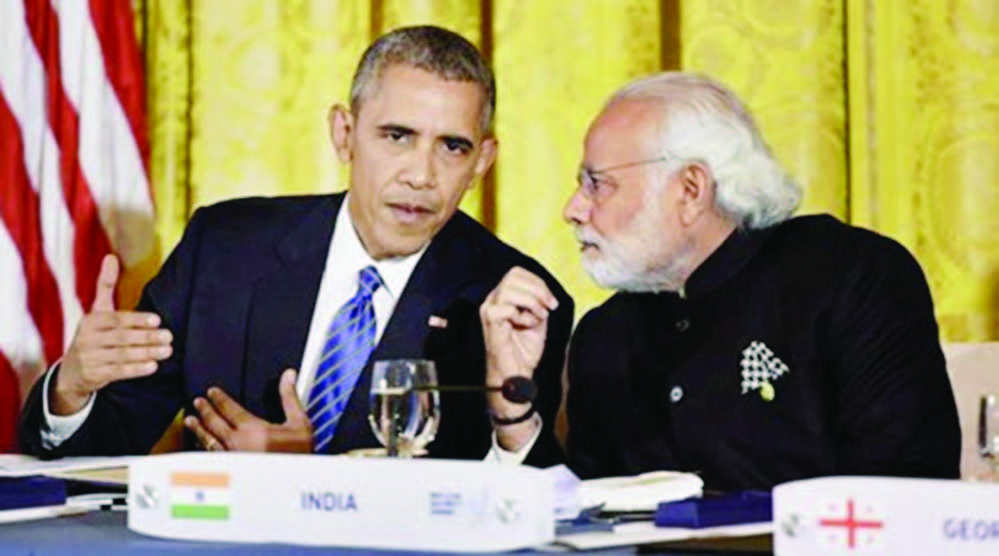
    WASHINGTON (TIP): Prime Minister Narendra Modi is likely to visit the US in June to hold a bilateral meeting with US President Barack Obama before he demits office in January next year.

    Sources confirm that the US has reached out to India on this matter and the dates are being sorted out. Sources say if dates can’t be worked out for June, Modi may then travel to the US in September. Obama is keen on meeting some world leaders before stepping down and the US is in the process of reaching out to these leaders.

    Obama will be demitting office in January next year after two four-year terms. His presidency has seen its fair share of highs and lows. Modi and the US President were able to develop a good rapport, which resulted in Obama accepting the invitation to be the Chief Guest at the Republic Day parade in 2015. That also helped Modi score a diplomatic coup on the home front.

    Besides the personal camaraderie between the two leaders, the US today has great interests in India, which it wants to safeguard. The US wants to build India as an ally in the region vis-a-vis China.

  • PM Modi launches ‘Stand up India’ to promote financial inclusion

    PM Modi launches ‘Stand up India’ to promote financial inclusion

    NEW DELHI (TIP): Prime Minister Narendra Modi launched the Stand up India scheme to enable Scheduled Castes, Scheduled Tribes and women entrepreneurs to access loans, setting a target of creating 2.5 lakh such entrepreneurs across the country.

    Under the scheme 1.25 lakh bank branches will provide loans up to Rs 1 crore. Each branch will be required to provide two such loans ranging from Rs 10 lakh to Rs 1 crore without collateral for setting up a new enterprise.

    The PM said it is not possible for the government to provide jobs to everyone. The scheme will convert “job-seekers into job creators,” he said. “This scheme is going to transform the lives of people from dalit and tribal communities,” Modi said. Stand up India, he said, aims to empower every Indian and enable them to stand on their own feet. The scheme was announced by Modi in his Independence Day address last year.

    At a function in Noida in Uttar Pradesh that also marked the birth anniversary of dalit leader and former Deputy Prime Minister Babu Jagjivan Ram, the PM also flagged off 5,100 e-rickshaws. Without naming anyone, Modi said that while poor people are generous and honest some rich borrowers look for ways to flee after taking loans.

    “This nation has seen the generosity of poor. Rich borrowers look for ways to run away after borrowing money from banks,” he said.

    Modi said that Prime Minister’s Jan Dhan Yojana encouraged people to open zero-balance account but they depositedRs 35,000 crore.

    “Look at their honesty, their self-respect. They opted to put money into their accounts…Rs 50, 100, 200. The deposits exceeded Rs 35,000 crore. This is the generosity of our poor people,” Modi said. Finance Minister Arun Jaitley said his ministry, which is usually associated with big business houses, in the last two years has tried to work for the betterment of the poor people. He recalled various schemes of the government like Jan Dhan Yojana, insurance and pension and MUDRA Yojana to promote financial inclusion with the view to empower the poor.

    Under the Stand up India scheme people from Scheduled Castes and Scheduled Tribes, and women entrepreneurs, will get support such as pre-loan training, facilitating loan, factoring and marketing. There will be a Rs 10,000 crore refinance window through Small Industries Development Bank of India (SIDBI) and the National Credit Guarantee Trustee Company Ltd (NCGTC) will create a corpus of Rs 5,000 crore.

    SIDBI will engage with the Dalit Indian Chamber of Commerce and Industry and various other institutions to take the scheme forward. The offices of SIDBI and National Bank for Agriculture and Rural Development will be designated ‘Stand Up Connect Centres’.

  • JD (U) – RLD MERGER EYES ALLIANCE WITH CONGRESS IN UP

    JD (U) – RLD MERGER EYES ALLIANCE WITH CONGRESS IN UP

    NEW DELHI (TIP): The forthcoming merger of Ajit Singh’s RLD with Nitish Kumar-led JD(U) is just the beginning of a larger experiment that may see the JD(U) and Congress trying to replicate a Bihar-like grand alliance in UP for the assembly elections next year, according to leaders involved in behind-the-scene strategising.

    While RLD’s merger with JD(U) will lead to Singh occupying a senior position in the merged party at the national level, his son and former MP Jayant Chaudhary may be the UP unit president of the party, sources said. There are a number of political factors and interests that make the coming together of the merged JD(U) and Congress to form an alliance for UP poll inevitable.

    Both parties recognise their mutual need to pool their resources to take on entrenched rivals such as the SP, BSP and BJP. Further, after SP leader Mulayam Singh Yadav ‘spoiled’ the Janata Parivar merger attempts last year, Kumar, Singh and Congress share a political aversion to Yadav, who also fielded SP candidates against the grand alliance in Bihar.

    Further, the traditional rivalry RLD and Congress share with BSP makes their coming together to form an anti-BJP platform inevitable, a source said. Incidentally, Kumar’s campaign strategist-turned-advisor Prashant Kishor is the campaign strategist of Congress in UP.

    “The merger is meant to expand our party by reinforcing the combined interests of the two parties and position effectively in the UP polls by tapping the joint strength,” said Sharad Yadav, who is set to step down as JD(U) president. Explaining his decision to step down from the presidentship, Yadav said: “I have completed my third consecutive full term as JD(U) president. Last time the party constitution, which had fixed cap on two consecutive terms for party president, had to be amended to extend my term. I don’t want to amend the constitution again, therefore, have chosen to step down.

  • PM Modi Announces 24X7 Helpline for Non-Resident Indians

    PM Modi Announces 24X7 Helpline for Non-Resident Indians

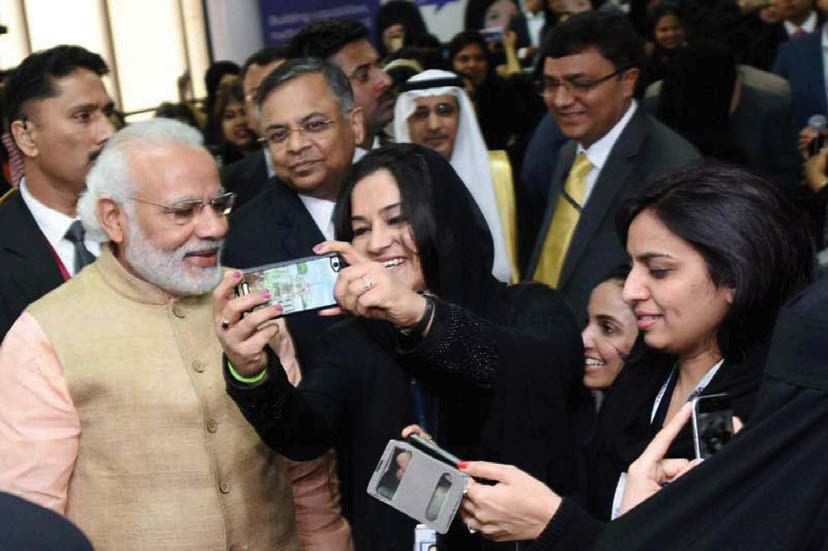
    RIYADH (TIP): Reaching out to Non-Resident Indians, Prime Minister Narendra Modi, April 3 night announced a 24X7 multi-lingual helpline for them and said a move to regularize migration was in the offing through an online program.

    Asserting that the NRIs could count on the Indian government in the times of crisis, he said they could use the avenues like the MADAD portal to reach the government for help.

    Specifically, for Indians in Saudi Arabia, he announced the setting up of worker resource centers in Riyadh and Jeddah to provide them with all necessary help. Addressing a gathering of L&T workers who are constructing metro rail in Riyadh, he said the country was proud of their contribution which has enhanced India’s image abroad and opened doors for overseas employment opportunities for their compatriots.

    “Whenever any good news regarding you people comes; I feel as happy as your family. When there is news of some concern regarding you, I feel the pain like your family would because you are my family,” PM Modi said, adding that he shared their happiness and sorrow.

    “Government has started a program called e-migrate. In the coming days, we are working to regularize migration,” he said.

    “In the coming days, we plan to establish worker resource centers in Riyadh and Jeddah to meet your needs and there will also be a 24X7 helpline. A call center will be established whose facilities can be availed in different languages and through this helpline you can share your problems,” PM Modi said.

  • Congress to challenge U’khand Budget ordinance

    Congress to challenge U’khand Budget ordinance

    NEW DELHI (TIP): The Congress on March 31 said it would move court if the Modi government issues an ordinance authorising expenditure from April 1 in Uttarakhand that has been placed under the President’s Rule.

    Former law minister Kapil Sibal contested Centre’s claims that the Uttarakhand Assembly had failed to pass the state budget on March 18.

    “I would like to ask Prime Minister Narendra Modi on what basis have you declared that the Budget has not been passed in the Assembly,” Sibal said referring to the Union Cabinet recommendation to the President to promulgate the Uttarakhand Appropriation ordinance.

    He said promulgation of an ordinance to authorise expenditure would be“unprecedented and unconstitutional”.

    The senior Congress leader contended that the Uttarakhand speaker had declared that the Appropriation Bill was passed by a voice vote and that there was no petition in the court contesting it.

  • ‘Terrorism is globally networked. But we still act only nationally to counter this threat’: PM Modi

    ‘Terrorism is globally networked. But we still act only nationally to counter this threat’: PM Modi

    WASHINGTON (TIP): India’s Prime Minister Narendra Modi who is on a three-nation visit of Belgium, the US and Saudi Arabia, arrived March 31 in Washington where, among many  other engagements, he is attending the Nuclear Security Summit.

    Speaking at the summit, Narendra Modi said: “Terrorism is globally networked. But, we still act only nationally to counter this threat. The reach and supply chains of terrorism are global, but genuine cooperation between nation states is not.”

    “Drop the notion that terrorism is someone else’s problem and that “his” terrorist is not “my” terrorist. Nuclear security must remain an abiding national priority for every country”, he added

    PM Modi praised President Obama for his vision and effort for nuclear security and said: “this legacy of President Obama must endure.”

    During his two-day stay in Washington, PM Modi is scheduled to interact with a number of world leaders including the host President Barack Obama.

    Prime Minister Narendra Modi had arrived in Washington DC on 31 March where he was received at the airport by US Ambassador to India, Richard Verma.

    Earlier in the day, Modi met a team of scientists, including 3 Indians, from the Laser Interferometer Gravitational Wave Observatory (LIGO), who proved gravitational waves theory.

    The team of scientists, was led by Dr France Cordova, Director of the National Science Foundation, who explained how India was extremely important for the future of the LIGO project. An MoU on the establishment of LIGO project in India was signed by Dr Cordova and Dr Sekhar Basu, Secretary, Department of Atomic Energy, India, which was witnessed by the Prime Minister himself.

    Brussels Visit

    Earlier, on March 30, Prime Minister Narendra Modi, arrived on his maiden state visit to Belgium and expressed India’s solidarity with the European nation for the tragedy that struck Brussels on 22 March.

    His daylong schedule in the city, which is still recovering from a terror attack last week that killed dozens of people, included attending the 13th India-European Union Summit and visiting a memorial at the Maalbeek metro station for the victims of the Brussels attacks, which included Indian engineer Raghavendra.

    Speaking in Brussels, Modi said, “India stands in full support and solidarity with Belgium.” He offered his sincere gratitude for the warm welcome he received despite it being a tough time for the country.

    Modi and Belgian Prime Minister Michel also had a bilateral meeting. The bilateral meeting between the two premiers was aimed at expanding trade, investment and high technology partnership with this important EU member. The meeting was also focused on stalled trade talks between the two sides as well as on investment, energy, climate, water and migration.

    Counter-terrorism was a key focus, particularly in the aftermath of the Brussels bombings. “We stand shoulder to shoulder with the people of Belgium in the wake of the horrific attacks in Brussels and share the grief of those who lost their loved ones,” Modi said.

    Over lunch, Modi met with a delegation of Belgian businessmen, an “opportunity for the him to encourage Belgian foreign direct investment into India.”

    Modi also met the Indian community outside his hotel on his arrival in Brussel.

    Saudi Arabia Visit 

    The Middle East, especially Saudi Arabia, has always played an important role in the India’s economic growth as well as relations with its querulous neighbor Pakistan.

    Prime Minister Narendra Modi and his government have been serious about cultivating ties with the middle east and within eight months of his visit to the United Arab Emirates, Modi is scheduled to visit the region again, this time to Saudi Arabia to strengthen Delhi’s close relations with the kingdom and loosen Saudi-Pakistani ties in the process.

    India is a major trade partner in the region, and Modi aims to position India globally so as to isolate Pakistan’s military-industrial complex and its policy of using terrorism as an instrument of state policy. The Saudis hope to leverage Indian expertise in IT and services to modernize and diversify a single-source economy dependent on oil.

    India’s ties with Saudi Arabia have grown over the last two decades based on burgeoning energy ties and the Indian diaspora – the largest group of foreign workers in the Saudi kingdom.

    Modi has already met King Salman of Saudi Arabia twice, and Saudi help was critical in the evacuation of Indian nationals from the Yemeni war zone. The 2012 deportation by the Saudis of Sayed Zabiuddin, also known as Abu Jundal, a suspect in 2008 Mumbai terrorist attacks, signaled a sea change in Saudi Arabia’s counterterrorism priorities.

    Saudi Arabia too is cautious in balancing ties between Pakistan and India. Ahead of Modi’s visit, Saudi Foreign Minister Adel al-Jubeir tried to alleviate concerns in Pakistan about budding Indo-Saudi ties and insisted that Saudi Arabia’s “relations with Pakistan do not come at the expense of [its] relations with India.” Adel al-Jubeir and Mohammad bin Salman, deputy crown prince and defense minister, visited Pakistan in January despite growing anger at Islamabad’s refusal to commit troops in Yemen and join the Saudi-led “coalition against terrorism” of 34 Islamic nations.

    For Indian strategists, any ally that can act as a counterweight to Pakistan in the Islamic world is useful. Saudi Arabia does the same with Iran, the two nations long competing for power and influence in the Gulf. As the regional balance of power between the two threatens to unravel in Iran’s favor, India has repeatedly emphasized a desire for stabilization in the region’s extant balance of power.

    The huge Indian diaspora in the country, nearly 3 million, makes India the largest recipient of foreign remittances from the kingdom at an estimated $11 billion. Pakistan, Bangladesh and Indonesia each send about 1.5 million foreign workers to Saudi Arabia

    Indian IT companies are building capacity in Saudi Arabia, including an all-women business process operations center run by TCS as one example.

    A hallmark of Modi’s foreign policy has been a self-confident assertion of Indian interests, marking a distinct break from unnecessary and counterproductive diffidence of the past. The prime minister is keen to see that Pakistan’s close allies apply pressure on Pakistan – and after limited success with the UAE, he will press the Saudis. While it’s unlikely that the Saudis will break with Pakistan, a declaration of opposition to state-sponsored terrorism would be considered a major step.

    To win such support, Modi most likely won’t be vocal about Saudi support for Wahhabism, a fundamentalist branch of Islam blamed by many in the international community for contributing to a spread of global terrorism.

  • Ugly politics in Uttarakhand: No participant left with clean hands

    Ugly politics in Uttarakhand: No participant left with clean hands

    In the unfolding Uttarakhand drama all participants emerge diminished. It was a problem borne of rebellion in the Congress. Apparently, Chief Minister Harish Rawat, now facing horse-trading charges, had lost majority with nine MLAs parting ways with the Congress. The Speaker did not agree to their demand for a division of votes on the appropriation Bill, claims the BJP and asks on what ground the MLAs were suspended by the Speaker. The floor test would have determined whether the Congress government enjoyed the majority. However, an impatient BJP leadership imposed President’s rule, which has invited all-round criticism and Arun Jaitley’s arguments just don’t add up.

    If the Governor had evidence of a “breakdown of constitutional machinery”, as is made out to be, why would he call for a floor test? Where is the so-called “breakdown of constitutional machinery?” If the Speaker says the appropriation Bill has been passed, his ruling is final and it may be challenged subsequently. Whether a Bill is passed or not, whether a government enjoys a majority or not -these are questions which can be answered only on the floor of the House as has been decided by the Supreme Court in the SR Bommai case. Such issues cannot be settled in Delhi. When all interested parties play such dirty politics, the country looks up to the President to maintain the high standards his position demands. The President could have deferred the signing of the proclamation for Central rule and asked the BJP government to wait for the outcome of the floor test. However, he, disappointingly, did not rise to the occasion and spare the nation a few absurdities.

    The sordid political drama could have been avoided if everyone had followed the rulebook. Now it has thrown up legal issues the High Court at Nainital is grappling with. While the single-judge Bench is right in asking for a floor test in keeping with the Supreme Court guidelines, whether he could interfere with a Presidential proclamation and revive a suspended government for a floor test is an open question which the Division Bench is expected to take up at the next hearing. The matter would end up in the apex court. Federal arrangements have suffered.

  • Narendra Modi, Priyanka Chopra, Sania Mirza are Contenders for TIME’s ‘Most Influential’

    Narendra Modi, Priyanka Chopra, Sania Mirza are Contenders for TIME’s ‘Most Influential’

    NEW YORK (TIP): Prime Minister Narendra Modi, tennis star Sania Mirza and actor Priyanka Chopra are among the probable contenders for TIME magazine’s annual list of the most influential people in the world., says a PTI report

    peeceeMirzaNarendra ModiTIME will announce its annual list of the world’s 100 most influential people, ‘TIME 100,’ this month.

    While its editors will determine the ultimate honorees, the publication has asked readers to vote from 127 “world leaders, great minds in science and technology, outstanding figures in the arts and other icons of the moment,” on who they think deserves the recognition.

    TIME said “Modi remains a powerful voice on the world stage,” and while he saw his domestic agenda “sidetracked by political squabbles” in 2015, his country still leads the world in economic growth.

    Modi was named among TIME’s 100 Most Influential People in the World last year and President Barack Obama had written a profile for him for the magazine.

    For Mirza, TIME said India’s best female tennis player secured the number one ranking in the world for women’s doubles “while helping to redefine the role of female athletes in her home country.”

    TIME said Chopra, one of the highest paid actors in Bollywood, has “caught Hollywood’s attention” for her role in the drama series “Quantico” and “will continue to do so in the ‘Baywatch’ remake.”

    India-born CEOs of the world’s top technology companies, Google and Microsoft, are also among the list of 127 probables for the annual honor.

    TIME said Google CEO Sundar Pichai, who is co-founder Larry Page’s “right hand,” now oversees core businesses such as Android and YouTube for the tech giant.

    Under Microsoft CEO Satya Nadella, the publication said, Windows 10 launched “successfully,” the cloud business is “booming” and new technologies like the HoloLens have industry analysts “excited.”

    Indian-origin actor Aziz Ansari has also found a place on the list.

    The list also includes SpaceX CEO Elon Musk, singer Rihanna, Jamaican sprinter Usain Bolt, Harry Potter author J.K. Rowling, Facebook CEO Mark Zuckerberg and his wife Priscilla Chan, Myanmar’s pro-democracy leader Aung San Suu Kyi, German Chancellor Angela Merkel, Pope Francis, reality TV star Kim Kardashian, Russian President Vladimir Putin and Fox News anchor Megyn Kelly.

  • Modi hails Islam, calls it a ‘great religion’

    Modi hails Islam, calls it a ‘great religion’

    NEW DELHI (TIP): Prime Minister Narendra Modi on March 17 praised the contribution of Islam, calling it a “great religion” whose invocation of Allah was itself a call for abjuring violence and upholding peace for mankind.

    In an exercise seen as an outreach to the minority community ahead of crucial Assembly elections, the prime minister, while addressing World Sufi Forum here, also called upon the religious leaders to spread this message of Islam to wean away those sections that were falling pray to radicalisation.

    Modi, who has often emphasised on the need to give importance to Sufism at world fora in order to counter radical ideas, said any link between terrorism and religion must be rejected.

    “Those who spread terror in the name of religion are anti-religious. When we think of the 99 names of Allah, none stand for force and violence, and that the first two names denote compassionate and merciful. Allah is Rahman and Raheem,” he said. Modi also sought to convey that his government believed that Islam occupied pride of place among other religions that have existed for a long time in the country.

    “All our people, Hindus, Muslims, Sikhs, Christians, Jains, Buddhists, the micro-minority of Parsis, believers, non-believers, are an integral part of India. This is the spirit of India. This is the strength of our nation,” he said.

    “Sufism became the face of Islam in India, even as it remained deeply rooted in the Holy Quran, and Hadis,” he said.

  • PM Modi to join world leaders in wax at Madame Tussauds

    PM Modi to join world leaders in wax at Madame Tussauds

    NEW DELHI (TIP): Prime Minister Narendra Modi will join the ranks of prominent global leaders at Madame Tussauds in London, Singapore, Hong Kong and Bangkok next month, the world famous wax museum announced on March 16.

    Describing him as a “hugely important figure in world politics”, the museum said the Indian Prime Minister had given the museum’s team of artists and experts a sitting at his residence in New Delhi earlier this year.

    “Madame Tussauds has crafted figures of very distinguished dignitaries from around the world – how could I regard myself worthy of being alongside them? But when I was informed that your decision had emanated from public opinion and public sentiment, I was comforted,” Modi said in a statement to the museum.

    “During my sitting, I observed the team carefully and was deeply impressed by its dedication, professionalism and skill. I have visited Madame Tussauds three or four times and had the pleasure of getting myself photographed standing next to the figures of various dignitaries,” he said.

    The wax figures at each of the museum’s locations around Europe and Asia will be dressed in Modi’s “signature kurta” in cream with a jacket and he will be featured in a traditional pose “making a namaste gesture”.

    “Prime Minister Modi is a hugely important figure in world politics, a position supported by his place in the top 10 of Time Magazine’s Person of the Year List 2015,” said museum spokesperson Kieran Lancini.

    “His massive social media presence – he is currently the second most followed politician on twitter after President Obama – also confirms the intense interest the public have in him, a fact supported by the requests our guests have made for us to create his figure.


  • Positions harden: Opposition, government spar as Bills await action

    Positions harden: Opposition, government spar as Bills await action

    After the Opposition amendment to the motion of thanks to the President’s Address and the Prime Minister’s speech in the Rajya Sabha on Wednesday, hopes of Congress-BJP patch-up for passing crucial Bills pending in Parliament have further receded. The Prime Minister’s cursory appeals for Opposition cooperation and the withdrawal of the amendments proposed to the motion of thanks coupled with strident attacks on the Congress leadership indicate the government itself has given up all hope of seeing the GST and other Bills through.

    For the second consecutive year the Opposition has embarrassed the Modi government in the Rajya Sabha, where it outnumbers the ruling alliance. This time, however, cracks appeared in Opposition unity. The BJD and BSP MPs staged a walkout, while the Trinamool Congress did not participate in the voting. The amendment, moved by the Congress, regretted the failure of the President’s Address to mention the government’s commitment to securing the right of all citizens to contest elections. Haryana and Rajasthan have laid down educational qualifications for contesting the  panchayat elections – a controversial decision upheld by the Supreme Court. Since opinion is clearly divided on the issue, the Opposition only wanted to score a point and it did succeed in putting the government in its place.

    Prime Minister Modi’s strategy is clear: divide the Opposition and isolate the Congress. Last month he blamed “Ma-Beta” for the Rajya Sabha logjam. He quotes Nehru, Indira Gandhi and Rajiv Gandhi to run down the present Congress leadership, including Dr Manmohan Singh. Nobody has ever accused him of being an economist, leave alone of the caliber of Dr Manmohan Singh. He is firm on his resolve on a “Congress-mukt Bharat”. Modi has a penchant for oratory but knows when to keep quiet. He has skipped the hot countrywide debate on nationalism and did not utter a word either on JNU or riots in Haryana. His battalion of warriors, joined lately by Anupam Kher, is busy dividing people into “national” and “anti-national”. Few expect Modi to control them. Divisive issues occupy the national center stage now. In this combative national mood, legislators indulge in theatrics and refuse to do the job on hand: pass the Bills.

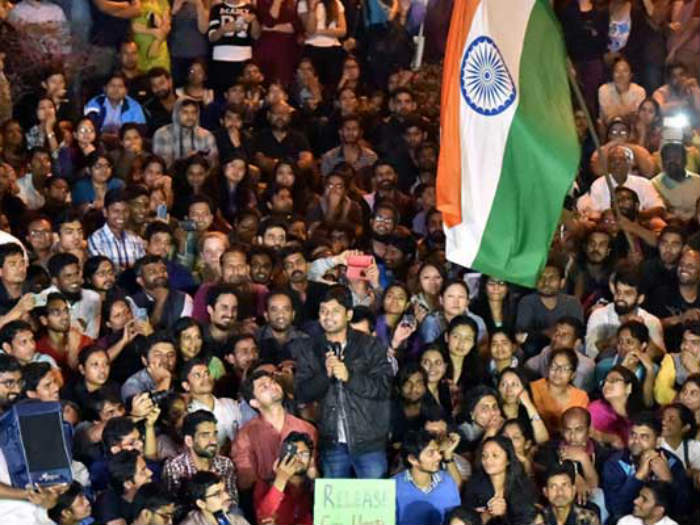
  • JNU Row: Kanhaiya To Lead ‘Azadi’ Movement For Umar, Anirban

    JNU Row: Kanhaiya To Lead ‘Azadi’ Movement For Umar, Anirban

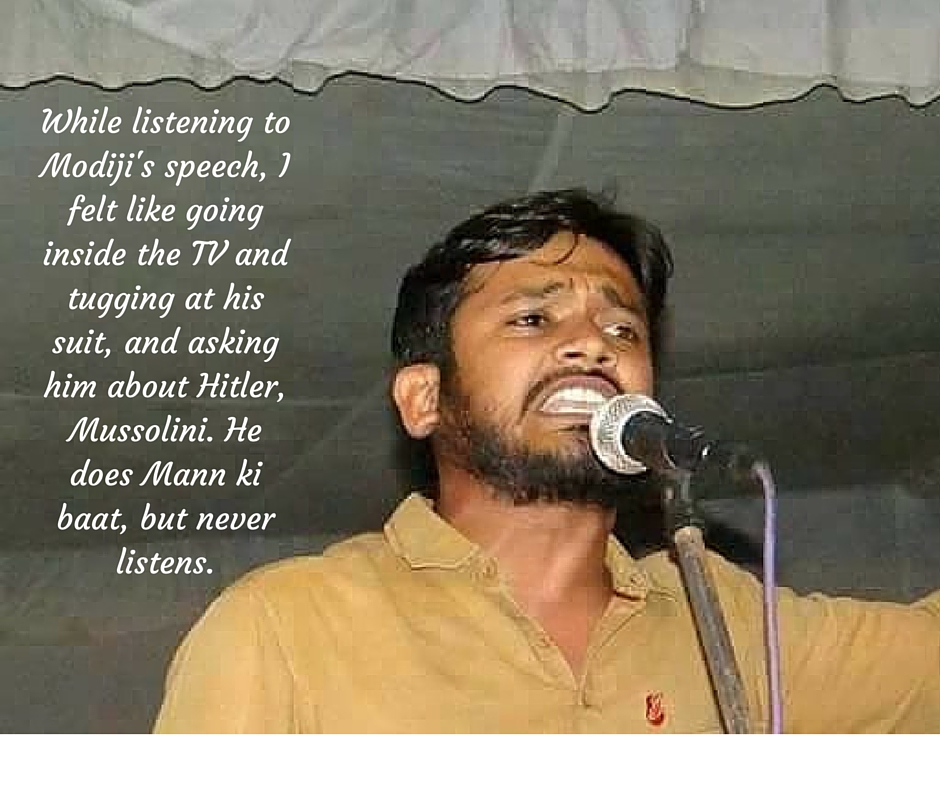
    JNU students union president Kanhaiya Kumar will lead the movement demanding release of two other varsity students who are still in judicial custody in a sedition case.

    “Though I have got bail in the case despite both the government and police trying their best to delay it as far as they can but our fight is not over yet. Umar and Anirban are yet to be released. I will now lead the ongoing student movement,” Kanhaiya told PTI.

    Kanhaiya was released from Tihar Jail last week after the Delhi High Court granted him bail.

    “Though our primary focus is to get them released but one thing I am sure of is if I adopt this ideology of raising our voice these trips to prison will become a frequent thing,” he added.

    Jawaharlal Nehru University is caught in a row over an event on the campus to commemorate the hanging of Parliament attack convict Afzal Guru, where “anti-national” slogans were allegedly raised.

    While Kanhaiya spent 18 days in jail, two other students — Umar Khalid and Anirban Bhattacharya are also in judicial custody in a sedition case over the event.

    The JNU Students Union led by Kanhaiya has called a council meeting tonight to discuss the “onslaught on JNU” and finalise their future course of action.

    In Kanhaiya’s absence, JNUSU Vice President Shehla Rashid Shora had led the student agitation.

    The JNUSU president was arrested in connection with the February 9 event. Five other students — Umar Khalid, Anirban Bhattacharya, Rama Naga, Anant Prakash and Ashutosh Kumar — had gone in hiding since then but resurfaced on the campus 10 days later.

    While Umar and Anirban surrendered before the police, the remaining three refused to do so but maintained that they are open to questioning by police as and when needed.

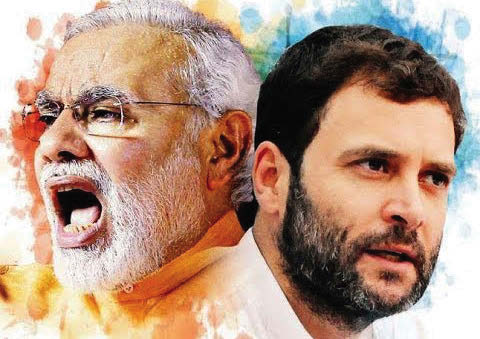
  • PM MODI IN GRIP OF AN ACUTE DISEASE ‘RAHUL PHOBIA’: CONGRESS

    PM MODI IN GRIP OF AN ACUTE DISEASE ‘RAHUL PHOBIA’: CONGRESS

    Congress has described Prime Minister Narendra Modi as being in grip of “Rahul phobia” and said he has made a “mockery of democracy” by making “petty-minded jibes” in his political speech on President’s address in Parliament, never done in the past. “Prime Minister Shri Modi seems to be in the grip of what I can describe as ‘Rahul phobia’. It is an acute disease. It has now attained the size of an epidemic as far as the BJP and the Prime Minister are concerned,” Congress spokesperson Abhishek Manu Singhvi said.

    Singhvi said that the Prime Minister’s speech was “devoid of substance” as he lost the opportunity of clearing doubts of people that were raised through questions posed by Congress and Rahul Gandhi, which he never answered.

    “In what has now become a characteristic habit of the Prime Minister, he again made a mockery of democracy and Parliament. In a response to President’s address, this kind of political petty-fogging, petty-minded jobs is neither the culture nor the occasion, nor the manner and style sanctified and hallowed in the almost 70 years of Indian Democracy,” he said.

  • Tulsi Gabbard, the first Hindu in the US Congress, on Modi, Hinduism, and linking Islam to terror

    Tulsi Gabbard, the first Hindu in the US Congress, on Modi, Hinduism, and linking Islam to terror

    Washington has no shortage of politicians struggling to be seen as a maverick. But Tulsi Gabbard isn’t one of them.

    As one of the first two female combat veterans elected to US Congress and also its first Hindu and first American Samoan representative, she wears the label quite easily. And this week, the 34-year-old congresswoman from Hawaii reminded everyone of it, as she broke ranks with the Democratic party establishment and relinquished her post as vice chair of the Democratic National Committee on Feb. 29 to endorse Bernie Sanders for president. (Her role with the DNC, the party’s governing body, would have required to stay neutral in the election.)

    Described last October by the Washington Post as “the Democrat that Republicans love and the DNC can’t control,” Gabbard offered a sample of her independent streak a year ago, when she spoke out of sync with her fellow Democrats and criticized US president Barack Obama’s handling of Islamic extremism—specifically over his unwillingness to brand ISIL an “Islamic” group. “[Obama] is completely missing the point of this radical Islamic ideology that’s fueling these people,” Gabbard told Fox News last February.

    Her viewpoint on this subject is all the more notable given her military experience in the Middle East, where she served in a field medical unit in Iraq and was a trainer for the Kuwait National Guard.

    But it also aligns nicely with the stance toward Islam held by India’s right-wing Bharatiya Janata Party (BJP) and its Hindu nationalist leader, Narendra Modi, with whom Gabbard shares a great rapport.

    Gabbard was among the few to criticize the US government’s decision to deny a visa to Modi before he was prime minister, in the wake of accusations that his government in the state of Gujarat did not do enough to save Muslims during the horrific communal violence carried out there in 2002. The Gujarat riots claimed more than 1,000 people, including close to 800 Muslims. Gabbard had called the no-visa decision a “great blunder.”

    And in November 2013, five months before Modi would win election as prime minister, Gabbard opposed a House resolution that called for “religious freedom and related human rights to be included in the United States-India Strategic Dialogue and for such issues to be raised directly with federal and state Indian government officials,” saying it would weaken the friendship between India and US.

    Critiques of her stance, like this one published on the American social-justice site Alternet.org, accused her of putting politics before policy:

    Rather than review the litany of abuses that have occurred in the country, Gabbard mused she did “not believe that the timing of this hearing is a coincidence….I am concerned that the goal of this hearing is to influence the outcome of India’s national elections.” She went on to state that even holding a hearing on the issue was “an attempt to foment fear and loathing purely for political purposes.” In other words, her concern was that Modi’s electoral chances would be hurt by an honest look at religious persecution in India.

    Speaking at a fundraising event for the BJP in August 2014, where she articulated the plight of Hindus around the world who have suffered persecution, Gabbard said that Modi’s election victory was only possible because “people stood up, one by one by one by one, and said we will demand that this change occurs.”

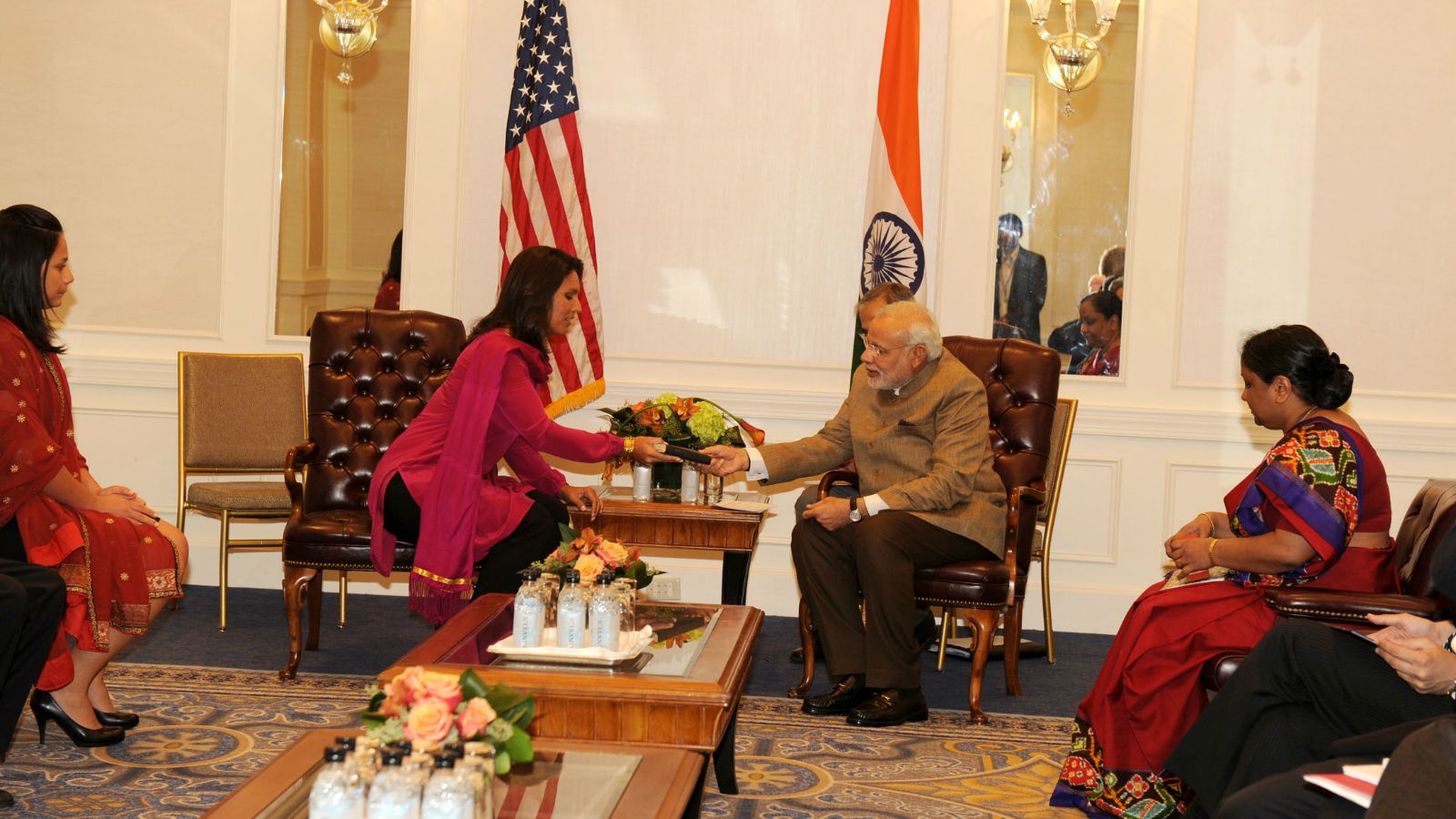
    In September 2014, the new Indian prime minister made it a point to meet Gabbard following his historic post-election speech at New York’s Madison Square Garden. And the congresswoman gave Modi a gift—a copy of the Bhagwad Gita that she swore by when elected to office—and assured him of her support for a Modi pet project of declaring an International Yoga day.

    “We had a wide-ranging discussion on several issues our countries have in common, including how America and India can work together to help combat the global threat posed by Islamic extremism,” Gabbard said after the meeting.

    For all that and more, Gabbard was treated as royalty on her visit to India last year. As she hobnobbed with the Indian prime minister and foreign minister among others, The Telegraph, a Kolkata-based newspaper, called her “the Sangh’s mascot” in the US. The Sangh, a moniker for the Rashtriya Swayamsevak Sangh (RSS), is a right-wing hindutva organisation and the ideological guardian of the BJP party that rules India now.

    With Modi set to stay in power until 2019, and Sanders doing better than expected in the Democratic primaries (or at least was up until March 1, when Democratic frontrunner Hillary Clinton handily won key states like Texas and Virginia in the “Super Tuesday” state contests), it can’t hurt the BJP and India to have a friend like Gabbard in the US.

    On March 2, Gabbard answered questions from Quartz via email about her support of Modi, her approach to Hinduism, and the connection she draws between Islam and terrorism. The transcript below has been condensed and lightly edited:

    Quartz: Could you tell us about your reasons for supporting the BJP and Narendra Modi, and why you referred to him being denied a visa as a “great blunder”?

    Tulsi Gabbard: There are many different areas and sectors where the United States and India’s growing friendship can cover mutually beneficial ground such as defense, renewable energy, bilateral trade, and global environmental concerns such as climate change. Modi impressed me as a person who cares deeply about these issues and as a leader whose example and dedication to the people he serves should be an inspiration to elected officials everywhere.

    It is very important that the US and India have a strong relationship of mutual respect. The denial of a visa to prime minister Modi could have undermined that relationship had he used it as an excuse to reject having a strong bilateral relationships with America. This would have been bad for both of our countries. For many reasons—not the least of which is the war against terrorists—the relationship between India and America is very important.

    QZ: You took on the US president for his reluctance to name ISIS as an Islamic extremist group. Do you still stand by this criticism?

    TG: In order to defeat the terrorists who have declared war on the United States and the rest of the world, we need to understand their ideology. In other words, the war can’t be won just militarily. We must defeat them in the ideological war, not just on the battlefield. In order to defeat their ideology, we need to recognize what their ideology is.

    The ideology of these terrorists is “Islamism.” It is a radical political ideology of violent jihad aimed at bringing about an establishment of a totalitarian society governed by a particular interpretation of Islam as state law. Referring to terrorists as “Islamist extremists” is simply an accurate way to identify ISIS and other Islamist extremist organizations whose ideology is rooted in one form of Islamism or another.

    The majority of Muslims are practicing the spiritual path of Islam within their own lives in a pluralistic, peaceful way. So by calling organizations like ISIS Islamic or Islamist extremists [emphasis hers], we are making a distinction between the vast majority of Muslims who are not extremists and a handful of those who are.

    QZ: How much of that sentiment is influenced by your experience serving in the military in the Middle East, versus your interest in Hindu/Muslim conflicts in India?

    TG: My experience serving in the Middle East has shaped many of my views. This has nothing to do with any “Hindus/Muslim” conflict in India or anywhere else. It comes from the understanding that in order to defeat the terrorists who have declared war on the United States and the rest of the world, we need to understand their ideology.

    My two deployments in the Middle East reinforced the fundamental military wisdom that you can’t defeat an enemy if you don’t understand him. We cannot win this war if we do not understand our enemy’s goals, [or the] ideology that inspires them and fuels their recruitment propaganda. And the first step to understanding an enemy is correctly identifying him in a way that makes clear his ideology.

    QZ: You referred to the suffering of Hindu minorities across the world, in a speech you gave during a fundraiser attended by some of the top leaders of the BJP. Do you think that in India there exists a similar situation?

    TG: Throughout the world, Hindus are victims of discrimination. Recently, a Hindu priest in Bangladesh was brutally hacked to death by ISIS terrorists and two others were injured trying to help him. Unfortunately, even in the United States, as well as different pockets of India, such discrimination exists.

    While there is no doubt there is some discrimination directed toward different “religious minorities” in India, throughout India you will find Muslims, Christians, and people of all kinds of religions free to practice their faith. However, you will not find this degree of tolerance or openness in countries like Pakistan, Saudi Arabia, Iran, or other Muslim countries. In fact, if you are not a member of the government-approved religion in those countries, it is government policy that you will be punished and discriminated against. To my knowledge, this does not exist in India. However, if India were to enact government policies that punish their citizens simply for being of a “minority religion,” I would condemn that action.

    The essence of the Hinduism that I practice is karma yoga and bhakti yoga, which means to love God and all [emphasis hers] of His children, regardless of their race, religion, etc., and to use my life working for the well-being of everyone.

    QZ: A report in The Telegraph, an Indian newspaper, referred to you as the mascot for the right-wing RSS in India. How do you respond to that? Do you think that is true and would you like to be associated with the RSS?

    TG: Both in India and here in the US, I have held meetings with members of both the BJP and the Congress Party. As a member of the US Congress, my interest is in helping produce a closer relationship between the United States and India, not just between the United States and one political party of India.

    I have no affiliation with the RSS. Sometimes people on both sides, for their own purposes, try to say I somehow favor, or am part, of the BJP or take photos of me at Indian events and circulate them for their own promotional reasons. But the fact is, I’m not partial to BJP, the Congress Party, or any other particular political party in India.

    QZ: Some media reports suggest that you seem to be supporting the Indian diaspora, mostly because they are huge contributors to your campaign, especially with your Hindu identity. How do you respond?

    TG: Through my election to Congress and my swearing in on Bhagavad-gita, those in the national media, my colleagues in Congress, and regular Americans across the country have all been very respectful, and even proud of America’s diversity. I assume the reason Hindus all across the country have been so supportive of me, is because when they see me, they see the potential for themselves and their sons and daughters.

    There are many Hindus in America who feel they need to convert to Christianity or take “Christian” names if they or their children are to succeed in this country. I have found that simply being the first Hindu elected in Congress has been liberating to so many because it shows that every American, regardless of their background, race, or religion, has the opportunity serve our community in any capacity he or she may choose.

  • Rahul vs Modi: Who has won the battle of speeches?

    Rahul vs Modi: Who has won the battle of speeches?

    In the last two days, the rivalry between Narendra Modi and Rahul Gandhi has become more intense and exciting. In Rahul Gandhi’s speech on Thursday, March 3, which received widespread praise, the leader used satire and sarcasm to punch holes in the prime minister’s image and performance.

    Congress vice-president Rahul Gandhi spared no attempt to attack Prime Minister Narendra Modi and his Cabinet for their high-handedness in office and the saffronisation of education. The Gandhi scion rained barbs on Modi sarkar’s policies, calling the black money scheme ‘fair and lovely yojana’ and the ambitious Make In India project no more than a “babbar sher”.

    Modi let ego get in the way of a debate with Rahul Gandhi, PM in him must advise the politician in him not to take everything to heart.

    Prime Minister Narendra Modi began his reply to the Vote of Thanks to the President by invoking the words of Rajiv Gandhi to hand out a sermon to the Congress party now led by Sonia & Rahul.

    Modi sought to portray the present Congress leadership as violating the spirit and advice of its own political ancestry.

    The point Modi was trying to make was simple: Nehru, Indira Gandhi and Rajiv talked about the necessity of maintaining parliamentary decorum but their words were being ignored by the present leadership and that they were not being truthful to their inheritance.

    These are the points PM Modi made:

    On Parliament Disruption – MPs have expressed their views in House. We should take advice from seniors in the House. The House is a forum where views are expressed, where questions are raised at the government, where the government has to defend itself. Nobody is spared but if the sanctity of the institution is kept intact, then we can express our opinions more effectively. Parliament is a forum for debates. PM cited Rajiv Gandhi on decorum and said we must maintain decorum in parliament. When the House is stalled, the country suffers. Need to find solutions to issues in House.

    On Passage of Bills – PM lists bills stalled after ruckus in parliament, says inferiority complex of some MPs stalling House. Request MPs across parties to help pass bills.

    On Congress – Tackling problems left by earlier government, can’t ignore 60 years of mis-governance. After so many years of independence, 18000 villages are still in the dark. You have sown the seeds of poverty. The 2012 CAG report explains everything in detail how money was looted and it has made some startling revelations. CAG report says in states where poor are less, MNREGA is more effective whereas in states where poor are more, MNREGA hasn’t been that effective. In contrast, PMGSY has benefited those states the most which are below the poverty line.

    On Rahul Gandhi – There are some people who do not become wise with age.

    On Opposition – Opposition is concerned how the govt is doing better than it, says Modi as he cites comparison in some sectors like Railways and MNREGA. I appeal to entire opposition in passage of important bills in both Houses of Parliament, says PM, quoting Rajiv Gandhi. There is need for improvement in this government too, for that I need your help too, let us work together.

  • Modi ji, talk about Hitler and Mussolini also: Kanhaiya Kumar in speech at JNU

    Modi ji, talk about Hitler and Mussolini also: Kanhaiya Kumar in speech at JNU

    Over 2,500 students and teachers gathered at the admin block of Jawaharlal Nehru University on Thursday to welcome JNU students’ union president Kanhaiya Kumar.

    Kanhaiya, who has been accused of sedition, was granted a six-month interim bail by the Delhi High Court on Wednesday.

    While addressing the gathering, Kanhaiya demanded that HRD minister Smriti Irani should grant their fellowships and make honest efforts to apprehend those who are responsible for 26-year-old Rohith Vemula’s death.

    A Dalit research scholar at University of Hyderabad Rohith Vemula committed suicide on January 19.

    “Smriti Irani ji, we are not your children, we are JNUites. Please stop these sedition charges, gives us our fellowships and take moral responsibility for Rohith’s death and apprehend those who are responsible for his demise,” Kanhaiya said while addressing the mass gathering.

    Taking a dig at Prime Minister Narendra Modi, Kanhaiya said ,”Modi ji, when you talk about Stalin and Khruschuv, please talk about Hitler and Mussolini also.”

    Showing mass solidarity, students erupted on joy with constant whistling, cheering and clapping.

    “Modi tweeted and said Satyamev Jayate. I want to convey this to him that I also say the same thing,” Kanhaiya said.

    On the controversy of sloganeering, Kanhaiya said, “We are not asking for freedom from India but freedom in India.”