Tag: Indian Politics

  POLITICS & POLICY  

  • Modi, Sharif to meet on margins of US nuclear summit?

    Modi, Sharif to meet on margins of US nuclear summit?

    NEW DELHI (TIP): The US, India and Pakistan are “quietly exploring” the possibility of a meeting between Prime Ministers Narendra Modi and Nawaz Sharif on the margins of a nuclear security summit in Washington next month, according to a Pakistani media report on Friday.

    Modi and Sharif have accepted US President Barack Obama’s invitation to attend the summit he is hosting on March 31 and April 1.

    “The chances are strong, very strong,” an unnamed senior official was quoted as saying by the influential Dawn newspaper. “But you know the history of India-Pakistan talks, you cannot be certain about an event until it has happened.”

    This will be the first time Modi and Sharif will be attending the nuclear security summit that Obama initiated in 2010. The summit is aimed at preventing terrorists from acquiring nuclear weapons.

    The first summit was held in Washington in April 2010. The second summit was organised in South Korea in 2012 and the third in The Hague in 2014.

    Since this is Obama’s final year in office, the US administration is pushing hard for concrete results during the fourth summit. US officials have recently expressed concern at the proliferation of small nuclear weapons in South Asia.

    “We’re concerned both about the security of those nuclear weapons, and that’s been a common refrain in our discussions with Pakistan,” State Department spokesman Mark Toner said while responding to a question about the increase in Pakistan’s tactical nuclear weapons.

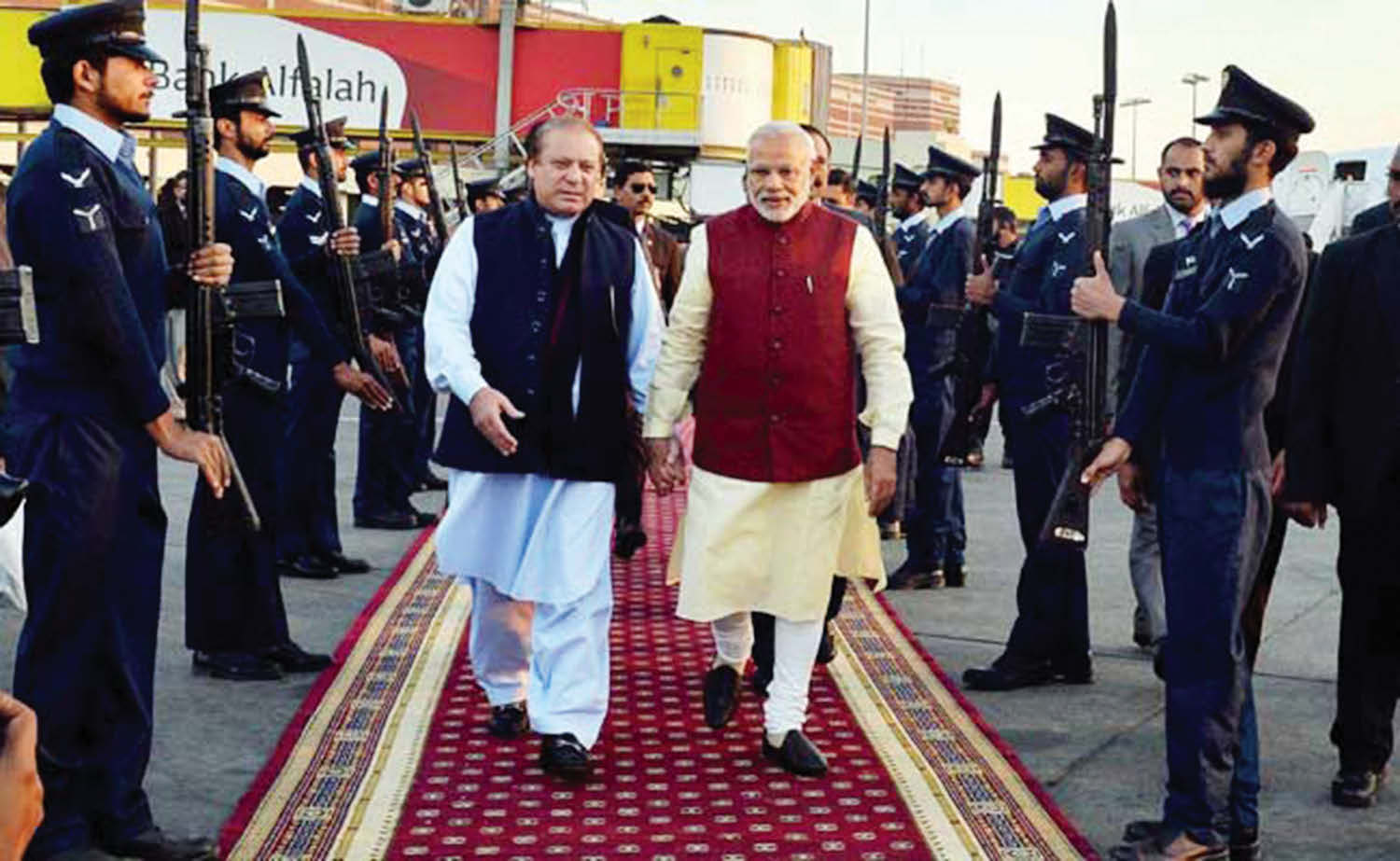
    Sharif and Modi last met in December, when the Indian leader made a surprise visit to Lahore to wish his Pakistani counterpart on his birthday while flying from Kabul to New Delhi.

    However, ties went into a tailspin when members of the Pakistan-based Jaish-e-Mohammed attacked the Pathankot airbase days later, killing seven security personnel.

  • Modi government is “Banking the unbanked; Funding the unfunded; Securing the unsecured”: Ravi Shankar Prasad

    Modi government is “Banking the unbanked; Funding the unfunded; Securing the unsecured”: Ravi Shankar Prasad

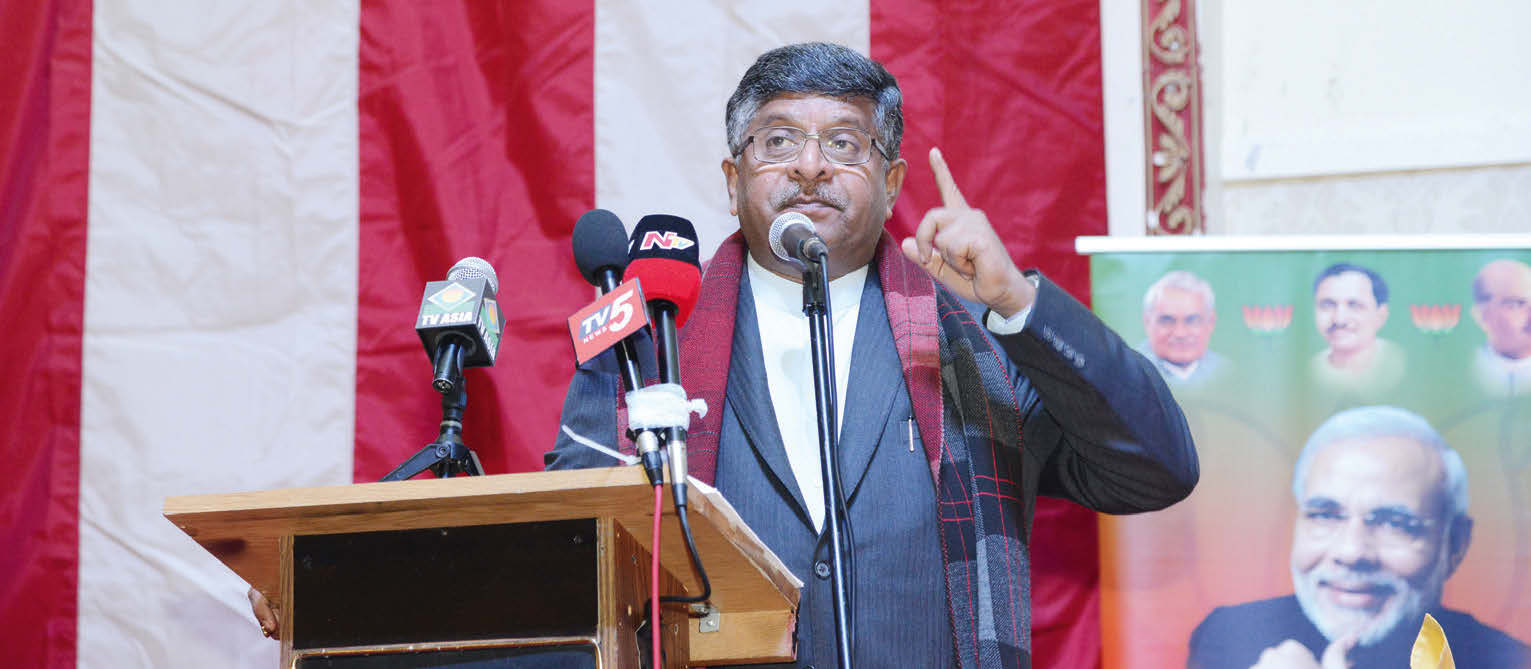
    EDISON, NJ (TIP): “We are changing the nation’s face. Our aim is to make India a formidable power in the world. We work honestly to make India a strong, resilient and great nation in the world”, said India’s Minister for Communications and Information Technology Mr. Ravi Shankar Prasad. He was speaking at a meet and greet program organized by Overseas Friends of Bharatiya Janata Party (OFBJP) in his honor at Royal Albert’s Palace in Edison, New Jersey on February 7.

    Mr. Jayesh Patel (former President, OFBJP) welcomed the gathering. After the traditional lighting of the lamp and rendition of United States and Indian National anthems, Mr. Krishna Reddy (Treasurer, OFBJP) introduced the honorable minister as a visionary, thinker, writer and an eminent lawyer whose fight against corruption and issues have brought him laurels. He said Mr. Prasad has scaled great heights and is currently managing an important portfolio in PM Narendra Modi’s cabinet.

    Mr. Ravi Shankar Prasad, India's Minister for Communications and Information Technology speaking at the meet and greet organized by OFBJP in Edison, NJ on February 7
    Mr. Ravi Shankar Prasad, India’s Minister for Communications and Information Technology speaking at the meet and greet organized by OFBJP in Edison, NJ on February 7
    Photos/ JugeshSoni- 732.910.9343

    Addressing a gathering of about 200 that had assembled there Mr. Ravi Shankar Prasad said he was happy to be amongst them. He said that he had originally come to participate in the India Day being celebrated at Harvard University where he was the keynote speaker talking on India in Transition, Challenges and Opportunities. Stating that India Day is being celebrated across several universities in US shows the power of India and Indians here.

    Characterizing the elevation of Narendra Modi as a defining moment in the history of India, he said that Modi had become the symbol of aspirations and hope of the entire country. Coming from a very poor family background with his father selling tea and mother doing chores in houses to run the family shows us the odds that were stacked against him but he went on to make these obstacles as stepping stones to rise to great heights and become one of the tallest leaders of the world

    Mr. Prasad went on to count the achievements of the BJP governments under Mr. Vajpayee and under Mr. Modi.

    Minister Ravi Shankar Prasad (fourth from left) is seen with organizers and (to his left) the Consul General of India in New York Ambassador Dnyaneshwar M Mulay  Photos/ JugeshSoni- 732.910.9343
    Minister Ravi Shankar Prasad (fourth from left) is seen with organizers and (to his left) the Consul General of India in New York Ambassador Dnyaneshwar M Mulay
    Photos/ JugeshSoni- 732.910.9343

    “We all know that the NDA1 government under Atal Bihari Vajpayee had connected the four corners of India from Kashmir to Kanyakumari, Silchar to Surat. This NDA2 under Modi will be known for Information Highway as the government has taken up the task to connect all the villages in India with its Digital India project.

    “In just one and a half years this government, had taken India to great heights in every walk of life. The IMF has predicted that India is bound to grow at 7% plus this year when economies across the world are on a shaky ground. It is the 7th most sought after brand in the world, had moved over 15 places on the corruption index during the period of last one year shows us how well this government is working to meet the aspirations of Indians who had put their confidence on Modi. There is zero corruption in the government now unlike the scams that happened during UPA where the resources of our country were looted by the people in power and then supported with a shameless theory of zero loss. The spectrum auction, coal block auctions that generated huge revenue are an example of that.

    “Narendra Modi with his foreign visits had not only generated energy among the NRI’s across the world but had also carved a niche for him among the world’s tallest leaders. During the recent Paris conference, the top leaders of the summit have taken Modi’s input before coming up with a draft resolution on terrorism. This is in stark contrast to the previous governments were no one knew who our PM was. Again, this turnaround happened in just 18 months of time which is mind boggling.

    “In just this short span of time this government has touched the lives of the poorest which the governments during the past 60 plus years have failed to do. With its Jan Dhan Yojana, it had opened 20 crore bank accounts for the poor who were kept away from this, Rs. 12 for 2 lakh insurance for accidental death, Crop insurance scheme that would safeguard the interests of farmers by covering 90% of his losses., Mudra bank to fund the entrepreneurs. This government had already completed its poll promise of Banking the Unbanked, Funding the Unfunded and Securing the Unsecured.

    “Digital India campaign has increased the connectivity across the entire nation. We have over 40crore Internet connections, 100 crore Mobile Phones and equal number of land lines. 970 million people have Aadhar cards and their bio-metric information is already available. We have become the second highest user base for Facebook, Google and other social media tools. The previous UPA had just laid 358 km of optic fiber but this government had already completed laying 86K km of optical fiber. Energy production is the highest and power cuts are a thing of the past.

    “The prime minister” s reference of Imran Khan of Alwar, Rajasthan in his speech in UK for the mobile apps he had developed for the students goes on to speak volumes of how much the PM cares about his country and its people. Digital India, Make in India, Skill India, Startup India, Stand-up India, Sukanya Samruddhi Yojana, Beti Bachao Yojana, Smart cities and many more schemes have Shaken up India like never before and the country is developing at a pace that has never been witnessed earlier. This government is working hard to meet the aspirations of everyone especially Dalits, Tribals, Women, Youth in particular.

    “The government under Narendra Modi is working hard not only for the people of India but also for the NRI’s who have left India and settled elsewhere. Our consulates are making sure the NRI’s are supported well and we request NRI’s to actively get involved in national building by interacting with government and by sending their feedback”.

    Later Mr. Ravi Shankar Prasad answered several questions related to India as part of a Q&A session that was moderated by Mr. Arvind Modini (Co-Convener, OFBJP NJ). Mrs. Jayshree Nair (Volunteer, OFBJP NY) presented the vote of thanks to the sponsors whichincluded Mr. Albert Jasani, of Royal Albert’s Palace, Dr. Naveen Mehta and Atma Singh. Also thanked were, Kaushal Thakkar who provided sound and media. Volunteers who had worked hard to make the program a big success received special mention

    TAILPIECE Minister Ravi Shankar Prasad did not sing the Indian National Anthem. There was no movement of his lips. Hope, the minister has not forgotten the national anthem.

    Time for the national anthem
    Time for the national anthem
    Photos/ JugeshSoni- 732.910.9343
    • Mr. Jayesh Patel spoke in English. So did Mr. R.P. Singh. This from a party which does not tire of reminding Indians abroad that they must love Hindi which is the national language of India and mother tongue of the majority of Indians.
    • Incidentally, the gathering consisted of Indians only. There was nobody from mainstream for whose benefit English needed to be spoken.
    • The Minister addressed in a mix of Hindi and English
    • There were some tense moments when the Minister, after giving an interview to TV Asia, decided not to speak with the print media waiting to interview him. Prof. Indrajit S Saluja, Chief Editor of The Indian Panorama resented at being “insulted” and said media would not take the insult from the Minister. He told Mr. Prasad that media only carried the message of the government to the public and if the minister thought he had no message to give he was welcome not to speak. But, Prof. Saluja added that it was unfair on the part of the Minister to have kept mediaperons waiting only to tell them that he did not want to speak. However, the Minister was apologetic and spoke with the media. Those who spoke with him included Prof. Indrajit S Saluja, Chief Editor of The Indian Panorama, Mr. Ilayas Qureshi, COO of News India Group, and Ashok Ojha, Reporter for The South Asian Times.
    • Of the sponsors listed in the bill only Atma Singh was present. Dr. Navin Mehta was conspicuous by his absence. The FIA was listed as a sponsor. There was no representative of FIA.
    • It was a small gathering of fewer than 200 persons, most of whom were seniors. There were hardly a few young persons
    • Some young volunteers complained of being ignored in the organization.
  • Sack erring govt officials: PM Modi’s stern message to secretaries | Modi pulls up the govt

    Sack erring govt officials: PM Modi’s stern message to secretaries | Modi pulls up the govt

    NEW DELHI (TIP): Going tough on non-performers, Prime Minister Narendra Modi has sent out a stern message to government officials who have not corrected their professional conduct despite repeated warnings.

    During his monthly interaction with central government secretaries and chief secretaries of states through Pro-Active Governance and Timely Implementation (PRAGATI), PM Modi directed secretaries to identify and asses such employees and recommend disciplinary action, that include dismissal from service and withholding of pension.

    The Prime Minister urged all secretaries whose departments have extensive public dealing, to set up a system for top-level monitoring of grievances immediately.

    Reviewing the complaints and grievances from people related to the customs and excise sector, Modi asked for strict action against concerned officials.

    Modi also held a meeting of his council of ministers to review progress on schemes related to some ministries and laid thrust on faster delivery of government initiatives.

    According to the sources, the meeting reviewed schemes and government initiatives related to ministries such as agriculture, chemical and fertilizer and water resources.

    The Modi government completed 20 months in office on Tuesday.

    Calls for strict action on grievances related to customs, excise

    Modi took strong exception at complaints and grievances from people related to the customs and excise sector and asked for strict action against concerned officials.

    Modi, who chaired his ninth interaction through PRAGATI – Pro-Active Governance And Timely Implementation – urged all secretaries whose departments have extensive public dealing, to set up a system for top-level monitoring of grievances immediately.Later in the day, Modi held a meeting of his council of ministers to review progress on schemes related to some ministries and laid thrust on faster delivery of government initiatives.

    According to the sources, the meeting reviewed schemes and government initiatives related to ministries such as agriculture, chemical and fertilizer and water resources.

  • Muftis vacate CM’s official residence, spark speculation

    Muftis vacate CM’s official residence, spark speculation

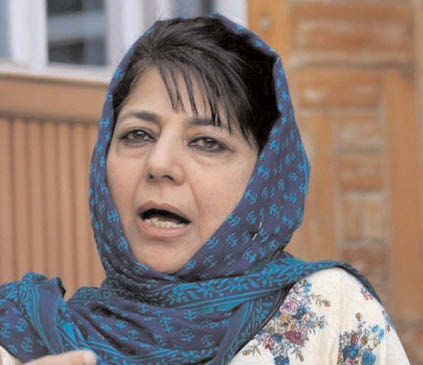
    SRINAGAR (TIP): Quietly and without fuss, PDP president Mehbooba Mufti and her mother Gulshah Mufti, widow of Mufti Mohammed Sayeed, vacated the Jammu & Kashmir CM’s official residence last week, a senior government official said.

    Deputy director, estates, Satish Kumar, said the watchman at the bungalow reported the Mufti family landed at the Wazarat Road house last week and emptied it, which amounts to vacating the official CM house in the winter capital. PDP later issued a statement that the Mufti family’s belongings were taken out to maintain the highest standards of dignified political conduct practised by late Sayeed.

    “There’s no politics involved,” senior PDP official Naeem Akhtar said.

    But, exiting the official house, coupled with Mehbooba’s lengthening silence over government formation, has made many observers contend that this could be yet another way of telling BJP about her unhappiness over their differences. Among several points of departure between PDP and BJP, Mehbooba is particularly miffed with the Centre’s rejection of the transfer of two power projects, Dulhasti at Kishtwar and Uri in Baramulla.

  • Hema Malini given 2,000 square metre plot for just Rs 70,000

    Hema Malini given 2,000 square metre plot for just Rs 70,000

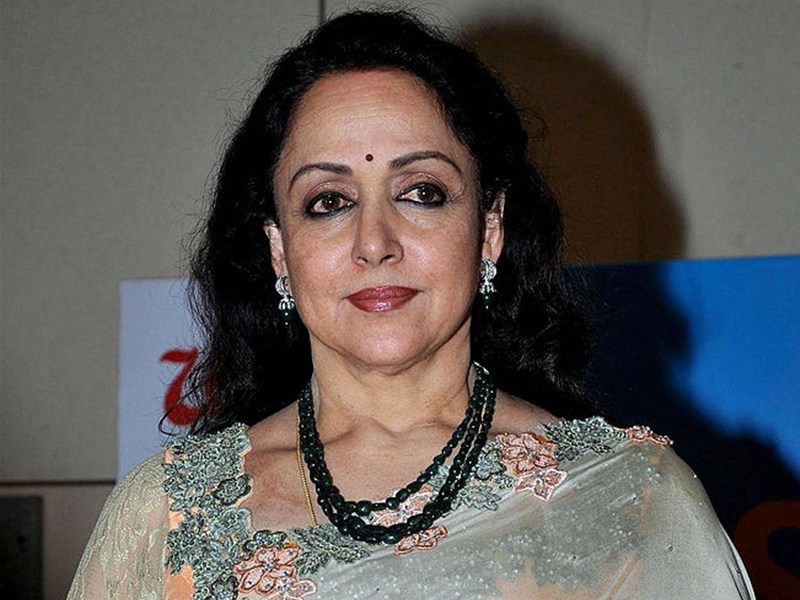
    MUMBAI (TIP): Eyebrows were raised when actress and BJP MP Hema Malini was alloted land in Andheri for setting up a dance academy. Now in what could add fuel to the fire it transpires that the 2,000 square metre plot in Oshiwara in Andheri was given to her for a pittance, just Rs 70,000. The value of the plot is at least around Rs 40 crores.

    It has come to light that the actress was alloted another plot of land in 1997 which she could not develop because it came under CRZ, however she did not hand over the plot back to the state government.

    The details were revealed in reply to a query by RTI activist Anil Galgali who filed a query before the Mumbai suburban collector seeking details of the land being handed over to the actress and the correspondence with her in that regard.

    “First of all the government hands over a prime plot at dirt cheap rates to an organization run by a party MP, which it self is questionable. Secondly the earlier plot of land given to Hema should have been taken back before handing over this plot of land. Maharashtra is not a cash rich state, we have farmers committing suicides and have a debt burden of Rs 3, lakh crore. How is it public interest giving land to her at such rates.” questioned Galgali.

    RTI documents show that the Mumbai Suburban collector has now written to Hema to hand over the old plot of land and has imposed a few conditions before she could be handed the new plot.

  • TO APPEASE CRITICS, MODI LIKELY TO REJIG CABINET WITH NEW TALENT

    TO APPEASE CRITICS, MODI LIKELY TO REJIG CABINET WITH NEW TALENT

    NEW DELHI (TIP): Prime Minister Narendra Modi may look to press the reset button on his leadership this spring to reinvigorate stalled economic reforms and appease critics, eyeing a mix of tried and tested allies and fresh blood, senior government sources said.

    The government has overseen rapid economic growth but failed on tax and land reforms, and the euphoria that met Modi’s 2014 election triumph has given way to investor disillusionment; stocks have erased all of their gains since he won power.

    The ruling Bharatiya Janata Party (BJP) faces a crucial election test in the most populous state of Uttar Pradesh in 2017 that it probably needs to win if it wants to hold on to power nationally in 2019.

    “Modi needs to identify new talent and bring changes in his government. It will be too late if he fails to do it now,” said veteran newspaper editor and commentator Shekhar Gupta.

    With an eye on Uttar Pradesh, Modi looks set to keep Amit Shah on as BJP president, the sources said, extending his closest aide and election campaign manager’s tenure by three years when it expires at the weekend.

    But finance minister Arun Jaitley, responsible for delivering the Modi message to international investors, may move to defence after he delivers his annual budget in late February, sources said.

    Jaitley, 63, has failed to push through a major tax reform and critics have faulted his stewardship over India’s $2 trillion economy, which is growing fast but not creating enough jobs to employ an expanding workforce.

    A spokesman for Modi declined to comment on the move and an official in Jaitley’s office said he had no knowledge of a possible reshuffle.

    Moving Jaitley to defence, a post he also held in the early months of the Modi government, could better suit the veteran corporate lawyer and keep the strategically important portfolio in trusted hands.

    It would also open the way for power and coal minister Piyush Goyal to take the finance portfolio, while underperformers in other minor posts may be weeded out.

    A central minister and two BJP officials said Goyal, 51, was being groomed for his next big role, and a white paper on banking was recently shared with him to seek his inputs. A Goyal aide denied all knowledge of an impending promotion.

    Goyal is a good communicator and has often travelled abroad with Modi, but lacks political and electoral experience.

    The ex-investment banker has turned around state-run Coal India, tackled chronic power shortages and backed renewable sources of energy.

    Those are key wins for Modi, whose provision of 24/7 electricity as chief minister of Gujarat state helped him become prime minister.

    “Goyal is doing a fine job – he has brought a lot of energy to the coal and power sector,” said Rajiv Kumar, senior fellow at the Centre for Policy Research in New Delhi.

    “But I’m not sure he can do justice to the complex finance portfolio,” he said. “Goyal, with his micro orientation, might struggle to get to grips with multi-dimensional and serious macroeconomic issues facing the country.”

  • PRIME MINISTER MODI’S VISITS ABROAD

    PRIME MINISTER MODI’S VISITS ABROAD

    One of the most  talked about subjects in India has been the foreign visits of India’s Prime Minister Narendra Modi  who  visited  35 odd countries in  about two years. Not that other Prime Ministers  did not go on foreign tours. What  was remarkable in the case of Modi has been the quick succession in which he went abroad, as if at the drop of the hat.  Also,  public reception to him by the Indian community abroad  was a distinguishing feature of his visits abroad.

    Russia – December

    Prime Minister Narendra Modi was on a two-day visit to Russia on Dec 23 for annual summit talks with President Vladimir Putin. India was looking at deeper engagement in Russia’s oil and coal sector besides stepping up cooperation in some other areas like diamond trade and agro-business. India is also likely to push for a Free Trade Agreement with the Eurasian Economic Zone and is sharing details of a study it conducted in this regard.

    Singapore – November

    PM Modi addressed the Indian diaspora there on a two-day visit to Singapore. He said the government is laying thrust in generating power from clean and renewable sources like solar, nuclear, wind and biomass with the target of 175 gigawatts, and in turn, reduce dependence on coal.

    Malaysia – November

    PM Modi visited Malaysia on a two-day visit and discussed with his counterpart Nazib Razak on ways to ramp up bilateral cooperation in a range of areas including defence and security and take the strategic ties to a new level. Combating terrorism was also one of the key issues. Modi also visited Ramakrishna mission and also inaugurated a statue of Swami Vivekananda.

    United Kingdom – November

    PM Modi struck 27 deals in 3 days during his UK visit. From technology transfer in defence to going after the Lashkar-e-Toiba, from cyber security to tackling online child pornography – a new joint statement on defence and security has emerged as a major takeaway from the meetings between Prime Minister Narendra Modi and his British counterpart David Cameron.

    United States – September

    PM addressed a summit on the agenda of Sustainable Developmental Goals at UN. He also attended a summit on peacekeeping forces hosted by Barack Obama. In San Jose, Modi attended a digital dinner with who’s who of the tech world. he also joined in for a Townhall Q&A hosted by Facebook CEO Mark Zuckerberg.

    PM Modi at Facebook Headquarters with its CEO Mark Zuckerberg.
    PM Modi at Facebook Headquarters with its CEO Mark Zuckerberg.

    UAE – August

    Prime Minister Narendra Modi’s visit to the United Arab Emirates has scored big on three fronts – terror, trade and outreach to the blue-collared Indian expatriate community. While substance was evident in these three counts, his symbolic outreach to Muslims – in his maiden visit to an Islamic country – by visiting the Sheikh Zayed mosque and praising the inherent tenets of Islam was music to many.

    Central Asia – July

    Modi was the first Indian PM to visit the five Central Asian nations in one trip. The focus during the trip will be on enhancing trade, cooperation in energy and security. PM visited Uzbekistan, Kazakhstan, Tajikistan, Russia and Turkmenistan.

    Russia – July

    Prime Minister Narendra Modi travelled to Russia to participate in the 7th BRICS summit and SCO summit in Ufa in a bid to give an impetus to strategic, economic and energy ties.

    Prime Minister Narendra Modi with Russian President Vladimir Putin
    Prime Minister Narendra Modi with Russian President Vladimir Putin.

    Bangladesh – June

    As India extended a $2 billion Line of Credit (LoC) to Bangladesh to develop its infrastructure and signed 22 agreements, Prime Minister Narendra Modi almost took a leaf out of former PM Manmohan Singh’s book to address Dhaka’s concerns on Teesta and trade imbalance. On the issue of trade imbalance, Modi said he was “conscious” of the huge trade imbalance and will do everything India can to bridge the deficit.

    China – May

    Prime Minister Narendra Modi asked China to take advantage of the “winds of change” in India with a much more transparent, responsive and stable regulatory regime even as leading firms from the two sides signed deals worth USD 22 billion.

    Modi at TerracottaWarriorsMuseum in Xi’an, the hometown of Chinese President Xi Jinping.
    Modi at TerracottaWarriorsMuseum in Xi’an, the hometown of Chinese President Xi Jinping.

    Mongolia – May

    India announced a credit line of USD 1 billion to Mongolia to expand its economic capacity and infrastructure, as they decided to upgrade their relationship from Comprehensive to “Strategic Partnership”. Narendra Modi, the first Indian Prime Minister to visit Mongolia, held wide-ranging talks with his counterpart Chimed Saikhanbileg here following which the two sides inked 14 agreements covering defence, cyber security, agriculture, renewable energy and health sector.

    South Korea – May

    India and South Korea seven agreements, including on avoidance of double taxation and formalising consultations between National Security Councils of the two nations, to boost bilateral ties.

    France – April

    India asked France to supply 36 Rafale fighter jets in “fly-away” condition “as quickly as possible”. This is under a government-to-government deal, unlike the tender currently being negotiated by the Ministry of Defence with Dassault, Rafale’s manufacturer.

    Germany – April

    PM Modi and Angela Merkel spoke in favour of a free trade agreement between the European Union and India. PM Modi said that this was important for the expansion of India as a manufacturing hub. The joint statement by both countries recognized the establishment of a working group on urban development. The two countries said stronger educational exchanges will be encouraged along with collaborations between universities.

    Canada – April

    Modi became the first PM to arrive in Canada in a stand-alone bilateral visit in 42 years.

    Both countries signed an agreement for long-term supply of Uranium to India. Harper and Modi agreed to increase collaboration in the fields of energy efficiency, oil and gas development and renewable energy.

    Seychelles, Mauritius, Sri Lanka – March

    PM Modi’s visit to the three island countries was against the backdrop of China’s increasing focus on the Indian Ocean region. Modi renewed India’s commitment to the ocean economies where India envisages its role as a net security provider. Modi’s visit to Sri Lanka was the first standalone Prime Ministerial visit to the island nation since 1987.

  • Modi Declines Singapore Offer to Name Orchid variety After Him

    Modi Declines Singapore Offer to Name Orchid variety After Him

    The Singapore government wanted to name a variety of orchid, the island city-state’s national flower, after Prime Minister Narendra Modi, during his November visit but the Indian leader declined.

    In the past, Singapore has accorded this honor to the duke and duchess of Cambridge, Britain’s Prince William and his wife Kate, the king and queen of Belgium, Phillipe and Mathilde, former U.S. first lady Laura Bush, former South African president Nelson Mandela, former British prime minister Margaret Thatcher and most recently, Chinese President Xi Jinping. Modi did, however, launch a commemorative Singapore-India stamp set comprising two stamps that depict the presidential residences of both countries.

    Singapore is one of the few countries Modi visited as Gujarat chief minister between 2002 and 2014, when he was shunned by the West for allegedly turning a blind eye to the 2002 Gujarat riots.

    Modi’s predecessor Manmohan Singh declined the honour during a visit to Singapore in July 2011, according to an Indian official, who recalled that former prime minister Indira Gandhi had an orchid named after her. India’s former first lady Usha Narayanan who visited Singapore along with her husband, then president K.R. Narayanan, in the year 2000 also has an orchid in her name, according to the Singapore Botanical Garden website.

    Naming an orchid after a country’s leader is aimed at promoting goodwill and fostering closer ties between nations, according to the website.

    A separate section of the Singapore Botanical Garden is devoted to honouring artistes and celebrities. As the name goes, the garden acknowledges celebrities who have “contributed significantly to the society”.

    Bollywood stars Shah Rukh Khan and Amitabh Bachchan are among the many celebrities honoured by Singapore.


  • Obama invites Modi, Sharif to Washington

    Obama invites Modi, Sharif to Washington

    WASHINGTON (TIP): US President Barack Obama has invited Prime Minister Narendra Modi and his Pakistani counterpart Nawaz Sharif to attend the Nuclear Security Summit from March 31 to April 1 next year in Washington.

    According to The Express Tribune, there has been no official announcement regarding the invitation as yet.

    The conference would offer the first planned opportunity of 2016 to carry forward bilateral ties between India and Pakistan which have seen some icy lows and relative heights this year.

    The fourth Nuclear Security Summit had been announced by Obama during the previous edition in 2014.

  • PM Narendra Modi Surprises All: Makes Pit Stop at Lahore

    PM Narendra Modi Surprises All: Makes Pit Stop at Lahore

    NEW DELHI (TIP): The news of Indian Prime Minister Narendra Modi’s surprise stopover in Pakistan on Friday, December 25, took everyone by surprise. A move that is seen to have reset the relationship between the two nuclear-armed neighbors, paving the way for official dialogue to resume next month.

    In a tweet that instantly sparked frenzy, Modi announced he will “drop by” in Lahore on his way back to New Delhi from Afghanistan making him the first Indian Prime Minister to set foot in Pakistan in 11 years. The last time an Indian prime minister had visited Pakistan was in 2004. Sharif, however, came to India last year to attend Modi’s swearing-in ceremony.)

    “Looking forward to meeting PM Nawaz Sharif in Lahore today afternoon, where I will drop by on my way back to Delhi,” the Indian premier said on Twitter.

    Following this announcement, Indian Minister for External Affairs Sushma Swaraj appreciated the Indian premier’s decision to stop by in Pakistan on his way to India, saying
    “That’s like a statesman. These are the kind of relations we should have with our neighbors,” she tweeted.

    Narendra Modi chose  the birthday of Pakistan’s founder Mohammad Ali Jinnah to make his maiden visit to Pakistan -speaks of symbolism.

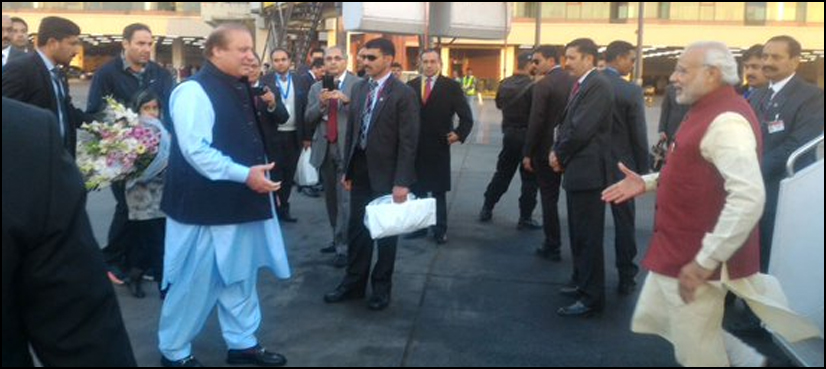
    He hugged PM Sharif as soon as he landed in Lahore.

    The two leaders met for a little less than two hours at Sharif’s festively lit ancestral home in Lahore, where they talked about improving ties.

    “Beyond the noise, a personal connect. The Prime Ministers discuss India Pakistan relations,” tweeted Vikas Swarup, a spokesman for India’s Ministry of External Affairs. He added that Modi met Sharif at his home as “a special gesture” and blessed the latter’s granddaughter ahead of her wedding.

    NDTV 24×7 news TV channel called it “Modi’s masterstroke.” In Pakistan, the phrase “birthday diplomacy” trended.

    A statement from Pakistan’s Ministry of Foreign Affairs said the leaders “expressed their desire to carry forward the dialogue process for the larger good of the people of the two countries.”

    Pakistani security analyst Rifaat Hussain said the symbolism of the visit is “huge.” He added that the meeting is likely to have been preceded by some “behind the door” preparation.

    Bharatiya Janata Party’s Nalin Kohli told media “It was a spontaneous but bold and innovative decision to visit Pakistan.”  “The India-Pakistan story has many difficult issues lingering for decades. It is not an easy path ahead. But the two leaders are trying to establish a personal equation that can add momentum to the structured process of official talks in the future,” he added.

    The two leaders last met during the climate change conference in Paris in November, chatting briefly.

    Analysts said the prospect of the December 25 meeting was probably kept hidden until the last minute to prevent the irrational expectations and acrimony that often accompany any such diplomatic move.

    (Also read Finding a Niche in the Emerging World Order by Sandhya Jain in Opinion)

  • ‘Start up India, stand up India’ mission launching in Jan 2015, PM Modi

    ‘Start up India, stand up India’ mission launching in Jan 2015, PM Modi

    New Delhi: Seeking to boost entrepreneurship at the grassroots level, the Action Plan of the ‘Start-up India, Stand-up India’ will be unveiled on January 16 said Prime Minister Narendra Modi through his last radio address for 2015. He urged the states to help spread this campaign across the country’s nook and corner.

    He also spoke about how the direct benefit transfer scheme is helping people.

    “On 15 August, in my speech I had announced the scheme of ‘start up India, stand up India’. The world doesn’t grow without innovation and opportunity for the youth. The government is going to launch the complete action plan and details on 16 January for the mission,” Modi said. As in all other editions of his Mann ki Baat programme, he spoke in Hindi. (Modi had made the announcement about the campaign in his last Independence Day address)

    “We have to make changes according to the need of the country. There is talent across the country but they need the opportunity. ‘Start up India stand up India’ should be spread across the country and I need the help of states for this,” he added.

    Institutions including the Indian Institutes for Technology, Indian Institutes of Management and central universities will be connected live through this scheme.

    Talking of the advantages of direct benefit transfer, Modi said, “Subsidy is reaching people directly under the world’s largest direct benefit transfer scheme. I feel proud to inform you that this scheme has been given a place in the Guinness book of records.”

    He added, “under different schemes around Rs.40,000 crore has been transferred directly to beneficiary bank accounts. This will be extended.”

    The Prime Minister also invited suggestions for how the message of the Constitution can be spread. On the 125th birth anniversary of B R Ambedkar, the father of the Indian Constitution, the parliament held a-two day discussion on the Constitution.


  • US gives thumbs-up to Lahore stopover – Modi’s Masterstroke

    US gives thumbs-up to Lahore stopover – Modi’s Masterstroke

    December 26: Describing Prime Minister Narendra Modi’s surprise visit to Lahore as a significant development in the ties between India and Pakistan, mainstream American media today said it was likely to add momentum to a tentative reconciliation process between them.

    “Indian Prime Minister Narendra Modi made a surprise visit to Pakistan on Friday — a significant sign the icy relationship between the two neighbours is thawing,” CNN said.

    The Washington Post said Modi had “pressed the reset button on the blow-hot-blow-cold relationship” between the two nuclear-armed neighbours, paving the way for official dialogue to resume next month.

    The Wall Street Journal said Modi’s surprise move was “likely to add momentum to a tentative reconciliation process” between the nuclear-armed neighbours, while The Chicago Tribune noted it as “potential sign of thawing” relations.

    It is “the biggest surprise of all” of Modi’s diplomatic moves since he came to power on May 26, 2014, for which he had invited leaders of the South Asian countries, the Time magazine wrote.

    “It’s the first trip to the country by an Indian head of state in a decade — and could be a sign of improving relations between the two neighbours,” the popular National Public Radio said.

    According to The Los Angeles Times, with his Lahore visit Modi “breathed new life into a long troubled” relationship.

    The New York Times, which quite often has been critical of the Prime Minister, while underscoring the significance of Modi’s impromptu trip to Lahore said the Indian leader in the past had moved from one policy to the other and described it as “a diplomatic dance”.

    Twitter – where the Prime Minister first informed the world about his visit to Lahore – was abuzz with his decision to meet Sharif.

    All major American news outlets took to Twitter and other modes including SMS and emails to inform their readers about the breaking news from South Asia. Even on a Christmas Day, a number of think-tank experts and academicians expressed their views about Modi’s Lahore visit on the social media.

    “Unexpected but welcome visit” by Modi to Lahore, said Richard N Hass, president, Council on Foreign Relations, a top US think-tank. There is “need to make high-level” India-Pak “diplomacy routine”, he wrote on Twitter.

    Injecting an element of drama into the see-saw Indo-Pak ties, Modi took the world by surprise with a stopover in Lahore on his way back home from Kabul to meet Sharif and attend a family weeding.

    — PTI

  • PM Narendra Modi Surprises All | Makes pit stop at Lahore

    PM Narendra Modi Surprises All | Makes pit stop at Lahore

    NEW DELHI: The news of Indian Prime Minister Narendra Modi’s surprise stopover in Pakistan on Friday took everyone by surprise. A move that is seen to have reset the relationship between the two nuclear-armed neighbors, paving the way for official dialogue to resume next month.

    In a tweet that instantly sparked frenzy, Modi announced he will “drop by” in Lahore on his way back to New Delhi from Afghanistan making him the first Indian Prime Minister to set foot in Pakistan in 11 years. The last time an Indian prime minister had visited Pakistan was in 2004. Sharif, however, came to India last year to attend Modi’s swearing-in ceremony.)

    “Looking forward to meeting PM Nawaz Sharif in Lahore today afternoon, where I will drop by on my way back to Delhi,” the Indian premier said on Twitter.

    Following this announcement, Indian Minister for External Affairs Sushma Swaraj appreciated the Indian premier’s decision to stop by in Pakistan on his way to India, saying “That’s like a statesman. These are the kind of relations we should have with our neighbours,” she tweeted.

    Narendra Modi has chosen the birthday of Pakistan’s founder Mohammad Ali Jinnah to make his maiden visit to Pakistan — speaks of symbolism.

    He hugged PM Sharif as soon as he landed in Lahore.

    The two leaders met for a little less than two hours at Sharif’s festively lit ancestral home in Lahore, where they talked about improving ties.

    “Beyond the noise, a personal connect. The Prime Ministers discuss India Pakistan relations,” tweeted Vikas Swarup, a spokesman for India’s Ministry of External Affairs. He added that Modi met Sharif at his home as “a special gesture” and blessed the latter’s granddaughter ahead of her wedding.

    NDTV 24×7 news TV channel called it “Modi’s masterstroke.” In Pakistan, the phrase “birthday diplomacy” trended.

    A statement from Pakistan’s Ministry of Foreign Affairs said the leaders “expressed their desire to carry forward the dialogue process for the larger good of the people of the two countries.”

    Pakistani security analyst Rifaat Hussain said the symbolism of the visit is “huge.”He added that the meeting is likely to have been preceded by some “behind the door” preparation.

    Bharatiya Janata Party’s Nalin Kohli told media “It was a spontaneous but bold and innovative decision to visit Pakistan.”  “The India-Pakistan story has many difficult issues lingering for decades. It is not an easy path ahead. But the two leaders are trying to establish a personal equation that can add momentum to the structured process of official talks in the future,” he added.

    The two leaders last met during the climate change conference in Paris in November, chatting briefly.

    Analysts said the prospect of the Friday meeting was probably kept hidden until the last minute to prevent the irrational expectations and acrimony that often accompany any such diplomatic move.

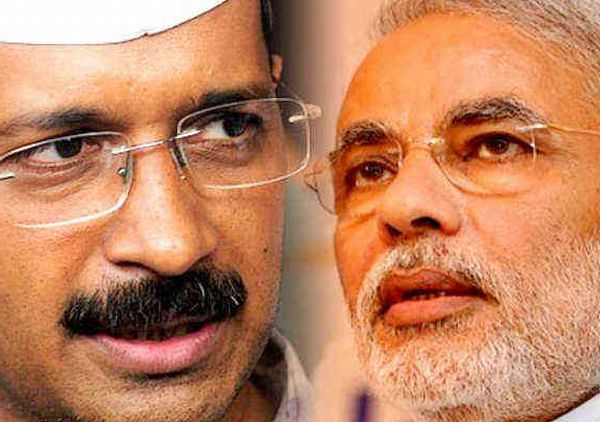
  • Kejriwal vs Modi: Vendetta, Politics & Overreaction

    Kejriwal vs Modi: Vendetta, Politics & Overreaction

    NEW DELHI (TIP): The war which began after Arvind Kejriwal had tweeted that the CBI is raiding his office, quickly spilled over to name calling & #politicaljihad.

    Kejriwal continued with the tweets and then a press conference accusing the Centre of foul play. It was met with an equally aggressive response from the BJP.

    Arvind Kejriwal blamed Prime Minister Narendra Modi for the “raid”, calling him a “coward and a psychopath”.

    “When Modi couldn’t handle me politically, he resorts to this cowardice,” he added.

    By calling the prime minister of the country a “coward” and a “psychopath” for a CBI raid on his bureaucrat and labeling the finance minister a “liar”, politics in India has touched spectacularly new lows that may yet set a dubious “benchmark” for adversarial politics.

    Officials from the Central Bureau of Investigation (CBI) have denied the allegations.

    “It is not a raid on Arvind Kejriwal’s office, it was a raid on Rajender Kumar, principal secretary to the CM,” CBI spokesperson Devpreet Singh told BBC.

    However, Mr. Kejriwal has accused the CBI of “lying”.

    Meanwhile, the Central Bureau of Investigation clarified that it has not raided the office of Delhi Chief Minister Arvind Kejriwal. Raids were carried out in the office of CM’s Principal Secretary Rajender Kumar, top CBI sources told media.

    After preliminary investigation, CBI found prima facie evidence against Kumar. After which CBI conducted several raid at 14 other locations in Delhi and Uttar Pradesh related to Rajender Kumar. Papers of three immovable properties along with cash Rs 2.4 lakh have been recovered in raid conducted at his house. Another Rs 10.5 lakh was recovered from Rajendra’s close aide and co-accused in the case, GK Nanda, GM Telecommunications Consultants India Limited (TCIL).

    The reported raid came days after a top bureaucrat working for the Delhi government was arrested red-handed for taking bribe.

    AAP Counter Claim

    Kejriwal claimed that CBI came for DDCA files and was working on behest of Arun Jaitley, who was the chairman of DDCA at the time of corruption scandal.

    Referring to the October 9 sacking of Food Minister Asim Ahmed Khan, he said: “I am the only CM who dismissed, on my own, a minister and a senior officer on charges of corruption and handed their cases to the CBI”.

    “If they were looking for proof of corruption, they should be looking for the concerned files in those departments,” added Kejriwal while coming in support of his principal secretary Rajender Kumar.

    A government-appointed panel had recently recommended that the BCCI suspend DDCA over financial irregularities and corruption.

    Aftermath of the raid: The biggest war of words takes off

    The big guns from the AAP and BJP continue to trade fire amid a raging war of words between the two parties over alleged corruption in Delhi’s cricket association which, the city’s ruling party claims, deepened under finance minister Arun Jaitley’s watch.

    The Delhi unit BJP on Tuesday, December 15, came down heavily on chief minister Arvind Kejriwal over his remarks on Prime Minister Narendra Modi and threatened to launch a “pol khol” campaign to expose “corruption” of the AAP government.

    “The BJP workers will no longer tolerate the language used by Mr Kejriwal against the PM Narendra Modi. We will launch a pol khol (expose) campaign to show to the people how his party is involved in corruption and that Secretariat has become a den of corruption,” Delhi BJP president Satish Upadhyay said.

    Leader of the Opposition in Delhi Assembly Vijender Gupta accused Mr Kejriwal of “defending” a “corrupt” officer.

    “The CBI often register cases and conducts raids against corrupt in the country, but it is first time that a chief minister has come forward to save a corrupt officer.”

    Referring to rule of law, he alleged that some people were trying to be above the law while people of Delhi were feeling “betrayed” in this “queer situation”.

    The war of words over accusation against Finance Minister Arun Jaitley of his involvement in “glaring irregularities” in Delhi District Cricket Association (DDCA) intensified on Thursday, December 17, with the BJP coming all out in his defence, describing him as a man of “impeccable” political record.

    The party described the accusations by Delhi’s AAP government as “blasphemous and preposterous campaign bordering on political hysteria”.

    “The BJP resolutely stands behind Arun Jaitley and publicly condemns the malicious intent of the AAP to deflect public attention from a corrupt officer working with (Delhi Chief Minister) Arvind Kejriwal,” Union Minister for Human Resource Development Smriti Irani told reporters at a press conference.

    She also made a comparison between Jaitley and Kejriwal in terms of their contributions so far, saying the Finance Minister had written his name in “golden letters in history” with his “dedication and work”.

    She said a “blasphemous and preposterous” campaign bordering on political hysteria was being created by the AAP to divert the public attention from a “corrupt officer”. Kejriwal is failing the anti-corruption movement from which he had shot to limelight by making efforts to protect a “corrupt officer”, she added.

    Smriti Irani pointed out that the 2013 SFIO probe found no evidence against Jaitley while looking into alleged irregularities in Delhi’s cricket body that he headed for over a decade.

    In a Facebook post, the finance minister struck back at AAP leaders for making allegations of corruption in the Delhi and District Cricket Association following a CBI raid at the office of chief minister Kejriwal’s principal secretary, saying “does free speech include the right to speak only falsehood.”

    Jaitley also attacked the Delhi chief minister, saying it was a propaganda technique of Kejriwal to deflect attention when he himself was in the “dock”, as both the AAP and Congress intensified their demand for his resignation from the Union cabinet.

    “Delhi CM Kejriwal seems to believe in untruth and defamation, delivered in language that borders on hysteria. No personal allegation was ever made against me nor did I ever feel the need of contradicting it,” he wrote. “Finding himself acting as a shield to cover an officer under investigation, the Delhi Chief Minister has attempted to focus attention on me.”

    DDCA Responds
    Former cricketer Chetan Chauhan, who now heads the cricket body, rejected the AAP’s charges and issued a point-by-point rebuttal, saying they had nothing to hide.

    “We want complete transparency. All allegations are baseless. We have spent money like misers,” Chauhan told reporters. “No embezzlement took place during Jaitley’s tenure. You can check SFIO report. There were only procedural lapses and we have compounded (paid fine) for those lapses.”

    Congress & its allies join the Fun
    The political feuding over the CBI raid, became fiercer on Wednesday, December 16, with Congress leaping into the fray and demanding the resignation of finance minister Arun Jaitley for alleged irregularities at the Delhi and Districts Cricket Association (DDCA).

    Congress demanded a joint parliamentary committee (JPC) to probe the matter and Jaitley’s resignation, the principal opposition party did not raise the issue inside or outside Parliament.

    The party mounted a renewed attack on Jaitley in a series of tweets, echoing the AAP allegations that corporate boxes at Delhi’s Feroz Shah Kotla cricket ground were given out on lease to companies without following rules.

    Trinamool Congress, too, joined, saying it was the first to ask for a JPC on DDCA. “Now, media says that Congress and AAP have demanded the same. We welcome that,” the party said.

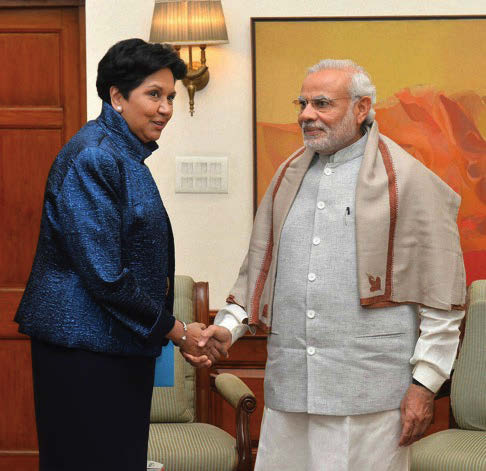
  • PepsiCo Chairperson Indra Nooyi meets PM Modi in New Delhi

    PepsiCo Chairperson Indra Nooyi meets PM Modi in New Delhi

    NEW DELHI (TIP): Global food and beverages major PepsiCo Chairperson and CEO Indra Nooyi  called on Prime Minister Narendra Modi in New Delhi, December 10.

    The meeting was a courtesy call, sources said although PepsiCo India officials declined to comment.

    Nooyi was in the Capital to meet government officials. She also caught up with Union Minister for Food Processing Industries, Harsimrat Kaur Badal.

    India has been one of the top five markets of PepsiCo and it has eight brands which clock turnover of over Rs 1,000 crore in the market.

    In 2013 the company had announced an investment of Rs 33,000 crore in India by 2020 to scale up operations here.

    The company has multiple plants across India and apart from cold drinks like Pepsi, 7UP, Mirinda and Mountain Dew, it sells snacks under Lehar, Uncle Chipps and Kurkure brands, among others.

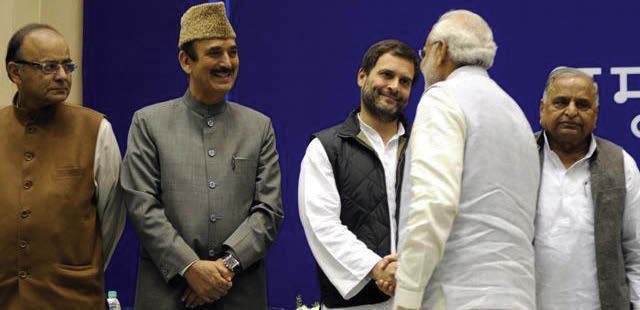
  • Modi shared dais with Sonia, shook hands with Rahul

    Modi shared dais with Sonia, shook hands with Rahul

    NEW DELHI (TIP): Nationalist Congress Party (NCP) chief Sharad Pawar on December 10  became instrumental in bringing Prime Minister Narendra Modi and Congress president Sonia Gandhi on the same dais for the first time in their long political careers.

    It was a function to felicitate Pawar on his 75th birthday at Delhi’s Vigyan Bhawan, barely two kilometres from Parliament where the government and the principal Opposition party have been trading barbs over the National Herald case for the past three days.

    Prime Minister Narendra Modi exchanges greetings with Pratibha Pawar during her husband and NCP chief Sharad Pawar's 75th birthday celebration at Vigyan Bhavan in New Delhi on Thursday. Congress President Sonia Gandhi is also seen.
    Prime Minister Narendra Modi exchanges greetings with Pratibha Pawar during her husband and NCP chief Sharad Pawar’s 75th birthday celebration at Vigyan Bhavan in New Delhi on Thursday. Congress President Sonia Gandhi is also seen.

    In what came as a testimony of Pawar’s political standing and clout, a galaxy of leaders from across the political spectrum gathered to felicitate the former Union minister and four-term Maharashtra chief minister. President Pranab Mukherjee praised Pawar for his role in turning India into a net exporter of food grains from being an importer.

    Lauding Pawar for his commitment to the uplift of farmers and his focus on “innovation in agriculture”, the Prime Minister said, “He has the quality of a farmer who can gauge the weather. Sharad Rao has used it fully in politics. Ask Sharad Rao which way the political wind will blow.”

    Sonia Gandhi also expressed her respect for Pawar. “We may have differences on some occasions, as any two individuals will have, but what has always been there is our respect for each other… He is a politician through and through in the best sense of the term,” she said and also acknowledged Pawar’s “formidable networking skills” as was evident from his friendship with politicians across the board.

    Although the PM and the Congress President did not exchange any words, they were seen clapping in appreciation at the end of each other’s speeches. While leaving, the PM shook hands with Congress vice-president Rahul Gandhi who had come on the dais for a group photo session.

  • Another ‘intolerant’ day

    New Delhi: ‘Intolerance’ – the dirty word of Indian politics has finally found its place in the parliamentary discussion.

    But as usual, to no avail. Even before the learned members of the parliament could dwell on the subject, the left party MP, Mohammad Salim struck a deep chasm with the Home Minister Rajnath Singh. Singh was so livid, he demanded an instant apology from Salim. When the dust settled down and the parliamentary discourse started again, nothing substantial seemed to emerge barring the opponent bashing by both the ruling and opposition benches. At end of day one of the debate on intolerance, we all just know what has already been reiterated by most political parties, nothing more. Then why waste 2.25 cr rupees per day to hold this debate?

    Since Bihar elections, “intolerance” has become the dirtiest word in politics. After 28 years of banning ‘The Satanic Verses’, the then home minister, P Chidambram, regretted the order issued by Rajiv Gandhi government. How one wonders, does this help the Congress today, which has been trying to use the “intolerance debate” to keep itself relevant in the current the political discourse?

    Did, Chidambram seek permission from Congress President, Sonia Gandhi prior to critiquing late PM Rajiv Gandhi’s decision. Or was he shooting from the hip as is the current norm in Indian politics. The party distanced itself and now we have no clue as to what is official and what is a comment in personal capacity. The veil of secrecy that has always been the hallmark of Congress engulfs all.

    Likewise, BJP, seems clueless. How does the party rein-in the Hindutava brigade, which has been vocal on its agenda, polices, aims and ultimate goal – one and only Hindu Rashtra. Can the party align itself with the proclaimed nationalists / hindu protagonists or is the party still committed to the plank of development which propelled the BJP to power in the face of Modi wave in 2014. The ruling party seems highly confused on its own agenda and goals to pursue.

    After all which BJP leader won’t desire, a Ram Mandir in Ayodhya, Uniform Civil code and abrogation of article 370 from the constitution? But then, votes were not sought on these issues. Votes were sought on the plank of corruption-free development which will truly reflect the economic might of Elephantine India.

    While the ruling elite are in a bind, the people seem to be the victims of ceaseless debate in newspapers, television and countless news portals.

    What to do is the Hobbesian choice…

  • EcoSikh Calls on Prime Minister Modi for Climate Agreement in Paris

    EcoSikh Calls on Prime Minister Modi for Climate Agreement in Paris

    WASHINGTON (TIP): EcoSikh has appealed to Prime Minister Narendra Modi to commit to reducing carbon emissions and to work towards a meaningful agreement at the UN Climate Summit in Paris this week on behalf of India and the Indian people. Leaders from around the world have convened in Paris this week to begin negotiating a landmark climate agreement that may alter the course of climate dialogue for the future.

    Suneet Tuli of EcoSikh with the World Bank president along with faith representatives in Washington, DC
    Suneet Tuli of EcoSikh with the World Bank president along with faith representatives in Washington, DC

    The aim of the United Nation’s 21st Conference of Parties, also known as COP21, will be to commit the nations to reducing their greenhouse gas emissions, which is one step in fighting the adverse effects of climate change. The meeting is expected to be one of the largest held for the UN Framework Convention on Climate Change (UNFCCC), with 40,000 delegates attending the negotiations.

    EcoSikhDr. Rajwant Singh, President of the Washington based EcoSikh, said, “India stands to be affected severely from the effects of climate change in the coming decades. Many important parts of the country are vulnerable. India’s policy to increase coal plants and production of coal based energy is devastating to the overall goal of controlling carbon emissions. India’s poor are some of the hardest hit by climate change, and will continue to be if India does not take a grander stand in the UN negotiations. While PM Modi makes the argument that historically, India has not been the largest emitters of carbon and therefore should be able to prioritize development over environmental conservation, India still has the duty to its citizens to provide them with a safe, clean and healthy environment to live in.”

    Singh added, “We appreciate PM Modi’s drive to increase alternate sources of energy for the country and focusing on technology transfers, research and development, and investment in India’s alternative energy sector with the overall goal of emissions reductions. But, this will only come with the commitment of Prime Minister Modi and his cabinet. Climate change is a moral issue and India should stand on the right side of history.”

    Amar Singh Sawhney, a member of EcoSikh’s Board of Directors and CEO of Boston based Ocular Therapeutix, Inc, said, “There is a cost to using fossil fuel based energy that goes beyond global warming and its catastrophic climate change implications. The additional costs come in the form of health disasters from particulate and other gaseous emissions that are affecting the Indian populace. Already, asthma, lung cancer, and other diseases are growing in incidence dramatically in India as a direct result of air pollution.”

    He added, “While understandably, India may not be able to eliminate coal and oil from its energy mix, a firm commitment to technological improvements to decrease the pollution impact of these energy sources must be undertaken. Solar energy, which has begun to gain traction in India, must be supported to increase if it is to be viable in the long term.”

    Suneet Singh Tuli, a member of the EcoSikh Board of Directors and CEO of the Datawind, said, “One does not have to look too far to see farmers in Punjab suffering from a lack of groundwater, or India’s south devastated by intense storms and strong typhoons. India is at risk, and it is time for Prime Minister Modi, and India’s energy minister Piyush Goyal to take seriously the impending damage climate change will cause for India’s 1.2 billion people, and make sure economic development is not their only agenda. For, what will they develop if there is no land left?”

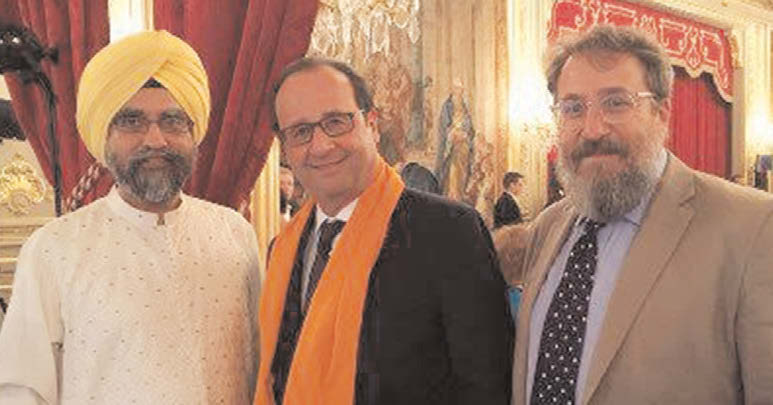
    EcoSikh has been invited by French President Francois Hollande and by the White House this year on consultations on Climate Change issues for faith perspectives. EcoSikh also took part in UN and the World Bank sponsored conference in Bristol and Paris on climate change and poverty issues leading to the UN Paris summit.

    India often finds itself in the same boat as another large greenhouse gas emitter: China. Both countries have a gone through and are currently undergoing rapid development, economic opening, and possess the top two most populous nations in the world. The difference comes with how China has led in the UN agreements. China has pledged $3.1 billion to help developing countries par down their carbon emissions, has promised an emissions peak around 2030 and committed to having 20% of their energy from non-fossil fuels sources. India, on the other hand, has made some commitments in comparison; one of which is to reduce emissions intensity by 30 to 35 percent by the year 2030. Still, India will require US$2.5 trillion to meet their goals and introduce alternative energy sources to the country.

  • DELHI MLAS GIFT THEMSELVES 400% SALARY HIKE

    DELHI MLAS GIFT THEMSELVES 400% SALARY HIKE

    NEW DELHI (TIP): Delhi MLAs on December 3 approved a 400% increase in their salary, accepting in totality the recommendations made by an independent committee that proposed a monthly payout of Rs 2.35 lakh to each MLA against the existing Rs 88,000.

    The bill was introduced – and passed – on Thursday in face of opposition from the BJP MLAs who said that this was probably not the right time for MLAs to take an increment. “We will abstain from voting for this bill because we do not think this is the right time for it. Even if you have to introduce it, the increment needs to lowered,” said leader of Opposition Vijender Gupta.

    The recommendations were proposed by an expert committee, headed by former secretary general of Lok Sabha, PDT Achari, which was constituted on August 21 after several MLAs of the ruling Aam Aadmi Party complained that they were unable to make ends meet with the existing pay package. The party came in for further criticism in light of its statement that the government is running extremely low on funds and despite its ‘aam aadmi’ credentials, sought to first ensure its own bank balance.

    The chief whip, speaker and deputy speaker will be entitled to the salary, allowances and entitlements of a minister of Delhi government.

    While a monthly allowance of Rs 4,000 for water and electricity has been removed from the salary, several other perks have been added, which include Rs 70,000 as allowance for constituency, a one-time payment of Rs 1 lakh to furnish office, Rs 60,000 to make the office functional and Rs 1 lakh for purchase of computers.

    A massive Rs 3 lakh has been included as annual payout for travel, including foreign trips, for the member and dependents. An annual increment of Rs 5,000 in basic salary has also been included.

    Several MLAs justified the rise, saying they had emerged from the anti-corruption movement and had no additional income with which to support their families or perform the duties expected of a legislative member. “Our salaries finish in the first 10 days of the month. We have now added responsibilities of running a constituency office, paying staff and meeting social obligations. I have to maintain a vehicle for official work and the salary we are getting at present is just about sufficient to meet the expenses,” said MAL Sanjeev Jha.

    Amid concerns that the implementation of these amendments would make Delhi MLAs the highest-paid in the country, sources said a large chunk of the emoluments was meant for official expenses.

    “Since 2014, the basic salary of MLAs in Assam is Rs 60,000 per month. With these amendments, Delhi MLAs will get only Rs 50,000 per month. The constituency allowance being paid to MLAs in Goa at present is Rs 90,000, despite the fact that it is an assembly smaller in terms of membership as well as population represented per MLA than Delhi,” said a source.

  • Obamian advice for Modi: No escape from the Cabinet system

    Obamian advice for Modi: No escape from the Cabinet system

    Towards the end of September 2015 Prime Minister Narendra Modi, according to the Indian media narrative, was out there conquering the West, engaging and earning applause from the most un-Indian Indians, the Silicon Valley NRI crowd. That week the American media was engrossed in the sudden resignation of the House of Representatives Speaker, John Boehner. This departure was the inevitable outcome of the extreme confrontational politics that the Republican Party right wing practises, not just against the Democratic Party but against its own moderate voices and faces. Speaker John Boehner was deemed by this fringe to be not sufficiently abusive, not sufficiently ideologically partisan, not sufficiently confrontational towards the Obama White House. He was forced out.

    The Silicon Valley bunch that had gathered to cheer Modi also subscribes and relishes the American right wing’s personalised, adversarial approach to matters politics. Modi appeals to them because he satisfies their notion of how political issues should be settled. It is this collective itch for a take-no-prisoner approach that doubly goads the NRI crowd to reinforce Prime Minister Modi’s own political instincts.

    When John Boehner stepped down, President Obama was magnanimously generous. He not only praised Boehner as a “patriot” and “a good man,” but also complimented his sense of democratic fairness:

    “We obviously have had a lot of disagreements, and politically we’re at different ends of the spectrum, but I will tell you he has always conducted himself with courtesy and civility with me. He has kept his words when he has made a commitment. He is somebody who has been gracious  and I think he most importantly is somebody who understands that in governance, you don’t get 100 per cent  of what you want, but you have to work with people who you disagree with, sometime strongly, in order to do the people’s business.”

    It has taken 18 months and a glorious defeat in Bihar for Mr Modi to begin to realise the abiding usefulness of Obamian wisdom about settling sometime for something less than 100 per cent. The invitation to the Congress president, Mrs Sonia Gandhi, to talk the complicated matter of the GST was perhaps the first acknowledgement of the need “to work with people you disagree with, sometime strongly, in order to do the people’s business.” This unaccustomed experiment with political dialogue has not come a day too soon.

    Arguably Bihar has put paid to the pipedream of an inexorable political supremacy, wining state after state. Regrettably, many of the professional partisans and the neo-converts are busy telling the Prime Minister that notwithstanding the grand rebuff in Bihar, he remains undiminished as the voice of our times. No one can be sure whether the Prime Minister continues to buy into this hogwash. Nor can anyone know if it has dawned on the Prime Minister that instead of working for the total annihilation of his rivals, he and his party have no choice but to seek partnership with the rest of the political rivals. Surely, there is neither shame nor a slight to political manhood to want to seek cooperation and conciliation with different stakeholders in the Indian polity.

    Nor is there any need for Mr Modi to announce from the housetop that he has understood that the Gujarat model of control and command has not worked in Delhi; but he does need to listen to the wise among his colleagues who would want to tell him that his preoccupation with over-centralisation of authority and over-concentration of initiative in the PMO has rendered the NDA government an ineffectual arrangement. Poor governance never yields healthy political dividends.

    At the end of the day there is no option for Mr Modi but to go back to the Nehruvian fix. He has to discover that he has available to him an institution called the Cabinet as an instrument of governance. And, then understand that there is this niggling little encumbrance called the state governments, with their own defined areas of constitutional authority and responsibilities. The Modi sarkar, to put it mildly, cannot be a sultanate.

    History can be a good teacher for helping Mr Modi find a good fix. Let us go 60 years back when Prime Minister Nehru was made to learn a thing or two in the niceties of federal functioning. Last week of December 1955. The new city of Chandigarh is being built. The great visionary architect Le Courbusier wanted to retain the services of the Chief Engineer, a gentleman called Parmeshwari Lal Varma, even after he had reached the age of superannuation. As far as Nehru was concerned, Le Corbusier was to have a carte blanche, Chandigarh was a dream project and the service rules were dispensable. Not for Chief Minister Bhimsen Sachar. And the Punjab Chief Minister told the Prime Minister so, in words less than courteous. In a letter dated January 10, 1956, to Sachar, Nehru noted “a certain irritation on your part that I had interfered in this matter at all and your desire to make it clear that you would stand no nonsense from me, if I may put it crudely.”

    This was in early 1956. Jawaharlal Nehru was at the peak of his political authority. But Nehru conceded that “there is the Constitution which lays down precisely in what matters the state governments must follow the Centre’s direction and in what matters they have full authority to decide for themselves and even not accept the Centre’s advice.”  In his defence, all that Nehru could do was to invoke personal and political loyalties “as a leading member of the Congress organisation of which we are all members.”

    Then, Nehru goes on to spell out a cardinal principle of governing this vast and complex land called India: “In any important matter, I do not function by myself, even though I am Prime Minister. I take the advice of my colleagues in the Cabinet either formally or informally. That is the way of democratic government. I am often overruled by my colleagues and sometimes converted by them. Often we find a middle way. There is no other method of working of democracy except by the fullest consultation and by the largest measure of agreement.”

    The ruling establishment is entitled to its silly preoccupation of wanting to de-legitimise the Nehruvian legacy. This preoccupation may perhaps be necessary to keep the Nagpur bosses in good humour. But a ruler has an obligation not to confuse frills with essentials. It is not too late in the day for the Prime Minister to defer to the Nehruvian wisdom and return to collegiate functioning. If the Prime Minister has any doubts, he can always consult President Obama.

  • Consensus more important than majority rule: PM Modi

    Consensus more important than majority rule: PM Modi

    NEW DELHI (TIP): Prime Minister Narendra Modi said on Nov 27 “India first” was the government’s only religion and the Constitution was its scripture, but refrained from making a direct reference to the ‘intolerance’ issue in his Parliament speech.

    He ruled out any review of the Constitution and reached out to the Opposition by saying that the ruling side does not believe in forcing decisions using its majority but in working through consensus.

    The PM also praised Jawaharlal Nehru for his greatness in accepting a point made by an opponent during a Parliament debate and congratulated Congress chief Sonia Gandhi for her speech on the Constitution.

    Speaking in the backdrop of the Opposition’s onslaught over ‘intolerance’, Modi said diversity was India’s strength and it needed to be nurtured.

    “For the government, the only ‘dharma’ is ‘India first, the only ‘dharma granth’ (holy book) is the Constitution,” the Prime Minister said in his nearly 70-minute reply to the debate during which Opposition members raked up the issue of ‘intolerance’ and questioned his silence over the issue.

    He said India was a diverse nation and the Constitution held the power to bind all its citizens. “Maintaining the sanctity of Constitution is the responsibility” he said.

    Highlighting the importance of a healthy discussion in Parliament, Modi said the spirit of discussion in the Lok Sabha is “us” and not “me” or “you”.

    Modi thanked everyone present in the House for the interest shown during the debate on the Constitution. “Some people have this wrong idea, maybe out of habit, that Prime Minister will respond to everything in the end. But I am speaking now, expressing my views, just as any other person here did,” he said.

    He also praised Lok Sabha Speaker Sumitra Mahajan for her speech during the special sitting of the House to discuss commitment to the Constitution. “I believe your speech will be an inspirational document in parliamentary history. I congratulate you,” the PM said.

    He was speaking during a discussion on commitment to the constitution as part of 125th birth anniversary celebrations of Bhim Rao Ambedkar, the chief architect of the Constitution.

    “26 November (Constitution Day) celebration doesn’t reduce the importance of 26 January… Our constitution has dignity for Indian and unity for India,” Modi said in his speech. “Man cannot be immortal but constitution has to be,” he said quoting a framer of the American constitution.

    On the first day of the winter session of Parliament on Thursday Modi had indicated that he will address the opposition’s concerns saying that the government is ready for debates but all parties must work for the nation.

    “The bitterness today reminds how our great leaders worked together to make the constitution,” Modi said on Friday.

    The month-long winter session is expected to see fireworks with the government determined to push through its ambitious legislative agenda of 38 bills – including the landmark goods and services tax reform.

    But opposition parties are adamant on discussing a wide range of subjects like drought, price rise, declining industrial production and exports and especially use the growing chorus over rising intolerance to corner the government. Recent weeks have seen intense back-channel negotiations with several rounds of meetings between top leaders and exhortations by the Speaker to let the House run without disruptions.

    The last monsoon session was washed out by a Congress-led Opposition demanding the resignation of senior BJP leaders mired in controversies and the government is keen to use this session to further its reform agenda.

  • Winter session of  Parliament gets off with debate on Constitution

    Winter session of Parliament gets off with debate on Constitution

    NEW DELHI (TIP): The Winter session of Parliament got underway November 26 with an aggressive Opposition taking  on the government over the Constitution and the legacy of its framer BR Ambedkar.

    Congress president Sonia Gandhi said the basic ideals of the Constitution were in danger and the happenings of the past few months were against its values, a reference to the swirling debate on intolerance in the country, stoked by controversial statements by BJP leaders.

    “Those who have no respect for the Constitution and have no role in the making of the Constitution are claiming to be keeping the Constitution,” the Rae Bareli MP said, a possible reference to the BJP that has been accused by the Congress of attempting to usurp Ambedkar’s legacy.

    The session began on a heated note, with home minister Rajnath Singh saying the word ‘secular’ was the most misused word in Indian politics.

    He went on to say that Ambedkar didn’t find it necessary to insert the word along with ‘socialist’ in the Preamble because he felt it was already in the basic nature of people.

    “We know how many problems he (Ambedkar) faced, he must have been hurt, yet (kept) his emotions in control… But he never said I have faced discrimination in India, so I will go somewhere else,” Singh said, hitting out at actor Aamir Khan who revealed this week that his family contemplated moving abroad due to rising intolerance.

    But Gandhi rejected Singh’s charge, saying the Constitution undeniably upheld secularism and that Ambedkar worked to give a voice to people discriminated by society.

    “The Constitution is closely linked to the history of Congress party. It is the Congress that brought Dr Ambedkar into the Constituent Assembly,” she said, amid uproar by BJP parliamentarians.

    “Indian Constitution is a result of decades of struggle. Mahatma Gandhiji made a huge contribution in this struggle.”

    The heated argument came at a two-day long special sitting of Parliament to discuss commitment to the Constitution as part of Ambedkar’s 125th birth anniversary celebrations. The Rajya Sabha was adjourned on Thursday after an obituary reference to sitting member Khekiho Zhimomi who died on Thursday morning.

    The session, which ends on December 23, is expected to see fireworks with the government determined to push through its reform agenda, including the landmark goods and services tax bill. After intense negotiations, it has agreed to reach out to the Opposition and agreed to a debate on intolerance as part of its attempts to avoid a repeat of the monsoon session washout.

    Hours before Parliament opened, Prime Minister Narendra Modi said the government was ready for debates but all parties must work for the nation.

    “I’m confident we all MPs will leave no stone unturned to match the expectations of the people of the nation. I have spoken to all the political parties and all want the House to run smoothly,” the PM said, speaking to reporters outside Parliament. including price rise, Mohammad Ikhlaq’s mob lynching over cow slaughter remarks and the killing of Dalit children in Faridabad.

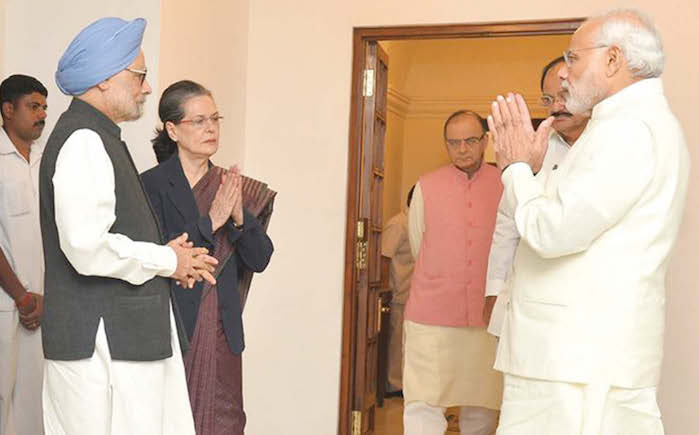
    Later, on November 27, PM Narendra Modi met the Congress leaders Sonia Gandhi and Dr. Manmohan Singh who he had invited for  a discussion on GST. The 45-minute meeting at 7, Race Course Road did not result in an immediate breakthrough, but it did serve to break the ice between the government and the Congress, with the latter consistently alleging that the ruling party was riding roughshod over the Opposition in Parliament. Finance Minister Arun Jaitley and Parliamentary Affairs Minister M Venkaiah Naidu were also present during the meeting. Sonia reiterated her party’s three main demands – 18 per cent cap on the tax, formation of a GST Disputes Settlement Authority and scrapping of the proposed one per cent additional tax that ends up favoring producer states. The government presented its viewpoint with facts and figures. All eyes are fixed on Monday, November 30 when the Parliament sits again to transact business.

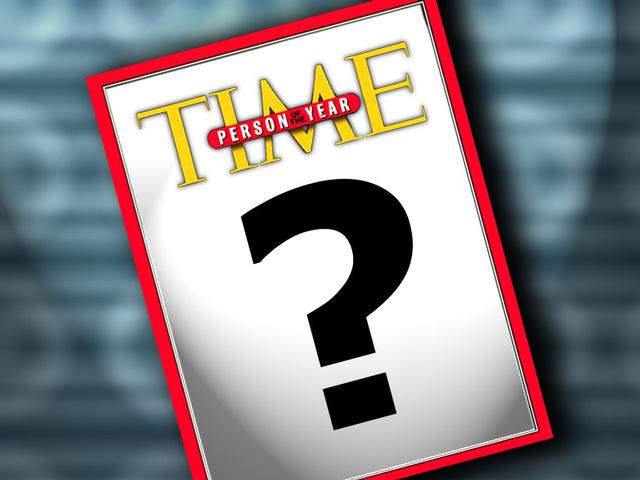
  • Narendra Modi, Mukesh Ambani, Sundar Pichai in Line for Time Person of the Year Award

    Narendra Modi, Mukesh Ambani, Sundar Pichai in Line for Time Person of the Year Award

    New York: Prime Minister Narendra Modi, Reliance Industries Chairman Mukesh Ambani and Google’s India-born CEO Sundar Pichai are among over 50 global leaders, business chiefs and pop icons named as contenders by Time magazine for its annual Person of the Year honor.
    The Time Person of the Year 2015 will be announced next month. The news weekly said the title would be bestowed on the person who “most influenced the news this year for better or worse.”

    Time said Modi has “encouraged foreign direct investment in India and is trying to modernize the world’s largest democracy,” but added that the Indian leader has also “faced controversy over what some see as rightwing extremism.”

    Modi was a contender for the honor last year also. While he was not chosen for the award by Time’s editors, he was named winner of the readers’ poll, securing more than 16 percent of about 5 million votes cast.

    On Ambani, Time said the richest person in India is the chairman of Reliance Industries, “which owns everything from telecom properties to the world’s largest crude oil refinery.”

    Among the contenders is Pichai. “After 11 years at Google, most recently as cofounder Larry Page’s right hand, Pichai assumed the tech giant’s top job,” Time said.

    In a separate “face-off” poll, Modi has been pitted against Jinping, while Ambani has been pitted against Nigerian President Muhammudu Buhari.

    Time asked its readers to vote for the individual who they think should get the title of Person of the Year. The winner of the readers’ choice poll will be announced next month before Time’s editors choose the individual from the 58 candidates.

    Modi has so far got 1.3 percent of the votes, the same as Pichai and Russian President Vladimir Putin. Ambani has garnered a mere 0.2 percent of the votes cast.

    Other candidates in the fray include U.S. President Barack Obama, French President Francois Hollande, Chinese President Xi Jinping, ISIS leader Abu Bakr al-Baghdadi, Democratic presidential frontrunner Hillary Clinton, the refugees fleeing conflicts in Syria, Afghanistan and East and West Africa, Pakistani Nobel Peace Prize laureate Malala Yousafzai, Tesla head Elon Musk, Apple CEO Tim Cook and last year’s winner Pope Francis.
    – PTI

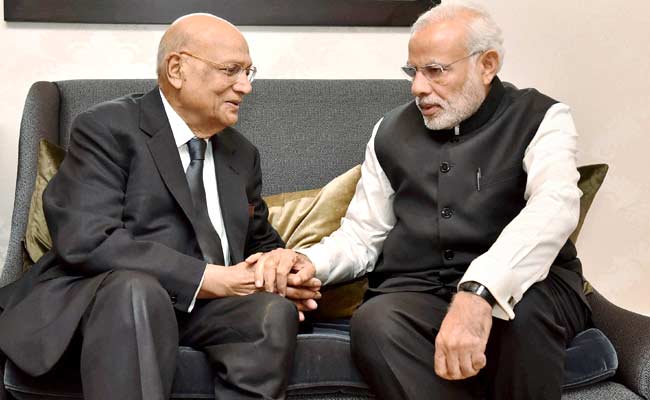
  • PM Modi Conveys Condolence to Lord Swaraj Paul Over Son’s Death

    PM Modi Conveys Condolence to Lord Swaraj Paul Over Son’s Death

    LONDON:  Prime Minister Narendra Modi today personally conveyed his condolence to NRI industrialist Lord Swraj Paul, whose son Angad died a few days ago after falling from his penthouse in central London.

    Prime Minister Modi, who had telephoned Lord Paul to offer his condolence immediately after the tragedy on Sunday, met Lord Paul at his hotel in London.

    “He was very generous, unbelievably warm and kind,” Lord Paul said after meeting the Prime Minister at Taj St James’ Hotel in London, where PM Modi was staying during his three-day UK visit.

    Top Indian leaders including former Prime Minister Manmohan Singh, Union Ministers — Arun Jaitley and Rajnath Singh — and others have conveyed their condolence to Lord Paul.

    Former Jammu and Kashmir Chief Ministers Farooq and Omar Abdullah have also conveyed their grief.

    Angad Paul’s cremation was held yesterday at the Golders Green electric crematorium where over 1,000 mourners offered their condolences to Lord Paul, his wife Aruna and Angad’s widow Michelle.

  • Bihar elections debacle will test PM Modi’s foreign policy 

    Bihar elections debacle will test PM Modi’s foreign policy 

    The debate within the country on the wider implications of the election results on Prime Minister Narendra Modi’s personal image and his ability to pursue his political and economic agenda has also been of interest to our major external partners seeking economic opportunities in a rising India and working with us on regional and global challenges.

    Just as the Bihar elections have been followed with interest in India-related foreign circles, Modi’s ascension to power too had received attention abroad.

    The apprehensions raised domestically about a Modi victory by all those opposed to him and the BJP, often viscerally, affected views outside, especially as those attacking him belonged to sections of our society in contact with foreign diplomats, interest groups, academicians, journalists and so on.

    Modi’s impressive electoral victory and state interests of foreign countries, however, made them engage the new Indian leader without reservations, even as domestic opponents continued to politically assault him.

    For them, after years of weak coalition governments, the country had now a single-party majority government in Delhi, which raised hopes of a decisive leadership and revival of the stalled economic reforms agenda.

    Modi’s dynamism on the foreign policy front reinforced his image externally as an energetic, self-confident, ambitious, reform-minded leader with innovative ideas for India’s development, even as domestic critics carped at his frequent foreign travels and the personal publicity they garnered for him.

    The rapturous welcome he received from the Indian diaspora during his visits abroad attested to Modi’s personal popularity and that of his ideas, which raised his profile as a leader even more, causing still more anguish to his opponents at home. The electoral battering of the BJP in the Delhi state elections did not have much external impact, barring raising some speculation about whether the BJP could be worsted in the election in Bihar and the implications of that in terms of governance at the Centre and the implementation of the government’s promise to ease of doing business in India and introduce other policy and procedural reforms. For our external partners, India’s economic opening is of critical interest, not the electoral ups and downs in state level elections that do not threaten the survival of the Union government.

    For them, the question, therefore, was whether a setback to the BJP in Bihar might mean a derailment of the government’s economic agenda, a slowing down of reforms, more populist policies, a loss of political will, more focus on domestic political management and diminished external ambitions.

    They are aware that the government does not have a majority in the Rajya Sabha and, therefore, cannot pass the legislation it wants, as in the case of the Land Acquisition Bill and the GST.

    In that context, the outcome of the Bihar elections in view of their impact on the prospects of the BJP obtaining in due course a majority in the Upper House, would have been of interest to foreign governments and investors.

    The electoral bludgeoning of the BJP in Bihar will no doubt be a subject of analysis by foreign diplomats in Delhi for the benefit of their respective foreign offices, not to mention the foreign media, especially in our neighborhood.

    Those neighboring countries apprehensive of a strong Indian government at the Centre, especially a BJP government, would welcome the BJP’s defeat in Bihar as this might, in their view, turn the government’s attention inwards, cause some loss of confidence and give these countries greater room to challenge India’s interests. For others, it would not be very material in terms of bilateral ties.

    Barack Obama lost majority in both houses of the US Congress and in many ways his domestic agenda ran aground because of lobbies and legislative opposition, but that has not affected the momentum of India-US bilateral ties.

    François Hollande of France has seen his domestic popularity fall precipitously without affecting our bilateral relations in any domain.

    Nawaz Sharif has been considerably weakened domestically without any material impact of that on the substance of US policy towards Pakistan.

    Whether David Cameron was prime minister in a coalition government earlier and now rules on his own has not changed India- UK equations.

    Many such examples can be given.

    Relations: All this implies that whatever course correction Modi and the BJP may undertake domestically because of Bihar, our external relations are on a different track. The economic expectations of our foreign partners can be met substantially by the government through policy measures and administrative action.

    Clean India, Clean Ganga, Digital India, Skills India, Start-Up India, Make in India, Smart Cities — the various Modi campaigns can be progressed irrespective of the shrillness of the Opposition.

    Perhaps faster progress in implementing the developmental agenda would be more productive politically for later state-level elections.

    The BJP’s poor performance in Bihar, one hopes, will not make elements of our society even more reckless in opposing Modi.

    Their hyped-up campaign against rising intolerance and suppression of dissent, the return of awards by literary figures, historians, scientists, etc, the vastly disproportionate reaction to a couple of reprehensible criminal incidents of a local nature, seems to be a concerted effort to denigrate him by distorting reality and, in the process, undermining national interest by giving foreign lobbies a specific agenda, a handle to beat India with.