Tag: Indian Politics

  POLITICS & POLICY  

  • BJP leaders question Modi for calling Rahul ‘shahzada’

    BJP leaders question Modi for calling Rahul ‘shahzada’

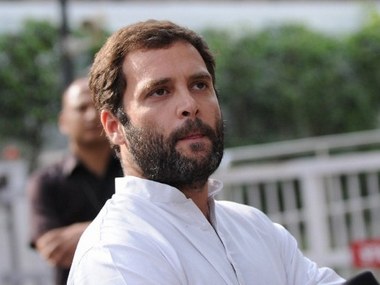
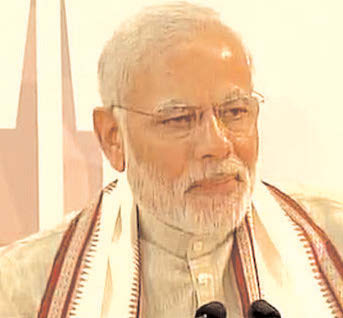
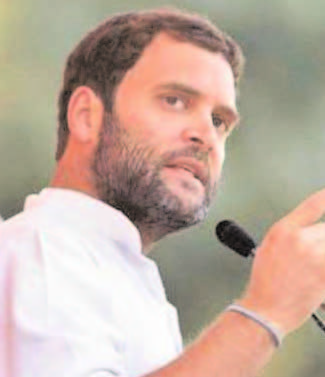
    BHAGALPUR (TIP): Disgruntled BJP leaders in Bihar’s silk city, Bhagalpur, have written to Prime Minister Narendra Modi questioning him for calling Congress vice-president Rahul Gandhi ‘shahzada’ when his own party is promoting nepo-tism in the state.

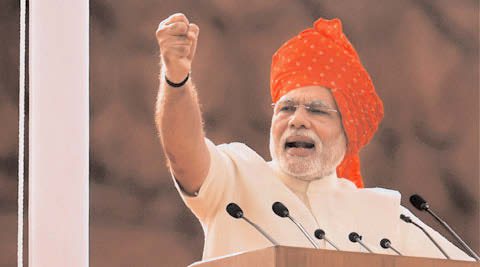
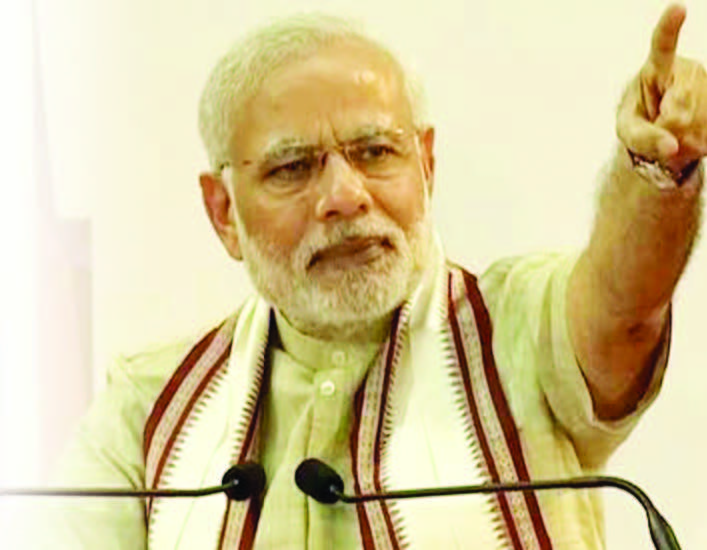
    In his election speeches, Modi often takes a dig at the alleged dynastic politics promoted by Congress calling Rahul shahzada – an Urdu word for scion of an imperial estate – and accusing the Gandhi family of usurping reigns of the party. The word that he has been using to describe the Congress vice-president and Sonia Gandhi’s son often earns him lots of applause at rallies.

    Little did Modi know that the word be used by his own party men to attack him during the on-going campaigns for the tough Bihar elections where at least five senior leaders have managed tickets for their sons overlooking several leaders who say they deserved the tickets and have contributed a lot to the party.

    The decision has triggered protests in Bharatiya Janata Party units at Bhagalpur, Brahampur, Digha, Agiaon and Meenapur where sons of senior BJP leaders like Ashwini Choubey, CP Thakur, Ganga Prasad, Muni Lal and Dinesh Khuswaha have been fielded by the party.

    In Bhagalpur assembly constituency, that will vote in the first of five phase Bihar polls slated October 12, the BJP Mahanagar president, Vijay Sah, revolted against the party’s decision to field former health minister Ashwini Choubey’s 35-year-old son, Arjit Saswat Choubey, and filed his nomination as an independent candidate.

  • Testing time for President | Modi as CM had pushed the Gujarat terror Bill

    Testing time for President | Modi as CM had pushed the Gujarat terror Bill

    Two Presidents have rejected the Gujarat Control of Terrorism and Organized Crime Bill, including APJ Abdul Kalam whom the BJP claims to revere. The Union Home Ministry has cleared the Gujarat Bill, which now awaits President Pranab Mukherjee’s consideration — this at a time when the prime mover of the law, Narendra Modi, is the Prime Minister. Though Atal Behari Vajpayee was not enamored with Modi’s style of running Gujarat, he agreed on the need to forego public accountability and judicial oversight while framing POTA. Modi followed suit with the Gujarat Bill. Anti-terror laws have reflected different ideological approaches on countering terrorism.

    One of the Congress-led UPA government’s first acts in 2004 was to repeal POTA. The Congress has also bitterly opposed the Gujarat Bill in the Assembly. On the other hand, the BJP has always made a case for strong laws to tackle terrorism. It justified POTA (post-Parliament House attack) as being the product of circumstances similar to the post-September 2011 Patriot’s Act in the US. The Patriot’s Act was a knee-jerk reaction and Washington later restored the power balance by diluting it. Statistics have proved the security forces blatantly misused POTA and its predecessors, especially TADA, to frame innocents.

    The BJP has invested too much in the Gujarat Bill through public posturing to back down, especially when its architect is the Prime Minister. The person who first moved it in the Gujarat Assembly is now the BJP’s national president. The possibility of judicial intervention is one solace against its intervention. The Supreme Court in the past had severely criticized similar laws, especially POTA. But President Pranab Mukherjee will have to first take a call. As a politician, he was adept at consensus building. As the Head of State it will be tougher for him to deploy those skills. If it comes to judicial intervention, perhaps all state laws of a similar nature, such as the ones in Karnataka and Maharashtra, should also be scrutinized. The key to a terror-free environment depends on factors other rather than laws without checks and balances. Such lop-sided laws have always been prone to misuse and heavy-handed application.

  • Rahul Gandhi – Missing without Action in United States

    Rahul Gandhi – Missing without Action in United States

    Update: Rahul Gandhi found in Aspen: Sep 28, 2015 – Read Now

    NEW YORK (TIP): Congress party is finding it hard to defend another “holiday” taken by its vice-president Rahul Gandhi, and the question everyone may be asking is whether or not the Crown Prince of Congress Party is interested in politics?.

    Gandhi, a 44-year-old bachelor parliamentarian, took a leave of absence starting in late February this year as well for 56 days which he termed as a sabbatical. The timing led to much talk and speculation in political circles, as budget session of Parliament had just commenced.

    The Press Trust of India reported that Gandhi had left India to attend the ‘Weekend with Charlie Rose’ Conference at Aspen, Colorado, as per Congress spokesperson Randeep Singh Surjewala & Salman Soz.

    Congress chief spokesman Randeep Surjewala rejected rumors about Mr. Gandhi’s whereabouts and stated “Congress Vice President Rahul Gandhi is traveling to Aspen, US on a short visit to attend a conference. The conference is expected to be attended by global leaders from various domains, both from government and private sectors.”

    He, however, did not give dates about the conference or the duration of the visit.

    Earlier in the day when asked about Rahul at AICC briefing, Surjewala said, “Rahulji is traveling abroad on a short personal visit and will return shortly. We reject all rumors stating otherwise. He will continue to lead the party’s Bihar campaign as also in the rest of the country.”

    What baffles the media is that ‘Weekend with Charlie Rose’ conference was held in July this year. Senior Journalist Padma Rao in a TV debate tried to clear confusion and checked about this conference of Mr. Gandhi with Karen Peterson who is the Conference Manager of Aspen Ideas Festival which hosts this annual event.

    As per Ms. Paterson, Mr. Rahul Gandhi is not listed as a speaker in any Aspen related event, public or private, in the past or in the near future.

    Mr. Charlie Rose has not hosted the ‘Weekend with Charlie Rose’ since 2012. The INOC Overseas President also confirmed that Mr. Gandhi is not in the United States in any official capacity and if he is in Aspen he must be on a Personal Visit.

    Interestingly, Prime Minister Narendra Modi is also in the USA from September 24th morning on a six-day visit.

  • West Bengal government makes public 64 new files on Netaji

    West Bengal government makes public 64 new files on Netaji

    NEW DELHI (TIP): The making public of 64 new files on Netaji Subhash Chandra Bose by the West Bengal government has renewed debate on the disappearance of the legendary freedom fighter.  The newly released 64 classified files with over 12,000 pages are now on display at the Kolkata police museum.

    Subhas_Chandra_BoseThese files have been digitized and the digital version will be available to public viewing. The documents are expected to throw light on one of the most talked about mysteries of modern history.  Until now the belief was that Bose had died in a plane crash in 1945 in Taipei, Taiwan but with the new documents released recently, speculations are rife that he did not die in the plane crash.

    “We know the birth date of Netaji but not his death date. It’s unfortunate and unbelievable. The Centre has many files which should be made public,” an NDTV report quoted West Bengal Chief Minister Mamata Banerjee as saying.

    In his Mann Ki Baat radio address, September 20th, Prime Minister Narendra Modi avoided a direct comment on the released files or the declassified files which are in the National Archives in New Delhi.

    Members of Netaji’s family said that a first look at the documents confirmed what they had suspected for almost 70 years, that the Bose family was spied on by the government, the NDTV report said.

    The digital version of the released files was handed over to the family of revered freedom fighter.

    “I was able to look at the snooping files. There was surveillance on my father Amiya Nath Bose, Shishir Bose and Arabindo Bose. Why should there be surveillance on members of Bose family and Netaji’s followers?” Netaji’s grand-nephew Chandra Bose was quoted as

  • Bihar to Witness Keen Contest | BIHAR ELECTIONS

    Bihar to Witness Keen Contest | BIHAR ELECTIONS

    PATNA (TIP): As far as political lineups go, the penultimate stage has been reached in the BJP-led NDA camp in preparation for the five-phase Assembly polls in Bihar due to kick off in a month’s time. The secular side of the ruling JD (U)-RJD-Congress crossed this stage a little earlier.

    Considerable bickering took place in both groupings on the share of the state’s 243 seats each alliance partner will get to contest. There is apparently some bad blood still between the NDA’s dalit leaders (Union minister Ram Vilas Paswan and former CM Jitan Ram Manjhi) over whose party is politically more significant in this election. But there seemed greater bruising on the seat-share issue in the secular camp, which is quite foolishly calling itself the “mahagathbandhan”, or great alliance. The smaller parties – the NCP and Mulayam Singh Yadav’s SP – just departed, although their exit is unlikely to alter the result in any significant way. For both sets of contestants, the  greater trouble lies ahead with specific seats for each alliance partner to be decided. Seemingly steady and rock-solid political conglomerates also crack under pressure of bloodletting in this stage. The state of the pre-election chemistry of parties and fronts is best gauged when obstacles in this phase are overcome.

    THE BIG PICTURE

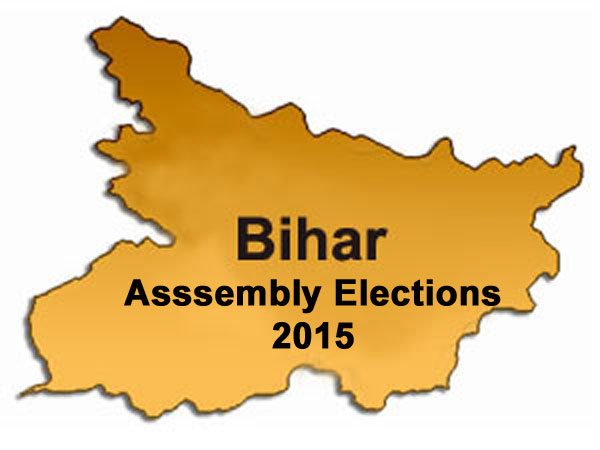
    • 6.68 crore: The total number of people who are eligible to vote in the 2015 Bihar Assembly elections
    • 2.06 crore: The increase in the number of voters from the 2010 elections in which 4.62 crore voters were on the rolls.
    • 243: The number of constituencies up for grabs in these elections. 38 of these are reserved for Scheduled Castes and 2 for Scheduled Tribes
    • 47: The number of seats that are considered affected by Left-wing extremism
    • 62,779: The number of polling stations in Bihar
    • 1.8 crore: The number of voters below the age of 30

    Cutting through all this seems to be BJP’s ambition to do a Lok Sabha in the Bihar Assembly, namely to arrive at a majority of its own with the aid of allies and then call the shots. In that event, as the New Delhi experience has shown, the allies won’t be in any position to play even second fiddle.

    This is the real meaning of the story of seats distribution in the NDA camp. Hiccups aside, what’s also noteworthy is the relative ease with which the BJP, traditionally an upper caste platform in Bihar, has been able to rope in on its side the known leaders of dalits, the lowest in the caste order.

    If BJP is essentially an upper caste party, the secular camp is the consolidation of intermediate castes, the so-called OBCs, with fringe upper caste support on account of the Congress factor. In addition, the minority factor is expected to work wholly for the secular camp without getting divided, particularly because of the presence of the Congress. But confusion and political trouble could lie ahead if the RJD wins more seats than the JD(U). Chief minister Nitish Kumar has been named prospective CM if the alliance wins. Will this be sustainable if his party trails Mr. Lalu Yadav’s party?

    Poll pundits speak of a close race. That is essentially due to caste equations at work. In that case, is “development” really the key issue which will decide the election?

  • CEO club await Modi in NY

    CEO club await Modi in NY

    NEW DELHI (TIP): Prime Minister Narendra Modi will meet CEOs of top global companies with collective worth of nearly $4 trillion — twice the size of India’s GDP — in New York on September 24 to discuss ideas to turn the country into an investment hotspot and a manufacturing hub.

    Lockheed Martin chairman Marillyn A Hewson, Ford Motor president Mark Fields, IBM CEO Ginni Rometty, PepsiCo CEO Indra Nooyi, Abbott Laboratories CEO Miles D White, Johnson & Johnson chairman Jorge Mesquita and Starwood Hotels and Resorts CEO Adam M Aron were among the leaders of several Fortune 500 companies who would be at the dinner meeting with Modi in New York’s Waldorf Astoria hotel, sources said.

    The push also comes at a time when many global companies are seeking an alternative to China as costs and risks rise in Asia’s biggest economy.

    On his second visit to the US in as many years, the PM will hard-sell India’s growth potential while looking to widen business ties between the world’s two largest democracies.

    He will specifically seek out global chief executives and top Wall Street bankers for his signature “Make in India” programme.

    The government has turned to homeboy and Michelin starred chef Vikas Khanna to showcase the diversity of the Indian platter for its guests.

    Ahead of the dinner, Modi would meet a group of financial sector CEOs organised by investment bank JP Morgan. Modi is also likely to meet News Corp chairman Rupert Murdoch as part of a media delegation, sources said.

    Modi’s New York pitch, which will be replicated during a two-day visit to the Silicon Valley, comes exactly a year after he launched the Make in India, vowing to rid India of bureaucratic sloth and make the country more investor friendly. The PM will be in the US from September 23 to 28.

    Make in India is as much an invitation to domestic and foreign companies as a promise to rectify ills that have kept the country almost at the bottom of World Bank’s ‘ease of doing business’ index.

    The government wants to boost the share of manufacturing in country’s gross domestic product to 25% from about 15% now.

    “The meeting with the CEOs on September 24 will specifically focus on making India a global hub for manufacturing, innovation and design,” a source, who did not wish to be identified, told a news agency.

    Modi discussed the global economic scenario with domestic business leaders earlier this month, urging them to take risks and invest in India.


  • Can’t force meat ban down someone’s throat, says Supreme Court

    Can’t force meat ban down someone’s throat, says Supreme Court

    NEW DELHI (TIP): Sending a strong message amidst concerns over mounting curbs on individual liberties, the Supreme Court on September 17 said that “a ban cannot be forced down somebody’s throat” and that the “spirit of tolerance” was paramount. Declining to approve a temporary ban on sale of meat in Mumbai in deference to the Jain festival of ‘Paryushana’, the top court asserted that every order of prohibition has to honour the spirit of tolerance and take into account the sensibilities of people.

    “There has to be spirit of tolerance and accommodation. Some sensibilities are called for. It cannot be in the spirit of conflict. The spirit of tolerance is very important and it has to be inculcated in a very subtle manner…in a very sensible manner,” said a bench of Justices T S Thakur and Kurian Joseph. “There has to be an understanding of a different level…of a mature level,” the bench added.

    The bench also quoted a couplet by poet Kabir to put across its point:
    “Kabira teri jhopadi gal katiyan ke paas, jaisi karani vaisi bharani tu kyun hua udaas (One reaps what one sows and nobody else needs to worry about it). “So why do you worry?” the bench asked advocate Manish Singhvi, who appeared for a Jain organisation which had challenged the Bombay High Court order lifting the ban.

    Observing that the state placing sudden restrictions on the citizens’ eating habits is not correct, the High Court had on Monday stayed the ban sought to be imposed by the state government in Mumbai on September 17. Singhvi, however, contended that some compassion has to be shown for living creatures and asked what harm could be caused by not selling meat on one or two days in a year. Singhvi added there are various judgments of the apex court, underlining the need to be compassionate towards animals in terms of Constitutional duties.

    But the bench responded: “We think that compassion for living creatures does not have to be only on a few days around festivals. It has to be throughout the year.” It said the meat ban would also be difficult to enforce practically when meat can also be sold as packed food items. “Half the day is already gone. The abattoirs are already closed under orders. We know butchering of animals is going on throughout the country everyday. Let this all be in the spirit of tolerance. The High Court has passed a detailed order with extensive reasoning. You should first get it decided there,” said the bench. Singhvi then urged the apex court to request the High Court to hear the issue expeditiously so that there is clarity on the subject in future. While allowing him to withdraw the petition, the bench asked the High Court to preferably decide the matter within six months if approached by the petitioner, the Shree Tapagachiya Atma Kamal Labhdisuriswarji Gyanmandir Trust.

  • Bihar Elections Announced: Model Code of Conduct comes in to Force

    Bihar Elections Announced: Model Code of Conduct comes in to Force

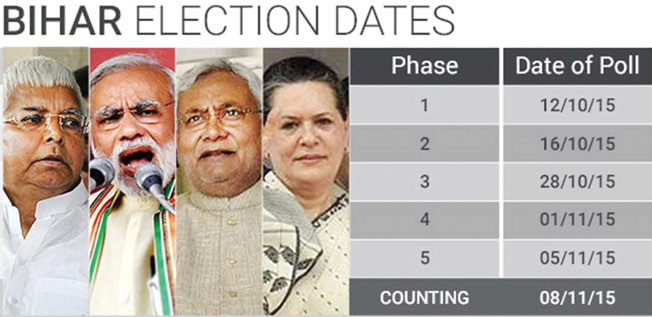
    NEW DELHI (TIP): The great Bihar Battle is on. The Election Commission on Wednesday, September 9, announced the dates for Bihar assembly polls. The five-phase election will be held in October-November; the first phase will take place on October 12 and the final phase will be held on November 5. Counting of votes will take place on November 8.

    Bihar Elections Announced
    Prime Minister Narendra Modi, Nitish Kumar and Laloo Prasad Yadav have been doing vigorous campaigning in Bihar

    Describing the security arrangements made by the commission, Chief Election Commissioner Nasim Zaidi said, “The paramilitary forces will guard all the polling stations.” All political parties in the state have demanded CRPF, CISF and BSF forces for the polls. At least 47 assembly segments are affected by Left-wing extremist areas and securing these segments is priority on the agenda, Zaidi said, flanked by Election Commissioners Achal Kumar Jyoti and Om Prakash Rawat.

    Our strategy will be to manage misuse of money by voters, including paid news. Nine central and state agencies have been pressed into action to keep a check on movement of cash and liquor,” Zaidi said adding that a total of 6.68 crore voters are eligible to cast their votes in Bihar.

    He also said that the Electronic Voting Machines (EVMs) this time will carry the photos of the candidates also.

    Noting that a number of important festivals like Dussehra, Eid, Muharram, Diwali and Chhath will fall in the election period, Zaidi said the Commission will ensure communal harmony and peace.

    The term of the 243-member Bihar assembly comes to an end on November 29.

    After ruling the state for ten years, Chief Minister Nitish Kumar is seeking a third term this time in alliance with Rashtriya Janata Dal and Congress after he walked out of NDA in June, 2013 snapping 17-year-old ties with the Bharatiya Janata Party.

    The BJP, which had almost swept the state in the Lok Sabha polls in alliance with Ram Vilas Paswan’s Lok Janshakti Party and Upendra Kushwaha’s Rashtriya Lok Samata Party, is hoping to repeat its performance and slamming Kumar for aligning with Lalu Prasad, a convict in fodder scam case.

    Meanwhile, a survey has predicted edge for the BJP led  Alliance over Laloo-Nitish alliance. The India Today-Cicero survey has predicted in a pre – poll survey that BJP-led NDA will win 125 out of 243 seats in Bihar getting simple majority while Nitish Kumar-led coalition will manage only 106 seats if elections were held in the first week of September.

    The survey shows significant gains for the BJP and its allies, and predicts losses for JD(U)-RJD-Congress combine.

    The Bihar assembly election could be “very, very close”, according to the agency which conducted the poll.

  • INOC Felicitates Rajya Sabha Deputy Chairman Prof. P.J. Kurien

    INOC Felicitates Rajya Sabha Deputy Chairman Prof. P.J. Kurien

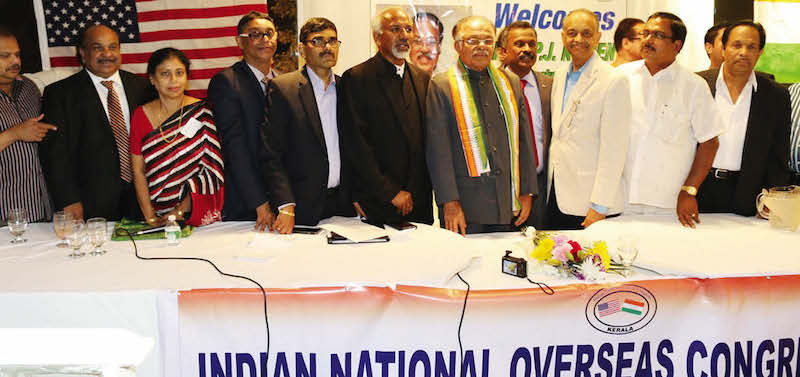
    NEW YORK (TIP): Prof. P J Kurien, Deputy Chairman of Rajya Sabha was honored by the Indian National Overseas and its Kerala Chapter OICC(Overseas Indian Cultural Congress) at a reception given in Flushing, New York, September 4. The dinner -cum -reception was held at the World’s fair Marina in Queens.

    Chairman of INOC USA George Abraham , Chairman of OICC North America Thomas T Oommen, President of INOC Juned Qazi, Vice President Mohinder Singh Gilzian, R. Jayachandran, U A Naseer, Leela Maret, Jose George, Nalini Shah, Sonia Sodhi, officers of various INOC chapters admired the leadership of Prof. P J Kurien and his services to the motherland. Democracy.

    Prof. Kurien said that Federalism and Secularism are important and interdependent. Without  the one the other will not survive. Democracy is very strong and secure in India and India’s  growth has made every Indian proud.

  • Obama, Biden to lead high decibel US engagement with India

    WASHINGTON (TIP): US President Barack Obama along with vice president Joe Biden and several of his cabinet ministers are all set for a high-level engagement with the Indian leadership in a series of meetings later this month.

    This would be the highest level of engagement between the two countries after Obama’s trip to New Delhi in January to attend the Republic Day parade as the chief guest of Prime Minister Narendra Modi.

    Obama and Modi are expected to meet in New York on September 28.

    While no official announcement has been made yet, the proposed meeting itself is a reflection of the seriousness and commitment of the two leaders to this bilateral relationship.

    On a day, which is said to be one of the busiest days for the US President given his address to the UN General Assembly on the first day of the annual session, Obama’s schedulers had a tough time in creating space for his meeting with Modi.

    Modi, on the other hand for all practical purpose would be taking an overnight flight – although it would be Air India One – from Silicon Valley on September 27 after addressing the Indian-Americans at the SAP Center in San Jose to be back to Big Apple for his likely meeting with Obama, sources said.

    Notably in the January joint statement, the two leaders had committed themselves for a more regular meeting.

    Modi-Obama meeting in New York would cap more than a week of high level India-US engagement – most of which would be held in Washington DC, the sources said.

    It is learnt that Vice President Biden is himself keen to be part of this highest level of India-US engagement. It was Biden who, during his visit to India a few years ago, had set the ambitious goal of increasing the bilateral trade from the current USD 100 billion to USD 500 billion per annum.

    It is in this backdrop, it might not be surprising that Biden is seen taking a lead once again when it comes to the economic dimension of the India US relationship.

  • SONIA ATTACKS MODI’S ‘HAWA BAZI’, FLIP FLOPS

    SONIA ATTACKS MODI’S ‘HAWA BAZI’, FLIP FLOPS

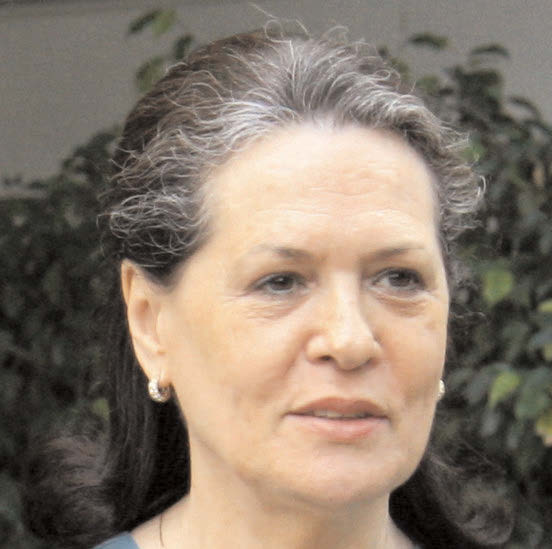
    NEW DELHI (TIP): Sonia Gandhi set the tone for the meeting in her inaugural remarks as she launched a frontal attack on Prime Minister Modi, terming his promises as nothing more than “hawa baazi” (hot air) and his government failing abysmally to match its words with deeds.

    BJP leader and union minister Smriti Irani hit hack at the Congress president over her “hawa baazi” remark, saying “whenever Sonia Gandhi targets us, people of India come to support Prime Minister Modi”.

    The CWC meeting was necessitated with the party deciding to hold its organisational elections by the end of next year amid the possibility that the long-speculated elevation of party vice president Rahul Gandhi could take place as culmination of the organisational election process.

    Both Sonia Gandhi and the CWC on Tuesday congratulated Rahul Gandhi for leading the fight against the government on the controversial land acquisition bill and forcing the government to back off.

    The CWC, the highest decision-making body of the Congress, also decided on significant changes to the party’s constitution such as increasing reservation for weaker sections, including Scheduled Castes and minorities from 20 percent to 50 percent, bringing back the practice of active membership, inclusion of electronic membership and reducing the term of members and office bearers from five years to three years.

    The changes are meant to strengthen the Congress base and expand its membership at a time the party is seeking its electoral revival after a string of reverses in assembly polls following its debacle in the Lok Sabha elections last year.

    Briefing reporters after the meeting, Leader of Opposition in the Rajya Sabha Ghulam Nabi Azad said the party was in support of the Goods and Services Tax (GST) but the government should accept its proposed amendments on the bill.

    He ruled out the party’s support to the government suggestion for a special session of Parliament to pass the GST bill, saying it had not taken action against three BJP leaders whose resignations were being sought by the Congress.

    The Congress has been demanding resignation of External Affairs Minister Sushma Swaraj and Rajasthan Chief Minister Vasundhara Raje over their alleged help to former IPL chief Lalit Modi, who is facing Enforcement Directorate investigations, and of Madhya Pradesh Chief Minister Shivraj Singh Chouhan over the Vyapam scam.

    In her hard-hitting speech, Sonia Gandhi accused Modi of “unedifying flip-flops” and lack of a coherent policy vis-a-vis Pakistan. She said the government had chosen to disregard the will of Parliament and “displayed an inexplicable hurry to snatch land from our farmers”.

    She also accused the government of being “controlled and directed” by the Rashtriya Swayamsewak Sangh (RSS), the ideological fountainhead of BJP.

    “It has become painfully clear that most of the pledges made by the prime minister during his election campaign were nothing more than ‘hawa baazi’. The Modi government has failed abysmally to match words with deeds, to match media events with actual accomplishments, to match headlines with substance,” she said.

    She said the Congress needs to mount campaigns against the assault on tribal welfare, on women and child welfare, on labour laws, on laws that protect the environment and forests, on RTI and “on our flagship initiatives MGNREGA which are being systematically undermined”.

    Stating that the economy was on a downslide while prices “continue on their unrelenting rise”, Sonia Gandhi accused the government of systematically eroding the autonomy and integrity of vital institutions.

    She said history was sought to be rewritten with special targeting of Jawaharlal Nehru.

    She called for a transparent mechanism to recognise and reward hardworking and performing workers in the party.

    The term of Sonia Gandhi, who has been at the helm for 17 years, was to end in December this year.

    The party will now write to the Election Commission informing it that it will complete the process of organisational elections by the end of next year.

    At its meeting at the party headquarters here, the working committee decided on a series of significant amendments to its constitution including bringing back practice of active membership, inclusion of electronic membership and reducing term of members and office-bearers from five years to three years.

    Briefing reporters after the meeting, senior party leader Ghulam Nabi Azad, who is leader of opposition in the Rajya Sabha, said that the amendments had been approved by the working committee but the changes made in the constitution will take time to be implemented.

    The CWC approved the proposal to extend term of all the committees including the All India Congress Committee and the Pradesh Congress Committees by one year. The party will now hold organisational elections before the end of 2016.

    “As a party we have always championed the rights of the marginalized sections of society such as women, adivasis, dalits, minorities and OBCs. It is only through affirmative action that we will guarantee greater say in the working of our party to these sections of society,” Gandhi said.

    There had been demands within the party earlier that party vice president Rahul Gandhi should be elevated as the president but the party appears to have decided to make the change at an appropriate time later.

    Rahul Gandhi was elevated as vice president in January 2013 and has been aggressively taking on the Narendra Modi government on a range of issues over the past few months since his return from a sabbatical.

    Sonia Gandhi, who took over reigns of Congress in 1998, is already the longest serving president of the party.

    The CWC meeting comes weeks ahead of the crucial assembly elections in Bihar where the Congress will contesting 40 seats, in alliance with the Janata Dal-United and Rashtriya Janata Dal.

    There has been talk in the party that any change in leadership before the Bihar elections would not be appropriate as the election was tough and there was no certainty about party’s prospects.

  • PM Modi inaugurates new terminal at Chandigarh airport

    CHANDIGARH (TIP): Prime Minister Narendra Modi on Sept 11 inaugurated a new terminal at Chandigarh airport which will handle both domestic as well as international flights. Modi dedicated to the nation the modern facility which is expected to boost the economic and industrial development in Punjab, Haryana and Himachal Pradesh.

    The ambitious Rs 939-crore project, which is being seen as a “harbinger” of regional development for the northern part of the country, will be operated and maintained by Chandigarh International Airport Ltd (CHIAL), a joint venture between Airports Authority of India (AAI) and the governments of Punjab and Haryana.

    AAI has 51 per cent stake in the project while Punjab and Haryana have 24.5 per cent equity each. Governor of Punjab and Haryana and Administrator of the Union Territory of Chandigarh, Kaptan Singh Solanki, Union Minister for Civil Aviation, P Ashok Gajapathi Raju, Punjab Chief Minister Parkash Singh Badal and his Haryana counterpart Manohar Lal Khattar were among those present on the occasion. Before inaugurating the civil air terminal, Modi was shown the model of the new building and taken around an exhibition of photographs of the facility. He was also presented a memento by Civil Aviation Minister Raju.

    Designed on the green building concept, the terminal in Mohali (Punjab) is spread over 53,000 sq.m and can handle 1,600 passengers, including 450 international travellers, during peak time. The apron capacity of the airport will be 8 aircraft, including cargo planes. With parking facility for 500 cars, it is equipped with 48 check-in counters, nine immigration counters, four arrival baggage carousels, three passenger boarding bridges, six escalators and 14 lifts. Depicting heritage and culture of Punjab, Haryana and Chandigarh with murals, paintings and sculptures, the terminal building has five levels with arrival hall at ground floor, departures in the first floor and services, including baggage handling system, and offices in the basement.

  • PM MODI TO WIN WEST WITH STAR-STUDDED BUSINESS MEETINGS

    PM MODI TO WIN WEST WITH STAR-STUDDED BUSINESS MEETINGS

    NEW DELHI (TIP)): A galaxy of super-rich chief executives, techies, entrepreneurs, investors with global giant companies like Google, Microsoft, Qualcomm and Adobe are lined up to meet Prime Minister Narendra Modi during his two day trip to Silicon Valley on September 26-27. This firmament of business does not include some 35 chief executive officers of manufacturing companies and financial institutions who have a date with Modi during a ‘Make in India’ event in New York after he touches down late on September 23. The West Coast theme is ‘Innovative Entrepreneurship, Digital Economy and Renewable Energy’.

    Diplomatic sources confirm that John T Chambers, executive chairman of $47-billion CISCO Technology, Satya Nadella, CEO of $93-billion Microsoft, Paul Jacobs of $27-billion Qualcomm,$66-billion Google’s top honchos Eric Schmidt and Sundar Pichai, ex-Google billionaire Ram Shriram, and Shantanu Narayen, CEO of $5-billion Adobe Systems, will meet Modi on the West Coast.

    Modi will also meet Silicon Valley’s hi-tech billionaire  entrepreneurs like Romesh Wadhwani of Symphony Technology Group, Venktesh Shukla of Monta Vista Capital and Naren Gupta of Integrated Systems.

    The Prime Minister is also slated to visit Tesla Headquarters in Palo Alto in California and meet one of the co-founders of the next generation US automotive and energy storage companies. Modi may miss meeting Elon Musk, Tesla’s founder and CEO, as he is believed to be away from the US during that time. From these stratospheric technologies companies and entrepreneurs, the Prime Minister may interact with Dr Manu Prakash of Stanford, who is a ‘frugal science’ innovator whose 50-cent microscopes have been sold across Asia and Africa.

    South Block sources said the India show kickstarts in Washington with India-US strategic commercial dialogue on September 20-21 with external affairs minister Sushma Swaraj, commerce and industry minister Nirmala Sitharaman, power and renewable energy ministry Piyush Goyal interacting with their US counterpart in order to cement the bilateral relationship.

    After addressing the UN Sustainable Development Summit in New York on September 25, Modi has a hectic programme on the West Coast with an address to Indian diaspora at San Jose auditorium. Through innovative entrepreneurship, the PM wants to bring the experience of Silicon Valley start-ups to India without the downside.

    “The PM is keen on interacting with the US techies on digital economy which is changing the face of business and trade, for instance, how Uber has changed the transportation landscape. Prime Minister Modi is interested in renewable energy as this could be India’s answer to Climate change. While Boeing Chairman wanted Modi to come to its headquarters in Seattle, CEO of Textron Inc, which manufactures Bell Helicopters, Cessna and Beechcraft, has also placed a request to meet the Prime Minister. The focus of the Prime Minister’s West Coast trip is on leapfrogging the Indian economy through latest technology,” said an Indian diplomat.

  • Meat ban in Maharashtra: The politics of food

    Meat ban in Maharashtra: The politics of food

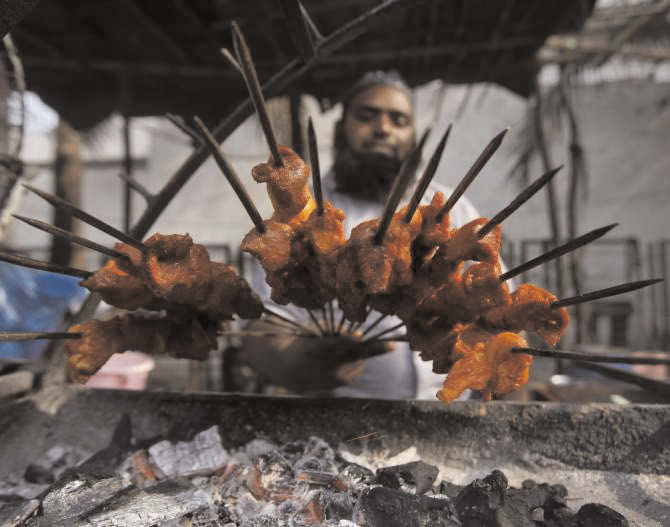
    MUMBAI (TIP): Food and eating habits have by no means been at the centre of Maharashtra’s politics for the past many a decade. However since the BJP government came to power last year, food particularly the non- vegetarian kind, has become an important political issue in the state. After the banning of beef in March which drew limited protests from largely Muslims and Dalits, the state is witnessing yet another attempt to curb non-vegetarian eating habits.

    The decision to ban the consumption of meat for eight days was taken by the BJP-led Mira Bhayander Municipal Corporation (MBMC) during Paryushan when the Jain community practices temporal monasticism. The community believes that violence against all living beings should be curtailed during these days. As a mark of respect, abattoirs remain closed across most of Maharashtra’s major cities for a couple of days.

    The insistence of the MBMC on closure as well as on private consumption of meat for all eight days has raised the eyebrows of the Maharashtra Navnirman Sena (MNS) as well as the Shiv Sena (SS) as the decision is likely to have an impact on a largely meat and poultry eating Marathi population. The MNS which has been fast losing ground and political relevance in Maharashtra has been raking up the issue of vegetarian terrorism in the city. It has been at the forefront of leading agitations against discrimination that non-vegetarian home buyers face in certain pockets of the city. It has also been demanding action by the Brihanmumbai Municipal Corporation (BMC) against those builders who deny houses to people because of their food preferences. The agitation has found much resonance amongst the Marathi population. With elections of the Brihanmumbai Municipal Corporation (BMC) slated for 2017, the Shiv Sena too has jumped into the fray to ensure that it does not cede its space as the champion of Marathi rights to the MNS. That the BJP is contemplating breaking its local level alliance and fighting the corporation elections on its own has also forced the Sena to brace itself against any political fallout. The BJP has projected itself as the patron of the mercantile community in the city which is largely Gujarati and Jain. With the party going out of its way to adhere to the demands of its voter base, the Sena has decided to turn the heat on the anti meat ban protest. Interestingly, the demands and protest are marked by contradictions. The Jains have sought a ban against mutton and chicken but are comfortable with the sale of fish and eggs. The Sena is protesting against the BJP-led MBMC’s eight-day ban on meat — later upturned and changed to a two-day closure of abattoirs. However, in Mumbai the BMC, governed by the Sena, has asked abattoirs to remain closed for four days.

  • Barack Obama’s big plans to engage with Modi’s India

    Barack Obama’s big plans to engage with Modi’s India

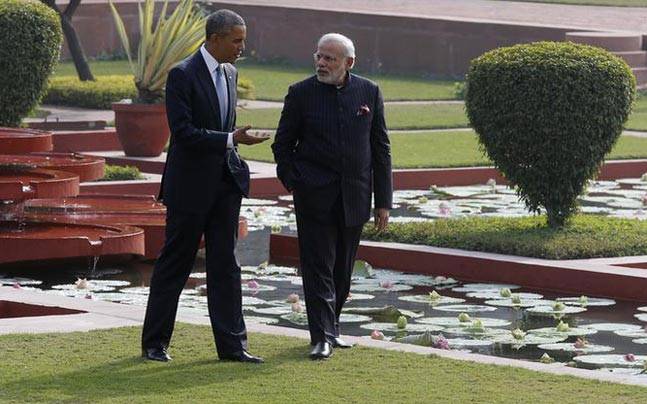
    US President Barack Obama along with Vice-President Joe Biden and several of their government officials are all set for a high-level engagement with the Indian leadership in a series of meetings later this month. This would be the highest level of engagement between the two countries after Obama’s trip to New Delhi in January to attend the Republic Day parade as the chief guest of Prime Minister Narendra Modi.

    Obama and Modi are expected to meet in New York on September 28. While no official announcement has been made yet, the proposed meeting itself is a reflection of the seriousness and commitment of the two leaders to this bilateral relationship.

    On a day, which is said to be one of the busiest days for the US President given his address to the UN General Assembly on the first day of the annual session, Obama’s schedulers had a tough time finding a slot for his meeting with Modi.

    Modi, on the other hand, is likely to take an overnight flight to New York in his Air India One from Silicon Valley on September 27 after addressing the Indian-Americans in San Jose for his likely meeting with Obama.

    Notably, in their joint statement in January, the two leaders had committed themselves for a more regular meeting. The Modi-Obama meeting in New York would cap more than a week of high-level India-US engagement, most of which would be held in capital Washington DC.

    It is learnt that Vice-President Biden is himself keen to be part of this highest level of India-US engagement. It was Biden who, during his visit to India a few years ago, had set the ambitious goal of increasing the bilateral trade from the current USD 100 billion to USD 500 billion per annum.

    It is in this backdrop that Biden has been seen taking a lead once again when it comes to the economic dimension of the India US relationship. Several cabinet ranking officials along with corporate leaders from both the countries are expected to be present at the 40th Anniversary Leadership Summit of the US-India Business Council (USIBC) on September 21.

    Among others, it would be attended by Energy Minister Piyush Goyal and Commerce Minister Nirmala Sitharaman and US Commerce Secretary Penny Pritzeker along with who’s who of corporate leaders from the two countries. The next day, TERI North America would host the 6th India-US Energy Partnership Summit.

    However, it is the first ever India-US Strategic and Economic Dialogue to be hosted by Secretary of State John Kerry that will be the center of attraction when Modi is in the US. While the dates of this dialogue has not been announced yet, it is most likely to be held on September 22. The decision to expand India-US Strategic Dialogue to Commercial one was taken during Obama’s January visit to India.

    Kerry along with Pritzeker would lead the US delegation, while the Indian delegation would be led by External Affairs Minister Sushma Swaraj and Sitharaman. Foreign Secretary S Jaishankar will also expected to be part of the Indian delegation. Indian Ambassador to the US Arun K Singh and his American counterpart in India Richard Verma would also be part of their respective terms.

  • Bihar polls: Mulayam’s SP quits Janata Parivar, to contest independently

    Bihar polls: Mulayam’s SP quits Janata Parivar, to contest independently

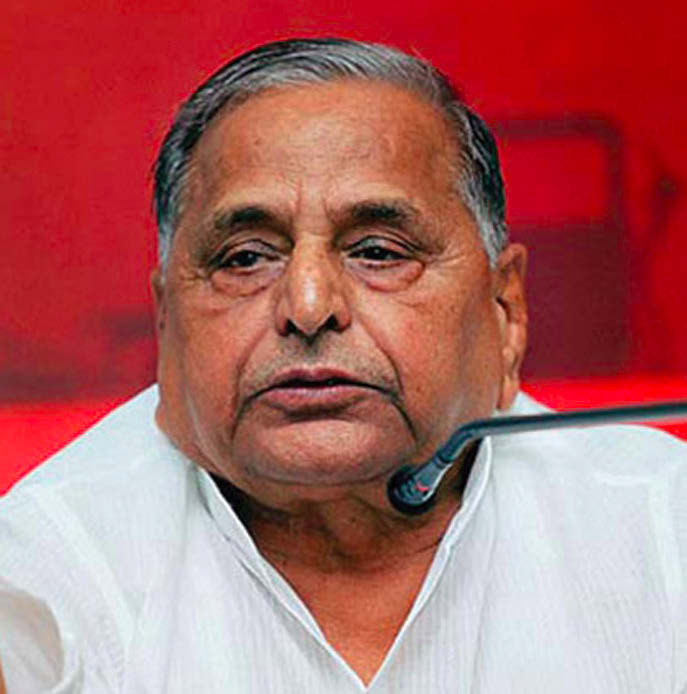
    NEW DELHI (TIP): Jolting the Nitish Kumar-led grand alliance in Bihar, the Samajwadi Party walked out of the fold on September 3 saying it had been “insulted” by the offer of only five seats against its demand for 12 in the assembly elections in the state. To the delight of the BJP, SP general secretary Ram Gopal Yadav told reporters in Lucknow that the party would contest independently in Bihar and “jitna woh de rahe thai, ussey zyada jeetenge (will win more than what was being offered)”. As the desertion in Bihar raised the larger question whether the Janata Parivar would put up a united fight in Uttar Pradesh when it votes in 2017, JD (U) president Sharad Yadav announced that the SP would be won back and kept on board. Earlier, Ram Gopal Yadav told reporters: “When we are contesting alone, there is no question of a Janata Parivar. It is buried now. In fact, it never came into existence. I knew from the beginning that such a thing will happen in Bihar. I refused to sign on the death warrant of our party. No more Janata Parivar now.”

    But Sharad Yadav said his association with SP chief Mulayam Singh went back many years and he would find a “solution”. “We are very old colleagues… I have to talk to Mulayam Singhji… I have spoken to him once, I will talk to him again. We will resolve this finally… let me tell you, our alliance will stay… I will not go into details but let me assure you it will not damage our alliance,” the JD(U) chief said.

    When a reporter suggested that the SP action may have had something to do with Mulayam Singh’s recent meeting with Prime Minister Narendra Modi and that of Ram Gopal Yadav with BJP chief Amit Shah, Sharad Yadav said, “This angle is not correct. Mulayam Singh Yadav is not someone new… He has impeccable secular credentials. There was a time when he was called Maulana Mulayam. Political leaders keep meeting one another. Even I meet leaders of many parties. Does it mean I am working in tandem with them?” That the SP, never a big player in Bihar, was not happy with the number of seats being offered by the JD(U) and RJD was evident when Mulayam Singh skipped the August 30 rally of the alliance in Patna.

    He had also not figured in any of the alliance posters in the state. Bihar SP chief Ramchandra Singh Yadav said: “Our leader was constantly ignored. He was the one who played an important role in formation of the Janta Parivar and in the projection of Nitish Kumar as CM nominee. But we were given a raw deal in seat sharing.

    The SP was not given any seat in the first seat-sharing arrangement. It was only after we protested that we were offered five seats.” The NCP has already walked out of the alliance in Bihar. Its leader Tariq Anwar said they have been exploring the option of a new front with SP and other parties. Sources said Pappu Yadav’s Jan Adhikar Party may be part of this front if it fails to strike a poll pact with the BJP. The SP, which contested 170 seats in the last Bihar assembly elections, could not win a single seat. It had won three seats in the 2005 polls. Sources said the party may decide to contest 40-50 seats this time, mostly in districts bordering Uttar Pradesh. In Lucknow, Ram Gopal Yadav said: “The bigger constituents did not follow the decorum of an alliance. We learnt from the media about the five seats being offered. We are feeling insulted. So, keeping in mind the feelings of our workers, we are going to contest the Bihar assembly polls alone.” He denied the suggestion that the SP decision would help the BJP in Bihar by splitting “secular” votes. “If this was the case, why did the BJP win in MP, Rajasthan and Chhattisgarh? There was no other party there except the BJP and Congress. This argument has no basis,” he said.

  • Classroom gives a sense of mission, PM Modi tells students

    Classroom gives a sense of mission, PM Modi tells students

    NEW DELHI (TIP): Prime Minister Narendra Modi on September 4  paid rich tributes to the teaching community of the country and hailed the role of mothers in shaping the lives of their children. He also interacted with young achievers from select schools across the country through video conferencing.

    Modi was speaking at an event at the Manekshaw Auditorium to mark Teachers’ Day, which was attended by 800 hundred students and 60 teachers from various schools.

    To highlight his point about the role of teachers, Modi invoked the life of former President APJ Abdul Kalam who he said “passed away while teaching.”

    “True was his passion, he never left students for a moment in his life,” Modi added.

    Speaking extempore, Modi said “all of us have a memory of something our teachers had taught us when we were young”.

    Later, answering questions from students through media conferencing, Modi hailed the role played by youngsters in bringing change in the country through their innovative ideas. Interacting with Soniya Yellapa Patil from Telangana, Modi praised the support of her mother in helping her achieve the dream of becoming a sportsperson.

    “Whenever a woman shines on the sports, the mother of the child has a very important contribution,” Modi said. Mixing anecdotes from his own life to drive home his points, Modi told a student from Senapati in Manipur that “politics had acquired a bad name in the country” and added that “good people and people from all walks of life are required in politics.”

    “Leadership quality is essential. You must be clear why you want to be a leader: only to fight elections or to serve the people? If the feeling for latter is developed, then you will be on your way to be a great leader,” Modi added. Earlier, Modi also released a commemorative coin of Rs 125 denomination and a circulation coin of Rs 10 denomination in the honour of Dr Sarvepalli Radhakrishnan, former president and educationist, teacher and philosopher, on the eve of his birth anniversary. The event is being held on September 4 as September 5 – Teachers’ Day — is a school holiday and the country would also be celebrating Janamashtmi.

    While nine crore students had participated in the interaction last year, the attempt is to scale up the numbers significantly this time, officials said, adding that states have been asked to ensure both public and private school students listen to the Prime Minister, beamed live through Doordarshan and All India Radio.

  • NDA’s Abysmal Scorecard – A tendency toward ‘liberal’ cozying up to corporates

    NDA’s Abysmal Scorecard – A tendency toward ‘liberal’ cozying up to corporates

    The UPA government was rightly thrown out for its poor performance on the economic front (among other fronts). The NDA government was voted in with a massive mandate which – despite its insistence to the contrary – is not justified by the view that the incumbent government’s own economic performance is no worse than its predecessor’s. Whether one likes it or not, there is a fundamental asymmetry between being in power and being in the opposition. Not only will it not do, but it is in downright bad taste and insulting to the electorate for a government to enjoin silence on a critical citizenry on the grounds that, having tolerated an old bad government for ten years in the past it must now tolerate a new bad government for at least ten years into the future. It is in the nature of things that the new dispensation must and will be held to stricter account: it was voted in on the strength of its many extravagant promises of improvement, not on the strength that the previous government wasn’t much better (even assuming that that is true).

    Judged by these standards, the scorecard on the economic/development front since May 2014 is really rather abysmal. Principled legal scholars such as Usha Ramanathan have expressed considerable apprehension over recent trends in the State’s attitude toward the law of the land in respect of the environment and acquisition of land. In a lecture delivered at the Madras Institute of Development Studies in January 2015 (see https://chaikadai.wordpress.com/2015/01/18/understanding-reforms-in-environment-land-and-labour-laws-in-india/), she draws attention to how the UPA government began bypassing the law, through executive fiat, in respect of requirements of the Forest Rights Act and the Provisions of the Panchayats (Extension to the Scheduled Areas) Act, 1996, when these requirements were seen to come in the way of the State’s priorities regarding ‘developmental’ projects. The present government seems to be pushing the frontiers in the matter.

    Consider, in this light, the amendment to the Right to Fair Compensation and Transparency in Land Acquisition, Rehabilitation and Resettlement Act, 2013. The move to implement the amended Bill through an ordinance, that is to say by force majeure, has been stalled in the Rajya Sabha, and has attracted the widespread perception that it is an anti-farmer and pro-corporate piece of legislation. For a dispensation which came to power by deriding its predecessor for pursuing crony-capitalist policies, the former has succeeded in making the latter appear almost radical through its soft-pedalling of issues relating to consent for acquisition from landowners, duration of time over which acquired land can be left unutilised, requirements of socio-economic impact assessments, and liability of officials for prosecution in the event of questionable acquisition.

    Consider, in a similar spirit, the government’s efforts at ‘labour reform’, which is predicated on the pro-corporate and anti-labour view that the requirement of ‘labour flexibility’ is at the heart of economic development. This orientation is reflected in amendments that are being sought to be introduced in the Factories Act, the Industrial Disputes Act and the Apprenticeship Act. Medium, small and micro enterprises are being exempted from the provisions of minimum wages and maternity benefits. Violations in these areas are increasingly being brought within the purview of civil rather than criminal litigation. The duration of apprenticeship is sought to be indefinitely prolonged and the working day extended by enhancing overtime hours. Once more, the tendency is pronouncedly toward even more ‘liberal’ cozying up to corporates than the previous government, which was justly maligned for such an orientation, was guilty of.

    Are these the routes to development, or must one still rely exclusively on the (reported) performance of national income over time in order to judge progress?Unhappily, the most distinguished feature of national income in recent times has been the unreliability of its official estimates. The new estimates of Gross Domestic Product (GDP) for 2012-13 and 2013-14 put out by the Central Statistical Organisation (CSO) are widely believed by economists to be overstated in relation to the figures put out by the old series. This is mainly on account of the suspicion that the new methodology employed for assessing the non-financial corporate sector’s contribution to GDP has been blown out of proportion.

    These criticisms have been scrupulously recorded by economist R Nagaraj in recent issues of the Economic and Political Weekly, and they command respect in professional circles despite the claim of NITI Ayog’s Vice Chairman to the effect that he has not heard compelling criticisms to the contrary.

    One of the first acts of the NDA government was the dismantling of the Planning Commission, and its replacement by NITI Ayog. The autonomy of institutions engaged in economic planning and policy has been further diluted by the government’s thinly-veiled interference in the Reserve Bank of India’s interest rate management. The interest rate has been kept up by the RBI in a bid to contain inflation, while the government, again presumably in the interests of the business community, has been exerting pressure for lowering the rate of interest. Equally worrying are those parts of the revised Indian Financial Code which seek to place four government nominees in a seven-member Monetary Policy Committee that will also see withdrawal of the RBI Governor’s veto power. “Minimum Government, Maximum Governance”?

    And what of the Prime Minister’s election promises of clamping down on unaccounted income? This has achieved some notoriety as the Rs 15 lakh commitment, in terms of which the citizens were vouchsafed a gift of the stated amount each from the proceeds of recovering illicit funds banked abroad. As it happens, press leaks suggest that the National Institute of Public Finance and Policy (NIPFP) had submitted its report on the unaccounted economy to the Finance Minister of the UPA government as far back as December 2013. The UPA government did not release the report into the public domain. Neither, since then, has the NDA government. The NIPFP apparently estimates the size of the unaccounted economy to be 75 per cent of legitimate, accounted GDP! There is sufficient slack, by way of fraud and non-compliance, to wipe out a great bulk of officially reported income poverty in the country. But no such move has announced itself with a bang. Nor, indeed, with a whimper.

    Other economics/development-related election promises, explicit or implicit, have been with respect to ‘One Rank One Pension’, ‘Make in India’, transparent defence deals, and a clean and corruption-free government. What we do have is an army of disenchanted defence veterans, the Rafale fighter aircraft deal with France, and Vyapam, DEMAT, Lalitgate and chikki scams.

    All right, children: why does the economics/development scorecard of the new dispensation put you in mind of India’s second-innings scorecard against Sri Lanka at Galle? Might it have something to do with hubris, bluff and defeated promise?

    (British English)

    (The author is National Fellow, Indian Council of Social Science Research)

  • Kashmir, terror dominate agenda at RSS – BJP Meet

    Kashmir, terror dominate agenda at RSS – BJP Meet

    NEW DELHI (TIP): On the second day of the three-day RSS-BJP coordination meeting Kashmir and how to deal with Pakistan-sponsored terror dominated the discussion here on Thursday, September 3, even as  increase in the population of minority communities, and the need for a value based education formed part of the discussion.

    The heavy presence of Ministers, with Prime Minister Narendra Modi expected to attend on Friday, saw the Opposition raise the red flag over the accountability of the government to the RSS.

    As the meeting went on till late in the night, reactions on social media and the principal opposition Congress party looked askance at it.

    “Ministers of the government giving presentations to non-elected shenanigans of a supposedly non-political organization and getting appraised by the RSS for the work they are doing is nothing but a grave travesty of democracy,” AICC general secretary in charge of media, Randeep Surjewala said.

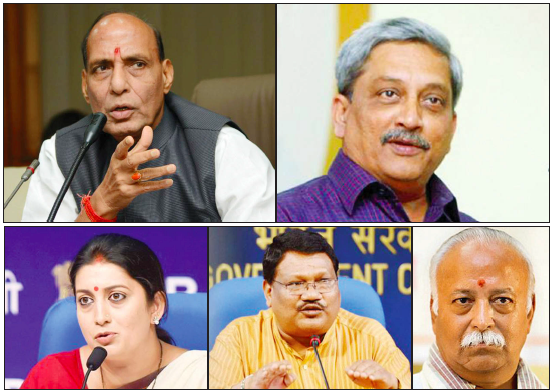
    Union Ministers Rajnath Singh (Home), Manohar Parikkar (Defence), Smriti Irani (Human Resource Development), Jual Oram (Tribal Affairs) spoke to 93 delegates, including RSS chief Mohan Bhagwat, about the challenges facing their Ministry.

    Although an annual feature in the RSS-BJP events calendar, this meeting is different in the sense that it is much bigger in terms of delegates, and the duration (three days instead of the two days normally reserved for it).

    The RSS told Mr. Rajnath Singh and Mr. Parikkar that the escalation in terror incidents needed to be tackled both by security forces and through political efforts.

    The government was advised that the people of Jammu and Kashmir need to be made aware of Pakistan-sponsored terror and its true nature. The RSS also expressed concern that the Hindu population had fallen under the “psychological” mark of 80% in the recently released census data on religious demographics.

    The reported rise in the population of minority communities in the border areas also came up for sharp comment. However, Hindu Bangladeshis were to be treated as refugees, was the common consensus.

    Ms. Smriti Irani was asked by the RSS to ensure, as much as possible, education in the mother tongue. “Value education and a breaking away from western values should also be part of the new education policy. Text books should add heroes from all walks of life,” reported a source as being the RSS’ contribution to the discussion.

    The organization’s prachar pramukh Manmohan Vaidya confirmed that the “samanwaya baithak today discussed scenario of national security, internal and external, besides the national education scenario.” The meeting concludes on Friday.

  • Lok Sabha Speaker Sumitra Mahajan views NRIs as India’s Ambassadors

    Lok Sabha Speaker Sumitra Mahajan views NRIs as India’s Ambassadors

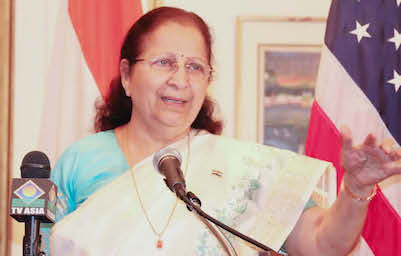
    NEW YORK (TIP): “Not only Ambassador Mulay or Ambassador Mukerji but you all are India’s ambassadors”, Mrs. Mahajan said to a gathering of Indian Americans. She was speaking at a dinner reception she hosted to the Indian American community at the Indian Consulate, September 1. Speaker Sumitra Mahajan was here, at the head of a large delegation, to attend the tenth annual meeting of Women Speakers of Parliament and the fourth world conference of Speakers of Parliament held between August 29 and September 2.

    Discussions were held on themes like more gender inclusive decision-making processes and bodies in democracy, innovations to end violence against women and harmful practices, in particular in conflict situations and efforts for financing for gender equality in development during the meeting.

    Mahajan made a presentation on “Development: Innovating for financing for gender equality ” during the meeting.

    Secretary General, Lok Sabha, Anoop Mishra accompanied the Speaker.

    Ms Majahan also attended the fourth meeting of Preparatory Committee of the Fourth World Conference of Speakers of Parliament in which India is a member.

    Deputy Chairman of Rajya Sabha PJ Kurien also attended the Fourth World Conference of Speakers of Parliament.

    Secretary General, Rajya Sabha , Shumsher K Sheriff accompanied  Mr Kurien.

    Earlier, Ms Mahajan was given a rousing welcome by the Indian American community present at the reception. Speaking on the occasion, India’s Consul General Dnyaneshwar Mulay spoke highly of the accomplishments and achievements of Ms Mahajan. He said she is the only woman Member of Parliament to be elected 8 times in a row from the same constituency.

  • Togadia, Sakshi seek curbs on Muslims over population growth

    Togadia, Sakshi seek curbs on Muslims over population growth

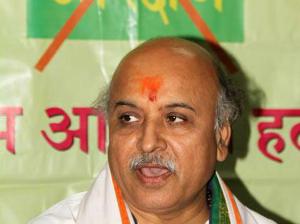
    New Delhi: Two senior Hindutava leaders have sought curbs on Muslims in view of the increasing population of the community as revealed in the recent census report. While VHP Working President Pravin Togadia has gone to the extent of demanding punitive measures against Muslims having more than two children for engaging in “population Jihad”, BJP MP Sakshi Maharaj said the community should be stripped of its minority status as it no longer deserved it due to its growing share in the population.

    Maharaj, who has sparked controversies in the past with his hardline Hindutva views, said Muslims were a majority in many districts and there number had risen to such a extent that there was no reason to accord them minority status. “They are no longer a minority. They say they are over a quarter of the population. In Kashmir, they are more than 90 per cent. There are many districts where they are 70, 80, 90 per cent, so what is minority about them,” he said.

    His comments came in the wake of the latest census figures which showed that Muslims’ share in the population had grown, while that of Hindus had fallen, inviting extreme comments from a number of right wing leaders.

    Alleging that “extinction” of Hindus could happen due to the “population jihad” of Muslims, Togadia has said having more than two children should be declared a criminal offence. “Rather than subsidising each birth of a Muslim kid, it is must that after two children, there has to be the strictest curb. Perhaps a punishable criminal offence and stopping rations, jobs, educational facilities will streamline the population facilitation towards better development,” he said in an article in RSS mouthpiece ‘Organiser’.

    “A serious extinction seems to be on the anvil. And it is of Hindus. There is method in the systematic growth of Muslims… Now, if we do not stand up against the ‘Population Jihad’, Bharat will soon be an Islamic state. It is also must to strictly implement two children norm irrespective of the political pressures … The latest Census figures are a wake-up call,” he had said.

  • Bihar polls: BJP may finalise seat sharing by September

    PATNA (TIP): Under pressure from its allies in Bihar to finalise the seat-sharing arrangement for the upcoming Assembly polls, the BJP indicated on Thursday that it would seal the deal in the first week of September.

    Speaking to reporters, BJP general secretary in-charge of Bihar Bhupender Yadav said they had informally met leaders of Lok Janshakti Party (LJP), the Rashtriya Lok Samata Party (RLSP) and the Hindustani Awam Morcha (Secular) over the seat-sharing arrangement and formal talks over the issue will be held in the first week of September. The BJP’s allies have been mounting pressure on the party’s leadership to finalise the seat-sharing arrangement at the earliest.

    Sources said the LJP wants to contest from 75 seats, while the RLSP has sought 66 seats for itself. Former CM Jitan Ram Manjhi-led Morcha is learnt to have demanded 40 seats. The BJP, on its part, wants to contest on at least 160 seats in the 243-member assembly. Yadav said the campaign in the state, led by Prime Minister Narendra Modi, has already put development on the centre stage of the campaign. He said Modi’s rallies had set off a “storm of change” in the state which Chief Minister Nitish Kumar and his foe-turned-ally Lalu Prasad ruled for 25 years between them.

  • From Nitish turf, Kejriwal targets PM Modi

    In the run-up to the Bihar Assembly polls, Delhi Chief Minister Arvind Kejriwal travelled to Patna on Thursday and threw his weight behind Chief Minister Nitish Kumar by calling him a sushashak (good administrator) during a state government function.

    Kejriwal also attacked Prime Minister Narendra Modi over his recent “DNA test” jibe and accused him of trying to “buy out” the people of Bihar with his special package. “It is wrong to challenge Bihar’s DNA. This state has given so many important people to the country. They (BJP) also targeted me before the Delhi elections and said that I came from an upadravi gotra (anarchist community). It backfired. Janta to bata deti hai (people give a befitting answer),” Kejriwal said. Speaking at a Bihar government function to celebrate the implementation of the Right to Public Services (RTPS) Act, the Delhi CM said his government planned to emulate Bihar’s successful RTPS model that had benefitted about 11 crore people.

    Calling the Central government “confrontationist”, he accused it of deliberately giving a thumbs down to Delhi government’s every move. The Delhi CM also claimed that AAP won Delhi after BJP’s resounding Lok Sabha win and at a time when it was winning almost every state election. Kejriwal, who was shown black flags by protesters outside the Patna airport, mocked the BJP for seeking votes with a promise to bring back black money and then focusing on yoga. “Yoga is a good thing but let there be clarity among people if you are seeking votes in name of black money or yoga,” he said. Kejriwal also accused the Centre of violating the spirit of cooperative federalism. As Kejriwal wrapped up his attack on AAP’s and JD(U)’s common political enemy, the Bihar CM thanked him for coming to the state and even reiterated his support for Kejriwal’s demand for full statehood for Delhi.

  • Bruised Gujarat limps to normalcy under army watch

    Bruised Gujarat limps to normalcy under army watch

    AHMEDABAD  (TIP): Ravaged by violence since August 25, Gujarat limped back to normalcy on Thursday, August 27, even as the army was moved into three more cities to curb tensions following riots that claimed ten lives, officials said.

    Besides Ahmedabad, soldiers joined paramilitary and state police in Surat, Rajkot and Mehsana to patrol the cities. Though there were no major incidents of violence on August 27, the situation remained tense, and roads were deserted in most major cities and towns.

    Schools and colleges were shut, and so were most shops, offices and commercial establishments.

    However, all government offices as well as public and private banks reported near normal operation on August 27.

    Curfew imposed in certain areas of Ahmedabad, Surat, Rajkot and other cities since Tuesday was relaxed on August 27, enabling residents to go out and buy essentials including milk, vegetables and medicines.

    But night curfew may continue in the worst-hit cities and localities, officials indicated.

    While auto-rickshaws and taxis started plying on Thursday, public transport, which bore the brunt of mobs in Ahmedabad, Surat, Vadodara and other cities, operated only partially.

    The BRT system, in which buses and stops were badly damaged, are expected to resume normal operations only by next week.

    The Gujarat State Road Transport Corp services also resumed partly after many buses were attacked and burnt. Rail tracks damaged by rioters were being repaired, delaying intra-state and inter-state services.

    The two days of unrest figured prominently in the Gujarat assembly where a vociferous Congress demanded the resignation of Chief Minister Anandiben Patel, forcing two adjournment of the house.

    The speaker suspended around 30 Congress legislators for the day after they rushed towards him shouting slogans against the government.

    Congress leader Rahul Gandhi targeted Prime Minister Narendra Modi for the violence in his home state.

    “Modi’s ideology is of anger… which is what is happening in Gujarat. Anger helps no one except Modiji,” Gandhi tweeted.

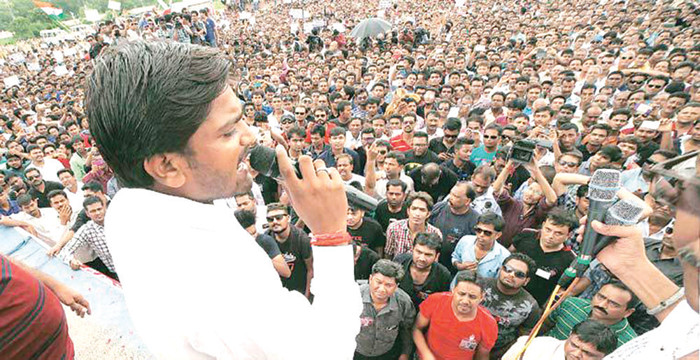
    In Ahmedabad, Hardik Patel, 22, the convener of Patel Anamat Andolan Samiti (PAAS), denounced the government for the police action on Patidars on Tuesdaywhich resulted in a riotous Wednesday.

    “Children and women were hurt. Police officers responsible for this should be suspended,” Patel said, warning that essential supplies to Ahmedabad would be stopped until the guilty policemen were punished.

    He demanded a compensation of Rs.3.50 million to the families of each victim killed in Wednesday’s violence.

    Most major cities and towns in Gujarat erupted from late Tuesday after police caned members of the Patidar community who had taken out a mammoth rally in Ahmedabad demanding caste-based reservations.

    By Wednesday evening, 133 companies of the Indian Army, Central Reserve Police Force, SRPF, RAF and BSF besides Gujarat Police were engaged in controlling violent mobs in various cities including Ahmedabad, Surat, Rajkot, Jamnagar, Morbi, Vadodara, Mehsana and Banaskantha.

    The PAAS mega rally saw the participation of 1.20 million Patidars seeking reservations in education and jobs, virtually swamping Ahmedabad on Tuesday afternoon.

    The ‘maha-revolution rally’, as the PAAS termed it, capped a 55-day long agitation across the state with scores of mini rallies in different towns and cities.

  • Modi rocks UAE, nets major gains

    Modi rocks UAE, nets major gains

    DUBAI (TIP): There are about 700 flights every week from India to the Gulf region, the largest to any foreign region, and yet it took 34 years for an Indian Prime Minister to visit it, said Prime Minister Narendra Modi to a cheering and highly charged up audience at the jam-packed cricket stadium here.

    The rockstar style address, UAE version of his Madison Square performance, generated a huge response and reflected his continued popularity with the NRIs. A home to over 2 million Indians or nearly 30 per cent of its population, a visit to the UAE by an Indian prime minister, was indeed, overdue.

    However, it was not just the visit but the signals it emanated after Modi’s talks with the UAE leaders that are of marked significance. The joint statement at the end of the visit has brought out India and the UAE together to focus on terror. The forthright condemnation of nations using religiously motivated terrorism against other countries reflects clearly India’s concern over Pakistan sponsored terrorism in India. The implicit reference to Pakistan found a resonance in Modi’s speech to the Diaspora where he asked the audience to guess where was it aimed.

    For India the references to the source of terrorism was a real strategic gain. It is seen as a major shift in UAE’s policy on the issue which had traditionally remained pro-Pakistan. However, to be fair, UAE had been emerging as a key counter-terror partner for India over the last few years. Long a safe haven for terrorists and fugitives like Dawood Ibrahim and Chhota Shakeel, the UAE has been of late more receptive to cooperation with India. Terrorists are finding it harder to use the UAE as a base. It is no longer providing shelter to the accused wanted in India for terror activities. In fact the 1993 Mumbai serial bombing accused Tahir Merchant is facing trail because the UAE authorities had nabbed him and had deported him to India. There have been several other instances of cooperation extended by UAE to the Indian authorities. It may be due to its realization of growing threat from terror groups but the India-UAE declaration has given a clear signal to those promoting religious terrorism.

    Apart from the indications towards Pakistan, Modi’s visit has yielded several other possibilities of mutual benefit. The $ 75 billion target for UAE investments in Indian infrastructure projects is part of the joint declaration. Bilateral trade between the two has grown to $30 billion (Rs 1.95 lakh crore). India is UAE’s second largest trading partner while UAE is India’s third largest trading partner. Remittances from the UAE total over $11 billion (Rs 71,500 crore) annually, sustaining the economies of states like Kerala.

    As per the January 2015 figures of the Ministry of Overseas Indian Affairs, over 7.2 million, or a quarter of the total overseas Indian population of 28 million live in the six Gulf countries of Bahrain, Kuwait, Oman, Qatar, Saudi Arabia and the UAE. Some 50 per cent are in unskilled or semi-skilled jobs, and 30 per cent are in medium-skilled professions. Only about 20 per cent Indians are highly skilled professionals. The largest chunk of remittances to India comes from the UAE -some estimates put it as high as US $ 12 billion per annum.

    The visit also assumed significance because Modi had been criticized for looking East and West but had been ignoring the Islamic world. That perception no longer holds good. Apart from Bangladesh, the prime minister had recently visited several Muslim-majority Central Asian countries last month both before and after the BRICS and SCO summit meetings in Ufa, Russia.

    His two-day visit to the UAE is, however, important for two other specific reasons. First, it re-established the balance between the Modi government’s lean-Israel policy and the Arabian Gulf states. Second, with the UAE playing an active role in the Saudi Arabia-led war in Yemen against the Shia Houthis, India needs to deepen counter-terrorism links in the Middle-East. The UAE, also Sunni majority, remains largely peaceful but its participation in the Yemen war as well as strikes by its Air Force over IS positions in Syria make it vulnerable to future terrorist attacks. Obviously, this vulnerability has made the UAE take India’s concerns over terrorism seriously.

    The prime minister’s visit to the Sheikh Zayed Grand mosque in Abu Dhabi was a political coup. The UAE has also now pledged to allot land for the construction of a Hindu temple, an announcement that was greeted with a huge applause in the Dubai Cricket ground.

    Unlike Indians settled in the US and many other countries, Indians in the UAE are mostly unskilled workers. And unlike other NRIs elsewhere, they are not citizens of the country where they work. They will have to one day return to India. Modi obviously also had an eye on the voters back home. Little wonder he mentioned sawa crore des wasio even when he was speaking to a limited audience in the cricket ground.