Tag: Indian Politics

  POLITICS & POLICY  

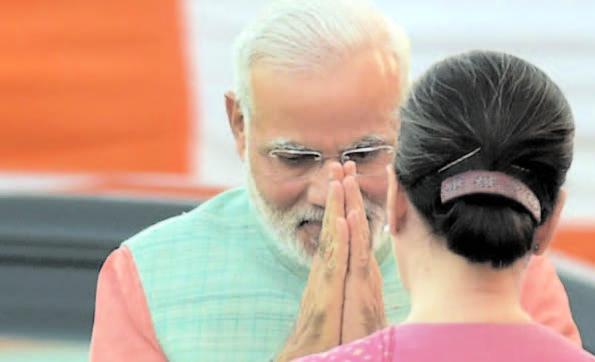
  • India-Bangladesh land boundary deal passed, Modi thanks Sonia

    India-Bangladesh land boundary deal passed, Modi thanks Sonia

    NEW DELHI (TIP): The Parliament on May 7 passed the constitutional amendment bill regarding the land boundary agreement with Bangladesh, following which Prime Minister Narendra Modi personally thanked Congress president Sonia Gandhi for Opposition’s support over the legislation.

    The Prime Minister expressed his gratitude towards the Opposition and went to thank Sonia Gandhi personally after the passage of the Bill in Lok Sabha.

    PM Modi also tweeted that alongwith Sonia, he thanked Congress’ Mallikarjun Kharge, CPIM’s Sitaram Yechury, BSP supremo Mayawati, Samajwadi Party chief Mulayam Singh Yadav, BJD chief Naveen Patnaik and JDU leader Sharad Yadav.

    The Prime Minister also conveyed his gratitude to NDA allies for their support to the India-Bangladesh Land Boundary Bill.

    The PM also took to Twitter to thank the Opposition, wrote: “My thanks to all the political parties for their cooperation, as also to the states of Assam, Meghalaya, Mizoram, Tripura & West Bengal.”

    He also spoke to chief ministers of bordering states –West Bengal’s Mamata Banerjee, Assam’s Tarun Gogoi, Tripura’s Manik Sarkar, Meghalaya’s Mukul Sangma and Mizoram’s Lalthanhawla — to thank them for support to the Land Boundary Bill that provides for exchange of territories with Bangladesh.

    The bill had been unanimously passed by the Rajya Sabha on Wednesday and on Thursday it received Lok Sabha`s unanimous nod.

    Earlier in the day, External Affairs Minister Sushma Swaraj had moved the Constitution (One Hundred and Nineteenth Amendment) Bill, 2013, for passage of the bill and said it had been passed unanimously by the Rajya Sabha on Wednesday.

    “There was no vote against it and there was no abstention (in the Rajya Sabha). It sent a message to Bangladesh that all political parties are one on the issue. I will request that it is passed with the same spirit in the Lok Sabha as it will send a good message,” she said.

    The bill, which entails exchange of enclaves between the two countries, seeks to amend the First Schedule of the Constitution to give effect to an agreement entered into by India and Bangladesh on acquiring and transfer of territories between the two countries on May 16, 1974.

    Sushma Swaraj said that while the Bangladesh parliament had ratified the 1974 land boundary accord between two countries, the Indian parliament had not done so as demarcation had not been completed on the ground.

    She said then prime minister Manmohan Singh signed the protocol for transfer of territories during his visit to Bangladesh in 2011.

    The minister said the Constitution amendment bill was presented in the Rajya Sabha by the then United Progressive Alliance government in 2013 but the Bharatiya Janata Party, Trinamool Congress and Asom Gana Parishad had opposed it at the time.

    She said that while the AGP and the BJP felt that it overlooked interests of Assam, West Bengal was keen on a package for people who would come to the state as a result of implementation of the agreement.

    Sushma Swaraj said as foreign minister she chose Bangladesh as the country for her visit abroad, and Bangladesh Prime Minister Sheikh Hasina had urged her to move forward with the agreement.

    She said Prime Minister Narendra Modi told her to work towards removing hurdles in the implementation of the agreement.

    Sushma Swaraj said West Bengal Chief Minister Mamata Banerjee wanted a package from the central government and it had been agreed upon.

    The minister said she had moved the cabinet to keep Assam out of the implementation of agreement but the Congress was willing to support the bill only if the state was included.

  • Cameron reprises Modi slogan for reelection

    Cameron reprises Modi slogan for reelection

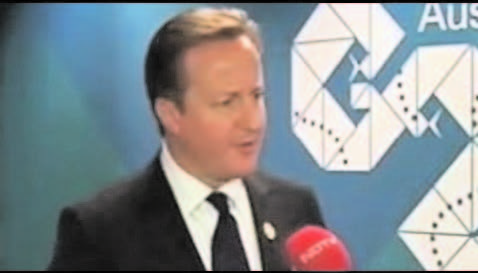
    LONDON: British Prime Minister David Cameron appears to have discovered a new electoral language: Hindi. Speaking to a TV correspondent on April 30 while crisscrossing UK in a frenetic election campaign, Cameron was asked if there was anything he’d like to tell voters of Indian origin.

    “I’ll try,” said Cameron. “Phir ek baar, Cameron Sarkar.” It was a take-off on his Indian counterpart Narendra Modi’s successful poll mantra last year that went ‘Abki baar, Modi Sarkar’. Cameron also described Modi’s 3D holograms used during the election campaign as “very impressive”.

    “I’ve seen the holograms. Britain is the oldest democracy but a small country. We haven’t used the hologram yet, but who knows we might in the next 12 days?” said Cameron.

    The British PM’s remarks came a day after the Conservative party, released a song in Hindi: Aasman Neela Hai (the sky is blue). He also spoke about British ethnic voices finding increasing space in parliament, police and other wings of governance, and that more will be done in these directions in the weeks and months ahead.

    Saying he expects Modi in UK before long, Cameron said Britain takes India very seriously, evident in the deepening of bilateral relationship. “You’ve got a government with a clear plan. We take the same approach here. The key is to run the country and the election campaign at the same time.”

    British Asian votes would be a significant factor during May 7 elections and Cameron’s outreach is seen as recognition of the importance of Indian votes to the Conservative party.

  • RAFALE DEAL MAY BE CONGRESS’S NEXT WEAPON TO TARGET MODI GOVT

    RAFALE DEAL MAY BE CONGRESS’S NEXT WEAPON TO TARGET MODI GOVT

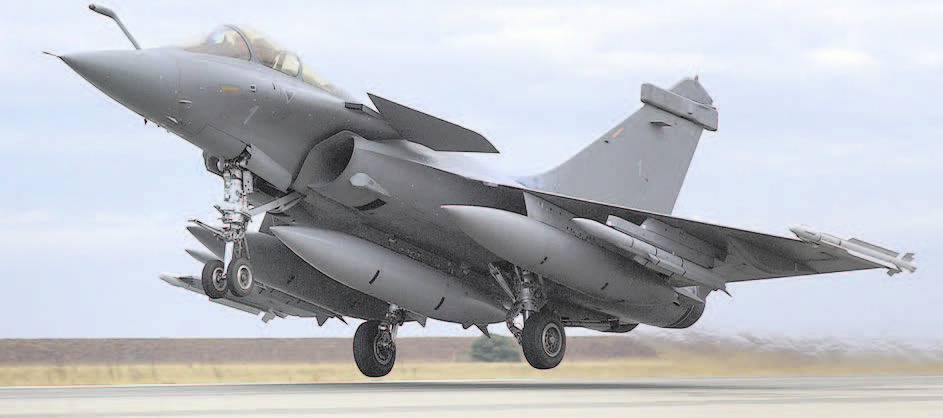
    NEW DELHI (TIP): Congress is likely to probe the government on how Prime Minister Narendra Modi’s announcement to buy 36 Rafale fighters reconciles with his “Make in India” objective, seeking to get back at the Centre by painting the deal with France as a compromise on manufacturing.

    Sources said party vice president Rahul Gandhi has suggested that Congress focus on the blow the Rafale deal may give to local manufacturing. In contrast, UPA’s deal had put a condition that 108 of the 126 fighters would be manufactured in India. While BJP too espoused “Make in India” in weapons acquisitions, the decision to buy 36 planes off-the-shelf has raised doubts, claim Congress men.

    Congress has been mulling ways of raising the issue in Parliament but is hobbled by the absence of details.

    Former defence minister AK Antony is learnt to have told the party that it may be premature to touch the subject because there is still no agreement between India and France and that Modi’s much-feted announcement of a government-to-government sale earlier this month in Paris remains more an expression of intent.

    If the 90 remaining fighters are also purchased directly, the local manufacturing component would be dead, claim Congressmen.

    Antony’s opinion was cited during a strategy session when Rafale subject came up. However, sources said, Rahul suggested that the party could focus on “Make in India” to seek a response from government.

    Since UPA had ensured a built-in condition that 108 would be manufactured by HAL with technology transfer, it is argued the course taken by the Modi regime could end the possibility of local assembling.

    A final decision on the issue may be taken at the Political Affairs Committee that comprises Congress MPs from Lok Sabha and Rajya Sabha.

    The intent would be to show that the Centre was failing in delivering on its promises despite grand slogans.

    However, the limited focus on Rafale deal being a blow to “Make in India”, if also technology transfer, falls short of the indignation in Congress over the way Modi regime has slammed UPA over defence acquisition.

    Defence minister Manohar Parrikar blamed Antony for delay in buying the fighters, suggesting the direct buy from France was a consequence of UPA’s failure to clinch the deal.

    A senior Congress manager alleged there was no transparency in the new deal, but agreed that absence of an agreement was restraining the party from raising the issue strongly. “The role of HAL in Rafale is under serious doubt now. The government would have to clarify it,” he said.

  • India, China to boost maritime cooperation during PM Modi’s visit

    NEW DELHI (TIP): China may allow India access to the Western Pacific Ocean, while India may countenance Chinese presence in the Indian Ocean. When Prime Minister Narendra Modi travels to China in a couple of weeks, the two Asian powers may sign an innocuous-sounding “scientific cooperation” agreement.

    In reality, it has deeper significance – first, an acknowledgement that India and China are the big powers in these ocean areas and second, acknowledgment of the growing reach of both countries in what is considered their strategic backyard. There are few details available about the proposed agreement, but sources said this could imply India-China cooperation at a different level.

    Any India-China document for cooperation in the oceans will be set up against the strategic vision document on Asia-Pacific and Indian Ocean region between the US and India signed during US President Barack Obama’s January visit. That particular agreement, whose strategic implications reverberated outside India, had compelled the rest of Asia to sit up and take note of the evolving US-India equation, largely because it set out an “acceptable” code of conduct in the region.

    India and China have already agreed to start a maritime cooperation dialogue, as set out in the joint statement when Chinese President Xi Jinping visited India in September. “The two sides decided to hold the first round of maritime cooperation dialogue within this year to exchange views on maritime affairs and security, including anti-piracy, freedom of navigation and cooperation between maritime agencies of both countries.”

    The political dialogue between Modi and Xi Jinping will hold greater value. China watchers have predicted a possible breakthrough discussion on resolution of the boundary dispute that continues to be a thorn in bilateral relations.

    While a resolution may be ambitious at this stage, analysts agree that an exchange of maps in the western sector would be a big step forward.

    China may also conduct a feasibility study of a high speed railway corridor between Delhi and Chennai. As a start, they will conduct a “pilot project” for a certain part of the route, said sources. Japan is already in the final stages of conducting a feasibility study for a Shinkansen (bullet train) corridor between Mumbai and Ahmedabad, while France has agreed to study upgradation of railway link between Delhi and Chandigarh to a semi-high speed line. With the Modi government focused on reviving the railways as an engine of growth and connectivity in India, China, France and Japan will become big players in this area. China has made a huge success of its own high speed railway system, now the largest in the world.

    Modi is expected to begin his trip in South Korea, then to China and ending up in Mongolia. On 14th May, he will accompany Xi Jinping to his hometown in Xian, which holds historical significance particularly with regard to the silk route.

  • Prime Minister Narendra Modi concludes visit to Canada with 13 agreements with the host country

    Prime Minister Narendra Modi concludes visit to Canada with 13 agreements with the host country

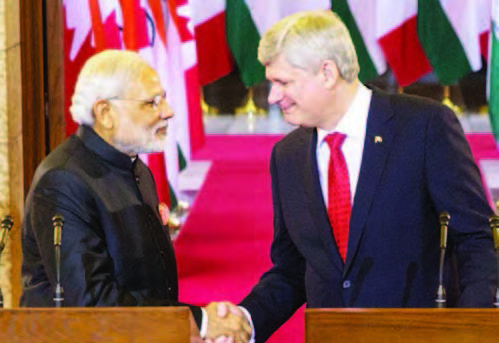
    VANCOUVER (TIP): Prime Minister Narendra Modi’s  “Initiative sign pacts and agreements” continued during his Canada visit where  India inked a deal with Canada for supply of uranium for its nuclear reactors, capping negotiations on safeguards that started five years ago. Modi himself made the announcement following talks with Canadian counterpart Stephen Harper.

    Under an agreement signed on Wednesday, April 14, after comprehensive talks Modi had with Harper, Cameco Corporation will supply 3,000 metric tons of uranium over five years to India for $254 million. The supply may begin in a year.

    “The agreement on procurement of uranium from Canada for our civilian nuclear power plants launches a new era of bilateral nuclear cooperation,” said Modi in his joint presser with Harper. This was the highlight of total 13 pacts that the two countries signed that also included a pact on space cooperation. “It also reflects a new level of mutual trust and confidence. Further, it will contribute to India’s efforts to power its growth with clean energy,” Modi said.

    A jubilant Modi, in his address to the Indo-Canadian community boated that what others could not do in 42 years, he achieved in 10 months.

    Modi and Harper also resolved to fight terror jointly. “We in India felt Canada’s pain when this city was struck by a senseless act of terrorism…

    We will deepen our cooperation to combat terrorism and extremism. We will also promote a comprehensive global strategy, and consistent policy and action against all sources of terrorism and its support,” said Modi.

    The two countries also decided to strengthen defense and security cooperation and decided to cooperate to stabilize the Asia Pacific region. Modi also announced Electronic Visa Authorization for tourist visa for Canadian nationals. They will also be eligible for 10-year visas now. The two countries also agreed for new framework for economic partnership.

    “I am confident that we can conclude the Bilateral Investment Promotion and Protection Agreement very soon. We will also implement the road map to conclude the Comprehensive Economic Co-operation Agreement by September 2015,” the PM said on deepening economic cooperation. India and Canada had signed a civil nuclear cooperation deal in 2010. It was followed by the signing of an administrative arrangement in 2012 under the Manmohan Singh government.

    Prime Minister Narendra Modi on April 17 visited a gurdwara and a temple in Vancouver in the final leg of this three-day visit to Canada which ends today. Later, the Prime Minister is scheduled to attend an official dinner hosted by his Canadian counterpart Stephen Harper, before departing for India.

    With their heads covered with a cloth -customary before entering a gurudwara – PM Modi and Prime Minister Harper offered prayers at the Gurdwara Khalsa Diwan. Later, both visited the Laxmi Narain Temple where Modi received a rousing reception. Saying that he was honoured to host one of the world’s great leaders, PM Harper said that India and Canada were “natural partners”.

    Earlier, on April 16 Modi, accompanied by Prime Minister Harper, visited the memorial in Toronto for the victims of Air India Flight 182 that was bombed in 1985, killing all 329 people on board. 268 of them were Canadian citizens, mostly of Indian descent. There were 24 Indian and 27 Britons as well.

    Air India Flight 182, a Boeing 747 named “Kanishka”, flying on the Montreal-London-New Delhi route on June 23, 1985, crashed into the Atlantic Ocean after being bombed while in Irish airspace.

  • WHY INDIA MATTERS TO CANADA

    WHY INDIA MATTERS TO CANADA

    For two countries that Prime Minister Stephen Harper calls “natural partners” in a new global economy, Canada and India might appear to share a rather meek business relationship.

    Not even one per cent of Canadian exports currently ship to India, with goods exports around $3.1 billion in 2014 – less than one-sixth what Canada exports to China.

    Promising to open India to global commerce, Indian Prime Minister Narendra Modi’s historic three-day Canadian tour this week seeks to change that.

    His trip ends a 42-year dry spell since a head of state from the world’s largest democracy visited to talk bilateral relations.

    As Harper pushes for a free-trade pact with Modi, Canadian economists and business leaders representing South Asian professionals lay out their case for why India is a social, political, cultural and economic force that matters.

    1. A hot opportunity

    “Let’s not forget there’s a race to get to India’s door,” says Jaswinder Kaur, director of the Canada-India Centre of Excellence in Ottawa.

    “We’re competing against Japan, the French, the Australians, and this is an opportunity for Canada to demonstrate how we can contribute and make a true partnership.”

    Canada’s Global Markets Action Plan identified India as a priority market, with a burgeoning economy and roughly 11 million people under 30 entering the workforce each year.

    India has for years remained the largest market for Canada’s pulses (grain legumes such as lentils and peas), and Canada also supplies lumber and potash.

    “But are Canadian companies ready to do business?” Kaur says. “That’s where the real work is going to begin.”

    The International Monetary Fund projects that by 2016, India’s GDP growth will outpace that of China’s becoming the fastest-growing major economy in the world.

    In the meantime, two-way bilateral trade has grown to $6 billion, up 47 per cent since 2010, when trade was around $4.09 billion.

    2. Energy demands

    Much has been made, Kaur notes, of Modi “shopping for uranium” as part of this Canadian tour.

    India needs the radioactive element to feed its nuclear reactors, and Canada has a vast supply.

    ‘Mr. Modi will be looking for a signed contract for Canada to be a supplier of uranium, as India desperately needs energy as it expands.’ – Elliot Tepper, Carleton University South Asian studies professor

    If Ottawa allows, Saskatchewan-based Cameco Corp. could resume uranium exports to India following a ban 40 years ago, when India was accused of testing a nuclear weapon in 1974, and then again in 1998, using Candu technology supplied by Canada.

    “Since then, our relations have slowly climbed back up to the point where we have a nuclear agreement,” said Elliot Tepper, a South Asian studies professor at Carleton University.

    “Mr. Modi will be looking for a signed contract for Canada to be a supplier of uranium, as India desperately needs energy as it expands, and wants to rely more on nuclear power.”

    Meanwhile, Canadian natural gas and oil will continue to be useful resources to India.

    3. Young population

    The under-35 demographic represents more than 65 per cent of India’s population, and many of them are migrating from rural areas to cities searching for education and employment, both of which Canada can help supply.

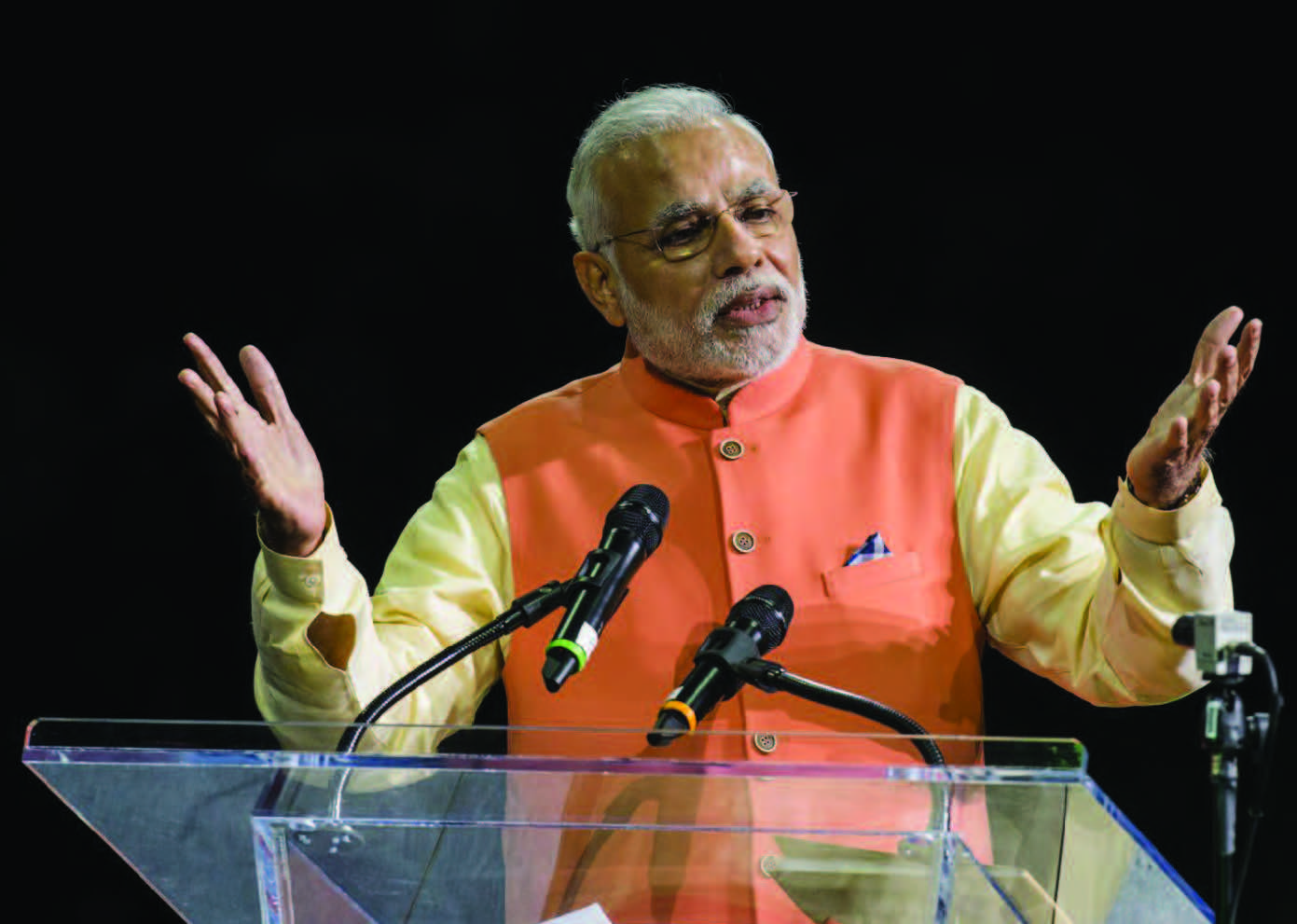
    Open for business. India’s Prime Minister Narendra Modi addresses the world’s largest industrial technology fair, the Hannover Messe, in Hanover, Germany, earlier this month. He has been on something of a world tour, trying to drum up industrial investment in job-hungry India.

    Modi’s “Make in India” initiative is encouraging international firms to set up manufacturing plants in India to spur job creation at home and become a low-cost alternative to China.

    Flipping the saying that China will grow old before it grows rich, Gary Comerford, president of the Canadian Indian Business Council, believes

    “India will grow wealthy before it grows old.”

    Over the last decade, he says, a large number of Indians have “pulled themselves out of poverty” and into a rising middle class.

    “And that means they’re consuming,” Comerford says of the next generation of big spenders. “They’re getting a fridge, a TV, a cellphone.

    “If you take that sheer population of 1.2 billion and convert it into a consuming group, as well as being an economic powerhouse, it will be a political powerhouse as well.”

    4. Cross-cultural understanding

    India remains a democracy with a “remarkably pluralistic society,” which Canada can appreciate as a state that welcomes diversity as a foundation of the country, says Tepper.

    Two business-friendly PMs, India’s Narendra Modi and Canada’s Stephen Harper chat at the G20 summit in Australia in November. (The Canadian Press)

    “That makes our two countries both natural allies and rather special in terms of the states of the world,” he says, adding that the two countries have worked together quietly for years on such things as counter-terrorism and sharing concerns about violent extremists.

    University of Toronto professor Kanta Murali, who analyzes Indian politics at the Centre for South Asian Studies, points to a 1.2 million-strong Indian diaspora in Canada as “central to the excitement surrounding Modi’s visit.”

    A shared history under British colonial rule, a broadly English-speaking population and a democratic system add to a sense of kinship, adds Comerford.

    5. A knowledge economy

    According to Dherma Jain, president of the Indo-Canada Chamber of Commerce, more than 15,000 Indian students have decided to pursue foreign studies at universities and colleges in Canada.

    Modi’s visit is expected to seal some educational co-operation agreements such as twinning programs, Tepper said.

    “Canada will be providing expertise that India invites as it wants to upscale its own capacity, from technology to agriculture, and attracting people to come to Canada instead of going elsewhere,” he said.

    India is interested in harnessing green tech as well, notes Karunakar Papala, chairman of the Indo-Canada Ottawa Business Chamber, which represents some 600 business owners in the capital.

    Modi’s plan for India to develop 100 high-tech “smart cities” that are more energy and resource efficient, could benefit from Canadian know-how. (The Indian prime minister made a similar pitch when he visited Germany recently.)

    “Solar technologies, green technologies, Canada has got a lot to offer there,” Papala said.

  • Is Hindutva baggage diluting Modi’s development focus?

    Is Hindutva baggage diluting Modi’s development focus?

    RSS’ Hindutva baggage is once again haunting Prime Minister Narendra Modi  and this time criticism against it has come from an unlikely quarter: the India Inc.

    According to a report in the Times of India, corporate chieftains are increasingly getting disillusioned with the NDA government, which will complete a year in office next month. The reasons for this are two fold: for one, the tax demands being slapped on some of the companies and secondly, “the seemingly unchecked Hindutva agenda of some right wing groups”, the ToI report said.

    Tax notices had been a concern for businesses ever since Pranab Mukherjee introduced retrospective tax in 2012, when he was the finance minister. There have been a slew of tax litigations between corporates and the government ever since. What is creating a heartburn for the business community now is the fear that the NDA government may be continuing with the ‘tax terrorism’ of the UPA, which finance minister Arun Jaitley had recently promised to end.

    According to reports, the income tax department has slapped $5-6 billion as minimum alternate tax on nearly 100 foreign funds. The amount is likely to rise to $10 billion, a PTI report said. This comes close on the heels of the department demanding $3.3 billion tax from Cairn India on the gains it had got when it transferred shares to parent company some 8 years ago.

    Jaitley’s clarification that these are legitimate demands has only heightened the worries of the business community.

    Interestingly, the ‘ease of doing business’, which had been businesses main grudge against the erstwhile UPA government, seems to be no longer a big issue for the corporates. This appears to have been replaced with the ‘Hindutva agenda’.

    “…As a secular nation, we must avoid any form of fundamentalist activity. Random fascist comments lead to communal disharmony and should be dealt with severely,” RPG Group chairman Harsh Goenka has been quoted as saying in the ToI report.

    The report also cites another un-named banker who also has raised worries about the Hindutva agenda.

    The business community’s concerns are not displaced given some of the recent church attacks that have unsettled the Christian community and the conversion drive under the name of ‘Ghar Wapsi’ being undertaken by right wing organizations like the Vishva Hindu Parishad and the Rashtriya Swayamsevak Sangh.

    What is making the matters worse is the insensitive and ill-informed comments made by some of the RSS leaders and even BJP ministers about various issues, ranging from science to gender equality.

    The business honchos’ concerns about the Hindutva assume significance also because rarely do they get vocal about such sensitive issues. One earlier instance was in the aftermath of the Gujarat riots, in which thousands of Muslims and Hindus were killed in clashes.

    Rahul Bajaj, one of the most outspoken industrialists in India, had termed 2002 as the “lost year” for Gujarat because of the riots. He even questioned the leadership of Modi, who was the chief minister of Gujarat during the riots.

    “We would like to know what you believe in, what you stand for, because leadership is important. You are today the undisputed leader of your party and government in Gujarat and we want to know you better…We are prepared to work with governments of all hues, but we also have our own views on what is good for our society and what works for it,” Bajaj told Modi at a CII function.

    The industry leaders now seem to be echoing Bajaj’s sentiment then. This is because Modi, as the prime minister, has not taken any concrete steps yet to address the increasing right wing menace. And the business community has every reason to be worried because, as FICCI president Jyotsna Suri told ToI, “It (statements by the saffron hotheads) is certainly diluting the focus and is uncalled for.” 

  • Will ensure equality to people of all faiths, says Modi at UNESCO event

    Will ensure equality to people of all faiths, says Modi at UNESCO event

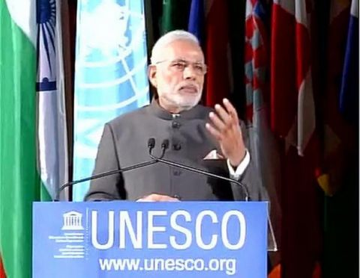
    Paris: At a time when India is witnessing increased activities of right-wing groups, Prime Minister Narendra Modi on Friday said his government will defend the rights of citizens of all faiths.

    Modi, during his address at the UNESCO headquarters here, also asked the global community to dwell deep on culture and religion to overcome the rising tide of extremism as well as violence.

    “We will defend and protect the rights and liberty of every citizen. We will ensure that every citizen, of every faith, culture and creed has an equal place in our society; belief in our future; and the confidence to pursue it,” he said.

    Noting that culture remains a source of conflict in many parts of the world, Modi said it must connect and not divide and that it should be a bridge to greater respect and understanding between people. “We must turn deep into our cultures; traditions; and religions; to overcome the rising tide of extremism, violence, and divisions across the world,” said the Prime Minister.

    The Modi government is under attack from opposition parties as well as some minority community groups for not being able to curb the activities like ‘Ghar Wapsi’ (conversions) by RSS-backed groups.

    Calling climate change a pressing global challenge, the Prime Minister who arrived here late last night, said his government has set a target of adding 175,000 MW of clean and renewable energy in the next seven years.

    His remarks come ahead of a crucial UN meet on climate change to be held here later this year.

    Modi also noted that the foundation of India’s Constitution rests on a fundamental principle of the peace and prosperity of all. “The strength of the nation is determined by the joined hands of every citizen; and, real progress is measured through empowerment of the weakest,” he said.

    Earlier, he paid floral tributes at the bronze statue of spiritual leader Sri Aurobindo at the UNESCO headquarters.

    During his 20-minute speech, Modi referred to the teachings of Mahatma Gandhi as also philosopher sage Aurobindo, at whose statue outside the UNESCO building he paid his respects.

    “There is much that we can learn from his humanism and spiritualism, from his belief in the unity of individual consciousness with the world outside; the enlightened purpose of education; the service of science; and, the unity of world, founded on national freedom, diversity of civilisations and autonomy of culture,” he said.

    Noting that the link between habitat and fulfilment of human potential is deep and strong, he said, “It is a guiding spirit for the purpose of this institution — the defence of peace in the mind of men”.

    Among those who were present in the audience were Adani Group chairman Gautam Adani, senior Congress leader Karan Singh, who is on the Executive Board of UNESCO, as also Bollywood actress Mallika Sherawat, who was mobbed by several NRIs for photographs. “The highest priority for my government is to provide a roof over every head; power in every house; sanitation and clean water within everyone’s reach; a hope for every child to survive; and a chance for every new mother to love her child,” Modi said.

    “It also means clean rivers, air that we can breathe and forests filled with the sound of birds. To achieve these goals, we need not just policies and resources, but even more the power of science,” he said.


  • Mallika Sherawat to be the ONLY Bollywood celebrity attending PM Narendra Modi’s speech at UNESCO

    Mallika Sherawat to be the ONLY Bollywood celebrity attending PM Narendra Modi’s speech at UNESCO

    Mallika Sherawat may not be reaching in news due to the choices made by her in her career but the actress has won herself a seat at PM Narendra Modi’s speech at UNESCO,which will be held today. Now that’s a first. The B-town star tweeted about the same writing,” ”Feel honored to be invited, looking forward to hearing our Prime Minister Shri Narendra Modi’s speech.” Check out the picture of the invitation below:

    We hear that the actress is the only Bollywood celebrity who has been invited for Modi sahab’s speech. Her political thriller Dirty Politics may not have impressed at the box office but has surely left an impression on politicians? We wonder why no one else from the fraternity has been invited for the speech.

    A source close to the actress revealed,”Mallika thinks highly of Narendra Modi. She is excited that she was invited and is waiting to hear his speech.”

    We hope the actress enjoys the speech. After all, when Modi speaks, the nation is bound to get hooked! 

  • I wish I could Listen To Ghulam Ali: Modi

    I wish I could Listen To Ghulam Ali: Modi

    India’s elected Prime Minister Narendra Modi was invited to participate in the Music Festival at  India’s ghulam Alihistorical sankat Mochan temple, but he apologized because of engagements.

    Modi said on Twitter on Tuesday ‘I wish I could get a chance to go to the fair, where many famous artists who delight audiences sometime in the future’

    I have listened to Ghulam Ali in the past and now have learned from the newspapers that Ghulam Ali expressed desires that I should come to the event. Unfortunately, I will not be able to.

    Modi said in another tweet that the festival is no less than a treat for music lovers.

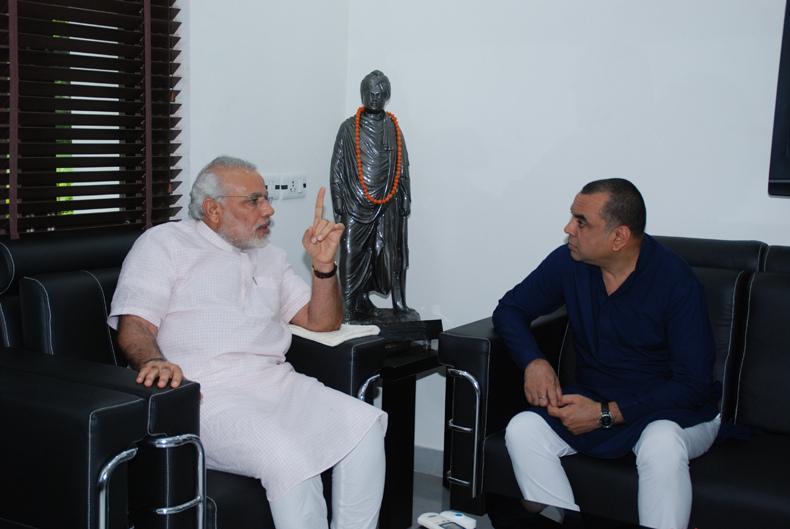
  • Actor Paresh Rawal to do a Narendra Modi Biopic- says will not mimic PM Modi, will try to capture his spirit:

    Actor Paresh Rawal to do a Narendra Modi Biopic- says will not mimic PM Modi, will try to capture his spirit:

    Actor Paresh Rawal is looking forward to the shooting of the Narendra Modi biopic and feels it’s a massive responsibility as an artiste to don the role of Indian Prime Minister.

    The yet-to-be titled film, which will go on the floor in August, will be produced by Rawal, the actor’s second production venture after “Oh My God!”.

    “I will start shooting the Narendra Modi biopic from August. It’s a massive responsibility being an actor to portray a leader of such great stature. He knows that I am playing him in his biopic,” Rawal told reporters here.

    For the Modi biopic, the national-award winning actor says he will have to research a lot before starting the shoot, adding he will not mimic him.

    “Like the way I did during my stint in playing Sardar Patel in the film ‘Sardar’, here also I have to do loads of photo reading and listen to his speeches. But I will not mimic him. I will try to capture his spirit. I know very well that I can never look like Modi,” said Rawal.


    Now this is some interesting news, we would love to watch the multi talented actor soon in a challenging role.


  • MODI TO VISIT CANADA FROM APRIL 14

    MODI TO VISIT CANADA FROM APRIL 14

    NEW DELHI (TIP): Prime Minister Narendra Modi will reach Ottawa on April 14, ending a 42-year-long hiatus in bilateral visit by an Indian prime minister to Canada.

    Indira Gandhi was the last Indian prime minister to travel to Canada on a bilateral visit in June 1973.

    Manmohan Singh, who held the office for 10 years since 2004, had also traveled to Canada in 2010, but to attend the G-20 summit in Toronto and not for a bilateral visit.

    Ever since he took over as the prime minister on May 26 last year, Modi has traveled to several countries for bilateral visits which were not on the agenda of his predecessors for a long period of time.

    His tour to Nepal in August 2014 was the first bilateral visit by an Indian prime minister in 17 years. I K Gujral was the last prime minister to embark on a bilateral visit to Nepal in June 1997.

    Modi was the first Indian prime minister to visit Australia in 28 years since Rajiv Gandhi did so in 1986. His visit to Fiji, too, was the second by an Indian prime minister after Indira Gandhi’s visit to the island nation in 1981.

    His recent visit to Seychelles was also the first by a prime minister since 1981, when Indira Gandhi had visited the country.

    Syed Akbaruddin, official spokesperson of the Ministry of External Affairs, said that Modi would travel to Canada from April 14 to 16 – after visiting France and Germany from April 9 to 13.

    Apart from meeting Canadian Prime Minister Stephen Harper, Modi will address a conclave of Indian and Indian-origin people living in Canada, he said.

  • INDIA, SRI LANKA SIGN 4 PACTS DURING MODI VISIT

    INDIA, SRI LANKA SIGN 4 PACTS DURING MODI VISIT

    COLOMBO (TIP): India and Sri Lanka on March 13 signed four bilateral pacts — agreement on visa, customs, youth development and building Rabindranath Tagore memorial — during Prime Minister Narendra Modi’s first tour to the island country.

    Modi’s visit to Sri Lanka is the first stand alone bilateral tour by an Indian Prime Minister since 1987.

    “I am delighted to be in Sri Lanka,” PM Naredra Modi said.

    “India is ready to help Trincomalee become a petroleum hub,” PM Narendra Modi said at the joint press meet with Lankan President M Sirisena.

    Prime Minister Narendra Modi said that fishermen’s issue between India and Sri Lanka has both livelihood and humanitarian dimensions and it will take some time to reach an amicable solution on this.

    “We will cooperate in developing a Ramayana trail in Sri Lanka and a Buddhist Circuit in India,” Modi said.

    “Our trade has seen impressive growth over the past decade,” the PM said.

    PM Modi also said that India will extend visa-on-arrival to Lankan citizens.

    The PM said that he was eagerly looking forward to early commencement in the Sampur coal power project in Sri Lanka.

  • Former Outlook Editor Vinod Mehta passes away after prolonged illness at 73

    Former Outlook Editor Vinod Mehta passes away after prolonged illness at 73

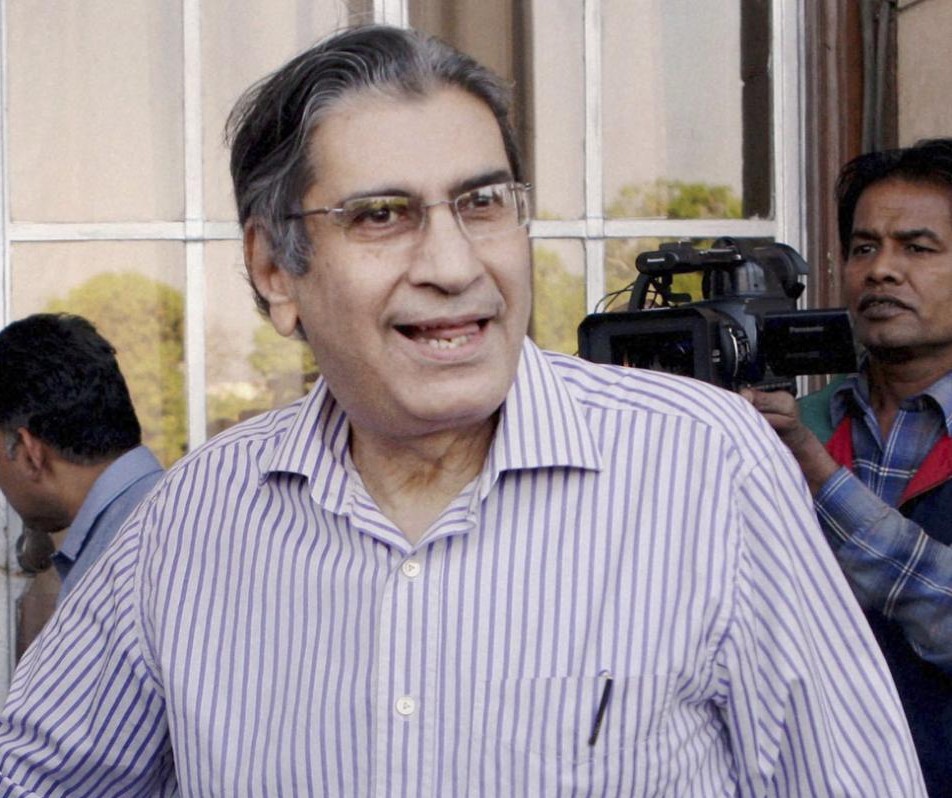
    NEW DELHI (AP) — Vinod Mehta, founding editor of India’s Outlook magazine and a fearless and irreverent commentator on Indian politics, died Sunday. He was 73.

    Mehta died of multiple organ failure at New Delhi’s All India Institute of Medical Sciences, said hospital spokesman Amit Gupta.

    In a career spanning four decades, Mehta launched several newspapers and magazines. But he was best known for his trenchant editorial columns on politics and the shenanigans of Indian politicians.

    Mehta was born in the city of Rawalpindi, in present-day Pakistan, in 1942. He spent his childhood in Lucknow, India.

    In 2011, he published his best-selling memoirs, “Lucknow Boy,” followed a couple of years later by “Editor Unplugged.”

    Mehta was the founding editor of newspapers such as the Sunday Observer, the Indian Post, The Independent and the Delhi edition of The Pioneer. In 1995, he founded Outlook, a weekly news and views magazine. He was a popular commentator on television chat shows, well known for his fiercely independent views.

    Indian Prime Minister Narendra Modi tweeted: “Frank & direct in his opinions, Vinod Mehta will be remembered as a fine journalist & writer. Condolences to his family on his demise.”

  • PM Modi furious with absent MPs after humiliation in Rajya Sabha


    NEW DELHI (TIP): A day after the government faced embarrassment due to division of votes in Rajya Sabha over an amendment to the President’s address, an ‘unhappy’ Prime Minister Narendra Modi on Feb 4  sought explanation from members of his party (BJP) and NDA allies for being absent from the Upper House at the crucial moment of voting.

    As many as 10 out of 46 BJP members and 12 from allies were absent in the House when the CPM members Sitaram Yechury and P Rajeeve moved the amendment and pressed for division of votes. The amendment was passed with 118 votes in favour and 57 against it.

    “All these members including couple of ministers who were absent in the House during voting have been asked to explain the reasons of their absence”, said a source.

    Though their presence wouldn’t have made much difference as the NDA is in a minority in Rajya Sabha, the explanation should ensure that these members are present in full strength next time when such a situation arises.

    Since a number of bills are lined up for the Rajya Sabha in the ongoing budget session, such a situation cannot be ruled out.

    Besides 46 of BJP, the NDA has six members from TDP, three each from Shiv Sena and Shiromani Akali Dal (SAD), two from PDP and one each from other smaller parties.

    The NDA could, however, get 57 votes during the division despite the absentees as members from the friendly AIADMK and couple of Independents voted against the amendment.

    Though the Opposition was also not present in the House in full strength, it could easily manage to sail through as members of almost all opposition parties including Congress, SP, BSP, Trinamool Congress, DMK, BJD, JD(U) and CPI voted for the CPM’s amendment.

    [quote_box_center]‘LAND BILL NOT AGAINST FARMERS’[/quote_box_center]

    Even as the government is getting ready to push the contentious Land Acquisition Bill in the Lok Sabha on Monday after the Holi break, Prime Minister Narendra Modi on Thursday accused the Opposition of using its majority in the Upper House to stall the country’s progress.

    Virtually taking the impasse over the land bill to public, Modi said: “I appeal you to raise your voice against them.”

    He was speaking at inauguration of two units of 600 MW of Shri Singhaji Thermal Plant and laying foundation stone for two units of 660 MW each in Khandwa district of Madhya Pradesh.

    While accusing the previous government of passing a law that he termed as “anti-farmer and anti-development”, Modi said: “We are accused of being anti-farmers, but when I told them in the Rajya Sabha that I am ready to amend the legislation, they did not come up with one point.”

    In his old Gujarat election campaign style, he asked a series of questions to the gathering to drive home the point that land was essential for schools, roads, hospitals and factories because “they can’t be built in the sky.”

    “Do you want your sons to end up in slums in Delhi or Mumbai? Would you rather have your sons employed in nearby places,” he said, while accusing the UPA Government of not allocating land for schools, hospitals and factories.

    “I have no personal business or interests,” he said and called himself a chowkidar (watchman), a term he used frequently during campaigning for the general elections. Alleging corruption in the coal block allocation during the UPA rule and the subsequent cancellation by the Supreme Court, he said, “they sinned and created problems for us.”

    Referring to the recent auction of 19 coal blocks and the 1.10 lakh crore it generated, Modi said his government has proved the then CAG right. “We are transparent and don’t work behind curtains. Not one paisa will be swindled,” he said and added, “no one can estimate the amount that will be generated when the auction of the remaining coal mines is over.”

    “It’s your money,” he told the audience while referring to the 40,000 crore Madhya Pradesh will get from auction of four coal mines.


  • Bhushan threatened to destroy the party says Ashutosh – All is not well with AAP

    Bhushan threatened to destroy the party says Ashutosh – All is not well with AAP

    NEW DELHI (TIP): In another big revelation exposing fissures in Aam Aadmi Party (AAP), party leader Ashutosh on Sunday said that Prashant Bhushan once threatened to destroy the party, demanding Arvind Kejriwal’s resignations as party’s convener.

    Speaking to ANI, Ashutosh said that many questions were raised on Arvind during a party meeting earlier, he got up to respond, but broke into tears instead.

    “Kejriwal said – I fought against Robert Vadra, Ambani and Narendra Modi, but I can’t fight with my own people,” Ashutosh was quoted as saying by ANI.

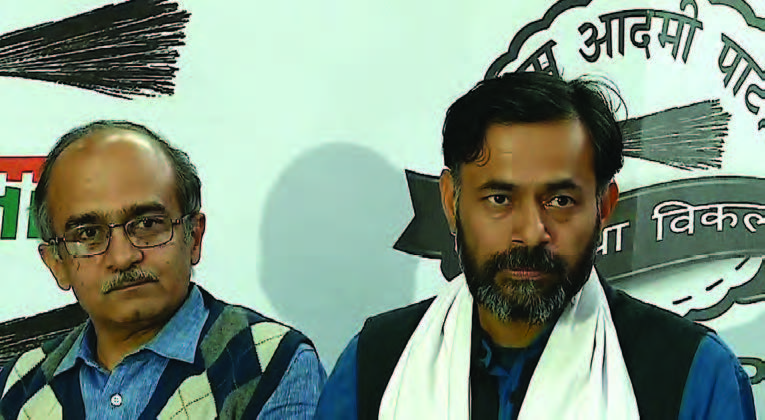
    AAP leader Arvind Kejriwal stamped his dominance over the party on March 4 when two of his critics, Prashant Bhushan and Yogendra Yadav, were removed from the Political Affairs Committee, while his own offer of resignation as national convener of AAP was unanimously turned down.

    While one chapter of the bitter feud in AAP might have ended now, it may not be the end of the story. The decision to remove Bhushan and Yadav wasn’t unanimous – in fact, as many as eight voted against it while 11 voted for – indicating that there are a number of people in the PAC who share some of the concerns raised by the Bhushan-Yadav duo.

    Kejriwal himself stayed away from the meeting, possibly because of his poor health (he went to Bangalore for naturopathy treatment of his very high sugar levels), but more likely to make the point that he was above the squabbling lot – in other words, truly the first among the so-called equals.

    Kejriwal also avoided engaging with the Bhushan-Yadav duo on any of the issues raised by them. Even last night the duo, or one of them, is learnt to have sought a one-on-one meeting with Kejriwal but there was no response to the overture. At the end, he apparently insisted on their removal from the PAC as a precondition for his staying as the National Convener. A fresh letter of resignation as national convener on Wednesday morning only reiterated his firm stand.

    Before Wednesday’s PAC Meeting, there were serious efforts to sort to bring about a reconciliation between Kejriwal and the duo. Many options were considered, including one where the duo would offer some kind of apology. Most senior leaders found this reasonable as they also didn’t want the party’s unity to be affected in any way.

    However, when the leaders reached Kejriwal, he insisted on the duo’s removal from PAC, indicating a rather quick graduation of AAP to hard-nosed power politics. Sources said that while many recognized that the issues raised by the duo were important and needed to be addressed, their presence in the PAC was untenable after the recent war of words.

    At the meeting, Bhushan and Yadav suggested that the PAC be reconstituted, allowing new members to come in. This was, however, opposed by the Kejriwal loyalists, who insisted on a resolution seeking the removal of the duo. The resolution was moved by deputy CM Manish Sisodia and put to vote and the duo lost 11-8. Interestingly, some senior AAP leaders like Anand Kumar, Ajit Jha, Rakesh Sinha voted against their removal while Mumbai’s Mayank Gandhi and treasurer Krishnakant Sevada abstained.

    Sources said that considering that the resolution was backed by Kejriwal it was a democratic process of open voting that was followed without fear of recrimination. Yadav was also removed as the party’s chief spokesman.

    Kejriwal loyalists criticised Bhushan and Yadav at the six-hour meeting for not showing confidence in the Delhi election team. They pointed out that this lack of confidence was despite the team crafting a stunning win for AAP in the election. The duo’s continuing criticism of the team only showed that they were out of synch with the popular mood, the loyalists said. Bhushan and Yadav also raised the need for an internal ethics committee that had also been mentioned in their note.

    “There is a huge trust deficit between the two groups and it will take a while for it to be bridged, if it is bridged at all. In the last few days a lot of things have been said which have left everyone with a bad taste in the mouth. There was criticism from both sides with very little middle ground,” a senior leader said.

    The removal of the Bhushan-Yadav duo was announced by Kumar Vishwas who said that the duo have been “freed” of their responsibilities in the PAC and would be given new responsibilities. The new responsibilities were, however, not spelt out. He said “personal opinions and personal differences” will not come in the way of the unity of the party, which will deliver on its promises and will not betray the trust of the people.

    While there is an unmistakable sense of triumphalism in the Kejriwal camp, having removed the “two thorns”, leaders and members close to the duo felt that Bhushan and Yadav’s ouster from PAC only lent credence to their charge about the party being made into a “one-person” show.

    Still, Yadav and Bhushan are unlikely to leave AAP. They are likely to raise the same issues at the meeting of the AAP National Council – an all-India body of leaders, members and volunteers – that is scheduled for the month-end. The duo believe, said sources close to them, that the broader body would be the right forum to test whether their misgivings was shared by AAP members or not, or was it just a Delhi-centric opposition to their criticism.

    Speaking after the meeting Bhushan said, “The NE by majority decision decided that we should not remain the PAC. I hope that the party which was created and inspired millions of people as a party wedded to the principles of transparency, accountability, inner party democracy and Swaraj will not disappoint the people on whose efforts the party was founded.”

  • PM Modi pulls up absent MPs after humiliation in Rajya Sabha – Trending

    PM Modi pulls up absent MPs after humiliation in Rajya Sabha – Trending

    NEW DELHI (TIP): A day after the government faced embarrassment due to division of votes in Rajya Sabha over an amendment to the President’s address, an ‘unhappy’ Prime Minister Narendra Modi on Feb 4  sought explanation from members of his party (BJP) and NDA allies for being absent from the Upper House at the crucial moment of voting.

    As many as 10 out of 46 BJP members and 12 from allies were absent in the House when the CPM members Sitaram Yechury and P Rajeeve moved the amendment and pressed for division of votes. The amendment was passed with 118 votes in favour and 57 against it.

    “All these members including couple of ministers who were absent in the House during voting have been asked to explain the reasons of their absence”, said a source.

    Though their presence wouldn’t have made much difference as the NDA is in a minority in Rajya Sabha, the explanation should ensure that these members are present in full strength next time when such a situation arises.

    Since a number of bills are lined up for the Rajya Sabha in the ongoing budget session, such a situation cannot be ruled out.

    Besides 46 of BJP, the NDA has six members from TDP, three each from Shiv Sena and Shiromani Akali Dal (SAD), two from PDP and one each from other smaller parties.

    The NDA could, however, get 57 votes during the division despite the absentees as members from the friendly AIADMK and couple of Independents voted against the amendment.

    Though the Opposition was also not present in the House in full strength, it could easily manage to sail through as members of almost all opposition parties including Congress, SP, BSP, Trinamool Congress, DMK, BJD, JD(U) and CPI voted for the CPM’s amendment.

    [quote_box_center]‘LAND BILL NOT AGAINST FARMERS’[/quote_box_center]

    Even as the government is getting ready to push the contentious Land Acquisition Bill in the Lok Sabha on Monday after the Holi break, Prime Minister Narendra Modi on Thursday accused the Opposition of using its majority in the Upper House to stall the country’s progress.

    Virtually taking the impasse over the land bill to public, Modi said: “I appeal you to raise your voice against them.”

    He was speaking at inauguration of two units of 600 MW of Shri Singhaji Thermal Plant and laying foundation stone for two units of 660 MW each in Khandwa district of Madhya Pradesh.

    While accusing the previous government of passing a law that he termed as “anti-farmer and anti-development”, Modi said: “We are accused of being anti-farmers, but when I told them in the Rajya Sabha that I am ready to amend the legislation, they did not come up with one point.”

    In his old Gujarat election campaign style, he asked a series of questions to the gathering to drive home the point that land was essential for schools, roads, hospitals and factories because “they can’t be built in the sky.”

    “Do you want your sons to end up in slums in Delhi or Mumbai? Would you rather have your sons employed in nearby places,” he said, while accusing the UPA Government of not allocating land for schools, hospitals and factories.

    “I have no personal business or interests,” he said and called himself a chowkidar (watchman), a term he used frequently during campaigning for the general elections. Alleging corruption in the coal block allocation during the UPA rule and the subsequent cancellation by the Supreme Court, he said, “they sinned and created problems for us.”

    Referring to the recent auction of 19 coal blocks and the 1.10 lakh crore it generated, Modi said his government has proved the then CAG right. “We are transparent and don’t work behind curtains. Not one paisa will be swindled,” he said and added, “no one can estimate the amount that will be generated when the auction of the remaining coal mines is over.”

    “It’s your money,” he told the audience while referring to the 40,000 crore Madhya Pradesh will get from auction of four coal mines.

  • Modi among 30 most influential people on internet: Time

    Modi among 30 most influential people on internet: Time

    NEW DELHI (TIP): Prime Minister Narendra Modi has been named among the 30 most influential people on the internet by Time magazine in a list which also features US President Barack Obama.

    The list, which analysed social-media followings, site traffic and overall ability to drive news, also includes British author of the Harry Potter series J K Rowling and singers Taylor Swift and Beyonce.

    Time said the Indian Prime Minister has roughly 38 million followers on social networking sites Twitter and Facebook, putting him ahead of any other leaders in the world except Obama.

    “And unlike many of his contemporaries, Modi recognises that social media can be invaluable when trying to reach India’s 200 million-plus online population directly,” the Time magazine said. Modi, an ardent user of social media to communicate with people, announced in an unconventional way, Obama’s strategic visit to India in January this year. He took to Twitter to make the announcement, “bypassing traditional media outlets,” the magazine said.Time said given the power of the social media, anyone with a web connection can start a global conversation.

    “Yes, it helps to be famous in real life. But the rise of social networks has levelled the playing field, allowing unknowns to command audiences rivalling those of real-world leaders, even if by accident,” it said.

    On Obama’s virtual influence, Time said the US President is the most-liked world leader on Facebook and the most-followed on Twitter.

    “But more impressively, Obama is able to meme himself to push an agenda,” Time said citing a video he featured in for American internet news media company Buzzfeed.

  • Don’t use RS majority to stop development: Modi

    Don’t use RS majority to stop development: Modi

    KHANDWA (TIP): Prime Minister Narendra Modi on March 5 took on the opposition over the prospects of defeat of important bills in the Rajya Sabha, where the government is in a minority. “You may have a majority in the Rajya Sabha, but don’t use it to stop development of the nation,” said Modi while addressing a large gathering here.

    The Prime Minister was referring to important legislations like the land acquisition bill which the government is finding hard to push in the Rajya Sabha because of a united opposition. His jibe at the opposition comes just two days after parties had united in the Upper House to force an amendment to the motion of thanks on President’s address. The opposition’s amendment had referred to the absence of corruption or black money in President’s speech.

    Defending his government’s land acquisition policy, Modi said that a year ago, the UPA had passed a land acquisition law to garner votes before elections, but the farmers opted to vote for a different government.

    The Prime Minister said the government wanted a series of small industries developed in rural areas as farming alone could not sustain the economy. “Today’s farmer, who has three sons, does not want all of them to harvest his fields. He wants one son to be a farmer and the other two employed in industries. Where will employment in industries come from?” said the Prime Minister, who was in Khandwa to inaugurate the first phase of 1,200 MW Shri Singaji thermal power plant.

    Modi said there was no basis in opposition’s charge that he was anti-farmer. “They (farmers) need canals for irrigation. Can irrigation projects be constructed in the skies?Government needs land to make homes for poor. Roads in villages, schools and hospitals cannot be constructed in heavens. How can development take place without acquisition of land,” he asked.

  • Indian PM Narendra Modi’s suit sells for $690,000

    Indian PM Narendra Modi’s suit sells for $690,000

    “It has been one of the most talked about and controversial suits in the history of Indian politics”

    An Indian diamond trader has agreed to pay 43.1m rupees ($690,000; £450,000) for a suit worn by Indian PM Narendra Modi.

    Winning bidder Hitesh Patel told BBC: “We will keep the suit at our factory and it will be a source of inspiration.”

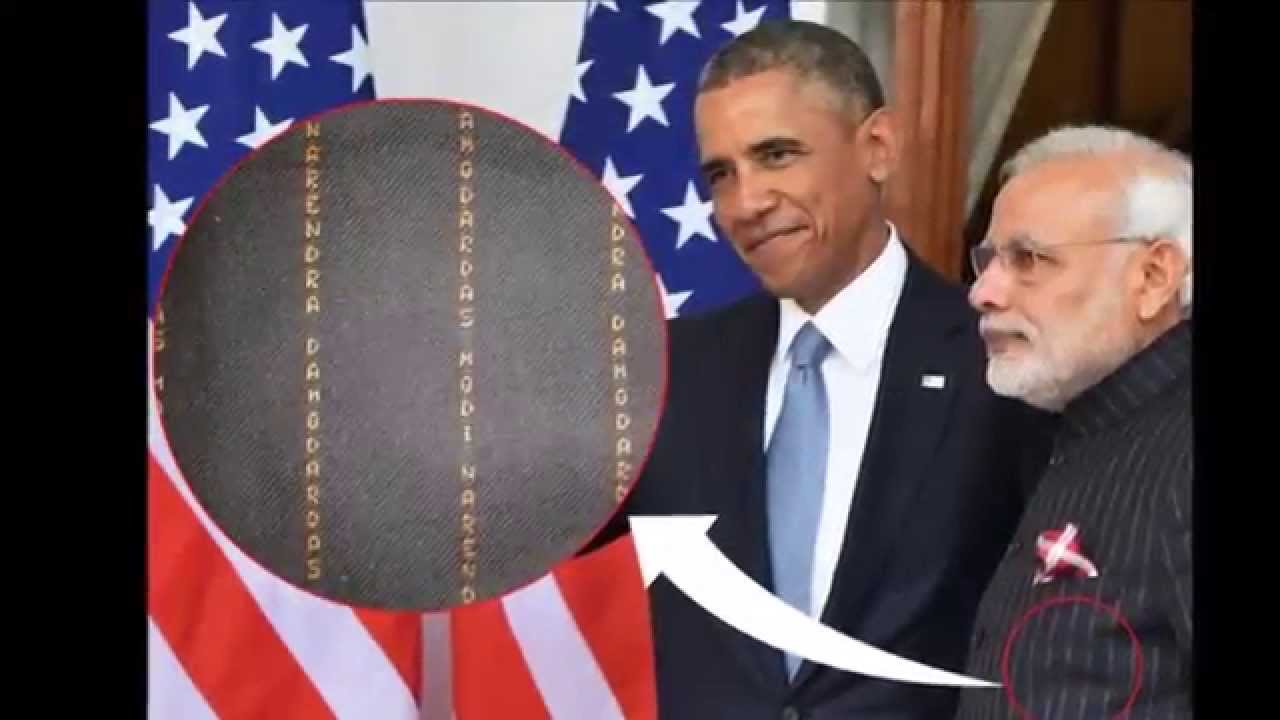
    India’s Prime Minister Narendra Modi’s had worn a pinstripe monogrammed suit in his meeting with President Barack Obama last month when Obama had come at India’s Republic Day as the Chief Guest earlier this year on January 25.

    The said suit was rumoured to cost around $16,000 and carried India’s Prime Minister Narendra Modi name in gold thread monogrammed on a closer inspection. The stripes were actually tiny letters spelling out his name in full– Narendra Damodardas Modi–and embroidered vertically down the stripe. 

    Narendra Modi had earlier this week put the suit along with 455 other items on auction in a 3 Day auction event at Surat, India. Narendra Modi is generating funds for his ambitious Clean Ganga RPT Ganga Mission.

    India’s Prime Minister is known for raising funds in similar fashion during his chief ministerial tenure in Gujarat, India before becoming the Indian Prime Minister earlier in 2014.

    [quote_box_left]Backdrop – Read full auction story – The Suit that was – BID FOR PM MODI’S PINSTRIPE SUIT[/quote_box_left]


  • Kejriwal reaches out to the aam aadmi, begins ‘Janta Darbar’

    Kejriwal reaches out to the aam aadmi, begins ‘Janta Darbar’

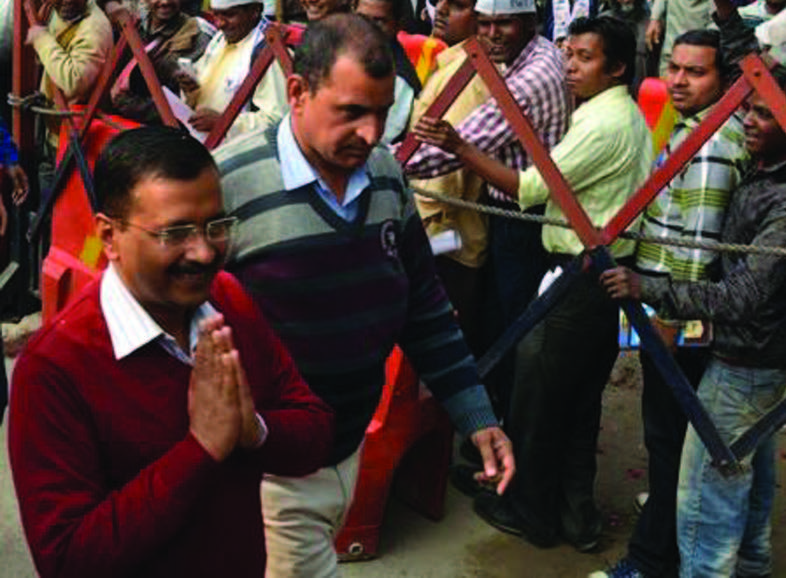
    NEW DELHI (TIP): In a first after becoming Delhi Chief Minister for the second time, Arvind Kejriwal on Feb 18 morning held a “Janta Darbar” at the Aam Aadmi Party office in Kaushambi, Ghaziabad.

    Kejriwal met visitors for around three hours and took note of their problems. Most of the people who came to meet the CM were contractual employees who wanted to be made permanent and others who had lost their jobs. Giving permanent status to contractual employees was one of the biggest poll promises that the AAP government had made in their poll manifesto.

    A contractual employee with the New Delhi Municipal Corporation, Lala Ram said: “I have been a contractual employee for a very long time now. The department does not give me and many others like me, a permanent job. I want to request  Kejriwal to make all the contractual employees in NDMC permanent.”

    A group of women from Home Guard who had lost their job in 2013, also came to meet the Chief Minister. “All of us lost our job in the year 2013. The department hired people from a batch junior to us after sacking us. They assured us that they would give our jobs back but nothing happened. We had come to meet the CM about this issue during his last Janta Darbar also but we could not meet him. This time, we hope to meet him and hope that something will happen.”

    Differently-abled Nahid from Shastri Park reached “Janta Darbar” complaining about his lost job. “I was working as a contract employee with Jag Pravesh Chand Hospital but three months ago, I was removed and now I do not have any job. I have come here hoping that Kejriwal listens to my problem and I get my job back,” Nahid said.

    Some people came with nursery admission problems, others came with some civic issues. While many others came just to wish good luck to the CM and share their ideas with him.

    The first “Janta Darbar”, however, was held minus the fan fare witnessed during the event held outside Delhi Secretariat that ended up in chaos during his previous stint as Delhi CM.

    The district administration of Ghaziabad has granted permission to AAP to hold public meetings thrice a week for an hour at Mr. Kejriwal’s residence. To handle crowd and provide security during the meeting, a team of police personnel under the supervision of a police inspector were present.

  • The Suit that was – BID FOR PM MODI’S PINSTRIPE SUIT

    Lastest Update -Earlier, the diamond baron spearheading the world-class Surat Diamond Bourse (SDB) project formed a ring to get the personalized monogramed pinstripe suit of the Prime Minister put up at auction in the city’s Science Centre.

    On the final day, leading diamond company owners including Diamond Trading Company (DTC) sightholders have descended at the auction venue to raise the pitch.

    They have also roped in Lavji Badhsha (Patel), a former diamantaires, who is now into realty business, in a big way. After the Dharmanandan Diamond company raised the suit price at Rs 1.61 crore, a textile trader named Rajesh Jain bid for 1.65 crore.

    However, Lavji Badhsha threw his hat in the ring by increasing the bid money at 1.71 crore.

    A diamond baron said, “We will not let go the Modi suit out of Surat. The suit will be displayed at the upcoming SDB as a memorabilia. For this, we are ready to pay any price at the auction.”

    Previous Update 19th Feb 2015 (below)

    Prime Minister Narendra Modi’s wore a pinstripe monogrammed suit in his meeting with President Barack Obama last month when Obama had come at India’s Republic Day.

    The said suit was rumoured to cost around 10 lacs and carried Narendra Modi name in gold thread monogrammed on a closer inspection. The stripes were actually tiny letters spelling out his name in full– Narendra Damodardas Modi–and embroidered vertically down the stripe. 

    Narendra Modi had earlier this week put the suit along with 455 other items on auction in a 3 Day auction event at Surat. Narendra Modi is generating funds for his ambitious Clean Ganga RPT Ganga Mission.

    On Day 1 in Surat, a whopping Rs 1.11 crore has been the bid by a Gujarati NRI in an auction today for Prime Minister Narendra Modi’s controversial pinstripe monogrammed bandhgala suit.

    The suit drew a lot of attention in the Delhi Assembly elections with all political parties making it one of the political agendas against Narendra Modi. Many are still calling the auction a disaster control exercise. 

    Narendra Modi is known for raising funds in similar fashion during his chief ministerial tenure in Gujarat and started a trend to auction the gifts that he received in a year and it was donated to Kanya Kelavani Yojna for girl child education. 

    The event was organised at SMC’s Science Convention Centre at city-lights road in Surat as the Prime Minister’s Office (PMO) had decided to hold the auction event in the city.

    ”Prime Minister Narendra Modi’s suit, that he wore during his meeting with President Barack Obama last month, along with other 455 items that he received as gifts during his tenure as Prime Minister will be auctioned at a three-day event in Surat,” Surat Municipal Commissioner Milind Toravane told PTI. 

    Toravane said no base price has been fixed for any of the items to come under the hammer. 

    On Day 2 of the Auctions – Bhavnagar-based diamond trader bids Rs 1.40 crore for PM Modi’s suit. The highest closing offer on the second day came from a diamond trader and ship-breaking tycoon from Bhavnagar, K.K. Sharma, who is also the chairman of the Leela Group of Companies.

    Sharma is likely to be present to pick up delivery of the Modi suit if his bid of Rs 1.40 crore proves the highest on Friday, his official agent Chirag Mehta told media persons.


  • J&K government formation: Mufti to meet PM Modi soon to ‘seal the deal’

    J&K government formation: Mufti to meet PM Modi soon to ‘seal the deal’

    NEW DELHI (TIP): Jammu and Kashmir’s wait for a new government is likely to get over as the Bharatiya Janata Party (BJP) and the Jammu and Kashmir Peoples Democratic Party (PDP) are poised to join hands and form a coalition soon.

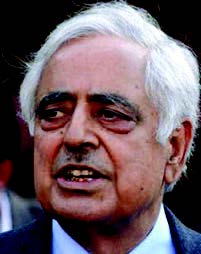
    Sources said that the PDP patron and former chief minister Mufti Mohammed Sayeed  will be meeting Prime Minister Narendra Modi and a formal announcement will be made in the next few days.

    Sayeed would be the chief minister of the alliance and an agreement had been reached between the two parties on a Common Minimum Programme(CMP) and contentious issues like Article 370, displaced Kashmiri Pandits and uniform civil code had been thrashed out, said sources.

    PDP, which has 28 MLAs in the 87-member Assembly, has formed a team of six people to begin the structured dialogue with the BJP. It includes MPs Muzzafar Hussain Baig and Tariq Hameed Qara, chief spokesman Naeem Akthar, MLAs Hasseb Drabu and Altaf Bhukari and Vikramaditya Singh all of whom will be arriving in the national capital tomorrow.

    The team is expected to meet Finance Minister Arun Jaitley on Friday, who was nominated by the BJP along with Arun Singh, for negotiating with parties in the state for government formation, sources said. BJP has 25 MLAs in the state Assembly.

    This may be followed by a meeting between Sayeed and Modi to seal the deal, sources said.

    BJP has in-principle agreed for a six-year term for Sayeed while the party will hold the post of Deputy Chief Minister which is expected to be given to state BJP leader Nirmal Singh.

    After hectic negotiations between the two parties in Mumbai and Chandigarh, it was agreed that PDP will keep the Home portfolio and BJP may get the finance.

    Akthar said the results were an opportunity for both PDP as well as BJP to bring normalcy to the state.

    Asked about a possible Sayeed-Modi meeting, he said “nothing is scheduled”.

    “For us, finalisation of government has to be preceded by a CMP which is must. What will be the use of the government which will not be able to deliver on the ground,” he said, adding, “once the CMP is finalised, the government formation will be purposeful.”

    PDP had been offered support by National Conference which has 15 MLAs and Congress which has 12 to form the government but it started negotiations with BJP, which made historic electoral gains in the state for the first time.

    If the two parties agree over the nitty-gritties then this would be the first time that the BJP would be part of a government in the Valley.

  • IN OPEN LETTER TO MODI, OBAMA, GUJARAT VILLAGES SEEK PUBLIC DEBATE ON NUCLEAR POWER

    IN OPEN LETTER TO MODI, OBAMA, GUJARAT VILLAGES SEEK PUBLIC DEBATE ON NUCLEAR POWER

    Consulting firm chosen to conduct EIA on proposed NPCIL 1,000-MW reactors at Mithivirdi lacks accreditation, say sarpanches


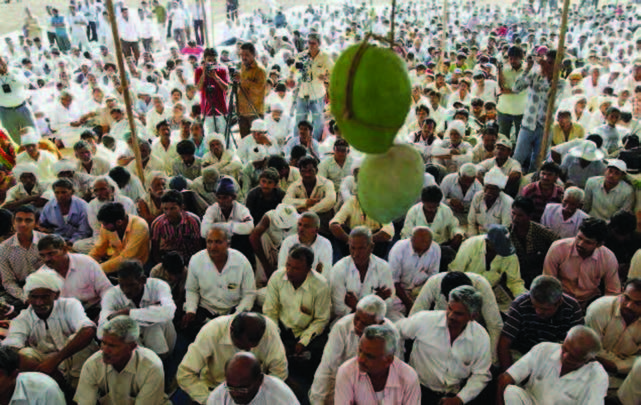
    GANDHINAGAR (TIP): Heads of four villages in Gujarat’s Bhavnagar district have written an open letter to United States President Barack Obama and Prime Minister Narendra Modi calling for a public discussion and debate on the proposed 6,000-MW Mithivirdi Nuclear power plant, according to a news report published in The Hindu on January 25.


    Their demand comes in the light of upcoming talks between the two leaders about of civil nuclear deal.


    The state-owned Nuclear Power Corporation of India Ltd (NPCIL) plans to install six 1,000-MW nuclear reactors at the district headquarters of Mithivirdi with the joint support of U.S. firm Westinghouse Electric Corporation.


    The letter raised concerns over NPCIL’s nomination of environmental consulting firm Engineers India Limited for conducting the environmental impact assessment (EIA). The villages pointed out that the agency was “lacking necessary accreditation to conduct the EIA for nuclear power plants.”


    “The Ministry of Environment and Forests has asked NPCIL to ‘revise’ and ‘resubmit’ its Environment Impact Assessment report of the project as it lacks clarity on a large number of issues. The [Expert Appraisal Committee (Nuclear)], simultaneously, criticized the NPCIL for a three-year delay in the proposal for environmental clearance following the [Atomic Energy Regulatory Board’s ‘site clearance’] for the project, and noted key coastal regulatory clearances to be missing.”


    The MoEF noted “major shortcomings” in the EIA report, including the absence of base-line radioactivity data for milk samples; absence of studies on the impact of two hills near the site on atmospheric dispersion and effect of historical tsunamis; and the lack of clarity on the impact of land and groundwater, the letter states.


    “This casual approach to clearing a nuclear powerplant can lead to a major nuclear disaster. Agriculture forms the backbone of human survival, and this project strikes at a very important asset of our country – the prime agricultural lands. It is not that we are against electricity generation. But no serious thought has been given to the available sustainable alternatives for electricity generation. Solar and wind power have an equal and more sustainable potential to produce electricity and that too in a decentralized manner. Let us have a fair and open discussion before taking any decision on the project,” the village heads urged.


    The letter – dated January 22, 2015 – was signed by sarpanches Shaktisinh H. Gohil of Jaspara village, Samuben Dabhi of Mithivirdi village, Vilasba Gohil of Mandva village and Pruthvirajsinh Gohil of Khadarpar village.

  • MODI GOVERNMENT ENTERS PHASE II

    MODI GOVERNMENT ENTERS PHASE II

    We are now in the second phase of the Modi government. The first phase consisted of positioning the brickwork for a five-year term. Key states had to be won in elections to buttress the Modi image and to seek to augment the Bharatiya Janata Party’s (BJP’s) strength in the Rajya Sabha over time. And in a surprise sprung upon the country, Mr Narendra Modi showed an unsuspected sure touch in making foreign policy moves, including in getting President Barack Obama to witness the Republic Day parade.


    What then can the country expect now that the Prime Minister has his initial structure of government in place? The journey thus far has demonstrated the strengths and weaknesses of the Modi dispensation. The irony is that the baggage that is pulling him down was an essential element in catapulting him from Gujarat to the pinnacle of power in New Delhi. But apart from a sure-footed approach to foreign policy, he has also given many signals of his economic objectives the world is watching with anticipation.


    On the negative side, Mr Modi’s compact with the Rashtriya Swayamsevak Sangh (RSS) is proving an increasing liability for his party and government. Apart from the RSS’s own belief in Hindutva, which the organisation’s chief Mohan Bhagwat keeps stressing, the more embarrassing part, which is bringing great opprobrium and some disbelief, is a continuing army of BJP members of Parliament and other eminences declaiming the virtues of obscurantist ideas.


    For a time, the BJP received a pass by a helpful media describing them as fringe elements. But each day these venerable men and women are proving that they represent the mainstream, not the fringe of the party. What seems to have changed is that they are in a mood of triumphalism, relishing the first BJP victory with a majority at the national level in the country’s history.


    That the Prime Minister has chosen to offer his apology only in one instance in Parliament after constant needling reveals his Achilles’ heel. After all, the ludicrous propositions his members are expressing are very much part of the RSS diet on which Mr Modi himself was reared. The jury is still out on whether he himself subscribes to such sentiments (judging by his public remarks, he does believe in ancient Indians possessing knowledge of plastic surgery). But even if one assumes that he is willing to disguise his feelings at the altar of realpolitik, he is apparently in no position to penalise his supporters for such beliefs.


    It is for similar reasons that Mr Modi has had to give a carte blanche to the RSS in shaping the country’s future education policy, with the minister concerned, Ms Smriti Irani, having to carry the can. And in appointing a new censor board for film certification after the previous lot resigned in protest, the government has outdone itself in getting a chief censor who proclaims his worshipful attitude to Mr Modi. What kind of education the country’s young generation will receive in the years ahead is too dreadful to contemplate.


    There are, of course, many positives to take away from Modi’s innings at the Centre so far. After years of a lackadaisical government of the UPA-II vintage, the firm slap of decisive decision-making is welcome. Second, it is good for a new regime not merely to see the cobwebs, for instance, but do something about removing them. Clearly, the Manmohan Singh government had outlived its usefulness and it was good to have a successor question the logic of how things were done.


    In any case, changes in governments are an essential aspect of the democratic system. The Congress, which built up modern India, lost power only to regain it after the incompetence of successor regimes, bar a coalition spell led by the BJP, seemed to have fallen into a rut compounded by the dual-key arrangement. Mr Modi capitalised on his good fortune and took office in a wave of great optimism and every initial decision it took was welcomed almost because it demonstrated that New Delhi could take decisions.


    Inevitably, the euphoria has somewhat worn off and the second phase of the Modi government will be more testing, depending as it will be on concrete results and the harm the disruptive capacity of Mr Modi’s supporters can cause. There is a built-in dilemma here in the Prime Minister’s own mind and in that his mentor, the RSS. Some contradictions are part of life, but anomalies seem to be the rule, rather than the exception, in the BJP’s persona.


    For a man so taken up by modern technology and the power of digital wonders, Mr Modi coexists with a mixture of fact and fiction that is an essential element of the Sangh Parivar’s belief systems. It remains to be seen how he will resolve this dilemma and at what cost to his essential self and the tolerance levels of the RSS leadership.


    For a leader obsessed with controlling his public image, Mr Modi must be aware that the pearls of wisdom one sometimes hears from the Prime Minister himself and much too often from his supporters are objects of great derision for the outside world. Indeed, it is difficult to imagine that the same mind that can think big in terms of modern technology can be partial to theories of ancient Indians’ ability to fly aeroplanes, employ human cell transfer and other feats associated with the progress of science and technology in the last and present centuries.


    Possessing a sharp political mind, an ability to connect with people and dramatising objectives in people’s language, Mr Modi must be conscious of his handicap in taking the Indian development story ahead. The case of Turkish President Recep Tayyip Erdogan is an object lesson in what to avoid. His ruling Justice and Development Party (AKP) has already taken his country in an Islamic direction, compared to modern Turkey’s founder, Ataturk. Lately he has been dispensing such gems as Muslims having discovered America 200 years before Columbus and declaring that women are not the equal of men.


    (By S Nihal Singh The author is a senior journalist)