Tag: Indian Politics

  POLITICS & POLICY  

  • TEAM NARENDRA MODI

    TEAM NARENDRA MODI

    NIRMALA SITHARAMAN, Minister of State (Independent Charge), Commerce and Industry, Finance, Corporate Affairs. She graduated from the prestigious Seethalakshmi Ramaswami College, Tiruchirapalli in 1980.Nirmala completed her M. Phil in International Studies from Jawaharlal Nehru University. Nirmala Sitharaman has worked for Pricewaterhouse Coopers as a Senior Manager and for BBC World Service. She is one of the founding directors of Pranava school in Hyderabad. She was a former member of the National Commission for Women.


    2

    DR. SANJEEV KUMAR BALYAN is the Minister of State for Agriculture and Food Processing Industries. This is his first term as Member of Parliament. Dr. Balyan represents Muzzaffarnagar constituency in Uttar Pradesh in the newly constituted 16th Lok Sabha. By profession, Dr Balyan is a veterinary doctor.


    3

    G.M. SIDDESHWARA is Union Minister of State for Civil Aviation. He has been elected from the Davangere constituency of Karnataka for the third term successively since 2004. Siddeshwara is one of the top unquestionable Lingayat leaders in Karnataka and a mass based leader in Central Karnataka. He has been rated as one of the best MPs in the 15th Lok Sabha by various independent organizations based on his performance both in the Parliament as well as his efficiency in the constituency. He has been rated as the second best MP from Karnataka by the Rezorce Parliamentary Productivity Framework (www.rezorce.com).


    4

    KIREN RIJIJU is the Union Minister of State of Home Affairs. He is BJP’s Member of Parliament from Arunachal Pradesh. He was also the BJP National Secretary. In the Indian general election 2009, he suffered defeat against Takam Sanjoy of Indian National Congress in general elections 2009. In 2014, he was elected as a Member of Parliament in the 16th Lok Sabha elections, representing the Arunachal West constituency. Kiren defeated Takam Sanjoy of the Indian National Congress by a margin of 47,424 votes.


    5

    KRISHAN PAL GURJAR is the Minister of State of Road Transport in the Modi government. In 1996, Krishan Pal Gurjar contested in Haryana Vidhan Sabha elections and was elected the MLA from Mevla Maharajpur constituency. In the same year he was also chosen the Transport Minister of Haryana during the governing period of Choudhary Bansi Lal. In the next assembly elections, he was reelected as the MLA of Mevla Maharaj Pur constituency along with becoming the leader of BJP’s legislator team.


    6

    MANOJ SINHA is the Minister of State for Railways and the member of Lok Sabha,. He represents the Ghazipur lok sabha constituency. He is a member of the Bharatiya Janata Party. He has an M. Tech. in civil engineering from Indian Institute of Technology (BHU) Varanasi. From 1989-1996, he was a member of the national council. In 1996, 1999 and in 2014 he is elected to Lok Sabha. He was among the most best performing member of parliament of 13th lok sabha with a very high attendance and asked many questions on various topics related to public welfare.


    8

    MANSUKHBHAI DHANJIBHAI VASAVA is the Minister of State for Tribal Affairs in the Modi government. He was elected to 12th Lok Sabha in a bye-election held on 25 November 1998 from Broach constituency in Gujarat. He was reelected to the Lok Sabha in 1999, 2004 and 2009 from the same constituency (renamed as Bharuch in 2008).


    9

    Nihalchand, Minister of State for Chemicals and Fertilizers. He is a member of the 16th Lok Sabha. He represents the Ganganagar constituency of Rajasthan and is a member of the Bharatiya Janata Party (BJP).


    10

    RADHAKRISHNAN P is the Minister of State for Heavy Industries and Public Enterprises. He has served as the minister of state for Youth affairs and Minister of State in the Ministry of Housing and Urban Poverty Alleviation in Third Vajpayee Ministry. He was elected to Lok Sabha from Kanyakumari in Tamil Nadu.


    11

    Raosaheb Dadarao Patil Danve is the Minister of State for Consumer Affairs, Food and Public Distribution. He represents the Jalna constituency of Maharashtra and is a member of the Bharatiya Janata Party (BJP). He was also a member of 13th, 14th and 15th Lok Sabha from Jalna. He has been also a M.L.A. for two times. His son, Santosh Danve is also active in politics.


    12

    SUDARSHAN BHAGAT is the Minister of State for Social Justice and Empowerment. He is the only face in Prime Minister Narendra Modi’s council of ministers from Jharkhand. He is the MP from Lohardaga constituency and is closely associated with the RSS.


    13

    VISHNU DEO SAI is the Minister of State for Mines, Steel, Labour and Employment in the Modi government. He represents the Raigarh constituency of Chhattisgarh and is a member of the Bharatiya Janata Party.


    14

    UPENDRA KUSHWAHA, minister of State for Rural Development Panchayati Raj Drinking Water and Sanitation. He is Member of Parliament From Karakat in Bihar. He is a former member of Rajya Sabha and a leader of Rashtriya Lok Samata Party.

  • Narendra Modi sworn in as India’s 15th Prime Minister

    Narendra Modi sworn in as India’s 15th Prime Minister

    Indrajit S Saluja

    NEW DELHI (TIP): Narendra Modi has taken over as Prime Minister of India, with tons of good wishes of the people of India and people of Indian origin all across the world. At the same time, their expectation level touches the skies. They see in Modi a man who will pluck stars from the skies for them. Too tall an order. This expectation level puts an extra responsibility and pressure on Modi to perform.

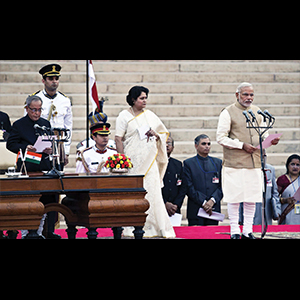
    People have voted for Modi and given him unprecedented mandate to govern well -keep his word of providing “sushasan” – and rid country of the evils that have forced them to lead a harsh living for decades. People of India look for deliverance from the man they believe is a performer. Pranab Mukherji, President of Republic of India, administered the oath of office to Narendra Damodardas Modi at about 6.10 P.M. on May 26 in the forecourt of Rashtrapati Bhavan in the presence of more than 4000 invited guests that included leaders of all seven South Asian countries as well as Mauritius.

    Pakistan’s Prime Minister Nawaz Sharif joined other regional leaders at the ceremony in Delhi’s Rashtrapati Bhavan. It is the first time since the two countries won independence in 1947 that a prime minister from one nation has attended such a ceremony in another’s. Besides Pakistan Prime Minister Nawaz Sharif, other regional leaders attending the ceremony included Sri Lanka’s President Melinda Rajapaksa, Afghan President Hamid Karzai, Bhutanese Prime Minister Tshering Tobgay, Nepal’s Prime Minister Sushil Koirala and Maldives’ President Abdulla Yameen Abdul Gayoom.

    Bangladesh was represented by Speaker Shirin Chaudhury as PM Sheikh Hasina was traveling to Japan at the time of the swearing-in ceremony. Tight security and traffic restrictions were imposed in Delhi and all offices around Rashtrapati Bhavan were closed hours before the event took place. Narendra Damodardas Modi led his BJP party to a landslide win in the recent elections.

    The BJP won the biggest victory (282 seats) and, with its partners in National Democratic Alliance (336 seats) by any party in India in the last 30 years, gaining a majority in parliament and trouncing the outgoing Congress Party. The highest ever number of seats won by a political party since 1950 when the Constitution of India was adopted and the first elections held in 1952 , is the Indian National Congress that had won 415 seats in 1984. But what a fall for the party from 415 to 44.

    It was a moment of great pride for 89 year old Ashtray Swayamsewak Sangh (RSS) founded in 1925, which has its first Pracharak to become the Prime Minister of India. Modi joined RSS in childhood, at the age of 8, and became a full time Pracharak in 1970. Of the 23 cabinet ministers sworn in on Monday, 17 have their roots in the RSS and affiliates. Modi’s Bharatiya Janata Party (BJP) is effectively the political wing of the RSS.

    Many of the 22 junior ministers are also linked to the movement. “Modi, the BJP and the RSS, it’s not right to treat them separately, his is a leaf from the same branch. They can’t be separated from each other, they complement each other,” said Dinesh Sharma, a BJP leader and RSS member in Uttar Pradesh.

  • Sharif Sees Chance for India-Pakistan Peace after Meeting Modi

    Sharif Sees Chance for India-Pakistan Peace after Meeting Modi

    Pakistan Peace after Meeting Modi NEW DELHI (TIP): Pakistani Prime Minister Nawaz Sharif hailed his meeting with Indian counterpart Narendra Modi as a “historic opportunity” and said he was ready for talks on all topics to overcome years of mistrust. Sharif, who met Modi in New Delhi on his first full day as India’s leader, May 27, said the nations should end a cycle of confrontation and focus on cooperation. Sharif has four years left in his term, while Modi is fresh off winning the biggest Indian election mandate in 30 years.

    “I stressed to the prime minister that we have a common agenda of development and economic revival, which is not possible to achieve without peace and stability in the region,” Sharif told reporters in New Delhi after meeting Modi. “I urged that together we should rid the region of instability and insecurity that has plagued us for decades.” The meeting marks a fresh start for the nuclear-armed neighbors, which have fought three wars since the British carved up South Asia in 1947.

    Border conflicts and terrorist strikes have undermined efforts to bring peace and boost trade between India and Pakistan, which have a combined population of more than 1.4 billion. Modi said the two nations could “move immediately” to improve trade ties while calling on Pakistan to prevent its territory from being used for terrorism against India, Sujatha Singh, the top bureaucrat in India’s foreign ministry, told reporters in New Delhi today.

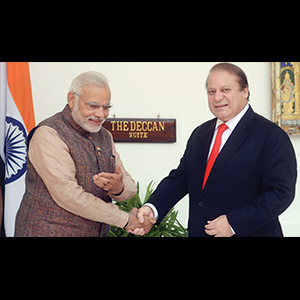
    Modi accepted invitations to visit Pakistan and other nations in the region, she said. Terrorist Attacks “We want peaceful and friendly relations with Pakistan,” Singh said. “However, for such relations to proceed, it’s important that terror and violence is brought to an end.” Modi invited Sharif and other leaders of the eightmember South Asia Association for Regional Cooperation to attend his swearing-in ceremony on May 26, an unprecedented move. Modi and Sharif shook hands as they met today at Hyderabad House, a former palace close to the ceremonial avenue in New Delhi.

    The meeting was the second between prime ministers from India and Pakistan since peace talks resumed in 2011 after dialogue was shattered when Pakistani gunmen attacked Mumbai in 2008, killing 166 people. Sharif won elections last year to become Pakistan’s prime minister for the third time and has pledged to improve ties with India. He’s on his first visit to India since 1991, when he attended former Prime Minister Rajiv Gandhi’s funeral in New Delhi.

    The country’s leaders last met in September in New York, where they pledged to enforce the ceasefire in Kashmir, a disputed border region. Economic Ties India’s economy will expand 5.4 percent in the fiscal year through March 31, the International Monetary Fund predicts, after averaging growth of more than 7 percent in the past decade. Pakistan’s economic growth will slow to 3.1 percent in 2014 from 3.6 in 2013, the IMF forecasts.

    While India and Pakistan share a 2,000-mile border and have mutually understandable languages, trade between the nations totaled $2.6 billion last year. That’s less than 0.5 percent of India’s combined commerce with other nations, according to government data. Pakistan has yet to follow through on a November 2011 pledge to grant India mostfavored nation status, which would provide greater access to Indian exports.

    The move would remove 1,200 items from a banned list. An attack on India’s consulate in Herat, Afghanistan, last week underscored the challenges to improved ties between India and Pakistan. Afghan President Hamid Karzai in an interview with Headlines Today television channel yesterday blamed the Herat strike on Lashkar-e-Taiba, a Pakistan-based group that India says conducted the 2008 Mumbai attacks.

    Obstacles Remain Modi met with Karzai today in New Delhi. Singh, the Indian foreign secretary, declined to comment on Karzai’s claim that a Pakistan-based group conducted the Herat attack. “While we want closer ties with Pakistan, I don’t think it would be possible,” said Dipankar Banerjee, founding director of the Institute of Peace and Conflict Studies in New Delhi, who commanded troops on the border with Pakistan. “There are elements within Pakistan strongly against any such moves.

    They will try to put obstacles in the way of any rapprochement.” Some progress on peace talks has been made even while breakthroughs have been elusive. Eighteen months ago, India and Pakistan agreed on a new visa regime to make travel between the countries easier, a measure meant to spur regional trade and establish trust. Before Sharif’s visit, Pakistan released 151 Indian fishermen it had detained and said it’s seeking reciprocal measures.

    Modi welcomed the move on his Twitter account. “I pointed out that we were at the beginning of our respective tenures with a clear mandate,” Sharif told reporters today. “This provides us with the opportunity of meeting the hopes and aspirations of our peoples.

  • Jaitley, Shourie to be key players in Modi’s team

    Jaitley, Shourie to be key players in Modi’s team

    NEW DELHI (TIP): The Narendra Modi-led National Democratic Alliance (NDA) is all set to form the most stable government since 1984 after winning over 60 per cent of seats in the 16th Lok Sabha. The favourable electoral verdict has unleashed a strong rally in India’s stocks, bonds and currency.

    The Sensex hit the key 25,000 levels, while the Nifty scaled the 7,500 levels on May 16, when results were announced. The rupee is trading near an 11-month high. Overseas investors have intensified buying Indian stocks and bonds and the momentum in markets is expected to continue.

    The union budget, which is likely to be announced in early July, will be the next trigger for markets as it will provide an early glimpse of the new government’s policies, analysts say.

    However, even before the budget announcement, markets are focused on the likely composition of the new government. While political circles are abuzz with who will get the big four ministries of home, finance, defense and external affairs, market participants are firmly focused on the next finance minister.

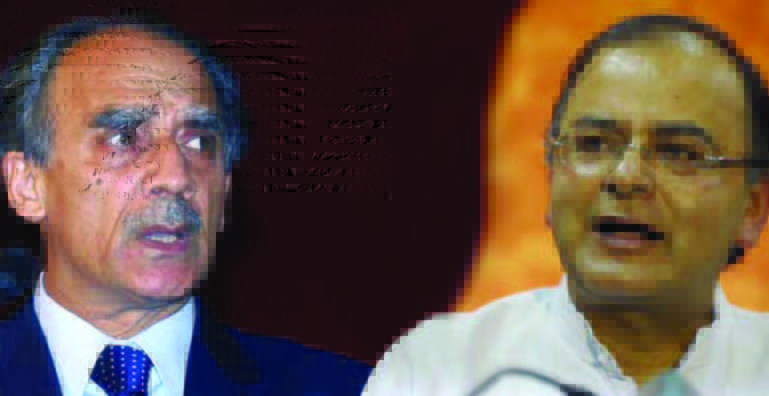
    Barclays analysts Siddhartha Sanyal and Rahul Bajoria see Arun Jaitley as a frontrunner for the finance minister’s job. Jaitley, who was the leader of the opposition in the Rajya Sabha, is one of Modi’s close associates. “A lawyer by profession, Jaitley, like his party, is right-winged and likely to pursue a pro-reform agenda.

    Thus, his appointment would likely be met with approval by markets,” Nomura’s Sonal Varma and Aman Mohunta say. Arun Shourie, a highly regarded technocrat and a former divestment minister in the previous NDA government, is the other competitor. “Shourie advocates focusing on executive announcements as a tool to restore confidence and favors fiscal consolidation,” Barclays noted. Nomura says former RBI Governor Bimal Jalan is a dark horse for the coveted post.

    Some other key economy facing industries such as commerce and industries are also in focus. Former BJP president Nitin Gadkari, who is widely recognized as the person behind many infrastructure projects in Maharashtra, may be given one of the infrastructure-related ministries, given his background, Barclays noted. Subramanian Swamy, a PhD from Harvard University and a former commerce minister, could have an economic portfolio in the new cabinet, the investment bank said.

    There’s also a buzz about the appointment of technocrats as junior ministers. Nomura says these technocrats will incorporate their subject matter expertise into the decision making process. “Piyush Goyal (ex-Investment Banker) and Jayant Sinha (ex-Partner, Omidyar Network) may be appointed as junior ministers in the ministry of finance,” Nomura analysts said.

    Goyal is also a treasurer of the BJP, while Sinha is son of former finance minister Yashwant Sinha. E Sreedharan, widely credited for overseeing the mass rapid transit project in Delhi and other cities, could join the cabinet as railways minister to oversee the upgrading of railways and the construction of a bullet train corridor across India, a cornerstone project outlined in the BJP manifesto, Barclays noted.

    Arvind Panagariya, a Columbia University professor, has openly advocated implementation on a national level of Gujarat’s best practices and could become a part of the next government or take up an advisory position. According to Nomura, he may be appointed as the chairman of the Prime Minister’s Economic Advisory Council. In the last government, this post was held by C Rangarajan.

    Deepak Parekh, chairman of HDFC, could be in the running to become a part of the cabinet. He has supported Raghuram Rajan, the current RBI governor, in undertaking financial reforms, Barclays noted. Modi may induct a smaller cabinet as compared to the outgoing UPA-led government, which had 71 ministers, including 28 cabinet ministers, analysts say. He is also expected to merge several ministries to improve coordination. “The ministries of power, petroleum, coal and non-renewable energy may be merged into a single ministry of energy,” Nomura said.

  • WITH COOK, PERSONAL AIDES, NARENDRA MODI CHECKS IN TO DELHI

    WITH COOK, PERSONAL AIDES, NARENDRA MODI CHECKS IN TO DELHI

    AHMEDABAD (TIP): Narendra Modi, who is shifting to New Delhi as India’s next Prime Minister, on May 22 said “Aavjo (So Long) Gujarat” as he left the state he has ruled for 13 years. “Today I am leaving for Delhi and as they say in Gujarat, I would like to say ‘aavjo’ to 6.25 crore people,” Modi said at the airport in Ahmedabad.

    He is taking his cook, Badri, and his personal aides Dinesh Thakur and OP Singh, to his new home, the Prime Minister’s residence at 7, Race Course Road in Delhi. Badri has served as Modi’s cook and caretaker for over a decade. Modi’s close aide Amit Shah, who has been credited with the BJP’s spectacular haul of 71 seats in Uttar Pradesh, also accompanied him to Delhi.

    Before leaving Ahmedabad, the PM-designate stopped to meet his mother Hiraben, 95, for the second time since his victory in the national election. Modi later tweeted that he was moved when he learnt that his personal staff in Gujarat had set up a shrine in his official car and prayed daily for his security. The 63-year-old will be sworn in as Prime Minister on May 26.

  • FINALLY, SONIA CONGRATULATES MODI

    FINALLY, SONIA CONGRATULATES MODI

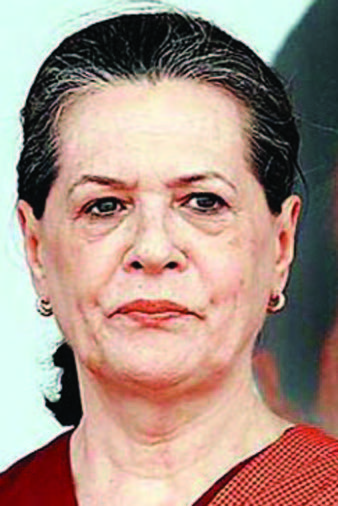
    NEW DELHI (TIP): Days before Narendra Modi’s swearing-in as Prime Minister, Congress president Sonia Gandhi has written a letter, congratulating him on BJP’s victory in the Lok Sabha elections. Congress sources said Gandhi sent the letter to Modi on May 20 after he was elected as leader of the BJP parliamentary party.

    The Congress chief and vice-president Rahul Gandhi had on May 23 refrained from mentioning Modi and his party when the poll results were announced. The Congress’s top brass was slammed by BJP for omitting any mention of Modi or BJP in their congratulatory massage to the “new government”. There has been criticism of Sonia and Rahul for not felicitating Modi by his name after the BJP’s landslide win.

  • Economic Challenges for Modi’s New Government

    Economic Challenges for Modi’s New Government

    Goods and Services Tax (GST) India’s most ambitious indirect tax reform would replace existing state and central levies with a uniform tax, boosting revenue collection while cutting business transaction costs. GST, which could boost India’s economy by up to two percentage points, has so far faced resistance from various states, including those governed by the BJP who fear a loss of their fiscal powers.

    The BJP aims to address state concerns and implement GST in an “appropriate timeframe”. The Congress party would back the reform in opposition, a senior party member told Reuters earlier this month. The reform needs broad backing because it requires a change in the constitution.

    Central bank policies A Reserve Bank of India panel in January proposed key changes including targeting consumer price inflation and making a committee responsible for monetary policy, and not the RBI Governor alone.

    This would require changes to the RBI Act. The BJP top brass has not spoken widely on the issue, but it will likely be a tough sell for RBI Governor Raghuram Rajan. He has the backing of some global agencies like the International Monetary Fund. Modi’s government may also look to eventually separate the debt management function from the RBI, on the grounds that debt management sometimes conflicts with the central bank’s monetary policy stance.

    Privatisation The new government is likely to focus on selling its holdings in state-run firms that could raise much-needed revenues to trim India’s ballooning fiscal deficit and boost economic growth.

    The rising stock market helped New Delhi raise more than $3 billion (Rs. 18,000 crore at 60 rupees per dollar) via stake sales in the fiscal year to March 31 – but that was only a third of the government’s original target. The outgoing government announced plans to raise Rs. 56,900 crore through asset sales in 2014-15.

    This could help achieve a lower fiscal deficit target of 4.1 per cent of GDP. These estimates may be revised by the next government.

    Subsidies Modi’s government needs to examine how it subsidizes basic commodities if it is to contain the fiscal deficit and avoid a ratings downgrade. Subsidies cost an estimated 2.2 per cent of India’s GDP in 2013-14. The BJP in its manifesto said it will seek greater fiscal discipline without compromising on the availability of funds for development.

    Labor The BJP wants to reform labor laws to boost job-intensive manufacturing and create as many as 1 crore jobs a year for young Indians entering the workforce. Changing the law would be politically tricky, though, and Modi may seek to encourage competition between India’s states to boost job creation.

    Defense More foreign investment in defense would help India reduce imports, modernize weapons systems and speed up deliveries of hardware it needs for operations and training. India, the world’s biggest arms importer, now allows 26 per cent foreign ownership in defense, and proposals to exceed that limit are considered only for stateof- the-art technology. The BJP has said it would allow some greater foreign investment in defense industries.

    Insurance Attempts to raise the cap on foreign investment in India’s $45 billion (Rs. 2.70 lakh crore) insurance sector, to 49 per cent from 26 per cent, have met resistance from employees at statecontrolled insurers and their political backers. A BJP leader said in March the party had held talks with Congress to break the deadlock.

    Banking The next government will need to help staterun lenders battling rising bad loans caused by the slowing economy, rising interest rates and project delays. Stressed loans in India – either bad or restructured – total $100 billion (Rs. 6 lakh crore), or about 10 per cent of all loans. Fitch Ratings expects that ratio to reach 14 per cent by March 2015. Rising bad loans threaten to choke the gradual recovery in Asia’s third-largest economy, according to the OECD. The interim budget in February set aside Rs. 11,200 crore to help the sector meet key capital ratios, but analysts say more money is needed.

    Power A BJP-led government may implement the socalled Gujarat model of distributing electricity that has been widely praised for delivering reliable 24-hour power supplies in the state. Modi provided different power feeds to farmers, households, and companies instead of a uniform feed in his home state.

    Gas pricing In January, India notified the new gas pricing formula that could double the prices of locally produced gas from April 1, but the poll regulator stopped the government from raising the prices until the elections are over. Reliance Industries and its partners BP and Niko Resources last week issued a notice of arbitration to the government seeking implementation of higher gas prices. The BJP-led government may review the formula on the lines suggested by a senior party leader last year and announce the date of implementation of new prices.

    OTHER CHALLENGES

    A landslide election victory for Narendra Modi’s Bharatiya Janata Party (BJP) has created euphoria in India’s financial markets, driving shares to life-time highs and the rupee to its strongest level against the dollar in 11 months. After a decade in opposition, the BJP has promised to repair an economy growing at its weakest rate since the 1980s and tackle stubbornly high inflation. However, the most urgent challenges facing the government, from a large budget deficit to concerns that the El Nino could devastate agricultural output, have no easy solutions.

    DELIVERING A BUDGET THAT LIMITS THE DEFICIT

    Modi’s government will face its first credibility test with markets when it delivers a budget by July that will need to convince investors that India can realistically contain its fiscal deficit.

    To meet a deficit target of 4.6 percent of gross domestic product (GDP) for the year that ended in March, the outgoing government cut spending by $13 billion and pushed about $16 billion in subsidy costs into the New Year.

    That austerity could prove hard to sustain. Spending accounts for 11 percent of GDP, offering a critical growth lever. Continuing to defer payments to state-run companies that would compensate them for selling fuel, fertilizer and food below market prices can create havoc with their finances and make them rely on borrowing to fund operations.

    Meanwhile, tax revenues are unlikely to recover immediately in a weak economy. The government’s tax-to-GDP ratio has slipped to 10.2 percent from a peak of 12.5 percent in 2007/08.

    The interim budget of the outgoing government in February was greeted with widespread skepticism. It sought, for example, to contain the fiscal deficit at 4.1 percent of GDP in 2014/15, the lowest in seven years, while keeping spending growth at just 10.9 percent compared to a recent average of about 15 percent.

    Standard & Poor’s has a negative outlook on its “BBB-minus” rating for India, and has said the new government’s policy agenda will determine whether India can avert a downgrade to “junk” status.

    NARROWING THE CURRENT ACCOUNT DEFICIT

    A sharp narrowing of the current account deficit, to under 2 percent of GDP in 2013/14 from a record high of 4.8 percent the previous year, was helped by steps to curb gold imports.

    Higher duties and other restrictions almost halved gold imports, but the moves have been deeply unpopular. Gold smuggling surged after the measures, casting doubt on reported data.

    The BJP promised to review gold import duties within three months of coming to power. That may please gold buyers, but not investors, as concerns about the current account deficit sent the rupee to a record low last August.

    Fixing the structural challenges that keep the current account deficit wide, such as the weakness of manufacturing exports, could take years to reverse.

    DEALING WITH RBI AND EL NINO

    The new government may face a factor beyond its control: the El Nino weather pattern, typically associated with weak rains.

    Analysts say El Nino could batter India’s farm output. Citigroup estimates that below-average rainfall in the June-September monsoon could shave 0.50-0.90 percentage points off its economic growth forecast and lead to a spike in inflation.

    Surging prices could spark tension with the central bank, whose governor, Raghuram Rajan, has made containing inflation a priority. The Reserve Bank of India wants to bring down consumer price inflation to around 6 percent from the current 8.6 percent by January 2016, which would probably mean more interest rate increases. It has raised rates three times since September.

    REVIVING PRIVATE INVESTMENT

    Market expectations of Modi are based largely on perceptions of his track record as chief minister in Gujarat, where he is widely credited with attracting investment.

    However, analysts say replicating that nationwide will be difficult, given that states wield much of the power in approving projects. Credit Suisse estimates that only a quarter of pending projects depend on central government approval.

    Capital investment contributes nearly 35 percent to India’s economy, but it barely grew in the fiscal year that ended in March as delays in clearances and funding issues grounded many infrastructure projects.

    That is particularly the case with state electricity boards, which remain hobbled by losses caused in part by the high cost of fuel and their inability to raise prices correspondingly.

    Short of recapitalizing state utilities, the central government has few choices in pushing for a restructuring.

    RECAPITALISING STATE-RUN BANKS

    India needs to address a $100 billion pile of bad loans at its state-run lenders – about 10 percent of all loans. Fitch Ratings expects stressed assets to reach 14 percent of loans by March 2015.

    The bulk of these bad loans are related to infrastructure projects, which have made banks circumspect in lending.

    The interim budget set aside 112 billion Indian rupees ($1.89 billion) to help the sector meet the minimal capital ratios mandated by Basel III norms, but more will be needed.

  • US lauds Modi invite to Pak, other SAARC nations

    US lauds Modi invite to Pak, other SAARC nations

    WASHINGTON (TIP): The United States has welcomed Prime Minister-designate Narendra Modi’s invitation to leaders of Pakistan and other SAARC nations for his swearing-in ceremony on Monday, May 26, commenting that increased engagement with Islamabad is a “positive step”. “Broadly speaking, we welcome increased engagement between India and Pakistan and their leaders and other leaders in the region and India’s engagement with its neighbors leading up to the inauguration,” State Department spokesperson Jen Psaki said.

    Asked to comment specifically on Pakistan, Psaki said: “We believe increased engagement between India and Pakistan is a positive step, so we’ll see what happens.” Quizzed if Washington would “encourage” the Pakistani leaders to attend the ceremony, she said: “I don’t think we’re going to get into that level of engagement, but certainly, the invitation has been issued, we support increased dialogue, and this is representative of that.” US media called the Modi move an unusual gesture, with The New York Times noting that for someone with the reputation of being a hardliner, Modi has “broken new ground by extending invitations to the leaders of all of India’s neighbors”.

    “Previous swearing-in ceremonies have been small affairs, a reflection of the country’s inward-looking approach to politics. Modi has made it clear that he hopes to make India a leader in its own neighborhood, knitting together a regional trade and economic bloc,” the NYT commented. South Asia expert Stephen P Cohen has been quoted as saying: “I think we might see a dialogue between Modi and Sharif. But Sharif has an Army problem and Modi has a right-wing ideological problem.” Some other reports noted that the decision, among the first taken by Modi as Prime Minister-elect, could signal intent to improve ties with Pakistan and other neighbors.

  • Nawaz Sharif mulls attending Modi’s swearingin ceremony

    Nawaz Sharif mulls attending Modi’s swearingin ceremony

    ISLAMABAD (TIP): Pak PM Nawaz Sharif is still considering attending Narendra Modi’s swearing-in ceremony and a final decision will be taken by this evening, officials said on May 22. Foreign office has confirmed that formal invitation has been received but any decision by the Prime Minister to attend the ceremony on May 26 in New Delhi has not been taken as yet. Sources within Sharif’s Pakistan Muslim League-Nawaz (PML-N) said that Prime Minister wanted to normalize ties with India to promote commercial and business activities.

    “He is keen to improve ties which is also the official policy of the party but he needs to take various aspects of the relations into consideration,” a top PMLN leader told PTI. He said the invitation has come at a short notice and the premier needs time to accept it. He also said that any decision about going to India will be made by the evening after consultations with the civil and military leaders.

    Diplomatic sources said that unexpected move by India’s Prime Minister-designate has left Sharif with difficult choices. “If he skipped the invitation it will send a very negative message to India and the world but the acceptance may bring backlash from the hardliners and hawks who consider Modi as anti-Pakistani,” said a diplomat.

  • Prime Minister MODI

    Prime Minister MODI

    Challenges and opportunities in a new innings

    “Mr. Modi thus comes to power in an atmosphere of great expectations and in the end an unforgiving public in case he does not measure up. In the popular mind, he is the doer, a man who takes decisions and has clear-cut policies that will put the country on the path of rapid development. But as opposed to a state with a people known for their entrepreneurial skills, governing a diverse country with a bewildering variety of problems is another matter”, says the author.

    Mr. Narendra Modi, Prime Minister-designate, is on the cusp of a moment that comes rarely in a nation’s history, a moment of hope tinged with anxiety stemming from his antecedents and the shadow of the Rashtriya Swayamsevak Sangh. For the present, hope trumps darker thoughts because the nation’s mood is to give him a chance. This comes against the backdrop of a widespread feeling that the second term of the United Progressive Alliance government was prey to indecision, paralysis and a stream of scams that bled the goodwill the UPA had enjoyed in the first term.

    Indeed, one aspect of the Bharatiya Janata Party’s impressive victory, in addition to Mr. Modi’s super packaging, was a desire for change. Mr. Modi thus comes to power in an atmosphere of great expectations and in the end an unforgiving public in case he does not measure up. In the popular mind, he is the doer, a man who takes decisions and has clear-cut policies that will put the country on the path of rapid development.

    But as opposed to a state with a people known for their entrepreneurial skills, governing a diverse country with a bewildering variety of problems is another matter. Underneath these problems is the sneaking suspicion that the Rashtriya Sayamsevak Sangh, which has invested much in his dramatic rise, will demand its pound of flesh. For the RSS, its tenets of spreading its creed revolving round the Hindutva philosophy is far more important than immediate political gains.

    Mr. Modi has demonstrated that in governing Gujarat, he was able to keep the RSS and fringe elements at a distance. But the stakes at the national level are much higher and the RSS is unlikely to be easily sidelined. Apart from dealing with his internal problems of the Sangh Parivar, Mr. Modi faces two kinds of challenges. The first is to get the vast machinery of national government to function efficiently in an essentially colonial “filepushing” culture.

    The other is the larger problem of convincing the administrative and political class that he means business and his slogan of governance, rather than a bloated government, is the solution of the country’s problems. At the broader philosophical level, Mr. Modi needs to convince India’s large Muslim population and other minorities that he will play fair by them.

    The stain of the 2002 Gujarat pogrom has not gone away and he needs to do something more than to suggest that he will lift all boats in the water through the strength of his economic policies. What strikes odd to many is his refusal to give an apology for 2002, having muddied the waters by his unfortunate analogy of feeling sad if a puppy comes under the wheels of a vehicle in which he is travelling. Thus far Mr. Modi has shown that he is less than happy in a media environment he cannot control.

    There was the infamous case of a television interview he aborted midstream, rather than answer the difficult questions he was asked. He is a rare politician who has demonstrated his métier for employing modern technology in his dramatic political journey. As Prime Minister he must learn to field inconvenient and rude questions from journalists who are not beholden to him. Despite these question marks, there is a lot going for him. Like the advent of the Aam Aadmi Party, Mr. Modi is a breath of fresh air in a political environment that had been atrophied by a “Congress culture” that had become synonymous with inertia and a refusal to take risks after weighing all options.


    13

    And sad to say the dual nature of the power arrangement at the top accentuated a culture of consensus building almost for its own sake. Much will depend upon the team of politicians he picks in his Cabinet, warding off obvious political pressures from the RSS and his allies. It will be an easier task to put together a competent team of bureaucrats and it is a given that the Prime Minister’s Office will again enjoy a clout rarely seen after the days of Indira Gandhi. The country can take it for granted that, unlike in the Manmohan Singh era, Mr. Modi’s policies will be presented countrywide in the best light, as demonstrated by the slick and lavish campaign that tilted him to the top office. But in the end, propagating policies will be as effective as substantive action.

    What is beyond doubt is that with the advent of Mr. Modi, the country has entered a new era. How good it will be will depend upon the new Prime Minister’s ability to move mountains. He is by all accounts a man of prodigious energy and a quick mind in understanding the essence of abstruse problems. But will the very different work culture and problems compared to the placid banks of the Sabarmati fox Mr. Modi? Even those who disagree with the philosophical framework of the new Prime Minister will give him the benefit of the doubt if he can bring life to the tired sinews of government and give a fillip to the country’s economic development.

    If he can bring Gujarat’s resultoriented work culture to the filepushing babus of the Central Secretariat, he would be performing a great service. However, the underlying philosophical underpinnings of the new government will not go away because it affects the idea of India and the new India built over more than six decades on the sacrifices of the Independence generation and the vision they enshrined in the Constitution.

    It represents more than the welfare and development of the majority community and empowers the entire citizenry, whatever its ethnicity and religion. It is, of course, true that the bloody birth of the independent states of India and Pakistan on the basis of religion will remain a disturbing legacy. But it is for new generations to rise above the past and look to the future. The Sangh Parivar has a greater problem in reconciling with history than the rest of us because it seeks to employ history as a badge of its distinctiveness. Mr. Modi will have to surmount this handicap to become a successful Prime Minister.

  • Eeny, Meeny, Miney, Modi

    Eeny, Meeny, Miney, Modi

    Does India’s new prime minister actually have a foreign policy?

    Despite an impressive mandate, he (Modi) will have to work with an established bureaucracy and political partners in India and abroad. But India’s next leader certainly has spelled out how he wants to project himself as a global leader”, says the author.

    Narendra Modi is set to be India’s next prime minister after an election won conclusively by his Bharatiya Janata Party (BJP). The combative chief minister of the western state of Gujarat, he has often been written off as a novice on foreign affairs. Commentators in India and abroad have dismissed him as having “little foreign policy experience,” and consider him unlikely to change the “broad contours of Indian foreign policy” — which have traditionally involved steady, balanced relations with several partners.

    Others paint him as a “hardliner,” given his right-wing base, or have generously over-interpreted portions of his party’s election manifesto that have implied changes to India’s nuclear posture. Yet few actually listen to what Modi himself has said about his foreign policy. He has delivered at least three speeches dedicated to international affairs and security since having been anointed his party’s prime ministerial candidate in September, and discussed the subject in several interviews.

    But this has been largely ignored by New Delhi’s cognoscenti. (For his part, Modi dismissed much of the speculation about his foreign policy as anuman, or conjecture.) So what has Modi actually said? He has repeatedly stated that foreign policy begins at home. National security, he said in his first speech in September as the BJP’s official prime ministerial candidate, requires a “strong, patriotic government in Delhi,” while instability arises from “a lack of our capacity to understand and accept the viewpoint of the other.”

    He has described “stagnancy” as the biggest problem facing the country. “I believe a strong economy is the driver of an effective foreign policy…we have to put our own house in order so that the world is attracted to us,” he said in a speech on India and the world in October. “The current dysfunction in Delhi has prevented even much-needed military modernization and [the] upgradation [sic] of India’s defense infrastructure.” But far from resorting to isolationism, Modi acknowledges the realities of a globalized world.

    “We are not living in 18th or 19th century. We are living in the 21st century,” he said in an interview, adding that commercial interests now are important shapers of India’s foreign policy. On several occasions, both in prepared remarks and in off-the-cuff responses, Modi has used the Sanskrit phrase vasudhaiva kutumbakam (“the world is a family”), and has stated that “India can offer a lot to the world.”

    In particular, he has referred to India’s historical ability to create “institutions and intellectual property,” recalling ancient centers of learning such as Nalanda and Takshashila. The considerations of a globalizing world — rather than any personal animosity he may feel about the U.S. government’s controversial revocation of his visa under an obscure law on religious freedom — have informed his recent public statements, including those concerning relations with Washington.

    “What happened with Modi does not affect the policies of the country,” he said in an April interview. He has also, rather remarkably, refrained from speaking negatively about U.S. surveillance activities, even when given the opportunity to do so recently by an interviewer. More significantly, he has criticized some of the previous Indian government’s economic policies that have adversely influenced relations with Washington, and described as a “breach of trust” New Delhi’s retroactive tax on Vodafone.

    “It’s not as if people from other countries don’t like India, that they don’t want to invest here,” he said in April. But if “the constant policy changes by the government” could be stabilized, he said, that would increase confidence. The twin objectives of national security and deeper commercial links are reflected in Modi’s recent statements on Pakistan and China, two countries with which India has longstanding territorial disputes.

    On Pakistan, Modi has said that it is “better to keep good relations,” while adding that to hold talks with Islamabad, “the blasts and gunfire first have to stop.” In 2013, he called on India, Pakistan, and Bangladesh to wage war on “poverty, illiteracy, and superstition,” and urged Pakistan to “abandon its anti-India politics and become a friendly country.” Similarly, while much has been made of Modi’s willingness to do business with China, he has stressed that there should “not be any compromise on India’s interest.”

    Referencing a recent book by his colleague Arun Shourie, Modi said that “India is making a mockery of itself with its limited and timid approach” to China. And speaking in February in Arunachal Pradesh — a state that Beijing claims — Modi said that “China should give up its expansionist attitude and adopt a developmental mindset.” Regarding both Pakistan and China, Modi has spoken highly of former Prime Minister Atal Behari Vajpayee’s ability to balance shakti and shanti (strength and peace).

    Two other countries have featured prominently in Modi’s actions in Gujarat, although less in his public statements since he began campaigning for prime minister. One is Japan, a rare bright spot in India’s foreign relations over the past couple of years. Modi met with Japan’s current prime minister, Shinzo Abe, on visits to Tokyo in 2007 — during Abe’s previous prime ministerial tenure — and again in 2012, when Abe was in the opposition.

    He has spoken of trying to emulate Japan’s high-speed rail network so as to bring India’s enormous railway system into the 21st century, and Japanese companies are among the largest investors in Gujarat. In addition, Modi has expressed his admiration for Israel, a state no sitting Indian prime minister has ever been to, but which he visited in 2006 for a bilateral summit on agricultural cooperation.

    Modi often speaks of India learning from Israeli best practices in modernizing its massive agricultural sector. He has also discussed cooperation with Israeli diplomats on areas including renewable energy, pharmaceuticals, and water use, among others. But Modi’s views have not been restricted to trade and investment, technological cooperation, and border security. Since nuclear weapons have traditionally proved a litmus test of every Indian prime minister’s national security credentials, Modi’s views on this matter carry weight.

    In his October speech, he praised Vajpayee’s decision to green light India’s nuclear tests despite international pressure, but also lauded the former prime minister’s commitment to a “no first use” nuclear doctrine. After rumors swirled that a BJP government might revisit that tenet, Modi reiterated in April that “‘no first use’ is a very good initiative of [Vajpayee] and there is no compromise on this. We are very clear on this.” Nuclear proliferation is not the only multilateral issue on which he has opined.

    He has proposed, for example, the creation of a G8/G20-type grouping to cooperate on solar energy technologies in order to address the “big challenge” of global warming. As in any democratic process, statements made during what Modi has described as the “fever” of an election campaign may not translate directly into policy. Despite an impressive mandate, he will have to work with an established bureaucracy and political partners in India and abroad. But India’s next leader certainly has spelled out how he wants to project himself as a global leader. With his overwhelming electoral victory, the world would do well to take notice.

  • Modi invites Nawaz Sharif, SAARC Heads for swearing-in ceremony

    Modi invites Nawaz Sharif, SAARC Heads for swearing-in ceremony

    NEW DELHI (TIP):
    Pakistan Prime Minister Nawaz Sharif has been invited to attend Narendra Modi’s swearing-in ceremony at the Rashtrapati Bhavan on May 26, reports said on Wednesday, May 21. According to reports, the Pakistan Prime Minister will be among 3,000 dignitaries who have been invited to attend the function. Besides Pakistan Prime Minister, the heads of governments of the SAARC member countries have also been invited to attend the function.

    There is no recent precedent for inviting foreign heads of state when an Indian prime minister has been sworn in. SAARC nations include Bangladesh, Bhutan, India, Maldives, Nepal, Pakistan, Sri Lanka and Afghanistan and the invitation would send out a strong signal of a neighborfriendly new government. Praising the move, Jammu and Kashmir Chief Minister Omar Abdullah poster on Twitter, “Excellent move by @narendramodi to invite SAARC leaders, especially Pak PM for his swearing in.

    Hope this is beginning of sustained talks (sic).” Minutes later he tweeted again saying, “At the same time I can’t help wonder what BJP would have said if a PM designate Rahul Gandhi had done the same thing.” Modi will be administered the oath of office by President Pranab Mukherjee on May 26 at 6 pm. Following in the footsteps of a former Prime Minister of India, Atal Behari Vajpayee, Modi has preferred to be sworn in in the forecourt of Rashtrapati Bhavan where a larger number can be accommodated.

    Meanwhile, keeping in view the intelligence reports about terrorist strikes, unprecedented security arrangements are being made. Security will be “tighter than the annual Republic Day parade,” officials have confirmed. Sources say the Air Force and the Army will be “discreetly involved” but most of the arrangements are being overseen by the Delhi Police, along with paramilitary forces.

    Anti-aircraft guns of the air force are being positioned in strategic areas to take care of any flying threat. Modi is one of the most protected politicians in the country. His swearing-in ceremony has become a worse security nightmare after invites to world leaders, including Pakistan Prime Minister Nawaz Sharif, Afghan president Hamid Karzai and Sri Lankan President Mahinda Rajapaksa.

  • Congratulations pour in for Narendra Modi from leaders across the world

    Congratulations pour in for Narendra Modi from leaders across the world

    AHMEDABAD (TIP): Foreign Heads of State and government on May 17 congratulated BJP’s prime ministerial candidate Narendra Modi on his party’s victory in the Lok Sabha polls and said they were looking forward to working with him. The leaders who called up Modi included Pakistan Prime Minister Nawaz Sharif, Sri Lankan President Mahinda Rajapaksa and prime ministers of UK, Australia and Israel.

    Bangladesh Premier Sheikh Hasina and opposition leader Khaleda Zia also sent messages greeting Modi. Congratulating Modi for a “great” victory, Sri Lankan President Mahinda Rajapaksa hoped that India and Sri Lanka will work closely and further strengthen their strong ties. Sharif telephoned Modi and congratulated him on his resounding victory in the general elections, which he said, he followed “closely”.

    He also invited Modi to visit Pakistan in future. British Premier David Cameron while felicitating Modi, said he was looking forward to meet Modi at an early date and extended an invitation to him to visit UK. In his congratulatory message, Australian Prime Minister Tony Abbot hoped that his country and India will work closely to further strengthen the bilateral ties.

    He further said that he was looking forward to meet Modi during the upcoming G-20 Summit to be held in Australia. The G-20 Summit is scheduled to be held in Brisbane in November. During his telephonic conversation, Israeli Prime Minister Benjamin Netanyahu said he was looking forward to work with Modi and enhance bilateral cooperation.

    China also said it is willing to work with the new Indian government to take their bilateral strategic partnership to a new height. “China is willing to make joint efforts with new Indian government, maintain high level exchanges, deepen cooperation in all areas and bring China-India strategic partnership to new height,” Chinese Foreign Ministry spokesperson Hua Chunying told reporters in Beijing in response to a question on BJP’s victory in the elections. Reaching out to Modi in a warm letter, Bangladesh Premier Hasina said that with the kind of people’s mandate given to their respective parties they can work together to take the bilateral relationship to “increasingly greater heights”.

  • NRIs celebrate Modi victory

    NRIs celebrate Modi victory

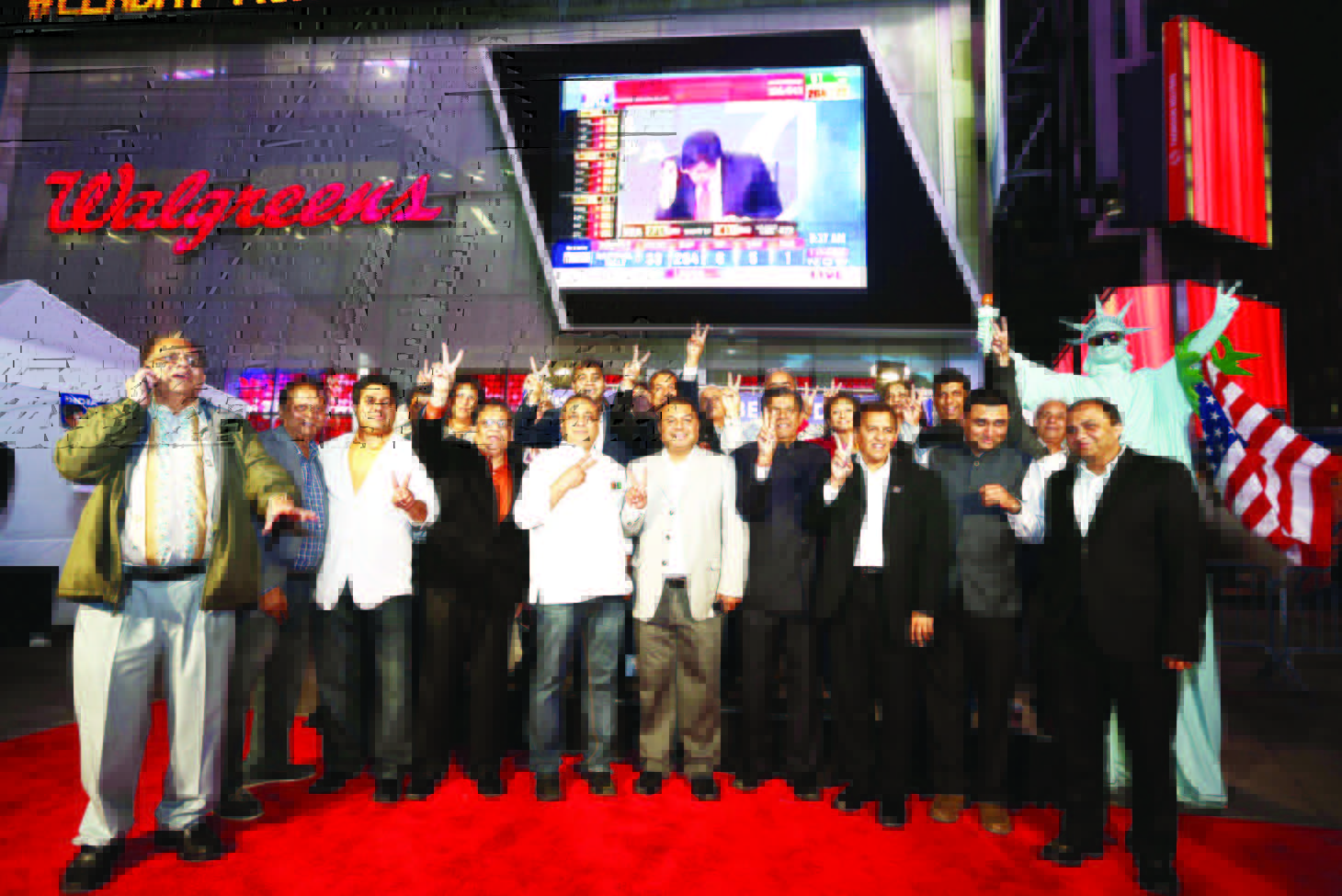
    NEW YORK/NEW JERSEY (TIP): NRIs in New York and New Jersey jubilated on the victory of Modi and the BJP in the 2014 elections in India, the results of which came out on May 16th. BJP on its own, bagged 282 of the 543 seats in the Lok Sabha. Together with its partners in the NDA, it has got a formidable number of 336.


    36

    Narendra Modi who was named by the BJP as its Prime Ministerial candidate, led a long, tough and determined campaign to dislodge the Congress led UPA government that he ultimately decimated. The large following that Modi has in the Tri- State area of New York,New Jersey and Connecticut broke into spontaneous celebrations of Modi’s victory.


    35

    While a large number of people gathered at the Times Square to watch live the election results and analysis on Times Now big screen specially put up for the occasion, others, in Jersey City, played Holi to celebrate the occasion. Still others stayed home and celebrated Modi’s victory with friends and local politicians and officials.

    Our photo journalist Mohammad Jaffer captured the momentous jubilations for the readers of The Indian Panorama.We present some of the pictures here.

    Photos/ Mohammad Jaffer, SnapsIndia

  • Factors that helped BJP and Narendra Modi win Elections

    Factors that helped BJP and Narendra Modi win Elections

    FIXING THE ECONOMY
    India’s once-impressive economic growth, averaging above 8 per cent over the last decade, slowed to below 5 per cent in the last year while inflation rocketed into double digits. The BJP and Narendra Modi maintained a laser focus on the economy throughout the campaign, hammering the Congress party for stalled development projects while touting Modi’s state of Gujarat as a model of success.

    In fact, Gujarat’s growth has been mediocre compared with others of India’s 28 states. But Modi’s message resonated with an electorate aching for change and upward mobility, and India’s corporate leaders backed Modi as a decisive administrator needed to revive industrial growth.

    COMBATING CORRUPTION
    A slew of massive corruption scandals involving public funds and resources battered the Congress-led coalition. Anti-graft protests inspired a fierce anti-incumbency wave among voters and inspired the launch of Arvind Kejriwal’s Aam Aadmi Party or AAP. In his campaign, Mr Modi has said he will serve as a “chowkidaar” or watchman, vowing he will expunge corruption from the government and bureaucracy.

    YOUTH
    India’s electorate is particularly young, with half the country’s 81 crore voters under 35 years old and eager to secure employment with promise. Mr Modi has promised to create jobs for them. They are also averse to the political tradition of whipping up communal loyalties to secure votes from certain socio-economic groups, castes or religions.

    TECHNOLOGY
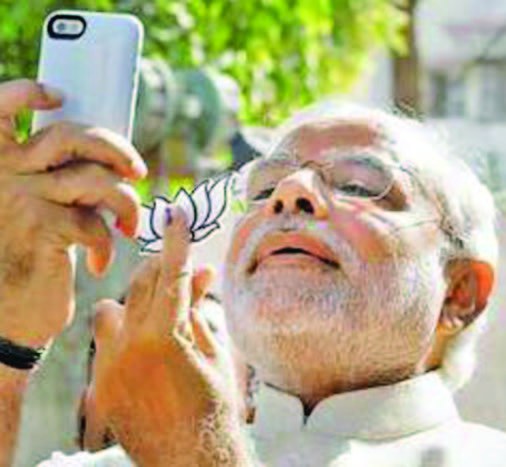
    The BJP and Modi ran a high-adrenalin and tech-savvy campaign that dazzled and engaged voters directly through social media. Modi snapped campaign selfies that went viral and even appeared as a holograph at campaign events. He has tweeted daily for years. By contrast, his main rival from the Congress party, Rahul Gandhi, shunned Twitter himself while his party took to the site only this year.

    INFRASTRUCTURE
    India’s crumbling roads and ports, plus lack of adequate electricity supply, were high on the list of problems that make business projects hard to get off the ground. They are also of paramount importance to voters, one-third of whom now live in cities. In Gujarat, Mr Modi made infrastructure improvements a priority, building thousands of kilometers of highways and attracting investment to build up the country’s largest modern port. He promised to bring the same focus if elected prime minister.

  • NARENDRA MODI IN DELHI, HOLDS ROAD SHOW

    NARENDRA MODI IN DELHI, HOLDS ROAD SHOW

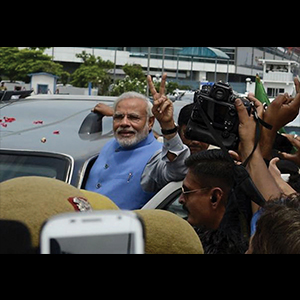
    NEW DELHI (TIP): After the landslide victory in Lok Sabha polls, Narendra Modi arrived in the national capital on May 17 to a rousing welcome by thousands of enthusiastic BJP workers and supporters to whom he gave credit for the historic achievement.

    The Prime Minister-elect waved victory sign to the cheering crowds of supporters wearing saffron caps and showing BJP flags as he undertook a roadshow from Indira Gandhi International Airport to the party headquarters at Ashoka Road, a distance of about 16 kms. He was received at the airport by a number of senior BJP leaders, including party chief Rajnath Singh.

    Escorted by elite commandos, Modi was greeted by supporters at various places along the route from the airport to the party headquarters at Ashoka Road. BJP workers on motorcycles waving party flags were part of the roadshow. On reaching the BJP headquarters, he briefly addressed the supporters, saying he was thankful to them for rekindling “new hope” through their hard work. “As a person, Modi requests all of you, don’t give credit for this victory to Modi. It is a result of hard work of lakhs of workers.

    This victory belongs to those fourfive generations who have toiled hard since 1952,” he said. “The first right of credit for this victory goes to 125 crore Indians and second to those martyred since 1952. In the last 25 years, thousands of our workers were killed in states like Kerala and those who gave up their lives in Tamil Nadu,” Modi said.

  • Karunanidhi accepts defeat; congratulates Modi

    Karunanidhi accepts defeat; congratulates Modi

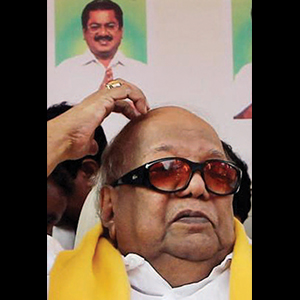
    CHENNAI (TIP): DMK leader M. Karunanidhi said he would accept the outcome of the Lok Sabha election as the verdict of the people. Accepting the total defeat of the DMK and its allies in Tamil Nadu he said he bowed to the people’s verdict. Karunanidhi said the DMK in the past had witnessed similar defeats and also had achieved great victories.

    “As our party founder Anna said while we will not lose heart by defeat we will not allow victory to go into our head. We will continue to work for the welfare of the people.” He congratulated the BJP on its major victory and Prime Minister in waiting Narendra Modi.

  • India votes for political stability, development and good governance

    India votes for political stability, development and good governance

    The days of political instability in India should be over, with the people of India clearly preferring the BJP to lead the country. India has chosen, after almost three decades, a government that can function without pulls and pressures, which in other words means, political blackmail, to which the nation has been a helpless witness during the last two decades.

    In a house of 543, where a party needed 272 to have a simple majority, BJP has got 282 seats, 10 more than required to form a government on its own. With its alliance partners in the NDA-Shiv Sena, TDP, SAD, LJP and others, it commands an imposing majority, with 336 seats. It could well lead to an Indian Renaissance. Indubitably, there has been a “tectonic shift in the Indian politics”.

    How one could, otherwise, explain the total decimation of the Congress and its allies in the UPA and the meteoric rise of the BJP. Indians have been waiting for the promised millennium but found, to their chagrin that it was an endless wait for Godot. Their patience was running out. Promises and pledges were made to be broken, not kept, seemed to be the belief of the ruling UPA.

    The result: 44 seats for the Congress Party and a total of 59 for the UPA. The impatience of the people with the government that was steeped in corruption led to protests against corruption and misgovernance. Indians cannot in their honesty deny that the movement against corruption and for a Lok Pal Bill launched by Anna Hazare dented the Congress image.

    Arvind Kejriwal, taking a more hostile opposition to the corruption in the UPA government, launched a frontal attack on the UPA government and the Congress leaders and exposed a number of corruption cases. These movements enjoyed people’s support. The image of the Congress party and its allies in the UPA got sullied, with people openly expressing their disapproval of the functioning of the government.

    Look at the Delhi assembly elections. The Congress party was nearly routed, with just 8 seats, after having ruled the state for 15 years, trailing behind BJP (32) and the fledgling AAP (28). Apart from the exposure of the Congress led UPA government corruption and misdeeds, what hurt it the most was its inability to control inflation. The common man suffered from ever increasing prices which made his life miserable.

    The regular backbreaking price rise of essential commodities made him think of a change. See how Delhites fell to the AAP promises of cheaper water and electricity supply and gave a few months old political party, the massive support to rule. It was another matter that AAP government could not last.

    Other factors that contributed to people’s disenchantment with the Congress party included growing unemployment, failure of law and order machinery to protect the honor of women, and the ruling party’s attitude of indifference towards people’s problems. People wanted a change. As when one medication does not work, one tries another hoping it will work; so, the people of India, oppressed by the ruling party’s indifference to their woes, decided to go in for a change.

    Their vote for the BJP is, in fact, a voteagainst nonperformanceand misperformance of the UPA government. BJP, today, is in a position to deliver. With its comfortable majority, it can shape its policies, without being pressurized, as in a coalition. Narendra Modi has been harping on development during election campaign which he so successfully led from the front. Mr. India would like to get a slice of it.

    If he does not, he knows what to do. History repeats itself. Not long ago, a Kejriwal in Delhi was a cynosure of the common man’s eye and a few months later, he was dumped because he could not deliver. It has happened with the Congress Party. It could as well happen with the BJP. Indians are looking for results from the BJP. They are not going to wait long. First of all, they would like the government to control the killing price rise. Next, they would like to see the law and order machinery protect their lives and property. They want a judicial system which does them justice.

    They would like to be rid of everyday harassment in government offices where everybody seems to be out to reach in to their pockets. They would like to be treated with respect due to a human being. For long, India has followed the colonial system in many ways.

    One, which is more disturbing and destabilizing, is the large presence of the privileged and the non-privileged sections of society. The feudal system which the laws ended a long time ago is still going strong. The mai baap, sarkar, huzoor, VIP culture is doing no good to the nation. And then, we do not want to give up status symbols. One fails to understand why a lawmaker or an official of the government requires security and a fleet of vehicles.

    Who pays for it? Why should the people of India pay for the idiotic notions of the privileged few? Modi’s charisma has worked with the people of India and we would hope it works with the governments of the world. The Modi government must ensure cordial relations with neighbors and friendly nations. In particular, relations with USA, China and Pakistan will need extra care and attention. Over the years, India has diligently built up certain alliances which will need to be strengthened.

    In international relations, change of government does not mean abrupt changes in alliances. It may be remembered that such alliances exist between nations, not between governments. Indians are glad to see a star politician in Modi. They would be happier to see a statesman in Modi. Only time will tell whether or not Modi can graduate from a politician in to a statesman. One hopes, BJP will live up to the expectations of people of India who have placed their trust in the party’s promise of giving good governance – “Sushashan”.

  • STATES SWEPT CLEAN BY NARENDRA MODI

    STATES SWEPT CLEAN BY NARENDRA MODI

    NEW DELHI (TIP): The BJP has crossed the 272 mark in the Lok Sabha on its own. Its stupendous performance has been propelled by the clean sweep, or the near clean sweep, effected by it in a few states. But Tamil Nadu, West Bengal, Jammu and Kashmir, states ruled by other parties, have also registered dramatic results.

    Gujarat
    The BJP, led from the front by its prime ministerial candidate Narendra Modi, has won all 26 seats. It had 15 in 2009.

    Rajasthan
    The results in this state mark a continuation of the trend visible in the assembly polls held in December. The BJP is leading in all 25 seats – a dramatic reversal in its fortunes from 2009, when it could only win 4 seats.

    Jharkhand
    The BJP had walked away with 8 of the 14 seats in 2009. It has now won 12 of the 14 seats. Its impact will be felt in the assembly elections, due later this year. Chhattisgarh: In the assembly elections held late last year, the BJP could barely get a wafer thin majority. It has now won 10 of the 11 seats, the same as in 2009.

    Delhi
    The BJP had drawn a blank in 2009. It has won all seven seats. The outcome is certain to have a bearing in the assembly polls, likely to be held soon.

    Uttarakhand
    Another state where the BJP is witnessing a dramatic turnaround in its fortunes. It had failed to open its account in 2009. Here also all five seats have gone to the BJP.

    Goa
    The BJP won both the constituencies. It emerged victorious in one in 2009. Tamil Nadu: J Jayalalithaa’s AIADMK has swept a startling 37 of the 39 parliamentary constituencies. It had won only 9 seats five years ago.

    West Bengal
    Mamata Banerjee’s Trinamool Congress also swept 34 of the 42 seats. Her party had cornered 19 seats in 2009 in alliance with the Congress. The Trinamool Congress has now gone solo.

    (India Votes 2014: Personalities) Tripura: The only state where the Left Front has managed to retain its base. Thanks to chief minister Manik Sarkar’s popularity, the CPM has won both the seats.

    Madhya Pradesh
    BJP has won a high total of 27 seats of the total 29 from the state. It had won 16 seats five years ago.

    Jammu and Kashmir
    In 2009, the Congress had walked away with two seats, and its ally, National Conference, another three. The two parties are headed for a wash-out, with the BJP wresting three, and Mehbooba Mufti’s People’s Democratic Party the remaining three.

    Himachal Pradesh
    Another state where the BJP has made a clean sweep. It has won all four seats. It had cornered three five years ago.

    Uttar Pradesh
    No one would have imagined that the BJP would make a near clean sweep in this politically-crucial state. It has won 73 of the 80 seats out of which two have been won by Apna Dal, in its best-performance ever. In 1998, the party bagged 57 seats. But the tally included five from Uttarakhand, which was till then a part of Uttar Pradesh. In 2009, the BJP had secured 10 seats.

    Maharashtra
    The BJP-Shiv Sena alliance, which also includes three smaller parties, has wrested 43 of the 48 seats, a leap of 24 over its 2009 tally.

  • From Rahul to Akhilesh, from Ajit Pawar to media: why Modi needs to thank them

    From Rahul to Akhilesh, from Ajit Pawar to media: why Modi needs to thank them

    By Rajdeep Sardesai

    Barring a miracle, at some stage on Friday, Narendra Modi will be poised to fulfill his long-cherished ambition of being the next prime minister. Yes, exit polls have a spotty record in the country, but unless we have all got it horribly wrong, there is no reason to believe that there isn’t a Modi ‘wave’ in large parts of the country, if not a tsunami.

    When Modi writes his blog and thanks the Indian voter, here are a few more thank you cards he should send out. On top of the list will be Rahul Gandhi. No individual can be held solely responsible for a party’s electoral defeat, but the fact is, Gandhi had his chance and fluffed it. His approach to the elections was collegiate: Almost as if he was participating in a student council election and not in a battle for the heart of India.

    The Congress campaign was listless and confused, perhaps because the general wasn’t in a position to set the agenda. The ‘face’ of a party needs to offer a big idea: Modi offered hope and aspiration, Gandhi stood for the status quo. His refusal to take an office of responsibility in the Manmohan Singh government or launch a sustained campaign on any specific issue was equally calamitous. The ‘divine right to rule’ principle no longer holds in Indian politics: Gandhi needed to prove himself by doing the real heavy lifting, not by midnight stays in a Dalit home or suddenly waking up to call his own government’s ordinance “nonsense”.

    By the time he eventually agreed to lead the ship in January this year, he had been pigeonholed as Rahul Baba, a dynast who couldn’t be taken seriously. The next thank you card must be sent to Manmohan Singh. We are in the age of communication and to have a prime minister who was in near permanent silent mode was a disaster. Frankly, he should have stepped down well before he finally announced his retirement this year.

    Maybe he should have asserted himself on day one of UPA 2 when he was forced to take back A Raja into his Cabinet. Even if he had stepped down in September last year when he was publicly humiliated by Gandhi on the ordinance on convicted MPs, he might have saved himself from an utter loss of face. As it is, a decent man will go down in the history books as little more than a political survivor.

    Maybe a thank you note also needs to go to 10 Janpath. Sonia Gandhi’s economic philosophy meant that UPA 2 ran a government on dole, not growth. However wellintentioned, the populist rhetoric created an unsustainable growth model, aggravated by a global economic crisis. No government can survive prolonged inflation and low growth: Jobs, not hand-outs, win you votes.

    The weaknesses of Singh and the Gandhis meant that Modi’s muchhyped “chappan kee chaati” (56-inch chest) actually appeared even broader than the reality. Leaders emerge in a context: A government in a state of drift and hobbled by corruption charges allowed the Gujarat chief minister to position himself as India’s Mr. Fix-it, someone whose despotic streak and questionable role in the 2002 riots could be forgiven in the overarching need for a ‘decisive’ leader. The next thank you card must go to Akhilesh Yadav. Uttar Pradesh was always going to be the Kurukshetra of Modi’s political ambitions.

    The BJP needed to win big in this state to achieve its ‘Mission 272+’. The party didn’t have the organizational muscle to achieve its aim. But Yadav’s dysfunctional government made it that much easier for Modi’s master strategist Amit Shah to get a foothold in UP. From its handling of the Muzaffarnagar riots to the return of goonda raj, anger against the Samajwadi Party government provided the perfect platform for Modi’s message of change. Modi may also wish to send a thank you card to Mani Shankar Aiyar.

    The backbencher Congress MP’s derisive chaiwallah remark was just the kind of opening the BJP’s mascot was looking for. It allowed Modi to rediscover his tea boy past, and contrast his social origins with the elitist moorings of the Congress. Chaiwallah versus shehzada in a merit-driven new India: Even Salim-Javed couldn’t have written a better story line. Other Congress leaders who chose to liken Modi to ‘bhasmasur’ and a ‘cockroach’ could also be thanked since the demonization allowed the BJP’s poster boy to cleverly position himself as a ‘victim’ and an antiestablishment ‘outsider’.

    A thank you card might also be sent to Ajit Pawar, the politician who has become the ‘face’ of an arrogant and insensitive Maharashtra government. When confronted with a drought in the state, if a senior leader chooses to ask people to urinate in the dams, then no amount of repentance will lead to public forgiveness. Along with UP, Maharashtra is the other big state turnaround for the BJP. A thank you card should also be sent to corporate India. Never before in the history of Indian elections, has so much big money been riding on the fortunes of one man.

    Team Modi ran a brilliant campaign, but it was driven by unlimited access to funds, changing the face of Indian elections, perhaps forever. The final thank you card should be sent to the media: Never before have the Indian media been so open about their role as a political cheerleader. Instead of a serious interrogation of the Gujarat model of development, a powerful section of the media allowed Modi to get away with a mix of genuine achievement, clever marketing and half-truths.

    When Modi, for example, almost claimed credit for Gujarat’s ‘White revolution’, the media even forgot to remind him of a certain Verghese ‘Amul’ Kurien. In the making of Brand Modi, the man from Vadnagar owes a huge debt to the media.

  • ALLIES TO BE PART OF MODI GOVT, RAJNATH SAYS

    ALLIES TO BE PART OF MODI GOVT, RAJNATH SAYS

    NEW DELHI (TIP): The BJP will include all its pre-poll allies in the government though the party has numbers to form government on its own. Soon after it became clear that the BJP would cross the majority mark of 272 on its own, party chief Rajnath Singh said, “We thank our allies for their support. To run a government, you need a majority but to run a country, you need the support of everybody.

    We will accept support of all those who want to help us in running the country. All NDA allies who have fought the elections with us will have due representation (uchit bhagidari) in the government. On the formation of cabinet, he said, “Cabinet formation is the prerogative of the Prime Minister and we will discuss all these issues after we sit together.” A visibly elated Rajnath Singh gave wholesome credit to Narendra Modi for the party’s spectacular electoral performance and said the role of seniors including L K Advani would be decided collectively and with consensus. “I am happy and satisfied.

    It is people’s mandate for change and it is a mandate for Modi’s popularity… Time has come to re-write the Indian success story,” he said. “The role of senior leaders will be taken up after meeting of the central parliamentary board,” he said, answering a volley of questions on possible role for Advani, Murli Manohar Joshi and Sushma Swaraj in the new government. He went on to praise Advani, saying, “as far as Advaniji is concerned, he is not only our leader but we treat him as our guardian.

    The party was taken to the heights that it has reached today because of Atal Bihari Vajpayee and Advani.” In an attempt to do away with controversies at a time of party leaders were keen to enjoy the big victory, Singh said, “The reports about differences over leadership are baseless. We are united under Modi’s leadership and a very happy party today.” When asked if May 16 mandate reflects an end of dynastic politics, Singh said, the party won the election on its agenda of good governance and development even though many parties tried to divert the attention of the people.

    “No one can win an election like this on negative issues and negative agenda. Our proven track record of good governance helped us get the mandate,” he said. “This is a mandate for change and it is a mandate for Modi. People from all segments have voted for BJP breaking barriers of caste, religion, creed and region. The BJP was considered an urban party but it has emerged as a party for people in slums, villages, poor and all sections of the society,” he said.

  • Modi can revive ‘rudderless’ US-India relationship: US experts

    Modi can revive ‘rudderless’ US-India relationship: US experts

    WASHINGTON (TIP): : Two US foreign policy experts have suggested that Bharatiya Janata Party (BJP) leader Narendra Modi can “revive India’s sputtering economy and give new élan to a disillusioned and rudderless USIndia relationship.” Noting that since 1991, India-US “bilateral relationship has gone through many stop-and-go cycles,” James C. Clad and Brent Scowcroft wrote in Foreign Policy magazine that “With Modi in place, the boom part of the cycle is about to start again.”

    “A BJP-dominated central government, led by a proven Thatcher-like and market-oriented Hindu conservative, is likely to prompt another cascade of hype, aided by an enthusiastic new generation of Indian-Americans,” they wrote. “The Modi era may offer a chance to recast US-India ties in more realist mode,” wrote Clad, a former US deputy assistant secretary of defense for Asia, and Manning, a senior fellow of the Brent Scowcroft Centre for International Security at the Atlantic Council.

    “To the degree Modi succeeds in re-energizing India’s economy (as he has done impressively as chief minister of Gujarat), he will give substance, and not hot air, to a deeper US-India partnership,” they wrote. “Perhaps the foundering efforts at a bilateral investment treaty, or even the prospect that India may eventually join the trans-Pacific Partnership, could shape a realistic, forward-looking bilateral agenda,” the experts suggested.

    “Modi’s success will depend on how effectively he empowers the private sector and how he implements the next belated phase of market-centered reforms,” Clad and Manning wrote. The two experts suggested that the US “stay clear of ‘wish’-driven agendas, driven by the American desire for a ‘natural ally’ in South Asia. “Delhi has its own reasons to be wary of China, as Modi stressed during his campaign.

    But don’t expect allegiance to US views on China or major global issues,” they said. “A more modest, focused, and realistic agenda can put the US-India relationship on a more enduring foundation,” they wrote suggesting that while “the economic piece is critical,” the “second foundation remains security cooperation.”

    “As Modi goes, we suspect, so also will go a rejuvenated partnership with India, one based on bedrock interests, not romanticized wishes,” Clad and Manning wrote. “Both countries can and should build a solid, and necessarily more modest partnership, than has been wished since 1991,” they wrote.

  • US media hails ‘India’s moment’ in Modi’s historic win

    US media hails ‘India’s moment’ in Modi’s historic win

    WASHINGTON (TIP): The American media and foreign policy experts greeted the Narendra Modi-led BJP’s historic election victory as “India’s moment” and an opportunity to revitalize the economy and “shape the way India engages with the world”. BJP’s “landslide victory reflects a changing country more willing to extend governance to those outside the established elite”, the influential New York Times said in an editorial advising the Gandhi family to “hand over the leadership to others”.

    “That is the only chance for India to have a credible opposition,” it said The Bharatiya Janata Party’s victory gives Modi, the Times said, “The chance to revitalize the economy and shape the way India engages with the world”. “How he moves forward will matter to Indians clamoring for jobs and development, but also to others, including the US, which sees India as a vital economic and security partner in Asia,” it said.

    “The two countries will have to work hard to overcome the strain built up between them in recent years,” the Times said, suggesting “Modi needs to deliver on his vow to make progress, and he and Washington must confront differences on global trade issues”. The Washington Post wondered whether the “Narendra Modi era (would) be marked by an economic boom or derailed by nationalism. “A frequent visitor to China, he (Modi) clearly aspires to show that India can match Chinese dynamism,” it said in an editorial.

    “What remains to be seen is whether Modi will be the Deng Xiaopeng of India or its Vladimir Putin, a leader whose economic ambitions are derailed by nationalism and authoritarian temptations.” The US, which a decade ago was rapidly growing closer to India, may have difficulty influencing Modi’s course, the Post said, noting both the Obama and Bush administration shunned him “because of his behavior” during the 2002 Gujarat riots.

    “Indians already perceived the Obama administration as neglectful of their country; President Obama will have to play catch-up if there is to be a significant US-Indian partnership in the coming Modi era,” it said. Calling the election result “India’s Moment”, the Wall Street Journal said: “The world’s largest democracy makes a statement at the polls: No to corruption, bureaucracy and dynastic politics, and yes to Narendra Modi’s promise of a country ready to do business.” Modi, it said, “inherits a country that is now impatient with its leaders.

    It remains to be seen whether he and the BJP can refashion it in their own image. “But they are clearly determined to try …to change India for not just an election cycle but for years to come.” Ashley J. Tellis, senior associate at Carnegie Endowment for International Peace, called Modi’s win a “breathtaking landslide”. “A single party with an absolute majority gives Modi the opportunity to redefine Indian politics in a way that the Congress did for many decades before,” he said.

  • NARENDRA MODI From a tea vendor to prime minister of India

    NARENDRA MODI From a tea vendor to prime minister of India

    From selling tea at a stall his father set up at a small village railway station and at a bus terminal at a tender age to the prime ministerial throne at 63, Narendra Modi’s rise is the stuff that fairytales are made of.

    Inspired by the lives and teachings of Gautama Buddha and Swami Vivekananda (whose real name was Narendra Dutta), Modi had left his Vadnagar home at the beginning of his youth, joined the RSS as a pracharak (preacher) and was loaned to its political front Bharatiya Janata Party (BJP) as a fulltime worker.

    Born in a socially backward family in Vadnagar town of Gujarat’s Mehsana district, Modi rose to the throne of India’s PM in such a way that would leave many in wonder. Back in 1990s, he was a familiar figure at the BJP headquarters on Ashoka Road in New Delhi as a low-profile general secretary of the party, always polite, calm and smiling, unruffled by even the most uncomfortable questions from the media.

    But ever since Modi was deputed by the party to his home state Gujarat in 2001 to rescue the BJP from existence-threatening internecine war to succeed chief minister Keshubhai Patel, he has acquired a stern look and an aggression typical of a battle-hardened politician, a battle that saw him rising steadily through the party ranks and striding up the echelons of the organisation, knocking out in the process veterans like LK Advani and Murli Manohar Joshi.

    If Modi was seen as the BJP’s saviour in Gujarat, he was brought in as the party’s prime ministerial candidate at a time when it was out of power for a decade and was struggling with internal squabbles among senior leaders jockeying for positions and prominence. The communal riots in Gujarat which left at least 1,000 people, mostly Muslims, dead in 2002, had made him a deeply polarising figure. Once a poster boy of hardline Hindutva, Modi struggled to shake off that perception by largely steering clear of Hindu nationalist rhetoric on his election campaign trail.

    He pledged to focus on development by generating investments, jobs and restoring business confidence. A Supreme Court-monitored probe found no case against Modi in the riots and he himself denied any wrongdoing. However, many still believe that his government in Gujarat did not do much to stop the riots. During campaigning, Modi has crafted an image for himself of a man who renounced worldly life to become an RSS pracharak and as a decisive leader with an alternative vision and governance for a country caught in a policy paralysis over the last few years.

    He made instant contacts with leading business houses, aspiring young voters, middle class people and those in rural areas yearning for a change in the backdrop of growing frustration over economic slowdown and corruption scandals. The starkly contrasting perceptions about Modi are best typified by a little-noticed war of words between the BJP and the Congress. As Modi surveyed the vast crowds at his poll rallies, one of his top aides proclaimed the wave of support to turn into a tsunami.

    The Congress quickly shot back saying tsunamis leave a trail of death and devastation. Married to Jasodhaben decades ago, a fact he made public only last month while filing his nomination for contesting parliamentary polls, Modi is tech-savvy, often posting his views on social networking site Twitter. DNA India reports: Modi during the phase of his sanyash (seclusion from family life) had just two pair of clothes. But he has been very particular about the way he looks in public.

    He wears wrinkle-free and ironed dresses. He has favourite cloth store Jade Blue of Ahmedabad which he prefers for his dresses. He might not have been provided with a visa in 2005 to the US but the irony is the BJP leader has done a three-month course on public relations and image management in that country. A workaholic, Modi sleeps only four hours. He reports to his office around 7:00am and works as late as 10:00pm or even later. He likes to keep a tab on every change and makes sure to keep all the clippings of what his opposition or critics have to say about him.

    NaMo Rises

    1950

    Narendra Damodardas Modi is born on September 17,1950, in Vadnagar village, Mehsana district. As a youth, he worked in his family’s tea stall. Modi joined the Akhil Bharatiya Vidyarthi Parishad, the student’s wing of the Rashtriya Swayasevak Sangh (RSS), and later joined the parent organisation.

    1987

    Modi joins the Bharatiya Janata Party (BJP) as the young party taps into Hindu nationalism that had engulfed the entire country. The BJP wins a majority in Gujarat in 1995 and Modi quickly rises up the ranks. Very soon, Modi is appointed the party’s general secretary in the state unit.

    1990

    Narendra Modi comes into the limelight as one of the key choreographers of BJP leader L.K. Advani’s Ram Rath Yatra from Somnath in Gujarat to Ayodhya.

    1995

    Modi is appointed as National Secretary of the BJP in charge of 5 states and later promoted to general secretary in 1998

    2001

    Modi gets his big break when he replaces Keshubhai Patel as Gujarat chief minister.

    2002

    In February that year, he faced widespread flak for failing to contain brutal riots following killing of 59 passengers in a train fire in Godhra. More than 1,000 people, mostly from the minority community, were killed in the subsequent riots. Modi is also accused of encouraging the rioters which he has strongly denied.

    2005

    US denies Modi a travel visa for ‘religious intolerance’, causing uproar among his followers.

    2007

    Narendra Modi is elected as Gujarat chief minister for the third time.

    2012

    Elected as Chief Minister for the fourth time, with BJP cornering 115 of the total 182 seats.

    2013

    On June 9, BJP appoints Modi as head of the party’s 2014 election campaign. Advani resigns from BJP posts in protest but backtracks later that week. On June 16, Nitish Kumar, head of the Janata Dal (United), pulls out of a 17-year-old alliance with the BJP, making their opposition to Modi’s elevation loud and clear. On September 13, the BJP announces Narendra Modi as the PM candidate for the 2014 elections.

    2014

    On May 16, the BJP recorded a thumping victory in the Lok Sabha elections under the leadership of Narendra Modi.

  • US Lawmakers congratulate Modi

    US Lawmakers congratulate Modi

    WASHINGTON (TIP): US lawmakers, including the only Hindu- American House member, have congratulated Narendra Modi and his BJP for its sweeping election win, calling it “an extraordinary achievement” for Indian voters. Rep. Tulsi Gabbard who represents Hawaii, congratulated Narendra Modi on his Party’s victory.

    She released the following statement from Honolulu on the results of the Indian election that concluded earlier this week. “I recently spoke with Narendra Modi by phone and congratulated him and the Bharatiya Janata party for winning a majority vote in India’s Lok Sabha. This election was an extraordinary achievement for the 550 million Indians who voted over the course of six weeks in some 930,000 polling locations.

    I look forward to working with Mr. Modi and other members of the Indian government toward our mutual goals of peace, stability, and economic growth in the Asia-Pacific region. A partnership between the world’s two largest and greatest democracies is necessary for us to successfully address the many global challenges we face, including economic growth, bilateral trade, the environment, terrorism, and security.”


    7
    Mark R. Warner, Democratic cochair of the bipartisan US Senate India Caucus, congratulated the BJP and Modi, and said he looked “forward to working with the new Indian government to move the USIndia relationship forward.

    Mark R. Warner, Democratic co-chair of the bipartisan US Senate India Caucus, congratulated the BJP and Modi said he looked “forward to working with the new Indian government to move the US-India relationship forward. “Once the new government is formed, both the US and India should commit to accomplish some specific actions in the first 100 days to demonstrate that we can work together to get things done.” Warner said he believed “opportunities exist in the areas of defense trade, energy, and foreign direct investment, as well as further efforts to advance the bilateral investment treaty”.