Tag: Indian Politics

  POLITICS & POLICY  

  • Perspective : Looking for balance in power

    Perspective : Looking for balance in power

    By Harsh V Pant

    An arrangement that had started with an attempt to manage American unipolarity is now being affected fundamentally by Chinese resurgence. Both Russia and India are having to deal with the externalities being generated by China’s rise. While Russia is getting closer to China, India is trying to leverage its partnership with other like-minded states in the wider Indo-Pacific region. As a multipolar world order takes shape, India will have to engage with multiple partners so as to limit bilateral divergences, says the author.

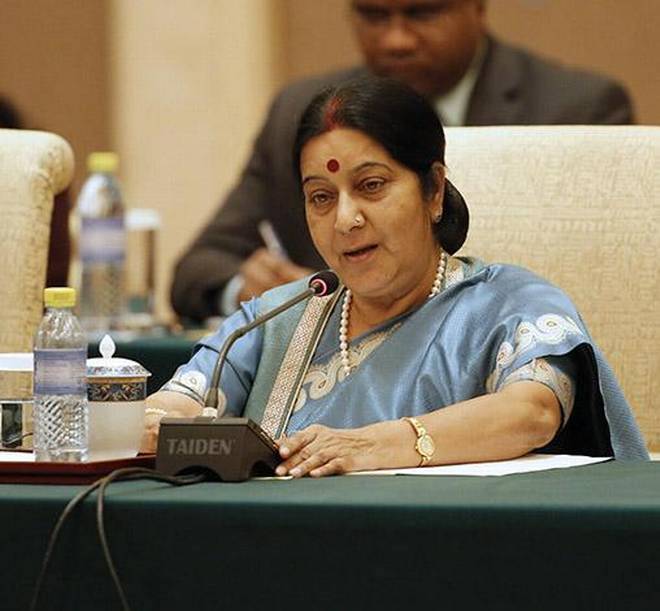
    A month after India was part of the ‘Quad’ discussion on the sidelines of the East Asia Summit in Manila involving Japan, Australia and the U.S., New Delhi hosted foreign ministers of Russia and China this week. The Russia-India-China trilateral held its 15th meeting in what can be construed as New Delhi’s attempt to get a semblance of balance in its ties with Moscow and Beijing.

    Scope of talks

    The broader discussions, according to a joint communique of the 15th meeting, “took place in the backdrop of the political scenario in West Asia and North Africa, numerous challenges in putting the world economy back on the growth track, concerns relating to terrorism, transnational organized crime, illicit drug trafficking, food security, and climate change.”

    But what was perhaps interesting was Russia and China’s continued attempts to frame global and regional politics through a similar lens, and the growing divergences between India and them. Russian Foreign Minister Sergei Lavrov made it clear that he believes that India can benefit by joining China’s Belt and Road Initiative. “I know India has problems, we discussed it today, with the concept of One Belt, One Road, but the specific problem in this regard should not make everything else conditional to resolving political issues,” Mr. Lavrov said. Targeting India’s participation in the ‘Quad’, he also underlined that a sustainable security architecture cannot be achieved in the Asia-Pacific region with “closed bloc arrangements.” Chinese foreign minister Wang Yi also cautioned against “spheres of influence” and “cliques” by arguing that China opposed “hegemony and power politics and disagree with the sphere of influence and cliques and promote the democratization of international relations.”

    China, meanwhile, continued to take an aggressive posture on Doklam and its aftermath. Mr. Wang said in a speech before his Delhi visit: “We have handled the issue of cross-border incursions by the Indian border troops into China’s Donglang (Doklam) area through diplomatic measures.” Though he suggested that “China and India have far greater shared strategic interests than differences, and far greater needs for cooperation than partial friction,” he maintained that “through diplomatic means, the Indian side withdrew its equipment and personnel which reflected the value and importance of China-India relations and demonstrated sincerity and responsibility of maintaining regional peace and stability.”

    Tension in the air

     The tensions in the trilateral framework are inevitable given the changes in the global geopolitical environment. The original conception of this framework was a response to a very different global environment. The proposal for a Moscow-Beijing-Delhi ‘strategic triangle’ had originally come from former Russian Prime Minister Yevgeny Primakov during his visit to India in 1998, when he argued that such an arrangement would represent a force for greater regional and international stability. This did not elicit as enthusiastic a response from China and India as Russia had perhaps hoped for. Thereafter, the three countries continued to focus on improving the nature of their bilateral relationships, maintaining a safe distance from the Primakov proposal. But, this idea of a ‘strategic triangle’ took a tangible form when former Foreign Ministers of Russia, China, and India — Igor Ivanov, Tang Jiaxuan and Yashwant Sinha — met on the margins of the UN General Assembly in New York in September 2002. Despite the fact that nothing concrete emerged out of that meeting, it represented the first major attempt by the three nations to deliberate on world affairs, and since then has become a regular feature of interactions among the three states.

    The three nations had very different expectations from this trilateral. Russia’s role was key as its loss of power and influence on the world scene was a major cause of concern for its leadership. There was a growing and pervasive feeling in Russia that it surrendered its once-powerful position on the world stage for a position of little international influence and respect. It is against this backdrop that Russia tried to establish itself as the hub of two bilateral security partnerships that could be used to counteract U.S. power and influence in areas of mutual concern. While Russia witnessed a downward slide in its status as a superpower since the end of the Cold War, China emerged as a rising power that saw the U.S. as the greatest obstacle, if it was to achieve a pre-eminent position in the global political hierarchy. As a consequence, China recognized the importance of cooperating with Russia to check U.S. expansionism in the world, even if only for the short term. In fact, American policies towards Russia and China moved the two states closer to each other, leading to the formation of a new balance of power against the U.S.

    India’s stance

     India, on the other hand, had different considerations, as it was still far from becoming a global power of any reckoning. India saw in the trilateral a mechanism to bring greater balance in the global order as it believed that a unipolar U.S.-dominated world was not in the best interests of weaker states like itself, even as strategic convergence deepened between Washington and Delhi. Moreover, all three countries realized the enormous potential in the economic, political, military and cultural realms if bilateral relationships among them were adequately strengthened.

    As a consequence, the trilateral did not lead to consequences of any great import. It merely resulted in declarations which were often critical of the West, and of the U.S. Yet this was also a period which saw significant shifts in Indo-U.S. ties as bilateral relations expanded while Russian and Chinese links with the U.S. have witnessed a downward shift.

    The joint declaration of the recent trilateral meeting said: “Those committing, organizing, inciting or supporting terrorist acts” must be held accountable and brought to justice under international law, including the principle of “extradite or prosecute.” It stopped short of naming Pakistan-based terror groups such as Lashkar-e-Taiba and Jaish-e-Mohammed, something that India would have liked in line with the most recent BRICS declaration.

    An arrangement that had started with an attempt to manage American unipolarity is now being affected fundamentally by Chinese resurgence. Both Russia and India are having to deal with the externalities being generated by China’s rise. While Russia is getting closer to China, India is trying to leverage its partnership with other like-minded states in the wider Indo-Pacific region. As a multipolar world order takes shape, India will have to engage with multiple partners so as to limit bilateral divergences.

    The Russia-India-China template comes with its own set of challenges. China’s Global Times, commenting on the recent trilateral, suggested that “the leaders of the three only meet with each other on international occasions,” adding, “this indicates it does not have high status in diplomacy and cannot bear more functions.” While this may be true, New Delhi’s continued engagement with the duo suggests that India is today confident of setting its own agenda in various platforms. Just as China engages with the U.S. on the one hand and with Russia on the other, a rising India is quite capable of managing its ties with Washington, Beijing and Moscow simultaneously. It will not always be easy, but in an age when the certitudes of the past are fast vanishing, diplomacy will have to tread a complex path.

    (The author is Professor at King’s College, London and Head of Strategic Studies at the Observer Research Foundation, New Delhi)


  • Cong suspends Aiyar for ‘neech’ remark against Modi

    Cong suspends Aiyar for ‘neech’ remark against Modi

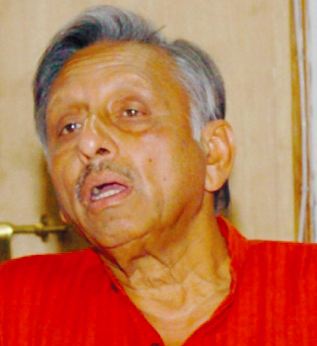
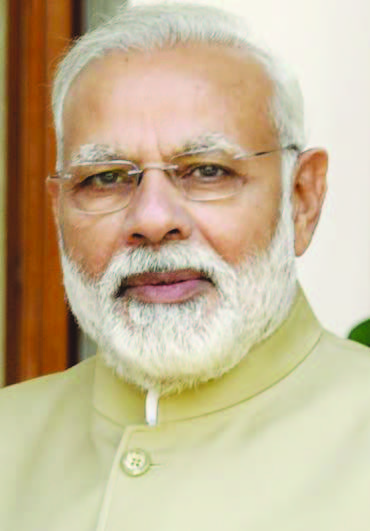
    NEW DELHI (TIP): The Congress has suspended the primary membership of Mani Shankar Aiyar after the Gandhi family loyalist set off a firestorm by calling Prime Minister Narendra Modi “neech aadmi” (a vile person), remarks fraught with adverse consequences for the party in poll-bound Gujarat.

    In an apparent move to contain the possible damage barely two days ahead of the keenly contested Assembly elections in the Prime Minister’s home State, the Congress announced disciplinary action against Aiyar, insisting it showed the party’s “Gandhian leadership”.

    “The Congress party has served a show cause notice to Mani Shankar Aiyar and suspended him from the primary membership of the party,” Congress’s communications department incharge Randeep Surjewala said. “This is Congress’ Gandhian leadership and respect for its political rivals….Will Modi ji display such courage?,” he asked.

    “He (Modi) is ‘neech kism ka aadmi’ (a vile man) who has no ‘sabhyata’ (civility),” Aiyar said earlier today in an ill-timed comment, attacking Modi after the latter accused the Congress of seeking votes in B R Ambedkar’s name but trying to erase his contribution to nation building.

    An apparently rattled Congress vice president Rahul Gandhi, who is set to assume the reins of the party from his mother Sonia Gandhi midway through the Gujarat elections, admonished Aiyar through Twitter and virtually instructed him to tender apology.

    “BJP and PM routinely use filthy language to attack the Congress party. The Congress has a different culture and heritage. I do not appreciate the tone and language used by Mani Shankar Aiyer to address the PM. Both the Congress and I expect him to apologise for what he said,” Gandhi said on Twitter.

    A chastised Aiyar did proffer a conditional apology, but that did not apparently smooth the ruffled feathers of the troubled Congress leadership which suspended his primary membership to contain the possible damage his comment might cause in Gujarat elections.

    Modi, the seasoned campaigner, quickly lapped up Aiyar’s comment to launch a scalding attack on the Congress leader and his party, claiming the remark was a casteist slur against him. “Shriman (Mr) Mani Shankar Aiyar today said that Modi is of ‘neech’ (lower) caste and is ‘neech’ (vile). Is this not an insult to Gujarat?

    “You called us donkey, you called us ‘gandi nali ka keeda’ (worm of a dirty drain), you called us ‘maut ka saudagar’ (merchant of death), you said I am of ‘neech jaati’ (lower caste man) and ‘neech’. But we will live according to our ‘sanskars’ (values),” Modi said, launching an onslaught against Congress leaders who called him names in the past. “This is a Mughal mentality where if such a person (who comes from a humble background) wears good clothes in a village, they have a problem,” he said.

    After the rebuke by the Congress leadership, Aiyar, known for making offthe- cuff remarks against political rivals that often embarrassed his party, was soon on national television proffering clarification, insisting it was because of his poor understanding of Hindi language that he used the word, and tendering apology.

    “I am told that ‘neech’ has many meanings, many connotations in Hindi, and if Mr Modi chooses to distort it to claim that it means low born, then all I can do is to apologise for having used a word that could be interpreted as low born. But that was not my intention at all and certainly not a part of my culture.

    “Therefore, for the misinterpretation that can be given to the word, I extend my apologies, particularly since it is going to harm the Congress party’s interests in Gujarat,” he said, in an open admission that his comment would have adverse consequences for the party.

    When repeatedly asked if he was tendering apology for calling Modi ‘neech’, Aiyar said,”Do I apologise about the word ‘low’? No. Do I apologise about the word that is translated which says ‘low born’? Absolutely yes.” The Congress leader said he does not think Modi was low born “but the language…I would say is very low”.

    Reacting to Aiyar’s suspension, Finance Minister Arun Jaitley said on Twitter: “Mani Shankar Aiyer’s ‘Neech’ – attack on Prime Minister- a deliberate casteist statement, a convenient apology, a strategic suspension. People should see through this game.

    Source: PTI

  • Close BJP-Cong fight likely in 1st phase of Gujarat polls

    Close BJP-Cong fight likely in 1st phase of Gujarat polls

    RAJKOT (TIP): With curtains down on electioneering for the first phase of the Gujarat Assembly polls, a close contest seems likely between the BJP and Congress, which probably mounted the most spirited campaign against the ruling party in over two decades.

    The pre-poll estimation of the Congresss grassroots level managers is that that the party stands a good chance of winning more seats this time compared to its 2012 tally of 61 in the 182-member Assembly. The saffron party, ruling the state for over 19 years now, had romped home bagging 115 seats.

    The BJP, however, is dismissive of the Congresss optimism, insisting it would come out with flying colours on the strength of the performance of its successive governments.

    In the absence of any leader with pan- Gujarat appeal, both contenders to power heavily relied on the charisma of their national leaders in an attempt to swing votes in their favour.

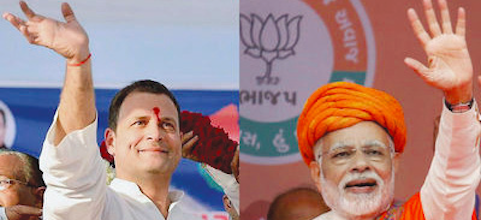
    While Prime Minister Narendra Modi powered the high-pitch BJP campaign, assisted by party chief Amit Shah, considered a master strategist after a string of electoral victories the party registered under him, the Congresss fight was led by a manifestly transformed Rahul Gandhi, who looked more sure- footed and less tentative.

    Rahul Gandhi spearheaded the Congresss campaign at a time when the party has been out of power in the key western state for 22 years now, and days before he steps into the shoes of his mother Sonia Gandhi, who helmed the grand old party for 19 years.

    A BJP victory will consolidate Modis position even further and would be seen as an endorsement of his governments reform measures, including the GST and note ban, while a win for the Congress will kindle hopes of its revival after debilitating electoral reverses state after state.

    A defeat for BJP in Modi and Shahs home state, observers feel, may catalyse formation of a broad-based anti-NDA secular front ahead of the 2019 general elections.

    In the first phase on December 9, a total of 89 assembly seats spread over Saurashtra and South Gujarat regions will go to the polls.

    There are 977 candidates in the fray. The BJP started off its campaign blitzkrieg with Modi has its pivot and the catchline–Hu Chu Vikas, Hu Chu Gujarat (I am Vikas (development), I am Gujarat). The Congress targeted the ruling party over the very same issue of development, claiming in Gujarat “vikas gando thayo che (development has gone crazy).”

    The Congresss optimism, apart from the possiblity of anti-incumbency factor working in its favour, also stems from it having secured the support of three young caste leaders– Patidar quota stir spearhead Hardik Patel, OBC leader Alpesh Thakor and Dalit activist Jignesh Mewani–ahead of the elections.

    While Patel has extended his Patidar Anamat Andolan Samitis support to the Congress, Thakor has already joined the party, and Mewani, who is contesting the Vadgam seat, is being backed by the Congress. All these leaders shot into prominence while leading agitations for their caste groups in the post-Modi Gujarat.

    Many feel the BJP held sway over Gujarat, particularly after Modi took over the reins of power in the communally sensitive state, owing to the consolidation of Hindu votes in its favour.

    The emergence of caste leaders on Gujarats political firmament may somewhat dent the the Hindu support base of the saffron party.

    On the rise of caste politics in the state, where the BJP has been highlighting its model of development, Gaurang Jani, a sociologist, said it was because the issues faced by these groups had not been properly addressed. Source: PTI

  • GUJARAT ASSEMBLY ELECTION 2017: From demonetisation to development, the key issues that will decide outcome

    GUJARAT ASSEMBLY ELECTION 2017: From demonetisation to development, the key issues that will decide outcome

    NEW DELHI (TIP): The Gujarat Assembly election, scheduled for 9 and 14 December, is significant for Prime Minister Narendra Modi and Congress vice-president Rahul Gandhi.

    While the former is eager to retain home turf, the latter is trying to mount a serious challenge to the BJP ahead of the 2019 General Election.

    The BJP may have its numerous infrastructure projects and the bullet train to help sway votes, but the Congress has the saffron party’s flawed implementation of the GST and the demonetisation going in its favour.

    The high-stakes battle in a state with only two major parties — BJP and Congress — will be contested on a number of issues that may well decide the outcome. The Gujarat election is considered even more important than Uttar Pradesh for Modi and a defeat will be embarrassing for the BJP.

    With the quota agitation crippling Gujarat and the disenchantment growing, BJP might not find it easy to win the state and Congress appears to be putting up a good fight to counter the saffron party.

    Congress vice-president Rahul Gandhi created a stir, especially on social media, with his swipe that the goods and services tax
    (GST) was nothing but a “Gabbar Singh Tax”. By drawing a reference to the celluloid bandit Gabbar Singh, immortalized in
    the cult film Sholay, Gandhi was being anything but subtle in his criticism of India’s marquee tax reform.

    THE PATIDAR PROBLEM AND THE DALIT DILEMMA

    The two sensitive issues that rattled the state and forced Anandiben Patel to resign as the chief minister were the protests for reservation for Patels in jobs and educational institutions, and the angry response against the flogging of Dalits.

    The BJP was at its wits’ end thanks to the fierce agitation led by Hardik Patel. Party leaders were not allowed to hold public rallies and they were barred from many Patel dominated areas in a show of increasing irritation with the saffron party.

    The issue has still not abated and Hardik has emerged as an influential leader able to sway votes in favour of whichever party he chooses to endorse. According to the India Today-Axis opinion poll, the Patidars play a decisive role in 21 of the state’s 182 seats and makes up almost 16 percent of the electorate. Hardik can give a bump of two percent to whichever party he supports.

    The drifting away of the Patidars from the BJP might alter the result of the election because the party has been banking on these votes for last two decades.

    The other issue which can play a major role in the election is the Dalit uprising. Gujarat witnessed one of the biggest Dalit uprising that ever took place in the state last year.

    Anandiben faced criticism after four Dalit youths were beaten up in Una on 11 July, 2016 for allegedly skinning a dead cow.

    Her exit was seen as BJP’s message to Dalits that the party was concerned about the growing unrest in the community. The Dalit anger, as The Hindupoints out, is mounting.

    Dalit leader Jignesh Mevani extended his support to the Congress and met party leader Ashok Gehlot.

    They comprise seven percent of the electorate in Gujarat and their vote in favour of the Congress could represent a huge loss for the saffron party.

    THE GST DECISION AND DEMONETISATION GAMBLE

    As Hindustan Times pointed out, small and medium-scale businessmen and traders, who form the core of the BJP support base, have been hit by what they call implementation glitches in the roll out of the Goods and Services Tax (GST).

    Textile traders in the state want a roll back of the GST on cloth. According to the Times Now-VMR opinion poll, about 40 percent respondents feel that the quality of life has worsened after the implementation of GST and demonetisation.

    Fifty-three percent of the people are dissatisfied with demonetisation, according to the India Today-Axis survey. The Opposition, specifically the Congress party, has been very vocal and vociferous in its criticism of the new tax regime.

    Rahul termed it the ‘Gabbar Singh Tax’ and the party will also observe Black Day on the anniversary of demonetisation. This might shift the stakes in the favour of the Congress.

    Traders have traditionally been BJP’s principal vote base but the disenchantment over the GST and demonetisation might shift the favour.

    In the Gujarati press, The Hindu reported, there are alarming reports of disenchantment with the BJP government, particularly due to unemployment.

    DEVELOPMENT AND INFRASTRUCTURE

    Modi said that the election in Gujarat is a contest between development and dynasty.

    “The elections for us are about politics of development while for the rivals it is about promoting dynastic politics. And let me tell you that the politics of development will win,” he was quoted as saying by Livemint.

    BJP has perhaps been focussed on infrastructure projects because of this. Modi laid the foundation stone of Ahmedabad- Mumbai High-Speed Rail Network, commonly known as the bullet train, on 14 September in Gujarat along with his Japanese counterpart Shinzo Abe.

    He also laid the foundation stone of a bridge between Okha and Beyt Dwarka. He also announced six-laning of the Ahmedabad- Rajkot National Highway and four-laning of the Rajkot-Morbi state highway.

    During his visit to Gujarat, the prime minister inaugurated the Bhadbhut Barrage that will be constructed over the river Narmada, and also flagged off the Antyodaya Express from Surat to Jaynagar in Bihar, The Financial Expressreported.

    With focus on these infrastructural projects and promoting its development pitch, BJP may be able to sway some voters who are concerned about the development of the state.

    Almost 16 percent of the voters, according to India Today-Axis opinion poll, agree with Modi and BJP chief Amit Shah that it is the most important issue.

    ANTI-INCUMBENCY

    The BJP is facing the anti-incumbency sentiment and the Gujaratis are showing signs of fatigue from being ruled by the BJP since 1995, The Indian Express reported.

    With the change of chief minister in the middle of a tenure and the absence of Modi as the chief ministerial candidate, the anti incumbency sentiment is perhaps apparent.

    Achyut Yagnik, a leading expert on Gujarat, told Rediffthat there has been a difference in administrative control since Modi was elevated.

    “Modi had tight control over the bureaucracy, which was not the case with Anandiben Patel and Vijay Rupani,” she said.

    According to OpIndia, “with 20 years being in power, the state BJP seems to have peaked and reached a saturation point. Of these 20 odd years, Modi was the chief minister for little over 12 years. In the three years that Modi has moved to Centre, Gujarat has had two chief ministers.”

    Source: FP and agencies

  • Bofors: Will probe detective’s allegations against Rajiv Gandhi: CBI

    Bofors: Will probe detective’s allegations against Rajiv Gandhi: CBI

    NEW DELHI (TIP): The CBI said on Wednesday that it would look into the “facts and circumstances” of the Bofors scam mentioned by private detective Michael Hershman, who alleged that the Rajiv Gandhi-led Congress government had sabotaged his investigation.

    Hershman, who is the president of the US-based private detective firm Fairfax, claimed in television interviews recently that Rajiv Gandhi was “furious” when he had found a Swiss bank account ‘Mont Blanc’”.

    Hershman alleged that the bribe money of the Bofors gun scandal had been parked in the Swiss account. He was in New Delhi last week to address a conference of private detectives.

    “The agency has learnt of the matter pertaining to the Bofors aired on certain TV channels containing interview of Michael Hershman,” CBI information officer and spokesperson Abhishek Dayal said.

    “Facts and circumstances as mentioned in the interview will be looked into as per due process by the CBI,” Dayal said.

    Hershman was quoted as saying that Rajiv Gandhi got very upset when “our work was uncovered”. He then established a SC commission to look into the circumstances surrounding then finance minister VP Singh’s hiring of Fairfax.

    In the interviews Hershman has expressed his willingness to testify and help Indian agencies on the Rs 64 crore Bofors gun pay-off scandal but the effort has to be a credible. The   development comes even as the CBI recently told Parliament’s Public Accounts Committee that it has informed the SC of its willingness to continue a probe into the Bofors scandal.

  • Note ban a disaster, GST poorly conceived: Yashwant Sinha lambasts Modi govt

    Note ban a disaster, GST poorly conceived: Yashwant Sinha lambasts Modi govt

    Contradicting BJP chief Amit Shah’s stand that the economy was sluggish due to ‘technical reasons’, Sinha says it is here to stay and the slowdown in demand has only aggravated the situation

    NEW DELHI (TIP): Senior Bharatiya Janata Party leader and former finance minister Yashwant Sinha launched a scathing attack on the BJP-led central government’s economic policies,saying that the economy is headed for a downward spiral.

    In an opinion piece for the Indian Express, Sinha lambasts the government’s decisions on the economic front. “I shall be failing in my national duty if I did not speak up even now against the mess the finance minister has made of the economy,” writes Sinha, adding that many within the BJP are aware of the situation, but fear speaking up. In the no-holds barred piece, Sinha says demonetisation proved to be an “unmitigated economic disaster” and that the Goods and Services Tax (GST) was a “badly conceived and poorly implemented” havoc.

    Finance minister Arun Jaitley comes in for the bulk of the criticism, as Sinha writes, “Arun Jaitley is considered to be the best and the brightest in this government.

    It was a foregone conclusion before the 2014 elections that he would be the finance minister in the new government.”

    Sinha further took on BJP president Amit Shah for citing ‘technical’ reasons for slowdown in the GDP rate and wrote, “Even the SBI, the largest public sector bank of the country, has stated with unusual frankness that the slowdown is not transient or “technical”, it is here to stay and the slowdown in demand has only aggravated the situation. It has openly contradicted what the BJP president said just a few days ago that the slowdown in the last quarter was on account of “technical” reasons and will be corrected soon.”

    On that note, the figures of the first quarter of fiscal 2017-18, released last month, showed the GDP growth rate falling at 5.7 percent, while in the concurrent period last year, the GDP was soaring ahead at 7.6 per cent.

    In his article, Sinha also took a jibe at raids conducted by Income Tax department, Enforcement Directorate and Central Bureau of Investigation and said that it has become “a new game to instill fear in the minds of people,” adding, “We protested against raid raj when we were in opposition. Today it has become the order of the day.”

    He also ridiculed the “massive” loan waivers given to the farmers “varying from one paise to a few rupees.”

    Sinha concluded his article by saying, “The prime minister claims that he has seen poverty from close quarters. His finance minister is working over-time to make sure that all Indians also see it from equally close quarters.”


    SINHA A JOB APPLICANT AT 80: JAITLEY

    NEW DELHI (TIP): Finance minister Arun Jaitley on September 28 took a dig at predecessors Yashwant Sinha and P Chidambaram, who have been critical of his handling of the economy.

    In a speech at a book release function, Jaitley reminded Sinha, a colleague of his in the Bharatiya Janata Party (BJP), that when he was finance minister in the Atal Bihari Vajpayee government in 1998-2002, non-performing assets (NPAs) of commercial banks stood at a “staggering” 15% of total advances. And in 1991, Sinha had left the office of finance minister with only $4 billion of foreign exchange reserves.

    “The Reserve Bank of India had to bring down interest rates radically to deal with the high level of NPAs,” Jaitley said.

    Jaitley said he does not have the luxury of being a former finance minister who has turned a columnist and cannot conveniently forget the past record.


    Sinha’s unsually sharp piece caused quite the stir and he started trending on social media. The Opposition has reacted strongly to the piece, with senior Congress leader and former finance minister P Chidambaram lauding Sinha’s words as proof that truth will prevail.

    “Yashwant Sinha speaks Truth to Power. Will Power now admit the Truth that economy is sinking?,” tweeted Chiadambaram.

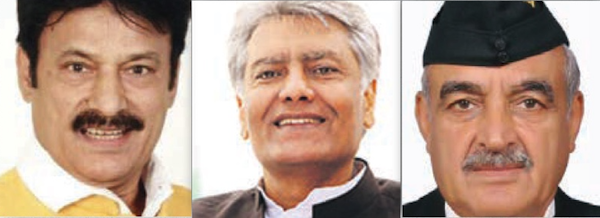
  • INDUSTRIALIST SALARIA BJP’S GURDASPUR PICK, SUNIL JAKHAR CONGRESS’

    INDUSTRIALIST SALARIA BJP’S GURDASPUR PICK, SUNIL JAKHAR CONGRESS’

    CHANDIGARH (TIP): The Bharatiya Janta Party on Sept 21 (Thursday) announced Swaran Singh Salaria as its candidate from the Gurdaspur parliamentary constituency, which fell vacant after the demise of actor-turned-politician Vinod Khanna in April this year.

    The BJP central election committee picked Salaria for the by-election to the parliamentary constituency of Gurdaspur.

    Salaria is a businessman from Chauhana village of Bhoa Assembly constituency. Meanwhile four candidates on Thursday filed their nominations for the Gurdaspur parliamentary constituency by-poll, to be held on October 11.

    An official spokesperson said those who filed nominations include Aam Aadmi Party candidate Suresh Khajuria and his covering candidate Taripata Kumari, besides Rajinder Singh of Hindustan Shakti Saina and Santosh Kumari of Megh Deshm Party. The Congress on Wednesday nominated its Punjab unit president Sunil Jakhar, a loyalist of Chief Minister Amarinder Singh, to contest Gurdaspur Lok Sabha by-election scheduled on October 11. Jakhar (63), a threetime MLA from Abohar and a former Congress Legislative Party (CLP) leader, was pitted in the intra-party battle against Amarinder’s bête noire and former PPCC chief Partap Singh Bajwa, whose wife was a claimant for the same ticket.

  • AFTER KERALA CM, KEJRI MEETS KAMAL HAASAN

    AFTER KERALA CM, KEJRI MEETS KAMAL HAASAN

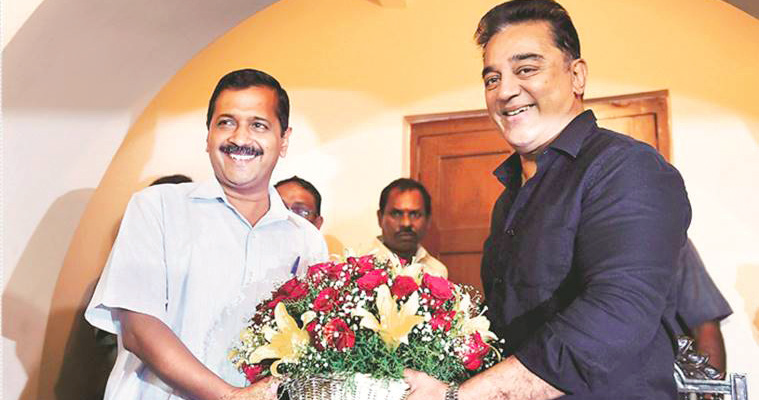
    CHENNAI (TIP): Delhi Chief Minister Arvind Kejriwal on Sept 21 met veteran actor Kamal Haasan and hailed him for coming out against communalism and corruption amid mounting speculation that the latter would take a political plunge.

    Kejriwal also said that the 62-year-old multilingual actor should enter politics.

    Today’s interaction, where the two men expressed mutual admiration for each other, was the second high-profile meeting Haasan had with a political figure in three weeks. The actor had recently called on Kerala Chief Minister Pinarayi Vijayan in Thiruvananthapuram.

    “It is important at this point when the country is facing strong forces of corruption and communalism, all likeminded people should talk to each other on these issues and work in tandem,” said the Aam Aadmi Party (AAP) chief with Haasan by his side.

    Emerging from an hour-long meeting at the actor’s office-cum-residence at Alwarpet here, Kejriwal told reporters that Haasan should enter politics and added that the two would continue to meet in future.

    Haasan, who has of late been dropping hints on taking the political plunge, showered praises on Kejriwal, saying the Delhi Chief Minister had a national profile of fighting against corruption and communalism. “I also have a similar reputation and it is no wonder we decided to have a dialogue on the existing situation (in the country and Tamil Nadu),” he said.

    Stating that he was honoured by Kejriwal’s visit, Haasan said his endeavour was to seek advice from anyone fighting against communalism and corruption.

    Kejriwal said he had always been a great fan of Haasan both as an actor and as an individual. “Kamal Haasan ji enjoys a reputation of integrity and courage,” he added.

    “There are rare people who have the courage to stick their neck out. And Kamal Haasanji happens to be one of them, who has stuck his neck out and he has decided rather than curse from outside that he should enter politics,” Kejriwal said. Earlier on his arrival, Kejriwal was received at the airport by Haasan’s younger daughter Akshara.

    Source: PTI

  • Slowdown gives Opposition ‘inclusive’ plank against govt

    Slowdown gives Opposition ‘inclusive’ plank against govt

    NEW DELHI (TIP): The Congress-led Opposition feels it has found an ‘inclusive narrative’ against the government in the looming economic slowdown, after highlighting issues such as ‘lynching’ and ‘intolerance’ in the last two years.

    As the government works on providing stimulus to boost the economy, the Opposition camp calculates that highlighting against the economic slowdown and its potential social and economic fallout will cut across divisions — poor, jobless youth, distressed farmers, unhappy middle class, traders, small & medium enterprises and industry — and give it a pan-India plank that has minimum ‘polarising’ risk while it questions the Modi government’s development record.

    Over the past few days, senior Congress leaders have reached out to leaders of like-minded Opposition parties, informally discussing ways to convert ‘economic distress’ into a new collective plank along with ‘social distress’, that a 16-party national committee is pursuing in various parts of the country by holding ‘save our composite culture’ stirs.

    Congress insiders said, the Opposition will hold a joint meeting to announce an agitation to highlight ‘economic mismanagement’, ‘flawed development model’ and demand solutions. Soon after the RBI data on demonetised currency was out, ET had reported Congress president Sonia Gandhi could call a meeting of Opposition parties to work out a strategy to highlight the government’s ‘betrayal’.

    The analysis given to the Congress leadership by in-house experts such as Manmohan Singh, P Chidambaram and Anand Sharma predicts further trouble for the economy. These parties think after demonetisation, the heralding economic slowdown along with teething problems can pose the biggest challenge to the regime. “The painful fallouts of economic slowdown have turned off those social segments, the youth, middle-class, traders and industry which had intensely rallied behind the BJP during the 2014 polls,” said an AICC functionary.

    Source: TOI

  • During the Monsoon session Oppn to corner govt on GST, farm suicides

    During the Monsoon session Oppn to corner govt on GST, farm suicides

    NEW DELHI (TIP): The government will face a united Opposition in Parliament as the monsoon session begins this Monday.

    Led by the Congress, 17 Opposition parties, which recently fielded Gopalkrishna Gandhi as their joint candidate for the August 5 Vice-Presidential poll, will also coordinate on Parliament strategy issues mainly on “political vendetta against non-NDA leaders and the grim internal and border security situation”.

    TMC leader in the Rajya Sabha Derek O Brien said the Opposition discussed the need to corner the government on vendetta, GST consequences and demonetisation, farmers’ suicides, lynchings, and security scenario in the coming session from July 17.

    “The meeting of 18 Opposition parties to discuss the VP poll candidate lasted 90 minutes on July 11. Of the 90 minutes, 15 minutes went in finalising the name of Gopalkrishna Gandhi. Later, we discussed the ongoing political and security situation, vendetta against Opposition leaders, GST, and farmers’ suicides. It was decided to coordinate a floor strategy inside Parliament and attack the government outside through the social media on these issues,” Derek o Brien said.

  • Govt needs math tutor Rahul taunts RBI for not finishing scrapped note counting

    Govt needs math tutor Rahul taunts RBI for not finishing scrapped note counting

    P Chidambaram also taunted the RBI for buying couting machines 8 months later and asked them if they had ever heard of leasing

    NEW DELHI (TIP): The Congress on July 13 (Thursday) took a dig at the RBI for still counting banned currency notes, with Rahul Gandhi saying the government is looking for a mathematics teacher and one should apply to the PMO soon.

    “GOI looking for a Math tutor. Please apply to PMO ASAP,” Gandhi said on Twitter, while tagging a news report quoted to Urjit Patel, the RBI governor, saying the central bank is still counting demonetised notes.

    Earlier, senior party leader P Chidambaram took a jibe at the RBI for buying note-counting machines eight months after demonetisation and asked the federal bank if it had heard of “leasing” equipment.

    “RBI buying note counting machines 8 months after demonetisation! Has RBI not heard of ‘leasing’,” he tweeted. Chidambaram also poked fun at the NDA’s Mudra scheme, which the government claims has provided self employment opportunities to over 7 crore people, especially the youth.

    “‘7.28 crore youth self-employed under MUDRA loan scheme’ — that is title of mythological serial beginning today. Scriptwriters may apply,” he posted on Twitter today.

    The former finance minister has been critical of the government’s demonetisation decision and has said it has hit the country’s economy and growth prospects.

    RBI Governor Urjit Patel, while appearing before a Parliamentary panel, is understood to have said the deposited banned notes were still being counted and therefore he was not in a position to give a figure on the scrapped currency that was back in the system. Appearing before the Standing Committee on Finance yesterday, Patel did not provide any “specific number” on the amount of money that had been deposited postdemonetisation.

    Prime Minister Narendra Modi had on November 8 banned 500-rupee and 1000- rupee currency notes. Source: PTI

  • Institutional equilibrium weakens as a dangerous arrogance of power sets in

    Institutional equilibrium weakens as a dangerous arrogance of power sets in

    By Harish Khare

    “Come July 20, 2017, Modi will have his own President. That would make a qualitative difference to the nature of choices available to the Prime Minister in dealing with friends and foes. Though Pranab Mukherjee was not a difficult President for Prime Minister Modi, nonetheless he could not be called a rubber stamp. Prime Minister Modi or his advisers certainly could not take President Mukherjee for granted — an option that is now open to the Prime Minister. A vital equation in the national power grid will stand definitely tilted, in favor of the Prime Minister, says the author.

    Quietly and perhaps unsuspectedly we are entering a potentially dangerous period in our polity. Not because we have reason to entertain continuous anxiety on our nation’s borders, not because the external environment is deteriorating to our disadvantage, but because internal institutional equations are about to change in a manner that would upset the democratic polity’s equanimity.

    To begin with, in another seven days we shall know who would be the new Head of our Republic. Barring potential subversion on an extremely large scale, Ram Nath Kovind should be the new tenant of that sprawling real estate property atop the Raisina Hill. The change of tenancy will have its consequences. The equation between the President and the Prime Minister has always been subject to considerable modification and negotiation after every change of players; and, though Rashtrapati Bhavan is not a rival center of power, its occupant —any occupant — can be a source of irritation and frustration for any Prime Minister. Hence, the importance of next week’s presidential poll on the quality of the Prime Minister’s control and power of the Delhi sultanate.

    It is widely accepted by New Delhi’s political cognoscenti that Ram Nath Kovind is Prime Minister Narendra Modi’s personal choice; moreover, it is further suggested that in opting for him, the Prime Minister has cocked a snook at the RSS impresarios, who had different ideas. The RSS-Narendra Modi relationship is up for a revision.

    Like Atal Bihari Vajpayee before him, Modi too has sought to gain a kind of upper hand in the patron-client relationship that defines the RSS-BJP symbiosis. The heart of the matter is that there is an inherent conflict between a prime minister’s constitutional obligations and a swayamsevak’s oath of allegiance to this “cultural body”, with its headquarters in Nagpur. Prime Minister Vajpayee was clear from the very beginning that his constitutional responsibilities and duties would take precedence over the RSS’ expectations and demands; but he had to pay a certain price for clarity and conviction. Modi has played a subtler hand of cultivated ambiguity, humoring the RSS once in a while. But then it is in the nature of office that, sooner or later, a prime minister has to draw a line — for himself and for the Nagpur bosses.

    In opting for Kovind, Modi has drawn a line. This has not gone unnoticed or unresented by the parent body. For a BJP prime minister, the RSS is the elephant in the room and it cannot be ignored. From a different perspective it would appear to be rather ironic that a hope ought to be pinned on a body like the RSS to keep in check a rampant prime minister.

    Come July 20, 2017, Modi will have his own President. That would make a qualitative difference to the nature of choices available to the Prime Minister in dealing with friends and foes. Though Pranab Mukherjee was not a difficult President for Prime Minister Modi, nonetheless he could not be called a rubber stamp. Prime Minister Modi or his advisers certainly could not take President Mukherjee for granted — an option that is now open to the Prime Minister. A vital equation in the national power grid will stand definitely tilted, in favor of the Prime Minister.

    Not only a pocket President, next month the Prime Minister will also be able to get a Vice-President of his choice. Whatever little space the Opposition was able to claim for itself in the Rajya Sabha would get drastically curtailed. And, all said and done, Hamid Ansari did not deny himself the pulpit, from where he spoke out in defense of republican values and democratic sensibilities. This minor source of irritation would also stand taken care of in less than a month’s time.

    And then, later in August, there will be a change of guard at the Supreme Court of India. Institutionally, the higher judiciary remains the only power center that is not easily amenable to the government’s blandishments or brandishments. Of late certain mutedness seems to have crept in the judicial voice. Like any other institution, the judiciary’s spunk is vitally dependent upon the moral fortitude of those who come to man the bench. On this count, there are rumors. Those who believe that a robust and vibrant judiciary remains a necessary condition for a functioning democracy do not feel all that sanguine. The ruling coterie will have less and less reason to worry about a judicial disapproval or rebuff.

    Of course, there is the ruling party itself. For all its appearances as a modern political party, the BJP remains a closed affair. Since 2013, when Narendra Modi crowbarred his way to dominance with the BJP and then went on to graft democratic legitimacy over his leadership by winning the 2014 Lok Sabha poll, the party has allowed itself to be content with a very subordinate voice. The BJP president has no political persona outside Narendra Modi’s shadow. There is no leader left who can be remotely thought of as a potential challenger to Prime Minister Modi’s hegemonic stewardship. Neither Vajpayee nor LK Advani ever enjoyed this kind of sway over the BJP; their leadership was collegiate and they found themselves constrained to share authority. Narendra Modi feels no such handicap.

     Three other democratic institutions — Cabinet, bureaucracy, media — stand cheerfully self-emasculated. Never before was such a convergence of timidity and opportunism seen as now among these three institutions; there seems to be a veritable race to reduce themselves to the role of a spear-carrier for the Prime Minister.

    The sum total of reconfiguration of these institutional equations can only set in motion objective conditions in which an authoritarian temptation becomes a tempting proposition. The Modi government is approaching a difficult phase, when all the promises and pretensions have not exactly worked out. Economically, the jobless growth has a very limited potential for electoral dividends. The entire business community — the corporates, traders, shopkeepers and consumers — is yet to regain its breath after being buffeted twice — first by the demonetization drama and now by the GST tantrums.

    Politically, the Modi establishment has proved itself extremely competent and clever; it feels it has reduced the Gandhis and the Congress and other opposition parties to an ineffectual bunch; it feels doubly sure of its cleverness after having sold the demonetization joke to the masses; it feels it has the momentum — and, history — behind it.

    There is a dangerous edge to this overconfidence. It is morphing itself into a sense of entitlement. Strong-headed leaders tend to arrogate to themselves an aura of inevitability and infallibility. A robust democracy should have available to itself institutions of accountability that ensure that no leader, however powerful and however popular, trips over his own web of megalomania.

    (The author is the chief editor of Tribune group of publications)

  • In Nitish backing Kovind, BJP sees cracks in alliance

    In Nitish backing Kovind, BJP sees cracks in alliance

    NEW DELHI (TIP): Even as the party attacks Nitish Kumar for not acting against RJD chief Lalu Prasad and his family in alleged graft cases, BJP sees the Bihar CM’s support to NDA presidential nominee Ram Nath Kovind as a serious division in the alliance rather than an “isolated” act.

    A senior BJP member said Kumar’s support to Kovind was reminiscent of his stance when he had supported UPA’s presidential nominee Pranab Mukherjee in 2012 despite being part of NDA. Subsequently, Kumar parted ways with the NDA.

    “By support to the NDA nominee, Kumar has expressed displeasure with RJD and Congress and the ‘mahagathbandhan’ will not last six months,” he claimed. The party is keenly seeing what Kumar’s position on the vice-president’s election will be.

    BJP’s optimism is in contrast to remarks by JD(U) members like K C Tyagi, who said Kumar’s support to Kovind did not have political ramifications beyond the presidential poll. However, while reacting to RJD and Congress’s criticism of the CM, even Tyagi has recalled JD(U)’s alliance with BJP when Vajpayee was PM.

    BJP feels the CM is keen to differentiate himself from his partners. “Candidature of Meira Kumar was a known secret. Kumar could have waited for two days. But he had made up his mind and Kovind’s selection made it easy for him,” the BJP member said. He said Meira Kumar’s particular Scheduled Caste was a sizeable one in Bihar and it could have been a poll ploy to support her. “But a large section of JD(U) wanted to join hands with BJP.”

    After support for demonetisation, the latest trigger for Kumar to explore a break-up with the ‘mahagathbandhan’ is premised on several factors, including possibility of legal action against Lalu’s family members. The CM, it is felt, has also realised the futility of forging a grand national alliance against BJP since Congress is unlikely to formally back anyone for PM other than Rahul Gandhi.

    PREZ POLL FIGHT BETWEEN IDEOLOGIES, SAYS MEIRA

    PATNA (TIP): Opposition’s presidential pick Meira Kumar has described her electoral fight with NDA nominee Ram Nath Kovind as a contest between two ideologies — communalism and secularism.

    The former Lok Sabha Speaker was interacting with Bihar’s ruling Congress and RJD legislators at a posh hotel in Patna on Thursday, ten days before the election is to be held on July 17. The other ruling ally, JD (U), has announced support to Kovind.

    “Our country is standing at the crossroads… There’s complete darkness on one side where people are being divided on religious and caste lines and the poor being suppressed for political advantage.

    We (read the parties supporting her) are on the other side, trying to help the suppressed sections. This is what we have been doing since ages,” she said, alleging people today were afraid of even walking beside a cow.

    Thanking RJD chief Lalu Prasad who was the first politician after Congress president Sonia Gandhi to call her, Meira said he told her about his support. “I knew he would support me for I have seen him lead the people of Bihar in stalling nefarious attempts to communalise the country in the past,” she said and hoped history would be repeated with her win.

  • CBI files case against Lalu, family after searching premises over hotel tender irregularities

    CBI files case against Lalu, family after searching premises over hotel tender irregularities

    CBI on July 7 (Friday) carried out searches at the premises of family members of former railway minister Lalu Prasad Yadav in connection with a fresh case of alleged irregularities in awarding the tender for maintenance of hotels.

    A case has been registered against the then railway minister, his wife Rabri Devi, Bihar Deputy Chief Minister and his son Tejashwi, the then IRCTC MD, P K Goyal, the wife of Yadav’s confidante Prem Chand Gupta, Sujata, and others, CBI sources said. Gupta is a former Union corporate affairs minister.

    The sources said the FIR relates to allegations of irregularities in the tender for development, maintenance and operation of BNR Hotels in Ranchi and Puri, awarded to the private Sujata Hotels in 2006.

    The BNR Hotels are heritage hotels of the Railways which were taken over by the IRCTC from the public transporter earlier in the same year.

    Searches are being conducted today at 12 locations, including Delhi, Patna, Ranchi, Puri and Gurgaon, they said.

    Source: PTI

  • Cattle ban BJP’s route marker for 2019

    Cattle ban BJP’s route marker for 2019

    By Rajindar Sachar

    “The new legislation has been deliberately brought up to further communalize the situation and also financially ruin the poor Muslims. And the government is not even attempting a sham of making suggestions to counter the perception that its actions are weakening the morale of minorities”, says the author.

    Union Home Minister Rajnath Singh, speaking of the achievements of the three years of the Modi government, proudly proclaimed: “We have by and large provided security to the country. India is the second largest country in the world as far as the Muslim population is concerned, and I can say with full responsibility that despite such a large population (of Muslims), the IS has not been able to set foot.”

    Frankly, it is not clear whether he meant it to be a compliment for the patriotism and nationalism of Indian Muslims or he was only praising his security agencies – that notwithstanding such a large population of Muslims, his intelligence agencies have been able to control it. I hope it was not the latter, because it would be uncalled for and unjustly maligning the Muslim community.

    Rajnath Singh should openly say that the patriotism and nationalism of Indian Muslims is no less than any other community, including Hindus. And that anyone even remotely suggesting otherwise is talking treason, as some of the sickening communal Hindu bodies are doing.

    Muslims do not have to carry their patriotism on the sleeve; to suggest that would be calumny. In fact, notwithstanding the provocation from RSS fanatics, the equanimity shown by Muslims is praiseworthy. If the Home Minister is really keen to keep peace in the country, he needs to persuade Modi to immediately withdraw the deliberately provocative animal slaughter legislation, which is being opposed by many states apart from being challenged in high courts.

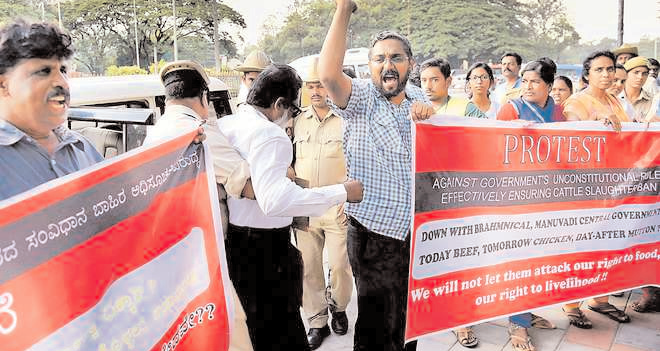
    The legislation purporting to be for the prevention of cruelty to animals is a ploy to snatch jurisdiction by the Centre on the subject of cattle trade, which is squarely the purview of the states. Even the BJP accepts this, as is clear from the Arunachal Pradesh state party president openly announcing that the Centre’s ban on the sale of cattle for slaughter could not be binding on the states. The entire North-East is on the boil on this matter. Minister of Environment Harsh Vardhan says diplomatically that the government is open to suggestions. This sounds hollow given that half the states are opposed to this legislation, which in reality is an attempt at pleasing the “gau rakshak” gang and to allow them to spread terror. This legislation has been deliberately brought up by the BJP to further communalize the situation and also financially ruin the poor Muslims who earn their livelihood through cattle sales.

    The atmosphere was earlier vitiated by RSS Nagpur bosses installing Yogi Adityanath as Chief Minister of UP, who has already spread fear among Muslims in the state by praying at the makeshift Ram Temple near the Babri Masjid demolition site. This is blatant communalization of the situation in India, which is the strategy of the BJP for 2019 elections.

    Prime Minister Narendra Modi needs to be reminded of how he addressed cow vigilantes in August 2016 saying: “It makes me angry that people are running shops in the name of cow protection…. Some people indulge in antisocial activities at night and in the day masquerade as cow protectors.”

    The Modi government is not even attempting a sham of making suggestions to counter the perception that its actions are weakening the morale of minorities. In that regard, the way Modi has handled the naming of National Commission for Minorities members shows he only wants to retain the shell of it. The present members were appointed after the positions remained vacant for months. Of the five persons appointed, only one is a Muslim (Chairperson) and the remaining are one each from other minorities.

    This too was done after a high court asked the government for a response to a writ petition. According to the 2011 Census, the Hindu population is 79.8 per cent and Muslim 14.2 per cent. The rest 6 per cent is constituted of Christians (2.3%), Sikhs (1.7%), Buddhists (0.7%), Jains (0.4%), and Parsis. It can’t be denied that the object of the minorities panel is to create a mechanism that would give them confidence. To make the minorities feel that they have an equal stake in the running of the State and are equal beneficiaries of its programs. It is hoped that the two more members yet to be appointed would be Muslims, either well-recognized academicians or public figures from the community, to give some reassurance to the community.

    The report of the UN Human Rights Council Forum on Minority Issues, 2010, had made some significant recommendations on minorities and their effective participation in economic life, which each country is mandated to follow: “…the right of minorities to participate effectively in economic life must be fully taken into account by governments seeking to promote equality at every level. From implementing non-discrimination in employment and enforcing protection laws in the private sector to developing national economic development and international development assistance schemes.”

    It is unfortunate that the Opposition has not come up with a concrete/specific program on which it intends to fight the 2019 election. In fact, the Opposition has been reduced to a debating/TV phenomenon. It has no specific program for action. The way the Congress and other political parties are letting wither away the opportunity that arose from the Dalit assertion in Saharanpur speaks ill of their commitment.

    There is already a competition between the Chief Minister of UP and Prime Minister Modi as to who would be a greater favorite of the Sangh Parivar after the 2019 parliamentary elections, assuming the BJP wins the majority.

    Yogi Adityanath has given encouragement to the cow vigilante brigade, as indicated in the UP Director-General of Police issuing instructions to all police officers that those involved in cow slaughter or smuggling should be booked under the National Security Act – a legislation designed to handle terrorists. Has the BJP lost all sense of balance and proportion?

    (The author is a retired Chief Justice of the Delhi High Court)

  • SUNIL JAKHAR APPOINTED PUNJAB CONG PRESIDENT

    SUNIL JAKHAR APPOINTED PUNJAB CONG PRESIDENT

    NEW DELHI (TIP): Eyes on the 2019 Lok Sabha elections, the Congress on May 4 appointed Sunil Jakhar, former minister and a staunch Capt Amarinder Singh loyalist, as the new president of the Punjab unit. Jakhar, 63, who lost the Assembly election, will replace Capt Amarinder, who took oath as Chief Minister this March 17.

    Jakhar was Capt Amarinder’s choice for the post. Congress president Sonia Gandhi and party vice-president Rahul Gandhi both endorsed it.

    Jakhar said he would act as a bridge between the government and the party and ensure the grassroots connect of the Congress stayed intact.

    Jakhar’s appointment is strategic as the central leadership wants complete coordination between the government and the organisation to ensure a strong footing in the state where the party has only three Lok Sabha seats (Ludhiana, Amritsar and Jalandhar) of 13.

    “We have challenges ahead. The LS poll of 2019 are just two years away. The organisation has to be strengthened. I will endeavour equally to ensure that election manifesto promises are fulfilled,” Jakhar said.

    He said he had sought an appointment with Rahul Gandhi for tomorrow. A former minister in the Amarinder Singh cabinet, a three-time MLA from Abohar, and until recently Congress’ Legislature Party Leader in Punjab, Jakhar has been a diehard Amarinder loyalist.

    On the eve of Punjab elections, he was the one to consistently urge the Congress leadership to replace Partap Bajwa with Capt Amarinder as state chief. When that finally happened a year before the state polls, Jakhar was dropped as the CLP leader and Bajwa as state chief.

    While Rahul Gandhi sent Bajwa to Rajya Sabha, Jakhar was left in the cold only to be unsuitably placated later by being named party’s chief spokesperson in Punjab. In between, on poll eve, Jakhar was sour with his mentor Amarinder Singh, who today redeemed his friend politically.

    In Congress circles, Jakhar is known for his straight talk and is someone who has always spoken his mind frankly even in meetings chaired by Rahul Gandhi. His appointment, sources say, indicates that the Congress won’t ignore regional satraps anymore and will value their opinion. Besides, the move is important as the Congress has given Hindu leaders a pride of place in its Punjab scheme. The state has 45 per cent Hindus, who backed the Congress to victory this time.

    Jakhar, when asked how he saw his appointment, said, “I have received the affection of all communities. It’s up to you to analyse my appointment politically.” As the son of former LS Speaker Balram Jakhar, he realises he has a lot riding on him. His acid test will be organisational strengthening ahead of the 2019 LS poll.

    Source: The Tribune

  • ‘Outsiders’ Sanjay, Durgesh finally exit Punjab AAP

    ‘Outsiders’ Sanjay, Durgesh finally exit Punjab AAP

    CHANDIGARH (TIP): It’s been more than six weeks since the Aam Aadmi Party’s disappointing loss in the Punjab assembly elections, but finally a humiliation in the Delhi civic polls became the trigger for Sanjay Singh and Durgesh Pathak to resign as the party’s bosses for the state on April 27 (Thursday).

    The signs were there immediately after the party lost face in the elections to the municipal corporation of Delhi (MCD) on Wednesday. Punjab AAP legislative party leader HS Phoolka, chief whip Sukhpal Singh Khaira and star campaigner MP Bhagwant Mann had upped the ante and again blamed the central leadership, or “the outsiders”, for the party’s Punjab loss.

    Uttar Pradesh natives Sanjay (Sultanpur) and Durgesh (Gorakhpur) had effectively taken over the Punjab unit in early 2015 — as in-charge and co-incharge — almost 18 months before the state polls. The idea was to reap dividends in Punjab — the state that had given the party all its four MPs in the 2014 Lok Sabha polls — particularly after the party’s historic mandate in the Delhi assembly polls in the February of that year.

    By then, Sucha Singh Chhotepur, who had been picked by party national convener and Delhi chief minister Arvind Kejriwal, had built a structure for the party as the state unit convener. The Sanjay-Durgesh team brought along a 52-member team of observers from Delhi that spread out as an umbrella body over that structure.

    Inside story a mystery

    A dormant fight for dominance blew up when Chhotepur was removed in August 2016 over a “sting operation”, allegedly showing him taking bribe for a ticket. The “sting” was never made public, and thus the real reasons behind Chhotepur’s removal remain a mystery. After Chhotepur floated his own party —significant in the politics of perception— the Congress and Shiromani Akali Dal raised the decibel level on labelling AAP as a party of outsiders.

    Some local faces were given posts, but the duo continued to enjoy primary roles— Durgesh as final authority on tickets and funds to candidates, and Sanjay as the overseeing troubleshooter. Their dominance was even disliked by a number of candidates, but they said little or nothing, hoping for a bigger role in an AAP government.

    Another section in the party kept raking up allegations of Sanjay-Durgesh taking money for tickets, but the party overlooked it all, not realising that opposition parties were cashing in.

    All their doing?

    But can the two be blamed for all the mistakes? A section of AAP leaders in Punjab is asking this question too.

    For instance, the party faced serious flak from within for not announcing a chief ministerial candidate. But who could have been projected when prominent local leaders were competing with each other in being on the right side of the duo?

    On seeing all others getting miffed with one given prominence, the party went into the polls on the back of Brand Kejriwal, but the bubble burst on March 11, the result day, when the party managed to win just 20 seats, plus two of coalition partner Lok Insaaf Party, as against its own claims of 100 out of 117. The Congress won a decisive victory with 77, though the AAP managed to become the prime opposition ahead of the SAD-BJP combined tally of 18.

    Insiders and observers both have also pointed out Kejriwal’s flirtations with Sikh radicals, and theories of his own ambitions to become Punjab CM, as reasons behind the loss; and not just mismanagement by the duo.

    Even party leaders in Punjab are not satisfied by the duo’s ouster alone. Khaira and NRI wing convener Jagtar Sanghera want more heads to role, and Khaira in particular has called for a “free hand” to state leaders. A roadmap for introspection and action is still not clear, and party leaders and volunteers remain confused. The resignations by Sanjay and Durgesh are the culmination of resentment within the AAP, but not the final solution to its troubles in Punjab.

    ‘Victory has many fathers, defeat has none’

    While Durgesh did not dwell, Sanjay again denied that he took money in exchange of poll tickets. “There’s no proof,” he told HT over phone. On being blamed for the Punjab fiasco, he commented, “Victory has many fathers; defeat has none.” Advocating introspection now, Sanjay said he had worked “very hard” to build the party “but the results turned out to be a reversal”. Source: HT

  • Funds for my property not linked to husband  finances : Priyanka

    Funds for my property not linked to husband finances : Priyanka

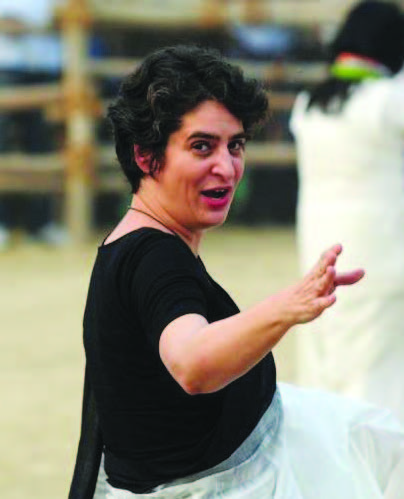
    NEW DELHI (TIP): Congress president Sonia Gandhi’s daughter, Priyanka Vadra, has said funds for her properties are not linked to the finances of her husband, businessman Robert Vadra, or his company Skylight Hospitality.

    Priyanka’s denial came after a financial daily sent queries to Robert Vadra about his land deals and alleged profits.

    “The source of funds for this or any other property acquired by Priyanka Gandhi Vadra has no relationship whatsoever with Robert Vadra’s finances and/or Skylight Hospitality and no relationship whatsoever with DLF,” her office said in a statement on Thursday.

    The statement said Gandhi bought 5 acres of agricultural land in Amipur village in Faridabad district for Rs 15 lakh on April 28, 2006, six years prior to the purported land deal involving Skylight Hospitality.

    The land was resold to the original owner four years later for Rs 80 lakh, the then prevailing market price, the statement said, adding that all transactions were done through cheque.

    It said the earlier owner was made the offer to allow him exercise the right of first refusal.

    “The source of funds for the aforesaid purchase was rental income of Priyanka Gandhi Vadra from property inherited by her from her grandmother (former prime minister) Indira Gandhi,” it added. The statement added that any insinuations made about the land deal were “false, baseless and defamatory” and represented “a deliberate, politically motivated and malicious campaign to besmirch and destroy her reputation”.

    Political opponents of Robert Vadra had often raised questions about his company’s land deals in Haryana and Rajasthan. No charges, however, have been proved. A land deal in Himachal Pradesh, where Priyanka is building a hillside house, has earlier run into controversy following allegations that the then state government had relaxed laws to facilitate the transfer of the land to her.

  • House panel summons RBI’s Urjit Patel over note ban after Manmohan’s prod

    House panel summons RBI’s Urjit Patel over note ban after Manmohan’s prod

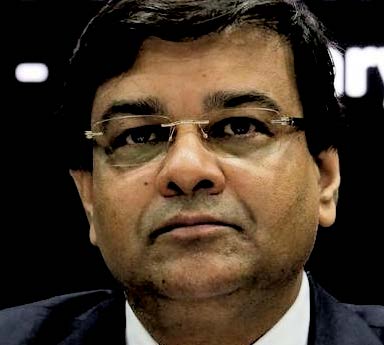
    NEW DELHI (TIP): Reserve Bank of India (RBI) governor Urjit Patel has been asked by a parliamentary panel to appear before it again on May 25 over the demonetization issue after former prime minister Manmohan Singh prevailed over BJP MPs in the panel to call him.

    Sources said the decision to summon Patel was made at the insistence of Singh, a former RBI governor himself, who had earlier come to Patel’s rescue in the last meeting in January. When Patel was confronted with tough questions from parliamentarians – including queries on the exact amount of demonetized currencies deposited during the 50-day window and the time by when normalcy would return to the banking system – Singh had intervened, saying that the governor’s institution should be respected. The former PM said that Patel didn’t have to answer all questions.

    Singh is one of the members of the panel, headed by Congress leader Veerappa Moily.

    At the last meeting in January, Patel failed to provide any figure for how many banned notes had been deposited into the banking system and he did not provide clarity on when the cash situation would become normal.

  • PM NARENDRA MODI TO GIVE PEP TALK TO BJP CMS; EYE  ON UPCOMING POLLS

    PM NARENDRA MODI TO GIVE PEP TALK TO BJP CMS; EYE ON UPCOMING POLLS

    NEW DELHI (TIP): Prime Minister Narendra Modi will give a pep talk to chief ministers of 13 BJP ruled states at the party headquarters here on Sunday. Party president Amit Shah too will join them.

    The meeting comes within weeks of Modi holding a similar session with leaders of 33 NDA allies, who reposed faith in his leadership and resolved to win the 2019 elections again.

    BJP sources described the meeting as an exercise to gear up BJP-ruled states for the next Lok Sabha election, a key electoral challenge that will also be seen as a referendum on Modi government’s five year tenure.

    Three BJP ruled states, Chhattisgarh, Madhya Pradesh and Rajasthan, will also go to poll in 2018.

    With the BJP ruling 13 states and sharing power in four others, party leaders admit the performance of the state governments will have a bearing on the performance of the BJP in 2019.

    Modi doesn’t want any anti-incumbency to set in against the sitting BJP governments, which can pull down the party in 2019.

    “At the Sunday meeting, he will reiterate that BJP needs to keep its focus on governance and avoid controversies that can provide fresh ammunition to the opposition looking for an opportunity,” a BJP leader said.

    Activism by cow vigilantes, conduct of certain BJP leaders and several others issues have hogged the media limelight, putting the BJP in a tight spot.

    At the just concluded conclave of the BJP in Bhubaneswar, Prime Minister Modi asked BJP leaders to be mindful of their conduct.

    “Don’t let power go into your head. We should not get spoiled,” he told over 300 BJP leaders.

  • AFTER TALK OF BETTER DAYS SANS SASIKALA CLAN, AIADMK GROUPS TURN BITTER

    AFTER TALK OF BETTER DAYS SANS SASIKALA CLAN, AIADMK GROUPS TURN BITTER

    ? HIGHLIGHTS
    • Two days after AIADMK (Amma) opened doors to its rival faction, the two camps have again hardened their stand.
    • ? The O Pannerselvam-led faction termed the truce call by the EPS faction a “drama” authored by Sasikala.

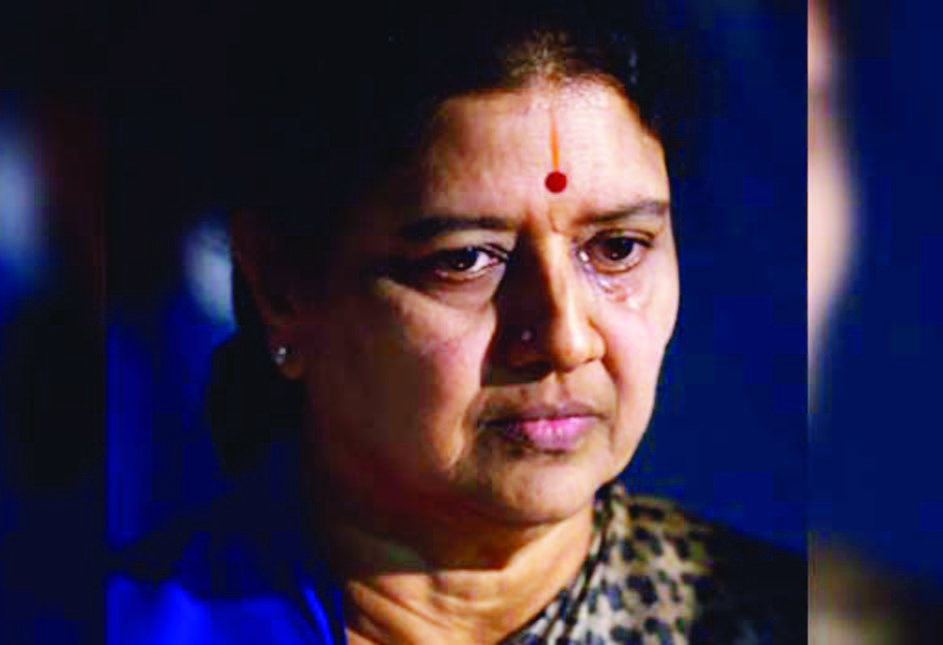
    CHENNAI (TIP): Two days after AIADMK (Amma) announced it would free the party and the government from the influence of the V K Sasikala family, and opened doors to its rival faction for merger talks , the two camps hardened their stand and flung barbs at each other. The central player in the political drama, party deputy general secretary TTV Dhinakaran, meanwhile, remained out of sight on Thursday.

    Dhinakaran loyalists and MLAs Thanga Tamilselvan and P Vetrivel visited chief minister Edappadi K Palaniswami at the secretariat on Thursday after a brief meeting with Dhinakaran at his Adyar residence in Chennai. Vetrivel later said Dhinakaran had directed them to meet the chief minister and extend their cooperation forsmooth functioning of the government. “Dhinakaran will remain our deputy general secretary,” said Vetrivel.

    The O Pannerselvam-led faction dug in its heels, terming the truce call by the EPS faction a “drama” authored by Sasikala, her husband M Natarajan, and brother V Dhivakaran, using Dhinakaran as the ‘pagadaikai’ (dice). It also laid down threeconditions, including withdrawal of an affidavit filed by the Palaniswami group on the appointment of Sasikala as general secretary, officially removing her and Dhinakaran+ from their posts and instituting a CBI investigation into former chief minister J Jayalalithaa’s death.

    For its part, the EPS camp got several of its leaders to hit back, setting the tone for fiery talks ahead. Jayakumar took on OPS over his remarks that Dhinakaran’s ouster was his “first victory”, saying, “Will he also say that he was the force behind ((US President) Trump’s victory?” Law minister C Ve Shanmugam asked how his party’s affidavit could be withdrawn when it was the OPS camp which moved the EC to challenge the appointment of general secretary and to stake claim for the ‘two leaves’ symbol.

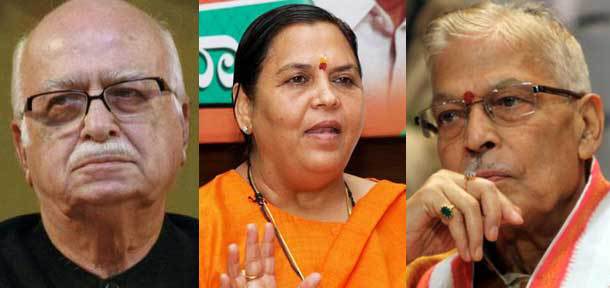
  • Babri Masjid Demolition: Supreme Court of India indicts BJP leaders LK Advani, Murli Manohar Joshi, Uma Bharti for Criminal Conspiracy

    Babri Masjid Demolition: Supreme Court of India indicts BJP leaders LK Advani, Murli Manohar Joshi, Uma Bharti for Criminal Conspiracy

    Apex Court favors joint trial of the accused to speed up the judicial process

    NEW DELHI (TIP): In a major judgement handed down on April 19, Supreme Court of India ordered that the co-founder of the BJP, LK Advani, and other leaders be tried for criminal conspiracy in the demolition of Babri Masjid about 25 years ago.

    The Babri Masjid in Ayodhya was allegedly pulled down by Hindu activists in December 1992, leading to widespread riots in which more than 2,000 people died.

    The apex court added that the trial must conclude within two years, a decision welcomed by Muslim clerics.

    This is a huge setback for former BJP chief Lal Krishna Advani and his colleagues who have repeatedly denied making inflammatory speeches that encouraged Hindu mobs to tear down the Babri Masjid.

    Those accused along with Mr Advani are senior BJP leaders Murli Manohar Joshi and Uma Bharti. They have all denied any wrongdoing, however, the Central Bureau of Investigation (CBI) has always said the destruction of the mosque was a planned event.

    The Supreme Court has been hearing the case since 2011 after setting aside a high court judgement which allocated two-thirds of the disputed site to Hindu groups, and the remainder to Muslims.

    The Allahabad High Court ruling in 2010 addressed three major issues. It said the disputed spot was Lord Ram’s birthplace, that the mosque had been built after the demolition of a temple and that it was not built in accordance with the tenets of Islam.

    The Archaeological Survey of India, in 2003, had reported to the Allahabad High Court that its excavations found distinctive features of a 10th century temple beneath the Babri Mosque site.

    For the first time in a judicial ruling, it also said that the disputed site was the birthplace of the Hindu god.

    Hindus claim the mosque is the birthplace of one of their most revered deities, Lord Ram, and that Babri Masjid was built after the destruction of a Hindu temple by a Muslim invader in the 16th Century.

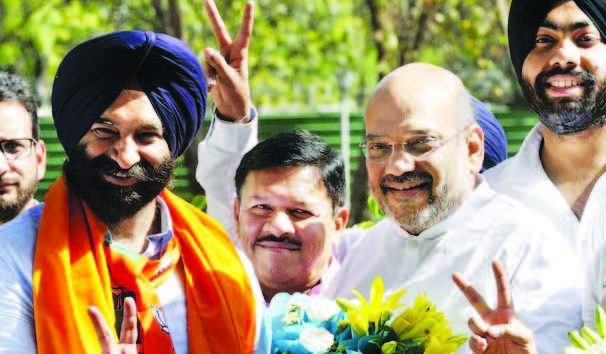
  • BJP-Akali joint candidate Sirsa wins Rajouri Garden bypoll, AAP loses deposit

    BJP-Akali joint candidate Sirsa wins Rajouri Garden bypoll, AAP loses deposit

    NEW DELHI (TIP): The Bharatiya Janata Party (BJP) registered a huge victory in the Rajouri Garden Assembly bypoll in the national capital on April 13 handing a humiliating defeat to the ruling Aam Aadmi Party (AAP), which finished a distant third and even lost deposit.

    BJP-Shiromani Akali Dal (SAD) joint candidate Manjinder Singh Sirsa bagged 40,602 seats, over 50% of the total votes polled, in a boost for the saffron party ahead of the 23 April municipal polls.

    Congress’ Meenakshi Chandela finished second with 25,950 votes while AAP’s Harjeet Singh managed to get only 10,243 votes, less than one-sixth of the total votes polled, and lost deposit.

    In terms of vote share, the Congress staged a turnaround of sorts by getting around 33% of the total votes cast,in a jump of over 21% over the 2015 Assembly polls.

    Around 47% of the over 1.6 lakh electors of the west Delhi seat had cast their vote on 9 April.

    With the victory, the BJP’s tally in the 70-member Delhi Assembly will become four. The Congress does not have any presence in the House.

    The seat fell vacant early this year after AAP’s Jarnail Singh quit as MLA to contest the Punjab Assembly poll against SAD patron Parkash Singh Badal.

    Delhi’s richest MLA

    Sirsa will be the richest MLA in Delhi with declared assets of over Rs 185 crore.

    By this distinction, Sirsa dislodges AAP’s Pramila Tokas who topped the list of wealthiest MLAs until now with declared assets of Rs 87 crore. Tokas is an MLA from RK Puram in south Delhi.

    Sirsa, who had contested the assembly election in 2015 also, had declared assets of Rs 239 crore at that time. However, the worth of his assets has dropped by over 22% since then. Sirsa, who calls himself an “agriculturalist and businessman” on his affidavit filed in 2017, has declared moveable assets, such as money, cars, and other valuables worth almost Rs 89 crore, and immovable assets, such as agricultural land and commercial buildings worth over Rs 120 crore. He has also declared liabilities and other outstanding dues, like bank loans, worth approximately Rs 24 crore.

    According to an analysis by Association of Democratic Reforms (ADR), 11 of the 70 Delhi MLAs had total assets worth more than Rs 10 crore after the assembly election in 2015.

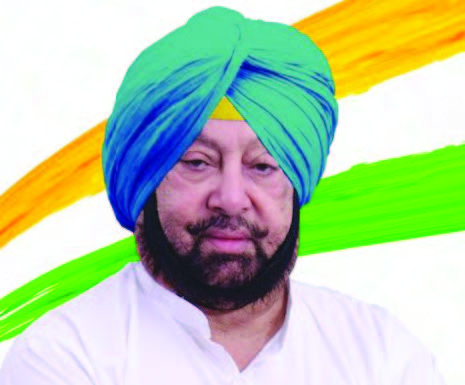
  • Capt says many Sikh Canadian ministers, MPs Khalistani sympathisers; Canada terms it disappointing, inaccurate

    Capt says many Sikh Canadian ministers, MPs Khalistani sympathisers; Canada terms it disappointing, inaccurate

    CHANDIGARH (TIP): Punjab chief minister Captain Amarinder Singh’s statement against Canadian defence minister Harjit Singh Sajjan terming him a “Khalistani sympathiser” has triggered a diplomatic row with the Canadian high commission on April 13 terming it “disappointing and inaccurate”.

    Reacting to the remarks, the Canadian high commission here said Canada greatly values its relationship with the people and the government of Punjab, and look forward to further advancing it. “We regret that the CM of Punjab is unavailable to meet with Canada’s minister of defence. The CM is welcome to visit Canada,” the high commission added.

    However, Amarinder rejected Canada’s defence and said he stood by his principled stand of not associating himself with any “Khalistani sympathiser”. Amarinder reiterated that the Canadian defence minister and several other top leaders in Canada were sympathising with those indulging in anti-India activities, notwithstanding Canada’s claims to the contrary, said a press note issued by his office.

    He named other Canadian political leaders, including Navdeep Bains, Amarjit Sohi, Sukh Dhaliwal, Darshan Kang, Raj Grewal, Harinder Malhi, Roby Sahota, Jagmeet Singh and Randeep Sari, as “well known for their leanings towards the Khalistani movement”.

    Amarinder had on April 12 alleged that Sajjan, like his father, is a “Khalistani sympathiser” and he would not meet him during his scheduled visit to India from April 17 as he (Sajjan) and four other Sikh ministers in the Justin Trudeau cabinet scuttled his visit to Canada before Punjab assembly polls.

    Canadian Defense minister Harjit Singh Sajjan
    Canadian Defense minister Harjit Singh Sajjan

    The CM said while Sajjan was welcome to attend conferences and meets, and even to visit the Golden Temple in Amritsar, he would personally not entertain the Canadian minister. The state government would provide full security to the minister and also ensure that he gets due treatment as per protocol, said Amarinder.

    Amarinder also lashed out at the Aam Aadmi Party (AAP) and the Dal Khalsa for their criticism of his refusal to meet Sajjan.

    In Canadian federal elections of 2015, Jutin Trudeau and his liberal party faced criticism from a section of Punjabi diaspora in Vancouver over World Sikh organisation (WSO), said to be a radical organisation, supporting Punjabi-Sikh candidates in the polls, including Sajjan.

  • INCOME TAX DEPT LAUNCHES ‘OP CLEAN MONEY’-II; TO PROBE 60,000 PEOPLE

    INCOME TAX DEPT LAUNCHES ‘OP CLEAN MONEY’-II; TO PROBE 60,000 PEOPLE

    NEW DELHI (TIP): The Income Tax department will investigate over 60,000 individuals under the second phase of the ‘Operation Clean Money’ which was launched on Friday with a view to detecting black money generation post demonetisation.

    The Central Board of Direct Taxes (CBDT), policy-making body of the department, said it had detected undisclosed income of over Rs 9,334 crore between November 9, 2016 and February 28 this year. The note ban was announced by Prime Minister Narendra Modi on November 8 last year.

    “More than 60,000 people, including 1,300 high-risk ones, have been identified for investigation into claims of excessive cash sales during the demonetisation period. More than 6,000 transactions of high value property purchase and 6,600 cases of outward remittances shall be subjected to detailed investigations (under Operation Clean Money II).

    “All the cases where no response is received shall also be subjected to detailed enquiries,” the CBDT said.

    A senior officer said advanced data analytics had been used to identify suspect cash deposits before launching the latest edition of the operation. As part of the first phase of the ‘Operation Clean Money’, launched on January 31 this year, the department had sent online queries and investigated 17.92 lakh people out of which 9.46 lakh people had responded to the department. Source: PTI