Tag: Indian Space Research Organisation

  • What will Chandrayaan-3 do on the Moon?

    What will Chandrayaan-3 do on the Moon?

    As the Indian Space Research Organisation (ISRO) gears up to launch the Chandrayaan-3 mission to the Moon, the world is awaiting the discoveries that it will unravel on the lunar surface. The mission is likely to be launched this year and Isro has learned from the failure of the previous mission.

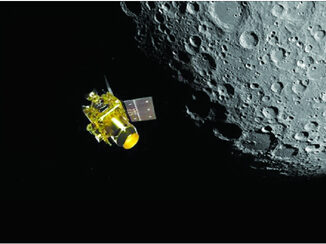
    Chandrayaan-3 is a follow-up to the Chandrayan-2 mission that will demonstrate end-to-end capability in safe landing and roving on the lunar surface and consists of a lander-rover configuration. The mission will be launched aboard India’s most powerful rocket, the LVM-III, from the Satish Dhawan Space Centre in Sriharikota.

    While the Indian space agency is yet to say anything about the final launch dates, it is likely to be in the second or third quarter of 2023.

    The mission is aimed at better understanding the Moon’s composition. Isro has laid out three main objectives for the mission, which include demonstrating a safe and soft landing on the lunar surface, demonstrating the rover’s roving capabilities on the moon and performing in-situ scientific observations. Isro said that the mission’s Chandra Surface Thermophysical Experiment (ChaSTE) will measure the thermal conductivity and temperature, while the Instrument for Lunar Seismic Activity (ILSA) will measure the seismicity around the landing site. The Langmuir Probe (LP) will estimate the plasma density and its variations and a passive Laser Retroreflector Array from NASA is accommodated on the mission for lunar laser ranging studies.

    “Chandrayaan-3 consists of an indigenous Lander module (LM), Propulsion module (PM), and a Rover with the objective of developing and demonstrating new technologies required for Interplanetary missions. The Lander will have the capability to soft land at a specified lunar site and deploy the Rover which will carry out in-situ chemical analysis of the lunar surface during the course of its mobility. The Lander and the Rover have scientific payloads to carry out experiments on the lunar surface,” Isro said in new detail.

                    Source: India Today

  • ISRO report shows entire Joshimath may sink; town sank by 5.4 cm in last 12 days

    ISRO report shows entire Joshimath may sink; town sank by 5.4 cm in last 12 days

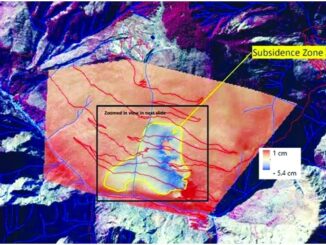
    Dehradun (TIP)- The National Remote Sensing Centre (NRSC) of the Indian Space Research Organisation (ISRO) has released satellite images of Joshimath and a preliminary report on land subsidence which shows that the entire town may sink. The pictures are taken from the Cartosat-2S satellite.

    Hyderabad-based NRSC has released the satellite images of areas that are sinking.

    In images, the entire town, including the Army’s helipad and the Narasimha temple, has been marked as sensitive zone.

    On the basis of ISRO’s preliminary report, Uttarakhand government is conducting rescue operation in danger-prone areas and the people in these areas are being shifted to safer places on priority.

    According to the report, the land subsidence was slow between April and November 2022, during which Joshimath had sunk by 8.9 cm. But between December 27, 2022 and January 8, 2023, the intensity of land subsidence increased and the town sank by 5.4 cm in these 12 days.

    The satellite images show that the Joshimath-Auli road is also going to collapse due to the land subsidence. Although scientists are still studying the cracks that appeared in the houses and roads after the land subsidence in the town, the findings in the primary report of ISRO are frightening.

    Joshimath has been declared a land-subsidence zone by the Chamoli district administration after hundred of houses developed cracks within a few days and families had to be relocated as their residences have been identified as dangerous. While the government has announced an interim relief package of Rs 1.5 lakh and working on a rehabilitation package, the demolition of two hotels began on Thursday, January 12,  but was again halted because of bad weather. The mechanical demolition was earlier stalled for a few days because of the protest of the locals and residents.

    Only hotel Malari Inn and Mount View Hotel will be demolished as their existence is dangerous for the surrounding structures, the administration said assuring that no other houses will be demolished as of now. Several expert teams have been roped in to analyse the sinking of Joshimath, while tunnelling work for NTPC hydel project is being blamed by the experts. NTPC, however, issued a statement and claimed that their tunnel is not passing under Joshimath.