

The only recent election in the South Asian region perceived by voters to have been free and fair was the 2024 Sri Lankan polls

As young Indians take to the streets to protest the alleged illegality of the Special Intensive Revision (SIR) of electoral rolls and demand the resignation of Chief Election Commissioner Gyanesh Kumar, the sound of “Gyanu you’re done, bro” is surely being heard across the South Asian region and beyond. The management of the ‘Great Indian Election’ has long been an object of admiration worldwide and has been no less a source of India’s soft power, especially in the neighborhood.
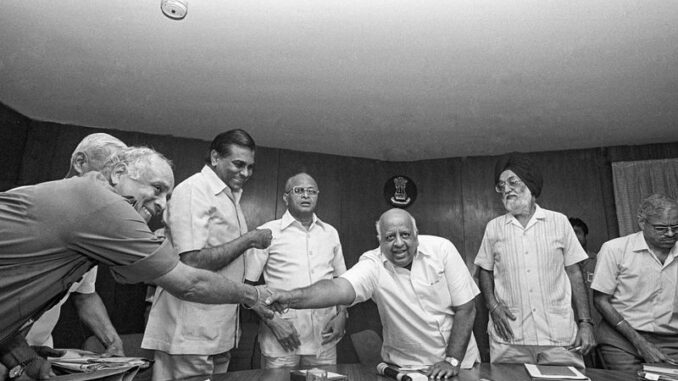
Take, for example, Sri Lanka’s former Election Commissioner Mahinda Deshapriya. In 2015, he won much praise for his impartial conduct in both the presidential and parliamentary elections. “His steely resolve brings to mind that redoubtable Indian Election Commissioner TN Seshan who regularly locked horns with India’s politicians and vigorously campaigned against electoral corruption,” a columnist in the Sri Lankan newspaper The Sunday Times wrote then.
The comparison with Seshan was not an exaggeration. Just five years earlier, his predecessor Dayananda Dissanayake had broken down on TV while announcing President Mahinda Rajapaksa’s re-election, accusing government institutions of misusing their powers to ensure a favorable result for the incumbent, such that he was unable to ensure the safety of even a single ballot box. Between tears, he requested his “immediate release” from the post.
The ECI and election commissioners (ECs) have long been held up in India’s neighborhood for their courage in standing up to politicians during election time. This is especially true of TN Seshan. In Pakistan, where election results have been fought over since 2013, Seshan is considered the gold standard for the conduct of free and fair elections. Many Pakistani commentators have made the case for Pakistan to stop appointing judges as ECs and emulate the Indian practice of selecting people with administrative experience.
In Bangladesh, where election results have been fiercely rejected by the losing side for decades, one commentator said there were “chief election commissions and election commissioners, but what the country needs is a change-maker” and that India’s former Chief Election Commissioner fell in this category.
In Nepal, during the recent parliamentary committee hearings that preceded the appointment of an MP from the opposition Nepali Congress, Guruprasad Wagle, as the Chief Election Commissioner, it was stressed that those in charge of the Election Commission should be as fearless and bold as Seshan.
In 2011, when SY Quraishi was India’s Chief Election Commissioner, the ECI set up the India International Institute of Democracy and Election Management (IIIDEM). Writing about the IIIDEM in an article in 2021, Quraishi noted that it “was envisioned to be an advanced resource center for learning, training, research and extension on participatory democracy and election management in South Asia and Africa.”
He recalled that most of the commissioners from these regions who participated in the ECI’s diamond jubilee celebration in January 2010 were of the view that India should share its experience and expertise internationally.
The next year, meeting in New Delhi, the heads of election commissions from SAARC countries established a Forum of Election Management Bodies of South Asia (FEMBoSA). The IIIDEM is now a key institution for FEMBoSA, providing training and capacity-building programs for election officials. All countries in the region, with the exception of Pakistan, and including pre-Taliban Afghanistan, have sent teams of election officials to the IIIDEM. As recently as November 2025, a press note from the Indian High Commission in Colombo announced that a group of 40 Sri Lankan election officials had participated in a course at the IIIDEM.
On the IIIDEM page of the ECI site, India’s current chairship of International IDEA, an intergovernmental body founded in 1995 to promote democracy, is announced with much fanfare: “With its vast electoral experience, strong democratic institutions, and global credibility, India is uniquely positioned to lead International IDEA in 2026. India’s chairship will show how democracy delivers, deepen collaboration with Election Management Bodies worldwide and amplify knowledge that supports emerging democracies, especially in the Global South.”
A 74-page booklet, available on the site, outlines India’s themes for its one-year leadership of the organization as “Democracy for an inclusive, peaceful, resilient and sustainable world” and “thematic priorities” for the year. Among the “key deliverables” are the development of “model international electoral standards”, including free media, voter registration and maintaining electoral rolls.
“Transparency in (voter) eligibility determination builds public confidence,” it says, killing irony in the gap between preaching and practice. “When citizens understand the criteria, can verify their registration status, and have access to straightforward dispute resolution processes, they trust that the system operates fairly.”
The rotating one-year chair of International IDEA is India’s until December 2026. India was one of the 14 founding members of the organization and has always been represented by the CEC. Today, India’s face at the forum is Gyanesh Kumar, architect of the controversial SIR that has disenfranchised over 130 million voters.
Accusations of bias and constitutional violations against him have given rise to the ECI’s most serious credibility crisis in memory. Word travels fast in the region and around the world. An institution once admired for its autonomy and looked up to is at risk of losing its international reputation fast. With results of many elections in India already suspect in the eyes of many Indian voters for reasons ranging from the alleged EVM fraud to the SIR, it can be assumed in the light of the new revelations about the unsavory goings-on in the ECI that results henceforth would be more fiercely contested, just as they are in Pakistan and Bangladesh.
It is noteworthy that the only recent election in the region perceived by voters to have been free, fair and impartially managed was the 2024 Sri Lankan polls, in which the JVP-led National People’s Power won a majority in Parliament and its candidate Anura Kumara Dissanayake was elected President.
In 2006, the Pakistan Institute of Legislative Development and Transparency (PILDAT) praised India as a “mature democracy”, which, unlike Pakistan and Bangladesh, did not require a “caretaker government” to ensure a free and fair election. “India is one good example of such democracies where the Election Commission becomes a virtual caretaker government during election time and no neutral caretaker government is inducted for the election,” says a PILDAT study of the system of caretaker administrations in the region.
Two decades after these words were written, it should surprise no one if the demand for a caretaker administration is raised in India too.
(Nirupama Subramanian is an independent journalist with over 36 years of experience in print media)


Be the first to comment