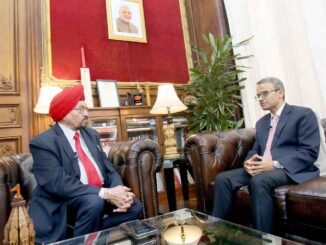
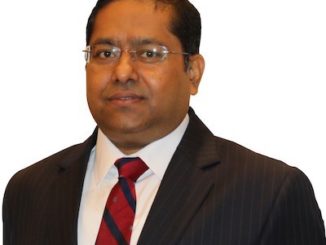
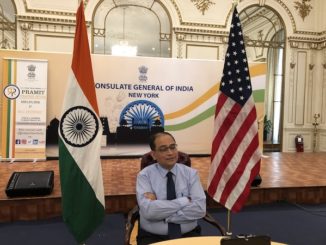
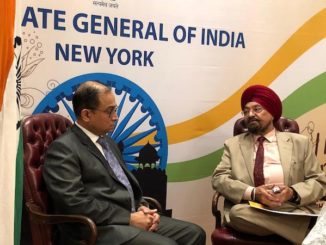
Ambassador Binaya Srikanta Pradhan, Consul General of India in New York, in an interview with The Indian Panorama on December 22, 2025, highlighted significant achievements of the Consulate in 2025, including the establishment of new satellite centers in Ohio, New Jersey, and Boston, extension of consular services on weekends and holidays, and improved VFS services. The consulate as of now handles 11 states, with plans to reduce the number to six, once the Boston consulate is fully operational.
Here are edited excerpts from the interview.
TIP: Please share with the readers of The Indian Panorama your achievements in 2025. What you dreamed to achieve? What you have been able to achieve? What you have not been able to achieve? And why you have not been able to achieve, if at all, that was the situation, and what you plan to do in future?
CG: It’s always a pleasure to speak to you and through you to your viewers and readers. But coming to this year, I would say this is the last week, practically, of the year, 2025 and if I look back, this year has been quite momentous when it comes to the consulate services that we provide to the community. On first of August, we started our satellite centers in three new places in this consular jurisdiction. Now we have a VSF satellite center in Columbus, Ohio. We have one in Edison in New Jersey, and we have one in Boston, in Massachusetts. And if you remember, last year when the prime minister came, he announced that soon we will be having a new consulate in Boston. And I am so happy to say that now we have a consulate functional there. We have a consul general. And I would say in a record period of time, we have got a consulate functional over there. But more importantly, we cater to about 2.4 million strong Indian diaspora from here. And in addition to the Indian diaspora, we also cater to the American friends who go to India for tourism, for business, for meetings, and for various other purposes. So the effort has been to provide seamless, best quality service from here. Last year, we started to open the consulate on Saturdays and Sundays for emergency services, and also on other national holidays. This year, we continue to do that, and we worked with the Indian communities across the consular jurisdiction. We held consular camps in each and every state that we deal with. And now, as I said, from first of August, we not only have the satellite centers, but they are qualitatively different. Now, we signed a new agreement across the country, by the way, by which the VFS, which is our service provider, is now providing qualitatively far superior services. They charge $19 across the board for whatever service they provide. For $19 now they are providing improved services in the sense that suppose somebody reaches a VFS center in Edison or in Columbus, Ohio, or in Boston or in New York City, and the applicant has not been able to fill the application, they will help the applicant to fill up the application. If for any reason, the applicant has not got his photographs, or, let us say, photocopies of the documents, then VFS, without charging any additional money, would be providing photographs, would be providing photocopies of the documents. I am happy that 2025 was a very good year in bringing a qualitative improvement in the services that we provide.
TIP: What has been the most significant achievement for the consulate in 2025?
CG: I would say, like I said we as a consulate, deal with, not only the Indian diaspora and the consular requirements. We also deal with the businesses and have economic engagement. We deal with political engagement. I would say the year was quite good. We have reached out to, you know, all the states, to the elected leaders at federal level, to the elected leaders at State Assembly and State Senate level. We look at the sub national cooperation. The governor of New Jersey went to India three months back, and that was the second visit in five years. The governor of Connecticut went to India in February 2025 and now in February 2026 the governor of Delaware is going. So, I would say, in the year 2025 we had two governors from our jurisdiction visiting India. It shows the dynamism in the relationship. It shows how the relationship is playing out in a very successful and positive way, even at state to state cooperation level. Because when Governor of Connecticut went to India, he went to different states. He met the chief ministers he met the business communities. He met the investment community, trading community. Same thing happened when the governor of New Jersey went. He took five universities with him, and all these five universities are having significant number of Indian students. So look at the connect. I cannot imagine another such relationship, where we have such strong people to people connect. I would say 2025 was successful in every sense, in terms of our providing qualitatively better services to our diaspora, to our community, the sub national cooperation, as I mentioned about, the visits of the governors, economic engagement have been quite successful. Look at the investment track, whether we are talking about FDI, whether we are talking about alternate venture capital investment. Recently, $72 billion of investment were announced in last one month only in the artificial intelligence space in India. So we saw Amazon announcing $35 billion investment. We saw Google announcing $15 billion investment. We saw Microsoft announcing their biggest investment in Asia when Mr. Satya Nadella met the Prime Minister and spoke about $17.5 billion of investment. And we also heard about Apple investing. $72 billion investment, just in AI space. That was the same week when the CEO of Intel met Prime Minister. So I would say the economic engagement between US and India is quite deep and quite dynamic. I would say 2025, as I see it, was quite successful in my jurisdiction, from economic engagement to community engagement to political engagement. And if you look at the softer side, like our cultural engagement, people to people connect, was quite good.
TIP: How do you view the contribution of the Indian Americans, the diaspora in promoting these ties between this country and India?
CG: This is quite well known now that Indian diaspora takes the lead when it comes to building the relationship, not only in the softer side of culture, people to people contact, but even in critical areas, whether it is investment, whether it is trade, whether it is scientific, technological collaboration, whether it is political engagement. I think, this community has been playing a lead role and leadership from both sides, both in India and the United States. They appreciate that. So that is what you would see that, like I took the names of diaspora members who are leading technology companies having met Prime Minister, you would find the same thing when President Trump was celebrating Diwali, you would find many of the Indian American community people, tech CEOs, you know, being with him. I think you know they play a very critical role in every possible way.
TIP: And how about the students who have come here to study? They are a sizable number, number one, and also they must be contributing a lot towards better understanding, better relationship between India and the US. How do you view that?
CG: The student community is a is a very important community, because when we talk about the diaspora here today, 5.4 million strong Indian diaspora, most of them came here as students. And they have contributed to nation building of this country. Many of them are going back to India and contributing there as well. And even if they are staying here, both as nationals of India or nationals of United States, they are forming very formidable bridges between our two countries. But let us also not forget the remittances India makes for the education of the student population here People.. It is ‘s to the tune of $21 to $26 billion every year. These students become an important part of the American society. People who go back, they become an important part of Indian society.
TIP: As they say, it’s time to ring out the old and ring in the new , , so let us know your mind. What do you plan to do in 2026?
CG: The new year 2026 , I’m sure would provide us opportunities to intensify our engagement with the community, not only in terms of providing them better services, but also working closely with them for all the objectives, like whether it is promoting cultural collaboration between our two countries, or economic engagement between our two countries, or engaging for scientific and technological advancement, because there are huge complementarities between our two countries and our two economy and scientific communities sitting in New York. When you are dealing with the best of the minds here, whether it is Wall Street, whether it is the universities, whether it is the cultural minds, our job is to find the connect between two sides. Notwithstanding these engagements, the Prime Minister is very mindful about taking care of the Diaspora requirement. So I think you will see in 2026 the consulate having focus on all these things. Through you, I would urge your viewers, your readers, to give their suggestions, give their ideas about how we can improve the services . On the consular side, our effort has been to have zero pendency, whether it is issuing of passports, whether it is issuing of OCI cards, whether it is issuing of visa or any other service, miscellaneous services. And our objective would be to work with the community, with the community groups, community leaders, to provide a service that, you know, people would find hassle free, people friendly, and people would find it accessible. So that is going to be the effort in 2026 .
TIP: I would request you to please give your message for the new year to our readers.
CG: On behalf of the consulate and on my personal behalf, I would wish everybody a Happy New Year. I’m sure the year 2026 is going to bring new dimensions, new opportunities and new success stories of our collaboration, both between our two countries and between our two people. And I am sure the Indian diaspora, the Indian American community, which has been playing a very prominent role in this, would be doing the same. And when it comes to our diaspora here, you know, we would lay special emphasis on friends like you to work with us in making these objectives realities.
The Consulate General of India in New York is one of the busiest Indian diplomatic missions in the world, serving a jurisdiction of ten states on the U.S. East Coast with a diaspora population of over 2.3 million. It is both a service hub for passports, visas, and other consular needs, and a diplomatic bridge between India, Indian Americans, and the broader American public.
Ahead of India’s 79th Independence Day, I met with India’s Consul General in New York, Ambassador Binaya Srikanta Pradhan, for an in-depth conversation. We spoke at length about new services being introduced from August 1, the Consulate’s broad mandate, and its engagement with students, women, cultural promotion, and the Indian-American community at large.
I was joined by my colleague Mr. Gurinder Singh Hothi, who documented our discussion.
Saluja: Good afternoon, sir. It’s such a wonderful opportunity to speak with you after a long time. I’m sure you have much to share with the readers of The Indian Panorama. Before we begin the formal questions, I want to thank you for inviting me to your office for this conversation.
Consul General: Thank you, Professor Saluja. It’s always a pleasure to speak to the readers of The Indian Panorama and, through you, to reach out to the larger Indian community in our jurisdiction. I also extend a warm welcome to you and Gurinderji to the Indian Consulate.
Saluja: There’s talk in the community that the Consulate is about to give a “big gift” on the eve of Independence Day. Could you share what’s in store?
Consul General: While I’d avoid the word “gift,” I can say that the Government of India—through both the Embassy and the Consulates—has worked to improve services for three main groups: Indian nationals living in the U.S., persons of Indian origin, and American friends of India who travel, invest, or engage culturally with India.
Starting August 1, several new initiatives will make our services more accessible and user-friendly. These include:
Three new satellite VFS Global centers in Boston, MA; Edison, NJ; and Columbus, OH—offering the full range of consular services, not just passports, visas, and OCI cards, but also attestation, power of attorney, birth/death certificates, will registration, and more.
All-inclusive service charge of $19 covering form-filling assistance, four passport-size photographs, photocopies, and return courier service—at no extra cost.
Saturday service: All VFS centers in our jurisdiction (New York, Boston, Edison, Columbus) will now be open Monday to Saturday, 9:00 a.m. to 6:00 p.m., providing more flexibility for working people.
This is a decentralization of services that will save time, travel, and effort for community members, while standardizing the quality of assistance.
Saluja: The Consulate’s role seems multifaceted—providing consular services, engaging in diplomacy, and fostering people-to-people contact. Could you describe your main priorities?
Consul General: Broadly, our work falls into three categories.
Consular services for the Indian diaspora and friends of India—passport, visa, OCI, and miscellaneous documentation.
Political engagement with elected representatives—both at the federal level (U.S. Congress) and in state legislatures within our ten-state jurisdiction. Many of these leaders are longstanding friends of India.
Economic and commercial work—about one-third of India-U.S. merchandise trade originates in this region. We host frequent delegations from Indian industry sectors including IT, jewelry, textiles, ceramics, and more.
Underpinning all of this is cultural outreach and constant contact with the diaspora—maintaining bonds and strengthening mutual understanding.
Saluja: Let’s talk about students. How important are they to your work?
Consul General: Students are a top priority. In our jurisdiction alone, there are about 117,000 Indian students. Nationwide, there are 373,000, making India the largest source of international students in the U.S. This number grew from 353,000 last year, and represents an investment of about $20 billion annually by Indian families.
We engage with student associations, visit campuses (I’ve personally visited about 30 universities), and hold meet-and-greet events—both in-person and virtual—to provide guidance on safety, cultural adaptation, and U.S. regulations.
Our focus is not only on Indian passport holders but also on the second and third generation of Indian Americans. Many of them visit India for studies—ranging from Sanskrit and philosophy to engineering and liberal arts. The goal is to integrate them into the larger India-U.S. story, economically and culturally.
Saluja: You’ve mentioned culture several times. How successful has the Consulate been in promoting Indian culture?
Consul General: I’d say Indian culture is now mainstream in the U.S. Take yoga—there are 36,000 yoga studios here, and 33 million Americans (10% of the population) practice yoga. It’s part of daily life, not just a niche activity.
Similarly, Indian cuisine has gone from “ethnic” to celebrated—an Indian restaurant, Sema, is now ranked No. 1 in The New York Times’ list of best New York City restaurants. Indian dance, music, Ayurveda, cricket, and cinema are all finding large non-Indian audiences. Literature festivals and film screenings attract significant American participation.
This is a moment of pride: our culture enriches the American mosaic while retaining its distinct identity.
Saluja: Women are a vital part of the diaspora. How does the Consulate support those in adverse circumstances?
Consul General: While most Indian-origin women here thrive—often excelling in academia, business, and the arts—there are still cases of hardship: domestic violence, legal disputes, sudden bereavement, or financial distress.
We offer one-time legal assistance, connect individuals with community lawyers and doctors for free counseling, and link them with local support organizations for ongoing help. I’ve urged community associations to make women’s welfare a philanthropic priority.
It’s a mixed story—alongside challenges, we see remarkable achievements, such as Indian-origin women winning Grammys, leading university departments, and breaking barriers in diverse fields.
Saluja: Returning to the August 1 changes—could you outline the practical benefits for community members?
Consul General: Certainly. The benefits include closer access: Residents of New England, New Jersey, and the Midwest will no longer need to travel to New York for in-person services.
Uniform service quality: Every VFS center will offer the same range of services with the same $19 flat fee, eliminating uncertainty.
Form-filling assistance: Many applicants struggle with online forms—now trained staff will help on-site.
Included extras: Photos, photocopies, and return courier—no hidden costs.
Extended hours: Monday–Saturday access helps working families.
For comparison, similar services from other countries’ consulates often cost significantly more.
Saluja: We are days away from India’s 79th Independence Day. What message would you like to share?
Consul General: Independence Day is a time to remember our nation’s achievements, the sacrifices of our freedom fighters, and the strength of the India-U.S. partnership.
When I look at the progress we’ve made—from a global comprehensive strategic partnership to the deep contributions of our diaspora—I feel proud. This success is built collectively, with the effort of both India and its overseas community.
In the U.S., every celebration reflects three parallel rises.
The rise of India itself.
The rise of India-U.S. friendship.
The rise of the Indian diaspora’s impact—both here and in strengthening bilateral ties.
I congratulate all members of the Indian community, as well as the friends of India, on this occasion. Let us continue to work together so that both our nations and our partnership grow stronger in the years ahead.
The conversation revealed a Consulate not just managing paperwork but actively shaping connections—between individuals and institutions, between culture and commerce, and between generations of Indians and Americans.
From August 1, with expanded services, decentralized centers, and extended hours, the Consulate General in New York aims to make consular access easier than ever. Yet, as the Consul General emphasized, its role goes beyond transactions—it is about trust, engagement, and community partnership.
This Independence Day, the message is clear: as India rises, so too does the India-U.S. relationship and the role of its diaspora in shaping it.
Saurin Parikh, President of FIA, originally from Gujarat, highlighted the theme “Survey Bhavantu Sukhina” emphasizing unity and happiness. The parade will feature 35 floats representing diverse faiths and cultures, including “Hindu, Muslim, Sikh, Isai, and Jainism”. Celebrities Rashmika Mandanna and Vijay Deverakonda will serve as grand marshals. Local politicians, including Mayor Eric Adams, have confirmed participation. Cultural programs, a street fair, and a cricket-playing area will accompany the parade. FIA has 1,800 volunteers and 10 city agencies involved in the planning.
Here are excerpts from the conversation.
TIP : Good morning, Mr. Parikh. Before we talk about the parade, I’d like our readers to know about you personally. Could you tell us about your background—where you are from, your education, and your family?
SP: First of all, Professor Saluja, I would like to thank you and The Indian Panorama for your continuous support over the years in highlighting and promoting the India Day Parade. This is a massive annual event that FIA organizes, and it is heartening to see your newspaper cover it year after year.
As for myself, I am originally from Gujarat, India. I was born and raised there before immigrating to the United States at the age of 20. I am a licensed civil engineer by profession, and I have been actively involved with the FIA for the past 15 years. This year, I have the privilege of serving as the President of the FIA Executive Committee for 2025.
TIP: And your family?
SP: My father was a banker with Bank of Baroda in India before we immigrated. After coming to the U.S., he worked for the State Bank of India for about 15 years. My mother was a social worker back in India. Both my parents were deeply committed to community service, and they were my earliest role models in working for the community selflessly.
TIP: Are you married?
SP: Yes, I am married. I have a wonderful wife and am the proud father of twin daughters. They are the joy of my life.
TIP: Let’s talk about the big event. Is this the 43rd India Day Parade?
SP: Yes, it is. This is the 43rd India Day Parade in New York City—organized by FIA since its inception.
TIP:Every new FIA president tries to bring in something fresh and exciting. What is your vision for this year’s parade?
SP: That’s a very good question. For any incoming president, the challenge is not just to maintain tradition but to improve upon the previous year’s achievements.
After much thought, we have chosen this year’s theme as “Sarve Bhavantu Sukhinah”—a Sanskrit phrase meaning “May All Be Happy”. It’s a message of universal well-being, unity, and harmony. In a world currently plagued by wars, terrorism, and division, our goal is to unite all faiths and communities and encourage people to spread happiness. Happiness grows when it is shared.
To put this theme into action, my team and I, along with the Board of Trustees Chairman and my Executive Committee, reached out to leaders of various faiths—Hindu, Muslim, Sikh, Christian, and Jain. We met them individually, participated in their community events, and invited them to be part of the parade.
For the first time in FIA history, we will have floats representing all these faiths marching side by side. Out of the 35 floats confirmed, a substantial number will reflect this diversity, alongside marching groups representing different Indian states, cultures, and ethnicities.
TIP:Our readers always want to know about star attractions. Who are your celebrity grand marshals this year?
SP: This year, we are delighted to have two prominent stars from the Indian film industry—Rashmika Mandanna, currently one of Bollywood’s most sought-after actresses, and Vijay Deverakonda, a hugely popular actor from the South Indian film industry who has also made a mark in Bollywood. Their presence will add glamour and draw a massive crowd.
TIP: And what about political dignitaries?
SP: We have invited governors, senators, mayors, and other elected officials from across the United States. Mayor Eric Adams of New York City has confirmed his participation. We will also have several U.S. Congress members, New Jersey mayors, and, we hope, a few senators, whose confirmations are pending.
TIP:Apart from the parade itself, what other attractions have you planned?
SP: Alongside the parade on Madison Avenue, there will be cultural performances at Madison Avenue and East 25th Street—featuring Indian classical, folk, and Bollywood dance presented by talented kids from schools in the tri-state area.
We will also have a Street Fair on East 26th Street between Madison and Park Avenues. Visitors will find Indian and international cuisines, vendor booths showcasing products and services, and even giveaways at various stalls.
This year, a unique addition is a cricket playing area organized by our title sponsor, CricMax. We will build a safety-enclosed cricket cage right on the streets of New York, where people can enjoy playing with a softball. It’s symbolic of our effort to promote cricket in America, which has been gaining popularity, especially after the T20 World Cup matches were hosted in New York earlier this year.
TIP:The parade is the centerpiece, but FIA also organizes other events during this period. Could you tell us about them?
SP: Yes. On August 15, we will participate in the Empire State Building Lighting Ceremony, where the iconic skyscraper will be lit in the Indian tricolor. This partnership has been ongoing for over a decade, and it is always an emotional and proud moment for the Indian community here.
On August 16, we will host the Flag Hoisting Ceremony at Times Square—a tradition we began during COVID-19 when large gatherings were not permitted. It became so popular that we continued with it. This year’s flag hoisting will be at 10:30 a.m. and is open to the public.
We also host a Gala Dinner to thank our volunteers, sponsors, and supporters. This year, it will be held at Cipriani’s on Wall Street—one of New York’s most elegant venues—and it is already sold out.
TIP: Organizing the largest India Day Parade outside India must require enormous effort. Who would you like to acknowledge?
SP: You are absolutely right—it is a gigantic undertaking. The parade involves 1,800 volunteers, numerous committee members, and collaboration with 10 city agencies to secure permits and ensure smooth execution. Planning begins almost a year in advance.
I am deeply grateful to our Board of Trustees, comprised of past presidents whose experience is invaluable. Our sponsors deserve special thanks—without their financial and moral support, this event would not be possible.
I especially acknowledge our title sponsor CricMax, along with other major supporters such as X-RAY Group, TEK Group, Wenzel Foundation, Mehta Foundation, ICICI Bank, State Bank of India, Bank of Baroda, Bank of India, and our media partners—including The Indian Panorama.
TIP:Finally, what is your message to our readers?
SP: I invite each and every member of the community to come and be part of this grand celebration of India’s 79th Independence Day. The parade will be held on Sunday, August 17, starting at noon, on Madison Avenue at 38th Street in Manhattan.
Come with your families, bring your friends, wave the tricolor, and let’s celebrate our heritage with pride. I promise that you will experience the joy and emotion of seeing Mother India honored in the heart of New York City.
TIP: Thank you, Mr. Parikh, for speaking with The Indian Panorama. We wish you and the FIA a very successful 43rd India Day Parade.
SP: Thank you, Professor Saluja. I look forward to seeing all your readers at the parade. Jai Hind!
Dr. Manoj Kumar Mohapatra in Conversation with Prof. Indrajit S. Saluja
Dr. Manoj Kumar Mohapatra, India’s Ambassador to Guatemala, El Salvador, and Honduras, recently made headlines by leading the largest-ever International Day of Yoga event outside India. Over 10,000 participants gathered at Carchá, Guatemala, on June 13, 2025, for a celebration of wellness, unity, and Indian philosophy. Days before concluding his term, Ambassador Mohapatra sat down with Prof. Indrajit S. Saluja, Editor of The Indian Panorama, to reflect on his tenure, the deepening of Indo-Central American relations, and his vision for India’s role in the region.
Excerpts from the interview.
TIP: Good morning, Ambassador Mohapatra. Congratulations on organizing a historic yoga event here in Guatemala. With over 10,000 participants and only a small Indian diaspora in the country, it’s astonishing. How did you manage to mobilize such a massive gathering, especially with so many young participants?
Amb. Dr. Mohapatra: Thank you so much, Professor. We’ve been friends for over a decade, and you’ve seen me work in New York and Washington, D.C. My goal has always been to promote Indian culture globally—and yoga, as a gift of India to the world, is central to that mission.
A view of the mammoth presence at the Yoga session in Carcha, Guatemala, on June 13, 2025
Now, regarding the International Day of Yoga in Carchá, our strategy focused on engaging youth. Young people are the future of any nation, and in a country like Guatemala, where awareness of India is still growing, targeting schoolchildren created an organic way to connect with families and communities. This wasn’t just about organizing an event; it was about creating a movement.
Despite the Indian community here being fewer than 100 families, we intentionally focused on local participation. Our goal has always been people-to-people contact. We wanted Guatemalans to experience Indian culture firsthand. That’s why we worked hard to include school administrations, youth groups, municipal authorities, and the education ministry.
Addressing the gathering at the Yoga celebrations in Carcha, Ambassador Mohapatra spoke about Yoga as a unifier of body, mind, and soul.
And it’s been building up. Three years ago, our Holi and Diwali celebrations had around 2,000 participants. Last year, it was 5,000. This year, more than 10,000 came together. It became a regional festival. The enthusiasm of the local people, the support from the government, and the underlying message of this year’s theme—“One World, One Health”—all came together beautifully.
I believe this was likely the largest International Day of Yoga celebration outside of India.
TIP: Truly remarkable. It’s not something easily replicated. You’ve clearly established a strong cultural bridge between India and Guatemala. I recall the Holi and Diwali festivals you’ve organized—massive turnouts, enthusiastic local participation.
Amb.: Absolutely. Beyond Guatemala, I’ve extended this outreach to El Salvador and Honduras as well. Two years ago, we celebrated Holi in San Salvador with over 7,000 people. This year, even with shifting political landscapes, more than 3,000 attended.
We’ve celebrated everything—from Gandhi Jayanti and Durga Puja to plantation drives under the “Green Earth” initiative. Over 500 children planted saplings last year. We’ve implemented campaigns aligned with India’s national initiatives, such as “Ek Ped Mahakalyanam” and “LiFE Mission,” while always ensuring inclusivity and local participation.
This year, for example, we took the yoga event 250 kilometers away from the capital to reach communities that would otherwise never interact with India. The idea was to move beyond the capital, beyond our comfort zones.
I must thank the governments of all three countries, the municipal bodies, and especially the young people. Their response has been heartening.
TIP: After more than three and a half years in these three countries, how do you look back at your tenure?
Ambassador Dr. Mohapatra sharing joyous moments with Romeo Roderiguez, Minister of Public Works, and Mr. Russell Alexander Luther Rodas of Laxmi Capital after signing the MoU.
Amb.: I see it holistically. Wherever I’m posted, I ask myself: what legacy can I leave in this short time?
When I arrived, the total bilateral trade between India and the three countries was modest. Today, it exceeds $1 billion. Guatemala alone, with a population of 17 million, is leading among the three—El Salvador has 6.7 million, and Honduras about 10 million.
We’ve facilitated major Indian investments, especially in renewable energy. One company has established a paper production facility using sugarcane bagasse—environmentally friendly and sustainable. Another entered the vegetable oil industry, and Indian businesses are also active in textiles and digital infrastructure.
These aren’t short-term deals. They are long-term engagements. Giants like Adani and Reliance are exploring opportunities, and Jio is laying groundwork for telecom infrastructure. India is no longer just a cultural friend—we are becoming an economic partner.
TIP: What potential do you see for further strengthening these trade relationships?
Amb.: Immense potential. While India traditionally doesn’t interfere in the internal affairs of other nations, geographical distance and limited awareness about India’s rise remain challenges. But every challenge brings opportunity.
When I came here from Washington, D.C., I had extensive experience in economic diplomacy. That experience helped me identify strategic sectors and bring in Indian businesses. We organized 30 to 40 B2B meetings annually.
To guide our work, I introduced the acronym “SPEED”:
S – Supply Chain Management
P – Pharmaceuticals
E – Education
E – Energy
D – Digital
In each of these areas, we’ve seen real results.
India now supplies up to 30% of the pharmaceutical requirements for these countries. Our energy sector, particularly solar, is competitive. Supply chains are stabilizing post-pandemic. Education and digital infrastructure are next frontiers. And we’re positioning India as a dependable long-term partner.
Ambassador Mohapatra at the launch of TVS Motors in Guatemala
TIP: Central America’s economy is closely tied to the United States. Given the evolving U.S. political and economic climate, how can India strengthen its engagement with the region?
Amb.: That’s an important question. While these countries have historical and trade ties with the U.S., they are now seeking to diversify.
India’s growth—6.5 to 7.5% consistently—has caught their attention. They want to reduce dependency on a single partner. That helps us. But again, geographical distance is a factor.
If India and the U.S. can maintain excellent relations across such distance, why not between India and Central America?
We don’t impose political conditions. Our engagement is apolitical, focused purely on development, commerce, and culture. I believe we’ve succeeded in converting challenges into opportunities.
TIP: India still has a significant trade imbalance with China. Isn’t it necessary for India to find new markets—like these Central American nations—for its goods?
Amb.: Absolutely. But trade is never one-sided. For it to be sustainable, it must be mutually beneficial.
India is one of the largest consumer markets in the world, with over 1.4 billion people. So, while we aim to export, we also import. It’s a two-way street.
Rather than just selling products, we’re encouraging Indian companies to manufacture locally—particularly in textiles and consumer goods. That way, semi-finished goods from India can be processed here and shipped quickly to the U.S. or other Latin American countries.
It’s a classic win-win.
TIP: You’ve worked closely with businesses and governments here. What would you say were your biggest achievements? And were there any regrets or things left unfinished?
Amb.: I wouldn’t call them failures—perhaps areas needing more time.
We’ve laid a strong foundation. For instance, the largest investment in Guatemala in recent years is by an Indian company. We’ve created thousands of jobs. A company that had 400 employees now has 1,500. Another in the energy sector is scaling up rapidly.
India’s presence in sectors like digital infrastructure, textiles, pharmaceuticals, and renewable energy has deepened.
And on the diplomatic side, Honduras has opened an embassy in New Delhi. That’s a significant milestone.
I’ve also worked hard to build genuine friendships. I often say these countries are like Lord Hanuman—they don’t always realize their own strength until reminded. My job was to help them see India as a reliable, rising partner.
TIP: So you’ve built the foundation. Now the next ambassador has a platform to build upon.
Ambassador Dr. Mohapatra is honored for his instrumental role in strengthening the bonds of friendship and cooperation between India and Guatemala.
Amb.: Precisely. I arrived during the 50th anniversary of diplomatic ties between India and Guatemala. I leave on the 53rd. Three years may seem short, but we’ve made it count.
Continuity is key. As T.S. Eliot said, “Time past is present in time future.” I’ve built on the work of my predecessors and laid the groundwork for my successor. That’s how diplomacy should function.
TIP: You’ve often spoken of “Vasudhaiva Kutumbakam”—the world is one family. That was a powerful message during the yoga session. Would you like to elaborate?
Amb.: Of course. That phrase isn’t just a slogan—it’s a philosophy that guides all our actions.
We don’t undertake initiatives for personal or national gain alone. We share knowledge, technology, and experience generously. That’s India’s ethos.
“Vasudhaiva Kutumbakam” means we see everyone as part of one global family. One sun, one moon, one earth, one health. Our yoga event, the prosthetic limb donation, the medical camps—we did all this to connect people, not to chase headlines.
I’m proud of how the Indian community, our partners in the U.S., and local authorities came together. That’s what diplomacy is truly about.
TIP: Thank you so much, Ambassador Mohapatra. Your vision, leadership, and deep sense of service have left a lasting mark. On behalf of The Indian Panorama and all our readers, we wish you continued success wherever you go next.
Amb.: Thank you, Professor. Your support and that of the Indian diaspora have meant a lot. This isn’t goodbye—it’s just the continuation of a journey. We’ve built a bridge between India and Central America. Now it’s time to walk across it together.
A globally recognized transformation expert, Award-winning author, and Mentor : Shikha Bajaj is redefining what it means to lead with purpose and authenticity. Recently honored as one of America’s Top 20 Women of Excellence by the GSA in Chicago and honored at Capitol Hill and the Embassy of China, Shikha continues to inspire through her book Own Your Color, her global speaking engagements, and her work with the Own Your Color Academy. We sat down with her to discuss the rationale behind her movement, the power of mentorship, and what’s next.
Q: Why did you write Own Your Color, and why now?
I wrote Own Your Color to provide a transformative blueprint for individuals to embrace their authenticity, build confidence, and pursue bold dreams. As a first-generation immigrant and a corporate leader in the digital transformation space, I’ve seen firsthand how owning your story can unlock immense power. The book introduces the M.E.N.T.O.R. framework, a practical tool to help anyone—especially women—turn adversity into opportunity and impact. The timing felt right because the world is calling for authentic, inclusive leadership now more than ever.
Q: Why did you write Own Your Color, and why now?
I wrote Own Your Color to provide a transformative blueprint for individuals to embrace their authenticity, build confidence, and pursue bold dreams. As a first-generation immigrant and a corporate leader in the digital transformation space, I’ve seen firsthand how owning your story can unlock immense power. The book introduces the M.E.N.T.O.R. framework, a practical tool to help anyone—especially women—turn adversity into opportunity and impact. The timing felt right because the world is calling for authentic, inclusive leadership now more than ever.
Q: How is Own Your Color being received?
With open arms, full hearts, and a resounding “we need this.” The response has been both humbling and energizing—from corporate leaders to students, from community advocates to global changemakers. The message of authenticity, purpose, and rising together is resonating across the world.
I was deeply honored to recently be named one of America’s Top 20 Women of Excellence by the Global Strategic Alliance. Receiving this recognition at the U.S. Capitol from Representatives Danny K. Davis, Jonathan Jackson, Raja Krishnamoorthi, President Toni Preckwinkle, and Mayor Nathaniel Booker was both humbling and empowering. Also, getting honored at Capitol Hill and the Embassy of China was energizing. These recognitions are a tribute not just to me, but to all the women who lead with authenticity, purpose, and impact.
A special thank-you to AMEC’s Dr. VGP and Mr. Mustafa Ajmeri for their vision and leadership in amplifying diverse voices and fostering global unity.
Yet, the greatest award is hearing someone say:
“I’m ready to own my color.” “Mentorship matters.” “Thank you for your message and academy—we need it. We all rise together.”
That’s what makes it all worth it.
(Top Left to Right): Dr. VGP, President AMEC, Shikha Bajaj, Awardee (Bottom Left to Right) : Mayor Nathaniel Booker of Maywood, IL, Congressman Danny K. Davis, President of Cook County Board of Commissioners Tony Preckwinkle, Congressman Jonathan Jackson.
Q: Why does gender equity and women’s leadership matter?
Gender equity isn’t a nice-to-have—it’s a business and societal imperative. When women lead, organizations perform better. But mentorship is a key part of that equation. Despite its benefits, 63% of women say they’ve never had a formal mentor. That’s a huge gap, especially when 71% of women who have mentors say it was critical to their career growth. Mentorship doesn’t just elevate individual careers—it fosters cultures of confidence, retention, and innovation.
Q: Can you share some recent initiatives you’ve been involved in?
Absolutely! We’re thrilled to be hosting the upcoming “Women in the Workforce: Own Your Color” workshop in collaboration with the Princeton Mercer Regional Chamber. This experience is all about helping women tap into their unique strengths while navigating an ever-evolving workplace with confidence and clarity.
Recently, I’ve had the privilege of partnering with Henry Schein and the Boys and Girls Club of Mercer County, delivering leadership development sessions rooted in purpose, confidence, and authentic connection. Whether in boardrooms or community centers, these programs are designed to bridge the gap between potential and action, equipping individuals with the tools to rise as impactful, purpose-driven leaders.
What fuels me most is seeing people light up—when they gain the courage to rewrite their story, lead with authenticity, and own their destiny.
“Shikha brought so much wisdom and authenticity to the conversation, challenging us all to move from awareness to action. It was a reminder that celebrating women’s voices isn’t just for one month—it’s an ongoing commitment to elevate, empower, and evolve.” — Henry Schein, Women’s Leadership Network
“Shikha is a rare blend of warmth, wisdom, and strategic insight. Her mentorship helped me and so many others unlock their full potential—professionally and personally. This was the most impactful session in women conference today!” — Participant, Own Your Color Workshop at Boys and Girls Club, Mercer County
Shikha has in the backdrop Congressional Awards
Q: What is the Own Your Color Academy, and how can people seek mentorship?
The Own Your Color Academy is a platform for transformation. We offer tailored programs—from leadership coaching and goal-setting workshops to group mentoring and interactive community conversations. Our work spans corporate, academic, and nonprofit sectors. People can reach out via our website or social media to explore mentorship or partnership opportunities. Whether you’re an individual looking for guidance or an organization seeking to create inclusive cultures, we’re here for it: www.ownyourcolor.com
Q: Any message for our readers?
Own your voice, your vision, your value. Mentorship is the key to unlocking true power.
Corporate leaders, invest in your teams—empower them through training and mentorship to fuel authentic leadership.
You were never meant to shrink. You were born to shine. Own your color, light the way, and inspire others to rise.
Mr. Binaya Srikanta Pradhan, Consul General of India, on July 23, 2024 sat with The Indian Panorama Chief Editor Prof. Indrajit S Saluja for an interview. It was the day when the Interim Budget was presented in the Indian Parliament by India’s Finance Minister Nirmala Seetharaman.
Our conversation began with my request for the Consul General’s comment on the budget. And the Consul General obliged with his comments, saying that he had not studied the budget in detail yet. But since the interview is being published on the eve of the Independence Day of India, I am omitting a large part of conversation on the Budget, as such, only retaining the part dealing with budgetary provisions for students, at home and abroad.
The long interview has been edited , but the spirit of the comments made by the Consul General has been kept intact.
Here are excerpts from the interview.
TIP: You had expressed anxiety about Indian students here, some of them committing suicide, some of them dying unnatural deaths, and you wanted the Indian American diaspora here to, to take care of them. Why I said that because that is indicative of your concern for the youth and the students? What do you think the interim budget has offered our youth in India, our students in India? What is there for students in the Budget?
CG: In the recent budget announcement, a new provision has been introduced aimed at encouraging students to pursue higher education within the country. The scheme includes an incentive for students to take loans for their higher education in India, thus motivating them to stay within the country for their academic pursuits. This initiative is seen as a significant move to retain talent within India and reduce the financial burden on students who choose to study domestically.
Now, we are talking about a different issue here. At the moment, we have about 350,000 Indian students in the U.S., a dramatic rise from approximately 200,000 just two years ago. This surge has brought attention to several issues, including unfortunate incidents involving accidents and other causes of death among the student population. The consulate has been actively working with the families of the affected students, American authorities, and Indian community leaders to address and prevent such incidents.
Efforts have been made to connect Indian student communities with the broader Indian diaspora in the U.S. The consulate has launched a portal specifically for Indian students, providing access to resources such as a list of doctors offering free consultations, internship opportunities with over 30 companies, and legal experts who can assist in case of any legal requirements. With 113,000 Indian students under the jurisdiction of the consulate, there is a significant responsibility to ensure their safety and well-being.
The consulate has been engaging with universities and student communities to raise awareness about the local laws, culture, and job market, emphasizing the importance of navigating the initial months in a new country with caution. The consulate has also organized various events and visits to university campuses to interact with students and university authorities. Notable Indian figures, including Indra Nooyi, have been involved in initiatives to guide and support new Indian students in the U.S.
With 113,000 Indian students under the jurisdiction of the consulate, there is a significant responsibility to ensure their safety and well-being.
TIP: Did you during your interaction with the academicians at the universities and colleges and the students come across any complaint that Indian students are taking drugs ?
CG: Indian students are generally viewed as disciplined and responsible. Concerns raised by students tend to be more related to their lack of awareness about the legal system, job market challenges, and access to internships, rather than issues like drug use or lack of medical insurance.
TIP: Is there any provision here for them that they are provided health insurance?
CG: I’m not having great expertise on this particular issue. I have come across students who are here with insurance. Many universities are providing those facilities. So, I really don’t know in great detail, but I understand that that is not a major issue that the students are facing in terms of not having access to medical care, that is not an issue.
TIP: Let me then take you to another question. If at all, medical insurance is not provided by the educational institutions, where they are studying, or where the students are not in a position to buy their medical insurance, do you think government of India could ever think of taking on the burden of providing them the required medical care.
CG: That’s a theoretical question. Let me not get into that because we have over 4 million strong Indian community over here. Out of which about 2 million are Indian passport holders. Are you suggesting that anybody who is coming to US, if they don’t have access to medical care, they should be provided medical care at government of India expense?
TIP: No. Only the students I’m talking about.
CG: I think, let me not make a comment. Like I said in my six months having interacted with a large number of Indian students community, this is not one among the concerns I have come across. I have come across, you know, their access to let’s say, the internship, their access to job. These are the concerns that I come across. The legal challenges they face at times when they don’t know and violate a law, unintentionally or unknowingly. Those are the challenges, I’m yet to come across a case where an Indian student is not having access to medical care. I can assure you that if we come across such a case, we’ll take care of that as a Consulate. So, rather than getting into a policy issue of whether government of India is having a provision or not, let me assure that if there is a case like that, we are there to find a solution that is so crucial. So that is that.
TIP: So, you have a panel of legal advisors?
CG: The consulate has established a panel of legal advisors available through the student portal, ensuring that students have access to legal support if needed. The overall message is one of ongoing efforts to support Indian students abroad, ensuring they are well-prepared, safe, and able to succeed whether they choose to stay in the U.S. or return to India with the skills they have acquired.
TIP: What are the various schemes available for Indian nationals, particularly those providing legal assistance? There is a lack of widespread awareness about these schemes.
CG: I acknowledge the importance of publicizing these initiatives and efforts have been made to reach out to the public, including holding a press conference when the consulate announced it would remain open 365 days a year to provide emergency services. There is a need for consistent communication to ensure that the wider Indian community is aware of these services, even though these initiatives have already received some media coverage in both the local and Indian media.
TIP: You may utilize the robust local media in the U.S., which includes various community-specific newspapers and TV channels, to disseminate information more effectively.
CG: I appreciate this suggestion and, also understand the importance of continuous engagement with the media to keep the community informed. In fact, we have plans for another press conference in August to brief the media about new initiatives and services offered by the consulate.
TIP: What has been your experience over the past six months you have been here?
CG: As You know we have ten states under New York Consulate’s jurisdiction. It is a large constituency. And it has to be served well. The consulate’s primary functions include consular duties, promoting trade and commerce, and engaging in political, cultural, and media activities. One of the important tasks is a smooth operation of consular services, highlighting the positive feedback received through reviews and the proactive approach in addressing complaints, particularly with the involvement of VFS, the outsourced agency handling visa and passport services.
The Consulate plays a significant role in fostering trade and economic relations between India and the U.S. The ten states covered by the consulate account for about $43 billion in trade, a substantial portion of the overall India-U.S. trade. There has been an active participation of business delegations from both countries, with numerous economic events organized to promote trade and investment opportunities. I am satisfied with an increasing interest among American stakeholders in engaging with India economically.
TIP: What other areas of India-US relationship do you see?
CG: The political, cultural, and media engagement are other key areas. There is a strong and evolving relationship between India and the U.S. The bilateral ties have reached a point where they are irreversible and poised for continued growth. And the Consulate plays a significant role in maintaining this relationship through regular interactions with elected representatives and media outlets. The consulate’s efforts to engage with both mainstream and Indian-origin media are essential for providing accurate information about India and its developments.
TIP: How do you look at the balance of trade between India and the US?
CG: The trade between the two countries is growing on both sides, with the trade balance becoming more balanced over time. The increasing volume of energy imports from the U.S. to India is an example of new trade segments being developed..
I welcome feedback from the Indian-origin community in the U.S. Their input helps a lot in strengthening India-U.S. economic relations. There have been instances in the past where community feedback led to successful initiatives. The Consulate is committed to openness in receiving ideas and suggestions for future collaborations.
The trade between the two countries is growing on both sides, with the trade balance becoming more balanced over time.
TIP: There is a growing sentiment among the Indian diaspora that now is an opportune time for India to become a global manufacturing hub for various small-scale products that China previously dominated. Given the current geopolitical climate, especially with the strained relationship between the U.S. and China, India could step in to fill this gap. India could capitalize on this opportunity, providing employment to its vast workforce by manufacturing and exporting goods like jute products and carpets, which are already in demand in international markets.
CG: Yes, manufacturing is indeed a priority for India. India initiated the “Make in India” campaign, which has been instrumental in promoting this sector. The recent budget documents highlight the government’s ongoing efforts to boost manufacturing across various sectors, particularly by supporting the Micro, Small, and Medium Enterprises (MSME) sector with credit facilities. It is important not just creating manufacturing capabilities but also ensuring market access, which is crucial for sustaining growth in international trade.
In order to achieve the ambitious goal of $500 billion in trade, India must explore and tap into new areas of trade, including those smaller but essential products that can be manufactured domestically and exported globally. It is equally important to diversify supply chains, a lesson reinforced by the COVID-19 pandemic. India is increasingly being seen as an attractive alternative for sourcing not only smaller goods but also more complex products like semiconductors and electronics.
TIP: Look at the textile industry. Clothes available in American markets are often from countries like Bangladesh, Pakistan, and Indonesia. Indian textiles, known for their superior quality, could capture a significant share of this market if India refocused on revitalizing its textile mills and exporting these products.
CG: I agree. Indian handloom and handicraft products are already widely available in U.S. markets and are recognized for their high quality. During a recent Indian Handloom Fair in the U.S., most exhibitors were already exporting their products to the country, indicating a strong market presence. However, while Indian products are already well-received in the U.S., there is still room to expand and increase exports, thereby generating more foreign exchange and contributing to India’s economic growth. There is potential for India to enhance its manufacturing capabilities, tap into new markets, and address rural unemployment by turning this potential into reality.
TIP: India could benefit from feedback from the Indian diaspora in the U.S. to address issues like unemployment and poverty in India. Many people of Indian origin in the U.S. have valuable ideas and solutions that could help India develop, and they want these ideas to be communicated back to the Indian government.
CG: While there is progress, more acceleration is needed. Indian exporters and government bodies are actively working to increase exports and tap into new markets, but trade is a competitive field, not one of charity.
TIP: How do you view the Indian-American community’s relationship with the U.S. government?
CG: Recently, I was going through the report that was prepared by the Boston Consultancy Group, which highlighted the significant contributions of the Indian community in various sectors, including public office. The Indian-American community is increasingly holding elected positions and contributing to mainstream governance in the U.S., which reflects the healthy relationship between the community and the broader American society.
The Indian-American community plays a vital role in strengthening the India-U.S. relationship. Prime Minister Narendra Modi recently acknowledged that the Indian-American community is the “main engine” driving this relationship. This sentiment was echoed by President Biden, who described the India-U.S. relationship as one of the most consequential of the 21st century.
Today, India is held in respect; India is looked upon as a growing country and doing well. It is because of the effort of the Indian American community.
The fact that when we meet the elected Congressmen , Senators, or governors, the kind of goodwill they express when they talk about the Indian community, the warmth with which they kind of appreciate the contribution of our community , it shows there is wider acceptance and appreciation of o our community by the government here, and I am sure, going forward, we are going to see that increasing. Today, India is held in respect; India is looked upon as a growing country and doing well. It is because of the effort of the Indian American community.
TIP: How far , do you think, Indian culture has been helpful in building this relationship or strengthening this relationship?
CG: I met somebody who is a professor from India, who, after studying at prominent universities in the U.S., is writing a book on how the Indian value system contributes to the success of the Indian-American community. This professor suggests that the emphasis on education, strong family values, and support within the community are key factors behind the Indian-American community’s success, including their higher per capita income compared to the mainstream American population. These cultural values likely play a significant role.
TIP: What are you doing at the Consulate level to promote Indian values and Indian culture?
CG: We work with the Indian community. Besides, there are events that we do ourselves. Recently, we celebrated International Yoga Day across all ten states under the consulate’s jurisdiction, which involved not only the Indian community but also many Americans. A survey reveals that 10% of Americans practice yoga, with 36,000 yoga studios across the country. This in itself is illustrative of how Indian cultural practices have been embraced in mainstream America.
The same goes for the Indian art forms within the Indian-American community. For example, during a visit to New Jersey, I witnessed 700 young Indian kids dancing together on one stage, a sight I hadn’t even seen in India. The consulate actively collaborates with Indian community groups to ensure that cultural heritage is passed down to younger generations, including teaching them their mother tongues and keeping them connected to Indian cuisine, costumes, and traditions.
Indian culture has already found a strong foothold in the U.S., with Indian food, festivals, and clothing becoming increasingly popular. The consulate works closely with the community to support and celebrate these cultural expressions, hosting and participating in various events and festivals, thereby fostering a deeper cultural connection between India and the U.S.
TIP: How does the Consulate support various Indian organizations, particularly those organizing parades and other events?
CG:The Consulate offers support to all Indian community organizations that request assistance, though most large-scale events, like parades, are primarily funded and organized by the communities themselves. The consulate works in partnership with these organizations, providing modest support when needed.
TIP: How about the bigger events, like Jaipur Literary Festival?
CG : Such events are typically organized independently but the Consulate is open to offering assistance if approached. The Consulate’s support is guided by its core principles and the requests it receives from the Indian-American community.
It’s a true honor to be working in this country very closely with the Indian American community. (Photos: Jay Mandal- on assignment)
TIP: What are the plans of the Consulate for the upcoming Independence Day celebrations?
CG: This is the first time I will be part of the Independence Day celebrations here. Besides the celebration we do at the Consulate, we do celebrate Independence Day at prominent places in multiple states. This year, events will take place from August 10th to August 17th, with invitations already received from seven states and 15 cities. The consulate plans to attend as many events as possible to show solidarity with the community.
TIP: What do you plan to do for the segments of the Indians here who face certain challenges?
CG: There is a need of a better connect of Indian students with the broader community to provide them with support in emergencies. While most students are doing well, there is a need for stronger ties between them and the established Indian-American community. 6% of the Indian-American community is not as privileged and requires assistance, particularly women facing legal and economic challenges.
There is a need to raise awareness about the available support systems. Media and community organizations play a crucial role in bridging the gap between those in need and the resources available. I was pleased to know about Indian-American doctors providing scholarships for distressed women to attend community colleges, thereby upgrading their skills and improving their employment prospects. There should be a better collaboration between the consulate, media, and community organizations to ensure that those in need receive the help they require.
TIP: What , do you think, is the impact of Indian values in the U.S.?
CG: Indian-American community has distinguished itself for upholding values such as service and responsibility. These values have helped integrate the community into American society. Indian-origin doctors, who make up 10% of the medical professionals in the U.S. but treat 30% of the patients. It’s a testament to the community’s commitment to giving back.
TIP: Indian values have even influenced mainstream American families, with many non-Indians embracing these values through their relationships with Indian-Americans. Look at Tulsi Gabbard.
CG: Yes. She’s deep into Indian value system. She’s not an Indian. She’s an American, Hawaiian. There are many such cases.
TIP: What is your Message for the Indian American community on the eve of the 15th of August?
CG: I would say it’s a true honor to be working in this country very closely with the Indian American community. The contribution you have made , not only to the American society , American nation building, , and also the contribution you have made in terms of cementing the relationship between India and the US is exemplary. So, we look forward to work with you very closely. Like the Prime minister said, our relationship with you is not a passport. So, it’s a different relationship. And I remain committed to work in that spirit with the Indian American community for the larger end, objective, of bringing a win win proposition and cementing the relationship between the two nations.
We are pleased to introduce to the readers of The Indian Panorama a very special person. He is India’s 23rd Consul General at New York. Ambassador Randhir Jaiswal succeeded Ambassador Sandeep Chakravorty who is now at Ministry of External Affairs in New Delhi . Ambassador Jaiswal assumed charge on July 19, 2020.
Ambassador Randhir Jaiswal is a career diplomat. He joined the Indian Foreign Service in 1998. In his over two decades of diplomatic career so far, he has served in Portugal, Cuba, South Africa and at the Permanent Mission of India in New York.
In between his overseas assignments, he served in New Delhi at the Ministry of External Affairs, first as Deputy Secretary looking after India’s relations with the United States of America, and then as Joint Secretary managing India’s relations with West European countries. In the middle of 2017, he was deputed to serve the President of India as Joint Secretary managing his international relations portfolio.
Randhir Jaiswal is passionate about sports, environment, culture, monuments, old cities and cuisines. He is deeply interested in strategic, sustainable development and public policy issues. He has been part of India’s delegation at various Climate Change Conferences and was the lead negotiator for the G-77 countries at the RIO+20 Conference held in Brazil in 2012.
He holds a Master’s degree in History from Delhi University, India.
He speaks Hindi, English, Portuguese and Spanish and is conversant with several dialects of Bihar, India.
He is married to Dr. Abha Jaiswal, a public health expert. The couple has two daughters.
On August 5, editor Prof. Indrajit Saluja and assistant editor Bidisha Roy got to formally interview in person the new Consul General.
The full text of conversation runs into 8000 words. However, keeping in mind that readers prefer brevity, which is the soul of wit, as William Shakespeare said, we have edited the interview and are giving below a few excerpts. Should The Indian Panorama Readers have any question, they may write to us at editor@the Indianpanorama.com or go to https://pramit.indiainnewyork.gov.in/ and send their questions/ queries/ concerns to the Consulate.
We have the solemn commitment from Ambassador Randhir Jaiswal that he will ensure the community receives efficient consular services and the best cooperation from the Consulate. Communicate directly with the Consulate; no agents or intermediaries are welcome, he says.
Here are excerpts from the interview.
TIP: What do you think of accomplishing as consul general which would create a legacy?
CG: You have asked me very straight question. I would like to answer a little differently. You know our engagement with the United States of America and the engagement with the Indian community in this part of United States for which the Indian consulate of NY is responsible. We see this engagement as a continuation . Therefore, the question of legacy etc. is part of this continuation. You know this consulate has had very close relationship, very engaging relationship with the Indian diaspora. It would be my endeavor to further strengthen and further deepen this connection. We want the community to continue to warmly embrace the consulate. There are new developments happening on a daily basis. We live in a hyperconnected world. We are living in a digital world and these new developments provide new opportunities for us to be connected with the community and serve them better. So it would be my endeavor to see how best we can bring these new technologies and new developments in our engagement with the community. So, community work and community engagement, of course, will be top priority. We would also like to see how best we can engage with the community and strengthen economic ties between India and United States. That is the priority for government of India to strengthen ties with United States in trade, technology , and investment . There are immense opportunities waiting for US business es and corporate houses. The Indian community here plays an important role in people to people partnership. The Indian community, given it size, given its achievements in the United States has played a leading role in enhancing the ties. And being a living bridge between US and India, I would seek their support to see how best we can take our mutual understanding between the two countries forward with their help and with their participation.
TIP: You have spoken about three areas of cooperation. The top priority you have said is promotion and strengthening of relationship with the community. The second area you spoke of is to have better relationship, economic , trade and business relationship between India and the United states. And, you also spoke of immense opportunities for investment in India. Are you looking at the Indian American community to be investing in India or you are looking at the bigger picture of American investment in India?
CG: We are looking at bigger picture. But the Indian American community because of their close connection with India, understand business eco system in India very well. So, that gives them extra edge to play out important facilities between business houses. Business they can hand hold and they can bring shoulders together and see how best we can make investments to happen between India and United States; both ways from India to the United States and from United States to India. Recently, Prime Minister announced reforms in the space sector, in financial services and insurance sector, in health. In the agriculture sector we have undertaken several new reforms and these open up new opportunities for participations. I specifically focus on health, financial and insurance, defense and agriculture sectors because there are immense possibilities between what we can learn and what we can gain from United States. There is a whole new world of opportunities waiting.
TIP: You have been in New York earlier as Consul at PMI. You already know the Indian community. So, do you think it will give you advantage?
CG: Yes, in a sense that I am familiar with the territory here, familiar with people and organization s and also the kind of functions. It gives me an advantage which will help me in carrying out my responsibilities. Indian organizations are organized here on culture lines, economic lines etc. So, I am familiar with the landscape and that surely will help me. If you go any country and you are familiar with the city, it becomes easier to engage with people. In the last two weeks that I have been here, I have started to meet diaspora organization in Ohio, Pennsylvania, Philadelphia so far, and also speaking to diaspora through The Indian Panorama and through channels as well to connect with them. You know this relationship is about partnership not for ourselves but for both the countries. Whatever we do we are going to be promoting mutual understanding and mutual interest in both the countries.
TIP: I come back to the economic aspect of relationship. There is a much better investment opportunity in the pharmaceutical sector because India is probably one of the largest producers of generic drugs and other drugs. And there are a lot of companies in America that are interested in working with Indian pharmaceutical companies. What special advantages can the Govt. of India offer to the big pharma industries here? What special incentives do you think government of India can offer to attract American investment?
CG: India is known as the pharmacy of the world. We produce a lot of generic drugs in India which are exported to the United States. So what India does today is being helpful to the world and to the United States as well. Even on research side we are collaborating very closely even during the Covid-19. You would be aware that there are several Indian companies, several Indian entities and US entities which are working together to produce a vaccine for Covid-19 . We have rolled out FDI policies which are of best interest to people who want to invest in India. We also have a large skilled manpower which can be taken advantage of by American companies and entities which want to invest in India in pharmaceutical sector. Even research and development infrastructure is expanding, and there again, because R& D is important component for pharmaceuticals industry. We have dedicated parks for pharmaceuticals industries located in various part of India. Those are some of the incentives that could be utilized by American companies. The prime minister recently talked about ATMA NIRBHAR BHARAT. ATMA NIRBHAYA BHARAT is about strengthening domestic capacity so that we can then strengthen global supply chains and make the global economy escalate.
TIP: A large number of our youth who are mostly students, and professionals are not at all sufficiently attracted towards Indian way of life and Indian culture. Do you think the consulate should be trying to promote Indian culture among this vast number of people who are responsible or who will be responsible for passing on the Indian values to their own children?
CG: So you know as far as consulate is concerned, we are actively promoting Indian culture and various forms of Indian culture from dance, drama, theater, music, languages etc. We have several programs including the one to send young people from various parts of the world to go and see India and see various specifics of India. That is one exposure program that we have. We also conduct several other programs such as quizzes about India- “know India”. This 15th of August here in this consulate we are organizing an essay competition wherein we are asking the participants, and mostly they will be young friends from the Indian American community, and of course open to everybody else, to write about Indian freedom struggle and the contribution of overseas Indians in that freedom struggle. You would be aware that we had our leaders and freedom fighters who were based in United States from Ghadar Party and others, in San Francisco and elsewhere and they played a leading role and the Indian community here and people in general should be aware of the kind of role that freedom fighters staying in United States played in India’s freedom struggle. You know Mahatma Gandhi himself was influenced by the great American Thoreau . So, it’s important that historical dimension of the relationship is not missed by young leaders, young community members . So, we are trying our best but obviously it’s such a huge expansive community. We look forward to partnership with cultural organizations. . We are living in a digital age. One thing which people understand, specially the youngsters, is that it the world of technology. Through the world of technology, we are trying to connect with the youth here to tell them all the excitement that is happening in India.. They will feel more connected .
TIP: Prospective investors are afraid of Red tape in India. My friend Harry S. Panaser who is a lobbyist shared with me how he prepared some to invest in India, but they feared it will not be easy to work in India.
CG: You know we have moved more than 65-70 places in the last five , six years in the ease of doing business. . We have made a significant jump. From 142 four years back we came down to 65.
TIP: I come to relationship with consulate’s relationship with media. How do you plan to effectively communicate with media?
CG: We are fully aware that media people are important partners in our engagement with the United States. Media has important role to play. We of course look forward to engaging with each and every segment to the media.. We are open about it. We would like to engage with them as much as possible.
TIP: August 5 is a significant day. What are your thoughts on this historic day?
CG: Today is one year of Kashmir action, of abrogation of article 370. Through your newspaper I would like to inform your readers and others here that a lot has happened on the ground in Jammu & Kashmir. In terms of development and giving good governance , much has been done. . After abrogation of article 370, various acts of India are now applicable to people in Jammu and Kashmir, whether it be women empowerment , domestic violence, the right to education, right to information , and so on. There is a long list for that. We also made changes for that transgender community who can benefit from social securities. 50 new educational institutions have been established, including 7 medical colleges and 5 nursing colleges. New modern infrastructure in terms of transit system for 2 cities have been planned. We have established international trading center for saffron growing in Kashmir because saffron is an important item that is grown in Kashmir and it is known globally. And it got a GI Tax.
We also brought benefits of digital technology to farmers in Jammu and Kashmir, to apple growers and establishing marketplace for them. Over half a million Kashmiri youth have benefitted from scholarships given in just one year alone There is a long list of things that we have done. Not everybody would be aware of the kind of things that are happening , and the changes that are taking place on the ground. 300,000 villages have been given electricity in just one year. Almost 300,000 household have been given tap water. People living in remote areas get tap water in their homes. Block development council elections have been held. For the first time in so many years. So we have a grassroots support approach. We have a pro- people approach and we have a right space approach. All these things put together are empowering people who now have more more economic choices.
TIP: What message will you like to give to the Indian American community?
CG: My message is in beautiful words of Tagore .We have done very well to connect with everybody here but it would be my endeavor to bring the distance near, as near as possible.
Ambassador Chakravorty may be credited with enormous work he has done to streamline the consulate functioning, bringing Indian American community to consulate and vice versa; strengthening bond between Indian Americans and mainstream Americans at various levels; reaching out to American lawmakers and educating them on contentious issues, and winning over some hesitant ones to India’s side ; educating Indian Americans on various Indian issues and winning their support for government of India policies; lobbying with investors in America to invest in India, and creating an image for himself as a dependable friend to Indian Americans and Americans alike. His passion for promotion of Indian culture and heritage resulted in the Consulate becoming a home to artists and promoters of various arts. His dialogue with anti -India separatists to persuade them to give up their futile efforts at separatism and get back to Indian mainstream, is a part of his historic initiatives. There is so much more to Ambassador Chakravorty’s immense work and valuable contribution.
The Indian Panorama, which was the first publication to interview Ambassador Chakravorty, three days after his taking over, as Consul General , on August 3, 2017 , is probably the privileged publication to have him to sit for his last interview as Consul General, on June 16, 2020.
“Setting up of Gandhi Shanti Van is my lasting legacy”, said Ambassador Sandeep Chakravorty. Ambassador Chakravorty ((third from left) inaugurated the plantation ceremony at Gandhi Peace Garden at CUNY, Old Westbury, October 1, 2019. 150 trees were planted in Commemoration of Mahatma Gandhi’s 150th birth anniversary Photo / Courtesy Indian Consulate, New York
The Indian Panorama Chief editor Prof. Indrajit S Saluja and Assistant Editor Bidisha Roy spoke with Ambassador Chakravorty.
Here are some excerpts from the interview.
TIP: Thank you for the interview, which I believe, is your last interview as Consul General with The Indian Panorama.
I recall your first interview to The Indian Panorama in August 2017. I believe it was your first interview to media after taking over as Consul General on August 3, 2017. You were kind enough to give us time immediately after joining here. And that was on August 6, 2017. You had said certain things, then, which I would probably like you to recall.
We have come a long way during the past close to 3 years.
We kept track of your journey, sometimes, through very difficult terrains particularly during the last about one and half year that I can think of. We have been appreciative of your work, and critical, too, where we thought the Consulate was failing, as is the dharma of media. However, we have had a great relationship, to the building of which you contributed more than we did. Thank you.
Institution building Is a continuous process. The consulate in 2017 when you took over has undergone transformation at your hands. You have added enormously to what you inherited. Pramit is the most outstanding example of your prized additions. What led you to imagine Pramit? How successful has it proved? Can you elaborate on that?
Ambassador: So, first of all, thank you and I vividly remember our first meeting right after I arrived here on August 3, if I remember correctly and you mentioned that our interview was on 6th August. So, I would request you to also remind me of what I had said then and I remember in another interview you had brought up what I had said and, you know, we were able to evaluate our performance. So now that I’m ending my tenure here I would again like to go back and see what all I promised, how much I was able to deliver and where I could not. But that’s not from a negative point of view but to see what more can be done. And I like this approach because three years back I set out the roadmap and some milestones to achieve, and I would be very happy to see how much I have achieved and how much I have not been able to achieve. So, that’s a very evaluative kind of exercise that you always do and I want to thank you and Indian Panorama for doing that.
Always planning better services at the Consulate. Ambassador Harsh Shringla cuts the ribbon to inaugurate the E-Seva at the Consulate, July 16, 2019. Consul General Sandeep Chakravorty is on extreme right. Photo/ Jay Mandal-On Assignment
Talking about the app that was developed – the app was developed with the whole idea. You know the moment I arrived here I realized that conventional ways of reaching out to the community will not succeed because of the sheer size and number. And this consulate, although it’s one of the largest consulates India has, it is not commensurate to the responsibilities and the duties that we have to perform. Our staff is the same since last so many years but the Diaspora has doubled, at least in the last 20 years, from 1 million it has become 2 million in this part of the world, and our interaction and connection with India in every, every way has increased. So, we realized that we had to rely on technology and with that objective we worked and I would like to put on record my appreciation and gratitude to one of my consuls Vipul Mesaria who came up with this server based idea, and then both of us, worked together and we developed it and it has really stood us in good stead, particularly now when we faced this crisis, due to COVID. One small example is that you know we responded to medical prescription requirements for across the United States, even outside our jurisdiction, hundreds and thousands. At least five to seven thousand people have responded – that would not have been possible without this app. You know the number of queries that we handle, the number of phone calls. We handle on an average 400 to 500 phone calls a day. That is not possible without this application. So, we integrated our web-based work, our telephone system, our monitoring system into one. And I think this is a great powerful tool, which we have developed and my hope is that other embassies and other missions use it and it actually proved its worth during this crisis, where we were able to reach out to everyone who came to us with some kind of a response. In these circumstances now what people need is response. Even if you say no, it’s a response. But what people don’t like is indifference. Indifference is the worst sentiment that can be created in somebody, and we have tried to overcome that, and I am very proud that my team has been very responsive. Our 24 hours helpline since mid-March, it is working 24 hours – you can call anytime, and you’ll get a response. So, I think that has been because of the technological changes we made in our consulate and our team spirit that we were able to bring. And we did it when things were Ok and normal, and it proved its worth when things became adverse in the last four months.
Building bridges. Ambassador Harsh V Shringla at an informal dinner reception, hosted in his honor by the New Jersey Governor, Phil Murphy (right) and his wife Tammy Murphy at his private residence in NJ, July 15, 2019. . Also in the picture is Consul General, Ambassador, Sandeep Chakravorty who organized the meeting Photo / Jay Mandal-On Assignment
TIP: If it is such a useful app, don’t you think the Ministry of External Affairs should recommend it across the board to all consulates all over the world ?
Ambassador: They are working on it, and I’ve been told by a very senior official that they are developing apps. This was home developed, homebrewed. I think they are trying to do it in a more professional That idea has been implanted. I have myself spoken to our leadership, and they liked the idea and they understand it, and I’m sure it will be the way we work in the coming years.
TIP: Let me take you to your first interview with The Indian Panorama in August 2017, soon after your arrival.
Always a man of ideas. General (Ret) David Howell Petraeus (Left), former Director of CIA and Ambassador Sandeep Chakravorty, India’s Consul General to New York at the Consulate General of India in New York July 23, 2019. General Petraus was invited to deliver a lecture on US-India relations under the New India Lecture Series. Photo/ Jay Mandal- On Assignment
You had said then, and I quote you “There are three relationships here – India-US relationship, Indian community-US relationship, and Indian community-India relationship. All are very important and we need to focus on all three.”
Almost three years later, when you look back, how do you score yourself on these issues?
Ambassador: Look, I would say that in all three, there has been positive developments. I can’t give a number because that would be the job of others who are evaluating me. Self-evaluation is always very difficult. But I think that on all three fronts, there has been, you know, great strengths. The India us relationship has gone ahead. It has been transformational with the Prime Minister’s visit to the US last year in September, then President Trump’s visit to India in February. All those have contributed immensely and if you are a keen observer of the political and geopolitical space, you will realize the kind of goodwill that India generates in the United States. Similarly, there’s a great deal of goodwill about United States in India. So, I think on that account too, we don’t have any reason to be unhappy. What may be, where we have the challenge is to convert this goodwill into economic opportunities, into businesses for bettering the lives of people in India. Having a strong economic relationship, I think ,nothing will put us back.
Rajiv Kumar, Vice Chairman, NITI Aayog (left) speaking about government policies and programs. Ambassador Chakravorty is to the right.
The India-Indian community relationship is also, I think, strong and vibrant. “Howdy Modi’ was a very good example where thousands of people went and you know there is a great deal of support to India and Indian causes in the United States, and the best support we found was when article 370 was abrogated. The Indian community, by and large, you know, greatly and very enthusiastically thought that it was anachronistic and they accepted it. You also mentioned in your remarks that there was a great deal of support. And as far as Indian community Indian Consulate relations are concerned, the assessment should be done by you. But I think that we have opened up our consulate to multiple actors. You know, all kinds of things we have done here. The idea was to not only open up to the Indian community but also to the mainstream American community, and events are a big method of doing that. I offered our facilities and our platform to all kinds of groups. Things that we have never done before we have done here. You know, and one initiative that I took was recognizing the contributions of Indian Americans who are friends of the consulate, and that I think has gone on very well. Few people told me don’t get into this, there will be people who are unhappy! Just because I will make one person unhappy, it doesn’t mean I won’t make 10 more people happy. So, I started in 2019 which was the first year we did it. And we honored people from the media and I think, Prof Saluja, you were one of the honorees last year. This year we honored Renee. You’re working in the media and you have contributed so much to the understanding of India in the United States and vice versa. This year it was in many more in numbers and in the coming years, I’m sure, it will be institutionalized and some of my colleagues and other consulates have liked this and they are proposing to do the same thing.
The New India Lecture Series at Indian Consulate, New York. From left, Sanjay Bhatnagar, CEO, WaterHealth International and Board of Dir. US-India Strategic partnership Forum, Arvind Panagariya, Professor of Indian Political Economy at Columbia University and Ambassador Sandeep Chakravorty, Consul General of India to New York during conversations on India’s current state of Economy at the Indian Consulate in New York City, New York; Jan 22, 2018
I’ll raise one point here. Earlier the interactions were different. They were more personal, because one could afford to be very personal in relationships, because the numbers were small and the kind of things that you did was small, relationship was small. But things have changed in last five years. Relationship has gone to a new level – it’s difficult to go personal now. But I think institution level power interactions have become much, much more. We have taken lots of initiatives. This year I started something called a ‘Chalo Consulate’. Rather than we going to you, you come to us, we will host you, we will talk to you. We did two or three Chalo Consulate’ editions till we were hit by COVID. We did with GOPIO we did it with AIA. But as soon as the situation normalizes, we’ll restart it. So, I think we’re at multiple levels we have connected with. You know, we celebrated 350th birth anniversary of Guru Gobind Singh Ji Maharaj then Guru Nanak Dev Ji’s 550th anniversary, and Gandhi celebrations. We introduced a lot of art and culture and business events. Then, educational events. So, I have tried to vibrate on all the cords, some very successfully, resulting in harmony in music; some maybe not so successful, but I tried my hands on all cords of the Sitar.
TIP: About India, American relationship, there are two areas, which you were looking at. One is the political and diplomatic relationship- India getting the support of the US, and the other is more important maybe, economic development, trade and commerce. There were high expectations of ever-growing economic cooperation between the US and India. There was a huge optimism. You organized so many lectures here by eminent economists, and there was huge optimism that Indian Americans will invest in India; Indian Americans will invest. Many central ministers and chief ministers of states made it a routine affair to visit New York to attract investment and they went all over the US in fact. Where are we on investment by Indian Americans in trade and commerce?
Ambassador Chakravorty held a meeting, October 2018, with the only Hindu Congresswoman Tulsi Gabbard Photo/ -Jay Mandal- On Assignment
Ambassador: The US India investment story is very positive. Now, as far as Indian Americans investing in India is concerned you know we have to understand it in a slightly nuanced way. If you consider an Indian company here which is owned by an Indian American, it doesn’t remain an Indian company, it becomes an American company. So, it then becomes very difficult to ethnically segregate that data. When you look at investment flows, for instance, let’s say, Google is investing in India. Now Google is headed by an Indian, or let’s say KKR is investing or let’s say BlackRock is investing – all their investment portfolio, India portfolio is handled by Indians. So, when American companies invest in India, we don’t see them as Indian American companies we see them as American companies, and that data is not available. But what I can say is that Indian Americans in decision making places, they are very pro India. I have attended so many meetings with CEOs when the finance minister came, when our Chief Ministers came. And we have been inviting all American corporates, but the room is full of Indians. The point is that our people have been so successful, they are making the main decisions in these companies. And so, you know, I would not like to go down that road and try to segregate the data. I think Americans are big investors in India, and when I talk of Americans, it means Indian Americans or, you know, African Americans or Latin Americans, all kinds of Americans are investing in India and the mood is very upbeat. The geopolitical changes that are happening in India will attract investments from the US and even during the COVID times, Facebook invested $6 billion, KKR invested some few hundred million dollars or I don’t know how much and that story is quite intact. And it will, as soon as things normalize, I think you will see a bounce back.
Kevin Thomas, the first Indian American NY State Senator was honored at the Consulate. Seen from left to right: Ambassador Syed Akbaruddin, India’s Permanent Representative to the United Nations, Senator Kevin Thomas, Ambassador Sandeep Chakravorty
TIP: Do you see American companies investing in pharmaceutical sector in India?
Ambassador: I think so. I think so because you know one point which came across is that although we are the pharmacy of the world, we do not make all the APIs in India. One of our friends, common friend, Mr Panaser – he has been leading this charge and trying to make sure that American companies also invest in India, particularly in some of the APIs. They would like to see the entire supply chain located in India so that there are less disruptions. So, we have held one video conference webinar on this issue. Some more are planned and the message I’m getting is that there is, and I see some collaborations. The only drug which works on COVID patients is Remdesivir. Indian companies got license to make Remdesivir. Jubilant America which makes Remdesivir in America, is an Indian company. So, you cannot separate India from pharmaceuticals, neither from vaccines. We are the vaccine factory of the world.
Ambassador Chakravorty at India Day Parade in New York. Seen from left to right: Yashpal Soi, Prof. Indrajit Saluja, Ambassador Sandeep Chakravorty, Congresswoman Carolyn Maloney, Dr. Neeta Jain, FIA Chairman Ramesh Patel (now deceased)and HR Shah
TIP: Coming to some very challenging situations you refer to – article 370 and abrogation of that. And that had international ramifications. Because Kashmir has always been a very hotly contested issue at the world fora, at United Nations and in world capitals. And it must have demanded a very huge effort on your part to explain to not only the Indian American community, a part of which was skeptical about what was being done by government of India, but the American mainstream, the lawmakers, including you know one Congressman you know you disciplined him. How big was that challenge and how you met it, because this is a story, which should be told, and which is a very important one.
Ambassador: I think you’ve raised a very important question. As we all know, and this is something which really strikes a chord in all Indians because we feel that Indian unity and India is one. And what was existing before – even if it was good – I don’t want to even evaluate it as good and bad – it was ineffective. And, rather integrating the people of Kashmir with India, it was fueling distancing. And something which does not work has to be changed. You can’t keep on taking the same medicine and get violent reactions and not do anything about it, you know, you have to stop that and take something else. And I’m optimistic that in the future, things will work out and Kashmir as a part of India will be fully integrated in our hearts and minds as well. So, you are right. You know it’s all a question about messaging and some people, I think, over the years had had been messaging in a very different way and when it happened I think there were some apprehensions and, also, we’ve to understand, other side was also very active in messaging that India was in the wrong. But I think from the messages that we got from our leadership, both in India and from Washington helped us in building a coherent strategy and there again we obtained or got the help of our community, and they were actually the main messengers to the American interlocutors and to the elected officials, public officials, saying that you know this is something where you know we feel very strongly about. And you need to hear all sides of the story, not only one side which they were had been listening to before. So, I think we were quite successful, to some extent, and people understood that this is something where Indians will not be muted. And, we will have to understand that. So, if you want a strong relationship with Indian Americans and with India, then you have to understand our point of view – I think that message went out well. And I think, very soon people understood that India had the full right to do. Earlier there were phrases being used like unconstitutional. It was not unconstitutional at all. It was done as per our law, as per our Constitution, and then then the narrative I think, we slowly shifted. And I think the message went down well and also I think we did a good job in managing the situation in Kashmir which was a very violent place earlier.
Promoting Indian culture internationally. Seen, among others, are Ambassador Chakravorty, wife Taruna Chakravorty, and their daughter who performed classical dance to perfection.
TIP: Even now there is violence. I mean, you can’t say there is peace. You know there are encounters taking place, every day.
Ambassador: Yeah, there is. But I think one has to understand that violence is reduced, and civilian deaths have gone down. I think, even if one life is saved, it’s worth that effort.
TIP: And I think COVID has played its own role. All contentious issues have been laid to rest for the time being. Everybody is bothered about self-preservation. So, that’s probably the positive effect of COVID on India. Even, on the world scene the differences and the contentions that were there, the strifes that were there, they have for now been laid to rest. Talking about COVID, it has affected everybody, in particular, a section of Indians. Whether Indians abroad got stranded in India, or Indians got stranded abroad, this was a big issue. And it was a big challenge – how did you deal with that. It was a huge number, particularly in the US
TIP: You know one thing which I felt good and I want to mention here also is that when we entered into lockdown in middle of March, we quickly retooled ourselves, and we decided that we will work from home, but we will work, we will not disappear from the scene. So, the consulate quickly re-modulated itself or reengineered itself. And we stopped people from coming to the consulate, but all of us were 24/7 available. And I realized the power of social media and I said, we have to be right there in the community, people should know that the consulate is there if they needed help. I think the number of events that we did over the last three/ four months is quite a mind-boggling number. And I involved the community. I found talent in the community. I asked people for help, people for ideas and suggestions and some of them have absolutely clicked so well that at the end, they have found resonance in India. So, I realized that one is helping people in need, in terms of helping them with food and housing and medicine. That was the first case; will come to the second case later. Otherwise, you know, keeping the morale high because people are sitting at home, getting upset, depressed they need some avenue or connection. I think we were able to provide that and I am very happy that our, social media platforms are very active and we have done lots of events and in fact, I will mention one event which will be of interest to you is that, we started this virtual. We were supposed to have this play festival for Natya Darpan of New Jersey, and it had to be canceled. And then I thought, why don’t we do virtual play festival. So, we had Vibrations 1. It was two/ three plays in English. Then I thought why we don’t go regional. So, we had one Hindi and one English play Vibrations 2. On Sunday we had Vibrations 3 in Kannad and Gujarati. And now we have Vibrations 4. For that I’ve asked people to come with a Punjabi or Telugu play, or whatever. So, this has become very popular and people in India are also seeing it. So, it is an invention of the times. So, initially when flights were not there we tried to engage with the community and Indians stranded here.
Promoting adventurer Soman, the globetrotting bicyclist
And then, when we were assured the flights are going to resume and run the Vande Bharat 1, we got involved in preparing those lists of people and trying to put as many needy people as we could. There were certain criteria for selection, and we tried to be as objective as possible, but the numbers are just staggering. And, so you know some people may say that I did not get a chance but I want to say, those who got chance were equally needy. And, you know, so many flights have gone. In the Vande Bharat 2 mission, the number of flights is tremendously high, and we opened up the booking. Now it’s directly through Air India and people are getting seats and people are going back home. And I think that’s a very positive development, you know. So, the burden of ticketing has now moved from us to Air India, and the people can go online and buy tickets. There are issues, because demand may be slightly more than whatever availability. But, again, you know, last week more flights were added from New York. So, I’m sure that the critical requirements was there, that is being fulfilled.
TIP: Yeah, right, critical requirement was fulfilled. I have received complaints that Air India has been charging astronomical fares.
Ambassador: This is completely baseless because Air India was not a company which was in the pink of health, with a green balance sheet or a blue balance sheet. It was in financial stress. I will give you one example. Get me a ticket to China! Chinese nationals are complaining you know how much a ticket to China is costing? $10,000. How can you run the operation if this is not paying? What has happened here was due to COVID. All the supplies were disrupted. And everyone was charging more because you see everyone was laid off and they were earning Social Security, nobody wanted to come to work. Second thing is, Air India has taken a policy of dividing the cost. You know some tickets are cheap. It’s not a money-making operation. It has to be a viable operation – thousands of people went back home. It can’t run on charity. Because of COVID everybody has taken a hit, government has taken a hit; revenues are down. Air India has taken a hit. So, whatever has happened, I think that is a positive culture. When the situation was normal, there were other carriers; people had an option. It could not have been done by any other model. I think it’s justified but saying that Air India is price gouging I don’t accept that.
Celebrating Guru Nanak, the First Master of the Sikhs at his 550th birth anniversary celebrations, at the Indian Consulate. Prof. Baldeep Singh and his co- performers at the shabad kirtan were honored.
TIP: You have actually seen in the consulate basically middle-aged people; the older generation you know they are all over. But the younger generation of Indian Americans, and you probably were trying to rope them in. What did you exactly do to rope them in, to make them interested in their roots, and promote their visits to India so that they get familiar with their own homeland, you know, I mean the Mother India. What did you do about that and how successful has been your initiative?
Ambassador: I think it’s a very valid point and although we tried, I don’t think we have been very successful. But that doesn’t mean that you see, we may not get attract young Indian Americans to our, let’s say, cultural programs. But we were all the people who came for investment programs or the roadshows or the, you know, business with India, those are all young people. So when you come in the evening, let’s say, for classical music, you may not see young people, but during roundtable with Jaitley saab or Nirmala Sitharaman or Planning Commission and many other such events, they joined. So, I would say that, if you go across the events that we did, we were able to attract young people also, but maybe in some events they came in others did not. But I think that exercise is more needed.
TIP: We have thousands of students, you know, studying in various colleges and universities here under your jurisdiction. So, have you been able to drop a program to reach out to those students?
Our student outreach is, I think one of the high points of our work here. We have now an educational officer. We have an India-US student hub running out of Washington. We are active members of that, and hundreds and thousands of students are being reached in through social media. During COVID time we reached out. In fact, Ambassador did an event on Instagram, where more than 100,000 people students saw. So, we have a fantastic outreach to student. In every campus we have a campus lead, who connects to us. We have this India Corner library initiative, I have personally gone to many universities and colleges and set up the India corner where we have reached out to students.
So, we have a very strong student outreach.
Recognizing Friends of the Consulate at PBD 2018. Prof. Indrajit S Saluja was among those honored. See, from L to R: Prof. Indrajit Saluja, Ambassador Sandeep Chakravorty, Deputy Consul General Shatrughna Sinha Photo/ -Jay Mandal- On Assignment
TIP: I come to another question, and I take you back to your August 2017 interview. and I quote, but as you said, every person is different. And I would also love to leave a legacy behind my legacy that I would love to leave behind this fantastic relationship with the Indian community here. So, as we look at your relationship with the Indian American community and the mainstream of Americans. We have no doubt you have created that legacy. And people here will fondly remember you. But how did you achieve it? It must have meant an enormous effort and work on your part. Would you please like to tell us, for our readers.
Yeah, I think, you know, I sensed that many people were hesitant to engage with the consulate. They had some issues in their mind. Maybe we were signaling what we were not. So, I tried to change that signaling. I said that this is home for everybody, and all kinds of people. You know, whether you’re rich or poor or belong to which part of India, really, as long as you are in India connection, you are most welcome here and even if you don’t have you are most welcome. So I think, and that messaging I passed down my consulate and, you know, I tried to build. I told my team that you know the way you behave with each other and with your family, you will have to be here with your clients and customers. So that is the messaging I tried to give from the very beginning and I think we have been successful. And I also said that you know everyone needs a response. People come to see you, or meet you or write to you or call you, response was a deficit, I think, in the same when I came in. And I tried to put in place a very efficient response management system. People want an answer. So, if you see on social media on Google on Facebook, on Twitter and all I think the feedback that we give, we get that has improved dramatically. And to that feedback also we respond. So, I said you know respond to everybody. And I think that creates a positive sensation. And I think the message that I gave to people was that, you know, we are here to serve people you know it’s not the other way around. You have to be very clear. I got support from our embassy and from our leadership. And I think if it continues like this, then I think I’ve achieved my goals.
2018 Friends of the Consulate honorees with Ambassador Sandeep Chakravort, DCG Shatrughna Sinha and Devadasan Nair, Consul (Community Affairs)
TIP: There always is some unfinished task, as there are unsatiated desires. What are the things that you had on the list to do, but haven’t been able to do?
The greatest regret is COVID!! It took away four months from my calendar. There were many things that I wanted to do. Even I am not able to say goodbye in a proper way. I wanted to work more on some political issues, meeting governors and elected officials under my jurisdiction. After President Trump’s visit, the messaging was very important but could not do that. I leave on a high, if people say, ‘don’t go’ – I think that’s the achievement rather than they say, ‘you go now!’
TIP: What would be your message for people in the New York Consulate jurisdiction, in particular, and for all Indian Americans, in general?
Ambassador: People must be very careful about COVID. You have to take precautions. If you are opening up and re-engaging with the community, you have to do it very carefully. Secondly, we have tried to make a new relationship with the community and the consulate is part of the community. This Consulate has the best relationship with people. Extend the same degree of support to my successor. I think I have been able to create a very good team. They are all working for you and will be there. Use that relationship for your benefit. And thirdly, I want to thank everybody. Various institutions, including temples, mosques and gurdwaras were extremely cooperative. I want to thank them all.
Celebrating International Day of Yoga 2019
TIP: What situation or event or happening can you identify as you may like to cherish and never want to forget?
Ambassador: It is a little difficult to identify it. But I may say, the driven and energetic leader that I saw in our Prime Minister on his last visit in September to USA is one I cannot forget. However, I should think, setting up of Gandhi Shanti Van at CUNY campus was my high point. It was my idea. You know my love of trees. So, it was a very satisfying thing to do. I asked Mr. Arvind Vora, who is at least, 70, for his cooperation and he very willingly stepped forward. No government of India funds were used. It was people’s participation. They planted trees in commemoration of their near and dear ones, even as I did in the name of my parents. Gurdwaras, temples, institutions and individuals contributed .We planted trees in the name of all 50 States. Prime Minister Modi Ji made some suggestions which were very helpful. I consider setting up of Shanti Van as my lasting legacy.
TIP: Any situation or event or happening you may like to forget as a bad dream?
Finding time to watch US Open. Also seen is wife Taruna Chakravorty. Photo/ -Jay Mandal- On Assignment
Ambassador: I try to be very discerning not to get into a situation which I may regret later. I may not have made all happy. But I did not intentionally make anybody unhappy. What I know for sure is institutionally, we have never failed.
Always a man of the people. Participating in the Holi festivities organized by The Indian Panorama in 2019
TIP: As you are preparing to leave , to take up another assignment , we, at The Indian Panorama and Opinio Media, Bidisha and myself ,wish you all success and happiness .I hope our bond is beyond geographical limits, and our paths will continue to cross again and again.
The Indian Panorama team of chief editor Prof. Indrajit S Saluja and assistant editor Bidisha Roy interviewed Consul General of India Sandeep Chakravorty on August 7, 2019 to elicit his views on certain recent developments in India and to address some issues related to the Indian American community here.
Ambassador Chakravorty, as ever, candidly answered all our questions. We bring to readers of The Indian Panorama excerpts from the interview.
“We have decreased the turnaround time of our consular services. For instance, you apply for passport through CKGS today. It comes to us this evening. Tomorrow we do it and day after tomorrow you get it. So our turnaround time is just a day. Which means if somebody is in an emergency, we can give him the passport across the counter.”
TIP: We are here with you when India has lost one of her best human beings and an accomplished politician who, until a few months ago, was India’s external affairs Minister, and your boss. I will like to begin with your memories of Sushma Swaraj Ji, and, of course, your condolences .
Ambassador Sandeep Chakravorty with Late Smt. Sushma Swaraj
CG : We know politicians, we know leaders, ministers but Sushmaji was very special in the sense that she led our ministry (External Affairs) for five long years and she really had a very intimate relationship with all officer and staff. I think she changed our ministry. She changed the way our consulates work. She made us responsive to the community. On many issues, she played very very important role in keeping our embassy in forefront of diplomacy. She used the power of Twitter to help people. It is unparallel in the diplomatic history. No leader, no foreign minister used social media so effectively. There is an outpouring of grief. In New York she used to come every year for the General Assembly and we got the chance to meet her. I remember she would call me personally and ask me to help people in stress and trouble including patients in hospitals here in the United States. She connected beautifully to everybody. Everybody is missing her. We are poorer by her absence. She was a tall leader. We don’t have many women at the forefront of politics. She was the youngest minister at the central government. She has been in politics for 40 years. She was the face of Indian diplomacy. I think we will all miss her. My condolences to her family.
TIP: Modi government has taken some decisions on the State of Jammu & Kashmir which have divested the State of certain privileges and taken away some special rights of the people of J &K. Obviously, the decisions have altered the character of relationship between the State of J& K and the Center. How will you explain the action which you have called in your note circulated to media, including the NY Times, as “administrative action”? How does abrogation of Article 370 help people of J&K?
CG – Before I get into answering it, I would like to recall the last tweet of Sushmaji which she made just an hour before her cardiac arrest. She thanked Prime Minister Modi and said I could never imagine that I will see this day I was waiting for. I think it’s a very telling comment, poignant tweet. I’ve seen the tweet a number of times and I think it was a historic day. I would like to highlight two points. One is that – I believe that Article 370 was a temporary provision in our constitution, and it was made to protect the people of Kashmir to work for its development and protect their culture and uniqueness of Kashmir. Unfortunately, because of several developments, it went to the contrary. It has not developed Kashmir. There is no institution, no hospital, no university, no medical college, no engineering college, no industry, no business.
What will happen in next few years that Kashmir will become a developed state, a global state. It will become the pride of India. I got a comment from one company – they said, we’ll work with India to bring Kashmir to the forefront of technological change in the world. The people of Kashmir are as Indian as anybody else. Why they have been deprived for so many years of these benefits of development? No law of India was applicable to Kashmir including reservations for the backward classes. There was rampant corruption. Even the prevention of corruption act was not applicable. It was a jarring point in our political structure which has been corrected and I am so happy that our government has the courage to do so. The culture of Kashmir will be demolished – that’s not true. India is based on linguistic states and India celebrates its culture and diversity. More and more Kashmiri culture will come to the forefront. There have been forces who tried to kill the culture of Kashmir. This action will protect the culture of Kashmir. I am very very positive that this is a landmark decision and it will be a game changer. It will solve the problems that we have faced in the past. It will bring out the people of Kashmir to a high level of economic development.
TIP: There are fears that when you open up the forbidden area to people to buy land, the land mafia will dispossess the local people who are known to be poor. And that will drive them to greater poverty. What do you think?
CG- I don’t think that is a correct description of the fact. It is a very hypothetical situation. It has not happened elsewhere. Nobody will force you to sell your land. Things will not happen overnight. If somebody has land and wants to build a hotel, why he should be denied? The land of Kashmir should have similar valuation like in Mumbai or Delhi. Tourism will prosper and protection will be given like in other parts of India. The beginning has to be made.
TIP: Let me take you to your August 2017 interview with The Indian Panorama. You had said : There are three relationships here – India-US relationship, Indian community-US relationship, and Indian community-India relationship. All are very important, and we need to focus on all three. How do you assess yourself today with regard to your work in strengthening these relationships?
Thank you for reminding me. It was a very useful framework to analyze our work. The India-US relationship has progressed enormously in the last two years. The best indicator is the trade which has crossed 142 billion. It was less than 20 billion 20 years back. What is very interesting is trade deficit has been reducing. US export to India is growing. We believe in comparative advantages. We are buying thing from US which we have never done before such as oil and gas. We are also increasing our defense purchases from the US. US is the biggest supplier of aircraft to India. On economic relations, the investment relationship is very strong. Indian companies are investing here. Strong presence of them in our jurisdiction. The US-India relationship has done well. It is prospering. Our Prime Minister and US leaders have said that this is the most important bilateral relationship in the world. It is the relationship of the future. There is great deal of understanding about the role of India. As the relationship advances it creates opportunities for us.
As far as the Indian community-US relationship is concerned, that is also very significant. More and more Indians are participating in the political process. Indian origin men and women are participating in the local level across the US as assemblyman, councilman or judges or senators. That awareness is growing and people are talking about it. There is appreciation of role of Indian community in the US administration. Our community is the most educated and prosperous community and they are playing huge role in the development of United States. Today US is the technological powerhouse because of the contribution of people of Indian origin.
Thirdly, the connection with India is growing. The concern which I have is whether the second or third generation is connected or not. As India is becoming economic powerhouse, the interest in India should be natural. The second or third generation should not connect to India because their parents belong to India. They should connect because they feel to do so just like other Americans do. That is happening. I find lot of people who deal with India, are investing in India. Our job is to facilitate that. I see my role as a bee, a pollinator – pollinating the flower. In diplomacy we don’t do business. Our role is to facilitate business. Here at the consulate, so many subsidiary relationships are blooming. I believe in supporting these contacts and relationships.
TIP: Between 2017 and 2019, you have accomplished a lot. Also, you may probably have a feeling that much more could have been done. Do you have any flop side?
CG- I think after two years, I am focusing on involving more and more mainstream Americans in the activities of the consulate. I have done, but I have to do more. My emphasis now will be trying to do more of that. I am trying to do things that will last. I am sitting on the success and hard work done by my predecessors. We also increased our outreach. The feedback is very positive. We fail in many occasions but it’s not because of lack of effort. We failed because everything is not in our control. When we get feedback, we respond. We try to correct problems of people. We respond on google, Facebook, twitter, Instagram. We have developed our web Application – Pramit. It is an in- house development. It has ensured 100% response to any applicant who has any issue with the consulate. it is widely used. In the last 7 months about 10,000 people used it. We have redone our website in June 2018, we had 1.3 million hits since then. For a consulate, it’s very very satisfying.
“I believe that India’s time is now. India is on the way to becoming five trillion dollar economy and that cannot happen without greater India-US cooperation and involvement of Indian American community.”
TIP: You inherited one particular initiative from Mr Mulay – Consulate at your doorstep – what have you done to promote that?
CG- We have decreased the turnaround time of our consular services. For instance, you apply for passport through CKGS today. It comes to us this evening. Tomorrow we do it and day after tomorrow you get it. So our turnaround time is just a day. Which means if somebody is in an emergency, we can give him the passport across the counter. This has not happened before. Our turnaround time for visas is also one day. I am proud to say that we are one of the very few consulates globally who open on weekends to give emergency services. For transfer of mortal remains, we are open on Saturday and Sunday. I think hardly anybody does that. We give emergency visas and passport if anybody is critically ill. A proper procedure is established. The consulate is for the people. If we are not able to satisfy and help them, there is no point. Consulate at your doorstep is happening but because we have brought down the processing time, the demand has decreased. But still we are doing it in places like Boston and Philadelphia. Our jurisdiction is very compact.
TIP: It is about Open House and redressal of grievances. Do you maintain a record of complaints received?
CG – We do. We are very sensitive regarding this. If an appreciation makes my day, a complaint ruins my week. That is the importance we give to complaints. We respond to each and every complaint. Some of the complaints come because of our limitations when we say ‘No.’ We can’t say yes in every circumstance. When we say ‘No’ people respond in a negative way. We understand their difficulties and we try to be as humane as possible. Most of the complaints are because of lack of response. Because of Pramit, the complaints have also drastically reduced. It’s a mixed bag and I take both in my stride. Our phone calls are now on recorder. We receive 120 to 130 calls a day and every call is recorded. I make sure by the end of the day we respond. We call and leave a message and I guarantee you that we’ll get back within 24 hours.
TIP: What have been the most recurrent complaints and grievances?
CG – Mainly two. One is for passport of people who are not documented here and asylum seekers who have not got US travel document. Sometimes they need to travel to India. There is a very flexible rule and we are compassionate. But sometimes people take benefit of the rule and then don’t travel to India. They say, somebody is unwell. So we give them the passport and then they don’t go. But that number is not large. One thing to notice that passport is not an identity document but a travel document. Some undocumented people who demand the passport they do not travel. They want identity. When we ask what the purpose is, they are unable to explain. We don’t want to jeopardize the US immigration system.
Passport and Visa Consul Mr. Murugesan explains to The Indian Panorama assistant editor Bidisha Roy the new digital system of registration on arrival
TIP:Congratulations for providing certain new facilities to visitors to the Consulate to transact business. We visited the office in the basement area and found the place much more welcoming than before. The comfortable new chairs and the ambience of the place are surely welcome. Bidisha who spoke with the Consul Passport and Visa Mr. Murugesan was told about the entire operation-how a visitor has to register on arrival and then wait in the queue. The new digital queue monitoring and display makes things much easier for visitors. Bidisha also noted that the Consulate has provided free copying and computer services to fill in the forms. Mr. Murugesan also informed about the plans to have a children’s section. Surely, there are enough indications of improvement.
CG: We constantly review the services.
TIP: What are your plans regarding the celebration of 550 years of Guru Nanak Devji and 150 years of Mahatma Gandhi?
CG – In last several months we have arranged many events on 550 birth anniversary of Guru Nanak Devji. We have had many outstanding events at the consulate. The latest one was at the Gurudwara at Hicksville. We are planning few more events. We have proposals from other Gurudwaras in our jurisdiction. We are planning with Mayor’s office in Norwalk, Connecticut where there is a sizable Sikh community to host an event in November on of Guru Nanak Devji’s birthday. We are planning to host it at mayor’s office with participation of mainstream people.
In connection with the year long commemorative celebration of 150 birth anniversary of Mahatma Gandhi, we have partnered with the State University of New York, Old Westbury (SUNY-OW), and Shanti Fund to plant 150 trees in the Old Westbury Campus. We are requesting individuals to adopt trees. The Gandhi Peace Garden will be inaugurated in September during the visit of Prime Minister who will do it. On October 1 we are doing ‘Homage to Mahatma’ music concert by Sitarist Subhendu Rao and his wife at the consulate.
TIP: We are a week away from celebrating India’s 73rd Independence Day. Your message , please.
CG – On the occasion of our 73 rd Independence Day, I greet the readers of Indian Panorama and the larger Indian American Community and the friends of India. I believe that India’s time is now. India is on the way to becoming five trillion dollar economy and that cannot happen without greater India-US cooperation and involvement of Indian American community. I felicitate you on this very very happy occasion. We should project what is good in India. I want to take this opportunity to invite you to participate at the grand celebration of August 15. Please join us and come in large numbers.
TIP: Thank you, Ambassador Chakravorty for your time. Happy Independence Day1
Signup to our Newsletter!
Don’t miss out on all the happenings around the world