Tag: Investments

  • OZ FIRMS TO INVEST US$100 MILLION

    VADODARA (TIP): Australian firms will invest US $100 million in Vadodara region between Surat and Ahmedabad. This investment will generate close to 10,000 jobs. This was claimed by New South Wales (NSW) Labour Party secretary Hassan Kureshi here on Wednesday.

    “The investments will be made in five sectors including pharmaceutical, chemical, electrical, tourism and education,” he said. Kureshi said the proposals are in their final stage and are awaiting the final nod from the central government.

    A three-member delegation including members of NSW parliament – leader of opposition in NSW parliament Luke Foley and Labour upper house and NSW parliament member Daniel Mookey – along with Kureshi met chief minister Anandiben Patel on Tuesday.

    Projects based on nine proposals have been identified as the starting point of an improved trade relation, Kureshi said during his visit to the city.

    “During the Vibrant Gujarat summit of 2014, as many as 383 memorandums of understanding (MoUs) were signed between the two countries. We are hoping to put 43 MoUs in effect, of which these nine will be the first to go on the floors,” Kureshi said.

    “Gujarat and New South Wales can be sister states. Vadodara region is an ideal point to start because of the student base and it already has an industrial set-up which has been explored enough globally,” he added.

    The NSW delegation also announced the setting up of special skill development and training centers in the region. Kureshi said, “The centers will focus on producing globally accepted skilled labour.

    They will be based on the Industrial Training Institutes that India has.”

    “The plans include a Narmada museum near Sardar Sarovar Dam along with a state-of-art water treatment laboratory. Multiple spots along Narmada will be developed to offer water sports. The pilgrim sites on the Reva belt on Chandod-Karnali belt will also be developed,” he said.

    Indian companies are also planning to approach the Australian government with export proposals including pharmaceutical and chemical products.

    Federation of Gujarat Industries will be the nodal point in these deals.

  • Centre keen on evolving political consensus on labour reforms

    Centre keen on evolving political consensus on labour reforms

    NEW DELHI (TIP): After burning its fingers with the land bill, the NDA government has signalled it will try to build a wide political consensus instead of rushing through the much-awaited labour reforms that will affect a 48.7-crore domestic workforce.

    An inter-ministerial panel headed by finance minister Arun Jaitley will negotiate with trade unions and other stakeholders while senior BJP managers are expected to reach out to Congress, SP and Trinamool among other parties, in a marked shift with the government earlier preferring the ordinance route, which the Opposition called “bulldozing tactics”.

    Sources say the Centre has lined up sweeping amendments in labour laws to woo investments with changes aimed at drastically curbing rampant strikes, diminishing the influence of trade unions and making the labour market more flexible.

    Plans are also afoot to create simpler norms for small scale industries to boost Prime Minister Narendra Modi’s ambitious “Make in India” manufacturing campaign.

    But the ruling dispensation has decided to be cautious. “These reforms are in the proposal stage, and tripartite discussions are on. We are not in a hurry,” union labour minister Bandaru Dattatreya had said after announcing the panel last month. As the confrontation between the government and the Opposition escalated over the land ordinance, the passage of the real estate and Goods and Services Tax bills got blocked. The land ordinance also drew flak from NDA allies and RSS-affiliated labour and farmer bodies. The Modi government enjoys an overwhelming majority in the Lok Sabha but is likely to remain in minority in the upper House till 2019. The government’s excessive use of ordinances earned it a word of caution from the President.

    “We have several plans and proposals for bringing structural changes in the labour sector but how and when to push them, would be a political call,” said a senior government official.

  • Harvard and hedge fund tycoon hammered for $400 million donation

    Harvard and hedge fund tycoon hammered for $400 million donation

    WASHINGTON (TIP): The world’s wealthiest university just added $400 million to it kitty by way of the largest donation in its history, but the gift from a hedge fund tycoon is being shredded by critics who see it as a rich man’s selfish gesture to a spoilt school.

    “If billionaires don’t step up, Harvard will soon be down to its last $30 billion,” was one of the many snarky tweets by Malcolm Gladwell, the outlier writer, as news broke on Wednesday that hoary Harvard, already the richest school in the world with a $36 billion endowment (greater than the GDP of 100 countries), was the recipient of the massive contribution, the biggest in its 379-year history.

    The donor was hedge-fund honcho John Paulson who made his fortune betting on the housing market collapse, and who was an alumnus of Harvard Business School in 1980.

    “Next up for John Paulson: volunteering at the Hermes store on Madison Avenue. Let’s make this a truly world class retail outlet!” Gladwell sneered, as the philanthropic world weighed the gesture and rival schools and those less fortunately looked on enviously. “It came down to helping the poor or giving the world’s richest university $400 mil it doesn’t need. Wise choice, John!” Gladwell added.

    Other critics piled on to Harvard and other elite universities (such as Yale and Cornell) that have in recent years been the beneficiaries of large donations from billionaires (including some from India). even as lesser-known schools catering to poorer students have languished. According to a survey by Moody’s Investor Services, the 10 richest institutions in the US held nearly a third of total cash and investments in fiscal 2014, while the top 40 accounted for nearly 60 per cent.

    Indian billionaires such as Anand Mahindra and Ratan Tata are among those who have contributed in recent years to their Ivy League alma mater. Mahindra, a HBS 1981MBA, gave Harvard $10 million to support a Humanities Center that was renamed the Mahindra Humanities Center in honor of his mother, Indira Mahindra.

    But critics charge that many philanthropic gestures to Ivy League schools have as much to do with the giver’s ego as their sense of altruism. “If you slap your name on a college campus in return for a pile of cash, your act of charity is, by definition, not very modest,” argued a Slate columnist in a commentary headlined “Billionaire’s Ego Donates $400 Million to Harvard.”

    “Harvard is already America’s richest university, with an endowment of $36 billion … by any reasonable measure, the school does not strictly need more money, especially compared to the financially strapped colleges that typically educate lower-income students,” the writer maintained.

    But Paulson shot back, reminding FT in an interview that far from an elite background, he went to public schools in New York City and then to Harvard on a scholarship. “I am very grateful for the financial support that I got. The money is going to be used largely for financial aid and scholarships; I know how expensive it is to go to university. It will also go to research that is going to be beneficial and impactful to all humanity,” he said.

    Paulson’s $400 million will go primarily to Harvard’s lesser-known engineering school, whose Dean at one time was the Indian academic Venky Narayanmurthi. Among the school’s alumni are former Microsoft chief executive Steve Ballmer and Bill Gates (before he dropped out).

  • Why Bill Gates doesn’t want students to be like him

    WASHINGTON (TIP): Bill Gates is something of a model for education skeptics. Gates — like Steve Jobs, Mark Zuckerberg and Oprah Winfrey — dropped out of college. If they didn’t need a college degree, the skeptics suggest, maybe you don’t need one, either.

    Gates has just published a blog post with something of a reply: Yes, you do need one.

    “Although I dropped out of college and got lucky pursuing a career in software, getting a degree is a much surer path to success,” he writes.

    “College graduates are more likely to find a rewarding job, earn higher income, and even, evidence shows, live healthier lives than if they didn’t have degrees. They also bring training and skills into America’s workforce, helping our economy grow and stay competitive.”

    He adds, “It’s just too bad that we’re not producing more of them.”

    The post is tied to an interview Gates has done with Cheryl Hyman, the chancellor of the City Colleges of Chicago, the city’s network of community colleges. During her five-year tenure, the system has started to raise its abysmally low graduation rate. One of her main pushes has been simplifying the course-selection process, so students know what courses they need to take and can enroll in them. The complexity of that process at many colleges is a bigger problem than many people realize.

    “The problem isn’t that not enough people are going to college,” Gates writes. “The problem is that not enough people are finishing.” About one-fifth of the working-age population, he notes, have attended some college without earning a degree.

    The attention that Gates and his foundation are putting on college completion is part of a broader push on the subject. The Obama administration has also started emphasizing college completion, as have some governors and mayors, both Republican and Democratic.

    It’s still not clear exactly what works best in reducing dropout rates, but it is clear that doing so matters. As I wrote recently, two large recent studies suggest that college graduation itself matters. (And other studies have come to similar conclusions.) Not only do students learn from the courses they take, but they also learn the valuable skill of seeing something through to the end —of figuring out how to finish what they started and of gaining the confidence that comes with that success.

    The broader economic weakness over the past 15 years— which has affected college graduates, too — has created a fair amount of cynicism about college. People worry, somewhat understandably, that the economy is a zero-sum game in which producing more college graduates will simply force those graduates to fight over a fixed number of good jobs. But the evidence points strongly in the other direction.

    Education, as David Autor, the MIT economist, notes, is not a game of musical chairs. More educated societies generally become richer, healthier and better functioning over time. Take the United States, which led the way in making high school universal in the early 20th century. Or South Korea, which has rapidly expanded its number of college graduates in recent decades.

    “It’s hard to find examples of countries that have not ultimately benefited from sustained investments in modern education,” Autor said. “The evidence favors the idea that human capital investments pay off over the medium and long term.”

    I’ve pointed out before that even education skeptics aren’t skeptical about the value of education — and college — for their own children. One of the world’s most famous college dropouts isn’t skeptical about it, either.

  • IN INDIA-US TIES, THE LONG DISTANCE RACE HAS NOW GOT UNDERWAY

    [quote_box_right]”The key to attracting much needed investment in the country is predictability and transparency in areas like tax and intellectual property. When these principles are consistently applied, business will boom for both the US and India as investors will have the certainty they need to proceed in projects that require long-term commitment. Laws, rules and policies have to be framed in a manner that eliminates ambiguity, whimsical discretion, and interpretation”, says the author.[/quote_box_right]

    The India-US Delhi Declaration of Friendship, which was upgraded from a bilateral strategic dialogue to a strategic and commercial dialogue, has provided a renewed sense of optimism to the business community in the US. If the first year of the NDA government was about the formation of this alliance and setting the tone of the friendship, the second year will focus on bringing ideas to fruition. Undoubtedly, this journey will be one that takes a U-turn from past trends and it requires political manoeuvrings and skilful negotiations.

    Much like US President Barack Obama, Prime Minister Narendra Modi too acquired a troubled economy, desperately in need of a facelift and new direction. During Modi’s first year in office, the economic and strategic partnership between the US and India has gone forward in a sure-footed manner. Businesses in the US have been encouraged by the government’s commitment to ‘ease of doing business’. A survey conducted by Forbes India-BMR Advisors shows a positive affirmation for Modi’s ‘minimum government and maximum governance’ agenda. He has led by example -cutting down red tape and bureaucracy in his own office.

    The cornerstone of Modi’s campaign and reforms agenda has been trade and investment relations – the passage of the significant coal mines Bill, mines and mineral amendment Bill, and raising FDI in insurance and pension have sent powerful signals to investors that the PM is serious about getting the economy back on track.

    Government-led initiatives like Make in India, Digital India, Smart Cities, Swachh Bharat Abhiyan and Jan Dhan Yojna will be Modi’s calling card in the next year. But the key to breathing life into these initiatives rests on the overarching theme of ‘ease of doing business’ at both the central and state levels. The Centre should fund states based on whether they have implemented ‘ease of doing business’ policies. Flexible environmental clearances, increasing single-window clearance for FDI proposals to attract new investments, increased budgetary allocation to infrastructure, railways, power and urban development will be the recipe for long-term success for this government. In a nutshell, what Modi did in Gujarat needs to be replicated for retooling the economy and opportunities to the people of India.

    However, in thriving democracies like the US and India, consensus building is an uphill task. Modi’s government will be tested this year as it tries to pass critical legislation such as the Land Acquisition Bill and Goods and Services Tax (GST) Bill. Bilateral trade between the US and India currently stands at $100 billion. Increasing that number five-fold is achievable if the countries work as partners and avoid protectionist tendencies. The next chapter of Make in India will be reliant on ensuring that all these policies are translated into action, where states and local municipal authorities have a shared vision with the government.

    An important step in further strengthening the partnership will be US defence secretary Ashton B Carter’s on-going visit. Carter has been widely credited for ‘upgrading’ the US-India defence relationship through the formation of the iconic Defence Technology & Trade Initiative (DTTI). His first visit as defence secretary promises a framework for defining the scope of an upgraded defence relationship with India – one that has seen explosive growth in bilateral defence trade and an increase in the number of joint exercises and intelligence sharing. As we embark on the next chapter of bilateral defence ties, US companies will seek close collaboration with India’s defence industry to co-produce and co-develop defence capabilities that serve common interests and mutual benefit. A time-bound commitment to procurement, more transparent and decisive offset policy and regime, and closer consultation with industry will serve to advance the bilateral defence relationship.

    The key to attracting much needed investment in the country is predictability and transparency in areas like tax and intellectual property. When these principles are consistently applied, business will boom for both the US and India as investors will have the certainty they need to proceed in projects that require long-term commitment. Laws, rules and policies have to be framed in a manner that eliminates ambiguity, whimsical discretion, and interpretation.

    Innovation is an intrinsic part of India’s DNA. But innovation too needs to be backed by appropriate policy measures. Young start-up companies and India’s vibrant informal sector will gain from uniform tax standards. Their success will place India on a firm growth trajectory.

    The speediness of economic reforms and avoidance of politically driven distractions will determine the success of the government. Few political leaders have been so closely watched in their first year of assuming office as Modi. The close scrutiny has been for obvious reasons -the expectations of 1.25 billion people who gave him the mandate to lead the nation to economic prosperity rest on his shoulders. Further private sector investment in areas of skill development and early education can fast track India’s growth story. The time is ripe to tap into the skills and enthusiasm of the youth population and prepare them for better opportunities. Hope, optimism and working with a strategy – all these lie before the nation and the PM in this next phase.

    (The author is  president, US-India Business Council)

  • India is home to the highest number of hungry people in the world

    India is home to the highest number of hungry people in the world

    India is home to the highest number of hungry people in the world, at 194 million, surpassing China, according to United Nations annual hunger report.

    At the global level, the corresponding figure dropped to 795 million in 2014-15, from 1 billion in 1990-92, with East Asia led by China accounting for most of the reductions, UN body Food and Agriculture Organisation (FAO) said in its report titled ‘The State of Food Insecurity in the World 2015’.

    India too saw a reduction between 1990 and 2015, it added.
    In 1990-92, those who were starved of food in India numbered 210.1 million, which came down to 194.6 million in 2014-15.

    “India has made great strides in reducing the proportion of food insecure persons in the overall population, but according to FAO, it still has over 194 million hungry persons. India’s numerous social programmes are expected to continue to fight hunger and poverty,” the report stated.

    However, China stood out as the reduction in the number of hungry people was much higher than in India, which came down to 133.8 million in 2014-15 from 289 million in 1990-92.

    “A majority – 72 out of 129 – of the countries monitored by FAO have achieved the Millennium Development Goal target of halving the prevalence of undernourishment by 2015, with developing regions as a whole missing the target by a small margin,” the report said.

    In addition, 29 countries have managed to meet the more ambitious goal of the World Food Summit in 1996 where governments had committed to halve the absolute number of undernourished by 2015.

    Talking of noticeable progress, the report made a specific mention of Latin America and the Caribbean, southeast and central Asia as well as some parts of Africa.

    The overall analysis suggested that inclusive economic growth, agricultural investments and social protection, along with political stability, can eradicate hunger, the UN report added.

  • JAPAN UNVEILS $110 BILLION PLAN FOR INFRASTRUCTURE TO COUNTER CHINA

    JAPAN UNVEILS $110 BILLION PLAN FOR INFRASTRUCTURE TO COUNTER CHINA

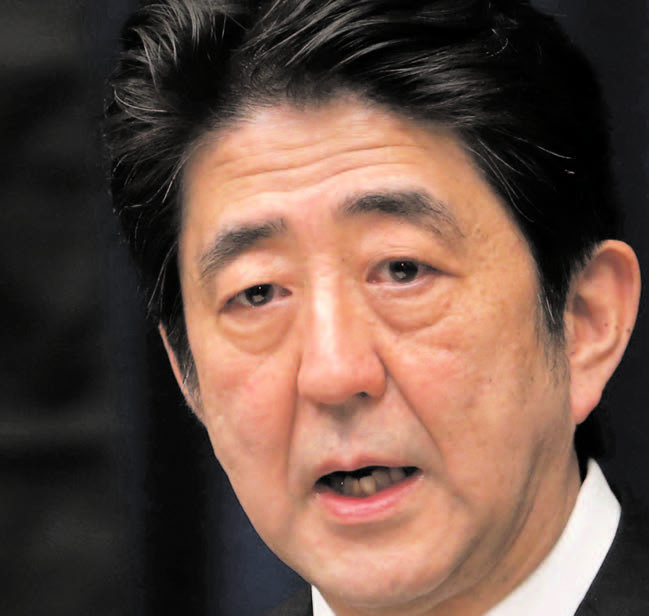
    TOKYO (TIP): Japan’s Prime Minister Shinzo Abe announced on Thursday a $110 billion investment plan for infrastructure projects in Asia in an apparent counter to China’s move to launch a new development bank.

    Abe said in a speech in Tokyo that Japan and the Asian Development Bank (ADB) will boost their assistance by 30 per cent to offer the massive investment aid under a five-year public-private partnership vision.

    “By attracting diverse funds, we hope to bring changes to Asia,” Abe said in prepared remarks, in the latest twist in the tussle for influence in the fast-growing region.

    “In the long run, we’d like to spread quality infrastructure and innovative infrastructure in Asia,” Abe said, according to Kyodo News.

    The sum is just slightly higher than the expected $100 billion capital of the Asian Infrastructure Investment Bank (AIIB) that Beijing and more than 50 founding member states are establishing.

    Japan and the United States were the biggest standouts earlier this year when Beijing began courting members for the AIIB.

    Washington led a high-profile, and ultimately unsuccessful, attempt to dissuade allies from taking part in the project, which critics say will not demand the same good-governance and environmental standards imposed by other international bodies, such as the ADB, a long-established body in which Tokyo plays a key role.

    However, supporters say fears over undue Chinese influence are overblown, and that the participation by more than 50 countries, including ones as diverse as Britain and Iran, will dilute Beijing’s power.

    Few observers doubt there is a need for billions of dollars of investment in infrastructure in Asia.

    The region also offers rich opportunities for countries with strong infrastructure industries, like Japan.

    But political and other risks in doing business in Asia have discouraged some businesses from making long-term investments.

  • A FORTHRIGHT MODI IN CHINA

    A FORTHRIGHT MODI IN CHINA

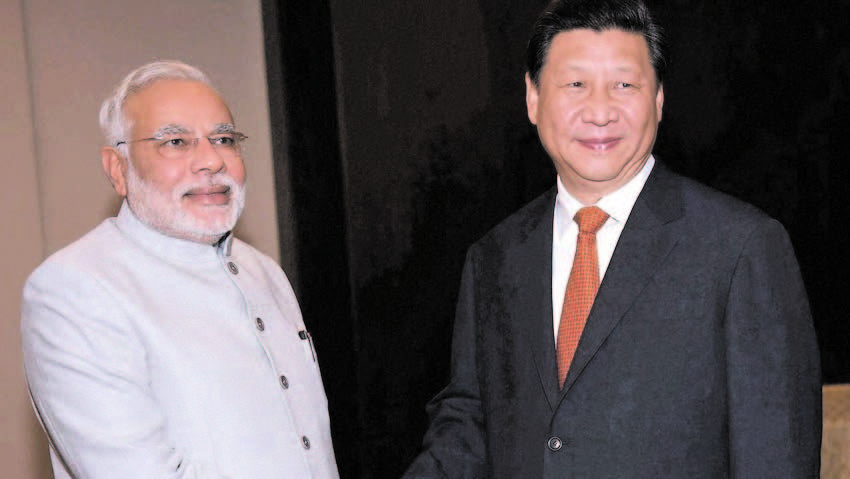
    During his China visit, Prime Minister Modi has been unusually forthright in speaking about the problems that hold back the India-China relationship. He probably feels that his desire to strengthen ties with China being so clear, he has earned the confidence of the Chinese leaders enough to be able to pinpoint India’s concerns about some aspects of China’s policies that we find difficult to digest. This is a new approach Modi has fashioned. Our earlier approach has been to soft pedal differences, avoid airing them in public and pretend they are more manageable than they actually are. There has been a tendency also to explain China’s behaviour to ourselves by becoming their spokespersons to our own people, and in the process accept some of the blame for the problems that endure.

    Modi is following a different tack, that of creating consciousness in the Chinese public that China has a responsibility of addressing outstanding issues if it wants the bilateral relationship to move forward and bring about the Asian century that its leadership visualises. This is a more self-confident approach. Whether this more robust attitude will produce the results we want is not certain. China is used to such exhortations by the US, which, unlike our case, are also backed by US power. Yet, China both bends and defies to the degree necessary to manage the relationship with the US, but without changing its fundamental course of building its national power and commensurately raising the level of its strategic challenge to the US. In other words, China does not get cowed down, nor is willing to yield on essentials even when its policies do not make sense always in the light of its own self-interest as seen by external observers.

    Prime Minister Modi interacts with people at the India China business forum  (Photo courtesy: Twitter/PIB)
    Prime Minister Modi interacts with people at the India China business forum (Photo courtesy: Twitter/PIB)

    Whatever the caveats, Modi is moving the Chinese out of their present comfort zone and dealing with China with greater self-assurance which cannot but have some impact on how it treats India in the future. This is a new balance that Modi is establishing between leveraging economically the China connection for India’s development and not losing politically by diffidence in mentioning differences that endure. There are some indications that China believes that of all the partners that India is wooing for investments, it is the one best placed to meet India’s needs, especially in modernising its poor infrastructure. In other words, India’s choices are limited and this gives China a strong hand to play even in the economic field. Modi is implicitly making China reexamine its assumptions

    By choice or consequence, Modi is linking the economic to the political by his double messaging in Beijing. On the one hand, the joint statement issued during the visit explicitly says that outstanding differences, including on the boundary question, should not be allowed to come in the way of continued development of bilateral relations. On the other, Modi stressed in his joint press conference with Chinese premier Li Keqiang that China needed to “reconsider its approach on some of the issues that hold us back from realising the full potential of our partnership” and “take a strategic and long term view of our relations”. This suggested that the long term relationship could be either jeopardised or impeded if China continued with its present approach. It is interesting that in asking China to think long term he summarily debunked the widely accepted myth that China thinks not years but decades ahead in policy making. Standing alongside Li Keqiang, Modi reiterated the “importance of clarification of the Line of Actual Control”, a point he had made in Xi’s presence during the latter’s September visit to India, and “tangible progress on issues relating to visa policy (stapled visa issue, no doubt) and trans-border rivers”. He also alluded to “some our regional concerns” (undoubtedly China’s policies in our neighbourhood, especially in Pakistan). It is clear that Modi raised all these issues in his private conversations with Xi and Li Keqiang, as otherwise publicly mentioning them in the latter’s presence would have seen as a form of political ambush by the Chinese premier. Modi’s intention was obviously to make public his political expectations from China in the years ahead.

    Modi expatiated further on these points in his address at the Tsinghua University. He put more pressure on the Chinese government by stating publicly that if the two countries “have to realise the extraordinary potential of our relationship, we must also address the issues that lead to hesitation and doubts, even distrust, in our relationship”. This is extraordinary plain speaking. He spoke of trying “to settle the boundary question quickly” in a way that does “not cause new disruptions”- an allusion no doubt to China’s unreasonable demands in the eastern sector. This amounts to, again, asking the Chinese publicly to rethink its posture on the package deal on the border. To remove “a shadow of uncertainty” that “hangs over the sensitive areas of the border region” because “neither side knows where the Line of Actual Control is in these areas”, he recalled his proposal to resume the process of clarifying the LAC
    “without prejudice to our position on the boundary question”. This is a via media he is seeking between, on the one hand, stabilising the border and eliminating periodic stand-offs that damage the political relationship and make headway in other areas that much more difficult and, on the other, a permanent solution to the boundary question. It is doubtful whether China would accept this option that was always open. indeed, China was committed to this process but abandoned it favour of the Special Representatives (SR) mechanism. It is unclear, moreover, how the LAC clarification process and the SR mechanism can proceed simultaneously.

    Voicing concerns about China’s increased engagement “in our shared neighbourhood”, Modi, in his Tsinghua address, called for “deeper strategic communication to build mutual trust and confidence” so as to “ensure that our relationships with other countries do not become a source of concern to each other”. In talking of “shared neighbourhood” Modi is talking about South Asia and not the western Pacific, and this is significant. To strengthen our international cooperation, he frontally sought China’s support for India’s permanent membership of the UN Security Council and India’s membership of export control regimes like the Nuclear Suppliers Group. This was unusual as such a public appeal does not normally come from his elevated position. A prime Minister should not seen as a supplicant. Anyhow, by stating all this, Modi has, in a sense, laid out the political agenda of the relationship in the years ahead from his side, which if not achieved in some measure in a reasonable time frame can become a source of criticism and could even make the economic agenda with China even more controversial as a one-sided strategic compromise.

    The joint statement and the Tsinghua speech contain some notable formulations, omissions and iterations, some curious, many positive and a few negative. If the India relationship was for president Obama a defining one for the 21st century, the joint statement notes, as a rhetorical balance, that the “India-China relations are poised to play a defining role in the 21st century in Asia and, indeed, globally”. A China that supposedly rejects an equal status for India accepts in the joint statement that the two countries are “major poles in the global architecture”. On the boundary question, the old, cliched language is repeated and the emphasis remains on improved border management. No mention is made to China’s self-serving One Road One Belt
    (OBOR) initiative to which Xi attaches much importance, and which figured prominently in his recent Pakistan visit. Our neighbours like Sri Lanka and Nepal would have particularly noted this omission. Significantly, the joint statement contains no reference to security in the Asia-Pacific region, unlike in September 2014, which suggests a failure to agree on language on this sensitive issue. Maritime cooperation too does not figure in it, which suggests difficulties in drafting the joint statement.

    We have again thanked China’s Foreign Ministry and the government of “the Tibetan Autonomous Region of the People’s Republic of China” for facilitating the Kailash Manasarovar Yatra. It would have been sufficient to have simply thanked “China” in September 2014 and now, but the Chinese obviously press us to include formulations that recognise TAR as part of the PRC in our joint statements- a practice that was discontinued by the UPA government in the face of China’s increasingly strident claims on Arunachal Pradesh. These offensive claims unfortunately continue and therefore do not justify such politically one-sided gestures by us. Maybe we think this is too sensitive a subject for us to reticent about and to keep the relationship on even keel we feel we can keep giving China comfort over Tibet even when China cynically uses Tibet to make outlandish territorial claims on us. This gesture could also have been a quid pro quo for the stronger formulation on terrorism in the joint statement that could not have pleased Pakistan (though it should be noted that the statement refers not to “cross-border terrorism” which is a formulation India uses to accuse Pakistan, but to “cross border movement of terrorists” which has a different connotation), as well as the separate joint statement on Climate Change that fully reflects India’s position and assumes importance in the context of the Climate Change summit in Paris where the effort would be to isolate India and use the US-China agreement to that end. The question though remains how India will reconcile its commitment to work closely with the US to make the Paris Conference a success with the enunciation of a common position with China which conflicts with the basic US approach.

    The reference in the joint statement to the “commonalities” in the approach of the two countries to global arms control and nonproliferation is puzzling as it conflicts with reality and whitewashes China’s historical and current proliferation activities in Pakistan. To have China in return “note” our aspirations to join the NSG, is an altogether insufficient reason to make this concession and lose a political card against China and Pakistan. Opening ISRO to China through a Space Cooperation Outline (2015-2020) Cooperation may also seem premature to some, given the actual state of India-China relations.

    In his Tsinghua speech, Modi noted pointedly that while both countries seek to connect a fragmented Asia, “there are projects we will pursue individually”, which implies cold shouldering China’s idea of linking our Mausam and Spice Route projects with OBOR. Progress in the BCIM (Bangladesh, China, India, Myanmar) Economic Corridor is mentioned in the joint statement, despite the danger of opening up our inadequately nationally integrated northeast to more economic integration with China. Why Modi mentioned this corridor again in his university speech is unclear, but then, having participated in the joint working group discussions on the project for some time now, it might have been tactically difficult to close the door on it abruptly.

    That Modi himself announced at the last minute at Tsinghua the grant of e-visas to the Chinese after the Foreign Secretary had told the media earlier that no decision had been taken, raises questions about policy making, especially as the stapled visa issue remains unresolved. Of course, enhanced economic engagement requires easier visas and to that extent such a decision can be seen as pragmatic, but we have given up a valuable card touching upon sovereignty issues without sufficient return. No wonder the Chinese Foreign Minister was delighted by this gift from the Prime Minister.

    The driving force behind Modi’s wooing of China being trade and investment, the progress achieved on that front was of principal interest in terms of outcomes. Here, the results have been less than expected. In a sense this was to be expected as too little time had elapsed between Xi’s visit to India and Modi’s visit to China to produce dramatic results. The $20 billion of investment five years promised by Xi would take time to materialise under any circumstances, but more so in the case of China as it has so far invested little in the country, its investors have limited experience of working in India, its leaders are looking for preferential treatment and want a better understanding of the legal conditions. The joint statement largely repeats what was said in September 2014 during Xi’s visit on taking joint measures to alleviate the problem of deficit and cooperate in providing Indian products more market access in China. The language is very noncommittal and it is left to the India-China Joint Economic Group to work on these issues. It was agreed that the next meeting of the Strategic Economic Dialogue, co-chaired by Vice Chairman of NITI Aayog of India and Chairman of NDRC of China, will be held in India during the second half of 2015. On the other hand, China’s economic interests in India are treated more concretely, with satisfaction expressed with the progress achieved in the Railway sector cooperation including the projects on raising the speed on the existing Chennai-Bengaluru-Mysore line, the proposed feasibility studies for the Delhi-Nagpur section of high speed rail link, the station redevelopment planning for Bhubaneswar & Baiyappanahalli, heavy haul transportation training and setting up of a railway university.

    Although 24 agreements were signed during the visit and the number is impressive, in reality the most significant one relates to the opening of our respective consulates in Chengdu and Chennai and space cooperation. There is no economic agreement of note that figures in the list. Surprisingly, the joint statement contains no reference to the two industrial parks that China will be setting up in India, even if it were to merely record some progress in implementing this initiative. Even the figure of $20 billion of Chinese investments in India in the next 5 years- if nothing but for its positive optical effect- is not mentioned this time. No doubt 26 “agreements” were signed during the visit to Shanghai- mostly MOUs involving the private sector that have no binding value- in the areas of renewable energy, power, steel etc. These are sectors in which China is either already strongly present in India or is a global player as in the case of solar power. Its aim would be to capture the Indian market in what would be a highly fecund area for Chinese business given India’s massive plans in developing the solar power sector. A point to consider is whether the unfettered entry of Chinese firms would suffocate Indian enterprise in the renewable industry sector as has happened in the power and telecom sectors. Even financing of private Indian companies by Chinese banks has been put on the positive ledger in projecting the results of Modi’s visit, even though all that is meant is that China will lend money to Indian companies to buy more Chinese products and only add to the burgeoning trade deficit between the two countries. That these MOUs, if and when implemented ( many are in the form of intentions only) are potentially worth $ 22 billion is a PR exercise, which all countries resort to in order to embellish the economic “success” of visits by their leaders abroad, and can therefore be excused as standard diplomatic practice.

    All in all, the China challenge for India has not been reduced by Modi’s visit. On the contrary, Modi has highlighted the political challenges ahead, as China has remained reticent on the points raised by him. Modi is to be commended for largely making the right points during the visit. There were some slippages, but this was perhaps inevitable because China holds the stronger hand. The attempt always is to enlarge the areas of real or potential convergences rather than get bogged down over contentious issues and create a situation where it becomes difficult to issue any meaningful joint statement. The problem in the India-China case is that we are not strategic partners in reality and yet claim that we are. At the end of the day, making the right points and winning them the are two different things.

    As for personal chemistry between Xi and Modi, it would have been better if Xi too had avowed publicly that the two had a “plus one” friendship, otherwise the psychological advantage is with the side that remains silent. Let us also note personal chemistry can have a short shelf life in the face of hard political and strategic realities. Obama and Xi have had a shirtsleeves meeting in Palm Springs in California in 2013, Bush read Putin’s soul in Slovenia in 2001 and Obama had hamburgers with Medvedev in Washington in 2010, but these get-to-know informal meetings intended to create a personal rapport do not help resolve issues beyond a point. It remains though that both Xi and Li Keqiang made unprecedented personal gestures to Modi.

    (The author is a former Foreign Affairs Secretary and Dean, Centre for International Relations and Diplomacy, Vivekananda International Foundation. He can be reached at sibalk@gmail.com)

    (British English)

  • NRI investments to be considered domestic

    New Delhi (TIP): In an attempt to attract overseas funds, the Centre on Thursday said non-repatriable investments by non-resident Indians (NRIs), overseas citizens of India (OCIs) and persons of Indian origin (PIOs) will be treated as domestic investments and will not be subject to FDI caps.

    The Cabinet approved some amendments, including changes in definition of NRI, to be incorporated in the FDI policy.

    “Investment by NRIs under Schedule 4 of FEMA (Transfer or issue of security by persons residing outside India) Regulations will be deemed to be domestic investment at par with the investment made by residents.” an official statement said.

    The NDA government, which has liberalised the FDI policy for sectors such as Defence, Railways, infrastructure, medical devices and insurance, is keen to tap NRIs, OCIs and PIOs.

    The government wants to channelise the funds of NRIs, who now have set up large companies abroad, by treating their non-repatriable investments as domestic investment.

    NRIs have been demanding the government that their investment be considered as domestic investment.

    A committee set up to look into the possibility of treating non-repatriable NRI funds as domestic investment, had earlier said that NRIs might prefer investing through corporate entities.

    “It was intended to provide NRIs an incentive to bring funds into India without repatriation rights, at a time when foreign exchange reserves were limited and capital inflows were modest,” the statement said.

    The provision should continue to incentivise investments by NRIs, including OCIs and PIOs, resulting in increased investments in the country.

    “This will enable investments by NRIs, OCI and PIO cardholders under Schedule 4 on non-repatriation basis, across sectors without being subjected to any of the conditions associated to foreign investment,” it said.

    During the April-February period of the previous fiscal, FDI rose by 39 per cent to $28.81 billion as against $20.76 billion in the same period last fiscal.

  • Strategic Autonomy as an Indian Foreign Policy Option

    Strategic Autonomy as an Indian Foreign Policy Option

    [quote_right]For a large country like India, which has the potential of becoming a big power in the future, strategic autonomy is a compelling choice. By virtue of its demographic, geographic, economic and military size, India must lead, but does not have yet the comprehensive national power to do so. It cannot subordinate itself to the policies and interests of another country, however powerful, as its political tradition and the functioning of its democracy will not allow this. India may not be strong enough to lead, but it is sufficiently strong not to be led”, says the author.[/quote_right]

    In the joint statement issued during the Indian prime minister’s visit to France in April, the two sides reaffirmed “their independence and strategic autonomy” in joint efforts to tackle global challenges. In the French case, as a member of NATO it is not so clear what strategic autonomy might mean, but in our case it would essentially mean independence in making strategic foreign policy decisions, and, consequently, rejecting any alliance relationship. It would imply the freedom to choose partnerships as suits our national interest and be able to forge productive relationships with countries that may be strategic adversaries among themselves.

    In practical terms, this means that India can improve relations with the United States of America and China while maintaining close ties with Russia. It can forge stronger ties with Japan and still seek a more stable relationship with China. It can forge strong ties with Israel and maintain very productive ties with the Arab world, including backing the Palestinians in the United Nations. It means that India can have strategic partnerships with several countries, as is the case at present with the US, France, Germany, the United Kingdom, the European Union, Russia, China, Japan, Brazil, Saudi Arabia, Australia, Canada, Kazakhstan, Afghanistan, Vietnam, Iran and the like.

    It means that India can be a member of BRICS and the RIC dialogues, as well as IBSA, which exclude the West, and also forge closer political, economic and military ties with the Western countries. Our strategic autonomy is being expressed in other ways too. India is a democracy and believes that its spread favors its interests, but it is against the imposition of democracy by force on any country. If the spread of democracy is in India’s strategic interest, using force to spread it is against its strategic interest too, as is shown by the use of force to bring about democratic changes in West Asia by destroying secular authoritarian regimes and replacing them with Islamic authoritarian regimes. Likewise, India believes in respect for human rights, but is against the use of the human rights agenda to further the geo-political interests of particular countries, essentially Western, on a selective basis.

    For a large country like India, which has the potential of becoming a big power in the future, strategic autonomy is a compelling choice. By virtue of its demographic, geographic, economic and military size, India must lead, but does not have yet the comprehensive national power to do so. It cannot subordinate itself to the policies and interests of another country, however powerful, as its political tradition and the functioning of its democracy will not allow this. India may not be strong enough to lead, but it is sufficiently strong not to be led.

    India preserved its strategic autonomy even in the face of severe technology sanctions from the West on nuclear and missile issues. It preserved it by not signing the non-proliferation treaty and continuing its missile program. By going overtly nuclear in 1998, India once again exercised its strategic autonomy faced with attempts to close the doors permanently on its nuclear program by the permanent extension of the NPT and the comprehensive nuclear test ban treaty and fissile material cutoff treaty initiatives.

    In some quarters in India and abroad, the idea of strategic autonomy is contested as another manifestation of India’s non-aligned mindset, its propensity to sit on the fence, and avoid taking sides and assuming responsibility for upholding the present international order as a rising power should. These critics want India to join the US camp more firmly to realize its great power ambitions. These arguments ignore the reality that while the US has been crucial to China’s economic rise, China has been sitting on the fence for many years, even as a permanent member of the UN security council. Far from sacrificing its strategic autonomy, it has become a strategic challenger of the US.

    To be clear, the US government has officially stated its respect for India’s position on preserving its strategic autonomy, and denies any expectation that India would establish an alliance kind of relationship with it. It is looking for greater convergence in the foreign policies of the two countries, which is being realized.

    During Narendra Modi’s visit to the US in September, 2014, and Barack Obama’s visit to India in January this year, a strategic understanding on Asia Pacific and Indian Ocean issues, encapsulated in the January 2015 joint strategic vision for the Asia Pacific and the Indian Ocean has emerged. This document suggests a shift in India’s strategic thinking, with a more public position against Chinese maritime threat and a willingness to join the US in promoting partnerships in the region.

    Modi chose a striking formulation in his joint press conference with Obama in September when he said that the US was intrinsic to our Look East and Link West policies, which would suggest a growing role for the US in our foreign policy thinking. During Obama’s January visit, the joint statement noted that India’s Act East policy and the US rebalance to Asia provided opportunities for India, the US and other Asia-Pacific countries to work closely to strengthen regional ties. This was the first time that India implicitly endorsed the US rebalance towards Asia and connected our Act East policy to it.

    Rather than interpreting it as watering down our strategic autonomy, one can see it as strengthening it. So far, India has been hesitant to be seen drawing too close strategically to the US because of Chinese sensitivities. China watches closely what it sees are US efforts to rope India into its bid to contain China. At the same time, China continues its policies to strengthen its strategic posture in India’s neighborhood and in the Indian Ocean at India’s expense, besides aggressively claiming Indian territory.

    By strengthening relations with the US (which is strategically an Asian power), Japan and Vietnam, and, at the same time, seeking Chinese investments and maintaining a high-level dialogue with it, India is emulating what China does with India, which is to seek to build overall ties as much as possible on the economic front, disavow any negative anti-India element in its policies in our neighborhood, but pursue, simultaneously, strategic policies intended to contain India’s power in its neighborhood and delay its regional extension to Asia.

    In discussing the scope of our strategic autonomy, one should recognize that the strength of US-China ties, especially economic and financial, far exceeds that of India-US ties. India has to be careful, therefore, in how far it wants to go with the US with a view to improving its bargaining power with China. The other point to consider is the US-Pakistan equation. The US has just announced $1 billion of military aid to Pakistan; its position on the Taliban is against our strategic interests in Afghanistan; its stand on Pakistan’s sponsorship of terrorism against us is not robust enough.

    To conclude, strategic autonomy for India means that it would like to rely as far as possible on its own judgment on international issues, balance its relations with all major countries, forge partnerships with individual powers and take foreign-policy positions based on pragmatism and self-interest, and not any alliance or group compulsion.

    (The author is former foreign secretary of India. He can be reached at sibalkanwal@gmail.com)

  • Nuclear Fears in South Asia – Pak Vs Ind

    Nuclear Fears in South Asia – Pak Vs Ind

    The world’s attention has rightly been riveted on negotiations aimed at curbing Iran’s nuclear program. If and when that deal is made final, America and the other major powers that worked on it — China, Russia, Britain, France and Germany — should turn their attention to South Asia, a troubled region with growing nuclear risks of its own. 

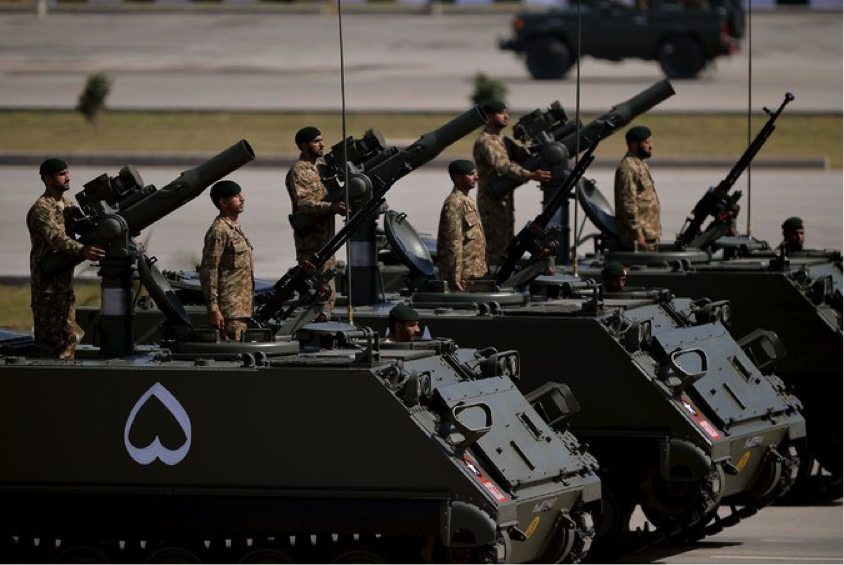
    Pakistan, with the world’s fastest-growing nuclear arsenal, is unquestionably the biggest concern, one reinforced by several recent developments. Last week, Pakistan’s prime minister, Nawaz Sharif, announced that he had approved a new deal to purchase eight diesel-electric submarines from China, which could be equipped with nuclear missiles, for an estimated $5 billion. Last month, Pakistan test-fired a ballistic missile that appears capable of carrying a nuclear warhead to any part of India. And a senior adviser, Khalid Ahmed Kidwai, reaffirmed Pakistan’s determination to continue developing short-range tactical nuclear weapons whose only purpose is use on the battlefield in a war against India.

    These investments reflect the Pakistani Army’s continuing obsession with India as the enemy, a rationale that allows the generals to maintain maximum power over the government and demand maximum national resources. Pakistan now has an arsenal of as many as 120 nuclear weapons and is expected to triple that in a decade. An increase of that size makes no sense, especially since India’s nuclear arsenal, estimated at about 110 weapons, is growing more slowly. 

    The two countries have a troubled history, having fought four wars since independence in 1947, and deep animosities persist. Prime Minister Narendra Modi of India has made it clear that Pakistan can expect retaliation if Islamic militants carry out a terrorist attack in India, as happened with the 2008 bombing in Mumbai. But the latest major conflict was in 1999, and since then India, a vibrant democracy, has focused on becoming a regional economic and political power.

    At the same time, Pakistan has sunk deeper into chaos, threatened by economic collapse, the weakening of political institutions and, most of all, a Taliban insurgency that aims to bring down the state. Advanced military equipment — new submarines, the medium-range Shaheen-III missile with a reported range of up to 1,700 miles, short-range tactical nuclear weapons — are of little use in defending against such threats. The billions of dollars wasted on these systems would be better spent investing in health, education and jobs for Pakistan’s people.

    Even more troubling, the Pakistani Army has become increasingly dependent on the nuclear arsenal because Pakistan cannot match the size and sophistication of India’s conventional forces. Pakistan has left open the possibility that it could be the first to use nuclear weapons in a confrontation, even one that began with conventional arms. Adding short-range tactical nuclear weapons that can hit their targets quickly compounds the danger.

    Pakistan is hardly alone in its potential to cause regional instability. China, which considers Pakistan a close ally and India a potential threat, is continuing to build up its nuclear arsenal, now estimated at 250 weapons, while all three countries are moving ahead with plans to deploy nuclear weapons at sea in the Indian Ocean.

    This is not a situation that can be ignored by the major powers, however preoccupied they may be by the long negotiations with Iran.

  • MOODY’S UPGRADES INDIA RATING OUTLOOK TO POSITIVE

    MOODY’S UPGRADES INDIA RATING OUTLOOK TO POSITIVE

    MUMBAI (TIP): Moody’s ratings revised India’s sovereign rating outlook to “positive” from “stable” on Thursday as it expects the actions by policymakers will enhance the country’s economic strength in the medium term.

    Moody’s also said that it expected structural advantages, supported by relatively benign commodity prices and liquidity conditions globally, will keep India’s growth above its peers over the rating horizon.

    The outlook revision was announced before Indian markets opened on Thursday. Analysts said they expected bank stocks to rise and the rupee to strengthen on the upgrade.

    The investor-friendly Narendra Modi government, which came to power last May promising faster growth, more jobs and quick clearances, has taken measures to fast-track clearances for investment projects, boost infrastructure investment and remove policy uncertainty in mining and coal sectors.

    The government has also relaxed foreign investments in sectors such as defence, insurance, e-commerce, railways and eased steps to allow businesses to acquire land and set up factories.

    “India’s policymakers are establishing a framework that will likely allow India’s growth to continue to outperform that of its peers over medium term and improve India’s macro-economic, infrastructure and institutional profile,” Moody’s said in its statement. However, Moody’s stopped short of raising the sovereign credit rating due to relative weakness in fiscal, inflation, infrastructure and poor asset quality among Indian banks.

    Constrained credit profile 

    “Recurrent inflationary pressures, occasional balance of payments pressures, and an uncertain regulatory environment have contributed to periods of volatility in growth, and have exposed India to external and financial shocks, constraining its credit profile,” Moody’s said.

    Moody’s has a Baa3 rating on India 

    After a recent revision in the methodology of measuring gross domestic product, which raised a lot of scepticism from policymakers including government and central bank officials, India registered growth of 7.5 per cent in the December quarter, higher than China’s.

    Under this new method, the Reserve Bank of India expects India to growth at 7.8 per cent for 2015/16, lower than the government’s estimate of 8.0-8.5 per cent.

    The government has been pitching to rating agencies to improve India’s credit rating, citing reforms, and on Thursday officials were to quick to welcome Moody’s improved outlook.

    “Upgrade of outlook proves government is moving in the right direction … it validates India’s commitment on fiscal discipline,” India’s chief economic adviser Arvind Subramanian said on news channel CNBC TV18.

  • 100bn barrels of oil deposit found near London airport

    LONDON (TIP): A British energy company says there is oil, and lots of it, near London’s Gatwick Airport. The question is how much of it can be pumped from the ground.

    UK Oil & Gas Investments PLC says analysis of a new well in the Weald Basin indicates there may be as much as 158 million barrels of oil per square mile in the region. That suggests the entire basin may hold as much as 100 billion barrels of oil, more than 10 times earlier estimates. By comparison, Britain has pumped about 42 billion barrels of oil from the North Sea over the past 40 years.

    While oil companies have been drilling in the Weald Basin since the 1930s, UK Oil & Gas says new “concepts, techniques and technology” have given it a better understanding of the region’s potential. As recently as December, the British Geological Survey issued a report suggesting the basin’s shale rock formations held up to 8.8 billion barrels of oil.

    Stephen Sanderson, the CEO of UK Oil & Gas, said the latest estimates shows this is a “world class potential resource.” 

    The U.K. has identified three potential reservoirs of onshore oil and gas as it seeks to get in on the shale oil boom that has made the US the world’s top energy producer. While US developers have relied on hydraulic fracturing, or fracking, to break up the shale and release energy deposits, UK Oil & Gas says the Weald Basin is “naturally fractured” and so can be tapped using conventional drilling techniques.

    But Alastair Fraser, a professor of petroleum geoscience at Imperial College London, warned that the area’s geology is “rather unfriendly.” While the oil may exist, it will be difficult to get out of the ground because the rocks are extremely tight and non-permeable, said Fraser, who worked for British oil producer BP for 30 years.

    “That’s all very well,” he said of the increased estimate of the basin’s oil resources. “But you’ve got to get at that.” 

    Experts agree that only a fraction of the oil in shale rock formations can be extracted.

    Developers have been able to recover from 3 percent to 15 percent of the oil present in areas that are geologically similar to the Weald Basin, Sanderson said.

    Another complication may be opposition to large-scale drilling in a basin that stretches across 4,180 square miles (10,825 square kilometers) of southern England.

  • SMART MOVES – Modi Government on US & China

    SMART MOVES – Modi Government on US & China

    [vc_row][vc_column][vc_column_text]

    “The Modi government will face the test of managing closer strategic relations with the US, which are in part directed against China, and forging closer ties with China that go against this strategic thrust, besides the reality that China has actually stronger ties with the US than it can ever have with India, though the underlying tensions between the two are of an altogether different order than between India and the US.”


    [/vc_column_text][/vc_column][/vc_row][vc_row][vc_column width=”1/2″][vc_column_text]

    [quote_box_center]China[/quote_box_center] 

    Prime Minister Modi has been quick to court both US and China. His first overtures were to China, prompted no doubt by his several visits there as Chief Minister of Gujarat, Chinese investments in his home state and his general admiration for China’s economic achievements. Beyond this personal element, many in the government and corporate sectors in India believe that our politically contentious issues with China, especially the unresolved border issue, should be held in abeyance and that economic cooperation with that country should be expanded, as India can gain much from China’s phenomenal rise and the expertise it has developed in specific sectors, especially in infrastructure. It is also believed that China, which is now sitting over $4 trillion of foreign exchange reserves, has huge surplus resources to invest and India should actively tap them for its own developmental needs. In this there is continuity in thinking and policy from the previous government, with Modi, as is his wont, giving it a strong personal imprint.

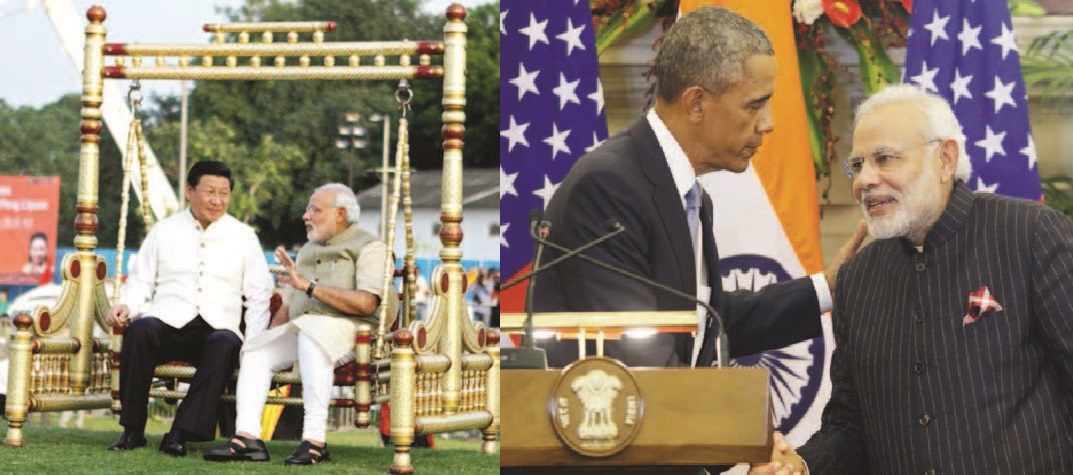
    The first foreign dignitary to be received by Modi after he became Prime Minister was the Chinese Foreign Minister, representing the Chinese President. This was followed by up by his unusually long conversation on the telephone with the Chinese Prime Minister. Our Vice-President was sent to Beijing to celebrate the 60th anniversary of the Panchsheel Agreement even though China has blatantly violated this agreement and India’s high level diplomatic endorsement of it only bolsters Chinese diplomacy, especially in the context of China-created tensions in the South China and East China Seas. Modi had occasion to meet President Xi Jinxing in July at the BRICS summit in July 2014, and this was followed up by the Chinese President’s state visit to India in September 2014, during which the Prime Minister made unprecedented personal gestures to him in an informal setting in Ahmedabad.

    The dramatics of Modi’s outreach to the Chinese aside, his objectives in strengthening economic ties with China, essentially imply a consolidation of the approach followed in the last decade or so, with some course correction here and there. In this period, China made very significant headway in our power and telecom sectors, disregarding obvious security concerns associated with China’s cyber capabilities and the links of Chinese companies to the Chinese military establishment. Many of our top companies have tapped Chinese banks and financial institutions for funds, and this has produced a pro-Chinese corporate lobby in our country. This lobby will obviously highlight the advantages of economic engagement over security concerns. The previous Prime Minister followed the approach of emphasizing shared interests with China rather than highlighting differences. The position his government took on the Depsang incident in May 2013 showed his inclination to temporize rather than confront. Externally, he took the line, which Chinese leaders repeated, that the world is big enough for India and China to grow, suggesting that he did not see potential conflict with China for access to global markets and resources. Under him, India’s participation in the triangular Russia-India-China format (RIC) and the BRICS format continued, with India-originated proposal for a BRICS Development Bank eventually materializing. Indian concerns about the imbalance in trade were voiced, but without any action by China to redress the situation. India sought more access to the Chinese domestic market for our competitive IT and pharmaceutical products, as well as agricultural commodities, without success. Concerns about cheap Chinese products flooding the India market and wiping out parts of our small-scale sector were voiced now and then, but without any notable remedial steps. The Strategic Economic Dialogue set up with China, which focused primarily on the railway sector and potential Chinese investments in India, did not produce tangible results.

    The Manmohan Singh government, despite China’s aggressive claims on Arunachal Pradesh and lack of progress in talks between the Special Representatives on the boundary issue as well as concerns about China’s strategic threats to our security flowing from its policies in our neighborhood, especially towards Pakistan and Sri Lanka, declared a strategic and cooperative partnership with that country. During Manmohan Singh’s visit to China in September 2013, we signed on to some contestable formulations, as, for example, the two sides committing themselves to taking a positive view of and supporting each other’s friendship with other countries, and even more surprisingly, to support each other enhancing friendly relations with their common neighbors for mutual benefit and win-win results. This wipes off on paper our concerns about Chinese policies in our neighborhood. We supported the BCIM (Bangladesh, China, India, Myanmar) Economic Corridor, including people to people exchanges, overlooking Chinese claims on Arunachal Pradesh and the dangers of giving the Chinese access to our northeast at people to people level. The agreement to carry out civil nuclear cooperation with China was surprising, as this makes our objections to China-Pakistan nuclear ties politically illogical. We also agreed to enhance bilateral cooperation on maritime security, which serves to legitimize China’s presence in the Indian Ocean when China’s penetration into this zone poses a strategic threat to us.

    As a mark of continuity under the Modi government, during President Xi Jinxing’s September 2014 visit to India, the two sides agreed to further consolidate their Strategic and Cooperative Partnership, recognized that their developments goals are interlinked and that their respective growth processes are mutually reinforcing. They agreed to make this developmental partnership a core component of their Strategic and Cooperative Partnership. The India-China Strategic Economic Dialogue was tasked to explore industrial investment and infrastructure development.

    To address the issue of the yawning trade imbalance, measures in the field of pharmaceuticals, IT, agro-products were identified and a Five-Year Development Program for economic and Trade Cooperation to deepen and balance bilateral trade engagement was signed. Pursuant to discussions during the tenure of the previous government, the Chinese announced the establishment of two industrial parks in India, one in Gujarat and the other in Maharashtra, and the “Endeavour to realize” an investment of US $ 20 billion in the next five years in various industrial and infrastructure development projects in India, with production and supply chain linkages also in view. In the railway sector, the two sides the two sides agreed to identify the technical inputs required to increase speed on the existing railway line from Chennai to Mysore via Bangalore, with the Chinese side agreeing to provide training in heavy haul for 100 Indian railway officials and cooperating in redevelopment of existing railway stations and establishment of a railway university in India. The Indian side agreed to actively consider cooperating with the Chinese on a High Speed Rail project. In the area of financial cooperation, the Indian side approved in principle the request of the Bank of China to open a branch in Mumbai.

    The Modi government has agreed to continue defense contacts, besides holding the first round of the maritime cooperation dialogue this year, even though by engaging India in this area it disarms our objections to its increasing presence in the Indian Ocean area, besides drawing negative attention away from its policies in the South China Sea as well as projecting itself as a country committed to maritime cooperation with reasonable partners. The joint statement issued during Xi Jinxing’s visit omitted any mention of developments in western Pacific, though it contained an anodyne formulation on Asia-Pacific. This becomes relevant in view of the statements on Asia-pacific and the Indian Ocean region issued during President Obama’s visit to India in January 2015.

    Our support, even if tepid, continues for the BCIM Economic Corridor. On our Security Council permanent membership, China continues its equivocal position, stating that it “understands and supports India’s aspiration to play a greater role in the United Nations including in the Security Council”. It is careful not to pronounce support for India’s “permanent membership”. During Foreign Minister Sushma Swaraj’s visit to China for the RIC Foreign Ministers meeting, China has maintained its equivocation, although the press has wrongly presented the formulation as an advance. China is openly opposed to Japan’s candidature in view of the sharp deterioration of their ties. In India’s case, it avoids creating a political hurdle to improved ties by openly opposing India’s candidature. “A greater role” could well mean a formula of immediately re-electable non-permanent members, of the kind being proposed by a former UN Secretary General and others.

    On counter-terrorism lip service is being paid to cooperation. On Climate Change, the two countries support the principle of “equity, common but differentiated responsibilities and respective capabilities”, although the US-China agreement on emission reduction targets has created a gap in Indian and Chinese positions, with the Modi government deciding to delink itself from China in international discussions to follow.

    In diplomacy, once concessions or mistakes are made, retrieval is very difficult unless a crisis supervenes. The Modi government, for reasons that are not too clear, repeated the intention of the two countries to carry out bilateral cooperation in civil nuclear energy in line with their respective international commitments, which has the unfortunate implication of India circumscribing its own headroom to object to the China-Pakistan nuclear nexus, besides the nuance introduced that China is observing its international commitments in engaging in such cooperation. The calculation that this might make China more amenable to support India’s NSG membership may well prove to be a mistaken one. Surprisingly, stepping back from the Manmohan government’s refusal towards the end to make one-sided statements in support of China’s sovereignty over Tibet when China continues to make claims on Indian territory, the new government yielded to the Chinese ruse in making us thank the “Tibetan Autonomous Region of the People’s Republic of China” as well as the Chinese Ministry of Foreign Affairs – as if both are independent of the Chinese government- for facilitating the Kailash Mansarovar Yatra and opening the new route through Nathu La, even though this is not the  most rational route because it involves a far longer journey, made easier of course by much better infrastructure. On receiving the flood season hydrological date the Chinese have stuck to their minimalist position.

    On the sensitive border issue, the disconnect between the joint statement which repeats the usual cliches and the serious incident in Chumar coinciding with Xi’s visit was obvious. China’s double game of reaching out to India- with greater confidence now as the gap between it and India has greatly widened and it has begun to believe that India now needs China for its growth and development goals- and staging a provocation at the time of a high level visit, continues. This is a way to remind India of its vulnerability and the likely cost of challenging China’s interests, unmindful that its conduct stokes the already high levels of India’s distrust of that country. It went to Modi’s credit that he raised the border issue frontally with XI Jinping at their joint press conference, expressing “our serious concern over repeated incidents along the border” and asking that the understanding to maintain peace and tranquility on the border “should be strictly observed”. He rightly called for resuming the stalled process of clarifying the Line of Actual Control (LAC). While this more confident approach towards China is to be lauded, we are unable to persuade China to be less obdurate on the border issue because we are signaling our willingness to embrace it nonetheless virtually in all other areas.

    That Modi mentioned “India’s concerns relating to China’s visa policy and Trans Border Rivers” while standing alongside Xi Jinping at the joint press conference indicated a refreshing change from the past in terms of a more open expression of India’s concerns. With regard to Bangladesh-China-India-Myanmar Economic Corridor that China is pushing hard, Modi rightly added a caveat by declaring that “our efforts to rebuild physical connectivity in the region would also require a peaceful, stable and cooperative environment”. He also did not back another pet proposal of Xi: the Maritime Silk Road, which is a re-packaged version of the notorious “string of pearls” strategy, as the joint statement omits any mention of it.

    Even as Modi has been making his overall interest in forging stronger ties with China clear, he has not shied away from allusions to Chinese expansionism, not only on Indian soil but also during his visit to Japan. After President Obama’s visit to India and the joint statements on South China Sea and Asia-Pacific issued on the occasion which can be construed as directed at China, Foreign Minister Sushma Swaraj’s recent visit there acquired more than normal interest in watching out for indications of China’s reaction. Her call on Xi Jinping was projected, quite wrongly, as going beyond normal protocol, when in actual fact the Chinese Foreign Minister gets access to the highest levels in India during visits. Swaraj seems to have pushed for an early resolution of the border issue, with out-of-the-box thinking between the two strong leaders that lead their respective countries today. Turning the Chinese formulation on its head, she called for leaving a resolved border issue for future generations.

    That China has no intention to look at any out-of-the-box solution- unless India is willing to make a concession under cover of “original thinking”- has been made clear by the vehemence of its reaction to Modi’s recent visit to Arunachal Pradesh to inaugurate two development projects on the anniversary of the state’s formation in 1987. It has fulminated over the Modi visit over two days, summoning the Indian Ambassador to lodge a protest, inventing Tibetan names for sub-divisions within Arunachal Pradesh to mark the point that this area has been under Tibetan administrative control historically. The Chinese Vice-Foreign Minister arrogantly told our Ambassador that Modi’s visit undermined “China’s territorial sovereignty, right and interests” and “violates the consensus to appropriately handle the border issue.” China is making clear that it considers Arunachal Pradesh not “disputed territory” but China’s sovereign territory. It is also inventing a non-existent “consensus” that Indian leaders will not visit Arunachal Pradesh to respect China’s position. There is a parallel between China’s position on the Senkakus where it accuses the Japanese government to change the status quo and inviting a Chinese reaction, and its latest broadside against India. This intemperate Chinese reaction casts a shadow on Modi’s planned visit to China in May and next round of talks between the Special Representatives (SRs) on the boundary question. If without a strong riposte these planned visits go ahead we would have allowed the Chinese to shift the ground on the outstanding border issue even more in their favor. It would be advisable for our Defense Minister to visit Tawang before Modi’s visit. A very categorical enunciation of our position that goes beyond previous formulations should be made by the Indian side. The Chinese position makes the SR talks pointless, as the terms of reference China is laying down cannot be agreed to by our side.

    [/vc_column_text][/vc_column][vc_column width=”1/2″][vc_column_text]

    [quote_box_center]UNITED STATES[/quote_box_center] 

    Prime Minister Modi, contrary to expectations, moved rapidly and decisively towards the US on assuming office. He confounded political analysts by putting aside his personal pique at having been denied a visa to visit the US for nine years for violating the US law on religious freedoms, the only individual to be sanctioned under this law. The first foreign visit by Modi to be announced was that to the US. Clearly, he believes that strong relations with the US gives India greater strategic space in foreign affairs and that its support is crucial for his developmental plans for India.

    To assess the Modi government’s policies towards the US, the results of his visit to Washington in September 2014 and that of Obama to India in January 2015 need to be analyzed, keeping in mind the approach of the previous government and the element of continuity and change that can be discerned.

    The joint statement issued during his US visit set out the future agenda of the relationship, with some goals clearly unachievable, but the ambitions of the two countries were underscored nonetheless. It was stated that both sides will facilitate actions to increase trade five-fold, implying US-China trade levels, which is not achievable in any realistic time-frame. They pledged to establish an Indo-US Investment Initiative and an Infrastructure Collaboration Platform to develop and finance infrastructure. An agreement on the Investment Initiative was signed in Washington prior to Obama’s visit to India, but bringing about capital reforms in India, which the Initiative aims at, is not something that can be realized quickly. India wants foreign investment in infrastructure and would want to tap into US capabilities in this broad sector, but the US is not in the game of developing industrial corridors like Japan or competitively building highways, ports or airports. Cooperation in the railway sector was identified, but it can only be in some specific technologies because this is the field in which Japan and China are competing for opportunities in India, whether by way of implementing high speed freight corridors or building high speed train networks in the country. India offered to the U.S. industry lead partnership in developing three smart cities, even if the concept of smart cities is not entirely clear. Some preliminary steps seem to have been taken by US companies to implement the concept. The decision to establish an annual high-level Intellectual Property (IP) Working Group with appropriate decision-making and technical-level meetings as part of this Forum was done at US insistence as IPR issues are high on the US agenda in the context of contentious issues that have arisen between the US companies and the Indian government on patent protection, compulsory licensing and local manufacturing content requirements.

    In his joint press briefing with Obama, Modi raised IT related issues, pressing Obama’s support  “for continued openness and ease of access for Indian services companies in the US market”, without obtaining a reaction from  the latter then or later when Obama visited India. On the food subsidy versus trade facilitation stand off in the WTO, Modi maintained his position firmly and compelling the US to accept a compromise. Modi’s firmness on an issue of vital political importance to India showed that he could stand up to US pressure if the country’s interest so demanded. He welcomed “the US defense companies to participate in developing the Indian defense industry”, without singling out any of the several co-development and co-production projects offered by the US as part of the Defense Technology and Trade Initiative (DTTI). Clearly, it was too early to conclude discussions on the US proposals before his September visit.

    The more broad based reference in the joint statement to India and the US intending to expand defense cooperation to bolster national, regional and global security was, on the contrary, rather bold and ambitious, the import of which became clearer during Obama’s January visit. While bolstering such cooperation for national security makes sense, regional security cannot be advanced together by both countries so long as the US continues to give military aid to Pakistan, which it is doing even now by issuing presidential waivers to overcome the provisions of the Kerry-Lugar legislation that requires Pakistan to act verifiably against terrorist groups on its soil before the aid can be released. As regards India-US defense cooperation bolstering global security, securing the sea lanes of communication in the Indian Ocean and the Asia-Pacific region is the obvious context. It was decided to renew for 10 years more the 2005 Framework for US-India Defense Relations, with defense teams of the two countries directed to “develop plans” for more ambitious programs, including enhanced technology partnerships for India’s Navy, including assessing possible areas of technology cooperation.

    The US reiterated its commitment to support India’s membership of the four technology control regimes: the Nuclear Suppliers Group (NSG), the Missile Technology Control Regime (MTCR), the Wassenaar Agreement and the Australia Group, with Obama noting that India met MTCR requirements and is ready for NSG membership, but without setting any time-tables. An actual push by the US in favor of India’s membership has been lacking because of issues of nuclear liability and administrative arrangements have remained unresolved until now and the US has wanted to use their resolution as a leverage. US support for India’s membership of these export control organizations was reiterated during Obama’s January visit, but how quickly the US will move remains unclear even after the political resolution of outstanding nuclear issues.

    The US at one time described India as a lynchpin of its pivot or rebalance towards Asia. The underlying motivation behind the pivot and US interest in drawing India into this strategy is China, though this is not stated publicly in such open terms. India has been cautious about the US pivot towards Asia as its capacity and willingness to “contain” Chinese power has been doubted because of the huge financial and commercial interdependence forged between the two countries. India seeks stable and economically productive relations with China and has wanted to avoid the risk of being used by the US to serve its China strategy that raises uncertainties in the mind of even the US allies in Asia. However, under the Modi government, India has become more affirmative in its statements about the situation in the western Pacific and the commonalities of interests between India and the US and other countries in the Indo-Pacific region. The government has decided to “Act East”, to strengthen strategic ties with Japan and Australia, as well as Vietnam, conduct more military exercises bilaterally with the US armed forces as well as naval exercises trilaterally with Japan. Modi has spoken publicly about greater India-US convergences in the Asia-Pacific region, to the point of calling the US  intrinsic to India’s Act East and Link West policies, a bold formulation in its geopolitical connotations never used before that suggested that India now viewed the US as being almost central to its foreign policy initiatives in both directions.

    On  geopolitical issues, India showed strategic boldness in the formulations that figured in the September joint statement. These laid the ground for more robust demonstration of strategic convergences between the two countries during Obama’s visit later. The reference in September to the great convergence on “peace and stability in the Asia Pacific region” was significant in terms of China’s growing assertiveness there. The joint statement spoke of a commitment to work more closely with other Asia Pacific countries, including through joint exercises, pointing implicitly to Japan and Australia, and even Vietnam. In this context, the decision to explore holding the trilateral India-US-Japan dialogue at Foreign Minister’s level- a proposition that figured also in the India-Japan joint statement during Modi’s visit there- was significant as it suggested an upgrading of the trilateral relationship at the political level, again with China in view.

    On the issue of terrorism and religious extremism, India and the US have rhetorical convergence  and some useful cooperation in specific counter-terrorism issues, but, on the whole, our concerns are  inadequately met because US regional interests are not fully aligned with those of India. The September joint statement called for the dismantling of safe havens for terrorist and criminal networks and disruption of all financial and tactical support for networks such as Al Qaeda, Lashkar-e-Taiba, Jaish-e-Mohammad, the D-company and the Haqqanis, but the Taliban were conspicuously omitted from the list. In any case, such statements against Pakistan-based terrorist groups have been made before but are ignored  by Pakistan in the absence of any real US pressure on it to curb Hafiz Saeed or credibly try Lakhvi despite repeated joint calls for bringing those responsible for the Mumbai terrorist massacre to justice.

    We had a paragraph on Iran in the joint statement in Washington, clearly at US insistence, which the Iranians would have noted with some displeasure. The Modi government is also willing to accommodate the US on Iran within acceptable limits. While the US supports India’s permanent membership of the UN Security Council, the support remains on paper as the US is not politically ready to promote the expansion of the Council.

    At Washington, India and the US agreed on an enhanced strategic partnership on climate change issues, and we committed ourselves to working with the US to make the UN Conference on Climate Change in Paris in December this year a success. This carried the risk of giving a handle to the US to ratchet up pressure to obtain some emission reduction commitments from India, encouraged  diplomatically by the US-China agreement.

    The unusually strong personal element in Modi’s diplomacy towards the US came apparent when during his Washington visit he invited Obama to be the chief guest at our Republic Day on January 26, 2015- a bold and imaginative move characteristic of his style of functioning. That this unprecedented invitation was made was surprising in itself, as was its acceptance by Obama at such short notice. Modi and Obama evidently struck a good personal equation, with the earlier alienation supplanted by empathy. Obama made the unprecedented gesture of accompanying Modi to the Martin Luther King Memorial in Washington, perhaps taking a leaf from the personal gestures made  to Modi in Japan by Prime Minister Abe.

    On the occasion of Obama’s January visit, Modi has moved decisively, if somewhat controversially, on the nuclear front, as this was the critical diplomatic moment to work for a breakthrough to underline India’s commitment to the strategic relationship with the US, which is the way that US commentators have looked at this issue. While in opposition the BJP had opposed the India-US nuclear agreement, introduced liability clauses that became a major hurdle in implementing the commitment to procure US supplied nuclear reactors for producing 10,000 MWs of power, and had even spoken of seeking a revision of the agreement whenever it came to power. During Obama’s  visit, the “breakthrough understandings” on the nuclear liability issue and that of administrative arrangements to track US supplied nuclear material or third party material passing through US supplied reactors, became the highlight of its success, with Modi himself calling nuclear cooperation issues as central to India-US ties. The supplier liability issue seems to have resolved at the level of the two governments by India’s decision to set up an insurance pool to cover supplier liability, as well as a written clarification through a Memorandum of Law on the applicability of Section 46 only to operators and not suppliers. On the national tracking issue the nature of the understanding has left some questions unanswered; it would appear that we have accepted monitoring beyond IAEA safeguards as required under the US law. However, the larger question of the commercial viability of US supplied reactors remains, a point that Modi alluded to in joint press conference. On the whole, whatever the ambiguities and shortfalls, transferring the subject away from government to company level to eliminate  the negative politics surrounding the subject is not an unwelcome development.

    For the US, defense cooperation has been another touchstone for the US to measure India’s willingness to deepen the strategic partnership. While the significant progress expected to be announced under the DTTI during Obama’s visit did not materialize, some advance was made with the announcement of four “pathfinder” projects involving minor technologies, with cooperation in the area of aircraft engines and aircraft carrier technologies to be explored later. The government has already chosen for price reasons the Israeli missile over the Javelin that was part of the several proposals made to India under the DTTI. As expected, the India-US Defense Framework Agreement of 2005 was extended for another 10 years, without disclosing the new text. It is believed  that India is now more open to discussions on the three foundational agreements that the US considers necessary for transfer of high defense technologies to India.

    The US-India Joint Strategic Vision for the Asia-Pacific and Indian Ocean Region signed during the visit is a major document which in the eyes of some reflects India’s move away from the shibboleths of the past associated with nonalignment and the obsession with strategic autonomy. Issuing a separate document was intended to highlight the growing strategic convergences between the two countries, with full awareness of how this might be interpreted by some countries, notably China. It affirms the “importance of safeguarding maritime security and ensuring freedom of navigation and overflight throughout the region , especially in the South China Sea”, while calling also on all parties to avoid the threat or use of force and pursue resolution of territorial and maritime disputes through all peaceful means in accordance with international law, including the Law of the Sea Convention. It speaks, in addition, of India and the US investing in making trilateral countries with third countries in the region, with Japan and Australia clearly in mind. This is a direct message addressed to China, reflecting less inhibition on India’s part both to pronounce on the subject and do it jointly with the US, irrespective of Chinese sensibilities. Some Chinese commentary has criticized this effort by the US to make India part of its containment strategy, without taking cognizance of how India views China’s maritime strategy in the Indian Ocean involving its strategic investments in Sri Lanka, Maldives, Pakistan and other countries. In the joint statement issued during  Obama’s visit, the two sides noted that India’s Act East Policy and the US rebalance to Asia provided opportunities to the two countries to work closely to strengthen regional ties, in what amounted to an indirect endorsement of the US pivot to Asia.

    Obama’s visit also demonstrated the consolidation of the good personal rapport established between him and Shri Modi, with embraces and first name familiarity- possibly overdone on Modi’s part- walk in the park and talk over tea, all of which boosted the prime minister’s personal stature as a man comfortable and confident in his dealings with the world’s most powerful leader on the basis of equality. This personal rapport should assist in greater White House oversight over the Administration’s policies towards India, which experience shows greatly benefits the bilateral relationship.

    Counter-terrorism is always highlighted as an expanding area of India-US cooperation because of shared threats. The joint statement in Delhi spoke dramatically of making the US-India partnership in this area a “defining” relationship for the 21st century. Does this mean that the US will share actionable intelligence on terrorist threats to us emanating from Pakistani soil? This is doubtful. The continued omission of the Afghan Taliban from the list of entities India and the US will work against is disquieting, as it indicates US determination to engage the Taliban, even when it knows that it is Pakistan’s only instrument to exert influence on developments in Afghanistan at India’s cost. The subsequent refusal of the US spokesperson to characterize the Taliban as a terrorist organization and preferring to call it an armed insurgency has only served to confirm this.

    On trade, investment and IPR issues, the two sides will continue their engagement with the impulse given to the overall relationship by the Obama-Modi exchanges. On a high standard Bilateral Investment Treaty the two sides will
    “assess the prospects for moving forward”, which indicates the hard work ahead. On the tantalization agreement the two will “hold a discussion on the elements requires in both countries to pursue” it, a language that is conspicuously non-committal. On IPRs there will be enhanced engagement in 2015 under the High Level Working Group.

    On climate change, we reiterated again the decision to work together this year to achieve a successful agreement at the UN conference in Paris, even when our respective positions are opposed on the core issue of India making specific emission reduction commitments. While stating  that neither the US nor the US-China agreement put any pressure on India, Modi spoke in his joint press conference about pressure on all countries to take steps for the sake of posterity. While  finessing the issue with high-sounding phraseology, he has left the door open for practical compromises with the US.

    As a general point, hyping-up our relations with the US is not wise as it reduces our political space to criticize its actions when we disagree. The previous government made this mistake and the Modi government is not being careful enough in this regard. Obama’s objectionable lecture to us at Siri Fort on religious freedom and his pointed reference to Article 25 of our Constitution, illustrates this. He showed unpardonable ignorance of Indian history and Hindu religious traditions in asking us to “look beyond any differences in religion” because “nowhere in the world is it going to more necessary for that foundational value to be upheld” than in India. To say that “India will succeed so long as it is not splintered around religious lines” was a wilful exaggeration of the import of some recent incidents  and amounted to playing the anti-Hindutva card by a foreign leader prompted by local Christian and “secular” lobbies. Reminding us of three national cinema and sport icons belonging only to minority religions- when their mass adulation is unconnected to their faith- was to actually encourage religiously fissured thinking in our society. On return to Washington Obama pursued his offensive line of exaggerating incidents of religious intolerance in India. On cue, a sanctimonious editorial also appeared in the New York Times. The government could not attack Obama for his insidious parting kick at Siri Fort so as not to dim the halo of a successful visit and therefore pretended that it was not directed at the Modi team. The opposition, instead of deprecating Obama’s remarks, chose to politically exploit them against Modi, as did some Obama-adoring Indians unencumbered by notions of self-respect.

    While giving gratuitous lessons on religious tolerance to the wrong country Obama announced $1 billion civil and military support to Pakistan that splintered from a united India because of religious intolerance in 1947 and has been decimating its minorities since. Obama has also invited the Chinese president to visit the US on a state visit this year, to balance his visit to India and the “strategic convergences” reached there on the Asia-Pacific region. Obama’s claim that the US can be India’s “best partner” remains to be tested as many contradictions in US policy towards India still exist.

    The Modi government will face the test of managing closer strategic relations with the US, which are in part directed against China, and forging closer ties with China that go against this strategic thrust, besides the reality that China has actually stronger ties with the US than it can ever have with India, though the underlying tensions between the two are of an altogether different order than between India and the US.

    [/vc_column_text][/vc_column][/vc_row]

  • INVESTMENT PROPOSALS DON’T MEET PROMISES

    INVESTMENT PROPOSALS DON’T MEET PROMISES

    NEW DELHI (TIP): Investment proposals by corporates are generally associated with improving business sentiment and often linked with the possibility of job creation. The comparison of proposed investment with actual implementation and job creation in the past 23 years, however, shows that the actual delivery has fallen well short of the promise.

    Data from the department of industrial policy and promotion shows that between August 1991 and March 2014, the government received about 94,000 investment proposals. These proposals include Industrial Investment Intentions through Entrepreneurs Memorandum — IEMs (delicensed sector) and Direct Industrial Licences (licensable sector).

    Put together, these proposed the investment of more than Rs 102 lakh crore and were supposed to create 2.3 crore jobs. The data on actual implementation of these proposals shows that only Rs 5.1 lakh crore was actually invested and just 20.1 lakh jobs created. That’s less than 5% of the proposed investments and 8.9% of the promised jobs.

    A state-wise analysis of proposals shows that between August 1991 and March 2014 corporates proposed to invest Rs 15.4 lakh crore in Orissa —the highest in the country. It was followed by Gujarat and Chhattisgarh receiving over Rs 10 lakh crore of proposed investments and Maharashtra just a tad below that mark. Overall, there were 15 states, which were each supposed to get over Rs 1 lakh crore of investments in these 23 years.

    When one analyses actual investments, Haryana has been the most successful among these 15 states in converting proposals to reality as 18.9% of the proposed money actually reached the state. It is followed by Gujarat (12.6%) and Uttar Pradesh (11.4%). The states that fared the worst in this conversion are Bihar, Jharkhand, Chhattisgarh and Orissa, where less than 1% of the proposed money actually arrived.

    So, what is the investment to job creation ratio? Overall, the Rs 5 lakh crore actually invested created a little over 20 lakh jobs, which amounts to four jobs per crore of investment. There were 25 states which witnessed the actual investment of more Rs 1,000 crore. Among these states, Jammu and Kashmir witnessed the most labour intensive investments, while Gujarat had the most capital intensive ones. Every crore of rupee invested in Jammu and Kashmir created about 12 jobs, while in Gujarat a crore of investment yielded only two jobs.

    In the investment to job creation ratio, Jammu and Kashmir is followed by Goa, Uttarakhand, Kerala and Punjab, where ten or more jobs were created per crore of investment. The worst state/UTs in this list are Madhya Pradesh, Jharkhand, Daman & Diu, Uttar Pradesh and Gujarat.

  • China’s 7% growth target lowest in 20 yrs

    BEIJING (TIP): China has set a growth target of 7% for 2015, lowest in two decades. This lowered target reflects declining exports and foreign investments, besides the government’s fear of slipping into a “middle income trap” along with problems like industrial pollution.

    “Downward pressure on China’s economy has continued to mount, and we have faced an array of difficulties and challenges,” Chinese premier Li Keqiang said, while explaining why he chose a GDP target that was even lower than the achievement of 7.4% in 2014. China would end 2015 with the highest ever budget deficit of 2.3 % of GDP against last year’s 2.1 %, the premier said. The country has entered an era of low growth rates, which is the “new normal,” he added.

  • Indian-American Dhanurjay ‘DJ’ Patil named first US chief data scientist

    Indian-American Dhanurjay ‘DJ’ Patil named first US chief data scientist

    A 45-year-old Indian-American Dhanurjay ‘DJ’ Patil has been named the first chief data scientist by the White House to shape policies and practices that will help the US remain a leader in technology and innovation.
     
    Patil— who has worked with several big-name Silicon Valley operations, including LinkedIn, eBay, PayPal, Skype, and venture capital firm Greylock Partners. Prior to his work in the private sector, Patil worked at Department of Defence, where he directed efforts to bridge computational and social sciences in fields like social network analysis to help anticipate new threats to the US. 


    Patil will now work as Deputy Chief Technology Officer in the Office of Science and Technology Policy, reporting to US Chief Technology Officer Megan Smith. He will also work on the Obama administration’s Precision Medicine Initiative, which focuses on utilising advances in data and healthcare to provide clinicians with new tools, knowledge, and therapies to select which treatments will work best for which patients, while protecting patient privacy. 

     
    Over the course of two decades of work in the private and public sectors and in academia, Patil has pioneered new ways for institutions to benefit from data. As a doctoral student and faculty member at the University of Maryland, Patil used open datasets to improve weather forecasting. He worked briefly for the Department of Defense, advising on efforts to use social network analysis, for example, to anticipate emerging threats to the United States. Most recently, he was the vice president of product at enterprise software company RelateIQ, which was acquired by Salesforce last July.

    Patil is moving his family to Washington where he’ll play a role in helping the United States government maximize its investments in big data and advise on policy issues and technology practices. And like his tech peers, he’ll be recruiting others to the cause. Patil will also be devoting time to the Administration’s Precision Medicine Initiative, which focuses on giving clinicians new tools, knowledge, and therapies to select which treatments will work best for which patients, while protecting patient privacy.

    In a memorandum to the American people, Patil said his role as chief data scientist will be to responsibly source, process, and leverage data in a timely fashion to enable transparency, provide security, and foster innovation for the benefit of the American public.

    “Data will continue to transform the way we live and work,” Patil said.

    He has authored a number of articles and books explaining the important current and potential applications of data science.

  • MRC Nagar deal a shot in the arm for Tata Coffee

    CHENNAI (TIP): As the property earns a rental of 65 per sq ft per month, the annual returns on investment for Tata Coffee will be 10.8%, higher than the industry average of 10% returns for Grade A commercial space.

    Sivasankaran is now under bankruptcy protection by an order of the Seychelles Supreme Court. Andhra Bank took possession of property after Siva Industries defaulted payment of Rs 42.7 crore loans.

    “The company has invested in a commercial property consisting of four floors of office space in MRC Nagar in Chennai for a consideration of approximately Rs 65 crore through public auction,” Tata Coffee said. Sivasankaran could not be reached for comments.

    Sivasankaran’s financial problems began when he was supposedly coerced into selling Aircel to Maxis by former Union telecom minister Dayanidhi Maran. His re-entry into the telecom sector through S Tel, and his investments in renewable energy and shipping backfired.

    The serial entrepreneur applied for bankruptcy protection in a Seychelles court to ward off a claim by his Bahrain-based telecom partner Batelco, which won a court decree for its $212million claim on its investment in S Tel, for which Sivasankaran had stood personal guarantee. S Tel’s telecom licences in India were cancelled along with 121 other licences by the Supreme Court in the 2G case.

    Since then, entities that were part of Siva Group have started selling or monetizing the group’s assets. His group headquarters–Sterling Towers on Anna Salai-has been sold.

    Last month, Sivasankaran, agreed to sell Firhaven Estate, his 1.9 lakh sqft residence in MRC Nagar, to unknown buyers for nearly Rs 400 crore.

  • Income Tax Expectations: Here’s What India Wants

    Income Tax Expectations: Here’s What India Wants

    A survey carried out by industry body Assocham has found that a majority of salaried employees want Finance Minister Arun Jaitley to increase the income tax exemption in the forthcoming Budget.

    A hike in income tax exemption from Rs. 2.5 lakh to Rs. 3 lakh will lead to savings of up to Rs. 5,000 for those who fall in theRs. 2.5 lakh to Rs. 5 lakh tax bracket. Those in the Rs. 5 lakh to Rs.10 lakh tax bracket will save up to Rs. 10,000, while those in the highest tax bracket can save up to Rs. 15,000.

    Any increase in exemption in income tax would leave more money in the hands of people and will increase their purchasing power, Assocham said.

    If Mr Jaitley hikes income tax exemption limit, it will be for the second time in two years that salaried employees will get a relief on taxes.

    The other big expectation is about exemption on housing loans. 78 per cent of those surveyed want interest exemption on home loans to go up to Rs. 5 lakh from Rs. 2 lakh.

    Property prices in the country have gone up sharply over the years and many individuals have to pay large amounts as interest for home loans. Exemption on interest on home loan was hiked by Rs. 50,000 to Rs. 2 lakh in the previous Budget.

    A large number of respondents in the survey also voted for hiking exemption limit under section 80C of the Income Tax Act; the section makes investments worth Rs. 1.5 lakh on saving instruments such as fixed deposits, national saving certificates and public provident funds exempt from taxes.

    “Hike in exemption limits will boost the savings rate in the Indian economy to 35 per cent of GDP from below 30 per cent currently,” said Assocham secretary general D S Rawat.

    88 per cent of respondents want the government to reduce the record-high duty on gold import. Import duty on gold was hiked to 10 per cent in 2013 when the economy was struggling with a high current account deficit and volatile rupee.

    Nearly 82 per cent of the salaried class expects a separate deduction of Rs. 50,000 for the payment towards annuity or pension plans. Deduction of the amount paid towards annuity plans u/s 80CCC and NPS u/s 80CCD come under the threshold limit of section 80C currently.

    Around 55 per cent of the survey respondents were between 25 and 29 year-old; 26 per cent fell between 30 and 39 years; 16 per cent were between 40 and 49 years. The survey was carried out among employees from 18 broad sectors, with maximum share contributed by employees from IT/ITes sector (17 per cent). It was conducted across Delhi, Mumbai, Kolkata, Chennai, Ahmedabad, Hyderabad, Pune, Chandigarh, Dehradun, etc. About 500 salaried employees from the different sectors were covered by the survey from each city on an average.

  • MUNJALS TO SELL 3.5% IN HERO MOTOCORP

    MUNJALS TO SELL 3.5% IN HERO MOTOCORP

    NEW DELHI (TIP): The promoters of Hero MotoCorp, India’s largest twowheeler company, are set to raise about Rs 2,000 crore by selling 7 million equity shares, or 3.5% stake, in the flagship entity of their estimated $5 billion (about Rs 31,000 crore) Hero Group in a block deal on Wednesday, a move aimed at raising money for investments in defence and infrastructure.

    As per the term sheet of the offer, the Delhi-based Munjal family offered shares in an indicative price band of Rs 2,664 to Rs 2,720 a piece for the deal that was reportedly been arranged by Kotak Mahindra Capital.

    After selling seven million equity shares, the family led by Hero MotoCorpBSE 0.88 % chairman BML Munjal, still holds more than 36% controlling stake in the two-wheeler maker. “The group has been looking at the defence sector for quite some time now and has been exploring certain options. Infrastructure, particularly power and adjacent businesses, is another area which has been in the pipeline for some time. The money raised through this block deal will be utilised in these forays,” an industry veteran close to the promoter group said on the condition of anonymity.

    Another person close to the Munjals said, “The Hero Group and their flagship company Hero MotoCorp (formerly Hero Honda) have remained debt-free for well over a decade now due to strong management and leadership of the Munjal family.”  “The promoters want to maintain this debt-free status in future as well and, therefore, have deliberately avoided borrowing to fund diversification drive,” the person added.

    In a statement, Hero Group said, “The Prime Minister’s ‘Make in India’ platform has opened up new vistas, some in very high-growth areas, and the Hero Group -with its experience, scale of operations and brand equity – is uniquely placed to leverage these emerging opportunities…the group will use the sale proceeds to fund new growth avenues.” 

    At the same time, the group remains strongly committed to its core two-wheeler business, where it sees enormous potential, both in India and overseas.

  • Amul to pump in Rs 5,000 crore in next 3 years

    Amul to pump in Rs 5,000 crore in next 3 years

    KOLKATA (TIP): Dairy major Amul will invest Rs 5,000 crore over the next three years to ramp up milk production and new processing capacities.

    “We will require Rs 5,000 crore over three years in adding new capacities, ramping up existing facilities and entering new markets,” managing director R S Sodhi said.

    The company, he said, would be setting up 10 new milk processing plants across the country and upgrade existing plants which would translate into enhanced processing capacity of 320 lakh litres from 230 lakh litres.

    “The new investments will help attaining Rs 50,000 crore turnover in 2-3 years from Rs 18,000 crore as on March 2014,” Sodhi said.

    Of the 10 new plants, 5 will be set up in Gujarat and the remaining five will be set up in Faridabad, Kanpur, Lucknow, Varanasi and Kolkata, he said.

    The Anand-based dairy cooperative currently operates 51 plants in the country, of these, 41 are in Gujarat.

    This financial (2014-15) the revenues of the company, owned by Gujarat Co-operative Milk Marketing Federation, should exceed Rs 21,500 crore, he said.

  • Reliance Group to foray into defense sector

    NEW DELHI (TIP): The Reliance Group is ready to set foot in the defense land scape, and in a big way, said chairman Anil Ambani. “My presence here today demonstrates our commitment to the development of India’s defence industry ,” he said at the Investors’ Summit and Global CEOs’ Conference at Aero India 2015.

    He was among the many honchos who came together to discuss the Prime Minister’s ambitious Make in India plan. Ambani said there’s a need for a sovereign defense fund on a PPP model, in which the government holds a 49% share while private sector players hold the rest.

    Stating that decision making in India’s defense sector is hamstrung by the fear of regulatory censure and the long shadow of the 3Cs -CBI, CVC and CAG -is leading to a lack of initiative. Defense minister Manohar Parrikar said transparency in policy making is the best way to curb corruption, and in turn, get rid of regulatory fears which hold back investors.

    Baba Kalyani, chairman and MD of Bharat Forge, said being a country with traditional manufacturing investments in automotive, capital goods and consumer products, which show limited growth, India needs to invest in untapped industries.

  • Reset of a policy of equidistance

    Reset of a policy of equidistance

    Soon after Prime Minister Narendra Modi took office, an Indian TV channel held a discussion on likely foreign policy reorientation. When the doyen of South Asian Studies, Stephen Cohen, was asked in which direction Mr. Modi would tilt -the U.S. or China – without hesitation he replied, “China,” adding, “because it is the Asian century.” Mr. Modi hosted Chinese President Xi Jinping last year but despite the fanfare preceding the visit, there was little to suggest any strategic overlap. Alas, Mr. Cohen was proved wrong after the Modi-Obama Joint Vision Statement reflected a sharp, strategic congruence. Mr. Modi has reset the United Progressive Alliance (UPA) government’s policy of equidistance between the U.S. and China and dropped the political refrain that India will not contain China.


    Choosing friends and allies

    In New Delhi last year, at a seminar, the former U.S. Ambassador to India, Robert D. Blackwill, posed the question: “How can New Delhi claim strategic autonomy when it has strategic partnerships with 29 countries?” After the latest Modi-Obama vision statement, even less so. Strategic autonomy and no military alliances are two tenets of India’s foreign policy. Quietly, India has converted strategic autonomy to strategic interconnectedness or multi-vectored engagement. When the Indo-Soviet Treaty of Peace, Friendship and Cooperation 1971 was signed, Mrs Indira Gandhi had requested the Soviet Union to endorse India’s Non-Aligned status, so dear was the policy at the time. That multifaceted treaty made India a virtual ally of the Soviet Union. Russia inherited that strategic trust and has leased a nuclear submarine, provided high-tech weapons to all three Services including technology for nuclear submarines and aircraft carriers. At the BRICS meeting in Brazil last year, when asked a question, Mr. Modi said as much: “If you ask anyone among the more than one billion people living in India who is our country’s greatest friend, every person, every child knows that it is Russia.” 

    On the other hand, differences over foreign policy with the U.S. are many including over Syria, Iran, Russia, BRICS and the Shanghai Cooperation Organisation (SCO). These policy irritants will not go away. The vision statement highlights (at the U.S.’s insistence) that both countries were on the same page in ensuring that Iran did not acquire nuclear weapons. The tongue-lashing by Mr. Obama to Mr. Putin over his bullying small countries has certainly embarrassed Mr. Modi who was himself disingenuous by inviting the leader of Crimea as a part of the Putin delegation in 2014, which deeply offended the Americans.

    What Mr. Obama and Mr. Modi easily agreed on was China’s “not-peaceful rise” which could undermine the rule-based foundations of the existing international order. So, Mr. Modi became a willing ally to stand up to China. The synergisation of India’s Act East Policy and U.S. rebalancing to Asia is intended to ensure that China does not cross red lines including the code of conduct at sea. The two theatres of action where freedom of navigation and overflight have to be ensured were identified as Asia-Pacific especially the South China Sea and, for the first time, the Indian Ocean Region.

    This is a veiled riposte to Chinese assertiveness in the South China Sea. Mr. Modi had earlier mooted the revival of the Quad, an enlarged format for naval exercises between India, the U.S., Japan and Australia. When it was mooted earlier in 2006, it was shot down by China. Underlying the strategic centrality of the Indian Ocean Region is the realisation that the existing India-China military imbalance across the high Himalayas can be offset only in the maritime domain where India has the initiative. Beijing realises that teaching India a lesson in 1962 was only a tactical success because territorial claims on Arunachal Pradesh got delegitimised after the unilateral withdrawal and worse, pushed India into the U.S.’s arms.


    Defence ties

    The rise of India which will punch to its weight under a new self-confident leadership pursuing a policy of multi-engagement is a manifest U.S. strategic goal. Defence has been the pivot around which India-U.S. relations were rebuilt, starting in 1991 with the Kicklighter Plan (Lt.Gen. Kicklighter of the U.S. Pacific Command) who initiated the multilayered defence relations which fructified in 1995 into the first Defence Framework Agreement. It was renewed in 2005 and now for the second time this year, the difference though is that for the first time, the vision statement has provided political and strategic underpinnings to the agreement. What had also been lacking until now was trust and the extent to which India was prepared to be seen in the American camp. Just a decade ago, while contracting for the Hawk trainer aircraft with the U.K., India inserted a clause that “there will be no US parts in it.” This followed the Navy’s sad experience of the U.S. withholding spare parts for its Westland helicopters. Such misgivings have held up for a decade the signing of the three “alphabet- surfeit” foundational defence agreements of force-multiplication. But we have moved on and purchased $10 billion of U.S. high-tech military equipment and another $10 billion worth will soon be contracted. The most elaborate defence cooperation programme after Russia is with the U.S.


    Dealing with China

    What made Mr. Modi, who visited China four times as Chief Minister, change his mind on the choice of the country for primary orientation was the jolt he received while welcoming President Xi Jinping to Gujarat last year. Mr. Xi’s delegation was mysteriously accompanied by a People’s Liberation Army (PLA) intrusion in Ladakh which did not yield ground till well after he had left. A similar affront preceded the 2013 visit of Premier Li Keqiang, making routine the PLA’s bad habits. While the UPA government had made peace and tranquillity on the Line of Actual Control (LAC) a prerequisite for consolidation of bilateral relations, border management rather than border settlement had become the norm. Seventeen rounds of Special Representative talks on the border yielded little on the agreed three-stage border settlement mechanism. It was therefore path-breaking when Mr. Modi during the Joint Statement asked Mr. Xi for a clarification on the LAC -the process of exchanging maps that had failed in the past and led to the ongoing attempt at a political solution skipping marking the LAC. Clearly, we have moved full circle in calling for a return to that process. Foreign Minister Sushma Swaraj, who was in Beijing this month, sought an out-of-the-box solution for the border, in which category LAC clarification will not figure. Mr. Modi is determined not to leave resolution of the border question to future generations as Chinese leaders have persistently counselled. 

    Mr. Modi, in Japan last year, expressed concerns over “expansionist tendencies.” 

    Chinese scholars I met in Beijing last year said that conditions for settling the territorial dispute were not favourable because the border is a very complicated issue, entailed compromise and had to take public opinion along. And most importantly, strong governments and strong leaders were needed for its resolution.

    While Mr. Xi did promise last year investments worth $20 billion, the fact is that, so far, Chinese investments in India do not exceed $1.1 billion. Mr. Xi’s dream of constructing continental and maritime Silk Roads are intended to complement the String of Pearls in the Indian Ocean Region, bypassing choke points like the Malacca Straits as well as neutralising the U.S. rebalancing to Asia.


    Risks and opportunities

    How will India walk the tightrope between the U.S. and China, given that the U.S. is about 13,000 kilometres away and Beijing exists cheek by jowl, peering over a disputed border and with a whopping $40 billion in trade surplus? China’s reaction to the vision statement has been to warn India against U.S. entrapment. Operationalising the strategic-security portions of the vision statement will not be easy, especially as India has no independent role in the South China Sea. Once the euphoria over the Obama-Modi statement dissipates, ground reality will emerge. Instigating Beijing, especially in the South China Sea will have costs like having to deal with the full frenzy of the PLA on the LAC with most likely ally, Pakistan lighting up the Line of Control (LoC) – the worst case two-front scenario.

    Given Mr. Modi’s growth and development agenda, for which he requires the U.S., China, Japan and others, he cannot afford to antagonise Beijing. The U.S. is vital for India’s rise and a hedge to China. So, New Delhi will necessarily be on a razor edge. In any realisation of the Asian century, while China and India are likely key players, Washington will be large and looming, making a geostrategic ménage à trois.

  • BENGALURU STANDS TALL WITH $2.6-BILLION VENTURE CAPITAL

    BENGALURU STANDS TALL WITH $2.6-BILLION VENTURE CAPITAL

    BENGALURU (TIP): India’s IT hub, Bengaluru, came in fifth in a list of cities globally that received the most venture capital in 2014, an indication of the growing vibrancy of its startup ecosystem.

    San Francisco led the list with $13 billion of VC investments, followed by Beijing ($6.4 billion), New York ($5.7 billion), Palo Alto ($3.2 billion) and Bengaluru ($2.6 billion). The list has been put together by Crunchbase, a global startup ecosystem database.

    Among countries, India received the third highest VC funding ($4.6 billion) after the US ($58.9 billion) and China ($8.9 billion).

    Ravi Gururaj, chairman of the Nasscom Product Council, says India enjoyed record VC investments in the second half of 2014, and the wave shows no sign of slowing down. “This was kicked off by the historic election results which boosted investor confidence tremendously. Additionally, private equity investors worldwide, particularly those that missed out on the meteoric rise in Chinese startup valuations, flocked to high performing Indian consumer startups determined not to miss out on a fast ride on the India Startup Express.”

    Sanjeev Aggarwal, co-founder of Helion Venture Partners, says Bengaluru’s lead position is because of its ability to attract tech talent. “The cycle kicked in with Infosys and Wipro, followed by global companies coming in large numbers. Engineers employed with companies like Google and Yahoo wanted to experiment with new ideas, and that has spawned a startup culture. Mobile apps and cloud have reduced entry barriers to build companies,” he told TOI.

    CrunchBase does not give a breakup of the investments in each city. In Bengaluru’s case, a significant portion of the $2.6 billion would likely be on account of Flipkart’s two rounds of funding that happened last year. The e-commerce company received an estimated $1.7 billion.

    Parag Dhol, MD of Inventus Advisors India, believes Bengaluru’s startup ecosystem is beginning to have a multiplier effect. “You have an ecosystem where companies have gone public, there are good product startups, and new-age entrepreneurs are turning into angels. In that sense, success begets success. Venture capitalists are looking at India with a fresh set of eyes,” he adds.

    Aggarwal notes that capital is going particularly to the leaders who are building companies in large under-served markets, and to companies like Flipkart, Snapdeal and Ola. “Investors are paying a leadership premium,” he says.

    Japanese internet giant Softbank invested $627 million in Snapdeal and $210 million in Ola Cabs last year.

  • PBD 2015 ROUND-UP

    PBD 2015 ROUND-UP

    Chief Ministers beckon overseas Indians to cash in on Investment opportunities in States

    GANDHINAGAR (GUJARAT) (TIP), January 9, 2015. Chief Ministers of as many as 9 States made a strong pitch for investments by overseas Indians as they laid bare the opportunities and facilities for investors here today at the CMs session on the concluding day of the three-day Pravasi Bharatiya Divas. Presiding over the session, Mr. Rajnath Singh, Union Home Minister, said that the real Bharat was the villages of India and therefore it was important to develop villages to ensure a balanced and an inclusive growth.

    He added that every state in India has a success story to tell and have been able to make a mark in one sector or the other. The Central government, he said, believed in promoting cooperative federalism and therefore the States and the Centre have to work in tandem to make India an economic super power. NRIs, he said, will have to play an important role in fulfilling the Centre’s

    ‘Make in India’ vision.

    GUJARAT: ‘Smart State’ is the mantra of the State Government for which a five-point agenda has been adopted. These are smart schemes for welfare, smart economy, smart governance, smart energy and smart human resources. These schemes are expected to help the Indian diaspora to channelize the flow of investments into the State, set up industrial units and contribute to the social sector schemes to light up the lives of the common man. Kerala: Some of the path-breaking projects being undertaken by the State Government are: e Kochi Metro Rail project, Smart City Project, Vizhinjam port development, Light Metro Rail, Kannur Airport Project, Surface Transport Development, National Waterway and a Student Entrepreneurship Programme. These projects demonstrate that this is the right time to invest in the State and be part of the overall growth of the State. The State Government will offer full support to all who extend their help in further developing the State. Kerala has seen a rapid increase in its growth performance. The state has the highest literacy rate, best human development indicators and has many structural advantages such as a vast coastal line and high productivity due to historical reasons.

    PUNJAB: The immediate investment opportunities in the State are in the fields of IT, bio-sciences and healthcare and futuristic development of 147 cities and towns. The focus areas of the government are agro and food processing, education & skills, electronics manufacturing, textiles & garments and infrastructure development. The top five reasons for investing in Punjab are: easiest place to do business, robust infrastructure, abundant skills and enterprise,responsive, accountable & transparent governance and fiscal incentives. A lot of facilities have been initiated for the NRIs in the State of Punjab. A special court has been set for NRIs in the State to expedite the process of litigation, special police thanas have been put in place and a special commission has been set up to address property related issues of the NRIs.Jharkhand: The State Government offers ample opportunities to investors to partner in sectors such as industry and industrial infrastructure, electronics & IT/ITeS, road & road transport infrastructure, skill development, knowledge & education, healthcare, power generation & distribution, tourism, hospitality, leisure & entertainment and urban infrastructure. The key enablers for attracting investments are nearness to natural resources, skilled manpower due to existing industrial base, investor friendly policies and land bank. To leverage these enablers through a comprehensive and partnering module, the Government of Jharkhand has focused on industrial and economic development of the state through implementation of various infrastructure projects on PPP format.

    MADHYA PRADESH: The State has come a long way from being counted amongst the BIMARU states. It has state-of-the-art infrastructure including roads, power, railways etc. The state has been witnessing double digit growth and has the most investment friendly environment. The industrial policy of the state is investor friendly, the state is very peaceful and there are no man day losses and has single window clearances. The State houses India’s best national parks and world heritage sites.

    ANDHRA PRADESH: The state of Andhra Pradesh has a long coast line and is the gateway to India and south east Asia, has 30 urban centres, extensive road and rail network, natural gas and 24X7 power, young and skilled population and deposits. The state is looking at building five grids- water, gas, power, road and fibre. It has a very strong agriculture and marine and diary sector besides having a niche in high technology sectors like information technology. The state has formulated specific policies to give customised impetus for thrust sectors like industry, port, electronics, textile and agro processing. Also, a land bank has been created with 400 thousandhectares of land. The state is ideally poised for river linking and has the potential to become a drought proof state in the next 5 years.

    MAHARASHTRA: The state of Maharashtra is a land of investment opportunities. The State Government has started fast tracking approvals, simplifying processes and initiated the process of reducing timelines to facilitate investors, inflow of FDIs and make the state conducive for ease of doing business. The state has commenced work in full earnest to take ahead Prime Minister Narendra Modi’s call for ‘Make in India’. The State offers immense opportunities for infrastructure development as the government is planning to create a new urban city which would be bigger than the city of Mumbai. Also, the Government looks forward to providing affordable housing to middle and lower strata of society, and hence the State invited the Pravasis to take advantage of these investment opportunities.

    GOA: The State possesses talented human resource, natural reserves, captivating beauty which makes a great tourism destination. The Goa Government has now identified thrust areas such as creation of knowledge hub, focus on R&D, pharmaceuticals, biotechnology, aviation, aerospace, defence, IT, agro-based & food processing industries, to synergize its efforts with the ‘Make in India’ campaign of the Prime Minister. The aim is that the fruits of development percolate to the underprivileged of the society.

    HARYANA: The state of Haryana witnessed rapid growth in various sectors and is also an integral part of Delhi’s National Capital Region. Earlier, known as an agricultural state, Haryana has come a long way and now witnesses the presence of some of the well-known multinational companies. Haryana is focusing on skill development for both its urban and rural population toprovide them with employment opportunities, particularly, in MSMEs. Known for achieving milestones in sports, the Government desires to establish Haryana as a ‘Sports Hub’.